Front matter (continued 2)
Reading edition
The south slopes that were originally prairie, were evidently only sparsely clothed with trees up until the thirties when livestock were fenced out. Then the abundant growth of shrubs and young trees formed thickets. Honey locust, growing rapidly tended to dominate. The younger locust saplings that were shaded beneath the leaf canopy died in large numbers.
Honey locust plays an important part in the over-all ecology of the area, providing both food and shelter for many kinds of animals. The foliage is well liked by livestock; consequently young trees have little chance of surviving in heavily grazed pastures. Rabbits like both the foliage, and the bark. Often they girdle or injure young trees, and eat the beans. Both the prairie vole and the pine vole often feed upon the inner bark and root crowns of small saplings, sometimes completely undermining them. These voles also store and eat the seeds. Beneath large mature locusts, runway systems and burrow sof the pine vole are sometimes much in evidence. As ground vegetation is scanty in these places it seems that the voles are attracted by the abundant supply of locust seeds.
The spiny branches of locusts provide well protected nesting sites that are utilized by various kinds of birds; mourning dove, horned owl, yellow-billed cuckoo, gnatcatcher, cardinal and goldfinch have been recorded nesting in locusts. The wood is relatively soft. The hairy woodpecker has been recorded nesting in a cavity which it had dug in a living honey locust, while the black-capped chickadee and red-bellied woodpecker have been recorded nesting in cavities in dead limbs. The summer tanager prefers large locusts near the edge of woodland as singing stations.
Fox squirrels also often exploit the spiny protection provided by locust trunks, and build their stick nests in these trees, usually in a fork of the main trunk eight to twelve feet above the ground. Such nest trees often are either isolated or are in groves of other locusts. Presumably the squirrels are attracted to them by the supply of locust seeds.
Acer Negundo.—Boxelder probably was not a part of the original flora of the Reservation. The trees present now are few and scattered, and most are not more than eight inches in trunk diameter. The species seems intolerant of shade and does not grow in the denser woodlands. A few are present along the banks of the intermittent streams, and there are others in open woodlands of south slopes. The small patch of bluestem prairie remaining at the northwest corner of the Reservation is being invaded by a variety of shrubs and saplings, and boxelder is by far the most prominent of these invaders, with two hundred seedlings and saplings per acre.
Ailanthus altissima.—Tree-of-heaven is an Asiatic species that was introduced early into northeastern Kansas, and has become established locally in the woodland. Most of those on the Reservation are near the central part of the southwestern one-fourth. Concentrated about the site of an old homestead, occupied in the eighteen-seventies, within a few acres, there are dozens of mature trees, up to 22 inches in trunk diameter, and hundreds of saplings. Elsewhere on the Reservation the species is scarce and is represented by isolated trees and scattered clumps at a few places.
EXPLANATION OF PLATE 7
Upper figure shows gully in southeastern part of Reservation, which has enlarged and deepened greatly in the past 40 years. Heavy precipitation in the summer of 1951 resulted in the undermining and collapse of many large and medium sized trees, as shown in this photograph taken in March, 1956, by H. S. Fitch.
Lower figure shows Cottonwood fifteen feet in circumference, growing on hilltop near south edge of the Reservation. This is the largest tree on the area. Several exceptionally large black oaks, chestnut oaks, and elms are present on the same hilltop. Photograph taken in December, 1954, by H. S. Fitch.
PLATE 7
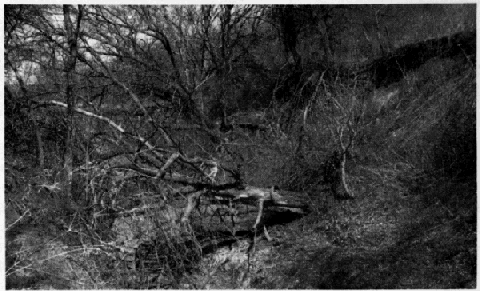
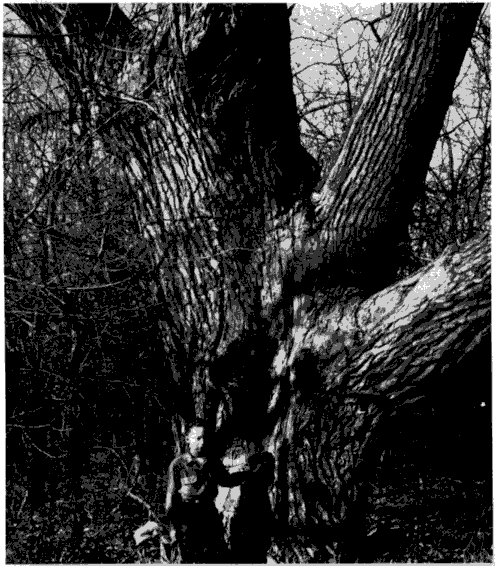
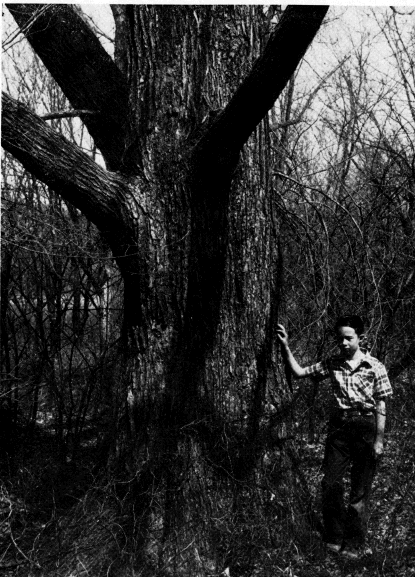
PLATE 8
Large American elm at edge of bottomland field in west part of the Reservation. Photograph taken on April 2, 1955, by H. S. Fitch.
Cornus Drummondi.—This dogwood is the most abundant tree on the area. However, it scarcely reaches the size of a tree. Most mature examples are 1½ to 3½ inches in trunk diameter, and rarely more than twelve feet high. Dogwood grows in greatest abundance on dry rocky slopes where other trees are scarce. In small areas it may be the dominant tree, often closely associated with chinquapin oak and red elm. In parts of the woodland where there are larger trees, dogwood may form an understory, its development depending largely on the amount of light passing through the upper leaf canopy. Where the canopy is dense and nearly continuous, dogwood tends to be eliminated by shading. In some situations where forest has recently closed in, most of the dogwoods are dead or dying. Especially on formerly cut-over north slopes, where oak and hickory have sprung up in a dense stand 20 feet high, with a thick canopy, most of the dogwoods have been eliminated.
On the remaining hillside prairie near the northwest corner of the Reservation, dogwood is the most prominent of the trees and shrubs encroaching onto the area since it has been protected from fire—a period of approximately 20 years. There are dense thickets of dogwood along the borders of the prairie and the woodland edge.
The white-eyed vireo and Bell vireo both forage and nest in thickets of dogwood and other shrubs.
Fraxinus americana.—White ash is localized on the Reservation and most of the mature trees are within an area of perhaps three acres on a steep slope of northwest exposure. Several of the largest trees, well over a foot in trunk diameter, grow at the lower limestone outcrop. Ash is most abundant at this level and at the terrace just below it. On the one slope where it is concentrated, ash is one of the most common trees, growing in association with American elm, chestnut oak, black oak, and shagbark hickory. This area is one of the most mesic on the Reservation. The soil is usually damp, with thick leaf litter and rich humus. In hilltop fields, formerly cultivated or pastured, saplings of white ash are among the most prominent invaders.
The leaves of this tree and especially its saplings, are favorite foraging places for the tree frog. The groves of this tree provide favorable habitat for the opossum, short-tailed shrew, gray squirrel, and white-footed mouse. Birds that frequent the same habitat include the black-capped chickadee, tufted titmouse, blue jay, rose-breasted grosbeak (Pheucticus ludovicianus), yellow-billed cuckoo, red-eyed vireo, gnatcatcher, hairy woodpecker, Kentucky warbler, and crested flycatcher (Myiarchus crinitus).
Summary and Conclusions
The University of Kansas Natural History Reservation, in the northeastern corner of Douglas County, Kansas, is situated in an area that originally supported two types of climax vegetation, tall grass prairie, and hardwood forest. These associations were distinct and sharply defined. The present distribution of the different species of trees on the area, supplemented by the data from snails, indicates the approximate distribution of the two original climaxes. The principal climax trees of the original forest were mossy-cup oak (mainly in bottomlands), black walnut, shagbark hickory, hackberry, red oak, black oak (mainly on hillsides and hilltop edges), chestnut oak (mainly on rocky upper slopes). Subclimax trees characteristic of marginal situations include: American elm, red elm, white ash, honey locust, osage orange, coffee-tree, red haw, dogwood, redbud, cherry, wild plum and crab-apple. Others characteristic of hydroseral situations include sycamore, willow (of four species), and cottonwood.
In the Kansas River flood plain and small tributary valleys, rich mesophytic forest of predominantly oak-hickory type was present. In somewhat stunted form, and with partial replacement of its species by those of more xeric habit, it extended up onto hillsides sloping north, east or west, and onto the adjacent hilltop edges. Slopes having poor shallow soil and exposures mainly to the south supported chiefly tall grass prairie, but also had compact clumps of blackjack oak and post oak, usually more or less isolated from other parts of the woodland. Hilltops were mostly treeless (except near their edges) and supported a tall-grass prairie vegetation. Shrubs and various kinds of small trees must have been a much less conspicuous part of the woodland flora than they are at present, and occurred in small ravines where shelter was inadequate for the larger forest trees, and also along the extensive line of contact between forest and open land.
One of the earliest changes was the destruction of the bottomland forest. With the rapid settlement of the region in the sixties and seventies, lumber was in demand and the supply was limited. The cleared land was productive as pasture. Heavy grazing combined with drought, gradually altered the original tall grass prairie; the bluestems and other perennial grasses were replaced by the introduced blue grass and by various weedy forbs. Prolonged protection from fire permitted encroachment of trees and shrubs into situations where they had not grown previously. Heavy grazing however, tended to hold in check the spread of the woody vegetation.
When the bottomlands had been cut over, lumbering operations were extended onto those hillsides where the better stands of trees were located. The cutting of large, mature oaks, walnuts, and hickories opened up the woodland and permitted large scale encroachment by subclimax species. American elm, especially, sprang up in thickets. Ash, honey locust, cherry, red haw, crab-apple, dogwood, and the introduced osage orange, thrived and spread in the situations to which they were especially adapted. These species largely replaced the original climax. Some of the trees cut, the oaks, sycamores, and hickories, usually produced fast-growing stump sprouts and competed vigorously with the invaders. At each successive cutting, however, the climax species lost ground. American elm, being tremendously prolific of seed, and only a little less tolerant of shading than its climax competitors, soon became the dominant tree of the woodlands.
Literature Cited
Braun, E. L.
1950. Deciduous forests of eastern North America. The Blakiston Co., Philadelphia, xiv + 595 pp.
Fernald, M. L.
1950. Gray's manual of botany, 8th edition. The American Book Co.,N. Y., lxiv + 1632 pp.
Fitch, H. S.
1952. The University of Kansas Natural History Reservation. Univ. Kansas Mus. Nat. Hist. Misc. Publ. no. 4: 1-38.
Fitch, H. S. and D. H. Lokke
1956. The molluscan record of succession on the University of Kansas Natural History Reservation. Trans. Kans. Acad. Sci. 59(4).
Flora, S. D.
1948. Climate of Kansas. Rept. Kansas State Board Agric. 67, no. 285, pp. xii + 320.
Leonard, A. B. and C. R. Goble
1952. Mollusca of the University of Kansas Natural History Reservation. Univ. Kansas Sci. Bull. 34: 1013-1053, 2 pls.
Parks, G. S.
1854. "The Tourist" [Column]. The Kansas Herald of Freedom, 1 (no. 1) Wakarusa, Kansas Terr., October 21, 1854.
Robinson, [Mrs.] S. T. D.
1899. Kansas; its interior and exterior life including a full view of its settlement, political history, social life, climate, soil, productions, scenery, etc. Journal Publishing Co., Lawrence, Kansas (10th ed.) xi + 438 pp.
Taft, R.
1950. The great sandy desert. Trans. Kansas Acad. Sci., 53: 441-442.
Ward, [Mrs.] A. M.
MS. As I knew them—early settlers of Grant Township—Douglas Co., Kansas. Univ. Kansas Library, 26 pp.
Transmitted April 20,1956.