Front matter
Reading edition
Note: Images of the original pages are available through Internet Archive. See https://archive.org/details/footprintsofjesu00thom
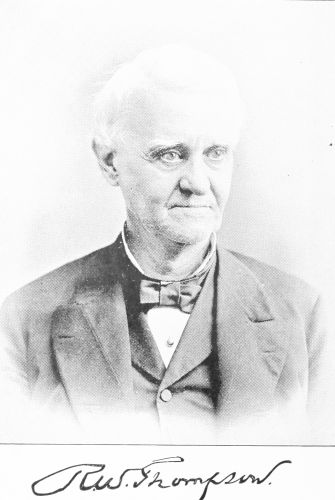
R. W. Thompson.
THE
Footprints of the Jesuits.
BY
R. W. THOMPSON,
Ex-Secretary of the Navy, and Author of "The Papacy and the Civil Power."
"It was very difficult, not to say impossible, that the Church could recover a firm or durable peace so long as the said society existed."—Pope Clement XIV.
"The Jesuits, by their very calling, by the very essence of their institution, are bound to seek, by every means, right or wrong, the destruction of Protestantism. This is the condition of their existence, the duty they must fulfill, or cease to be Jesuits."—Nicolini, of Rome.
CINCINNATI: CRANSTON & CURTS.
NEW YORK: HUNT & EATON.
1894.
COPYRIGHT
BY CRANSTON & CURTS,
1894.
PREFACE.
The civil institutions of the United States could not have been formed without the separation of Church and State, and could not continue to exist if they were again united. Christianity could not maintain its primitive purity if politics and religious faith were mingled together; nor could the State preserve its capacity to provide for the general welfare if subjected to the dominion of ecclesiastical authority. Our success as a nation is mainly attributable to the fact that these sentiments are deeply imbedded in the American mind.
A party pledged to restore to the pope the temporal power which the Italian people have taken away, must necessarily be politico-religious in character, because it proposes to interfere with the temporal affairs of one of the European nations. And if the attempt to do this is justified upon the ground that such restoration involves religious duty, any one can see that the obligation is the same in the United States as in Italy, for the laws of God do not shift to suit the exigencies of human affairs.
In the times before the Reformation the temporal affairs of Governments were required to conform to the commands of the ecclesiastical authority—that is, the pope—and it was held to be a necessary and essential part of religion that this union should be continued, no matter what might be the degree of popular ignorance and humiliation. The founders of our Government started out upon a different theory, believing it to be their duty to separate "the things of God" from "the things of Cæsar," so that each could reach perfection in its own distinct sphere. Therefore, it is clear that a politico-religious party in this country, pledged to unite Church and State in Italy, against the expressed will of the Italian people, not only must oppose one of the fundamental principles of our Government, but disturb the public peace.
To my mind it is also clear that a nation acts politically, and not religiously, when it decides upon the structure of its temporal Government—that is, whether its affairs shall be managed by an absolute or elective monarch, or by machinery provided by a written constitution. I have, therefore, refrained from the discussion or criticism of religious belief—as it is understood in the American sense—any further than it is made the pretext for the reversal of this opinion, so generally prevalent in this country. It would be an evil day for the people of the United States if they should be persuaded to permit any power whatsoever, whether temporal or spiritual, at home or abroad, to share with them any portion of their political authority, or to dictate, in any degree, the measures of their civil polity.
In reminding those into whose hands this volume may chance to fall, of their obligations of citizenship under our popular form of government, I have found it absolutely necessary to portray the character of the Jesuits, but for whom, in my opinion, there would be but little to disturb us. This society has nothing in common with American ideas or principles. It represents monarchism in its most despotic and obnoxious form, by requiring each of its members to impersonate the most abject servility, and to accept this humiliation as an absolutely necessary part of religious faith. It has had a history unlike that of any other society in the world. In pointing out its origin and tracing its footprints among the nations, I have relied upon the most undoubted authority, much of which is furnished by Jesuit authors. A careful examination of the evidence will leave the mind of the reader in no doubt as to the odium which rested upon the society from the beginning, as well as the manner in which it has disturbed the quiet of the nations, defied the popes themselves when adverse to them, and disregarded the interest, welfare, and harmony of the Church it professed to serve, when required by its general.
I have deemed it important to trace out some of the leading events which have transpired under the pontificates of Gregory XVI, Pius IX, and Leo XIII, up to the present time. In this way only is it possible to understand the full meaning of the revolution which led to Italian unity and the overthrow of the temporal power of the pope by Roman Catholic populations, and what is involved in the demand for its restoration. In doing this I have considered only such matters as are politico-religious, in the sense common among the people of the United States, and which can not be made a part of religious faith without doing violence to the recognized spirit of our civil institutions. Thus I have avoided any conflict with those who prefer the Roman Catholic to the Protestant form of religious belief, for the express reason that I have neither the purpose nor desire to question their right to do so. It seems to me that the constitutional guarantee which protects this right ought to be satisfactory to all, and can not be disturbed without imperiling our Government. Therefore, all I desire will be accomplished if I shall succeed in convincing thoughtful Roman Catholics that it will be far better for all of us if they shall decline to accept the politico-religious teachings of the Jesuits as a part of their religious faith, and content themselves without interference with the political affairs of their Christian brethren in Italy. They may maintain fidelity to the Government as patriotically as professed Protestants, without abating their devotion to the spiritual doctrines which prevailed in their Church before the fall of the Roman Empire enabled the popes to place the crown of temporal royalty upon their heads. To this end I would, if permitted, appeal to that portion of our population in all sincerity, and invoke the exercise of their intelligence no less than their patriotism. And if any of them shall peruse this volume, and carefully consider its contents, they will see that what I have written centers in the hope that the Protestants and Roman Catholics of the United States shall live together in the concord of Christian fellowship, emulating each other in those things that shall tend most to promote their mutual happiness, and preserve for their common posterity the civil and religious liberty guaranteed by our Constitution and laws.
There are abundant evidences to show that the Jesuits have adopted a loose code of morality, upon which they have built up a system of "moral theology" as irreconcilable with the true teachings of the Roman Catholic religion as they are with the well-established doctrines of all Protestant Christians. But I have refrained from any discussion of these, not only because this is sufficiently done by Pascal and Bert, in France, and by numerous American authors, but because my main object is to show that the triumph of the Jesuits in this country would bring about such a condition of things as would imperil our civil institutions. They teach as religious doctrines necessary to salvation the following: That the State must be reunited with the Church, and be required to obey its spiritual commands in the enactment of laws; that the Roman Catholic religion shall be established by law as the only true religion, and every other form of religious belief treated and punished as heresy; that, along with this destruction of the freedom of religious belief, there must be corresponding restrictions placed upon the liberty of speech and of the press; that the Roman Catholic Church shall be recognized as an organization exempt from obedience to all our laws relating to the ownership and management of real property; that the clergy of that Church shall be also exempt from obedience to the laws as other citizens, and shall obey only such as the pope may prescribe; and that our common-school system of education must be absolutely and entirely destroyed. If, in these things, the Jesuits should obtain success, our Government would necessarily come to an end; and what this volume contains has been written alone with the view of making this question plain and palpable to the ordinary reader. I have written from the standpoint of an American citizen, thoroughly impressed with the belief that this is the most prosperous country in the world, and not from that of a theologian. About the duties and obligations of the former to the Government, I assume to have learned something from both instinct and education; but about the metaphysical subtleties of the theologians, I do not trouble myself.
I know how difficult it is to escape the accusation of a persecuting spirit from those who, like the Jesuits, allow nothing for honest differences of opinion. This, however, ought not to be permitted to interfere with the plain and obvious duty of defending our civil institutions from any assault made upon them, no matter by whom, or in whose name, the assailing forces shall be marshaled. With the consciousness, therefore, that this volume may subject me to the imputation of uncharitableness from some upon whom I would inflict no injury in return, I have expressed myself with candor and fairness, and have written nothing in malice.
R.W.T.
Terre Haute, 1894.
CONTENTS.
CHAPTER I.
INTRODUCTORY.
Abolition of the Pope's Temporal Power—The Pope commands its Restoration—Organization for that Purpose—Duties of American Citizens, 15
CHAPTER II.
IGNATIUS LOYOLA, FOUNDER OF THE ORDER.
Ignatius Loyola, the Founder of the Jesuit Society—His Original Purpose to reform the Church, and to establish his Society in Palestine—Having failed, he was compelled to have it approved by the Pope—This was done by Paul III, after the Constitution was amended, 32
CHAPTER III.
THE CONSTITUTION OF THE SOCIETY.
(The Constitution of the Jesuits) Entirely Monarchical—Substitutes the General for God upon Earth—Sin committed with out Offense when the General commands it—The General Independent of the Pope—The Society obey him alone, 49
CHAPTER IV.
GOVERNMENT OF THE SOCIETY.
Loyola, a "Soldier of Fortune"—His Monarchical Government—His Unpopularity among the Dominican Monks—His Plottings against the Franciscans at Saragossa and Condemnation by the Church Authorities—His Success Accomplished only by aid of Monarchical Power, 66
CHAPTER V.
STRUGGLES AND OPPOSITION.
Conduct of the Jesuits at Toledo in Spain—Opposition of the Church Authorities to them—They again get Protection from Royal Power—The Effort to get into France—Opposition of the French People to them—Long Continued Struggle, 84
CHAPTER VI.
THE STRUGGLE FOR FRANCE.
Continued Struggle of the Jesuits to get into France—Resisted by the Parliament—Their Intrigues and Reliance upon Royal Power—Council at Poissy—Attended by the Jesuit General, who suppressed Discussion with Protestants—Their Reliance upon Catharine de Medicis—Her Aid in the St. Bartholomew Massacre, 99
CHAPTER VII.
THE SOCIETY ENTERS GERMANY.
Jesuit Efforts to get into Germany—Less Difficulty than in France—When they reached there, Protestants and Roman Catholics living in Peace—Jesuit German College at Rome—Teaching Treason to German Youth as a Religious Duty, 114
CHAPTER VIII.
THE JESUITS IN ENGLAND.
Plottings of the Jesuits in England—Their Opposition to Religious Toleration—Opposition to Elizabeth by the Pope, and her Trial at Rome—Papal Decree dethroning her, and releasing the English People from their Allegiance to her, 130
CHAPTER IX.
JESUIT INFLUENCE IN INDIA.
Jesuit Mission to India—Imposition of Xavier upon the Monks at Goa—His Pretended Miracles, 152
CHAPTER X.
IN PARAGUAY.
The Jesuits in Paraguay—Their Government of the Indians—Their Resistance to the Authority of the Spanish and the Portuguese Governments, 168
CHAPTER XI.
THE PORTUGUESE AND THE JESUITS.
Conflict between the Portuguese and the Jesuits—Charges against them laid before the Pope, Benedict XIV—Investigation ordered by him, 183
CHAPTER XII.
IDOLATROUS USAGES INTRODUCED.
Jesuits become Idolaters by the Worship of Brahma in India, and of Confucius in China, 196
CHAPTER XIII.
PAPAL SUPPRESSION OF THE SOCIETY.
Clement XIII was compelled by Public Opinion to Promise the Suppression of the Jesuits, but was murdered—They were suppressed by Clement XIV, who was poisoned—His Decree of Suppression, 217
CHAPTER XIV.
RE-ESTABLISHMENT.
The Jesuits evade the Decree of the Pope suppressing them, and seek Shelter in Russia and Prussia—They were re-established by Pius VII, to aid the "Allied Powers" to perpetuate Monarchism, 236
CHAPTER XV.
RE-ENTERING SPAIN.
The Jesuits re-enter Spain—They support Ferdinand VII in trampling upon the Constitution—They arouse a Revolutionary Spirit among the People, 257
CHAPTER XVI.
REVOLUTIONS IN SOUTHERN EUROPE.
Retrogressive Policy of Gregory XVI—He holds the Italians in Subjection by the Austrian Army—Is succeeded by Pius IX during the Revolution, 282
CHAPTER XVII.
TEMPORAL POWER OF THE POPE OVERTHROWN.
Pius IX unable to quiet the Revolution—He drives the Jesuits out of Italy—Italy unites with Sardinia—Italian Independence established, and the Temporal Power of the Pope abolished—Terms of Conciliation proposed by Victor Emmanuel, and rejected by the Pope—The New Government anathematized, 306
CHAPTER XVIII.
PAPAL DEMANDS.
Distinction between the Church and the Papacy—Allocution of Pius IX—Demand for the Restoration of the Temporal Power—An Act of Infallibility—Leo XIII elected—Educated by the Jesuits—Refused to be reconciled to Modern Progress—His Encyclical—Demands Temporal Power—Prefers the Middle Ages—His Jesuit Training, 329
CHAPTER XIX.
PRESENT ATTITUDE OF THE PAPACY.
The Faithful in the United States required to organize to restore the Temporal Power—That Question an International One—Its Opposition to the Policy of this Country—Opinion of Leo XIII upon Freedom of the Press—He condemns Separation of Church and State—Politico-Religious Questions, 347
CHAPTER XX.
THE CHURCH AND THE STATE.
Doctrines maintained by Leo XIII before he became Pope—The Union of Church and State—Absolute Obedience to the Church, 366
CHAPTER XXI.
THE CHURCH SUPREME.
The Church the Mistress of all Nations—Its Right to command Universal Obedience—The School Question—Mgr. Satolli, the Vice-Pope—His Theory as dictated by the Pope—Our Common Schools Heretical—Must be superseded by Parochial Schools, where Religion is taught, 388
CHAPTER XXII.
JESUITICAL TEACHINGS.
Doctrines of Thomas Aquinas—Also those of the Jesuits—De jure and de facto Governments—The United States the Latter, and may be resisted—Persistence in these Teachings, 407
CHAPTER XXIII. PAPAL INFALLIBILITY.
The Decree of Infallibility—Its Passage by the Vatican Council—Its Definition and Meaning—Extends the Jurisdiction of the Pope—Gives him Authority over Politico-Religious Questions throughout the World,427
CHAPTER XXIV.
THE CHURCH AND LITERATURE.
Papal Teachings by Means of Literature—Arraignment of American Institutions—Attack upon the Liberties of the People—Free Institutions are Heretical—Religion requires their Overthrow, 443
CHAPTER XXV.
INTRIGUES AND INTERPRETATIONS.
The Temporal Power Hurtful to the Church—Has led to its Disintegration—Maintained by Oppressions—Designed to check the Reformation—Infallibility Essential to it—Jesuit Influence in the Council of Trent—Perversions of Scripture—Infallibility not decreed by the Council of Trent, 463
CHAPTER XXVI.
CONCLUSION.
The Vatican Council—Effect of the Decree of Infallibility—The Bull Unam Sanctam of Boniface VIII—Absolute Dominion over Peoples and Nations—Necessity of Guarding against it in the United States—Importance of Common Schools—The Duty of keeping them free from Jesuit Control, 479
Footprints of the Jesuits.
CHAPTER I.
INTRODUCTORY.
The American people have imbibed, from association, the spirit of their civil institutions, and are ready at all times to repel any direct assault upon them. They are, however, so actively engaged in their various pursuits, that multitudes of them fail to realize the necessity of inquiring whether the conflict between opposing principles of government which resulted in our national independence, has or has not ended—whether, in other words, the victory the founders of the Republic won over monarchism, is or is not final.
Those who won this victory intended to provide against this seeming want of vigilance by means of some system of education, which should assimilate the principles and opinions of the people, as a perpetual bulwark against aggression. This would have been accomplished long ago if the paternal counsels of Presidents Washington and Madison had been heeded as they deserved to be,—that we should educate "our youth in the science of government,"[1] under the auspices and protection of national authority. Instead of this, we have considered ourselves sufficiently shielded by our system of public-school education, under State control, and have mainly relied upon this to fit our children for citizenship and self-government. Hitherto, we have not been seriously disturbed by the apprehension that it would result in failure, and for that reason it has been maintained with great popular unanimity. It is now, however, assailed with violence, and, manifestly, with the purpose of destroying it entirely. Hence, we are all required, by obligations we can not rightfully evade, to rest long enough from our active avocations to discover, if possible, why this is—what motives impel the assailants—and whether or no they desire to substitute other principles of government for ours, by turning us back upon a course we have solemnly repudiated.
In addition to other works of like character but less ability, there is one, extensively circulated in this country, from the pen of a writer conspicuous for his learning and ability. The author asserts without disguise that what he calls "Catholicity"—that is, what the Roman popes taught when they were temporal monarchs—has been more beneficial to the world and more civilizing in its influences upon mankind than Protestantism, not alone in a social, but in a political, religious, and literary point of view. His argument proceeds from the Jesuit standpoint, and may be summed up in a single sentence,—that Protestantism has placed mankind in a far worse condition than they were when dominated over by papal kings.[2]
This work was intended to counteract the effect produced by the writings of Guizot, the great French historian, who maintained, by eloquent and matchless reasoning, that mankind had been improved, in every point of view, by the influences of Protestantism. Accordingly, it was translated from Spanish, in which language it was originally written, into French and German, and extensively circulated in France and Germany. It soon acquired the reputation among the Jesuits of being unanswerable, and on that account was regarded, in the conflict between progress and retrogression, like heavy ordnance in battle—a suitable weapon with which to attack Protestantism and its institutions in the seat of its greatest strength. Therefore it was translated into the English language, and printed by two publishing-houses in the United States, for circulation among the American people. An American preface is attached, wherein these propositions are affirmed: First, that Protestantism compels its votaries to infidelity, by its variations of belief; second, that civilization was not only commenced but was prospering under "Catholicity," when it was retarded by Protestantism, which is unfavorable and injurious to it; and, third, that the principles of Protestantism are incompatible with the happiness of mankind and "unfavorable to civil liberty."
This preface—which manifestly bears the Jesuit impress—was intended to notify American readers, beforehand, that the three foregoing propositions are maintained in the body of the work, and to prepare their minds for the acceptance of them. Its reprint and circulation in the United States could have had no other object than to inculcate the belief that what the people of this country have supposed to be the advantages they have derived from Protestant institutions are, in fact, absolutely injurious to them, and that their condition would be improved by the revival of such as existed during the Middle Ages, before the Reformation.
By giving prominence to political matters, and discussing them from the Jesuit point of view, this author presents a plain, distinct, and practical issue between progress and retrogression. He intends to make it as plain to the minds of his readers as it seems to be to his own, that Governments constructed upon the monarchical plan confer more happiness and prosperity upon society than those upon the Protestant plan of self-government. Evidently it was with the hope of disseminating this belief that this work has been reprinted and circulated in the United States so extensively that it is believed to have become a standard authority among the Jesuit enemies of Protestantism. If it does nothing else, however, it apprises our Protestant population that a powerful influence exists among them which is uncompromisingly hostile to the principles which underlie the whole structure of their Government. And, being thus apprised, their indifference would be little less than criminal; because their adroit aggressors would construe it into fear of possible consequences, or assign it to their inability to combat successfully the arguments supplied by this work, whose author is an acknowledged monarchist.
The differences between popular and monarchical governments are well known, and appear at every point of comparison which has arisen during the course of events since the Reformation of the sixteenth century. The former have achieved their completest triumphs where Protestantism prevails, and in its presence the latter have been compelled either entirely to surrender their pretensions, or to abate their demands for absolutism. Until the Reformation became an accomplished fact, monarchism was maintained by uniting Church and State, and employing their joint authority to coerce obedience from the multitude. The dominion thus acquired condemned self-government by the people as both heresy and treason, punishable at the pleasure of those who held the reins of authority in their hands. It took many years of conflict to change this condition of affairs; and when the people of the United States were, in the course of events, placed in a condition to choose between this coercive system and that which was the natural outgrowth of Protestantism, and to construct a Government for themselves, their wisdom was sufficient to assure them that any plan of government they adopted would result in failure, unless they distinguished between their politics and their religion by separating the Church from the State, and by so framing their civil institutions as to reserve to themselves alone the entire sovereignty over them. If either of these essential prerequisites had been omitted, all exertions to better and improve their condition would have resulted in failure, as all readers of history know. Instead of failure, however, they created a Government which has survived the vicissitudes of more than a hundred years, is now supplying protection to more than sixty millions of people, and has reached a most commanding position among the leading nations; if, indeed, its influence over the happiness and prosperity of mankind does not surpass that of any of them. Of this we may be assured, that the measure of its success has been such as to incite among other peoples the desire to imitate its example; and that the conflicts of opinion which now agitate the world give reasonable promise that the popular right of self-government may, in less than another century of time, be universally recognized. To this end the American people are obliged to contribute by warding off every blow aimed at their institutions by either domestic or alien adversaries, especially when these blows are aimed, as some of them are, at the fundamental principles of their government.
The influence of our example finds a striking illustration in the revolution in Italy in 1870, which abolished the temporal power, or kingship, of the pope, separated the State from the Church, and established a constitutional form of government in place of the absolute monarchism which had prevailed, almost uninterruptedly, for many centuries. The fires of this revolution had been burning for a long time, kindled originally by oppressions, which had been so magnified that the people could endure them no longer. Their culminating point was the passage of the Conciliar Decree, called a "Dogmatic Constitution," whereby it was declared that the pope was infallible, and could not err in matters pertaining to faith or morals; that is, within such spheres of governmental, social, and individual duties and obligations as the pope alone, for the time being, should decide to be included in his spiritual and pontifical jurisdiction. This act was considered the consummation of the "Jesuit plan," at which the Italian people had been so incensed but a short time before, that Pope Pius IX had been compelled to expel the members of that odious society from Rome. The consequence was that the fires which popular indignation had kindled grew hotter, and it became impossible to extinguish them except by assuring complete success to the revolution. Therefore, the ink with which this decree of papal infallibility was written was scarcely dry before the Italian people, with extraordinary unanimity, determined to reject it, not merely because it was the introduction of a new principle of faith hitherto unrecognized, but because they could easily see that it would place them, and their children after them, under Jesuit dominion and dictation. They realized that its acceptance would involve them in the obligation to submit to the absolute temporal rule of the pope, in whose selection they had no voice, and to those whom he should think proper to put over them, whether fit or unfit, and thus put an end to all popular demands for the right of political self-government. It involved no question of religious faith, as the faith had been handed down to them by their fathers; nothing whatsoever which involved their duty to God, otherwise than as presumptuous men, to answer their own selfish ends, were striving to convert the pope into a God upon earth, and themselves into his plenipotentiaries. Influenced solely by this conviction, and stimulated by the success the people of the United States had won, they merely abolished the temporal power of the pope, and created a constitutional form of civil government, which places satisfactory limitations upon the authority of their king, and establishes representative political institutions, which provide that their voice shall be heard in the enactment of public laws. In this they have taken a long stride in the direction of government "of the people, for the people, and by the people." They have cast off political absolutism—which the Jesuits commend to us as "Catholicity"—and have assumed the station and dignity of an independent people. They have converted a priest-ridden oligarchy into a nation. On this account, and this alone, they have made themselves the special objects of Jesuit malevolence, for the simple reason that the monarchical society of Jesuits has never, since its beginning, relented in its vindictive opposition to every form of civil government which recognizes the people as the source of political power. By the most fundamental principles of its organization it is forbidden to sympathize with the sentiment of personal independence, or to allow its members to acquire the dignity of manhood necessary for participation in the affairs of government.
In the face of the fact that the Italian people have not changed the religious convictions they have maintained for hundreds of years with steadfast fidelity, and in the face also of the successes of Protestantism as universally recognized, the Jesuits employ the extorted decree of papal infallibility as the basis of an argument to prove that the pope is divinely endowed with such spiritual sovereignty over nations and peoples as entitles him to prescribe, at his own personal will and pleasure, such laws and regulations, concerning both faith and morals, as are necessary for the government of society and the conduct of individuals throughout the world. Within the circle of this extraordinary and unlimited jurisdiction, they make no distinction between spirituals and temporals,—never failing to make the power over the former sufficiently comprehensive to embrace the latter, accordingly as the pope himself shall decide. Hence they infer that this papal jurisdiction is not subject to any other limitation than such as he shall establish, and that it may, consequently, be rightfully enlarged so as to exact submission from all, and set aside all requirements in conflict with it. And the result they reach—as logically following this premise—is, that the refusal of obedience to the pope, within this comprehensive jurisdiction, violates the law of God, and is heresy. Therefore, as the Jesuits believe that the separation of Church and State by the Italian people is heresy, so they are required also to believe that all civil institutions which have grown out of that separation—like those of the United States—not only have the curse of God resting upon them, but that they are the divinely chosen messengers of heaven to bring them within this enormous circle of papal dominion.
In assigning these powers to the pope alone, they entirely ignore everything associated with the original and primitive organization of the Christian Church, and especially the important fact that it was not until the beginning of the sixth century that the bishop of Rome succeeded in acquiring the distinctive title of pope.[3] Before that time they had exercised at Rome only such powers as metropolitan bishops elsewhere—each of them having been called papa or pope. When the Roman bishop acquired by usurpation the exclusive title of the pope, the other metropolitan bishops were reduced to a condition of inferiority and subordination, and he then required only the temporal power to assure to him the power and jurisdiction the Jesuits now claim for him. It took several hundred years of conflict within the Churches and with the civil powers to accomplish this, and was only accomplished at last by subduing impotent kings, and so uniting the power of the Church with that of the State as to hold ignorant populations in subjugation. And now that the Italians, after submitting to this humiliation for more than a thousand years, and finding all the sources of their prosperity withered up, have abolished and destroyed this illicit and usurped temporal power, and taken into their own hands the administration of their own temporal affairs—obeying the example set them by the people of the United States—the Jesuits employ all their energies to reverse this popular verdict, and plunge them again into the dreary chasm from which they have escaped.
The Jesuits are subtle disputants. When they talk about the papacy reconciling itself to any form of government, they reserve to themselves the meaning that it does not interfere—either in monarchies or republics—with such local and limited affairs as pertain to the common and ordinary interests of society in the management of counties, townships, cities, and municipalities. These may be conducted without complaint, under one form of government as well as another, and are held to be such temporal affairs as the pope may exclude from his spiritual jurisdiction without any violation of the divine law. But when measures of public policy pass beyond these local and limited spheres, and involve matters which the pope shall decide to have relation to the Church, to the papacy, to faith, or to morals, his jurisdiction attaches, and, according to the Jesuits, he possesses the divine right to regulate and direct them. So that, when civil institutions are constructed—no matter in what form—by which Church and State are separated and the freedom of religious belief is guaranteed, as they are by the Constitution of the United States, they are brought within this unlimited jurisdiction of the pope, and he may pass such sentence of condemnation upon them as he shall deem necessary to maintain his own infallibility, as well as his spiritual and temporal power. If, in the execution of this extraordinary spiritual power, the pope and the Jesuit general at Rome shall unite in a decree that all such institutions shall be opposed, resisted, and overthrown, the Jesuit militia are always ready to pay obedience, because it is one of the fundamental maxims of their society, that when thus commanded, with reference to anything concerning the Church, the papacy, faith, or morals, disobedience is visited with divine displeasure.
Before he entered Rome with his victorious troops, and with the hope of pacifying the pope, Victor Emmanuel, the liberator of the Italian people, addressed an affectionate letter to Pope Pius IX, calling him "the chief of Catholicity," and expressing the hope and intention that nothing should be done inconsistent "with the inviolability of the sovereign pontiff and of his spiritual authority, and with the independence of the Holy See." But this kindly spirit was not reciprocated by the irascible pope, who excitedly rejected the overture of pacification. Thereupon the victorious troops entered the city of Rome, and terminated the temporal dominion of the pope, which had rested upon the Italian people with crushing weight for nearly fourteen hundred years. Then the pope, having lost his royal diadem—nothing more—and with the view of prescribing it as an article of faith that it should be recovered again, caused his Cardinal Secretary of State to notify Victor Emmanuel to that effect. This he did as follows:
"I have the command from his holiness to declare, and the undersigned does hereby declare in the august name of his holiness, that such usurpation is devoid of all effect, is null and invalid, and that it can never convey any prejudice to the indisputable and lawful rights of dominion and of possession, whether of the holy father himself, or of his successors in perpetuity; and, although the exercise of these rights may be forcibly prevented and hindered, yet his holiness both knows his rights, intends to conserve them intact, and re-enter at the proper time into their actual possession."
These are expressive words, and every Jesuit interprets them to mean that, having the direct approval of an infallible pope, they impose the religious obligation of obedience upon all the members of their society, and that it will be offensive to God if they shall cease their struggle for the restoration of the temporal power before it is accomplished. Therefore they so enlarge the spiritual jurisdiction and authority of the pope as to make the question of the restoration of his temporal power an international one, so that he shall have the divine right to require all professing Christians to obey him in all matters relating to that question, no matter under what Government, or in what part of the world they may live. The refusal of this obedience is held by them to be heresy. Consequently, when the Roman Catholic people of Italy abolished the temporal power of the pope, remaining in all other respects faithful to the historic and traditional teachings of the Church, the Jesuits made an organized appeal to all the Roman Catholics throughout the world, to unite themselves into a politico-religious party, in order to restore the temporal power, and thereby to teach their Christian brethren in Italy that they have no right to govern themselves by laws of their own making, and that by irreligiously asserting that right, in imitation of the heretical people of the United States, they have themselves become heretics. In point of fact, the Jesuit appeal is made to populations entirely foreign to the people of Italy, inviting these foreign populations to subvert the civil institutions the latter have established for themselves, by forcibly substituting the pope as an arbitrary and irresponsible monarch, without any constitutional check, for a constitutional king whose powers have been placed under satisfactory restraint. The pope himself, when he realized that he was about to lose his crown, talked about the two hundred millions of Roman Catholics scattered throughout the world, who were to be excited to this conflict with the Italian people; and the Jesuits consider themselves specially assigned to the duty of massing the forces of this great papal army, and directing its movements. In that capacity, and with that secret purpose, they have distributed themselves throughout the populous parts of the United States, crowding into our cities, and employing their tireless energies in the work of educating a considerable portion of our people, both old and young, in the religious belief that it is their Christian duty to snatch the crown from the head of the constitutional king of Italy, where those of their own religious faith have placed it, and restore it to the pope, from whose head they removed it by employing the same sovereign power which the people of the United States invoked when they laid the foundations of their own institutions.
It is a serious thing, too serious to be disregarded, to know that, under protection of the liberalism of our laws, there are scattered among our people those who are striving to entangle us in alliances which can have no other end than to disturb the quiet of the nation, and endanger the public welfare. The sacrifices made by the American people in behalf of the right of self-government entitle them to be left to themselves in the undisturbed enjoyment of that right. They have shown themselves wise enough to understand the causes which led to the decay of former nations, and discreet enough to avoid them. Among these causes the union of Church and State has always been conspicuously prominent; wherefore they found it necessary to put an end to this union, by leaving the Church independent in the spiritual, and the State equally so in the temporal sphere. This separation constitutes a great and important political fact, wholly distinct from any of the forms or principles of religious belief, and practically embodies the American idea—perpetuated in Protestantism—that the right to perfect and untrammeled freedom of conscience is not derived by concession from either spiritual or temporal monarchs, but from the inalienable laws of nature. In view of the past experience of mankind, it seemed clear to them that the best form of government is that which guarantees this natural right to each individual, to be enjoyed as a political right, without any restraint whatsoever. In no other way can free popular government ever become possible. They believed also that mankind had been held long enough in inferiority and bondage by the combined influence of Church and State despotism, and that inasmuch as they had been providentially placed in possession of a new and undeveloped continent, it was not only wise but best for them and their posterity that, in establishing their Government, they should make the further union of Church and State impossible, unless some alien power should be strong enough to overthrow their institutions, or they should fall into decay by means of the corruptions engendered by this fatal union, as other Governments had fallen. It was an experiment, hitherto unsuccessful, and was consequently observed by multitudes throughout the world with intense solicitude. If there were any who considered the experiment injudicious, and likely to prove a failure, but little time elapsed before their doubts were dissipated by the results accomplished—results which all who are rightfully entitled to American citizenship, now accept as a precious inheritance from the founders of the Republic. Our institutions are no longer an experiment; they have become actual and accomplished reality. And it is not now the time for us to think of turning back to the bondage of monarchism, as we should indicate the desire to do by denying to the people of Italy the right to imitate our example by separating Church and State, and governing themselves by laws of their own making. They who invite us to this are counselors of evil.
That the Jesuits are not content with the separation of Church and State is a fact too palpable for contradiction. Hence the readiness with which they engage in the organization, in this country, of a politico-religious party pledged to restore the pope's temporal power, notwithstanding such a party is condemned by the spirit of our institutions, and is regarded by the general public as impolitic, inexpedient, and hazardous; and inasmuch as they have chosen to thrust this issue upon us, we are not permitted to become indifferent to it, or shrink from our responsibility of citizenship under a Government entitled to our patriotic allegiance. Such an issue can not be evaded, and must be met with fearlessness and becoming candor. If one is informed that a poisonous viper is coiled up under a pillow upon which he is about to lay his head, he will instinctively strive after the means necessary to escape its fangs. So, when apprised that cunning and adroit adversaries, like the Jesuits, are plotting against cherished and vital principles of our institutions, the obligation to make ourselves familiar with their principles, policy, and history becomes imperative. Being forewarned, we shall have no excuse for not being forearmed.
We must do nothing, either now or hereafter, forbidden by our national character, or by the liberalism we prize so highly. Our Constitution amply protects the rights of free speech, free thought, and a free press, all of which must be held inviolable; but violence is manifestly done to the spirit of patriotism which guarantees this protection when it is demanded of any portion of our population that they shall participate in the work of undoing, in any degree whatsoever, what the founders of the Government considered fundamental. We are prohibited from submitting to anything that shall tend, even by possibility, to subject the people to any sovereignty, either spiritual or temporal, higher than themselves, in such matters as involve their own happiness and welfare. It would be well, consequently, for those who are seeking to accomplish this, to learn that the world is large enough for them and us; that there are other fields wherein better grounds of hope are furnished for re-welding the fragments of shattered monarchies; and that, when they avail themselves of the tolerance of our institutions to assail their foundations, they become intruders into a peaceful and harmonious circle, where, but for them, universal peace and quiet would prevail.
In his conflict with the Italian people for the re-possession of the temporal power, by overthrowing the Constitutional Government they have established, the pope could not find another ally so formidable as the Jesuits, nor one with such implacable hatred of liberalism and popular government. Their society is so united and compact that its ranks can not be broken. They are everywhere the same, moved by a common impulse, under the dictation of their general in Rome. They are the deadly enemies of civil and religious liberty. Nothing that stands in their way can become so sacred as to escape their vengeance. Protestantism has borne no fruits to which they have ever been reconciled. They consider the Reformation which gave birth to it to have been criminal resistance to the only rightful authority upon earth—that which proceeds from Church and State combined. They believe that the condition of mankind during the Middle Ages, staggering under the weight of feudal oppression, was preferable to modern progress and enlightenment; that human happiness would be promoted by the return to that period; that the political right of self-government by the people can not be set up against the higher right of papal and monarchical power; that the progress of the advancing nations is delusive and unsubstantial; and that institutions which guarantee civil and religious freedom, if not arrested by some coercive power strong enough to put an end to them, will lead, through heresy, to social ruin and desolation. If, at the period of the Reformation, this society had not been established for the express purpose of counteracting its influence, a knowledge of the difference between primitive Christianity and the prevailing dogmas might have led to such reforms as would have reconciled Christians to dwell together in peace and concord. But when a dove should have been sent forth bearing the olive-branch of Christian charity, this society sprang from the brain of a disappointed military adventurer, and began at once to scatter the seeds of strife and discord. Almost from the beginning it has been a disturber of the peace of nations, suffering only such as have bestowed patronage upon it to escape its maledictions and its plottings.
The members of this society are numerous and powerful in the United States. They are constantly increasing, mainly by accessions from their drilled and disciplined companions in Europe, but also by conversions of unsuspecting young men, who are seduced by their vain and supercilious pretensions as educators. They are, as they have always been, selfish and vindictive—restless under opposition, and compromising in nothing. They have neither country, nor homes, nor families, nor friendships beyond the limits of their order—none of the affections of the heart which give charm to life and social intercourse—being required to abandon all these and fit themselves for uninquiring obedience to their general, whose commands, whether right or wrong, good or bad, they have solemnly vowed to execute, without the least regard for consequences. Having persistently refused to become reconciled to the forms and methods of Christian civilization which prevail among our Protestant population, they employ all the resources they can command in endeavoring to arrest them. They insist that Church and State shall be united wheresoever they are separate, and that the basis of such union shall be the subordination of the State to the Church. Self-government by the people is held by them to be violative of the divine law, and on that account may rightfully be resisted as heretical, when its overthrow can be assured. They will allow no rights to exist in either States, peoples, or individuals, against what they consider the prerogatives of their society as defined by their general, who, in their estimation, possesses the divine right to enlarge or contract them at his own pleasure. There must be no limitation to the power and independence of the pope, either in the spiritual or temporal domain, except where the interests of their society command otherwise; they must be full, absolute, unquestioned, to the extent defined by himself. His liberty must be such that he may, at his own discretion, curtail the liberties of all others. His spiritual sovereignty must include whatsoever he shall embrace within it. Neither the existence nor the extent of this sovereignty must be brought in question before any human tribunal; but he alone shall define it, together with the character of the obedience he shall exact. And if, in the course of the papal economy, he should ever find it necessary to hold in one hand emblems of harmony and peace, this restless and uncompromising society stands always ready to place the rod of chastisement in the other.
The conflict of opinions, therefore, in which the Protestant people of the United States find themselves engaged is not of their own inviting. They are unwilling parties to it. It had its origin in the spirit of aggression which prevails among those who have stronger sympathy for an alien power than for the right of self-government, and, on account of their peculiar fitness for the work, it will engage every Jesuit tongue and pen in the land. Because of this, a sense of both duty and security demands that the history and character of this skilled and powerful adversary—alien in birth, growth, and sentiment—should be understood; as also the causes which have led to the expulsion of the Jesuits from every country in Europe, the public odium which has rested upon them for many years, their long-continued disturbance of the peace of nations, and the final suppression and abolition of their society by one of the best and most enlightened of the popes. In view of the obligation to preserve our civil institutions as they are, not only for ourselves and our children, but for the multitudes who shall seek shelter under them, we have no right to become either indifferent or inactive in the presence of such assailants, who complacently fling defiance in our faces, and seek to impregnate the free and pure atmosphere of our schools and seminaries of learning with the poison of monarchism. "Against the insidious wiles of foreign influence," said Washington, "the jealousy of a free people ought ever to be constantly awake, since history and experience prove that foreign influence is one of the most baneful foes of republican government."
FOOTNOTES:
CHAPTER II.
IGNATIUS LOYOLA, FOUNDER OF THE ORDER.
It is of little consequence to the general reader what place in history is assigned to Ignatius Loyola, apart from the fact that he was the founder and originator of the society of Jesuits, and lived long enough to stamp upon it the impress of his own personality. He availed himself of that organization to maintain among its members the vain and impious assumption of his equality with God, and in that way obtained such complete mastery over them that, in explanation and justification of their slavish obedience, they represent him as having possessed miraculous powers. They assign to him the performance of more miracles than Christ, and do not hesitate to record that he not only restored the dead to life, but, in one conspicuous case, gave life to a child born dead! The silly stories of this character, told of him in apparent seriousness, can have no other effect than to impose upon and encourage ignorant and superstitious people, and are undoubtedly repeated by his Jesuit biographers for this purpose. They seem never to have realized that the world has grown wiser, and that the period has passed when fictions and myths can be proclaimed as realities.
The life of Loyola was written, soon after his death, by Rabadenira, one of his Jesuit followers, who had known him intimately. Of course, under such circumstances, his statement of personal characteristics was presumably reliable. What he stated in the first edition was professedly based upon his own knowledge and what he had learned from Loyola's "intimate friends" and "inseparable companions." And with these facts before him and fully considered, he declared that his "sanctity was not justified by miracles." Some years after, however, it was deemed expedient that this concession should be withdrawn entirely, and another more favorable to the Jesuits be substituted for it. Accordingly, in another edition of the same work, it is stated that Loyola's performance of miracles was "confirmed by the most authentic proofs and careful examination."[4] These statements are in direct conflict, and can not both be true. The first bears the impress of veracity because it is consistent with human experience, while the latter shows the tracings of Jesuit fingers too clearly to mislead any thoughtful and intelligent mind.
It is singularly strange that, in the present reading and enlightened age, these pretended miracles are cited by Jesuits to prove that divine power and authority were conferred upon Loyola, because God chose him to accomplish special objects in his name; when the very things which, as they allege, he was providentially appointed to defeat, have transpired in spite of him, his successors, and all their followers. The suppression of the Reformation and the extirpation of Protestantism—its legitimate fruit—were the avowed purposes of himself and his society, because, according to them, the curse of God rested upon these as the excess of unpardonable heresy. For the accomplishments of these objects he converted the members of his society into a compact body of militia, and placed in their hands weapons chosen by himself, instructing them that they were specially selected as the executioners of the Divine vengeance. Yet the Reformation progressed until it marked out new paths of advancement for the nations; and Protestantism has extended its beneficent influences until it is to-day the controlling power in human affairs, and has even taken possession of places where the papacy once ruled with sovereign and unchallenged authority. And the great work thus begun, in the face of Jesuit maledictions and curses, has not yet ended; for Protestantism still continues to build up new nations, elevate and improve peoples, and make mankind freer, happier, and more prosperous; whilst there has not been a time since the Jesuits existed as a society when they have not been odious in all parts of the world, and have not been regarded as the plotters of mischief and disturbers of the public peace. How can a thoughtful mind account for these results by any known process of human reasoning, if it were true that Loyola had divine power conferred upon him expressly for the purpose of exterminating Protestantism as heresy? And how, if his society of Jesuits has been providentially endowed with faculties to consummate his ends, could it have happened that one of the wisest and best of the popes—for whom infallibility is now claimed—was constrained to condemn it by positive suppression, and to declare, under the solemn responsibilities of his sacred office, that it was not worthy of longer existence? But leaving these questions unanswered for the present, it is sufficient to say here that no qualities possessed by Loyola, whatsoever they were, can oblige the present age to recognize his society as entitled to any such prerogatives and immunities as exempt it from having its real worth tested by the rules universally accepted as applicable to human conduct and affairs. It must now be tried by these rules; and if it shall be found that its conduct has been marked by wrong and injustice, its boastful claim of superiority will appear to every investigator as merely vain and presumptuous.
That Loyola was shrewd and sagacious, and laid his plans with a full and intelligent comprehension of the ends he had in view, ought not to be denied. When engaged in framing the constitution of the Jesuits, he was familiar with the troubles existing in the Church, and with the prevailing public sentiment with reference to their causes; that is, the unfitness for the proper discharge of spiritual functions of those charged with their exercise. The Jesuits themselves assert this, in explanation of the necessity for the establishment of theirs as a new society, declaring that the numerous orders then existing—such as the Benedictines, Dominicans, Franciscans, Minorites, and others—were incompetent to arrest the decline of the Church, on account of their own need of reform. This point in their history should invite the closest attention and scrutiny, because it shows, in a conspicuous degree, the basis of their assumed superiority over all other societies and orders which, in the course of time, have had the sanction of the Church. And this scrutiny is desirable, moreover, inasmuch as it will be seen that the pictures of demoralization prevailing among the clergy, as they were drawn by the reformers in their most vivid coloring, had their accuracy vouched for by Loyola himself, to justify the establishment of his society of Jesuits, not merely because it would constitute a distinct, independent, and superior organization, but would bring back all dissenters to obedience, which he made its main and fundamental principle.
One of the leading Jesuit authorities—an author upon whom the society relies to make known that part of its history considered favorable—endeavors to maintain the proposition that it was absolutely obligatory for Loyola to have been intrusted with the duty "of reforming the morals of the people of Rome," immediately within the shadow of the Vatican. He represents the task as "most difficult and important, as at that time the people were much demoralized, and indulged in the most frightful excesses," notwithstanding the papal Government, with plenary and absolute powers, had existed there during all the period of the Middle Ages—nearly a thousand years. Not content alone with asserting that the people were demoralized, this same author affirms, in addition, that Loyola "sought to reform the monastic orders, and reanimate the priesthood with a holy fervor,"[5] thus alleging that the monastic orders and the priesthood were demoralized like the people, and needed that a new guardian of their morals, other and better than any the Church had ever furnished, should be empowered to regulate their conduct. In further explanation of the reasons why Loyola desired to establish the society of Jesuits, he represents him as having addressed directly to the pope, Paul III, this argument: "It appears that this society is absolutely necessary for the eradication of those abuses with which the Church is afflicted."[6] And at another place, referring to the condition of the Church in Germany, he says it was "mainly attributable to the ignorance of the people, and, more dangerous still, to the shortcomings of the priesthood, abandoned to the gratification of their own passions. In the entire city of Worms there was but one priest worthy of respect."[7] Neither Luther nor the reformers could have employed apter words to justify themselves; nor can those of the present time, who comment upon the vices which then prevailed among the clergy, express themselves in stronger language. The well-established historical fact is, that the same condition of things existed throughout the leading nations of Europe, beginning at Rome and reaching out in every direction, having the papacy as its common center. When the Jesuits, therefore, bestow their curses upon Luther and other reformers for having proclaimed the necessity for reform in the Church because of the demoralization of the clergy, they show their memories to be short in forgetting that their society was justified by its founder upon the plea of the same necessity.
Loyola was fully advised, also, of the progress made by the Reformation, and doubtless persuaded himself to believe that the necessity for reform would be made available by others of less ambition than himself, who would be likely to seek for it elsewhere than through the papacy, under whose auspices so many evils had grown up, unless he could check the progress of the Reformation by the creation of some new and opposing influences which he could himself control. There were no fundamental points of Christian doctrine involved; and, if there had been, the whole life of Loyola proves that he would have regarded them of inferior importance, compared with his main purpose of preventing the enlightenment of society by free religious thought, and holding it in obedience to authority superior to itself. The friendly author already quoted declares his object to have been "to re-establish those principles of submission and discipline which alone can insure obedience to legitimate authority;"[8] that is, to the combined authority of Church and State, as no other was at that time considered legitimate by him, or has ever been by his society since then.
The acute and penetrating intellect of Loyola enabled him to foresee that, unless some new method of counteracting the effects of the Reformation should be discovered, the disintegration of the Church, already begun, could not be arrested. The difficulties surrounding this problem were increased by the fact that the papacy had been unable to put a stop to its own decline; and accordingly he taxed his inventive faculties, not to reform doctrine—for that was not needed beyond the points interpolated upon the primitive faith by the ambitious popes—but to prevent the decay of papal and ecclesiastical power. Undoubtedly it was his purpose that whatsoever plan he might adopt should supersede the old methods to which the Church had been long accustomed, and which had the sanction of numerous popes and many centuries of time. He intended to enter upon an experiment, the chief recommendation of which was, that it required new paths to be marked out in preference to those which had acquired the approval of antiquity. But he was careful to see, at every step he took, that whatsoever was done should inure to his own credit in the accomplishment of such ends as were suggested by the burning ardor and ambition of a soldier; in other words, that if good results ensued, they should be attributed to himself, and neither to the pope, nor to the Church, nor to the ancient monastic orders. Assuming, as he manifestly did, that all these combined had failed to check the advancing corruptions of the clergy, which had grown up under their protracted auspices, his inventive and ambitious mind was animated by the hope of bringing the world to realize that he alone could give to the organized authority of Church and State the vigor and efficiency necessary to keep society in obedience. Having a mind thoroughly indoctrinated with the principle of absolute monarchism, he did not regard it as possible or desirable to accomplish this in any other mode than by making that the central and controlling feature of whatsoever plan should be adopted. Accordingly, in the constitution of the society of Jesuits, which was the product of his reflections, he provided for consolidating in his own hands, as superior or general, such absolute authority as would subject all its members to his individual will, so as to hold them, at all times and under all possible circumstances, in perfect and uninquiring obedience, surrendering their right to think as completely as if they had never possessed it. By this method he designed to annihilate all personal independence, so that freedom of thought should not, by any possibility, exist in the society. He meant to convert all who were brought within the circle of his influence, from thoughtful and reflecting men into mere human automatons, and so to mold and fashion them that each one should be reduced to a universal and common level of humiliating submission and obedience. Thus he hoped to arrest the further development of popular intelligence, so that those who had been lifted out of the old grooves of despotism might be plunged into them again, and such as had not should be held there in ignorance and superstition. This he supposed would defeat the Reformation, in which event he and his society, as the originator and executors of the plan, would enjoy the glory of the achievement. If he had ever exhibited any evidences of great sanctity of life, this presumption of selfish ambition might have been rebutted; but he was known only as an aspiring soldier, whose early life had been characterized by such follies and irregularities as prevailed about the courts of royalty at that time. He had done nothing to raise him above the character of an adventurer.
There was nothing in the original Jesuit constitution necessary to Christian faith or to the established doctrines of the Roman Church. It provided for the organization of a select body of men, united together professedly to maintain what Loyola chose to call the greater glory of God—"ad majorem Dei gloriam"—by such undefined methods as might be, from time to time, made known to them by their general, and without fixing any limitation or restraint upon either his discretion or authority. There was no pretense of adding to or taking from the settled doctrines or dogmas of the Church; for that could have been done only by the pope, or by a General Council, or by the two powers acting conjointly—in unity. It would have been a direct censure of the Church to have assumed the necessity of this, or to have solicited authority to undertake it—equivalent to saying that it had failed to provide the necessary means of maintaining the true faith after many centuries of unlimited power. It was the duty of Loyola, as a faithful son of the Church, no less than it was the duty of those who were less pretentious, to have regarded its faith and doctrines as already perfect. To have done otherwise would have given aid and comfort to Luther and the Reformation. Hence his pretense of the necessity for the organization of a new society or order, with special methods of its own hitherto unknown, clearly indicated a desire to act apart from and independently of the existing methods and authorities of the Church.
No matter, however, what pretenses were made by Loyola, or what his secretly cherished designs were, there is not the least ground for doubt that his method of establishing and organizing a new society had no relations whatsoever to the principles of Christian faith—in other words, that the existing methods were competent for all practicable and necessary purposes without it. It was, consequently, temporal merely; that is, it had reference exclusively to the management of men, so as to reduce them to uninquiring obedience to such authority as was set over them. There was nothing besides this which the Church and the ancient monastic orders did not already possess the power to accomplish. The "exercises" he prescribed were, it is true, spiritual in character—such as penance and mortification of the flesh—but the Church had already provided these, and they were rigidly observed by the monastic orders. The pledge to employ them, made by the members of the Jesuit society so as to promote their own spiritual welfare, was merely incidental to the duty they already owed to the Church. Consequently, while these "exercises" conformed to the existing obligations imposed by the Church, the new society projected by Loyola was intended to furnish the machinery necessary for exacting obedience—for training and disciplining all who could be influenced by it for that single purpose. And in order to accomplish effectually this obedience to himself and his new society, leaving out entirely both the Church and the pope, he originally designed that the members of the society should be responsible alone to their general, from whom all the laws and regulations for their government should emanate. The pope, as the head of the Church, had not the least authority over these members conferred upon him by the original constitution; nor was it intended that they should obey any other authority than that of their general, because he, and he alone, was recognized as the sole representative of God upon earth. There was nothing spiritual in all this, in the sense in which the Church had defined spiritual things and the Christian world understood them; but it made the society, as Loyola planned it, temporal merely—a mere police corps, drilled and disciplined to obedience alone, without the right either to inquire or decide whether the commands of their superior were right or wrong. It should surprise no intelligent man, therefore, at learning the fact that the pope hesitated about giving the society his approval, when Loyola first requested his pontifical ratification of its constitution.
That Loyola's original intention was that his new society should exact from its members a pledge of fidelity alone to himself and those who should succeed him in its government, and not to the Church or to the pope, is plainly to be seen in the fact that when he found a few sympathizing friends to unite with him, he did not submit the plan of organization to the pope for approval, so as to make it a religious order like the Dominican, Franciscan, and other ancient orders, but sought only from him permission for himself and friends to go as missionaries to the Holy Land, to labor for the conversion of the infidel Turks to Christianity. That he then contemplated acting, in so far as the movements and operations of his society were concerned, independently of the Church and the pope, is evidenced by the most undoubted authority. The author of the "Lives of the Saints," a work which has the highest indorsement, says: "In 1534, on the Feast of the Assumption of our Lady, St. Ignatius and his six companions, of whom Francis [Xavier] was one, made a vow at Montmartre to visit the Holy Land, and unite their labors for the conversion of the infidels; or, if this should be found not practicable, to cast themselves at the feet of the pope, and offer their services wherever he thought fit to employ them."[9]
It will be seen, therefore, that it was entirely conditional whether or no Loyola would make known to the pope his new society and the plan of its organization, and ask his pontifical approval. He had already formed the primary organization, and obtained from Xavier and his five other associates the necessary vow of obedience, by which they had placed themselves entirely under his dominion and control. If it should prove "practicable" for him to plant his new and independent society in the Holy Land, which presented a large and tempting field of operations, it was undoubtedly his secretly-cherished purpose to do so, without making his constitution known to the pope, and thus to establish in Asia an organization independent of the pope, and submissive only to himself. But if found to be "not practicable," then, and only then, he and his companions would "cast themselves at the feet of the pope, and offer their services" to him and to the Church. His military ambition, not yet extinguished, was manifestly kindled afresh by the hope that a whole continent would be opened before him, where he would find the Oriental methods of obedience strictly consistent with those he desired to introduce, and where he could create, unmolested, such influences as, being introduced into Europe, might counteract those already produced by the Reformation. But not until he found that he was balked in this, did he intend to devote himself and his companions to the immediate work of attempting to arrest the progress of the Reformation in Europe, where the existing methods of resisting it were not under his control. It was worthy of the founder of the Jesuits to solicit the pope's approval of this great missionary scheme, and to conceal from him, at the same time, his secret purpose to act in the name of a new society, adverse to the ancient monastic orders and submissive to himself alone. That this concealment was studied and premeditated, there can be no reasonable doubt; and as it was the first step taken by Loyola in the execution of his plan, he thereby practiced such duplicity and deceit toward the Church and the pope, that these qualities may well be considered as fundamental in the society of Jesuits. And there is ample proof in the strange and eventful history of this society that it has been, from that time till the present, consistently faithful to this example of its founder.
His first successes were, doubtless, flattering to the pride, as well as encouraging to the hopes, of Loyola. Having succeeded in obtaining the consent of the pope that he and his companions should become missionaries to the Holy Land, without having revealed the existence or character of his society, they were all ordained as priests for that purpose, as none of them had been previously admitted to the priesthood. Thus equipped, they took their departure for Palestine, with the plan and principles of their organization locked up in their own minds, and the ultimate design of their ambitious leader known, probably, to himself alone. They must have commenced their journey with joyful hearts and rapturous hopes, which soon, however, became chilled by what Loyola must have considered a sad misfortune, probably the first he had encountered since he had received the wound at the battle of Pampeluna, which disfigured his person so that he could share no longer in the gay festivities of the royal court. They were prevented from reaching Palestine by the war then in progress between the Emperor Charles V and the Turks, and, after an absence of about a year, were compelled to return to Europe disheartened, as may well be supposed, by their failure. This put a new aspect upon the fortunes of Loyola. His first advance towards independence and the acquisition of power had accomplished nothing favorable to his ambition, and, consequently, it became necessary for him to discover some more promising field of operations, where no such mishap as he had encountered would be likely to occur again. There was abundant room in Europe for missionary labor; but he was now, for the first time, confronted by the fact that his society could not engage in this work, in the presence of numerous religious orders already in existence, without obtaining for it the express approval of the pope, so that, by this means, it might be also stamped with a religious character, in so far as that approval would confer it. He, manifestly, had not calculated upon a crisis which would make it necessary to submit the provisions of his constitution to the pope, or to make them known to any others besides those who were to become members of his society, and were willing to yield up their manhood so completely as to vow uninquiring obedience and submission to him and his successors as the only representatives and vicegerents of God upon earth. It can not be supposed that a man of so much sagacity as he undoubtedly possessed, would not have foreseen the difficulty in obtaining the approval of the pope to a constitution which humiliated him by assigning higher authority to the general of a new society than the Church had confided to him. But he had gone too far to retreat, and had too much courage to attempt it; for his courage was never doubted, either upon the battle-field or elsewhere; and when he found it absolutely necessary to visit Rome in order to obtain the pope's sanction, he did so, accompanied by Lefevre and Laynez, two of his companions. Before their departure, however, from Vicenza in Austrian Italy, where they were assembled, Loyola deemed it important to announce to his followers, probably for the first time, the name he had decided to give his society. He thus instructed them: "To those who ask what we are, we will reply, we are the Soldiers of the Holy Church, and we form 'The Society of Jesus.'"[10] This was evidently suggested by the necessities which then confronted him. He had not found it expedient to adopt such a designation, or to announce that they were "Soldiers of the Holy Church," until their attempt to obtain an independent position in Palestine had failed. Therefore, these avowals, made before going to Rome, are justly to be considered as mere expedients, suggested by the necessity of obtaining the pope's approval. The existing religious orders had taken their names from their founders; but Loyola's profane use of the sacred name of the Son of God, clearly indicated that he intended to set up for his society a claim for holiness superior to all others. Or it was assumed as a cover for practices, contemplated by him, that would not bear inspection in the light. That it was intended as a reflection upon the ancient monastic orders then existing, and to express superiority over them, can not be doubted. In any view, to say the least, it was impudent and presumptuous, and was generally offensive to the Christian world.
At the time of Loyola's visit to Rome, Paul III was pope. When his approval of the new society was solicited, he deemed it indispensable, as a measure of precaution, that the question should be investigated with the greatest care; for until then no opportunity had been afforded him of knowing the ultimate purposes of Loyola, or the machinery he had constructed for executing them. Whether the pope suspected him of concealment or not, it is impossible now to tell; but that he had reason to do so is evident from the most favorable accounts given of the original official interview between them. Then it was that the pope was apprised, for the first time, that the constitution under which the society of Jesuits had been organized, required a solemn vow, by which all the members were pledged to "implicit and unquestioning obedience to their superior,"[11] without the possibility of equivocation or mental reservation; that is, to Loyola himself as the first general, and to his successors from time to time thereafter. It required but little deliberation upon the part of the pope to realize that neither the Church nor the papacy could derive any advantage from this, but rather injury; for the reason that it would create a society under the protection of both, and, at the same time, absolutely independent of both. He therefore hesitated, evidently supposing that his approval under those circumstances would drag him into deep waters from which it would not be easy to escape, and referred the question to a committee of cardinals for thorough and scrutinizing investigation, so that his final action should be based upon full information.
Loyola was too sagacious not to have anticipated this difficulty; but he manifestly hoped to escape it in some way, either by evading or bridging it over, or he would not have asked the pope to approve the original constitution which contained it. He certainly did not desire or contemplate any change in his original constitution or plan; and therefore, when Paul III hesitated and appointed a committee of cardinals to scrutinize them, he must have felt a degree of perplexity to which his proud and ambitious military spirit had not been hitherto accustomed to submit unresistingly. He could not avoid seeing, however, that if the pope's final decision should be adverse to him, it would necessarily be the death of his society, upon which he had, with inordinate ambition, fixed his hopes. The occasion constituted the most serious crisis in his personal fortunes he had ever encountered. Success promised him a long list of triumphs; defeat, nothing but obscurity. He had no such intellectual resources as fitted him for rencounter with those who had, not having attended school until after he had reached the years of manhood, and not having then shown any special aptness for learning. Whatsoever capacity he possessed, tended in the direction of governing men, his faculty for which was developed during his service in the army; and he must therefore have experienced the consciousness that if he failed to obtain the sanction of the pope, his career would be seriously, if not entirely, checked. The future of the papacy depended upon the successful training of men to obedience; and Loyola, understanding this, could have had no difficulty in persuading the pope that a society like his, contrived especially to suspend the power of human reasoning and reduce its members to mere unthinking machines, would more assuredly produce that result than had been done by the very worst forms of absolute despotism which had, for so many centuries, held the Oriental world in subjugation.
But Loyola's embarrassment did not amount to discomfiture. He may never have held personal intercourse with Paul III before; but he understood the papacy, its wants and necessities, and had ample opportunity to study the character and penetrate the motives of the pope. For this he was specially fitted—few men have lived who excelled him in this respect—and, having constructed his society upon the theory that men were of no value unless persuaded to surrender up their personality to superiors, the occasion served him to address such arguments to the pope as would convince him that the obedience to authority he had introduced in his society was just what the existing exigencies of the papacy required to save it from overthrow. It may easily be seen now—although the pope may not have then employed penetration enough to discover it—that he did not intend to deal unequivocally and in entire frankness with the pope, so long as there remained a prospect of obtaining his end otherwise. He evidently had an accurate conception of what is meant by the terms confession and avoidance, in the sense of seeming to consent while not consenting. Thus, in order to remove the objection of the pope and secure his approval, he suggested another and new obligation to be inserted in the constitution of his society, providing that the members should also take a vow "of obedience to the Holy See and to the pope pro tempore, with the express obligation of going, without remuneration, to whatsoever part of the world it shall please the pope to send them."[12] These words must be read critically in order that their meaning as intended by Loyola, and always since interpreted by the Jesuits, may not be misconceived. Their true import is, that whilst the members of the society were to pay obedience to the pope as well as to their general, it was qualified as to the former, and absolute as to the latter; that is, that as they were nominally to have two heads, the authority of both should, for all practical purposes, center in one. In point of fact, as amply demonstrated by subsequent experience, this new provision did not change the nature or limit the extent of the obligation of unquestioning obedience to the Jesuit general. Its most essential feature was that which required the members to go wheresoever ordered by the pope, without compensation; but with regard to this and all other duties, and the manner of discharging them, they were required to obey their general. They could receive no instructions except those which came from him, all of which they were required to obey as coming directly from God. This amendment created no special relations—or, indeed, any whatsoever—between the pope and the society; for he held no direct intercourse with it. And it only created such relations between the pope and the general as obliged the latter to send the members wheresoever the former desired, without remuneration. They remained the slaves of the general, and not the slaves of the pope. They obeyed the general, and not the pope, unless ordered to do so by the general, in which case they paid obedience only to the latter. But Paul III did not detect the well-concealed purposes of Loyola, and may not even have suspected them, in view of his anxiety to arrest the disintegration of the Church and the threatened decay of the papacy. Howsoever this may have been, the cunningly-contrived concession made to him by Loyola was satisfactory to him, notwithstanding the opposition of one of the committee of cardinals, and he issued his pontifical bull approving the society of Jesuits as a religious order. This pledge of fidelity to the pope, however, has been kept or evaded accordingly as the interests of the society have from time to time demanded. Its history shows prominent instances when the decisions of the popes have been denounced and resisted, and when the popes themselves have been treated with contempt and defiance. When the Jesuits have found shelter and protection under the authority of the popes, they have exalted them to absolute equality with God; when otherwise, they have disobeyed and traduced them.
FOOTNOTES:
CHAPTER III.
THE CONSTITUTION OF THE SOCIETY.
All the circumstances which attended the origin and establishment of the society of Jesuits combine to explain, with unmistakable clearness, the motives which must have influenced the mind and incited the action of Loyola in every step he took. They plainly show that his leading and controlling purpose was to organize a body of men, each one of whom should be brought into implicit and unquestioning obedience to the authority of their general, and hold themselves in readiness so long as the society existed, to do, without the least inquiry into results, whatsoever he should command to be done, so that they should have no wills or opinions of their own upon any subject over which he should assert jurisdiction. By making this the central and most fundamental principle of the constitution, he placed his society in direct antagonism to all intellectual progress and enlightenment—to everything that tended to dignify and elevate mankind. No one, therefore, ought to wonder that it has produced more disturbance in the world than any other organization that has ever existed; or, if it were out of the way, could ever exist again.
The constitution was locked up in the secret archives of the society for more than two hundred years, many of its details having been unknown, it is said, even by a considerable portion of the members, whose submissive obedience must have reduced them to the condition of trained animals. This concealment by a society professedly religious could not have been favorable to Christianity, and must have been the consequence of some sinister motive, as subsequent developments have shown. This is a fair inference from the reluctance with which the constitution was surrendered when the French Government demanded its exposure. The facts connected with the proceedings of the French Parliament, when they compelled the society to make it known, justify the belief that there must have been some special reason for its long concealment, and that the public odium, so long resting upon it in France, was attributable, among other things, to the secrecy of its proceedings. And when it is considered that the strong and vigorous measures adopted by the Parliament to extort the constitution by dragging it from its hiding-place, transpired at a time when Protestantism had no control whatsoever over the public affairs of France, it conclusively proves that the integrity of the society was suspected by the French people whilst they were faithful adherents of the Roman Church. Such a fact as this indicates—what every Jesuit stands ready to deny if necessary—that where the society was best known, it was most suspected and disliked.
The whole machinery of this society was admirably designed to accomplish its complete consolidation. Although Loyola was neither a theologian nor a learned man, having obtained almost his entire education after he was thirty years of age, yet he understood, far better than many who had acquired higher intellectual culture, the springs and motives of human conduct; and this, supplemented by cunning, which never deserted him, constituted his leading characteristic. As his sole object was to dominate over others by promising them a place in paradise as a reward for unmanning themselves, he studiously excluded all who could not be reduced to this low condition by training, discipline, and education. Accordingly, before an applicant could be admitted to probation, his whole life and character were closely scrutinized by the general, if it were in his power to do so; but if not, by persons selected as spies, who were "to live with him and examine him," so as to be able to penetrate his most secret thoughts.[13] Upon admission, he was required to confess to a rector, who was to be recognized by him as holding "the place of Christ our Lord," and from whom nothing should be concealed—"not opposing, not contradicting, nor showing an opinion in any case opposed to his opinion."[14] When the probationer was found by these tests qualified for membership—that is, when it was ascertained that he had no will of his own, but was fitted by nature and inclination for a state of complete bondage—he was required to recognize the general of the society as occupying the place of God, and as possessing absolute authority over him, with the right to exact absolute obedience from him. He was reduced to the condition of a mere inanimate machine, with no discretionary power whatsoever over his own emotions, opinions, or actions. This obligation is thus expressed in the constitution: "He must regard the superior as Christ the Lord, and must strive to acquire perfect resignation and denial of his own will and judgment, in all things conforming his will and judgment to that which the superior wills and judges."[15] And, in order to assure, beyond the possibility of mistake, the complete surrender of all individuality, and to bring the probationer down to the lowest possible degradation, his uninquiring obedience is defined and exacted in these words: "As for holy obedience, this virtue must be perfect in every point—in execution, in will, in intellect—doing what is enjoined with all celerity, spiritual joy, and perseverance; persuading ourselves that everything is just; suppressing every repugnant thought and judgment of one's own, in a certain obedience; ... and let every one persuade himself that he who lives under obedience should be moved and directed, under Divine Providence, by his superior, just as if he were a corpse (perinde ac si cadaver esset), which allows itself to be moved and led in any direction."[16]
It would be hard to find, in any written or spoken language, words more expressive than these of the complete eradication of all sense of personality, unless it be some elsewhere employed in the same society to express the same or equivalent ideas. In the Prague edition of the "Institutes," the following is given as the language of one of its decrees: "It behooves our brethren to be pre-eminent in true and absolute obedience, in abnegation of all individual will and judgment."[17] The Jesuit Bartoli, in his history of Loyola, expresses the meaning of the constitution in substantially the same words, thus: "An entire abnegation of their own will, of their own judgment."[18] Elsewhere he says the members must act "according to the pleasure of the superior."[19] Again: "What can be more complete than our submission to the orders of our superiors in everything that concerns our state of life, the places we are to dwell in, the employments, the offices we are to be engaged in."[20] And again, this submission to the will and judgment of the superior, or general, is called "renouncing our own judgment," "the annihilation of self," "complete obedience, entire dependence upon the will of others, perfect abandonment of personal reputation."[21]
This self-abnegation, this slavery of the mind, is a worse form of servitude than the slavery of the body. The latter places fetters upon the limbs, the former rivets shackles upon the mind. A brief comparison will illustrate this. The methods of punishing slaves for disobedience have varied accordingly as masters have been humane or otherwise. Some have been compelled to endure the torture of solitary imprisonment and starvation; others to wear iron fetters until they have eaten, by slow degrees, into their flesh; and multitudes have escaped only with the lash. In all this, merely the animal capacity for enduring physical suffering has been put to the test,—the minds of the victims having been left free to implore the mercy and protection of Providence, according to their own wills and consciences. But this Jesuit method of training probationers and novices to secure their implicit obedience to their superiors, transcends anything pertaining, especially in modern times, to the relation of master and slaves. It trifles with the interests and destiny of the soul, its relations to God and to eternity, by substituting a mere man, with the passions and impulses of other men, as the final arbiter of human conduct, and with the power to open and close the doors of heaven at his own personal pleasure. It is for fitting him to assent implicitly to this that the Jesuit is required to abnegate his individual self, dismiss from his mind the idea that God gave him the priceless faculty of thought and reflection, and abase himself to such a degree that he has no will or judgment of his own concerning the future condition of his soul. By considering himself a mere corpse—dead to everything in life but humiliating obedience to the general—he consents to accept his commands as equal to those of God, and to recognize the sentence he might see fit to pass upon him in this life, in lieu of the judgment of God in the life to come.
There is a vast deal of cumulative evidence upon these points, which have evidently been considered fundamental and indispensable. Besides the foregoing humiliating vows, strict rules and regulations are established for the government of the novices. Number 34 is as follows: "At the voice of the superior, just as if it came from Christ the Lord, we must be most ready, leaving everything whatsoever, even a letter of the alphabet, unfinished, though begun." Rule 35 defines "holy obedience" to be "abnegating all opinion and judgment of our own contrary thereto [that is, to what they are commanded to do], with a certain blind obedience." Rule 36 is in these words: "Let every member persuade himself that those who wish to live under obedience, ought to suffer themselves to be borne along and governed through Divine Providence through the superiors, just as if they were a corpse, which may be borne as we please, and permits itself to be handled anyhow; or like an old man's stick, which everywhere serves any purpose that he who holds it chooses to employ it in."[22] The same ideas exactly are expressed in one of the vows which Loyola made conspicuous, and which is given by Bartoli in his biography, as follows: "I should regard myself as a dead body, without will or intelligence, as a little crucifix which is turned about unresistingly at the will of him who holds it, as a staff in the hands of an old man, who uses it as he requires it, and as it suits him best."[23]
The human mind is not fertile enough in invention to discover a lower depth of humiliation than this—a more complete surrender of all the ennobling qualities and instincts of manhood. If these have ever been possessed, the remembrance of them is required to be obliterated, so that there may be no room in the mind for a single generous emotion. When Shakespeare conceived the idea of a "mindless slave," he must have had before his mind the portrait of a Jesuit, after he had been disciplined and fashioned under the master-hand of Loyola, who left his followers no personal sense of truth or right or justice, having made their abnegation so thorough that, even with the knowledge of right and wrong, truth and falsehood, they were trained to incline indifferently to either as commanded by their superiors. He allowed no hesitation, heard no reasons, accepted neither apology nor excuse. Their whole duty consisted in blind and uninquiring obedience to him in thought, word, and deed, no matter what consequences might follow, or what harm be inflicted. What of consciences they had left, were required to become so callous as to be insensible to either honor or shame, all conscientious sense being extinguished as if it had never existed—like the light of a candle blown out. Nowhere else in the world, within the confines of civilization, has such a point of the absolute annihilation of individuality been reached. Nowhere else is a man required to acknowledge himself a "corpse," a "dead body," a "little crucifix," a "staff" in the hands of another, with no will, or thought, or sensibility, or emotion, except such as shall be dictated by those to whose mastery he has ignominiously submitted. It is the very perfection of tyranny, such as the most heartless despots known to history would have rejoiced to discover.
Far too little consideration is generally given, even by careful students of history, to this assumption of equality with Christ—this vain pretense of a state of divine perfection which recognizes a single human being as possessing upon earth the authority of God. Undoubtedly it is true that multitudes of individuals, of good intentions, have been misled by it into the false belief that the most prominent feature in the plan of Christ's atonement was the substitution for himself of a mere man, to whom alone, of all mankind, he assigned his own divine attributes. The original suggestion of such a proposition must have startled the Christian mind; and its establishment as an article of faith may be intelligently accounted for by the fact that the superstition and ignorance of the Middle Ages enabled monarchism in Church and State to perpetuate itself by requiring this dogma to be accepted as revealed by Christ himself. In evidence of its repugnance to the common sense of mankind, it is proper to observe that the Christian world has ever since labored hard to get rid of the delusion, and would in all probability long since have done so, but for the society of Jesuits, which has ceaselessly maintained it as an essential part of its machinery. That it is condemned and repudiated by reason, it requires no argument to prove in this enlightened age. If the Creator had designed that he should have such a representative upon earth after the ascension of Christ, he would have imparted his divine attributes to him by such manifestations of his own power as the world could not misunderstand—either by such simple and peaceful incidents as attested the birth and divinity of the Savior, or by such convulsions of nature as accompanied the delivery of the tables of the law to Moses. In the entire absence of any visible and intelligent evidences whatsoever of this divine purpose, the pretension of it, as the mere means of acquiring authority over others and exacting obedience from them, is nothing less than presumptuous and vainglorious impiety. It seeks to dethrone God by abolishing the bar of judgment, where he has announced that all mankind shall appear; for what is it less than this to say that conformity to the commands of the Jesuit general assures, beyond any peradventure, admission to the kingdom of heaven? God manifestly reserved to himself this great prerogative; and he who claims it as pertaining to an earthly office of man's creation, arraigns the divine authority, and insults the Majesty of heaven by requiring that the Creator shall abdicate his throne. If, moreover, God had intended to confer divine attributes upon any individual man, it is contrary to a just estimate of his character, as well as to all human experience, to suppose he would have chosen the general of a society which has from its origin been a byword of reproach among the nations, upon which such a heavy weight of odium has rested that it has been ignominiously driven out of every nation in Europe; whose enormities compelled a good and virtuous pope to suppress and abolish it in order to assure the peace and welfare of the Church; and whose members are still skulking through these same nations, silently and secretly, as ghostly apparitions are supposed to move about in the night-time under the cover of darkness.