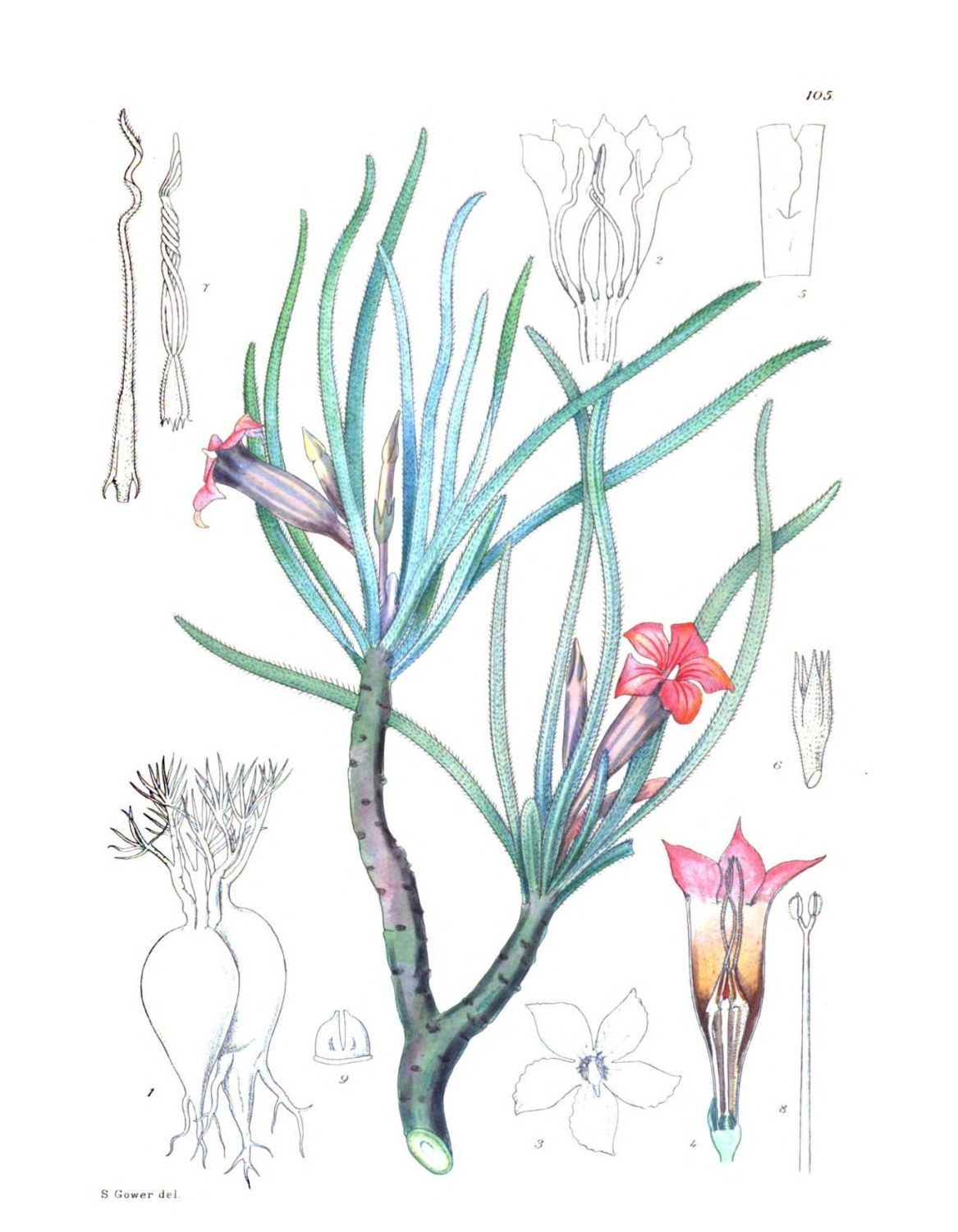
Plate 104. MACKAYA bella.
Reading edition
Natal.
Acanthaceae. Tribe Justiceae. MacKaya, Harv.; Benth. et Hook. f. Gen. Plant. vol. ii. p. 1095 (under Asystasia). MacKaya bella, Harv. Thes. Cap. i. 8, t. 13; Fl. Cap. vol. v. sect. 1, p. 44; Wood, Natal Plant. t. 585.
This plant was discovered in Natal by Mr. J. Sanderson, who sent living specimens to Kew, where it flowered first in May 1869. From the material a figure of the plant was published in the Botanical Magazine of the same year. This figure, however, does not accurately represent the plant as it is known in its native habitat and in local cultivation. The flowers are lilac, and not almost white, as indicated in the Botanical Magazine. The late Dr. Medley Wood reproduced a pencil drawing of the plant in “Natal Plants” in 1912, and states it “is a handsome shrub, but it is of no economic value; it is found only in the coast and midland districts of Natal, and does not seem to be very common.” MacKaya bella differs from Crossandra Greenstockii (see Plate 77), which also belongs to the Acanthaceae, in having almost a regular, not a 1-lipped corolla.
Dr. Harvey, who first described the genus, dedicated it to Dr. J. T. MacKay, keeper of the Dublin University Botanic Garden. Our figure was prepared from plants growing in the “Flanagan Arboretum,” Union Buildings, Pretoria.
Description:—A shrub about 1-1·5 m. high. Branches pubescent. Leaves opposite, petioled; blade 3-6 cm. long, 1·3-3·5 cm. broad, elliptic or elliptic-lanceolate, acuminate, obtuse, usually narrowed at the base, margins lobulate or subentire, with the nerves distinct beneath, glabrous; petioles about 1 cm. long, pubescent. Flowers opposite in a terminal lax raceme; the internodes almost 2 cm. long. Bracts 4·5 mm. long, subulate; bracteoles 2, at the base of the pedicels. Pedicel 5-7 mm. long, pubescent. Calyx divided almost to the base; lobes 8 mm. long, acuminate from a base 1 mm. broad, very finely pubescent, and ciliate on the margins. Corolla-tube 3·5 cm. long, 2 cm. in diameter at the throat, campanulate above, becoming cylindric below, finely pubescent; lobes 2 cm. long, 1-1·5 cm. broad, ovate, obtuse, very finely pubescent or glabrous. Fertile stamens two; filaments fixed to narrow portion of corolla-tube, 1·5 cm. long, terete, with a few scattered short stiff hairs; anthers 7 mm. long, bluntly sagittate at the base, hirsute on the back; sterile stamens represented by filaments only. Ovary 3 mm. long, 2-celled, with 2 superposed ovules in each cell, glabrous; style 3·3 cm. long, filiform, with a few scattered hairs at the base; stigma shortly bifid. (National Herb. Pretoria, No. 2638.)
Plate 104.—Fig. 1, calyx; 2, corolla; 3, anther back view and filament; 4, anther front view; 5, ovary; 6, apex of style showing shortly bifid stigma; 7, longitudinal section of ovary.
F.P.S.A., 1923.
S. Gower del.