Chapter V
Reading edition
Flags as a Means of Signalling—Army Signalling—the Morse Alphabet—Navy Signalling—First Attempts at Sea Signals—Old Signal Books in Library of Royal United Service Institution—"England expects that every man will do his duty"—Sinking Signal Codes on defeat—Present System of Signalling in Royal Navy—Pilot Signals—Weather Signalling by Flags—the International Signal Code—First Published in 1857—Seventy-eight Thousand different Signals possible—Why no Vowels used—Lloyd's Signal Stations.
We propose in this, our final chapter, to deal with the use of flags as a means of signalling; a branch of the subject by no means wanting either in interest or in practical value.
The flags used for army signalling are only two in number if we consider their design, though, as each of these is made in two sizes, the actual outfit consists of four flags. The large size is three feet square, and the smaller is two feet square; the larger sizes are clearly more visible, but on the other hand the smaller save weight and consequently labour; and with good manipulation and clear weather their messages can be followed by observers, with ordinary service telescopes, up to a distance of twelve miles or so. The poles are respectively five feet six inches long and three feet six inches, and the flags themselves are either white with a blue horizontal stripe across the centre, or wholly blue. Only one flag is used at a time, the first being used when the background is dark and the second when light, so as to ensure under all circumstances the greatest visibility.
The person sending the signals should hold the flag pointing upwards to the left, and with the pole making an angle of about 25°, with an imaginary vertical line passing down the centre of his body. The signals are based upon the dot and dash system of Morse. The dot or short stroke is made by waving the flag from the normal position to the corresponding point on the right hand, while for the dash or long stroke the flag is waved till the head of the pole nearly touches the ground.
The Morse alphabet is so constructed that the letters of most frequent occurrence are represented by the shortest symbols, and no letter requires more than four of these for its expression, while figures are all represented by five signs.
The letters of the alphabet are thus represented:—
A · — A (æ) · — · — B — · · · C — · — · D — · · E · F · · — · G — — · H · · · · I · · J · — — — K — · — L · — · · M — — N — · O — — — O (œ) — — — · P · — — · Q — — · — R · — · S · · · T — U · · — U (ue) · · — — V · · · — W · — — X — · · — Y — · — — Z — — · · Ch — — — —
The following code is adopted to represent figures:—
1 · — — — — 2 · · — — — 3 · · · — — 4 · · · · — 5 · · · · · 6 — · · · · 7 — — · · · 8 — — — · · 9 — — — — · 0 — — — — —
A space about equal in length to the dash is left between each letter, and a time interval of about three times the duration between each word. This alphabet, once learned, it is evident can be utilized in many ways. Steamers, by means of short and long whistles, can spell out messages to each other; seamen, across a harbour, can communicate by waving their arms; prisoners by opening and shutting their hands. It is also utilised in the light-flashes of the heliograph, in telegraphy again, and in various other directions.
Classes are held at the School of Army Signalling at Aldershot, and from thence the knowledge permeates the Army and the Auxiliary Forces.[84] The requirements are steadiness, intelligence, quickness of eye-sight and of action, and the power to spell correctly; and it takes a man from fifteen to twenty days, at five hours drill a day, to learn the alphabet and the proper manipulation of the flags. The standard of efficiency is ten words a minute with the large flag or sixteen with the small. If our readers will take the trouble to count the letters in the first sixteen words in this present sentence they will find that they are sixty-nine in number, and they will further find, if they take the additional trouble to translate these letters into Morse, that it will take 105 dots and 60 dashes to do it. Our readers will probably then go on to conclude that as it takes one hundred and sixty-five motions of the flag, plus sixty-eight intervals between the letters to signal these sixteen words, a speed of ten words a minute is a very creditable performance either for the sender to work off or for the receiver to read.
Besides the ordinary spelling out of the words, various arbitrary signs are used, thus a continued succession of dots · · · · · · is used to call attention to the fact that a message is going to be sent, and a series of dashes — — — — — — means that it is finished. G means "go on," R is a request to "move more to the right" and L to "shift a little to the left"; B means "use the blue flag," and W "use the white flag," K.Q is "say when you are ready," F.I means that figures are coming, and F.F indicates that the figures are finished. Those who have to receive the message may see that the background behind the transmitter is not quite satisfactory for the due observation of the flags, and they may then flash back H or O, meaning either "higher up" or "lower down," as the case may be, and in case of any misunderstanding, they will signal I.M.I, which means "please repeat," and as soon as all is clear, they will signal R.T, meaning "all right."
As our man-of-war's-men are also instructed in this system of signalling, communication can be established during an expedition between the ships and the troops on shore. The signal for communication is a white pendant with two black X.X on it. Should this special flag not be forthcoming, the X.X — · · — — · · — (see code of letters) is flashed at night or waved by the flag by day, and as soon as the preparative dots · · · · · · have been acknowledged, the message is dispatched. When the message is of a general character, nothing more need be done, but when it is intended for a particular vessel, the communication is preceded by the special sign apportioned to that vessel.
Though the Morse system has its place, as we have seen, in the drill of our blue-jackets, it does not altogether meet naval requirements. A man waving flags on board ship would be a scarcely conspicuous enough object, and intermediate vessels in a squadron would block out all view of him from those farthest off, hence naval communications are ordinarily made by means of flags exhibited from the mast head or other clearly visible position. Instead of one flag being used, our men-of-war have over forty, and these are all conspicuously distinct from each other. The messages are not spelt out, as in land operations, but the flags are used in various combinations, and the meaning of the signal is found by reference to a code-book. These flags, it is arithmetically evident, can be transposed and grouped in some thousands of different ways, and the code-book contains questions and answers to meet the very varied requirements of naval service, and the special signal hoist for each.
The first real attempt at sea-signalling was made during the reign of Charles II., when a series of signs of the most arbitrary character was devised, consisting for the most part of flags hoisted in various parts of the ship, and altering their significance as their locality was changed. The system was a very cumbrous one, and in 1780 Kempenfeldt, the Commander of the ill-fated Royal George, improved to some extent upon it, but even then the result was not very brilliant. Lord Howe, in 1792, could only make a total of one hundred and eighty-three signals. As yet, however, it had never struck anybody how much simplicity and advantage would be gained by employing numbered or lettered flags, and then using them in the thousands of combinations that such a system rendered possible. It is stated by various authorities—and even authorities have a way of copying from each other—that flags were numbered for the first time about the year 1799, but in the Library of the Royal United Service Institution may be seen "An Essay on Signals, by an Officer of the British Navy," bearing the date 1788.[85] The flags were numbered 1, 2, 3, 4, 5, 6, 7, 8, 9, and 0, and they are represented in our illustrations by Figs. 287, 288, 289, 290, 291, 292, 293, 294, 295, and 296. It will be seen that they are all of a very clear and distinct character. When such a number as 444 was required, it would appear to be necessary to have three flags like Fig. 290—the No. 4 of the series—but to avoid this multiplication of identical flags, a red triangular flag called a decimal, a white triangular called a centenary, and a blue triangular called a millenary, were used, and these were placed as required before the unit to be repeated. By this plan 444 would be expressed by the yellow flag, the No. 4, having below it the red and white pennants. Sometimes these flags really meant numbers, and then the required number was hoisted, plus a yellow swallow-tailed flag. Thus in answer to "How many guns does she carry?" if the response should be fifty, the five and the nought flags, Figs. 290 and 296, plus the swallowtail or cornet, as it is technically called, would be hoisted, while the same five-nought signal, without the cornet, would signify "whole fleet change course four points to starboard."
If we want to find the English equivalent of some German word, we turn to the German-English half of our dictionary, but if we required the German equivalent of our English word, we should refer to the English-German part of the book, and signal codes are in like manner divided into flag-message and message-flag. By the system we are at present discussing, we should find by referring to the flag-message half of our book, that the three flags 7, 3, 6, meant, "recall cruisers," while 8, 3, 6, signified "sprung a leak." On the other hand, if we wished ourselves to send such an order we should turn to the message-flag half of our code book, and under the heading of "Cruisers," find all the references that could concern the management of such vessels until we presently found "Cruisers, recall—7, 3, 6," and then at once proceed to hoist those particular flags. Only fourteen flags, the ten numerals, the three pennants, and the cornet, suffice for sending many hundreds of messages, but the anonymous author adds, "exclusive of this arrangement, I would propose to have the most current signals in battle made with one flag only, and these should be used on the day of battle only. A similarity between these and the flags used as the numerical signals ought as much as possible to be avoided." Figs. 279, 280, 281, 282, 283, 284, 285, and 286, are illustrations of some of these. The striking design of the rising sun signifies "engage the enemy." Fig. 280 is an order for "close action." Fig. 281 is an instruction to "invert the line of battle by tacking," while Fig. 282 is a direction to "force the enemy's line." It is needless to particularise them all, suffice it to say that each and all are of stirring significance. Many minds were at work on the urgent problem of an adequate system of sea-signalling, and numerous plans, therefore, were suggested. It does not appear that the one we have just referred to as an example of these endeavours to solve the difficulty was ever adopted.
The official "Signal Book for the Ships of War," compiled by the Admiralty in 1799, and afterwards amplified in 1803 by Admiral Sir Hope Popham, is of immense interest, as it was introduced into the Navy for the first time in the fleet of Nelson, and it was therefore the code of Trafalgar. In the copy preserved in the Library of the Royal United Service Museum is written, "this is a copy of the signal book by means of which the battle of Trafalgar was fought." All signals are by numbers. In the book in question, those given have been pasted over others, but some of those underneath are still visible: thus the flag that once represented one here stands for five, and the flag that heretofore was three is now seven. "If the Admiral"—an instruction in the book says—"should have reason to believe that the enemy has got possession of these signals, he will make the signal for changing the figures of the flags. The figure, which by the new arrangement each flag is to represent, is to be immediately entered in every ship's signal-book," and it is evident that one of these transpositions has been made here. The ten flags of the code are represented in Figs. 269, 270, 271, 272, 273, 274, 275, 276, 277, and 278. It is very difficult to say really how the flags were arranged for the world-famed "England expects that every man will do his duty," as the numerical significance of the ten flags was so often changed during the exigencies of war. The book we have referred to makes Fig. 270 stand for 1, Fig. 278 for 2, Fig. 275 for 3, Fig. 273 for 4, Fig. 269 for 5, etc.; and while it declares that it was by this code Trafalgar was fought, we have no evidence as to who wrote this statement. It may have been the authoritative statement of some one at the time in full possession of the facts, or a mere surmise added a dozen years afterwards by some irresponsible scribbler. On turning to the "Naval History" of James, Vol. IV., p. 34, we read "there is not, that we are aware of, a single publication which gives this message precisely as it was delivered. The following is a minute of the several flags, as noted down on board more than one ship in the fleet." He then proceeds to give them, and the arrangement that he follows is that of our illustration, his 1 being Fig. 269; 2, Fig. 270; 3, Fig. 271; 4, Fig. 272; 5, Fig. 273; 6, Fig. 274; 7, Fig. 275; 8, Fig. 276; 9, Fig. 277; and 0 Fig. 278. If he may be accepted as a reliable authority, "England" was expressed by the flags 2, 5, and 3; "expects," by 2, 6, and 9; "that," by flags 8, 6, and 3; "every," by flags 2, 6, and 1; "man," by 4, 7, and 1; "will," by 9, 5, and 8; "do," by 2, 2 and 0; and "his," by 3, 7, 0, those being the code numbers assigned to those words in the vocabulary. This necessitated eight distinct hoists, one group of flags for each word, but singularly enough the code contained no signal for "duty," so that it was necessary to spell this out letter by letter, making four hoists more, flag 4 being for "d"; 2 and 1 for "u"; 1 and 9 for "t"; and 2 and 5 for "y." As given in one or two French historical works the signal is equally short and expressive: "L'Angleterre compte que chacun fera son devoir." The story of Nelson's signal is best told in the words of the Victory's Signal Lieutenant, Pasco, the officer who received Nelson's orders to make it. "His Lordship," Lieutenant Pasco says, "came to me on the poop, and, after ordering certain signals to be made, about a quarter to noon, said, 'Mr. Pasco, I want to say to the fleet "England confides that every man will do his duty."' He added, 'You must be quick,[86] for I have one more to add, which is for "close action."'[87] I replied, 'If your Lordship will permit me to substitute "expects" for "confides" the signal will soon be completed, because the word "expects" is in the vocabulary, and "confides" must be spelt.'[88] His Lordship replied in haste, and with seeming satisfaction, 'That will do, Pasco, make it directly.' As the last hoist was hauled down, Nelson turned to Captain Blackwood, who was standing by him, and said, 'Now I can do no more. We must trust to the Great Disposer of all events, and the justice of our cause; I thank God for this great opportunity of doing my duty.'" And Great Britain that day did not call upon her sons in vain, nor was the appeal to the God of Battles unheard, though the rejoicing of victory was turned into mourning at the loss of him who had so nobly done his duty in the nation's service.
In the Royal Navy of the present day, a special code, requiring forty-five different flags, is employed. Figs. 254 to 267 inclusive, are examples of some of these.[89] This code, we need scarcely say, is of a confidential nature, and is not published anywhere for all the world to study. The Commercial code of International signals being now recognised by the principal maritime States of the world, is, by Queen's regulations, made use of by our men-of-war when communicating with foreign war-ships, or with merchant vessels whether British or foreign. The signal codes of the Royal Navy, when not actually in use, are kept in perforated metal cylinders, so that in case of capture of the vessel they may at once be thrown overboard. In the Library of the Royal United Service Institution may be seen the Signal book of the U.S. frigate Chesapeake, with bullets attached to it for the purpose of sinking it. In the confusion incidental to the capture of the vessel by H.M.S. Shannon,[90] it fell into the hands of the Britisher. Besides these regulation signals of the American Navy, a second set, supplied to privateers, was also captured, marked "Strictly confidential. The commanders of private armed vessels are to keep this paper connected with a piece of lead or other weight, and to throw the whole overboard before they shall strike their flag, that they may be sunk." This also, instead of going to the bottom of the Atlantic, may be seen within half a mile of Charing Cross.
Landsmen have a notion, remembering possibly that Nelson went into action with the signal for close action flying, that when a signal is made it is to be instantly obeyed, but the present system of signalling is on somewhat different lines. The hoisting of a signal on the flag ship is preparative. The ships leading the other columns repeat the signal, hoisting their colours three-quarters of the way up the mast. The other ships each hoist their "answering pennants" to show that they have seen and understood the order. Then when the repeating ships notice that all the other vessels have answered, they hoist the signal right up as an intimation to the Admiral that this is the case. Then it is that on the Admiral's ship the signal is hauled down, thus giving the executive order for its purport to be obeyed, so that the signal is cautionary of what is coming, and the manœuvre is only executed when to the eye no instructions at all are to be seen. The answering pennant has vertical stripes—red, white, red, white, red.
Fig. 268 is the flag used by any vessel that wishes to communicate with a coastguard station, or hoisted when one coastguard station wants to send a message to another. Thus when Beachy Head has any notification to make to the neighbouring post away down at Burling Gap, the first thing to be done is to hoist at the masthead Fig. 268. When the men on duty at Burling Gap see this they hoist the answering pennant, meaning "all right, talk away," and then the arms of the Beachy Head semaphore work vigorously, or the gay signal flags flutter in the breeze and send their message across the downs.
War vessels signal to each other at night by means of the Morse system of short and long flashes,[91] and all the large steamship lines have night signals peculiar to themselves, thus the night signal of the Orient Line is red and blue lights burnt alternately. Any vessel seeing this, knows that they are dealing with this special Line and similarly report themselves, and after this due introduction proceed to dot and dash to their heart's content.
The last two rows of flags on plate XXIII. are signals for pilots. These are either the two flags standing for P. and T. in the International Signal Code, a system we have yet to deal with, or it may be a single flag, the special pilot flag of each nation. Fig. 297 is the pilot flag of the Argentine Republic; Fig. 298, that of Brazil; Fig. 299, that of Ecuador. Fig. 300 is the pilot flag of Greece; 301, that of Japan; and 304, that of Spain. France, Mexico and Chili all adopt a flag like Fig. 278, a white flag with broad blue border, while Great Britain, Fig. 104, Germany, Fig. 302, Belgium, Fig. 303, Denmark, Fig. 305, Holland, Fig. 306, Sweden, Austria-Hungary, Italy, all fly the national flag of the country with a broad white border to it. Russia takes the Jack, Fig. 215, for the same purpose, and places this white band around it, while the United States of America takes the star-bestrewn azure canton from the national flag, Fig. 146, and similarly surrounds it with the broad band of white.
Penalties are recoverable, as they clearly should be, if any ship uses or displays signals which may be mistaken for either pilot calls or signals of distress.
The United States uses flags for its weather signals at the various meteorological stations. A violent storm is prognosticated by a red flag with a black centre. A red pennant signifies "storm approaching station," while a yellow pennant signifies "call at station for special information." A plain white flag betokens fine weather and a plain blue one rain or snow, and there are various combinations of other flags that indicate direction, intensity, velocity and so forth. It is evident that this employment of flags could be made a very valuable one.
Another instance of its use with which we are acquainted, is at the London office in St. Paul's Churchyard of the Draper's Record, one of the largest in circulation of any trade paper in the world. The citizen of London may see displayed from its roof by private enterprise the whole of the forecasts issued by the Meteorological Office, viz., the 11 a.m., the 3.30 p.m., and the 8.30 p.m. for the South of England, which officially includes St. Paul's Churchyard. A white flag is hoisted for clear weather, a blue one for rain, while local showers are prognosticated by a flag half blue and half white. Changeable weather is indicated by a flag like Fig. 267, and a coming fog by a yellow flag with black ball in its centre, like Fig. 258. Snow is foretold by a flag like Fig. 278, and squally weather by a swallow-tailed flag, having its upper half black, and the lower white. A plain red triangular flag is used to indicate temperature; when this is hoisted above other flags, it indicates rising temperature; when placed below, falling temperature; and when omitted we are to conclude that things are stationary. Thus the red flag, then below it the white one, and then the blue hoisted together, would mean that we might expect warmer weather, at first fair, but succeeded by rain, while the blue flag above the red would indicate that wet weather was before us, and a fall of temperature.
At the 1894 meeting of the National Rifle Association at Bisley a system of this kind was inaugurated, in order to give those in camp an idea of the weather that might be expected for the ensuing twelve hours, the hoisting of a blue flag indicating fine weather or moderate wind, a red one foretelling stormy weather or strong wind; green, pointing to unsettled weather or gusty wind, and a yellow flag indicating thunder or rain storms. For shooting purposes a knowledge of the strength of the wind is very valuable.
The development of a code of flag signals seems to have exercised a great fascination on many minds, and the result has been that until the general adoption of the International code things had got into a somewhat chaotic state. Some systems had many excellent points in them, while others broke down under the strain of practical use. In some cases, too, the claims of patriotism influenced the choice, it being difficult for an Englishman or an American to believe that the scheme of a Frenchman or German could possibly be better than the home-grown article.
The systems best known in this country are the Admiralty codes of 1808, 1816, and 1826, Lynn's in 1818, Squire's in 1820, Raper's in 1828, Philipps' in 1836, Eardley Wilmot's in 1851, the code of Rogers, the American, in 1854, the French code of Reynolds in 1855, and the system devised by Marryat in 1856, all being superseded by that of the Board of Trade.
The International code of signals was prepared and first published in April, 1857, in accordance with the views and recommendations of a Committee appointed by the Lords of the Privy Council. Three members, Admiral Beechey, Captain Robert Fitzroy, and Mr. J. H. Brown, the Registrar-General of Seamen, were named by the Board of Trade; one member, Admiral Bethune, by the Admiralty; an elder brother, Captain Bax, was appointed as a member by the Trinity House; Mr. W. C. Hammett and Captain Halstead were the members named by Lloyds; while the Liverpool Shipowners' Association, and the General Shipowners' Society, each, by the nomination of a member, had a voice in the discussion.
After a deliberation of more than a year, the examination of the thirteen then existing codes and due attention to any practical suggestion made to them, a mature and valuable scheme was promulgated. Eighteen flags in all, viz., one burgee, four pennants, and thirteen square flags, were employed, and these represented the consonants of the alphabet. These are depicted in the three upper rows on plate XXIV. Figs. 307 to 324, the letter it stands for in the code being placed by each flag. These flags are combined in various ways, either in twos, threes, or fours, and are always read downwards, thus Fig. 325 must be read B.D.T.F; if we read it the reverse way, as F.T.D.B, it would have an entirely different significance.
Of the two-flag signals we have three varieties. Should the burgee, Fig. 307, be uppermost it constitutes what is termed an attention signal; thus the hoisting of B.D signifies, "What ship is that?" If the upper flag be a pennant C.D.F. or G it is a compass signal; thus G.F means west-north-west-half-west. If a square flag be uppermost it is an urgency signal; thus, N.C signifies "am in distress," or N.J "am driving, no more anchors to let go."
Signals made with three flags are not classified according to the upper flag; they relate to subjects of general inquiry or communication of news. In the lower portion of Plate XXIV. we have given five examples of these. Fig. 330, flags B.P.Q, asks "Do you wish to be reported?" while the hoisting of P.D.S, see Fig. 332, replies, "Report me to Lloyds' Agent." Fig. 333, H.V.F, asks, "Do you want assistance?" while Fig. 334, G.B.H, enquires, "Has any accident happened?" Fig. 331, made up of flags V.K.C, gives the reassuring answer to both enquiries—"All safe." As weather signals, we find "barometer rising" indicated by G.F.W; "barometer falling" by G.H.B; and "barometer standing," by G.H.C. Fine weather is prognosticated by the group H.M.S; a breeze off sea is foretold in the combination H.S.V; and a breeze off land by H.S.W.
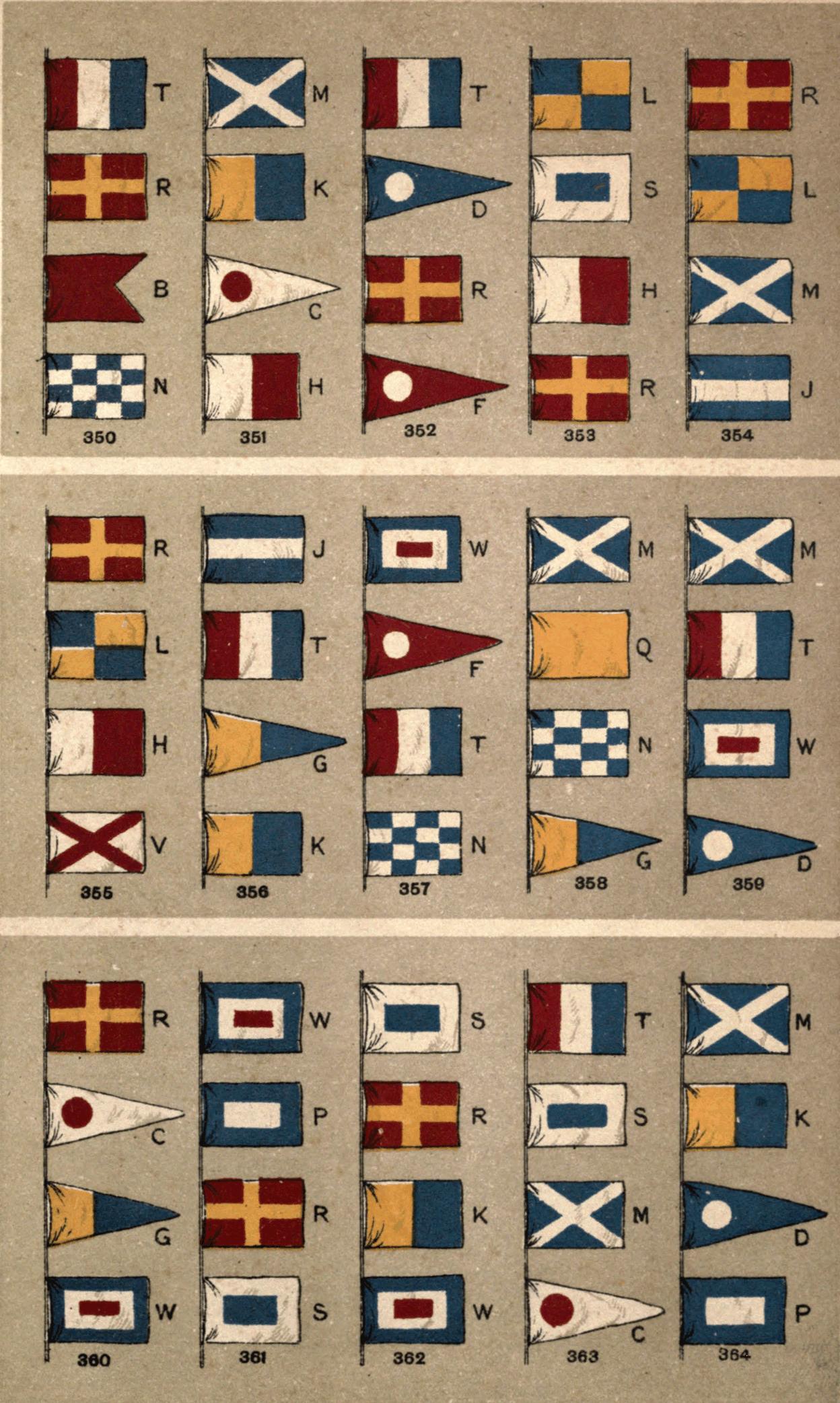
Signals composed of four flags are divided into different sections again, according to the form of the uppermost flag employed. If this upper flag be either of the pennants C.D or F, it indicates that the signal is what is called vocabulary. If the upper be the burgee—the letter B of the code—it is a geographical signal; thus, any vessel beating up channel and seeing Fig. 325, made up of B.D.T.F, hoisted from a lighthouse, would, even if uncertain before, know their position, as this signal is the one specially assigned to the Eddystone. Fig. 326, the letters B.D.P.Q, signifies that the vessel flying it hails from the port of London, while B.F.Q.T. is Edinburgh, and so on. All names of ships are expressed by four letters, thus N.V.B.Q is the code signal (Fig. 327) of the steamship Germanic; M.N.D.L (Fig. 328) that of the Hesperus; and Fig. 329, made up of G.R.C.T, is the special grouping assigned to H.M.S. Devastation. All these names are recorded in the Shipping List, so that two vessels passing each other in mid-ocean are able at once to determine each others' names if within sighting distance of the flags run up. Should we see a stately liner coming to port, flying M.T.L.Q, we recognise that it is the Australia of the great Peninsula and Oriental Line, but if she runs up L.H.T.B then she is the Orient Company's boat Orotava. Some names occur frequently, thus other Australias, belonging to various owners, are distinguished by the code signals R.L.H.V, J.T.G.K, M.P.F.C, M.Q.N.G, M.T.W.D, W.F.T.N, etc., etc. Figs. 355, 356, 357, 358, 359 are all code signals of various Australias. While the Peninsular and Oriental Company has also a Victoria, K.M.Q.F., they have no monopoly of the name. There are numerous other boats of that popular designation, but even when vessels have the same name no two vessels ever have the same code letters assigned to them. Other Victorias, for example, are differentiated, as W.Q.M.N., L.S.H.R, K.P.G.Q, M.K.C.H, M.S.P.B, M.Q.C.J, L.D.F.H, T.R.B.N, K.J.H.P, T.D.R.F, etc., etc. Figs. 350, 351, 352, 353, 354 are all Victorias; and Figs. 360, 361, 362, 363, 364 are the flag-signals of various Britannias. Our readers will see at once how distinctive they are. Figs. 335 to 349 inclusive are the special flags of well-known steamships of the Peninsular and Oriental, the Orient Line, and the Compagnie Générale Transatlantique.
Should the vessel be a yacht, it is the Aline if she shows the flags P.W.N.D; the Star of the Sea if her signal is T.N.B.H; but if it is the Meteor we shall be aware of the fact from her hoisting the four flags L.C.T.P. The flag signal of the Valkyrie is L.F.M.G.
Applications for the allotment of a code-signal, for the purpose of making ships' names known at sea, should be made, if of the United Kingdom, to the Registrar General of Shipping, Custom House, and, if belonging to a Colony, to the Registrar at the port to which the vessel belongs. If a ship to which this International Code Signal has been alloted is reported wrecked, lost, or sold to a foreigner, and her register is in consequence cancelled, the signal letters allotted to her are also cancelled, so that if the ship is afterwards recovered or re-purchased from foreigners, either in her original or some other name, new signal letters will be necessary, and the owner must make application anew for another allotment, as the signal letters the vessel originally bore may have been in the interval re-allotted.
The flags to be hoisted at one time never exceed four, and it is an interesting arithmetical fact, that, with these eighteen flags, never using more than four at a time, over seventy-eight thousand different combinations can be made. With these flags, only using two at a time, 306 different arrangements can be made, while by using three at a time we get 4,896 possibilities, and by using four at a time, we can make 73,440 changes; a total in all of 78,642 variations made from these simple elements. Marryat's code, prior to the introduction of the International, being the one most in use, twelve out of its sixteen flags were, to save expense, incorporated in the new code. Their significance was, however, entirely changed. Marryat's flags, too, were numerals, while the International code, as we have seen, has its flags named after the letters of the alphabet.
Proposals are in the air to add eight new flags to the code, the X, Y, and Z, and the five vowels, since it is held that even the great number of combinations now possible may in time not suffice. The reason for the absence of the vowels is a somewhat curious one. Directly vowels are introduced we begin to spell words, and it was found that amongst the thousands of combinations possible, would be presently included all the profane, obscene, and otherwise objectionable four-letter words of the whole world. To hoist D.B.M.N could offend no one's susceptibilities, but to run up the signal D.A.M.N in response to an enquiry is quite another matter, and it must be remembered that as this code is used by all civilised nations, a word that is merely meaningless in one country might be most offensive in another. An English Captain might hoist as a necessary signal J.A.L.P. or F.L.U.M. and see no possible objection to it, but "jalp" or "flum" might to the people of some other nationality carry a most atrocious significance.
It is a practical necessity that all connected with the sea should understand the use of the International code, therefore, the Lords Commissioners of the Admiralty require that all Royal Naval Reserve men who act as Masters or Mates of ships should be instructed in its working, and the Board of Trade makes like requirements from all candidates for Masters' or Mates' Certificates. Its International character is a most valuable feature, as by its use two captains, say a Dane and a Greek, or a Russian and a Spaniard, who, on the quay, could not comprehend a word of each other's language, can at sea, by this common flag-language, come to a perfectly clear understanding of each other's need, or impart any information required. It is the only code used at the signal stations around our coasts. Lloyds' have thirty-three of these signal stations at Dover, Beachy Head, Lundy Island, Dungeness, Flamborough Head, St. Catherine's Point, North Foreland, and other conspicuous points on our line of ocean traffic, and abroad again at Aden, Ascension, Gibraltar, Bermuda, Honolulu, Suez, Perim, Malta, Teneriffe, and elsewhere, and here too, the International is the only code recognised.
This "Lloyds," that we may see daily referred to in the newspapers, is a Corporation that, amongst other marine business, distributes shipping intelligence. A Mr. Edward Lloyd, in the seventeenth century, kept a coffee house in Tower Street, which in time from the daily gathering there of merchants, captains, and others interested in marine affairs, became a centre for shipping and underwriting news and business. In the year 1692 it was moved to Lombard Street, and in 1774 the coffee supplying part of the business was abandoned and rooms were taken in the Royal Exchange. During the wars with Napoleon, the Government was often indebted to the Committee of Lloyds' for the earliest information of important events all over the world. Lloyds' has its agents in every port, and by its complete organisation and the potent aid of the telegraph, the shipping business of the world is brought day by day before us. Vessels spoken far out on the ocean are reported by the vessel that spoke them immediately on its arrival at any port. Thus a sailing-vessel journeying from London to Vancouver may be five months or more before it touches land, but during that time it is sighted by other vessels from time to time, and these report having seen it, and that all was well on board. So the mother knows that her son, who is parted from her by thousands of miles of ocean, has got thus far in health and safety; and the owners of the vessel learn that their venture has so far surmounted the perils of Cape Horn and the other dangers of the deep. The good ship is drawing nearer at each report to the end of her long voyage, and on arrival at last off Vancouver, as the land is sighted, the signal flags run up once more to the masthead, the news of her coming is flashed across continent and ocean, and the London newspaper of the next morning contains the brief notification that far exceeds to anxious hearts all else of interest its broad pages may contain.
Familiarity, though it may not necessarily breed contempt, dulls the sense of the wonder of it all, and yet how marvellous it is! We have before us the Standard, that came into our hands about seven o'clock this morning, and we find from it that yesterday the Glenshiel had arrived at Hong Kong, that the Arab, from Cape Town, had just put in at Lisbon, that the Sardinian, from Quebec, had reached Moville, that the Circassian was safely at New York, that the Orizaba, speeding on to Sydney, had at 2 a.m. passed the desolate shores of arid Perim, that the Danube, from Southampton, had at 6 a.m. entered the harbour of Rio Janeiro. Of this, and much else of the same tenor, may we read in a space of a quarter-column or so of the paper as we sit at breakfast and see pass before us a panorama of world-wide interest and extent; and to accomplish this result, the flags we have figured have been a potent factor.
Though we have covered much ground, it must have been patent to all readers who have thus far companioned us that much detail was necessarily omitted, unless our book had to grow to the dimensions of an encyclopædia. It would probably, for instance, take some fifty figures or so to give all the distinctive flags of the various government departments, official ranks, etc., of a single Great Power. We trust nevertheless that while our labours have been by no means exhaustive, they have been instrumental in showing that there is much of interest in flag-lore, and that an increased knowledge and appreciation of our subject may be one result of our pleasant labours, and prove full justification for our work.
INDEX.
A. Aargau, flag of 116 "Acta Sanctorum," the 38 Admiral's flag, R.N. 56 Admiralty, flag of the 71, 72 Agincourt, battle of 106 Agincourt, flags at 5 Agnus Dei, as device on flag 22 Ailsa, flag of the yacht 73 Allan Line, flag of the 75 Allotment of code signals 138 Ambulance flag 117 Ancient Irish harp 33 Anchor as badge 63, 71, 87, 100, 114 Andrew, cross of St. 4, 35, 42, 43, 45, 53, 116 Andrew, St., of Scotland 37, 42, 44 Andrew, St., of Russia 103, 104 Andrew, St., order of 102 Anne, Standard of Queen 35 Annunciation on flag 4 Answering pennant 134 Antelope as a device 16 Antiquity, standards of 2 Antwerp, device of city of 111 Anvil as device on flag 7 Argentine Republic, flag of 124 Armada, defeat of the 3 Arms of Canada 81, 82 Arms of Washington 91 Army, flags of the 61 Army signalling 127, 128, 129 Arragon, arms of 111 Articles of War 56 Assaye, special flag for 65 Assyrian standards 2 Athene, owl of 2 Australian Steam Navigation Company's house flag 74 Austro-Hungarian flags 101, 102 Avondale flag 43 Awdeley, standard of Sir John 17 B. Bacon on sea-power 84, 85 Baden, flag of 101 Badge 9, 13, 15, 21, 62, 66, 67, 83, 84, 117 Bahamas, Badge of the 84 Balmoral tartan 1 Banner, its nature 10 Banneroll, kind of flag 18 Bannockburn, battle of 44 Barbadoes, badge of 83 Barcelona, arms of 111 Bar, banner of Sir John de 11 Bardolph, banner of Sir Hugh 11 Basel, flag of city of 116 Bavaria, flag of 101, 119 Bayeux tapestry, flags represented in 19, 22 Bear as a device 1, 2 Beau-seant of Knights Templars 24 Beaver as a device 1, 30 Bede on flags 4 "Beehive of the Romish Church" 3 Bees of the Napoleons 106, 109 Belgium, flags of 23, 118 Bermuda, badge of 84 Berne, flag of 116 Beverley, flag of 5 Birkenhead, burning of the 64 Black and white flag of Prussia 98 Black as a flag colour 7, 24, 25 Black Swan, device of the 84 Blackwall line of shipping 74 Black Watch, the 62 Blenheim, battle of 64, 66 Blue blanket of Edinburgh 42 Blue ensign 40, 56, 73, 78, 83 Board of Trade, flag of the 71 Bohemia, flag of 102 Bolivia, flag of 23, 123 Bombardment of Scio 118 Boots and shoes on a flag 7 Bordered Jack 48, 58 Botetourte, banner of Sir John 11 Bourbon kings, the 107 Brabant, lion of 112 Brass of Sir John Daubernoun 18 Brazil, flag of 23, 24, 123 Brazil, pendant of 20 Bremen, flag of port of 99 Britannia, flag of the yacht 73 British East Africa, device of, 84 British Guiana, badge of 84 British North Borneo, badge of 84 Broad pendant 56 Brunswick, arms of 35 Brunswick, flag of 101 Buckles as device on flag 7 Bugle-horn as a device 15 Builder's square on flag 6 Bulgaria, flag of 121 Bunker's Hill, battle of 87 Bunting as material for flags 22 Burgee, variety of flag 19, 73 Burgundy, flag of 111, 112 Burning of rebel colours 70 Butler's "Lives of the Fathers" 39 Butterflies as a flag device 17 C. Campbell on the national flag 54 Canada, Dominion of 10 Canada, flags of Dominion of 80 Canadian Pacific steamship line 75 Candlemakers' flag, the 7 Canterbury Cathedral, flags in 66 Cantonal colours 116 Cape of St. Martin 105 Cape St. Vincent, action off 41 Castle Line, house flag of the 75 Castle on flag as a device 111, 112 Cavalry standards 65 Cavers standard, the 43 Ceylon, device of the Colony of 84 Chapel of Royal College, Chelsea, flags in 3, 66 Chaucer, quotation from 12, 18 Cheering to order 102 Cherbourg, flag of port of 75 Chili, flag of 121 Chili, pendant of 20 Chinese flags 125 Chrysanthemum flag of Japan 124 Coastguard flag 134 Codes for flag-signalling 136 Coffee plant on flag 123 Coins, devices on 2, 88, 90, 120 Colombia, flag of United States of 122 Colonial Defence Act 78, 79, 80 Colonial flags 20, 40, 78 Colonies, value of 76, 77 Colour party 64 Colours, Queen's 61, 65, 67 Colours, regimental 61, 65, 67 Colours used in flags 23 Columbus, flag flown by 86, 111 Commodore's broad pendant 56 Commonwealth flags 48 Company or house flags 74, 75 Compasses as a device 6 Compass signals 136 Confederate States of America 27, 94, 95 Congo Free State, flag of 126 Conquest of Ireland 33 Consecrated banner 3, 103 Constantine, Labarum of 2, 3, 51 Consular flag 71 Consul-General, Russian, flag of 104 Cornet, variety of flag 19, 130 Costa Rica, flag of 122 Courtenay, banner of Sir Hugh de 11 Covenanter flags 24, 43, 91 Crescent as device 11, 15, 88, 95, 119, 120 Croatia, flag of 102 Cromwell, arms of 35 Cromwell, funeral of 19 Cross of St. Andrew 4, 35, 42, 43, 45, 53, 116 Cross of St. George 4, 10, 14, 16, 35, 39, 41, 45, 48, 53, 84, 87, 116 Cross of St. Patrick 4, 51, 53, 116 Crown of Charlemagne 35 Crowns of Ireland 33 Cuba, flag of 124 Culloden, battle of 70 Cunard Line, house flag of 74 Customs Department, flag of 71 Czarina, standard of the 102 Czar, standard of the 102, 103 D. Dalmatia, flag of 102 Dannebrog, the 115 Demerara and Berbice Steamship Company 74 Denis, St., flag of 5 Denmark, flags of 115 Derivation of word flag 8 Desjardins on French flag 107 Devitt and Moore house flag 74 Diana, crescent of 119 Diplomatic Service, flag of 71 Dipping the flag 25 Dragon as a device 17, 125 Drayton, quotation from 15 Durham, St. Cuthbert of 5 E. Eagle as a device 41, 91, 93, 94, 98, 101, 102, 105, 109, 110 Early Spanish flags 27 East Africa Company, German 100 East India Company, flag of 47, 89 East Kent Regiment, flags of 66 East Prussia, flag of 98 Ecclesiastical flags often pictorial 4 Ecuador, flag of 124 Eddystone Light flag signal 137 Edinburgh Cathedral, flags in 68 Edinburgh Trained Bands 42 Edmonson on flag usage 9 Edward the Confessor, arms of 34 Edward III., "King of the Seas" 25 Edward VI., funeral of 17 Egypt, ancient, standards of 2 Egyptian flags, modern 120, 121 Electoral bonnet 52 Elephant as a device 65, 84, 125 Elephant, order of the 115 Elizabeth, funeral of Queen 17 Elizabeth, thanksgiving service 3 Elsass, flag of 101 Emperor of Germany 98 Ensign 8 Ermine as a flag device 24 Errors in flag-making 58, 59, 60 Excise, flag of the 71 Eye as a device on flag 7 F. Facings of the regiment 62 Falcon as a device 17 Favyn "Le Théâtre d'honneur" 4, 107 Fiji, badge of colony 84 Files represented on trade flag 7 Flag-book of the Admiralty 120 Flag-lore valuable 58 Flagons on trade flag 7 Flag-signalling 127, et seq. Flanders, badge of 111 Flashing messages at night 134 Fleur-de-lys 21, 34, 36, 106, 108, 109, 112 Flodden, battle of 6 Florida, settlement of 86 Florin, arms on the 32 Fly of a flag, the 10 Fork and spoon on a flag 7 Four-flag signals 137 France, flags of 1, 21, 105, 106, 107, 108, 109, 110 Franco-German War of 1870 97 Fribourg, flag of 116 Frogmorton, standard of 17 Funeral obsequies, flags at 6, 17, 18, 19, 22 G. Garter, order of the 38 Gautier on the Swiss flag 116 Geneva Convention 117 Geneva, flag of 116 Geographical signals 137 George, St., cross of 4, 10, 14, 16, 35, 39, 41, 45, 48, 53, 84, 87, 116 George, St., of England 36, 37, 116 George, St., of Russia 102, 103 German Unity 97, 98 Germany, flags of 99, 100 Globe on flag 63, 87 Gnu as a flag device 84 Golden Legend, the 37 Gonfalon, kind of flag 8 Government, departments, flags of 71 Governor-General of Canada, flag of 81 Governors of Colonies, flags of 81, 84 Grandison, banner of Sir William de 11 Gray, quotation from 9 Greater Britain 77 Great Seal of Canada 83 Great Seal of Richard I. 30 Greece, flag of 119 Green and white of the Tudors 21 Green as a flag colour 23, 43, 113, 123 Greyhound as a device 17 Growth of the Italian State 113 Guards, flags of the 65 Guatemala, flag of 23, 122 Guidon, form of flag 21 Guild flags 6, 7 Guinea Company's flag 27 H. Half-mast high, flags at 25 Hamburg, flag of city of 99 Hammer represented on flag 6, 7 Hand as a device 2 Hanover, arms of 29, 35, 52 Hanover, flag of 101 Hanseatic League, flag of 99 Harfleur, siege of 12 Harleian MS. on flags 16, 21 Harp of Ireland 4, 29, 32, 33, 34, 49, 54 Hayti, flag of 23, 124 Heavenly succour 37, 42, 44, 106, 115 Henry V., standard of 16 Henry VII., flags in chapel of 12 Heraldic Exhibition, Edinburgh 43 Heraldic requirements in flag devising 23, 54 Hesse, flag of 101 Highland tartans 1 "History and principles of Heraldry" 10 Hohenzollerns, arms of the 99 Hoisting one flag over another 25 Hoist of the flag, the 10 Holderton, banner of Sir John de 11 Holland, flags of 117, 118 Hong Kong, badge of colony of 84 Horse as a device 2 Horsham, political colours at 8 House flags 24, 74, 75 House of Orange, flag of 117 Hungary, flag of 23, 102 I. Idolatrous emblem 87 Illiterate voters, mistakes of 7, 8 Imperial Eagle 66, 101, 102 Inscriptions on flags 3, 4, 13, 15, 16, 24, 35, 41, 43, 49, 66, 88, 90, 93, 122, 123 International signal code 133, 136, 137, 138 Investiture of knight-banneret 14 Invocation of saints 3 Ireland joined to Great Britain 32 Iron cross of Germany 100 Isandlwana, battle of 63, 69 Istria, flag of 102 Italy, flags of 23, 113, 114 J. James II., statue of 35 Japan, flags of 124 Jerusalem, arms of city of 114, 115 Jewish standards 3 Joan of Arc, standard of 4 Jove, Eagle of 2 K. Karlaverok, siege of 11, 18 Kasan, arms of province of 102 Katharine of Arragon flag-making 13 Kempenfeldt's signal code 130 Key as a device on flag 15 Khorsabad, slabs from 2 Kingdom of Hungary 101 King's Own Borderers 63 Kiow, arms of province of 102 Knights-banneret 14 Knights of the Bath, banners of 12 Knights of the Garter, banners of 12 Knights Templars, banner of the 24 Köbel, book on costume and flags 101 Korea, flag of kingdom of 125 L. Labarum of Constantine 2, 3, 51 Labuan, badge of colony of 84 La Haye's book on flags 87 Lamartine on the red flag 109 Lancer pennon 14, 19 Landing of Charles II. 47 Land of the rising sun 124 Laurel wreath on flag 49, 81 Lawyers, flag of the 7 Leeward Isles, badge of the 84 Leon and Castile, arms of 86, 110, 111 Liberia, flag of 125 Liberty, figure of 94, 118 Lion of Scotland 4, 29, 31, 34 Lions of England 4, 29, 30, 34 Livery colours 7, 14, 17, 21 Livy on Vexillum 2 Lloyd's signal stations 139 Locksmiths, flag of the 7 London, port of, flag signal 137 London Trained Bands 41, 67 Lone Star State, flag of the 95 Lord Cardross, flag of 16 Lord High Admiral of England 72, 80 Lord-Lieutenant of Ireland, flag of 71 Lord Mayor's Show, flags at 19, 20 Loss of colours at Edgehill 65 Lothringen, flag of 101 Louisiana, flag of State of 94 Louisiana, settlement of 86 Lozenges as a device on flag 41 Lubeck, flag of city of 99 Lucerne, flag of 116 Lunenburg, arms of 35 Lydgate, the duty of chivalry 12 M. Maccabees, standard of the 3 Machyn, diary of 6, 17, 21, 39, 111 Mackay, extract from 57, 58 Mail service flag 72 Mainsail emblazoned as banner 12 Malplaquet, battle of 64 Man-of-war pendant 20, 78, 93, 110, 111, 121, 129, 135 Maple-leaf of Canada 30, 81 Marmion, quotation from 8, 18 Martin, description of Western Islands 1 Marseillaise, the 98 Marseilles, flag of port of 75 Martlets on flag 34 Massachusetts, flag of 3, 87 Mayflower, sailing of the 87 Mecklenburg-Strelitz, flag of 101 Mediæval spelling 6, 22 Mediterranean and New York Company 75 Merchant flag, red ensign 40, 47, 58, 73, 80 Merchant Shipping (Colours) Act 58 Metal-workers, flag of the 7 Meteorological signals 135 Mexico, flag of 23, 123 Milton, quotation from 8 Minotaur as a device 2 Minden, battle of 64 "Mirror for Magistrates," quotation from 15 Mohammedan flags often green 24 Monasteries, flags of 5 Monk, funeral of General 18, 22 Monogram, sacred, on flag 3, 42, 51 Monthermer, banner of Sir Ralph 11 Morse alphabet for signalling 127, 128, 129 Mottoes on flags 3, 4, 13, 15, 16, 24, 35, 41, 43, 49, 66, 88, 90, 93, 122, 123 Mutiny in the Royal Navy 25 N. Napoleon, flags at tomb of 4 Nassau, arms of 29, 35 Natal, device of colony of 84 Naval Discipline Act 56 Naval Exhibition at Chelsea 41 Navy signalling 129, et seq. Nelson, funeral of 18, 22 Neville's Cross, battle of 5 New Brunswick, arms of province of 82 Newfoundland, badge of colony of 83 New Granada, flag of 122 New Guinea, badge of colony of 84 New South Wales, badge of colony of 84 New Zealand, badge of 84 New Zealand Shipping Company 24, 75 Night signalling at sea 134 Nisbet on the tressure 32 Norie's "Flags of All Nations" 26 Northallerton, sacred flags at 5 North German Confederacy 99 Norway, flag of 115 Nova Scotia, arms of province of 82 Nova Scotia, settlement of 87 Novgorod, arms of province of 102 O. Obsolete flags 8, 22, 26 Ontario, arms of province of 82 Orange flag 8 Orange Free State, flag of 23, 125 Order of Black Eagle 100 Ordnance Department flag 71 Orient Steam Navigation Company 24, 134 Oriflamme 105 Oudenarde, battle of 64 Owl of Athene 2 P. Palmetto palm on flag 94, 95 Pamiot Azof, flag of the 104 Papal States, flag of the 23, 114, 115 Paraguay, flag of 122 Paris, arms of city of 109 Passion symbols on flag 6 Patrick, St., life of 51, 52 Pendant or pennant, 20, 40, 78, 93, 110, 111, 121, 129, 135 Peninsular and Oriental Company, flag of 74 Pennoncelle or pencel 19 Pennon, nature of the 14, 18, 19 Pepys, extract from diary of 55 Percy, banner of Sir Henri de 11 Percy lion 11, 15 Percy motto 15, 16 Percy standard 15 Persepolis, sculptures of 2 Peruvian flag 123 Pictorial flags 4 Pilgrim Fathers, the 87 Pilot flag 48, 100, 104, 134 Pine-apple as a device 84 Pine-tree flag 87, 88, 89 Plantagenet livery colours 21 Pliny on Roman standards 2 Poland, flag of 105 Political colours 7 Political devices on flags 4 Pomerania, flag of 101 Popham's signal code 131 Portcullis as a device 21 Portobello, capture of 41 Ports, flags of 75 Portugal, flags of 112, 113 Pottery, representation of flags on 89 Precedence a difficulty 28 Presentation of colours 3, 66 President, U.S.A., flag of 93, 94 Printed flags 23 Protectorate flag, the 50 Prussian eagle 98 Q. Quarantine flag, the 25, 59 Quebec, arms of province of 82 Queen's colour 61, 65 Queensland, badge of colony of 83 Queen's Regulations 54, 55, 64, 71, 78, 81 R. Ramilies, battle of 64 Rattlesnake flag 1, 13, 87, 88 Raven of the Danes 13 Rebel colors burnt 70 Red ensign 40, 47, 58, 73, 80 Red flag of revolution 25, 59, 109 Relics of saints worked into flag 5 Religious character of early flags 4, 5, 22 Religious service 3, 103 Revenue flag, U.S.A. 93 Rey on the French flag 107 Rhode Island, flag of 87 Richard II., standard of 17 Ridre, standard of Sir William de 11 Riga, flag of port of 75 Ripon, St. Wilfrid's banner at 5 Rolls of arms 10 Rome, standards of ancient 2, 42 Roses as a flag device 16, 21 Rotterdam, flag of port of 75 Rouen, capture of 5, 38, 112 Roumania, flag of 121 Royal Colonial Institute 76 Royal Horse Artillery of 1813 19 Royal Marines 63 Royal Naval Reserve 40, 56, 57, 73, 79, 139 Royal Navy, flag code of the 133 Royal Oak on coins 88 Royal Standard 11, 29, 34, 48, 54, 59, 78 Royal United Service Museum 24, 125, 130, 131 Royal Yacht Squadron, flag of the 72 Royston, political colours at 8 Russia, flags of 24, 102, 103, 104, 105 Russian American Company's flag 26 S. Sacred monogram on flag 3 Salique law, operation of 36 Salmon as a flag device 82 Saluting the flag 26, 55, 56 San Salvador, flag of 124 Sarawak, flag of 125 Sardinia, flag of 26 Savoy, flag of 27, 113, 123 Saxe-Coburg Gotha, flag of 101 Saxony, arms of 35 Saxony, flag of 100 Schomburg-Lippe, flag of 101 School of Army Signalling 128 "Scotland for ever" 70 Scots Greys 66 Scottish grievance as to arms 31, 45, 46, 53 Scottish variation of Union flag 46 Scott, quotation from 8, 29 Servia, flag of 121 Seven Champions of Christendom, 38 Seventeenth Lancers 66 Shakespeare, quotation from 15, 37 Shannon and Chesapeake duel 90 Shears as a device on trade flag 7 Siam, flag of kingdom of 125 Signal-book of Chesapeake 133 Signalling by flags 20, 23, 127, et seq. Simon de Montfort, banner of, 12 Skull and cross-bones device 66 Sledge flags of Arctic expedition 16 South Australia, badge of 83 South Carolina, flag of 87, 88, 94 Southern Cross 30, 80, 96 Sovereignty of the seas 25, 26 Spain, flags of 1, 24, 110, 111, 112 Spelling, mediæval liberty of 6, 22 Spenser, quotation from 36 Sphinx as a badge 62, 63 Spoon and fork on trade flag 7 Standard, nature of the 14 St. Andrew, cross of 4, 35, 42, 43, 45, 53, 116 Stars and bars, C.S.A. 95, 96 Stars and stripes, U.S.A. 59 St. Denis, flag of 105 Stewart on tartans 1 St. Gallen, flag of 116 St. George, cross of 4, 10, 14, 16, 35, 39, 41, 45, 48, 53, 84, 87, 116 St. Helena, badge of colony of 84 Storm signals by flags 135 "Story of Thebes," quotation from 12 St. Patrick, cross of 4, 51, 53, 116 Straits Settlement, device of 84 Streamer, variety of flag 20, 21 Strictly confidential signals 133 Stuart, livery colours of house of 21 Sun as a device 2, 17 Swallow-tail flag 14, 18, 93, 110, 115, 116, 130 Swan, black, of Western Australia 84 Sweden, flag of 115 Switzerland, flag of 116 Swynnerton, standard of Sir Thomas de 16 Sydney, Sir Philip, funeral of 18 Sidney, Sir Philip, on war 19 Symbols to express colours 74 T. Tartans, Scottish 1 Tasmania, device of colony of 84 Telegraph Department, flag of 71 Tessin, flag of Canton 117 Teutonic, armament of the 57 Teutonic order, cross of the 100 Texas, flag of the State of 95 Texel, flag of the port of 75 "The late unpleasantness" 96 "Theorike and Practike of Modern Warres" 61 Third Dragoons 66 Thistle as a flag device 42, 82 Three-flag signals 137 Tiger of Korea 125 Titus, the arch of 2 Tobacco plant on flag 123 Torpedo practice flag 133 Trafalgar, Nelson's famous signal 132, 133 Trajan's column, standards on 2 Transport service, flag of the 71, 104 Transvaal, flag of the 126 Trefoils as a device 41 Tressure of Scotland, the 31, 32 Tricolor of France 40, 108 Trinidad, badge of colony of 84 Trinity, banner of the 5, 6 Trowel on guild flag 6 Trumpet banners 12, 20 Tudor flags 17 Tughra device, the 120, 121 Tunisian flags 120 Turkey, flags of 24, 119, 120 Twenty-fourth regiment 62 Tyrol, flag of the 102 U. Union between England and Scotland 45 Union between Great Britain and Ireland 50, 52 Union flag 1, 4, 45, 47, 50, 54, 61 Union flag of Sweden and Norway, 116 Union Jack 47, 48 Union Steamship Company's flag 75 United Italy 113 United States of America, flag of 86, 89, 90, 91 Universal code for signalling 28 Urgency flag signals 136 Uri, flag of Canton of 116 Uruguay, flag of 122 Utilisation of liners as cruisers 57 V. Valence, banner of Sir Aymer de 11 Valkyrie, flag of the yacht 73 Variation in size a sign of rank 17 Venezuela, flag of 23, 122, 123 Venice, obsolete flags of 27 Versailles, palace of 97 Vessels spoken at sea 139, 140 Viceroy of India, flag of 65, 81 Victoria Cross 63 Victoria, flag of colony of 80 Victualling Department, flag of 71 Virginia, settlement of 86 Virgin Mary on flag 6 Vocabulary signals 137 Voldermirz, arms of 102 Vowel flags objectionable 138, 139 W. Waldeck, flag of 101 War cries 37 War songs 95, 98 Warriors' Chapel at Canterbury 66, 67 Washington, arms of 91, 93 "Watch upon the Rhine" 98 Waterloo, battle of 70 Weather signals 135, 137 Wellington, funeral of Duke of 18, 22 West Africa, device of 84 Western Australia, device of 84 Western Australia, governor's flag 81 West Prussia, flag of 98 White cross of France 107 White elephant of Siam 125 White ensign 40, 55, 59, 72 White horse of Hanover 63, 66 White horse of Kent 36 White Star Line, house flag of 57, 75 Why called "Jack" 48 William III., standard of 35 Wreath on flag 63, 66, 81 Wolf as a device 2 Wurtemburg, flag of 101 Y. Yacht flags 100, 138 Yellow flag, its significance 24, 59 York, livery colours of house of 21
COLOURED PLATES.
PLATE I.
1 Banner of Sir John Botetourte. 2 Banner of Sir Ralph de Monthermer. 3 Banner of Sir Hugh Touches. 4 Banner of Sir William de Ridre. 5 Banner of Sir Hugh Bardolph. 6 Banner of Sir John de Holderton. 7 Banner of Sir Henri de Percy. 8 Banner of Sir Hugh de Courtenay. 9 Banner of Sir Aymer de Valence. 10 Banner of Sir John de Bar. 11 Banner of Sir William de Grandison. PERSONAL FLAGS—MEDIÆVAL PERIOD.
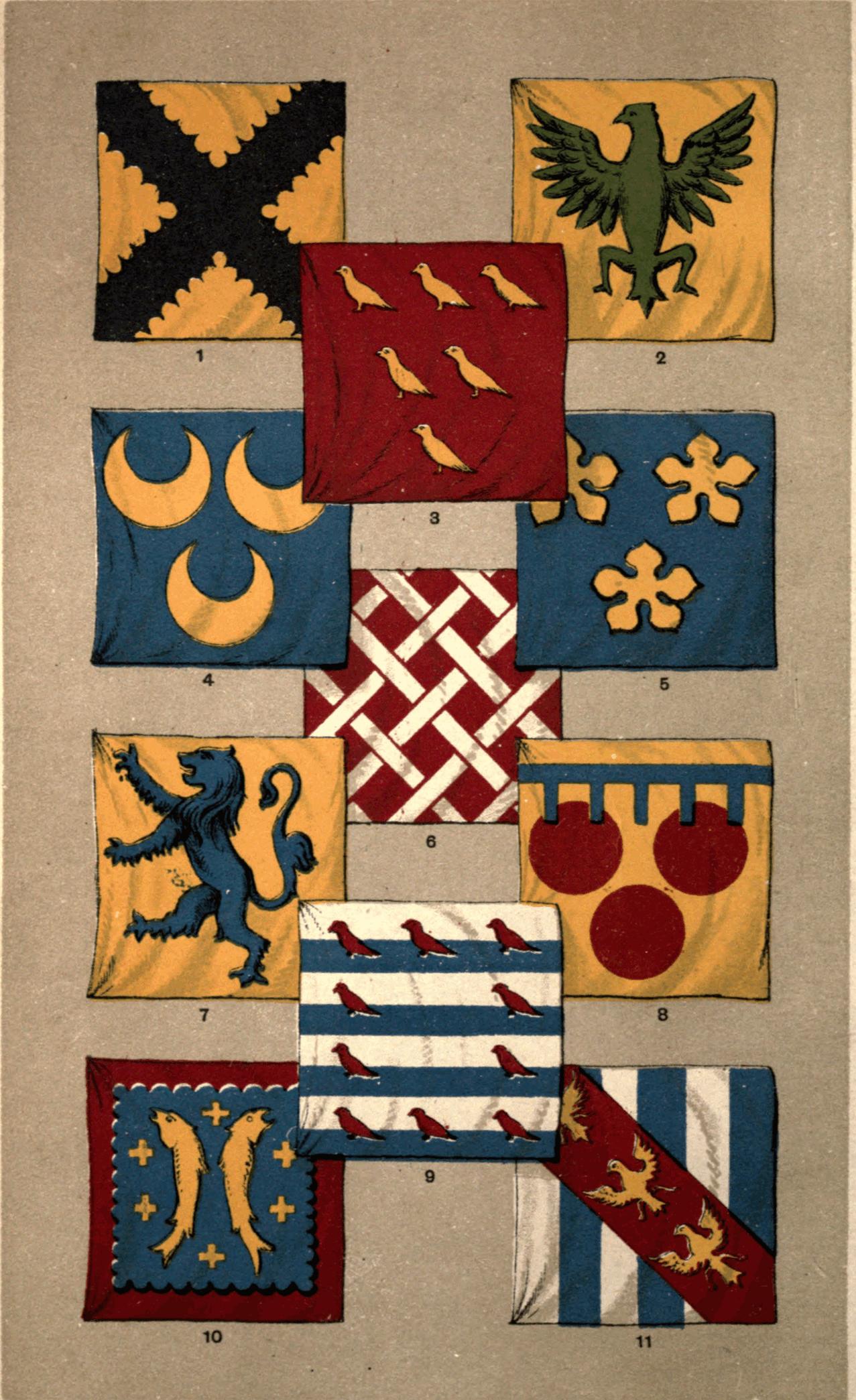
PLATE II.
12 Percy Flag, Crescent Badge. 13 Arctic Sledge-flag, Expedition of 1875-76. 14 The Percy Standard. 15 Standard of Sir Thomas de Swynnerton. 16 Arctic Sledge-flag, Expedition of 1875-76. 17 Banner of St. Edmund. 18 Banner of Simon de Montfort. 19 Banner of St. Edward.
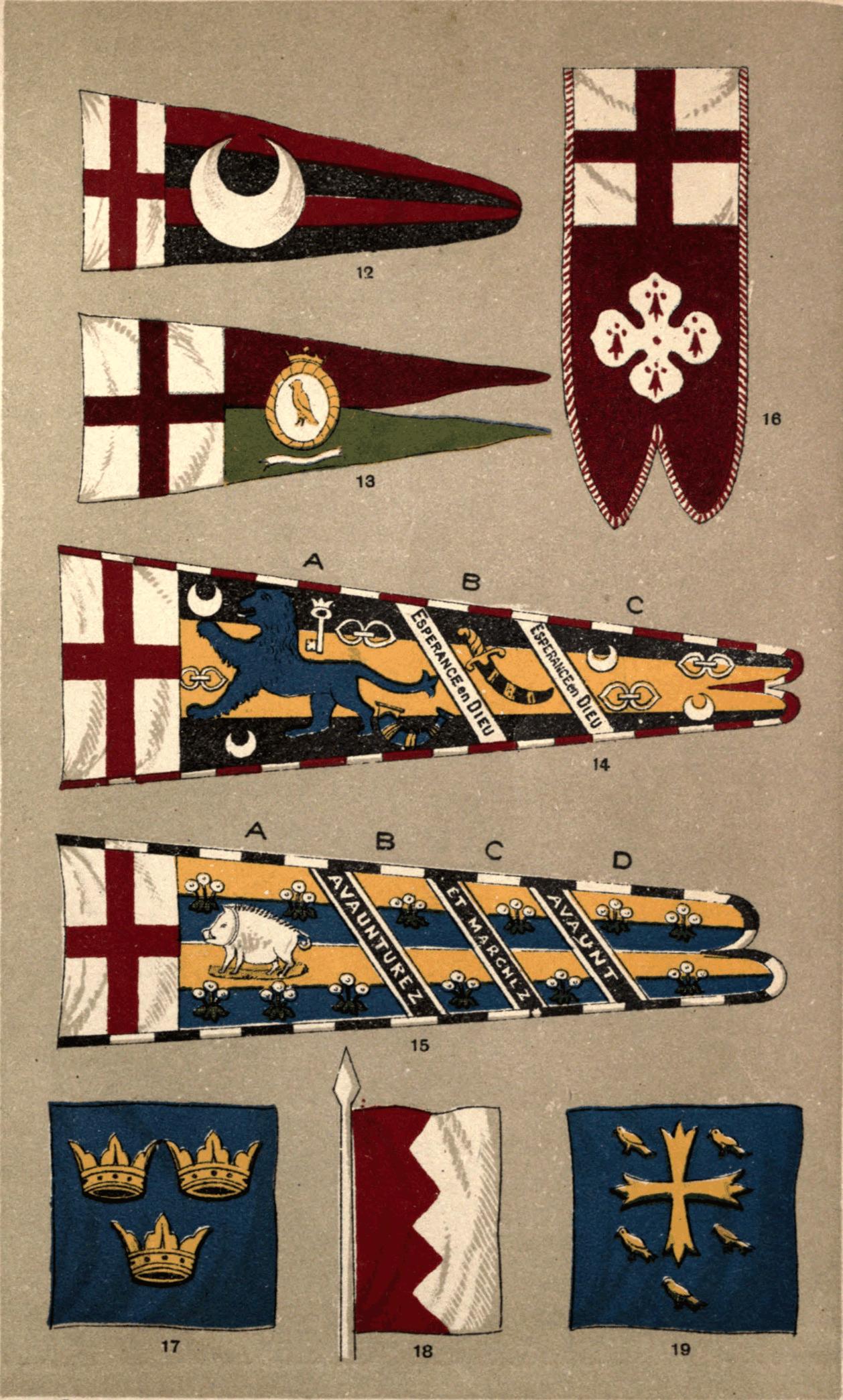
PLATE III.
20 Streamer, Tudor Fleur-de-Lys Badge, 1520. 21 Streamer, Tudor Portcullis Badge, 1520. 22 Standard of Henry VIII. 23 Streamer, Tudor Rose Badge, 1520. 24 Streamer, Tudor Red Dragon Badge, 1520. 25 Pendant of H.M.S. Lion. 26 Pendant of H.M.S. Tiger. 27 Pendant of Warship of 1520.
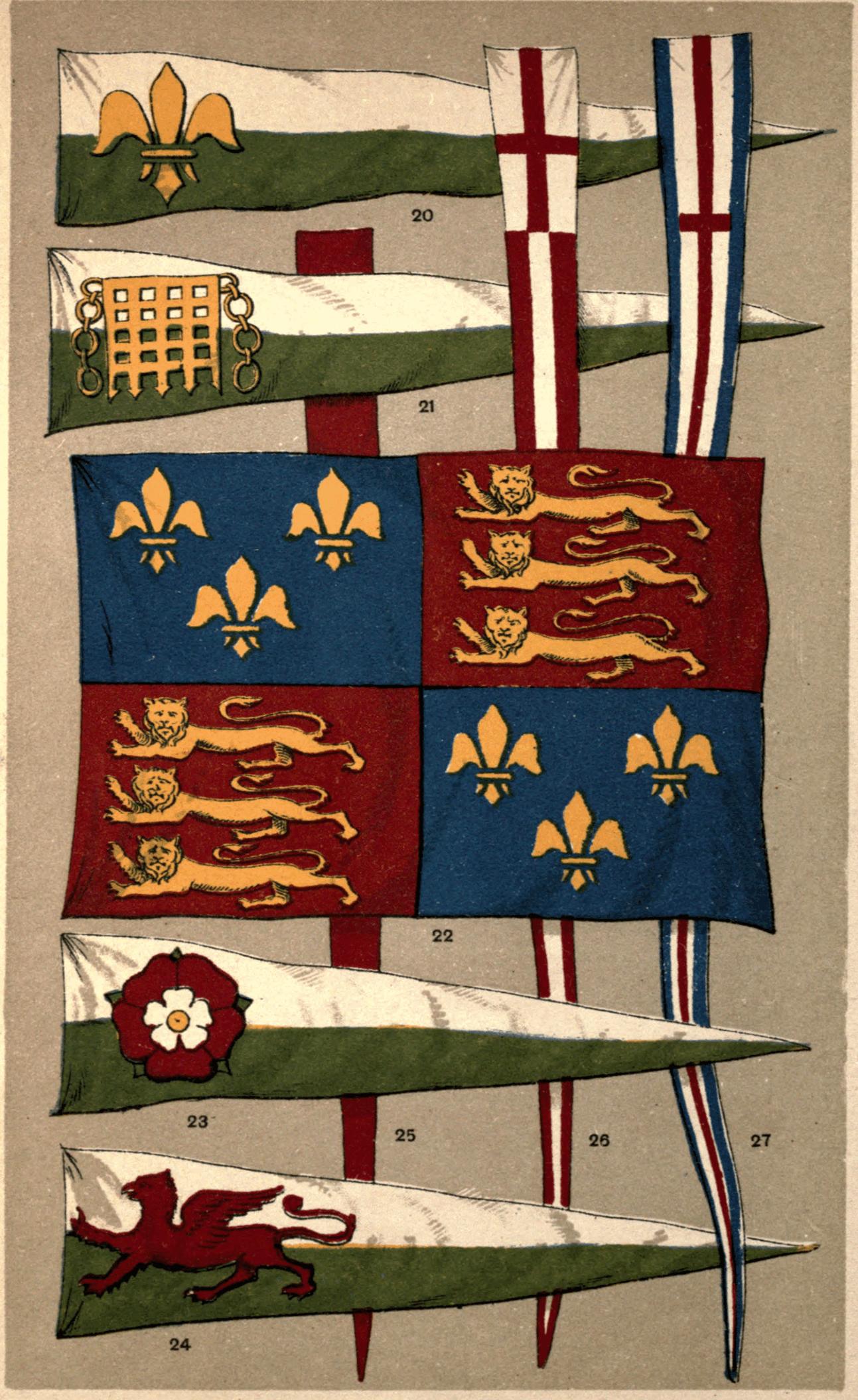
PLATE IV.
28 Guidon form of Flag. 29 Abnormal form of Pennon. 30 Lancer Pennon of present day. 31 Pennon, Royal Horse Artillery, 1813. 32 Flag from Early German Book. 33 Modification of Pennon form. 34 Flag of H.M.S. Niger, 1797. 35 Ecclesiastical Flag, MS. British Museum. 36 Burgee, the Ducal Shipping Line. 37 Early form of Banner, MS. British Museum. 38 Burgee, McIver's Shipping Line. 39, 40, 41, 42 Examples from Bayeux Tapestry. 4 illus.
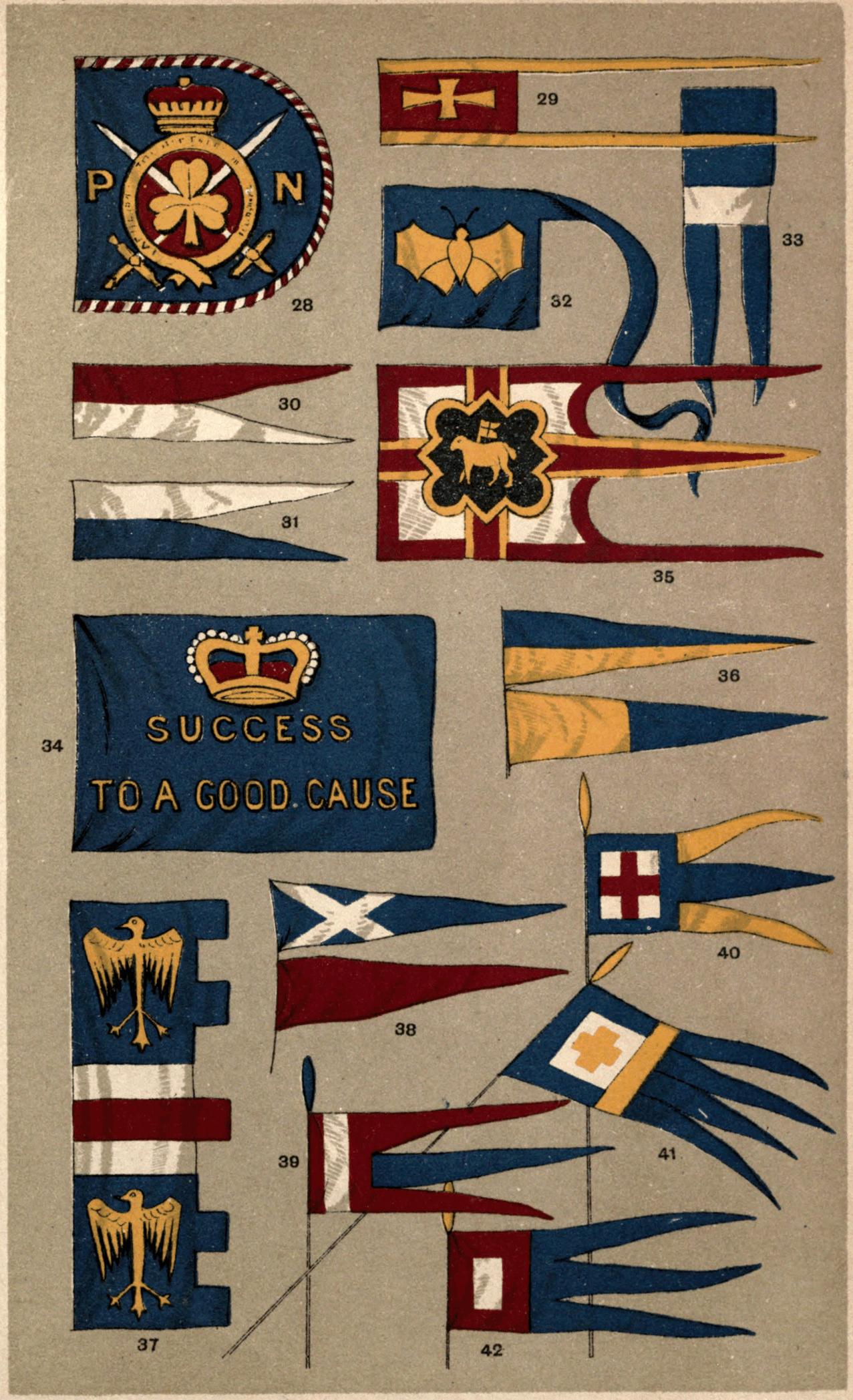
PLATE V.
43 The Royal Standard of King George III. 44 The Royal Standard of Queen Victoria.
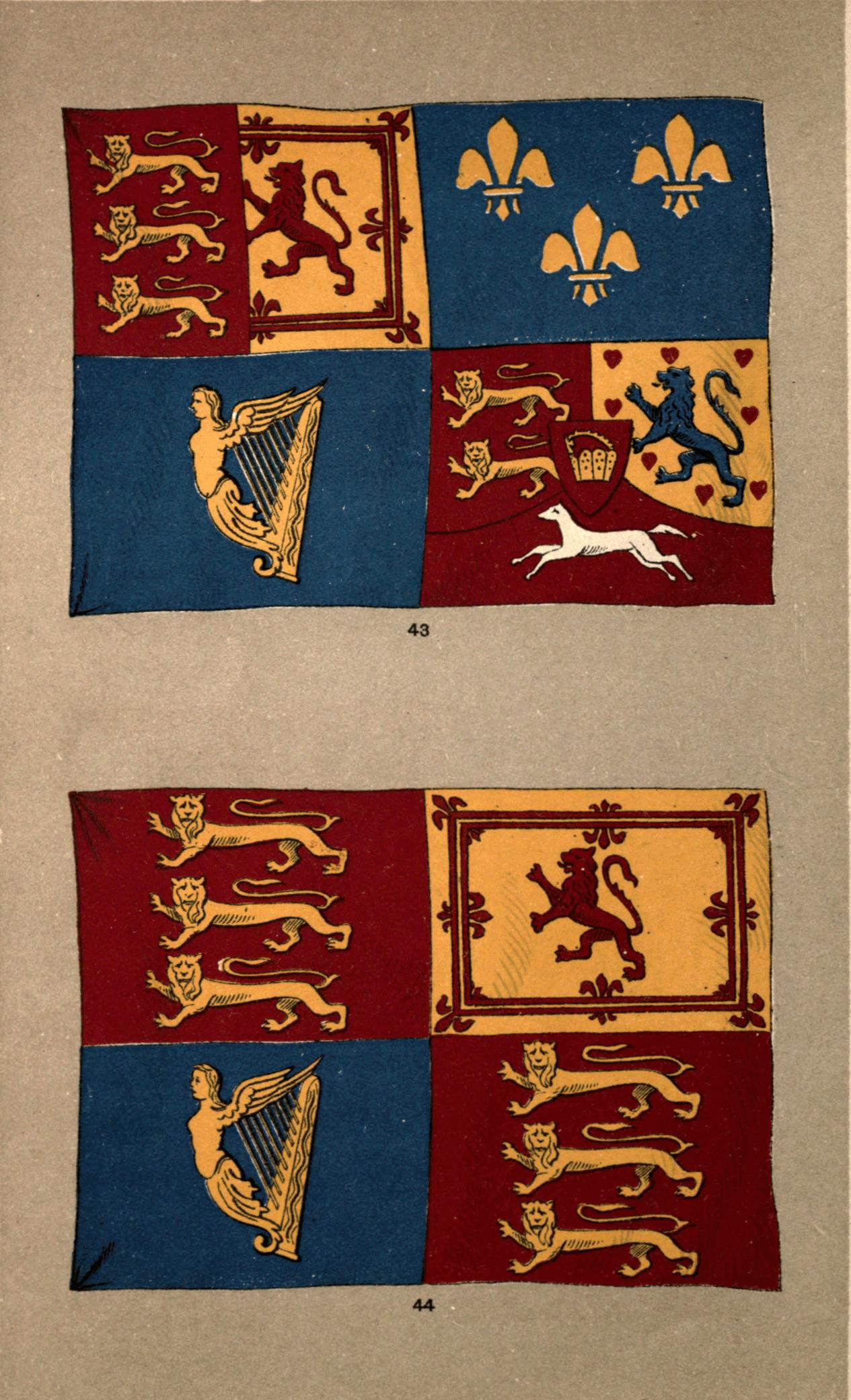
PLATE VI.
45, 46, 47, 48, 49, 50, 51 Illustrations of perverted ingenuity and crass ignorance, taken from street decorations on occasions of general rejoicing.
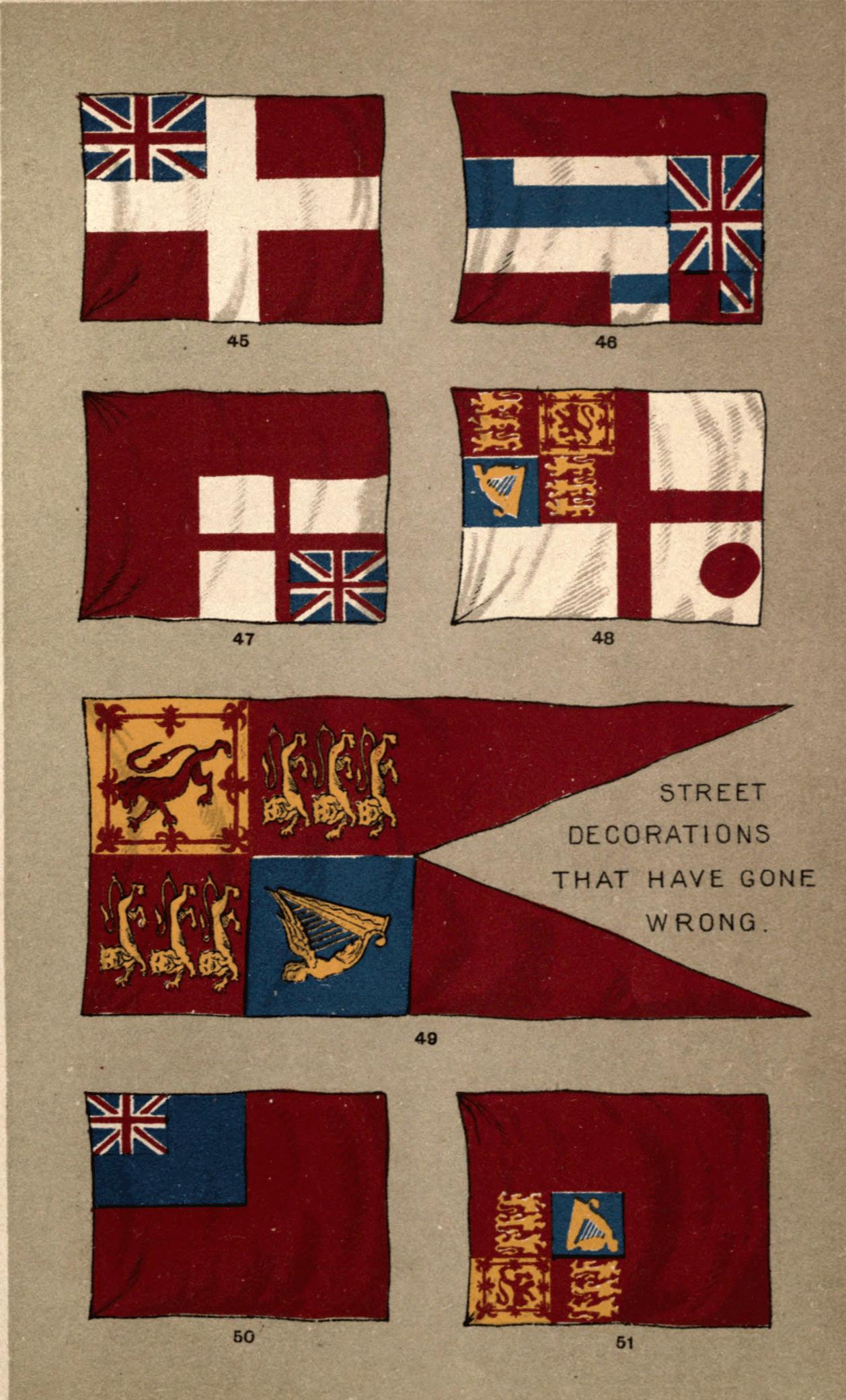
PLATE VII.
52, 53 Flags from early Spanish Map in British Museum, 1502. 54, 55 Early Portuguese Flags, British Museum. 56 The Guinea Company. 57 East India Company. 58 Early form of Algerian Flag. 59 Russian-American Company. 60 Early English War Flag. 61 Heligoland Flag during British Possession. 62 The Flag of Savoy. 63 Flag of the Grand Seigneur. 64 Turkish Flag.
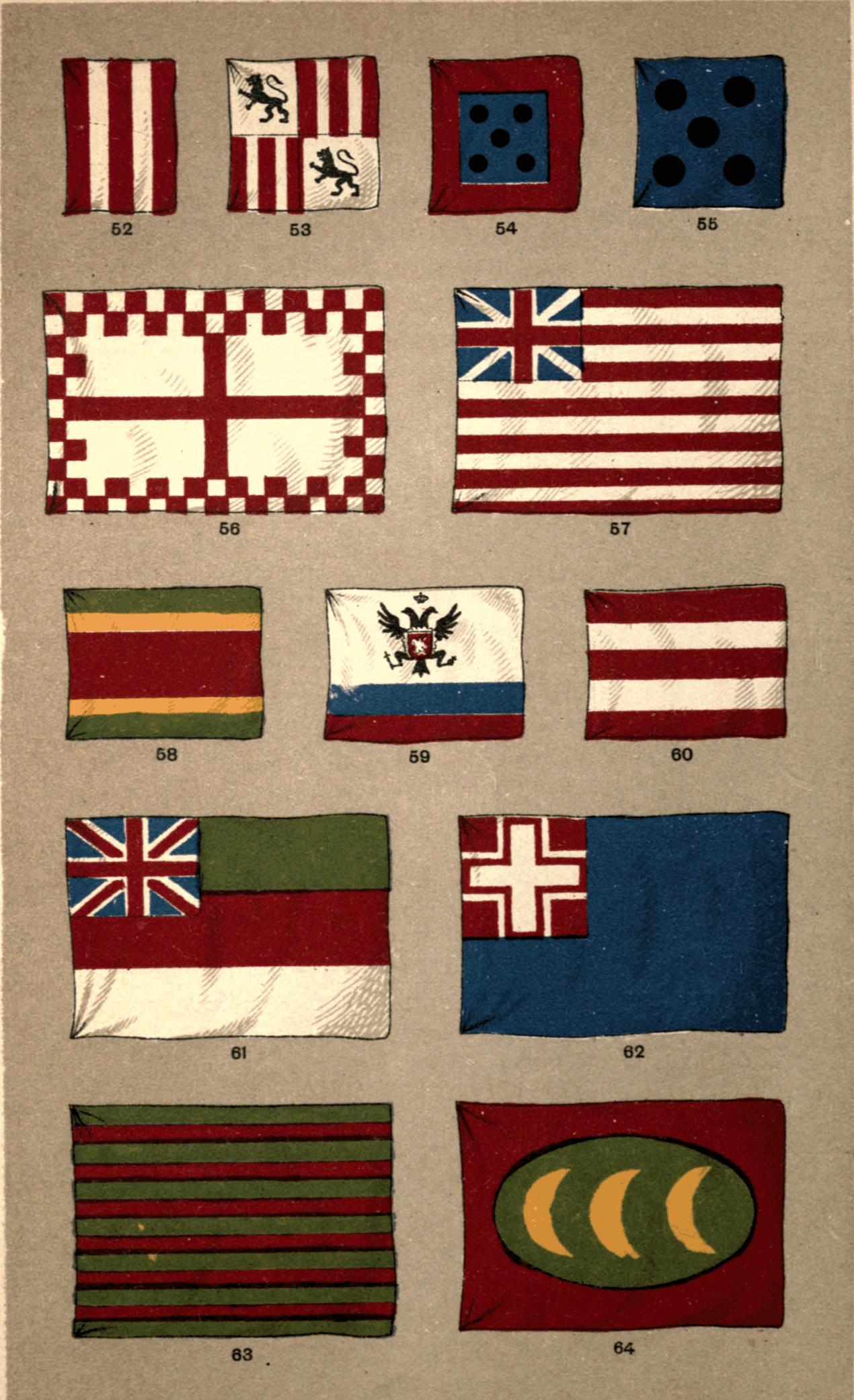
PLATE VIII.
65 Ship Flag, Reign of George I. 66 Early form of Red Ensign. 67 London Train Bands: The Blue Regiment, 1643. 68 London Train Bands: The Yellow Regiment, 1643. 69 Flag of Warship, 16th Century. 70 Flag of H.M.S. Tiger. 71 St. George, and Tudor Livery Colours. 72 London Train Bands: The Green Regiment, 1643. 73 Flag of Union of England and Scotland. 74 Pendant of H.M.S. Lion, 1745. 75 Scottish Blue Ensign. 76 Scottish Red Ensign. 77 Banner of St. Alban's Abbey. 78 Jack of Warship of the 16th Century. 79 Suggested forms for Union Flag, 1801.
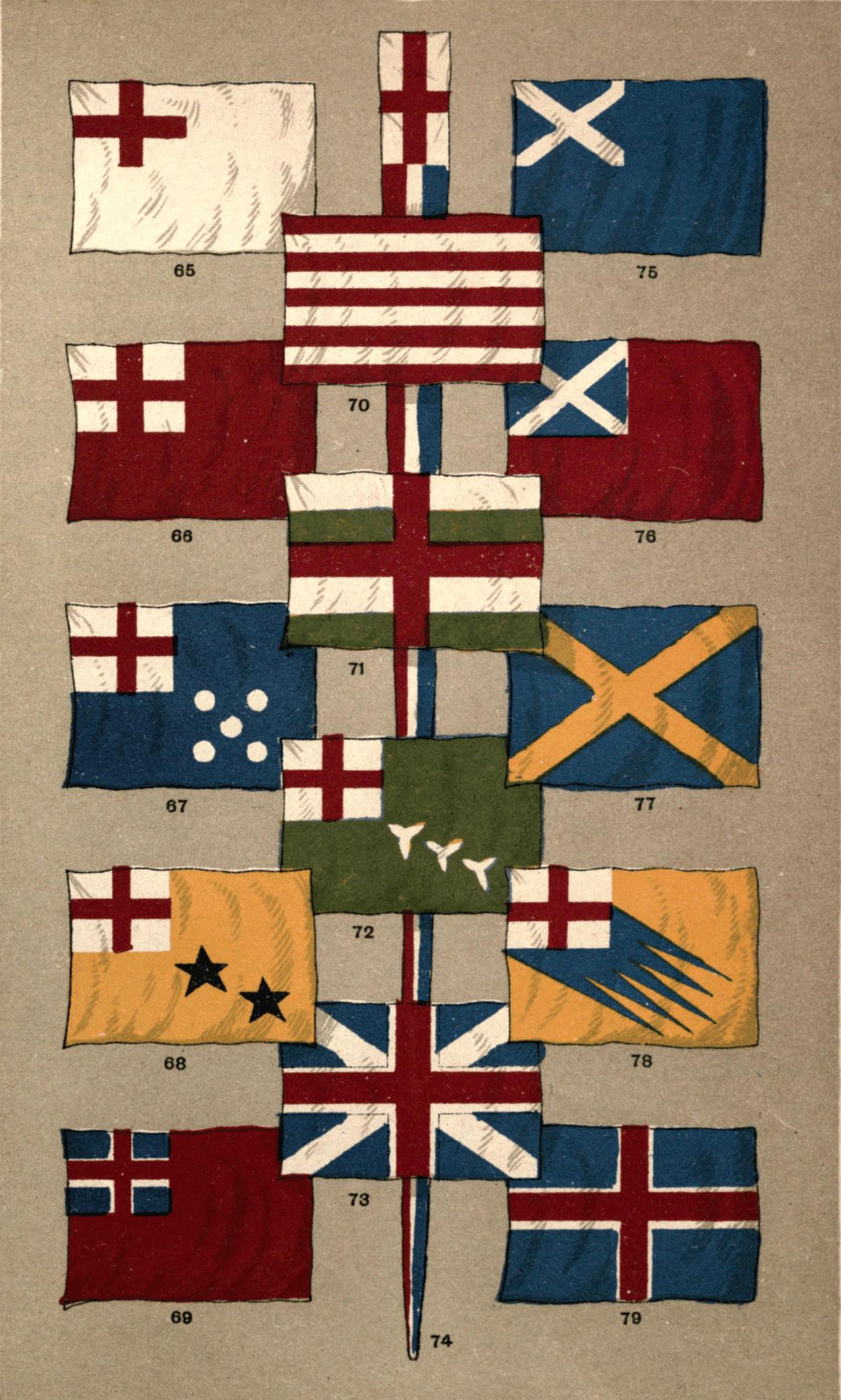
PLATE IX.
80 Early Union Flag, England and Scotland. 81 Commonwealth Flag, England and Scotland. 82 Commonwealth Flag, England and Ireland. 83 Standard of Cromwell. 84 Scotch suggestion for Union Flag, 1801. 85 Flag of Commonwealth. 86 Commonwealth Flag of England and Ireland. 87 Early Form of Irish Flag, MS. in British Museum. 88, 89 Suggested Forms for second Union Jack.
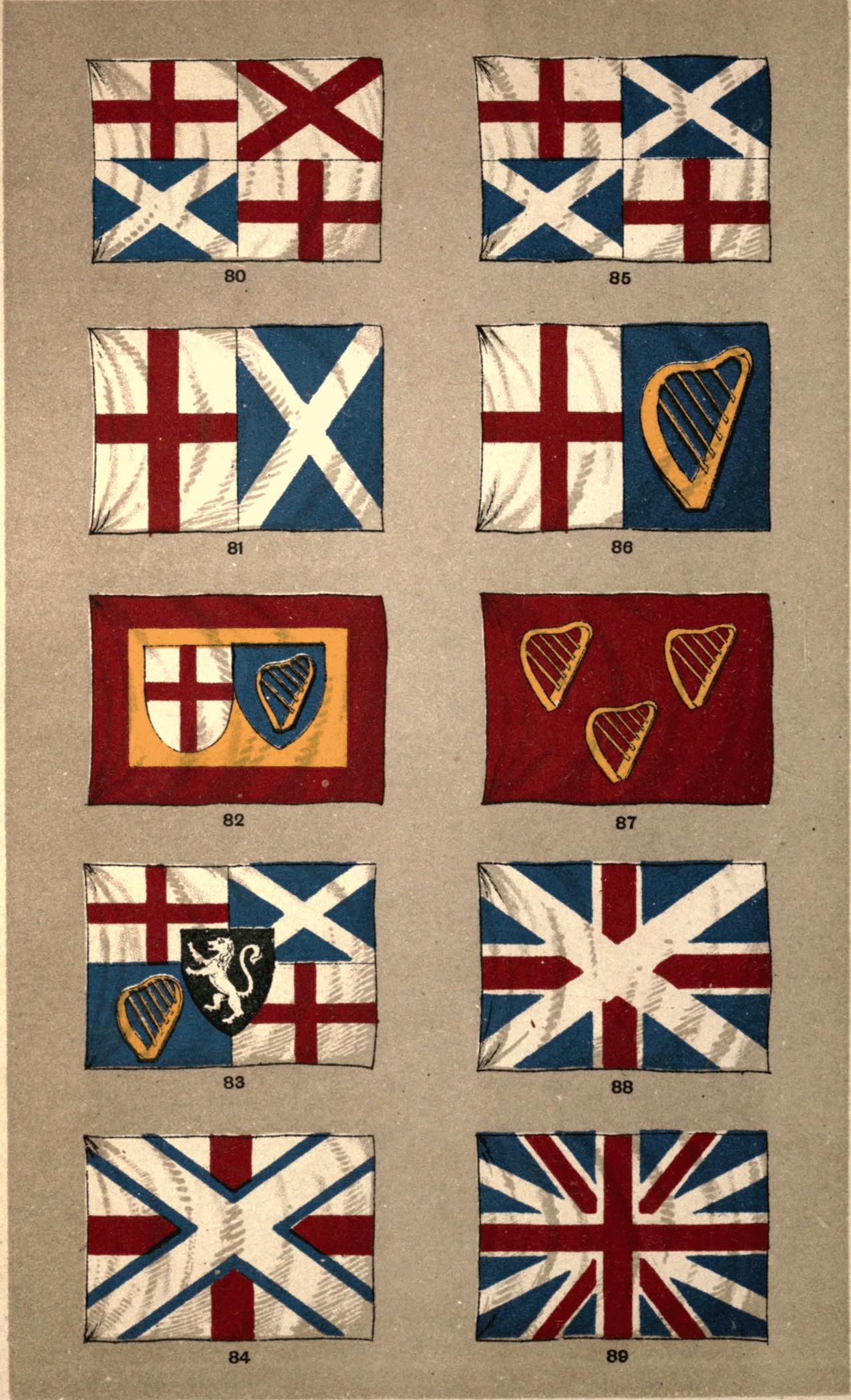
PLATE X.
90 Union Flag of Great Britain and Ireland. 91 Cross of St. George of England. 92 Cross of St. Andrew of Scotland. 93 Cross of St. Patrick of Ireland. 94 Regimental Colours: 24th of the Line, the 2nd Warwickshire Regiment.
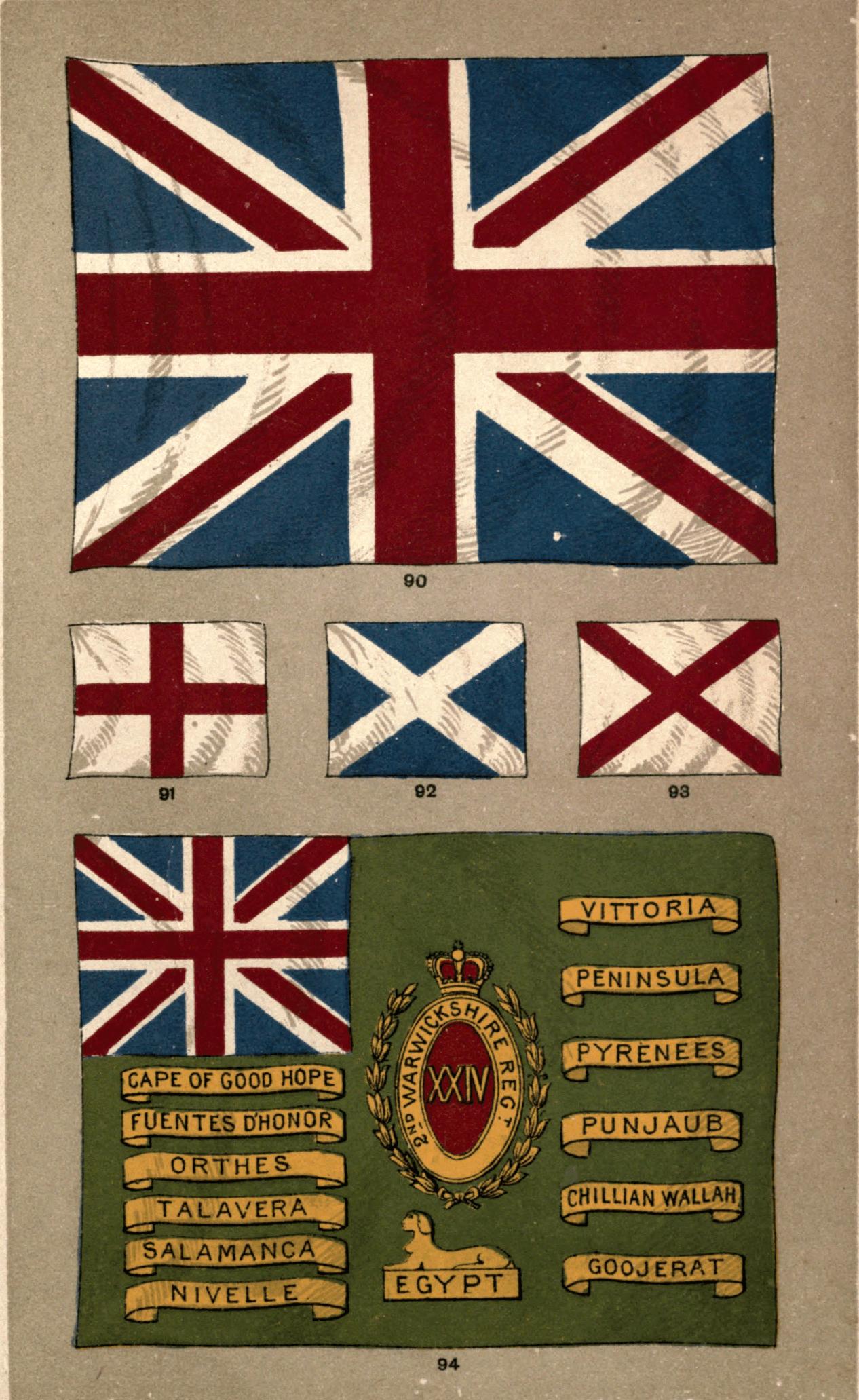
PLATE XI.
95 The White Ensign, Man-of-War. 96 The Blue Ensign, Naval Reserve. 97 The Red Ensign, Merchant Service. 98 Victualling Service. 99 Admiralty Flag. 100 Ranelagh Yacht Club. 101 Yare Yacht Club. 102 Royal Thames Yacht Club. 103 Dublin Bay Yacht Club. 104 Pilot Jack. 105 Board of Trade Flag. 106 Flag of Lord-Lieutenant of Ireland. 107 Customs House Flag. 108 Ordnance Flag.
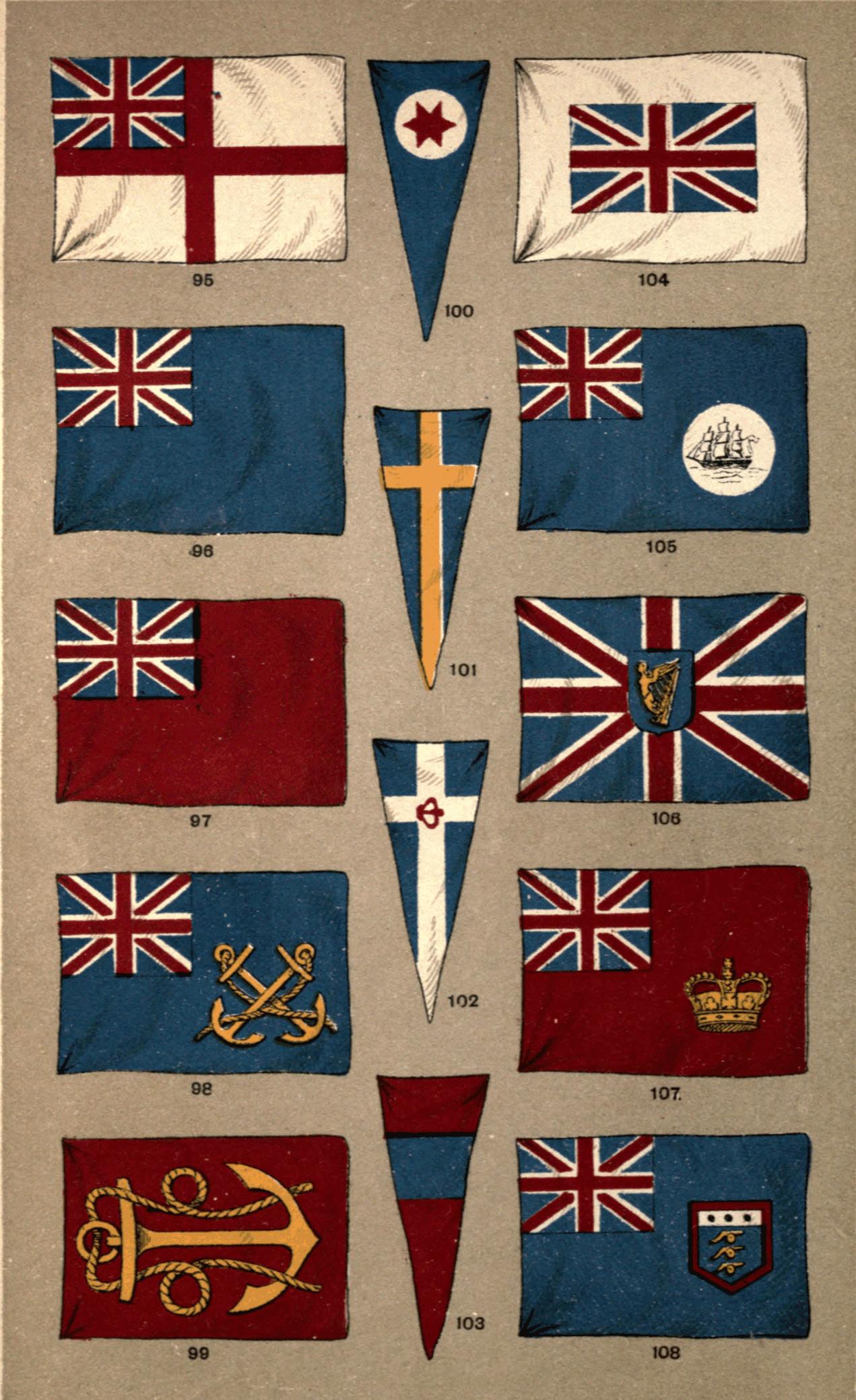
PLATE XII.
109 Green's Blackwall Line. 110 Cunard Line, Liverpool. 111 Peninsular and Oriental Company. 112 Australasian Naval Company. 113 Devitt & Moore, London. 114 Canadian Pacific Company. 115 Donald Currie & Co., London. 116 Union Steamship Company, Southampton. 117 Mediterranean and New York Shipping Company. 118 Houlder Brothers & Company, London. 119 White Star Line, Liverpool. 120 New Zealand Shipping Company. 121 Britannia, H.R.H. the Prince of Wales. 122 Ailsa, A. B. Walker, Esq. 123 Valkyrie, The Earl of Dunraven. 124 Hester, Major W. H. Gretton. 125 Dream, W. H. Jones, Esq. 126 Carina, Admiral Montague.
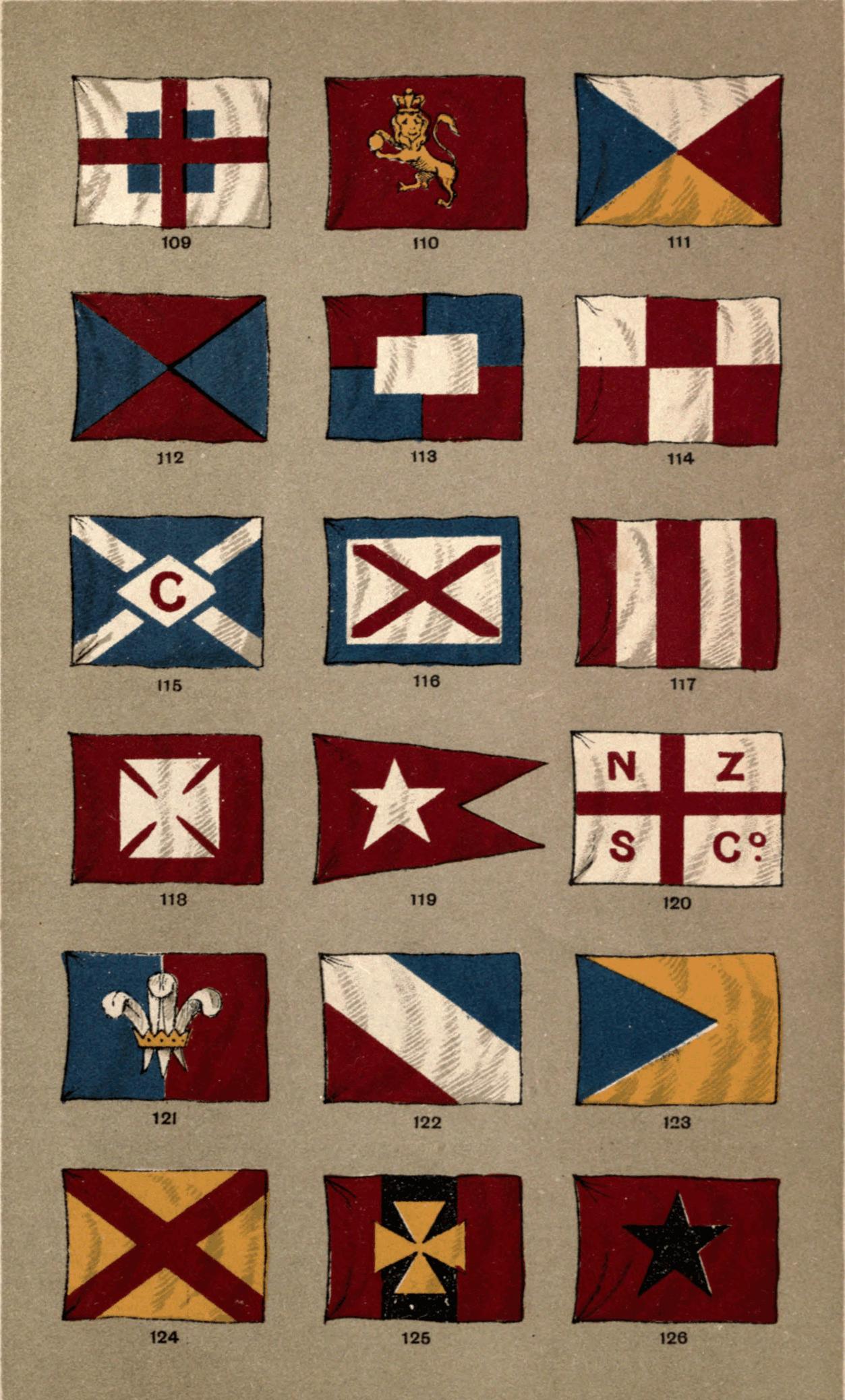
PLATE XIII.
127 Cape Colony, Government. 128 Queensland, Government. 129 Canada, Commercial. 130 Canada, Government. 131 Badge of Straits Settlements. 132 Badge of British North Borneo. 133 Badge of Tasmania. 134 Victoria, Commercial. 135 Victoria, Government. 136 Badge of New Zealand. 137 Badge of Fiji. 138 Badge of New South Wales. 139 Flag of Viceroy of India. 140 Portion of Pendant, Government Colonial vessels. 141 Governors' Flag, West Australia.
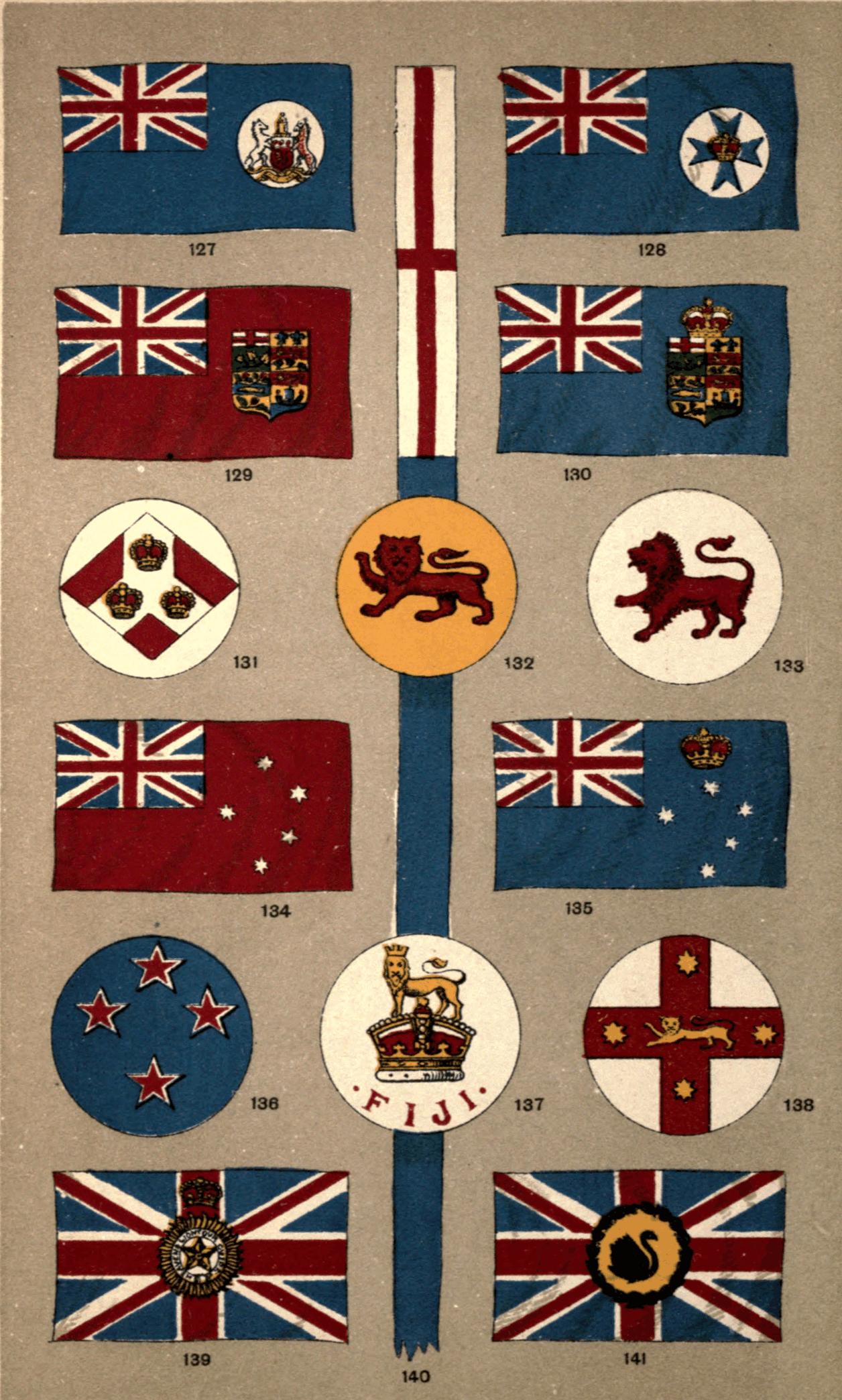
PLATE XIV.
142 American Insurgent Flag, 1775. 143 Admiral's Flag, U.S. Navy. 144 Flag used at Bunker's Hill. 145 American Pine-tree Flag. 146 The Stars and Stripes of the United States. 147 New England Navy Flag, 1776. 148 Massachusetts Flag, 1775. 149 Pine-tree and Stripes. 150 Early American Flag. 151 Portion of Pendant, U.S.Navy.
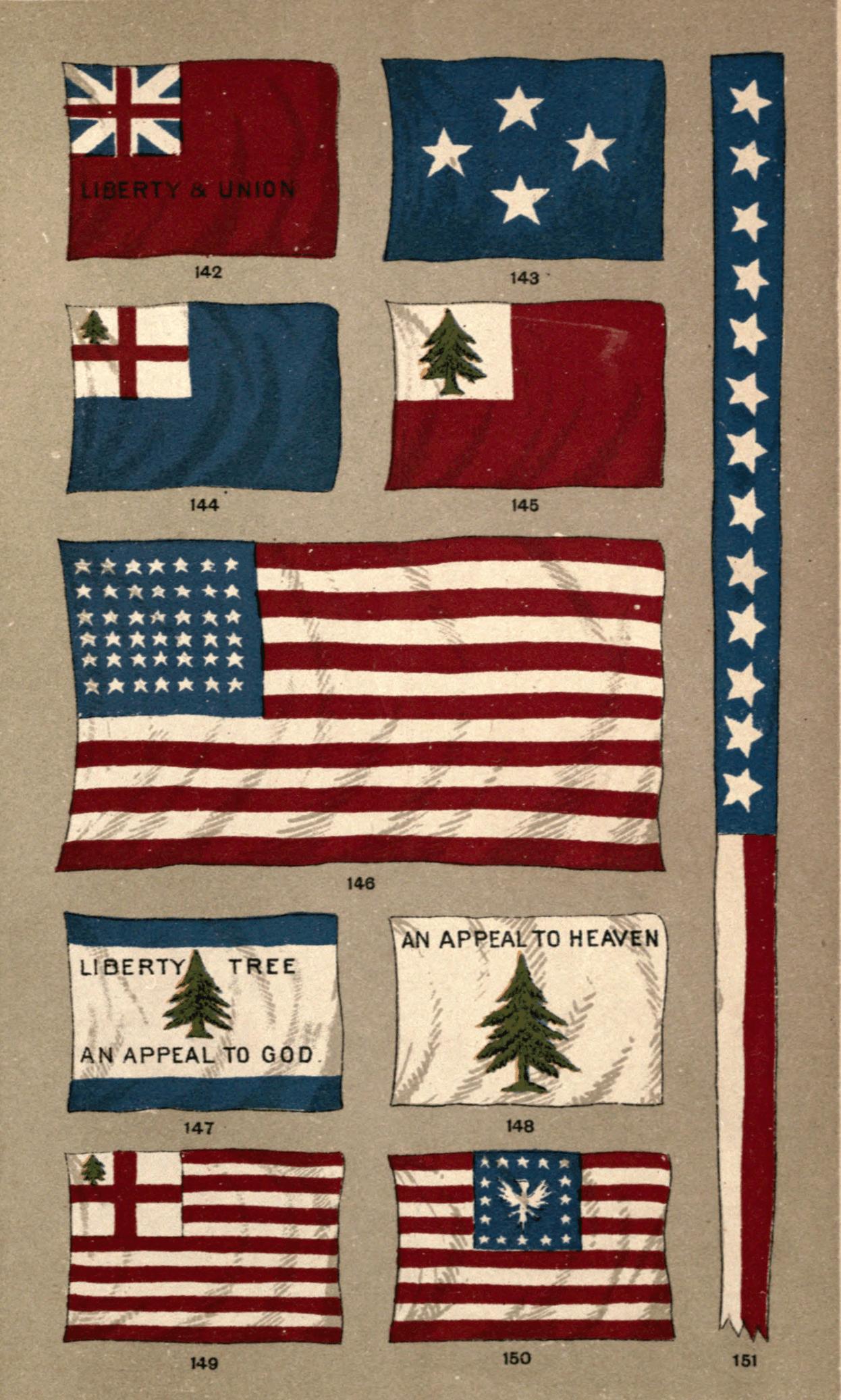
PLATE XV.
152 Confederate States of America. 153 Confederate, the Southern Cross. 154 Southern Cross, modified. 155 South Carolina State Flag, 1861. 156 Louisiana State Flag. 157 Chili, portion of Pendant. 158 South Carolina, 1775. 159 South Carolina State Flag, 1861. 160 Texas State Flag. 161 Chili, Commercial. 162 Guatemala, Flag of 1851. 163 Guatemala, Flag of 1858.
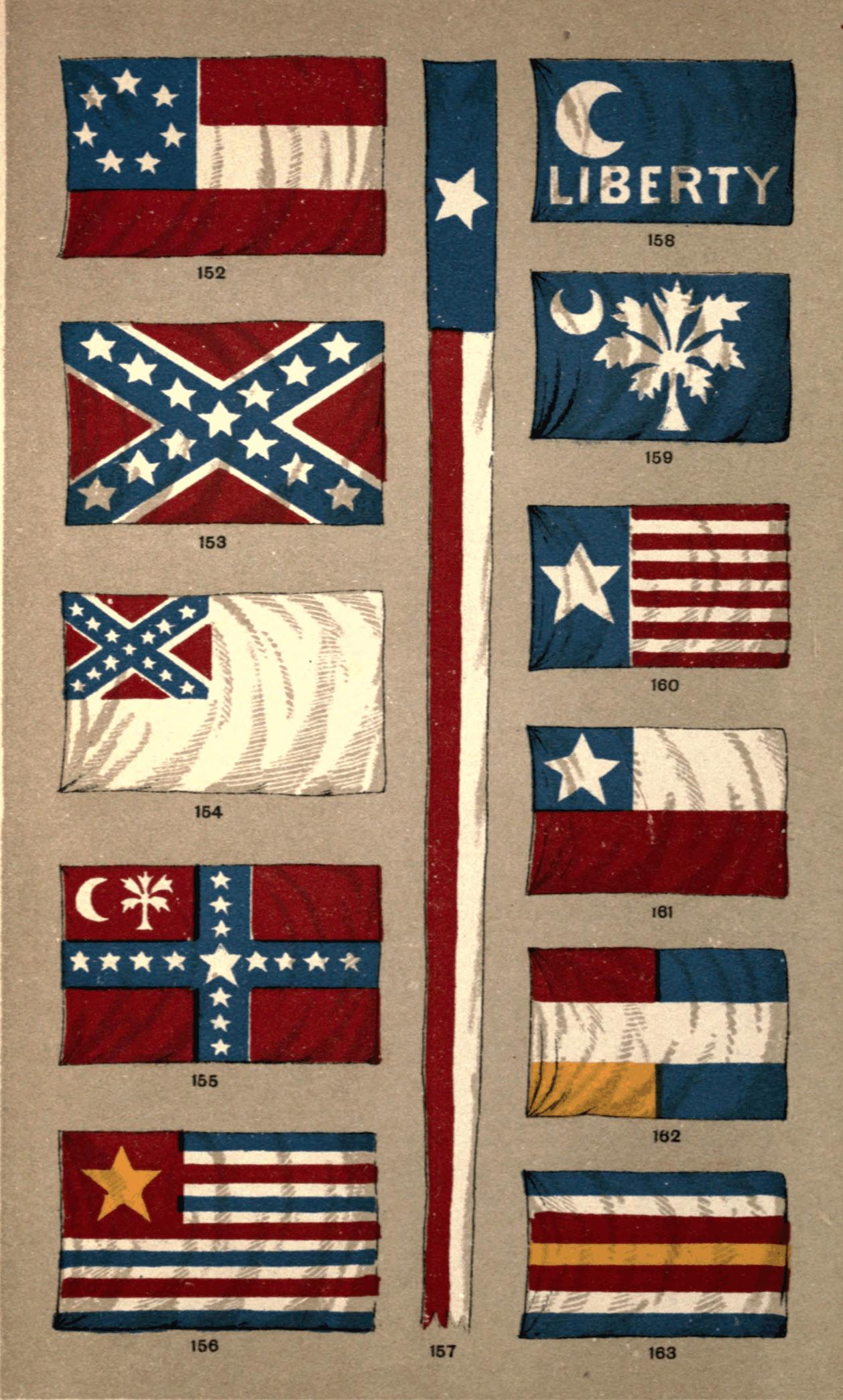
PLATE XVI.
164 Colombia (formerly New Granada), Commercial. 165 Uruguay, General Service. 166 Guatemala, Government. 167 Costa Rica, Commercial. 168 Paraguay, Government. 169 Brazil, General Service. 170 Venezuela, Commercial. 171 Bolivia, Commercial. 172 Mexico, Government. 173 Portion of Pendant, Brazil. 174 Peru, Government. 175 San Salvador, General Service. 176 Argentine, Government. 177 Ecuador, Government. 178 Hayti, Commercial.
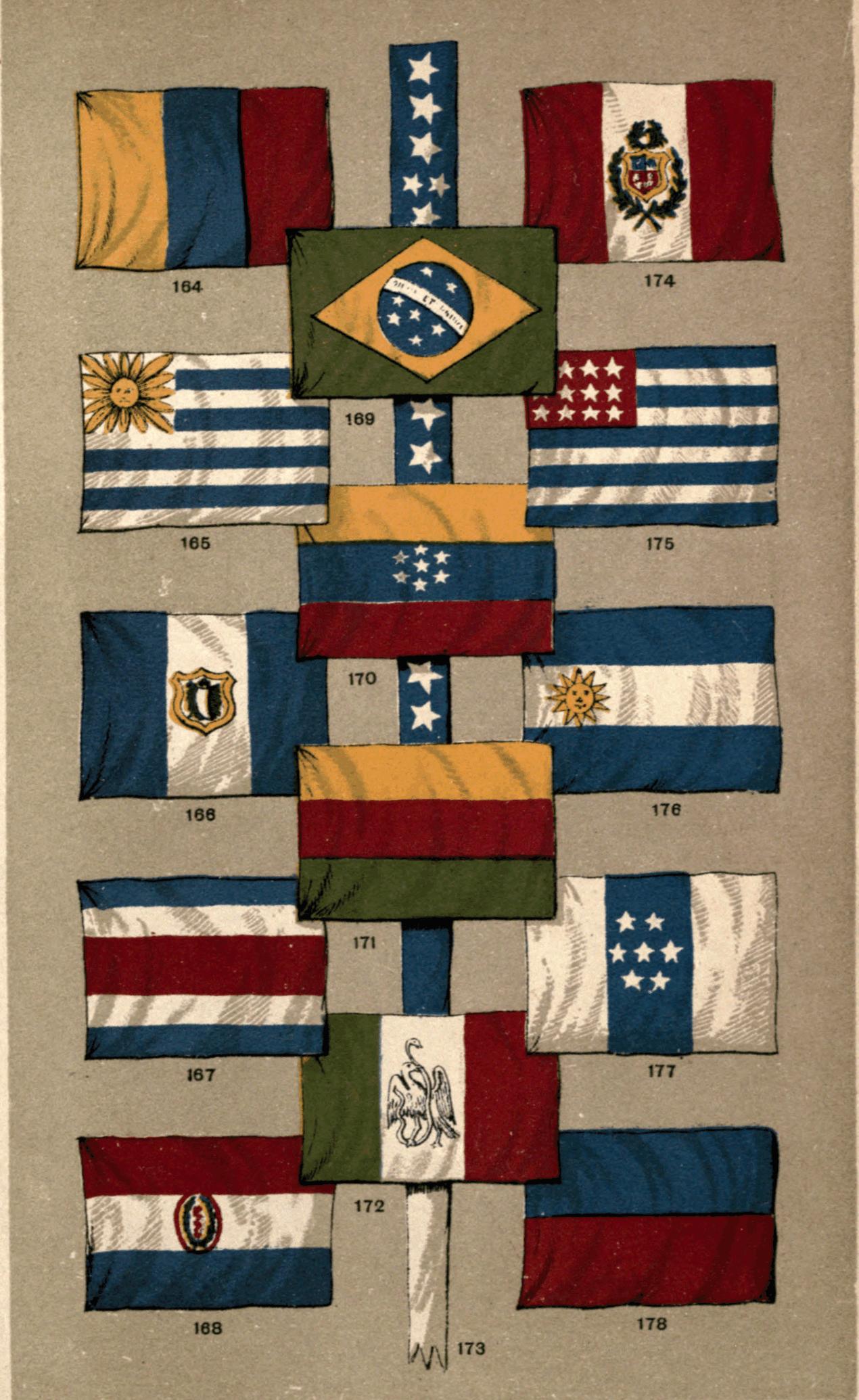
PLATE XVII.
179 Oriflamme. 180, 181 Early French forms of Flag. 182 Soissonois Flag. 183 Bourbon Flag. 184 Standard of Charles VI. 185 Standard, French. 186 Man-of-War Pendant. 187 Standard, French. 188 Flag of French Guards, 1563. 189 Flag of Republic, France. 190 Tricolor of 1790. 191 Modern French Tricolor.
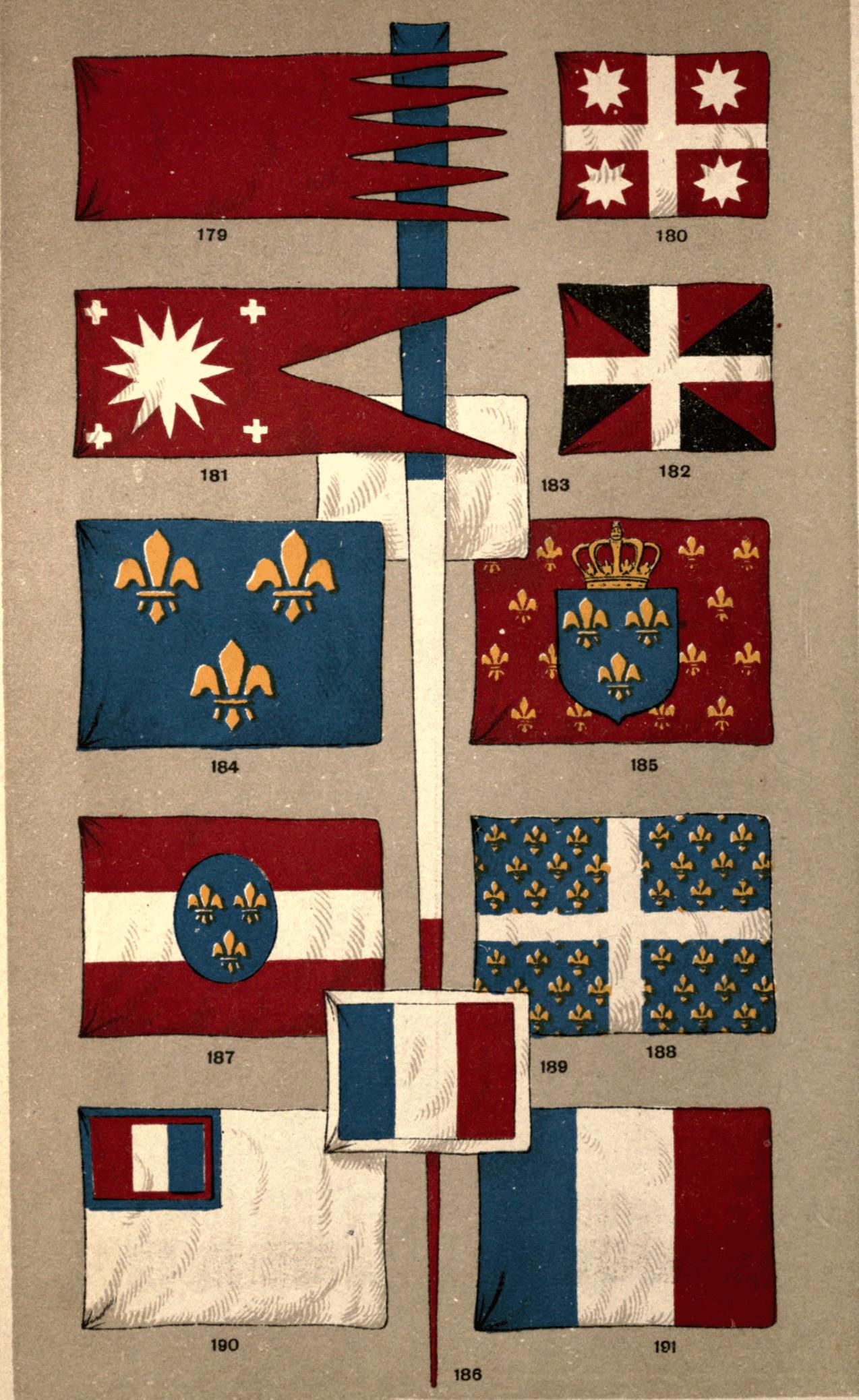
PLATE XVIII.
192 Spain, War. 193 Spain, Commercial. 194 Royal Standard of Spain. 195 Portugal, Royal Standard. 196 Portugal, General Service. 197 Italy, Commercial. 198 Papal Merchant (obsolete).
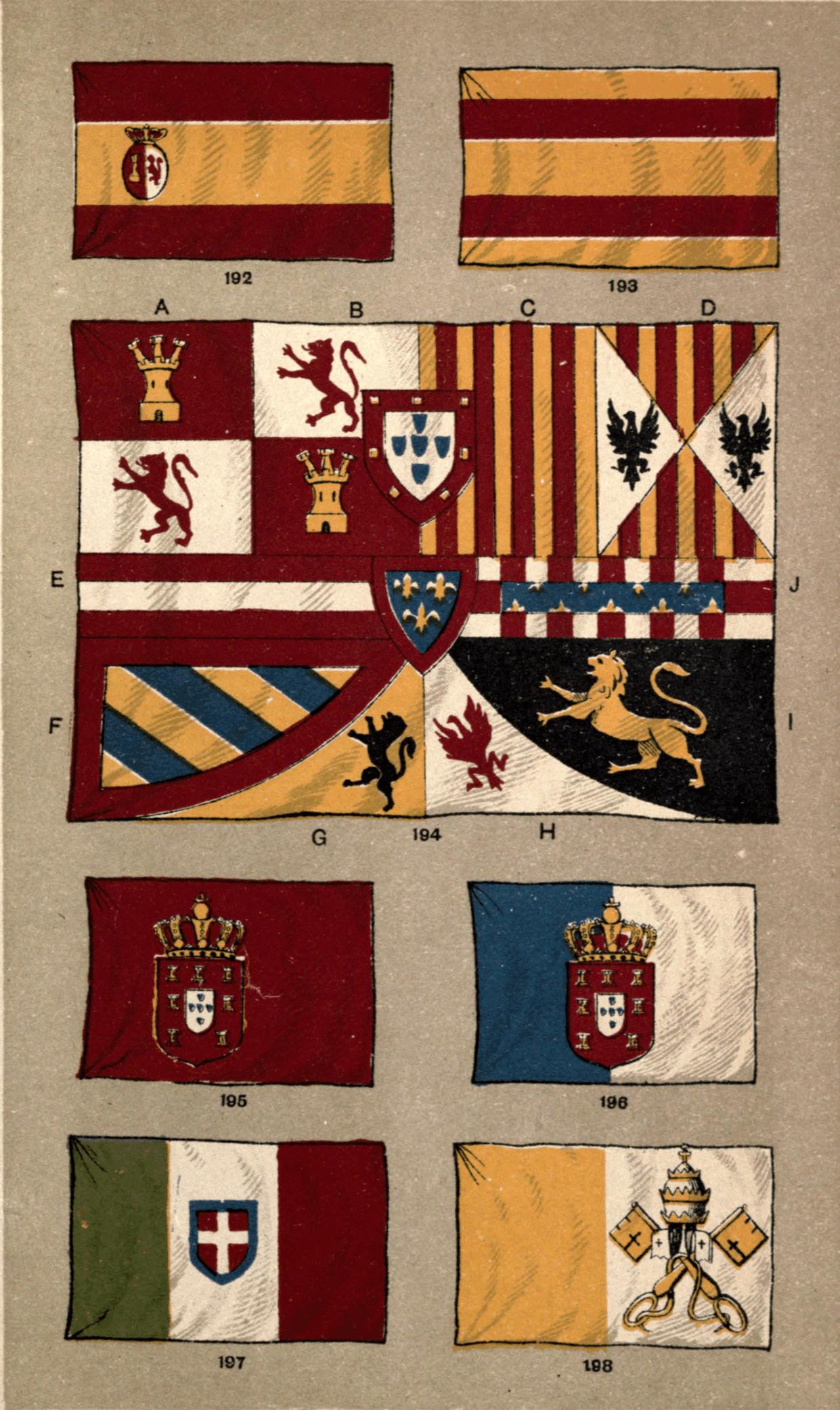
PLATE XIX.
199 Saxony. 200 Waldeck. 201 Saxe Weimar. 202 Pomerania. 203 Wurtemburg. 204 Oldenburg. 205 Mecklenburg Strelitz. 206 Brunswick. 207 German Empire, War Ensign. 208 German Empire, Jack. 209 Saxe-Coburg-Gotha. 210 Schomberg Lippe. 211 West Prussia. 212 Hesse. 213 Austria, Government. 214 Austro-Hungarian, Commercial. 215 Russian Jack. 216 Poland.
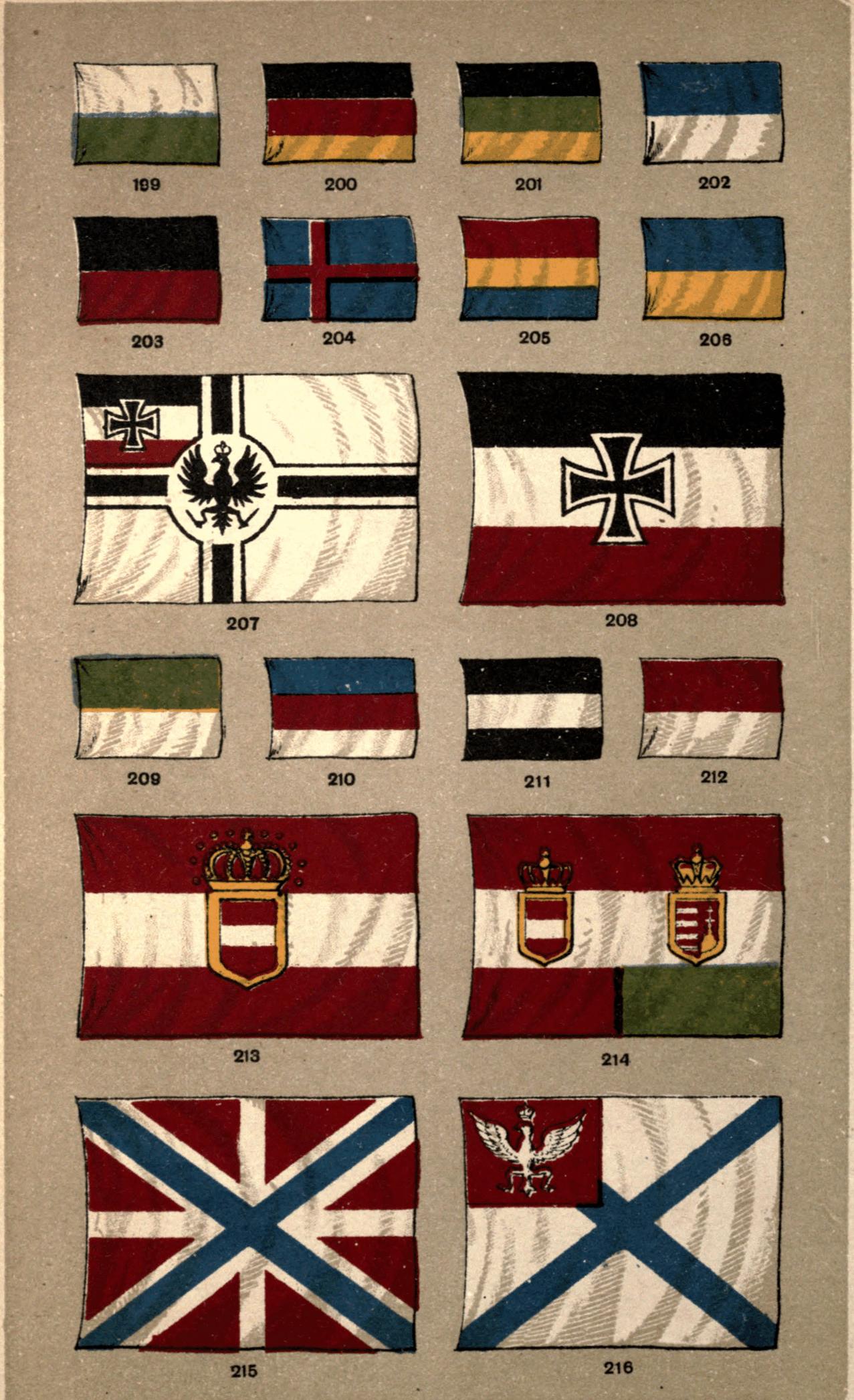
PLATE XX.
217 Russian Man-of-War. 218 Russia, Commercial. 219 Early Form of Russian Ensign. 220 Russia, Consul General. 221 Russia, Chargé d'Affaires. 222 Russia, Ambassador or Minister. 223 Russia, Transport Service. 224 Danish Man-of-War. 225 Danish, Commercial. 226 Russian Imperial Standard. 227 Swedish, Commercial. 228 Norwegian Man-of-War. 229 Union Flag of Sweden and Norway. 230 Flag of Norway. 231 Flag of Sweden. 232 Switzerland.
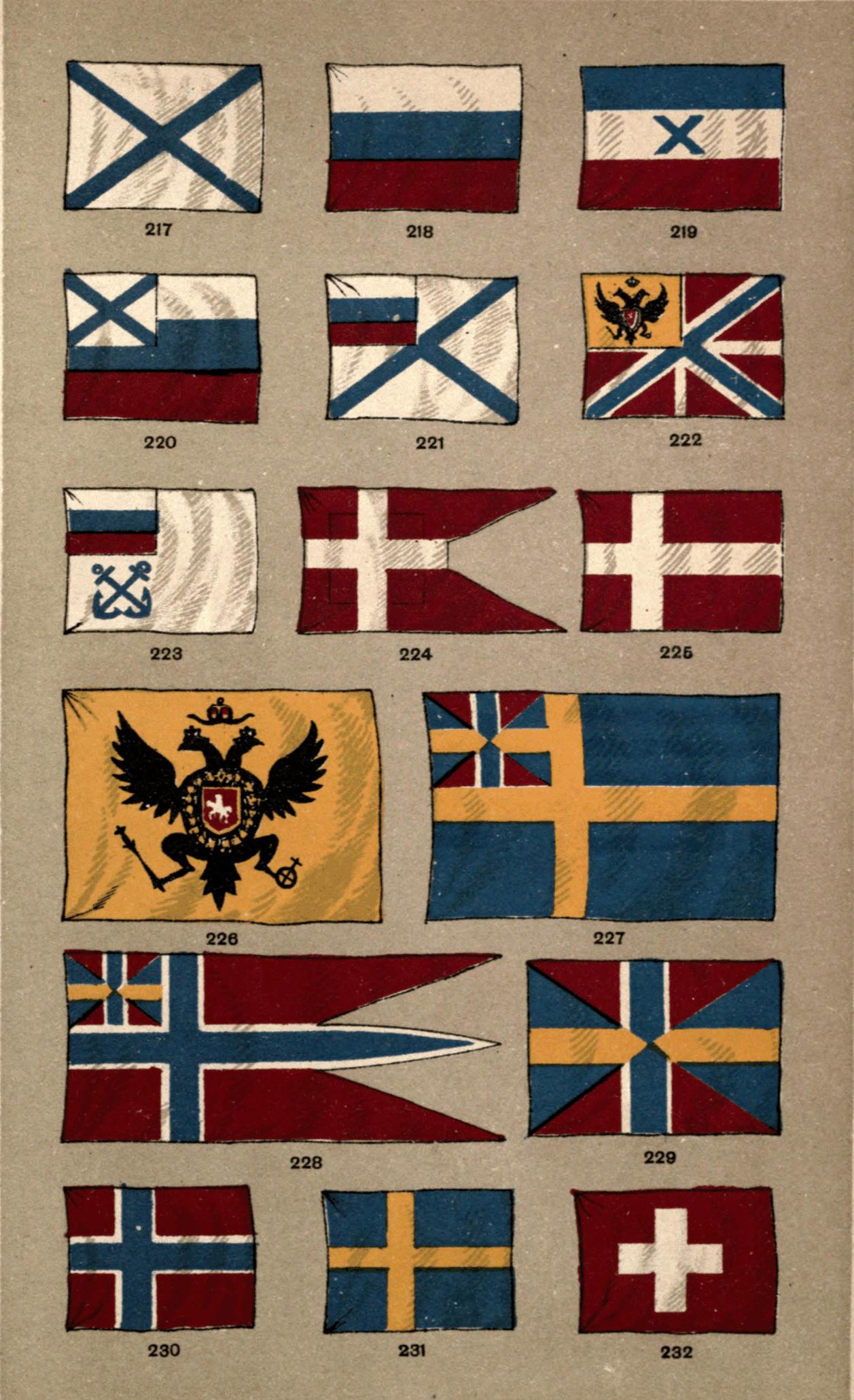
PLATE XXI.
233 Greece, Commercial Flag. 234 Italian Jack. 235 Turkey, Commercial. 236 Belgium, Commercial. 237 Holland, Royal Standard. 238 Turkey, Standard. 239 Turkey, Government. 240 Tunis, Government.
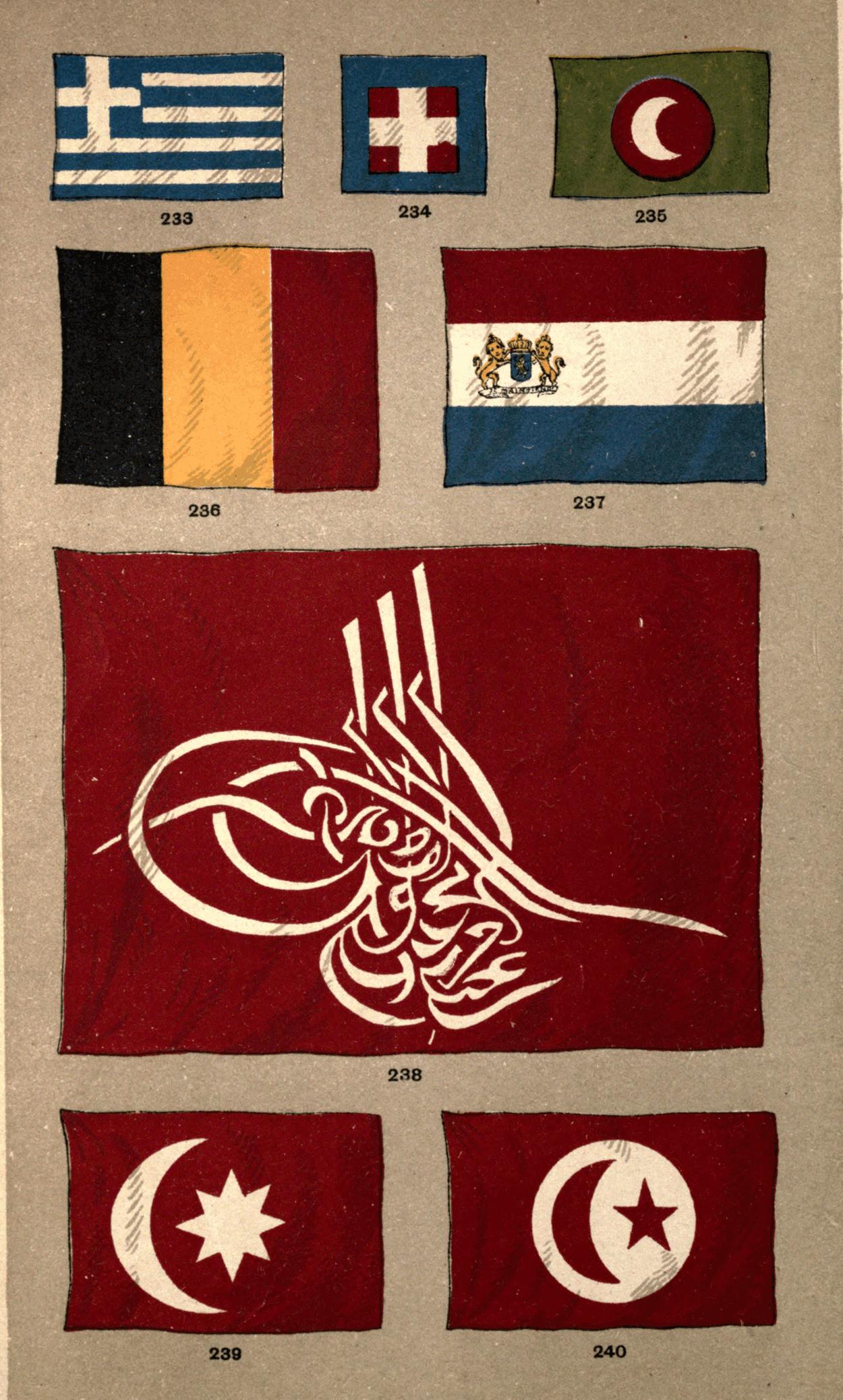
PLATE XXII.
241 Bulgaria. 242 Roumania. 243 Servia. 244 Japanese Ensign. 245 Japanese Imperial Standard. 246 Japanese Transport Flag. 247 Chinese Merchant Flag. 248 Japanese Guard Flag. 249 Orange Free State. 250 Liberia. 251 Congo State. 252 Rajah of Sarawak. 253 South African Republic.
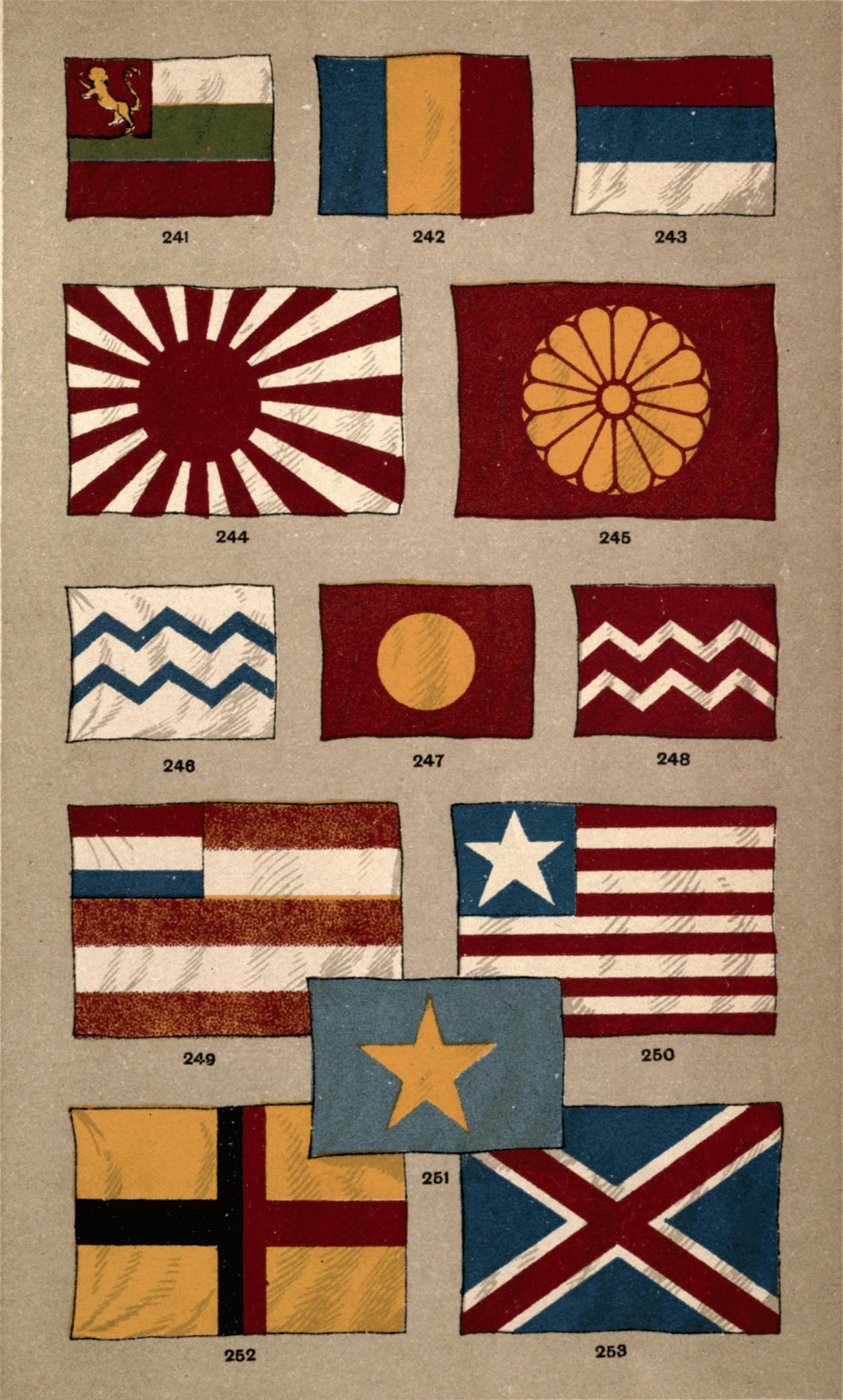
PLATE XXIII.
254 to 267 Fourteen Flags from the Signal Code of the Royal Navy. 268 Special Flag of the Coast Guard. 269 to 278 Code of Sir Hope Popham, used by Nelson at Trafalgar, &c. 10 illus. 279 to 286 Special Battle Signals, code suggested in 1788. 8 illus. 287 to 296 Numerical Code. Signal Code of 1788. 10 illus. 297 to 306 Pilot Signals of various Nationalities. 10 illus.
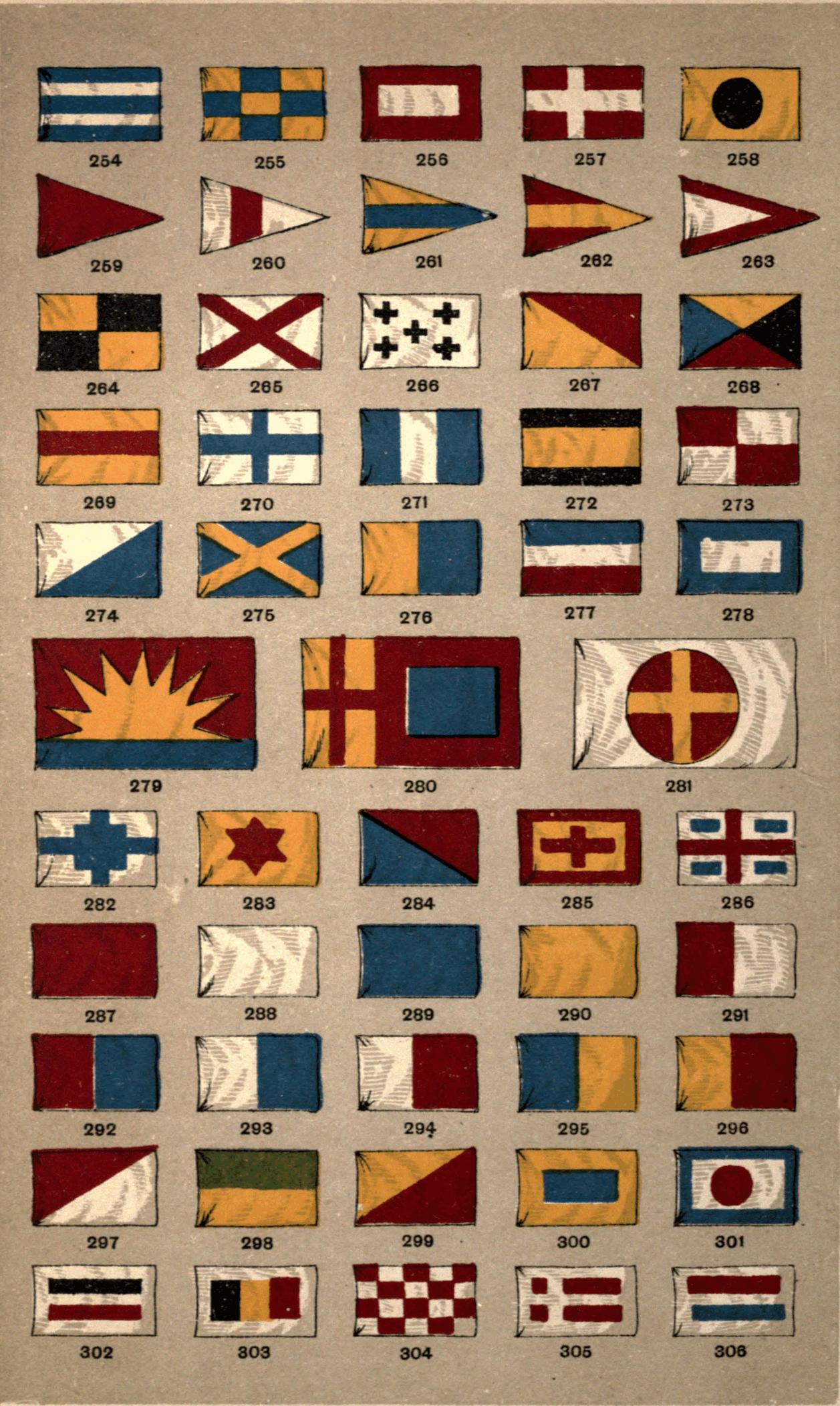
PLATE XXIV.
307 to 324 The Flags of the International Code. 18 illus. 325 The Signal-hoist for the Eddystone Lighthouse, B.D.T.F. 326 Code-signal for the Port of London, B.D.P.Q. 327 Code-signal of SS. Germanic, N.V.B.Q. 328 Code-signal of the Hesperus, M.N.D.L. 329 Code-signal of H.M.S. Devastation, G.R.C.T. 330 "Do you wish to be reported?" B.P.Q. 331 "All safe!" V.K.C. 332 "Report me to Lloyd's Agent." P.D.S. 333 "Do you want assistance?" H.V.F. 334 "Has any accident happened?" B.G.H.
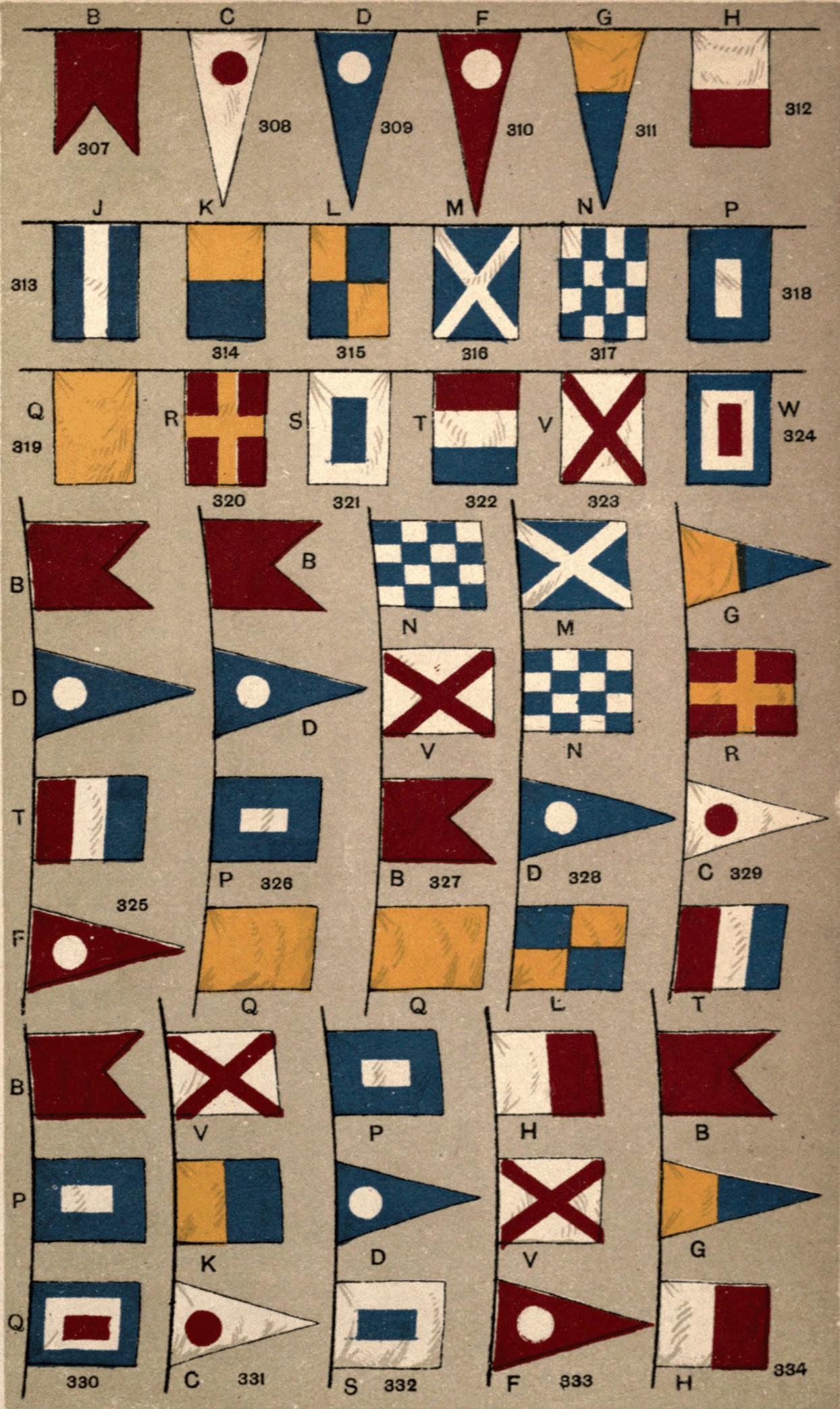
PLATE XXV.
335 to 339 Signal Flags of SS. Australia, Arcadia, Massilia, Victoria, Bengal. (Are all Vessels in the P. & O.) 340 to 344 Signal Flags of SS. Oroya, Orient, Ophir, Orotava, Ormuz. (Are all Vessels of the Orient Line.) 345 to 349 Signal Flags of SS. La Touraine, Lafayette, Ville-de-Tanger, Amerique, Saint-Germain. (Are all Vessels of the Compagnie Generale Transatlantique.)
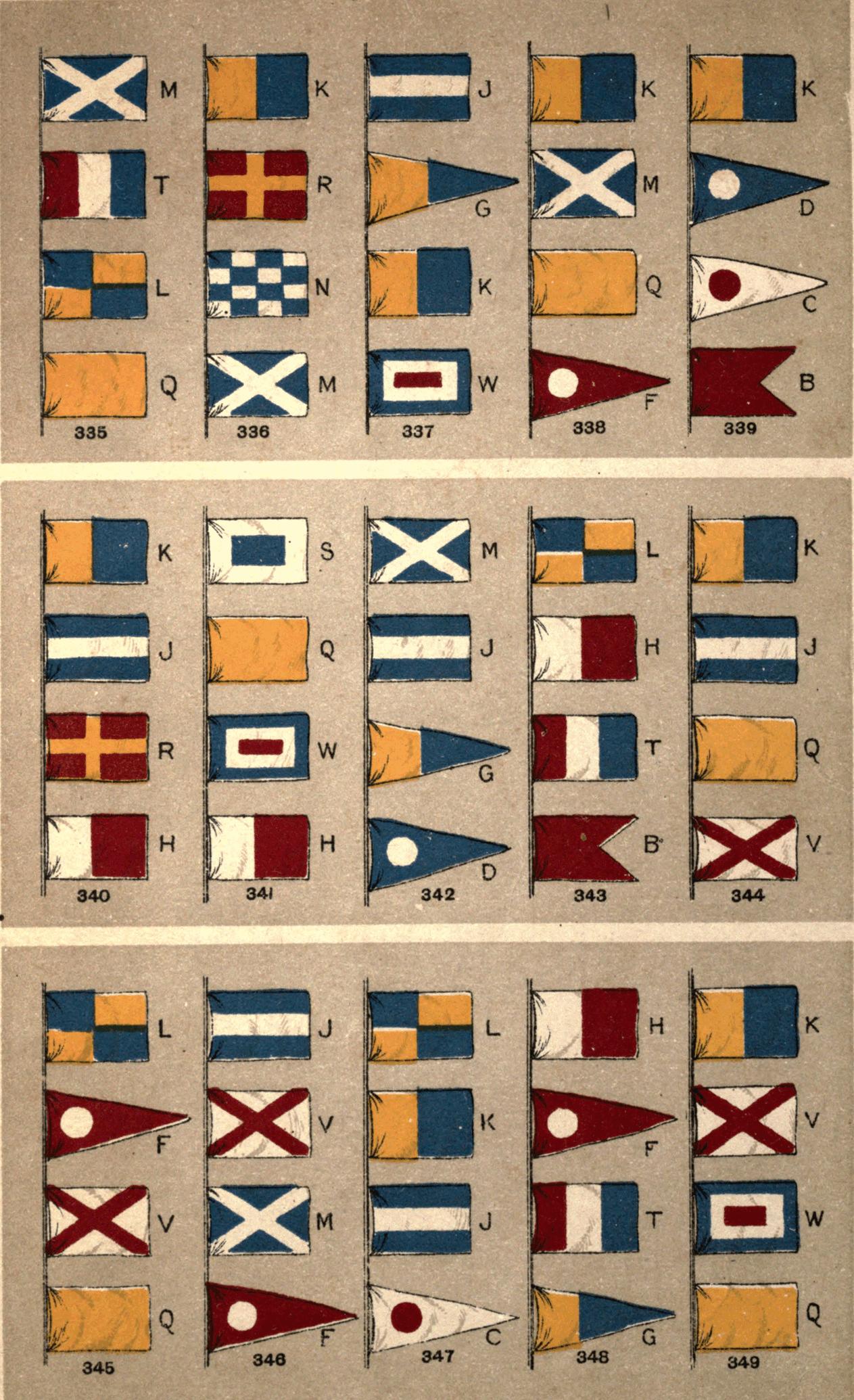
PLATE XXVI.
350 to 354 Flag-signals of some of the numerous Victorias on the Shipping List. 355 to 359 Flag-signals of some of the numerous Australias on the Shipping List. 360 to 364 Flag-signals of some of the numerous Britannias on the Shipping List.
The Botolph Printing Works, Crosskey Square, Little Britain, E.C.
NOTES
[1] "Every Isle differs from each other in their Fancy of making Plads, as to the Stripes in Breadth and Colours. This Humour is as different through the main Land of the Highlands in so far that they who have seen those Places are able at the first View of a man's Plad to guess the Place of his Residence."—Martin's "Description of the Western Islands," 1703. See also "Old and Rare Scottish Tartans," by Donald Stewart, all illustrated by actual pieces woven in silk to a reduced scale. The latest tartan, that of Balmoral, was devised by Prince Albert in the year 1848.
[2] In mediæval days the pastoral staff or crook of the bishop often had a small scarf attached to it. This was known as the vexillum, and was supposed to be derived from the Labarum, or standard of the first Christian emperor, Constantine the Great.
[3] In Favyn's book, "Le Théâtre d'honneur et de Chevalerie," published in Paris some two hundred and fifty years ago, we read of "Le grand estendard de satin bleu celeste double en riche broderie de fleurs de lys d'or de Chypre à une grande croix plein de satin blanc, qui est la croix de France.
"Le grand estendard Saint Michel ange gardien de la France, de satin bleu celeste de riche broderie d'or de Chypre, semé d'estoiles d'or.
"Le grand estendard de l'ordre du benoist Saint-Esprit, faict de double satin verd à une columbe d'argent, rayonné d'or de riche broderie, le rest semé de flammes d'or."
Joan of Arc had a white standard powdered over with gold fleurs-de-lys, and in the centre a figure of Christ sitting on a rainbow, and holding a globe. On either side an angel in the posture of adoration, and, underneath, the words "Jhesu, Maria." On another she had the Annunciation, and the words "Ave Maria." These were painted at Tours "par James Power, Ecossais, Peintre du Roi."
[4] Thus the Cross of St. George would be normally represented as in Fig. 91, but we find it much elongated in Figs. 12 and 14, much widened out in Figs 27 and 56, and yet more so on the shield of the arms of the Dominion of Canada in Fig. 129.
[5] We do not pause to explain the meaning of any heraldic terms that we are obliged to employ. Such terms may be readily found in any technical book on blazonry, and we have ourselves, in "The History, Principles and Practice of Heraldry," gone very thoroughly into the meaning and use of the various forms that enter into the blazonry of shield or banner, and do not, therefore, repeat these matters here.
[6] i.e., badges.
[7] "Lord Gordon has arrived at Nauplia. He has brought the Greeks a number of ensigns, embroidered by Scotch ladies, and sent by them."—Salisbury and Winchester Journal, December 27th, 1824.
[8] This crowned key may be seen as early as 1359 on the seal of Sir Michael de Poynings.
[9] The bugle horn appears as the crest of Sir William de Bryan on his brass, 1375.
[10] In an old pedigree of the family is inscribed the lines:—
"Esperance en Dieu, Trust in hym, he is most true. En Dieu Esperance, In hym put thyne affiaunce. Esperance in the worlde? Nay, The worlde variethe every day. Esperance in riches? Nay, not so; Riches slidethe, and some will go. Esperance in exaltacion of honour? Nay, it widderethe away, lyke a flowre. Esperance en Dieu, in hym is all, Which is above Fortune's fall."
[11] The modern flag, known as the burgee, largely used in flag signalling, is like a shortened pennon. It is sometimes also called a cornet.
[12] "Now the often changing fortune beganne also to channge the law of the battels. For at the first, though it were terrible, yet Terror was deckt and broachie with rich furniture, guilt swords, shining armours, pleasant pensils, that the eye with delight had scarce time to be afraide; but now all defiled with dust, blood, broken armour, mangled bodies, tooke away the maske, and set forth Horror in his own horrible manner."—Sir Philip Sydney.
[13] "A streamer shall stand in the toppe of a shippe, or in the forecastle, and therein be putt no armes, but a man's conceit or device, and may be of the lengthe of twenty, forty, or sixty yards."—Harleian MS., No. 2,358, dealing with "the Syze of Banners, Standardes, Pennons, Guydhomes, Pencels, and Streamers."
[14] While thus severe in our judgment on misguided foreigners it is only just to point out that England itself is responsible for a combination as horrible as any in the green, red, white, of the special flag that she bestowed on Heligoland, while it was yet a British possession. It may be seen in Fig. 61.
[15] The famous banner of the Knights Templars, called the Beau-seant, had its upper half black and lower white. The black symbolised the terror it should be to the foe, and the white amity and goodwill to friends.
[16] The "house-flags" of the various shipping companies make a great use of letters: thus the flag of the Orient Steam Navigation Company is white and divided into four portions by a blue cross. In these four portions are placed in red the letters O.S.N.C. In Fig. 120 we have the flag of the New Zealand Shipping Company, where the N.Z.S. Co. are equally conspicuous. Any reference to a good list of house-flags, such as that published by Griffin, would reveal scores of illustrations of this feature.
[17] The map is freely embellished with illustrations. In South America, for instance four immense crimson parrots about fill up Brazil, while in Africa the parrots are green. Many of these figured details are very quaint.
[18] "The dazzling field, Where in proud Scotland's royal shield, The ruddy lion ramped in gold."—Scott.
[19] With only one exception the Sovereigns of Scotland never quartered the arms of any other kingdom with their own. The only exception was when Mary Stuart claimed the arms of England and placed them upon her standard, and thus gave irreparable provocation to Queen Elizabeth.
[20] Brian Boru, who was killed in battle with the Danes, did much to civilise Ireland; and, amongst other things, introduced the harp. The ancient Irish harp at Trinity College, Dublin, was long claimed as the identical instrument of Boru, but it has been proved by the ornament upon it that it cannot be later than the fourteenth century. The most primitive representation of the harp in Ireland is in a rude sculpture in a church near Kilkeny. This is known to date from the ninth century. Though the harp has ever shone in the poetry of the Irish people, they have but little claim to it. It has been by no means such a national instrument with the Irish as with the Welsh. It is one of the most ancient of instruments, figuring in the mural paintings of Egypt centuries before the Christian era.
[21] As may be seen beautifully enamelled on his tomb in Westminster Abbey.
[22] Another flag was a plain scarlet one, having this inscription: "For the Protestant Religion and the Liberty of England" in white upon it.
[23] The following summary may be taken as correct in its broad facts:—From about 1195 to 1340, the Standard had the lions of England alone on it. From 1340 to 1377, England and France together. 1377 to 1399, England, France, and the arms of Edward the Confessor. 1399 to 1603, England and France. 1603 to 1649, England, France, Scotland and Ireland. 1649 to 1659, Interregnum: a period of change and uncertainty, when divers changes in the Standard were made that are scarcely worth detailing. 1659 to 1688, England, France, Scotland, and Ireland. 1688 to 1701, England, France, Scotland, Ireland, and Nassau. 1701 to 1714, England, France, Scotland, and Ireland. 1714 to 1801, England, France, Scotland, Ireland, and Hanover. 1801 to 1837, England, Scotland, Ireland, and Hanover. From 1837, England, Scotland, and Ireland.
[24] Spenser.
[25] In the same way, we find the Scottish clansmen rushing to the fray to the cry of "St. Andrew and our Right." In the ballad of Otterbourne we read that the Scots
"Uppon Sent Andrewe loude they crye, And thrysse they showte on hyght."
[26] One interesting exception to this is that, on St. George's Day, the 5th regiment (Northumberland Fusiliers) holds full-dress parade, all wearing the rose, the national emblem, in their headgear, and the officers on their sword-knots also. The colours, too, are festooned with roses.
[27] "The x day of January hevy news came to London that the French had won Cales (Calais), the whyche was the hevest tydyngs to England that ever was herd of.
"The xj day of January the Cete of London took up a thousand men, and mad them whytt cotes and red crosses, and every ward of London found men.
"The xxj day of January came a new commandement to my Lord Mayre that he shuld make men redy in harnes with whyt cotes weltyd with green, and red crosses, by the xxiij day of the same moneythe to be at Leydenhalle to go forward.
"The xviij day of May there was sent to the shyppes men in whyt cotes and red crosses, and gones, to the Queen's shyppes."—Machyn's Diary.
[28] Thus we have the white, the blue, the white and orange, the green and red, the purple, the blue and white, the orange and green, the red and yellow, the red and blue, the red and white, and divers others. The orange company always took the lead. These companies were for a long time in abeyance, and were superseded in 1798 by the formation of the Royal Edinburgh Volunteers, but each year the Magistrates and Council still appoint one of their number to be captain of the orange colours. His duty is to take charge of the old colours and preserve them as an interesting relic of a bygone institution.
[29] It is remarkable that none of the flags extant bear the motto which the Parliament on July 5th, 1650, ordered "to be upoun haill culloris and standardis," i.e., "For Covenant, Religion, King, and Kingdom." It is characteristic that each body claimed independence even in this matter. Thus the Fenwick flag bore "Phinegh for God, Country, and Covenanted work of Reformations." Another flag has, "For Reformation in Church and State, according to the Word of God and our Covenant," while yet another bears the inscription, "For Christ and His truths, no quarters to ye active enemies of ye Covenant."
[30] St. Andrew's day is November 30th.
[31] The question of the Union between England and Scotland was often mooted. In the year 1291 Edward I., being victorious in the north, declared the two countries united, but this did not last long. In 1363 Edward III. opened negotiations for a union of the two crowns if King David of Scotland died without issue. In the reign of Edward VI. the matter was again to the fore, but it was left to Queen Elizabeth to take the decisive step.
[32] April 12th, 1605.
[33] Thus in the Royal Standard of Spain, Fig. 194, the arms of Leon and Castile being In the upper corner next the staff take precedence of honour over Arragon and all the other States therein introduced.
[34] In a picture in the collection at Hampton Court, representing the embarkation of Charles II. from Holland, the ship has a large red flag charged with the Stuart arms in the centre, but so soon as his position in England was assured he reverted to the royal standard of his Stuart predecessors and to the original form of the union flag, a form that during the Protectorate was widely departed from.
[35] "Jaque, espece de petite casaque militaire qu'on portait au moyen age sur les armes et sur la cuirasse."—Bouillet, "Dict. Universel."
[36] A contemporary representation of this Long Parliament flag may be seen on the medals bestowed on the victorious naval commanders, where the principal ship in the sea-fight represented on the reverse of the medal flies this flag at her masthead.
[37] Andrew Marvell on the victory of Blake at Santa Cruz.
[38] As the year of his birth is scarcely known within a century or so, it is too much to expect the month or the day, but the day that is assigned to St. Patrick in the calendar is March 17th.
[39] In the year 1816, in consequence of the Electorate of Hanover being raised to the rank of a Kingdom, the Hanoverian Royal Crown was substituted for the Electoral headgear in the royal arms on the shield and standard.
[40] A writer in the Retrospective Review in the year 1847, thus relieves his feelings:—"The banner of St. George, argent, and cross gules is still borne as part of the English flag, though, from the disgraceful manner in which it has been amalgamated with the Crosses of St. Andrew and St. Patrick, it has not only lost all its purity, but presents a melancholy example of the ignorance of heraldry and total want of patriotism and taste which must have characterised those to whom we unfortunately owe its arrangement."
[41] "All Her Majesty's Ships of War in Commission shall bear a white ensign with the Red St. George Cross, and the Union in the upper Canton, and when it shall be thought proper to do so, they may display the Union Jack at the bowsprit end."—Queen's Regulations.
[42] We read, for instance, in the Diary of Pepys that in the expedition of the Duke of Buckingham, in the year 1627, against the Isle de Rhé that "the Duke divided his fleet into squadrons. Himself, ye Admirall, and General in chiefe, went in ye Triumphe, bearing the Standard of England in ye maine topp, and Admirall particular of the bloody colours. The Earl of Lindsay was Vice-Admirall to the Fleete in the Rainbowe, bearing the King's usual colours in his foretopp, and a blew flag in his maine topp, and was admirall of the blew colours. The Lord Harvey was Rear Admirall in ye Repulse, bearing the King's usual colours in his mizen, and a white flag in the main topp, and was Admirall of ye squadron of white colours."
[43] On the hoisting of the Ensign all work stops, and all ranks muster on deck, standing with hand raised to the cap in salute, while the ship's band plays the opening bars of the National Anthem.
[44] Charles Mackay.
[45] Other regiments with green facings are the 5th, 11th, 19th, 36th, 39th, 46th, 49th, 73rd, etc. Regiments with blue facings are the 1st, 4th, 6th, 7th, 13th, 18th, 21st, 23rd, 25th, etc., while buff is found in the 2nd, 3rd, 14th, 22nd, 27th, 31st, 40th, etc. Amongst the regiments with yellow facings are the 9th, 10th, 12th, 15th, 16th, 20th, 26th, 28th, 29th, 30th, 34th, 37th, 38th, etc. White is met with in the 17th, 32nd, 41st, 43rd, 47th, 59th, 65th. Red is not so common, since the colour is that of the tunic ordinarily, but we see it in the 33rd, 48th, and 76th. Black is also less commonly used, but we find it in the facings of the 58th, 64th, 70th, and 89th Regiments.
[46] The "Black Watch," the gallant 42nd, and other regiments also bear the Sphinx for their services in Egypt in 1801, where Napoleon received his first serious check from British troops.
[47] When a regiment consists of two battalions the distinctions won by each are common to both, and are, quite justly, the property of the whole regiment.
[48] In like manner we find the Royal Marines bearing on their colours an anchor, first granted to the corps as a badge in the year 1775. The lion and crown was added to this in 1795. In 1802, in honour of the gallant share taken by the Marines in the capture of Bellisle, a laurel wreath was added to the other badges of honour, and in 1827 the motto "Per Mare per Terram" and a globe, surmounted by the word "Gibraltar," was also placed on their colours, as a testimony to the services of the Marines all over the world, and notably at the taking of Gibraltar.
[49] Blenheim, August 2nd, 1704; Ramilies, May 23rd, 1706; Oudenarde, June 30th, 1708; Malplaquet, September 11th, 1709; Dettingen, June 16th, 1743; Minden, August 1st, 1759.
[50] This, with many other interesting trophies of war, may be seen in the Chapel of Chelsea College. The Blenheim Colours are now nearly all consumed away with age: of one but the staff remains, and many others are now as tender as tinder. French, Russian, American, Chinese, and many other flags of former foes may there be seen quietly fading away, as the old national animosities have likewise done.
[51] Amongst the various devices seen on the flags of the Parliamentarians, was one of a skull surrounded by a laurel crown, accompanied by the words "Mors vel Victoria."
[52] There are the colours of other regiments as well. Those that we specially refer to above will be found in what is known as the Warriors' Chapel. We deal with these especially, because, as being the flags of the territorial regiment, they find, with particular appropriateness, their resting place in Canterbury Cathedral.
[53] There is now no Lord High Admiral of Great Britain; his functions are analogous to those of the Commander-in-Chief of the Army; the last Lord High Admiral was William IV., who received this appointment when Prince of Wales. The office is now said to be "in commission"—its functions are performed by the Lords Commissioners of the Admiralty, a board uniting the dual control which is exercised over the land Forces by the War Office and the Horse Guards. Commissions of Naval Officers are not signed by the Queen, they are headed "By the Commissioners for executing the office of Lord High Admiral of the United Kingdom," etc.; and they are signed by two of the Lords.
[54] We find the Royal Yacht Club, in 1815, and the Royal Thames Yacht Club, in 1835, flying what would be a white ensign if it had but the great Cross of St. George upon it; an entirely white flag having the Union in the corner next the staff. One may get a fair notion of its effect by looking at Fig. 154, but imagining the Union in the place of the device there seen. The Royal Yacht Club burgee at this period was plain white, without any device whatever. The burgee of the other Club we have named has undergone many changes. In 1823 it is scarlet, with the letters T.Y.C. in white; in 1831 the prefix Royal has been gained, and the flag, still red, has the crown and the R.T.Y.C. in white upon it; while in 1834 we still find the crown and the same letters, but now, not white on red, but red on white.
[55] "By the Commissioners for executing the office of Lord High Admiral of the United Kingdom of Great Britain and Ireland, &c.
"Whereas, we deem it expedient that Canadian registered vessels shall be permitted to wear the Red Ensign of Her Majesty's Fleet, with the Canadian Coat of Arms in the Fly thereof.
"We do therefore, by virtue of the power and authority vested in us, hereby warrant and authorize the Red Ensign of Her Majesty's Fleet, with the Canadian Coat of Arms in the Fly, to be used on board vessels registered in the Dominion.
"Given under our hands and the seal of the Office of Admiralty, this second day of February, 1892."
[56] The Maple is to Canada what the Rose is to England, or the Shamrock to Ireland. Hence, we find it on the coinage, etc. In the Canadian Militia List before us we find it on the accoutrements of many of the regiments, enwreathing the motto or device; sometimes alone, and often in association with the rose, thistle, and shamrock.
[57] Thus in a French book on flags (La Haye's), published in 1737, we see a "pavillon de Nouvelle Angleterre en Amerique." This is a blue flag, having on a white canton the Cross of St. George, and in the first quarter of this canton a globe, in allusion to America, the new world.
[58] In September, 1775, Moultrie, the heroic defender of the fort which still bears his name, devised this the first flag of the State of South Carolina, the uniform of the South Carolina men being blue, and some of the regiments having a silver crescent in their caps; but why they had the silver crescent as a badge no record seems to inform us.
[59] It may be somewhat of an assistance to our readers if we give a few chronological details: The obnoxious duty on tea and other articles imposed by the British Parliament, June, 1767. Tea thrown overboard in Boston harbour by the discontented populace, November, 1773. The Boston Port Bill, by which that port was to be shut up until compensation made to the East India Company for the tea destroyed, passed March, 1774. General Congress of the colonists at Philadelphia, September, 1774. Revolution, first blood shed at Lexington, April, 1775. Washington appointed Commander-in-Chief of the American Armies, June, 1775. Thirteen colonies declare themselves independent, July 4th, 1776. Independence of Colonies recognised by France in March, 1778, by Holland in April, 1782, and by Great Britain in September, 1783. John Adams received as ambassador from America by George III. in June, 1785, and first ambassador sent from Great Britain to the United States, in 1791.
[60] In an old print before us of the fight between the Shannon and the Chesapeake, we see that the latter hoists three American flags, all having the top and bottom stripes white, and at the foremast a white flag inscribed with the enigmatical motto, "Free Trade and Sailors' rights."
[61] "Forty flags with their silver stars, Forty flags with their crimson bars." Whittier, "Barbara Frietchie."
[62] At a banquet at the Mansion House, when many leading Englishmen and eminent Colonists gathered together to celebrate St. George's Day, the American Ambassador, an honoured guest, said that he was very conscious that he was there at a gathering of the clans. "There was a tradition that the mischievous boy was generally the favourite of the household. His mother might confess it openly, his father secretly, but the rest of the family said nothing about it. Now there was a mischievous boy who broke away from home something more than a century ago, but let them not suppose that because he left the home he or his descendants ever came back without a strong feeling that it is the home." He went on to say that he never met a body of representative Englishmen, British men, speaking the same language that he did, without a sense of grave joy and pleasure: the sense that they were his brethren in a great cause, and that he joined with them, he and his people, in sustaining the best hopes and aspirations of the world's civilization. Blood is thicker than water, and all right-minded Englishmen will read his kindly words with pleasure, and give them heartiest reciprocation.
[63] To the Germans, in their campaign against France, this and the "Watch upon the Rhine" were worth many battalions as a spur and stimulus to heroic deeds. During the American War both Federals and Confederates owed much to the influence of stirring patriotic songs. There can be no doubt that the songs of Dibdin contributed not a little to our own naval victories, and every cause that is worth fighting for evokes like stirring strains. Perhaps one of the most marked illustrations of this is the birth of that grand war-song known as the "Marseillaise." Rouget de l'Isle, its author, was a captain of French Engineers stationed in Strassbourg on the opening of the campaign against Austria and Prussia in 1792. On the eve of the day that the contingent from that city was going to join the main army of the Rhine, a question arose as to what air should be played at their departure. Several were suggested and rejected, and Rouget de l'Isle left the meeting and retired to his own quarters, and before the gathering broke up had written both words and music of "Le Chant de l'Armee du Rhin." On returning to the meeting, still in consultation on the various details of the morrow, he sang his composition, and it was at once welcomed with delight. It flew like wildfire throughout France, and, owing to the Marseillaise troops singing it on entering Paris, it derived the name by which it has ever since been known. Its stirring words and the grand roll of the music aroused the enthusiasm of the country, and at once made it the battle-song of France, to be at times proscribed, but never forgotten.
[64] The book on German costume by Köbel, printed at Frankfort-on-the-Main in 1545, should be referred to, if possible, by the reader. It is, unfortunately, a very rare book. The first edition of this splendid volume contains 144 large illustrations of standard-bearers; the figures are admirably drawn and very varied in attitude, while the flags they carry are replete with interest, many of course being now quite obsolete, while others there represented have come down to us through the three centuries intact.