THE FIRST SEVENTEEN YEARS
Reading edition
Virginia, 1607-1624
Charles E. Hatch, Jr.
The University Press of Virginia Charlottesville
COPYRIGHT©, 1957 BY VIRGINIA 350TH ANNIVERSARY CELEBRATION CORPORATION, WILLIAMSBURG, VIRGINIA
Tenth printing 1991
PRINTED IN THE UNITED STATES OF AMERICA The University Press of Virginia / Charlottesville
CONTENTS
Foreword
The Start of Colonization1
The Establishment of Jamestown4
Summer and Fall, 16075
The Three Supplies, 1608-16106
A Critical Hour10
Order and More Stable Ways12
Tobacco16
Yeardley and Argall18
A New Approach21
Yeardley and Wyatt26
Virginia and the Dissolution29
The Spread of Settlement—1607 to 162434
Towns, Plantations, Settlements, and Communities in Virginia: 1607-1624 (numbers are keyed to text and to illustrating map) 32, 33
1. Pasbehegh Country—161735
A. Argall Town—161736
B. Pasbehegh—c.161737
C. "the Maine"—160837
2. Smith's (Southampton) Hundred—161738
3. "Tanks Weyanoke"—c.161841
4. Swinhows—before 162243
5. Westover—c.161943
6. Berkeley Town and Hundred—161944
7. Causey's Care (or "Cleare")—c.162046
8. West and Shirley Hundred—c.161347
9. Upper Hundred-"Curls"—c.161349
10. "Diggs His Hundred"—c.161349
11. The "citty of Henricus" (Henrico)—161150
12. Arrahatock—before 161952
13. The College Lands—c.161953
14. The Falls—160956
15. Falling Creek—c.161957
16. Sheffield's Plantation—before 162259
17. Proctor's Plantation—before 162260
18. Coxendale—c.161160
19. "Bermuda Citty" (Charles City) Incorporation62
A. Bermuda Hundred—161362
B. Rochdale Hundred—161363
C. Bermuda City—161363
20. Piercey's Plantation—c.162066
21. Jordan's Journey—c.161967
22. Woodleefe's Plantation—c.161968
23. Chaplain's Choice—c.162368
24. Truelove's Plantation—c.162169
25. "Powle-brooke" or Merchant's Hope—161970
26. Maycock's Plantation—c.161871
27. Flowerdieu Hundred-Piercey's Hundred—c.161871
28. "Captaine Spilmans Divident"—before 162273
29. Ward's Plantation—c.161973
30. Martin's Brandon—c.161775
31. "Paces-Paines"—162077
32. Burrow's Mount—c.162478
33. Plantations "Over the river from Jamestown"79
A. Treasurer's Plantation (George Sandys)—c. 162180
B. Hugh Crowder's Plantation—c.162281
C. Edward Blaney's Plantation—c.162481
D. Capt. Roger Smith's Plantation—c.162282
E. Capt. Samuel Mathews' Plantation—c.162282
34. Hog Island—160983
35. Lawne's Plantation—161985
36. Warrascoyack (Bennett's Plantation)—162186
37. "Basse's Choyse"—162289
38. Nansemond—160989
39. The Eastern Shore—c.161490
40. Elizabeth City (Kecoughtan)—161093
41. Newport News—162198
42. Blunt Point—c.1621101
43. Mulberry Island—c.1617102
44. Martin's Hundred—1618104
45. Archer's Hope—c.1619107
46. "Neck-of-Land neare James Citty"—before 1624109
Selected Readings112
Appendix; Supplies for Virginia114
FOREWORD
The colonization of Virginia was a mammoth undertaking even though launched by a daring and courageous people in an expanding age. The meager knowledge already accumulated was at hand to draw on and England was not without preparation to push for "its place in the sun." There was a growing navy, there was trained leadership, there was capital, there was organization and there were men ready to make the gamble for themselves and to the glory of God and for their country.
It remained for the Virginia Company of London, under its charter of April 10, 1606, to found the first permanent English settlement in America. This company, a commercial organization from its inception, assumed a national character, since its purpose was to "deduce" a "colony." It was instrumental, under its charter provisions, in guaranteeing to the settlers in the New World the rights, freedoms, and privileges enjoyed by Englishmen at home as well as the enjoyment of their customary manner of living which they adapted to their new environment with the passage of years. Quite naturally the settlers brought with them their church and reverence for God, maintained trial by jury and their rights as free men, and soon were developing representative government at Jamestown.
The immediate and long-range reasons for the settlement were many and, perhaps, thoroughly mixed. Profit and exploitation of the country were expected, for, after all, this was a business enterprise. A permanent settlement was the objective. Support, financial and popular, came from a cross section of English life. It seems obvious from accounts and papers of the period that it was generally thought that Virginia was being settled for the glory of God, for the honor of the King, for the welfare of England, and for the advancement of the Company and its individual members.
In England, and in Virginia, they expected and did carry the word of God to the natives, although not with the same verve as the Spanish. They expected to develop natural resources, to free the mother country from dependence on European states, to strengthen their navy, and to increase national wealth and power. They expected to be a thorn in the side of the Spanish Empire; in fact, they hoped one day to challenge and overshadow that empire. They sought to find the answer to what seemed to be unemployment at home. They sought many things not the least of them being gold, silver, land and personal advancement. As the men stepped ashore on Jamestown Island, perhaps each had a slightly different view of why he was there, yet some one or a combination of these motives was probably the reason.
The first section of this account is an adaptation, by the author of the booklet, Jamestown, Virginia: The Town Site and Its Story (National Park Service, Historical Handbook Series, No. 2) published by the Government Printing Office, Washington, D. C., 1949.
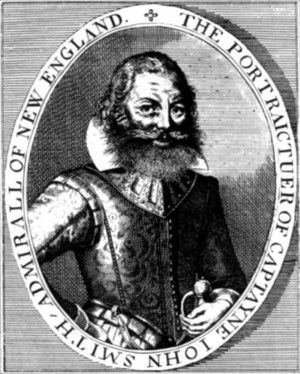
Portrait from John Smith's General History (London, 1624). Courtesy of the Tracy W. McGregor Library, University ofVirginia.
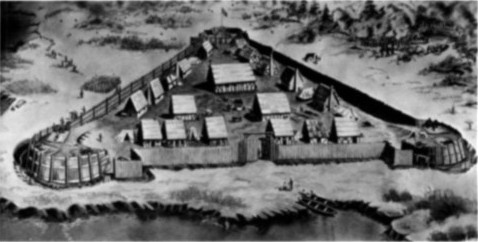
"James Fort" built in May and June, 1607—A painting by Sidney King for Colonial National Historical Park.
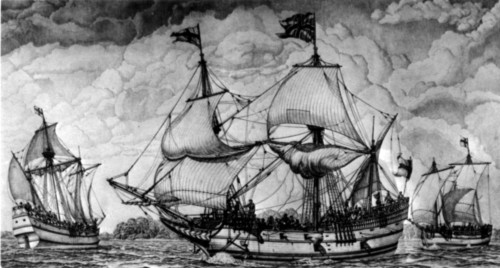
The Arrival of the Settlers at Jamestown on May 13, 1607. English Merchantmen of the size and date of the Godspeed 40 tons, Susan Constant 100 tons, and the "pinnessee" Discovery 20 tons maneuvering for anchorage off Jamestown Island 1607. A pencil Study by Griffith Bailey Coale, courtesy of Mariners Museum.
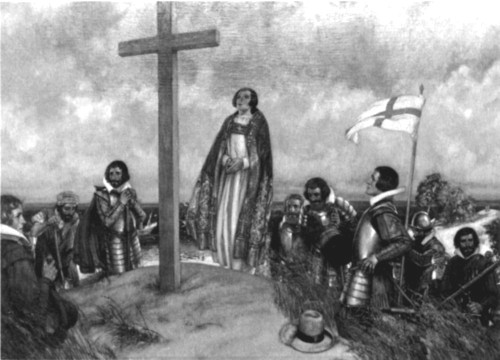
Worship at Cape Henry on April 29, 1607 as depicted by Stephen Reid. Courtesy of the Chrysler Museum at Norfolk.
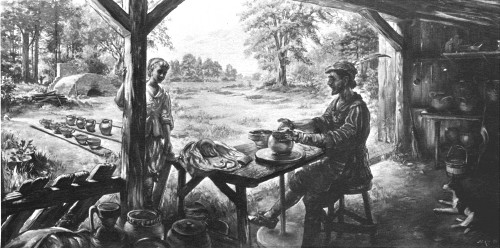
Pottery-making as it may have been done in the early years at Jamestown where such work was carried on. A painting by Sidney King for Colonial National Historical Park.
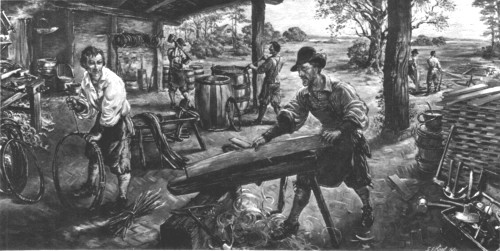
"The Cooper" as he may have worked in early Jamestown. A painting by Sidney King for Colonial National Historical Park.
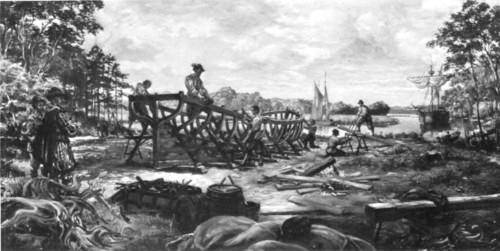
Shipbuilding, known to have been carried on at Jamestown as early as 1609, may have been done in this manner. A painting by Sidney King for Colonial National Historical Park.
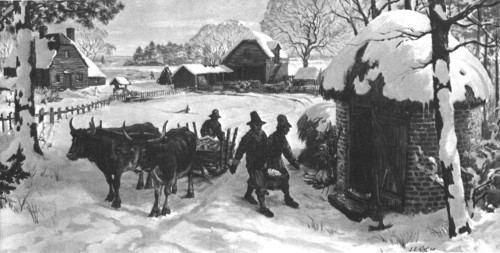
A winter scene suggestive of life on Jamestown Island about 1625. From a painting by Sidney King for Colonial National Historical Park.
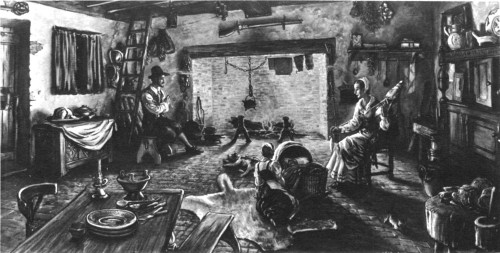
A home such as could have existed at Jamestown by 1625. From a painting for Colonial National Historical Park by Sidney King.