Front matter (continued 3)
Reading edition
FROM ATTACK TO DEFENCE
It was now generally recognized that the wheeling movement originally contemplated was an impossibility. Between Armentières and Givenchy the 3rd, 5th, and 6th Divisions, and Conneau's cavalry, which was acting with them, had opposed to them the II., IV., VII. and IX. German Cavalry Divisions, several battalions of Jägers, the XIII. Division of the VII. A.C., a brigade of the III. A.C., and the whole of the XIV. A.C., which had recently moved north from in front of the 21st French Army. They were therefore sufficiently outnumbered, even at this period, to put any idea of further advance quite out of the question. It now became merely a matter of holding on to that which they had got—if possible.
The 2nd A.C. front, owing to the irregularity of the advance, was of a zig-zag character, and on the night of the 19th Sir Horace ordered a slight retirement so as to straighten out the line. It was quickly evidenced that this step was not taken a moment too soon, for on the following day the Germans, confident in the sufficiency of their numbers, attacked all along the line, and succeeded in re-capturing Le Pilly, and with it the whole of the R. Irish Regiment. This was something of a disaster, but luckily the attack was not equally successful elsewhere. The 1st Cheshires, though attacked with great vigour, held their ground unshaken throughout this day and the next, and inflicted heavy loss on the enemy. Two platoons of the R. Fusiliers, who were sent up to establish communication between Herlies and the R. Irish Regiment at Le Pilly, were caught in flank, owing to the capture of the latter place, and suffered severely, Captain Carey, in command, being killed.
The 9th Brigade, which had throughout these operations been on the left of the 3rd Division, was now temporarily transferred to the 3rd A.C., whose line, reaching as it did from Radinghem to Le Gheir, was considered by the C. in C. to be too thin for safety. The removal of this brigade had the effect of widening the gap between the 2nd and 3rd A.C.'s by a further four or five miles, and the responsibilities of Conneau's cavalry were correspondingly increased, the left of the 2nd A.C. now stopping short at Riez, which was held by the 1st Gordons. The weakening of the 2nd A.C. by the borrowing of one of its brigades and the capture of one of its battalions was made up to it in some measure by the arrival of the Lahore Division of Indians, under General Watkis, which took up a position in rear of it at Neuve Chapelle.
With the additional assistance which had been lent him, Gen. Pulteney was everywhere successful in holding his ground. At one moment in the day the enemy succeeded in getting possession of Le Gheir, but as the loss of this place would have laid bare the flank of the cavalry at St. Yves, Gen. Hunter-Weston decided that it must be retaken at any cost, and the work was entrusted to the K.O. Regiment and the Lancs. Fusiliers. These two battalions, finely handled by Col. Butler, of the Lancs. Fusiliers, proved themselves quite equal to the call made upon them, and not only re-captured the lost trenches, but took 200 prisoners and released 40 of our own men who had been captured.
THE BIRTH OF THE YPRES SALIENT
It is necessary now to turn for the moment to the scene further north, where a mild interest was beginning to be displayed in England in the war-clouds which were gathering round the picturesque and historical Flemish town of Ypres. It will be remembered that, on the 14th, Sir Henry Rawlinson, with the 7th Division and the 3rd Cavalry Division, had reached Ypres from Dixmude. On their first arrival, the 3rd Cavalry Division had been sent south of Ypres, the 6th C.B. going to Wytschate and the 7th C.B. to Kemmel; but as the Cavalry Corps under General Allenby gradually drew up from the direction of Béthune, the 6th and 7th C.B. (3rd Cavalry Division) were withdrawn to the north side of Ypres, where they worked the ground between Zonnebeke and the Forêt d'Houlthust, filling, in fact—as well as might be—the gap between the French Cavalry to the north and the left of the 7th Division. This latter division, since its arrival, had pushed forward with little or no opposition to a convex position some six miles east of Ypres, which embraced the villages of Zonnebeke, Kruiseik and Zandvoorde. South of Zandvoorde there was a considerable hiatus, Allenby's Cavalry Corps, which had unexpectedly found itself opposed by the XIX. Saxon Corps and three divisions of German Cavalry, having not yet got into proper touch with the right of the 7th Division. This, however, in view of the fact that the 7th Division was on the outside of the wheeling movement, and had therefore the bigger sweep to make, was a matter of little moment, and one which would have speedily righted itself at a later stage, had the original plan been successfully carried through. A matter of more moment at the time was that the 22nd Brigade, on the left of the 7th Division at Zonnebeke, was considerably in arrear of the 20th Brigade at Kruiseik, whereas the converse should have been the case. Accordingly, in the early morning of the 19th, the 22nd Brigade was ordered to advance from Zonnebeke in the direction of the straight road connecting Roulers and Menin, so as to bring the left shoulder of the 7th Division well forward. When this had been done, the 20th and 21st Brigade were to join in the general advance.
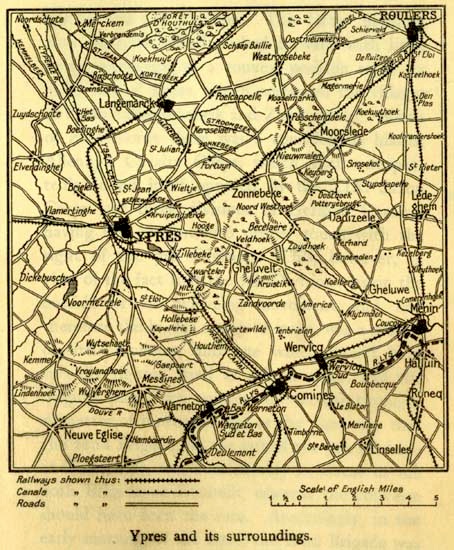
Ypres and its surroundings.
The main idea on the extreme left of our line, at the moment, was to seize the bridge over the River Lys at Menin, and so impede the further advance of the German reinforcements which were being steadily railed up from the direction of Lille. In the event it turned out that the manœuvre was impracticable owing to the insufficiency in numbers of the British force operating east of Ypres. This force, it will be understood, consisted, at the time, of the 7th Division alone, supported by two cavalry brigades on its left flank, whereas the Germans had by the 19th concentrated on the spot a force of five or six times this magnitude. However, in the intention lies the explanation of the subsequent Ypres salient. The original idea was strategically sound, but it was frustrated owing to the difficulty and consequent delay in concentration which accompanied the transfer of the British force from the Aisne to its new field of operation in Flanders. It was a race as to which army could concentrate with the greatest rapidity, and the Germans—having by far the easier task and by far the shorter road to travel—got in first.
At 5 a.m., then, on the 19th, the 22nd Brigade set out from Zonnebeke on its forward movement, the 2nd Queen's on the left, the 1st R. Welsh Fusiliers in the centre, and the 2nd Warwicks on the right, the 1st S. Staffords being in reserve.
This 22nd Brigade, as it turned out, was the only one in the 7th Division which was destined to do any fighting this day. The 20th Brigade, which was at Kruiseik, some couple of miles in advance of the 22nd, never really came into action. As a matter of fact, they were in the act of deploying for an attack on Ghelowe about 11 a.m., when news was brought by an airman that two fresh German Army Corps had suddenly made their appearance, moving up from the direction of Courtrai. As far as this brigade was concerned, then, the original order to advance was cancelled, it being clearly impracticable for one division to take the offensive against four. By this time, however, the 22nd Brigade had advanced some six miles from Zonnebeke to the neighbourhood of the straight road and the parallel railway which connect Roulers and Menin. The news of the unexpected reinforcement of the enemy in front was duly communicated to General Lawford, commanding the brigade, and he at once ordered the retirement of his four battalions. This order reached the Queen's and the Warwicks about 11.30, but did not penetrate through to the R. Welsh Fusiliers, who accordingly pressed on towards Ledeghem, quite ignorant of the new development, or of the fact that they were unsupported by the battalions on either flank. Ledeghem was found to be very strongly occupied, and on reaching the high road from Roulers to Menin, just short of the railway, the battalion found itself not only attacked in force from in front, but at the same time enfiladed from the direction of the main road on the left, and very heavily shelled from Keselburg on the right front. To this artillery fire there was no response whatever from our own gunners, who, it is to be presumed, were in ignorance of the single-handed advance of the R. Welsh Fusiliers, and had withdrawn with the rest of the brigade. The German artillery accordingly had it all its own way, and their shrapnel played havoc in the ranks of the gallant Welshmen. Nine officers [4] had already fallen when at 1.20 the order to retire reached the C.O. The order now was that the battalion was to withdraw to a ridge in rear, near the windmill at Dadizeele, and there act rear-guard to the rest of the brigade. This order was carried out without any great further loss, the enemy showing no disposition at the moment to advance, and eventually the brigade reached Zonnebeke in the dusk of the evening.
Throughout that night a constant stream of refugees passed through Zonnebeke on their way westward from Roulers, which was burning. These were all subjected to examination, but their number was too great to make close examination possible, and that many spies got through among them is unquestionable.
It very soon became apparent that the newly-arrived German troops had no intention of letting the grass grow under their feet. During the night they had put behind them the six miles which separate Ledeghem from Zonnebeke, and at eleven o'clock on the morning of the 20th they started bombarding the latter place. Once more fate elected that the R. Welsh Fusiliers should stand in the path of the attack. They were now on the left of the 22nd Brigade, and they were attacked not only from the direction of the road, but from their left flank, which was very much exposed, the line of the cavalrymen north of the road being even more extended than that of the 7th Division. However, in spite of everything, they held their ground with great determination throughout this day and the next. Their losses, however, were again very severe indeed. This was, in fact, the first of the 7th Division battalions to undergo that gradual process of annihilation which was destined in time to be the fate of all. The extreme tension of the situation at Zonnebeke was in some part relieved by the arrival on the scene, during the night, of the 4th (Guards) Brigade, who took over the ground north of the Zonnebeke road from the cavalry. This brigade formed part of the 1st A.C. which had arrived at St. Omer from the Aisne on the 17th and 18th, and had been billeted outside Ypres on the night of the 19th.
The question as to how best to dispose of this 1st A.C. was an extremely delicate one. The numerical weakness of the Cavalry Corps, holding the Wytschate and Messines line, suggested strongly that it would be of the greatest use in that area. On the other hand was the very grave danger of the Allies' left flank being turned by the sudden advance of fresh German forces north and east of Ypres, of sufficient strength to break through the very thin line guarding that quarter. In this dilemma, the C. in C., with consummate judgment, decided to send Sir Douglas Haig's Army Corps to the northern side of Ypres. The wisdom of this step became apparent on the very next day, that is on the day when the 22nd Brigade advanced to the Roulers-Menin road, and were forced back by the unexpected appearance of two Army Corps whose presence was unknown to our air-scouts. These fresh German forces as we have seen, pursued the 22nd Brigade as far as Zonnebeke, and there attacked our line with the utmost determination on the 20th and 21st. On the first of these two days, the brigade, as already described, managed to hold its own—though at great sacrifice—but the German attacking force was all the time being augmented, while our defensive force, owing to continuous losses, was getting weaker; and it is hardly conceivable that the enemy's advance could have been checked for another twenty-four hours, except for the timely arrival of the 1st A.C.
As soon as the destination of this corps had been decided on between the C. in C. and Sir Douglas Haig, the latter hurried forward the Guards' Brigade to the assistance of the 7th Division, and these—as has already been explained—came up into line on the left of the R. Welsh Fusiliers on the night of the 20th, and were unquestionably very largely instrumental in preventing something in the nature of a débâcle on the 21st.
On that morning the enemy renewed the attack in great force at daybreak, and kept up a succession of violent assaults till four in the afternoon. The Welsh Fusiliers were again in the very path of the attack, but the presence of the Guards' Brigade on their left, north of the Zonnebeke road, just made the difference. With this backing, they successfully held out from daybreak till 4 p.m., by which time their trenches had been wholly annihilated and a retirement became necessary. Their difficulties were increased by the giving out of their ammunition, but the situation was to some extent saved by the gallantry of Sergt.-Drummer Chapman, who brought up fresh supplies under a very heavy fire. Another Welsh Fusilier who won great distinction during the day was Pte. Blacktin, who was awarded the D.C.M. for the continued heroism with which he attended to the wounded throughout the two days' fighting. Of these there were now, unfortunately, only too many, the Welsh Fusiliers having—in three successive days' fighting—lost 23 officers and 750 men. Their retirement in the evening was assisted by the 2nd Queen's, who (with the exception of one company, which was away to the right, supporting the Northumberland Hussars between the 22nd and 21st Brigade) were in the second line. This battalion too suffered severely during the operations, Lieuts. Ingram and Ive being killed, and Major Whinfield, Lieuts. Heath, Haigh, Williams and Gabb wounded. They effectively, however, checked the further advance of the enemy. By a piece of good fortune the S. Staffords, on the right of the Welsh Fusiliers, were also in a position to give the advancing Germans a very bad time. They had a body of expert shots posted in the upper windows of St. Joseph's school, from which point of vantage they were able to get the Germans in flank. The school was being shelled all the time, but was not hit. During the night which followed, however—a night of exceptional darkness—the Germans found an opportunity of pushing forward round the left flank of the S. Staffords, but without succeeding in dislodging them, till an order arrived at four o'clock in the morning for their retirement, as they were ahead of the line.
In the meanwhile the Guards' Brigade, north of the road, had not been idle, and it is not too much to say that, except for the arrival of this brigade in the very nick of time, the position would have been very nearly desperate. As it was, however, their presence at once made itself felt. The fire of the S. Staffords from the right, the Guards' Brigade from the left, and the 2nd Queen's from in face, was more than the German advance was prepared at the moment to push forward against, and it came to a standstill. The Guards' casualties were considerable, especially in the case of the 3rd Coldstream, who had the Hon. C. Monck and Lieut. Waller killed, and Colonel Feilding, Lieut. Darrell and Lieut. Leese wounded. Lord Feilding was given the D.S.O. for conspicuous gallantry on this occasion. The 52nd Oxford Light Infantry, acting with the Guards' Brigade, proved in every way worthy of the association, and fully lived up to its great fighting reputation. Amongst those who particularly distinguished themselves in this regiment during the fight were Lieut. Spencer, Corpl. Hodges and Pte. Hastings.
In the events of these three days is to be found the origin of the singular bulge, or—in military parlance—salient, which throughout October characterized the disposition of our forces east of Ypres. By the unexpected appearance to our front of 80,000 fresh German troops, our contemplated progress eastward had perforce to be replaced, on the spur of the moment, by a grim determination to hold on as long as possible to the ground we had already won. This was, no doubt, a natural desire, but its fruit was unsound.
On the evening of October 21st the position was that the 21st Brigade at Becelaere and the 20th at Kruiseik and Zandvoorde were still very considerably ahead of the 22nd, which, as we have seen, had been driven back to Zonnebeke. North of Zonnebeke the line of the 1st Division fell still further back, facing, in fact, very nearly due north, while south of Zandvoorde there was no line at all, the 7th Division here ending in space, for reasons already given. Later on the 3rd Cavalry Division—when released from its duties north of Zonnebeke—were detailed for the duty of keeping up the communication between Zandvoorde and the Cavalry Corps far back at Hollebeke, Wytschate and Messines, but even so, the line they occupied fell back almost at right angles from our true front, and was a constant source of anxiety. For a General voluntarily to relinquish ground already won is probably the supreme act of renunciation, at the same time it is obvious that three sides of a square are longer than the fourth side, and therefore require more men for their defence, and it is no exaggeration to say that between October 20th and 26th the Ypres salient bore a perilous resemblance to three sides of a square.
The timely arrival of the 1st A.C. had undoubtedly saved the situation for the moment, as far as the German attempt to break through at Zonnebeke was concerned, but the position was still one for the very gravest anxiety. Even with the addition of the 1st A.C. we had only three infantry divisions and two cavalry brigades with which to defend the entire front from Bixschoote, due north of Ypres, to Hollebeke, nearly due south of it. From Bixschoote to Hollebeke, as the crow flies, is a matter of some eight miles, but, as our front at that time jutted out as far as Becelaere, six miles east of Ypres, it may be reckoned that the frontage to be defended was not less than sixteen miles in length. The strength of the enemy—that is to say, of the force which was immediately pressing forward at this moment on the Ypres frontage—may be approximately reckoned at 100,000; and had the German General at this juncture pushed his forces along all the main avenues to Ypres, it is difficult to see how he could have been held back. The line of defence was ridiculously extended—extended indeed far beyond the recognized limits of effective resistance, and there were no reserves available with which to strengthen any threatened spot. Every fighting man was in the long, thin line that swept round in that uncomfortable curve from Bixschoote to Hollebeke. The 89th French Territorial Division was, it is true, in general reserve, at Poperinghe, but this division was composed entirely of untried troops who could in no sense claim to be comparable to the French regulars. The 87th French Territorial Division, again, had as much as it could do to attend to its own affairs north of Ypres, and was not to be counted on as a source of reinforcement.
From this time on, the whole of our line north of the Zonnebeke road was gradually taken over by the 1st A.C., the 6th and 7th C.B., who had so far been responsible for that section of the front, being thereby released and retiring to Hooge, from which point, for the time being, they acted as a kind of mobile reserve—the fan-like arrangement of roads which branches out eastward from Ypres enabling them to be sent with the least possible delay to any threatened point on the front.
For purposes of descriptive clearness, it may perhaps be pardonable, even at the risk of labouring the point a little, to call attention once more to the fact that the British force in Flanders now consisted of two distinct and separate armies, which we may call the North and South Army. The South Army was made up of the 2nd A.C., the 3rd A.C., and the 19th Brigade, and was supported by Conneau's cavalry, which operated between these two Army Corps, and by the Lahore Indians in rear. The line of this army extended as far north as Le Gheir, or, rather, let us say, Ploegsteert, to which place the left of the 3rd A.C. shortly withdrew.
The North Army consisted of the 1st A.C. and the 7th Division, supported by the 3rd Cavalry Division, and the southernmost point in its charge at the moment was Hollebeke, or, to be more precise, the canal which turns off sharply towards Ypres just north of Hollebeke. The eight miles gap between the North Army and the South Army was held by the Cavalry Corps under Allenby.
The terrific fighting, then, of the end of October and beginning of November may be considered as taking place in three distinct sections, viz.—the South Army, the Cavalry Corps, and the North Army. The latter, it may be added, had the 89th French Territorial Division in support, and Gen. Bidon, with the 87th French Territorial Division, on its left, north of Ypres.
The fact that the 1st A.C. had arrived on the scene absolutely at the psychological moment in order to avert disaster, was made abundantly clear, not only by the effective support which the 2nd Division of that Army Corps was able to lend north of the Zonnebeke road on the 21st, but also by the immediate demand which arose further south for the services of the released 3rd Cavalry Division. These two Cavalry Brigades, it will be remembered, had been replaced on the night of the 20th by the 2nd Division, who had taken over their position north of the Zonnebeke road.
At 1 p.m. on the following day, that is, at the same time that the Welsh Fusiliers were being so fiercely attacked along the Zonnebeke road, news arrived that Gough's 2nd Cavalry Division was being very hard pressed, and had been forced to fall back on Messines. This left a gap, or—to be more accurate—widened the gap on the right of the 7th Division at Zandvoorde, and the 6th C.B. (10th Hussars, Royals, and 3rd Dragoon Guards) were sent off to fill it, as well as might be, by occupying the two canal crossings north of Hollebeke. This they did with success, and the 10th Hussars and 4th Hussars (from the 3rd C.B.) even attacked the Château de Hollebeke itself, but were unable to take it, on account of its being still under fire from our own artillery. Later on in the evening, however, it was felt that the line south-west of Zandvoorde was dangerously open, and the 6th C.B. was shifted in that direction, the 10th Hussars at 3 o'clock in the morning taking over the Zandvoorde trenches from the 2nd Scots Guards in the 20th Brigade. The 7th C.B. went into reserve at St. Eloi, where it remained for the night. In the meanwhile the C. in C. had sent up the 7th Indian Brigade to help support Gough.
This transfer of the Zandvoorde trenches into the keeping of the 3rd Cavalry Division was the first abridgement of the immense frontage (from Zonnebeke to south of Zandvoorde) held by the 7th Division. From this time on, till the moment when they were permanently abandoned, it will be found that these Zandvoorde trenches were in the occupation either of the 6th C.B. or the 7th C.B. They formed the most dangerous position in the whole line of defence, being in the form of a promontory which jutted out defiantly into the enemy's country. The 3rd Cavalry Division suffered very severely during its nine days' defence of these deadly trenches, the 10th Hussars, who were perhaps the worst sufferers, losing on the very first day of occupation Col. Barnes, Major Mitford and Captain Stewart.
THE STAND OF THE FIFTH DIVISION [5]
In the meanwhile, further south, at and around Givenchy, a situation was developing which in point of dramatic interest, and as a test of indomitable resolution, bid fair to rival the defence of Ypres. From Givenchy to Le Gheir the 2nd and 3rd A.C. had now definitely assumed the defensive, and the story of how that defence was maintained in the face of overwhelming odds, and under conditions of extreme difficulty and fatigue, is one of which Britain may ever be justly proud.
The 21st French Army was, throughout these La Bassée operations, responsible for the ground up to the canal south of Givenchy. From that point the 5th Division took up the line; then came the 3rd Division, then the 6th, and finally, with its left resting on Le Gheir, the 4th Division. Behind the 5th and 3rd Divisions were the Indians.
Between Le Gheir and Zandvoorde, which we may take as the southernmost point of the arm of Ypres, was Allenby's Cavalry Corps.
In the case of the South Army, as with the Army of Ypres, the impetus of the first advance had carried our troops to a line which was only afterwards maintained under great strain, in the face of the masses of troops which the enemy were gradually concentrating in this particular area. La Bassée and Ypres became, for the time being, the two points on which German attention was specially riveted. With the avowed intention of breaking through to Calais by one or other of these routes, troops were being systematically railed up from the east and massed along the Belgian frontier. It was officially computed that by October 20th there were 250,000 German troops north of La Bassée, and that by the middle of November that number had been increased to 750,000.
The fact that it was the British Army which stood between this vast mass of armed men and its projected advance was in all probability not entirely a matter of chance. If the attempt to break through either at Ypres or La Bassée had succeeded, the little British force would either have been wiped out, or hopelessly disgraced in the eyes of its allies. In either case the prestige of England would have received a rude shock; and, with a German base established at Calais, she would have been in imminent danger of losing something more than prestige.
The fact, then, that the Kaiser's selected road to Calais or Paris, as the case might be, lay through the thirty miles of front held by the British troops, was in all probability part of a carefully-thought-out plan. One factor in the case, however, had been overlooked, or at least under-rated, viz.—the indomitable tenacity of the British soldier in the face of difficulties. Of this essentially British quality the Germans had as yet had no practical experience. At Mons and Le Cateau we had dropped back before their onslaughts—dropped back, it is true, in obedience to orders, and in conformity with a pre-arranged plan. Still, we had dropped back. At the Aisne there had been no serious attempt on the part of the enemy to break through our lines. Such had not been part of the German programme at the moment. It was therefore not wholly unnatural, that the very thin British line between Givenchy and Ypres, should have been reckoned at German Head Quarters as being penetrable at any point where sufficient pressure was brought to bear.
In the face of beliefs such as these, the stone-wall resistance put up by our three war-worn Army Corps must have been a source of equal astonishment and exasperation to the wire-pullers in Berlin. To the Britisher it must always bring a thrill of justifiable pride. Many of the regiments engaged were technically "annihilated." Their officers went; their senior N.C.O.'s went; they were worn to the last stage of mental and physical exhaustion by sleeplessness, and by unceasing digging and fighting. And still they held on. There were no "hands uppers" among these men from Britain. We gave ground, of course, both in the La Bassée area and at Ypres. In the latter case a withdrawal of some kind was dictated by every consideration of military prudence. The original bulge was a danger from every point of view, and with no compensating advantage. It thinned our line and laid us open at all times to the risk of enfilading attacks from north and south.
At La Bassée, too, we had got too far ahead, and from the military point of view we lost nothing by falling back a few miles. But from the three points in the line of vital strategical importance, Givenchy, Ploegsteert and Klein Zillebeke, we were never driven. Those points were held on to with a stubborn determination which nothing could break through; and to the battalions on whose shoulders fell the main weight of this burden is due the homage of all who stayed at home. It is not suggested that there was an entirely uniform standard of excellence throughout all the units engaged. Any attempt to make such a representation would be a gross injustice to those battalions which stand out, and which have for ever immortalized themselves, and the honour of British arms, by an indomitable resistance which can find few parallels in the history of war.
But at first we got too far ahead at La Bassée as at Ypres, and this soon became very clear. During a thick fog on the morning of the 21st, some of the 5th Division were driven out of their trenches; and in lieu of making any attempt to retake the trenches so lost, Gen. Morland—who on Sir Charles Fergusson's promotion had taken over command of the division—thought it advisable to readjust the entire line.
Further north, just east of Fromelles, the 19th Brigade had also to give ground. They fought all through this day with great gallantry, but their losses were very heavy, and, in spite of all efforts, by evening they had been forced back over a mile. The Argyll and Sutherland Highlanders were specially conspicuous on this occasion; they fought with indomitable valour, and it was only with the greatest reluctance that in the end they obeyed the order to abandon their trenches. In Sergt. Ross's platoon eighty per cent. had been killed or wounded, but the gallant sergeant still refused to give way.
This succession of small reverses was, of course, disappointing in view of the anticipations of the week before, but they brought home to all concerned a thorough realization of the change of outlook. This was still further emphasized by the shifting northwards of the 3rd A.C., a step which was rendered necessary by the obvious inadequacy of the Cavalry Corps numbers for the frontage allotted to it. By this move that frontage was appreciably shortened, but the gap between the 2nd and 3rd A.C. was correspondingly widened, and the difficulty of Conneau's gallant but highly tried corps of cavalry was proportionately increased. The effect on the Frenchmen was at once felt, these being driven out of Fromelles on the following afternoon with very heavy loss. On the same afternoon the 5th Division again suffered severely. The Cheshires were driven out of Violaines, and the Dorsets—terribly thinned though they had been by the fighting of the 13th—seeing them hard pressed, left their trenches and dashed up in support, but the odds were too heavy and both were driven back with loss. The Germans thereupon occupied Rue du Marais, a little village on the northern slope of the Givenchy ridge, but their advantage was short-lived, for they were promptly counter-attacked by the Manchesters and Worcesters and driven out again.
In the meanwhile the Devons had been forced to fall back some two miles from Canteleux, which they had now occupied for three days, to Givenchy, the former place having been formed into an untenable salient by the withdrawal of the troops on either flank.
In the evening General Morland told Sir Horace that the 5th Division was completely worn out with constant digging and fighting, and that he doubted whether they could withstand another attack. The 2nd A.C. had already in the last ten days lost 5,000 men, to which the 5th Division had contributed more than its share. This division had, in fact, from first to last had a most trying time. It had borne the brunt of the fighting at Le Cateau, and at the Aisne it had struck what proved to be by far the most difficult crossing. It had subsequently throughout the Aisne fighting been forced to occupy trenches in the low ground by the river, which were throughout dominated by the German artillery on the heights beyond. Then, within one week of leaving the Aisne trenches, they were once more engaged in ceaseless battling day and night against superior numbers, for on the several battalions of this division in turn devolved the paramount duty of holding the Givenchy position at all costs.
That night Sir Horace motored twenty-five miles over to St. Omer to explain the situation to the C. in C., who was most sympathetic and promised that he would send all that he could spare of the Lahore Indians to be at Estaires at eight o'clock next morning, with a rider to the effect that they were not to be used except in emergency, as they were destined for other work. As a matter of fact they were not used, the 5th Division proving equal to the occasion without foreign assistance.
Throughout the 23rd, 24th and 25th the Germans continued to attack Givenchy with the utmost persistence, but without succeeding in dislodging the Devons. That gallant regiment, however, was becoming very weak in officers. During their three days at Canteleux, Captain Chichester and Lieut. Ridgers had been killed, and Col. Gloster and Lieut. Tillett wounded. Then on the 24th, Lieut. Ainslie was killed, and on the following day Captain Besley and Lieut. Quick were killed, the latter while running to the next regiment to tell them that the Devons meant holding on and that they must do the same. On the 20th they relieved the Manchesters at Festubert. The latter regiment, during its occupation of Festubert, had held its difficult position with magnificent determination and had won two Victoria Crosses, 2nd Lieut. Leach and Sergt. Hogan being each awarded the Cross for valour.
On the following day, the whole line in the neighbourhood of Festubert was subjected to a particularly infernal shelling, every known species of missile being hurled against it. The Devons stood firm through it all, but the regiment on their left—an Indian regiment for the first time in the firing line—found it too much for them, and after having lost most of their officers they retired, their trenches being at once occupied by the enemy. This made the position of the Devons very precarious. With as little delay as possible the reserve company of the regiment under Lieut. Hancock and Lieut. Dunsterville was brought up, and with great gallantry the company attacked and drove the Germans out of the right-hand section of the lost trenches, the 58th Vaughan Rifles at the same time retaking the left-hand section. Both Lieut. Hancock and Lieut. Dunsterville were killed during the charge, and Lieut. Ditmas thereupon took over command of the company, but he himself was subsequently killed, after displaying conspicuous gallantry. On the 31st, as a part of the general process of transfer, the Devons were at length relieved, after sixteen days of almost continuous fighting. They received a great ovation from the other troops on their withdrawal. Lieut.-Col. Gloster was given the C.M.G. and Lieut. Worrall the Military Cross. Other officers who showed conspicuous ability and daring were Lieuts. Lang, Prior and Alexander. Sergt.-Major Webb, who on several occasions had given proof of remarkable courage and coolness, got the D.C.M., as also did Lance-Corpl. Simmons and Pte. Worsfold, the latter of whom greatly distinguished himself by carrying numerous messages at Festubert after the telegraphic communication was cut.
We have now, however, got considerably ahead of the general situation, from which we digressed on October 22nd in order to keep in touch with the position at and around Givenchy. We must therefore once more take up the thread at that date.
During the 23rd, 24th and 25th there was no movement of marked importance in the southern area, but continuous attacks all along the line still further reduced the number and vitality of the 5th Division, and by the evening of the 25th it was rapidly becoming evident to all concerned that the condition of that division, and indeed of the entire 2nd A.C. in greater or less degree, was extremely serious. The casualties of this Army Corps since its arrival in Flanders now amounted to 350 officers and 8,204 men, and those that survived were in a state of extreme exhaustion both mental and physical.
Sir Horace summoned General Maude, Col. Martyn (who had taken over the command of the 13th Brigade when Col. Hickie had been invalided home on October 13th), and Count Gleichen, the three Brigadiers of the 5th Division, to meet General Morland, and all agreed that the situation was very grave indeed, and that human endurance was nearly at the breaking point. General Maude (14th Brigade), however, reported that Col. Ballard was determined to hold the canal trenches with the Norfolks to the last gasp, and that the Devons next the Norfolks at Givenchy were equally resolute, though terribly thinned by casualties. All, however, agreed that however willing the spirit might be, the flesh was too weak to make any prolonged resistance. The Generals themselves were well-nigh worn out with the ceaseless strain, and with want of sleep, their nights being largely occupied in motoring hither and thither for purposes of consultation with other commanders. Two or three hours' sleep in a night was a luxury. Luckily the Germans—accurate as their information usually was—seem to have failed to realize the extreme exhaustion of the troops facing them at this part of the line, otherwise the history of events might have been different.
NEUVE CHAPELLE
The 3rd Division had perhaps, if anything, been so far less highly tried in the way of ceaseless fighting against odds than the 5th Division, but any deficiency in this respect was fully made up to them by the fighting at Neuve Chapelle on the 25th, 26th and 27th.
This very costly three days' fighting opened on the night of the 25th, during a heavy downpour of rain which succeeded a beautiful day, by a furious attack, from the neighbourhood of the Bois de Biez, on the left of the 7th Brigade and the right of the 8th Brigade. This wood, which played a prominent part in these three days' fighting, lies about half a mile to the south-east of Neuve Chapelle, in the centre of the equilateral triangle formed by that place, Aubers and Illies. The Germans advanced out of the wood with great courage and with every appearance of meaning business, but the 7th Brigade and the 15th Sikhs, who had taken over from Conneau's cavalry the day before, managed to stand their ground, and in the end drove the enemy back with very heavy loss, though themselves suffering severely, the Sikhs, who fought superbly, alone losing 200 in officers and men.
The 8th Brigade was not so fortunate, the R. Irish Rifles, who were the right-hand battalion, being driven out of their trenches, which lay north of the La Bassée road on the east side of the village. The situation for the moment was critical, but the lost trenches were very gallantly retaken by the 4th Middlesex, led by Col. Hull, and the 4th R. Fusiliers. The latter battalion suffered considerably in the operation, Lieuts. Hope-Johnstone and Waller being killed. This battalion had now only 200 men left. The whole of the 9th Brigade, in fact, had been reduced to mere skeletons. This brigade (Shaw's) had a magnificent record behind it. [6] From the time when, at Mons, it had borne the brunt of the German attack and put up such a magnificent defence, it had never failed in any task for which it had been called upon; and it is possible that its great fighting reputation and the cheerfulness with which it undertook any duty assigned it, coupled with the undoubted military talents of its Brigadier, had earned for it rather more than its fair share of difficult and dangerous work. During the past fortnight it had fought with great gallantry and with invariable success, and during that short period it had lost 54 officers and 1,400 men.
On the following day the attack was renewed, the Germans suddenly swarming once again out of the Bois de Biez opposite, and the R. Irish Rifles were again driven in, their trenches being at once occupied by the enemy, many of whom entered the town and remained there throughout the day.
The 7th Brigade on the right and the 9th Brigade on the left now had the Germans wedged in between them. The Northumberland Fusiliers (the old Fighting Fifth) on the right of the 9th Brigade, now found the position untenable in the weak numerical condition to which they had been reduced, and they were compelled to withdraw to the western side of the town. During this withdrawal, which was carried out in excellent order, Corpl. Fisk found time to extinguish some flames which were enveloping the limber of one of our guns—a gallant act performed under very heavy fire for which he was given the D.C.M.
On the night of the 26th the position at Neuve Chapelle was a curious one. The enemy were in possession of all the trenches on the north-east side of the town, but on the south-east side the Wiltshire Regiment, the R. West Kents, the K.O.Y.L.I. and the East Surrey were still holding their ground, in advance of the town. The rest of the 3rd Division were thrown back behind the town.
About 11 a.m. on the 27th the usual morning attack was made on the Wiltshire Regiment, whose left flank was now, of course, quite unprotected, and by noon they too had been forced to retire, the Germans in great numbers following closely on their heels. The position of the R. West Kents was now most precarious, as they had the enemy on three sides of them, and it seemed inevitable that they must follow the example of the several regiments on their left, who had been successively forced to give way. Such, however, was not their opinion, and, undismayed by the apparent hopelessness of their position, they promptly set about preparing a defence which proved to be one of the most remarkable of the campaign. Major Buckle, who was in command, on seeing the Wiltshires forced back, at once made his way to the left of his battalion in order to reorganize the formation so as to meet the altered conditions, but he was almost immediately killed, Captain Legard being killed at the same time and Lieuts. Williams and Holloway wounded. All the company officers on the left flank were now down, but the new movement was carried out under the direction of Sergt.-Major Penny and Sergt.-Major Crossley, the reserve company wheeling to its left, while the left of the firing line threw back its flank, so as to present a convex face to the position now occupied by the enemy. All this was carried out under a murderous fire. In this formation the battalion held on till the evening, when our troops in rear of the town counter-attacked with momentary success. This success was mainly brought about by the 47th Sikhs and the 9th Bhopal Regiment, who made a fine dash into the town from the direction of Croix Barbée, the first-named regiment showing great courage, but they both suffered heavy losses from the ubiquitous German machine-guns in the houses. At the same time three groups of the French Cyclist Corps made an attack from the Pont Logis side. The impetus of these combined attacks drove the Germans back for the time being, and indeed for the whole of that night, but their concealed machine-guns continued to play havoc in the ranks of the assailants, and in the early morning of the 28th the attacking force had to fall back, the Germans once more re-occupying the town.
The position of the R. West Kents was now as bad again as ever, and once more half the battalion had to face about to its left flank and rear. The execution of this movement again took its toll of officers, Captain Battersby and Lieut. Gore being killed, and Lieut. Moulton-Barratt wounded. The battalion had now lost twelve out of the fourteen officers with which it had gone into these trenches, 2nd Lieut. White and 2nd Lieut. Russell alone being left, and on these two it now devolved to maintain the spirit of the corps. The remarkable position had by this time developed that practically the whole of Neuve Chapelle was in the hands of the enemy, with the exception of the little south-east corner by the La Bassée road, which was still stubbornly held by the undefeated R. West Kents. On the other side of the La Bassée road, and in the angle which that road makes with the Richebourg road, the K.O.Y.L.I. were still standing firm with the East Surrey beyond them, but these last two regiments were not so hardly pressed, the main attack being always on the eastern side of the main La Bassée road.
We must now take a glance at the Neuve Chapelle position from the larger military point of view. The counter-attacks on the 27th had failed mainly owing to the exhaustion and insufficiency of the troops employed. The place, however, being of considerable strategic importance (to us), the Divisional Head Quarters determined that it could not be left in the hands of the enemy, and an attack on a more important scale was therefore organized for the following day. Sir Horace motored across at night and saw General Conneau, who told him that in addition to the six hundred Chasseurs already in the line, he could lend him a regiment of dismounted cavalry and nine batteries of artillery. The C. in C. also sent him the 2nd C.B. under Col. Mullens, of which the 4th Dragoon Guards arrived on the evening of the 27th, the 9th Lancers and 18th Hussars during the early part of the night. The whole were placed under the command of General McCracken of the 7th Brigade, to whom the details of the attack on the following day were entrusted.
At 8 a.m. on the 28th, some two hours after the Indians and French cyclists had been forced to retire, proceedings were started with a general bombardment of the village. This was a matter of some little delicacy on account of the position still held by the R. West Kents and K.O.Y.L.I., and the difficulty was not made lighter by the fog which lay thick on the plain in the early hours of the morning. In the circumstances the accuracy of the French artillery was remarkable. The north side of the village was given a great bombardment, and at eleven o'clock the sun came through, the fog cleared, and the infantry attack began. The artillery had now played its part, but, to assist in the assault, one gun of the 41st Battery was pushed forward to the junction of the Armentières and La Bassée roads. From this point of vantage it was able to work considerable execution on the German infantry massed in the north-east corner of the village, but, as an inevitable consequence, was itself singled out for special attention on the part of the enemy. At the same time, as the attack became more general, its sphere of usefulness became greatly circumscribed, and finally Lieut. Lowell, who was in command, resolved to make an attempt to report the position to his C.O. with a view to getting further instructions. To do this, however, it was necessary to leave his shelter and negotiate a hundred yards of bullet-swept road. He was hit almost at once, but kept on his way till a second bullet brought him down in the road. A gunner of the name of Spicer thereupon ran out to get him under cover, but was himself at once knocked over, and subsequently died. Bomb. Bloomfield then went out to the assistance of his officer and comrade, and was fortunate enough to get them both under cover without himself being wounded.
In the meanwhile, the infantry attack was gallantly pressed home, the 47th Sikhs and the 2nd C.B. (on foot) fighting splendidly from street to street. In spite of all, however, the attack once more failed, and at 5 p.m. the Germans were still in possession of the village, always excepting the one small corner still held by the R. West Kents and K.O.Y.L.I.
The anticlimax of the whole thing, and a cause for reflection as to the objects for which modern armies fight one another, is furnished by the fact that in the evening the Germans quietly vacated the town, apparently realizing—after the sacrifice of some 5,000 men—that the position was either untenable, or was not worth the cost of keeping. Our losses in the last day's fighting alone amounted to 65 officers and 1,466 men. The heroes of the three days' fighting were of course the R. West Kents, who immortalized themselves by a performance which in many ways must be unique. The two surviving officers, 2nd Lieuts. White and Russell, were each awarded the D.S.O., and were, in addition, the subjects of some particularly flattering remarks on the part of Sir Horace. The two Sergt.-Majors above referred to were each given the D.C.M., as also was Sergt. Stroud and Pte. Alison. At 2 a.m. on the 29th, the battalion was finally relieved by the Seaforths, having lost over 300 men in the Neuve Chapelle trenches.
This affair of Neuve Chapelle marks the close of the 2nd A.C. operations in the La Bassée district. On the 31st the British troops began to be formally relieved by General Willcocks and his Indians. This corps had now been augmented by the arrival of the Ferozapore Brigade, to be followed almost immediately by the Secunderabad Cavalry Brigade and the Jodhpur Lancers. By 10 a.m. on the 31st the transfer of positions was complete, and Sir Horace and his gallant but war-worn A.C. withdrew to Hazebrouck. A certain proportion of the 2nd A.C. was afterwards called upon to support General Willcocks, but for the most part we shall, in the future, find them co-operating with the 1st A.C. and the 7th Division in the neighbourhood of Ypres.
As far, then, as this record of events goes, we may now bid farewell to the fighting area between Armentières and La Bassée, and follow exclusively the events east and south of Ypres. These were destined to develop into a succession of battles, in which small numbers of British troops successfully opposed large numbers of German troops, and the details of which furnish, in the words of Sir J. French, "one of the most glorious chapters in the annals of the British Army."
PILKEM
Having now taken a permanent farewell of the fighting in the La Bassée area, with a view to following uninterruptedly the more exciting situation which had gradually been developing around Ypres it becomes necessary once more to pick up the thread of the northern doings where it was dropped.
It will be remembered that on Oct. 19th, 20th and 21st there had been very fierce fighting in and around Zonnebeke, where the enemy made persistent efforts to break through to Ypres—efforts which were frustrated by the timely arrival of the 1st A.C. on the night of the 20th, This Army Corps during the night took over the entire line from Bixschoote to Zonnebeke, and on the 21st the Guards' Brigade, on the right of this line, was able to contribute largely to the repulse of the German attack.
On the 22nd the pressure was shifted to the left of the 1st A.C. line, the 1st Brigade being attacked in great force at Pilkem from the direction of Staden. The Germans advanced to their attack with the utmost determination and with a complete disregard of danger, singing "Die wacht am Rhein" and waving their rifles over their heads. The focus-point of the attack was the position occupied by the Camerons, who eventually, by sheer weight of numbers, were driven back, but not before they had taken an appalling toll of the enemy, 1,500 of the latter being found dead upon the ground the following day.
General Lomax, commanding the division, had no idea of leaving the enemy in peace to enjoy this temporary triumph, and at nine o'clock on the same evening the 2nd Brigade, which was billeted some eight or nine miles to the south at the village of Boesinghe, received orders to retake the lost trenches. The R. Sussex regiment was left at Boesinghe, but the remaining three battalions, viz., the 1st Loyal N. Lancashires, the 2nd K.R.R. (60th) and the 1st Northamptons, set out and marched all night to the little village of Pilkem, which was reached at 5 a.m.
The brigade, which had had no food all night, was given no time for rest or breakfast, but was ordered to attack the trenches at once. In the brigade order of October 28th, dealing with this action, General Bulfin, the Brigadier, singles out the 1st Loyal N. Lancashire Regiment for special praise. It may, therefore, be allowable to confine our description of the action to a brief review of the part played by this battalion, which, it will be remembered, had behaved with such remarkable gallantry at the battle of Troyon.
At 6 o'clock, in the dim light of an autumn morning, the brigade set out from Pilkem. The lost trenches lay more or less parallel to the Bixschoote to Langemarck road, a mile to the north of Pilkem. The attacking troops advanced in line, the K.R.R. being on the left, the Loyal N. Lancashires in the centre, with the Northamptons on the right. The 2nd S. Staffords and the 1st Queen's (from the 3rd Brigade) were in support. In this order they advanced to within 300 yards of the trenches, where they began to come under a very heavy rifle fire. Major Carter, [7] commanding the L. N. Lancashires, decided to charge at once with the bayonet, and he sent a message to this effect to the K.R.R. on his left, asking them to advance with him. This, however, they were unable to do, and Major Carter accordingly decided to attack alone. Captain Henderson, with the machine-gun section, pushed forward to a very advanced position on the left, from which he was able to get a clear field for his guns, and the battalion formed up for the attack. Captain Crane's and Captain Prince's companies were in the first line; the other two were in support. The order to fix bayonets was given; a bugler sounded the "Charge," and with loud cheers the battalion dashed forward, and in less than ten minutes had carried the trenches and cleared them of the enemy. Six hundred prisoners were taken, a number which might have been increased but that further pursuit was checked by our own artillery.
During this most gallant charge on the part of the Loyal N. Lancashires, the Queen's and Northamptons on the right advanced and occupied the inn at the cross-roads, where the road from Pilkem joins the main road to Langemarck.
The victory was now complete. The L. N. Lancashires lost 6 officers and 150 men killed and wounded. They won, however, very high praise from the Brigadier and from General Lomax, the Divisional General. Captain Henderson was awarded the Military Cross for
"conspicuous gallantry and ability on Oct. 23rd, when, with his machine-gun detachment, he performed most valuable services in the final attack and charge, inflicting heavy losses on the enemy. He pushed his guns close up to a flank, and helped in a great degree to clear the enemy's trenches."
One cannot convey a sense of the really remarkable nature of this performance better than by quoting the words of General Bulfin in the G.O. already referred to. "In spite," it says, "of the stubborn resistance offered by the German troops, the object of the engagement was accomplished, but not without many casualties in the brigade. By nightfall the trenches previously captured by the Germans had been re-occupied, about 600 prisoners captured, and fully 1,500 German dead were lying out in front of our trenches. The Brigadier-General congratulates the L. N. Lancashires, the Northamptons and the K.R.R. but desires especially to commend the fine soldierlike spirit of the L. N. Lancashires, which advancing steadily under heavy shell and rifle fire, and aided by its machine-guns, were enabled to form up within a comparatively short distance of the enemy's trenches. Fixing bayonets, the battalion then charged, carried the trenches, and then occupied them, and to them must be allotted the majority of the prisoners captured. The Brigadier-General congratulates himself on having in his brigade a battalion which, after marching the whole of the previous night, without food or rest, was able to maintain its splendid record in the past by the determination and self-sacrifice displayed in this action."
THE SECOND ADVANCE
The 2nd Brigade remained in the position it had captured for twenty-four hours, when it was relieved by the French. In fact during the night of the 23rd and the morning of the 24th the entire line from Bixschoote to Zonnebeke, which the 1st A.C. had taken over from the 3rd Cavalry Division three days earlier, was in turn taken over from them by the French, a Division of the 87th Territorials relieving the 1st Division between Bixschoote and Langemarck, and the 18th Corps of the 9th French Army taking the place of the 2nd Division from Langemarck to Zonnebeke.
The 1st Division went into reserve at Ypres, whilst the 2nd Division moved down to its right across the Zonnebeke road, and took over the position of the 22nd Brigade, which also went back into reserve with its numbers sadly thinned by the fighting of the last three days.
On the following night the 1st Division came up on the right of the 2nd Division and took over the line from west of Reutel to the Menin road, thus relieving the 7th Division of any further responsibility north of that road.
This proved to be the final shuffle of the Ypres defence force, and the positions now taken over proved—broadly speaking—to be permanent. It will be well, therefore, for a thorough understanding of what followed, that these positions should be clearly fixed in the reader's mind. They were as follows: North of the Zonnebeke road the French had now taken over entire charge. From the Zonnebeke road to a point near the race-course in the Polygon wood, west of Reutel, was the 2nd Division; on its right, reaching to the Menin road, was the 1st Division, and from the Menin road to Zandvoorde the 7th Division, with the 3rd Cavalry Division in the Zandvoorde trenches. So far, so good. Our line was everywhere strengthened and consolidated. Between Zonnebeke and Zandvoorde three divisions now occupied the ground hitherto held by the three brigades of the 7th Division; but, on the other hand, fresh German troops were daily arriving in their thousands at Roulers and Menin, and though the line of our resistance might be stronger, the pressure of attack was correspondingly increased.
The shortening and thickening of our line was not, as events proved, accomplished one moment too soon, for on the morning of the 24th the British position was attacked all along its length with a determination which could hardly have been withstood by the attenuated line of a week before.
The 2nd Battalion of the Warwickshire Regiment accomplished a fine achievement on this morning. At dawn they were marched away from Zonnebeke to retake the trenches south of Reutel out of which the Wiltshire Regiment had been shelled. The operation entailed an advance of a mile over ground which was constantly under fire. The final act was the rushing of the German position, the nucleus of which was a small detached farm-house in which were several machine-guns. Col. Loring, who had already been wounded, himself led this last charge and fell dead in the act. The house, however, was captured and the whole German position rushed and occupied, the enemy being driven out with very considerable loss. The Warwicks lost 105 men and several officers.
Almost at the same moment a very similar act, in many respects, was performed by Captain Dunlop's company of the 1st S. Staffords, which it will be remembered had been detached from its battalion on the 21st for the support of the Northumberland Hussars. Here again a farm-house bristling with machine-guns had to be rushed, and here again in the very moment of victory the leader fell dead.
These single company engagements were a special characteristic of the fighting at this period. Owing to our scarcity of men, it was seldom that an entire battalion could be spared for purposes of support, and single companies were consequently sent hither and thither to do the work of battalions—to fill gaps, strengthen weak spots, and even—as sometimes happened—to retake lost positions and drive back parties of the enemy which had broken through. A case in point on this very morning of October 24th was that of No. 4 Company 1st Grenadier Guards. The circumstances here were that the Germans had succeeded in breaking through the right flank of the 21st Brigade, and, as serious consequences threatened, a counter-attack was ordered to be made by Major Colby with No. 4 Company of the Grenadiers, who were at the time on the left of the 20th Brigade. The undertaking in this case was an extremely difficult and dangerous one, both on account of the numerical insufficiency of a single company for the task assigned it, and also because the attack entailed the negotiation of our own barbed wire entanglement. This entanglement, it need scarcely be said, was under a very constant fire from the enemy, making the undertaking, on the face of it, almost a hopeless one. However, it was done. The Grenadiers crawled through, over or under the wire, reformed on the far side, charged and drove the enemy back once more to their own lines. The losses of the Grenadiers were very severe, and, as in the case of the other two companies, the leader, Major Colby, fell dead at the head of his men. Lieut. Antrobus was also killed and Captain Leatham was severely wounded. In the meanwhile the 5th Brigade had been brought up from reserve and completed the rout of the enemy.
On the same morning the 6th Brigade, which had taken over the position of the 22nd Brigade south of the Zonnebeke road, began pushing forward with the ambitious view of re-occupying the advance trenches originally held by the 7th Division along the Paschendael—Becelaere road. The 1st Berkshire Regiment, under Col. Graham, was on the left of the brigade next the road, with the King's Regiment on its right, the other two battalions being in support. In this formation the brigade now advanced with such dash and vigour as completely to outstrip the troops to right and left. The woods in front were full of Germans; every yard gained had to be fought for, and there were considerable casualties, Col. Bannatyne, of the King's, being amongst those killed. However, the brigade made its point and got into the old trenches, but as the French on the north side of the road had not succeeded in making the same progress, the position was a precarious one, and two companies of the Berkshire Regiment had to be thrown back almost at right angles, that is to say, parallel with the road, in order to cover the half mile which separated them. The performance of this regiment was a distinctly meritorious one, several guns being captured as well as prisoners, and it was duly recognized as such in high quarters, Lieut. Nicholson and Lieut. Hanbury-Sparrow getting the D.S.O. for their conduct on this occasion, while Sergt.-Major Smith, Sergt. Taylor and Pte. Bossom were awarded the D.C.M.
The push and enterprise of this regiment on the 24th roused the activity and emulation of the whole division, which, on the following morning, was ordered to advance against Reutel. The attack opened with a furious bombardment of that place by our artillery, and in the afternoon the 4th Brigade was ordered to clear the Polygon wood, the object now being to bring up the 4th and 5th Brigades in line with the 6th.
The 4th Brigade advanced with the Irish Guards and 2nd Grenadiers in the front line, the two Coldstream battalions being in support. Night fell before any great advance could be made. The night was one of torrential rain, which the troops passed in the extremity of misery waiting for the dawn. The attack was then resumed, the 2nd Coldstream coming up into line between the Irish Guards and the Grenadiers. Later on the 3rd Coldstream were also brought up into line on the right of the Grenadiers. The 5th Brigade was on the right of the 4th. Good progress was made, and the line with the 6th Brigade having been established, the men dug themselves in at dusk. This wearisome but highly necessary step had hardly been completed before a furious counter-attack was made at 10 p.m. It was, however, repulsed with loss, and the 2nd Division, cold, wet and weary, remained unmolested for the rest of the night.
This successful advance on the 26th was—as far as this chronicle is concerned—the last act of the 4th (Guards) Brigade as an integral unit. From this time on, the 2nd Grenadiers and the Irish Guards will be found acting quite independently in another part of the field, under the command of Lord Cavan, while the 2nd and 3rd Coldstream remained in the Polygon wood trenches under Col. Pereira. Later on these two Coldstream battalions were joined by the remnant of the 1st Battalion from the 1st Brigade, so that the regiment was, in fact, consolidated. It is important in view of subsequent events to keep this clearly in mind. The Coldstream—with the exception of the 1st Battalion—will not again appear in these pages as actors in the great Ypres drama. But though not directly under the limelight, the rôle allotted to them henceforth was probably as trying as that to which any regiment could be subjected. For twenty-two consecutive days from the date of the advance they occupied the Polygon wood trenches. In the case of the 3rd Battalion these trenches zig-zagged along the eastern edge of the wood, while the 2nd Battalion trenches ran through the wood itself and were straight. In each case the general lie was north and south, in contrast to the trenches of the 6th Brigade on their left, which faced north-east, making, in fact, the first bend back in the Ypres salient. These Polygon wood trenches proved most abominably wet even for Flanders, the neighbourhood abounding in springs which kept them half full of water even in dry weather. Here the Coldstreamers stayed unrelieved for over three weeks, up to their knees in water, under ceaseless shell-fire, and sniped at with horrible precision on every occasion when they raised their heads. To add to the unpleasantness of the position, the woods in front were thick with unburied Germans, from which the whole atmosphere was polluted. Luckily during the whole of their tenure the wind blew from westerly quarters, which while it brought abominably wet weather, nevertheless blew the tainted air in the direction of the enemy.
THE FIGHTING AT KRUISEIK
While four of the Guards' battalions were thus pushing their way through the Polygon wood near Reutel, the two Guards' battalions in the 20th Brigade were enacting a small drama of their own at the village of Kruiseik, south of the Menin road. Here two companies of the Scots Guards, and the King's Company, 1st Grenadiers, had been posted in some advance trenches east of the village in the direction of the country road running from the village of Vieux Chien to Werwick. About 8.30 at night these advance trenches were attempted by peculiarly German methods. Through the intense darkness that reigned that night, and through the torrential rain, the enemy crept up close to our lines with the aid of every device known to twentieth century warfare. Some said they had come to surrender, others said they were the S. Staffords, and others again called appealingly for Captain Paynter, who was, in actual fact, in command of the right-hand of the two Scots Guards companies. That officer's response, however, took the form of a well-directed fire, and the friendly inquirers departed with some haste. Lord Claud Hamilton (1st Grenadiers), who was in charge of the machine-gun section, was also undeceived by the friendliness of the visitors, and his maxims contributed to the haste of their departure. This officer had now been seven days and nights, unrelieved, in the machine-gun trenches, and the coolness and resource which he displayed during that period gained for him the D.S.O. He was relieved early on the morning following this night attack by an officer of the Scots Guards, who was killed the same day.
The inhospitable reception of the enemy above described made the night attack a distinct failure as far as Captain Paynter's company was concerned. The left-hand trenches were less fortunate. It may be that they were more unsuspecting, or perhaps the British accent of the figures advancing through the darkness was purer on the left than on the right. In any event a report reached the battalion headquarters in rear about nine o'clock that these trenches had been rushed and all the occupants killed. On receipt of this news the two reserve companies of the Scots Guards were sent up under Major the Hon. H. Fraser to investigate, and if necessary to retake the lost trenches. These two companies filed silently through the main street of Kruiseik, keeping close under the shadow of the houses on either side. Not a light was burning, and not a sound was to be heard.
At the far end of the village Major Fraser halted the column, and went forward alone to try and get in touch with Captain Paynter in the right-hand forward trenches, and find out from him what the truth of the matter really was. He managed after a time to find that officer, who assured him that not only were his own trenches still uncaptured, but that he had every intention of keeping them so. As to the trenches on his left he knew nothing. With this information Major Fraser made his way back to the east end of the village, where he had left his men. He decided to investigate for himself the truth as to the left-hand trenches, and, accordingly, accompanied by Lieut. Holbeche, in the capacity of guide, and forty men, he crept down the cinder track which led from the road to the trenches in question. The trenches were in absolute silence, and he was beginning to doubt the story of their occupation, when suddenly a flashlight was turned on to his party, a word of command rang out, and a volley broke the stillness of the night. Major Fraser gave the word to charge, and the little party dashed forward with fixed bayonets, but they were shot down before the trenches were reached. Major Fraser was killed and Lieut. Holbeche severely wounded, and of the whole party only four returned.
In the meanwhile the rest of the two companies which had been waiting at the end of the village street noticed a light in a house standing by itself in the fields. Lord Dalrymple and Captain Fox held a consultation and decided to surround it. When this was done, Sergt. Mitchell, with great courage, went up to the door and knocked. It was flung open and he was at once shot dead. The house, however, was well surrounded, and all within it were taken prisoners. They numbered over two hundred, including seven officers, and they were promptly sent to the rear under escort. Further back, however, the prisoners were transferred to the custody of some of the 2nd Queen's, and the Scots Guards escort rejoined the two companies at the end of the village, whereupon the lost trenches were attacked and re-captured, and connection once more established with Captain Paynter. [8] This was not effected without considerable further loss. In addition to those already mentioned, Lieuts. Gladwin and Dormer were killed, and Col. Bolton, Lord Dalrymple, Captain Fox, Lord G. Grosvenor, and the Hon. J. Coke were all wounded, and, in the darkness of the night, fell into the enemy's hands. The 2nd Scots Guards in all lost nine officers during this night's fighting. On the following day the battalion was ordered to abandon the Kruiseik trenches, and was taken back into reserve, mustering only 450.
The withdrawal of the 2nd Scots Guards from the trenches east of Kruiseik, which it had cost them so dearly to hold, marks the first step in our retirement from the advanced position we had taken up, following the forward movement of October 19th, and consequently the first step in the straightening out of the salient bulge. They were not replaced, and this ground passed permanently out of our hands.
The King's Company, 1st Grenadiers, which, it will be remembered, were also posted in the advance trenches east of Kruiseik, by some means failed to receive the order to withdraw, with the result that, on the afternoon of the 26th, they found themselves absolutely isolated, and cut off from their army by the better part of half a mile. The position, on the face of it, appeared absolutely hopeless, as the Germans were by this time in occupation of the village of Kruiseik itself. However, as the Guards, like the Samurai, do not surrender while yet unwounded, they faced the situation, and actually fought their way back through the main street of the village. The Germans had machine-guns in the windows of the houses, but for once in a way these weapons were less effective than usual, and in the evening the company rejoined its battalion, considerably thinned in numbers, but triumphant. Lieut. Somerset was the only officer killed during this retirement.
The night of the 25th was a bad one in every way for the 20th Brigade, and the wastage of life owing to the darkness, and the rain, and the impossibility of distinguishing friend from foe, is not good to think upon. Here is another instance.
The 1st S. Staffords were attached for the moment to the 20th Brigade, to which brigade they were acting reserve. Before the Scots Guards had recovered the lost trenches, that is to say, while these and the buildings in rear of them were still in the occupation of the enemy, Captain Ransford was ordered up with a platoon of the S. Staffords to reinforce the firing line. In carrying out this order he came under fire both from the Germans in front and from our own troops in rear, and the whole detachment was practically wiped out. Captain Ransford himself, with great courage, went forward alone through the impenetrable darkness to try and sift the position, and discover who was who, but he fell in the attempt and was seen no more. There is consolation in the probability that losses owing to mistaken identity were not confined to our side.
The 1st S. Staffords during the confused and sanguinary fighting of these two days, that is to say, the 25th and 26th, lost 13 officers and 440 rank and file. As has so often happened in this war, the battalion in reserve was called upon for much of the most strenuous work, and in this particular case the S. Staffords had at one time or another to support each of the four units of the 20th Brigade. Much of this work was of a particularly difficult and dangerous nature, and in the darkness and confusion that prevailed the various units were apt at times to get very greatly mixed up, and to lapse into the condition of sheep without any accredited shepherd.
At one very critical moment in the ebb and flow of battle, it happened that the C.O., Col. Ovens, who was at the time in an advanced position with two companies of the S. Staffords, noticed a mob of some 300 men of these mixed units retiring on his left. He sent off Captain White, the Quarter-Master of the regiment, to find out the cause. The reply was that an order had been received to retire. Captain White—suspecting German methods, or, at any rate, suspecting that the order originated with someone who was interested in its fulfilment—by super-human efforts succeeded in rallying the men and leading them back into the firing line, an act which beyond any question had a marked effect on the fortunes of the day, or, rather, of the night.
The desperate fighting of this period at and around Kruiseik will always be associated with the 20th Brigade. The other two brigades in the 7th Division were shifted about, as occasion required, to various points between Zonnebeke and Zandvoorde; but from October 19th to the 29th, the 20th Brigade operated at Kruiseik alone. The gradual annihilation of this splendid brigade—possibly the finest in the whole army—forms a story which is no less stirring than it is tragic. The tragedy is obvious, but it is relieved by the thought of the superb devotion of each of the battalions that formed the command of General Ruggles-Brise. Each battalion, in its own allotted sphere, fought to a finish. Each battalion in its turn furnished an example of unflinching heroism which is an epic in itself. They not only fought till there were no more left to fight, but they fought up to the very end with success. It must have been a consolation to their gallant Brigadier, when in the end he was carried off the field with a shattered thigh, to feel that he had survived long enough to share in a glory which will never be excelled.
The worst sufferer in the early days of the Kruiseik fighting was the 2nd Battalion of the Border Regiment. The experiences of this regiment are of the highest interest, as being typical of the hold-on-at-all-costs spirit which animated the British force during the period of the German advance, and which was responsible for the miscarriage of all the desperate efforts of the enemy to break through. On October 22nd the battalion was posted along the road from Zandvoorde, at the point where it cuts the Kruiseik—Werwick road. Their trenches formed an ugly salient, which was commanded on three sides by the enemy's artillery, and at which particularly accurate practice could be, and was, made by the German batteries posted on the America ridge, about a mile to the south-east. Their instructions were to hold on to these trenches at all costs till relieved. They did hold on, and on the 27th they were relieved—at least, those of them that were left. Their relaxation during those six days consisted in counting the shells directed at them, and speculating as to the accuracy of the next shot. The constant prayer of every officer and man was for an infantry attack of some sort—German or British. The prayer was not answered. Their orders were to hold on at all costs till relieved. They were not relieved, so they held on. On the 24th, 25th and 26th the shells fell in or around their trenches at the rate of two per minute from dawn till dark. Their casualties from this shell-fire averaged 150 a day and the enemy's guns fired unchallenged and unmolested by our own artillery. In those days the numerical superiority of the German artillery was overwhelming, and, as an inevitable consequence, our infantry afforded them passive but diminishing targets. In the case of the Border Regiment the target diminished rapidly. On the 23rd Captain Gordon and 2nd Lieut. Clancy were killed; on the 25th Major Allen and Lieut. Warren were killed, and Lieut. Clegg wounded; on the 26th Captain Lees, Captain Cholmondeley, Captain Andrews and Lieut. Surtees were killed, and Major Bosanquet and Lieut. Bevis were wounded. On the 27th the 300 men that remained were relieved—for the moment.
On the afternoon of the 26th the pressure against this battalion became so severe, and their casualties were so high, that at two o'clock General Kavanagh was ordered to make a demonstration with the 7th C.B. in the direction of Zandvoorde, with a view to diverting some of the pressure. The 1st Life Guards were already in occupation of the Zandvoorde trenches, and the demonstration was entrusted to the Blues, who were, at the time, the reserve regiment to the brigade. The Blues were at Klein Zillebeke when the order arrived, and they at once got mounted and galloped along the road that connects that place with Zandvoorde. Lord Alastair Ker's squadron, which was leading, rode right through the 1st Life Guards trenches, and, turning to the right at the top of the ridge, dismounted and opened fire. Their squadron immediately came under a heavy fire and its casualties were considerable. In the meanwhile the other two squadrons of the Blues (Captain Brassey's and Captain Harrison's), dismounted behind the Life Guards, and advanced to the top of the ridge on foot, supporting the fire of the leading squadron. The demonstration was kept up till darkness fell, when the regiment, having carried out its orders with complete success, retired to a château between Klein Zillebeke and Hollebeke, where it billeted for the night. Lord Alastair Ker and Trooper Nevin were both decorated for their gallantry on this occasion.
The continuation of the Zandvoorde trenches further south was still in the occupation of the 10th Hussars. These were heavily shelled all through the day, and the casualties among their officers continued to be on a high scale, Sir F. Rose and Lieut. Turnor being killed, and Major Crichton wounded.
THE LAST OF KRUISEIK
The next two days were days of comparative calm—the lull before the desperate storm which was preparing to break upon the British force. On the morning of the 27th, the 6th Brigade, on the left of our line, which had so successfully pushed forward its position on the 24th, made a still further advance, the 1st K.R.R. on this occasion being the left-hand battalion, with the 1st S. Staffords on its right. The 1st Berks and the King's Regiment were in support. The movement was again a complete success, the brigade advancing as far as the Paschendael—Becelaere road and occupying the crest of the ridge along which this road runs. Here the K.R.R. came under a very heavy shell-fire, and Prince Maurice of Battenberg and Captain Wells were killed, Captain Willis, Captain Llewellyn and 2nd Lieuts. Hone and Sweeting being wounded at the same time. The ground gained was, however, successfully held for the time being. The effect of this advance was to give a slightly concave formation to the eastern face of the Ypres salient, the two extremities now projecting beyond the centre trenches in the Polygon wood. This curious formation, however, was very temporary, both of the horns so formed having shortly to withdraw. The withdrawal of the southern horn was begun on the night of the 26th, during the events already narrated. We may now consider the subsequent events which led to its complete disappearance.
In the very small hours of the same morning on which the 6th Brigade advanced—before daylight, in fact—the 1st Scots Guards marched down the Menin road to resume its place in the 1st Brigade. At Gheluvelt the battalion deployed to the north of the road, and at once came under the blind shell-fire which ceased not night or day in this particular area. Captain Hamilton and Captain Balfour were killed, and Lieuts. Wickham and Roberts wounded. The battalion, however, worked its way up to its position on the left of the 1st Coldstream, and there awaited events. How dramatic those events were destined to prove was little suspected at the time.
A few hours later the 20th Brigade, returning from its one night's rest in the outskirts of Ypres, followed them down the same road, and filed into the shelter-trenches south of the road. Here they stayed till 5 p.m. on the 28th, when they continued their march down the high road through Gheluvelt, and took over the trenches just west and south of the Kruiseik cross-roads.
Here for the moment we may leave them in order to take a glance at the general situation.
The day which followed, that is to say October 29th, was the first of the five days during which the Kaiser was present in person with his troops opposite Ypres. He had arrived with the avowed intention of stimulating the army to one supreme, irresistible effort which would carry all before it, and open the coveted road to Calais to the mass of troops now concentrated at Roulers and Menin.
The occasion was signalized on the morning of the 29th by a grand assault along and on each side of the Menin road. This broad highroad was the most direct and obvious route to Ypres, and the Germans—as their way is—went straight for the shortest cut. There was no secret about the enterprise; it was, in fact, known among all ranks of the British Army, and even published in some of the general orders of the evening before, that the XXVII. German Reserve Corps would attack Kruiseik and Zandvoorde at 5.30 a.m. on the 29th.
In the light of this general knowledge, subsequent events are not wholly easy to understand. The attack came at the very hour which had been announced, and—as far as Kruiseik was concerned—at the very spot. Zandvoorde, as a matter of fact, was not implicated, and so can be left out of the discussion.
At Kruiseik our line of defence was just in rear of the cross-roads, about a quarter of a mile nearer Ypres than it had been on the 26th. The six regiments in the front line which came in the path of the attack were the 1st Grenadiers, 2nd Gordons and 2nd Scots Fusiliers south of the road, and the Black Watch, 1st Coldstream and 1st Scots Guards to the north of it. In reserve were the 2nd Scots Guards and the Border Regiment, the latter being in Gheluvelt, the former to the south of it.
At 5.30 then, with true military punctuality, the Germans made their advance under cover of a thick fog, and, as subsequent events proved, succeeded in getting past and behind our first line without opposition. It is said that they marched in column of fours straight down the main Menin road, which, for some reason only known to staff officers, does not appear to have been in the charge of any of the first line troops.
However that may be, the fact remains that the Germans did get past, without a shot being fired from either side, and established their machine-guns in the houses along the roadside in rear; with the result that the regiments next the road suddenly found themselves, without any warning, assailed by a murderous machine-gun fire from both rear and flank. To add to the unpleasantness of the situation, they were at the same time vigorously shelled by our own artillery. Under this combined attack the 1st Grenadiers next the road on the south side suffered very severely. Colonel Earle was wounded almost at the first discharge, and Major Stucley, who then took over command, was killed within a short interval. Owing to the thickness of the fog it was a matter of great difficulty to locate the enemy with any degree of accuracy, or to return a fire which appeared to come from the direction of our own reserves. Captain Rasch, who was now in command, accordingly decided to withdraw the battalion into the woods to the south, leaving the enemy to continue their fusilade at the empty trenches. With them went the left flank company of the Gordons, under Captain Burnett. "C" Company of the Gordons, which was on the right of Captain Burnett's company, was comparatively clear of the fire from the rear, and did not withdraw with the others. The subsequent exploits of this company were most remarkable, and will be described later on.
The fog now suddenly lifted, the sun came through, and the situation became comparatively clear to both sides. The Germans ceased their fusilade from behind at the empty trenches, and began to press southwards from the road, and westward from the direction of Menin, in great numbers. To meet this new movement, the 1st Grenadiers and Captain Burnett's company of the Gordons formed up and charged, driving the enemy back to the road in considerable disorder. In the moment of victory, however, they were heavily enfiladed from the trenches recently occupied by Captain Burnett's company, and numbers fell. They were again forced to withdraw to the south, the enemy following close on their heels. Once more the Grenadiers and Gordons reformed, and once more they drove the enemy back to the road, only to be themselves again driven back by weight of numbers. It was at this moment that Lieut. Brooke, of the Gordon Highlanders, who had been sent from the right flank with a message, arrived on the scene and—seeing the overwhelming superiority in numbers of the enemy—hurriedly collected a handful of men from the rear (servants, cooks, orderlies, etc.), and led them forward in a gallant attempt to do something towards equalizing numbers. He and nearly all his men were killed, but he was subsequently awarded the Victoria Cross for his action.
In the meanwhile the Grenadiers were fighting to a finish. Refusing to be beaten or to give way, they fought up to the moment when the order arrived for them to retire to Gheluvelt. This was about 10 a.m. By that time 500 out of the 650 men who had gone into action had fallen, and out of the sixteen officers only four were left. No. 4 Company—the heroes of the successful charge on the 24th—alone lost 200 men, or, in other words, were wiped out.
Of the officers, Major Stucley, Captain Rennie, Lord R. Wellesley, the Hon. W. Forester and the Hon. A. Douglas-Pennant were killed, in addition to which Col. Earle, the Hon. C. Ponsonby, Lieuts. Lambert, Kenyon-Slaney and Powell were wounded. Lieut. Butt, the medical officer attached, was killed while dressing Col. Earle's wounds. The casualties of the Gordons were between two and three hundred.
While this had been going on south of the road, an almost identical state of things prevailed on the north side where were stationed the Black Watch and 1st Coldstream. These two battalions similarly found themselves, without any warning, mowed down in the fog by machine-gun fire from their rear and right flank. Gradually they too were forced back, fighting every yard of the way, but powerless to stem the masses of the enemy opposed to them. Both these battalions were practically annihilated. The 1st Coldstream battalion, in fact, may be said to have ceased to exist, for the time being, after this day. The remnant was shortly afterwards absorbed into the 2nd and 3rd Battalions. That remnant consisted of 180 rank and file; no officers and no senior N.C.O.
The right flank company of the 1st Scots Guards shared the fate of the two battalions on its right. It became isolated, was surrounded by masses of the enemy, and ceased to exist.
At 11 a.m. the 2nd Scots Fusiliers, who had been on the right of the Gordons, and just outside of the pressure of the first attack, had in their turn to fall back, Col. Uniacke with two companies of the Gordons going forward again to aid them in their retirement.
About noon things were looking pretty serious; the Germans were pressing on towards Gheluvelt in great numbers, both on the main road itself and to the north and south of it, and it seemed doubtful whether their impetus could be checked.
At this critical moment, a succession of incidents, small in themselves, but powerful as a combination, brought about a marked change in the fortunes of the day. It has already been mentioned that "C" Company of the Gordons, under Captain R. S. Gordon, had remained throughout the morning in its original trenches, the order to retire not having reached it. Curiously enough, another small detachment to its right was in a very similar position. This detachment consisted of a platoon of the 2nd Queen's, and about a hundred men of other units, under the command of Major Bottomley of the Queen's. The party had been sent forward to reinforce the 20th Brigade, and, at the time of the retirement, was in some dug-outs in a very advanced position on the high ground near Kruiseik. As in the case of "C" Company of the Gordons, the order to retire did not reach them, and they were left. Here then were two distinct and quite independent detachments, completely isolated, and cut off by a good half mile from the rest of the brigade. It seemed as though their destruction was a foregone conclusion. In the event, however, not only were they not destroyed, but they were able, from their unsuspected positions, to work very considerable havoc in the ranks of the enemy. It so happened that Major Bottomley's party contained an unusual number of marksmen, including Lieut. Wilson of the 2nd Queen's. These—quite regardless of their own perilous position, or of the fire which they were sure to draw upon themselves by their action—now laid themselves out to take advantage of their advanced position to pick off the Germans to right and left. The very audacity of the proceeding proved their saving, the enemy finding it very hard to properly locate a fire which seemed to come from their very midst. There was, however, some retaliation, and Lieut. Wilson was eventually shot through the head and killed.