THE FIRST CANADIANS IN FRANCE (continued 2)
Reading edition
"I'm a little dazed myself," I admitted, "but it's all a part of the soldier-game. Some other day we'll find the cards reversed, and have to play it just the same."
Our host, however, was not a German, although that was his native tongue. He came from that little-known country of Luxembourg, which, sandwiched in between France and her Teutonic enemy, has still maintained a weak and unavailing neutrality. Being too small and unprotected to resist, the German army marched unmolested across it in the early days of war.
"Alvred," who was a French-Swiss, and spoke more languages than I can well remember, waited upon us at table. We were just finishing an excellent five-course dinner with a tiny glass of coin-treau, when the sound of a motor-car stopping at the door aroused us from our dream of heavenly isolation.
As we stepped into the hall, the door opened, and in walked the colonel, the senior major and the quartermaster, who had followed us from Boulogne by road.
"Well, how do you like our new hospital?" the colonel demanded with a satisfied smile.
"We love it," Burnham exclaimed. "It is weird, romantic and altogether comme il faut."
I suggested that a liqueur and a cigar might not be unacceptable after their long drive. The colonel smiled appreciatively as he replied:
"We are a bit chilly after our journey; I think a little drink will do us good. What do you say, Major Baldwin?" This question was addressed to the senior major, who, with the others, had now entered our dining room.
The artistic surroundings drove the major into poetry at once. He exclaimed:
"'Ah! my beloved, fill the cup that clears
To-day of past regrets and future fears.'"
"Splendid!" cried Burnham enthusiastically. "Now, let's have 'Gunga Din'—you do it so well! How does it go? 'You're a better drink than I am, Gordon Gin!'"
"No, no!" said the major deprecatingly. "You mustn't abuse Kipling—it's too early in the evening."
Whether the major intended abusing that famous author at a later hour, or merely reciting from him, we didn't enquire. We talked until late, formulating our plans for the morrow and for many days to come. We made a tour of inspection about the building. The colonel unfolded his plans as we walked along the halls.
"This suite," he said, as we came to the end of the hall, "will make a splendid pair of operating rooms, an anæsthetic and a sterilising room. The fifth will do for a dressing room for the surgeons, and in the sixth Reggy will have full sway—that will be his eye and ear reformatory. On the left we'll install our X-ray plant, so that all surgical work may be done in this one wing."
"What about the hotel furnishings," I enquired, "are they to remain in places?"
"Everything must go, except what is absolutely necessary to the comfort or care of patients," he replied. "It seems a pity, but we are here not only to cure patients, but to protect the Government from needless expense. In the morning set the men to work dismantling the entire building."
We walked along to the opposite end of the hall.
"Here's a fine room," exclaimed Major Baldwin, as he peeped into the dainty boudoir which I had chosen as a bedroom. "Who sleeps in this luxurious state?"
"I do—for to-night," I replied.
"I want that room for myself," he declared. "It looks like the best in the place."
How is it we always want that which the other fellow has? Its value seems enhanced by its inaccessibility.
"It shall be yours to-morrow night," I replied to this covetous request. It was no deprivation to give it up as there were fifty other rooms, which the Major had not seen, more richly decorated and more attractive than mine. This little room was cosy and prettily furnished in bird's-eye maple. It boasted an Axminster rug, a brass bed, and the glow from the open fire lent it a charm which had captivated Major Baldwin's eye.
There were other suites of rooms, with private baths attached, and hot and cold running water. The floors were covered with costly Persian rugs, and the furniture was of hand-carved olive wood or mahogany. Private balconies overlooked the golf course and the forest. Every detail bespoke wealth and luxury combined with the most modern contrivances for comfort.
The colonel was amused at us: "Pick out whatever rooms you like," he said, "and enjoy yourselves while you may, for in three days' time no one but patients will live in this building. The men will sleep in the Golf-club house, the nurses in one of these deserted villas, and we shall have another villa for ourselves."
We discovered that our hospital building was owned by an English company; hence the great number of bathrooms—thirty-four in all. The halls and glass enclosed balconies were steam heated throughout, and each room had its old-fashioned open fireplace to combat the chill of winter days.
At midnight the colonel and his party left us and commenced their return journey to Boulogne. Burnham and I climbed the stairs to my bedroom, our footsteps echoing loudly through the untenanted halls. We sat and chatted for an hour before the fire. I was getting very sleepy—we had dined well—and as I looked at Burnham his form seemed to dwindle to smaller and smaller proportions until he looked like a pigmy from Lilliput. I amused myself awhile watching this strange phenomenon. By and by his diminutive size provoked me to remark:
"Do you know, Burnham, although an hour ago when you entered the room, I mistook you for a full-grown man, I can now see that in reality you are only about ten inches tall—yet your every feature is perfect."
"Much obliged for the compliment implied in your last clause," he laughed; "you corroborate suspicions which I have long entertained that I'm a handsome dog whose beauty has remained unappreciated. It's a strange coincidence, but I am labouring under the opposite delusion, and although an hour ago you waddled into the room—just an ordinary fat man; now I view you as a Colossus."
I rather approved his regarding me as a Colossus, but saw that I must at once frown upon that "waddling" idea. It's an impression I can't afford to let go abroad.
"Come, let's to bed," I cried, "and sleep 'will knit your ravelled sleeve of care'—I really think your wide-awake impressions are the worst!"
We arose at six and under our direction the men commenced the work of disrobing the hotel. The stern necessities of war permit no sentiment. Everything had to go: The beautiful paintings, the silken hangings, the Oriental rugs, the artistic statuary, were all rapidly removed and packed away for safety. The card and dining rooms and lounges were stripped of their carpets, and before night its former guests would scarce have recognised the place. Sanitation is the first and paramount law of a Military Hospital; carpets and unnecessary furniture are a source of danger, for such a variety of diseases follow the troops that special care must be given to every possibility for infection and its prevention.
By five that evening the colonel, the matron and the nursing sisters arrived, and a few hours later came the balance of our officers and men. Motor lorries and ambulances toiled through the gates, laden with our equipment. Hundreds of boxes, crates of iron beds, bales of mattresses and blankets, folding bedside tables, bags of tents and poles, were brought to the door in an apparently endless stream. As fast as the lorries arrived the men unloaded them, piling boxes and bales under the balconies for protection.
Huxford and the team did their share too, bringing up loads of food from the train for the men and for prospective patients.
The senior major was pale and tired; he had been up since dawn and had worked hard. Nothing had been forgotten, and the transport of men and accoutrement had been accomplished systematically and well. He was a good soldier, true to his duty, stern and unflinching, and he never asked others to work without being willing to do more than his own share. Tired as he was, he would neither rest nor eat until the last box was unloaded, and the last lorrie had left the grounds—and the men shared his deprivation.
It was almost nine p.m. as Tim and Barker, staggering under the weight of a tremendous case, came across the driveway and dumped the last box to the ground. Tim sat breathless for a moment upon it, then looked wearily up at Barker, with his head on one side as was his custom when he soliloquised.
"Dat's a heavy load t'get offen an empty stummick," he gasped. "I can't lif annuder poun' until I gets a slab o' roas' beef under me belt. I'm dat hungry I could lick de sweat off a bake-shop window."
"I smell supper cookin' now," said Barker. "Did ye see th' ranges? Some cookery, I kin tell ye—they kin roast a whole cow at one time!"
"An' I kin eat dat same cow jus' as fas' as dey kin roast it," Tim declared. "I'm dat weak from starvation dat a drink uv holy water 'ud make me drunk!"
About nine-thirty p.m. the men fell upon their supper like a pack of hungry wolves.
"Gee!—Don't food taste good—when ye're hungry," drawled Wilson, with his mouth full.
"Dat's right," Tim replied. "Glad t' see ye're perkin' up an' takin' a little notice agin. I fought youse and Huxford wuz about all in."
"Where'd you get the onion?" Wilson queried.
"I foun' dis in d' hotel garbage," said Tim, as he took a large bite out of a Spanish specimen, "an' I wuz jus' t'inkin' wat a diff'rence there is 'tween an onion and a cake. Hav ye noticed it yerself?"
"I hevn't eat cake in so long I don't s'pose I could tell 'em apart now," Wilson replied.
"Well, dey say ye can't eat yer cake an' hev it too; but wit an onion it's different—wen ye eat it, it's like castin' yer bread upon de troubled waters—it'll always come back t' ye."
Cameron looked up as if he were about to correct this scriptural misquotation. It seemed to harass his religious sense. He opened his mouth to speak, but it was too full for utterance, and he had to content himself with a reproachful look at Tim.
Ten o'clock found everybody sleepy and exhausted. The boys didn't trouble to go to their quarters, but, crawling into any available corner, threw themselves down upon bundles or empty beds, and soon were fast asleep. The sergeant-major was too tired to care, and for one night at least discipline was happily forgotten.
In the morning early we were at it again, tooth and nail. If some of our friends at home, who think the trained nurse is too proud to work, could have only seen those splendid girls on their first day in the new hospital, they would still be lost in wonder. They washed woodwork and windows, helped to put up unruly beds, swept the floors and did a hundred other menial labours—menial only because in our artificial life we call them so—cheerfully and speedily.
If some day, by chance, one of our nursing sisters reads these lines, and blushes at the recollection of her work that day, let her remember that by that very labour, in our eyes, she was glorified. We shall always remember with pride those brave girls who were not afraid, when duty called, to "stoop and conquer."
The following evening I was despatched to Boulogne to interview the A.D.M.S. regarding our hospital. I was met at the office door by the D.A.D.M.S., who was one of that breed of cock-sure officer—now merci a Dieu almost extinct.
"Hello," he cried brusquely. "Is your hospital ready for patients?"
"We should prefer another day or two of preparation, sir," I replied.
"How long have you been out there now?" he demanded.
"Two days, sir."
"What! At the end of two days you mean to tell me you're not ready! You're very slow."
It was the first time we had been accused of sluggishness. It was undeserved, and I resented it accordingly. I replied—not too politely, I fear:
"You will please remember we had to dismantle and remove the carpets and furniture of a large hotel, take stock of the fixtures and house-clean the building before commencing the setting up of our hospital equipment. We are ready for two hundred patients now—but we prefer another day or two to make everything complete."
"I'll send you two hundred patients to-night," he cried. "Be prepared for them."
The A.D.M.S., a typical English gentleman of the old school, interfered. He called his deputy aside and said to him:
"You mustn't rush patients into a new hospital in this manner. Give them a few days' grace." He turned to me and continued: "You will receive a trainload of patients three days from now. That will give you plenty of time. Kindly inform your commanding officer to this effect."
Some men brush one's fur the wrong way, and others smooth it back again. I had been so rumpled by the D.A.D.M.S. that every bristle of my not too gentle nature was standing on end—it was not only what he said, but the manner of the saying; yet the A.D.M.S., with one gentle, kindly stroke of common sense, had soothed and made me human once again. I felt my wrath slipping quietly away, and I basked for a moment in the sunshine of a genial personality. I gratefully murmured:
"Thank you, sir. I shall tell him."
"I trust your hospital will soon prove itself a credit to your staff and to Canada. Good night, and good luck," he said, as he shook me warmly by the hand.
It was midnight of the third day after this interview. The orderly on duty in the hall was suddenly startled by the sharp ring of the telephone bell. He sprang to his feet and put the strange French receiver to his ear.
"Yes, this is the Canadian Hospital," he answered; and a distant voice gave this message:
"A train-load of three hundred wounded will arrive at the station at two a.m. Be ready for them!"
CHAPTER VIII
At last the time for action had come. Three hundred wounded would arrive in two hours; one-fifth the number would throw the average city hospital into confusion. Nurses and officers hurried from their villas to the hospital. The cooks and orderlies were already on duty, and the hospital presented a scene of bustling but systematic activity.
Our ten wards, each named after a province of our beloved Dominion, were soon ready for the reception of patients, and the deft hands of the nursing sisters added the final touch of extra preparation.
The colonel's motor car throbbed in waiting at the door, and ambulance after ambulance, with its quota of stretcher-bearers, whirled away into the darkness of the forest on the road to the station. It was a clear, cold nights. The ground was hardened by the frost, and the pale quarter-moon cast a faint chill light over the trees.
Reggy and I clambered into the colonel's car as it started, and in a moment we were moving swiftly through the gaunt, trembling shadows of the wood. As we approached the turning of the road we could see in the distance the flashing headlights of other motors from the English hospital, as they too sped toward the train.
When we reached the station a constant stream of vehicles was pouring through the gates, and as fast as each car or ambulance arrived, it was backed into the waiting line. Every few yards carbide jets spluttered in the wind, adding their fitful glare to the strangeness of the scene.
After about an hour's wait the shrill whistle of the incoming French train warned us that our vigil was nearly over. In a few minutes the coaches, each with its big red cross, came clanking slowly into the station yard. Car after car passed by: one, two, three,—ten,—twenty; it was a tremendous train. At last it stopped, the doors opened and we had our first glimpse of the brave boys who had held the line.
Dozens of Scots and English battalions were represented, but there were no Canadians save ourselves as yet in France. Some of the boys could stand or walk, and they clambered slowly and painfully down the steep steps and stood in little wondering groups. God knows they looked tired, and their clothes were still covered with the dried mud from the trenches; for during a battle speed and the necessities of the moment are the important things—the refinements of civilisation must await time and opportunity. Many were smoking cigarettes; some had bandages about their head or hands or feet; some had their arms in slings; but from none was there the slightest groan or sound of complaint. They waited with soldierly but pathetic patience until we were ready to take care of them.
One tall young man who was standing apart from the others and whose face was unusually pale, approached me and saluted. His right hand was thrust into the bosom of his coat, with his left he nervously drew a cigarette from his pocket.
"Would you mind helping me light this, sir?" he asked respectfully. "I can't protect the match from the wind."
As I assisted him I enquired: "Have you had your right hand wounded? I see you keep it in your coat."
"It's not exactly that, sir," he replied, with a faint smile. "I have no right hand—had it blown off this morning." He drew the bandaged stump from his breast as he spoke and held it up for inspection.
"But you must be suffering frightfully!" I exclaimed in pity, surprised at his coolness.
"It does give me 'Gip' now and again. I can bear it better when I smoke," and he pulled tremulously at his cigarette.
I helped the brave fellow into one of the waiting motors and turned to see what I could do for the others. There were dozens with bandaged feet who limped slowly toward the ambulances.
"What has happened to you chaps?" I enquired, as I came to a group of six, all apparently suffering from the same condition, and who could scarcely walk.
"Trench feet, sir," they answered readily.
At the time this was a new disease to me, but we soon saw all too much of it. It corresponds quite closely to what in Canada is known as "chilblain," but is much more painful, and is in some ways equivalent to "frost-bite." It is caused by prolonged immersion in ice-cold water or liquid mud. In those days too, the trenches were not as well built as they are to-day, or the ground was lower and more boggy. Men were subjected to great privations, and suffered untold hardships. "Trench foot" has now almost entirely disappeared, and conditions in the trenches are altogether better.
"Were you standing long in the water?" I asked them.
"We've been in it night and day since Sunday," they replied—-and this was Friday!
"Was the water deep?" I asked.
"The mud was up to the waist," one answered; "an' poor Bill Goggins stepped in a 'ole in the trench an' were drowned afore we could get to 'im."
Another spoke up: "A lad from my platoon got into a part of the trench that were like a quicksand, on'y 'e went down so fast—like as if there was a suction from, below. We seen 'im goin', an' 'e called fer 'elp, but w'en we got to 'im 'e were down to 'is chin, an' we couldn't pull 'im back."
"Good heavens!" I exclaimed in horror. "Was he drowned too?"
"'E were that, sir," he replied. "It were jolly 'ard to see 'im go, an' us right there!" and there were tears in the good fellow's eyes as he spoke.
"Climb into the motor, boys," I said. "We'll try to make up a little for the hell you've all been through."
There were others who had been severely wounded; some with broken arms or legs; some shot through the head or chest. It was wonderful to see the gentleness and kindness of our own rough lads as they lifted them tenderly from bed to stretcher, and carried them from the train to the waiting ambulances.
I stepped inside the train for a moment. It was a marvel of a hospital on wheels. It had comfortable spring beds and mattresses, and soft woollen blankets. There were kitchens, a dispensary, an emergency operating room and even bathrooms. A staff of medical officers, nurses and trained orderlies did all which human power can do to make the men comfortable during a trying journey. Every man had had his supper, and his wounds had been dressed en route as scientifically and carefully as if he had been in a "Base Hospital."
The ambulances rolled slowly away from the train with their precious loads, the drivers cautiously picking their way along the smoothest parts of the road; for to the man with a broken leg or arm the slightest jolt causes pain.
We saw the boys again at the entrance to the hospital, lying in rows on stretchers, or standing patiently in line, waiting until their names and numbers were duly recorded. Each one, as this procedure was completed, was given a little card on which the name of his ward and the number of his bed was written. He was then conducted or carried to his allotted place.
How tired they looked as they sat wearily upon the edge of their beds, waiting for the orderlies to come and assist them to undress! But even here they were able to smile and crack their little jokes from bed to bed.
As soon as they were undressed, they were given a refreshing bath, in which they revelled after their weeks of dirty work and mud. After the bath came clean, warm pyjamas, a cup of hot cocoa or soup, a slice of bread and butter, and last, but to the soldier never least, a cigarette.
To him the cigarette is the panacea for all ills. I have seen men die with a cigarette between their lips—the last favour they had requested on earth. If the soldier is in pain, he smokes for comfort; if he is restless he smokes for solace; when he receives good news, he smokes for joy; if the news is bad, he smokes for consolation; if he is well—he smokes; when he is ill—he smokes. But good news or bad, sick or well, he always smokes.
As I entered the ward a Highlander, not yet undressed, was sitting upon the side of his bed puffing contentedly at his cigarette. His tunic was still spattered with dried blood.
"Are you badly wounded?" I asked him.
"Not verra badly, sir," he returned, as he stood at attention.
"But you have a lot of blood on your tunic," I said, pointing to his right side and hip.
"It's not a' mine, sir," he replied as he grinned from ear to ear—"it's a souvenir from a Bosche, but he did make a sma' hole in ma thigh wi' his bayonet."
"And what happened to him?"
He laughed outright this time. "He's got ma bayonet an' ma rifle too," he cried. "Oh, man, but it was a gran' ficht!"
"Is he dead?" I asked.
"Dead?" he exclaimed. "I hae his top-hat wi' me noo;" and he held up a Prussian helmet to our admiring gaze.
I congratulated him and passed on; but I had little time just then for chatting. All the wounds had to be unbandaged, washed and freshly dressed, and although we worked rapidly, the nurses undoing the bandages and attending to the minor cases, while I did the more serious ones myself, it was broad daylight before we had finished. The morning sun, stealing gently over the trees, found patients and doctors alike ready for a few hours' sleep.
A similar scene had been enacted in every other ward. It was nearly six a.m. as the other officers and myself, with the exception of the unfortunate orderly officer, started down the road toward the villa. Our billet was about a quarter-mile away, but our "mess" was in the hospital building. I crawled into bed at last, very, very weary, and in a few moments was lost to the world.
It was Tim who finally roused me from this heavy sleep. He was standing at the foot of my bed with his head on one side in his customary bird-like attitude. His stiff black forelock hung straight over his brow. I was just conscious enough to hear him saying:
"Wake up, maje!"
Before strangers, or before brother officers, Tim was always respectful to us. He was a trained soldier, and, when occasion demanded, could be, and was, very regimental. But in the privacy of our home (of which he was in charge) Tim treated us like children whose pranks might be tolerated but must not be encouraged.
"What's the trouble, Tim?" I enquired sleepily.
"It's time to git up," he complained. "D'ye s'pose ye're goin' t' sleep all day, jes' because ye loss ye're beauty sleep las' night? Dis is war—dis is!"
"What's the hour?" I asked.
"It's ten o'clock," he replied, "an' dat Cap' Reggy's in de nex' room—chloroformed agin; wit his knees drawed up an' his mout' open ventilatin' his brain. Dey ain't a Pullman in de whole worl' dat's as good a sleeper as dat gent."
By this time I was fully awake, as Tim intended I should be. I turned over on my side and addressed him:
"Run downstairs now, Tim, and make me a good hot cup of coffee, and a slice of toast with fried mushrooms on top."
Tim stared at me a moment in open-mouthed amazement. We weren't supposed to eat at the villa, but Tim was a good cook and those he favoured with his "friendship" might coax a cup of tea before rising.
"Fried mushrooms," he repeated, as he went toward the door, shaking his head slowly from side to side. "Fried—mush—rooms! Gees, an' dey calls dis active service!"
But in spite of this show of pessimism, he returned shortly with the breakfast as ordered.
When we reached the hospital that morning everything was as neat and clean as though nothing had happened the night before. No adequate description can be given of the trained nurse at the front. She is one of the marvels of the war. Patient, industrious, cheerful, self-sacrificing and brave, she has robbed war of much of its horrors. She has made the wounded soldier feel that a sister's care, a mother's love and a clever woman's skill follow him wherever he goes. Her smile has cheered his lagging day; her gentle touch has soothed his pain and the warm sympathy of her kindly heart has made the foreign land a home. Under stress of work and nervous strain, ever forgetful of self, always thoughtful for others, no truer or nobler band of gentle women ever left the shores of Canada.
The patients had had a refreshing sleep and a good breakfast and were now snugly tucked in their clean sheets and warm blankets, looking very happy and contented. Even those who were badly wounded had partly forgotten their troubles. Some had souvenirs—German rifle bullets or bits of shell which had been extracted at the Clearing Hospital farther up the line, and these they exhibited with great pride to their fellow patients. The German helmet was always an object of interest. The slanting cut in the glossy leather of one spoke better than words of a bayonet thrust which had gone home. Each little bedside table had a few priceless trinkets, bought with blood, and brought with great difficulty and care from the battlefield.
It was our custom to postpone surgical operations, except urgent ones to save life, for one or two days, in order to give the tired soldiers a chance to get a much-needed rest—a simple expedient whereby many lives were saved. The patients were grateful for this little reprieve, and showed their gratitude by recovering more rapidly.
But sometimes it was necessary to operate at once. That morning I found a poor chap who had been shot through the brain with a rifle bullet. The missile had entered the temple and emerged at the back of the skull, fracturing the bone both at the point of entry and exit. His heavy breathing and stupor told us the case called for immediate relief. In the operating room pieces of the skull were removed, the depressed bone lifted, and in about an hour the patient was taken back to his ward. We had little hope of his recovery.
The following day, when I entered the hospital, his bed was empty. I thought: "Poor fellow! He has died in the night and no one has sent me word." I turned with a feeling of disappointment to the man in the next bed and asked:
"What has become of your neighbour?"
"Oh," he replied, "he's just gone out to the wash room. He'll be back in a few minutes. He stole out of the ward while the nursing sister was in the other room."
While we were talking he walked in, got quietly into bed and reached for a cigarette. I bade him good morning, repressing, as well as I could, my astonishment.
"You are feeling better this morning?" I remarked, as casually as if he had had a cold in his head.
"Oh, yes, I'm very well in myself, sir," he replied with a contented smile, "but I have a little headache—I'm thinkin' the bandages are a bit tight."
I loosened them and gave him a warning not to get up again. He seemed disappointed, but promised not to transgress a second time.
It is surprising and pleasing to know that a large percentage of men shot through the brain recover. Seven out of nine who entered the hospital one day, some months later, made a good recovery, and when they left were apparently mentally sound.
A young lieutenant who arrived with one train load of wounded, walked unassisted up the steps, and smilingly addressed the Registrar:
"About a week ago, a sly bullet popped over the trench and caught me in the temple. Fortunately it passed out through the opposite side. They took me down to the Field Ambulance, and, as the surgeon wasn't very busy that morning, he said he'd like to take a look inside and see the works." He laughed aloud at this gruesome witticism and continued: "So he gave me a whiff of ether, opened the skull and, just as I expected, found 'nobody home.' He closed the door, and here I am, as fit as a fiddle. What a lucky devil I am to have no brains!"
A number of wounded officers had arrived with the men, and many of our private rooms were filled. We had retained the brass beds, a few practical chairs and small rugs for these rooms, and with a good fire in the grate they looked particularly cosy and attractive.
The nurses, too, took special pride in supplementing the meals of the patients, both officers and men, with delicacies of their own. To the hot roast chicken was added creamed asparagus or French peas, followed by appetising salads of fresh green vegetables—which may be had in France the year round. A bottle of ale or wine and hot-house grapes or Spanish canteloupe helped to make life pleasant and hastened them along the road to health. Oh, you may well believe that nothing was omitted which made for their comfort or well-being. We felt, and justly so, that for the men who "held the line" there was nothing in this wide world half good enough. As the inspecting general remarked to the colonel a few days later:
"Give the boys the best the land affords—if they want Malaga grapes, get them. If they want beer or wine, let them have it. Spare no expense that will make them happy and well—they deserve it all!"
As I entered the room of a young English captain, I found him propped up in bed with a few magazines and books beside him. He was looking very bright and happy.
"How are you feeling this morning?" It was our stock question.
He smiled pleasantly as he replied: "Splendid, sir, splendid. Your nurses are charmingly attentive and kind. The rooms and meals are delightful. I'm in great dread lest I get well too soon!"
He was wounded in the foot; it had been shot through with a piece of high explosive shell. The small bones were fractured, but he appeared to be suffering little. The nurse deftly assisted me with his dressing; after we had finished he said:
"I have a slip of paper here you might be interested to see. I shall always treasure it as a souvenir of a brave man."
He handed me a little crumpled square on which a few lines in pencil were scrawled, and continued: "I showed that note to my commanding officer before they carried me away. It was an humiliation, but it was my duty."
"What does it mean?" I asked him. "I'm sure this little bit of paper has a history."
He smiled reminiscently and began: "Our company had been holding a point in the lines which, under a terrific bombardment, had become untenable. The commanding officer ordered us to withdraw to a safer trench in the rear. I called my men and we succeeded in retiring to the position indicated, in good order and with few casualties.
"I thought every man had left the advanced trench, but a few moments later when a small body of Germans attempted to storm it, we were astonished to see it defended by rapid rifle fire from some unknown source. The battle raged for some hours all along the line, but still this little spot was stubbornly held. Again and again the Germans assailed it; but each time with the same lack of success—each attack they lost twenty or thirty men, and those who reached the trench were apparently unable to oust its mysterious defenders. When dusk fell the fighting ceased; and shortly after, I received this little note—it speaks for itself."
I spread the paper upon my knee and read:
"Sir:
"Two other men and I were left behind when the Company withdrew. During the fight we collected in eight stragglers from other battalions, so we are now eleven. We held the line against all the attacks. If you, sir, and the rest of the company wish to come back now, the trench is perfectly safe.
"JAMES GUFFIN,
"Sergeant."
CHAPTER IX
Every military unit at the front has its "mascot." Ours was no exception; in fact we overdid it, and became a sort of home for pets of all shapes and sizes, from Jean, a little French boy nine years of age, who wandered in one day from Soissons, to nursing sister Marlow's baby goat.
Jean's mother was dead; his father was fighting at the front, and the little chap being, as we discovered later, of a migratory disposition, forsook his native haunts and "took the trail." How or why he came to us, no one knows, but he liked our company, so he stayed.
A small boy being the only sort of animal we had not already adopted, was hailed with joy, and before two days had passed, we had taken up a collection and bought him a complete military uniform, from cap to boots. He couldn't speak a word of English—but he was a boy, and as we too had been boys not so very long ago we understood one another from the start. Jean picked up English words with disturbing rapidity. He had learned several distinct and artistic varieties of oaths before we were aware he understood at all.
Jean and the goat had much in common. They had both been cast upon a warlike world at a tender age. They had both adopted us, and both accepted their living from us with gracious condescension.
According to world-wide custom, the goat was promptly nick-named "Billy," although he was a mere bundle of lank grey wool with legs so long that it must have made him dizzy every time he viewed the earth below. He was just strong enough to stagger over to the nursing bottle which Jean held out in his grimy fist.
Jogman loved Jean; Jean loved the goat, and the goat loved Jogman. Thus was established an "odd-fellows" circle into which none might break.
"Dat's a hand fer ye," Tim commented to Jogman, as the pair watched Jean feeding the goat. "A hand like dat ain't friends wit' soap an' water, but de goat ain't too pertickler."
"I washed him about an hour ago," Jogman replied defensively, "but ye can't keep th' boy clean—he ain't happy without dirt."
Jean sat upon the ground as they spoke, still holding the nursing bottle up to Billy's greedy mouth. He understood only a little of what they were saying, but looked up quickly at the last few words.
"I'm happy here—me," he cried. "Bien content—damn!"
The expletive was addressed to Billy who with a sudden tug had pulled the bottle from his hand.
"Do ye know where small boys that swear go?" asked Jogman reprovingly.
"Big boys what swear go to de war," Jean contended, "an' me soldier too."
"If you do it again I'll send ye back to yer aunt at Soissons," said Jogman.
The child sprang to his feet at once, and catching him by the hand cried tearfully: "No!—No!—No!—not back to Soissons—Oh! Je vous en prie, non!"
What strange fear had driven him from home? He couldn't or wouldn't explain it; but he was in great dread of being sent back, and it was the one threat which influenced him.
"Well, well," said Jogman soothingly, "be a good boy, an' don't swear no more—then we kin keep ye with us."
Jogman had a good heart, but a bad stomach—it's difficult to get a perfect combination. Jogman drank; so did the goat, but they imbibed from different bottles and with different results. He had been on his good behaviour for almost two weeks—his money had run out. But pay day came at last and trouble always followed in its wake.
Thirty dollars—over one hundred and fifty francs in French money—was enough to turn the head of any soldier. With a bulging pocket the Tommy's heart throbbed nervously, until he got a chance to "blow it in." But before this fortuitous event was completed Jogman had signally disgraced himself and us. Tim accosted him as he was leaving the hospital grounds:
"Where are ye goin'?" he demanded.
"Goin' to town to see th' sights," Jogman returned with a grin.
"Some sights—dose gals," Tim growled. "Remember yer failin' an' don't hit de can too hard. I can't bear seein' ye doin' mor'n six days 'First Field' per week."
Jogman had good cause to know to what form of military punishment Tim alluded. He had already had several trials of it.
Paris-plage was only two miles distant, and its smart cafés and pretty girls called irresistibly to the lonely boys. The girls, however, never worried Jogman. His life was full when his stomach was full, and the fumes of "cognac" or "whiskey blanc" beckoned him like a siren's smile. Loaded down with his full month's pay and with a twenty-four hour pass in his pocket, he took the shortest path through the forest towards his objective.
The day was clear and almost warm, and the soft breeze droned lazily through the pines. As he reached the edge of the wood he saw before him the sand dunes rolling gently toward the sea. There was a weird fascination about those great hollows and hills of sand. Time and the wind had beaten them so firmly that one might tread upon their crusted surface and scarcely leave a footprint. Craters as large as the Roman Coliseum, surrounded by tufted grass, spread before his gaze, but he tramped stolidly on, hardly conscious of the lonely beauty of his environment. All that Jogman saw was the top of the large French hospital which marked the edge of the town and stood out clearly against the deep blue of the sea.
When he came to the highest point of the dunes he idly noticed the strange house surmounting it—a dwelling made from an overturned fishing-smack, with door and windows in its side. But a little farther on a habitation, stranger still, by accident attracted his attention. He had lain down for a moment's rest beside some bushes, and on turning his head was surprised to see a small window on a level with his eyes. The house was buried in the sand; its little door, scarce big enough to permit a man's body to pass through, was cunningly hidden by the brush and grass. Whoever lived within was hiding from the world.
Jogman got upon his knees and thrust the brush aside; he pried open the window and peered within. He saw a small room, neatly furnished with bed and rug and chair. A dresser stood against the wall. An electric light hung from the ceiling, but no wires were visible without. The clothes still lying upon the bed, the overturned chair and the remains of a lunch upon the table all spoke of a hasty departure. Perhaps it had been the secret home of a German spy. If so, he had decamped some time since.
Dismissing idle speculation, but making a mental note for future reference, Jogman rose and proceeded on his quest. He soon found himself in the streets of that lively little town which has been aptly called the "Monte Carlo" of northern France. Its big gambling "Casinos" had long since been turned to better use, and the beds of wounded soldiers now replaced the gambling tables and petits chevaux.
Hurrying through the "Swiss Village" and scarcely taking time to acknowledge the greetings of a Belgian lassie who waved her hand from a shop window as he passed, he entered the Café Central and seating himself at one of the little round tables forthwith called for a drink. The barmaid approached him.
"M'sieur veut?" she asked.
"Gimme a glass of Scotch an' soda," Jogman demanded.
"Ees eet wiskie m'sieur desires?" she queried in broken English.
"Yes—whiskey—big glass," said Jogman picturing the size with his two hands.
"Oui, m'sieur."
She filled his glass. He drank it thirstily and called for another. Several more followed their predecessors, and being now comfortably alight he proceeded up street, seeking new worlds to conquer.
The butcher-shop door stood invitingly open. Jogman entered unsteadily; what maudlin idea was fermenting in his brain none but himself might say. The fat butcher, meataxe in hand and pencil behind his ear, approached to take his order.
"Bonjour, monsieur!" he said.
Jogman placed one hand upon the slab, the better to steady the shop which, ignoring the law of gravity, was reeling in most unshoply fashion.
"Bone Dewar, yerself!" he cried, incensed at being addressed in an unintelligible language. "Why th' hell can't ye speak English—like a—white man?"
How often we too have been unreasonably irritated by a foreign and incomprehensible tongue! Jogman's sense of injustice was preternaturally keen just then. The butcher was a trifle alarmed at his attitude without in the least understanding the cause of complaint.
"Quest ce que vous voulez, monsieur?" he demanded nervously.
"Drop that hatchet!" cried his irrational customer, making a step forward. "Drop it, er I'll drop you."
The unfortunate shopkeeper grasped his weapon more firmly still, and stood tremulously on the defensive.
"I'll learn ye to do as ye're told!" shouted Jogman, and seizing a large knife from the slab he rushed at the frightened man who ran screaming into the street, with Jogman in hot pursuit.
The sight of a British soldier brandishing a meat knife and chasing a fellow citizen along the main street was terrifying in the extreme to the peaceful denizens of the town. They ran shrieking for help, bolting into their shops or houses, and barring the doors as though the devil himself with a regiment of imps on horseback were at their heels.
Jogman had cleared the Rue de Londres and in the pride of drunken conquest was about to attack the lesser streets, when the Military Police hove in sight. Much to his annoyance the disturbance interrupted Sergeant Honk in a monosyllabic conversation, which he was holding with a pretty French girl. He humped himself around the corner just in time to see the Sergeant of Police take the belligerent Jogman by the scruff of the neck and the seat of his breeches and heave him into a waiting ambulance.
Honk returned to his Juliette. She had retired to her balcony and refused to descend. Honk lifted his voice appealingly from the street:
"H'I say! Down't ye' be h'afeered—'e won't come back, an' 'e wouldn't 'urt ye when h'I'm 'ere. Come h'on down!"
But Juliette was obdurate, and turned a deaf ear to his entreaties.
"Merci—je ne descends point!" she returned. This was about as intelligible to Honk as Chinese script, but he understood the shake of the head all too well.
"Blast 'im," he grumbled; "them bloomin' blokes what drinks is goin' to 'ave th' 'ole bleedin' town h'about our h'ears. Th' gals won't look at a decent feller soon." And he forthwith went to drown his sorrow in a mug of beer.
Honk's complaint was soon verified by the facts. Jogman's fame flew from house to house with such infernal rapidity that in less than twenty-four hours the French had learned an English phrase which it cost our lads several months of good conduct to eradicate. It was simple and to the point: "Canadians no good!" For weeks afterward it was shouted at them every time they entered the village. The populace gathered in little groups close to their own homes, while a few of the more timid locked themselves in and shouted through the shutters these same humiliating words.
As Jogman was brought in to the Guard Room, Barker caught a glimpse of him.
"Well," Barker cried in scathing criticism; "the colonel said I wuz th' first t' disgrace th' unit. By cripes; I wuzn't th' last. You sure made a good job uv it!"
The colonel was a busy man. His day was as varied and colourful as Job's coat. When it wasn't the vegetable woman who had to be bartered with, it was the iceman who sought, with true French business acumen, to show him why he wasn't really overcharged, although the bill was three times what the natives had to pay.
"Alvred" had been installed as "Interpreter," and throughout all these ridiculous and unsatisfactory arguments maintained a face as impassive as an English butler at a club dinner.
If the electric light bill to the former tenant was eighty francs per month, and our bill was three hundred francs for the same period, monsieur was assured, on word of honour, that the party of the first part was undercharged, and would forthwith be requested to pay the difference. But one thing was certain; the account against us was always correct.
When the colonel had finished these little business details he was hurried away to the operating room. A serious case was awaiting his skilled hand. The wounded man, whose thigh had been shattered with a rifle bullet, was lying upon the table waiting patiently to be etherised. The colonel stepped over to pass a kindly word with him before he was put to sleep.
"And how are you this morning?" he enquired.
"Oh, verra weel in me'self," the poor fellow answered, with a ready smile, "but ma leg is a bit troublesome. I hope ye won't hae t' cut it off, sir?"
"Oh, I think not," the colonel declared reassuringly. "I expect it won't be as serious as that."
"In course, sir, ye'll dae whichever ye think best—but I hae a wife and twa wee bairnies at hame, an' I were thinkin' as how I'd be better able tae dae for them wi' baith ma legs."
"We'll do our very best to save it," the colonel answered.
In a few minutes we were dressed in our white gowns and caps. The X-ray plates were brought in and placed in the illuminator for us to see the exact damage done. The thigh bone was badly splintered for a distance of three inches, and one large piece was torn away. We hoped to be able to put a steel plate upon the bone, and, by screwing it down, draw the fragments together with some fair chance of having them unite. This is a delicate operation, and not only demands considerable skill, but the operating facilities must be perfect.
Fortunately our operating room was ideal, with its white enamelled walls and marble basins, its rubber covered floor, the most modern of surgical appliances, and, most important of all, a staff of highly trained nurses—it was as ideal as science could make it.
With a bright keen knife the incision was made down to the bone. Alas! It was hopelessly fractured. For a space of several inches there was nothing but tiny fragments, and the one long loose piece we had seen in the X-ray plate. The colonel turned, and said:
"What a pity! The space is so large, the bone will never regenerate. This leg should come off—but I promised to try and save it."
We discussed the situation for a few moments, and finally decided to try an experiment. The loose piece of bone had not yet been thrown away. Might it be used as a splint? We fitted it in between the upper and lower fragment—it was just long enough to be wedged between. We drilled a hole through either end and fastened it firmly with silver wire. Would it grow or decay there? We had grave doubts, and time alone would tell.
Let no one imagine that in the thousands of operations performed at the front surgeons become careless! Every case is a special one; every "Tommy" the private patient of the Empire. The surgeon's responsibility is as great—and he feels it, too—in that far-away land, as it is at home.
We put the limb in a plaster cast to hold it firm. It had been a clean wound—no infection—we had hopes. Six weeks later the bone had united fairly well, and in three months McPherson was able to walk!
But when this operation was done the colonel's troubles were by no means over for the day. It was ten o'clock, and "office" must be held. This miniature military "Police-Court" sits every morning, with the commanding officer as judge. If the court is small, it is by no means unimportant. Jogman realised this as he stood waiting with the guard and witnesses in the hall, the day after his great "debâcle."
The colonel and adjutant were seated in due state, being in full "service dress," which, as distinct from undress, comprises belt and cap. The sergeant-major, in equally dread attire, ordered the guard and prisoner (the latter being minus both belt and cap—these appurtenances being denied him) to "'Shun!—Right turn; quick march!—Halt!—Right turn!" and the whole squad was in line, awaiting "office."
The colonel's face wore a tired and worried expression; his smile had disappeared. The sergeant-major announced:
"Private Jogman, sir!"
The adjutant read the charge sheet. "Number 17462, Private James Jogman, is accused with conduct to the prejudice of good order and military discipline, in that he, on the afternoon of the 21st instant at 4 p.m., in the village of Paris-plage, was disorderly."
The colonel turned to the accused: "Private Jogman, you have heard the charge against you, as read. Are you 'guilty' or 'not guilty'?"
"Not guilty,—sir," Jogman muttered shamefacedly.
Sergeant Honk, as a witness, expressed his surprise by an almost imperceptible lifting of the brush of red hair which did service in lieu of eyebrows. The sergeant-major's lip curled slightly. The colonel's face remained immobile.
"Read the written statement of the Military Police, Mr. Adjutant," he commanded.
The adjutant did so. Each line was correct and convincing. The accused, when asked, declined to express an opinion on it.
"Who is the first witness?" the colonel asked.
"Sergeant Honk, sir."
"Sergeant Honk, what do you know of this case?" demanded the Colonel.
"Sir, h'on the afternoon of the twenty-first, at about four o'clock, h'I was talkin' to a lady h'on the main street of Paree-plaige, when h'I 'eard th' devil of a row—beg pardon, sir, it slipped h'out afore I thought."
"Go on;" said the colonel drily. "I daresay what you state is quite correct."
Thus encouraged, Honk resumed with morose enthusiasm: "H'I says to th' young lady, says h'I, 'Somethin's broke loose 'ere.' The women and men was a-screamin' an' runnin' into their 'ouses. H'I run to the corner as fast as me legs could carry me—" Jogman looked instinctively at Honk's queer limbs, as if he were about to do a mental calculation of his speed, but was immediately called to attention by the sergeant-major.
"When h'I got there, h'I see th' prisoner goin' like h—— (h'excuse me, sir); well, 'e were goin' some, I tell 'e, with a butcher's' knife in 'is mit——"
"Did he appear intoxicated?" the colonel interrupted.
"'Orrible drunk, h'I calls it, sir—'e were that same, sir; and afore h'I gets to 'im, th' Sergeant o' Police 'ad 'im by th' seat of 'is pants an' 'oisted 'im into the waggin!"
"Have you any questions to put to the witness?" the colonel asked.
"Yes, sir," Jogman replied. "Will Sergeant Honk state, sir, how many beers he had inside him when he thought he seed me?"
The unfortunate Honk turned a deeper hue of red, and shuffled uncomfortably from one foot to the other.
"Your question is not allowed," the colonel replied sternly. "There is plenty of other evidence to show that Sergeant Honk's vision was reasonably accurate."
Other witnesses were called, but the evidence was all equally damning. At last the colonel asked the prisoner if he had any further defence to offer.
Jogman replied: "Yes, sir. Last month I fell from the boiler and my head has been queer ever since. When I take a drink I don't know what I'm doin'. I don't remember anything about all this."
And the Colonel replied: "This month you fell from the water waggon, and your head is queerer than before. For the crime of which you are guilty you might be shot; but I intend being lenient with you—on one condition—"
Jogman looked up expectantly.
"—and that is—that you sign the pledge that you will not touch another drop of liquor while you are in France."
Honk looked as if he thought this worse than being shot. Jogman glanced furtively at the colonel's face; he had never seen him look so severe before. It was a big sacrifice, but it could not be avoided. He heaved a sigh and replied slowly: "I'll—sign—it, sir!"
"Twenty-eight days First Field Punishment!"
"Right turn, quick march!" cried the sergeant-major; and "office" was over for the day. Remorseful recollection of the pledge he had just signed clouded Jogman's brow.
"He's gone an' spoiled th' whole war fer me," he grumbled, as they led him away.
CHAPTER X
Reggy might have been a success as Mess Secretary, if it hadn't been for the Camembert cheese. No one could have remained popular long under such a handicap. He had discovered it in some outlandish shop in Paris-plage. The shopkeeper had been ostracised and the health authorities called in.
Some one has said that cheese improves with age. I do not propose to indulge in futile argument with connoisseurs, but Reggy's cheese had passed maturity and died an unnatural death. When he produced its green moss-covered remains upon the table, the officers were forthwith divided into two factions—those who liked cheese and those who did not; and the latter class stated their objections with an emphasis and strength which rivalled the Camembert.
Corporal Granger had charge of the Mess. He was a quiet, gentlemanly little chap who said little, thought much, and smoked when he had a chance. He opened the box before dinner, took a whiff which distorted his face, and silently passed the box to his assistants.
Wilson and René—a French-Canadian lad—wrinkled their noses in unison over it; then Wilson drawled:
"Smells—like a—disease—we uster have—in the ward upstairs."
But René's atavistic sense approved the cheese. "Dat's bon fromage," he declaimed emphatically. "Cheese ain't good until it smells like dat."
"Then folks to home eats a lot what's bad fer them—don't they?" Wilson retorted, with mild satire; "an' them so healthy too!"
René disdained controversy, and with unruffled dignity continued laying the table. During the first few months of our labours he had been orderly to no less a person than the senior major—hence his feeling of superiority. But he and the Second-in-Command hadn't always agreed; the senior major had a penchant for collecting excess baggage, and it behooved his unfortunate batman to pack, unpack and handle his ever-increasing number of boxes and bags. By the time we reached Boulogne these had become a great burden. René looked ruefully down upon it before he started to lift it, piece by piece, into the lorrie.
"Ba gosh!" he exclaimed, in perspiring remonstrance, "I hope de war don' last too long—er it'll take one whole train to move de major's bag-gage!"
René was impressionable and had all the romantic instinct of the true Frenchman. As I watched him decorating the table with flowers—we were to have company that night, and it was to be an event of unusual importance to us—my recollection carried me back to a bleak October night on Salisbury Plain. It was scarcely nine p.m., but I had turned in and lay wrapped in my sleeping bag, reading by the light of a candle propped on a cocoa tin. René had just returned from "three days' leave," having travelled over fifty miles to see a little girl whose face had haunted him for weeks. He was flushed with excitement and had to unburden his heart to some one. He stepped into my tent for a moment, the rain running off his cap and coat in little rivulets onto the floor.
"I'm afraid you're in love, René," I teased, after he had given me a glowing account of his trip.
"I t'ink dat's right," he exclaimed, with sparkling eyes. "Why, dat's de purtiest gal what I ever see. Dose arms of hers! Gee, dere ain't lilies so white like dat, an' de roses of her cheeks!—every time I meet her, I see her like more kinds of flowers!"
"But you'll see another bud next week, René," I interjected, "and forget all about this dainty little flower."
"Me forget? Non!" he declared, with conviction—and then a wistful look crept into his big brown eyes. He sat upon the edge of Reggy's cot opposite and reminiscently smoothed the hair off his brow before he continued:
"Sometime wen you're up de Gat'-ineau at home, an' de lumbermen free de logs in de riviere, you see dem float so peaceful down de stream. De water is run so slow an' quiet you don' see no movement dere; but bimeby de riviere go lil' faster, de ripples wash de banks, de logs move swifter an' more swift until dey come above de falls—-dey fall, crash, boom! One gets stuck, annuder an' annuder; dey jam—dey pile up higher an' more high—more hun'reds of logs come down, an' jam an' jam. De water can't pass—it overflow de bank an' spread out in a great lake over de fields."
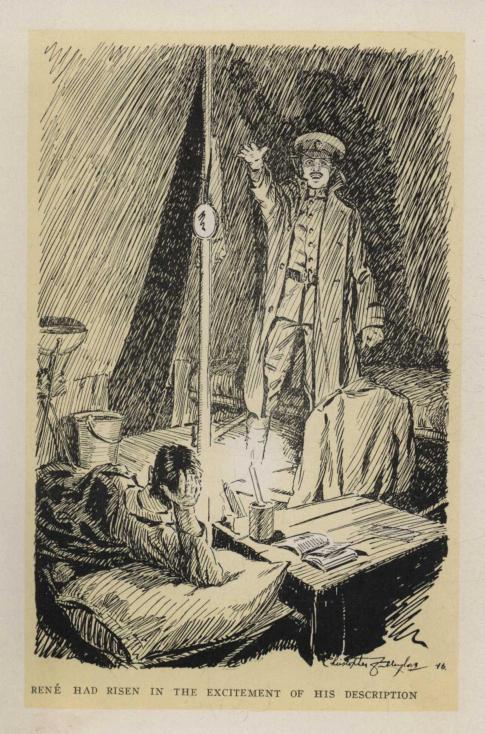
RENÉ HAD RISEN IN THE EXCITEMENT OF HIS DESCRIPTION
René had risen in the excitement of his description. The candle light shone faintly upon his broad shoulders and handsome, inspired face. His right arm was extended in harmony with the vehemence of his description. He continued more softly:
"Dat riviere is me; de falls is my lil' gal at de turnin'-point of my life, an' de great lake is my love which has burst over de fields of my fancy an' freshes all de dry places. I can't tell you how I love dat gal—sometimes I tink—maybe—I marry her some day."
At this juncture the senior major had thrust his head inside the tent.
"René," he called sternly, "get back to your work! Wash my rubber boots and keep an eye on the tent 'til I return."
And poor René, thus rudely brought to earth, had crept silently away.
At seven-thirty p.m., the shrill call of the bugle sounded "Officers' Mess":
"The officers' wives get pudding and pies,
The soldiers' wives get skilly—"
It is the one call which every officer, senior or junior, knows by heart, and answers promptly.
A mess dinner is a parade, and is conducted with all the pomp and dignity peculiar to a Chinese wedding. Woe betide the untrained "sub" who dares seat himself before the Commanding Officer has taken his place at the centre of the table! For the first time since our arrival in France, we were to be honoured with the presence of several ladies, and the whole mess was in a state of excitement compatible with the seriousness of such an occasion. It was so long since any of us had dined under the charming, but restraining, influence of the fair sex that, as Reggy afterward remarked, he was in a condition bordering on nervous prostration lest he forget to eat the ice cream with his fork, or, worse still, "butter" his bread with paté de fois gras.
Reggy had other worries on his mind as well. He had been taken aside early, and solemnly warned that if he, his heirs, executors or assigns, dared to bring forth upon the table so much as a smell of his ill-favoured cheese, he would be led out upon the sand dunes at early dawn and shot. This precaution having been duly taken, he was permitted to retire to the pantry with Fraser and Corporal Granger, and amuse himself making thirty Bronx cocktails for our express delectation. Promptly, as the last note of the bugle died away, the colonel and matron ushered our fair guests into the Mess Room.
Had our long separation from the beautiful women of Canada whetted our sense of appreciation? Or was it some dim recollection of an almost-forgotten social world which stimulated our imagination? Certainly no more exquisite representatives of the, to us, long-lost tribe of lovely women ever graced a Mess Room in France!
After the customary introductions had taken place, the twenty-five officers who now comprised our Mess distributed themselves in various awkward positions about the chairs of the five ladies—all the rest of our chairs were at the table—each trying vainly to give himself that appearance of graceful ease which indicates that the entertainment, of grandes dames is our chief sport in Canada.
What a dreadful encumbrance one's hands are on such an occasion! A military uniform does not take kindly to having its wearer's hands thrust deeply into his breeches pockets, and, as every one knows, this is the only way to feel at ease when addressing a lady in her evening gown—if you fold your hands unostentatiously behind your back, it hampers your powers of repartee.
Lady Danby, who conducted a Red Cross Hospital in a near-by town, appreciated our embarrassment, and did her best to make us feel at home.
"What a delightful Mess Room!" she exclaimed, as her tall, lithesome figure sank into an arm chair. "It must be so restful and refreshing after those dreadful operations!"
"Captain Reggy finds it very restful indeed," Burnham volunteered mischievously; "he spends a great deal of his time here—mixing drinks."
"Ah!—and he does them so very well too," exclaimed Madame Cuillard, with a flash of her beautiful dark eyes toward the hero of the moment, and lifting her glass to him in gracious compliment. "He is a man after my own heart."
"Madam, you flatter me," Reggy murmured, with a low bow, "and yet I fear I am not the first who has been 'after' such a kindly heart?"
"Nor you shall not be the last, I hope," the little widow returned, with a rippling laugh. "Still, 'Weak heart never won'—ah, non—I am forgetting my English—let it pass. A heart is so easy to be lost in France—you must be careful."
Fraser's Gibsonian figure towered above the others as he and Father Bonsecour and the senior major stood chatting with two Canadian guests. The girls made a pretty contrast, petite, dainty and vivacious; the one with blue-black hair and large soft brown eyes, the other fair as an angel, with hair of finely spun gold and eyes as blue as the sea over the dunes.
"May I take your glasses?" Fraser queried.
"Thank you, by all means," said the little brunette smilingly. "There's nothing I regret more than an empty glass or a flower that is dead."
"The former leaves little to hope, and the latter hopes little to leaf," asserted the senior major sententiously, animated by the beauty of our guests.
"What a dreadful pun, Major Baldwin!" cried the pretty blonde. "You deserve five days C.B.!"
"Thank Heaven," laughed the major, "we don't always get our deserts! We incorrigibles may still, for a moment
"'Take the cash and let the credit go,
Nor heed the rumble of the distant drum'!"
But the Colonel interrupted these delightful inanities by offering his arm to Lady Danby and showing her to the seat of honour on his right. The other ladies were distributed as impartially as was possible amongst the remaining twenty-four of us. We stood for a moment with bowed heads while our chaplain repeated that concise but effective military grace:
"For what we are about to receive, thank God!" and then we took our seats.
The dinner was progressing splendidly. Wilson hadn't spilled the soup; René hadn't tripped over the rug; course after course had proceeded under Granger's worried eye with daintiness and despatch. The sole meuniere was done to a turn, the roast pheasant and asparagus had been voted superb, and the ice-cold salad a refreshing interlude. Even the plum pudding, with its flaming sauce, had been transported without accident to the guests, when Reggy beckoned with a motion of the head to Granger, and whispered something in his ear.
Granger was the best lad in the world when he wasn't disturbed, but if he became excited anything might happen. The order was transmitted to René, and in a moment the murder was out. Whether through misunderstanding, or René's secret pride in its possession, Reggy's cheese had been excavated, and before it was possible to interfere, its carcase was upon the table!
The scent of hyacinth and lilies-of-the-valley faded on the instant; the delicate charm of poudre de riz was obliterated and all the delicious odours of the meal were at once submerged in that wonderful, pungent, all-embracing emanation from the cheese.
The colonel turned first red, then pale. He cast an appealing glance at Reggy—it was too late. The rest of us glared surreptitiously and silently at the culprit. An inspiration seized him. Unobserved, he signalled the mess president, who rose to his feet on the instant.
"Mr. Vice—The King!" he commanded.
"Ladies and gentlemen—The King!" came the formal but inspiring reply.
The cheese was forgotten. We were upon our feet, and lifting our glasses we drank to our sovereign. Cigars and cigarettes were passed around, and we waited patiently until the colonel lighted his cigar—for no one smokes at mess until the O.C. has set the example, or given his permission. The offending element had been quickly but quietly removed from the table, and once more peace and happiness prevailed.
But Reggy's fate as Mess Secretary was sealed!
CHAPTER XI
The first line of a certain popular song emphasises a bold and truthful platitude, namely: "The World's growing older each day." The incontrovertible fact is plumped unexpectedly before us, and blocks our only exit down the passage of argument. If it had read: "The World's growing smaller each day," we might have run to our text-book of Elementary Physics, and, placing a stubby but argumentative forefinger on the Law of the Indestructibility of Matter, have proved it a falsehood of the Nth. degree. But, of course, this must all have happened before the War. Every one knows now—every Tommy can tell you—that the world is really and truly smaller; for, if not, how is it he meets Bill, or Jake, or Harry on the streets of Poperinghe or Dickibusch? He knows instinctively that the world is shrinking, and Halifax and Vancouver may be found any time jumbled together in a little Belgian village on the wrong side of the Atlantic. I hadn't seen Jack Wellcombe for twenty-five years—we had been school chums together—and his name had almost faded from the pages of my mind; so that on entering the hospital the morning after Reggy's last dinner, I received a slight shock as I lifted a new chart from the table and saw this name staring up at me:
"Captain J. Wellcombe. Royal Army Medical Corps."
Had the world really become so small? Could a quarter century be bridged in an instant? I seemed to see the little old stone schoolhouse once again; its low-ceilinged room, the big box-stove, the well-hacked seats, and the rows of little boys and girls bowed over their greasy slates. The scent of midday lunches stowed away floated back to me in memory's dream, and the haw-tree brushed its leaves against the window pane. I saw Jack as he was then, with frank blue eyes and waving golden hair—courteous, genial and big-hearted, beloved by all; and I wondered as I stood there if by any chance this might be he.
The nursing sister awoke me from this reverie: "He arrived in the early morning," she volunteered, "but as he was not seriously hurt I didn't call you, and dressed the wound myself."
It was with a feeling of nervous tension and expectancy that I followed her down the hall to his room and entered. Alas! the world is full of disappointments. It was not Jack—this dignified man with the touch of grey about the temples—but still the resemblance grew stronger, the kindly blue eyes, the same winsome smile—I wondered still.
We passed the customary greetings and chatted commonplaces for a few moments, and all the time his face wore an expression of puzzled enquiry, as if he too were trying to recall some faint memory from the past. At last I blurted out:
"Are you by any chance related to Jack Wellcombe, of K——?"
"A very close relation," he returned laughingly. "I am his dearest friend; in fact—himself. And you—you are Mac—dear old Mac!" he cried, stretching out both hands to me in his impetuous, warm-hearted way. I could have hugged him, I was so glad to see him!
"What a queer game is Life!" he exclaimed a moment later. "For years you and I have been shaken about, with many a jolt, in the dice-box of the world, and now, like two Jacks, we are once more tossed together upon the Table of Fate!"
While we were chatting over old times, the nurse unwound his bandages.
"I hope it doesn't hurt too much?" I asked him, as I examined his wound preparatory to dressing it.
"It's a mere scratch," he returned lightly; "a piece of shrapnel through the flesh of the thigh; but the surgeon at the Field Ambulance thought I should come back to hospital for a week or two. Things are rather noisy around Ypres."
"But what possessed you to join the R.A.M.C.?" I enquired. "You should be with the Canadians."
He laughed. "Oh, you chaps were too long in coming over. I'd have lost three whole months of the war. I was in England when it broke out, and came over with the First Expeditionary Force."
"You were in the retreat from Mons, then!" I exclaimed in envious admiration.
"Every foot of it," he replied. "That was a fight, you may well believe. But the Huns didn't have it all their own way. I saw a strange scrap one day between a French and a German battalion. The Huns sprang suddenly out of an ambush and were upon the French with the bayonet before you could catch your breath. Taken by surprise, the 'poilus' ran for all they were worth for about a quarter of a mile—and they are some sprinters too—the Huns following them, shouting like demons. Suddenly the French stopped—they must have been running to get their second wind—wheeled about, and with fixed bayonets charged back like a streak of forked lightning through the Germans. You never saw such a surprised and rattled bunch of Huns since you were born. If it hadn't been so awful I could have shrieked with laughter. But the French weren't satisfied with going through them once; they turned about and came back at them again, like a regiment of cavalry. The Huns seemed stupefied with amazement and terror; they fought like men in a daze, and very few ever got back to tell the story of the 'cowardly French who ran away'!"
"We, too, have underestimated the French, I'm afraid," I said. "We are beginning to realise their possibilities as a fighting force, and the Germans aren't yet awake to their strength and determination."
"They fought well at the battle of the Marne," Jack remarked. "It makes me smile still as I picture a fat little French officer with drawn sword—God only knows what he intended doing with it—who stood behind a haystack waving to his men to come on. He was absolutely fearless. Again and again he charged up that steep hill with the men, and when they couldn't make it, back he would come to hide behind his hay-stack and wait until he could induce them to try it again. About the fifth attack they succeeded and went on over the hill."
I questioned him about the battle of Ypres. (This, of course, was the first battle of Ypres—not that in which the Canadians distinguished themselves.)
"It was fast work at 'Wipers,'" he said, "with shells falling into the town like a thousand roaring devils. They dropped one into the signaller's billet. It tore a hole in the side of the building large enough to march an elephant through, and killed every mother's son of them. A 'Jack Johnson' came through the roof of our hospital and dropped into the ward—exit ward! There wasn't a bed left standing. Luckily we had removed most of the patients into the cellar—but those who were left are still there, buried in the ruins."
"The usual German respect for the Red Cross!" I commented bitterly.
"The flag makes a good mark for their artillery," he returned, with a smile; "they always look for us."
"You've had many narrow squeaks, I presume?"
He laughed merrily. "So narrow that if I had had a big stomach it might have been whittled down to sylph-like proportions. I was standing one day close to a dug-out, talking to two brother officers. The 'Whizz-Bangs' and 'Coal Boxes' were sizzling over from time to time, but not especially close. An old friend of mine" (Jack always had an "old friend" everywhere!) "stuck his head out of the dug-out and shouted up to me:
"'Drop in and have a drink, Jack—the water's fine!'
"I told him I was never thirsty in the mornings. He looked surprised, but called back again:
"'If you'll do me the honour to descend, I'll make you a fine long John Collins!'
"'Well, well,' I said, 'as you're so kind and such a persistent beggar, I'll humour you.' The other two officers said they wouldn't go in, and so I climbed down into his dug-out and sat down.
"Just as I did so a big shell came—bang!—right where I had been standing. We sprang to our feet and looked out—the poor chaps I had just left had been literally blown to pieces!"
He lay pensively silent for a moment or two, and there was a suspicious glint of moisture in his eyes as he turned his face toward the wall. Then he turned on his side once more, and smiling brightly up at me, murmured:
"It's been a great lesson to me!"
"In what way?" I queried.
"Never to refuse a drink!"
It will take more than a world's war to depress Jack. His cork-like spirit will always make him pop up serene to the surface of the whirlpool of life.
"You know the Guild Hall at Wipers?" he exclaimed a moment later.
"No; I haven't been to the actual firing line yet," I returned. "The only time we realise there is a war back here is when the trains of wounded come in; or, on a stormy night, when the wind blows fiercely from the trenches, and the boom of the great guns is driven here intermittently with the gusts."
"As soon as I can stand upon this peg of mine, you and the colonel and I will motor up and see it all," he declared, with assurance.
"Agreed!" I cried. "You may now feel confident of a speedy recovery. But tell me more about 'Wipers.'"
He raised himself on one elbow, and commenced reminiscently: "Our dear old colonel was billeted in the tenement row which used to be in the square of Ypres, close to the Guild Hall. We had been shelled out of place after place, but for several days lately Fritzie had left us in peace. It was too good to last long. One night they started chucking big shells into the cathedral and what was left of the square. I counted fifty-seven falling over and around the colonel's billet. I began to suspect the place. Taken as an exhibition of fire-works, it was a success, but as a health resort it had defects.
"It was about eleven o'clock, and some of the houses in the row had already been hit. Ye gods! Vesuvius in its balmiest days was like a Chinese lantern to this—for a second, in a lull, you would hear the whine of a big shell; then, crash! it went into a building, and shell and house went up together in one frightful smash-up.
"I went over to wake the old boy, as he showed no symptoms of having been disturbed. It was useless to rap—there was such an infernal racket with shells bursting, roofs toppling in and walls falling out. I stumbled up the dark stairs to his room. He was sound asleep—think of it! I spoke to him, but he didn't wake; so I shook him gently by the shoulder and he opened his eyes.
"'Hello, Wellcombe!' he growled, in his rough but genial way. 'What the devil brings you prowling around at this time of night?'
"I told him that I thought the billet was becoming a trifle unsafe, as some of the other houses in the row had already been hit.
"'Is that all you came to tell me?' he asked, with indifference.
"I said it seemed sufficient to me, and told him we had no wish to lose him.
"'Well, well,' he came back at me, but not unkindly, 'and you woke me out of a sound sleep to tell me this! Go and get me a drink and then run along like a good fellow and go to bed.'
"And after the old chap had his drink he thanked me, turned over in bed, and I believe was sound asleep again before I got out of the house—while a continual hell of fire and shells tore the guts out of the town about him! When I went back in the morning, there was only one house left standing in that row—the colonel's. The others were a crumpled mess of bricks and mortar!"
I chatted with him as long as I could, and then, telling him I would drop in later in the day, continued my rounds on the wards.
As we entered one of the smaller rooms, I noticed a bright-eyed, red-cheeked Scotch lad, not more than seventeen years of age, seated upon his cot. He was chatting animatedly with several others, but sprang to attention as we approached. The nurse unwound the bandages and showed me his wound—a bayonet cut across the palm. We had already heard from his comrades that this slip of a boy, with the smiling eyes and ringing laugh, was one of the finest bayonet fighters in his battalion, and had to his credit a string of German scalps that would make a Pawnee Chief green with envy. His wound was the result of grasping his opponent's bayonet during one of these fights.
The nurse looked up at the boyish face—the big blue eyes and laughing mouth—he did seem such a child!
"How can you," she cried involuntarily; "how can a little lad like you bear to kill men with a bayonet?"
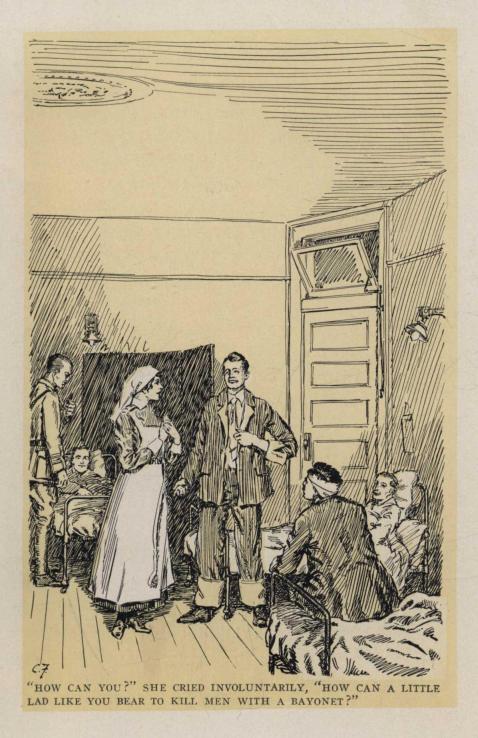
"HOW CAN YOU?" SHE CRIED INVOLUNTARILY, "HOW CAN A LITTLE LAD LIKE YOU BEAR TO KILL MEN WITH A BAYONET?"
His lips parted over his even white teeth in a broader smile than ever, but he flushed deeply as he exclaimed: "Oh, ma'm, when ye're in a charge an' ye see them steekin' yer best chums—ye go fair mad—everything turns red afore ye, an' ye could kill the whole bleedin' lot!"
"Bravo!" cried the little nurse enthusiastically, clapping her hands—she had been carried away, as I admit I too was, by his sincerity and vehemence. "May you live long and grow to be a great man, as you deserve!"
After dressing his hand and the wounds of the others, we passed on into the next room, where a poor fellow, shot through the hip, lay suffering in heroic silence.
It required three of us to do his dressing, because, on account of the peculiar position of the wound, he had to be turned upon his side each time, and with a fractured hip this was a process of great difficulty. This wonderful war has produced its many heroes, but when the great Recorder above opens His book at doomsday, He will find the name of William Hoare written large on the pages of valour.
Throughout the painful dressing Nursing Sister Dolly stood at his head, and, placing her strong little arms about his great shoulders would tell him to lift himself by her; and Hoare would gratefully lock his hands behind her neck and help to raise himself. What he suffered, God only knows! He made no sign of complaint, but gritted his teeth together like a vise and never spoke until the operation was over. Beads of sweat stood upon his brow, and his face was pale, but no groan had escaped.
"Have a little brandy, Hoare," Sister Dolly coaxed; "it'll do you good—you look so white." Tears of sympathy stood in her eyes, but Hoare smiled bravely up at her and said simply:
"Thank you—it would be welcome."
"You are a splendid soldier, Hoare," I remarked, as Sister Dolly hurried away for the stimulant.
"I'm not really a soldier, sir. I've only been a few months in the ranks," he answered. "I'm a 'bus driver in London."
I thought to myself: "A 'bus driver in London—but a hero of heroes in France!"
He raised his head as Sister Dolly held the glass gently to his lips. "You are very kind," he murmured gratefully. "I'm a deal of trouble to you."
The little sister smiled sadly and shook her head, then without a word dashed from the room.
"I'd have burst out crying—if I'd stayed another minute," she exclaimed impetuously, when I met her a moment later in the hall. "I'm a fool, I know—I'm too chicken-hearted to be a nurse."
"You're a real woman," I ejaculated in genuine admiration; "the world is the better because you were born!"
We then visited the large ward. There were forty patients in it, most of them looking as jolly as if hospital life were one of the most amusing experiences in the world. Some were reading, some playing cribbage, some of those with minor wounds were helping about the ward, and all were smoking.
But one, who had just arrived, looked dangerously ill. We approached his bed, his greenish pallor was alarming. I felt for his pulse—it had disappeared. We gave him a hypodermic at once to stimulate him, but we knew all too well he was far beyond human aid. He smiled slightly as I spoke to him. His mind was clear, with that preternatural clearness which heralds death. I sat down beside his bed—it was screened off from the others—and took his hand.
"Have you any friends to whom you wish to send a message?" I asked him gently.
"Why, doctor," he enquired, with a keenness of perception that was embarrassing, and looking up at me with a glance of slight surprise, "do you think I am going to die?"
"You are very ill indeed," I replied hesitatingly, "and I think it would be well, if there is some one in whom you are specially interested, that you should write at once."
He smiled faintly again as he looked me in the eye and answered: "There is only one person in the world who concerns me deeply—my mother;" he turned his head away an instant, "I have already written her. How long do you think I have to live?"
Even when one can answer, this is always the most awkward question in the world. No one ever gets accustomed to pronouncing a death sentence. I shook my head sadly and replied: "I cannot tell you positively—but I fear you have only a few hours more."
"Well, well," he said somewhat indifferently, and then his voice became more interested. He turned back and asked suddenly: "By the way, will you grant me a favour?"
I assured him I would do anything in my power; but I was totally unprepared for his request. He spoke eagerly:
"Then, may I have a bowl of rice pudding?"
His sang-froid startled me beyond speech. Death to him was a matter of small moment—but hunger was serious. We got him his pudding. He ate it with relish, and two hours later, with a cigarette between his lips, his brave eyes closed forever.
There was a bustle in the hospital that afternoon. We had orders to send two hundred patients to England. The boys were in a state of happy excitement; those who could walk hurrying down to the pack-stores and returning with all sorts of wrinkled tunics and breeches, and with old boots and caps. Sometimes an Irishman secured a kilt, and a "kiltie," much to his annoyance, was obliged to wear breeches. For when men from hospital were returning to England, although all their clothes were sterilised, no special effort was made in those days to return them their own. New clothes were issued at home. Those patients who were unable to get up were dressed in bed, their heads were encased in woollen toques, big thick bed-socks were drawn over their feet to keep them warm, and they were rolled in blankets and placed in the hall on stretchers, ready to depart.
The nurses had slaved for hours. Every patient had been carefully bathed, his hands and face were spotlessly clean, his wounds were freshly dressed and he was wrapped up so snugly that the loving eye of a mother could have found no fault.
The ambulances were at the door once more—but on a different mission this time—and the boys, all smiles and chatter, were carried out upon their stretchers or clambered gleefully down the stairs. Nurses, officers and men were at the door saying good-bye to their patients. Murmured words of thanks or gratitude on the one hand, and warmest well wishes on the other were exchanged, and at last, with much waving of caps and handkerchiefs, the convoy of ambulances started for the steamer at Boulogne, carrying the happy, care-free loads of boys another stage toward home, or, in Tommy's own vernacular—toward "Blighty."
CHAPTER XII
It was a wild fight the day the Germans broke through at Givenchy; and the Bosches were wilder still when, finding themselves in the town, they were in considerable doubt what to do with it. Of course it would have been perfectly all right if the rest of their corps had followed on and backed up the intrepid stormers. But the enemy had reckoned without his host, and Tommy decided that such visitors should be given a warm reception. In fact, they went so far in their efforts at hospitality that they entirely surrounded their guests and closed the breech behind them, in order that they might receive no "draft" from the rear.
Having thus graciously encompassed them, Tommy proceeded to kill them with kindness, rifles, bayonets and hand grenades. The Germans, greatly bewildered by this flattering reception, would fain have rested on the laurels already won. Tommy, however, insisted on entertaining them still further, and at last, despairing of ever satisfying such a busy host, the visitors threw down their arms and capitulated.
When we opened the doors of the Ambulance Train at Etaples and, instead of the customary khaki, saw the drab coats and the red-banded skull caps, we were almost as surprised as the Germans had been the day before.
They were a sorry-looking lot. Dazed and bewildered by their astonishing defeat, they looked like men still under the influence of a narcotic. As they got slowly down from the coaches, their heads or arms in bandages, they looked sick—very sick indeed; but it was not so much with an illness of the body as an illness of the mind. They stood together, silent and sullen, seeming to expect ill-treatment at our hands.
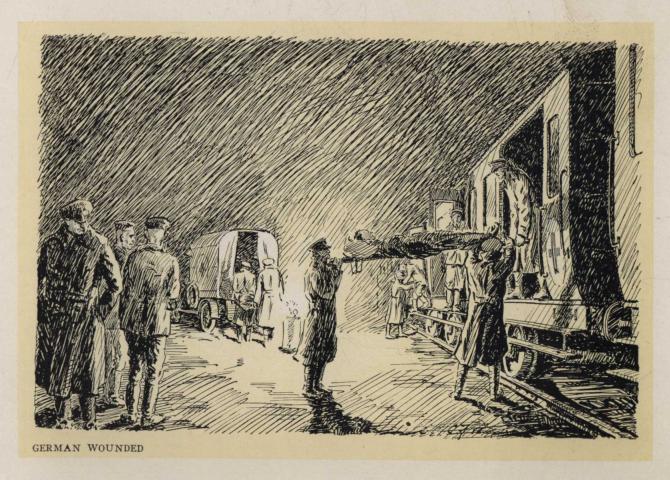
GERMAN WOUNDED
There is so little of the time "sport" in the German composition that they cannot understand that to the British war is still a game and, when the contest is over, ill-feeling ceases. We bore no more enmity toward these hapless victims of a malevolent militarism than as if they had been helpless waifs cast upon our charity. This is not a matter for self-praise; it is the inevitable result of a wholesome and broad-minded upbringing. God knows these defeated men looked sufficiently depressed and mean without our adding to their brimming cup of sorrow!
Waiving prejudice for the moment and looking at them with an impartial eye, what did we see? Stripped of their accoutrements of war, they looked quiet and inoffensive enough, but the closely shaven heads gave them the appearance of criminals. In spite of this handicap some looked to be decent, reliable chaps, not so very different from our own men. Some were dark and short of stature; some were tall, broad-shouldered and strong. Some had the fair hair and blue eyes which we always associate with the Saxon. But there were those too whose low brows, irregular features and cruel eyes indicated an unmistakable moral degeneracy which boded no one good.
One, a corporal, who spoke English and acted as interpreter for his fellows, presented a countenance of such striking malignancy and low cunning that the mere contemplation of his ugly features—the long nose, receding forehead and sneaky grey eyes—impressed one with an uneasy feeling that no dastardly deed would be beneath him. Upon request, he herded his companions into the ambulances, and as they were, with a few exceptions, but slightly wounded, a strong guard was sent to the hospital with them to see that they should do no mischief nor attempt to escape upon the way.
When they arrived at the hospital and were drawn up in line in the admittance hall, it was perhaps a pardonable curiosity which prompted the orderlies to crowd around and get a glimpse of the first German prisoners they had ever seen. The Bosche corporal took his stand beside the registrar's desk and called out, in English, the names, numbers and regiments of each of the prisoners. Amongst them were Prussians, Bavarians and German Poles. It is difficult to say how this medley of nationalities came to be together.
Sergeant Honk was in the forefront among the orderlies, and perhaps that was the reason he was drawn still further into the limelight. For suddenly a prisoner, putting his hand into the pocket of his coat, drew forth a hand grenade, and thrust it at him. Honk was startled, and, jerking his half-extended hand away with great expedition, backed hastily from the evil-looking bomb.
"'Ere you!" he gasped excitedly, "wot the dooce are ye h'up to now?"
"Ein 'souvenir' für Ihnen," said the German, astonished at Honk's precipitate retreat. Honk understood only the one word, but that was enough.
"H'I down't want any damn dangerous souvenir like that!" he returned wrathfully. "Put it h'on the tyble!"
The German, gathering his meaning from his actions rather than Honk's words, did as he was bidden, and stepped back into line.
"The bleedin' fool might 'a' blowed h'up the 'ole hospital," he declaimed peevishly to his companions, "whippin' out 'is blimed h'infernal machine like that; blessed if h'I wouldn't 'a' put 'im in the clink fer h'it."
Burnham now ordered our men to get about their business and proceeded with the allotment of beds for the prisoners. A slight difficulty arose at this point, as to their disposal. The colonel had decided to put them all in one ward; but, as we had no armed guard, we thought they would be safer if distributed in the several rooms. A number of them were so slightly wounded that, if segregated in one room, they might easily concoct schemes for escape or even offence. At the same time, by decentralising them, they would not only be under surveillance by the ward orderlies, but by the British Tommies as well, and there would be little opportunity for collusion. This plan was finally adopted. The Prussians fell to Reggy's lot; the Bavarians to mine, and the balance were divided amongst the different wards.
The next morning Reggy, who had studied in Berlin and spoke excellent German, when making his rounds approached the bed of a tall, fair-haired prisoner, whose steely blue eyes contained no hint of welcome, and who, in spite of his good treatment, was still openly suspicious of us.
After bidding him guten Morgen and dressing his wound—which was in the place we would have liked to see all Germans "get it," viz.: the neck, Reggy enquired:
"What do you think of the war? Do you still think you are going to win?"
The Prussian looked up with a half smile and the suspicion of a sneer curled his lip. "Is there any doubt about it?" he returned.
"There should be considerable doubt in your minds," Reggy answered warmly.
"We shall win," the prisoner said, with imperturbable coolness and assurance; "the war has only commenced, as far as we are concerned."