RARE FORMS OF FERNWORTS—XXII.
Reading edition
Still Another Christmas Fern.
In 1893, the late James A. Graves found a curious form of Christmas fern (Polystichum acrostichoides) in the vicinity of Susquehanna, Pa., and removed it 49 to his garden where it continued to put forth its abnormal fronds for many years and may still be alive for anything the writer knows to the contrary. During the period in which Mr. Graves gave his principal attention to the study of ferns he was often advised to describe his abnormal specimen, but he was always so much engrossed in the study and cultivation of the living ferns that he never found time to write a formal scientific description of the plant, though he had settled on a name for it. The form undoubtedly deserves a distinctive name and since the discoverer is no longer with us, it seems very fitting that the form be named for him. I therefore offer the following description of
Polystichum acrostichoides f. Gravesii.
Plant similar to the type but with the pinnae ending in truncate tips from which the midveins project as spinelike bristles. Type in the herbarium of Willard N. Clute. Cotype in the herbarium of Alfred Twining, Scranton, Pa.
Although the description is drawn from a single plant it is likely that a search in the regions where the Christmas fern is abundant would reveal other specimens with the same peculiarity. Indeed, H. G. Rugg in a paper before the Vermont Botanical Club, last winter, described a plant that, to judge from his remarks must be essentially the same thing. He says: “For several years I have had a peculiar form of this fern growing in my garden. It is interesting because of the truncate form of the pinnae and the multifid form of the tip of the frond. The sterile fronds are usually like those of the type plant. This fern I transplanted into my garden several years ago and ever since then it has continued to bear these peculiar fronds. The late Mr. B. D. Gilbert was interested in 50 the plant and asked permission to describe it in the Fern Bulletin but illness and finally death prevented.” Apparently the only difference between the Vermont and Pennsylvania plants is the cristate apex, but as forking tips are to be expected in any species this feature is not extraordinary.
Mr. Graves usually spoke of his specimen as the variety truncatum. This is the name it bears in some herbaria and is the one it undoubtedly would have borne in literature had he lived to describe it. Those who were fortunate enough to have known Mr. Graves personally, however, will be pleased to see his name associated with one of the forms of that division of the plant world which he studied so long and so assiduously. It need hardly be said for the readers of this magazine that Mr. Graves was one of the founders of the Linnaean Fern Chapter the name by which the American Fern Society was originally known, was elected the first treasurer and held that office through half the lifetime of the society, was one time president of the same society and for a long time one of the most resourceful of its Advisory Council members.
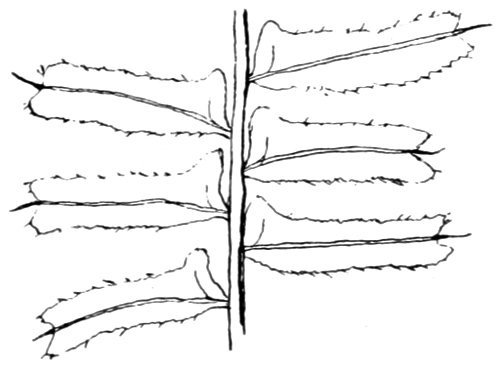
The drawing herewith was made from the middle pinnae of a frond kindly supplied by Mr. Alfred 51 Twining, of Scranton, Pa. It is a fair average of the form and though without much beauty of outline is still of interest for the form in which nature has cast it.