Chapter XXIII
Reading edition
REAPING AND THRESHING—A PIONEER FUNERAL—THE HOMELESS AND WAYFARING APPEAL TO MRS. BRUNNER—RETURN OF THE MINERS—SOCIAL GATHERINGS—OUR DAILY ROUTINE—STOLEN PLEASURES—A LITTLE DAIRYMAID—MY DOGSKIN SHOES.
Reaping and threshing were interesting events to us that summer. Mission Indians, scantily clothed, came and cut the grain with long knives and sickles, bound it in small sheaves, and stacked it in the back yard opposite grandma's lookout window, then encircled it with a rustic fence, leaving a wide bare space between the stack and the fence, which they swept clean with green branches from live oak trees.
After many days, Mexican drivers brought a band of wild mares to help with the work. A thick layer of unthreshed grain was pitched on to the bare space surrounding the stack and the mares were driven around and around upon it. From time to time, fresh material was supplied to meet the needs of the threshers. And, at given signals from the men on the stack, the mares were turned out for a short rest, also in order to allow the Indians a chance to throw out the waste straw and to heap the loose grain on the winnowing ground. So they did again and again, until the last sheaf had been trodden under foot.
When the threshing was finished, the Indians rested; then prepared their fires, and feasted on the head, feet, and offal of a bullock which grandpa had slaughtered.
Like buzzards came the squaws and papooses to take what was left of the food, and to claim a share from the pile of worn-out clothes which grandma brought out for distribution. Amid shouts of pleasure, gesticulations, and all manner of begging, the distribution began, and when it ended, our front yard looked as though it were stocked with prize scarecrows.
One big fellow was resplendent in a battered silk hat and a tattered army coat; another was well dressed in a pair of cast-off boots and one of grandma's ragged aprons. Georgia and I tried to help to sort the things as they should be worn, but our efforts were in vain. Wrong hands would reach around and get the articles, and both sexes interchanged suits with apparent satisfaction. Grandma got quite out of patience with one great fellow who was trying to put on a petticoat that his squaw needed, and rushed up to him, jerked it off, gave him a vigorous push, and had the garment on his squaw, before he could do more than grunt. In the end they went away caring more for the clothes that had been given them than for the money they had earned.
Before the summer waned, death claimed one of our own brave women, and immigrants from far and near gathered to do her honor. I do not recollect her name, but know that she was tall and fair, and that grandma, who had watched with her through her last hours, told Georgia and me that when we saw the procession leave the house, we might creep through our back fence and reach the grave before those who should walk around by the road. We were glad to go, for we had watched the growth of the fresh ridge under a large oak tree, not far from our house, and had heard a friend say that it would be "a heavenly resting place for the freed sufferer."
Her family and nearest neighbors left the house afoot, behind the wagon which carried the plain redwood coffin. At the cross-road several fell in line, and at the grave was quite a gathering. A number came in their ox wagons, others on horseback; among them, a father afoot, leading a horse upon whose back sat his wife with an infant in arms and a child behind clinging to her waist; and several old nags, freighted with children, were led by one parent, while the other walked alongside to see that none should lose their balance and fall off.
No minister of the Gospel was within call, so, after the coffin was placed upon the bars above the open grave, and the lid removed, a friend who had crossed the plains with the dead, offered a prayer, and all the listeners said, "Amen."
I might not have remembered all these things, if Georgia and I had not watched over that grave, when all others seemed to have forgotten it. As we brought brush to cover it, in order to keep the cattle from dusting themselves in the loose earth, we talked matters over, and felt as though that mother's grave had been bequeathed to us. Grandma had instructed us that the graveyard is "God's acre," and that it is a sin to live near and not tend it. Still, no matter how often we chased the cattle away, they would return. We could not make them understand that their old resting-place had become sacred ground.
About the middle of October, 1848, the last of the volunteers were mustered out of service, and shortly thereafter the excess of army stores were condemned and sold. Ex-soldiers had preference over settlers, and could buy the goods at Government rates, plus a small cost of transportation to the Pacific coast. Grandma profited by the good-will of those whom she had befriended. They stocked her store-room with salt pork, flour, rice, coffee, sugar, ship-bread, dried fruit, and camp condiments at a nominal figure above what they themselves paid for them.
This was fortunate, for the hotel was still closed, and the homeless and wayfaring appealing to grandma, easily persuaded her to make room for them at her table. The greater the number, the harder she worked, and the more she expected of us. Although we rose at dawn, and rolled our sleeves high as she rolled hers, and like her, turned up our dress skirts and pinned them behind under our long belt aprons, we could not keep pace with her work.
Nevertheless, we were pleasing reminders of little girls whom she had known in her native village, and she was proud of us, and had two little white dresses fashioned to be worn on very special occasions. After they were finished, we also were proud, and made many trips into the room to see how beautiful they looked hanging against the wall under the curtain.
Marvellous accounts of the extent and richness of the gold-diggings were now brought to town by traffickers in provisions for mining-camps. This good news inspired our home-keepers with renewed courage. They worked faster while planning the comfort they should enjoy after the return of the absent.
The first to come were the unfortunate, who sought to shake off rheumatism, lung trouble, or the stubborn low-grade fever brought on by working in the water, sleeping on damp ground, eating poorly cooked food, or wearing clothing insufficient to guard against the morning and evening chill. Few had much to show for their toil and privation; yet, not disheartened, even in delirium, they clamored to hasten back for the precious treasure which seemed ever beckoning them onward.
When wind and weather drove them home, the robust came with bags of gold rolled in their snug packs. They called each other "lucky dogs," yet looked like grimy beggars, with faces so bewhiskered, and clothing so ragged, or so wonderfully patched, that little children cried when they drew near, and wives threw up their hands, exclaiming, "For the land's sake! can it be?" Yet each home-comer found glad welcome, and messengers were quick to spread the news, and friends gathered to rejoice with the returned.
Now each home-cooked dish was a feast for the camp-fed to contrast with their fare at Coloma, Wood's Camp,[16] and sundry other places, where flour, rice, ship-bread, and coffee were three dollars a pound; salt pork and white beans, two dollars a pound; jerked beef, eight dollars a pound; saleratus, sixteen dollars an ounce; and salt, sugar, and raisins were put on the scales to balance their weight in gold dust; where liquor was fifty cents a tablespoonful, and candles five dollars each. It was not the prices at which they complained, but at the dearth of these staples, which had forced them home to wait until spring should again open the road to supply-trains.
The homeless, who in the evenings found comfort and cheer around grandma's table, would take out their treasure bags and boxes and pour their dust and grains of gold in separate piles, to show the quality and quantity, then pass the nuggets around that all might see what strange figures nature had moulded in secret up among the rocks and ravines of the Sierras.
One Roman Catholic claimed as his choicest prize a perfectly shaped cross of free gold, which he had cradled from the sands in the bed of a creek. Another had an image of the Virgin and Child. A slight stretch of the imagination turned many of the beautifully fretted pieces into miniature birds and other admirable designs for sweetheart brooches. The exhibition over, each would scrape his hoard back into its receptacle, blow the remaining yellow particles on to the floor so that the table should not show stain, and then settle himself to take his part in relating amusing and thrilling incidents of life in the mining camps. Not a window was closed, nor a door locked, nor a wink of sleep lost in those days, guarding bags of gold. "Hands off" was the miners' law, and all knew that death awaited him who should venture to break it.
Heavy purses made willing spenders, and generous impulses were untrammelled. Nothing could be more gratifying or touching than the respect shown by those homeless men to the pioneer women and children. They would walk long distances and suffer delays and inconveniences for the privilege of passing a few hours under home influences, and were ever ready to contribute toward pleasures in which all might participate.
There were so few young girls in the community, and their presence was so greatly desired, that in the early winter, Georgia and I attended as welcome guests some of the social gatherings which began at early candle-light, and we wore the little white dresses that were so precious in our eyes.
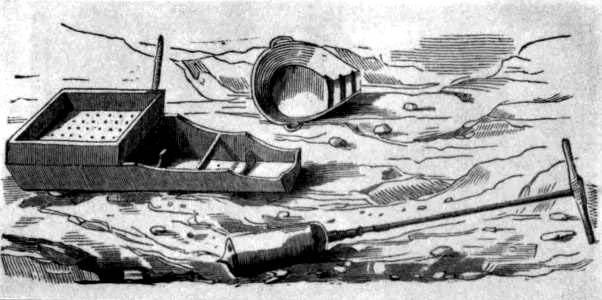
GOLD ROCKER, WASHING PAN AND GOLD BORER