JOHN WERGE. (continued 3)
Reading edition
Fig. 1. Fig. 2.
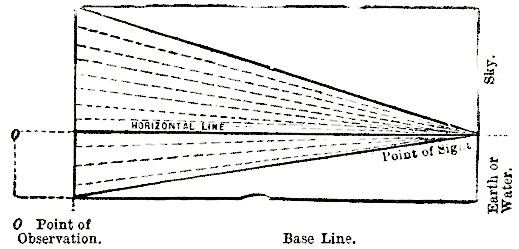
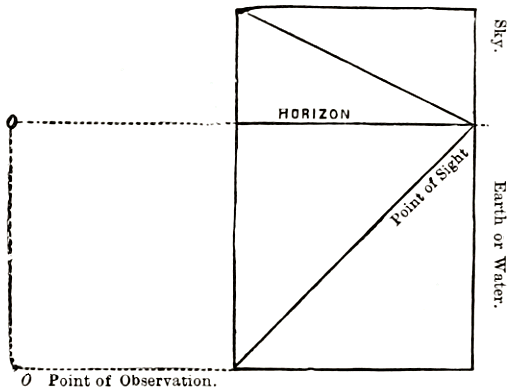
Fig. 1 is a section of the linear construction of a picture, and will show how the lines converge from the point of observation to the point of sight. Artists, in constructing a landscape of an ordinary form, allot to the sky generally about twice the space between the base and horizontal lines. But for portraits and groups, where the figures are of the greatest importance and nearer to the eye, the proportion of sky and earth is reversed, so as to give increased value to the principal figures, by making them apparently larger, and still preserving the proper relation between them and the horizontal line (see fig. 2). This diagram represents the conditions of a full-length carte portrait, where the governing horizontal line is on a level with the camera. If a pictorial background, painted in the usual way, with the horizontal line low in the picture, is now placed behind the sitter, the resulting photograph will be incongruous and offensive. It will be seen, on referring to fig. 2, that all the lines below the horizon must of necessity run up to it, no matter how high the horizontal line may be, for it is impossible to have two horizons in one picture; that is, a visible horizon in the landscape background, and an imaginary one for the figure, with the horizontal line of the background far below the head of the figure, and the head far up in the sky. The head of a human figure can only be seen so far above the horizontal line under certain conditions; such as being elevated above the observer by being mounted on horseback, standing on higher ground, or otherwise placed considerably above the base line, none of which conditions are present in a studio. Whenever the observed and observer are on the same level, as must be the case when a photographer is taking the portrait of a sitter in his studio, the head of the subject could not possibly be seen so high in the sky, if the lens included a natural background instead of a painted one. As, for convenience, the painted background is intended to take the place of a natural one, care should be taken that the linear and aerial perspectives should be as true to nature as possible, and in perfect harmony with the size of the figures. The lens registers, on the prepared plate, the relative proportions of natural objects as faithfully as the retina receives them through the eye, and if we wish to carry out the illusion of pictorial backgrounds correctly, we must have the linear construction of the picture, which is intended to represent nature, as true in every respect as nature is herself.
Aerial perspective has not been sufficiently attended to by the painters of pictorial backgrounds. There are many other subjects in connection with art and photography that might be discussed with advantage—such as composition, arrangement of accessories, size, form, character, and fitness of the things employed; but I leave all these for another opportunity, or to someone more able to handle the subjects. For the present, I am content to point out those errors that arise from neglecting true perspective, and while showing the cause, distinctively supply a remedy.
It is not the fault of perspective in the background where the lines are not in harmony with each other—these too frequently occur, and are easily detected—but it is the error of painting a pictorial background as if it were an independent picture, without reference to the conditions under which it is to be used. The conditions of perspective are determined by the situation of the lens and the sitter. If the actual objects existed behind the sitter, and were photographed simultaneously with the sitter, the same laws of perspective would govern the two. What I urge is, that if, instead of the objects, a representation of them be put behind the sitter, that representation be also a correct one. The laws of perspective teach how it may be made correctly, and the starting point is the position of the lens in relation to the sitter.
Some may say that these conditions of painting a background cannot be complied with, as the lens and sitter are never twice exactly in the same relation to each other. There is less force in this objection than at first appears. Each photographer uses the same lens for all his carte portraits—and pictorial backgrounds are very frequently used for these—and the height of his camera, as well as the distance from his sitter, are so nearly constant, that the small amount of errors thus caused need not be recognized. If the errors that exist were not far more grave, there would be no necessity for this paper. Exceptional pictures should have corresponding backgrounds.
When a “sitter” is photographed standing in front of a pictorial background, the photograph will represent him either standing in a natural scene, or before a badly-painted picture. Nobody should wittingly punish his sitter by doing the latter when he could do the former, and the first step to form the desirable illusion is pictorial truth. There is no reason why the backgrounds should not be painted truthfully and according to correct principles, for the one is as easy as the other. I daresay the reason is that artists have not intentionally done wrong—it would be too bad to suppose that—but they have treated the backgrounds as independent pictures, and it is for photographers to make what use of them they think proper. The real principles are, however, now stated, by which they can be painted so as to be more photographically useful, and artists and photographers have alike the key to pictorial truth.
In conclusion, I would suggest to photographers the necessity of studying nature more carefully—to observe her in their walks abroad, to notice the gradual decrease of objects both in size and distinctness, to remember that their lens is to their camera what their eye is to themselves, to give as faithful a transcript of nature as they possibly can, to watch the flow of nature’s lines, as well as natural light and shade, and, by a constant study and exhibition of truth and beauty in their works, make photography eventually the teacher of art, instead of art, as is now the case, being the reviler of photography.
PERSPECTIVE.
To the Editors.
Gentlemen,—At the end of Mr. Alfred H. Wall’s reply to Mr. Carey Lea’s letter on Artists and Photographers, I notice that he cautions your readers not to receive the very simple rules of perspective laid down in my paper, entitled Errors in Pictorial Backgrounds, until they have acquired more information on the subject. Allow me to state that all I said on perspective in that paper only went to show that there should be but one horizon in the same picture; that the lines of all objects below that horizon should run up to it; that the lines of all objects above should run down, no matter where that one horizon was placed; and that the horizon of the landscape background should be in due relation to the sitter and on a level with the eye of the observer, the observer being either the lens or the painter.
If your correspondent considers that I was in error by laying down such plain and common sense rules, which everyone can see and judge for himself by looking down a street, then I freely admit that your correspondent knows a great deal more about false perspective than I do, or should like to do.
Again, if your correspondent cannot see why I “volunteered to instruct artists” or painters of backgrounds, perhaps he will allow me to inform him that I did so simply because background painters have hitherto supplied photographers with backgrounds totally unfit for use in the photographic studio.
In spite of Mr. Wall’s assumption of superior knowledge on subjects relating to art, I may still be able to give him a hint how to produce a pictorial background that will be much more natural, proportionate, and suitable for the use of photographers than any hitherto painted.
Let Mr. Wall, or any other background painter, go out with the camera and take a carte-de-visite portrait out-of-doors, placing the subject in any well-chosen and suitable natural scene, and photograph the “sitter” and the natural scene at the same time. Then bring the picture so obtained into his studio and enlarge it up to “life-size,” which he can easily do by the old-fashioned system of “squaring,” or, better still, by the aid of a magic lantern, and with the help of a sketch of the scene as well, to enable him to fill in correctly that part of the landscape concealed by the figure taken on the spot; so that, when reproduced by the photographer in his studio, he will have a representation of a natural scene, with everything seen in the background in correct perspective, and in natural proportions in relation to the “sitter.” This will also show how few objects can naturally be introduced into a landscape background; and if the distant scenery be misty and undefined, so much the better. It is the sharpness, hardness, and superabundance of subjects introduced into pictorial backgrounds generally that I object to, and endeavoured to point out in my paper; and I consider it no small compliment to have had my views on that part of my subject so emphatically endorsed by so good an authority as Mr. Wallis, in his remarks on backgrounds at the last meeting of the South London Photographic Society.
I make no pretensions to the title of “artist,” although I studied perspective, drawing from the flat and round, light and shade, and other things in connection with a branch of art which I abandoned many years ago for the more lucrative profession of a photographer. Were I so disposed, I could quote Reynolds, Burnett, and Ruskin as glibly as your correspondent; but I prefer putting my own views on any subject before my readers in language of my own.
I endeavour to be in all my words and actions thoroughly independent and consistent, which is more than I can say for your correspondent “A. H. W.” In proof of which, I should like to call the attention of your readers to a passage in his “Practical Art Hints,” in the last issue of The British Journal of Photography, where he says:—“It is perversion and degradation to an art like ours to make its truth and unity subservient to conventional tricks, shams, and mechanical dodges,” while at the last meeting of the South London Photographic Society, when speaking of backgrounds, he admitted they were all conventional.
Now, that is just what we do not want, and which was the chief object I had in view when I wrote my paper. We have had too many of those art-conventional backgrounds, and want something more in accordance with natural truth and the requirements of photography.
In conclusion, allow me to observe that I should be truly sorry were I to mislead anyone in the pursuit of knowledge relative to our profession, either artistically or photographically. But let it be borne in mind that it is admitted on all sides, and by the best authorities, that nearly all the pictorial backgrounds now in use are quite unnatural, and totally unsuited for the purposes for which they are intended. Therefore the paper I read will have done the good I intended, and answered the purpose for which it was written, if it has been the means of calling attention to such glaring defects and absurdities as are now being perpetrated by background painters, and bringing in their place more natural, truthful, and photographically useful backgrounds into the studios of all photographers.—I am, yours, &c.,
J. Werge.
February 10th, 1866.
PERSPECTIVE IN BACKGROUNDS.
To the Editors.
Gentlemen,—I must beg of you to allow me to reply to Mr. Wall once more, and for the last time, on this subject, especially as that gentleman expects an answer from me.
To put myself into a fair position with regard to Mr. Wall and your readers, I will reply to the latter part of his letter first, by stating that I endeavour to avoid all personality in this discussion, and should be sorry to descend to anything of the kind knowingly. When I spoke of “independency and consistency,” I had not in view anything relative to his private character, but simply that kind of independence which enables a man to trust to his own powers of utterance for the expression of his ideas, instead of that incessant quoting the language of others, to which your correspondent, Mr. Wall, is so prone. As to his inconsistency, I mean that tendency which he exhibits to advocate a principle at one time, and denounce it at another. I shall prove that presently. Towards Mr. Wall, personally, I have neither animosity nor pique, and would take him by the hand as freely and frankly as ever I did were I to meet him at this moment. With his actions as a private gentleman I have nothing to do. I look upon him now as a controvertist only. So far, I hope I have made myself clearly understood by Mr. Wall and all concerned.
I also should like to have had so important a question discussed without introducing so much of that frivolous smartness of style generally adopted by Mr. Wall. But, as he has introduced two would-be-funny similes, I beg to dispose of them before going into more serious matter. Taking the “butcher” first (see the fifth paragraph in Mr. Wall’s last letter), I should say that, if I were eating the meat, I should be able to judge of its quality, and know whether it was good or bad, in spite of all the butcher might say to the contrary; and surely, no man not an out-and-out vegetarian, or lacking one of the five senses—to say nothing of common sense—will admit that it is necessary to be a “butcher” to enable him to be a judge of good meat. On the same ground, I contend that it is not necessary for a man to be an artist to have a thorough knowledge of perspective; and I have known many artists who knew as little about perspective, practically, as their easel did. They had a vague and dreamy idea of some governing principles, but how to put those principles into practice they had not the slightest notion. I once met an artist who could not put a tesselated pavement into perspective, and yet he had some right to the title of artist, for he could draw and paint the human figure well. Perspective is based on geometrical principles, and can be as easily mastered by any man not an artist as the first book of Euclid, or the first four rules of arithmetic; and, for all that, it is astonishing how many artists know so little about the working rules of perspective.
Again: Mr. Wall is surely not prepared to advance the dictum that no one can know anything about art but a professional artist. If so, how does he reconcile that opinion with the fact of his great and oft-quoted authority, Ruskin, not being an artist, but simply, in his public character, a voluminous writer on art, not always right, as many artists and photographers very well know.
Mr. Wall objects to my use of the word “artist,” but he seems to have overlooked the fact that I used the quotation marks to show that I meant to apply it to the class of self-styled artists, or men who arrogate to themselves a title they do not merit—not such men as Landseer, Maclise, Faed, Philips, Millais, and others of, and not of, the “Forty.” Mr. Wall may be an artist. I do not say he is not. He also is, or was, a painter of backgrounds. So he can apply to himself whichever title he likes best; but whether he deserves either one or the other, depends on what he has done to merit the appellative.
Mr. Wall questions the accuracy of the principles I advocated in my paper. I contend that I am perfectly correct, and am the more astonished at Mr. Wall when I refer to vol. v., page 123, of the Photographic News. There I find, in an article bearing his own name, and entitled “The Technology of Art as Applied to Photography,” that he says:—
“If you make use of a painted cloth to represent an interior or out-door view, the horizontal line must be at somewhere about the height which your lens is most generally placed at, and the vanishing point nearly opposite the spot occupied by the camera. * * * * I have just said that the horizon of a landscape background and the vanishing point should be opposite the lens; I may, perhaps, for the sake of such operators as are not acquainted with perspective, explain why. The figure and the background are supposed to be taken at one and the same time, and the camera has the place of the spectator by whom they are taken. Now, suppose we have a real figure before a real landscape: if I look up at a figure I obtain one view of it, but if I look down on it, I get another and quite a different view, and the horizon of the natural landscape behind the figure is always exactly the height of my eye. To prove this, you may sit down before a window, and mark on the glass the height of the horizon; then rise, and, as you do so, you will find the horizon also rises, and is again exactly opposite your eye. A picture, then, in which the horizontal line of the background represents the spectator as looking up at the figure from a position near the base line, while the figure itself indicates that the same spectator is at that identical time standing with his eyes on a level with the figure’s breast or chin—such productions are evidently false to art, and untrue to nature. * * * * The general fault in the painted screens we see behind photographs arises from introducing too many objects.”
Now, as I advanced neither more nor less in my paper, why does Mr. Wall turn round and caution your readers not to receive such simple truths uttered by me? I was not aware that Mr. Wall had forestalled me in laying down such rules; for at that date I was in America, and did not see the News; but, on turning over the volume for 1861 the other day, since this discussion began, I there saw and read, with surprise, the above in his article on backgrounds. I am perfectly aware that I did not say all that I might have said on perspective in my paper; but the little I did say was true in principle, and answered my purpose.
When Mr. Wall (in the second paragraph of his last letter) speaks of the “principal visual ray going from the point of distance to the point of sight, and forming a right angle to the perspective plane,” it seems to me that he is not quite sure of the difference between the points of sight, distance, and observation, or of the relation and application of one to the other. However, his coming articles on perspective will settle that. It also appears to me that he has overlooked the fact that my diagrams were sections, showing the perspective inclination and declination of the lines of a parallelogram towards the point of sight. In my paper I said nothing about the point of distance; with that I had nothing to do, as it was not my purpose to go into all the dry details of perspective. But I emphatically deny that anything like a “bird’s eye view” of the figure could possibly be obtained by following any of the rules I laid down. In my paper I contended for the camera being placed on a level with the head of the sitter, and that would bring the line of the horizon in a pictorial background also as high as the head of the sitter. And if the horizon of the pictorial background were placed anywhere else, it would cause the apparent overlapping of two conditions of perspective in the resulting photograph. These were the errors I endeavoured to point out. I maintain that my views are perfectly correct, and can be proved by geometrical demonstration, and the highest artistic and scientific testimony.
I wish it to be clearly understood that I do not advocate the use of pictorial backgrounds, and think I pretty strongly denounced them; but if they must be used by photographers, either to please themselves or their customers, let them, for the credit of our profession, be as true to nature as possible.
I think I have now answered all the points worth considering in Mr. Wall’s letter, and with this I beg to decline any further correspondence on the subject.—I am, yours, &c.,
J. Werge.
March 5th, 1866.
NOTES ON PICTURES IN THE NATIONAL GALLERY.
In the following notes on some of the pictures in the National Gallery, it is not my intention to assume the character of an art-critic, but simply to record the impressions produced on the mind of a photographer while looking at the works of the great old masters, with the view of calling the attention of photographers and others interested in art-photography to a few of the pictures which exhibit, in a marked degree, the relation of the horizon to the principal figures.
During an examination of those grand old pictures, two questions naturally arise in the mind: What is conventionality in art? and—In whose works do we see it? The first question is easily answered by stating that it is a mode of treating pictorial subjects by established rule or custom, so as to obtain certain pictorial effects without taking into consideration whether such effects can be produced by natural combinations or not. In answer to the second question, it may be boldly stated that there is very little of it to be seen in the works of the best masters; and one cannot help exclaiming, “What close imitators of nature those grand old masters were!” In their works we never see that photographic eye-sore which may be called a binographic combination of two conditions of perspective, or the whereabouts of two horizons in the same picture.
The old masters were evidently content with natural combinations and effects for their backgrounds, and relied on the rendering of natural truths more than conventional falsehoods for the strength and beauty of their productions. Perhaps the simplest mode of illustrating this would be to proceed to a kind of photographic analysis of the pictures of the old masters, and see how far the study of their works will enable the photographer to determine what he should employ and what he should reject as pictorial backgrounds in the practice of photography. As a photographer, then—for it is the photographic application of art we have to consider—I will proceed to give my notes on pictures in the National Gallery, showing the importance of having the horizontal line in its proper relation to the sitter or figure.
Perhaps the most beautiful example is the fine picture by Annibale Carracci of “Christ appearing to Peter.” This admirable work of art as nearly as possible contains the proportions of a carte-de-visite or whole-plate picture enlarged, and is well worthy the careful attention and study of every photographer; not only for its proportions and the amount of landscape background introduced, showing the proper position of the horizon and the small amount of sky visible, but it is a wonderful example of light and shade, foreshortening, variety and contrast of expression, purity of colour, simplicity of design, and truthfulness to nature. Neither of the figures lose any of their force or dignity, although the horizontal line is as high as their heads, and the whole of the space between is filled in with the scene around them. In its linear perspective it is quite in keeping with the figures, and the scenery is in harmonious subjection, controlled and subdued by aerial perspective.
The large picture of “Erminia takes refuge with the Shepherds,” by the same artist, is also a fine example of a horizon high in the picture. The figure of Erminia is separated from the other figures, and could be copied or reproduced alone without any loss of beauty and dignity, or any violation of natural laws.
Murillo’s picture of “St. John and the Lamb” suggests an admirable background for the use of the photographer. It consists of dark masses of rock and foliage. Nothing distinct or painfully visible, the distant masses of foliage blend with the clouds, and there is nothing in the background but masses of light and shade to support or relieve the principal objects.
In the picture of “Christ appearing to Mary Magdalene,” by Titian, the water-line is above the head of Christ, but if the figure were standing upright, the head of the Saviour would break the horizontal line.
Titian’s “Bacchus and Ariadne” also has the water-line breast high, almost to the neck of Ariadne. The figure of Bacchus springing from the car, as a matter of course, is much higher in the sky. This picture presents the perspective conditions of the painter having been seated while painting such figures from nature, or similar to the results and effects obtained by taking a group with the lens on a level with the breast or lower part of the necks of figures standing.
In Titian’s portrait of Ariosto there is a dark foliated background which gives great brilliancy to the picture, but no sky is visible. The “Portrait of a Lady,” by Paris Bardone, has an architectural background in which no sky is to be seen. The picture is very brilliant, and the monotony of a plain background is skilfully overcome.
The picture of “St. Catharine of Alexandria,” by Raphael, has a landscape background, with the horizon about as high as the breast, as if the artist had been seated and the model standing during the process of painting.
Raphael’s picture of “The Vision of a Knight” is another example of the fearlessness of that artist in putting in or backing up his figures with a large amount of landscape background.
The proportions of Correggio’s “Venus, Mercury, and Cupid,” are as nearly as possible those of a carte-de-visite enlarged; and that picture has no sky in the background, but a very suitable dark, cool, rocky scene, well subdued, for the rocks are quite near to the figures. This background gives wonderful brilliancy to the figures, and contrasts admirably with the warm and delicate flesh tints.
Correggio’s “Holy Family” has a landscape and architectural background, with a very little sky visible in the right-hand corner.
In the “Judgment of Paris,” by Rubens, the horizontal line of the background cuts the waist of the first female figure, showing that the artist was seated. The other two female figures are placed against a background of rocks and dark masses of foliage. Rubens’ picture of the “Holy Family and St. George” is also a good example of the kind of picture for the photographer to study as to the situation of the horizontal line.
The picture of “The Idle Servant,” by Nicolaes Maes, is also an excellent subject for study of this kind. It shows the due relation of the horizon of an interior in a very marked degree, and its shape and subject are very suitable to the size and form of a carte-de-visite. So are his pictures of “The Cradle” and “A Dutch Housewife.”
The picture of “John Arnolfini of Lucca and his Wife,” painted by John Van Eyck in the fifteenth century, is an excellent specimen of an interior background, with a peep out of a window on one side of the room. This is a capital subject for the study of photographers who wish to use a background representing an interior.
“The Holy Family at a Fountain,” a picture of the Dutch school, painted by Schoorel in the sixteenth century, has an elaborate landscape background with the horizon above the heads of the figures, as if the artist had been standing and the models sitting.
For an example of a portrait less than half-length, with a landscape background, look at the portrait of “An Italian Gentleman,” by Andrea da Solario. This picture shows how very conscientiously the old masters worked up to the truth of nature in representing the right amount of landscape in proportion to the figure; but the background is much too hard and carefully worked out to be pleasing. Besides, it is very destructive to the force and power of the picture, which will be at once visible on going to the portraits by Rembrandt, which have a marvellous power, and seem to stand right before the dark atmospheric backgrounds which that artist generally painted in his portraits.
There are other examples of half-length portraits with landscape backgrounds, wherein the horizontal line passes right through the eyes of the principal figure, one of which I will mention. It is that of the “Virgin and Child,” by Lorenzo di Credi. In this picture the horizontal line passes right through the eyes of the Virgin without interfering with the interest of the chief object.
Several examples of an opposite character are to be seen in the National Gallery, with the horizon of the landscape background much too low in the picture. It is needless to call special attention to them. After carefully examining the works already named, and comparing them with the natural effects to be observed daily, it will be quickly seen which is a truthful picture in this respect, and which is a false one.
SHARPNESS AND SOFTNESS V. HARDNESS.
The discussion on “Sharpness: what is it?” at the meeting of the South London Photographic Society in May, 1861, and the more recent discussion on “Focussing” at the last meeting of the same Society, seem to me to have lost much of their value and importance to photographers for want of a better definition of the term hardness as applied to art, and as used by artists in an artistic sense. Webster, in his second definition of the word “hardness,” gives it as “difficulty to be understood.” In that sense Mr. Wall succeeded admirably when he gave the term concentration, in reply to Mr. Hughes, who asked Mr. Wall what he meant by hardness. Fairholt gives the art meaning of the word as “want of refinement; academic drawing, rather than artistic feeling.” But even that definition would not have been sufficiently comprehensive to convey an adequate idea of the meaning of the term in contradistinction to the word sharpness, and I cannot but think that Mr. Wall failed in his object in both papers, and lost considerable ground in both discussions, by not giving more attention to the nice distinctions of the two terms as used in art, and explaining their artistic meanings more clearly.
Sharpness need not be hardness; on the contrary, sharpness and softness can be harmoniously combined in the representation of any object desired. On the other hand, a subject may possess abundance of detail, and yet convey to the mind an idea of hardness which the artist did not intend. This kind of hardness I should attribute to a miscarriage of thought, or a failure, from want of manipulative skill, to produce the desired effect. For example: one artist will paint a head, model it carefully, and carry out all the gradations of light and shade, and for all that it will be hard—hard as stone, resembling the transcript of a painted statue more than flesh. With the same brushes and colours another artist will paint a head that may be no better in its drawing, nor any more correct in its light and shade, but it will resemble flesh, and convey to the mind of the observer a correct impression of the substance represented—its flexibility and elasticity—that it is something that would be warm and pleasant to the touch, and not make you recoil from it as if it were something cold, hard, and repulsive, as in the former case. Again, two artists will paint a fabric or an article of furniture (say a table) with the same brushes, pigments, and mediums: the one artist will render it so faithfully in every respect that it would suggest to the mind the dull sound peculiar to wood when struck, and not the sharp, clear ring of metal which the work of the other artist would suggest.
Another example: one artist paints a feather, and it appears to have all the feathery lightness and characteristics of the natural object; the other will paint it the same size, form, and colour, and yet it will be more like a painted chip, wanting the downy texture and float-in-the-air suggestiveness of the other. Thus it will be seen that both artists had similar ideas, had similar materials and means at their disposal to render on canvas the same or similar effects. The one succeeded, and the other failed, in giving a faithful rendering of the same subjects; but it was no fault in the materials with which they worked. The works of one artist will convey to the mind an idea of the thing itself; with its texture, properties, weight, and proportions; nothing undervalued; nothing overrated, nothing softer, nothing harder, than the thing in nature intended to be portrayed. The other gives the same idea of form and size, light and shade, and colour, but not the texture; it is something harder, as iron instead of wood, or hard wood instead of soft wood, or stone instead of flesh. This, then, is the artistic meaning of hardness (or concentration, as Mr. Wall said), and that is an apparent packing together, a compression or petrifaction of the atoms or fibre of which the natural materials are composed. This difference in the works of artists is simply the effects of feeling, of power over the materials employed, and ability to transfer to canvas effects that are almost illusions. And so it is with photographers in the production of the photographic image. There is the same difference in feeling and manipulative skill, the same difference of power over the materials employed, that enables one photographer to surpass another in rendering more truthfully the difference of texture. Photographers may and do use the same lenses and chemicals, and yet produce widely different results. One, by judgment in lighting and superior manipulation, will transfer to his plates more texture and suggestiveness of the different substances represented than the other. It is a fact well-known to old photographers that in the best days of the Daguerreotype practice two widely different classes of pictures were produced by the most skilful Daguerreotypists, both sharp and full of exquisite detail; yet the one was hard, in an artistic sense, not that it wanted half-tone to link the lights and shades together, but because it was of a bronzy hardness, unlike flesh from which it was taken, and suggested to the mind a picture taken from a bronze or iron statue of the individual, rather than a picture taken from the warm, soft flesh of the original. The other would be equally sharp as far as focussing and sharp lenses could make it, and possess as much detail, but it would be different in colour and texture; the detail would be soft, downy, and fleshy, not irony, if I may use that word in such a sense; and this difference of effect arose entirely from a difference of feeling, lighting, preparation of the plate, and development of the pictures. They might all use the best of Voightlander’s or C. C. Harrison’s lenses, the favourite lenses of that day. They might all use the same make of plates, the same iodine, bromine, and mercury, yet there would be this difference in the character of the two classes of pictures. Both would be sharp and possess abundance of detail, still one would be soft and the other hard in an artistic acceptation of the word hardness.
Collodion positives exhibited a similar difference of character. The works of one photographer would be cold and metallic looking, while the works of another would be softer and less metallic, giving a better idea of the texture of flesh and the difference of fabrics, which many attributed to the superiority of the lens; but the difference was really due to manipulation, treatment, and intelligence. And so it is with the collodion negative. A tree, for instance, may be photographed, and its whole character changed by selecting a bad and unsuitable light, or by bad manipulation. The least over-development or “piling up” of a high light may give it a sparkling effect that would change it into the representation of a tree of cast iron, rather than a growing tree, covered with damp, soft, and moss-stained bark. Every object and every fabric, natural or manufactured, has its own peculiar form of “high light” or mode of reflecting light, and care must be taken by both artist and photographer not to exceed the amount of light reflected by each particular object, else a hardness, foreign to the natural object, will be represented. But not only should the artist and photographer possess this feeling for nature in all her subtle beauties and modes of expressing herself, to prevent a miscarriage in the true rendering of any object, the photographic printer should also have a sympathy for the work in hand, or he will, by over-fixing, or in various other ways, mar the successful labours of the photographer, and make a negative that is full of softness, and tenderly expresses the truth of nature, yield prints that are crude, and convey to the mind a sense of hardness which neither the natural objects nor the negative really possess.
Now, I think it will be seen that hardness in a painting or a photograph does not mean sharpness; nor is the artistic meaning of the word hardness confined to “rigid or severe drawing,” but that it has a broader and more practical definition than concentration; and that the converse to the art meaning of hardness is softness, tenderness, truthfulness in expressing the varied aspects of nature in all her forms, all of which are coincident with sharpness.— J. Werge (Photographic News).
UNION OF THE NORTH AND SOUTH LONDON PHOTOGRAPHIC SOCIETIES.
To the Editors, British Journal.
Gentlemen,—Allow me to express my opinion on the suggestion to unite the North and South London Societies, and to point out a few of the advantages which, I think, would accrue from a more extensive amalgamation.
Though I am a member of all the three London photographic societies, I have long been of opinion that there are too many, and that the objects of all are considerably weakened by such a diffusion of interests. If the furtherance of the art and the free and mutual interchange of thought and experience among the members were the only things considered, there would be but one society in London; and with one society embodying all the members that now make the three, how much more good might be done!
In the first place, the amounts now paid for rent by the three would, if united, secure an excellent meeting room or chambers, in a central position, for the exclusive use of the society, where the ordinary and special meetings, annual exhibitions, and soirées could be held much more independently than now, and at a cost little or no more than what is now paid for the privilege of holding the ordinary meetings alone.
Secondly: If such a place of meeting were secured, then that laudable scheme of an art library, so strenuously advocated by Mr. Wall and Mr. Blanchard at the South London Photographic Society, might be successfully carried into effect. Then a library and a collection of works of art might be gradually gathered together, and one of the members could be chosen curator and librarian, to attend the rooms one evening in the week, or oftener, as circumstances might require, so as to give members access to the library to make exchanges, extracts from bulky books, &c.
Thirdly: If the union were effected, and the place of meeting more central, there would be a larger attendance of members, and more spirited and valuable proceedings would be the result. Papers to be read at the regular meetings would be much more certain, and the discussions would be more comprehensive and complete. The members would become personally acquainted with each other, and a much better feeling would pervade the whole photographic community.
These, gentlemen, are a few of the advantages which ought to accrue from a union of the three societies; but, if that cannot be effected, by all means let the triumvirate now existing be reduced to a biumvirate. If it be not possible for the “Parent Society” and her offspring to reunite their interests and affection for the common good, surely the other two can, and thereby strengthen themselves, and secure to their members a moiety of the advantages which would result from the triple alliance.
But, before proceeding farther, let me ask—Has such a thing as a triple alliance ever been considered? Has it been ascertained that an amicable amalgamation with the Photographic Society of London is impossible? If so, what are the motives of the proposers of the union of the North and South London Societies? Do they wish to form a more powerful antagonism to the other society, or do they simply and purely wish to further the advancement of our art-science, and not to gratify personal pique or wounded pride? I do not wish to impute such unworthy motives to anyone; but it does seem singular that the proposition should come from the Chairman of the North London Photographic Association almost simultaneously with the resignation of his seat at the council board of the Parent Society.
If, however, the motives are pure, honest, and earnest, I heartily approve of the suggestion as a step in the right direction, although I candidly admit that I would much rather see all the societies united in one, and fully believe that that would be the most advantageous arrangement that could possibly be made for all concerned.—I am, yours, &c.,
Union Jack (J. Werge).
London, February 18th, 1867.
UNION OF THE LONDON PHOTOGRAPHIC SOCIETIES.
To the Editors of the British Journal.
Gentlemen,—Perhaps I am in courtesy bound to answer the questions of your correspondents, Mr. Homersham and “Blue Pendant,” but in self-justification I do not think it necessary, for it turns out that my suspicions of antagonism to the Parent Society were well founded; and, from their remarks, and the observations of your contributor “D.,” I learn that the disaffection is more widely spread than I at first thought it was.
I may have been wrong in suspecting the Chairman of the North London Photographic Association of unworthy motives; if so, I frankly beg that gentleman’s pardon. But I am not wrong in suspecting that antagonism is mixed up with the movement.
Your contributor “D.” chooses to construe my unwillingness to make a direct charge—my hope that there were no such unworthy motives—into timidity; but I beg to remind “D.” that there is not much, if any, of that apparent in my putting the plain questions I did, which, by-the-by, have not yet been very satisfactorily answered.
I flatter myself that I know when and how to do battle, and when to sue for peace, as well as any in the service under whose flag I have the honour to sail; and I, as much as anyone, admire the man that can fight courageously when in the right, or apologise gracefully when in the wrong; but, as the object of this correspondence is neither to make recriminations, nor indulge in personal abuse, I return to the primary consideration of the subject, and endeavour to sift the motives of the movers of the proposition to unite the North and South London Societies, and ascertain, if possible, whether they have the good of those societies and the furtherance of photography really at heart or not.
Imprimis, then, let us consider the arguments of “D.,” who cites the resignation of three gentlemen in proof of the management of the London Photographic Society being “out of joint.” He might as well say, “because a man is sick, leave him and let him die.” If there were anything they disliked in the government of the Society, or any evil to be corrected, their most manly course was to have held on, and fought the evils down. They all had seats at the Council board, and if they had wished well to the Society, they would not have resigned them, but battled for the right, and brought their grievances, real or imagined, before the members. A special meeting has been called before now to consider personal grievances which affected the honour of the Society, and I should think it could have been done again. I do not maintain that all is right in the Society, but I do think that they were wrong in resigning their seats because an article appeared in the Society’s journal condemnatory of a process to which they happened to be devotedly attached.
It can scarcely be supposed that the cause of reform, or the general good of the country, would have been forwarded had Gladstone, Bright, and Earl Russell resigned their seats as members of either House because they could not carry their ministerial bill of last session. From this I argue that men who have the object they advocate, and the “best interests” of the Society, thoroughly at heart, will stick to it tenaciously, whether in or out of office, and, by their watchfulness, prevent bad becoming worse, in spite of captious opposition, fancied insults, or journalistic abuse.
The next paragraph by “D.” on which I shall comment contains that bold insinuation of timidity, which I have already noticed as much as I intend to do. But I wish to discuss the question of “absorption” a little more fully. I cannot at all agree with the sentiments of “D.” on that subject. Absorption is in many instances a direct and positive advantage to both the absorber and absorbed, as the absorption of Sicily by Italy, and Frankfort and Hanover by Prussia. Nitric acid absorbs silver, and how much more valuable and useful to the photographer is the product than either of the two in their isolated condition; and so, I hold, it would be with the Society were the two other Societies to join the old one, impart to it their chief characteristics, re-model the constitution, and elect the members of the Council by ballot. We should then have a society far more powerful and useful than could ever be obtained by the formation of a new one.
In the foregoing, I think I have also answered the question of Mr. Homersham, as well as that part of “Blue Pendant’s” letter relating to the establishment of a fourth society. On that point my views harmonise with those of your contributor, “D.”
On the subject of “members of Council,” I do not agree with either “D.” or your correspondent “Blue Pendant.” The Council should be elected from and by the body of members, and the only qualifications necessary should be willingness and ability to do the work required. No consideration of class should ever be admitted. The members are all recommended by “personal knowledge,” and elected by ballot, and that alone should be test sufficient on the score of respectability.
Concerning “papers written as puffs,” I cordially agree with “Blue Pendant” as far as he goes; but I go further than that, and would insist on each paper being scrutinised, before it is read, by a committee appointed for the purpose, so as to prevent “trade advertisements” and such shamefully scurrilous papers as I have heard at the South London Photographic Society.
With reference to the questions put by “Blue Pendant,” I beg to decline answering his second, it not being pertinent; but I shall reply to his first more particularly. He seems to have forgotten or overlooked the fact that I thought the advantages I enumerated would result from a union of the three societies—not from an alliance of the two only. That I still look upon suspiciously as antagonistic to the Parent Society; and “Blue Pendant’s” antagonism is proved beyond doubt when he says it is “tottering to its fall,” and he almost gloatingly looks forward to its dissolution coming, to use his own words, “sooner or later,” and “perhaps the sooner the better.” But I venture to think that “Blue Pendant” is not likely to be gratified by seeing the “aged Parent” decently laid in the ground in his time. There is too much “life in the old dog yet”—even since the secession—for that to come to pass. It cannot be denied that the Parent Society has amongst its members some of the best speakers, thinkers, writers, and workers in the whole photographic community.
While discussing this subject, allow me, gentlemen, to advert to an article in your contemporary of Friday last. In the “Echoes of the Month,” by an Old Photographer, the writer thinks that the advantages I pointed out as likely to accrue from a union of the societies are a “pleasant prospect that will not bear the test of figures.” It is a fact that “figures” are subject to the rules of addition as well as of subtraction, and I wish to show by figures that my ideas are not so impracticable as he imagines. In addition to the eight guineas a year paid by the North and South London Photographic Societies for rent, I notice in the report of the London Photographic Society, published last month, two items in the “liabilities” which are worth considering. One is “King’s College, rent and refreshment, £42 4s. 6d.,” which, I presume, is for one year. The other is “King’s College soirée account, £20 15s. 6d.,” part of which is undoubtedly for rent of rooms on that occasion. Now there is a clear showing of over £50 12s. 6d. paid in one year by the three societies for rent and refreshment, the latter not being absolutely necessary. I may be mistaken in my estimate of the value of central property; but I do think a sum exceeding £50 is sufficient to secure a room or chambers large enough for the purposes of meeting, and keeping a library, &c.; or, if not, would it not be worth while making a strain to pay a little more so as to secure the accommodation required? If the Coventry Street experiment were a failure from apathy or other causes, that is no proof that another attempt made by a more numerous, wealthy, and energetic body would also be abortive. In sea phraseology, “the old ship has made a long leg to-day!” but I hope, gentlemen, you will not grudge the space required for the full and careful consideration of this subject. The “developing dish” and the ordinary modus operandi of photography can well afford to stand aside for awhile to have this question discussed to the end. I have not said all I can on the amalgamation project, and may return to it again with your kind permission, if necessary.—I am, yours, &c.,
Union Jack (J. Werge).
London, March 4, 1867.
THE SOCIETY‘S EXHIBITION.
Impressions and Convictions of “Lux Graphicus.”
The brief and all but impromptu Exhibition of the Photographic Society, recently held in the rooms of the Architectural Society, 9, Conduit Street, Regent Street, where the Society’s meetings are to be held in future, was one of the pleasantest and most useful expositions in connection with photography that has been consummated for many years. In the first place the idea of an exhibition evening free from the formalities of a soirée was a happy one; the locale was happily chosen; and the whole arrangements most happily successful. Everybody seemed to be pleased; cordial expressions of agreeable surprise were freely exchanged; and there were abundance and variety enough of pictorial display to satisfy the most fastidious visitor.
As might have been expected, the works of M. Salomon, exhibited by Mr. Wharton Simpson, were the chief objects of attraction, and during the whole of the evening an anxious group surrounded the collection; and it was curious to remark with what eagerness these pictures were scrutinized, so as to ascertain whether they were examples of photography “pure and undefiled,” or helped by artistic labour afterwards. That they are the very finest specimens of art-photography—both in the broad and masterly treatment of light and shade, pose, manipulation, tone of print, and after finish—that have ever been exhibited, is unquestionable; but to suppose that they are photographs unaided by art-labour afterwards is, I think, a mistake. All of the heads, hands, and portions of the drapery bear unmistakable proofs of after-touching. Some of them give evidence of most elaborate retouching on the hands and faces, on the surface of the print. I examined the pictures by daylight most minutely with the aid of a magnifying glass, and could detect the difference between the retouching on the negative, and, after printing, on the positive. The faces of nearly all the ladies present that appearance of dapple or “stipple” which nothing in the texture of natural flesh can give, unless the sitter were in the condition of “goose flesh” at the moment of sitting, which is a condition of things not at all likely. Again, hatching is distinctly visible, which is not the photographic reproduction of the hatch-like line of the cuticle. In support of that I have two forms of evidence: first, comparison, as the hatchings visible on the surface of the print are too long to be a reproduction of the hatch-like markings of the skin, even on the hands, which generally show that kind of nature’s handiwork the most. Besides, the immense reduction would render that invisible even under a magnifying glass, no matter how delicate the deposit of silver might be on the negative; or even if it were so, the fibre of the paper would destroy the effect. Again, the hatchings visible are not the form of nature’s hatchings, but all partake of that art-technical form called “sectional hatchings.” I could name several of the prints that showed most conclusive evidence of what I say, but that is not necessary, because others saw these effects as well as I did. But I wish it to be distinctly understood that I have not been at the pains to make these examinations and observations with the view of lessening the artistic merit of these pictures. I unhesitatingly pronounce them the most beautiful achievements of the camera that have ever been obtained by combining artistic knowledge and skill with the mechanical aid of the camera and ability to handle the compounds of photographic chemistry. There is unmistakable evidence of the keenest appreciation of art, and all that is beautiful in it in the production of the negative; and if the artist see or think that he can perfect his work by the aid of the brush, he has a most undoubted right to do it. This question of pure and simple photography has been mooted all the summer, ever since the opening of the French Exhibition, and I am glad that I, as well as others, have had an opportunity of seeing these wonderful pictures, and judging for myself. Photography is truth embodied, and every question raised about the purity of its productions should be discussed as freely and settled as quickly as possible.
There was another picture in the exhibition very clever in its conception, but not so in its execution, and I am sorry to say I cannot endorse all the good that has been said of it. I allude to Mr. Robinson’s picture of “Sleep.” How that clever photographer, with such a keen eye to nature as he generally manifests in his composition pictures, should have committed such a mistake I am at a loss to know. His picture of “Sleep” is so strangely untrue to nature, that he must have been quite overcome by the “sleep that knits up the ravell‘d sleeve of care” when he composed it. In the centre of the picture he shows a stream of light entering a window—a ghost of a window, for it is so unsubstantial as not to allow a shadow to be cast from its seemingly massive bars. Now, if the moon shone through a window at all, it would cast shadows of everything that stood before it, and the shadows of the bars of the window would be cast upon the coverlet of the bed in broken lines, rising and falling with the undulations of the folds of the covering, and the forms of the figures of the children. In representing moonlight, or sunlight either, there is no departing from this truth. If the direct ray of either stream through a closed window and fall upon the bed, so will the shadows of the intervening bars. Any picture, either painted or photographed, that does not render those shadows is simply untrue to nature; and if the difficulty could not have been overcome, the attempt should have been abandoned. Then the beams are not sharp enough for moonlight, and the shadows on the coverlet and children are not deep enough, and the reflections on the shadow side of the children’s faces are much too strong. In short, I do not know when Mr. Robinson more signally failed to carry out his first intentions. Wanting in truth as the composition is, it proves another truth, and that is, the utter inability of photography to cope with such a subject. Mr. Robinson exhibited other pictures that would bear a very different kind of criticism; but as they have been noticed at other times I shall not touch upon them here.
Herr Milster’s picture bears the stamp of truth upon it, and is a beautiful little gem, convincing enough that the effect is perfectly natural.
Mr. Ayling’s pictures of the Victoria Tower and a portion of Westminster Abbey are really wonderful, and the bit of aerial perspective “Across the Water” in the former picture is truly beautiful.
Mrs. Cameron persists in sticking to the out-of-the-way path she has chosen, but where it will lead her to at last is very difficult to determine. One of the heads of Henry Taylor which she exhibited was undoubtedly the best of her contributions.
The pictures of yachts and interiors exhibited by Mr. Jabez Hughes were quite equal to all that could be expected from the camera of that clever, earnest, and indefatigable photographer. The portrait enlargements exhibited by that gentleman were exquisite, and of a totally different character from any other exhibitor’s.
Mr. England’s dry plate pictures, by his modified albumen process, are undoubtedly the best of the kind that have been taken. They lack that appearance of the representation of petrified scenes that most, if not all, previous dry processes exhibited, and look as “juicy” as “humid nature” can well be rendered with the wet process.
Mr. Frank Howard exhibited four little gems that would be perfect but for the unnatural effect of the artificial skies he has introduced. The “Stranded Vessels” is nicely chosen, and one of the wood scenes is like a bit of Creswick uncoloured.
Messrs. Locke and Whitfield exhibited some very finely and sketchily coloured photographs, quite up to their usual standard of artistic excellence, with the new feature of being painted on a ground of carbon printed from the negative by the patent carbon process of Mr. J. W. Swan.
Mr. Adolphus Wing’s cabinet pictures were very excellent specimens, and I think it a great pity that more of that very admirable style of portraiture was not exhibited.
Mr. Henry Dixon’s copy of Landseer’s dog “Pixie,” from the original painting, was very carefully and beautifully rendered.
Mr. Faulkner’s portraits, though of a very different character, were quite equal in artistic excellence to M. Salomon’s.
Mr. Bedford’s landscapes presented their usual charm, and the tone of his prints seemed to surpass the general beauty of his every-day work.
Mr. Blanchard also exhibited some excellent landscapes, and displayed his usual happy choice of subject and point of sight.
An immense number of photographs by amateurs, Mr. Brownrigg, Mr. Beasley, and others, were exhibited in folios and distributed about the walls, but it is impossible for me to describe or criticise more.
I have already drawn my yarn a good length, and shall conclude by repeating what I said at starting, that a pleasanter evening, or more useful and instructive exhibition, has never been got up by the Photographic Society of London, and it is to be hoped that the success and eclat attending it will encourage them to go and do likewise next year, and every succeeding one of its natural life, which I doubt not will be long and prosperous, for the exhibition just closed has given unmistakable evidence of there being “life in the old dog yet.”
Photographic News, Nov. 22nd, 1867.
THE USE OF CLOUDS IN LANDSCAPES.
The subject of printing skies and cloud effects from separate negatives having been again revived by the reading of papers on that subject at the South London Photographic Society, I think it will not be out of place now to call attention to some points that have not been commented upon—or, at any rate, very imperfectly—by either the readers of the papers or by the speakers at the meetings, when the subject was under discussion.
The introduction of clouds in a landscape by an artist is not so much to fill up the blank space above the object represented on the lower part of the canvas or paper, as to assist in the composition of the picture, both as regards linear and aerial perspective, and in the arrangement of light and shade, so as to secure a just balance and harmony of the whole, according to artistic principles.
Clouds are sometimes employed to repeat certain lines in the landscape composition, so as to increase their strength and beauty, and to unite the terrestrial part of the picture with the celestial. At other times they are used to balance a composition, both in form and effect, to prevent the picture being divided into two distinct and diagonal portions, as evidenced in many of the pictures by Cuyp; on other occasions they are introduced solely for chiaroscuro effects, so as to enable the artist to place masses of dark upon light, and vice versa. Of that use I think the works of Turner will afford the most familiar and beautiful examples.
In the instances cited, I make no allusion to the employment of clouds as repeaters of colour, but merely confine my remarks to their use in assisting to carry out form and effect, either in linear composition, or in the arrangement of light and shade in simple monochrome, as evidenced in the engraved translations of the works of Rembrandt, Turner, Birket Foster, and others, the study of those works being most applicable to the practice of photography, and, therefore, offering the most valuable hints to both amateur and professional photographers in the management of their skies.
Before pursuing this part of my subject further, it may be as well, perhaps, to state my general opinions of the effects of so-called “natural skies,” obtained by one exposure and one printing. Admitting that they are a vast improvement on the white-sky style of the early ages of photography, they fall far short of what they should be in artistic effect and arrangement. In nearly all the “natural skies” that I have seen, their office appears to be no other than to use up the white paper above the terrestrial portion of the picture. The masses of clouds, if there, seem always in the wrong place, and never made use of for breadth of chiaroscuro.
No better illustrations of this can be adduced than those large photographs of Swiss and Alpine scenery by Braun of Dornach, which nearly all contain “natural clouds;” but, on looking them over, it will be seen that few (if any) really exhibit that artistic use of clouds in the composition of the pictures which evidence artistic knowledge. The clouds are taken just as they happen to be, without reference to their employment to enhance the effects of any of the objects in the lower portion of the view, or as aids to the composition and general effect. For the most part, the clouds are small and spotty, ill-assorting with the grandeur of the landscapes, and never assisting the chiaroscuro in an artistic sense. The most noticeable example of the latter defect may be seen in the picture entitled “Le Mont Pilate,” wherein a bald and almost white mountain is placed against a light sky, much to the injury of its form, effect, and grandeur; indeed, the mountain is barely saved from being lost in the sky, although it is the principal object in the picture. Had an artist attempted to paint such a subject, he would have relieved such a large mass of light against a dark cloud. An example of a different character is observable in another photograph, wherein a dark conical mount would have been much more artistically rendered had it been placed against a large mass of light clouds. There are two or three fleecy white clouds about the summit of the mountain, but, as far as pictorial effect goes, they would have been better away, for the mind is left in doubt whether they are really clouds, or the sulphurous puffs that float about the crater of a slumbering volcano. That photographs possessing all the effects required by the rules of art are difficult, and almost impossible to obtain at one exposure in the camera, I readily allow. I know full well that a man might wait for days and weeks before the clouds would arrange themselves so as to relieve his principal object most advantageously; and, even if the desirable effects of light and shade were obtained, the chances are that the forms would not harmonize with the leading lines of the landscape.
This being the case, then, it must be self-evident that the best mode of procedure will be to print in skies from separate negatives, either taken from nature or from drawings made for the purpose by an artist that thoroughly understands art in all its principles. By these means, especially the latter, skies may be introduced into the photographic picture that will not only be adapted to each individual scene, but will, in every instance where they are employed, increase the artistic merit and value of the composition. But to return to the subject chiefly under consideration.
Clouds in landscape pictures, like “man in his time,” play many parts—“they have their exits and their entrances.” And it is almost impossible to say enough in a short paper on a subject so important to all landscape photographers. I will, however, as briefly and lucidly as I can, endeavour to point out the chief uses of clouds in landscapes. Referring to their use for effects in light and shade, I wrote, at the commencement of this paper, that the engraved translations of Turner afford the most familiar and beautiful examples, which they undoubtedly do. But when I consider that Turner’s skies are nearly all sunsets, the study of them will not be so readily turned to practical account by the photographer as the works of others,—Birket Foster, for instance. His works are almost equal to Turner’s in light and shade; he has been largely employed in the illustration of books, and five shillings will procure more of his beautiful examples of sky effects than a guinea will of Turner’s. Take, for example, Sampson Low and Son’s five shilling edition of Bloomfield’s “Farmer’s Boy,” or Gray’s “Elegy in a Churchyard,” profusely illustrated almost entirely by Birket Foster; and in them will be seen such a varied and marvellous collection of beautiful sky effects as seem almost impossible to be the work of one man, and all of them profitable studies for both artist and photographer in the varied uses made of clouds in landscapes. In those works it will be observed that where the lower part of the picture is rich in variety of subject the sky is either quiet or void of form, partaking of one tint only slightly broken up. Where the terrestrial part of the composition is tame, flat, and destitute of beautiful objects, the sky is full of beauty and grandeur, rich in form and masses of light and shade, and generally shedding a light on the insignificant object below, so as to invest it with interest in the picture, and connect it with the story being told.
From both of these examples the photographer may obtain a suggestion, and slightly tint the sky of his picture, rich in objects of interest, so as to resemble the tint produced by the “ruled lines” representing a clear blue sky in an engraving. Hitherto that kind of tinting has generally been overdone, giving it more the appearance of a heavy fog lifting than a calm blue sky. The darkest part of the tint should just be a little lower than the highest light on the principal object. This tint may either be obtained in the negative itself at the time of exposure, or produced by “masking” during the process of printing. On the other hand, when the subject has little to recommend it in itself, it may be greatly increased in pictorial power and interest by a judicious introduction of beautiful cloud effects, either obtained from nature, or furnished by the skill of an artist. If the aid of an artist be resorted to, I would not recommend painting on the negative, but let the artist be furnished with a plain white-sky print; let him wash in a sky, in sepia or india ink, that will most harmonise, both in form and effect, with the subject represented, take a negative from that sky alone, and put it into each of the pictures by double printing. This may seem a great deal of trouble and expense, and not appear to the minds of some as altogether legitimate, but I strenuously maintain that any means employed to increase the artistic merit and value of a photograph is strictly legitimate; and that wherever and however art can be resorted to, without doing violence to the truthfulness of nature, the status of our art-science will be elevated, and its professional disciples will cease to be the scorn of men who take pleasure in deriding the, sometimes—may I say too often?—lame and inartistic productions of the camera.
THE USE OF CLOUDS AS BACKGROUNDS IN PORTRAITURE.
There has long been in the world an aphorism that everything in Nature is beautiful. Collectively this is true, and so it is individually, so far as the adaptability and fitness of the object to its proper use are concerned; but there are many things which are truly beautiful in themselves, and in their natural uses, which cease to be so when they are pressed into services for which they are not intended by the great Creator of the universe. For example, what can be more beautiful than that compound modification of cloud forms commonly called a “mackerel sky,” which is sometimes seen on a summer evening? What can be more lovely, or more admirably adapted to the purposes of reflecting and conducting the last flickering rays of the setting sun into the very zenith, filling half the visible heavens with a fretwork of gorgeous crimson, reflecting a warm, mysterious light on everything below, and filling the mind with wonder and admiration at the marvellous beauties which the heavens are showing? Yet, can anything be more unsuitable for forming the background to a portrait, where everything should be subdued, secondary, and subservient to the features of the individual represented—where everything should be lower in tone than the light on the face, where neither colour nor light should be introduced that would tend to distract the attention of the observer—where neither accessory nor effect should appear that does not help to concentrate the mind on the grand object of the picture—the likeness? Still, how often do we see a photographic portrait stuck against a sky as spotty, flickering, and unsuitable as the one just described! How seriously are the importance and brilliancy of the head interfered with by the introduction of such an unsuitable background! How often is the interest of the spectator divided between the portrait and the “overdone” sky, so elaborately got up by the injudicious background painter! Such backgrounds are all out of place, and ought to be abandoned—expelled from every studio.
As the photographer does not possess the advantages of the painter, to produce his effects by contrast of colour, it behoves him to be much more particular in his treatment of light and shade; but most particularly in his choice of a background that will most harmonise with the dress, spirit, style, and condition in life of his sitter. It is always possible for a member of any class of the community to be surrounded or relieved by a plain, quiet background; but it is not possible, in nine cases out of ten, for some individuals who sit for their portraits ever to be dwellers in marble halls, loungers in the most gorgeous conservatories, or strollers in such delightful gardens. In addition to the unfitness of such scenes to the character and every-day life of the sitter, they are the most unsuitable for pictorial effect that can possibly be employed. For, instead of directing attention to the principal object, they disturb the mind, and set it wandering all over the picture, and interfere most seriously with that quiet contemplation of the features which is so necessary to enable the beholder to discover all the characteristic points in the portrait. When the likeness is a very bad one, this may be advantageous, on the principle of putting an ornamental border round a bad picture with the view of distracting the attention of the observer, and preventing the eye from resting long enough on any one spot to discover the defects.
When clouds are introduced as backgrounds to portraits, they should not be of that small, flickering character previously alluded to, but broad, dark, and “massy,” so as to impart by contrast more strength of light to the head; and the lighter parts of the clouds should be judiciously placed either above or below the head, so as to carry the light into other parts of the picture, and prevent the strongly-lighted head appearing a spot. The best examples of that character will be found in the engraved portraits by Reynolds, Lawrence, Gainsborough, and others, many of which are easily obtained at the old print shops; some have appeared in the Art Journal.
As guides for introducing cloud effects, accessories, and landscape bits into the backgrounds of carte-de-visite and cabinet pictures, no better examples can be cited than those exquisite little figure subjects by R. Westall, R.A., illustrating Sharpe’s Editions of the Old Poets. The engravings are about the size of cartes-de-visite, and are in themselves beautiful examples of composition, light, and shade, and appropriateness of accessory to the condition and situation of the figures, affording invaluable suggestions to the photographer in the arrangement of his sitter, or groups, and in the choice of suitable accessories and backgrounds. Such examples are easily obtained. Almost any old bookstall in London possesses one or more of those works, and each little volume contains at least half-a-dozen of these exquisite little gems of art.
Looking at those beautiful photographic cartes-de-visite by Mr. Edge, I am very strongly impressed with the idea that they were suggested by some such artistic little pictures as Westall’s Illustrations of the Poets. They are really charming little photographs, and show most admirably how much the interest and artistic merit of a photograph can be enhanced by the skilful and judicious introduction of a suitable background. I may as well observe, en passant, that I have examined these pictures very carefully, and have come to the conclusion that the effects are not produced by means of any of the ingeniously contrived appliances for poly-printing recently invented and suggested, but that the effects are produced simply by double printing, manipulated with consummate care and judgment, the figure or figures being produced on a plain or graduated middle tint background in one negative, and the landscape effect printed on from another negative after the first print has been taken out of the printing-frame; the figures protected by a mask nicely adjusted. My impressions on this subject are strengthened almost to conviction when I look at one of Mr. Edge’s photographs, in particular a group of two ladies, the sitting figure sketching. In this picture, the lower part of the added landscape—trees—being darker than the normal tint of the ground, shows a line round the black dress of the lady, as if the mask had overlapped it just a hair’s breadth during the process of secondary printing. Be that as it may, they are lovely little pictures, and afford ample evidence of what may be done by skill and taste to vary the modes of treating photography more artistically, by introducing natural scenery sufficiently subdued to harmonise with the portrait or group; and, by similar means, backgrounds of clouds and interiors may be added to a plain photograph, which would enrich its pictorial effect, and enable the photographer to impart to his work a greater interest and beauty, and, at the same time, be made the means of giving apparent occupation to his sitter. This mode of treatment would enable him, in a great measure, to carry out the practice of nearly all the most celebrated portrait painters, viz., that of considering the form, light, shade, and character of the background after the portrait was finished, by adapting the light, shade, and composition of his background to the pose and condition of life of his sitter.
I shall now conclude my remarks with a quotation from Du Fresnoy’s “Art of Painting,” bearing directly on my subject and that of light and shade:—
“Permit not two conspicuous lights to shine
With rival radiance in the same design; But yield to one alone the power to blaze, And spread th’ extensive vigour of its rays; There where the noblest figures are displayed, Thence gild the distant parts and lessening fade; As fade the beams which Phœbus from the east Flings vivid forth to light the distant West, Gradual those vivid beams forget to shine, So gradual let thy pictured lights decline.”
“LUX GRAPHICUS” ON THE WING.
Dear Mr. Editor,—I have often troubled you with some of my ideas and opinions concerning the progress and status of photography, and you have pretty often transferred the same to the columns of the Photographic News, and troubled your readers in much the same manner. This time, however, I am going to tell you a secret—a family secret. They are always more curious, interesting, and important than other secrets, state secrets and Mr. McLachlan’s photographic secret not excepted. But to my subject: “The Secret.” Well, dear Mr. Editor, you know that my vocations have been rather arduous for some time past, and I feel that a little relaxation from pressing cares and anxieties would be a great boon to me. You know, also, that I am a great lover of nature, almost a stickler for it, to the exclusion of prejudicial art. And now that the spring has come and winter has fled on the wings of the fieldfares and woodcocks—that’s Thomas Hood’s sentiment made seasonable—I fain would leave the pent-up city, where the colour of the sky can seldom be seen for the veil of yellow smoke which so constantly obscures it, and betake myself to the country, and inhale the fresh breezes of early spring; gladden my heart and eyes with a sight of the bright blue sky, the glistening snowdrops and glowing yellow crocuses, and regale my ears and soul with the rich notes of the thrush and blackbird, and the earliest song of the lark at the gates of heaven.
It is a pleasant thing to be able to shake off the mud and gloom of a winter’s sojourn in a town, in the bright, fresh fields of the country, and bathe your fevered and enfeebled body in the cool airs of spring, as they come gushing down from the hills, or across the rippling lake, or dancing sea. I always had such a keen relish for the country at all seasons of the year, it is often a matter of wonder to me that I ever could bring my mind to the necessity of living in a town. But bread and butter do not grow in hedgerows, though “bread and cheese” do; still the latter will not support animal life of a higher order than grub or caterpillars. “There’s the rub.” The mind is, after all, the slave of the body, for the mind must bend to the requirements of the body; and, as a man cannot live by gazing at a “colt’s foot,” and if he have no appetite for horseflesh, he is obliged to succumb to his fate, and abide in a dingy, foggy, slushy, and bewildering world of mud, bricks, and mortar, instead of revelling in the bright fields, fresh air, and gushing melodies which God created for man, and gave man senses to enjoy his glorious works.
But, Mr. Editor, I am mentally wandering among “cowslips,” daises, buttercups, and wild strawberry blossoms, and forgetting the stern necessity of confining my observations to a subject coming reasonably within the range of a class journal which you so ably conduct; but it is pardonable and advantageous to allow mind to run before matter sometimes, for the latter is more frequently inert than the former, and when the mind has gone ahead, the body is sure to follow. Melancholy instances of that present themselves to our notice too frequently. For example, when a poor lady’s or gentleman’s wits are gone, lettres des cachets, and some kind or unkind friends, send the witless body to some retreat where the wits of all the inmates are gone. I must, however, in all sober earnestness, return to my subject, or I fear you will say: “He is going to Hanwell.” Well, perhaps I am, for I know that photography is practised at that admirable institution; and now that I have struck a professional chord, I may as well play on it.
Lenses and cameras, like birds and flowers, reappear in spring, and, as the season advances and the sun attains a higher altitude, amateurs and professionals are quickened into a surprising activity. Renewed life is imparted to them, and the gregarious habits of man are developed in another form, and somewhat in the manner that the swallows return to their old haunts. At first, a solitary scout or reconnoitering party makes his appearance, then another, and another, until a complete flock of amateur and professional photographers are abroad, seeking what food they can devour: some preferring the first green “bits of foliage” that begin to gem the woods with emeralds, others waiting till the leaf is fully out, and the trees are thickly clothed in their early summer loveliness: while others prefer a more advanced state of beauty, and like to depict nature in her russet hues, when the trees “are in their yellow leaf.” Some are contented with the old-fashioned homesteads and sweet green lanes of England for their subjects; others prefer the ruined abbeys and castles of the feudal ages, with their deeply interesting associations; others choose the more mythical monuments of superstition and the dark ages, such as King Arthur’s round tables, druidical circles, and remains of their rude temples of stone. Some delight in pictorializing the lakes and mountains of the north, while others are not satisfied with anything short of the sublime beauty and terrific grandeur of the Alps and Pyrenees. Truly, sir, I think it may be safely stated that photographers are lovers of nature, and, I think, they are also lovers of art. If some of them do not possess that art knowledge which is so necessary for them to pursue advantageously either branch of their profession, it is much to be regretted; but there is now no reason why they should continue in darkness any longer. I know that it requires years of study and practice to become an artist, but it does not require a very great amount of mental labour or sacrifice of time to become an artistic photographer. A little hard study of the subject as it appears in the columns of your journal and those of your contemporaries—for I notice that they have all suddenly become alive to the necessity of imparting to photographers a knowledge of art principles—will soon take the scales off the eyes of a man that is blind in art, and enable him to comprehend the mysteries of lines, unity, and light and shade, and give him the power to compose his subject as readily as he could give a composing draught to an infant, and teach him to determine at a glance the light, shade, and atmospheric effects that would most harmonize with the scene to be represented. Supposing that he is master of the mechanical manipulations of photography, he has acquired half the skill of the artist; and by studying and applying the rules of composition and light and shade to his mechanical skill, he is then equal to the artist in the treatment of his subject, so far as the means he employs will or can enable him to give an art rendering of nature, fixed and immovable.
I do not profess to be a teacher, but I do think it is much more genial in spirit, and becoming the dignity of a man, to impart what little knowledge he has to others, than to scoff at those who do not know so much. If, therefore, Mr. Editor, in the course of my peregrinations, I see an opportunity of calling your attention, and, through you, the attention of others, to any glaring defects or absurdities in the practice of our dearly beloved art, I shall not hesitate to do so; not, however, with any desire to carp and cavil at them for cavilling’s sake, but with the more laudable desire of pointing them out, that they may be avoided. During the coming summer I shall have, or hope to have, many opportunities of seeing and judging, and will endeavour to keep you duly advised of what is passing before me.
My letters may come from all parts—N., E., W., and S.—so that they will, in that sense at least, harmonize with the nomenclature of your periodical. Where I may be at the date of my writing, the post-mark will reveal to you. And now I must consider my signature: much is in a name, you know. I can hardly call myself your “Special Correspondent”—that would be too much a la Sala; nor can I subscribe myself an “Old Photographer,” for that would be taking possession of another man’s property, and might lead to confusion, if not to difficulties; neither can I style myself a “Peripatetic Photographer”—though I am one—for that name sometimes appears in the columns of a contemporary; and my own name is such a long one, consisting of nearly half the letters of the alphabet. Well, I think, all things considered, I cannot do better than retain my old nom de plume. And with many apologies for this long, roundabout paper, and every expression of regard, I beg to subscribe myself your obliged and humble servant,
Lux Graphicus (J. Werge).
March 27th, 1868.
“LUX GRAPHICUS” ON THE WING.
Oxford and Cambridge—Cabinet Portraits—Mr. McLachlan’s Secret.
Dear Mr. Editor,—Do not let the above heading alarm you. I have no desire to convert the columns of your valuable journal into a kind of photographic Bell’s Life or Sporting Chronicle. Although the great University boat race has just been decided for the eighth consecutive time in favour of Oxford, it is not of that aquatic struggle that I am going to write, but of another matter in which the Cantabs seem to be behind the Oxonians in the race of life, or the pursuit of novelties. Not only are the Cantabs short in their stroke with the oars, and unable to obtain the first place in the contests on the Thames, they are also slow in giving their orders for a certain article of commerce which is of very great importance to professional photographers, especially those in the neighbourhood of the University of Cambridge. It is a remarkable fact, that while Oxford has gone in with a rush for those very charming portraits technically named “cabinets,” Cambridge holds aloof. How is this, I wonder. There are as good photographers in Cambridge—Mr. Mayland, to wit, whose work is all of the first class—as in Oxford; the sun shines as brightly in the region of the Cam as he does in that of the Isis. Have the Cantabs made up their minds not to be cabinet men in opposition to Oxford? or is the fact due to the lukewarmness of the Cambridge photographers themselves? It seems somewhat strange that two places likely to be so similar in tastes and a refined appreciation of the beautiful should so differ in this respect. Are the men of the two great seats of learning in this country opposed in matters of photographic proportion as they are in other matters of minor importance—as in the proper pronunciation of either and neither, for instance? Not having graduated at either, I do not know which is correct, neither do I care; but I am concerned in this question of photography. While at Oxford the cabinet picture has taken deep root, and has grown into a strong and vigorous article of demand, it is a well-known fact that at Cambridge it is “sicklied o‘er with the pale cast of thought,” and languishes on in a state trembling between life and death. Whether the producers or consumers are to blame for this langour in the demand for an article that is certainly worth being cultivated, is more than I can say. I know that the discrepancy exists, and the rest I leave to those most immediately interested. It cannot, however, be supposed that a demand for any particular size or style can spring up spontaneously; that must be created by the producer, by popularising the style in some attractive and judicious manner, and the cabinet size is well deserving of a very strenuous effort being made in its favour.
Of all the photographic sizes that have been introduced to the public, the cabinet is the most artistic in its proportions. As nearly as possible it falls under that art rule of producing an oblong or parallelogram of the most agreeable proportions, which is as the diagonal is to the square. The size of the cabinet is 51⁄2 by 4, and if you measure the diagonal of the square of 4 inches, you will find that the length of the cabinet, 51⁄2 inches, is as near that as possible. Doubtless Mr. Window had this in view when he introduced the size, and whether for upright or horizontal pictures, such proportions are decidedly the best. Many of the sizes already in use are too long, others are too short and square. In addition to the beautiful proportions of the cabinet size, it gives the portrait photographer more room and opportunities to introduce harmonious forms and effects in the posing and arrangements of portraits and groups; and I have seen some very charming views on the cabinet size, 51⁄2 by 4 inches horizontally; as well as some very beautiful interiors of Westminster Abbey, by Mr. V. Blanchard, on the cabinet cards vertical, which proves pretty conclusively that the proportions of the diagonal to the square of any size will suit both vertical and horizontal pictures. I have not the least doubt but a much greater demand for those cabinet pictures, both portrait and landscape, could be created, if photographers would set about introducing them with a will: depend upon it if they will but put their heart into the matter, they would put money into their pockets. I know how much has been done by launching them fearlessly on the sea of public patronage in several localities, and I feel certain the demand would be much more general if the cabinet picture were judiciously introduced. Mr. H. P. Robinson and Mr. Nelson K. Cherrill, having entered into partnership, are on the point of opening a photographic establishment at Tunbridge Wells, where they intend to incur considerable expense to introduce the cabinet portrait, and give it that prominence it so justly merits.
Since writing you last, I learn from a friend who is intimate with Mr. McLachlan that there is every possibility of his secret being revealed ere long. That this secret formula will be an immense boon to all photographers, there can be little doubt. If an absolute immunity from streaks in the direction of the dip, brain-markings, and pinholes—which are the advantages said to be derived from the process—can be guaranteed, then will the manipulatory part of photography be at once made easy; and Mr. McLachlan will have conferred a personal obligation on every photographic manipulator. Not only will photographers be benefitted by Mr. McLachlan’s generous conduct, the whole world will participate in the advantages he intends to place as a gift in the hands of photographers; and even art, that is so afraid of a photographic amalgamation, will be honoured by the revelation. But once let the mind of the operator be for ever free from the cares and anxieties of his negative being clean, spotless, and excellent in quality, he will then have more time and inclination to put his art knowledge, if he have any, into practice, by paying more attention to the pose of his sitters and the artistic choice and arrangement of accessories. If he be without art knowledge he will be obliged to acquire it and put it into practice, or be driven out of his field of operations. For, if the chemical difficulties and uncertainties are to be so summarily disposed of, and all the manipulations reduced to a certainty and dead level, a pre-eminence in the profession can only be maintained by him who exhibits a taste, feeling, and love for his labours superior to the desire to palm upon the public, for mere gain, works that are a disgrace and a scandal to the profession of which he is a member. That such a condition of things photographic may be quickly brought about is much to be desired, and if such be the result of Mr. McLachlan’s very noble willingness to give to the photographic community experiences that have cost him much time and money in acquiring by close observation and experiment, he will, at the least, be entitled to the sincere and hearty acknowledgments of all well-wishers and lovers of our art-science.