Chapter VIII · (continued 2)
Reading edition
"Sabotage is what? Where is that old song book? Let us see whether it means simply the folding of the arms. (Cooley dived into a mass of pamphlets, but being unable to locate the song book he came up with Elizabeth Gurley Flynn's pamphlet on Sabotage, reading from it as follows:) 'Sabotage itself is not clearly defined. Sabotage is as broad and changing as industry, as flexible as the imagination and passions of humanity.' Why, if it consisted simply of a folding of the arms, if it consisted simply of the withdrawal of efficiency, there would not be much flexibility to it, would there, and the passions of humanity would have nothing to do with it? That language means that sabotage means anything that the imagination can devise and the passions of men adopt, if they had the power to use it and get away with it. Oh, it is not wrong! No matter what form it takes it is not wrong, because they say so in their official publication. 'The tactics used are determined solely by the power of the organization to make good in their use. The question of 'right' and 'wrong' does not concern us.' Put the two together. Legality and illegality, those terms have no meaning to a man of the Industrial Workers of the World. Why? Because there is no law that they are bound to respect except the law that is made by them in their own union hall. It is in the song book, 'Make your laws in the union hall, the rest can go to hell.' That is the class of people that we had to deal with, who were coming there to Everett.
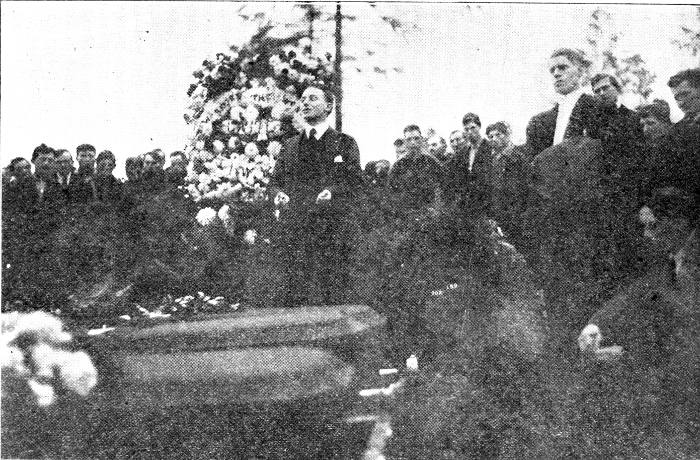
Charles Ashleigh speaking at the funeral, of Looney, Baran and Gerlot.
"In Spokane there were twelve hundred convictions upon a valid ordinance, and yet, after they had convicted a hundred of them they didn't stop coming, and two hundred, and two hundred and fifty, and five hundred, and they continued coming there until the city jail of the city of Spokane was filled, until the county jail of Spokane county was filled, until an old deserted school house was filled, and then until an army post jail was filled. A species of sabotage! They weren't willing to accept the verdict of one jury, or ten juries, or of a hundred juries, that they were violating the law. They had made their laws in their union halls and they were going to speak at a certain place, upon a certain street of Spokane; and they were going to compel the citizens of Spokane to let them speak when they pleased, where they pleased, and say what they pleased; and they kept it up until after Spokane had the expense of a thousand trials and had upon its hands a thousand defendants it began to think it had better yield and let them speak when they pleased, where they pleased and say what they pleased. And Spokane was licked!
"Is it any wonder that the citizens of Everett said 'If you have no regard for law we will meet you on your own ground; we are not going to be bankrupted; we are not going to be hammered into defeat as they were in Spokane; we are not going to have you sabotage us in that manner by your numbers; we are not going to have your people coming from the Dakotas, from Montana, from Oregon, and from all over the various parts of the state of Washington, and camping down on us until we surrender to you. We are going to keep you out of here.' Now, that may not have been strictly legal, but it was human nature.
"There is not hint anywhere in the argument of either counsel for the defense in this case as to what was ever done in the city of Everett by the I. W. W. that would constitute new methods and new tactics. Do you remember the testimony over a period of time there before Labor Day that they allowed them to speak without interference and a meeting was held there and every time they went up with a chip on their shoulder and were not satisfied when no one interfered with them. When they were there speaking on the corner of Hewitt and Wetmore somebody was going around the city of Everett distributing a nasty stinking chemical in the theater building, into the store buildings, into the business houses, into the automobiles. And the paper in the next issue gloats over it and intimates that the reason the officers did not arrest Feinberg was because they were evidently too busy chasing a cat of malodorous tendencies. When Thompson was upon the stand and was being questioned about sabotage and about cats; he could tell you what a cat was, he got a bit halting in his speech when he was asked what it meant when they said that the claws of the cat had been sharpened, when he was asked what a 'sabcat' meant, but when he was asked as to what a cat of 'malodorous tendencies' was he said he didn't know unless it was a skunk. But by that was meant that the skunk accomplishes sabotage. You never heard of a skunk that did sabotage by simply a withdrawal of efficiency, never!
"Now as to incendiary and phosphorous fires. Fire Chief Terrell tells you that up to the date of September 28th, the date of the first known phosphorous fire in Everett, that up to that time, in all of his experience upon the fire force of the city of Everett, it never had come to his knowledge or observation in any way that a phosphorous fire had ever occurred in the city. It occurred there, known to be a phosphorous fire, and within a period of two months at least two other fires occurred, mysterious, the origin unknown because the fire had progressed to such an extent that no one could tell how it did start."
Mr. Vanderveer: Didn't your detective go to work September 21st?
Mr. Cooley: Yes sir, he did.
"And they would have you believe that the detective was up there setting those fires. That, I know, is an insinuation not supported by any evidence in this case, and the detective wasn't working up there, he was operating down here in the city of Seattle. He was sending his reports to Blain before the Wanderer started out, before the men started out on October 30th, and that goes a good way to explain how it happened how these people were met on these different excursions and were not permitted to come within the city of Everett. They were trying to get into the city of Everett, to use their own judgment, to act on their own initiative, according to instructions that had gone out. And the officers stopped the thing before it started.
"What were they coming to Everett for, these forty-one men who were met? Were they coming to hold a street meeting? Forty-one men, enthused with the enthusiasm of the belief in their grand and glorious doctrine that they are teaching, forty-one men starting out as crusaders to carry the gospel of their organization to the benighted of Everett, forty-one going up there to be martyrs, to be beaten for the cause, and nothing else!
"I have told of the tactics and methods advocated, used and encouraged, by this peculiar, particular organization, so you can judge the character, purpose and intentions of the individuals that were seeking from time to time to force themselves into the city of Everett, in order that you may judge the two hundred and sixty that left on the Verona on November the 5th.
"But there is another matter you should likewise take into consideration in determining the character of the individuals of that crowd. Regardless of all environment, regardless of the effect of all legislation, regardless of all social conditions, men are born—not all with the same propensities, not all with the same natural ambitions, not all with the same qualifications, and out of the entire mass of humanity there is a certain percentage that were born without any ambition, born without any incentive; they go thru life without any incentive, constantly tired. Now I am not here to say that all the I. W. W.'s are that kind of people. I am not here to say that because a man is a member of the I. W. W. he is a tramp or a hobo. But there is a class that has been recognized in this country ever since the country existed, a class that don't want to work, that would not work if you gave them an opportunity. These are a percentage, I don't know how large, and I say that every one of these people are members of the I. W. W. organization or should be. Why? Well, in the first place, you don't have to show any qualification for any line of work. You don't have to make proof of anything whatever to become a member of that organization. And is there any inducement for a man who has been drifting here and there, walking the ties, counting the mile posts as he walks from one place to another, to join that organization? It gives him a pass upon every freight train that travels the length and breadth of the land. One of the best inducements in the world.
"There is another class of people in this country that are born with criminal instincts implanted in their very natures; they are scattered all over this land and we have them with us and we will always have them with us. There are men who are driven to crime thru misfortune; there are men who commit crime under the influence of environment; but there is a percentage of men who are habitual, natural and instinctive criminals. Now I don't say that because a man is a member of the I. W. W. he is necessarily and instinctively a criminal, but I do say that every habitual, instinctive criminal, who knows that he intends to violate the law upon every opportunity to satisfy his own criminal desire, has every inducement to become a member of that organization.
"There are a few uncontested and undisputed facts in connection with the occurrence at the dock. Jefferson Beard was killed on that dock. No doubt about that! The defendant was on the boat. No question about that! There is no question that the conversation between McRae and the people on the boat occurred substantially in the language that you have heard repeated here by witnesses for the State and for the defense, all agreeing that the conversation preceded the shooting. There is no dispute that McRae turned partially away from the boat and that one of the first three shots fired hit McRae while he was turning. The burden of the whole argument of the defense was that when somebody on the boat saw McRae put his hand on his gun he was justified in shooting. It is not material whether Tracy shot Jefferson Beard or somebody else. It is not material whether Tracy fired a gun or not, provided the evidence in this case satisfies you beyond a reasonable doubt that Tracy was a party to the conspiracy to go up to the city of Everett to violate an ordinance of the city of Everett.
"But have you any doubt that Tracy was seen on the boat? Hogan saw the window and he saw a man with his face at the window shooting in his direction. Hogan wasn't thinking of the exact angle at which the boat was standing to the dock, but he knows he was standing at such an angle to the boat that he could see a man in a certain place on the boat. And he testified he did see him.
"It wasn't Thomas Tracy that was looking out of that window, it was Martin. It wasn't Thomas Tracy dressed for the occasion, it wasn't Thomas Tracy shaven for a picnic, it wasn't Thomas Tracy wearing a Sunday countenance, it wasn't Thomas Tracy gazing placidly out of a mild blue eye! It was Thomas Tracy, alias Martin, with his face drawn down into a scowl of hatred, with his eyebrows lowering over his eyes, gazing at John Hogan, not only gazing at him thru a window, but gazing at him over a gun! And if there is anything that would impress itself into the memory and recollection of a man it is the remembrance of a face filled with venomous hatred, the eyes shooting daggers at you while he is gazing at you over the muzzle of a gun—and you are not going to forget that!
"Counsel for the defense says this is an important trial, that important questions are involved, that the verdict in this case will have a great deal to do with the ultimate future of the working man and organized labor. I don't think that matters of that kind should enter the minds of the jurors in arriving at a verdict, but if it does, I want to supplement what counsel for the defense has said. I want to say that in my mind a verdict in this case will have much to do with the future success and the future advancement of honest labor in every line and in all organizations. It will have much to do with clarifying the situation insofar as this one organization is concerned. Every organization don't preach the doctrines that are preached by this organization, and if this jury by its verdict does not support that kind of method and that kind of procedure it will aid in purifying an organization that otherwise might do a world of good, but as it stands today, uttering the propaganda that it does, pursuing the tactics that it does it, is a menace not only to society, but is a menace to the welfare of the other labor organizations that believe in pursuing lawful methods, in a lawful manner. This is an important case in that regard.
"I believe that it is a fortunate thing that a jury of King County and a jury from the city of Seattle should have been called to try this case. The seed was not planted in Snohomish County! The plot was not hatched in Snohomish County! It was hatched down here in Seattle. The expedition started out from Seattle, not this one alone but many of them. Seattle was the base, the enemy's base, and it was from here that they started. Just down here almost in sight of this court house is the place where we claim the plot was formed, and it has come back here, and we come into court and lay it at your feet. They returned here, they have brought the case here for trial, and we are satisfied. Now we lay it before you and say,—'As citizens of Seattle do justice to the city of Everett and Snohomish County.'"
With these words ringing in their ears the twelve jurors retired for their deliberations, the court having entered an order discharging from further service the two alternate jurors, Efaw and Williams.
Retiring shortly before noon, the jury consulted for nearly twenty-two hours, taking ballot after ballot only to find that there were some who steadfastly refused to agree to any compromise verdict. Then, shortly after nine o'clock on May 5th, two full calendar months after the start of the trial and just six months to the day from the time of the tragedy of the Verona, Foreman James R. Williams announced the result of their deliberations, and the word sped out to the many hundred thousands who had spent an anxious and sleepless night;
"We, the jury, find the defendant, Thomas H. Tracy, NOT GUILTY!"