PART SIX—THE ROMAN OF ROME (continued 2)
Reading edition
"Besides, there are features in my own case which I did not present to you in my friend's. One of them was the fear of being found out. Dearest, I must not shield myself behind the sweet excuse you find for me. I did think of the other man. It wasn't that I was afraid that he would intimidate me, and so corrupt my love. Not all the tyrannies of the world could do that now. But if from revenge or a desire to wrest me away from you by making you cast me off he told you his story before I had told you mine! That was a day-long and night-long terror, and now I confess it lest you should think me better than I am.
"Another thing you did not know. Dearest, I would give my life to spare you the explanation, but I must tell you everything. You know who the man is, and it is true before God that he alone was to blame. But my own fault came afterwards. Instead of cutting him off, I continued to be on good terms with him, to take the income he allowed me from my father's estate, and even to think of him as my future husband. And when your speech in the piazza seemed to endanger my prospects I set out to destroy you.
"It is terrible. How can I tell you and not die of shame? Now you know how much I deceived you, and the infamy of my purpose makes me afraid to ask for pardon. To think that I was no better than a Delilah when I met you first! But Heaven stepped in and saved you. How you worked upon me! First, you re-created my father for me, and I saw him as he really was, and not as I had been taught to think of him. Then you gave me my soul, and I saw myself. Darling, do not hate me. Your great heart could not be capable of a cruelty like that if you knew what I suffered.
"Last of all love came, and I wanted to hold on to it. Oh, how I wanted to hold on to it! That was how it came about that I went on and on without telling you. It was a sort of gambling, a kind of delirium. Everything that happened I took as a penance. Come poverty, shame, neglect, what matter? It was only wiping out a sinful past, and bringing me nearer to you. But when at last he who had injured me threatened to injure you through me, I was in despair. You could never imagine what mad notions came to me then. I even thought of killing myself, to end and cover up everything. But no, I could not break your heart like that. Besides, the very act would have told you something, and it was terrible to think that when I was dead you might find out all this pitiful story.
"Now you know everything, dearest. I have kept nothing back. As you see, I am not only my poor friend, but some one worse—myself. Can you forgive me? I dare not ask it. But put me out of suspense. Write. Or better still, telegraph. One word—only one. It will be enough.
"I would love to send you my love, but to-night I dare not. I have loved you from the first, and I can never do anything but love you, whatever happens. I think you would forgive me if you could realise that I am in the world only to love you, and that the worst of my offences comes of loving you more than reason or honour itself. Whatever you do, I am yours, and I can only consecrate my life to you.
"It is daybreak, and the cross of St. Peter's is hanging spectral white above the mists of morning. Is it a symbol of hope, I wonder? The dawn is coming up from the south-east. It would travel quicker to the north-west if it loved you as much as I do. I have been writing this letter over and over again all night long. Do you remember the letter you made me burn, the one containing all your secrets? Here is a letter containing mine—but how much meaner and more perilous! Your poor unhappy girl,
Roma."
XIV
Next day Roma removed into her new quarters. A few trunks containing her personal belongings, the picture of her father and Elena's Madonna, were all she took with her. A broker glanced at the rest of her goods and gave a price for the lot. Most of the plaster casts in the studio were broken up and carted away. The fountain, being of marble, had to be put in a dark cellar under the lodge of the old Garibaldian. Only one part of it was carried upstairs. This was the mould for the bust of Rossi and the block of stone for the head of Christ.
Except for her dog, Roma went alone to the Piazza Navona, Felice having returned to the Baron and Natalina being dismissed. The old woman was to clean and cook for her and Roma was to shop for herself. It didn't take the neighbours long to sum up the situation. She was Rossi's wife. They began to call her Signora.
Coming to live in Rossi's home was a sweet experience. The room seemed to be full of his presence. The sitting-room with its piano, its phonograph, and its portraits brought back the very tones of his voice. The bedroom was at first a sanctuary, and she could not bring herself to occupy it until she had set upon the little Madonna. Then it became a bower, and to sleep in it brought a tingling sense which she had never felt before.
Living in the midst of Rossi's surroundings, she felt as if she were discovering something new about him every minute. His squirrels on the roof made her think of him as a boy, and his birds, which were nesting, and therefore singing from their little swelling throats the whole day long, made her thrill and think of both of them. His presents from other women were a source of almost feverish interest. Some came from England and America, and were sent by women who had never even seen his face. They made her happy, they made her proud, they made her jealous.
It was Rossi, Rossi, always Rossi! Every night on going to bed in her poor quarters her last thought was a love-prayer in the darkness, very simple and foolish and childlike, that he would love her always, whatever she was, and whatever the world might say or evil men might do.
This mood lasted for a week and then it began to break. At the back of her happiness there lay anxiety about her letter. She counted up the hours since she posted it, and reckoned the time it would take to receive a reply. If Rossi telegraphed she might hear from him in three days. She did not hear.
"He thinks it better to write," she told herself. Of course he would write immediately, and in five days she would receive his reply. On the fifth day she called on the porter at the convent. He had nothing for "Sister Angelica."
"There must be snow on the Alps, and therefore the mails are delayed," she thought, and she went down to Piale's, where they post up telegrams. There was snow in Switzerland. It was just as she imagined, and her letter would be delivered in the morning. It was not delivered in the morning.
"How stupid of me! It would be Sunday when my letter reached London." She had not counted on the postal arrangements of the English Sabbath. One day more, only one, and she would hear from Rossi and be happy.
But one day went by, then another and another, and still no letter came. Her big heart began to fail and the rainbow in the sky of her life to pale away. The singing of the birds on the roof pained her now. How could they crack their little throats like that? It was raining and the sky was dark.
Then the Garibaldian and his old wife came upstairs with scared looks and with papers in their hands. They were summoned to give evidence at Bruno's trial. It was to take place in three days.
"Well, I'm deaf, praise the saints! and they can't make much of me," said the old woman.
Roma put on her simple black straw hat with a quill through it and set off for the office of the lawyer, Napoleon Fuselli.
"Just writing to you, dear lady," said the great man, dropping back in his chair. "Sorry to say my labour has been in vain. It is useless to go further. Our man has confessed."
"Confessed?" Roma clutched at the lapel of her coat.
"Confessed, and denounced his accomplices."
"His accomplices?"
"Rossi in particular, whom he has implicated in a serious conspiracy."
"What conspiracy?"
"That is not yet disclosed. We shall hear all about it the day after to-morrow."
"But why? With what object?"
"Pardon! Apparently they have promised the clemency of the court, and hence in one sense our object is achieved. It is hardly necessary to defend the man. The authorities will see to that for us."
"What will be the result?"
"Probably a trial in contumacy. As soon as Parliament rises for Easter Rossi will be summoned to present himself within ten days. But you will be the first to know all about it, you know."
"How so?"
"The summons will be posted upon the door of the house he lived in, and on the door of any other house he is known to have frequented."
"But if he never hears of it, or if he takes no heed?"
"He will be tried all the same, and when he is a condemned man his sentence will be printed in black and posted up in the same places."
"And then?"
"Then Rossi's life in Rome will be at an end. He will be interdicted from all public offices and expelled from Parliament."
"And Bruno?"
"He will be a free man the following morning."
Roma went home dazed and dejected. A letter was waiting for her. It was from the Director of the Roman prisons. Although the regulations stipulated that only relations should visit prisoners, except under special conditions, the Director had no objection to Bruno Rocco's former employer seeing him at the ordinary bi-monthly hour for visitors to-morrow, Sunday afternoon.
At two o'clock next day Roma set off for Regina Cœli.
XV
The visiting-room of Regina Cœli is constructed on the principle of a rat-trap. It is an oblong room divided into three compartments longitudinally, the partition walls being composed of wire and resembling cages. The middle compartment is occupied by the armed warder in charge who walks up and down; the compartment on the prison side is divided into many narrow boxes each occupied by a prisoner, and the compartment on the world side is similarly divided into sections each occupied by a visitor.
When Roma entered this room she was deafened by a roar of voices. Thirty prisoners and as many of their friends were trying to talk at the same time across the compartment in the middle, in which the warder was walking. Each batch of friends and prisoners had fifteen minutes for their interview, and everybody was shouting so as to be heard above the rest.
A feeling of moral and physical nausea took possession of Roma when she was shown into this place. After some minutes of the hellish tumult she had asked to see the Director. The message was taken upstairs, and the Director came down to speak to her.
"Do you expect me to speak to my friend in this place and under these conditions?" she asked.
"It is the usual place, and these are the usual conditions," he answered.
"If you are unable to allow me to speak to him in some other place under some other conditions, I must go to the Minister of the Interior."
The Director bowed. "That will be unnecessary," he said. "There is a room reserved for special circumstances," and, calling a warder, he gave the necessary instructions. He was a good man in the toils of a vicious system.
A few minutes afterwards Roma was alone in a small bare room with Bruno, except for two warders who stood in the door. She was shocked at the change in him. His cheeks, which used to be full and almost florid, were shrunken and pale; a short grizzly beard had grown over his chin, and his eyes, which had been frank and humorous, were fierce and evasive. Six weeks in prison had made a different man of him, and, like a dog which has been changed by sickness and neglect, he knew it and growled.
"What do you want with me?" he said angrily, as Roma looked at him without speaking.
She flushed and begged his pardon, and at that his jaw trembled and he turned his head away.
"I trust you received the note I sent in to you, Bruno?"
"When? What note?"
"On the day after your arrest, saying your dear ones should be cared for and comforted."
"And were they?"
"Yes. Then you didn't receive it?"
"I was under punishment from the first."
"I also paid for a separate cell with food and light. Did you get that?"
"No, I was nearly all the time on bread and water."
His sulkiness was breaking down and he was showing some agitation. She lifted her large dark eyes on him and said in a soft voice:
"Poor Bruno! No wonder they have made you say things."
His jaw trembled more than ever. "No use talking of that," he said.
"Mr. Rossi will be the first to feel for you."
He turned his head and looked at her with a look of pity. "She doesn't know," he thought. "Why should I tell her? After all, she's in the same case as myself. What hurts me will hurt her. She has been good to me. Why should I make her suffer?"
"If they've told you falsehoods, Bruno, in order to play on your jealousy and inspire revenge...." "Where's Rossi?" he said sharply.
"In England."
"And where's Elena?"
"I don't know."
He wagged his poor head with a wag of wisdom, and for a moment his clouded and stupefied brain was proud of itself.
"It was wrong of Elena to go away without saying where she was going to, and Mr. Rossi is in despair about her."
"You believe that?"
"Indeed I do."
These words staggered him, and he felt mean and small compared to this woman. "If she can believe in them why can't I?" he thought. But after a moment he smiled a pitiful smile and said largely, "You don't know, Donna Roma. But I do, and they don't hoodwink me. A poor fellow here—a convict, he works on the Gazette and hears all the news—he told me everything."
"What's his name?" said Roma.
"Number 333, penal part. He used to occupy the next cell."
"Then you never saw his face?"
"No, but I heard his voice, and I could have sworn I knew it."
"Was it the voice of Charles Minghelli?"
"Charles Ming...."
"Time's up," said one of the warders at the door.
"Bruno," said Roma, rising, "I know that Charles Minghelli, who is now an agent of the police, has been in this prison in the disguise of a prisoner. I also know that after he was dismissed from the embassy in London he asked Mr. Rossi to assist him to assassinate the Prime Minister."
"Right about," cried the warder, and with a bewildered expression the prisoner turned to go. Roma followed him through the open courtyard, and until he reached the iron gate he did not lift his head. Then he faced round with eyes full of tears, but full of fire as well, and raising one arm he cried in a resolute voice:
"All right, sister! Leave it to me, damn me! I'll see it through."
The private visiting-room had one disadvantage. Every word that passed was repeated to the Director. Later the same day the Director wrote to the Royal Commissioner:
"Sorry to say the man Rocco has asked for an interview to retract his denunciation. I have refused it, and he has been violent with the chief warder. But inspired by a sentiment of justice I feel it my duty to warn you that I have been misled, that my instructions have been badly interpreted, and that I cannot hold myself responsible for the document I sent you."
The Commissioner sent this letter on to the Minister of the Interior, who immediately called up the Chief of Police.
"Commendatore," said the Baron, "what was the offence for which young Charles Minghelli was dismissed from the embassy in London?"
"He was suspected of forgery, your Excellency."
"The warrant for his arrest was drawn out but never executed?"
"That is so, and we still hold it at the office...."
"Commendatore!"
"Your Excellency?"
"Let the papers that were taken at the domiciliary visitation in the apartments of Deputy Rossi and his man Bruno be gone through again—let Minghelli go through them. You follow me?"
"Perfectly, Excellency."
"Let your Delegate see if there is not a letter among them from Rossi to Bruno's wife—you understand?"
"I do."
"If such a letter can be found let it be sent to the Under Prefect to add to his report for to-morrow's trial, and let the Public Prosecutor read it to the prisoner."
"It shall be done, your Excellency."
XVI
At eight o'clock the next morning Roma was going into the courtyard of the Castle of St. Angelo when she met the carriage of the Prime Minister coming out. The coachman was stopped from inside, and the Baron himself alighted.
"You look tired, my child," he said.
"I am tired," she answered.
"Hardly more than a month, yet so many things have happened!"
"Oh, that! That's nothing—nothing whatever."
"Why should you pass through these privations? Roma, if I allowed these misfortunes to befall you it was only to let you feel what others could do for you. But I am the same as ever, and you have only to stretch out your hand and I am here to lighten your lot."
"All that is over now. It is no use speaking as you spoke before. You are talking to another woman."
"Strange mystery of a woman's love! That she who set out to destroy her slanderer should become his slave! If he were only worthy of it!"
"He is worthy of it."
"If you should hear that he is not worthy—that he has even been untrue to you?"
"I should think it is a falsehood, a contemptible falsehood."
"But if you had proof, substantial proof, the proof of his own pen?"
"Good-morning! I must go."
"My child, what have I always told you? You will give the man up at last and carry out your first intention."
With a deep bow and a scarcely perceptible smile the Baron turned to the open door of his carriage. Roma flushed up angrily and went on, but the poisoned arrow had gone home.
The military tribunal had begun its session. A ticket which Roma presented at the door admitted her to the well of the court where the advocates were sitting. The advocate Fuselli made a place for her by his side. It was a quiet moment and her entrance attracted attention. The judges in their red armchairs at the green-covered horse-shoe table looked up from their portfolios, and there was some whispering beyond the wooden bar where the public were huddled together. One other face had followed her, but at first she dared not look at that. It was the face of the prisoner in his prison clothes sitting between two Carabineers.
The secretary read the indictment. Bruno was charged not only with participation in the riot of the 1st of February, but also with being a promoter of associations designed to change violently the constitution of the state. It was a long document, and the secretary read it slowly and not very distinctly.
When the indictment came to an end the Public Prosecutor rose to expound the accusation, and to mention the clauses of the Code under which the prisoner's crime had to be considered. He was a young captain of cavalry, with restless eyes and a twirled-up moustache. His long cloak hung over his chair, his light gloves lay on the table by his side, and his sword clanked as he made graceful gestures. He was an elegant speaker, much preoccupied about beautiful phrases, and obviously anxious to conciliate the judges.
"Illustrious gentlemen of the tribunal," he began, and then went on with a compliment to the King, a flourish to the name of the Prime Minister, a word of praise to the army, and finally a scathing satire on the subversive schemes which it was desired to set up in place of existing institutions. The most crushing denunciation of the delirious idea which had led to the unhappy insurrection was the crude explanation of its aims. A universal republic founded on the principles enunciated in the Lord's Prayer! Thrones, armies, navies, frontiers, national barriers, all to be abolished! So simple! So easy! So childlike! But alas, so absurd! So entirely oblivious of the great principles of political economy and international law, and of impulses and instincts profoundly sculptured in the heart of man!
After various little sallies which made his fellow-officers laugh and the judges smile, the showy person wiped his big moustache with a silk handkerchief, and came to Bruno. This unhappy man was not one of the greater delinquents who, by their intelligence, had urged on the ignorant crowd. He was merely a silly and perhaps drunken person, who if taken away from the wine-shop and put into uniform would make a valiant soldier. The creature was one of the human dogs of our curious species. His political faith was inscribed with one word only—Rossi. He would not ask for severe punishment on such a deluded being, but he would request the court to consider the case as a means of obtaining proof against the dark if foolish minds (fit subjects for Lombroso) which are always putting the people into opposition with their King, their constitution, and the great heads of government.
The sword clanked again as the young soldier sat down. Then for the first time Roma looked over at Bruno. His big rugged face was twisted into an expression of contempt, and somehow the "human dog of our curious species," sitting in his prison clothes between the soldiers, made the elegant officer look like a pet pug.
"Bruno Rocco, stand up," said the president. "You are a Roman, aren't you?"
"Yes, I am—I'm a Roman of Rome," said Bruno.
The witnesses were called. First a Carabineer to prove Bruno's violence. Then another Carabineer, and another, and another, with the same object. After each of the Carabineers had given his evidence the president asked the prisoner if he had any questions to ask the witnesses.
"None whatever. What they say is true. I admit it," he said.
At last he grew impatient and cried out, "I admit it, I tell you. What's the good of going on?"
The next witness was the Chief of Police. Commendatore Angelelli was called to prove that the cause of the revolt was not the dearness of bread but the formation of subversive associations, of which the "Republic of Man" was undoubtedly the strongest and most virulent. The prisoner, however, was not one of the directing set, and the police knew him only as a sort of watch-dog for the Honourable Rossi.
"The man's a fool. Why don't you go on with the trial?" cried Bruno.
"Silence," cried the usher of the court, but the prisoner only laughed out loud.
Roma looked at Bruno again. There was something about the man which she had never seen before, something more than the mere spirit of defiance, something terrible and tremendous.
"Francesca Maria Mariotti," cried the usher, and the old deaf mother of Bruno's wife was brought into court. She wore a coloured handkerchief on her head as usual, and two shawls over her shoulders. Being a relative of the prisoner, she was not sworn.
"Your name and your father's name?" said the president.
"Francesca Maria Mariotti," she answered.
"I said your father's name."
"Seventy-five, your Excellency."
"I asked you for your father's name."
"None at all, your Excellency."
A Carabineer explained that the woman was nearly stone deaf, whereupon the president, who was irritated by the laughter his questions had provoked, ordered the woman to be removed.
"Tommaso Mariotti," said the president, after the preliminary interrogations, "you are porter at the Piazza Navona, and will be able to say if meetings of political associations were held there, if the prisoner took part in them, and who were the organising authorities. Now answer me, were meetings ever held in your house?"
The old man turned his pork-pie hat in his hand, and made no answer.
"Answer me. We cannot sit here all day doing nothing."
"It's the Eternal City, Excellency—we can take our time," said the old man.
"Answer the president instantly," said the usher. "Don't you know he can punish you if you don't?"
At that the Garibaldian's eyes became moist, and he looked at the judges. "Generals," he said, "I am only an old man, not much good to anybody, but I was a soldier myself once. I was one of the 'Thousand,' the 'Brave Thousand' they called us, and I shed my blood for my country. Now I am more than threescore years and ten, and the rest of my days are numbered. Do you want me for the sake of what is left of them to betray my comrades?"
"Next witness," said the president, and at the same moment a thick, half-stifled voice came from the bench of the accused.
"Why the —— don't you go on with the trial?"
"Prisoner," said the president, "if you continue to make these interruptions I shall stop the trial and order you to be flogged."
Bruno answered with a peal of laughter. The president—he was a bald-headed man with the heavy jaw of a bloodhound—looked at him attentively for a moment, and then said to the men below:
"Go on."
The next witness was the Director of Regina Cœli. He deposed that the prisoner had made a statement to him which he had taken down in writing. This statement amounted to a denunciation of the Deputy David Rossi as the real author of the crime of which he with others was charged.
After the denunciation had been read the president asked the prisoner if he had any questions to put to the witness, and thereupon Bruno cried in a loud voice:
"Of course I have. It is exactly what I've been waiting for."
He had risen to his feet, kicked over a chair which stood in front of him, and folded his arms across his breast.
"Ask him," said Bruno, "if he sent for me late at night and promised my pardon if I would denounce David Rossi."
"It was not so," said the Director. "All I did was to advise him not to observe a useless silence which could only condemn him to further imprisonment if by speaking the truth he could save himself and serve the interests of justice."
"Ask him," said Bruno, "if the denunciation he speaks of was not dictated by himself."
"The prisoner," said the Director, "made the denunciation voluntarily, and I rose from my bed to receive it at his urgent request."
"Ask him if I said one word to denounce David Rossi."
"The prisoner had made statements to a fellow-prisoner, and these were embodied in the document he signed."
The advocate Fuselli interposed. "Then the Court is to understand that the Director who dictated this denunciation knew nothing from the prisoner himself?"
The Director hesitated, stammered, and finally admitted that it was so. "I was inspired by a sentiment of justice," he said. "I acted from duty."
"This man fed me on bread and water," cried Bruno. "He put me in the punishment cells and tortured me in the strait-waistcoat with pains and sufferings like Jesus Christ's, and when he had reduced my body and destroyed my soul he dictated a denunciation of my dearest friend and my unconscious fingers signed it."
"Don't shout so loud," said the president.
"I'll shout as loud as I like," said Bruno, and everybody turned to look at him. It was useless to protest. Something seemed to say that no power on earth could touch a man in a mood like that.
The next witness was the chief warder. He deposed that he was present at the denunciation, that it was made voluntarily, and that no pressure whatever was put upon the prisoner.
"Ask him," cried Bruno, "if on Sunday afternoon, when I went into his cabinet to withdraw the denunciation, he refused to let me."
"It is not true," said the witness.
"You liar," cried Bruno, "you know it is true; and when I told you that you were making me drag an innocent man to the galleys I struck you, and the mark of my fist is on your forehead still. There it is, as red as a Cardinal, while the rest of your face is as white as a Pope."
The president no longer tried to restrain Bruno. There was something in the man's face that was beyond reproof. It was the outraged spirit of Justice.
The chief warder went on to say that at various times he had received reports that Rocco was communicating important facts to a fellow-prisoner.
"Where is this fellow-prisoner? Is he at the disposition of the court?" said the president.
"I'm afraid he has since been set at liberty," said the witness, whereupon Bruno laughed uproariously, and pointing to some one in the well, he shouted:
"There he is—there! The dandy in cuffs and collar. His name is Minghelli."
"Call him," said the president, and Minghelli was sworn and examined.
"Until recently you were a prisoner in Regina Cœli, and have just been pardoned for public services?"
"That is true, your Excellency."
"It's a lie," cried Bruno.
Minghelli leaned on the witness's chair, caressed his small moustache, and told his story. He had occupied the next cell to the prisoner, and talked with him in the usual language of prisoners. The prisoner had spoken of a certain great man and then of a certain great act, and that the great man had gone to England to prepare for it. He understood the great man to be the Deputy Rossi, and the great act to be the overthrow of the constitution and the assassination of the King.
"You son of a priest," cried Bruno, "you lie!"
"Bruno Rocco," said the president, "do not agitate yourself. You are under the protection of the law. Be calm and tell us your own story."
XVII
"Your Excellency," said Bruno, "this man is a witness by profession, and he was put into the next cell to torture me and make me denounce my friends. I didn't see his face, and I didn't know who he was until afterwards, and so he tore me to pieces. He said he was a proof-reader on the Official Gazette and heard everything. When my heart was bleeding for the death of my poor little boy—only seven years of age, such a curly-headed little fellow, like a sunbeam in a fog, killed in the riot, your Excellency—he poisoned my mind about my wife, and said she had run away with Rossi. It was a lie, but I was brought down by flogging and bread and water and I believed it, because I was mad and my soul was exhausted and dead. But when I found out who he was I tried to take back my denunciation, and they wouldn't let me. Your Excellency, I tell you the truth. Everybody should tell the truth here. I alone am guilty, and if I have accused anybody else I ask pardon of God. As for this man, he is an assassin and I can prove it. He used to be at the embassy in London, and when he was sacked he came to Mr. Rossi and proposed to assassinate the Prime Minister. Mr. Rossi flung him out of the house, and that was the beginning of everything."
"This is not true," said Minghelli, red as the gills of a turkey.
"Isn't it? Give me the cross, and let me swear the man a liar," cried Bruno.
Roma was breathing hard and rising to her feet, but the advocate Fuselli restrained her and rose himself. In six sentences he summarised the treatment of Bruno in prison, and denounced it as worthy of the cruellest epochs of tyrannical domination, in which men otherwise honourable could become demons in order to save the dynasty and the institutions and to make their own careers.
"Mr. President," he cried, "I call on you in the name of humanity to say that justice in Italy has nothing to do with a barbarous system which aims at obtaining denunciations through jealousy and justice through revenge."
The president was deeply moved. "I have made a solemn promise under the shadow of that venerable image"—he pointed to the effigy above him—"to administer justice in this case, and to the last I will do my duty."
The Public Prosecutor rose again and obtained permission to interrogate the prisoner.
"You say the witness Minghelli told you that your wife had fled with the Honourable Rossi?"
"He did, and it was a lie, like all the rest of it."
"How do you know it was a lie?"
Bruno made no answer, and the young officer took up a letter from his portfolio.
"Do you know the Honourable Rossi's handwriting?"
"Do I know my own ugly fist?"
"Is that the Honourable Rossi's writing?" said the officer, handing the envelope to the usher to be shown to Bruno.
"It is," said Bruno.
"Sure of it?"
"Sure."
"You see it is a letter addressed to your wife?"
"I see. But you needn't go on washing the donkey's head, Mister—I know what you are getting at."
"You must not speak like that to him, Rocco," said the president. "Remember, he is the honourable representative of the law."
"Mustn't I, Excellency? Then tell his honourableness that David Rossi and my wife are like brother and sister, and anybody who makes evil of that isn't stuff to take with a pair of tongs."
Saying this, Bruno flung the letter back on to the table.
"Don't you want to read it?"
"Not I! It's somebody else's correspondence, and I'm not an honourable representative of the law."
"Then permit me to read it to you," said the Public Prosecutor, and taking the letter out of the envelope he began in a loud voice:
"'Dearest Elena....'"
"That's nothing," Bruno interrupted. "They're like brother and sister, I tell you."
The Public Prosecutor went on reading:
"'I continue to be overwhelmed with grief for the death of our poor little Joseph.'"
"That's right! That's David Rossi. He loved the boy the same as if he had been his own son. Go on."
"'... Our child—your child—my child, Elena.'"
"Nothing wrong there. Don't try to make mischief of that," cried Bruno.
"'But now that the boy is gone, and Bruno is in prison, perhaps for years, the obstacles must be removed which have hitherto prevented you from joining your life to mine and living for me, as I have always lived for you. Come to me then, my dear one, my beloved....'"
Here Bruno, who had been stepping forward at every word, snatched the letter out of the Public Prosecutor's hand.
"Stop that! Don't go reading out of the back of your head," he cried.
No one protested, everybody felt that whatever he did this injured man must be left alone. Roma felt a roaring in her ears, and for some minutes she could scarcely command herself. In a vague way she was conscious of the same struggle in her own heart as was going on in the heart of Bruno. This, then, was what the Baron referred to when he spoke of Rossi being untrue to her, and of the proof of his disloyalty in his own handwriting.
Bruno, who was running his eyes over the letter, read parts of it aloud in a low husky voice:
"'And now that the boy is gone and Bruno is in prison ... perhaps for years ... the obstacles must be removed....'"
He stopped, looked up, and stared about him. His face had undergone an awful change. Then he returned to the letter, and in jerky sentences he read again:
"'Come to me then ... my dear one ... my beloved....'"
Until that moment an evil spirit in Roma had been saying to her, in spite of herself: "Can it be possible that while you have been going through all those privations for his sake he has been consoling himself with another woman?" Impossible! The letter was a manifest imposture. She wouldn't believe a word of it.
But Bruno was still in the toils of his temptation. "Look here," he said, lifting a pitiful face. "What with the bread and water and the lashes I don't know that my head isn't light, and I'm fancying I see things...."
The paper of the letter was crackling in his hand, and his husky voice was breaking. Save for these sounds and the tramp—tramp—tramp of the soldiers drilling outside, there was a dead silence in the court.
"You are not fancying at all, Rocco," said the Public Prosecutor. "We are all sorry for you, and I am sure the illustrious gentlemen of the tribunal pity you. Your comrade, your master, the man you have followed and trusted, is false to you. He is a traitor to his friend, his country, and his King. The denunciation you made in prison is true in substance and in fact. I advise you to adhere to it, and to cast yourself on the clemency of the court."
"Here—you—shut up your head and let a man think," said Bruno.
Roma tried to rise. She could not. Then she tried to cry out something, but her tongue clave to the roof of her mouth. Would Bruno break down at the last moment?
Bruno, whose face was convulsed with agony, began to laugh in a delirious way. "So my friend is false to me, is he? Very well, I'll be revenged."
He reeled a little and the letter dropped from his hand, floated a moment in the air, and fell to the ground a pace or two farther on.
"Yes, by God, I'll be revenged," he cried, and he laughed again.
He stopped, lifted one leg, seemed to pull at his boot, and again stood erect.
"I always knew the hour would come when I should find myself in a tight place, and I've always kept something about me to help me to get out of it. Here it is now."
In an instant, before any one could be aware of what he was doing, he had uncorked a small bottle which he held in his hand and swallowed the contents.
"Long live David Rossi!" he cried, and he flung the empty bottle over his head.
Everybody was on his feet in a moment. It was too late. In thirty seconds the poison had begun its work, and Bruno was reeling in the arms of the Carabineers. Somebody called for a doctor. Somebody else called for a priest.
"That's all right," said Bruno. "God is a good old saint. He'll look after a poor devil like me." Then he began to sing:—
"The tombs are uncovered, The dead arise, The martyrs are rising Before our eyes."
"Long live David Rossi!" he cried again, and at the next moment he was being carried out of court.
In the tumult that ensued everybody was standing in the well of the judges' horse-shoe table. The deaf old woman, with her shawls slipping off her shoulders, was wringing her hands and crying. "God will think of this," she said. The Garibaldian was gazing vacantly out of his rheumy eyes and saying nothing. Roma, who had recovered control of herself, was looking at the letter, which she had picked up from the floor.
"GOD WILL LOOK AFTER A POOR DEVIL LIKE ME."
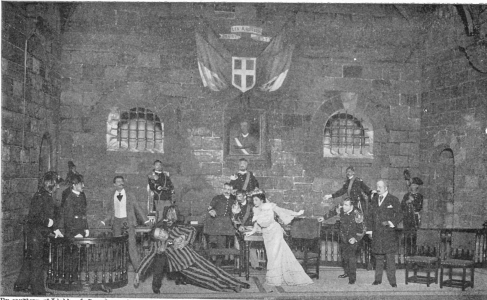
"Mr. President," she cried over the heads of the others, "this letter is not in Mr. Rossi's handwriting. It is a forgery. I am ready to prove it."
At that moment one of the Carabineers came back to tell the judges that all was over.
"Gone!" said one after another, more often with a motion of the mouth than with the voice.
The president was deeply agitated. "This court stands adjourned," he said, "but I take the Almighty to witness that I intend to ascertain all responsibility in this case and to bring it home to the guilty ones, whosoever and whatsoever they may be."
XVIII
"My dear David Rossi,—You will know all about it before this letter reaches you. It is one of those scandals of the law that are telegraphed to every part of the civilised world. Poor Bruno! Yet no, not poor—great, glorious, heroic Bruno! He ended like an old Roman, and killed himself rather than betray his friend. When they played upon his jealousy, and tempted him by a forged letter, he cried, 'Long live David Rossi!' and died. Oh, it was wonderful. The memory of that moment will be with me always like the protecting and strengthening hand of God. I never knew until to-day what human nature is capable of. It is divine.
"But how mean and little I feel when I think of all I went through in the court this morning! I was really undergoing the same tortures as Bruno, the same doubt and the same agony. And even when I saw through the whole miserable machination of lying and duplicity I was actually in terror for Bruno lest he should betray you in the end. Betray you! His voice when he uttered that last cry rings in my ears still. It was a voice of triumph—triumph over deception, over temptation, over jealousy, and over self.
"Don't think, David Rossi, that Bruno died of a broken heart, and don't think he went out of the world believing that you were false. I feel sure he came to that court with the full intention of doing what he did. All through the trial there was something in his bearing which left the impression of a purpose unrevealed. Everybody felt it, and even the judges ceased to protest against his outbursts. The poor prisoner in convict clothes, with dishevelled hair and bare neck, made every one else look paltry and small. Behind him was something mightier than himself. It was Death. Then remember his last cry, and ask yourself what he meant by it. He meant loyalty, love, faith, fidelity. He intended to say, 'You've beaten me, but no matter; I believe in him, and follow him to the last.'
"As you see, I am here in your own quarters, but I keep in touch with 'Sister Angelica,' and still have no answer to my letter. I invent all manner of excuses to account for your silence. You are busy, you are on a journey, you are waiting for the right moment to reply to me at length. If I could only continue to think so, how happy I should be! But I cannot deceive myself any longer.
"It is perhaps natural that you should find it hard to forgive me, but you might at least write and put me out of suspense. I think you would do so if you knew how much I suffer. Your great soul cannot intend to torture me. To-night the burden of things is almost more than I can bear, and I am nearly heartbroken. It is my dark hour, dearest, and if you had to say you could never forgive me, I think I could easier reconcile myself to that. I have been so happy since I began to love you; I shall always love you even if I have to lose you, and I shall never, never be sorry for anything that has occurred.
"Not receiving any new letters from you, I am going back on the old ones, and there is a letter of only two months ago in which you speak of just such a case as mine. May I quote what you say?
"'Yet even if she were not so (i.e. worthy of your love and friendship), even if there were, as you say, a fault in her, who am I that I should judge her harshly? ... I reject the monstrous theory that while a man may redeem the past a woman never can.... And if she has sinned as I have sinned, and suffered as I have suffered, I will pray for strength to say, 'Because I love her we are one, and we stand or fall together.'
"It is so beautiful that I am even happy while my pen copies the sweet, sweet words, and I feel as I did when the old priest spoke so tenderly on the day I confessed, telling me I had committed no sin and had nothing to repent of. Have I never told you about that? My confessor was a Capuchin, and perhaps I should have waited for his advice before going farther. He was to consult his General or his Bishop or some one, and to send for me again.
"But all that is over now, and everything depends upon you. In any case, be sure of one thing, whatever happens. Bruno has taught me a great lesson, and there is not anything your enemies can do to me that will touch me now. They have tried me already with humiliation, with poverty, with jealousy, and even with the shadow of shame itself. There is nothing left but death. And death itself shall find me faithful to the last. Good-bye! Your poor unforgiven girl,
Roma."
The morning after writing this letter Roma received a visit from one of the Noble Guard. It was the Count de Raymond.
"I am sent by the Holy Father," he said, "to say that he wishes to see you."