PLANE SURFACE PRINTING
Reading edition
L ITHOGRAPHY. Of these methods of printing, lithography is the outstanding example: it is a method of reproduction possessed of great possibilities, for by its employment a facsimile of any drawing can be obtained.
As a means of artistic expression it ranks high amongst the graphic arts, and, for the reproduction of drawings of a scientific nature, it is very popular, since it meets most requirements and is comparatively inexpensive.
The art, which was discovered by Senefelder towards the end of the eighteenth century, depends on the fact that grease and water are immiscible: a drawing made with a greasy pigment upon a suitable surface adheres very strongly, whilst those parts free from it retain water, so that when damped and rolled up (i.e., inked), the ink used will stick only to the lines, etc., of the drawing, but not to the other parts.
Clearly the surface is all important, and this is provided by lithographic stone, a limestone occurring in Germany, France, England and Canada. The best stones occur at Solenhofen near Munich, those from other localities being inferior in quality. Incidentally it may be mentioned that zinc and aluminium plates are not infrequently used in place of stone.
Lithographic stones vary in hardness, colour and grain. For the best work the stone should be homogeneous and of a hardness suitable for the subject; the colour affords an indication of the hardness, the lighter-coloured stones, which are much the commoner, being softer than the darker.
There are two modes of procedure; the drawing may be made direct on the stone with lithographic ink or crayon—both being mixtures of tallow, wax, soap and shellac, with a sufficiency of pigment to render the drawing visible to the artist—or else the drawing may be made upon transfer paper.
The former method, although the more satisfactory and often used by artists, is seldom pursued in scientific drawings except when professional draughtsmen are employed. In such cases it may be necessary to reverse the drawing, which is conveniently done by viewing it in a mirror, and, of course, all lettering must be reversed.
The majority of amateur draughtsmen make their drawings in pencil or ink and these the lithographer traces upon lithographic transfer paper and transfers them to the stone; he, the lithographer, may merely trace the salient features and work the drawing up on the stone. The transfer papers are coated with gelatine, starch or gum, or mixtures of these substances, the idea being to interpose between the real paper and the pigment—in the form of lithographic crayon or ink—some substance soluble in water which will hold the pigment and prevent it soaking into the paper, so that a transfer has only to be damped through the back, pressed on to the stone and peeled off. The work, together with more or less of the film, will thus be transferred on to the stone and, of course, will be reversed, since the part uppermost on the stone will be the back of the original drawing.
The original drawings may be made upon the transfer paper direct, and in so doing mistakes in tracing will be obviated. Suitable papers are made for various purposes, e.g., smooth for ink work and variously granulated for crayon (see Plate 1, which was drawn by Mr. Harry Becker on transfer paper).
Another advantage in drawing directly upon the transfer paper is that the draughtsman can make corrections pretty easily for, if needs be, a bad piece of work can be entirely cut out and a fresh piece of paper inserted.
Assuming that the transfer method has been employed, the stone must be prepared according as the drawing is made with ink or with crayon.
The stone is first thoroughly ground, in order to rid it of all traces of previous work, and then polished for ink work or grained—i.e. roughened—for crayon work, the small points produced taking up the crayon in proportion to the amount present on the transfer and the pressure used.
The transfer is then damped with water, sometimes with a dilute solution of nitric acid, and placed in position on the stone, which is then passed two or three times through the lithographic press until dry. Then the back of the paper is damped and the sheet peeled off.
The stone is next proved, i.e., prepared for printing.
It is first carefully examined for broken lines and other blemishes, which are touched up with ink or crayon. The stone is then painted over with a solution of gum in water which is allowed to dry, it is then washed in water and rolled up with ink. The drawing will now be clearly visible, for if properly inked the clear parts of the stone will not take the pigment, so that any parts which require cleaning up may be deleted. This is accomplished by means of a pencil of snake stone, a piece of pumice stone, an acid stump—a rod of hard wood, the sharpened end of which is dipped into nitric acid—or with a scraper. The stone is again washed and rolled up strongly with ink and etched with a dilute solution of nitric acid which is applied with a sponge; then the surface is again gummed and the stone allowed to dry. It is sometimes necessary to re-etch the stone; if so, the damp stone is rolled up with thin ink and allowed to dry, it is then dusted over with finely powdered resin, the superfluous resin is removed by means of a wet sponge, and the surface is painted over with a solution of gum arabic mixed with dilute nitric acid. If the resin is well incorporated with the ink, the work will suffer no damage in the process. The acid gum is then dabbed off with a rag, the stone is cleaned up with turpentine, rolled up once more, gummed and finally set aside to dry.
All this appears complicated, but it is very necessary to get a good surface for printing. The action of the gum does not appear to be clearly understood, the nitric acid obviously will etch the stone, so that the gum will easily penetrate. It is sometimes supposed that the arabic acid of the gum enters into a chemical composition with the calcium carbonate, making a film which is the real ink-resisting surface. This film has not a long life, so that in printing it is necessary to renew it periodically by the application of gum solution.
If possible, the stone should be allowed to rest for a day or two after proving, in order that the ink may sink well in.
Before printing, the gum is washed off and the stone allowed to remain in the press-room until its temperature is the same as its surroundings. The stone is then thoroughly and evenly damped all over, placed in the press, and rolled up with lithographic ink; the paper is then laid on, and the whole passed through the lithographic press. After the first few pulls it will be seen whether all is well. The essentials of a good impression are these: the lines must be black and not grey, provided black ink is used; the lines must not be wider or blacker ("smutty") than those on the stone, nor must they be ragged or broken ("rotten").
In printing, the stone must be damped and inked before each impression is taken, and occasionally re-gumming is required. Good printing requires a considerable amount of ability, especially in the case of crayon drawings.
The paper used is a very important matter, the selection of which can be safely left to the lithographer, provided he be a good one, unless the author possesses the necessary technical knowledge. If a smooth paper is required, and the paper is not to be damped before printing, India paper is best and plate paper next best. All coarse or grained papers must be damped before printing.
As has already been remarked, lithography is a good process for scientific work; but, unfortunately, considering the number of lithographic plates published, really first-class examples are rare. This is largely due to the original draughtsman; it is unreasonable to expect a lithographer, in all probability ignorant of the subject of the plate, to turn out first-class reproductions of drawings which are obviously bad. On the other hand, lithographers vary greatly in their capabilities, and indifferent plates may be entirely due to their ability not being first rate.
As drawings have to be traced, mistakes are apt to occur; the proofs should, therefore, be carefully examined, for a certain amount of correction can be made on the stone.
The following works contain excellent lithographs, which should be studied by those interested in the subject.
Bornet et Thuret: Notes Algologiques. Paris, 1876-1880. This contains some of the best work, illustrative of science, known to the present author. The original drawings mostly were made by Bornet, and the lithography was carried out by Riocreux—one of the best if not the greatest of botanical artists—Arnoul, Picart and Pierre.
Davis and Thurnam: Crania Britannica. London, 1865.
Mirbel: Sur le Cambium, Paris, 1842. The plates provide excellent examples of ink lithography by Laplante.
Von Mohl: Schriften botanischen Inhalts. Tübingen, 1845. Good examples by Federer.
The first volumes of the Annales des Sciences Naturelles (Paris) may be referred to for lithographic work earlier than the above (1820).
For more modern examples the following may be consulted:
Blackman and Welsford: Fertilisation in Lilium, Annals of Botany, Vol. 27, 1913.
Gravis: Recherches anatomiques sur les organes végétatifs de l'Urtica Dioica, Bruxelles, 1885. This memoir contains both good and indifferent plates.
Keibel: Normentafeln zu Entwicklungsgeschichte der Wirbeltiere, Jena, 1904.
Reed: A Study of the Enzyme-secreting Cells in the Seedlings of Zea Mais and Phœnix dactylifera. Annals of Botany, Vol. 18, 1904.
Semon: Zoologische Forschungsreisen in Australien, Jena, 1904.
Vaizey: On the Morphology of the Sporophyte of Splachnum luteum, Annals of Botany, Vol. 5, 1890.
Woodburn: Spermatogenesis in Blasia pusilla, Annals of Botany, Vol. 27, 1913.
Several memoirs in the Fauna und Flora des Golfes von Neapel (Berlin) are illustrated by excellent lithographic plates. Many good examples of chromolithography also will be found there.
CHROMOLITHOGRAPHY. Lithography is much used for the reproduction of coloured pictures and illustrations, the process being termed chromolithography. The principles involved are the same as for ordinary work, but it is necessary to print from several stones, one for each colour. It is obvious that much skill is required, for the employment of different colours will give a large number of secondary and tertiary tints when printed one above the other in various combinations. Thus, by printing part of a design in yellow and the other part in blue, the finished product would show three colours—yellow, green and blue, and by the use of three primary colours a large number of different tints may be obtained.
As already mentioned, each colour is printed by a separate stone, there is thus no limit—excepting that of expense—to the number of different colours which can be obtained.
In practice it is usual to make an outline of the essential parts of the composition on a stone, known as the keystone, which is not necessarily used in printing the picture. An impression of this outline is taken upon a sheet of paper, which is used to transfer the design on to the stones, on each of which the artist will draw only those parts which he desires to be printed in one particular pigment.
Although the sequence of colours is generally blue, red and yellow, it is obvious that various changes in this order must be made according to the colours used and the exact tint required. For instance, a body colour such as cadmium yellow would precede a glaze such as madder-lake; again, two distinct tints may be obtained from red and blue, for example, according to the order of printing—red upon blue will give a mauve, whilst blue upon red will give a purple.
A knowledge of pigments is thus all important, and in printing, the superposition must be perfect.
Plate 2 is an example of a chromolithograph. Miss O. Johnston first drew the outline of the plant, which was phototransferred on to the stone. An impression was then pulled and tinted by the artist, and from this tinted impression the colour stones were made by the lithographer. It may be added that only three colours were used in printing the plate.
Examples:
Baur: Einführung in die experimentelle Vererbungslehre (Plate 1). Berlin, 1911.
Bruce and others: A Note on the Occurrence of a Trypanosome in the African Elephant. Proceedings of the Royal Society of London, B. Vol. 81, 1909.
Cropper: The Development of a Parasite of Earthworms. Id. Vol. 85, 1912.
Oliver: On Sarcodes sanguinea. Annals of Botany, Vol. 4, 1889-1891.
Rubbel: UEber Perlen ... Zoologische Jahrbuecher, Vol. 32, 1911-12.
Biometrika, 1906-7, Vol. 5, Plate 23.
Mention has been made of the value of a knowledge of colours. The subject is much too extensive to be considered adequately on the present occasion even if it were desirable; its importance, however, warrants a few passing remarks.*
*See Ridgway: Color Standards and Color Nomenclature.
No two people will describe in the same way the colour of, say, a rose petal; both will have a different conception of the colour "crimson." The majority have but a limited sense of colour, and even when this faculty is possessed, the personal equation looms large; further, the ordinary names of colours are quite inadequate for descriptive purposes. For these reasons the importance of a scientific system of colour nomenclature and colour standards is all important. By the use of such a scheme, the exact colour of an object can be found by comparison with an adequate chart, and the name there given will convey to others exactly what colour is described or desired. The plumage of a bird or the colour of a flower can thus be described correctly, and an author can indicate exactly the colour desired in certain parts of a chromolithograph or other reproduction in colour.
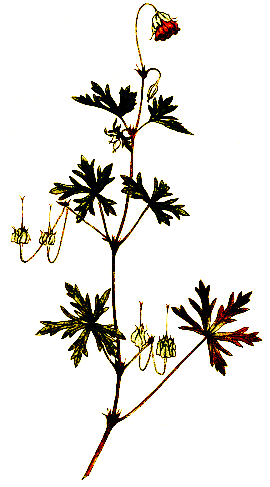
Plate 2.—Geranium Columbinum.
A chromolithographic reproduction of a drawing by Miss O. Johnston
PHOTOLITHOGRAPHIC PROCESSES.—Of these methods of reproduction there are several, their value lying in the fact that the originals can be reduced or enlarged with the greatest of ease. The general principles are as follows.
A photographic negative is taken of the original drawing and a positive made on a film of bichromate gelatine. Wherever light reaches the film, the gelatine is rendered more or less insoluble according to the intensity of the light acting upon it; through the dark parts of the negative but little light will pass, so that the gelatine will remain soluble.
The exposure of the positive having been made, the film, which may be mounted on paper, is inked with lithographic ink in the dark room and then washed. The pigment will adhere to those parts acted on by light, but will wash away from those regions unacted upon; obviously the half-tones will retain ink in direct proportion to their density.
The developed positive is then transferred to a stone or zinc plate and impressions taken as in pure lithography for the dark parts are resistant to water and will take the ink, whilst the high lights will retain water and so will not be inked. The intermediate tones will take the pigment according to their density.
In distinction to the previous methods, corrections cannot be made except in so far as the negative can be touched up.
COLLOTYPE.—Of the various photolithographic methods which have from time to time been employed, collotype is the one in most general use at the present time, especially for the reproduction of photographs.
Collotype is a simple process which does not require so extensive a technical knowledge and ability as some of those previously described. But notwithstanding this, the results are sometimes unsatisfactory and unequal; faults due to indifferent originals and to unsatisfactory conditions obtaining in the work rooms. The great drawbacks to good collotype are cold and dampness, and it is for these reasons that continental firms, blessed with a more stable climate, often produce much the best work. Provided the workshops are properly heated, the collotypers of this country ought to be able to turn out good work at all times of the year; indeed, the best firms do.
For this and for other processes in which photographs form the originals to be reproduced, authors should send the negative to the collotyper; if this be impossible, positives of the best possible quality, printed on ordinary P.O.P. paper, toned to various shades of purple, and also on smooth bromide paper, in ordinary black tones, should be provided in order that the collotyper can choose the print he most prefers to work with. Also, it is usual to glaze the prints.
The method is as follows. A piece of british plate glass, about half-an-inch in thickness, is ground on one side with fine emery powder, and then thoroughly washed and dried. The plate is covered with a filtered mixture of the colloids sodium silicate and dextrine or albumin, and placed in a warm oven to dry. If metal plates are used, such as zinc or copper, this preliminary coating is unnecessary; glass plates, however, must have the substratum in order that the sensitised gelatine—which is next put on—may stick.
When the plate is dry, it is thoroughly washed with water in order to remove any free silicate; it is then dried and put away until required for use.
The sensitising solution is made up of gelatine and bichromate of potash dissolved in water; before use it is filtered, freed from air bubbles and heated to not more than 120° F. The plate is now placed on a stand, which is provided with levelling screws, in the oven, and, when the temperature has reached 120° F., an amount of the bichromate gelatine solution sufficient to make a thickness of film proper for the mode of printing to be employed is poured upon the plate.
The oven is kept at a constant temperature, 120° F., until the gelatine is dry, when it is allowed to cool gradually.
Whilst the gelatine is setting, precautions against vibration must be taken else the plate will be spoilt.
When dry, the collotype plate is sensitive to light and moisture; its surface shows a more or less regular series of convolutions which resemble those of the outer surface of the human brain, although, of course, very much smaller. The character of the grain is very important, for if it be too fine it will not take up a sufficiency of ink, and, on the other hand, if too coarse it will yield coarse impressions.
A reversed negative, of a quality beyond reproach, must be made of the original; if the subject is dark or has heavy shadows the negative is frequently slightly over exposed so as to soften them.
The collotype plate is then exposed under the negative and washed in cold water until the yellow bichromate no longer comes away. It is then dried.
In printing, the plate is damped and rolled up with ink as in lithographic printing; the amount of ink adhering to the film depends on the extent to which the different parts have been acted on by the light, as has already been mentioned. The moistening of the plate—mis-termed etching—is best done with dilute glycerine containing 75 per cent. of water, which when first applied should be allowed to remain on for about half-an-hour. The excess of moisture is taken up with a sponge or a ball of rag, and then the plate is inked and printed in a lithographic or a collotype press. The picture is usually masked with tin foil in order that its edges may be quite clean.
Of the faults which may occur, the following may be alluded to. A mottled appearance may obtain in the high lights; this is due to the coating of gelatine being too thick. More commonly, the reproductions may appear flat owing to the degradation of the high lights; this is a sign that the sensitive film has been acted upon by moisture during its critical existence between the drying and the washing out of the potassium bichromate, or that the temperature has been too low.
The following contain good examples of collotype.
Karsten and Schenck: Vegetationsbilder, Jena.
Oliver: Notes on Trigonocarpus and Polylophospermum. New Phytologist, Vol. 3, 1904.
Semon: Zoologische Forschungsreisen in Australien. Jena. 1912.
Thompson: The Anatomy and Relationships of the Gnetales. Annals of Botany, Vol. 26, 1912.
See also Plates 3, 4, 5 and 9 in the present work.
THE PREPARATION OF ILLUSTRATED PAGES. Of the processes dealt with, photogravure lithography and collotype are those most generally used at the present day for the printing of plates or insets. Half-tone also is employed, a process which will be considered later since it is essentially relief printing. This, therefore, is a convenient opportunity to make a few general observations on plates.
Plates should only be employed for the reproduction of subjects of such complexity that cannot be reproduced satisfactorily by figures in the text.
A plate or page made up of several illustrations should look well as a whole; in other words, it should not outrage all the canons of composition, it should have some pictorial effect. At the same time, for facility of reference, the individual figures should run in a convenient sequence. This latter point is so important that a plate composed really well is distinctly rare, for a compromise nearly always has to be made. At the same time there are, apparently, comparatively few authors who pay much attention to plate design.
Although it is not desired to write of the laws of pictorial composition, attention may be drawn to a few points which are amongst those generally neglected.
The figures should not be crowded together; a reasonable amount of margin should be left around each. They should be arranged, as far as possible, in such a way that a sense of balance is maintained. As to how this is to be accomplished will depend upon the nature of the illustrations; if they are all about equal in tone, the largest ones should preponderate towards the base of the plate, and not vice versâ. The difference which this makes will be obvious if the two accompanying illustrations (Figs. 1 and 2, Plate 3) be compared. The first is a reduced copy of the plate as it was published: it will be noticed that it has a top-heavy appearance, which is corrected in the second figure by the simple device of turning it upside down.
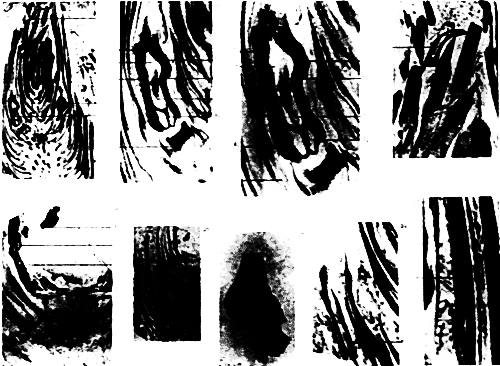
Plate 3. - 1
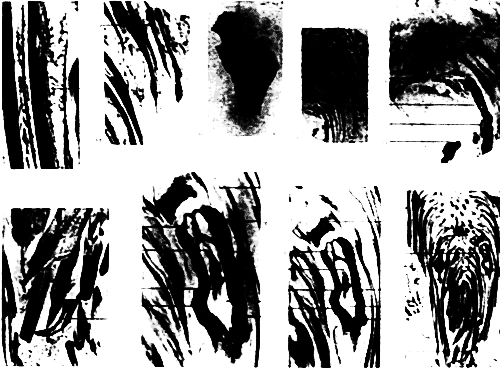
Plate 3. - 2
If, on the other hand, the figures are some lighter and others darker, the latter should form the base, since low tones give the idea of solidity; this is so marked that in cases where the figures vary much in size and tone, the darker ones may nearly always be situated at the base or at any rate low down on the plate unless they are very much smaller than the lighter toned ones.*
*If, of course, the reader understands chiaroscuro, he will take no notice of this paragraph, but arrange his plates in accordance with his ability.
An examination of the figures on Plates 4 and 5 will roughly illustrate these points. The upper figure of Plate 4 is well designed, and no improvement could be made, bearing in mind the compromise alluded to above. The lower figure is, however, not so good, it was obviously a difficult one to arrange; it would have been improved if Figs. 23, 26 and 28 could have been placed in the top tier, but this would have seriously disturbed the sequence. The first illustration on Plate 5 is well designed; it would, however, have been improved by interchanging 8A and 11B.
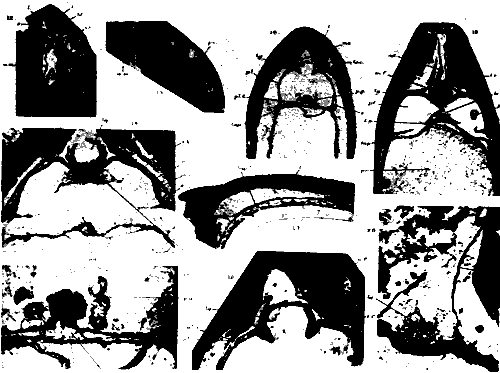
Plate 4. - 1
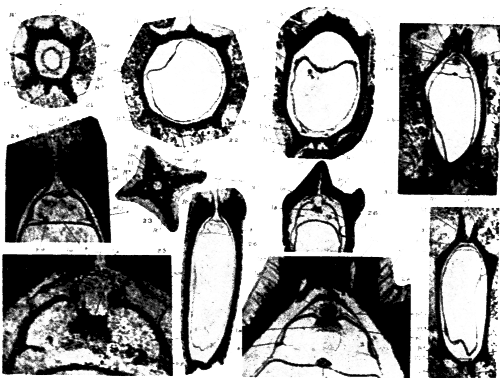
Plate 4. - 2
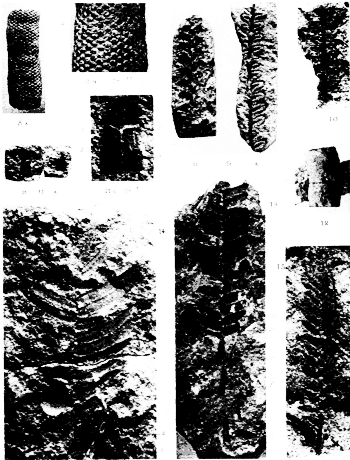
Plate 5. - 1
Plate 5. - 2
Plate 5. - 3
We may now pass on to the individual figures; these should shew the essential features, together with some surrounding and comparatively extraneous matter; often there is included too much of unimportance and its retention means a waste of valuable space. The first thing to do, therefore, is to trim, if needs be, the figures; their shape is more or less immaterial, provided that in cases where there are a large number of illustrations on one plate, they are not all alike. The American fashion of circular figures is particularly displeasing, at any rate to the author.
Having trimmed the figures, the next point to decide is whether any require reduction; if they do, cut out pieces of paper (referred to as patterns below) of the size which the figures will ultimately appear: on the whole, it is better to avoid reduction of the originals, for without a good deal of experience it is very difficult to judge exactly what the result will be; a good idea, however, may be gained by the use of a diminishing glass.
The size of the available surface of the plate should now be ruled on a white sheet of fairly thick cardboard, and the figures, or their patterns, arranged so as to be easy of reference, to compose as well as may be, and spaced in such a way that, in the case of a quarto plate to be folded vertically, no figure is placed so that the fold will pass through its centre. Nothing is more irritating than having an illustration spoilt in this way.
All this may be done by arranging in different ways until a satisfactory result is obtained, a process which may take an hour or two. The figures should then be pasted down, covered with several sheets of blotting paper and placed in a press. A press is seldom available; when such is the case, a number of heavy books serve equally well.
The lettering must next be attended to. The individual figures are usually designated by numbers; this is a bad method, since it involves referring to the description of the plate. The best way is to use a number, and after it to add the name of the plant or animal, and, if needs be, a description as short as may be. If the author can "print" or write reasonably well, well and good; if not, it is better to attach a slip to the plate with full directions relating to lettering, and to write in pencil on the plate the titles, etc., required in the proper places for the guidance of the craftsman. The typewriter is sometimes employed for this purpose by authors; it is purely a matter of taste, but some readers feel a slight shock when this method is resorted to.
In some cases a key to the plate printed on tough translucent tissue paper and having the necessary information, guide lines, etc., is inserted with the plate.*
*See Kerner and Oliver: Natural History of Plants (First Edition) London, 1894.
In the case of glossy chromolithographs this practice is best avoided, for the key is apt to stick to the plate if too much pressure is used when the book is bound.
With regard to the "catch letters" used to indicate different parts: these should be as obvious as possible, and the guide lines should be either in black or in white ink, according to the general tone of the illustration. These lines should be conspicuous without being heavy. Not infrequently they, together with the lettering, are printed on the plate by a second impression in red ink.
The foregoing is primarily the business of the author; with regard to editors and publishers, all plates should be mounted in a manner to facilitate reference and should be printed on suitable paper; the former is seldom or never done. All plates which must be constantly referred to in reading the text should have a selvedge as broad as the book, so that when unfolded the whole plate is visible, no matter what page is being read. This would, no doubt, prove an additional expense, but this should not militate against the suggestion here made, not by any means an innovation, for in many cases it would save the expense of mounting on guards, and, further, the additional expenditure could be saved several times over in other ways.
With regard to paper, this generally is satisfactory; unfortunately, highly glazed paper, mis-termed art paper, with an enamelled or chromo surface, and consisting chiefly of china clay and size, is generally used for printing the best half-tone reproductions. For this purpose a paper with a suitable surface, obtained by means other than those mentioned and not too costly, is highly desirable, since art paper has the reputation of being not at all permanent, owing to the deleterious action of moisture, and is somewhat brittle. When used, art paper, if folded, should have a proper paper hinge along the fold.
Half-tones are occasionally printed on a kind of vegetable parchment, a paper which should be more extensively used since it will sometimes, but not always, give as good a reproduction as art paper, and the final result is more pleasing from the artistic point of view.
G. Oliver, del.