Front matter (continued 2)
Reading edition
"Some children tear the wings off butterflies," said Mrs. Full. She stood up. "I'll go and tell the others," she said firmly. "It doesn't seem to me that we have much time left."
"If we start to bore them—" began Adam, and shut up.
She went out. In about five minutes everyone had come into the box but Watkins, who was playing the color organ. They discussed the discovery in low voices, as though the alien children might be listening; Villa and Summersby examined the slates. After a while Watkins was pushed in, looking rather worn and frayed. Adam was standing in the far corner under the silver web. He saw the wall start to slide shut, remembered his dowel, and tried to see if it was still in place at the bottom of the wall.
He couldn't see it. Maybe it blended with the color behind it, or maybe somebody had accidentally kicked it out of place.
The wall slid shut.
IX
Summersby was losing the sense of being apart, of having no problems no matter what happened. These people had drawn him into their trouble against his will; the situation was so bad that he could no longer tell himself he didn't give a damn. So he had a bad heart! He couldn't turn his back on these poor devils because of that. It was stupid and selfish. He felt sorry for them. He was uncomfortable with them, as he always was with standard-sized people, and he would still repel any attempt on their part to get close to him; but he was a little chastened by what he had been through. He recognized that.
It was all very well to say he didn't care where he died, but it would be a hell of a lot more dignified to accomplish it as a free man, rather than as a harried rabbit. Even if he were killed trying to escape, it would be endurable. But if his heart gave out while he was, say, trundling up and down the nursery in that ridiculous little auto thing, he knew his last breath would be a bitter one.
Adam had just said, "I laid a rod across the sill there." Summersby walked to the wall, which appeared to be closed as usual. Just as he came to it, he caught the sheen of metal in a thin line up the corner, and knew that he was seeing part of one of the machines in the nursery. The dowel had held the door.
Something moved outside; he could hear the dull slap of immense flat feet. They were going to be fed. He strolled away from the corner, saying quietly, "It worked, Adam. Don't check it now, though."
The small panel opened and one of the garishly hued platters was put in, loaded with a wriggling, seething mass of grubs and half-dead locusts.
"Supper?" cried Villa. "This is supper? Do they think we are a lot of African natives?"
"Well," said Adam, "I guess they were fooled by me." It was the first time he had made any sort of joke about his color. Possibly, thought Summersby, he's becoming one of the group, as I am. God knows the kid has as much reason to be bitter about people as I have; or more reason. It's put him on the defensive.
Summersby felt more chastened than ever.
No one cared to sample the insects. They walked away from the platter and hoped aloud that their captors would see the refusal and give them something else, but nothing was pushed in. After a quarter of an hour Watkins said, "Think it's safe to have a try at the door?"
"No," said Summersby.
Watkins jumped to his feet. "Listen, I've had all I can stomach of you!" he yelled. "If you don't want to help, okay, but keep your nose—"
"I was going to say that they'll be pumping in the sleep gas pretty soon, and we don't know whether they do it from outside the nursery or outside this box."
"That's right," said Calvin Full.
Watkins eyed him a moment. "I'm sorry, Summersby," he said then. "I shot off my mouth too quick."
"They filled the nursery with it once," went on Summersby, "but it seems logical to think they could also let it into this room alone. Maybe it works on them, maybe not; if it does, then they wouldn't flood the nursery with it every night, because the adults have to come in and clean the place up."
"A clever thought, Mr. Summersby," said the woman.
"Not particularly. At any rate, I'm going to stand by the crack and try to get enough air to stay awake; then when I think the coast's clear, I'll shove the door open and scout around. If I find a way out, I'll come back and drag you into the nursery and wake you."
"Why are you doing this?" asked Villa suspiciously. "No, Mr. Big Man, I don't like you going out alone. I think you wouldn't come back. You don't like us."
Watkins, evidently on edge from his mauling by the children, whirled on the Mexican. "Oh, shut your yap! The guy's doing you a favor." Then he said to Summersby, "I'll come along."
Summersby grinned wryly.
"I'm not saying you'd run out on us, man." Watkins made the motions of going through his pockets for a cigarette, which some of them still did occasionally out of hopeful habit. "I know locks and I might be able to help if you ran into trouble."
"Come on along, then." He put an eye to the thin slit. "Here comes one of them. It's the head scientist." He grinned. "Or the kid who owns us, who lives in this house and invites his little pals in every day to play with his toys and his pets."
The monster disappeared. Presently Watkins said, "It's in. I'm sleepy."
Summersby stretched as tall as he could and put his mouth to the crack, trying to breathe only what air came through from the nursery. He saw the enormous child pass on its way to the door, and shortly the sound of its heavy feet stopped. He felt drowsy, his eyelids flickered. He beat his hands together, sucking in air from the opening. Villa started to snore.
Watkins said, "I'm about done, Summersby." He was kneeling at the crack below Summersby, and his voice was sluggish. In a few seconds he rolled over on the straw.
When did the adults come in to clean up? Summersby didn't dare wait much longer. He was fighting sleep with all his vigor. Possibly they wouldn't come till morning.
He had to chance it. He forced his fingers into the gap and heaved. The wall didn't move. Holding his breath, he propped one foot against the adjoining wall, dug his hands as far into the breach as possible, and hurled himself backward. The big door jolted an inch, hung, then slid back a couple of feet. He swung around and jammed himself through the aperture and the wall moved silently back into place; this time the dowel was not there, and when the wall stopped, there was no crack at the corner. Summersby must have kicked the dowel aside when he slid through. Watkins was inside, asleep.
He breathed deeply, and the effects of the sleep gas died, so that he was wide awake and felt very excited and eager. To analyze the reasons for his eagerness would have killed it, and besides he was in a hurry. He ran to the great door of the playroom, whose lintel towered twenty feet from the floor. Hastily he tossed apparatus, boxes, toy blocks, until he had made a pile five feet high.
Scrambling up this, the things sliding under his feet, he waved an arm above his head in the place where he believed the electric eye beam to be. Then the pile collapsed, and he fell into it, giving one knee a terrific crack and skinning his knuckles. The door glided open.
The next room was deserted, and the soft bluish light was dimmer here than in the nursery. This place was far less cluttered, containing no more than a big yellow machine, a gigantic table, and two six-legged chairs. There was a picture on the wall, the size of a barn's side, which he did not stop to look at.
The opposite door was open. The third room was a dining hall, with two tables and a number of chairs, these of metal with eight legs each. Luckily, there was no one in it.
In the next room—all four were in a straight line, and he thought, Either it's a long narrow house, or else it's as big as Rockefeller Center—there were a number of gadgets, colorful and complex like the children's toys, but of different construction. He glanced at them but did not pause until he came to the next door.
It was closed. He presumed its opener beam would be in the same place as that of the playroom, and looked around for something to stand on.
There seemed to be nothing small enough to move. He shoved at a couple of things, but they wouldn't budge. The only slim possibility was a big square brown box, set twelve feet off the floor on one of their mammoth tables. It was of a size to accommodate half a dozen cows, but looked as though it might be of flimsy enough materials, plastic probably, to push off the edge, from which it would fall exactly where he needed it.
He dragged a chair over, climbed up on its seat and then onto the table. He saw at once that the box would be immovable. There was an affair that might be a dynamotor attached to one side, various objects sticking out of the other, and four stacks of thick coils on top. He was turning away, hoping to find another door in one of the first rooms, when his eye was attracted to a square plate among the things on the right side of the box. The plate was glass, for its surface shone under the blue light, and he thought he saw the pin-point twinkling of stars in it.
On a hunch, he walked over to it. He knew quite a lot of astronomy and if this happened to be a telescope, he might be able to determine their location.
The field of the plate was full of stars, but in patterns he had never seen. He could not understand it. It was not a painting, for the stars twinkled. Where the blazes was the thing focused?
A huge dial beside the plate had a pointer and scores of notches, each labeled with a couple of squiggly characters. He turned the pointer experimentally. The screen blurred, showed a planet with rings: Saturn.
"Neat," he said to himself, and turned the pointer another notch. He got a view of a landscape, trees of olive green and crimson, seen from above. He tried other notches.
Finally, just as he had reminded himself that he had to hurry, he saw a familiar globe swim onto the glass. It was Earth, with the two Americas clearly defined.
What in hell...?
He pushed the pointer on, and was given another landscape, this time of prosaic hue, a meadow with a cow in it. He clicked the thing another notch and got a constellation pattern again. He pushed it back to the cow.
He felt his heart thudding fast, too fast; and he hoped with all his faculties that he wouldn't conk out before he had solved this riddle. There were other dials, other pointers, a little behind the first. He turned one slowly.
The cow grew larger until it almost filled the screen. Only when he could see nothing but its broad placid back did he realize that he was looking at this scene, as at the others, from above.
He tried a third pointer. The land whipped by beneath his gaze. He came to a city, the buildings reaching up to him in a wonderful illusion of depth.
Then it dawned on him what the machine was, and he gasped.
There was no use in looking for the outer door. He had found the answer to their last problem, and he had to get back to the box with that answer and thrash it out with all of them. There might be a salvation for them and there might not.
Leaving the screen showing the city, he jumped down off the table, raced back through the room and into the next, the dining hall. Still there were no signs of any of the giants. He had crossed the threshold of the third room when he heard a door open on his right. There was no time to gape around; he covered thirty feet in five strides, dodged under the hanging shelf of the strange yellow machine, like a low desk covered with cogwheels, and ran along beneath it till he came to the extreme end of the contrivance.
A pair of feet, either of which would have outweighed a draft horse, went past him; he dared not lean forward to see the rest of the brute, but it was undoubtedly an adult. It went into the playroom.
After twenty or twenty-five minutes, during which Summersby thought over the problem and agreed with himself that he couldn't find the solution alone, the giant came out of the playroom, crossed near his hiding place, and went out through a door beside the huge picture. It was not in a hurry, so he decided it had not noticed his absence from the box.
He dragged an easy chair over to the nursery door. It was just four times the size of Summersby's Morris chair at home, and about eight times as heavy. As he was crawling up the leg to the seat, he recalled that he had a bad heart. If he hadn't been clinging to the plastic with both arms, he would have shrugged.
He intercepted the beam and opened the door. Having no more than half a minute to get through before it shut, he had to leave the chair where it was. He hoped none of the adults would realize that its position had changed.
The playroom was clean and neat. Likely it would remain unvisited through the night. He went to the box and only then remembered it was shut tight. What did the kids do when they opened it during the day? He had seen them at it twice. They laid their hands on top of the box, there on the left.
Hauling over enough junk to make a pair of steps, he got onto the roof of the box. There was a bar, set into the coaming. He pressed it, leaned over, and saw the wall slide back. A second push returned it to its shut position. He opened it again, swung his legs over the edge, pressed the bar once more and dropped. Snatching up a green dowel from the floor, he jumped into the box as the door was closing. He had just time to lay the rod across the threshold, as Adam had done, before the wall reached it and was held.
Trying not to breathe, Summersby picked up Watkins and slung him over his shoulder. He forced his fingers into the crack and heaved. Again he threw his weight against the wall.
Then he was buckling at the knees, trying desperately to bring his mouth next to the opening, but not quite making it.
"Describe it again," said Watkins. "Give me all the details you can think of."
As Summersby went over what he remembered of the brown machine, Watkins tried to envisage it. A tough job, and he might not be able to handle it. To reverse a thing like that—when there'd be at least one or two principles he'd never heard of—well, that would be the job of a lifetime.
"How do you know that it's the instrument that brought us here?" he asked.
"It must be." Summersby looked intent, almost eager. "It has those dials that focus it almost pin-point on any planet they want; at least, I saw quite a few planets, from a distance and close up. I saw a cow and a city on Earth. Then there's the big brown box. It's hollow—the door was half open. If they bring things, living things, from other planets, they need a receiving station large enough to take 'em. The box. It's logical."
"It sure is." Adam whistled. "So we're on another planet. That was plain, if we'd thought about it seriously. No place on Earth could hide a race like this. Not with all the factories they must have to produce the toys and what you saw out there."
"Why couldn't we be inside the Earth?" asked Mrs. Full stridently.
Watkins said, "He looked down on Earth. That argues another planet."
"But how did they get us here? In two days?"
Watkins scratched his bristled chin and thought aloud. "It must have been instantaneous. Remember, we went through a quarantine and were healed of just about everything that was wrong with us. That must have taken a while."
"The octopus was still wet," said Adam, "and the grubs and locusts were still kicking. They must focus that rig on Earth and push a button and here it is, like that. Instant transmission of matter." He smiled weakly, as though he were proud of the phrase. He looked very frightened, thought Watkins, and unhappy.
Tom Watkins was scared, too, but not especially unhappy. For the first time in almost twenty years, he was free of worry about the bulls, the law. He only wished he knew what had happened to his loot.
"The planet," said Cal, "whatever its name is, must have the same gravity and atmosphere as Earth. Same water, too."
"That's right. So it's produced a race of critters with plenty of human characteristics," said Watkins.
"Have they done this before?" asked Mrs. Full. "I mean do you think we're the first to be snatched up?"
"No, I don't," said Watkins, surprised that she was talking directly to him. "People disappear all the time. Look at the famous ones: Judge Crater, Ambrose Bierce—"
"Somebody mention the Marie Celeste," growled Summersby.
The wall began to open.
"Here's the plan, quick," said Watkins. "I've got to get out and find the machine, and see if I can gimmick it so it'll work backward, send us home. The rest of you create a diversion, keep the kids' minds off me."
"What kind of a diversion?" asked Villa. His abstracted face showed plainly that he was thinking of his chili stand and what he would say to the idiot relief man about conditions he would doubtless find therein.
"If you were a kid with pets, intelligent ones, what would you watch them do for hours? Something unordinary—something you'd never imagine they'd do." He looked at his chronograph. "It's just ten. I never saw the gadget I couldn't figure out in two hours; if I'm not back by noon, you'd better come out, Summersby."
"What if it's four-dimensional?" asked Adam.
"It's possible I can cook up a way to reverse its action anyway. There are some principles of electricity and mechanics that must be universal."
"Shall we run the machines for them?" asked Mrs. Full. "To distract the children?"
"They're used to that," said Watkins. "They bore easy. Suppose you're a kid with a normal regard for pets. You've had cats and dogs and rabbits and now you have monkeys. The monkeys are a lot smarter and more versatile, but they have their limits too. You get jaded with 'em. But one day they—" he snapped his fingers—"they start playing soldiers! They drill, stage mock battles, die and come to life, scrimmage—hell, you go nuts! You can't take your eyes off 'em!"
"That's it," said Villa promptly. "The children have gorillas, cows, they have never seen anything like war."
"Maybe they don't know what war is," said Adam. "It might just look as if we were fighting. None of their toys show a sign of war being ever waged by this race, like our own kids' toys do."
"The toys of any people reflect their civilization in an unreliable and distorted way," said Cal Full rather stuffily. "A visitor from Mars in one of our playrooms would conclude that we already have spaceships and ray guns, and that our usual clothing is chaps, sombreros, and spacesuits."
"They'll get the idea," Watkins said impatiently. The giant children outside were bawling the word that meant "Come!" He was in a hurry. These fools were always arguing. "Let's go," he said. "The four of you line up over there, catch the kids' eyes, and High-pockets can boost me up to the beam. Then he'll join you."
Watkins grinned tightly, slapped Adam on the shoulder, poked Villa in the belly, and dived behind the nearest many-colored pile of gear the moment he saw the children weren't watching him. As he went toward the door, he heard Villa saying, "My fourth cousin Pancho was a great man for war, so I will be general. Spread out in the thin line and be ready to march when I command."
Summersby followed Watkins, and they came to the door. Watkins managed to get up on the big man's shoulders, and waved a hand above his head. Nothing happened.
"Stand on them," said Summersby.
He struggled to do so. "Un, dos, tres," roared the Mexican down the hall. "Begin!"
This time Watkins found the beam. The door glided aside. He dropped off Summersby's shoulders, jumped into the next room. A quick look showed him it was empty. As the door closed he heard Villa shouting hoarsely.
"Make bang noises for the guns. Fall dead, spring to life. We are mountain fighters of great skill. Climb on machines, drop off with bullets in your head, play you are—"
The door cut him off. Watkins chuckled. "What a ham," he said. He started for the opposite door.
X
It was ten minutes to twelve. Summersby was panting like a spent hound. He had not exercised in months, not since the doctors had told him his heart was just about gone, and he was surprised that he hadn't keeled over before now. Dashing around playing guerrilla like some six-year-old! It had been a damn good idea, though. The giant children—there were two of them today—were still enthralled, lying on their bellies with their furry watermelon heads propped in fantastic two-thumbed hands.
Leaning against a pink plastic maze wall, puffing, he thought, I've almost grown to like them. Why?
Because for the first time since he was sixteen, John Summersby had to bend his neck back to look up at someone. These grotesque humanoidal beings were the only living things which did not make him feel overgrown, uncouthly out of proportion, a hulking lout. If a chair was too narrow for him, it would be like the head of a pin to one of these kids: if a fork felt uncomfortably small in his own hand, it would be a minikin indeed in one of those vast paws.
In their shadows, Summersby was a very small man. It was an unwonted sensation, the most satisfying he had ever experienced.
He looked at them out there, as they lay watching Mrs. Full and Adam mowing down Cal and Villa with imaginary Brownings. He grinned, felt his lips curve in the unaccustomed grimace, and thought with no particular bitterness that he was getting mellow in his last days. "Hello, High-pockets," he said softly to the kid that owned him. "How's the weather up there?"
At five to noon the door opened. Summersby, seeing its silent motion, left off the mimic gunplay and started for the wall, where he could intercept Watkins and find out whether he'd been successful. But the safe-cracker came running down the middle of the room, yelling.
"Come on, everybody!"
"Come on?"
The two giant children were on their feet, uncertain of what was happening. Obviously they didn't realize Watkins had been out of the room at all.
"The adults spotted me!" roared the blond man, swinging his briefcase wildly; where had he found that? "They're after me!"
Summersby let out an involuntary grunt when through the twenty-foot door came an eighteen-foot creature, a thing so mind-shakingly huge that even the ranger's size complex wasn't pleased by it. This was an adult: leaner in the body, broader of hand and thicker of limb, wearing trouserlike garments and a flaring jacket of royal purple caught by a ruby bar, it advanced calmly into the hall, clumping flat-footed in three yard strides. From its heavy-lipped gash of a mouth came noises like a whole orchestra badly in need of tuning.
"Hwhrangg!" it cried, waving its hands in the air. "Breemingg!" It appeared to be soothing the children, telling them that Daddy was here.
Mrs. Full, on the control platform, screamed. Her husband ran to her, Summersby stepped out irresolute, Adam stood stunned. But Porfirio Villa, afire with the heady make-believe carnage of the afternoon, was as quick to act as his fourth cousin Pancho could have been. A dozen waddling leaps, a swift swing of his legs over the side, and the Mexican landed in the little red vehicle with the vast control board, the car that only he had been able to master. Pressing buttons, pulling plungers, sliding levers, he whirled it around and sent it at the towering adult.
The beast skipped out of his way, blaring anger; he came about sharply, gunned his "motor"—if it was that—and rammed the gigantean enemy on the leg. There was the clear sharp snap of bone breaking. As Villa's car overturned, the creature fell at full length, with a crash like an elephant dropping out of a tree. It contracted its body and gripped its ankle with both hands, honking dismally.
Summersby was running. He skidded up to the groveling Villa, yanked him to his feet and shoved him out of range of the injured beast. The two children had broken into the barks that were their equivalent of weeping, one drawing its goading rod. Summersby crouched, went toward it, hoping to bring it down before it stunned him. As he came within diving range, though, the orange airship streaked over his head and jammed its nose into the child's belly. It folded over with a whoosh, grabbing its middle, as the toy wobbled off in eccentric flight.
Mrs. Full, the expert at flying the miniature vessel, was hectically jamming her blocks along their metal rods; something had gone wrong with the mechanism at the crash. Her husband hauled her off the seat and rushed her toward the door.
The remaining child stood in the middle of the floor, staring at its groaning, breathless playmate and at the maimed adult, honking a little frightened song to itself. Skirting it, the humans made for the door as fast as they could go.
Summersby overtook Watkins. "I found it okay," panted the crook.
"Can you work it?" They were through the door now, the two of them in the lead, running across the first of the rooms.
"There were other adults," said Watkins. "Three or four saw me. I don't know where they went."
"Can you work it?"
"The matter transmitter?" He grinned briefly. "Sure. There's two principles I don't get, but—"
The doorway before them was crowded by several of the giants. They came through, not hurrying, talking rather placidly; their movements had the swiftness of the children's without their jerkiness. In their hands were green goads. They pointed and came down upon the humans.
"Scatter!" yelled Summersby, and dodged under the shelf of the machine where he had taken cover last night. He went to the end. In seconds they would be peering under the shelf, spotting him, thrusting in their shockers and laying him out. And, damn it all, he cared! He didn't want to be stopped when so much of the fight was won. His heart might stop, he couldn't help that, but till it did he wanted to go on fighting. Balling his fists, he started to leave the sanctuary. Then he heard Adam Pierce begin to sing.
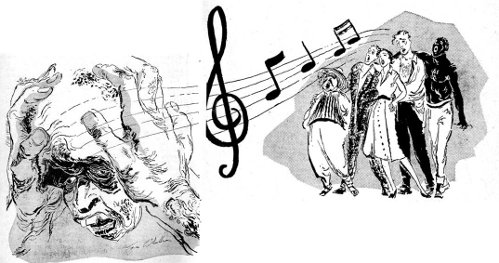
He had a high tenor voice, mellow with a sweet touch of huskiness in it, and he was singing "Drink to Me Only" at the top of his lungs.
He hadn't gone crazy! Summersby remembered the punishments they had endured for making harmonious noises on the musical toy, the slap Adam got for singing, the agonies the kids had gone through at Earth-type melody. Adam had thought of the only weapon they could use—song.
"Or leave a kiss within the cup," roared Summersby, and without further thought walked into the room. Watkins had chimed in now, breathless but true of pitch.
Three eighteen-foot brutes were standing there. Vast hands were pressed to bulbous heads, and agonized croaks came from gaping mouths. Whatever a tune did to them, it wasn't pleasant. What weird auricular structure could cringe so from a simple song? It did, and that was enough.
Mrs. Full clutched his arm. "One of them struck Calvin with his prod," she wailed.
"Where is he?"
"Near that door."
Beginning to sing again, Summersby pelted for the prone milk inspector. He picked him up and slung him, limp as a dead doe, over his left shoulder. The others were gathering. He motioned them forward, and, as Watkins joined him, ran on.
"Where'd you find your case?"
"On a table. Hope the dough is all in there." He glanced back. "They're coming. We're racking 'em but they're game."
The woman, Adam and Villa were right behind them. As they reached the midpoint of the third room, the dining hall, one of the beings staggered through the door behind them. It had lost its goad and was flattening its hands on its skull as Adam and Mrs. Full swung into "Dixie." It came at them like a drunk, unable to navigate a straight course but determined to reach them. It'll stamp on us, thought Summersby, easing Full back a little on his arm. It only has to come down once or twice with that Cadillac-sized foot and we're squashed ants. He sang.
"To live and die in...."
The second brute appeared, lurched over and fell on the table, caught up a flat trencher and skimmed it at them. It was as big as a bathtub. "Drop!" cried Summersby, went to one knee, felt the wind of the trencher's passing ruffle his hair.
The next door was closed. Summersby slammed himself flat against the wall and Adam, cat-lithe and fast, scrambled up over him, stood on his shoulders and broke the controlling beam. The aliens came down the room like two epileptic furies. "Sing!" said Watkins. "Everybody!" The door slid aside with maddening slowness.
"Try a fast one," said Mrs. Full. "'Blow the Man Down.'" It was a funny suggestion, coming from her. Summersby actually chuckled as he started to sing.
"As I was a-walkin' down Paradise Street...."
The third monster entered the dining hall, caught the full blast of their five voices (Calvin Full was still out, but Villa was giving a rum-tum-tum accompaniment), and sank to its knees, shaking its head as though it had been sapped. One of the others made a desperate leap at them, landing prone within a yard of Summersby. Melodies affect its organ of equilibrium, he thought; poor thing's in agony. "I says to her, Lollie, and how d'ye do...."
They were through the doorway now. The only pursuer still on its feet was reeling after them, green rod still held in one shaking hand. Its rust-red eyes were bulging out from their deep pits, and a thin trickle of violet ichor came from its nostril. It made guttural, creaking noises.
"Down at the end," said Watkins. "The brown box."
"Did you gimmick it?" asked Summersby.
"I think so. We have to take a chance. The main idea is easy. I guessed at a few things, but I think it'll work. Unless one of our big pals checked on it and mucked up my improvements."
It was twenty yards away; but so was the last of the monsters. Summersby changed Full to his other arm and added his voice to the general clamor for a bar or so, then asked Watkins the question that had been nagging at him. "Can we all go? Or does somebody have to send the others?"
"I'll send you. I'm not too sure I can get through. The dials and focusing lenses are on the outside, you know."
"I'll work it, then." They were at the table; he dropped Full and helped Adam shove a chair to the table. The woman and Villa were singing "Quiereme Mucho" in Spanish, their voices a trifle hoarse by now.
"You will like hell. It'd take me ten minutes to teach you how to work the transmitter. Think we have ten minutes?"
The giant was standing still, weaving, pawing the air. It would not give in to its pain and dizziness. If it fell now it might hit them. It was that close.
"You've got to show me. I have a bad heart. I'm due to die in a month or two," said Summersby urgently.
Watkins stared at him. "Do you think you went through the past hours with a rotten ticker? Don't make me laugh."
"It's true. I'm just waiting to die. You're no more than thirty-eight or forty, and you've got twenty-two thousand dollars there," he said, gesturing at the briefcase. "I don't give a damn about the morals of the case. You're a decent fellow and you ought to have this break."
Watkins snarled, as he gave the valiantly singing Mrs. Full a hand up to the chair seat, "You think I have a martyr complex? You think I want to stay here? I'm elected, that's all! It's me stays or it's everybody! I haven't the time to teach you to work it!" He hit Summersby a hard blow on the chest. "Your heart's fixed up the same as Adam's eyes and Cal's sinus. These gentry could turn your lungs upside down without opening you up, they're that good. Go back to your woods. You're okay."
"No," said Summersby with stubborn rage. "I'm sick of waiting to die. That's why I took the coaster ride in the first place. That's why I wanted—"
"You're nuts. You have a heart to match your frame, Highpockets, if you'd admit it. Hand up old Cal."
The monster took two wobbling steps toward them. They were all on the chair, then clambering onto the table. Watkins swung open the door of the brown box. "Fast," he said urgently, "fast!"
Adam had Cal by the armpits; he lugged him into the dark interior. Villa jumped in, Mrs. Full following. Summersby confronted the safe-cracker.
"Show me how to work the machine. I don't believe they could mend a bad heart."
Watkins handed him the briefcase with so unexpected a motion that Summersby took it automatically. "Send it to Roscoe & Bates, if I don't turn up. I guess I can't use it here." He put a hand under his coat. "Go on, Highpockets."
"No!"
Watkins drew a gun, a small steel-blue thing that looked as wicked as a rattler. Summersby had had no idea that he was carrying it. "Hop in, tall man," said Watkins, grinning. "You're holding up the works."
Reluctantly Summersby backed away, stood in the door of the box. He could jump Watkins, but if the mechanism were so complex, he would only doom them all. "You're out of your head," he said.
"Sure."
Abruptly above the safe-cracker towered the fantastic form of their forgotten enemy, reaching for them, one hand still to its head. Summersby inflated his lungs.
"Should auld acquaintance be forgot," he roared tunefully, "and never brought to mind!"
Everyone joined him. It was a startling cataclysm of sound, even to Summersby. The alien tottered, hand outstretched; its mouth fell open, its eyes popped, the violet blood coursed from its nostril; with a shudder it clawed the air, honked grotesquely, and pitched forward, half on and half off the table, where it lay gurgling. A spot on the side of its skull, about the width of a gallon jug, on which the hair grew sparse and gray, pulsed as though there were no bone beneath the skin, as though a bellows within was puffing it in and out, in and out. Its ear, thought Summersby. Probably we've wrecked it for good. Maybe the thing will die. Then Watkins is a gone goose, if he stays. He was about to lunge at the steady gun-hand when Adam and Villa yanked him backward into the box. Adam was crying.
"Try and come too, Mr. Watkins, try and come too," he said.
Watkins laughed. "I'll make out okay, son. I like my hide pretty well." He waved with the gun. "Be seeing you." Then he tossed the dark weapon into the box and slammed the door.
XI
There was darkness, then bright sun. They stood on a street corner, and Summersby could read the signs as plainly as Watkins must have read them in the focusing lens of the matter transmitter on the unknown planet.
Broadway and 42nd Street. The five of them had clicked into being on the busiest corner of New York.
"That old crook," said Adam, gulping. "He focused us here for a gag."
"I look awful," gasped Mrs. Full, and Summersby, glancing at her, agreed. Like all of them, she had lost weight; her skin showed the effects of a week's washing without soap; and her skirt and blouse were mussed up, to say the least. All the men needed shaves. Calvin Full, recovering gradually from the shock of the goad, and still supported by Villa, looked like a Bowery wino.
"Is he coming?" asked Adam, addressing Summersby. "Will Watkins be along too?"
"I don't know," said Summersby. He stared up at as much of the sky as he could see beyond the block-high ads. "I hope so."
"My chili stand!" shouted Villa, suddenly awakening to the fact of New York about him. "That no-good relief man! I've got to see what he's done to it!" Pushing Calvin to Adam, who grasped him by an arm, the Mexican waved hurriedly. "Come and see me," he said to all of them. "I'll give you a bowl free." He hastened away into the crowd.
"We've got to see about our clothes at the hotel," said Mrs. Full. She sounded apologetic. "I hope we'll see you again, Adam, and Mr. Summersby."
"I doubt it," said Summersby. He looked at Full. "Coming out of it?" he asked.
"Thanks," said Cal, nodding. He took his wife's hand. "Gave you my address, didn't I?"
"I have it," said Summersby.
"Well, good-bye," said Mrs. Full.
"You did a fine job up there," said Adam Pierce. "I'm proud to have known you, ma'am."
"Thank you, Adam. Good-bye." They were gone.
"I suppose you'll be going too," said Adam, somewhat wistfully.
"I guess so. You'll go home?"
"I guess so," Adam repeated. "My folks will be sore. They'll never believe such a story. They'll think I ran wild or something."
Summersby, still looking upward, and wondering if he could be staring blindly at the planet which Watkins must be trying to leave even now, put a hand on his heart. "Was he right? They did fix up everyone else." He laughed. It was the first time he had laughed normally in seven months. "I could get into the rangers again," he said. "Adam, I've got to see a doctor. I've got to find out something."
"Yes, sir," said Adam unhappily. Summersby looked at him. "Really worried about your folks?"
"Yes, sir."
"I'll come home and tell them, if you like."
Adam said gratefully, "Mr. Summersby, you're a gentleman."
"No," said Summersby, "no."
"Yes, sir, you are. Can we wait just a minute more? Mr. Watkins might be along any minute now."
"We'll wait."
After a while Adam said, "Remember that first feed we got up there, pies and cookies and glass?"
"I remember it."
"They must have just aimed that machine at a bakery window here on Earth, and taken glass and all."
"That's it."
"Probably it was called a smash-and-grab robbery, down here." He kicked something, bent down and picked it up. It was the safe-cracker's gun. "I didn't think he'd carry one," said the boy. He looked closer at it. "God!"
"What is it?" Summersby shifted the briefcase and held out a hand. Adam laid the weapon in his big palm. "He must have won it at the park that day," Adam said. "That old crook! Old faker!"
Summersby held it up. It looked like a small automatic of blued steel, but it was plastic. He turned it over. A pencil-sharpener.
Summersby grunted. "A toy," he said, giving it back to Adam. "Nothing but a kid's toy."