Chapter XIX · JAPAN.
Reading edition
I. THE TREATIES AND THEIR NEGOTIATORS.
Commodore Perry's expedition, 1853-54—Townsend Harris—Count Poutiatine—Lord Elgin—The treaties of 1858—The solidarity of Western Powers—The practical attitude of the Japanese—Their yielding to circumstances—The condition of the country—The character of the people—Nagasaki—The Dutch—Their two hundred years' imprisonment.
A mystery hung over the island empire, which had been sealed against foreign intercourse for two hundred years, and its mere seclusion, apart from the weird romance that gilded such fragments of its history as were known, invested the efforts to reopen the country with a romantic charm. It was in Japan that Lord Elgin achieved the real diplomatic success of his life, in the briefest possible time, at the least possible cost, and with the most far-reaching consequences; for undoubtedly he hastened the entry of the Land of the Rising Sun into the family of nations.
The poetical side of the mission was done ample justice to by Laurence Oliphant in his 'Narrative,' by Captain Sherard Osborn in the pages of 'Blackwood,' and elsewhere. The prosaic side and the practical issues of this rediscovery of an old world were not so clearly apprehended by them or by any other contemporary writer. The Powers of Europe and America had long been watching for opportunities to effect an opening in the barrier, but all tentatives proved in vain until force was resorted to. This was first done by the United States, whence a naval squadron under Commodore Perry appeared off the coast in 1853, repeating the visit, on a still more imposing scale, in 1854. The apparition deeply impressed the minds of the Japanese Government and people, who, Lafcadio Hearn tells us, speak to this day of the "black ships," birds of omen foreshadowing events for which it behoved them to prepare themselves. Black, indeed, they were, grim of aspect, huge in bulk, and looming larger than they really were, with their high sides, great paddle-boxes, and "smoke-stacks." The ships were armed with a few guns of such calibre and power as had not till then been placed on any floating battery. Jonathan is never second-best in naval artillery. Commodore Perry with his three black ships, the steamers Powhattan, Susquehanna, and Mississippi, and his squadron of sailing-vessels, opened the door of Japan—not very wide, it is true, yet so that it could never again be closed. The rudimentary treaty he made was little more than a covenant to supply wood and water to needy ships and to be merciful to their crews. A similar treaty was made by the English Admiral Stirling in 1854, and it included the "most-favoured-nation" clause, only excepting from its application the privileges enjoyed by China and Holland.
To carry the work forward to a more practical stage a man of affairs was required, and he was found in the person of Townsend Harris, who was accredited to Japan under the title of Consul-General for the United States. Mr Harris had been nearly two years in the country when Lord Elgin, with his modest escort, arrived and made his acquaintance. With infinite patience Mr Harris had been prosecuting his negotiations, against wind and current, it would seem, until a propitious gale wafted his venture into port. The black ships had gone, but another fleet more numerous was assembled on the neighbouring coast, whence their fame had reached the secluded empire. Riding on the shoulders of the Anglo-French exploits in China, and not obscurely hinting at the prospect of the allies shortly visiting Japan, Mr Harris induced his Japanese friends to "hurry up" with his treaty, that it might not only serve as a model of moderation for the other Powers when they also should come to negotiate, but provide in advance friendly mediation between them and Japan. Lord Elgin justified the forewarnings of Mr Harris by appearing in the Bay of Yedo within a few weeks after the signature of the American treaty.
How much both Mr Harris's treaty and the one which Lord Elgin was about to sign owed to the previous Russian negotiations cannot be estimated. Admiral Count Poutiatine concluded a treaty in 1855, and improved it in 1857, on the basis of Sir James Stirling's opening the ports of Nagasaki, Hakodate, and Shimoda for ship's supplies, with sundry minor privileges. When Lord Elgin reached the Bay of Yedo in August 1858 he found Count Poutiatine already there with a frigate and a gunboat.
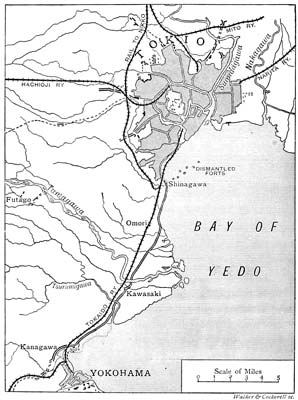
BAY OF YEDO. Walker & Cockerell sc.
This convergence of the great Powers of the world upon a single object, that of breaking down the seclusion of Japan, was clearly recognised, and its proximate effect weighed, by the Japanese statesmen of the day. Too wise to oppose an uncompromising resistance to the pressure, they employed their skill more profitably in deflecting its course. In accordance with this policy, Lord Elgin's demand, backed as it was by the prestige of his recent achievements in China, was promptly conceded, and within the short space of fourteen days from his arrival in the bay a treaty was concluded of the same tenor as the American, of which Lord Elgin had obtained a copy from Mr Harris, who also lent him the invaluable services of his Dutch interpreter, Mr Heusken. By the two treaties three of the chief ports of the empire were opened to foreign trade within one year, and two more at later dates. In some respects the English was an advance on the American treaty. By the latter the import tariff had been reduced from the old Dutch rate of 35 per cent to a general rate of 5 per cent ad valorem. The British treaty specifically provided that cotton and woollen manufactured goods should be included in the class of merchandise paying 5 per cent. The immunities of extra-territoriality were unreservedly conceded, and were only rescinded by the revised treaties, the first of which was made with Great Britain in 1894, coming into force in July 1899.
One general remark applies to all treaties made between foreign powers and China or Japan, that the interests of each separate Power were safeguarded by the virtual solidarity which existed among them, through the operation of that convenient diplomatic save-all, the "most-favoured-nation" clause. This comprehensive provision inserted in the treaties secured for all the Powers the advantages gained by any one of their number. Faith in this ultimate protection may have led occasionally to slipshod negotiations. There might even be a temptation in some cases to seek special credit for moderation, with the foreknowledge that the exactions of any of the Powers would inure to the benefit of all. Lord Elgin wrote the simple truth when he said that, "as regards all these important commercial privileges, I have to fight the battles of the Western trading nations single-handed." This feature had been particularly noticeable in the negotiations in China, where it was so well understood that the English treaty would be the common standard that it mattered little that the signature of some of the others was hurried forward so as to take priority of the British in point of date. The treaty which Lord Elgin negotiated with Japan was destined to occupy the same ruling position as the treaty with China, and therefore it devolved upon him to make provision for all manner of contingencies which no experience could enable him to foresee. Considering that these treaties were drawn up with so little knowledge of the circumstances of the country and of the future exigencies of trade, the fact that they have stood the test of forty years' experience redounds greatly to the credit of the negotiants.
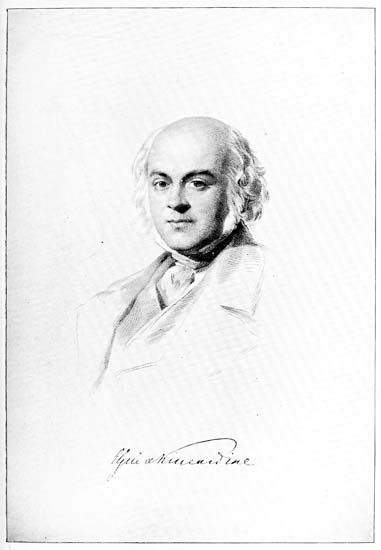
LORD ELGIN.
Lord Elgin had to learn what a Daimio was from Count Poutiatine, who probably had but just acquired the knowledge himself. It is strange at the present day to read the solemn preamble, "Her Majesty the Queen of the United Kingdom of Great Britain and Ireland and his Majesty the Tycoon of Japan." "It was not till some time later that it was discovered that there was a still higher power than the Shôgun," said Earl Russell in 1865. The imperfect knowledge, however, attests the general soundness of the principles adopted.
It must be admitted that on the Japanese side, also, nothing seemed wanting to render the treaty a workable instrument. The Japanese negotiators were animated by a more practical spirit than any Chinese diplomatist with whom foreigners had had dealings. There was no idea in their minds of blind obstruction; they were bent, if not upon efficient working, at least on the minimising of friction and risk. And though it is probable, indeed quite certain, that no treaty whatever could have been made without substantial force in the background, intelligently apprehended by the Japanese Government, yet, that being conceded, it was clearly their object to make the best of the position in which they actually found themselves. Under no other circumstances could treaties so complete in detail and so effective for their purpose have been concluded.
To judge of the acts of the pioneers of foreign intercourse, or to form a just opinion of the conditions under which the treaties came into force, it would be necessary for the critic to regard the whole surroundings as a painter does his subject, not representing what he knows or may afterwards discover to be there, but considering only what actually meets his eye. This, of course, is next to impossible in the case of Japan, where the transformation resulting from the contact with foreigners was so rapid and so kaleidoscopic, and while foreign knowledge of things Japanese has increased at so marvellous a rate, that only a series of mutoscopic photographs could have preserved the sequence. Opinions were at first, and for some time after, unduly affected by the preconception of a certain analogy between China and Japan founded on geographical propinquity, and in a measure on language: this bias influenced the first influx of foreigners in 1859, who were largely drawn from the commercial ports of China. Yet those who had been habituated to the manners and customs of the Chinese were at once struck, not by the similarities, but by the violent contrasts, which the two peoples presented. These visitants had left behind them filth and squalor; they met cleanliness and tidiness of an extreme type. They left behind vagueness of thought, slovenliness of action; and they encountered pedantic precision. They left behind indifference and stolidity, with ignorance cherished as a proud possession; and they encountered a keen and intelligent appetite for knowledge. These features met the stranger before even his ship had cast anchor, or he had set foot on shore. He soon perceived, also, that existence was carried on under an elaborate prescription which left but a narrow margin to spontaneous action, and such a minute supervision that a sparrow could hardly cross the road without being noted by the official guardians of the peace; that every function, whether of official or private life, was under the undisputed control of the same vigilant organisation.[1] On entering the narrow waters approaching the harbour of Nagasaki, he would pass under forts where through a telescope he could see guns and gunners' quarters all spick and span. If there happened to be another vessel approaching from seaward, he would know it by the booming of two guns from the outermost fort, the signal being taken up and passed on by those inland, and so all the way to Yedo. This, he learned, was the mode of announcing to the capital the appearance of any foreign craft off the coast. On entering the inner harbour he would see boats full of men who looked like women, pushing off to his ship; and then a posse of officers, each armed with two sharp swords, would come on board. They, by means of a very imperfect interpreter, would at once ply the master with questions on every conceivable subject, as if he were competing in an examination in universal knowledge. The tedious catechism, with its admixture of seeming frivolity, would have been exasperating but for the imperturbable suavity of the catechists. Every answer was promptly, yet deliberately, committed to writing. Such was, and is, the custom of the race.
Nagasaki being still, in the first half of 1859, the gate of Japan, and the only sample of the country known to foreigners, the bright welcome with which it greeted the new arrivals was of happy augury. It was there, also, that the first observations of the ways of Japanese commerce were made, for Nagasaki had carried on trade with China and with Holland for two hundred years,—a trade which was conducted on the one side by officials of the Government, who fixed the prices of the commodities exchanged, and which was all but strangled by monopoly. The restricted annual "turn-over" must have required a high percentage of profit to support the Dutch factory, and the privilege of trading on so petty a scale seemed to be dearly bought by the perpetual imprisonment of the agents. The unfortunate Dutchmen were confined, with their whole establishment of warehouses, residences, &c., within an area of less than three acres of reclaimed foreshore called Deshima, thus described by Sir Rutherford Alcock in 'The Capital of the Tycoon':—
A low fan-shaped strip of land, dammed out from the waters of the bay, the handle being towards the shore and truncated. One large wide street, with two-storeyed houses on each side, built in European style, gives an air of great tidiness; but they look with large hollow eyes into each other's interiors in a dismal sort of way, as if they had been so engaged for six generations at least, and were quite weary of the view.... But the view from the Dutch commissioner's residence, with its quaint Japanese garden and its fine sweep down the bay, is very charming.... There flitted before me a vision of the solitary chiefs of the factory in long succession taking up their present station in long rotation and looking forward upon the fair bay with which their sight alone may be gladdened. How often must the occupants of this lone post have strained their eyes looking in vain for the solitary ship bringing tidings from Europe and home!
The imprisonment of the Dutch was aggravated by many degrading conditions imposed by the Japanese Government. Their position bore some analogy to that of the English and other foreigners in Canton previous to 1839. In both cases the Europeans endured indignities at the hands of Asiatics for the sake of profit, but beyond that point it is the differences rather than the resemblances which are significant. The humiliation of the Dutch in the island of Deshima was indeed unmitigated so far as it went, but it was neither capricious nor spiteful. Once the yoke was peacefully adjusted, what remained of life to the Dutchman was made as agreeable to him as to a cockatoo in a cage. His jailors had no particular animus against him; they had a purpose of their own to serve in keeping open, through the foreigners, a channel of communication with the West, and they had as valid reasons of State for tethering him as one may have for tying up his ox or his ass. These purposes once served, however, the Japanese did not revel in harshness or cruelty.[2] With the Chinese it was otherwise. They also had a political object in restricting the barbarians, only they were never satisfied with its attainment, but continued heaping up insults on their victims to the utmost limits of their submissiveness.
The petty trade which the new-comers were able to do at Nagasaki was, in the beginning, managed through the existing agency of the Dutch, from whom, however, there was nothing useful to be learned, much indeed to be unlearned; and in a few months it was the Dutch themselves who had to go to school to the interlopers. As commerce had been kept entirely in the hands of the Government officials, there had been no opportunity for the rise of any mercantile class among the natives: that was to be a product of the new era.
II. THE OPERATION OF THE TREATIES.
Japanese preparations for trade at Yokohama—Mr Alcock's arrival as consul-general—Assumes the rank of Minister—The situation as he found it—The establishment of diplomatic intercourse at the capital—The location of the foreign settlement—The currency—The low value of gold—Its rapid exportation—Friction caused by conditions of exchange—Efforts of Mr Alcock to set matters right—Report by Secretary of H.B.M. Treasury—Japanese double standard, gold and copper—Japanese courage in meeting difficulties—The Daimios' coinage—Beginnings of trade—Amenities of residence—The charm of the people—The two Japans, official and non-official—Complete despotism and complete submission.
The treaties of 1858 took their proper effect at the two ports of Hakodate and Kanagawa; but the former being remote from any centre of population, and its trading resources so obviously limited, it attracted little attention in commercial circles. It was in the more southerly port that the new foreign interests became concentrated; and it was so near the capital—only seventeen miles distant—that the political and commercial currents soon acted and reacted on each other with direct, and sometimes violent, effect. To Kanagawa, therefore, the merchants of all nations gathered in anticipation of the official opening of the port on the 1st of July 1859.
We say "Kanagawa," to follow the official nomenclature, but in reality the adventurers who came there to seek their fortunes did not land at that place, but three miles away from it, at an obscure village called Yokohama. There the Japanese Government had decided should be the future settlement for foreigners, and they had made costly preparations, according to their lights, for the accommodation of the strangers. Roads were marked out, a certain number of wooden bungalows had been run up, a few shops had been opened in the quarter which was designed for native occupation, a custom-house was built, with warehouses attached, and stone landing-places had been constructed for boats and lighters. The area thus marked out for the native and foreign business quarter was a narrow strip along the sea-shore, having in its flank and rear an immense lagoon, or, as it was called, "the swamp," intersected by boat channels, where punting after wildfowl provided amusement for idle foreigners. Being an inlet of the bay, the swamp made a peninsula of Yokohama, which had just been connected with the tokaido, the great trunk road between the capital of the Tycoon and that of the Mikado, by a new causeway and several good bridges, admitting of boat traffic between the swamp and the sea.
In the middle of the swamp, in rear of Yokohama, was a reclaimed portion whereon was erected an extensive range of buildings connected by a causeway with the dry land of the settlement. From its balconies there waved pendants of cotton cloth bearing the legend, "This place is designed for the amusement of foreigners," a class of amusement of which there has never been any lack in Japan.
Such were some of the outward and visible preparations made by the Japanese Government, on its own initiative, for the reception of the foreigners under the new treaties,—preparations which surprised and somewhat disconcerted the representatives of the Western Governments when they arrived on the eve of the opening of the port.
Mr Alcock, who had recently returned to his post as consul at Canton, was chosen as the first representative of Great Britain in Japan, with the rank of consul-general. As this rank placed the representative of the leading Power in an inferior position to his colleagues, and consequently derogated from the influence he could exercise on the Japanese, Mr Alcock took it upon himself to assume the title of Plenipotentiary, placing his resignation in the hands of his Government in case they should disavow his action. At the same time he recommended that the future British representative should bear the title of Minister Resident. So far from disavowing his action, the Government appointed him Envoy Extraordinary and Minister Plenipotentiary, a higher rank than that suggested by him, and he was authorised to at once assume the title, although so unusual a proceeding as the transfer of a consular official to the diplomatic service involved considerable delay while the needful formalities were being arranged. The appointment, however, was coupled with the conditions that the step should not be made a precedent, and that it should confer no claim to future diplomatic employment in the countries of the West.
Mr Alcock was conveyed from China in one of her Majesty's ships, arriving at the port of Nagasaki in June 1859. There he found a fleet of foreign merchantmen already in the harbour, and some fifteen British subjects resident on shore, under the ægis of the old Dutch conventions supplemented by more recent enactments. Mr Alcock remained some days, and having made arrangements for the carrying on of trade under the new treaties, left a consul in charge of British interests and proceeded to Yedo, where he arrived on June 26.
It is a date to be remembered as that of the practical initiation of diplomatic intercourse with the ruling Power in Japan. The difference between a mission to negotiate treaties and one to carry them into effect is thus set forth by Sir Rutherford Alcock in the preface to his valuable work, 'The Capital of the Tycoon,' in terms the simple truth of which must commend itself to every candid reader:—
The Ambassadors Extraordinary had only to extort certain privileges on paper; it was the business of the resident Ministers to make of these paper-concessions realities—practical, everyday realities. As this was the very thing the rulers of the country had determined to prevent, it cannot be matter of wonder that there was not, and never could be, any real accord, whatever the outward professions of good faith and amity. Hence also it naturally followed that, although the original negotiators were received with smiles, and their path was strewn with flowers, their successors had only the poisoned chalice held to their lips, thorns in their path, and the scowl of the two-sworded braves and Samurai to welcome them whenever they ventured to leave their gates—while the assassin haunted their steps, and broke their rest in the still hours of the night with fell intent to massacre.
To say the situation was novel is to say little. The forces at work in the Japanese state economy were either unknown to, or, what was perhaps even worse, misunderstood by, foreign Powers. The lurid history of previous intercourse, followed by rigid exclusion for two centuries, would have sufficed to establish one factor in the problem, the iron resolution of the Japanese rulers. With such men neutrality or indifference was out of the question, while there was nothing as yet to indicate what was henceforth to be the ruling motive of Japanese policy. Both parties were embarking on an unknown voyage, and the avoidance of shipwreck depended in a very large measure on the character of those who had to discover for themselves the winds and currents, the rocks and shoals, through which they had to steer. The leadership among the foreign Powers was tacitly assigned to Great Britain, and it was a born leader who was commissioned to represent her. Mr Alcock had had fifteen years' experience of Asiatic relations, during which time he had proved himself the possessor of those qualities which were now in special request. These were indomitable energy, earnestness of purpose much beyond the common run of official service, fearlessness of responsibility, and alertness to grasp the nettle danger in order to avert greater evils, and a spirit which would neither shirk nor postpone an unpleasant duty nor tolerate lukewarmness nor dilatoriness in others. He was fifty years old—matured in character and experience, while yet in the prime of his intellectual vigour.
Mr Alcock arrived in Yedo Bay in time to arrange for the opening of trade at the appointed date, July 1.
Nagasaki to Yedo! Two centuries lie between these points, so near on the map, but so far and completely separated by the determined policy of the Japanese rulers. A policy of isolation so effectually carried out that no foreigner, though he might under the Dutch flag gain access to Nagasaki, could force or find his way to the capital.
Steaming up the Bay of Yedo, and leaving Kanagawa unvisited, Mr Alcock anchored as close to the capital as the depth of water would allow, and at once informed the Foreign Minister that he had come to stay. This was done advisedly, as he has explained, to obviate all discussion as to his place of residence, for he knew that efforts had been made—more Sinico—through Lord Elgin to induce her Majesty's Government to postpone the residence in Yedo for a couple of years, and to keep their representative at a distance. His first object was to obtain a suitable residence for himself and the Legation staff, in which assistance was cheerfully rendered by the Government officials, as soon as they saw he was resolved to remain in the capital. Diplomatic intercourse became thus an established fact.
The opening of the trading-port did not prove quite so simple, for the consul-general found he had been forestalled in the choice of a site for the merchants' residence, which the Government had, as we have seen, prepared at great expense some three miles away from Kanagawa, the port named in the treaty. Interpreting this hurried action of the Japanese as covering the ulterior design of segregating the foreigners from the natives by thrusting them to a distance from the trunk road which led through Kanagawa, of keeping them in a kind of imprisonment like the Dutch at Deshima, and of retaining the power to stop their supplies, whether of the materials of trade or of sustenance, Mr Alcock warmly contested the action of the Government. In the end he extorted from them the concession of a commercial site at Kanagawa itself, which, however, was never taken up. Events proved too strong for the consul-general, for the merchants of all nations as they arrived settled in Yokohama, where there was deep water for shipping and every convenience for business. And it soon began also to be felt that there was an element of safety in this foreign settlement being removed from the great imperial road along which armed processions were continually passing to and from the capital. Within a year the controversy had died a natural death, and Yokohama speaks for itself.
The second obstacle to the free course of trade was a more deep-rooted one, being nothing less than that chronic bugbear of commerce and finance, the currency. There was no circulating medium in Japan in the least degree adequate for the service of international commerce. The trade in miniature that had been carried on in Nagasaki had been a simple exchange of commodities without the intervention of the precious metals. Mr Consul Winchester says that neither in the Dutch nor in the Chinese factories was a Japanese coin ever seen. But the commerce inaugurated in 1859 could brook no such limitations, while the extent of its requirements was of course absolutely unknown to the negotiators of the treaties. In this state of doubt and ignorance on both sides it seemed that the best temporary provision that the circumstances admitted of was for the Tycoon's Government to undertake, after twelve months, to make all foreign money current in Japan at its natural value, and that until the expiration of that period Japanese coin should be supplied in exchange for foreign, weight for weight. Yet it was a monstrous stipulation to insert in any international treaty, and could never, in fact, be enforced.
The amazing laxity in this respect with which the treaties of 1858 were drawn opened the door to unfathomed abuses in the matter of currency. The coin which was in the minds of the American and English negotiators was what was then current on the coast of China, the dollar, or more specifically the Mexican dollar. Yet, as was afterwards pointed out by Mr G. Arbuthnot, Secretary to her Majesty's Treasury, no provision was made in the treaties expressly for exchanging that, but only British and American money. In his opinion the Tycoon's Government might have refused altogether to receive the Mexican dollar, which was the only coin tendered to them, and thus the currency clause in the treaty would have been a dead letter from the first. But since they did not know the weakness of the ground which the foreigners had chosen, they had to fight out the question under all the disadvantages of a false position.
By the treaty provisions, then, as interpreted by both sides, the foreign merchants who chose to import specie were to be supplied in exchange with current coin of the realm whereby they could purchase the produce of the country without awaiting the slow and uncertain realisation of imported merchandise. But the Japanese, apart from any question of good faith, had vastly under-estimated the demand which this agreement was to make on their mintage resources. They could only supply tens where thousands were required, and in consequence of their scarcity native silver coins were soon run up to a high premium. These coins were needed not alone for the purchase of produce, but for the more lucrative investment in the gold coinage of the country; for an extraordinary anomaly presented itself to the foreign traders in the relative value of silver and gold in Japan. The ratio between the two metals throughout the commercial world was at that time about fifteen to one, but in Japan, owing partly to the fact that the silver ichibu was a token coin, and yet interchangeable, weight for weight, with foreign silver coins, the ratio in the market was reduced to five to one. Nothing could better show how completely the country had been isolated than this simple phenomenon. Since the seclusion of Japan no such opportunity of profit without risk had ever tempted merchant adventurers outside the dreams of romance.[3] It could not be the intention of the treaty-makers to deprive Japan of her gold, yet the exportation of it was not only not prohibited, it was expressly sanctioned by treaty, the export of copper coins alone being forbidden; and once the conduit was opened no power could arrest the flow from the higher to the lower level. The currency question presented many intricacies and anomalies against which the foreign representatives struggled in the dark, but the ratio of gold to silver was the ruling factor which underlay the whole problem, and until every koban was exported, or the relative value of gold and silver had been assimilated to that of the outer world, there could be no settlement of the currency question in Japan.
In the mean time the friction caused by the unsatisfied demands of the traders was considerable; it became in time ludicrous. There was a daily exchange held at the custom-house, and various arbitrary systems of distribution were adopted by the officials there. The discovery that a kind of manhood suffrage was recognised, and that an employee received as much as his employer, led to applications being made in the names of servants and even of fictitious persons, to each of whom an allotment was granted. Again, the discovery that allotments were also made pro rata according to the amount applied for led to the applications being sent in for ever larger and larger sums until billions and quintillions were reached. By such devices, no doubt, some of the applicants may have gained a momentary advantage over their neighbours, but at no time did the merchants receive a sufficiency of Japanese coin to carry on the most restricted business. At one time, about a year after the opening, it was estimated that there was in the hands of foreign merchants one million and a half of dollars which were not exchangeable, and were a "drug in the market."
Their wants were, however, partially supplied in another manner. For among the anomalies of the place and period one must be mentioned which had a quite peculiar bearing on the supply of currency for commercial purposes. The precious coin, which was doled out homœopathically to merchants, was supplied to foreign officials in liberal measure. Every minister, consul, and assistant; every admiral, captain, and lieutenant; every paymaster, for himself and for the service of his ship, received his quota of Japanese money on a scale graduated according to rank. The amount put in circulation by these means was given by Mr Winchester as $2,000,000 per annum. The recipients, whether directly or through agents, were able to sell their surpluses to the merchants, of course at a handsome profit, and no doubt abuses grew out of what was in its original intention a simple measure of justice to salaried officers. The practice was condemned by Mr Arbuthnot, and was discontinued by order of the Foreign Office in 1864, on the initiative of the Prussian Government, whose agent in Japan had voluntarily renounced the privilege. But, oddly enough, the official exchange was resumed by request of the Japanese Government, and continued for several years longer, until, in fact, foreign and native coin had found their common level.
Trade certainly suffered much in the beginning from the incongruous state of the currency, which was greatly more complicated than we have attempted to outline. Even after the year of probation foreign coins were neither received by traders at their value nor exchangeable in accordance with the treaties. Whether the Government was at the bottom of the obstruction or was overruled by circumstances beyond its control was uncertain, but the British consul-general made masterful exertions to set the matter right. Currency reform, however, has baffled so many generations of expert economists that, even assuming the goodwill of the native Government, an alien official new to the country must have found it difficult to accomplish much, with the time and means at his disposal. Earl Russell in 1862 "declined to pronounce on so large and intricate a question," and would not even discuss it with the Japanese envoys.
Japanese currency formed the subject of four elaborate reports by the Secretary to her Majesty's Treasury, extending over twelve months, from December 1862 to December 1863, drawn up after personal conference with Sir Rutherford Alcock and on information derived from various other sources, especially from a series of very able papers by Consul Winchester. In each of these reports Mr Arbuthnot remarks on the paucity of data, and in each he qualifies the deductions of the preceding one. Had the series been still further extended, it is even doubtful if finality of judgment would have been reached; for in his third report he says, "The whole question, both as regards the condition of the currency and the real intentions of the Japanese Government, is involved in so much obscurity that no sound judgment can yet be formed on the subject" (May 1863).
It would be a mere weariness to the reader to attempt to elucidate a problem which an expert student found perplexing, but a few salient points brought out in Mr Arbuthnot's review may repay citation, as illustrative of the general state of relations beyond the immediate question of the currency. "We found," he says, "the Japanese with a carefully devised system of coinage, presenting indeed anomalies, when regarded from a European point of view, but apparently well adapted to their domestic wants; and their coins were found on assay in London to be well manufactured." The Chinese had no such system, and the evolution of a metallic currency entitled to such high praise, in a country from which the rest of the world had been long shut off, is one of the most striking evidences of the high originating faculty of the Japanese.
As to the stipulation in the treaties that foreign coin should be current in Japan on a par with native, weight for weight (not a word said about purity), it was not only preposterous and absolutely unworkable, but it was imposed by the ignorance of the foreign negotiators against the superior knowledge of the Japanese; for it is remarkable that in the negotiations carried on by the Americans in 1854 the Japanese took up the impregnable ground that "American coin was only bullion to them." Force alone—or the fear of it—drove them from that position in 1858, and in yielding to the unreasoning pressure of the subsequent negotiators the Japanese probably consoled themselves with their resources of secret evasion to save them from the worst consequences of the obligation—a characteristic of the whole treaty-making campaign.
It appeared to Mr Arbuthnot that the Japanese had a double standard—itself "a contradiction in terms"—gold and copper; silver occupying the position of a token currency between the two, at a highly artificial value, strictly governed by law. The fact was exemplified in many ways. Art objects in silver contained more metal than the coin paid for them, the work of the artificer thrown into the bargain. Gold and copper, on the other hand, bore about the same relationship to each other as prevailed in other countries. It was silver alone that was maintained at a conventional level three times above its value in the outer world. And the philosophy of this is explained by Mr Winchester, who tells us that, whereas the supply of gold and copper was in many hands, the sources of the supply of silver were in the exclusive control of the Tycoon's Government, which derived great advantage from maintaining the silver coinage at a high fictitious level.
The efforts of the Japanese to readjust the currency to meet the demands of the treaty were naturally first directed to silver, which was recoined and revalued, but confusion was worse confounded by all these attempts. Eventually the gold koban, worth intrinsically 18s. 4d. sterling, or 4 bus of the intrinsic value of 1s. 4d., was reduced to a sterling value of 5s. 6d., but was still rated at 4 bus, while the copper coinage was disestablished and iron substituted of no intrinsic value. "I am aware of no other example," says Mr Arbuthnot, "of so sudden and violent a rending of the monetary regulations of a country; certainly of none which has been produced by the interference of foreigners."
The effect of these inquiries by the Treasury was to discourage further interference by foreign Governments, to trust much to that great solvent of anomalies, the silent operation of commerce; while the only complete remedy was recognised as the establishment of a mint under European regulations.
The problem was still further complicated by the separate coinage of the Daimios. Their nibukin, as a general rule, passed only at first in their own provinces, but gradually they filtered down to the open ports, and at one time considerable embarrassment arose from the mixture of the coinage thus caused. In 1871-72 the Imperial Government, then just come to supreme power, took the matter up with the thoroughness they showed in all their doings. They gave secret notice to the foreign Ministers of their intention to call in all princes' nibukin, and thereupon issued an order that during one week these coins should be brought into the custom-houses at the treaty ports, where they would be fastened up in sealed packets of $100 value, and notified that coins so stamped within the week would be accepted by the Government as legal tender, but that thereafter their use would be prohibited. Now, as the Daimios' money stood at about 90 per cent discount at the time, the fact that some of the foreign officials who had access to this confidential information were also merchants created immediate speculation, with the result that within a fortnight these silver-gilt nibukin rose from 90 per cent discount to 2 or 3 per cent premium, the officially sealed packets being a most convenient form for the payment of duties.
The alacrity with which the Government applied heroic remedies to a disastrous predicament was typical of the energy of the Japanese, which has been displayed since in wider fields. They do not sit down and bemoan their troubles, but at once arm themselves against them.
When to the inherent difficulties common to currency problems generally were superadded the complexities of the monetary system of a non-commercial and long-secluded country, surprise should be felt that the regulation of the circulating medium in Japan was accomplished so soon, rather than that it took so many years to arrive at the solution. The Tycoon's Government did not live long enough to settle the currency, but left the problem as a legacy to the Restoration. A good many years elapsed before the Mikado's Government succeeded in evolving order out of chaos.
In the mean time, in spite of many drawbacks, trade was making headway in other directions besides the exportation of gold, and quaint indeed were the beginnings of it. The staple products happened to be the same in Japan as in China, tea and silk, and they soon began to be regularly brought down to Yokohama for sale. But business was at first on such a lilliputian scale, and was introduced in so dainty a manner, that to merchants accustomed to the large transactions of China the whole affair wore something of the air of comic opera, or as if children were playing at being merchants. This impression was strengthened by the aspect of the fragile wooden structures with their sliding doors and windows, but without sitting accommodation, wherein business was transacted, which to those habituated to the massive, if inelegant, buildings of Hongkong and Shanghai irresistibly suggested the idea of a doll's house. The Chinese methods also were inverted. Instead of sending samples of substantial quantities, such as a thousand chests of tea or fifty bales of silk, and the owner or his broker coming to chaffer in the silk-room or the tea-room of the foreign merchant, the latter had to go the round of the Japanese shops to find out what they had got. Early every morning the leading merchants might be seen booted to the thighs—for the rain was frequent and the roads unmade—trudging up and down the Japanese bazaar to see what novelties had come to hand. The more zealous would sometimes make a second round in the afternoon, in case there might be some late as well as early worms to be picked up. The bodily fatigue and consumption of time involved in this process would have rendered a large business impossible. There were as yet no Japanese merchants properly so called, and their endless parley resembled more the tenacious higgling of peasants than the negotiations of men of business. Moreover, the native dealers seemed scarcely conscious of any law which should hold them to a bargain in the event of a more acceptable offer turning up.
Conclusions unfavourable to Japanese commercial morality have been drawn from some of those early—and later—experiences; but commercial like other kinds of specialised morality has necessarily something of a professional character. The akindo, or merchant, was a sort of pariah in Japan, his social status being inferior to those of the peasant and the handicraftsman. His sense of honour was not, therefore, sustained by tradition or stimulated by esprit de corps. There being no mercantile body in Japan, there was no mercantile code, at least none applicable to international trade, and those unwritten laws without which large commerce is impossible had not yet been called into being. Contrasts between the two neighbouring nations have just been mentioned very much to the advantage of the Japanese; but in matters of commerce, it must be conceded, the advantage lay entirely with the Chinese, a nation of traders from their birth.
In the sale of lacquer ware and objects of art the Japanese were much more at home than in dealing in raw products of foreign manufactures, and the treasures which were in the early days exposed in the shops of Yokohama would make a modern dealer sigh for opportunities which are no more. Speaking roundly, it would have been safe to buy the stock indiscriminately at the sellers' own prices, when fortune would have awaited the investor as surely as if he had bought up the gold coinage at the ratio of 5 to 1. The same remark would apply to such of the raw produce of Japan as had been in large demand in China; and conversely the rule applied also to selected articles of foreign manufacture, which the Japanese were satisfied to buy at a price mid-way between the high level of the Dutch monopoly and the low level of what would remunerate the free importer. Therefore the sudden inroad of open trade on a market artificially confined resulted in profitable trading while a new equilibrium was being found; but such prosperity was in its nature evanescent.
Irrespective of the material aims which attracted foreign residents to Japan, the life itself presented several novel and interesting features. Nothing could have been pleasanter than the social relations which sprang up between the foreign communities and the unofficial natives. The strangers were received everywhere with open arms, and the residence among a smiling people (excluding altogether the meretricious allurements of the country, which have also not been without their influence) and amid enchanting scenery was found to add a new pleasure to existence. Here again we must resort for illustration to a comparison with China, where strangers at the best were sullenly tolerated, where one might live a lifetime without entering a house, or seeing a respectable woman, or making a friend save on a business footing. The Japanese of Yokohama and Kanagawa, as well as in the surrounding villages and temples, never failed in courtesy and hospitality to passers-by, and were eager for conversation with foreigners. A useful smattering of the language was soon acquired under the stimulus of a quick-witted and sympathetic people alert to jump at the meaning and patient to help the novice to find his words. The women of the household were always charming, and if their domestic conversation sometimes startled the stranger by its freedom, there was neither malice nor any such impropriety as leaves an evil odour in its trail. Friendships were formed, not deep perhaps, but genuine as far as they went, and certainly not the less sincere on the Japanese than on the foreign side.
The intelligence also of the common people enhanced both the pleasure and the value of friendly intercourse with them: apt as they were to receive, they were no less ready to impart, information. Their appreciation of their country—its beauties, history, traditions, and folk-lore—was conscious and unrestrained, indeed it amounted to a passion. This afforded endless subject for talk. Everything save the politics of the day might be freely discussed, and though the first-arrived foreigners came poorly prepared to assimilate so much that was novel, they could not help carrying away a good deal from their frequent confabulations. The native guide-books formed a reservoir of suggestive topics: surprisingly minute they were, noting every gem of scenery or point of interest, with the legends of history, romance, or mythology attaching to them. So accurate were these itineraries that with their contents well studied foreigners might make excursions inland lasting several days without the aid of guide or the necessity of inquiring the way.
It need not, of course, be said that the mutual intelligence of Japanese and foreigners did not penetrate below the surface of every-day phenomena. Of their festivals, their pilgrimages, their votive offerings to temples and shrines, their ancestral worship, and their whole relation to the Unseen—call it religion, superstition, or idolatry—the strangers had no comprehension. Although its outward symbols were passing constantly under their eyes, esoteric Japan was to them a sealed book, as the mental processes of the Oriental always are to the Occidental, whose imagination is cramped by the syllogism, and whose faith languishes for demonstration. There was, however, ample outside the region of mysticism, outside the concerns of trade, and equally apart from political questions, to nourish the best relations between Japanese and foreigners.
The impressions of the British Minister on his journeys of relaxation are by no means the least interesting portion of his important work, 'The Capital of the Tycoon.' Having shaken off the official incubus, and breathing the free air of the country, the intercourse with the common people in which he was able to indulge was fruitful of reflections of a brighter hue than any that were prompted by his strenuous life in the capital. He observes:—
They are really a kindly people when not perverted by their rulers and prompted to hostility.... I had begun to forget I was in Japan, so much goodwill was shown.... There may be a good deal of tyranny and oppression, but the people show no marks of it.... The feudal lord is everything and the lower and labouring classes nothing. Yet what do we see? Peace, plenty, apparent content, and a country more perfectly and carefully cultivated and kept, with more ornamental timber everywhere, than can be matched even in England.... The material prosperity of a population estimated at thirty millions, which has made a garden of Eden of this volcanic soil, and had grown in numbers and in wealth by unaided native industry.
Such were the observations made during a few days' rest at the mineral springs of Atami, and they coincided exactly with the opinions formed by those whose daily intercourse lay with these same common people, in which term, of course, were included such town populations as foreigners had acquaintance with. A contemporary writer, Nagasaki, 1859, remarked: "The Government of Japan is the most absolute despotism in the world, and perfectly successful.... For the present it is consistent with great prosperity and contentment on the part of the people, but it seems to me it is only their exclusive policy that has kept it so."
The great, industrious, prosperous masses of Japan, enjoying the gifts of the gods with thankful hearts, and drinking the cup of life as presented to them without any acidulating scruples, seemed to be happiest of all in this, that they were not burdened with the dignity of wearing swords. The storms that convulsed the upper regions passed over their humble heads without interrupting the cast of a fishing-net or hindering by a day the gathering of their harvest. How different the life of the nobles and their following! their humanity dominated by an elaborate and intolerable ceremonial, settling their quarrels at the sword's point, and ever on the alert for bloody intrigue.[4]
For there were two Japans, that of the people and that of the ruling class, separated by an impassable gulf. "The very existence of the plebeian seems unrecognised by the patrician in his lordly progress," wrote Sir Rutherford Alcock. "And for that very reason there may be more real liberty among the mass of the people than we imagine."
The members of the official class were distinguished by carrying in their girdle two heavy swords with a razor's edge, one long, one short. The functionaries of the custom-house, with whom alone the foreign lay community had contact, also wore swords as part of their official uniform, which they placed with delicate ceremony on a rack in front of them as they sat on their mats at the receipt of custom,—for there were no chairs, and the habitual posture was squatting on the hams and heels. To the aristocratic caste the Japanese people were as absolutely submissive as if every two-sworded man wielded the power of life and death, which, so far as the common people were concerned, was not far from the simple truth.[5] The only great concourses of armed men which the foreign residents were in the way of seeing were the Daimio processions, which, hundreds, sometimes thousands strong, were constantly travelling along the highroad; and in the long town of Kanagawa they could observe the people prostrated by the sides of the road with heads abased while the great man with his scowling retainers passed. Residents in Yedo—that is, the personnel of the foreign Legations—had less agreeable experience of these feudal swordsmen, who, living in idleness during their prince's sojourn in the capital, were quick in quarrel, especially in their cups, and far from agreeable to meet in the streets.
III. ASSASSINATION PERIOD, 1860-61.
Storms begin—Russians murdered at Kanagawa—Two Dutchmen in Yokohama—Prince regent assassinated—Servant of French Minister attacked—Mr Heusken, secretary to American Legation, murdered—Ministers withdraw to Yokohama—And return to Yedo—First murderous attack on British Legation, 1861—Mr Oliphant wounded—Attempt on a Japanese Minister—The causes of these outrages—Partly anti-foreign feeling—Foreign treaties imposed by force on Tycoon never received sanction of emperor—Hence universal hostility to foreigners—Internecine jealousy—Mr Alcock makes ascent of Fujiyama—Against the wish of Japanese Ministers—Makes a second overland journey from Nagasaki to Yedo—Sullen attitude of Daimios.
The ports had not been many months opened when storms began to disturb the political sky, and the idyllic charm of the new life became tempered by assassination. The why and the wherefore of these outrages was imperfectly understood at the time, though it has since been copiously expounded. The uncertainty as to the moving cause or causes rendered precautions difficult, and the only safe resource was a watchful eye and the nimble revolver.
Much bad feeling had been displayed towards the foreign diplomatic staff in Yedo, and assaults had been frequent, but nothing of a tragic nature had occurred until the arrival of a Russian squadron of ten ships, with Count Mouravieff-Amurski on board. He landed in August 1859 with an escort of 300 men in Yedo, where he was safe; but an officer and two men at Kanagawa, buying provisions, were cut to pieces by armed Japanese. This was what Sir Rutherford Alcock designated as "first blood." The next was the assassination of a native linguist employed in the British Legation. Early in 1860 two Dutch shipmasters, one over sixty years of age, were hacked to pieces in Yokohama. Next the prince regent himself was, within the precincts of the castle, set upon by an armed band of retainers of the Prince of Mito and killed, his head being carried off to assure the said prince of the accomplishment of an act of long-meditated revenge.
Before the end of the year 1860 the Italian servant of the French Minister had to defend himself at the entrance of the Legation from the murderous attack of a couple of two-sworded men; and the year 1861 was ushered in by the assassination of Mr Heusken, secretary to the American Legation, on his way from the Prussian Minister, whom he had been assisting in the negotiation of his treaty. This crime filled the cup for the time being. The Government proved itself unable or unwilling to protect the diplomatic body from their bloodthirsty assailants, and three out of the four foreign representatives—the Dutch minister not being at the time resident in Yedo—made a protest to the Tycoon's Government, struck their flags, and withdrew to Yokohama. The American Minister alone remained in Yedo. Soon the Prussian and Dutch returned thither, leaving only the British and French representatives in Yokohama, where they remained until specially invited back to the capital under conditions which they had demanded of the Government.
The following summer witnessed the most desperate attempt of all to exterminate the inmates of at least one of the Legations. Mr Alcock had just returned from a long, venturesome, dangerous, but most fruitful journey overland from south to north—from Nagasaki to Yedo—which included a sea passage through the Inland Sea, when an assault was made on the Legation at midnight on 4th July 1861. The Tycoon's guard of 150 men are charitably credited with having been asleep, for they opposed no obstacle to the entrance of a band of men who cut an opening through a substantial bamboo stockade at the outer gate, and on their way thence to the apartments of the Legation staff, a distance of some three hundred yards, killed, at intervals, four men, some of whom defended themselves, and a barking dog. The scene is fully and graphically described in 'The Capital of the Tycoon.' The central object of the attack seems to have been the Minister himself, who however escaped unhurt, while two members of the Legation were wounded,—Laurence Oliphant, who had recently come out as secretary of Legation, having a very severe sword-cut in the arm and another in the neck. Being more than common tall, Mr Oliphant's head was saved by the intervention of a low beam, in which a deep sword-cut was found. If that brilliant writer had seen Yedo rose-tinted in 1858, he had now at least a chance of judging it in a greyer light. The guard did not put in an appearance until after the assailants had been beaten off from, or at least baffled in, their attempt on that portion of the temple buildings which was occupied by the Minister, and a fierce struggle ensued in the precincts, in which two of the assailants were killed and one badly wounded, while twelve of the guard were wounded and one of the Tycoon's bodyguard killed. The details of Japanese sword-play are not pleasant matters to dwell upon, but a few words from Mr Alcock's notes of the tragedy will suffice to give an idea of the manner in which these massacres were carried out. "I have seen many a battlefield," he says, "but of sabre wounds I never saw any so horrible. One man had his skull shorn clean through from the back and half the head sliced off to the spine, while his limbs only hung together by shreds." "There is probably not in all the annals of our diplomacy an example of such a bloodthirsty and deliberate plot to massacre a whole Legation."
This is a sufficiently full list of the outrages of what may be called the Yedo period, to distinguish it from a subsequent chapter of history which was opened in connection with the new port in the Inland Sea, but which is beyond the range of the present work.
The only conclusions to be drawn from these occurrences, and those yet to be related, were—(1) that either the Tycoon's Government itself or some powerful faction was in deadly opposition to the admission of foreigners into the country, and (2) that the Tycoon's Government was either unable or unwilling to protect the persons of foreigners either within the capital or out of it; (3) that certain great Daimios were concerned in these murderous outrages. The Prince of Mito's men assassinated the regent, and were most probably the assailants of the British Legation, while the Prince of Satsuma's retainers killed Richardson. Another great Daimio, whose forts commanded the western gate of the Inland Sea, put himself a year later in a state of war with all the foreign nations.
The motives of these powerful feudatories were not free from ambiguity, for they might be animated by a bonâ fide desire to expel the foreigners, or they might be plotting to embroil the Government with the Western Powers. It was evident that the authority of the Tycoon over the great Daimios was far from absolute, and that at any rate he dared not enforce it in defence of the hated foreigners.[6] Thus the Legations were left to the mercy of a ferocity which has known no parallel. The midnight attempt on the British Legation on July 4, 1861, typified the whole situation. The inmates were ignorant whence the several attacks on them came, the imperial and Daimio's guard were asserted to have slept through the crucial stage of the assault, and the provoking cause of the attempt to exterminate the English was unknown. In such a maze of occult forces it was almost as difficult to adopt precautions as against earthquakes.
What lay at the root of all these troubles, according to the deliberate opinion of Mr Alcock, was that the foreign treaties had been forced on the Government against its will and in violation of the fundamental laws of the empire. He says the treaties were not sanctioned by the Mikado, and that therefore the opposition of the Daimios was on strictly legitimate lines. Also that the law of the seventeenth century which made it a capital offence for a foreigner to land in Japan had not been repealed. The Tycoon's Ministers had been scared into signing even Commodore Perry's almost platonic treaty; for though that officer had strict orders to use no force, he did not impart this information to the Japanese, and they could not otherwise interpret the naval demonstration than as an intimation that the ship's guns would support the commodore's demands. The case of Mr Harris's treaty of 1858 was even clearer. It had been drawn up, but the signature postponed sine die until the great nobles should have been gained over, and Mr Harris retired to his retreat at Shimoda to wait events. The news of the forcing of the Peiho forts by the Anglo-French squadron and the imposing of a treaty on the Emperor of China was conveyed express to Mr Harris by the steam frigate Mississippi. Another vessel, the Powhattan, arrived fortuitously at the same time, in which Mr Harris proceeded to Kanagawa, where commissioners were sent down at once to meet him, and in three days the treaty was signed. Of course the Allies who had forced the door of China, having no quarrel whatever with Japan, had no more thought of coercing that country than the United States had in 1853 and 1854; but it was perhaps scarcely conceivable to the oriental mind that any nation should deny itself the exercise of a power it consciously possessed. Naturally, therefore, the Japanese were predisposed to believe in the aggressive purposes of the invaders of China. No less natural was it that subsequent evidence of the self-imposed limitation of their pressure on China should lead the Tycoon's advisers to deplore the panic-haste with which they had been hustled into making treaties against the will of the great council of the Empire. In the interval between the signing and the execution of the treaties the Government had time for reflection on all that: the malcontent majority of Daimios had also time to consider what resistance they could offer to innovations which they detested.
The reactionary policy that had set in was also clearly shown in the obstacles thrown in the way of the negotiation of the Prussian treaty. Count Eulenberg had been six months at work, and as his treaty was but a copy of those already signed there was no reason in the thing itself for the obstruction. But Prussia was not then a nation from which there was much to be feared at such a distance, and therefore the true disposition of the Japanese Government had free play.
The Tycoonate itself was a perpetual cause of jealousy among the three great families, one of which was Mito, who had themselves pretensions to the honour; and the combination of their private grievances with a quasi-patriotic and probably sincere hatred of foreign intruders raised a storm against the Tycoon with which his advisers found it hard to cope. The Government being committed to the protection of foreigners, massacres of the latter offered a ready means of gratifying the double passion of hatred of them and of the Tycoon.
But although the foreign representatives and the Tycoon were thus to an unknown extent the objects of a common enmity, it was yet impossible for them to make common cause, for they were not in harmony. The Government would willingly have got rid of the treaties or reduced them to a dead letter. The foreign Ministers, on the other hand, had no choice but to insist on the fulfilment of the engagements into which the Government had entered. Not for them to count the cost, the difficulties, or the danger: relaxation of their demands would have aggravated all three. So there was nothing for it but the "rigour of the game."
The British Minister held decided views on the importance of keeping alive all rights and privileges by exercising them. China would have taught him, if the knowledge did not come by nature, the value of the modern principle of "effective occupation" as the only valid sanction of an abstract title. The treaties of 1858 conferred upon the representatives of Foreign Powers the right of travelling throughout Japan. The Tycoon's Government desired to restrict or nullify the privilege, no doubt for reasons quite sufficient from their point of view. Mr Alcock on his part saw good reasons for opposing this tendency from the outset. Consequently, as a first experiment, he organised a journey by the tokaido to the "matchless" mountain, Fujiyama, distant about eighty miles from the capital. Every effort was made by the Government officials to dissuade him from the undertaking; dangers natural and supernatural were conjured up, a more convenient season was recommended. At length their pleas for the abandonment or delay of the expedition having been exhausted without any effect on the resolution of the Minister, the officials became helpful in the preparations and most careful to provide for the success of the journey. The party—eight Europeans in all with a large native contingent—set out on September 4, 1860, rather late in the year for the ascent, which was, nevertheless, successfully accomplished, and for the first time the foot of the stranger trod the sacred summit, the object of constant religious pilgrimages. The whole journey, including a detour to the hot springs of Atami, occupied one month: it was fruitful in first-hand information, and replete with agreeable experiences.
A more important journey was undertaken eight months later, on the occasion of a return voyage from China and Hongkong, whither the Minister had gone on certain legal business. Being at Nagasaki, Mr Alcock arranged to travel in the company of Mr de Wit, the head of the Dutch mission, across the island of Kiusiu, then by junk up the Inland Sea to Hiogo, thence by the highroad to Yedo. The proposal met with the same kind of opposition from the Japanese authorities as the going to Fujiyama the previous year had done: the dangers of the journey were depicted in strong colours, and the unsettled state of the country was alleged as a cogent reason why a foreigner should not trust himself on the highroad. When these arguments proved unavailing, and the journey was finally resolved upon, the authorities endeavoured to minimise both its pleasure and its usefulness by an attempt to extort from the two Ministers an undertaking in writing never to go in advance of the escort or to leave the highroad. The plea for the latter restriction was that the road alone was under imperial control, the land on either side belonging to the Daimios. The feudatories on their part took effective measures to enforce the condition by supplying guards through their respective domains, who blocked up every byway, and in the towns and villages where the party rested screened off the side streets even from view by means of large curtains stretched on high poles, emblazoned with the Prince's arms. When the party landed at Hiogo to resume the journey by the tokaido, they were met by a "Governor" of Foreign Affairs, sent expressly from Yedo to warn the foreign Ministers once more of the dangers of the road, and to persuade them to complete their journey by sea. This had become such a stereotyped formula that the two diplomats paid no attention to the warning, though they had some reason afterwards to think that on this single occasion the cry of wolf was genuine; for the assassins who attacked the English Legation on the night of the return of the party to Yedo were said to have tracked the foreigners the whole way from Hiogo.
These two interesting and—the second one especially—arduous journeys, each of one month's duration, settled the question of the right of the foreign representatives to travel through the length and breadth of Japan. They also afforded much insight into the state of the country and the real feeling of the general population. But they were only interludes in the drama of sensational diplomacy, which had now to be resumed with redoubled energy. The Legations had been two years located in Yedo, and no progress whatever had been made towards establishing a state of security for foreign life. Matters were, indeed, going from bad to worse. One point had been gained after the murder of the American secretary in January—the Government had formally assumed the responsibility for the protection of the foreigners. Moreover, strong guards of the Tycoon's men were posted in the different Legations; but, as we have seen, they added nothing to the sense of security. The demonstration of the inadequacy of all these precautions left the conditions of foreign life in the capital in worse plight than ever. The attack on the British Legation therefore called for a fresh review of the position.
IV. NEGOTIATIONS AND RENEWED ASSASSINATIONS, 1862-64.
British and French guards brought to Yedo—Marks a new era—Decided position of British Government—Concessions asked by Japanese, refused by Mr Alcock, granted by Earl Russell to Japanese envoys—Retrogression—Position of foreign Ministers assimilating to that of the Dutch at Deshima—Mr Alcock's departure for Europe, 1862—Bad effects of Lord Russell's concessions to Japanese—Encouraged them to make fresh demands—The building of a British Legation in Yedo—Chargé d'affaires resides mostly in Yokohama—Colonel Neale's account of the system of guarding the Legation—Midnight attack on the guards—British sentries murdered—Suspicious behaviour of Government—British guard increased—Admiral Hope's opinion—Attack on an English riding party and murder of Mr Richardson on highroad—Admiral Hope's proposal to "nip assassination in the bud."
The question now, therefore, entered on a new phase. Since reliance on the Government afforded no sense of security, the foreigners must abandon the position or find some more effective protection, not to supersede, but to supplement, that which was afforded by the Government. There was fortunately a British despatch vessel, the Ringdove, at the moment at Yokohama, to the commander of which Mr Alcock appealed for a guard of marines and bluejackets. These arrived the next day, twenty-five all told, with Captain Craigie himself at their head, and they were happily accompanied by a detachment of fifteen men from the French transport Dordogne, brought up by the French Minister, Mons. de Bellecourt, always a staunch supporter of his British colleague. That gentleman, on hearing the tragic news at Yokohama, where he had been staying, returned promptly to his post with this most welcome reinforcement for the defence of the Legations. This simple proceeding marked the beginning of a new era in the foreign relations with Japan—the era in which the Powers represented there took the law into their own hands, with highly important consequences to Japan and to the world. The British naval guard was reinforced within a few months by a mounted escort of twelve men drawn from the force then in China. This step was strongly objected to by the Tycoon's Ministers, but the answer was complete: the Government's acknowledged incompetence had forced this measure of self-defence on the Legations. The position taken up by Mr Alcock was confirmed in the most explicit manner by Earl Russell a year later, who thus addressed the Japanese envoys in London:—
Her Majesty's Government will not agree to any proposal which may be made by the Ministers of the Tycoon having for its object to preclude the representatives of the Queen in Japan from maintaining a cavalry escort for the protection of her Majesty's servants in that country. The Tycoon cannot ensure the safety of the British officers within the precincts of the capital and its immediate neighbourhood; and even if the Tycoon were to engage to do so, it is notorious that he would not have the power to fulfil his engagement.
This plain speaking defined the status of "old" Japan, and gave the clue to the remarkable train of events which followed.
Much anxiety and many sinister rumours, but no serious outrages, disturbed the peace of the Legations and the general foreign community during the remainder of the year 1861. Mr Oliphant was sent home in consequence of his wounds, and the occasion was taken advantage of to have certain private conferences with the Japanese Foreign Ministers, at which that gentleman assisted, when the "past, present, and future" were confidentially discussed. Mr Oliphant, thus thoroughly "posted," was able personally to explain the state of affairs to her Majesty's Ministers, which greatly assisted them in forming their decisions. He was also the bearer of an autograph letter from the Tycoon to her Majesty the Queen.
The Japanese Government had long been pressing the foreign representatives for the relaxation of some of the articles in the treaties, which were not to come into operation until a subsequent date. These provided for the opening of Yedo for general residence on 1st January 1862, and for the opening of the trading ports of Hiogo, Osaka, and Ní-í-gata on 1st January 1863. The Tycoon's Government was most anxious to postpone all these privileges to an indefinite period, nominally seven years, and as the foreign Ministers in Yedo had no such authority—Mr Alcock had been instructed to grant "no concessions without equivalents"—the Government prepared to despatch special envoys to the five Courts of Europe with which they had treaties. A similar mission to the United States the previous year had been so well received as to encourage the second effort. The principle involved in the Japanese plea was precisely the same as that which had kept Canton closed for so many years, notwithstanding the treaty provision opening it; but there was this difference of fact between the two cases, that whereas the danger apprehended and alleged by the Japanese was probably real, that which had been put forward by the Chinese was false, and manufactured by the authorities themselves.
The Japanese were now in full retrogression, and every point they might gain was certain to become a new fulcrum for forcing more and more concessions from the foreign Powers. This was proved in many kinds of ways. For example, the restrictions placed on the foreign envoys, by which they were kept as prisoners in their Legations, and were attended in their walks abroad by officious guards who prevented them from seeing more than could be helped, and forbade intercourse with the people, were almost tantamount to those formerly imposed on the Dutch in Deshima. Mr Oliphant frankly speaks of his "jailors." Then repression, and yet more repression—as much repression, in fact, as the foreigners could be brought to endure—was the unvarying rule. Even when they were themselves seeking favours, and had therefore every inducement to show their liberal side to the foreign Minister, the rule of repression was rigorously maintained. Mr Alcock relates how this determination prevented him from presenting the Queen's reply to the Tycoon's letter. First, the audience was delayed on frivolous grounds; then the ceremonial was varied. Among other things it was proposed to place the envoy at double the distance from the Tycoon which had been observed on a previous occasion. Being anxious to take his leave, to present his locum tenens, and to deliver the Queen's autograph, Mr Alcock waived these innovations under protest—"being reluctant at the last moment to stand upon a point of mere etiquette"; but "having found my desire was strong not to raise difficulties on any minor points, it had been resolved [by the Japanese] to profit by the circumstance to gain some further advantages derogatory to the position of the British Minister," and so after everything had been arranged according to their own wishes the Court officials returned the following day to say they had made a mistake, and that, in fact, sundry further restrictions must be observed. This was too much, and the Minister quitted the capital without his audience, March 1862.
The same tactics were observed by the envoys in Europe. When the mission reached London and had laid their case before the same Foreign Secretary who had instructed the Minister in Japan to "make no concessions without equivalents," he at once conceded the whole of the Japanese demands unconditionally, for the nominal conditions were merely that the rest of the treaty should stand. A detailed memorandum of the agreement was drawn up and formally signed by Earl Russell and the three Japanese envoys on June 6, 1862. Having succeeded beyond all expectation in their demands, the Japanese envoys evidently concluded that the Foreign Office was of plastic substance, and within two days they had formulated a list of nine further concessions which they desired to discuss. This, however, was too much for Lord Russell's patience, and as the envoys had "completed their business and taken their leave," he declined to enter on any fresh questions.
The effect of Lord Russell's concessions could not be otherwise than detrimental, the only open question being whether his insistence on opening the ports on the agreed dates would have been a greater or a lesser evil. Mr Alcock points out the family likeness between the Japanese pleas for suspension of treaty rights and those with which we had so long been familiar in China. "The time," he says, allowed to the authorities of Canton to "soothe the people and prepare the way" was deliberately used by them to "create the very difficulties which they alleged already to exist, and make it each year more and more impossible to admit the foreigners,"—a comment on the Japanese proposal which leaves little doubt as to his opinion of that transaction. Yet there were cogent reasons for the course actually adopted, if the premisses be granted that the ports could only be opened by force, and that England would have been left alone to employ the necessary force. The most that can be said, then, for the concessions to the Japanese is that they represented the choice of evils. No one was benefited by them. They did not help the Tycoon or avert the catastrophe to his dynasty. They did not lessen the friction, or the danger to foreign life and interests, or interrupt the long series of assassinations of foreigners in Japan; nor did they obviate the necessity of using force in that country, to avoid which was the principal inducement to her Majesty's Government to violate its own principle. The analogy with China was, in fact, complete; the old lesson was once more driven home, that there is no safety in doing wrong. As Sir Rutherford Alcock puts it, "To retrograde safely and with dignity is often more difficult for nations and their governments than to advance."
During the year 1861 an important improvement was inaugurated in respect to the housing of the foreign Legations. Hitherto they had been accommodated in temples neither suited to Western modes of living nor, as had been proved, adapted for defence. Independent sites were now allotted on a commanding ridge within the city, where the respective Ministers might have buildings erected on their own plans. These were promptly put in hand, and soon after Mr Alcock was able to bring his first arduous campaign—a term applicable in its double sense—to a close. Having brought the various business of the Legation into a state convenient for transfer to new hands, he left Yedo in March 1862, a few days before the arrival of the future chargé d'affaires, Lieutenant-Colonel Edward St John Neale. The Minister was accompanied to England by Moriyama, the chief interpreter to the Japanese Foreign Office, who was charged with special instructions to the three envoys then in England.
From the time that Colonel Neale took charge of the British Legation events chased each other rapidly. While the new buildings were in progress the chargé d'affaires divided his time between Yedo and Yokohama, and while in the capital continued to reside in the temple called To-zen-ji, where the Legation had been located from the beginning. The inner buildings were guarded by the mounted escort and by the naval contingent, which had been renewed as one British warship took the place of another during the year. In the outer enclosure there was a guard of 500 Japanese, the retainers of a certain Daimio who was intrusted by the Tycoon with the protection of the Legation.
In order to understand what follows, it is necessary to give Colonel Neale's account of the arrangements which were in force for the protection of the British Legation:—
I found on my arrival that the usual precautions had been taken by the authorities, and which consisted in placing numerous guards, entirely surrounding this residence, in detached wooden huts: the number of these guards, according to the Japanese return which I obtained, amounted to no less than 535 men, partly of the Tycoon's bodyguard, but chiefly composed of the retainers of a Daimio named Matsudaira Temba no Kami, who had been chosen and charged by the Government with the protection of this Legation.
Small parties of these men came down at short intervals during the night to the very doors of this residence, and remained for a short time with our own sentries, leaving behind them one man at each post to aid in challenging persons approaching and demanding the parole, which was in the Japanese language, and issued at sunset each evening.
These dispositions were uninterruptedly observed up to the evening of the 26th June. At midnight on that day the several British sentinels were at their post, and challenging with vigilance the Japanese guards, who, in parties of two or three, descended from the heights overhanging this building at the back for the purpose of relieving their men.
What took place at midnight on the 26th June may also be best described in Colonel Neale's own language:—
At half an hour after midnight the British sentry posted at the door adjoining my bedroom challenged some approaching object in my hearing, and received in answer the right parole; but the sentry sharply challenged again in an anxious and eager manner, as if some circumstance excited his suspicion, after which he walked three or four steps towards the object approaching. I rose in bed to hear the result, and in an instant the deadened sound of a rapid succession of heavy blows and cuts reached my ears, given in less than two minutes, and at every one of which followed a cry of anguish from the unfortunate sentry. Silence succeeded for the moment, and was followed by the beating of drums from the heights and the gathering of Japanese guards with their red lanterns.... The assassin having left the sentry at my door, went on towards the corner of the residence occupied by the guard, a distance of twenty paces, where he met Corporal Crimp, R.M., coming alone on his rounds to visit the sentry at my door. A conflict appears instantly to have taken place between them: a revolver-shot was heard about the moment the guard was turning out, but nothing further.
The corporal was found dead with sixteen sword and lance wounds: the sentry had nine sword-wounds—"every cut had severed the member it was aimed at"; but he survived long enough to tell of the instant desertion of the Japanese sentry who was posted with him.
This attack was marked by several distinguishing features:—
1. The assassins belonged to the Legation guard, or were their comrades; the only weapon found on the ground was a lance of the precise pattern of those of the Daimio's guard, which was twelve feet long, and, according to Colonel Neale, no man carrying such a weapon could have passed the strong barricade or crawled through the brushwood: presumably, therefore, the lance was supplied from the armoury within the Legation. According to the Japanese Ministers, there was but a single assassin. In their anxiety to maintain their contention that the wounds were all inflicted by the same man, the Ministers explained to Colonel Neale a little of the science of Japanese sword-play. "They have attained the climax of dexterity. The sword is always carried at the side, and adepts in the use of it wound the moment it is drawn." The fatal stroke, upwards, is given in the act of drawing. Hence, placing the hand on the hilt is equivalent to presenting a cocked revolver, and if the assailant is not disabled in the act it is too late for defence. One only, being wounded by a pistol-bullet and having committed suicide, was found, and though they could not help admitting that the man was a retainer of the Daimio who supplied the guard, the Ministers yet drew a vain distinction between him and the men actually on duty. It could not, however, be denied that he, or they, were allowed free ingress and egress through hundreds of men carefully posted as described by Colonel Neale, and already alert and sounding the alarm, or that the huts of the Japanese were within 150 feet of the spot where two Englishmen were murdered, and while the assassin (or assassins) was inflicting sixteen wounds on one victim and nine on the other.
2. The intended attack was publicly known beforehand: for several days the Japanese servants had refused to remain in the Legation overnight, absenting themselves against orders. The Government also were aware of the plot, and of the day when it was to be put in execution, which was on the recurrence of a festival, and, according to the Japanese calendar, the anniversary of the attack in 1861. The actual day having passed, one of the Governors of Foreign Affairs was deputed by the Council to call and congratulate Colonel Neale on his escape. Colonel Neale remarked that he had no reason for anxiety. The Governor smiled and took leave. But the "ides of March ... had not gone," In the darkness of that very night the attack was made. Colonel Neale, recounting the circumstances to the Council of Foreign Affairs, asked why the Governor had not warned him of what was impending, instead of congratulating him on his supposed escape; but "the Gorogiu, to my great surprise, replied that I was quite right in my observations, and they regretted they had not thought of warning me."
3. The Japanese Ministers treated the whole matter with apparent indifference, months having elapsed before any information was communicated to the British Minister respecting either the cause of the attack or the execution of justice on the instigators, and then it was only such information as had been common property for two months. All that the Japanese Ministers had to say by way of explanation to the foreign envoys was that the attack proceeded from the unsettled state of public feeling and from the Japanese nation clinging to the old régime; but that they, the Ministers, hoped gradually to modify this national feeling so that the foreigners might live in the country without apprehension, &c. But in the meantime? Well, they "had given strict orders to increase the protection." Tragicomedy could not well go further. Evidently matters must soon reach a climax.
As the first outward and visible consequence of the assassination of the two marines, an infantry guard of twenty-five men from the 67th Regiment was sent over from China in addition to the naval guard and the cavalry escort; and thus another step was taken towards the dénoûment of the plot. Then the word "retribution" was revived in the diplomatic correspondence, after having been launched by the Foreign Office in 1861 but arrested in transitu, so that it did not reach the Japanese authorities. It was Admiral Hope, a man who never shrank from speaking his mind or backing his opinion, who put the case in a pointed form to the British Admiralty. "Deeply as I should lament the adoption of hostile measures against the Japanese," he wrote on August 28, "after the best consideration I have been able to give to the subject I cannot avoid the conclusion that it is absolutely necessary to nip this assassination-system in the bud; and that not to take effectual measures for doing so now will be merely to postpone the evil day to a future, but not far distant, occasion."
If further impetus had been wanting to develop this idea, the Japanese lost no time in supplying it; for the next assassination which has left a dark blood-stain on the annals of the time was perpetrated on the highroad between Yedo and Kanagawa on September 14, 1862.
The victims were a party of three gentlemen and one lady from Yokohama who had crossed the bay in a boat to Kanagawa, where their horses awaited them on the tokaido. This broad road not being macadamised made an agreeable riding-course, and it was beautified with lines of old trees, one section in particular near where the tragedy occurred being known as "The Avenue." The party proceeded from Kanagawa towards Yedo, not intending to go farther than Kawasaki, which was the limit of authorised excursions in that direction. On the way they met the cortège of a Daimio, the first indication of which was several norimono (the heavy palanquin in which the nobles of Japan travel) with armed attendants, forming an irregular train with considerable intervals between. When passing these norimono the foreigners walked their horses. In the intervals where the road was clear they cantered, and this mode of alternate progression continued for three or four miles. Then a regular procession was met, preceded by about a hundred men marching in single file on either side of the road. The foreign party thereupon proceeded at a foot's pace, keeping close to the left side, until they reached "the main body, which was then occupying the whole breadth of the road." The English party halted on approaching the main body, according to one of the survivors; but according to another, they were stopped "when they had got about twelve men deep in the procession," by "a man of large stature[7] issuing from the main body," who, swinging his sword with both hands, cut at the two leading foreigners, Mr Richardson and Mrs Borrodaile, as their horses were being turned round, and then rushed on the other two. Whereupon the advance-guard, who had been described as marching in single file, closed in upon the retreating riders. They were all able by the speed of their horses to get clear of their assailants; but Mr Richardson was so terribly hacked that after going some distance he fell from his horse, dying, or, as his companions thought, dead. He lived, however, until the Daimio's procession reached the spot, when several of his retainers proceeded to butcher and mutilate the dying man in the most shocking manner. It speaks well for all three gentlemen that Mrs Borrodaile escaped substantially unhurt, though a sword-stroke aimed at her head cut away her hat as she stooped to avoid the blow. She saw Mr Richardson fall, and her two wounded companions, unable to render help, urged her to ride on. She miraculously arrived at Yokohama, bespattered with blood and in a state of very natural agitation. Mr Clarke and Mr Marshall, exhausted by their wounds, managed to reach Kanagawa, where they were properly cared for at the American consulate.
This tragedy made a more vivid impression on the world at large than previous ones had done, for several reasons. The cumulative effect of so many cold-blooded massacres was beginning to tell, and the Japanese cup was nearly full. There was a lady in the case who galloped seven miles for dear life, her horse falling twice under her. The chief victim was a fine specimen of a young Englishman, and very popular. The crime touched the general foreign community in Japan in a special manner, since the party belonged to, or were the guests of, Yokohama, where there were also newspapers and press correspondents to make literature of the event.
Some friction was created between the foreign community and the British representative by the ghastly circumstances of this murder. The community, seeing their own comrades slaughtered without mercy, were incensed, and called for vengeance, which they deemed to be within reach, for the Daimio's retinue were sleeping at Hodogaya, a station but a few miles off. There was force enough afloat and on shore to effect the capture of the murderers red-handed, and the residents called for this to be done. Reasons of policy and expediency influenced Colonel Neale in a contrary sense, in which he was fully supported by the Foreign Office when the reports reached England.
The Richardson murder, like that at the British Legation, had its special characteristics, though of a different order. The outrage was unpremeditated; the Government was not implicated: it was a fortuitous collision between the spirit and traditions of two opposed civilisations. The deed might be construed as the natural punishment of a breach of good manners—for Japanese etiquette, of which the party seemed to have been ignorant, required them to dismount—or, as the spontaneous expression of feudal Japan's deep hatred of the foreigner, concentrated in the act of a single moment. There was no need on this occasion to hazard guesses as to the responsible author of the crime, or to keep up a long train of make-believe negotiations. The cortège belonged to the Prince of Satsuma, and was escorting his father, Shimadso Saburo, who went afterwards to the Mikado and said he had been grossly insulted by the foreigners on the road, and had ordered them to be cut down.[8]
The problem was thus reduced to its simplest expression. The circumstances supplied precisely what was wanting to give shape and point to Admiral Hope's proposal to "nip this assassination-system in the bud"; and a month after the event he followed up his previous despatch to the Admiralty by a detailed scheme of reprisals, with the amount and precise distribution of the force required to give effect to it. And he concludes his despatch appropriately with the remark, that "should it be found necessary to use measures of coercion especially against Satsuma, ... the position and confirmation of his principality render him peculiarly open to attack."
There were now two reclamations on the Japanese Government—redress for the murder of the two marines at the Legation in June, and for the killing and wounding of the Richardson party in September. The British chargé d'affaires pressed both demands, without committing himself to specific threats until the mind of her Majesty's Government should be known. Lord Russell's instructions were sent on 24th December 1862, and would reach Japan some time in February. They were peremptory as to the use of force in case of need, whether against the Government or the Prince of Satsuma.
V. THE TYCOON'S DILEMMA.
Strife of parties in Japan—Impotence of Tycoon—His prospective overthrow—Orders issued by Mikado to drive foreigners out of Japan—Prevarications of Tycoon—Plots and counterplots—French and English troops in Yokohama—Compensation paid for the Richardson murder, but assassin not yet brought to justice—Demand made on Prince of Satsuma—Bombardment of his castle by Admiral Kuper—Happy results—Offensive attitude of Prince of Nagato—Firing on foreign ships of war—Sir R. Alcock's return from furlough—Publication of his book 'The Capital of the Tycoon'—His exposition of the political status of parties in Japan—Dubious attitude of Tycoon—And Mikado—Utmost limit of concession to Japanese pleas of weakness reached.
During the interval that elapsed between the tragedy of September 1862 and the expiation of the crime, revelations of a startling character were made respecting the strife which was raging among the various parties in the State—the Tycoon, the Mikado, the great Daimios, and the lesser Daimios, who followed the Tycoon and the Mikado respectively. These revelations, however, though they lit up as by lurid lightning-flashes some corners of the landscape, left the whole in a fog more treacherous than total darkness. The foreign officials who were called upon to act in the midst of it confessed themselves unable to unravel the mystery that surrounded them, nor is it any part of our task to make such an attempt. It was the chaos which preceded order, a period when the elemental forces were in the melting-pot, a phase of foreshortened evolution such as had never till then been dreamed of. However trying such an ordeal was to the foreign agents who had to go through it, the stress upon them was as nothing compared to that which lay upon the principalities and powers of the country itself during the agony of their national birth-throes—a circumstance which has to be borne in mind when judging of the behaviour of the Japanese Government in that trying time; for truly the defence of their proceedings stood much in need of extenuating circumstances.