Chapter XVIII · INTERCOURSE UNDER THE TREATIES OF 1858 AND 1860.
Reading edition
I. THE DIPLOMATIC OVERTURE.
Spontaneous fulfilment of treaties not to be expected—Retreating attitude of foreign Ministers—Repression of British tourists—Hostility of Pekingese—Conciliation fails—Chinese refuse to conclude treaty with Prussia—Glimpse of the real truth—Rooted determination to keep out foreigners—Absence of the sovereign—Female regents—Diplomatic forms in abeyance—Foreign Ministers' task complicated by assumed guardianship of China—Pleasant intercourse with Manchu statesmen.
When Mr Bruce and M. Bourboulon took up their residence in Peking on March 22, 1861, diplomacy was as yet a white sheet on which it was their part to trace the first characters. The treaty—for all the treaties were substantially one—was their charter; its integral fulfilment their only safety. For as it had not been a bargain of give-and-take between equals, but an imposition pure and simple by the strong upon the weak, there would be no spontaneous fulfilment of its obligations, rather a steady counter-pressure, as of water forcibly confined seeking out weak spots in the dam. Moreover, the two parties to the treaty, foreigners and Chinese, were not acquainted with each other: aims, incentives, temper and character, and the nature of the considerations by which they respectively would be influenced, were all obscure. It was an uncertain situation, calling for vigilance and caution. There can be no doubt the pregnant importance of the first steps was realised by the representatives on both sides. The thoughts of the Chinese on that critical occasion can only be inferred from their acts. Of what was uppermost in the minds of the foreigners, or at least of the English Minister, we have some slight indications from the pen of a member of his staff, who, though not himself in the diplomatic circle, claims to be the authorised chronicler of the early days of the mission. This pretension is implicitly indorsed by the fact that the preface to Dr Rennie's book[45] was written in Government House, Calcutta, whither he followed Lord Elgin in the capacity of physician. When the Ministers had only been five days in Peking Dr Rennie wrote as follows: "Now is commencing perhaps the most difficult part of a permanent English residency at Peking—namely, the satisfying the Chinese that we are a tolerably harmless and well-intentioned people, inclined to live with them on terms of amity rather than the contrary, and that the desire of our Government is that its subjects should respect, as much as is consistent with reason, their national prejudices."
Such an immaculate sentiment placed in the very forefront of an ambassadorial programme, ushered in at the cost of two wars which shook the foundations of the Chinese empire, leaves something to be desired as a justification for being in Peking at all. But Dr Rennie indicates no other purpose for which foreign legations were established there. He does not get beyond the mere "residency." A viceroy of India proclaiming at each stage of a "progress" that he was a man of peace, a bride hoping to lead a passably virtuous life, would scarcely be more naïve than a foreign Minister's pious aspiration to behave tolerably well to the Chinese. For where was the "difficulty," one is tempted to ask? It is explained by Dr Rennie.
Two English officers, it appears, had made an excursion to the Great Wall without the necessary consular and local authorisation, and had further shown "the bad taste, at a date so recent to its destruction," to visit the Summer Palace. A formal complaint of these indiscretions met Mr Bruce on his arrival, and credit must be given to the Chinese for their appreciation of the tactical value of what Scotswomen call "the first word of flytin'." They moved the first pawn, and put the British Minister at once on the defensive. He responded by an arbitrary exercise of authority whereby Englishmen were prohibited from visiting Peking. The restriction possessed little direct importance, since few persons were then affected by it; but as the opening act of the new diplomacy, its significance could hardly be overrated. Though "only a little one," it was a recession from the right conferred on the subjects of all treaty Powers to travel for business or pleasure not only to Peking, but throughout the Chinese empire. It was as the tuning-fork to the orchestra.
It is not permissible to suppose that the British Minister had not good reasons for swerving from the principle of exercising rights, great and small, for which, as he well knew, experience in China had been one long, unbroken, cogent argument. Dr Rennie furnishes his readers with the reason. "The Chinese," he observes, "would seem to be very sensitive"; and "taking all the circumstances into consideration, ... the fear that casual visits on the part of strangers ... may prove antagonistic to the establishment of a harmonious feeling at the opening of a new era in our intercourse with the Chinese," the Minister resolved to keep Englishmen (and only them) out of the capital.
This explanation, like that of the purpose of the Legation itself, leaves on us a sense of inadequacy. These hyper-sensitive people had been engaged, only six months before, in torturing and massacring foreign envoys and prisoners, for which atrocities the destruction and sack of Yuen-ming-yuen was thought to be not too severe a reprisal. That the high officials who had committed these cruelties and endured the penalty should suddenly become so delicate that they could not bear the thought of a harmless tourist looking upon the ruins of the palace seems a somewhat fantastical idea. As for the sensitiveness of the townspeople, Dr Rennie himself had some experience of it three days after penning the above remarks. "A good deal of shouting and hooting," he says, was followed by "stones whizzing past me." Then "my horse was struck by a stone" and bolted. A similar experience befell another member of the Legation on the same day in another part of the city. Dr Rennie believed the stones to have been thrown by boys, which is probable enough. The favourite Chinese official palliation of outrages on foreigners is to attribute them to youths and poor ignorant people, which, however, in nowise softens the impact of the missile. Let us give the Chinese full credit for the virtues they possess—and they are many—but no one familiar with the streets of Peking would consider delicacy their predominant characteristic. View the diplomatic incident how we please, it cannot be denied that the Chinese drew first blood in the new contest, and at the same time practically tested the disposition of the invading force.
Another "straw" from Dr Rennie's journal may be noticed as indicating the set of the current. Apropos of the first commercial case that had been sent up from the ports to the Minister, he records the conclusion that "in almost every dispute which arises between ourselves and the Chinese we are in the first instance in the wrong; but, unfortunately [for whom?], the Chinese equally invariably adopt the wrong method of putting matters right," so that "the original wrong committed by us is entirely lost sight of." The observation refers exclusively to mercantile affairs, and it was a rather large generalisation to make after a month's experimental diplomacy in Peking.
The Minister soon found that his efforts to placate the Chinese Government were not producing the intended effect. It was not the "casual visitor" that in any special way annoyed them, but the foreigner in all his moods and tenses, most of all Mr Bruce himself, his colleagues and their staff, medical and other, and all that they stood for. General Ignatieff had not, after all, conjured away the foreign plague, nor were the Chinese statesmen entirely reassured even as to their immunity from the military danger. In the month of April Admiral Hope, Brigadier-General Staveley, and Mr Parkes visited Peking, and were courteously received; but Prince Kung was visibly relieved, Dr Rennie tells us, when assured that the admiral was not to remain there. As for the general, his presence in the vicinity was inevitable so long as a considerable British and French force remained in garrison in Tientsin and Taku. Like the Ministers themselves, he was an unpleasant necessity to be endured as well as may be. But being thus obliged to tolerate the greater evil, it would appear to Western reasoning that an admiral more or less in an inland town need not have so greatly upset Chinese equanimity. Prince Kung, however, was not yet able to look on such matters with Western eyes. Every foreigner kept at arm's-length, no matter what his rank or condition, was a gain, as every locust destroyed is a gain to the peasant.
So when the Prussian envoy, Count Eulenberg, presented himself, the British Minister vouching for his respectability, for the purpose of making a treaty on the lines of those already made and ratified, his efforts were frustrated by every plausible device. The envoy was relegated to the most distant point at which it was deemed feasible to stay his progress—namely, Tientsin, where negotiations were vexatiously protracted during four months. The first and final sticking-point was the claim to residence in the capital, which the Chinese absolutely refused to concede. Eventually they agreed to compound for a deferred entry ten years after signature. This by haggling was finally reduced to five years, and the treaty was thereupon concluded in August 1861. The old Canton tactics were thus revived, as if nothing had happened since 1857.
As the echo of Mr Bruce, Dr Rennie's comment on the proceeding is worth noting. "Looks very like merely gaining time, in hopes that, before that period expires, all foreign residence in the capital will be at an end." Here we catch a glimpse of the fundamental truth underlying all Chinese diplomacy from first to last—the purpose, never relaxed for an instant, of some day expelling foreigners from the country. No foreigner could hope to unravel the tangle of Chinese reasoning so as to comprehend in what manner the exclusion of one State was to assist in the eviction of the representatives of four Great Powers already established in the capital; but it may be inferred from the above remark that Mr Bruce was beginning to perceive that good behaviour towards the Chinese was not the be-all and end-all of the functions of a British representative in China. There was another side. We know, in fact, though Dr Rennie does not record it, that Mr Bruce began to see the necessity of making a stand against the reactionary pressure of the Chinese; that he was resolved on bending the Ministers of the Yamên to his will—being satisfied he could do it—instead of yielding to theirs in the vain hope of gaining their confidence.
The grand desideratum had been at last obtained, access to the capital; but how different the realisation from the anticipation! There was no sovereign and no Court, only the shell of the nut without the kernel. And as diplomacy began so it continued, in successive illusions, partially dispelled, yet clung to with slow-dying hope.
At first sight, no doubt, the task of the foreign representatives seemed an easy one: they had but to lay down the law to a defeated Power, to hammer the softened metal. This course would have been as simple in fact as it was in principle had they been united, and had it been possible for them to take a simple view of their mission; but from the first their duty to their respective countries was complicated, and in varying degrees, by what they conceived to be their duty towards China. It was inevitable that the attempt to follow two lines of policy divided by such cleavage should result in a fall into the crevasse. China, in fact, was too large a subject for either the treaty Powers or their agents to grasp. She made huge demands on the humanity, the indulgence, and the protection of the Powers who had broken down her wall of seclusion, and she had nothing in kind to offer them in return—neither gratitude nor co-operation, nor even good faith. For this China could be blamed only in so far as her own welfare was hindered by her irresponsiveness, for her statesmen were not far wrong in attributing to any motive rather than pure philanthropy the obtrusive solicitude of the Western Powers. International relations even between kindred peoples are in the nature of things selfish, or worse; and the more they assume an altruistic mask the more they lie open to suspicion. In this cynical view of the attitude of her neighbours China has never wavered.
Yet it was not all illusion and Dead Sea apples. Something had been gained by diplomatic access to the capital. The elaborate insolence of the Chinese mandarin had been exchanged for the urbanity of the well-bred Manchu. It became possible to converse. Foreigners were listened to with attention, and answered with an open countenance. The change was incalculable. It recalled the days of Lord Macartney and the Emperor Kienlung, of Sir John Davis's pleasant intercourse with Kiying, and of the agreeable impression left by the Manchu statesmen who were concerned from 1841 onwards in the conduct of war or the conclusion of peace. If to the kindly personal relations which characterised the earlier years of Peking diplomacy no permanent tangible result could be definitely ascribed, who can tell what evils were staved off or calamity averted by these friendly amenities?
In order, however, to appreciate the state of affairs in Peking in 1865, it is necessary to fill the gap in our narrative by an outline of events following the ratification of the treaty of Tientsin and Convention of Peking in October 1860.
II. NEW PORTS AND OPENING OF THE YANGTZE.
Seven new coast ports—Admiral Hope's Yangtze expedition—His relations with Taiping rebels—Hankow, Kiukiang, and Chinkiang opened to trade—Panic in Hankow, and exodus of population for fear of rebels.
The new ports opened to trade—Tientsin, Newchwang, and Chefoo in the North; Swatow, and two Formosan ports; Kiungchow in Hainan—added considerably to the range of foreign commerce, and necessitated a large extension of the foreign customs and of the consular services. But the most important feature in the new arrangements was the effective opening of the river Yangtze. It was interesting, as giving access to the commercial centre of the empire; and as bringing foreigners into direct contact, possibly conflict, with the Taiping rebels. For the banks of the great river were at the time checkered with the alternate strongholds of rebels and imperialists. Trade must therefore either be carried on on sufferance from both, or be efficiently protected from the interference of either belligerent. Obviously this was a matter to be gone about discreetly.
The course and capabilities of the great waterway, and the disposition of the military forces on its banks, had been well reconnoitred by Lord Elgin himself in 1858; and the ports to be opened, which were left unnamed in the treaty, were pretty definitely indicated in the survey then made. There were to be three in all. Chinkiang, which had been recently recovered from the rebels, situated at the intersection of the Imperial Canal and the Yangtze-kiang, was definitely fixed. The two others farther up river remained to be selected.
The opening of the river was by treaty made contingent on the restoration of imperial authority on its banks; but as there was nothing more likely to accelerate that consummation than commercial traffic on the river, the Chinese Government acquiesced in the British authorities making the experiment, at their own risk as regarded possible trouble with the insurgents. The object was to "throw open the general coasting trade of the river"; and Lord Elgin, on his departure from China, left the undertaking in the hands of Admiral Hope, to whom he attached Mr Parkes, withdrawn for the occasion from his duties as commissioner in Canton.
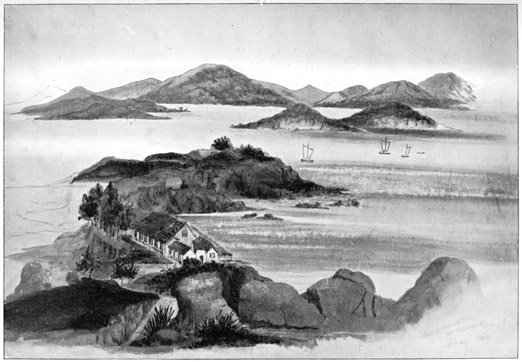
FIRST BRITISH CONSULATE AT KOLENGSOO, AMOY, 1844.
The admiral started from Shanghai in advance of Mr Parkes, with a squadron of light-draught steamers, on February 11, 1861. He carried an exploring expedition composed of Colonel Sarel, Captain Blakiston, Mr Shereshewsky, and Dr A. Barton, whose proceedings are reported in Blakiston's 'Five Months on the Upper Yangtze'; several American missionaries; two Frenchmen, afterwards distinguished, MM. Eugène Simon and A. Dupuis, the latter proving the means of eventually giving Tongking to France; a French military attaché; Lieut.-Colonel Wolseley, D.A.Q.-M.G.; and a delegation from the Shanghai Chamber of Commerce, with several private persons. Whether the pilots presumed upon light draught and steam power, or whether the course of the river had changed so much since the previous surveys were made, the vessels got stranded, one after another, in the estuary; and as each grounded a companion was told off to stand by her, so that before they had got clear of what is known as the Langshan Crossing (the home of the famous breed of black poultry) the admiral's tender, the Coromandel, was the only vessel left in a mobile condition. Not to lose time, the admiral determined to push on in that non-combatant craft to Nanking, the rebel capital, and test the temper and intentions of the Taipings.
As the steamer slowly approached the landing-place, in bright sunshine and a still atmosphere, the batteries on the river front were crowded, but remained silent.
"What will you do, sir, if they fire?" the admiral was asked.
"Oh, I will just drop down out of range, and send and ask them what they mean by it," he replied, with deep deliberate utterance, not unlike Beaconsfield's.
An officer was sent ashore to parley, some rebel officers came on board, and the prospect of an amicable understanding appeared to be satisfactory. It was a critical juncture in the history both of the Taiping movement itself and of foreign relations with it and with China. Without exaggeration, it may be said that the proximate fate of the Taipings then lay hidden within the brain of Sir James Hope, and each occasion of contact between him and them during the next few months added its definite contribution to the data on which the momentous decision was ultimately taken. Although he had then no higher opinion of the Taipings than that they were "an organised band of robbers," the admiral was resolved to give them fair play; and since no diplomatic intercourse could be held with insurgents, he determined to take relations with them under his own supervision (March 8, 1861). "The principle I shall adopt being that in the district of country of which they hold possession the Taiping authorities must be regarded as those of the de facto Government, ... and this principle being likely to lead to the payment of double duties (to rebels and imperialists) on all trade conducted at places in their possession, I am desirous of definite instructions on the subject."
The first point to be settled with the rebel authorities at Nanking was the non-molestation of British traffic passing up and down the river within range of their batteries or otherwise, to secure which object it had been determined to station a ship of war abreast of the city. The sanction of the Taiping chiefs was wanted to this arrangement, which, however, without such sanction, it would have been all the more necessary to insist upon. The second point affected the general relations between foreign trade and the rebel movement. The next aim of the admiral was to arrive at an understanding with the leaders for the neutralisation of Shanghai and Wusung within an area of thirty miles round these two places.
Not being prepared to enter into definite negotiations until the arrival of Mr Parkes, who had not yet joined the expedition, Sir James Hope returned to the squadron which he had left aground in the lower reaches of the river. But thinking the time and the opportunity might be usefully employed in gathering some acquaintance with the Taipings at their headquarters, he landed three volunteers at Nanking, whose presence he ascertained would not be unwelcome to the authorities there. They were to remain in the city as the guests of the rebels till the admiral's return. The party consisted of Lieut.-Colonel Wolseley, Mr P. J. Hughes, vice-consul designate of Kiukiang, and one of the Shanghai delegates. They were joined on shore by the Rev. William Muirhead, missionary, who had reached Nanking by land from Shanghai. The party was thus a thoroughly representative one. On the return of the admiral a week later, accompanied by Mr Parkes, the arrangements for a guard-ship were satisfactorily settled after some puerile obstruction, and the expedition proceeded on its way up the river to Hankow, where, as also at Kiukiang and Chinkiang, consular officers were established; and the Yangtze was declared open by notification in Shanghai on March 18, 1861.
The expedition was fruitful in information concerning the rebels, all tending to confirm the purely destructive character of the movement. Certain incidents of the voyage were also most instructive to the visitors. While the expedition was still at Hankow the Taipings had captured a walled city, fifty miles distant, which had been passed by the squadron on its way up a few days before. The news created a universal panic throughout the three cities, Wuchang, Hanyang, and Hankow, and the scene which followed could not be paralleled. It is thus laconically referred to in the report of the delegates of the Chamber of Commerce: "The abandonment was most complete, not a house nor a shop was open, and it became equally impossible to purchase goods, to check quotations, or pursue inquiries."
One day the deep Han river was so packed with junks that one might almost walk from bank to bank over their mat coverings. The next day everything that could float was crowded with fugitive families with their household stuff huddled precariously on the decks, and such a fleet as, for number and picturesqueness, was probably never seen, covered the broad bosom of the Yangtze, making slow headway under sail against the current.
Mr Parkes, eminently a man of fact, thus describes what he was witness to:—
Darkness fell upon crowds of the people lying with their weeping families, and the débris of their property, under the walls of Wuchang, anxious only to escape from defences that should have proved their protection.... The noise and cries attending their embarkation continued throughout the night, but daylight brought with it a stillness that was not less impressive than the previous commotion. By that time all the fugitives had left the shore, and the river, as far as the eye could reach, was covered with junks and boats of every description bearing slowly away up-stream the bulk of the population of three cities, which a few days before we had computed at 1,000,000 of souls.
Of what came of this and many such another melancholy exodus of humanity, without resources, ready to brave any death rather than fall into the hands of the destroyers, there is no record; and the scene at Hankow, magnified a hundred times, would give an inadequate conception of the havoc of the fifteen years of the Taiping rebellion.
III. ADMIRAL HOPE'S POLICY TOWARDS INSURGENTS.
Devastation only to be expected of them—Enforces neutrality and respect for foreign property—Thirty-mile radius round Shanghai—Hesitancy of British Minister and Foreign Office—Overcome by firmness of Admiral—Capture of Ningpo by rebels—Arrangements for trade there—Bad faith of rebels—Shanghai to be defended—Its dangerous position—Ravages of rebels—Offensive movements against them—Clearing of the thirty-mile radius—Cordial relations between English and French admirals—Mr Bruce won over—The campaign—Recapture of Ningpo—Chinese raise foreign force—Ward—Burgevine—Chinese statesmen who organised the suppression of the rebellion—General Gordon takes command of the "Ever-Victorious Army."
None of the spectators was more profoundly impressed than Admiral Hope, and the spectacle undoubtedly helped to mature his views on the demerits of the rebellion. On April 6 he wrote to the Admiralty: "A period of anarchy, indefinite in duration, appears likely to ensue, in which the commercial towns of the empire will be destroyed, and its most productive provinces laid waste. For this state of things, so destructive to foreign trade, I see no remedy except the recognition by both parties, if practicable, of the neutrality of the consular ports, which would then become places of security in which the Chinese merchants and capitalists could take refuge." And towards the realisation of this scheme the first step was the obligation laid upon the rebel Government at Nanking that their forces should not approach within thirty miles of Shanghai or Wusung. This idea, however, was but slowly assimilated by her Majesty's Minister at Peking and by the Government at home, and Lord Russell, while approving generally of the admiral's policy, stipulated that no force be used except in direct defence of British property. Mr Bruce wrote able despatches from Peking, in which the pros and cons, the contingencies and risks, of alternative courses were so well balanced, that the only practical conclusion that could possibly issue therefrom was that eventually arrived at,—to leave the decision to the admiral with a promise of support, whatever course he might adopt. The Foreign Office and the Peking Legation, in fact, faithfully represented the orthodox view of affairs, whereby national policy is primarily reduced to a game of safety for officials, and to the application of theories and general principles often having little bearing on the actualities of the case. The admiral's mind was cast in a different mould. To him the exigencies of the situation were everything, the official balance very little, the fear of responsibility nothing. The man on the spot, seeing clearly the right thing to do and resolved to do it, was bound in the end to gain the Government to his side, for Governments like a strong arm to lean on. With men like Sir James Hope there was no risk of complications arising, for complications arise mostly from the nervous dread of them, never from going straight and clear to the objective point. It needed a visit of the admiral to Peking, however, and the best part of a year's correspondence, to convert the British Government point by point to his views.
Meantime the Taiping rebels advanced to Ningpo, the defence of which Mr Bruce had refused to sanction, and they captured the city on December 9, 1861, after engaging not to do so. The leaders there were interviewed by the French Admiral Protêt and the English Captain Corbett with a view to gaining a comprehension of their plans, and "to prevent the atrocities of which they have hitherto been guilty, and to endeavour to effect an arrangement by which trade can be conducted from the town. The French Rear-Admiral Protêt will act in concert with me," wrote Admiral Hope to Corbett, December 7.
After the capture of the city the admiral instructed Captain Corbett that if the rebels wished to levy any duties, he was to see that in amount they did not exceed those stipulated in the imperial tariff. Arrangements were also made by the three treaty Powers for the protection of foreign life and the safety of the foreign quarter. The position was, however, a very difficult one, as the rebels had no idea of order or of keeping faith. Indeed the problem of protecting British subjects while observing Lord Russell's neutrality instructions was fast becoming impossible, for the conventions made with the Taiping authorities in Nanking were disregarded by them, and Shanghai itself was threatened.
The admiral's conception of what was required for the protection of British interests was all the while undergoing steady development, and in January he wrote that Kiukiang and Hankow had become as essential to our trade as Shanghai. Writing a month later, he pressed his plans still more definitely upon the Admiralty. "On every occasion," he said on February 21, 1862, "on which I have reported the state of Shanghai since my return here, it has been my duty to bring the devastation and atrocities committed by the rebels in its immediate vicinity very prominently under their Lordships' notice. These proceedings have been conducted at a distance much too close to be consistent with the respect due to the occupation of the town by French and English forces, or to leave its supplies of provisions and native trade unaffected."
The tension was at length relieved by the relaxation of Earl Russell's restrictions. He had already said that "it might be expedient" to protect the treaty ports, and that he was "of opinion that we ought to defend Shanghai and Tientsin as long as our forces [the garrison left from the Peking campaign] occupied these ports." But now, on March 11, 1862, he took a more practical view of the whole situation, and issued her Majesty's commands that "Admiral Hope should not only defend Shanghai and protect the other treaty ports, but also the British flag and the Yangtze, and generally that British commerce is to have the aid of her Majesty's ships of war."
During the winter of 1861-62 matters had become very critical in Shanghai. The rebel chiefs sent an intimation to the foreign consuls that it was their intention to capture the town, and they proceeded to burn the villages and ravage the country on both sides of the river within gun-shot of the military lines. Special local measures of defence were adopted by the residents, and fugitives in thousands flocked into the only asylum where their lives were safe. The pressure of these events led to yet more definite action on the part of Sir James Hope, who perceived that the effective defence of Shanghai and its sources of supply involved aggressive movements against the rebels in order to drive them out of all the places they occupied within the thirty-mile radius. In all these proceedings the admiral went hand in hand with his French colleague, and with the commanders of the French and British military forces. An agreement signed by the four on February 13, 1862, settled the immediate question of the defence of the city of Shanghai. An appeal to the British Minister completed his conversion to a "forward policy." "I strongly recommend," wrote the admiral on February 22, "that the French and English commanders should be required by yourself and M. Bourboulon to free the country from rebels within a line"—specified; and the reply was as hearty and free from ambiguity as could be wished: "We can no more suffer Shanghai to be taken by famine or destroyed by insurrection than we can allow it to be taken by assault; and it requires but little experience in China to be assured that the effect of remaining on a strict defensive within the walls is to convince our assailants that we are unable to meet them in the field."
The plan of campaign was settled in an agreement signed by Sir James Hope, Admiral Protêt, and Brigadier Staveley, April 22, 1862, and was carried out to the letter during the early summer and the autumn following. At an early period of the operations Admiral Protêt was killed: his loss was deeply lamented, most of all by his British colleague, with whom relations of exceptional intimacy had sprung up. "The extent to which I enjoyed his confidence and regard will ever prove a source of unmingled satisfaction to me," wrote Sir James Hope on the day of the admiral's death, May 17, 1862, himself at the time confined to his cabin by wounds.
The rebel forces in Ningpo, who had been on their good behaviour for a short time, became aggressive and insulting, even going the length of offering rewards for foreign heads in the good old mandarin fashion. It is well to remember that even in their unkempt condition, and with everything to gain from the goodwill of foreigners, the Taiping rebels lacked nothing of the most arrogant of Chinese assumptions. The pretensions of the chief far exceeded those of the Emperors of China. The Taipings required foreigners to be subject to their jurisdiction, and they habitually applied derogatory terms to foreign countries. Such things were regarded much as the eccentricities of a lunatic might be. Nevertheless they were a faithful reflex of what is rooted in the Chinese mind.
The position of foreigners and the foreign ships there having thus been rendered intolerable, the city was recaptured from the rebels by Commander Roderick Dew in the same month—a brilliant feat of arms. After the capture he wrote: "In the city itself, once the home of half a million of people, no trace or vestige of an inhabitant could be seen.... The canals were filled with dead bodies and stagnant filth." The recapture of Ningpo was the beginning of an Anglo-Franco-Chinese campaign against the rebels in Chêkiang which was carried on simultaneously with that round Shanghai.
It is needless to follow in detail the operations which culminated two years later in the final suppression of the Taiping rebellion; but the relations which grew up between the British and French commanders on the one side, and the Chinese military forces which were being organised on the other, were so fruitful in results as to merit their being held in particular remembrance. Though the history has been many times written, it may still not be considered supererogatory to trace some of the points of contact between the native and foreign motives and plans of action, and the evolution of the defensive idea which was the product of the combination.
The Taiping rebellion had devastated the central and southern provinces many years before the Chinese Government roused itself to a serious effort to resist it. The movement of repression originated with the Governor-General of the Hu provinces, whose chief lieutenant and successor was Tsêng Kwo-fan, Governor-General of Kiangnan at the time of which we now speak. His brother, Tsêng Kwo-chuan, the Governor of Chêkiang province, was the military leader, and Li Hung-chang, the most capable and energetic of them all, was governor of the province of Kiangsu. The imperialist forces had been gradually closing on Nanking, and it was thought probable that this hemming-in process forced the rebels to seek outlets and new feeding-grounds in the populous districts of Kiangsu and Chêkiang. The rebels had enlisted a number of foreigners in their ranks, and made great efforts to supply themselves with foreign arms and ammunition, for which purpose, among others, communication with the sea was most important for them. Li, futai (governor), also began to enlist foreigners and raise a special corps, drilled and armed in foreign fashion, and led by foreign officers. The foreign agent in this enterprise on the imperialist side was Frederick Ward, to whom Mr Bruce referred in May 1861 as "a man called Ward, an ex-Californian fillibuster." Within a year Mr Bruce wrote, "In the Chinese force organised and led by Mr Ward I see the nucleus of a military organisation which may prove most valuable in the disturbed state of China." The truth is, "Ward's force," which became known by its high-flown Chinese title of the "Ever-Victorious Army," was seized on from its origin by Sir James Hope, whose encouragement and support were essentially serviceable to it in its early days. The admiral treated Ward as a comrade, fighting by his side, and thus giving the new levy a military status. While the Chinese troops were yet raw he co-operated with them by capturing positions from the rebels and trusting Ward's men to hold them, on the assurance of their leader that they were equal to that duty. Ward himself was an unpretentious, cool, and daring man, reckless of his own life. During his brief campaign he was riddled with bullets, one of which entering his mouth destroyed the palate and impaired his speech, and before long the fatal missile reached its mark. He was succeeded in the command by his second, Burgevine, who, though a good soldier, lacked Ward's tact and moderation, and got into trouble with his paymasters, to whom he used violence and threats. He was deposed from the command by Governor Li, which brought about a serious crisis, for the disciplined force of foreigners and Chinese was left without a head. In this emergency Li applied to the British authorities for the loan of an officer to command the disciplined force. The responsibility of the British representatives, naval and military, became thus extended to finding a suitable Englishman to replace Burgevine. Their first selection was Captain Holland, R.M., who held the post for a short time, and was succeeded by Captain C. G. Gordon, R.E.
Gordon had arrived in China in 1860 in time to share in the last act of the Peking campaign; he passed the year 1861 at Tientsin, where he was highly esteemed as a model man and meritorious officer. In the winter of 1861 he had conferences with Mr Bruce and Prince Kung on the question of suppressing the rebellion; but none of their ideas, nor the policy of the British Government, were then sufficiently advanced to lead to any practical result. Gordon accompanied his corps to Shanghai in the spring of 1862, and was engaged in the operations for clearing the thirty-mile radius under General Staveley, who spoke warmly of his daring reconnoitring services, for which Gordon had been already distinguished in the Crimea. In the following winter he was busy surveying and mapping the country which had been reconquered from the rebels, and in the spring of 1863 he was offered by his chief the leadership of Ward's force. Gordon's was no doubt the best selection that could have been made, having regard only to the abilities which were then recognised in him; for though General Staveley knew him well both in Tientsin and Shanghai, it is not claimed for him, or any one else, that he had prescience of those transcendent qualities and that magnetic power which the subsequent campaign against the rebels was the means of bringing to light. When Gordon took command of the "Ever-Victorious," the force had had two years' training and regular campaigning, and the men were entitled to rank as veteran troops. Gordon, however, was to infuse new life into the corps by his dynamic personality and by the diligent use of the regenerative agency of "Sergeant What's-his-name." The number of foreigners actually employed in the force is doubtful, but detailed returns of killed and wounded in the course of a year's operations gave a hundred names. Gordon's faculty of control was probably more severely tested by his management of that motley foreign crew than of the whole indigenous force; but the best of which it was capable was got out of this fortuitous concourse of men, and under the inspiration of the commander several names of distinction emerged from the cosmopolitan group.
When Gordon took over the command in March 1863 it was six months since the thirty-mile radius had been entirely cleared of rebels, and the first duty of the "Ever-Victorious" was to keep that area clear; its second to carry the war as far as it was able into the regions beyond. Its efficiency, especially for this latter purpose, depended on the support and co-operation of the British and French commanders, whose troops remained in occupation of the treaty port of Shanghai. For a time there was danger of a lapse in this co-operation. The dismissed General Burgevine carried his grievances to Peking, and made such an impression by his plausible address on the American and British Ministers there, that Mr Bruce espoused his cause and wrote strong despatches to the British commander, Staveley (April 10, 1863), urging the reinstatement of Burgevine and the suppression of Gordon, to whom it was to be explained that the step was no reflection on him, &c. Again and again the Minister returned to the charge, both to the commander in Shanghai and to the Foreign Office at home; but the Governor Li was firm, and adduced such cogent reasons for the dismissal of Burgevine that Major-General Brown, who had just succeeded to the British command, joined Li in resolutely protesting against the removal of Gordon, whom, it may be remarked, the English general had never yet seen. The men on the spot prevailed against the man who was theorising from a distance, and on the worst data conceivable, the culprit's own account of himself. Mr Bruce, who, as we have seen, was well acquainted with Gordon, must have had reasons for his policy not given in his official despatches, for these were inadequate and narrow for a man of his large capacity.
We have said Major-General Brown had not then seen Gordon. He had arrived from India in April to relieve General Staveley of the command of the British troops in China. He was a wiry man and of an active temperament, and rapidly mastered the situation. Probably to him is due the credit of the first true perception of what manner of man this young engineer officer was. General Brown was for a few days after his arrival a guest in one of the spacious hongs in the Shanghai settlement, which had a wide verandah, giving access to all the bedrooms. One morning very early the general, excited by a message that had just reached him, rushed round in déshabillé calling for his host with a piece of coarse Chinese paper in his hand. "Do you know Major Gordon?" he said. "Why, yes, a very nice fellow, and reported to be a first-rate officer." "But," exclaimed the general, "he is a genius! Just look what I have received from him from the front," and he unfolded the whitey-brown paper with some rough diagrams, and a few not very legible pencil notes indicating his position and plan of attack on Taitsan (where Captain Holland had been repulsed) and Kuensan,[46] both cities on the line of communication with the provincial capital, Soochow. "The man is a genius," reiterated the general, "and must be supported." A few days later another of these cryptic missives arrived, when a similar scene was repeated with redoubled emphasis. "I tell you that man is a military genius; that's what I call him, a military genius," said the dapper little soldier in his vivacious reiterative manner. "I'll support him for all I am worth." And then he developed his own plan of relieving the "Ever-Victorious" of garrison duty, leaving the whole force—secure of its base—free to engage in aggressive operations. This plan of giving effective support to Gordon's force was carried out to the letter, as subsequently described by the general in his official despatches reporting the capture of Taitsan and Kuensan: "I had a field force acting in conjunction, as a support, moving on the extreme edge of our boundary, ... which was of great assistance to Major Gordon in his operations." He adds: "Kuensan having fallen, Major Gordon now proposes to make it his headquarters; ... and as the futai intends to make Taitsan his headquarters, I shall bring it within the boundary, thus giving the imperialists every confidence to hold it, knowing they could receive support from me at any moment." How vital to the fortunes of the "Ever-Victorious Army" was this decided action of General Brown's was seen when, three months later, General Burgevine had gone over, with a certain following of malcontents, to the Taipings, a movement which suggested to Gordon serious misgivings as to the loyalty of the foreigners remaining in his own force. Burgevine, however, had no success in the rebel camp, and soon, in a secret interview with Gordon, sued for safe-conduct and amnesty. Improving his acquaintance, however, with the new commander of the "Ever-Victorious," Burgevine's next proposal was the bold one of eliminating as between themselves all questions of conflicting loyalty to the respective belligerents by throwing over both, and by joining forces on their own account, to capture Soochow, and there raise an army to march on Peking. It was a partnership which did in nowise commend itself to Gordon, but the proposal served to show how shrewd Li Hung-chang had been in his estimate of the deposed leader.
IV. THE LAY-OSBORN FLOTILLA.
Orders sent through Mr Hart to Mr Lay—Fleet equipped under Captain Osborn, R.N.—Ratification of their agreements refused in Peking—Government would not place foreigners in a position of authority—Misunderstandings and final sacrifice of Mr Lay—Ships paid off and sold—Crucial question the recapture of Nanking.
The invincible distrust of foreign auxiliaries which dominates Chinese policy and prevents the empire from ever having an army or a navy, received another signal illustration in the same year in the great fiasco of the Lay-Osborn flotilla. Mr H. N. Lay, Inspector-General of Chinese Maritime Customs, was in England on leave in 1861, his locum tenens in Peking being Mr (now Sir) Robert Hart. Conferences with the Chinese Ministers on the naval weakness of the empire resulted in a very important decision, in consequence of which Mr Hart was empowered to send to Mr Lay orders for certain armed vessels to be officered and manned by Englishmen. Mr Lay executed the rather "large order" according to his lights, engaging Captain Sherard Osborn to command the fleet, which was equipped on a war-footing. The foreign enlistment difficulties of the British Government were overcome, as the Government was by that time ready to go to any length in assisting the Government of China. The fleet duly arrived in China, and Mr Lay and Captain Osborn presented themselves in Peking to obtain ratification of their agreements from the Imperial Government. This was refused, the force was disbanded, and the ships sold, at a heavy pecuniary sacrifice to the Chinese, for they made no demur about payment.
The rock on which the scheme seemed to split was the contention of Mr Lay that the fleet was imperial, and that the commodore should take no orders from viceroys or provincial authorities, but only from the emperor, and through Mr Lay himself. This was a shock to the very edifice of Chinese Government, conceived of as feasible only under the belief that in its helpless condition the Government must accede to anything. But the scheme was really impossible. So also, however, was the alternative of provincialising the naval force, as has been shown by subsequent failures in the attempt to use the services of British officers in the Chinese navy. Such an instance of reckoning without your host was never heard of before or since. It was like a practical joke on a titanic scale. The ships were actually there, manned, officered, and armed. It was a dangerous knot, which had to be promptly cut or untied. Following the line of least resistance, Mr Lay was made the scapegoat, on whose head the Minister "laid both his hands"—rather heavily—"confessing over him the iniquities of all," and sending him away into the wilderness. In the general interest the sacrifice of Mr Lay was perhaps the safest way out of the imbroglio, for he was a pugnacious little man in whose hands despotic power might have been attended with inconvenience. Nevertheless, the blame of the failure belonged to all the parties concerned—to Prince Kung, Wênsiang, Mr Hart, Mr Bruce, and the British Government. They each entered into the scheme with different ideas, more or less vague, except Mr Lay's own, which had perforce to be reduced to the definite when he came to draw up contracts with British naval officers, and to meet the strict requirements of British law. The Chinese Ministers of course could have no conception what a foreign-equipped navy really meant, nor had they probably fully divulged what was really in their mind; Mr Lay and Mr Hart were young men with large ideas, but without experience; Mr Bruce was a man of the world who had seen service, and was, from his position, the most responsible of them all, and therefore the most culpable in deceiving himself, and allowing the British Government to be misled. He approved of the project, or it could never have been carried out. But what was it precisely that he approved of? He "saw with pleasure that Captain Osborn was about to reorganise the preventive service" (October 6, 1862), and as late as February 8, 1863, he wrote to Prince Kung of the "speedy arrival of the steam flotilla which your Imperial Highness has so wisely ordered"—as if it were a pair of official boots! Yet on the arrival of the flotilla it was found that everybody concerned was at cross-purposes, and the question naturally suggests itself, what steps her Majesty's Minister had taken to satisfy himself as to the real intentions of Prince Kung, whether they had been properly transmitted by Mr Hart and correctly interpreted by Mr Lay and fully communicated to her Majesty's Government. It appears that Mr Bruce had, in fact, undergone a change of mind—induced, no doubt, by cogent considerations—during Mr Lay's final sojourn in Peking. Having received a message from the Minister urging a stiff attitude with the Chinese Government and promising the full support of the Legation, Mr Lay proceeded to the Yamên and laid down the law strongly, as his manner was, in the full assurance that he had the British Minister at his back. But after thus burning his boats he found himself abandoned, for reasons of State which he was unable to appreciate. Such was the account of the crisis given at the time by Mr Lay himself to a confidential friend then residing in Peking. For the Chinese Government the scheme was necessarily a leap in the dark. For the British Government it involved a violent reversal of recently declared policy, and on a most important issue. It was consequently a case where extreme and minute precautions against possible misunderstandings would not have been superfluous, yet—so far as has yet been made public, for there is doubtless a missing link in the record—such seem to have been wholly absent from the inception of the enterprise.
The crux of the question, no doubt, was the position of Nanking. The lever Mr Lay employed to secure acceptance of his conditions was the prospect of the immediate capture of the Taiping capital, against which the provincial Government, represented by the Viceroy Tsêng, his brother, and the governor of Kiangsu, Li, were expending their forces. The temptation was exceedingly strong to close with Lay and secure the services—probably much overrated for that particular object—of the new flotilla, were it even by recourse to some ambiguous phrase which might leave a loophole of escape from the agreement when its immediate object had been served. Something like this might have been attempted but for the uncompromising attitude of Li Hung-chang, for it was he who smashed the flotilla scheme. It was true, he allowed, that the assistance of the ships would enable the viceroy's forces to capture the city at once; but, he added confidently, we shall succeed in time by our own resources, and it were better to lose the city and the province, and even the empire itself, than to place such power as Lay demanded in the hands of any foreigner. Burgevine was fresh in the futai's mind—was indeed at that very time in the rebel camp near him. Li's arguments clinched the matter. The flotilla was never commissioned. The whole chapter of experiences of the campaign in Kiangsu has left a vivid impression on the mind of Li Hung-chang: it was the most interesting period of his life, but no incident of it imparts such vivacity to his reminiscences as that of the Lay-Osborn fleet. Nothing warms him to dramatic locution like a reference to that episode.
V. THE END OF THE REBELLION.
Gordon's brilliant campaign—His quarrel with Li Hung-chang—And reconciliation—Other French and English officers co-operate in suppression of rebellion—Russian aid offered.
Gordon's campaigning lasted one year: it was marked by great successes, sundry reverses, more than one crisis, and many discouragements. The famous quarrel with the futai Li was illustrative of several points of great utility to be borne in mind in considering the working relations of Eastern and Western peoples; but perhaps its chief interest lay in its revelation of the independent and dominating character of Gordon himself, which was his distinguishing mark through life. After a confused and scarcely intelligible bargain with the rebel chiefs at Soochow, by which their lives were to be spared, they were beheaded by order of Li. Gordon resented this, and, like another Achilles, withdrew to his tent. For this he was warmly applauded by General Brown, Mr Bruce, and the Foreign Office, who all denounced Li as the most odious criminal, with whom no further communication should be held. When, two months later, Gordon, without consultation with any of these parties, but not without friendly advice, changed his mind, resumed his friendship with the governor and active operations in the field, the same chorus of approval greeted his action as had previously been pronounced of his inaction. Mr Bruce wrote on February 10, 1864, to Prince Kung, among other things, that "Major Gordon is to be relieved from any communication with Governor Li." Within a week Gordon, of his own motion, had abandoned that position, leaving to the Minister to explain the change of attitude in any way he pleased, which he did by resort to that token coinage of diplomatic fiction which serves the domestic purposes of the craft, but has no market-value outside its conventional domain. An able explanatory letter from Mr Hart, the new Inspector-General of Customs, who investigated the transaction on the spot, would have afforded to the Minister colourable grounds for "revision" of the earlier judgment, had he been allowed time to avail himself of it. But Gordon's action forced his hand, and left him no choice but to acquiesce first and find his reasons afterwards. The Foreign Office, however, being at a distance, could not be swung back again so quickly, and they had, on the impulse of the first advices, withdrawn their sanction for Major Gordon's serving the Chinese at all. This order reached him after he had, on his own motion, definitely resigned the service, so that there was no further clashing of authorities. Though the force contributed materially to the suppression of the rebellion, the final act, the capture of Nanking, was left to the unaided resources of the Viceroy Tsêng.
Not the least of Gordon's successes was the peaceable dissolution of the force when it had done its work; for the establishment was, for its size, enormously costly, and it was a two-edged sword in the hands of the Chinese. The "Ever-Victorious Army" was happy in the opportuneness of its death. A prolonged existence might easily have dispelled the wonderful prestige it had gained in its short career and limited scope. Perhaps, after all, its place in history owes everything to the personality of its last leader, whose legacy to mankind is not so much a catalogue of achievements as a life—immortal.
The renown of Gordon and the brilliancy of his exploits have thrown unduly into the shade the Anglo-Chinese and Franco-Chinese campaign in the neighbouring province of Chêkiang, which had Ningpo for its sea base. In their degree these operations were no less essential to the ultimate overthrow of the rebellion than those in the province of Kiangsu, and, among many others, the names of Prosper Giquel, who afterwards managed the arsenal at the Pagoda anchorage, Foochow, and of the large-hearted bishop, Mgr. Delaplace, afterwards translated to the metropolitan see, where he died, deserve to be had in remembrance. Sundry risings in other provinces caused trouble and apprehension; but we may, for the purposes of this narrative, consider that the year 1864 witnessed the closing scene of the great rebellion.
It would be impossible, within any reasonable space, to follow even in outline the course of that stupendous devastation, exceeding in its wanton waste of human life the horrors of the Thirty Years' War in Germany: our concern has been only with that side of the movement with which foreign nations were forced into contact, with its political bearing, and its influence on the position of the Chinese Government. It happened that only two of the Powers were directly concerned in offensive operations against the rebels, but in the task of suppression they had the moral support of them all. Indeed, but for the French and English activity it seems probable that Russia was ready single-handed to undertake the whole business. The Russian Government from time to time signified its approval of the action taken by the French and English in assisting the Chinese Government to put down the rebellion. Russia was included in the thanks of the Chinese to their foreign allies; she had at least furnished material in the shape of "10,000 rifles and several cannons." These arrived in Peking, after a protracted journey, at a time when the Russian Minister deemed it expedient to explain to his British colleagues that the arms had reference only to the rebellion. Moreover, Russia had, or professed to have, serious intentions of sending a large force of her own to co-operate in its suppression. M. Petchroff, a member of the Russian Legation, spent a month in Shanghai in the autumn of 1862 in frequent conferences on this subject with the Chinese authorities, the report of which he carried in person to Admiral Popoff, who was at the time in Japan. M. Petchroff called upon the British admiral while in Shanghai, and informed him of this project. It was not carried out, as Prince Gortchakoff explained to Lord Napier, because the Russian Government had not force enough available to render effective assistance, but they wished to show the Chinese that they were in hearty sympathy with the Anglo-French policy, and might, for moral effect, show their flag in co-operation, so far as prudence would allow.
The importance of putting an end to the rebellion, and the value of foreign aid in doing so, were fully realised by the Peking Government. Of this the abortive, but costly, Osborn flotilla furnished proof enough; and the honours bestowed on Gordon by imperial decree were an expression of the unspeakable relief which was felt in the palace at the dispelling of the hideous nightmare. A final decree summing up the movement, in a tone of restrained sincerity not usual in these conventional documents, says: "Words cannot convey any idea of the misery and desolation he [the Taiping chief] caused; the measure of his iniquity was full, and the wrath of both gods and men was roused against him."
VI. EVACUATION OF CANTON.
Good feeling and compliments on both sides—Mr Parkes's able administration of the city.
An event which passed off without the slightest sensation, because without hitch, was the evacuation of Canton by the Allied troops in October 1861. Were it only for one clause in the proclamation issued by the high Chinese authorities on the occasion, this transaction would form a valuable historical landmark:—
During the occupation of Canton by the allied troops of England and France during a period of four years, their conduct has never been otherwise than friendly towards the military and people of the whole city, and the military and people having also corresponded with courtesy and friendship, harmony has been maintained from first to last. Now that the troops are being withdrawn, the consuls of England and France will continue to reside within the city, while the merchants and people of all nations will constantly pass in and out, or reside therein at their pleasure. It remains the duty of yourselves, the military and people, to continue to them the same respectful and courteous relations that have prevailed during the occupation.
Compare this with the state of things existing only three years before! Much of the success of the occupation and its good permanent results were unquestionably due to the high qualities of Parkes, the British commissioner, who thus modestly refers to the matter in his despatch: "The confidence of the people in a strong and inoppressive Government, added to their own governable character, materially facilitated the task of maintaining order in a vast and most intricate city containing a population of upwards of 1,000,000 inhabitants." The "Canton question" was thus finally disposed of to the satisfaction of all parties.
VII. DEATH OF THE EMPEROR.
His flight from the capital—Succession of his son—Regency of the two empresses—Prince Kung's sanguinary coup d'état.
Next in importance to the suppression of the Taiping rebellion, the death of the Emperor Hsienfêng marked the period we are now considering. That unfortunate monarch, who deserted his capital against the strongest remonstrances of his advisers, on the approach of the Allied forces, died at his hiding-place in August 1861, and his only son was proclaimed in his stead under the style of Tungchih. The new emperor was a child, and provision had to be made for a regency. How this regency fell into the hands of two empresses—one the mother of the young emperor, the other the true widow of the deceased—was not very well understood by the foreigners then in the capital. Prince Kung's coup d'état, by which the three male members of the regency were elaborately arraigned and then assassinated, was not organised to get rid of any imaginary "anti-foreign faction," as was too easily assumed at the time, but simply and solely to place the empire at the feet of himself and the emperor's mother. "Parties" in Peking have always been, and are to this day, a puzzle to foreigners, who, having seldom at the moment any trustworthy means of informing themselves, are apt to be carried away by "cries," sometimes got up for the purpose of misleading them,—for the Chinese are not at all averse from turning to account the half knowledge on which foreigners are prone to form their opinions.
VIII. INFLUENCE OF THESE EVENTS ON PROGRESS OF DIPLOMACY.
Inadequacy of foreign diplomacy—Absence of sovereign—Allies committed to protection of China—Coercion impossible—Large outlook of Mr Bruce—The provincial versus imperial administration—Attempt to force Central Government to coerce provincial—Contemptuous attitude of Chinese Ministers—Sir F. Bruce's despair—He clutches at various straws—General reaction of Chinese.
How did these various occurrences influence the progress of diplomatic relations with the Government? We have seen that diplomacy in Peking was a venture launched on imported capital, which, meeting with no indigenous support, was doomed from the first to feed upon itself. There was no dialect through which the foreign idea could translate itself to Chinese comprehension, no medium by which Chinese political conceptions could be made intelligible to the foreigner. When Gordon could not get his meaning filtered through an interpreter, he called for a dictionary and put his finger on the word "idiotcy"—and the most orthodox interpreting could not get much beyond this point in establishing a common currency for the interchange of national ideas. The initial difficulty in imposing foreign forms, foreign terms, foreign procedure—of revolutionising at a stroke a system of administration petrified by ancient usage—would have existed even if the statesmen of China had been sincere converts to the innovation. The contrary was, of course, the case: they were as much opposed to the new relations as they had been to the military invasion itself. No help, therefore, was to be expected from the Chinese side in creating a workable scheme of international intercourse. They desired nothing of that kind, their ambition soaring no higher than the creation of a buffer against which external impulsion might expend its force. That buffer was the Tsungli-Yamên. Foreign diplomacy, therefore, if it were to subsist at all, must subsist on its own resources, the foundation of which was force. The force that brought foreigners to Peking must, either in esse or in posse, for an indefinite time keep them there and render them efficient. Force no doubt would have enabled the foreign Ministers to bring about even those structural changes in the Chinese system which were necessary to clear the ground for the operation of their diplomacy. But if there was one thing more than another of which Western Governments were determined to convince themselves, it was that the law of force was finally abrogated in China; that on a certain day at a certain hour, coincident with the signing (by force) of a sheet of paper, the spirit of hostility had departed from the Chinese mind; and that the law of love and reason was, without preamble, to take the place of that which had brought about the new relations. Whether believed in or not, this curious paradox was to be the rule of all future action.
The game that opens with the "king" off the board, and is afterwards continued with the "queen" protected, is an obviously impossible one. The foreign Ministers had to do with a Government of irresponsibility, and instead of teaching its members from the outset to recognise their new obligations—training them as children, which as regards foreign matters they really were—the foreign Ministers began by treating the Chinese Government rather as an infant too delicate for discipline, with the familiar results of such treatment. The diplomats betrayed so much anxiety to lure the sovereign back to his palace, that the Chinese Ministers soon learned to exploit this feeling for their own ends. That such and such a concession "would have a good effect at Jêho" was inducement enough to the foreign representatives to waive one point after another in the transaction of public business. When the emperor died, after six months of this régime of indulgence, the position was changed materially for the worse,—for the diplomats had now a veritable infant on their hands, with a female regent "behind the curtain." No prospect thenceforth of even the initial formality of delivering letters of credence until the child should grow up, by which time many things might happen. Thus the European scheme of diplomacy, which was to have been imposed bodily on the Court of Peking, stumbled heavily on the threshold, and never recovered itself. But the Chinese recovered. Their fear of the "fierce barbarians" disappeared as they saw them throw away their weapons, and the process was resumed by which the fruits of the war and of the treaties of peace were gradually nibbled away.
And of course the whole idea of coercing the Imperial Government, even had it ever been entertained, was openly reduced to nullity when the foreign Powers interfered for the suppression of the rebellion. The Allies could not knock down with one hand what they were propping up with the other, and thus the Imperial Government not only enjoyed immunity, but knew that they possessed it,—that their late conquerors were now fully committed to the upholding of the integrity of China and the maintenance of the dynasty. Any liberties might consequently be taken: remonstrances from the foreigners would be loud in proportion to their hollowness, but the barbarians could not attack a citadel full of their own hostages.
Although remoteness from the scene of action and imperfect acquaintance with local requirements were apt to invalidate his conclusions on points of detail, and to compel him occasionally to follow where he might have been expected to guide the action of his subordinate executive, yet whenever Sir Frederick Bruce delivered his mind on the position of China and her foreign relations as a whole, his views were large, luminous, and statesmanlike. He foresaw from the first what the degradation of the Chinese Government must inevitably lead to. His outlook is revealed in a brief sentence in one of his earlier despatches: "The weakness of China rather than her strength is likely to create a fresh Eastern question in these seas." There need be little doubt that that idea dominated his Chinese diplomacy. Severity, or even strictness, may well have seemed on the face of the matter inconsistent with the pious wish to strengthen China, yet we now know that what she then most needed was to be braced up to the fulfilment of her obligations as a necessity of her own wellbeing.
The field of diplomacy in the orthodox sense being closed, and there being no foreign interests in Peking, the subject-matter for the Ministers' activity was furnished entirely from the trading-ports. Of these there were fifteen open in 1861. The kind of questions which arose may be generally defined as claims arising out of breaches of treaty by provincial officials, for which redress was sought from the Central Government. This was a reversal of Chinese methods, which, even had the Government been well disposed, would not have been easy to effect; and as the Government was hostile, difficulty became impossibility. The British Minister after a year's trial began to realise the magnitude of his Sisyphean task. "In a country like China," he wrote to the Foreign Office in July 1862, "where the principles of administration differ entirely from those practised by us, the conclusion of a treaty is the commencement, not the termination, of difficulties."
To a consul he wrote at the same time: "The important result to be gained by the establishment of direct relations with the Government of Peking is the avoidance of local acts of violence.... Time will elapse before the new system will work smoothly and efficiently, ... but you must not go beyond pacific efforts to remedy the abuses complained of." A few months later, in a general circular to consuls, he thus carefully recapitulated the instruction:—
The object to be attained is that of forcing the local officials to observe the treaty ... through the pressure brought to bear upon them by the Peking Government, and thus escape from the false position in which we have hitherto been placed of coercing the local authorities and people, and thus doing the work of the Imperial Government. To initiate this new system of relations is a task which can only be effected gradually and patiently; but the attempt must be steadily and perseveringly made, in order that the Chinese Government may be forced to teach its people, &c.
And at the same time he summed up the situation to the Foreign Office in these words: "Our relations with China cannot be put upon a safe footing until the Imperial Government itself compels its local officers to observe treaties"—a matter in which the Central Government itself most needed compulsion!
But all this about "forcing" the local officials and "forcing" the Imperial Government, without using any force, recalls the ancient Chinese maxim of "ruling barbarians by misrule." The world rested securely enough on the tortoise, but what did the tortoise itself rest on? With grim satisfaction must the Chinese Ministers have watched the foreigners entering on a desert campaign where they would exhaust their strength without reaching the enemy. The warnings and threats which alone the Minister allowed himself to use to enforce his demands or his admonitions, as the case might be, were to the Chinese mere blank cartridge. Prince Kung, replying to one of those minatory despatches, "imagines that his Excellency uses this outspoken language for the purpose of stimulating the Chinese Government to activity. His Highness is sure that it is not his Excellency's desire to act in the manner indicated." And so on indefinitely. The impression made on the Chinese Government by the force of foreign diplomacy was likened by an American Minister twenty years afterwards to "boxing a feather-bed." The policy above described, inaugurated by Mr Bruce and followed consistently by the British Government, was pithily termed by Lord Salisbury, when in Opposition, as an "ideal policy" in pursuit of which the concrete interests of the country were allowed to lapse.
It would be tedious to trace in detail the process of disintegration of treaty rights which followed these interesting overtures. It will be more to the purpose to cite the British Minister's review of the results twelve months later in a despatch to Prince Kung. This despatch and the reply to it were deemed so important at the time that they were separately called for by the House of Commons, and were published as independent Blue Books (Nos. 6 and 8, 1864):—
Sir Frederick Bruce wished the Prince of Kung to understand that he had reason to be greatly dissatisfied
1. With the general disregard of treaty provisions manifested at the ports.
2. With the tone of the Government generally towards foreigners.
It is entirely due to the exertions of the Allied forces that Shanghai and Ningpo are not now in rebel possession. Had Shanghai fallen, the imperial authority would have received a blow from which it could never have recovered....
Sir F. Bruce did not look for any extraordinary demonstration of gratitude for these services, but he had hoped that the Central Government would at least have insisted on the faithful observance of the treaty at the ports. He had hoped also that it would have addressed itself with some increase of vigour to the organisation of a competent executive.
These expectations have not been realised. At several of the ports the treaty is daily broken in matters great and small; and the Central Government, if not unwilling, shows itself unable to enforce a better order of things. The orders sent by the Foreign Board, when Sir Frederick Bruce complains, are not carried out, either because the local authorities do not stand in awe of the Foreign Board or because they do not believe the Foreign Board issues them in earnest....
The Foreign Board has gone through the form of issuing instructions, but the causes of complaint remain as they were, either because the local authorities do not fear or because the Foreign Board does not care. Seeing that none of the authorities complained of have been punished or removed, that officials notoriously hostile to foreigners have been appointed to places in which they have increased opportunity of indulging in their anti-foreign tendencies, while officials of friendly disposition have been withdrawn, Sir Frederick Bruce is induced, however reluctantly, to infer that if the Imperial Government be not adverse to friendly intercourse, it is, at all events, indisposed to do what is necessary to teach the people and local authorities that China is sincerely desirous of friendly relations with foreign Powers....
It is for the Chinese Government to consider whether it will listen to these warnings, &c.
Prince Kung's Reply, 19th June 1863.
With reference to the proposition on which the British Minister's note insists, that the treaty should rank with the law, the Prince has to observe that the principle that the treaty is identical with the laws of the Imperial Government, and that breach of treaty is the same thing as violation of the law, is the principle on which the Government of China proceeds, and its only desire is that foreign nations should regard the treaty in the same light....
As regards the cases still undetermined in the provinces, the Prince hopes that the British Minister will refer to the record and inform him, case by case, of the particulars of each, and the Yamên will at once write to the Provincial Governments concerned to hurry them with the cases enumerated....
Sir Frederick Bruce's Reply, July 2, 1863.
Your Imperial Highness states in explicit terms that the Government of China recognises the treaties as the law of the empire in its relations with foreigners, and that breaches of treaty are considered violations of those laws. But the despatch of your Imperial Highness contains nothing to show that this principle will be carried out in practice. I stated instances in which the authorities, in spite of the remonstrances of her Majesty's consul, had deliberately set aside the letter of the treaty for no other object than to curtail the privileges of her Majesty's subjects. Your Imperial Highness in your reply does not allude to these cases, nor do you inform me that any steps have been taken to remedy these grievances or to prevent a repetition of such conduct. I am simply requested to send in a list of the grievances complained of; and I am informed that the local authorities will be urged to settle them with speed. Such a proposal is entirely unsatisfactory; for what reason have I to suppose that the instructions now to be sent by your Imperial Highness will be attended to, when I see that the orders which I am assured were given by your Imperial Highness for the redress of outrages such as ... have been disobeyed?
In these State Papers the relations present and prospective between China and the outer world are accurately represented. Putting aside local and temporary questions, the despatches might be dated 1873, 1883, or 1893, for the position remained substantially the same during the three decades.
The attitude of the British Minister we see to be one of hopeless pleading and vague admonition; of the Chinese Ministers, elastic resistance. One wonders how far, under the mask of dull decorum, the Chinese entered into the real humour of the situation: foreigners chafing impotently, but with their teeth drawn, occupying themselves largely with the preservation of China and the dynasty; urging reforms, military, financial, and administrative, while putting up with the non-fulfilment of the commonest obligations.
Sir F. Bruce was much too wise a man not to be perfectly conscious of the negative result of foreign diplomacy in Peking. His private letters, some of which were published by Mr Lay in 1864, are more emphatic on the point than his public despatches. He saw it was a case for desperate remedies, but unfortunately he had no remedy except such as aggravated the disease. Like a drowning man, Sir Frederick Bruce clutched at one straw, then another—first at the inspectorate of customs, then at the collective body of his colleagues—to redress the balance which lay so heavily against him. We see in the despatch of June 12, 1863, the inception of what became known as the "co-operative policy." That was an arrangement by which the cause of one foreigner was to be made the cause of all, so that the treaty Powers might present a solid front to the Chinese. Unfortunately such a policy bears no fruit, since half-a-dozen Powers with separate interests, and of varying tempers, can only unite in doing nothing. The co-operative policy, therefore, by tying the hands of all the Powers, rendered the Chinese more secure than ever from outside interference.
From Sir Frederick Bruce's despatches it may be gathered that the reason for the non-success of the Peking diplomacy was, that it was not founded on fact. It assumed that the Government of China was centralised instead of decentralised; that the administration of the empire hinged on the initiative of Peking, from which distant point the resident Ministers could protect their respective national interests throughout the empire. This hypothesis, which might have graced an academic debate, was acted upon as if it was a reality, and the struggle to make it so has absorbed the resources of diplomacy for forty years. The real fact, however, was quite otherwise. The distinctive character of Chinese Government is not autocracy, but democracy and provincial autonomy. The springs of action work from below, not from above, and to reverse this order of the ages was to convert a court of appeal into a court of first instance: to sue for a tradesman's debt before the Lord Chancellor, requiring the legal machinery to be first turned upside down. Diplomacy in China has thus been a disheartening effort to drive in a wedge by its thick end without adequate leverage. It is possible, indeed, that force might have accomplished even as much as that, but force was the one thing the use of which was proscribed.
The redress of grievances being sought not where it could have been exacted, at the point affected, but in the capital, the Central Government was called on to exercise over the provincial officials a kind of control which had never been exercised before. The provincial officials, relieved from the local pressure which they respected, easily evaded the novel and unconstitutional interference of the capital, and violated the treaties with an impunity unknown in the days before the admission of the foreign Ministers to Peking. The treaties, no doubt, had become the "law of the land" so far as a mere barbarian phrase could make them so, but a full-grown tree of Western legality could not so easily transplant itself to an alien and refractory soil. The argument from legality appealed, therefore, to the ear only. The practical conclusion to which Sir Frederick Bruce was led is very simply stated in two paragraphs of his letters to Prince Kung: "My object has been to seek redress through the Imperial Government, and to do away with the necessity of seeking redress by forcible demonstrations at the ports. But it is evident that the reluctance of your Imperial Highness to enter frankly into this policy renders my efforts ineffectual." "Either the Imperial Government is unwilling to use its influence to cause the treaties to be fairly carried out, or it has not the power to cause its orders to be obeyed." Sir Frederick would have hit still nearer the mark if he had omitted the "either," "or," and said simply the Imperial Government was both unwilling and unable.
Notwithstanding these definite views, the experiment of forcing a centralisation which would have been a revolution on the unintelligible Government of China had to be continued through many weary years that were to follow, during which time the rights conferred by treaty on foreigners fell more and more into abeyance.
The progress in that direction made in the two first years is thus summarised by Mr H. N. Lay, the first Inspector-General of Customs, on his return to China in 1863:—
When I left China the emperor's Government, under the pressure of necessity, and with the beneficial terror established by the Allied foray to Peking in 1860 fresh in their recollection, was in the best of moods, willing to be guided, grateful for help, and in return for that help prepared to do what was right by the foreigner. What did I find on my return? The face of things was entirely changed. There was the old insolent demeanour, the nonsensical language of exclusion, the open mockery of all treaties.... In short, all the ground gained by the treaty of 1858 had been frittered away, and we were thrust back into the position we occupied before the war,—one of helpless remonstrance and impotent menace; ... the labour of years lost through egregious mismanagement. The Foreign Board looked upon our European representatives as so many rois fainéants.... Prince Kung was no longer accessible.... He professed to be engaged with more important matters.