Part 2 — B. Utensils of Bone, Horn, and the Teeth of Animals.
Reading edition
Implements of Bone.
Artifacts of animal derivation appear in great numbers and in a great variety of form among the objects recovered in excavating. This diversity in form is of course partly the result of the different kinds of bone used in their manufacture, partly of their varied manipulation, and partly of the uses to which they were put. There are all grades of elaboration from the most common splinter of bone to the tool whose shape is almost entirely different from that of the bone employed. All the objects found, however, may be reduced to the principal types of bone instruments which have been found in the United States under the most varying circumstances. In addition to awls, needles and paper-cutter-like knives of bone, there are instruments of horn used principally for chiseling and instruments of a secondary nature. They were the usual tools used in making clothes,[128] in weaving baskets,[129] etc., not to mention several subordinate uses to which they were put.
1. Awl-like Tools.
This is a large class containing more than 100 objects having various secondary forms and it is the most conspicuous class of bone instruments. They may be classified as follows:
a. Common Awls with a Good Point.
These comprise more than 100 perfect and fragmentary specimens. They were scattered through almost all the strata in the following way:
Stratum I—8 objects.
Stratum II—61 objects.
Stratum III—8 objects.
Stratum IV—11 objects.
Stratum V—3 objects.
Stratum VI— — objects.
Stratum VII-VIII—5 objects.
Stratum IX—5 objects.
Stratum X—4 objects.
The remarkable preponderance in stratum II is probably again the result of the practice of cremation of bodies.
When one remembers that awls were the principal tools used in making baskets and that baskets took the place of pottery in the household of the California Indians, one will not wonder at their great number.
Their shapes vary. Four of them are shown in plate 9, figs. 1 to 4. Fig. 1, from stratum I, gives the type by far the most common in the 3 or 4 upper strata; the other three, fig. 2, 1-8686, from stratum IV, fig. 3, 1-8897, from VIII, fig. 4, 1-8972, from IX, give examples of the many secondary forms and illustrate the diversity of form occurring in the lower strata. Although fig. 4, as regards its shape, reminds us of the type of the tool of the upper strata (cf. fig. 1), not a single implement was found in the lower strata that was the exact counterpart of those in the upper. Manifestly it was the inhabitants of the upper strata who developed and established the latter form. Its distinctive feature is this, that only one side of the bone (mostly tibia of deer) is used, that a foot-like portion of the joint is left, and that the awl is sharpened and well finished off on all sides, even to the inner channel. Usually there is a slight bulging out in the middle of the tool which increases its strength.
The characteristic feature of pl. 9, fig. 2, is that only the shaft of the bone is open, the joint being left intact. In pl. 9, figs. 3 and 4, the foot-like supports are missing; whether originally they were there or not is a question. They seem to have been missing from the very beginning, at least the one shown in pl. 9, fig. 3. The whole shape of the instrument is crude. In several awl-like implements of the lower strata, as in text-fig. 25, 1-8797, from stratum VII, the canal in the bone is not even opened, but kept intact through the whole instrument.[130]
b. Blunt Awl-like Implements.
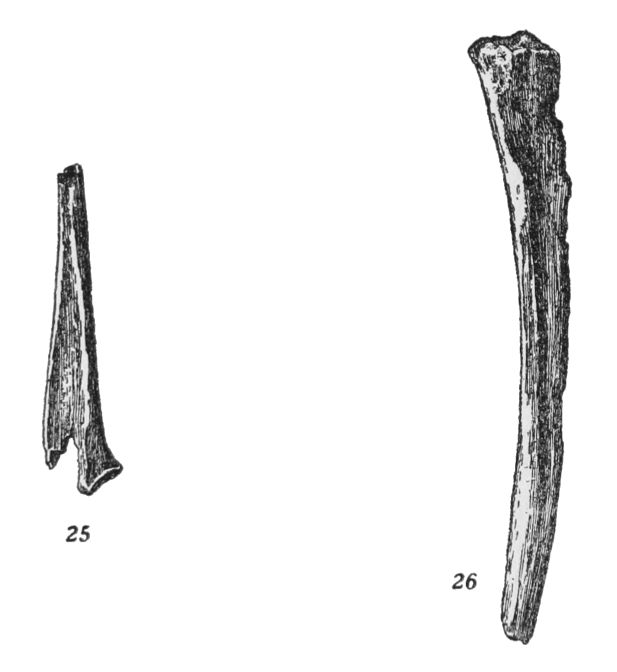
Fig. 25. × 1/2. A bone, probably used for an awl. Fig. 26. × 1/2. Bone implement of unknown use.
The absence of points indicates a somewhat different use to which such instruments were put. In addition to this feature there is very frequently a peculiar curve which, while it is the natural shape of the bone, must have been chosen purposely,—for instance, 1-8692, pl. 9, fig. 5, from IV, and 1-8829, text-fig. 26, from stratum VIIa. The bone of front leg of a stag is the original form of the partly awl-shaped partly paper-cutter-like implement, 1-8579, text-fig. 27, from stratum II. A similar one from the southern part of the United States has been observed.[131]
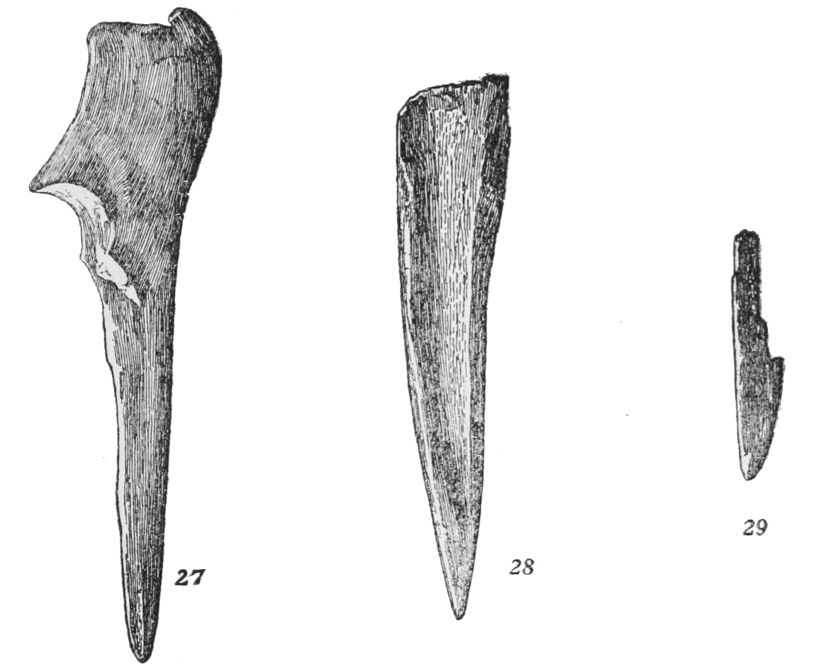
Figs. 27 and 28. × 1/2. Bones probably used as awls. Fig. 29. × 1/2. Bone of “paper-cutter” type.
c. Flat Awl-like Implements.
These represent a large and important class of implements which occur in numbers in several of the lower strata (V and IX), although really only in fragments; cf. 1-8985, pl. 9, fig. 6, from stratum V. They are curved sideways, and well-pointed in spite of their otherwise flat character. The interior reticulate structure of the natural bone is retained on one side of the implement.
Fig. 28, 1-8541, from stratum II, has a peculiar shape; it is broad, in the form of a channel and pointed. One of the edges of the channel seems to be worn smooth through usage. The back end is broken off.
2. Needle-like Implements.
They differ from the awl-like implements in that they are intended not only to pierce an article but also to pass through it. In this class there are also secondary shapes.
a. Straight Needles without Perforation.
1-8895, pl. 9, fig. 8, found twenty-seven feet beneath the surface in stratum VIII, may be taken as the prevailing type. The needle is a thin, pointed instrument, oval in cross section, blunt at the back end, well finished throughout. To this class also belongs a number of fragments found in different strata up to the VIIIth.
b. Curved Needles.
1-8901, pl. 9, fig. 9, from stratum VIII, represents this type. The needle is very slender and thin and of good workmanship. Unfortunately it is broken off at the smooth posterior end.[132]
c. Needles with “Eyes.”
We have also only one specimen of this type, 1-8735, pl. 9, fig. 10, from stratum V. It is straight, round in cross section and tapering at the perforated end.[133] The bluntness of the point must be the result of use.
d. Long Crooked Needles.
1-8831, pl. 9, fig. 7, a well preserved and seemingly perfect specimen, was found in stratum VIIa, in the tunnel, from eleven to fourteen feet below the surface. It consists of a long, thin rib pointed at the stronger end, thereby exposing the canal within.[134]
Among those found there is also a needle of fish bone and likewise one made from the spine of a stingray.
3. Rough Awl-like Implements of the Lower Strata.
We have chosen to discuss a number of implements from the lower strata under this separate head. Although some of these were probably used as awls, yet along with others with which they form a small group they cannot easily be considered with the other implements of this class. Plate 7, which represents typical bone implements of the lower layers, shows the greater number of these peculiar shapes in figs. 1 to 10. Altogether about fourteen of these awl-like implements were found in stratum VIII, five in stratum IX and four in stratum X. When one considers that from layers IX and X, only small sections were explored, the relative number of these implements must excite some interest. The awl-like and needle-like objects of pl. 9, although but little worked, are yet characterized by a definite fundamental form, different from that shown in the objects represented in pl. 7, figs. 1 to 10.[135] They represent simply bone splinters of the most varied forms such as would be made by accident. To be sure, there were isolated bone splinters in other places in the excavation, probably used as implements, as would naturally occur in a shellmound. In all of these latter cases, however, the character of the objects was, owing to the form of the bones and to the accidental or typical intention of their use, completely different. The objects shown in figs. 1 to 10 of this plate are made of fragments of somewhat thick long bones. All of them have been much used and the upper ends are strongly rounded and worn. Their use was evidently intentional both with reference to their more general and their typical uses. They do not belong to a peculiar type of implements because it is evident from their form that they were used for many purposes.
Some, as figs. 6, 7, and 8, 1-8919, 1-8918 (VIII), 1-8979 (IX), have an awl-like pointed form and may accordingly have been used as such an implement. Others, as figs. 1, 3, 4, and 10, 1-8983 (VIII), 1-9069 (X), 1-9068 (X), 1-9072 (X), although in general awl-like, are blunter and can hardly have been put to the same use as these forms just mentioned. Objects like 1-8980, pl. 7, fig. 5; 1-8996, pl. 7, fig. 9, and possibly also 1-8871, pl. 7, fig. 2, have such broad and blunt ends that for them characterization as “awl-like” would be entirely unsuitable and their use must be explained in some other way. The tie that holds them together is, therefore, in no way that of similar use but rather of analogous origin. They comprise a large number of implements having different uses. What is common to them is the similarity of the way in which they were obtained. Their use was determined by the chance form which they thereby received. There is before us then a class of the most primitive ethnological implements of which we have knowledge, in which, as in the oldest known implement of the human period, the natural form of the object determines the use, rather than the use the individual form.
4. Implements of the Shape of Paper-cutters.
It is natural that in so large a number of bone implements this shape also should be represented. Five belonging to two different types have already been discussed under the grave finds. Altogether the amount of material of this character obtained from the upper strata of the mound is remarkably small. Only a small number of fragments were found, of which only a fragment of the point, 1-8803, from stratum VIII is represented in fig. 29.
In the deeper strata the case was entirely different. There are from these layers no perfect implements, only fragments, but their number is in proportion to what one would expect, or even greater. Some of these show a variety of form and a degree of ornamentation which was hardly to be expected among the finds of the mound in general and least of all among the specimens obtained from the lower strata. Little as the well formed implements, which the fragments figured in pl. 7, figs. 11-17, represent, appear to resemble the rough awl-like implements on the same plate and which have been derived from the same strata, there is yet no doubt possible that the two classes of implements must have been used by the same people.
We have therefore the task, instead of denying the contrast, of suggesting some solution for it.
These paper-cutter-like implements have a moderate width and a thickness of only one-thirty-second to one-sixteenth of an inch. They are well worked in all cases. The objects shown in fig. 12, 1-8989 (IX), fig. 14, 1-8987 (IX), fig. 15, 1-8920 (VIII), fig. 13, 1-8988 (IX), of plate 7 show artistic forms differing from the simpler types of implements. Perforation, which in the bone implements of the mound is very infrequent, is in these implements alone found four times on the lower end. The notch on the lower end of pl. 7, fig. 14, probably the remnant of a circular section, is very artistic and one notices also curved lines on the surface about it. These show the geometric accuracy with which this work was carried out. 1-8986, pl. 7, fig. 16, from stratum IX, is the only piece of bone among all those recovered from the mound which has been engraved with geometric figures.
Out of the strongly varying yet constantly artistic characters of these fragments we are justified in drawing the conclusion that a much greater variety of implements of this form was used by these people. The variations seem to have been influenced largely by personal taste.
1-8875, fig. 11, represents a small fine point of a well formed small paper-cutter-like implement.
1-8989, fig. 12, stratum IX, is a quadrate piece of bone cut out of a “paper-cutter” and was possibly used in play.
1-8988, fig. 13, stratum IX, is the lower end of a “paper-cutter” with parallel sides and obliquely truncated at the lower end with a remarkably perfect perforation.
1-8987, fig. 14, stratum IX, is the lower part of a thin “paper-cutter” with a semi-circular notch. The base shows broken surfaces next the notch.
1-8920, fig. 15, stratum VIII, the lower, triangular part of a “paper-cutter,” which has been very broad and thin, has a small perforation.
1-8986, fig. 16, stratum IX, the middle fragment of a well-worked “paper-cutter” ornamented with geometric figures.
1-8984, fig. 17, stratum IX, is the oblong upper part of a very thin, well-worked “paper-cutter” with a perforation. The upper part is broken off.
At this place there should probably be mentioned also the small bar of bone, 1-8975, fig. 18, stratum IX, as it also comes from this stratum. This is likewise an uncommon form of implement. It is small and well worked, although not of the paper-cutter type. It is oval in cross section and has a small paper-cutter-like lower end which shows that it was fastened to some other object. Its upper end is broken.
5. Pointed Implements.
In the middle strata of the mound there were found about eight pointed bones, of which the types are figured in pl. 9, figs. 11-16.
1-8869, pl. 9, fig. 11, stratum VII, is 2-1/8 inches long, oval in cross section and having an inferiorly constricted neck. There is a small hook on the lower end of the broad side. A small fracture on the opposite side appears to indicate that there were originally two such hooks.
1-8868, fig. 12, stratum VIII, is two inches long. This specimen is in general similar to the one just mentioned. There is only one hook at the lower end. The side opposite is without a hook and is unbroken. Similar is 1-8738, from stratum V. An analogous object is figured by Moorehead, page 273, fig. 412, No. 3, from Stockton Channel.
1-8916, fig. 13, stratum VIII, 2 inches long, is similar to the last with the differences that the small broad, flat hook points toward the broad side, and that the pointed end has been smoothed by use. On this end there are also small traces of asphaltum which indicate that a cord had sometime been wound about it to fasten it to some other object.
1-8917, fig. 14, stratum VIIa or VIII, 1-7/15 inches long with a rounded cross section, is slightly curved and gradually narrows towards the lower point. The convex side shows a slight flattening.
1-8870, fig. 15, stratum VIIa or VIII, is 1-1/2 inches long, but the lower end is incomplete. The cross section is oval to flat; it shows on the broad side a sloping groove.
1-8694, fig. 16, stratum IV, an implement 2-3/15 inches long, is typically knife-like in its form in so far as it has a broad blade-like part. It is sharp on one side, blunt on the other and rounded at the upper end. It is bent well backward. At the lower end it runs out into a small neck-like portion which is extended in the same line with the back of the implement and is broadened at the base.
The objects already described and shown in figs. 11, 13, 14, 15, and 16 of plate 9 represent the principal types. Among these the knife-like object, fig. 16, is, judging from its shape, evidently to be separated from the others.[136] Numerous other knives of obsidian occur in addition to this one of bone.
Of the remaining, fig. 14 represents a typical arrow point made of bone such as are used in various parts of the world, e.g., in South America. The convex, slightly flattened side was laid against the slightly truncated upper end of the shaft of the arrow and was fastened to it by numerous coils of cord. The figure of a similar arrow point from the Swiss Pile Dwellings is given in Ranke’s work, Vol. II, pp. 5-19, fig. 11. This shows very well the manner of attachment.
The similarity of the remaining bone points, figs. 11, 13, 14, 15, is so significant that a similar use is to be ascribed to them. That they were used as fishhooks, which might be conjectured, there appears to be less evidence. It is worth considering that Mr. Meredith found on the breast of a single skeleton 51 objects of the form shown in pl. 9, fig. 14. In another case 28 such objects were found.[137] In the first case, with the skeleton in addition to these were found two long spear points with barbs such as are used on the northwest coast of America. A large number of objects from one grave and the association with other analogous objects supports very strongly the idea that the pointed bones were used for the points of arrows. The neck of these points was the portion about which the cord was wound and about this was laid a small quantity of asphaltum to hold the cord in place, while the hooks had the object of preventing the cord from sliding off from the neck. The form of the hooks varies but slightly. This suggests the prominent hooks at the base of the arrow points of stone. In a certain way these arrow points may possibly be considered as a middle form between long bone points provided with barbs, such as were used by the Eskimo, and the Indian arrow points of stone. In this connection it is worth noting that Mr. Meredith finds them in association with such bone points (also with a lip-plug such as are used on the northwest coast of America). The form of the Indian stone arrow-heads might have been imitated in the North in other materials.
That the analogy with the more northerly races is not limited to the burial layers of the mound from which the pointed implements, pl. 9, figs. 11, 15, were found is indicated by the object, pl. 7, fig. 12, which was found in the cremation layer, No. 2.
6. Saw-like Notched Bones.
The excavations furnish twelve objects of this type of implement, of which perhaps half were from stratum II. The remainder were found from the lower strata up to the eighth. Quite a number of the objects from stratum II were calcined, an evidence that they were deemed of value in life since they were burned with the dead.
The best preserved type of this implement, of which in most cases only small fragments were found, is shown in 1-8898, pl. 9, fig. 17, stratum VIII.
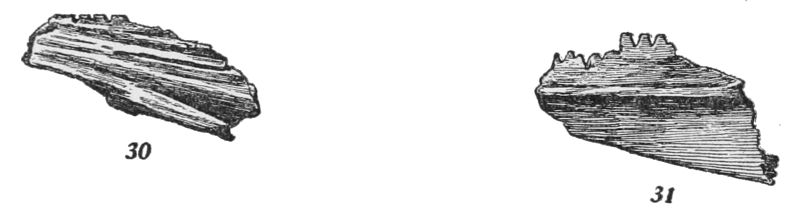
Figs. 30 and 31. × 1/2. Notched bones perhaps used in net-making or weaving.
Nearly all of these objects have a stereotyped form, being made from the shoulder blade of some large mammal, probably the deer. One, however, seems to have been made from a bird bone (1-8900, fig. 30, stratum VIII). On the specimen shown in pl. 9, fig. 17, about half of the length is taken up by the rounded handle, using the ridge-like end of the bone for this purpose. The other end of the object is incomplete, but according to the form in other specimens it was probably cut off squarely at the end. At any rate only a small piece of the implement is missing since the teeth cut into the thin convex margin of the bone are complete to the number of 15. The ridge-like edge runs next to the row of teeth, giving the implement greater firmness. The teeth vary considerably in different objects in size, in form, and in regularity (compare 1-8573, fig. 31, from stratum II). They also vary in degree of wear, which so far as observed is sometimes seen on the edge and sometimes in the spaces between the teeth. On one specimen the opposite edges of the bone are similarly toothed, although one side of the bone was quite thick. A smoothing or polishing of the object is never to be noticed, excepting on the under side.
Similar objects have frequently been found in California. Single fragments are figured by Moorehead.[138] As similar as these objects are to saws, it is probable that they were not used as such. The name “sachos” given to these implements by the Napa Indians, who possibly did not know their former use, is not to be taken as the slightest support for the idea that they were actual saws. In the first place it is hardly necessary to mention that the concept “saw” is missing among the Indians. The form of these objects and the general state of wear as already described shows that they were not and could not have been used as saws. It is remarkable enough that saw-like implements made of bone have a distribution much more extended than the Californian region. Since these occurrences are mostly local and entirely independent of each other, these implements must in their production have served certain practical aims. Why, however, saws made of bone should have such a wide distribution it is difficult to understand.
An analogous implement has been found in a shellmound in Massachusetts and figured by J. Wyman. He also in his description has shown that judging from the width of this implement it could not have been used as a saw.[139][140]
Another saw-like toothed bone implement was found in the cave dwellings in Franconia (Bavaria), which were inhabited in the early neolithic period. This has been described by Ranke as probably used in weaving.[141]
An implement having almost identical form as this just described above was figured by J. Murdock. This object was obtained from the Pt. Barrow Eskimo and was made of the shoulder blade of a reindeer. He received it as a model of a saw said to have been used before the introduction of iron.
After having made inquiries for the primitive form of the implement, this specimen doubtless was made for him.[142] His paper also contains a figure of another saw-like implement, of about twice the size of the first, made of antler. There was with this a kind of shuttle and a form of weaver’s sword with the statement that these three implements had been used in weaving feather girdles. In watching the process of making these belts he had, however, not seen any of these three implements.[143] In the opinion of the writer there is no reason to doubt materially the accuracy of the statements concerning the use of these implements by the Eskimo. It therefore contains the key to the understanding of all the remaining forms of this type of saw-like implements found in the northern region. And this explanation may be extended to the wrongly determined Californian bone saws. In our opinion the bone implement first figured by J. Murdock shows simply that the Eskimo remembered having had such an implement and that they gave to him the impression that it had been used in the way in which the investigator was inclined to think it ought to have been used. It appears that Ranke was on the right track when he supposed the Frankish bone implement to have been used in some processes of weaving. In like manner all of the Californian bone saws agree thoroughly with this supposed use.[144] In California many valuable feather girdles have been made, in the weaving of which these bone implements may have been used.[145] The exact mode of their use is not yet determined, but it is to be hoped, however, that even this may some time or other be discovered.
7. Various Implements and Objects of Bone.
It naturally occurs that in a shellmound in which so many implements of bone have been preserved there would be a number of bone objects the use of which can only be imperfectly determined. These implements are in part possibly only attempts to work bone, in part they are actually implements which had a use somewhat different from that of the other forms and a use for which the character of the material especially fitted them.
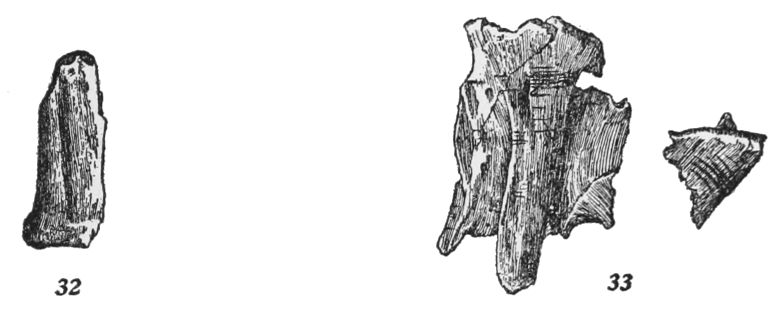
Figs. 32 and 33. × 1/2. Bone artifacts of unknown use.
Many fragments of bone show only a few cuts or marks as indications that they were worked. In one case, 1-8527, fig. 32, stratum IX, the marks which vary somewhat from those in the other strata may represent an implement of the paper-cutter type. The point is in this case calcined, as is also true of many other implements. This is evidently done intentionally, possibly in order to work the bone more easily. Other common bone fragments look as if they had occasionally been used as implements when they happened to have the right form, and that they were not intentionally worked into this shape. Still other bone fragments show knife-like incisions on the other edges, as, for example, that shown in fig. 33, 1-8877, stratum VIIa. They are probably not to be considered as marks of dog’s teeth, as which these could also be determined, for they are generally very numerous in one place or else they show exceeding regularity as if made intentionally.
The shellmound dwellers did not fail to notice the peculiar character of the tubular bones, which when cut into sections are easily made into small receptacles, similar to the cane plant, which is used in a similar manner by the inhabitants of tropical regions (for instance by the ancient Peruvians). Many such small objects with differing proportions were found, two of which are shown in fig. 34. 1-8922, stratum VIII; and fig. 35, 1-9076, stratum X.
Implements of Antler.
For many kinds of implements antler is particularly valuable on account of its hardness. For this reason a number of implements of this character have been found in the shellmound; they are, however, not so numerous as those of bone. They are usually made of deer or elk antler.
1. Chisel-like Implements.
Of these there are two principal types.
a. Actual Chisels.
About half of the objects of antler are to be considered as complete implements. These are shown in pl. 8, figs. 2a and 2b, 1-8892, stratum VIII; figs. 3a and 3b, 1-8821, from stratum VIIa, represent the two subspecies of the same, viz., broad and narrow chisels. The main difference between the two is simply one of size and proportion.
The broad chisels are represented by about ten objects, which belong to the middle and lower strata of the mound only, down to the Xth stratum. Whether this is accidental or caused by other reasons remains undecided. These objects are from four and one-half to five and one-half inches long, to one and three-fourths inches broad, and even as thick as one and one-quarter inches. Oval in cross section, they slightly diminish toward the lower end. Frequently they pass one to two inches above the lower end into the flat, knife-like, one-sided slope, ending in a semi-circular edge about one inch broad. The sloping surface as well as the polished sides of the implement frequently have impressions due to actual use upon hard objects. In a similar manner, the straight surface is broken by the use of a hammer which was struck upon it.
The narrow chisels are represented only by one complete specimen (pl. 8, fig. 3) and two fragments of the knife-edge. The latter were found between strata VIIa and IX. The complete chisel is only three and nine-sixteenths inches long; while it is one and three-sixteenths inches broad at the upper end, and but seven-sixteenths of an inch thick, it nevertheless diminishes toward the lower end to a breadth of three-eighths of an inch at the knife-edge. The slope of the one side toward the latter is by far shorter than that of the broad chisel, and yet the same indications of its use with a hammer can be found. The curvature of the cross section of this implement corresponds to the natural form of the antler from which it was made.
Such chisels[146] partly took the place of an axe in woodwork among the Indians, just as, for example, this was still the case among the Hupa during the eighties of the last century,[147] in the construction of houses. The Klamaths in Oregon still make use of such chisels. The better known implements of recent times possess only the natural surface of the original antler.
It is of interest to know that implements of exactly the same kind were found in the shellmounds of the Atlantic coast, e.g., in Maine.[148]
b. Chisel-like Implements of Varying Forms.
Implement 1-8730, pl. 8, fig. 1, found in stratum V, has a length of nine and three-fourths inches and a breadth of one and seven-eighths and one and five-sixteenth inches. It will be seen that though of greater length and breadth it is flatter than the preceding. On account of its origin from a complete antler it is curved along its length, and slightly curved in on its concave side. At the lower end of the latter it is given a straight slant for three and a quarter inches in the diameter of the breadth. Its upper end shows the same signs of use with a hammer, while the slanting surface is greatly worn on the sides. This makes it probable that the use of this tool was in many respects different from the preceding. It was possibly used as a lever.
For this also a parallel exists in the form of an apparently identical implement from the shellmounds in Maine.[149] As regards form, certain implements of the bones of cattle found in the caves of French Switzerland are similar to this object. Rauch calls them “leather-cutters” (Lederschneidemesser).[150]
2. Implements of Antlers with Dull, Rounded Ends.
Three such objects have been found. One of them is seven and one-eighth inches long, diminishing, horn-like, toward the blunt point. It came from the middle stratum of the mound. It is represented in pl. 8, fig. 7. Another is a young branch of an antler, and the third is a mere fragment. The use of these objects, which were doubtless implements, cannot be conjectured.
3. Pointed Implements.
Only one fragmentary blade exists, about one inch long.
4. Straight, Truncated Implements.
Two specimens of this kind came from stratum V of the mound. They are wanting in other parts of the mound. One of them is reproduced in pl. 8, fig. 4. It diminishes, horn-like, toward the lower end. Here it is truncated abruptly, having a breadth of five-eighths inches. Unfortunately the upper end is incomplete. The other implement, 1-8722, is absolutely identical with the one just described.
The collection contains also a fragmentary bone tool, 1-9066, which was found in stratum X. It may have corresponded to the peculiar implement, reproduced by J. Wyman,[151] pl. 14, fig. 3 (with the spiral cuts at the upper end), which was found in the shellmounds of Massachusetts.
Implements of Tooth.
Only one object made of tooth was found, viz., 1-8736, fig. 36, in stratum V. It is a bear’s tooth perforated at the root, serving the purpose of ornament or amulet, and corresponds exactly to the typical illustration of the one from New Jersey;[152] here Abbott emphasizes the fact that such ornaments were the most common among the earlier and present-day Indians.
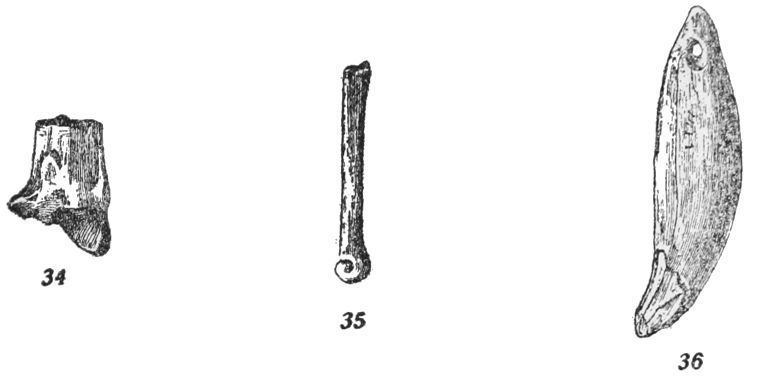
Figs. 34 and 35. × 1/2. Fragments of bones. Fig. 36. × 1/2. A bear-tooth ornament.