SPRING STORIES AND LEGENDS
Reading edition
APRIL
The year’s at the spring And day’s at the morn; Morning’s at seven; The hillside’s dew-pearled; The lark’s on the wing; The snail’s on the thorn: God’s in his heaven— All’s right with the world! And after April, when May follows And the whitethroat builds and all the swallows! Hark! where my blossomed pear-tree in the hedge Leans to the field and scatters on the clover Blossoms and dewdrops—at the bent spray’s edge— That’s the wise thrush; he sings each song twice over, Lest you should think he never could recapture The first fine careless rapture! And though the fields look rough with hoary dew, All will be gay when noontide wakes anew The buttercups, the little children’s dower— —Far brighter than this gaudy melon-flower! Robert Browning.
THE SPRING-MAIDEN AND THE FROST GIANTS
In their glittering palace of icebergs the Frost Giants were planning to capture Iduna, the fair Spring-Maiden, and the rare treasure which she guarded. Hoar-Frost, North-Wind, Sleet, Hail, and Blizzard were growing restless, locked in their frozen waste-land of the North. They longed to enter the valley of Spring and bring desolation to the fruitful fields.
“We are helpless unless we seize the Spring-Maiden and take from her the casket of golden apples,” said Giant Hoar-Frost. “So long as she guards this life-giving fruit all nature will rejoice; the birds will sing their foolish jubilees; gay blossoms will flaunt in the meadows; robes of green will bedeck the trees, and the people will enjoy everlasting youth and vigour.”
“What you say is true,” said Giant North-Wind. “If once I could enter the groves of the Spring-Maiden’s valley I’d howl so long and loud that those tiresome birds would stop their endless singing.”
“Ha! ha! ha!” laughed Giant Blizzard. “You would need my help, I believe. One of my early morning calls would turn the trembling dew-drops into icicles, and change the smiling faces of the brooks and rills into frozen images!”
“Especially if I went with you,” added Giant Sleet slyly.
“Oh, I should expect to be accompanied by you and your twin brother Hail,” nodded Blizzard. “I know how easily you can lock the grass and flowers in a casement of ice which they couldn’t break, and Hail has a very clever, quick way of cutting off all the leaves. But the question now is how shall we capture the Spring-Maiden whose apples keep the valley fresh and fair and the people forever young!”
For a few moments the Frost Giants were silent. Many times they had tried to entrap the fair Iduna and her treasure, but they had always failed.
“I have it,” said Hoar-Frost. “We must secure the help of Loki, the Prince of Mischief. He lives in Asgard near the Spring-Maiden’s groves, and people say he often visits Iduna in order to refresh himself with one of her life-giving apples. Let us capture him first and then compel him to help us. We giants are fast growing old! The magic apples would renew our strength for years to come!”
“Agreed!” said North-Wind, Blizzard, Sleet, and Hail in one voice. “Loki first and then Iduna!”
After much discussion it was decided that Blizzard should undertake to capture Loki.
A short time after the council of the Frost-Giants, Loki, the Prince of Mischief, was amusing himself with a great fire which he had built on one of the hills just beyond the city of Asgard. Several times he stopped and peered into the sky to see what caused the huge shadow which seemed to hover near him. He could see nothing but a gigantic eagle whirling around the summit of the hill. Loki left his fire to gather another bundle of faggots. Suddenly the great bird swooped down very near him. He quickly seized a long stake and struck the intruder across the back. To Loki’s amazement one end of the stake stuck fast to the eagle’s plumage and the Prince of Mischief could not loosen his hands from the end which he held. The eagle spread its huge dark wings and flew away over rocks and hills far to the North.
“Help! help!” screamed the terrified Loki, but although he struggled with all his might he could not escape from his captor.
When they reached a very lonely spot the eagle alighted on a mountain peak and from the black plumage stepped the Storm Giant, Blizzard, who said:
“Loki, you are in my power and you shall not escape until you promise to help the Frost Giants in a very difficult undertaking!”
“What is that?” gasped the bruised and terrified Loki.
“You must help us to capture Iduna, the Spring-Maiden, and the treasure which she guards. We cannot enter the valley of Spring until Iduna is made our captive.”
“Help you to capture the treasure which gives life and youth to all who partake of it!” said Loki. “Impossible!”
“Then away to the North we will go,” declared the Storm Giant, putting on his eagle plumage again.
“Stop! Stop!” cried Loki in terror. “Let me think a moment!”
After a short consideration Loki took an oath that he would betray Iduna and her treasure into the hands of the Frost Giants. Then the Prince of Mischief was freed, and back to the North sped Blizzard.
The next day late in the afternoon, Iduna, robed in a trailing garment of green and crowned with a coronet of blossoms, was walking through one of her loveliest groves. The leaves were dancing to the music of a gentle breeze. A delicious fragrance of hyacinths and roses scented the valley. She sat down near a cool fountain and placed her treasure-casket of apples on the marble basin.
Presently a long shadow darkened the path near her, and looking up quickly the Spring-Maiden saw Loki standing near.
“I have come for the refreshing gift of one of your apples, Iduna,” said he. “A long journey has wearied my limbs and broken my spirit.”
“You are very welcome to one of them,” said Iduna, opening her box. “It has been some time since you tasted a golden apple.”
Loki began to eat the precious gift, and Iduna watched him closely. She was very proud of her refreshing fruit.
In a little while he put the half-eaten apple on the basin of the fountain and said, “I am going to tell you a secret, Iduna. Not far away from here I discovered a grove where a marvellous tree grows. It bears fruit shaped like yours but larger and of a deep golden colour.”
“Oh!” laughed the Spring-Maiden, “the fruit may be larger and more beautiful than mine, but I’m sure it has not the power to put youth and life into those who partake of it.”
“I am afraid you are mistaken,” said the wily Loki. “People who have eaten the fruit of this tree say that its refreshing power is wonderful. If you wish, I will gladly guide you to the grove—it is not far away—and then you can compare this fruit, which is attracting much attention, with yours. Will you go?”
“Yes, I will indeed,” said Iduna, who could not believe that any other apples were comparable with hers.
Loki led the way and Iduna, carrying her treasure, followed him eagerly. She was a little surprised to find the grove Loki described so far away from Asgard, but her desire to find fruit more wonderful than the magic apples urged her on. Finally they reached a meadow bordered by a dense forest.
“Look,” said Loki, pointing forward, “we shall soon reach the place.”
Suddenly a dark shadow fell across Iduna’s path. The Storm Giant, disguised in eagle’s plumage, swooped down, caught the Spring-Maiden and her golden apples in his talons, and sped away to the frozen North. There the Frost Giants imprisoned the captive in one of their ice-palaces.
It was not long before the joyous valley of Spring felt the absence of Iduna. The flowers drooped and faded; the grass became parched and brown, and the tender green foliage turned to burnt orange, crimson, and russet.
“What has become of Iduna?” cried the people. “See how the valley is changing!”
Slowly but surely the Frost Giants were working their way toward the valley of Spring. One night Hoar-Frost stalked along the outskirts of the groves and withered the leaves and flowers with his icy breath. The next morning the people heard the dismal howl of North-Wind. “We must find the Spring-Maiden or we shall die,” they cried in alarm.
In their distress they begged Odin, the wise hero who governed Asgard, to call a special council in order to determine how the secret of Iduna’s disappearance could be discovered.
Odin called together his hero council and after earnest thought they decided to question Loki, the Prince of Mischief. He had seldom been seen in Asgard since the Spring-Maiden had left the valley. One of the heroes declared that the last time he saw Iduna she was walking with Loki.
The Prince of Mischief was accordingly summoned to appear in the council of heroes. His answers to the questions they asked him aroused suspicion.
“Tell us the truth about this matter,” said the hero Thor, in a voice which shook like the roar of distant thunder.
Then the cowardly Loki confessed the plot which robbed the valley of the Spring-Maiden and her magic apples.
“Loki,” said Odin sternly, “I command you to bring back Iduna. Let there be no delay, for even the heroes of Asgard are suffering in her absence!”
Loki knew he dared not disobey this final command. He disguised himself in falcon’s plumage and sped away to the desolate North where a dull leaden sky overhung all the land. In circling about the icebergs he spied the Storm-Giant, fishing from the top of a large rock. Loki descended quickly, flew into one of the openings of the Giant’s ice-palace, and made his way to the place where Iduna lay sleeping on a rough couch. The Prince of Mischief stepped out of his disguise and awakened the Spring-Maiden.
“False Loki,” she cried. “Have you come to do more mischief?”
“I have been sent by Odin to rescue you,” said he. “You can escape only by the help of my magic.”
Then he transformed Iduna and the precious casket of apples, placed them in a magic nutshell, put on his falcon plumage, and flew away toward Asgard.
As he sped across the dull sky the Storm-Giant looked up and saw him.
“It is Loki disguised as a falcon,” he said. “He is taking the Spring-Maiden back to Asgard. But he shall not escape me!” Instantly the Storm-Giant put on his eagle plumage and flew after Loki.
How anxiously the people of Asgard watched for the return of Loki with Iduna. They heaped great piles of chips around the walls of Asgard and held torches ready to light the fires in case the Frost Giants came near.
On the third day after Loki’s departure from Asgard, the people saw two great birds flying with lightning speed toward the city.
“It is the Storm Giant following Loki,” they cried. “What a furious pursuit! See! See! The eagle is gaining on the falcon! Light the fires as soon as Loki passes over! Ready! The fires!” Another moment of breathless suspense! The falcon swept over the walls of Asgard. Instantly a blaze burst forth all around the city. The falcon had won the mighty race. The eagle whirled far above the flames and looked down into the city. He dared not descend. With a cry of despair he sped back to the ice-bound Northland.
“The joyous Spring-Maiden is ours again,” cried the happy people as they gathered around Iduna. “Her presence fills us with life and hope. See, the casket of golden apples is safe in her hands! Soon all nature will be fair and beautiful. The Spring-Maiden is our joy.”
HOW THE BLUEBIRD WAS CHOSEN HERALD[1]
Jay T. Stocking
Query Queer was the boy who loved the woods and asked so many questions. The Wise-and-Wonder-Man was the spirit of the woods whom Query met one day and who answered Query’s questions. Of course, as Query often went to the woods it was quite certain that he should sometime meet the spirit again. And so he did. It happened one day just as the snow was disappearing and the sun was growing warm. Query had been taking his first spring walk, and, as he was a bit tired, he sat down on the sunny slope of a knoll. He was scarcely seated when down out of the green boughs of a hemlock tree in front of him slid the Wise-and-Wonder-Man, dressed in his light blue suit with every button a silver bell, and his pointed cap to match, with its fringe of silver bells. At every move he made, the bells went tinkle-tankle, tinkle-tankle. Query was so surprised that he almost forgot to breathe.
“Good morning, Query,” said the Wise-and-Wonder-Man, “what are you wondering about now?”
“I was just wondering,” said Query, nodding his head toward a bluebird near by, “why the bluebird is the first bird of spring.”
“Why, he is the herald, you know.”
“But how did he come to be the herald? Do you know?”
“I have heard,” said the Wise-and-Wonder-Man.
“Who told you?”
“My grandmother. She said her grandmother’s grandmother’s grandmother told the story; and what her grandmother’s grandmother’s grandmother said, my grandmother says is so.”
“Of course,” said Query. “Would you tell me the story?”
“Certainly; make yourself comfortable.”
Query lay down on one elbow and the Wise-and-Wonder-Man sat on a fresh, clean chip, that the choppers had made, and talked.
“You know there are four spirits of the year, Springtime, Summer, Autumn, and Winter. Some folks call them seasons, but they are really spirits. Of all four spirits, Springtime is the favourite. He had been coming to the earth every year for a great many years, year after year, when he got it into his head that it would be a fine thing and quite becoming to his dignity to have a herald,—some one to carry his colours and play the fife. At first he thought of the fragrant flowers, they could bear his colours. But he reflected that they could not play the fife. Then he thought of the buzzing bee; he might be taught to play the fife. But he remembered that he would not do, because he could not carry the colours. So he decided that he must have a bird.
“Springtime, being a very lively and practical spirit, called the birds together that very morning. He asked them all to meet him by the Great Rock under the Great Tree by the Great Bend of the Big River. They all came—birds of every size and colour and description. He sat on the Great Rock while the birds sat on the grass and listened with wide, round, blinking eyes and with heads cocked to one side.
“He made a speech to them of some length. He told them that he desired a herald to carry his colours and to play the fife. Of course, the bird to be chosen should be handsome and musical. But he must be more than all that. He wanted a bird of exceptionally good character, in fact, the very best bird that could be found. He did not expect to find a perfect bird, he said, but he desired a bird as nearly perfect as he could obtain. He concluded his speech by saying that his herald should be:
“‘Both handsome and happy, gifted and good, And as modest as modest can be. The very best bird that flies in the wood, I would that my herald be he.’
The choice, he said, he would leave to the birds as they knew each other thoroughly.
“The birds put their heads together and talked in at least forty different languages. Finally, their spokesman told Springtime that they were content to leave the selection to a committee of six whom he might name. As Springtime wanted to be on good terms with all the birds, he thought it not best that he should appoint the committee. He pulled a handful of grass and held it tightly between his hands just so that the ends would stick out, and then he asked the birds to come up, one by one, and pull out a blade. The six who should draw out the shortest blades of grass were to be the committee.
“They walked up one by one, and drew. Mr. Crow drew the shortest blade and so was the chairman. Mr. Parrot came next, then Mr. Blue Jay, Mr. Robin, Mr. English Sparrow, and Mr. Bluebird. It was a strange committee, to be sure, of all sizes and kinds of birds.
“That very evening the six birds met in a corner of Mr. Farmer’s orchard upon a dead branch of an old apple tree. They talked and talked and talked. They discussed all the birds that they knew, spoke of their good qualities and their bad ones.
“At last, as it grew late, very late, almost eight o’clock, and they had come to no conclusion, Mr. Bluebird proposed that they should vote, and all agreed. But how should they vote? That was the next question. Mr. Bluebird suggested that each one, as his name was called, should stand up and say which bird he thought was best fitted to be the herald. Mr. Crow cleared his throat and said that he did not think this was the wisest way. He thought it better, he continued, that each one should write the name of his choice on the under side of a leaf. The other members of the committee agreed with Mr. Crow. Each bird, therefore, took a leaf, and wrote a name upon it, and Mr. Bluebird counted the votes. There was one vote for Mr. Crow, one vote for Mr. Parrot, one for Mr. Blue Jay, one for Mr. Robin, one for Mr. English Sparrow, and one for—I don’t remember whether it was for Mr. Song Sparrow or Mr. Bobolink. Would you believe it?—every bird except the bluebird had voted for himself. The bluebird knew, because he knew the foot-writing of all the birds. He had seen it in the soft sand by the water.
“It was certain that they were not going to be able to decide among themselves who should be chosen, so Mr. Bluebird made another suggestion.
“‘I recommend,’ he said, ‘that we go and consult the old Wizard, Mr. Owl, who holds court every night by the light of the moon in the hollow of a great grey tree over the ridge. He is the wisest of birds and knows everything. I have heard, too, that whenever there is a star with a tail in the sky he can read your fortunes and your character. Now it so happens that at this very time there is in the sky a star with a tail, for I saw it this morning. Little Bluey, my eldest child, woke up very early and I had to fly out to get him a worm to keep him quiet. Just as I was starting, long before sunrise, I saw the comet. I propose that we go at once and consult the Wizard and let him decide for us who should be the herald.’
“‘It seems to me,’ said the crow, ‘that this is a most excellent suggestion. The Wizard is certainly a very wise bird. I have heard of him and doubtless he has heard of me. By all means, let us go.’
“It was decided then and there that they should go that very night, just as soon as the comet rose. Mr. Bluebird was to give the signal because he knew where to look for the comet.
“At the proper moment Mr. Bluebird shook them all by the wing and woke them up, and they started, Mr. Crow going first, then Mr. Parrot, Mr. Blue Jay, Mr. Robin, Mr. English Sparrow, and Mr. Bluebird.
“They flew and they flew and they flew, for it was a long way and a hard way to find, and not one of the six had ever been out so late in his life. When they reached the wood they were obliged to fly very carefully, so that they should not bump their heads against the trees, and so that they might be able to read the signs along the way. At length they spied a great grey tree, with a dimly lighted window in it, far up the trunk. Mr. Crow read the name on the door-plate and announced that they had reached the right house. There was no door-bell so Mr. Crow scratched three times,—scratch, scratch, scratch.
“‘Who-who?’ came from within.
“‘Friends,’ said the crow, ‘six friends come to consult the Wizard.’
“The latch was promptly lifted and the six birds walked solemnly in and up the stairs.
“They found themselves in a little dark round room with seats against the sides. Mr. Owl sat over on one side, his great fluffy coat turned up at the neck and his fluffy hood pulled down to meet it. He had his spectacles on and was reading by the light of his lamp,—that is, it looked like a lamp, but Mr. Owl explained later that it was not a lamp but the comet’s light which he caught through a knot-hole.
“The Wizard received them pleasantly and motioned to them to be seated. Mr. Crow sat down in front of the Wizard at his right, then the others in order, Mr. Bluebird sitting at the left.
“‘It is very late,’ observed the owl. ‘It must be most important business that brings you to me at this hour of the night.’
“‘It is,’ replied the crow, ‘exceedingly important business, indeed.’
“Then in plain and emphatic words he told the Wizard what their errand was. He repeated as nearly as he could the speech of Springtime, especially the last words:
“‘Both handsome and happy, gifted and good, And as modest as modest can be. The very best bird that flies in the wood, I would that my herald be he.’
“He told the Wizard of their inability to decide who should be chosen and of their conclusion to leave the choice to him. This was the reason of their visit.
“Then the owl looked grave as a judge and remarked, ‘It seems to me in this situation that the first thing to be done is to secure the opinion of each of you as to who is the fittest bird to be chosen. Mr. Crow, will you be so good as to give us your opinion?’
“Mr. Crow stood up, cleared his throat, and said, ‘To speak quite frankly, it seems to me that I, myself, should be chosen. It is scarcely possible to find a better bird.’
“‘What makes you think so?’ asked the owl dryly.
“‘My wife,’ said the crow. ‘Only to-day Mrs. Crow said to me, “Mr. Crow, my dear husband, you are a perfect man, unless—”’
“‘Unless what?’ inquired the Wizard, raising his eyebrows.
“‘I don’t recollect,’ replied the crow, ‘in fact, I didn’t hear distinctly, but I am sure it was something unimportant,’ and he sat down.
“‘Mr. Parrot,’ said the Wizard, ‘your opinion, if you please.’
“‘It is my opinion,’ said Mr. Parrot, ‘that I am the bird who should be chosen. I have heard myself talk on many an occasion, and I am sure that I speak both wisdom and wit. In modesty, I forbear to say more.’
“‘Mr. Blue Jay!’ called the Wizard.
“‘Since you ask me, Mr. Wizard, for my honest opinion I am bound to say that I feel that I am the only bird for this position. I have been looking in the glass to-day; in fact, I see myself in the glass very often, and I have never yet observed a single fault in myself. There is no bird who can say more.’
“‘Mr. Robin, if you please.’
“Mr. Robin arose with his fingers in his armholes: ‘I am quite convinced, Mr. Wizard, from much observation, that I should be made the herald. I am handsome and gifted, if I do say it myself. Besides, I live in the best of society; I dwell in the Bishop’s orchard. This very day I heard the Bishop say, “That robin is a fine, handsome bird,—as fine and handsome as a Bishop.” I am sure that recommendation is enough.’
“‘Mr. English Sparrow.’
“‘I am sure, Mr. Wizard,’ said the sparrow, speaking very rapidly and excitedly, ‘that while I am not so big as some of these who have spoken, I have a better claim than any of them to this high office. For I have long made it a practice to study carefully the faults and weaknesses of all the other birds, and I know that I have none of these failings.’
“‘Mr. Bluebird,’ said the Wizard, ‘what have you to say?’
“‘Nothing, Mr. Wizard. I have not made up my mind. I leave the matter entirely to your eminent wisdom and judgment.’ And he sat down.
“‘Well,’ said the owl, after a moment’s deliberation, ‘the next thing to do under these circumstances seems to be to read your fortunes, that is, your characters, in the light of the comet. I shall ask you, one by one, to step up on this judgment-seat at my left, where the light of the comet can fall on you and where I can see you plainly. Mr. Crow, will you be the first?’
“Mr. Crow stepped up to the judgment-seat very confidently, while the Wizard put on his spectacles and turned the lamp so that the light fell full upon the glossy feathers of the large black bird. It was a revolving seat, which the Wizard turned round and round slowly so that he could see all sides of the bird. ‘A fine bird,’ he said, very deliberately, as if thinking aloud, ‘a perfect bird, unless—unless what?—let me see—ah, a slant in the left eye—in both eyes—a very decided slant—very sly—very cunning—inclined to steal—very much inclined to steal—a thief, in fact; steals Mr. Farmer’s corn and peas—especially in the early morning when nobody is around—a very bad fault—one of the worst. I am quite sure, Mr. Crow, that Springtime would not choose you for his herald—he could not trust you. That will do. Mr. Parrot!’
“Mr. Parrot walked up very sedately and took his place on the judgment-seat. The Wizard gazed at him gravely and stroked his back. ‘Fine feathers—green, red—yellow—fine feathers—rather small head—large tongue—large tongue, small head—talks more than he thinks—talks very much more than he thinks—talks often without thinking—says what he hears others say. Tongue rather harsh, too—and blisters at the end—bad words! bad words! I am sorry to say, Mr. Parrot, that I cannot recommend you as herald. People would not be glad to see you year after year. That will do. Mr. Blue Jay!’
“The blue jay stepped up very jauntily and took the seat.
“The Wizard looked at him admiringly, for he was clad in a beautiful tailor-made suit that fitted him to perfection. ‘A handsome bird,’ he said, ‘a handsome bird,—that is, handsome clothes. Eye very good, too—a little slant, a little slant—but on the whole a good eye. Let me see, what is this on the back of the head? these long feathers?—oh, a crest! I see. Just for decoration. A vain bird, vain as a peacock—and like all vain people, hard to get along with—and very unfriendly—likes to flock alone—other folks not quite good enough. I regret to inform you, Mr. Blue Jay, that Springtime would not desire you as his herald. That will do. Mr. Robin!’
“The robin hopped up on the seat in his fine dress suit and red shirt-front, his chest inflated and his eyes shining. The Wizard looked at him intently for some time, then he began, ‘You are the Bishop’s friend, you say. Let me see—a bright red spot on your bill—the Bishop’s cherries, I should say—but we’ll let that pass. Eye very suspicious—very suspicious—always looking even among your best friends, to see if somebody isn’t going to harm you—cannot pull a worm out of the Bishop’s garden without looking around suspiciously all the time. A very unhappy frame of mind to be in—unhappy for you—unhappy for others. You would hardly do for the herald. That will do. Mr. English Sparrow!’
“The English sparrow fluttered up noisily and took his place. ‘You say,’ began the Wizard, ‘that you have not the faults of the other birds.’
“‘Yes,’ said the sparrow, talking very fast, ‘I am not as mean as the crow, and I don’t talk such nonsense as old Polly, and I’m not so stuck up as the jay, and I am not suspicious as the Bishop’s friend is. I haven’t any of the faults of the other birds.’
“The Wizard pushed his spectacles up on his brow, turned the light away, and looked at him, ‘I see,’ he said, ‘I do not need the comet light at all. I could see you in the dark. Sharp bill—sharp tongue—sharp claws, in a continual state of bad temper—very quarrelsome—very unpleasant neighbour; in fact, a common nuisance. That will do, Mr. Bluebird!’
“‘I am sure, Mr. Owl,’ said the bluebird, rising, ‘that I need not take your time. I am not the bird to be chosen, for I know that I am far from being a perfect bird. I have many faults. There are many nobler birds than I from whom Springtime may choose his herald.’
“But the Wizard was quite insistent that the bluebird should come forward where he could read his fortune.
“‘You say that you have many faults,’ remarked the Owl. ‘That may be, but I see by the light of the comet that they are small, very faint indeed. Besides, the ability to see one’s faults and the desire to correct them is the greatest of virtues. There may be better birds, but I am frank to say that I am not acquainted with them. I have no hesitation, Mr. Bluebird, in saying that it is my judgment that you should be the herald of the Spring, for, if you will permit me to say it, it seems that you are
“‘Both handsome and happy, gifted and good, And as modest as modest can be,’
whereat Mr. Bluebird blushed painfully, while in his heart he was very happy.
“Springtime agreed with Mr. Owl, and posted notices on every tree by the water’s edge that Mr. Bluebird should henceforth be his herald, the first bird of the spring.
“There is one now on the branch of that old tree,” said the Wise-and-Wonder-Man. “He is carrying the colours and playing the fife.”
“What is he saying?” asked Query.
“Well,” said the Wise-and-Wonder-Man, “it always sounds to me as if he were saying, ‘Pur-i-ty, pur-i-ty,’ but I asked him one day and he said it was only, ‘Spring-is-here, spring-is-here.’”
THE SPRINGTIME[2]
Eugene Field
A child once said to his grandsire: “Gran’pa, what do the flowers mean when they talk to the old oak-tree about death? I hear them talking every day, but I cannot understand; it is all very strange.”
The grandsire bade the child think no more of these things; the flowers were foolish prattlers,—what right had they to put such notions into a child’s head? But the child did not do his grandsire’s bidding; he loved the flowers and the trees, and he went each day to hear them talk.
It seems that the little vine down by the stone wall had overheard the South Wind say to the rosebush: “You are a proud, imperious beauty now, and will not listen to my suit; but wait till my boisterous brother comes from the North,—then you will droop and wither and die, all because you would not listen to me and fly with me to my home by the Southern sea.”
These words set the little vine to thinking; and when she had thought for a long time she spoke to the daisy about it, and the daisy called in the violet, and the three little ones had a very serious conference; but, having talked it all over, they came to the conclusion that it was as much of a mystery as ever. The old oak-tree saw them.
“You little folks seem very much puzzled about something,” said the oak-tree.
“I heard the South Wind tell the rosebush that she would die,” exclaimed the vine, “and we do not understand what it is. Can you tell us what it is to die?”
The old oak-tree smiled sadly.
“I do not call it death,” said the old oak-tree; “I call it sleep,—a long, restful, refreshing sleep.”
“How does it feel,” inquired the daisy, looking very full of astonishment and anxiety.
“You must know,” said the oak-tree, “that after many, many days we all have had such merry times and have bloomed so long and drunk so heartily of the dew and sunshine and eaten so much of the goodness of the earth that we feel very weary and we long for repose. Then a great wind comes out of the North, and we shiver in its icy blast. The sunshine goes away, and there is no dew for us nor any nourishment in the earth, and we are glad to go to sleep.”
“Mercy on me!” cried the vine, “I shall not like that at all! What, leave this smiling meadow and all the pleasant grass and singing bees and frolicsome butterflies? No, old oak-tree, I would never go to sleep; I much prefer sporting with the winds and playing with my little friends, the daisy and the violet.”
“And I,” said the violet, “I think it would be dreadful to go to sleep. What if we never should wake up again!”
The suggestion struck the others dumb with terror,—all but the oak-tree.
“Have no fear of that,” said the old oak-tree, “for you are sure to awaken again, and when you have awakened the new life will be sweeter and happier than the old.”
“What nonsense!” cried the thistle. “You children shouldn’t believe a word of it. When you go to sleep you die, and when you die there’s the last of you!”
The old oak-tree reproved the thistle; but the thistle maintained his abominable heresy so stoutly that the little vine and the daisy and the violet were quite at a loss to know which of the two to believe,—the old oak-tree or the thistle.
The child heard it all and was sorely puzzled. What was this death, this mysterious sleep? Would it come upon him, the child? And after he had slept awhile would he awaken? His grandsire would not tell him of these things; perhaps his grandsire did not know.
It was a long, long summer, full of sunshine and bird-music, and the meadow was like a garden, and the old oak-tree looked down upon the grass and flowers and saw that no evil befell them. A long, long play-day it was to the little vine, the daisy, and the violet. The crickets and the grasshoppers and the bumblebees joined in the sport, and romped and made music till it seemed like an endless carnival. Only every now and then the vine and her little flower friends talked with the old oak-tree about that strange sleep and the promised awakening, and the thistle scoffed at the old oak-tree’s cheering words. The child was there and heard it all.
One day the great wind came out of the North. Hurry-scurry! back to their warm homes in the earth and under the old stone-wall scampered the crickets and bumblebees to go to sleep. Whirr, whirr! Oh, but how piercing the great wind was; how different from his amiable brother who had travelled all the way from the Southern sea to kiss the flowers and woo the rose!
“Well, this is the last of us!” exclaimed the thistle; “we’re going to die, and that’s the end of it all!”
“No, no,” cried the old oak-tree; “we shall not die; we are going to sleep. Here, take my leaves, little flowers, and you shall sleep warm under them. Then, when you awaken, you shall see how much sweeter and happier the new life is.”
The little ones were very weary indeed. The promised sleep came very gratefully.
“We would not be so willing to go to sleep if we thought we should not awaken,” said the violet.
So the little ones went to sleep. The little vine was the last of all to sink to her slumbers; she nodded in the wind and tried to keep awake till she saw the old oak-tree close his eyes, but her efforts were vain; she nodded and nodded, and bowed her slender form against the old stone wall, till finally she, too, had sunk into repose. And then the old oak-tree stretched his weary limbs and gave a last look at the sullen sky and at the slumbering little ones at his feet; and with that, the old oak-tree fell asleep too.
The child saw all these things, and he wanted to ask his grandsire about them, but his grandsire would not tell him of them; perhaps his grandsire did not know.
The child saw the Storm King come down from the hills and ride furiously over the meadows and over the forest and over the town. The snow fell everywhere, and the North Wind played solemn music in the chimneys. The Storm King put the brook to bed, and threw a great mantle of snow over him; and the brook that had romped and prattled all the summer and told pretty tales to the grass and flowers,—the brook went to sleep too. With all his fierceness and bluster, the Storm King was very kind; he did not awaken the old oak-tree and the slumbering flowers. The little vine lay under the fleecy snow against the old stone-wall and slept peacefully, and so did the violet and the daisy. Only the wicked old thistle thrashed about in his sleep as if he dreamt bad dreams, which, all will allow, was no more than he deserved.
All through that winter—and it seemed very long—the child thought of the flowers and the vine and the old oak-tree, and wondered whether in the springtime they would awaken from their sleep; and he wished for the springtime to come. And at last the springtime came. One day the sunbeams fluttered down from the sky and danced all over the meadow.
“Wake up, little friends!” cried the sunbeams,—“wake up, for it is springtime!”
The brook was the first to respond. So eager, so fresh, so exuberant was he after his long winter sleep, that he leaped from his bed and frolicked all over the meadow and played all sorts of curious antics. Then a little bluebird was seen in the hedge one morning. He was calling to the violet.
“Wake up, little violet,” called the bluebird. “Have I come all this distance to find you sleeping? Wake up, it is the springtime!”
That pretty little voice awakened the violet.
“Oh, how sweetly I have slept!” cried the violet; “how happy this new life is! Welcome, dear friends!”
And presently the daisy awakened, fresh and beautiful, and then the little vine, and, last of all, the old oak-tree. The meadow was green, and all around were the music, the fragrance, the new, sweet life of the springtime.
“I slept horribly,” growled the thistle. “I had bad dreams. It was sleep, after all, but it ought to have been death.”
The thistle never complained again; for just then a four-footed monster stalked through the meadow and plucked and ate the thistle and then stalked gloomily away; which was the last of the sceptical thistle,—truly a most miserable end!
“You said the truth, dear old oak-tree!” cried the little vine. “It was not death,—it was only a sleep, a sweet, refreshing sleep, and this awakening is very beautiful.”
They all said so,—the daisy, the violet, the oak-tree, the crickets, the bees, and all the things and creatures of the field and forest that had awakened from their long sleep to swell the beauty and the glory of the springtime. And they talked with the child, and the child heard them. And although the grandsire never spoke to the child about these things, the child learned from the flowers and trees a lesson of the springtime which perhaps the grandsire never knew.
THE SELFISH GIANT
Oscar Wilde
Every afternoon, as they were coming from school, the children used to go and play in the Giant’s garden.
It was a large lovely garden, with soft green grass. Here and there over the grass stood beautiful flowers like stars, and there were twelve peach trees that in the spring time broke out into delicate blossoms of pink and pearl, and in the autumn bore rich fruit. The birds sat on the trees and sang so sweetly that the children used to stop their games in order to listen to them. “How happy we are here!” they cried to each other.
One day the Giant came back. He had been to visit his friend the Cornish ogre, and had stayed with him for seven years. After the seven years were over he had said all that he had to say, for his conversation was limited, and he determined to return to his own castle. When he arrived he saw the children playing in the garden.
“What are you doing there?” he cried in a very gruff voice, and the children ran away.
“My own garden is my own garden,” said the Giant; “any one can understand that, and I will allow nobody to play in it but myself.” So he built a high wall all round it, and put up a notice-board—
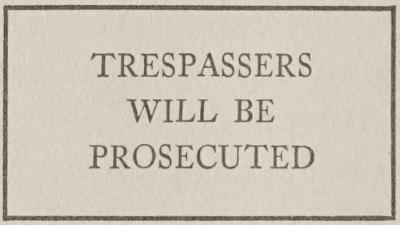
TRESPASSERS WILL BE PROSECUTED
He was a very selfish giant.
The poor children had nowhere to play. They tried to play on the road, but the road was very dusty and full of hard stones, and they did not like it. They used to wander round the high wall when their lessons were over, and talk about the beautiful garden inside.
“How happy we were there,” they said to each other.
Then the Spring came, and all over the country there were little blossoms and little birds. Only in the garden of the Selfish Giant it was still winter. The birds did not care to sing in it, as there were no children, and the trees forgot to blossom. Once a beautiful flower put its head out from the grass, and when it saw the notice-board it was so sorry for the children that it slipped back into the ground again, and went off to sleep. The only people who were pleased were the Snow and the Frost. “Spring has forgotten this garden,” they cried, “so we will live here all the year around.” The Snow covered up the grass with her great white cloak, and the Frost painted all the trees silver. Then they invited the North Wind to stay with them, and he came. He was wrapped in furs, and he roared all day about the garden, and blew the chimney-pots down. “This is a delightful spot,” he said; “we must ask the Hail on a visit.” So the Hail came. Every day for three hours he rattled on the roof of the castle till he broke most of the slates, and then he ran round and round the garden as fast as he could go. He was dressed in grey, and his breath was like ice.
“I cannot understand why the Spring is so late in coming,” said the Selfish Giant, as he sat at the window and looked out at his cold white garden; “I hope there will be a change in the weather.”
But the Spring never came, nor the Summer. The Autumn gave golden fruit to every garden, but to the Giant’s garden she gave none. “He is too selfish,” she said. So it was always Winter there, and the North Wind, and the Hail, and the Frost, and the Snow danced about through the trees.
One morning the Giant was lying awake in bed when he heard some lovely music. It sounded so sweet to his ears that he thought it must be the King’s musicians passing by. It was really only a little linnet singing outside his window, but it was so long since he had heard a bird sing in his garden that it seemed to him to be the most beautiful music in the world. Then the Hail stopped dancing over his head, and the North Wind ceased roaring, and a delicious perfume came to him through the open casement. “I believe the Spring has come at last,” said the Giant, and he jumped out of bed and looked out.
What did he see?
He saw a most wonderful sight. Through a little hole in the wall the children had crept in, and they were sitting in the branches of the trees. In every tree that he could see there was a little child. And the trees were so glad to have the children back again that they had covered themselves with blossoms, and were waving their arms gently above the children’s heads. The birds were flying about and twittering with delight, and the flowers were looking up through the green grass and laughing. It was a lovely scene, only in one corner it was still winter. It was the farthest corner of the garden, and in it was standing a little boy. He was so small that he could not reach up to the branches of the tree, and he was wandering all round it, crying bitterly. The poor tree was still quite covered with frost and snow, and the North Wind was blowing and roaring above it. “Climb up! little boy,” said the Tree, and it bent its branches down as low as it could; but the boy was too tiny.
And the Giant’s heart melted as he looked out. “How selfish I have been!” he said; “now I know why the Spring would not come here. I will put that poor little boy on the top of the tree, and then I will knock down the wall, and my garden shall be the children’s playground for ever and ever.” He was really very sorry for what he had done.
So he crept down-stairs and opened the front door quite softly, and went out into the garden. But when the children saw him they were so frightened that they all ran away, and the garden became winter again. Only the little boy did not run, for his eyes were so full of tears that he did not see the Giant coming. And the Giant strode up behind him and took him gently in his hand, and put him up into the tree. And the tree broke at once into blossom, and the birds came and sang on it, and the little boy stretched out his two arms and flung them round the Giant’s neck, and kissed him. And the other children, when they saw that the Giant was not wicked any longer, came running back, and with them came the Spring. “It is your garden now, little children,” said the Giant, and he took a great axe and knocked down the wall. And when the people were going to market at twelve o’clock they found the Giant playing with the children in the most beautiful garden they had ever seen.
All day long they played, and in the evening they came to the Giant to bid him good-bye.
“But where is your little companion?” he said; “the boy I put into the tree.” The Giant loved him the best because he had kissed him.
“We don’t know,” answered the children. “He has gone away.”
“You must tell him to be sure and come here to-morrow,” said the Giant. But the children said that they did not know where he lived, and had never seen him before; and the Giant felt very sad.
Every afternoon, when school was over, the children came and played with the Giant. But the little boy whom the Giant loved was never seen again. The Giant was very kind to all the children, yet he longed for his first little friend, and often spoke of him. “How I would like to see him!” he used to say.
Years went over, and the Giant grew very old and feeble. He could not play about any more, so he sat in a huge armchair, and watched the children at their games, and admired his garden. “I have many beautiful flowers,” he said; “but the children are the most beautiful flowers of all.”
One winter morning he looked out of his window as he was dressing. He did not hate the Winter now, for he knew that it was merely Spring asleep, and that the flowers were resting.
Suddenly he rubbed his eyes in wonder, and looked and looked. It certainly was a marvellous sight. In the farthest corner of the garden was a tree quite covered with lovely white blossoms. Its branches were all golden, and silver fruit hung down from them, and underneath it stood the little boy he had loved.
Down-stairs ran the Giant in great joy, and out into the garden. He hastened across, and came near to the child. And when he came quite close his face grew red with anger, and he said, “Who hath dared to wound thee?” For on the palms of the child’s hands were the prints of two nails, and the prints of two nails were on the little feet.
“Who hath dared to wound thee?” cried the Giant; “tell me, that I may take my big sword and slay him.”
“Nay!” answered the child; “but these are the wounds of Love.”
“Who art thou?” said the Giant, and a strange awe fell on him, and he knelt before the little child.
And the child smiled on the Giant, and said to him, “You let me play once in your garden; to-day you shall come with me to my garden, which is Paradise.”
THE PROMISED PLANT
Andrea Hofer Proudfoot
There was once a promise made to all the people of the world, and every one was waiting and had been waiting long for it to be kept.
No one could remember who had made the promise, but the little children were told that it was made by a great King who knew everything that had ever happened, and all things that would ever be.
And this was the promise:
A wonderful flower was to grow in a certain garden that would bring to the one who owned the garden all the good things in the world.
Every one waited and waited for the flower to come. Years and years they had waited—summer after summer; each new little boy and girl that came into the world was told of the great promise, and among the very first things they did was to go about seeking the flower and asking questions about it.
But no one could tell them anything except to repeat the promise that a beautiful gift-plant would some day grow upon the earth, which only people with loving hearts could see, and they should be greatly blessed.
Every one in the whole world went about looking for this flower; even though they did a great deal of work, and thought of other things, yet they never quite forgot the wonderful promise.
Many of them prepared the soil and made beautiful gardens to receive it. Some sought far and wide for rare seeds and bulbs which they planted and watered, but only such plants grew as every one had seen before, and so they still waited and searched.
Many others wished and wished, and some prayed and prayed, but the precious seed did not come.
The rich men of the land had great parks laid out; the ground was tilled and everything kept ready for the plant to find root. Many gardeners and watchers were hired to stay there and watch for this wondrous flower and guard it—but it did not come.
Yet no one ever doubted the promise, for every one wished very much to have all the good things which were to come with this flower.
Among all these people there was one very kind woman, who did many good deeds. She loved and cared for little children who had no one to help them. One night when she came home from her work what did she see in a little broken flower-pot that stood in her window?
A tiny plant which she had never noticed before! She watered it and it grew and grew, and she learned to love it.
One day while she was looking at the tiny plant she remembered the promise, and said quietly to herself: “Can it be that this is the beautiful flower the whole world is waiting for! I think it is, for it has made me so happy.”
And it was the flower.
She knew the promise had come because it made her so happy.
Every one, far and near, came to see it; and they begged pieces and seeds to plant. And though the good woman gave of her plant, it grew larger and larger, and she became happier and happier.
One day it blossomed wide and beautiful.
The rich men who had made great parks and gardens for the flower would not believe the woman had received the real promised plant. They shook their heads and laughed at it all, and went on seeking after other seeds and plants.
But the people who believed because they saw how happy it made the woman to whom the flower came, brought rich gifts to her and begged for the seed, and they took it home and planted it everywhere, that the whole world might be filled with joy and peace.
BRIER ROSE
Kate Douglas Wiggin and Nora Archibald Smith
A long time ago there lived a king and a queen, who said every day, “If only we had a child”; but for a long time they had none.
It fell out once, as the Queen was bathing, that a frog crept out of the water on to the land and said to her: “Your wish shall be fulfilled; before a year has passed you shall bring a daughter into the world.”
The frog’s words came true. The Queen had a little girl who was so beautiful that the King could not contain himself for joy, and prepared a great feast. He invited not only his relations, friends and acquaintances, but the fairies, in order that they might be favourably and kindly disposed toward the child. There were thirteen of them in the kingdom, but as the King had only twelve golden plates for them to eat off, one of the fairies had to stay at home.
The feast was held with all splendour, and when it came to an end the fairies all presented the child with magic gifts. One gave her virtue, another beauty, a third riches, and so on, with everything in the world that she could wish for.
When eleven of the fairies had said their say, the thirteenth suddenly appeared. She wanted to revenge herself for not having been invited. Without greeting any one, or even glancing at the company, she called out in a loud voice, “The Princess shall prick herself with a distaff in her fifteenth year and shall fall dead”; and without another word she turned and left the hall.
Every one was terror-stricken, but the twelfth fairy, whose wish was still unspoken, stepped forward. She could not cancel the curse, but could only soften it, so she said: “It shall not be death, but a deep sleep lasting a hundred years, into which your daughter shall fall.”
The King was so anxious to guard his dear child from the misfortune that he sent out a command that all the distaffs in the whole kingdom should be burned.
All the promises of the fairies came true.
The Princess grew up so beautiful, modest, kind, and clever that every one who saw her could not but love her. Now it happened that on the very day when she was fifteen years old the King and Queen were away from home, and the Princess was left alone in the castle. She wandered about over the whole place, looking at rooms and halls as she pleased, and at last she came to an old tower. She ascended a narrow winding staircase and reached a little door. A rusty key was sticking in the lock, and when she turned it the door flew open. In a little room sat an old woman with a spindle busily spinning her flax.
“Good day, Granny,” said the Princess; “what are you doing?”
“I am spinning,” said the old woman, and nodded her head. “What is the thing that whirls round so merrily?” asked the Princess; and she took the spindle and tried to spin too.
But she had scarcely touched it before the curse was fulfilled, and she pricked her finger with the spindle. The instant she felt the prick she fell upon the bed which was standing near, and lay still in a deep sleep which spread over the whole castle.
The King and Queen, who had just come home and had stepped into the hall, went to sleep, and all their courtiers with them. The horses went to sleep in the stable, the dogs in the yard, the doves on the roof, the flies on the wall; yes, even the fire flickering on the hearth grew still and went to sleep, and the roast meat stopped crackling; and the cook, who was pulling the scullion’s hair because he had made some mistake, let him go and went to sleep. And the wind dropped, and on the trees in front of the castle not a leaf stirred.
But round the castle a hedge of brier roses began to grow up; every year it grew higher, till at last it surrounded the whole castle so that nothing could be seen of it, not even the flags on the roof.
But there was a legend in the land about the lovely sleeping Brier Rose, as the King’s daughter was called, and from time to time princes came and tried to force a way through the hedge into the castle. But they found it impossible, for the thorns, as though they had hands, held them fast, and the princes remained caught in them without being able to free themselves.
After many, many years a prince came again to the country and heard an old man tell of the castle which stood behind the brier hedge, in which a most beautiful maiden called Brier Rose had been asleep for the last hundred years, and with her slept the King, Queen, and all her courtiers. He knew also, from his grandfather, that many princes had already come and sought to pierce through the brier hedge, and had remained caught in it and died a sad death.
Then the young Prince said: “I am not afraid; I am determined to go and look upon the lovely Brier Rose.”
The good old man did all in his power to dissuade him, but the Prince would not listen to his words.
Now, however, the hundred years were just ended, and the day had come when Brier Rose was to wake up again. When the Prince approached the brier hedge it was in blossom, and was covered with beautiful large flowers which made way for him of their own accord and let him pass unharmed, and then closed up again into a hedge behind him.
In the courtyard he saw the horses and dappled hounds lying asleep, on the roof sat the doves with their heads under their wings, and when he went into the house the flies were asleep on the walls, and near the throne lay the King and Queen; in the kitchen was the cook, with his hand raised as though about to strike the scullion, and the maid sat with the black fowl before her which she was about to pluck.
He went on farther, and all was so still that he could hear his own breathing. At last he reached the tower, and opened the door into the little room where Brier Rose was asleep. There she lay, looking so beautiful that he could not take his eyes off her; he bent down and gave her a kiss. As he touched her, Brier Rose opened her eyes and looked quite sweetly at him. Then they went down together; and the King and Queen and all the courtiers woke up, and looked at each other with astonished eyes. The horses in the stable stood up and shook themselves, the hounds leaped about and wagged their tails, the doves on the roof lifted their heads from under their wings, looked around and flew into the fields; the flies on the walls began to crawl again, the fire in the kitchen roused itself and blazed up and cooked the food, the meat began to crackle, and the cook boxed the scullion’s ears so soundly that he screamed aloud, while the maid finished plucking the fowl. Then the wedding of the Prince and Brier Rose was celebrated with all splendour, and they lived happily till they died.
PICCIOLA
Adapted from St. Saintine
Many years ago a good man, who lived in France, was thrown into prison because the King suspected him of having plotted against the government.
Within four grey stone walls, with only one small window through which the little stream of sunshine came, the poor man was kept captive for months and years. He was not allowed to speak to a living soul except his jailer who at best was but a cross old fellow. He had no work to do. There were no books to read, and his only source of amusement during many long tedious hours was drawing pictures with a bit of charcoal on the bare stone walls of his prison cell.
Fortunately, however, the poor captive was permitted to leave his cell for one hour each morning and go up a narrow winding stairway which led him into a small courtyard on all sides of which rose high, strong prison walls. There was no roof overhead. Here the prisoner could breathe the fresh air and feel the warm sun and by looking up he could see a bit of the blue sky above.
Day after day the prison life went on in the same round without any change or hope of change. The bitterness and loneliness of the poor man’s lot grew upon him as months and years passed without a word from his family or friends and without hope of ever seeing one of them again. And by and by a time came when he could no longer even find amusement in sketching upon the walls of his cell, for not one vacant spot was left in all that space where he could draw a picture. He was a very unhappy man indeed, and it is hard to say how it might have ended. But one day a new interest came into his life—an interest which changed the poor fellow from an unhappy bitter man who had come to hate everybody and everything, into one who forgot all wrong and who learned to see only the good and the beautiful in all around him. And this interest came about through the growing up of a tiny stray seed which had been blown into the courtyard by the wind and had taken root between two of the great stones with which the courtyard was paved.
It happened that one day as the prisoner was taking his daily walk his eyes caught sight of the bright green of the little seedling just in time to save it from being crushed beneath his foot. He stopped and looked closer. Then he saw how a little plant had sent down its rootlets into the crevice between the stones and had struggled to push its head up where its green leaves might catch what they could of the scant sunshine. He thought how wonderful it was that the little seed had found courage to take root and struggle for life in the dark and gloomy courtyard of the prison. “Brave little plant,” he said. “You deserve to live. I shall watch over you and guard you, for the wind and the hail are hard enemies.”
Day by day he noticed how bravely it grew higher and higher and unfolded one leaf after another to the dull sunshine. He became more and more interested in the little nursling which in time was like a dear friend and companion to him. He called it Picciola, which means, “little one,” and before many days had passed, it had taken root and grown in his own heart so that there was no longer room for bitterness or memory of any wrongs.
At one time when a great hailstorm sent its cruel hail into the courtyard, the prisoner bent over Picciola to protect it and the driving hailstones fell upon his own head until the storm was over.
“My poor little Picciola,” he said, “I shall not always be here to guard you from harm. Much can happen to my little plant when I am in my cell. I will build a little fence around you, then the wind cannot blow you down nor the hail cut you with sharp stones.”
The cross jailer, too, took an interest in Picciola when he saw how happy the prisoner had become and he was glad to help take care of the little plant. Somehow, the jailer did not seem to be such a cross fellow as before; indeed he seemed to be quite a gentle and kind hearted man.
Now the prisoner was very happy and the days were no longer weary and without interest for Picciola was always waiting for him in the courtyard and he was sure to see something new about the little plant each morning he visited it. And Picciola grew and grew and in time put forth two beautiful blossoms and sent perfume to make glad the heart of her friend.
But one morning alas! when the prisoner went to look at Picciola he found that, in spite of all his care, she had begun to droop and wither. What could be the matter? In a moment he was on the ground examining the little plant to find out what was causing all the trouble. He soon discovered that Picciola had grown so large that there was no longer room enough for it to grow in the crevice between the stones. The sharp edges of the stones cut into the delicate stem and the poor prisoner could see that his little companion would die unless the stones could be lifted.
He was in great distress. He tried with all the strength he had to lift the stones himself; but he could not move them. He begged the jailer to help him.
“I can do nothing for you,” said the jailer. “You must ask the King; he alone has the power to say that the stones should be lifted.”
“But the King is far away,” said the prisoner. “There is but one way to reach him—I must write.”
The poor fellow in despair sent a letter to the King begging him to save the life of his little friend, Picciola. The letter was written on a white handkerchief with a bit of charcoal. He begged the King, not for his own freedom and life, but for the life of Picciola. As soon as the King finished reading the prisoner’s letter he said:
“This man is not really wicked at heart or he could not care so much for a little plant. The stones shall be raised that the little plant may live, and I will pardon this prisoner because of his great love and sacrifice for so helpless a thing as Picciola.” So the prisoner was released and when he left his lonely prison cell he took Picciola with him, for she had been the beginning for him of a new happiness.
ST. FRANCIS, THE LITTLE BEDESMAN OF CHRIST[3]
William Canton
To all living things on earth and air and water St. Francis was most gracious and loving. They were all his little brothers and sisters, and he forgot them not, still less scorned or slighted them, but spoke to them often and blessed them, and in return they showed him great love and sought to be of his fellowship. He bade his companions keep plots of ground for their little sisters the flowers, and to these lovely and speechless creatures he spoke, with no great fear that they would not understand his words. And all this was a marvellous thing in a cruel time, when human life was accounted of slight worth by fierce barons and ruffling marauders.
For the bees he set honey and wine in the winter, lest they should feel the nip of the cold too keenly; and bread for the birds, that they all, but especially “my brother Lark,” should have joy of Christmastide; and when a youth gave St. Francis the turtle-doves he had snared, the Saint had nests made for them, and there they laid their eggs and hatched them, and fed from the hands of the brethren.
Out of affection a fisherman once gave him a great tench, but he put it back into the clear water of the lake, bidding it love God; and the fish played about the boat till St. Francis blessed it and bade it go.
“Why dost thou torment my little brothers the Lambs,” he asked of a shepherd, “carrying them bound thus and hanging from a staff, so that they cry piteously?” And in exchange for the lambs he gave the shepherd his cloak. And at another time seeing amid a flock of goats one white lamb feeding, he was concerned that he had nothing but his brown robe to offer for it; but a merchant came up and paid for it and gave it him, and he took it with him to the city and preached about it so that the hearts of those hearing him were melted.
Fain would I tell of the coneys that took refuge in the folds of his habit, and of the swifts which flew screaming in their glee while he was preaching; but now it is time to speak of the sermon which he preached to a great multitude of birds in a field by the roadside. Down from the trees flew the birds to hear him, and they nestled in the grassy bosom of the field, and listened till he had done. And these were the words he spoke to them:
“Little birds, little sisters mine, much are you holden to God your Creator; and at all times and in every place you ought to praise Him. Freedom He has given you to fly everywhere; and raiment He has given you, double and threefold. More than this, He preserved your kind in the Ark, so that your race might not come to an end. Still more do you owe Him for the element of air, which He has made your portion. Over and above, you sow not, neither do you reap; but God feeds you, and gives you streams and springs for your thirst; the mountains He gives you, and the valleys for your refuge, and the tall trees wherein to build your nests. And because you cannot sew or spin God takes thought to clothe you, you and your little ones. It must be, then, that your Creator loves you much, since He has granted you so many benefits. Be on your guard then against the sin of ingratitude, and strive always to give God praise.”
And when the Saint ceased speaking, the birds made such signs as they might, by spreading their wings and opening their beaks, to show their love and pleasure; and when he had blessed them, they sprang up, and singing songs of unspeakable sweetness, away they streamed in a great cross to the four quarters of heaven.
PROSERPINA AND KING PLUTO
Little Proserpina and Mother Ceres lived in the beautiful valley of Enna where the warm sun shone all the year round. Mother Ceres had plenty of work to do. Each day she made a journey to the meadows, orchards, and fields all over the earth. Indeed it was through her watchful care that the grass grew, and flowers bloomed, that the fruit ripened, and the precious crops of barley, wheat, and rye brought forth a bountiful harvest.
One day at dawn a shining car and a pair of restless winged dragons stood waiting to take Mother Ceres on her daily journey. The dragons were impatient to start, for they knew how much work had to be done each day. Very soon Ceres glided forth and mounted her splendid car. She was clothed in flowing robes of the softest grey and on her head she wore a crown of scarlet poppies and golden wheat.
“Farewell, little daughter,” she called. “I shall come back before the dew falls. Do not venture out of the valley to-day. Farewell!” Off sped the winged dragons with Mother Ceres. Little Proserpina did not mind being left in the valley for she found a good deal of amusement there. Her friends the naiads—beautiful water nymphs—sported about in the cool fountains. Proserpina loved to spend a quiet hour with these gentle maidens. She often played a merry game with Echo, a nymph who lived on a far-off wooded hillside; sometimes she danced in the sunshine with her little playmates.
Mother Ceres’ shining car soon disappeared and little Proserpina ran to some of her companions and said, “Come, come! I hear Pan, the shepherd boy, playing the sweetest music on his reed-pipes! Let us dance in the sunshine! Come!”
In her gayest mood she led the dance to the very edge of a deep wood which bordered the valley. Then the train of little maidens stopped suddenly and listened. Peals of boisterous laughter broke the silence. In the depths of the forest the queerest youths were rollicking about. They had snub noses, hairy ears, and tiny sprouting horns; their hips were covered with shaggy hair and their feet were exactly like a goat’s.
“Hush,” whispered Proserpina, “the madcap satyrs are dancing too. Let us hasten away.”
“We will gather flowers and make garlands,” said one of the maidens.
They slipped quietly away from the noisy wood and ran about in all directions to search for fragrant blossoms,—lilies and violets, hyacinth bells and pinks. The little maidens soon filled their arms with flowers and sat down on a mossy bank to weave garlands.
In her eagerness to find the loveliest blossoms Proserpina had sauntered off a long way from her companions. She could hear the faint echo of their merry voices in the distance.
“Oh, I have wandered out of the valley,” she thought. “I must hasten back with these lovely flowers. What beauties I have found!”
She turned to run toward the bank where her companions were sitting, when she heard a queer rumbling noise. What could it be! It sounded exactly like distant thunder, yet there was not a cloud in the blue sky overhead. There was another rumbling. Was it coming nearer? The earth beneath her feet quivered! Then in breathless fear she saw a great crack in the field! She was too frightened to move or speak. The flowers she had gathered dropped from her trembling hands. Out of the great cavity which seemed to widen every moment Proserpina saw dashing toward her four jet black horses with flashing eyes and quivering nostrils. At their heels whirled a wonderful golden chariot with jewelled wheels. Standing in this splendid car was a dark-browed man whose iron-crown was studded with precious stones of many colours. In one hand he lightly held the reins and guided the fiery steeds; in the other, he held a two-pronged fork.
“King Pluto!” gasped Proserpina. In a twinkling the King of the Underworld leaped from his chariot, seized Proserpina in his arms, mounted his chariot again and sped away over the hills.
Proserpina’s low cry of “Help! help! Mother! Mother Ceres!” was too faint to reach the ears of the merry companions who were very busy with their flowers.
“What has become of Proserpina?” cried one of them when she had finished her garland.
They looked in the direction where but a moment ago Proserpina was gathering flowers, but they could not see her.
“I wonder where she has gone,” said another. “Surely she has not wandered out of the valley!”
“Proserpina! Proserpina!” called the little companions becoming alarmed.
But no answer could come from the captured maiden who was whirling along beyond the distant hills. In vain did the dark-browed King try to calm his captive by declaring that no harm should come to her. In vain did he promise that she should share his throne and his riches.
“I want to go home to Mother Ceres,” sobbed Proserpina.
But King Pluto was deaf to her pleading; he urged his horses to go faster and faster until finally they came to the River Cyane whose waters began to seethe and foam in a very threatening manner. Little Proserpina knew the waters of this river were angry because she was made a captive. Quickly she loosened her girdle and flung it into the raging flood. Now King Pluto was afraid to risk his fiery steeds in the angry stream, so he determined to plunge at once into the depths of his kingdom. With his two-pronged fork he struck a mighty blow on the earth. Instantly a great crevice opened and gave him passage to the Underworld.
Phœbus Apollo had almost finished his day’s journey and was driving his beautiful sun-car down the steep slope of the western sky. Mother Ceres’ winged dragons were hastening to the valley of Enna. Proserpina always bounded forth with a cry of welcome, so when Mother Ceres missed her little daughter’s joyous words she called, “Proserpina! Proserpina!” There was no answer. What could be the matter! Mother Ceres’ heart beat fast! She sought the little maidens of the valley who were her daughter’s playmates and listened in trembling fear to the story they told about Proserpina’s sudden disappearance. Ceres lighted a torch and continued her search all night. At dawn the distracted mother was in despair, for she could find no trace of her lost child. She questioned the Naiads, the Nymphs, Pan, the shepherd boy, and Echo, but not one of them could give her tidings of Proserpina. For a long time the poor mother continued her wanderings from dawn until eventide all the world over.
One day she happened to wander near the River Cyane and there floating near the water’s edge she saw Proserpina’s girdle. Eagerly she grasped it in her hands and stood in breathless silence. A low murmuring sound reached her ears. Did it come from a nearby fountain? Ceres listened very carefully. “Proserpina! King Pluto!” whispered a voice from the cool depths of the clear water. In a moment Mother Ceres knew the truth about her little daughter’s disappearance. She had been captured by the King of the Underworld! Ceres could take no comfort in this knowledge for she knew King Pluto would do all in his power to keep his captive. In despair the poor mother withdrew to a dark cave to nurse her grief.
“Until Proserpina is returned to me no vegetation shall grow on the earth,” vowed Mother Ceres.
The gentle rain no longer refreshed the grass and drooping flowers; the withered leaves dropped from the trees; the fruit became parched and dry, and the precious grain failed to ripen! Alas! Famine spread throughout the land!
“Mother Ceres,” cried the people, “we implore you to give us your aid. Bring back the flowers and the fruit, and the grain. We shall starve without your help.”
“Not until my child is returned to me,” answered Ceres.
Finally Jupiter’s heart was touched by the distress of the people. He sent for Mother Ceres and said, “If your daughter Proserpina has refused to eat any of King Pluto’s pomegranate seeds during her stay in the underworld she shall return to the earth and never again disappear. My swift-footed messenger Mercury shall go at once to Pluto’s palace and state my will in this matter.”
Mercury put on his wonderful cap and winged sandals and sped away to deliver Jupiter’s message. At first King Pluto was angry when he heard that his merry little companion was to be taken from him, but of course he could not disregard Jupiter’s command, so Proserpina was led back into the sunlight.
How happy Mother Ceres was! She could not keep back tears of joy.
“Now the fields shall be covered with verdure; the soft showers shall fall and earth shall bring forth a bountiful harvest!” she declared. “Proserpina, my child, you shall never again leave me. King Pluto cannot demand your return unless you have eaten some of his pomegranate seeds.”
Then little Proserpina looked up into her mother’s face and said, “Mother dear, I must tell you the truth. A little while before Mercury came with his message I ate six of King Pluto’s pomegranate seeds. I was very, very hungry, mother.”
“Alas! Alas!” cried Ceres, feeling alarmed again. She hastened to Jupiter and asked him what could be done. Jupiter looked very serious, and finally decreed that for each pomegranate seed which Proserpina had eaten she should spend one month of each year in King Pluto’s Kingdom.
“Six months of each year my child must spend in that dark underworld! It is dreadful!” declared Ceres.
“Do not grieve, mother,” said Proserpina cheerily. “At first the dark-browed King frightened me very much but I soon found that he is kind and gracious. Let us be happy because I am to spend six months of each year here with you. During my stay with King Pluto you shall take a long rest from your hard work in the fields.”
So it happened that Proserpina spent half of each year in the dark underworld. But every springtime when the warm sun gladdened the earth, Mercury was sent to bring Proserpina back to Mother Ceres. And at the coming of the joyous little maiden the grass leaped forth in the brown fields, flowers gay brightened the meadows and from the tops of the budding trees the birds carolled songs of welcome.
THE WONDER—A PARABLE
Friedrich Adolph Krummacher
One day in the springtime, a youth was sitting under the palm trees in the garden of his father, the King. He was deep in thought. There came to him Nathan, the Prophet, saying, “Prince, why musest thou so earnestly under the palm trees?”
The Prince lifted his head and answered, “Nathan, I would see a wonder.”
The Prophet smiled and answered: “The same wish had I also in the days of my youth.”
“And was it fulfilled?” asked the King’s son, hastily.
“A Man of God came to me,” said Nathan, “having a pomegranate seed in his hand. Behold,’ he said, ‘what will come from this seed.’ Then with his finger he made a hole in the earth, planted the seed and covered it. When he withdrew his hands the clods parted one from another and I saw two small leaves coming forth. But scarcely had I beheld them, when they joined together and became a round stem wrapped in bark, and the stem increased before my eyes and grew higher and thicker. Then the Man of God said to me, ‘Give heed!’ And as I looked, I saw many branches spread forth from the stem like great arms. I marvelled but the Man of God motioned me to keep silence. ‘Give heed,’ he said, ‘new creations begin.’
“Then he took water in the hollow of his hand from the rivulet by the wayside, and sprinkled the branches three times, and, lo, the branches were covered with green leaves, so that a cool shade spread over us and sweet odours filled the air.
“‘From whence comes this perfume and this reviving shade?’ cried I.
“‘Dost thou not see,’ said the Man of God, ‘these crimson flowers bursting from among the green leaves and hanging in clusters?’ I was about to speak but a gentle breeze moved the leaves, scattering the flowers among us, as when snow descendeth from the clouds. Scarcely had the falling flowers reached the ground when I saw the ruddy pomegranates hanging between the leaves like the almonds on Aaron’s rod. Then the Man of God left me lost in wonder.”
“What is the name of this Man of God? Is he yet alive?”
“Son of David,” answered the Prophet, “I have spoken to thee of a vision.”
When the Prince heard these words he was grieved in his heart.
“How couldst thou deceive me thus?” he asked.
But the Prophet replied, “I have not deceived thee. Behold in thy father’s garden thou mayest see in reality what I have told thee. Dost not this same wonder happen to the pomegranate trees and all the other trees in the garden?”
“Yes,” answered the Prince, “but you cannot see it, and it comes to pass through a long time.”
“Is it less wonderful because it cometh to pass in silence and unheeded? Learn to know nature and her workings, then wilt thou long no more for a wonder performed by the hand of man.”