Volume 3 — NOTE ON SYMBOLS (continued 2)
Reading edition
and Vulcan comments:
They are set sunning like a crow in a gutter.
They remain as spectators of the play until they ‘shew themselves’ and intervene in the dénouement. Evidently they are in a raised place or balcony. And this balcony must be the battlement. An exact analogy is furnished by the one of Lyly’s plays to which I have not as yet referred. This is The Woman in the Moon, Lyly’s only verse play, and possibly of later date than his group of productions with the Paul’s boys. The first act has the character of an induction. Nature and the seven Planets are on the stage and ‘They draw the curtins from before Natures shop’. During the other four there is a human action in a pastoral setting with a cave, beneath which is a trap, a grove on the bank of Enipeus, and a spot near the sea-shore. And throughout one or other of the Planets is watching the play from a ‘seate’ (II. 176; III. i. 1) above, between which and the stage they ‘ascend’ and ‘descend’ (I. 138, 230; II. 174, 236; III. ii. 35; IV. 3).
XX STAGING IN THE THEATRES: SIXTEENTH CENTURY
[For Bibliographical Note, vide ch. xviii.]
In dealing with the groups of plays brought under review in the last chapter, the main problem considered has been that of their adaptability to the conditions of a Court stage. In the present chapter the point of view must be shifted to that of the common theatres. Obviously no hard and fast line is to be drawn. There had been regular public performances in London since the beginning of Elizabeth’s reign or earlier, and there is no reason to suppose that the adult companies at least did not draw upon the same repertory both for popular and for private representation. But there is not much profit in attempting to investigate the methods of staging in the inns, of which we know nothing more than that quasi-permanent structures of carpenter’s work came in time to supplement the doors, windows, and galleries which surrounded the yards; and so far as the published plays go, it is fairly apparent that, up to the date of the suppression of Paul’s, the Court, or at any rate the private, interest was the dominating one. A turning-point may be discerned in 1576, at the establishment, on the one hand of the Theatre and the Curtain, and on the other of Farrant’s house in the Blackfriars. It is not likely that the Blackfriars did more than reproduce the conditions of a courtly hall. But the investment of capital in the Theatre and the Curtain was an incident in the history of the companies, the economic importance of which has already been emphasized in an earlier discussion.[121] It was followed by the formation of strong theatrical organizations in the Queen’s men, the Admiral’s, Strange’s, the Chamberlain’s. For a time the economic changes are masked by the continued vogue of the boy companies; but when these dropped out at the beginning of the ’nineties, it is clear that the English stage had become a public stage, and that the eyes of its controllers were fixed primarily upon the pence gathered by the box-holders, and only secondarily upon the rewards of the Treasurer of the Chamber.
The first play published ‘as it was publikely acted’ is the Troublesome Raigne of John of 1591, and henceforward I think it is true to say that the staging suggested by the public texts and their directions in the main represents the arrangements of the public theatres. There is no sudden breach of continuity with the earlier period, but that continuity is far greater with the small group of popular plays typified by Clyomon and Clamydes and Common Conditions, than with anything which Lyly and his friends produced at Paul’s or the Blackfriars. Again it is necessary to beware of any exaggeration of antithesis. There is one Chapel play, The Wars of Cyrus, the date of which is obscure, and the setting of which certainly falls on the theatre rather than the Court side of any border-line. On the other hand, the Queen’s men and their successors continued to serve the Court, and one of the published Queen’s plays, The Old Wive’s Tale, was evidently staged in a way exactly analogous to that adopted by Lyly, or by Peele himself in The Arraignment of Paris. It is tout en pastoralle, and about the stage are dispersed a hut with a door, at the threshold of which presenters sit to watch the main action (71, 128, 1163), a little hill or mound with a practicable turf (512, 734, 1034), a cross (173, 521), a ‘well of life’ (743, 773), an inn before which a table is set (904, 916), and a ‘cell’ or ‘studie’ for the conjurer, before which ‘he draweth a curten’ (411, 773, 1060).[122] Of one other play by Peele it is difficult to take any account in estimating evidence as to staging. This is David and Bethsabe, of which the extant text apparently represents an attempt to bring within the compass of a single performance a piece or fragments of a piece originally written in three ‘discourses’. I mention it here, because somewhat undue use has been made of its opening direction in speculations as to the configuration of the back wall of the public stage.[123] It uses the favourite assault motive, and has many changes of locality. The title-page suggests that in its present form it was meant for public performance. But almost anything may lie behind that present form, possibly a Chapel play, possibly a University play, or even a neo-miracle in the tradition of Bale; and the staging of any particular scene may contain original elements, imperfectly adapted to later conditions.
Counting in The Wars of Cyrus then, and counting out The Old Wive’s Tale and David and Bethsabe, there are about seventy-four plays which may reasonably be taken to have been presented upon common stages, between the establishment of the Queen’s men in 1583 and the building of the Globe for the Chamberlain’s men in 1599 and of the Fortune for the Admiral’s men in 1600. With a few exceptions they were also published during the same period, and the scenic arrangements implied by their texts and stage-directions may therefore be looked upon as those of the sixteenth-century theatres. These form the next group for our consideration. Of the seventy-four plays, the original production of nine may with certainty or fair probability be assigned to the Queen’s men, of two to Sussex’s, five to Pembroke’s, fourteen to Strange’s or the Admiral’s or the two in combination, thirteen to the Admiral’s after the combination broke up, seventeen to the Chamberlain’s, three to Derby’s, one to Oxford’s, and one to the Chapel; nine must remained unassigned.[124] It is far less easy to make a guess at the individual theatre whose staging each play represents. The migrations of the companies before 1594 in the main elude us. Thereafter the Admiral’s were settled at the Rose until 1600. The Chamberlain’s may have passed from the Theatre to the Curtain about 1597. The habitations of the other later companies are very conjectural. Moreover, plays were carried from theatre to theatre, and even transferred from company to company. Titus Andronicus, successively presented by Pembroke’s, Strange’s, Sussex’s, and the Chamberlain’s, is an extreme case in point. The ideal method would have been to study the staging of each theatre separately, before coming to any conclusion as to the similarity or diversity of their arrangements. This is impracticable, and I propose therefore to proceed on the assumption that the stages of the Theatre, the Curtain, and the Rose were in their main features similar. For this there is an a priori argument in the convenience of what Mr. Archer calls a ‘standardisation of effects’, especially at a time when the bonds between companies and theatres were so loose.[125] Moreover, the Theatre and the Curtain were built at much the same date, and although there was room for development in the art of theatrical architecture before the addition of the Rose, I am unable, after a careful examination of the relevant plays, to lay my finger upon any definite new feature which Henslowe can be supposed to have introduced. It is exceedingly provoking that the sixteenth-century repertory of the Swan has yielded nothing which can serve as a point de liaison between De Witt’s drawing and the mass of extant texts.
It will be well to begin with some analysis of the various types of scene which the sixteenth-century managers were called upon to produce; and these may with advantage be arranged according to the degree of use which they make of a structural background.[126] There are, of course, a certain number of scenes which make no use of a background at all, and may in a sense be called unlocated scenes—mere bits of conversation which might be carried on between the speakers wherever they happened to meet, and which give no indication of where that meeting is supposed to be. Perhaps these scenes are not so numerous as is sometimes suggested.[127] At any rate it must be borne in mind that they were located to the audience, who saw them against a background, although, if they were kept well to the front or side of the stage, their relation to that background would be minimized.
A great many scenes are in what may be called open country—in a road, a meadow, a grove, a forest, a desert, a mountain, a sea-shore. The personages are travelling, or hunting, or in outlawry, or merely taking the air. The background does not generally include a house in the stricter sense; but there may be a cottage,[128] a hermit’s or friar’s cell,[129] a rustic bower,[130] a cave,[131] a beacon.[132] Even where there is no evidence, in dialogue or stage-directions, for a dwelling, a table or board may be suddenly forthcoming for a banquet.[133] There may be a fountain or well,[134] and a few scenes seem to imply the presence of a river.[135] But often there is no suggestion of any surroundings but rocks or trees, and the references to the landscape, which are frequently put in the mouths of speakers, have been interpreted as intended to stimulate the imagination of spectators before whose eyes no representation, or a very imperfect representation, of wilderness or woodland had been placed.[136] But it is not likely that this literary artifice was alone relied upon, and in some cases practicable trees or rocks are certainly required by the action and must have been represented.[137] There are plays which are set continuously in the open country throughout, or during a succession of scenes, and are thus analogous to Court plays tout en pastoralle. But there are others in which the open-country scenes are only interspersed among scenes of a different type.[138]
Nothing was more beloved by a popular audience, especially in an historical play or one of the Tamburlaine order, than an episode of war. A war scene was often only a variety of the open-country scene. Armies come and go on the road, and a battle naturally takes place in more or less open ground. It may be in a wood, or a tree or river may be introduced.[139] Obviously large forces could not be shown on the stage.
We shall much disgrace, With four or five most vile and ragged foils, Right ill disposed in brawl ridiculous, The name of Agincourt.[140]
The actual fighting tended to be sketchy and symbolical. There were alarums and excursions, much beating of drums and blowing of trumpets. But the stage was often only on the outskirts of the main battle.[141] It served for a duel of protagonists, or for a flight and pursuit of stragglers; and when all was over a triumphant train marched across it. There may be a succession of ‘excursions’ of this kind, in which the stage may be supposed, if you like, to stand for different parts of a battle-field.[142] Battle scenes have little need for background; the inn at St. Albans in Henry VI is an exception due to the fulfilment of an oracular prophecy.[143] A more natural indication of milieu is a tent, and battle scenes merge into camp scenes, in which the tents are sometimes elaborate pavilions, with doors and even locks to the doors. Seats and tables may be available, and the action is clearly sometimes within an opened tent.[144] Two opposing camps can be concurrently represented, and action may alternate between them.[145] Another kind of background is furnished, as in Orestes, by the walls of a besieged city. On these walls the defenders can appear and parley with the besieging host. They can descend and open the gates.[146] They can shoot, and be shot at from below.[147] The walls can be taken by assault and the defenders can leap from them.[148] Such scenes had an unfailing appeal, and are sometimes repeated, before different cities, in the same play.[149]
Several scenes, analogous in some ways to those in the open country, are set in a garden, an orchard, a park. These also sometimes utilize tents.[150] Alternative shelter may be afforded by an arbour or bower, which facilitates eavesdropping.[151] The presence of trees, banks, or herbs is often required or suggested.[152] As a rule, the neighbourhood of a dwelling is implied, and from this personages may issue, or may hold discourse with those outside. Juliet’s balcony, overlooking Capulet’s orchard, is a typical instance.[153] A banquet may be brought out and served in the open.[154]
The next great group of scenes consists of those which pass in some public spot in a city—in a street, a market-place, or a churchyard. Especially if the play is located in or near London, this may be a definite and familiar spot—Cheapside, Lombard Street, Paul’s Churchyard, Westminster.[155] Often the action is self-sufficient and the background merely suggestive or decorative. A procession passes; a watch is set; friends meet and converse; a stranger asks his way. But sometimes a structure comes into use. There is a scaffold for an execution.[156] Lists are set, and there must be at least a raised place for the judge, and probably a barrier.[157] One street scene in Soliman and Perseda is outside a tiltyard; another close to an accessible tower.[158] Bills may be set up.[159] In Lord Cromwell this is apparently done on a bridge, and twice in this play it is difficult to resist the conclusion, already pointed to in certain open-country scenes, that some kind of representation of a river-side was feasible.[160] In Rome there are scenes in which the dialogue is partly amongst senators in the capitol and partly amongst citizens within ear-shot outside.[161] A street may provide a corner, again, whence passers-by can be overheard or waylaid.[162] And in it, just as well as in a garden, a lover may hold an assignation, or bring a serenade before the window of his mistress.[163] A churchyard, or in a Roman play a market-place, may hold a tomb.[164] Finally one or more shops may be visible, and action may take place within them as well as before them.[165] Such a shop would, of course, be nothing more than a shallow stall, with an open front for the display of wares, which may be closed by a shutter or flap from above.[166] It may also, like the inn in Henry VI, have a sign.[167]
Where there is a window, there can of course be a door, and street scenes very readily become threshold scenes. I do not think that it has been fully realized how large a proportion of the action of Elizabethan plays passes at the doors of houses; and as a result the problem of staging, difficult enough anyhow, has been rendered unnecessarily difficult. Here we have probably to thank the editors of plays, who have freely interspersed their texts with notes of locality, which are not in the original stage-directions, and, with eighteenth-century models before them, have tended to assume that action at a house is action in some room within that house. The playwrights, on the other hand, followed the neo-classic Italian tradition, and for them action at a house was most naturally action before the door of that house. If a man visited his friend he was almost certain to meet him on the doorstep; and here domestic discussions, even on matters of delicacy, commonly took place. Here too, of course, meals might be served.[168] A clue to this convention is afforded by the numerous passages in which a servant or other personage is brought on to the stage by a ‘Who’s within?’ or a call to ‘Come forth!’ or in which an episode is wound up by some such invitation as ‘Let us in!’ No doubt such phrases remain appropriate when it is merely a question of transference between an outer room and an inner; and no doubt also the point of view of the personages is sometimes deflected by that of the actors, to whom ‘in’ means ‘in the tiring-room’ and ‘out’ means ‘on the stage’.[169] But, broadly speaking, the frequency of their use points to a corresponding frequency of threshold scenes; and, where there is a doubt, they should, I think, be interpreted in the light of that economy of interior action which was very evident in the mid-sixteenth-century plays, and in my opinion continued to prevail after the opening of the theatres. The use of a house door was so frequent that the stage-directions do not, as a rule, trouble to specify it.[170] Two complications are, however, to be observed. Sometimes, in a scene which employs the ‘Let us in!’ formula, or on other ground looks like a threshold scene, we are suddenly pulled up either by a suggestion of the host that we are ‘in’ his house or under his roof, or by an indication that persons outside are to be brought ‘in’.[171] The first answer is, I think, that the threshold is not always a mere doorstep opening from the street; it may be something of the nature of a porch or even a lobby, and that you may fairly be said to be under a man’s roof when you are in his porch.[172] The second is that in some threshold scenes the stage was certainly regarded as representing a courtyard, shut off from the street or road by an outer gate, through which strangers could quite properly be supposed to come ‘in’.[173] Such courtyard scenes are not out of place, even before an ordinary private house; still less, of course, when the house is a castle, and in a castle courtyard scene we get very near the scenes with ‘walls’ already described.[174] Some prison scenes, in the Tower or elsewhere, are apparently of this type, although others seem to require interior action in a close chamber or even a dungeon.[175] Threshold scenes may also be before the outer gate of a palace or castle, where another analogy to assault scenes presents itself;[176] or before a church or temple, a friar’s cell, an inn, a stable, or the like.[177] Nor are shop scenes, since a shop may be a mere adjunct to a house, really different in kind.
The threshold theory must not be pushed to a disregard of the clear evidence for a certain amount of interior action. We have already come across examples of shallow recesses, such as a tent, a cave, a bower, a tomb, a shop, a window, within which, or from within which, personages can speak. There are also scenes which must be supposed to take place within a room. In dealing with these, I propose to distinguish between spacious hall scenes and limited chamber scenes. Hall scenes are especially appropriate to palaces. Full value should no doubt be given to the extension in a palace of a porch to a portico, and to the convention, which kings as well as private men follow in Elizabethan plays, especially those located in Italian or Oriental surroundings, of transacting much important business more or less out-of-doors.[178] The characteristic Roman ‘senate house’, already described, is a case in point.[179] But some scenes must be in a closed presence-chamber.[180] Others are in a formal council room or parliament house. The conception of a hall, often with a numerous company, cannot therefore be altogether excluded. Nor are halls confined to palaces. They must be assumed for law courts.[181] There are scenes in such buildings as the London Exchange, Leadenhall, the Regent House at Oxford.[182] There are scenes in churches or heathen temples and in monasteries.[183] There are certainly also hall scenes in castles or private houses, and it is sometimes a matter of taste whether you assume a hall scene or a threshold scene.[184] Certain features of hall scenes may be enumerated. Personages can go into, or come forth from, an inner room. They can be brought in from without.[185] Seats are available, and a chair or ‘state’ for a sovereign.[186] A law court has its ‘bar’. Banquets can be served.[187] Masks may come dancing in.[188] Even a play ‘within a play’ can be presented; that of Bottom and his fellows in ‘the great chamber’ of Theseus’ palace is an example.[189]
My final group is formed by the chamber scenes, in which the action is clearly regarded as within the limits of an ordinary room. They are far from numerous, in proportion to the total number of scenes in the seventy-three plays, and in view of their importance in relation to staging all for which there is clear evidence must be put upon record. Most of them fall under two or three sub-types, which tend to repeat themselves. The commonest are perhaps bedchamber scenes.[190] These, like prison scenes, which are also frequent, give opportunity for tragic episodes of death and sickness.[191] There are scenes in living-rooms, often called ‘studies’.[192] A lady’s bower,[193] a counting-house,[194] an inn parlour,[195] a buttery,[196] a gallery,[197] may also be represented.
This then is the practical problem, which the manager of an Elizabethan theatre had to solve—the provision of settings, not necessarily so elaborate or decorative as those of the Court, but at least intelligible, for open country scenes, battle and siege scenes, garden scenes, street and threshold scenes, hall scenes, chamber scenes. Like the Master of the Revels, he made far less use of interior action than the modern or even the Restoration producer of plays; but he could not altogether avoid it, either on the larger scale of a hall scene, in which a considerable number of persons had occasionally to be staged for a parliament or a council or the like, or on the smaller scale when only a few persons had to be shown in a chamber, or in the still shallower enclosure which might stand as part of a mainly out-of-doors setting for a cell, a bower, a cave, a tent, a senate house, a window, a tomb, a shop, a porch, a shrine, a niche.[198] Even more than the Master of the Revels, he had to face the complication due to the taste of an English audience for romantic or historical drama, and the changes of locality which a narrative theme inevitably involved. Not for him, except here and there in a comedy, that blessed unity of place upon which the whole dramatic art of the Italian neo-classic school had been built up. Our corresponding antiquarian problem is to reconstruct, so far as the evidence permits, the structural resources which were at the Elizabethan manager’s disposal for the accomplishment of his task. As material we have the numerous indications in dialogue and stage-directions with which the footnotes to this chapter are groaning; we have such contemporary allusions as those of Dekker’s Gull’s Hornbook; we have the débris of Philip Henslowe’s business memoranda; we have the tradition inherited from the earlier Elizabethan period, for all the types of scene usual in the theatres had already made their appearance before the theatres came into existence; to a much less degree, owing to the interposition of the roofed and rectangular Caroline theatre, we have also the tradition bequeathed to the Restoration; and as almost sole graphic presentment we have that drawing of the Swan theatre by Johannes de Witt, which has already claimed a good deal of our consideration, and to which we shall have to return from time to time, as a point de repère, in the course of the forthcoming discussion. It is peculiarly unfortunate that of all the seventy-three plays, now under review, not one can be shown to have been performed at the Swan, and that the only relics of the productions at that house, the plot of England’s Joy of 1602 and Middleton’s Chaste Maid in Cheapside of 1611, stand at such a distance of time from DeWitt’s drawing as not to exclude the hypothesis of an intermediate reconstruction of its stage. One other source of information, which throws a sidelight or two upon the questions at issue, I will here deal with at more length, because it has been a good deal overlooked. The so-called ‘English Wagner Book’ of 1594, which contains the adventures of Wagner after the death of his master Faustus, although based upon a German original, is largely an independent work by an author who shows more than one sign of familiarity with the English theatre.[199] The most important of these is in chapter viii, which is headed ‘The Tragedy of Doctor Faustus seene in the Ayre, and acted in the presence of a thousand people of Wittenberg. An. 1540’. It describes, not an actual performance, but an aerial vision produced by Wagner’s magic arts for the bewilderment of an imperial pursuivant. The architecture has therefore, no doubt, its elements of fantasy. Nevertheless, it is our nearest approach to a pen picture of an Elizabethan stage, whereby to eke out that of De Witt’s pencil.
‘They might distinctly perceiue a goodlye Stage to be reard (shining to sight like the bright burnish golde) uppon many a faire Pillar of clearest Cristall, whose feete rested uppon the Arch of the broad Raynebow, therein was the high Throne wherein the King should sit, and that prowdly placed with two and twenty degrees to the top, and round about curious wrought chaires for diverse other Potentates, there might you see the ground-worke at the one end of the Stage whereout the personated divels should enter in their fiery ornaments, made like the broad wide mouth of an huge Dragon ... the teeth of this Hels-mouth far out stretching.... At the other end in opposition was seene the place where in the bloudlesse skirmishes are so often perfourmed on the Stage, the Wals ... of ... Iron attempered with the most firme steele ... environed with high and stately Turrets of the like metall and beautye, and hereat many in-gates and out-gates: out of each side lay the bended Ordinaunces, showing at their wide hollowes the crueltye of death: out of sundry loopes many large Banners and Streamers were pendant, brieflye nothing was there wanting that might make it a faire Castle. There might you see to be short the Gibbet, the Posts, the Ladders, the tiring-house, there everything which in the like houses either use or necessity makes common. Now above all was there the gay Clowdes Vsque quaque adorned with the heavenly firmament, and often spotted with golden teares which men callen Stars. There was lively portrayed the whole Imperiall Army of the faire heavenly inhabitaunts.... This excellent faire Theator erected, immediatly after the third sound of the Trumpets, there entreth in the Prologue attired in a blacke vesture, and making his three obeysances, began to shew the argument of that Scenicall Tragedy, but because it was so far off they could not understand the wordes, and having thrice bowed himselfe to the high Throne, presently vanished.’
The action of the play is then described. Devils issue from hell mouth and besiege the castle. Faustus appears on the battlements and defies them. Angels descend from heaven to the tower and are dismissed by Faustus. The devils assault the castle, capture Faustus and raze the tower. The great devil and all the imperial rulers of hell occupy the throne and chairs and dispute with Faustus. Finally,
‘Faustus ... leapt down headlong of the stage, the whole company immediatly vanishing, but the stage with a most monstrous thundering crack followed Faustus hastely, the people verily thinking that they would have fallen uppon them ran all away.’
The three salient features of the Swan stage, as depicted by De Witt, are, firstly the two pairs of folding doors in the back wall; secondly, the ‘heavens’ supported on posts, which give the effect of a division of the space into a covered rear and an uncovered front; and thirdly, the gallery or row of boxes, which occupies the upper part of the back wall. Each of these lends itself to a good deal of comment. The two doors find abundant confirmation from numerous stage-directions, which lead up to the favourite dramatic device of bringing in personages from different points to meet in the centre of the stage. The formula which agrees most closely with the drawing is that which directs entrance ‘at one door’ and ‘at the other door’, and is of very common use.[200] But there are a great many variants, which are used, as for example in the plot of 2 Seven Deadly Sins, with such indifference as to suggest that no variation of structure is necessarily involved.[201] Thus an equally common antithesis is that between ‘one door’ and, not ‘the other door’, but ‘an other door’.[202] Other analogous expressions are ‘one way’ and ‘at an other door’, ‘one way’ and ‘another way’, ‘at two sundry doors’, ‘at diverse doors’, ‘two ways’, ‘met by’;[203] or again, ‘at several doors’, ‘several ways’, ‘severally’.[204] There is a divergence, however, from De Witt’s indications, when we come upon terminology which suggests that more than two doors may have been available for entrances, a possibility with which the references to ‘one door’ and ‘an other’ are themselves not inconsistent. Thus in one of the 2 Seven Deadly Sins variants, after other personages have entered ‘seuerall waies’, we find ‘Gorboduk entreing in the midst between’. There are other examples of triple entrance in Fair Em, in Patient Grissell, and in The Trial of Chivalry, although it is not until the seventeenth century that three doors are in so many words enumerated.[205] We get entrance ‘at every door’, however, in The Downfall of Robin Hood, and this, with other more disputable phrases, might perhaps be pressed into an argument that even three points of entrance did not exhaust the limits of practicability.[206] It should be added that, while doors are most commonly indicated as the avenue of entrance, this is not always the case. Sometimes personages are said to enter from one or other ‘end’, or ‘side’, or ‘part’ of the stage.[207] I take it that the three terms have the same meaning, and that the ‘end’ of a stage wider than its depth is what we should call its ‘side’. A few minor points about doors may be noted, and the discussion of a difficulty may be deferred.[208] Some entrances were of considerable size; an animal could be ridden on and off.[209] There were practicable and fairly solid doors; in A Knack to Know an Honest Man, a door is taken off its hinges.[210] And as the doors give admittance indifferently to hall scenes and to out-of-door scenes, it is obvious that the term, as used in the stage-directions, often indicates a part of the theatrical structure rather than a feature properly belonging to a garden or woodland background.[211]
Some observations upon the heavens have already been made in an earlier chapter.[212] I feel little doubt that, while the supporting posts had primarily a structural object, and probably formed some obstacle to the free vision of the spectators, they were occasionally worked by the ingenuity of the dramatists and actors into the ‘business’ of the plays. The hints for such business are not very numerous, but they are sufficient to confirm the view that the Swan was not the only sixteenth-century theatre in which the posts existed. Thus in a street scene of Englishmen for my Money and in an open country scene of Two Angry Women of Abingdon we get episodes in which personages groping in the darkness stumble up against posts, and the second of these is particularly illuminating, because the victim utters a malediction upon the carpenter who set the post up, which a carpenter may have done upon the stage, but certainly did not do in a coney burrow.[213] In Englishmen for my Money the posts are taken for maypoles, and there are two of them. There are two of them also in Three Lords and Three Ladies of London, a post and ‘the contrarie post’, and to one of them a character is bound, just as Kempe tells us that pickpockets taken in a theatre were bound.[214] The binding to a post occurs also in Soliman and Perseda.[215] In James IV and in Lord Cromwell bills are set up on the stage, and for this purpose the posts would conveniently serve.[216] All these are out-of-door scenes, but there was a post in the middle of a warehouse in Every Man In his Humour, and Miles sits down by a post during one of the scenes in the conjurer’s cell in Bacon and Bungay.[217] I am not oblivious of the fact that there were doubtless other structural posts on the stage besides those of the heavens, but I do not see how they can have been so conspicuous or so well adapted to serve in the action.[218] Posts may have supported the gallery, but I find it difficult to visualize the back of the stage without supposing these to have been veiled by the hangings. But two of them may have become visible when the hangings were drawn, or some porch-like projection from the back wall may have had its posts, and one of these may be in question, at any rate in the indoor scenes.
The roof of the heavens was presumably used to facilitate certain spectacular effects, the tradition of which the public theatres inherited from the miracle-plays and the Court stage.[219] Startling atmospheric phenomena were not infrequently represented.[220] These came most naturally in out-of-door scenes, but I have noted one example in a scene which on general grounds one would classify as a hall scene.[221] The illusion may not have gone much beyond a painted cloth drawn under the roof of the heavens.[222] More elaborate machinery may have been entailed by aerial ascents and descents, which were also not uncommon. Many Elizabethan actors were half acrobats, and could no doubt fly upon a wire; but there is also clear evidence for the use of a chair let down from above.[223] And was the arrangement of cords and pulleys required for this purpose also that by which the chair of state, which figures in so many hall scenes and even a few out-of-door scenes, was put into position?[224] Henslowe had a throne made in the heavens of the Rose in 1595.[225] Jonson sneered at the jubilation of boyhood over the descent of the creaking chair.[226] The device would lighten the labours of the tire-man, for a state would be an awkward thing to carry on and off. It would avoid the presence of a large incongruous property on the stage during action to which it was inappropriate. And it would often serve as a convenient signal for the beginning or ending of a hall scene. But to this aspect of the matter I must return.[227] Whatever the machinery, it must have been worked in some way from the upper part of the tire-house; possibly from the somewhat obscure third floor, which De Witt’s drawing leaves to conjecture; possibly from the superstructure known as the hut, if that really stood further forward than De Witt’s drawing suggests. Perhaps the late reference to Jove leaning on his elbows in the garret, or employed to make squibs and crackers to grace the play, rather points to the former hypothesis.[228] In favour of the latter, for what it is worth, is the description, also late, of a theatre set up by the English actors under John Spencer at Regensburg in 1613. This had a lower stage for music, over that a main stage thirty feet high with a roof supported by six great pillars, and under the roof a quadrangular aperture, through which beautiful effects were contrived.[229]
There has been a general abandonment of the hypothesis, which found favour when De Witt’s drawing was first discovered, of a division of the stage into an inner and an outer part by a ‘traverse’ curtain running between the two posts, perhaps supplemented by two other curtains running from the posts back to the tire-house.[230] Certainly I do not wish to revive it. Any such arrangement would be inconsistent with the use of the tire-house doors and gallery in out-of-door scenes; for, on the hypothesis, these were played with the traverse closed. And it would entail a serious interference with the vision of such scenes by spectators sitting far round in the galleries or ‘above the stage’. It does not, of course, follow that no use at all was made of curtains upon the stage. It is true that no hangings of any kind are shown by De Witt. Either there were none visible when he drew the Swan in 1596, or, if they were visible, he failed to draw them; it is impossible to say which. We know that even the Swan was not altogether undraped in 1602, for during the riot which followed the ‘cousening prancke’ of England’s Joy in that year the audience are said to have ‘revenged themselves upon the hangings, curtains, chairs, stooles, walles, and whatsoever came in their way’.[231] It is not, indeed, stated that these hangings and curtains were upon the stage, and possibly, although not very probably, they may have been in the auditorium. Apart, however, from the Swan, there is abundant evidence for the use of some kind of stage hangings in the public theatres of the sixteenth century generally. To the references in dialogue and stage-directions quoted in the footnotes to this chapter may be added the testimony of Florio in 1598, of Ben Jonson in 1601, of Heywood in 1608, and of Flecknoe after the Restoration.[232] We can go further, and point to several passages which attest a well-defined practice, clearly going back to the sixteenth century, of using black hangings for the special purpose of providing an appropriate setting for a tragedy.[233] Where then were these hangings? For a front curtain, on the public stage, as distinct from the Court stage, there is no evidence whatever, and the precautions taken to remove dead bodies in the course of action enable us quite safely to leave it out of account.[234] There may have been hangings of a decorative kind in various places, of course; round the base of the stage, for example, or dependent, as Malone thought, from the heavens. But the only place where we can be sure that there were hangings was what Heywood calls the ‘fore-front’ of the stage, by which it seems clear from Florio that he means the fore-front of the tiring-house, which was at the same time the back wall of the stage. It is, I believe, exclusively to hangings in this region that our stage-directions refer. Their terminology is not quite uniform. ‘Traverse’ I do not find in a sixteenth-century public play.[235] By far the most common term is ‘curtain’, but I do not think that there is any technical difference between ‘curtain’ and the not infrequent ‘arras’ or the unique ‘veil’ of The Death of Robin Hood.[236] ‘Arras’ is the ordinary Elizabethan name for a hanging of tapestry used as a wall decoration, and often projected from a frame so as to leave a narrow space, valuable to eavesdroppers and other persons in need of seclusion, between itself and the wall. The stage arras serves precisely this purpose as a background to interior scenes. Here stand the murderers in King John; here Falstaff goes to sleep in 1 Henry IV; and here too he proposes to ‘ensconce’ himself, in order to avoid being confronted with both his ladyloves together in The Merry Wives.[237]
The stage-directions, however, make it quite clear that the curtains were not merely an immovable decoration of the back wall. They could be ‘opened’ and ‘shut’ or ‘closed’; and either operation could indifferently be expressed by the term ‘drawn’. This drawing was presumably effected by sliding the curtain laterally along a straight rod to which it was affixed by rings sewn on to its upper edge; there is no sign of any rise or fall of the curtain. The operator may be an actor upon the stage; in Bacon and Bungay Friar Bacon draws the curtains ‘with a white sticke’. He may be the speaker of a prologue.[238] Whether the ‘servitours’ of a theatre ever came upon the stage, undisguised, to draw the curtains, I am uncertain; but obviously it would be quite easy to work the transformation from behind, by a cord and pulley, without any visible intervention.[239] The object of the drawing is to introduce interior action, either in a mere recess, or in a larger space, such as a chamber; and this, not only where curtains are dramatically appropriate, as within a house, or at the door of a tent, but also where they are less so, as before a cave or a forest bower. One may further accept the term ‘discovered’ as indicating the unveiling of an interior by the play of a curtain, even when the curtain is not specifically mentioned;[240] and may recognize that the stage-directions sometimes use ‘Enter’ and ‘Exit’ in a loose sense of persons, who do not actually move in or out, but are ‘discovered’, or covered, by a curtain.[241]
Of what nature, then, was the space so disclosed? There was ordinarily, as already stated, a narrow space behind an arras; and if the gallery above the stage jutted forward, or had, as the Swan drawing perhaps indicates, a projecting weather-board, this might be widened into a six- or seven-foot corridor, still in front of the back wall.[242] Such a corridor would, however, hardly give the effect of a chamber, although it might that of a portico. Nor would it be adequate in size to hold all the scenes which it is natural to class as chamber scenes; such, for example, as that in Tamburlaine, where no less than ten persons are discovered grouped around Zenocrate’s bed.[243] The stage-directions themselves do not help us much; that in Alphonsus alone names ‘the place behind the stage’, and as this is only required to contain the head of Mahomet, a corridor, in this particular scene, would have sufficed.[244] There is, however, no reason why the opening curtains should not have revealed a quite considerable aperture in the back wall, and an alcove or recess of quite considerable size lying behind this aperture. With a 43-foot stage, as at the Fortune, and doors placed rather nearer the ends of it than De Witt shows them, it would be possible to get a 15-foot aperture, and still leave room for the drawn curtains to hang between the aperture and the doors. Allow 3 feet for the strip of stage between arras and wall, and a back-run of 10 feet behind the wall, and you get an adequate chamber of 15 feet × 13 feet. My actual measurements are, of course, merely illustrative. There would be advantages, as regards vision, in not making the alcove too deep. The height, if the gallery over the stage ran in a line with the middle gallery for spectators, would be about 8 feet or 9 feet; rather low, I admit.[245] A critic may point out that behind the back wall of the outer stage lay the tire-house, and that the 14-foot deep framework of a theatre no greater in dimensions than the Fortune does not leave room for an inner stage in addition to the tire-house. I think the answer is that the ‘place behind the stage’ was in fact nothing but an enclave within the tire-house, that its walls consisted of nothing but screens covered with some more arras, that these were only put up when they were needed for some particular scene, and that when they were up, although they extended to nearly the full depth of the tire-house, they did not occupy its full width, but left room on either side for the actors to crowd into, and for the stairs leading to the upper floors. When no interior scene had to be set, there was nothing between the tire-house and the outer stage but the curtains; and this renders quite intelligible the references quoted in an earlier chapter to actors peeping through a curtain at the audience, and to the audience ‘banding tile and pear’ against the curtains, to allure the actors forth.[246] I do not think it is necessary to assume that there was a third pair of folding doors permanently fixed in the aperture.[247] They would be big and clumsy, although no doubt they would help to keep out noise. In any case, there is not much evidence on the point. If Tarlton’s head was seen ‘the Tire-House doore and tapistrie betweene’, he may very well have gone to the end of the narrow passage behind the arras, and looked out where that was broken by one of the side-doors. No doubt, however, the aperture is the third place of entrance ‘in the midst’, which the stage-directions or action of some plays require, and which, as such, came to be regarded as a third door.[248]
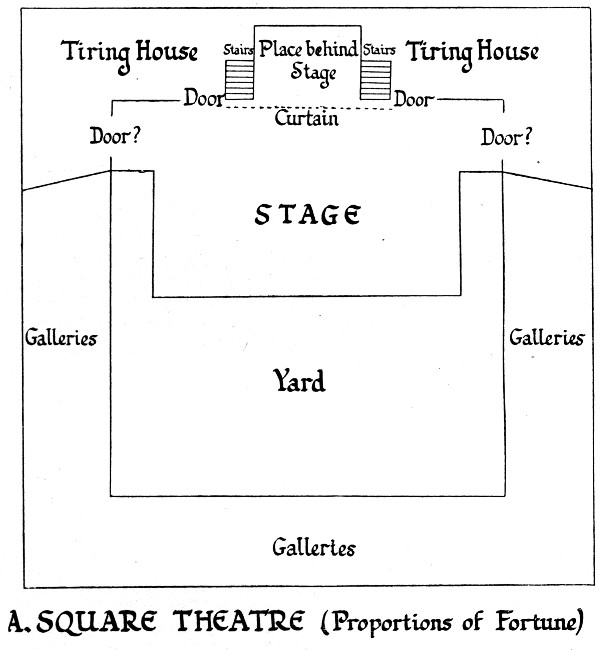
A. SQUARE THEATRE (Proportions of Fortune)
I conceive, therefore, of the alcove as a space which the tire-man, behind the curtains and in close proximity to the screens and properties stored in the tire-house, can arrange as he likes, without any interruption to continuous action proceeding on the outer stage. He can put up a house-front with a door, and if needed, a porch. He can put up a shop, or for that matter, a couple of adjacent shops. He can put up the arched gates of a city or castle. These are comparatively shallow structures. But he can also take advantage of the whole depth of the space, and arrange a chamber, a cave, or a bower, furnishing it as he pleases, and adding doors at the back or side, or a back window, which would enable him to give more light, even if only borrowed light from the tire-house, to an interior scene.[249] One point, however, is rather puzzling. There are some scenes which imply entrance to a chamber, not from behind, but from the open stage in front, and by a visible door which can be knocked at or locked. Thus in Romeo and Juliet, of which all the staging is rather difficult on any hypothesis, the Friar observes Juliet coming towards his cell, and after they have discoursed Juliet bids him shut the door. Here, no doubt, the Friar may have looked out and seen Juliet through a back window, and she may have entered by a back door. But in an earlier scene, where we get the stage-direction ‘Enter Nurse and knockes’, and the knocking is repeated until the Nurse is admitted to the cell, we are, I think, bound to suppose that the entry is in front, in the sight of the audience, and antecedent to the knocking.[250] Perhaps an even clearer case is in Captain Thomas Stukeley, where Stukeley’s chamber in the Temple is certainly approached from the open stage by a door at which Stukeley’s father knocks, and which is unlocked and locked again.[251] Yet how can a door be inserted in that side of a chamber which is open to the stage and the audience. Possibly it was a very conventional door set across the narrow space between the arras and the back wall of the main stage, at the corner of the aperture and at right angles to its plane. The accompanying diagrams will perhaps make my notion of the inner stage clearer.
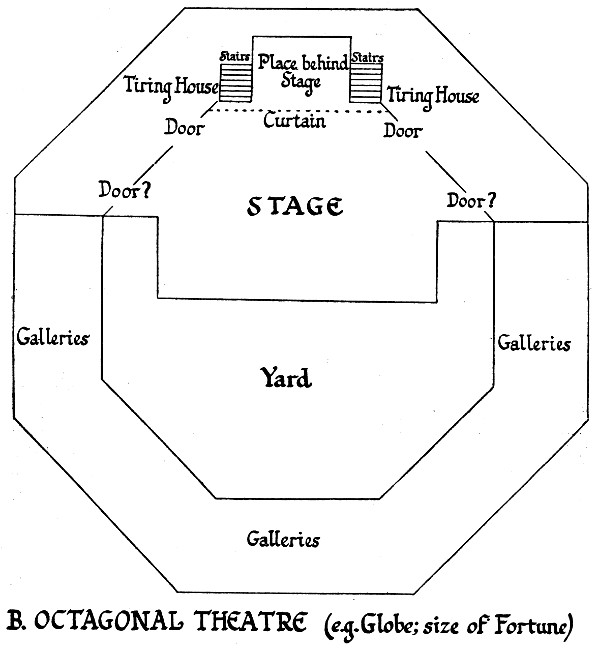
B. OCTAGONAL THEATRE (e.g. Globe; size of Fortune)
It has been suggested, by me as well as by others, that the inner stage may have been raised by a step or two above the outer stage.[252] On reflection, I now think this unlikely. There would be none too much height to spare, at any rate if the height of the alcove was determined by that of the spectators’ galleries. The only stage-direction which suggests any such arrangement is in the Death of Robin Hood, where the King sits in a chair behind the curtains, and the Queen ascends to him and descends again.[253] But even if the tire-man put up an exalted seat in this case, there need have been no permanent elevation. The missing woodcut of the Anglo-German stage at Frankfort in 1597 is said to have shown a raised inner stage; but until it is recovered, it is difficult to estimate its value as testimony upon the structure of the London theatres.[254]
It must not, of course, be taken for granted that every curtain, referred to in text or stage-directions as ‘drawn’, was necessarily a back curtain disclosing an alcove. In some, although not all, of the bedchamber scenes the indications do not of themselves exclude the hypothesis of a bed standing on the open stage and the revealing of the occupant by the mere drawing of bed-curtains.[255] I do not think there is any certain example of such an arrangement in a sixteenth-century play.[256] But tents also could be closed by curtains, and the plot of 2 Seven Deadly Sins requires Henry VI to lie asleep in ‘A tent being plast one the stage’, while dumb-shows enter ‘at one dore’ and ‘at an other dore’.[257] However it may have been with other theatres, we cannot, on the evidence before us, assert that the Swan had an alcove at all; and if it had not, it was probably driven to provide for chamber scenes by means of some curtained structure on the stage itself.
On the other hand, it must not be supposed that every case, in which a back curtain was drawn, will have found record in the printed book of the play concerned; and when the existence of an alcove has once been established, it becomes legitimate to infer its use for various chamber and analogous scenes, to the presentation of which it would have been well adapted. But this inference, again, must not be twisted into a theory that the stage in front of the back wall served only for out-of-door scenes, and that all interior action was housed, wholly or in part, in the alcove. This is, I think, demonstrably untrue, as regards the large group of indoor scenes which I have called hall scenes. In the first place, the alcove would not have been spacious enough to be of any value for a great many of the hall scenes. You could not stage spectacular action, such as that of a coronation, a sitting of parliament, or a trial at the bar, in a box of 15 by 13 feet and only 9 feet high. A group of even so many as ten persons clustered round a bed is quite another thing. I admit the device of the so-called ‘split’ scene, by which action beginning in the alcove is gradually extended so as to take the whole of the stage into its ambit.[258] This might perhaps serve for a court of justice, with the judges in the alcove, the ‘bar’ drawn across the aperture, and the prisoners brought in before it. A scene in which the arras is drawn in Sir Thomas More points to such a setting.[259] But a scene in which a royal ‘state’ is the dominating feature would be singularly ineffective if the state were wedged in under the low roof of the alcove; and if I am right in thinking that the ‘state’ normally creaked down into its position from the heavens, it would clearly land, not within the alcove, but upon the open stage in front of it. Indeed, if it could be placed into position behind a curtain, there would be no reason for bringing it from the heavens at all. Then, again, hall scenes are regularly served by two or more doors, which one certainly would not suppose from the stage-directions to be any other than the doors similarly used to approach out-of-door scenes; and they frequently end with injunctions to ‘come in’, which would be superfluous if the personages on the stage could be withdrawn from sight by the closing of the curtain. Occasionally, moreover, the gallery over the stage comes into play in a hall scene, in a way which would not be possible if the personages were disposed in the alcove, over which, of course, this gallery projected.[260] Some of these considerations tell more directly against the exclusive use of the alcove for hall scenes, than against its use in combination with the outer stage; and this combined use, where suitable, I am quite prepared to allow. But ordinarily, I think, the hall scenes were wholly on the outer stage; and this must necessarily have been the case where two rooms were employed, of which one opens out behind the other.[261]
It may be said that the main object of the curtain is to allow of the furniture and decorations of a ‘set’ scene, which is usually an interior scene, being put in place behind it, without any interruption to the continuous progress of an act; and that hall scenes cannot be set properly, unless they also are behind the curtain line. I do not think that there is much in this argument. A hall scene does not require so much setting as a chamber scene. It is sufficiently furnished, at any rate over the greater part of its area, with the state and such lesser seats as can very readily be carried on during the opening speeches or during the procession by which the action is often introduced. A bar can be set up, or a banquet spread, or a sick man brought in on his chair, as part of the action itself.[262] Even an out-of-door scene, such as an execution or a duel in the lists, sometimes demands a similar adjustment;[263] it need no more give pause than the analogous devices entailed by the removal of dead bodies from where they have fallen.
I must not be taken to give any countenance to the doctrine that properties, incongruous to the particular scene that was being played, were allowed to stand on the public Elizabethan stage, and that the audience, actually or through a convention, was not disturbed by them.[264] This doctrine appears to me to rest upon misunderstandings of the evidence produced in its support, and in particular upon a failure to distinguish between the transitional methods of setting employed by Lyly and his clan, and those of the permanent theatres with which we are now concerned. The former certainly permitted of incongruities in the sense that, as the neo-classic stage strove to adapt itself to a romantic subject-matter, separate localities, with inconsistent properties, came to be set at one and the same time in different regions of the stage. But the system proved inadequate to the needs of romanticism, as popular audiences understood it; and, apart from some apparent rejuvenescence in the ‘private’ houses, with which I must deal later, it gave way, about the time of the building of the permanent theatres, to the alternative system, by which different localities were represented, not synchronously but successively, and each in its turn had full occupation of the whole field of the stage. This full occupation was not, I venture to think, qualified by the presence in any scene of a property inappropriate to that scene, but retained there because it had been used for some previous, or was to be used for some coming, scene. I do not mean to say that some colourless or insignificant property, such as a bench, may not have served, without being moved, first in an indoors and then in an out-of-doors scene. But that the management of the Theatre or the Rose was so bankrupt in ingenuity that the audience had to watch a coronation through a fringe of trees or to pretend unconsciousness while the strayed lovers in a forest dodged each other round the corners of a derelict ‘state’, I, for one, see no adequate reason to believe. It is chiefly the state and the trees which have caused the trouble. But, after all, a state which has creaked down can creak up again, just as a banquet or a gallows which has been carried on can be carried off. Trees are perhaps a little more difficult. A procession of porters, each with a tree in his arms, would be a legitimate subject for the raillery of The Admirable Bashville. A special back curtain painted en pastoralle would hardly be adequate, even if there were any evidence for changes of curtain; trees were certainly sometimes practicable and therefore quasi-solid.[265] The alcove, filled with shrubs, would by itself give the illusion of a greenhouse rather than a forest; moreover, the alcove was available in forest scenes to serve as a rustic bower or cottage.[266] Probably the number of trees dispersed over the body of the stage was not great; they were a symbolical rather than a realistic setting. On the whole, I am inclined to think that, at need, trees ascended and descended through traps; and that this is not a mere conjecture is suggested by a few cases in which the ascent and descent, being part of a conjuring action, are recorded in the stage-directions.[267] One of these shows that the traps would carry not merely a tree but an arbour. The traps had, of course, other functions. Through them apparitions arose and sank;[268] Jonah was spewed up from the whale’s belly;[269] and the old device of hell-mouth still kept alive a mediaeval tradition.[270] Only primitive hydraulics would have been required to make a fountain flow or a fog arise;[271] although it may perhaps be supposed that the episodes, in which personages pass to and from boats or fling themselves into a river, were performed upon the extreme edge of the stage rather than over a trap.[272] I do not find any clear case, in the public sixteenth-century theatres, of the convention apparently traceable in Lyly and Whetstone, by which the extreme edge of the stage is used for ‘approach’ scenes, as when a traveller arrives from afar, or when some episode has to be represented in the environs of a city which furnishes the principal setting.[273] And I think it would certainly be wrong to regard the main stage, apart from the alcove, as divided into an inner area covered by the heavens and an outer area, not so covered and appropriate to open-country scenes. Indeed, the notion that any substantial section of the stage appeared to the audience not to lie under the heavens is in my view an illusion due to the unskilful draughtsmanship of De Witt or his copyist. Skyey phenomena belong most naturally to open-country scenes, nor are these wholly debarred from the use of the state; and the machinery employed in both cases seems to imply the existence of a superincumbent heavens.[274]
I come finally to the interesting question of the gallery above the stage. This, in the Swan drawing, may project very slightly over the scenic wall, and is divided by short vertical columns into six small compartments, in each of which one or two occupants are sitting. They might, of course, be personages in the play; but, if so, they seem curiously dissociated from the action. They might be musicians, but they appear to include women, and there is no clear sign of musical instruments. On the whole, they have the air of spectators.[275] However this may be, let us recall what has already been established in an earlier chapter, that there is conclusive evidence for some use of the space above the stage for spectators, at least until the end of the sixteenth century, and for some use of it as a music-room, at least during the seventeenth century.[276] With these uses we have to reconcile the equally clear indications that this region, or some part of it, was available when needed, throughout the whole of the period under our consideration, as a field for dramatic action. For the moment we are only concerned with the sixteenth century. A glance back over my footnotes will show many examples in which action is said to be ‘above’ or ‘aloft’, or is accompanied by the ascent or descent of personages from or to the level of the main stage. This interplay of different levels is indeed the outstanding characteristic of the Elizabethan public theatre, as compared with the other systems of stage-presentment to which it stands in relation. There are mediaeval analogies, no doubt, and one would not wish to assert categorically that no use was ever made of a balcony or a house-roof in a Greek or Roman or Italian setting. But, broadly speaking, the classical and neo-classical stage-tradition, apart from theophanies, is one of action on a single level. Even in the Elizabethan Court drama, the platform comes in late and rarely, although the constant references to ‘battlements’ in the Revels Accounts enable us to infer that, by the time when the public theatres came to be built, the case of Orestes was not an isolated one. Battlements, whatever the extension which the Revels officers came to give to the term, were primarily for the beloved siege scenes, and to the way in which siege scenes were treated in the theatres I must revert. But from two plays, The Rare Triumphs of Love and Fortune and The Woman in the Moon, both of which probably represent a late development of the Court drama, we may gather at least one other definite function of the platform, as a point of vantage from which presenters, in both cases of a divine type, may sit ‘sunning like a crow in a gutter’, and watch the evolution of their puppets on the stage below.[277] This disposition of presenters ‘aloft’ finds more than one parallel in the public theatres. The divine element is retained in The Battle of Alcazar, where Henslowe’s plot gives us, as part of the direction for a dumb-show, ‘Enter aboue Nemesis’.[278] There are traces of it also in James IV and in A Looking Glass for London and England. In James IV the presenters are Bohan, a Scot, and Oberon, king of fairies. They come on the stage for an induction, at the end of which Bohan says, ‘Gang with me to the Gallery, and Ile show thee the same in action by guid fellowes of our country men’, and they ‘Exeunt’. Obviously they watch the action, for they enter again and comment upon it during act-intervals. One of their interpositions is closed with the words ‘Gow shrowd vs in our harbor’; another with ‘Lets to our sell, and sit & see the rest’.[279] In the Looking Glass we get after the first scene the direction, ‘Enters brought in by an angell Oseas the Prophet, and set downe ouer the Stage in a Throne’. Oseas is evidently a presenter; the actors ignore him, but he makes moral comments after various scenes, and at the end of Act IV comes the further direction, ‘Oseas taken away’.[280] Purely human presenters in The Taming of a Shrew are still on a raised level. Sly is removed from the main stage during the first scene of the induction. He is brought back at the beginning of the second scene, presumably above, whence he criticizes the play, for towards the end the lord bids his servants
lay him in the place where we did find him, Just underneath the alehouse side below;
and this is done by way of an epilogue.[281]
I do not suggest that presenters were always above; it is not so when they merely furnish the equivalent of a prologue or epilogue, but only when it is desired to keep them visible during the action, and on the other hand they must not obstruct it. Sometimes, even when their continued presence might be desirable, it has to be dispensed with, or otherwise provided for. The presenters in Soliman and Perseda come and go; those in The Spanish Tragedy sit upon the stage itself. Why? I think the answer is the same in both cases. A platform was required for other purposes. In Soliman and Perseda one scene has the outer wall of a tiltyard reached by ladders from the stage; another has a tower, from which victims are tumbled down out of sight.[282] In the Spanish Tragedy, apart from some minor action ‘above’, there is the elaborate presentation of Hieronimo’s ‘play within the play’ to be provided for. This must be supposed to be part of a hall scene. It occupies, with its preparations, most of the fourth, which is the last, act; and for it the King and his train are clearly seated in an upper ‘gallerie’, while the performance takes place on the floor of the hall below, with the body of Horatio concealed behind a curtain, for revelation at the appropriate moment.[283] We are thus brought face to face with an extension on the public stage of the use of ‘above’, beyond what is entailed by the needs of sieges or of exalted presenters. Nor, of course, are the instances already cited exhaustive. The gallery overlooking a hall in the Spanish Tragedy has its parallel in the window overlooking a hall in Dr. Faustus.[284] More frequent is an external window, door, or balcony, overlooking an external scene in street or garden.[285] In these cases the action ‘above’ is generally slight. Some one appears in answer to a summons from without; an eavesdropper listens to a conversation below; a girl talks to her lover, and there may be an ascent or descent with the help of a rope-ladder or a basket. But there are a few plays in which we are obliged to constitute the existence of a regular chamber scene, with several personages and perhaps furniture, set ‘above’. The second scene of the induction to the Taming of the Shrew, just cited, is already a case in point. The presenters here do not merely sit, as spectators in the lord’s room might, and listen. They move about a chamber and occupy considerable space. Scenes which similarly require the whole interior of an upper room to be visible, and not merely its balcony or window bay, are to be found in 1 Sir John Oldcastle, in Every Man In his Humour, twice in The Jew of Malta, in 2 Henry IV, and in Look About You.[286] I do not know whether I ought to add Romeo and Juliet. Certainly the love scenes, Act II, scc. i and ii, and Act III, sc. v, require Juliet’s chamber to be aloft, and in these there is no interior action entailing more than the sound of voices, followed by the appearance of the speakers over Juliet’s shoulder as she stands at the casement or on a balcony.[287] It would be natural to assume that the chamber of Act IV, sc. iii, in which Juliet drinks her potion, and sc. v, in which she is found lying on her bed, is the same, and therefore also aloft. Obviously its interior, with the bed and Juliet, must be visible to the spectators. The difficulty is that it also appears to be visible to the wedding guests and the musicians, as they enter the courtyard from without; and this could only be, if it were upon the main level of the stage. If the scene stood by itself, one would undoubtedly assign it to the curtained recess behind the stage; and on the whole it is probable that on this occasion architectural consistency was sacrificed to dramatic effect, and Juliet’s chamber was placed sometimes above and sometimes below.[288] There is one other type of scene which requires elevated action, and that is the senate-house scene, as we find it in The Wounds of Civil War and in Titus Andronicus, where the Capitol clearly stands above the Forum, but is within ear-shot and of easy approach.[289]
I think we are bound to assume that some or all of this action ‘above’ took place in the gallery ‘over the stage’, where it could be readily approached from the tiring-house behind, and could be disposed with the minimum of obstruction to the vision of the auditorium. A transition from the use of this region for spectators to its use for action is afforded by the placing there of those idealized spectators, the presenters. So far as they are concerned, all that would be needed, in a house arranged like the Swan, would be to assign to them one or more, according to their number, of the rooms or compartments, into which the gallery was normally divided. One such compartment, too, would serve well for a window, and would be accepted without demur as forming part of the same ‘domus’ to which a door below, or, as in The Merchant of Venice, a penthouse set in the central aperture, gave access. To get a practicable chamber, it would be necessary to take down a partition and throw two of the compartments, probably the two central compartments, into one; but there would still be four rooms left for the lords. As a matter of fact, most upper chamber scenes, even of the sixteenth century, are of later date than the Swan drawing, and some architectural evolution, including the provision of a music-room, may already have taken place, and have been facilitated by the waning popularity of the lord’s rooms. It will be easier to survey the whole evolution of the upper stage in the next chapter.[290] For the present, let us think of the upper chamber as running back on the first floor of the tiring-house above the alcove, and reached from within by stairs behind the scenic wall, of which, if desired, the foot could perhaps be made visible within the alcove.[291] Borrowed light could be given by a window at the back, from which also the occupants of the room could pretend to look out behind.[292] Internal doors could of course also be made available. A scene in The Jew of Malta requires a trap in the floor of the upper chamber, over a cauldron discovered in the alcove below.[293] The upper chamber could be fitted, like the alcove itself, with an independent curtain for discoveries.[294]
Are we to conclude that all action ‘above’ was on or behind the back line of the stage? The point upon which I feel most uncertainty is the arrangement of the battlements in the stricter sense.[295] These appear to be generally regarded as running along the whole of the back line, with the gates of the town or castle represented in the central aperture below. Some writers suggest that they occupied, not the actual space of the rooms or boxes ‘over the stage’, but a narrow balcony running in front of these.[296] I cannot satisfy myself that the Swan drawing bears out the existence of any projecting ledge adequate for the purpose. On the other hand, if all the compartments of the gallery were made available and their partitions removed, all the spectators ‘over the stage’ must have been displaced; and siege scenes are early, and numerous. I do not know that it is essential to assume that the battlements extended beyond the width of two compartments. There is some definite evidence for a position of the ‘walles’ on the scenic line, apart from the patent convenience of keeping the main stage clear for besieging armies, in Jasper Mayne’s laudation of Ben Jonson:
Thou laid’st no sieges to the music-room.[297]
I am content to believe that this is where they normally stood. At the same time, it is possible that alternative arrangements were not unknown. In the Wagner Book, which must be supposed to describe a setting of a type not incredible on the public stage, we are told of a high throne, presumably at the back, of hell mouth ‘at the one end of the stage’, and of an elaborate castle ‘at the other end in opposition’. This is ‘the place where in the bloudlesse skirmishes are so often perfourmed upon the stage’, and although I should not press this as meaning that the walls were always at an ‘end’ of the stage, the passage would be absurd, if they were invariably at the back.[298] Further, there is at least one extant play in which it is very difficult to envisage certain scenes with the walls at the back. This is 1 Henry VI, the Orleans scenes of which, with the leaping over the walls, and the rapid succession of action in the market-place within the town and in the field without, seem to me clearly to point to walls standing across the main stage from back to front.[299] But if so, how were such walls put into place? The imagination boggles at the notion of masons coming in to build a wall during the action, in the way in which attendants might set up a bar or a lists, or carpenters the gibbet for an execution. Bottom’s device for Pyramus and Thisbe would hardly be more grotesque. Yet the Orleans siege scenes in 1 Henry VI are by no means coincident with acts, and could not therefore be set in advance and dismantled at leisure when done with. Can the walls have been drawn forwards and backwards, with the help of some machine, through the doors or the central aperture?[300] It is not inconceivable, and possibly we have here the explanation of the ‘j whell and frame in the Sege of London’, which figures in the Admiral’s inventories. Once the possibility of a scenic structure brought on to the main stage is mooted, one begins to look for other kinds of episode in which it would be useful. This, after all, may have been the way in which a gibbet was introduced, and the Admiral’s had also ‘j frame for the heading in Black Jone’, although nothing is said of a wheel.[301] The senate houses could, I think, have been located in the gallery, but the beacon in King Leir would not look plausible there, and the Admiral’s had a beacon, apparently as a detached property.[302] I am also inclined to think that a wall may occasionally have been drawn across the stage to make a close of part of it for a garden scene. In Act II of Romeo and Juliet Romeo pretty clearly comes in with his friends in some public place of the city, and then leaps a wall into an orchard, where he is lost to their sight, and finds himself under Juliet’s window. He must have a wall to leap. I mentioned Pyramus and Thisbe just above with intent, for what is Pyramus and Thisbe but a burlesque of the Romeo and Juliet motive, which would have been all the more amusing, if a somewhat conspicuous and unusual wall had been introduced into its model? Another case in point may be the ‘close walk’ before Labervele’s house in A Humorous Day’s Mirth.[303] I have allowed myself to stray into the field of conjecture.
One other possible feature of action ‘above’ must not be left out of account. The use of the gallery may have been supplemented on occasion by that of some window or balcony in the space above it, which De Witt’s drawing conceals from our view. Here may have been the ‘top’ on which La Pucelle appears in the Rouen episode of 1 Henry VI, and the towers or turrets, which are sometimes utilized or referred to in this and other plays.[304] It would be difficult to describe the central boxes of the Swan gallery as a tower.
Before any attempt is made to sum up the result of this long chapter, one other feature of sixteenth-century staging, which is often overlooked, requires discussion. In the majority of cases the background of an out-of-door scene need contain at most a single domus; and this, it is now clear, can be represented either by a light structure, such as a tent or arbour, placed temporarily upon the floor of the stage, or more usually by the scena or back wall, with its doors, its central aperture, and its upper gallery. There are, however, certain scenes in which one domus will not suffice, and two or possibly even three, must be represented. Thus, as in Richard III, there may be two hostile camps, with alternating action at tents in each of them.[305] There may also be interplay, without change of scene, between different houses in one town or village. In Arden of Feversham, Arden’s house and the painter’s are set together;[306] in The Taming of A Shrew, the lord’s house and the alehouse for the induction, and Polidor’s and Alphonso’s during the main play;[307] in The Blind Beggar of Alexandria, the houses of Elimine and Samethis;[308] in 1 Sir John Oldcastle, Cobham’s gate and an inn;[309] in Stukeley, Newton’s house and a chamber in the Temple;[310] in A Knack to Know an Honest Man, Lelio’s and Bristeo’s for one scene, Lelio’s and a Senator’s for another, possibly Lelio’s and Servio’s, though of this I am less sure, for a third.[311] These are the most indisputable cases; given the principle, we are at liberty to conjecture its application in other plays. Generally the houses may be supposed to be contiguous; it is not so in Stukeley, where Old Stukeley clearly walks some little distance to the Temple, and here therefore we get an example of that foreshortening of distance between two parts of a city, with which we became familiar in the arrangement of Court plays.[312] It is not the only example. In George a Greene Jenkin and the Shoemaker walk from one end to the other of Wakefield.[313] In Arden of Feversham, although this is an open-country and not an urban scene, Arden and Francklin travel some little way to Raynham Down.[314] In Dr. Faustus, so far as we can judge from the unsatisfactory text preserved, any limitation to a particular neighbourhood is abandoned, and Faustus passes without change of scene from the Emperor’s Court to his own home in Wittenberg.[315] Somewhat analogous is the curious device in Romeo and Juliet, where the maskers, after preparing in the open, ‘march about the stage’, while the scene changes to the hall of Capulet, which they then enter.[316]
I think, then, it must be taken that the background of a public stage could stand at need, not merely for a single domus, but for a ‘city’. Presumably in such cases the central aperture and the gallery above it were reserved for any house in which interior action was to proceed, and for the others mere doors in the scenic wall were regarded as adequate. I do not find any sixteenth-century play which demands either interior action or action ‘above’ in more than one house.[317] But a question arises as to how, for a scene in which the scenic doors had to represent house doors, provision was made for external entrances and exits, which certainly cannot be excluded from such scenes. Possibly the answer is, although I feel very doubtful about it, that there were never more than two houses, and that therefore one door always remained available to lead on and off the main stage.[318] Possibly also entrances and exits by other avenues than the two scenic doors, which we infer from the Swan drawing, and the central aperture which we feel bound to add, are not inconceivable. We have already had some hint that three may not have been the maximum number of entrances. If the Elizabethan theatre limited itself to three, it would have been worse off than any of the early neo-classic theatres based upon Vitruvius, in which the porta regia and portae minores of the scenic wall were regularly supplemented by the viae ad forum in the versurae to right and left of the proscenium.[319] No doubt such wings could not be constructed at the Swan, where a space was left on the level of the ‘yard’ between the spectators’ galleries and the right and left edges of a narrow stage. But they would be feasible in theatres with wider stages, and the arrangement, if it existed, would make the problem of seats on the stage easier.[320] It is no more than a conjecture. It has also been suggested that the heavy columns drawn by De Witt may have prevented him from showing two entrances round the extreme ends of the scenic wall, such as are perhaps indicated in some of the Terentian woodcuts of 1493.[321] Or, finally, actors might have emerged from the tiring-house into the space on the level of the yard just referred to, and thence reached the stage, as from without, by means of a short flight of steps.[322]
Working then from the Swan stage, and only departing in any essential from De Witt’s drawing by what appears to be, at any rate for theatres other than the Swan, the inevitable addition of a back curtain, we find no insuperable difficulty in accounting for the setting of all the types of scenes recognizable in sixteenth-century plays. The great majority of them, both out-of-door scenes and hall scenes, were acted on the open stage, under the heavens, with no more properties and practicable terrains than could reasonably be carried on by the actors, lowered from the heavens, raised by traps, or thrust on by frames and wheels. For more permanent background they had the scenic doors, the gallery above, the scenic curtain, and whatever the tire-man might choose to insert in the aperture, backed by an alcove within the tire-house, which the drawing of the curtain discovered. For entrances they had at least the scenic doors and aperture. The comparatively few chamber scenes were set either in the alcove or in a chamber ‘above’, formed by throwing together two compartments of the gallery. A window in a still higher story could, if necessary, be brought into play. So, with all due respect to the obscurities of the evidence, I reconstruct the facts. It will, I hope, be apparent without any elaborate demonstration that this system of public staging, as practised by Burbadge at the Theatre, by Lanman at the Curtain, by Henslowe at the Rose, and perhaps with some modifications by Langley at the Swan, is very fairly in line with the earlier sixteenth-century tradition, as we have studied it in texts in which the Court methods are paramount. This is only natural, in view of the fact that the same plays continued to be presented to the public and to the sovereign. There is the same economy of recessed action, the same conspicuous tendency to dialogue on a threshold, the same unwillingness to break the flow of an act by any deliberate pause for resetting. The public theatre gets in some ways a greater variety of dramatic situation, partly owing to its free use of the open stage, instead of merely a portico, for hall scenes, partly owing to its characteristic development of action ‘above’. This, in spite of the battlements of the Revels accounts, may perhaps be a contribution of the inn-yard. The main change is, of course, the substitution for the multiple staging of the Court, with its adjacent regions for different episodes, of a principle of successive staging, by which the whole space became in turn available for each distinct scene. This was an inevitable change, as soon as the Elizabethan love for history and romance broke down the Renaissance doctrine of the unity of place; and it will not be forgotten that the beginnings of it are already clearly discernible in the later Court drama, which of course overlaps with the popular drama, itself. Incidentally the actors got elbow-room; some of the Lylyan scenes must have been very cramped. But they had to put up with a common form setting, capable only of minor modifications, and no doubt their architectural decorations and unvarying curtain were less interesting from the point of view of spectacle, than the diversity of ‘houses’ which the ingenuity and the resources of the Court architects were in a position to produce. In any case, however, economy would probably have forbidden them to enter into rivalry with the Revels Office. Whether the Elizabethan type of public stage was the invention of Burbadge, the ‘first builder of theatres’, or had already come into use in the inn-yards, is perhaps an idle subject for wonder. The only definite guess at its origin is that of Professor Creizenach, who suggests that it may have been adapted from the out-of-door stages, set up from time to time for the dramatic contests held by the Rederijker or Chambers of Rhetoric in Flanders.[323] Certainly there are common features in the division of the field of action into two levels and the use of curtained apertures both below and above. But the latest examples of the Flemish festivals were at Ghent in 1539 and at Antwerp in 1561 respectively; and it would be something of a chance if Burbadge or any other English builder had any detailed knowledge of them.[324]
XXI STAGING IN THE THEATRES: SEVENTEENTH CENTURY
[For Bibliographical Note, vide ch. xviii.]
The turn of the century is also a turning-point in the history of the public theatres. In 1599 the Chamberlain’s men built the Globe, and in 1600, not to be outdone, the Admiral’s men built upon the same model the Fortune. These remained the head-quarters of the same companies, when at the beginning of the reign of James the one became the King’s and the other the Prince’s men. Worcester’s, afterwards the Queen’s, men were content for a time with the older houses, first the Rose, then the Curtain and the Boar’s Head, but by 1605 or 1606 they were occupying the Red Bull, probably a new building, but one of which we know very little. Meanwhile the earlier Tudor fashion of plays by boys had been revived, both at Paul’s, and at the Blackfriars, where a theatre had been contrived by James Burbadge about 1596 in a chamber of the ancient priory, for the purposes of a public stage.
We cannot on a priori grounds assume that the structural arrangements of the sixteenth-century houses were merely carried into those of the seventeenth century without modification; the experience of twenty-five years’ working may well have disclosed features in the original plan of James Burbadge which were not altogether convenient or which lent themselves to further development. On the other hand, we have not got to take into account the possibility of any fundamental change or sharp breach of continuity. The introduction of a new type of stage, even if it escaped explicit record, would inevitably have left its mark both upon the dramatic construction of plays and upon the wording of their stage-directions. No such mark can be discerned. You cannot tell an early seventeenth-century play from a late sixteenth-century one on this kind of evidence alone; the handling and the conventions, the situations and the spectacular effects, remain broadly the same, and such differences as do gradually become apparent, concern rather the trend of dramatic interest than the external methods of stage-presentation. Moreover, it is evident that the sixteenth-century plays did not pass wholly into disuse. From time to time they were revived, and lent themselves, perhaps with some minor adaptation, to the new boards as well as to the old. In dealing with early seventeenth-century staging, then, I will assume the general continuance of the sixteenth-century plan, and will content myself with giving some further examples of its main features, and with considering any evidence which may seem to point to specific development in one or more particular directions. And on the whole it will be convenient to concentrate now mainly upon the theatres occupied by the King’s men. For this there are various reasons. One is that the possession of Shakespeare’s plays gives them a prerogative interest in modern eyes; another that the repertories of the other companies have hardly reached us in a form which renders any very safe induction feasible.
Even in the case of the King’s men, the material is not very ample, and there are complications which make it necessary to proceed by cautious steps to somewhat tentative conclusions. The Globe was probably opened in the autumn of 1599. The first play which we can definitely locate there is Every Man Out of his Humour; but I have decided with some hesitation to treat Henry V and Much Ado about Nothing, for the purposes of these chapters, as Globe plays.[325] So far as we know, the Globe was the only theatre used by the company up to the winter of 1609, when they also came into possession of the Blackfriars. From 1609 to 1613 they used both houses, but probably the Globe was still the more important of the two, for when it was burnt in 1613 they found it worth while to rebuild it fairer than before. At some time, possibly about the end of James’s reign, the Blackfriars began to come into greater prominence, and gradually displaced the Globe as the main head-quarters of the London drama. This, however, is a development which lies outside the scope of these volumes; nor can I with advantage inquire in detail whether there were any important structural features in which the new Globe is likely to have differed from the old Globe. At the most I can only offer a suggestion for the historian of the Caroline stage to take up in his turn. In the main, therefore, we have to consider the staging of the Globe from 1599 to 1609, and of the Globe and the Blackfriars from 1609 to 1613. The plays available fall into four groups. There are nineteen or twenty printed and probably produced during 1599–1609, of which, however, one or two were originally written for private theatres.[326] There are two produced and printed during 1609–12, and one preserved in manuscript from the same period.[327] There are ten probably produced during 1599–1603, but not printed before 1622 or 1623.[328] There are perhaps nine or ten produced during 1609–13, and printed at various dates from 1619 to 1634.[329] It will be seen that the first group is of much the greatest value evidentially, as well as fortunately the longest, but that it only throws light upon the Globe and not upon the Blackfriars; that the value of the second and fourth groups is discounted by our not knowing how far they reflect Globe and how far Blackfriars conditions; and that the original features of the third and fourth groups may have been modified in revivals, either at the Blackfriars or at the later Globe, before they got into print. I shall use them all, but, I hope, with discrimination.[330] I shall also use, for illustration and confirmation, rather than as direct evidence, plays from other seventeenth-century theatres. The Prince’s men were at the Fortune during the whole of the period with which we are concerned, and then on to and after the fire of 1621, and the reconstruction, possibly on new lines, of 1623. We know that its staging arrangements resembled those of the Globe, for it was provided in the builder’s contract that this should be so, and also that the stage should be ‘placed and sett’ in accordance with ‘a plott thereof drawen’. Alleyn would have saved me a great deal of trouble if he had put away this little piece of paper along with so many others. Unfortunately, the Prince’s men kept their plays very close, and only five or six of our period got into print before 1623.[331] From the Queen’s men we have rather more, perhaps sixteen in all; but we do not always know whether these were given at the Red Bull or the Curtain. Nor do we know whether any structural improvements introduced at the Globe and Fortune were adopted at the Red Bull, although this is a priori not unlikely.[332] From the Swan we have only The Chaste Maid of Cheapside, and from the Hope only Bartholomew Fair.
At the Globe, then, the types of scene presented are much the same as those with which we have become familiar in the sixteenth century; the old categories of open-country scenes, battle scenes, garden scenes, street scenes, threshold scenes, hall scenes, and chamber scenes will still serve. Their relative importance alters, no doubt, as the playwrights tend more and more to concern themselves with subjects of urban life. But there are plenty of battle scenes in certain plays, much on the traditional lines, with marchings and counter-marchings, alarums for fighting ‘within’, and occasional ‘excursions’ on the field of the stage itself.[333] Practicable tents still afford a convenient camp background, and these, I think, continue to be pitched on the open boards.[334] The opposing camps of Richard III are precisely repeated in Henry V.[335] There are episodes before the ‘walls’ too, with defenders speaking from above, assaults by means of scaling ladders, and coming and going through the gates.[336] I find no example in which a wall inserted on the line of the scenic curtain would not meet the needs of the situation. Pastoral scenes are also common, for the urban preoccupation has its regular reaction in the direction of pastoral. There is plenty of evidence for practicable trees, such as that on which Orlando in As You Like It hangs his love verses, and the most likely machinery for putting trees into position still seems to me to be the trap.[337] A trap, too, might bring up the bower for the play within the play of Hamlet, the pleached arbour of Much Ado about Nothing, the pulpit in the forum of Julius Caesar, the tombstone in the woods of Timon of Athens, the wayside cross of Every Man Out of his Humour, and other terrains most easily thought of as free-standing structures.[338] It would open for Ophelia’s grave, and for the still beloved ascents of spirits from the lower regions.[339] It remains difficult to see how a riverbank or the sea-shores was represented.[340] As a rule, the edge of the stage, with steps into the auditorium taken for water stairs, seems most plausible. But there is a complicated episode in The Devil’s Charter, with a conduit and a bridge over the Tiber, which I do not feel quite able to envisage.[341] There is another bridge over the Tiber for Horatius Cocles in the Red Bull play of the Rape of Lucrece. But this is easier; it is projected from the walls of Rome, and there must be a trapped cavity on the scenic line, into which Horatius leaps.[342]
The Hope contract of 1613 provides for the heavens to be supported without the help of posts rising from the stage. For this there was a special reason at the Hope, since the stage had to be capable of removal to make room for bear-baitings. But the advantage of dispensing with the posts and the obstacle to the free vision of the spectators which they presented must have been so great, that the innovation may well have occurred to the builders of the Globe. Whether it did, I do not think that we can say. There are one or two references to posts in stage-directions, but they need not be the posts of the heavens.[343] Possibly, too, there was less use of the descending chair. One might even fancy that Jonson’s sarcasm in the prologue to Every Man In his Humour discredited it. The new type of play did not so often call for spectacular palace scenes, and perhaps some simpler and more portable kind of ‘state’ was allowed to serve the turn. There is no suggestion of a descent from the heavens in the theophanies of As You Like It and Pericles; Juno, however, descends in The Tempest.[344] This, although it has practically no change of setting, is in some ways, under the mask influence, the most spectacular performance attempted by the King’s men at Globe or Blackfriars during our period.[345] But it is far outdone by the Queen’s plays of the Golden, Silver, and Brazen Ages, which, if they were really given just as Heywood printed them, must have strained the scenic resources of the Red Bull to an extreme. Here are ascents and descents and entries from every conceivable point of the stage;[346] divinities in fantastic disguise;[347] mythological dumb-shows;[348] battles and hunting episodes and revels;[349] ingenious properties, often with a melodramatic thrill;[350] and from beginning to end a succession of atmospheric phenomena, which suggest that the Jacobeans had made considerable progress in the art of stage pyrotechnics.[351] The Globe, with its traditional ‘blazing star’, is left far behind.[352]