Section IX. STAMENS IN PARTICULAR.
Reading edition
281. Andrœcium is a technical name for the staminate system of a flower (that is, for the stamens taken together), which it is sometimes convenient to use. The preceding section has dealt with modifications of the flower pertaining mainly to calyx and corolla. Those relating to the stamens are now to be indicated. First as to
282. Insertion, or place of attachment. The stamens usually go with the petals. Not rarely they are at base
Epipetalous, that is, inserted on (or adnate to) the corolla, as in Fig. 283. When free from the corolla, they may be
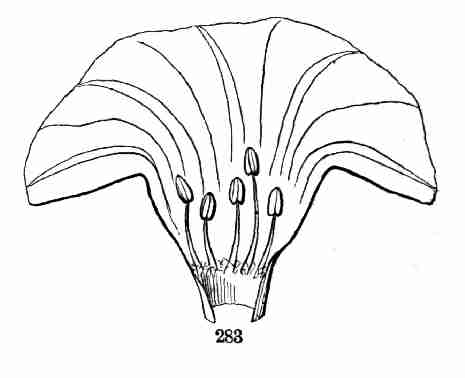
Fig. 283. Corolla of Morning Glory laid open, to show the five stamens inserted on it, near the base.
Hypogynous, inserted on the receptacle under the pistil or gynœcium.
Perigynous, inserted on the calyx, that is, with the lower part of filament adnate to the calyx-tube.
Epigynous, borne apparently on the top of the ovary; all which is explained in Fig. 270-274.
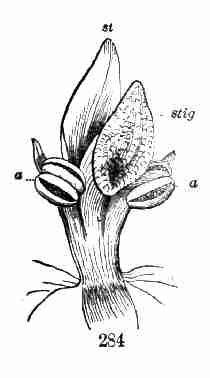
Fig. 284. Style of a Lady's Slipper (Cypripedium), and stamens united with it; a, a, the anthers of the two good stamens; st, an abortive stamen, what should be its anther changed into a petal-like body; stig, the stigma.
Gynandrous is another term relating to insertion of rarer occurrence, that is, where the stamens are inserted on (in other words, adnate to) the style, as in Lady's Slipper (Fig. 284), and in the Orchis family generally.
283. In Relation to each Other, stamens are more commonly
Distinct, that is, without any union with each other. But when united, the following technical terms of long use indicate their modes of mutual connection:—
Monadelphous (from two Greek words, meaning "in one brotherhood"), when united by their filaments into one set, usually into a ring or cup below, or into a tube, as in the Mallow Family (Fig. 286), the Passion-flower (Fig. 260), the Lupine (Fig. 287), and in Lobelia (Fig. 285).
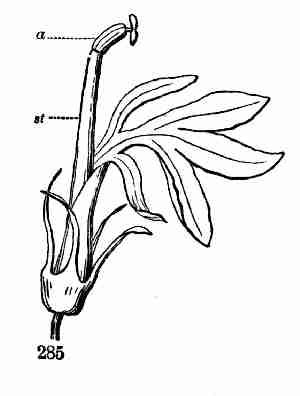
Fig. 285. Flower of Lobelia cardinalis, Cardinal flower; corolla making approach to the ligulate form; filaments (st) monadelphous, and anthers (a) syngenesious.
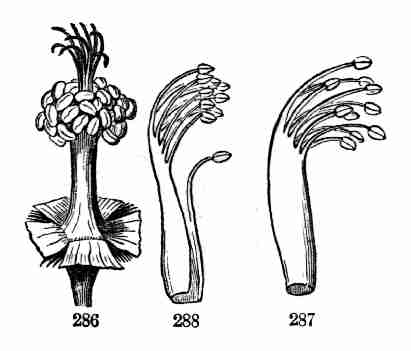
Fig. 286. Flower of a Mallow, with calyx and corolla cut away; showing monadelphous stamens.
Fig. 287. Monadelphous stamens of Lupine. 288. Diadelphous stamens (9 and 1) of a Pea-blossom.
Diadelphous (meaning in two brotherhoods), when united by the filaments into two sets, as in the Pea and most of its near relatives (Fig. 288), usually nine in one set, and one in the other.
Triadelphous (three brotherhoods), when the filaments are united in three sets or clusters, as in most species of Hypericum.
Pentadelphous (five brotherhoods), when in five sets, as in some species of Hypericum and in American Linden (Fig. 277, 289).
Polyadelphous (many or several brotherhoods) is the term generally employed when these sets are several, or even more than two, and the particular number is left unspecified. These terms all relate to the filaments.
Syngenesious is the term to denote that stamens have their anthers united, coalescent into a ring or tube; as in Lobelia (Fig. 285), in Violets, and in all of the great family of Compositæ.
284. Their Number in a flower is commonly expressed directly, but sometimes adjectively, by a series of terms which were the name of classes in the Linnæan artificial system, of which the following names, as also the preceding, are a survival:—
Monandrous, i. e. solitary-stamened, when the flower has only one stamen,
Diandrous, when it has two stamens only,
Triandrous, when it has three stamens,
Tetrandrous, when it has four stamens,
Pentandrous, when it has five stamens,
Hexandrous, when with six stamens, and so on to
Polyandrous, when it has many stamens, or more than a dozen.
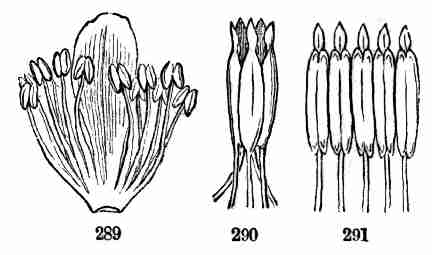
Fig. 289. One of the five stamen-clusters of the flower of American Linden, with accompanying scale. The five clusters are shown in section in the diagram of this flower, Fig. 277.
Fig. 290. Five syngenesious stamens of a Coreopsis. 291. Same, with tube laid open and displayed.
285. For which terms, see the Glossary. They are all Greek numerals prefixed to -andria (from the Greek), which Linnæus used for andrœcium, and are made into an English adjective, -androus. Two other terms, of same origin, designate particular cases of number (four or six) in connection with unequal length. Namely, the stamens are
Didynamous, when, being only four, they form two pairs, one pair longer than the other, as in the Trumpet Creeper, in Gerardia (Fig. 263), etc.
Tetradynamous, when, being only six, four of them surpass the other two, as in the Mustard-flower and all the Cruciferous family, Fig. 235.
286. The Filament is a kind of stalk to the anther, commonly slender or thread-like: it is to the anther nearly what the petiole is to the blade of a leaf. Therefore it is not an essential part. As a leaf may be without a stalk, so the anther may be Sessile, or without a filament.
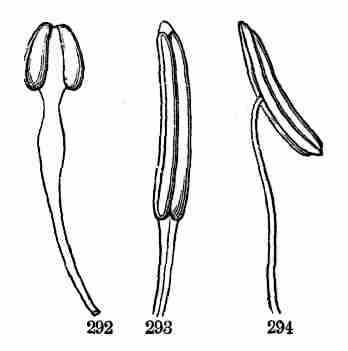
Fig. 292. Stamen of Isopyrum, with innate anther. 293. Of Tulip-tree, with adnate (and extrorse) anther. 294. Of Evening Primrose, with versatile anther.
287. The Anther is the essential part of the stamen. It is a sort of case, filled with a fine powder, the Pollen, which serves to fertilize the pistil, so that it may perfect seeds. The anther is said to be
Innate (as in Fig. 292), when it is attached by its base to the very apex of the filament, turning neither inward nor outward;
Adnate (as in Fig. 293), when attached as it were by one face, usually for its whole length, to the side of a continuation of the filament; and
Versatile (as in Fig. 294), when fixed by or near its middle only to the very point of the filament, so as to swing loosely, as in the Lily, in Grasses, etc. Versatile or adnate anthers are
Introrse, or Incumbent, when facing inward, that is, toward the centre of the flower, as in Magnolia, Water-Lily, etc.
Extrorse, when facing outwardly, as in the Tulip-tree.
288. Rarely does a stamen bear any resemblance to a leaf, or even to a petal or flower-leaf. Nevertheless, the botanist's idea of a stamen is that it answers to a leaf developed in a peculiar form and for a special purpose. In the filament he sees the stalk of the leaf; in the anther, the blade. The blade of a leaf consists of two similar sides; so the anther consists of two Lobes or Cells, one answering to the left, the other to the right, side of the blade. The two lobes are often connected by a prolongation of the filament, which answers to the midrib of a leaf; this is called the Connective. This is conspicuous in Fig. 292, where the connective is so broad that it separates the two cells of the anther to some distance.
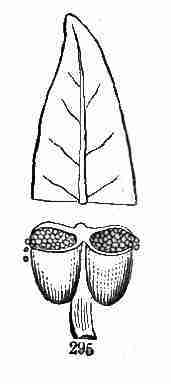
Fig. 295. Diagram of the lower part of an anther, cut across above, and the upper part of a leaf, to show how the one answers to the other; the filament to petiole, the connective to midrib; the two cells to the right and left halves of the blade.
289. A simple conception of the morphological relation of an anther to a leaf is given in Fig. 295, an ideal figure, the lower part representing a stamen with the top of its anther cut away; the upper, the corresponding upper part of a leaf.
290. So anthers are generally two-celled. But as the pollen begins to form in two parts of each cell (the anterior and the posterior), sometimes these two strata are not confluent, and the anther even at maturity may be four-celled, as in Moonseed (Fig. 296); or rather, in that case (the word cell being used for each lateral half of the organ), it is two-celled, but the cells bilocellate.
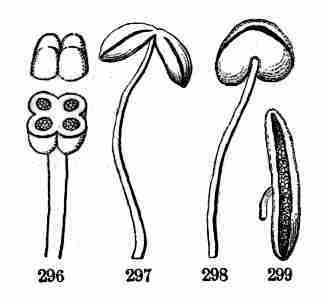
Fig. 296. Stamen of Moonseed, with anther cut across; this 4-celled, or rather 4-locellate.
Fig. 297. Stamen of Pentstemon pubescens; the two anther-cells diverging, and almost confluent.
Fig. 298. Stamen of Mallow; the anther supposed to answer to that of Fig. 297, but the cells completely confluent into one.
Fig. 299. Stamen of Globe Amaranth; very short filament bearing a single anther-cell; it is open from top to bottom, showing the pollen within.
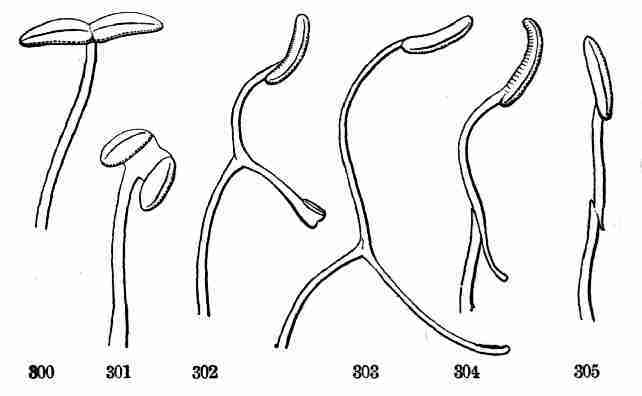
Fig. 300-305. Stamens of several plants of the Labiate or Mint Family. Fig. 300. Of a Monarda: the two anther-cells with bases divergent so that they are transverse to the filament, and their contiguous tips confluent, so as to form one cell opening by a continuous line. Fig. 301. Of a Calamintha: the broad connective separating the two cells. Fig. 302. Of a Sage (Salvia Texana); with long and slender connective resembling forks of the filament, one bearing a good anther-cell; the other an abortive or poor one. Fig. 303. Another Sage (S. coccinea), with connective longer and more thread-shaped, the lower fork having its anther-cell wholly wanting. Fig. 304. Of a White Sage, Audibertia grandiflora; the lower fork of connective a mere vestige. Fig. 305. Of another White Sage (A. stachyoides), the lower fork of connective suppressed.
291. But anthers may become one-celled, and that either by confluence or by suppression.
292. By confluence, when the two cells run together into one, as they nearly do in most species of Pentstemon (Fig. 297), more so in Monarda (Fig. 300), and completely in the Mallow (Fig. 298) and all the Mallow family.
293. By suppression in certain cases the anther may be reduced to one cell or halved. In Globe Amaranth (Fig. 299) there is a single cell without vestige of any other. Different species of Sage and of the White Sages of California show various grades of abortion of one of the anther-cells, along with a singular lengthening of the connective (Fig. 302-305).
294. The splitting open of an anther for the discharge of its pollen is termed its Dehiscence.
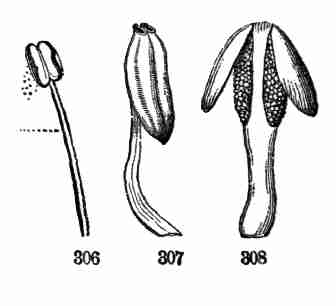
Fig. 306. Stamen with the usual dehiscence of anther down the side of each cell.
Fig. 307. Stamen of Pyrola; cells opening by a terminal hole.
Fig. 308. Stamen of Barberry; cells of anther each opening by an uplifted valve.
295. As the figures show, this is commonly by a line along the whole length of each cell, either lateral or, when the anthers are extrorse, often along the outer face, and when introrse, along the inner face of each cell. Sometimes the opening is only by a chink, hole, or pore at the top, as in the Azalea, Pyrola (Fig. 307), etc.; sometimes a part of the face separates as a sort of trap-door (or valve), hinged at the top, and opening to allow the escape of the pollen, as in the Sassafras, Spice-bush, and Barberry (Fig. 308).
296. Pollen. This is the powdery matter, commonly of a yellow color, which fills the cells of the anther, and is discharged during blossoming, after which the stamens generally fall or wither away. Under the microscope it is found to consist of grains, usually round or oval, and all alike in the same species, but very different in different plants. So that the plant may sometimes be recognized from the pollen alone. Several forms are shown in the accompanying figures.
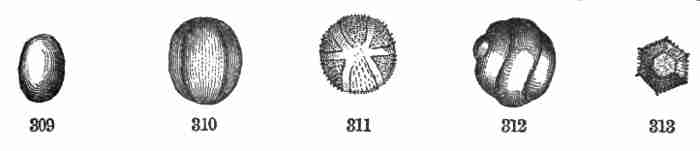
Fig. 309. Magnified pollen of a Lily, smooth and oval; 310, of Echinocystis, grooved lengthwise; 311, of Sicyos, with bristly points and smooth bands; 312, of Musk Plant (Mimulus), with spiral grooves; 313, of Succory, twelve-sided and dotted.
297. An ordinary pollen-grain has two coats; the outer coat thickish, but weak, and frequently adorned with lines or bands, or studded with points; the inner coat is extremely thin and delicate, but extensible, and its cavity when fresh contains a thickish protoplasmic fluid, often rendered turbid by an immense number of minute particles that float in it. As the pollen matures this fluid usually dries up, but the protoplasm does not lose its vitality. When the grain is wetted it absorbs water, swells up, and is apt to burst, discharging the contents. But when weak syrup is used it absorbs this slowly, and the tough inner coat will sometimes break through the outer and begin a kind of growth, like that which takes place when the pollen is placed upon the stigma.
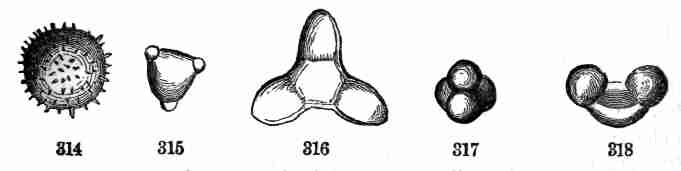
Fig. 314. Magnified pollen of Hibiscus and other Mallow-plants, beset with prickly projections; 315, of Circæa, with angles bearing little lobes; 316, of Evening Primrose, the three lobes as large as the central body; 317, of Kalmia, four grains united, as in most of the Heath family; 318, of Pine, as it were of three grains or cells united; the lateral empty and light.
298. Some pollen-grains are, as it were, lobed (as in Fig. 315, 316), or formed of four grains united (as in the Heath family, Fig. 317): that of Pine (Fig. 318) has a large rounded and empty bladder-like expansion upon each side. This renders such pollen very buoyant, and capable of being transported to a great distance by the wind.
299. In species of Acacia simple grains lightly cohere into globular pellets. In Milkweeds and in most Orchids all the pollen of an anther-cell is compacted or coherent into one mass, called a Pollen-mass, or Pollinium, plural Pollinia. (Fig. 319-322.)
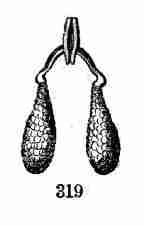
Fig. 319. Pollen, a pair of pollinia of a Milkweed, Asclepias, attached by stalks to a gland; moderately magnified.
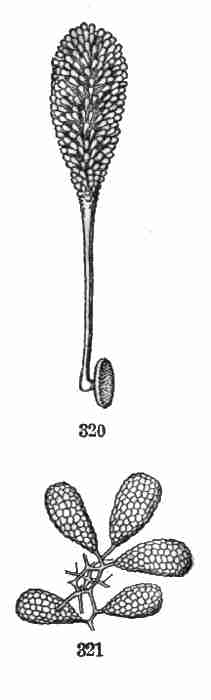
Fig. 320. Pollinium of an Orchis (Habenaria), with its stalk attached to a sticky gland; magnified. 321. Some of the packets or partial pollinia, of which Fig. 320 is made up, more magnified.
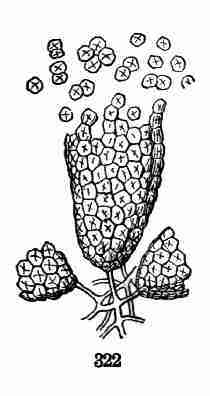
Fig. 322. One of the partial pollinia, torn up at top to show the grains (which are each composed of four), and highly magnified.