INDEX.
Reading edition
(Modern place-names in Italics.)
A.
Ad Salices (the Willows), battle of, 94.
Aemona (Laybach), 127, 131, 153.
Aequitius, Superintendent of the Palace, 100.
Aetius, 178, 191-210, 225, 226.
Agentes in Rebus, 42.
Alamanni, 25, 74.
Alani, 124, 152, 182, 196, 206.
Alaric, 131, 137-168.
Alatheus the Ostrogoth, 96, 97.
Alavivus, 87, 91.
Ambrose, St., 122.
Ammianus Marcellinus, 45, 47, 49, 102, 124.
Angles, 183.
Anianus, Bishop of Paris, 194.
Antioch, 23, 118-120.
Aquileia—besieged by Attila, 198.
Arbogast, 110, 128-132.
Ardaburius the Alan, 177.
Ardaric, King of the Gepidae, 196.
Arian controversy, 31.
Ariminum, plains of, 164, 172.
Aristocracy of Rome, not theoretically hereditary, 8;
manners of, in fourth century, 47-48.
Armogast, Count, 224.
Army, Roman, size of, in the fourth century, 39-40.
Ascholius, Bishop of Thessalonica, 109.
Aspar the Alan, 177.
Ataulfus, 172-175, 208.
Athanaric (Judge of the Visigoths), 79, 86, 111, 112.
Attalus, 162-164, 174.
Attila, King of the Huns, 180-203.
Augustine, St., 216.
Augustus, work of, 14.
B.
Bacurius, 131.
Baltic, the, 183, 184.
Barbaricum, 76, 79.
Barritus, the, 94.
Batvin (Gothic martyr), 79.
Bauto, the Frank, 110, 128, 142.
Bleda, King of the Huns, 180.
Bonifacius, Governor of Africa, 179, 209-214.
Bora, a fierce wind, 131.
Botheric, 121.
Bretons, the, 196.
Britain, invasion of by Angles and Saxons, 183-184.
Britain, Roman roads in, 2-4.
Brutus, 12.
Burgundians, the, 180, 196.
Busentus, the, Alaric buried in, 168.
C.
Caesar, work of, 13, 14;
on the Germans, 55.
Caesarius, 119, 120.
Camps, 20.
Carthage, Vandals at, 215, 218-220.
Cassiodorus, 49.
Castinus, Magister Militum, 177, 209.
Cauca (in Spain, the birthplace of Theodosius), 105.
Celtic nationality, 73.
Censorship, 9.
Châlons, battle of, so called, 195.
China, 183.
Christianity, relation of Diocletian to, 28.
— relation of Constantine to, 29.
— relation of Constantine’s successors to, 31.
Chrysopolis, battle of, 27.
Chrysostom, St. John, 120.
Clarissimi, class of, 43.
Claudian, 144.
Coinage, Imperial, of 1st and 3rd centuries contrasted, 19.
Coloni, condition of, 51-52.
Comes Privatarum Rerum, 42.
— Sacrarum Largitionum, 42.
Consistory, Imperial, 37.
— the Usurper, 152, 163, 207.
Constantinople, foundation of, 26;
siege of, 101.
Constantius I, 24-25.
— husband of Placidia, 176.
— secretary to Attila, 184, 185.
Crispus, son of Constantine, 27.
Crocus, king of the Alamanni, 25.
Curiales, 52-53.
D.
Damasus, Pope, 109.
Decurio, 52.
Diocletian, his work of restoration, 21-25;
his death, 26;
his relation to Christianity, 28.
E.
East, Prefecture of, 23.
Edeco the Hun, 186.
Ellebichus, 119, 120.
Emperor, Roman, appearance of, 34, 35;
titles of, 36.
Ernak, son of Attila, 190, 203.
Eucherius, 155, 158.
Eudoxia, wife of Arcadius, 142.
— wife of Valentinian III, 225, 228, 232.
— daughter of Valentinian III, 225;
married to Huneric, 232.
Eugenius, Emperor, 130, 131.
Eutropius, 142.
Extortion of Roman Governors, 11, 17.
F.
Fiesole, 149.
Firmus, 106.
Flaccilla, 126.
Flavianus, Bishop of Antioch, 118-120.
Food supply of Roman citizens, 48, 49.
Franks, 74, 152, 179, 196.
Frederic (Gothic martyr), 79.
Frigidus, battle of, 131.
Fritigern, Visigothic chieftain, 79, 86, 87, 91, 92, 96, 97, 111.
G.
Gainas the Goth, 131, 140, 141.
Gaiseric, King of the Vandals, 192, 209-234.
Galerius, colleague of Diocletian, 24.
Galla, wife of Theodosius, 126, 130.
Galla Placidia (see Placidia).
Games of the circus, 49.
Gau (= pagus), 65.
Gaudentius, father of Aetius, 178.
— son of Aetius, 226.
Gauls, prefecture of the, 22, 23.
Gelimer, King of the Vandals, 221.
Geougen, the, 183.
Gepidae, 182, 195, 202.
Germania of Tacitus, 55.
German kingship, 67-72.
— popular assemblies, 70-72.
Germans, condition of, 54-72.
Gerontius, 207.
Godigisclus, King of the Vandals, 206.
‘Gothic Architecture,’ 75;
Gothic Christianity, 78;
Gothic language, 76.
Goths, 75. See Visigoths, Ostrogoths.
Gratian, 91, 95, 105, 110, 111, 123-125.
Gunderic, King of the Vandals, 208, 209.
Gunthamund, King of the Vandals, 221.
H.
Hadrianople, battle of (323), 27.
— — (378), 96, 100.
Helena, mother of Constantine, 24.
Heraclian, 163, 167.
Heraclius the Eunuch, 226, 228.
Hermanric, King of the Ostrogoths, 76, 85.
Heruli, 182, 195, 202.
Hilderic, King of the Vandals, 221.
Hippo, siege of, 214, 216.
Hispalis (Seville) taken by Vandals, 209.
Honoria, 185, 192.
Honorius, 134, 146, 152-157, 161-164, 166, 176.
Huneric, 217.
Huns, 180, 193;
description of, by Jordanes, 81, 83;
ethnological character of, 84;
enter Europe (374), 85.
I.
Ildico, wife of Attila, 202.
Illustres, class of, 37.
Illyricum, Prefecture of, 23.
Ingenuus, 174.
Italy, Prefecture of, 23.
J.
Jerome, St., 45, 47, 174.
Joannes, Emperor, 177.
Jordanes (Gothic historian, wrote cir. 550), 81-83.
Jovian, 90.
Jovius, Praetorian prefect, 161-162.
‘Judges’ of the Visigoths, 76.
Julian ‘the Apostate,’ 90.
Julius, master of the soldiery, 104.
Justina, 91, 126, 128.
Jutes, the, 183.
K.
Kingship and national unity, 67.
L.
Lampadius, 153.
Lancearii, 98.
Land—settlement of the Germans, 60-62.
Latifundia, 50, 51.
Leo I, Pope, 200, 230.
Leo, Emperor, 232.
Libanius, 120.
Licinius, his struggle with Constantine, 27.
Lupicinus, Count of Thrace, 88-93.
Lupus, St., Bishop of Troyes, 195, 198.
M.
Magister Militiae, 39-40.
Magister Officiorum, 42.
Marcian, Emperor, 191.
Marcianople (Shumla), 92-93.
Marcomanni, 74.
Maria, wife of Honorius, 154.
Mattiarii, 98.
Maxentius, Emperor, 26.
Maximian, Emperor, 24, 26.
Maximin Daza, Emperor, 24.
— ambassador to Attila, 186.
Maximus (a wealthy citizen of Rome), 47.
Maximus, Duke of Moesia, 88-93.
— Magnus Clemens, usurper, 123, 125, 126.
Maximus, Emperor, 207, 228, 229.
Milan (Mediolanum), 23.
N.
Nicaea, Council of, 29-30.
Nicomedia in Bithynia, 24-25.
Nicopolis, city of, owned by Paula, 47.
O.
Oath taken by soldiers to Emperor, 36.
Offices, sale of, under the Empire, 43.
Official hierarchy of the Empire, 37-44.
Olybrius, ‘Shadow-Emperor,’ 232.
Olympius, 155-157, 159.
Onegesius the Hun, 187, 188.
Optila, henchman of Aetius, 227.
Orleans, siege of, 194.
Orosius, 172.
Ostrogoths, 75, 76, 99, 182, 195, 202.
P.
Pagus, German, 65-66.
Paris, 194.
Paula, piety and wealth of, 47.
Persian Empire, relation of, to Roman, 6-7.
Placidia, daughter of Theodosius, 130, 171, 174-180, 184, 191.
Placidia, daughter of Valentinian III, 225, 228, 232.
Pliny, 50.
Pollentia, battle of, 146.
Possidius, Bishop of Calama, 216.
Praefectus Annonae, 49.
— Praetorio, office of, 38, 39.
Praepositus Sacri Cubiculi, 41.
Prefectures, the four great, 22-3.
Priscus, ambassador to Attila, 186, 189.
Probus, wealth of, 46.
Procopius, 166, 210.
Proculus, 136.
Pulcheria, sister of Theodosius II, 191, 228.
Q.
Quaestor, 42.
R.
Radagaisus, 145, 146, 148, 149.
Ravenna, Honorius at, 146.
Richomer, Count of the Domestics, 97.
Ricimer, 232.
Roman Empire, boundaries of, 1-7.
Romanus, 106.
Rome, sieges of, 159;
entered by Alaric, 164;
plunder of, by the Vandals, 231.
Rufinus, Praetorian Prefect, 135-142.
S.
Salarian Gate, Alaric enters Rome through, 164.
Sallust, palace of, burned, 165.
Sangiban, King of the Alani, 196.
Saphrax, Ostrogothic chief, 96, 97.
Sarmatians, 73, 74.
Sarus the Goth, 149, 157, 164.
Saulus the Alan, 131, 147.
Saxons, the, 183, 196.
Sebastian, General, 96, 100.
— son-in-law of Bonifacius, 224.
Senate of Rome, 7-9;
behaviour of Emperors to, 15-16.
Serena, 136, 153, 160.
Severus, 24.
Siege artillery, Roman, 102.
Silentiarii, 33.
Silvanus the Goldsmith, 185.
Singeric, 175.
Sirmium, 23-95.
— vases of, 184, 185, 192.
Slaves, condition of, 50, 51.
Slavonic nationality, 73.
Spectabiles, class of, 38.
Stilicho, 135-158.
Suevi, 182, 206.
Symmachus, wealth of, 46.
T.
Tacitus, Germania of, 55, 60-62, 68, 71.
Tatianus, 136.
Theodoric, King of the Visigoths, 192-3.
Theodosius the Elder, 106.
— the Great, 105, 106-133, 139.
— II, son of Arcadius, 155, 177, 186, 191.
— son of Ataulfus and Placidia, 175.
Thermantia, wife of Honorius, 154, 158.
Thessalonica, 121, 126.
Thing, meeting of the Folk, 70.
Thiudans (= king in Gothic), 72.
Thorismund the Visigoth, 196, 197.
Thrasamund, King of the Vandals, 221.
Thraustila, henchman of Aetius, 227.
Ticinum (Pavia), 156.
Trajan, General-in-Chief, 100.
Tribunician power, 10.
Trier (Augusta Trevirorum), 23.
U.
Uldin the Hun, 149.
Ulfilas, Apostle of the Goths, 77, 78, 110.
V.
Valens, Emperor, 87-98.
Valentinian I, 90, 91.
— II, 91, 125-129.
— III, 177, 184, 191, 200, 225-7.
Valerian, Count of Imperial Stables, 100.
Vandals, the, 204-232.
Venice, foundation of, 199.
Victor, son of usurper Maximus, 128.
Victor Vitensis, 224.
Village settlements of the Germans, 57, 58.
Visigoths, 75, 87-99, 179.
Völker-wanderung, the, 215.
W.
Walamir, King of the Ostrogoths, 196.
Walia, King of the Visigoths, 176.
Wealthy Romans, fortunes of, 46.
Y.
York (Eboracum), 25-26.
Z.
Zercon, the Moor, 190.
Zosimus, 133.
THE END.
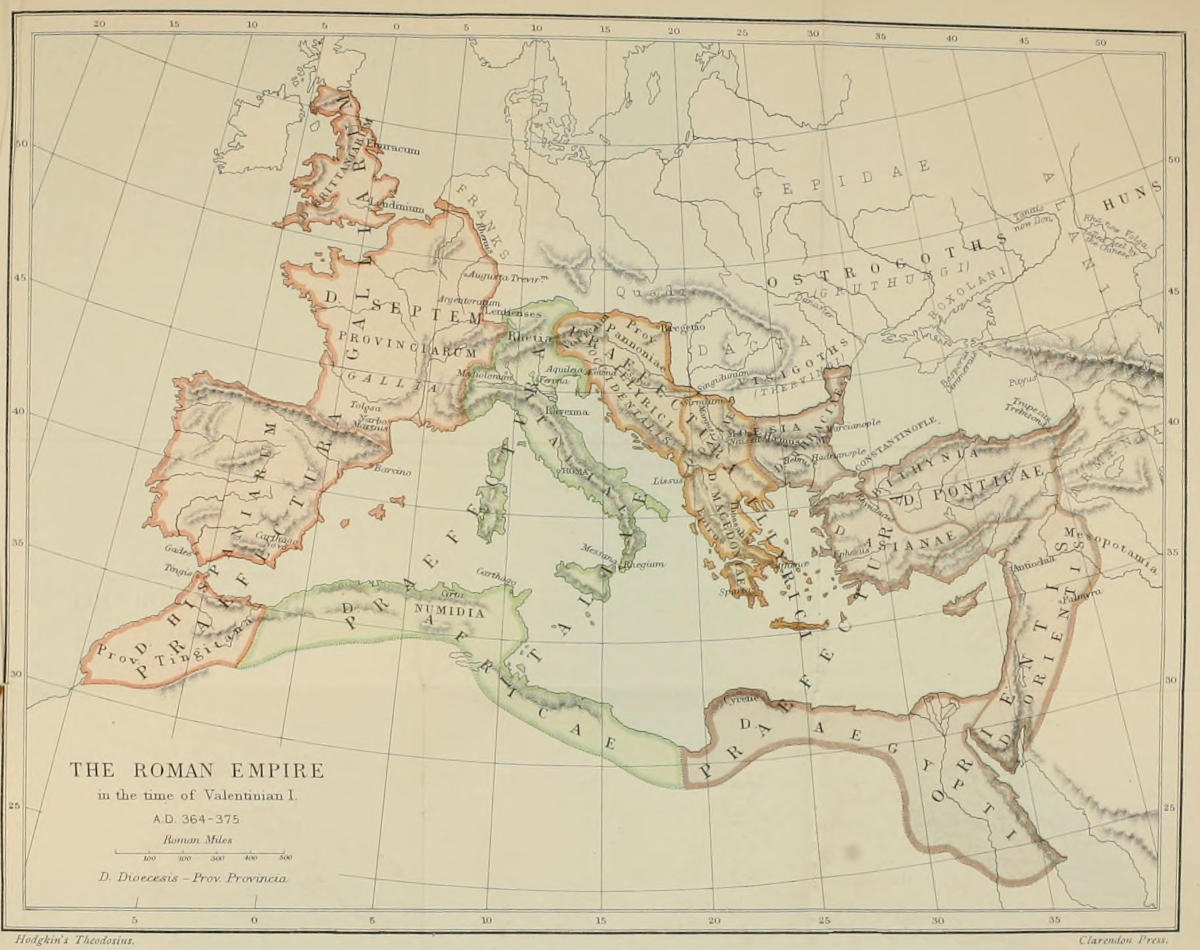
THE ROMAN EMPIRE in the time of Valentinian I. A.D. 364-375
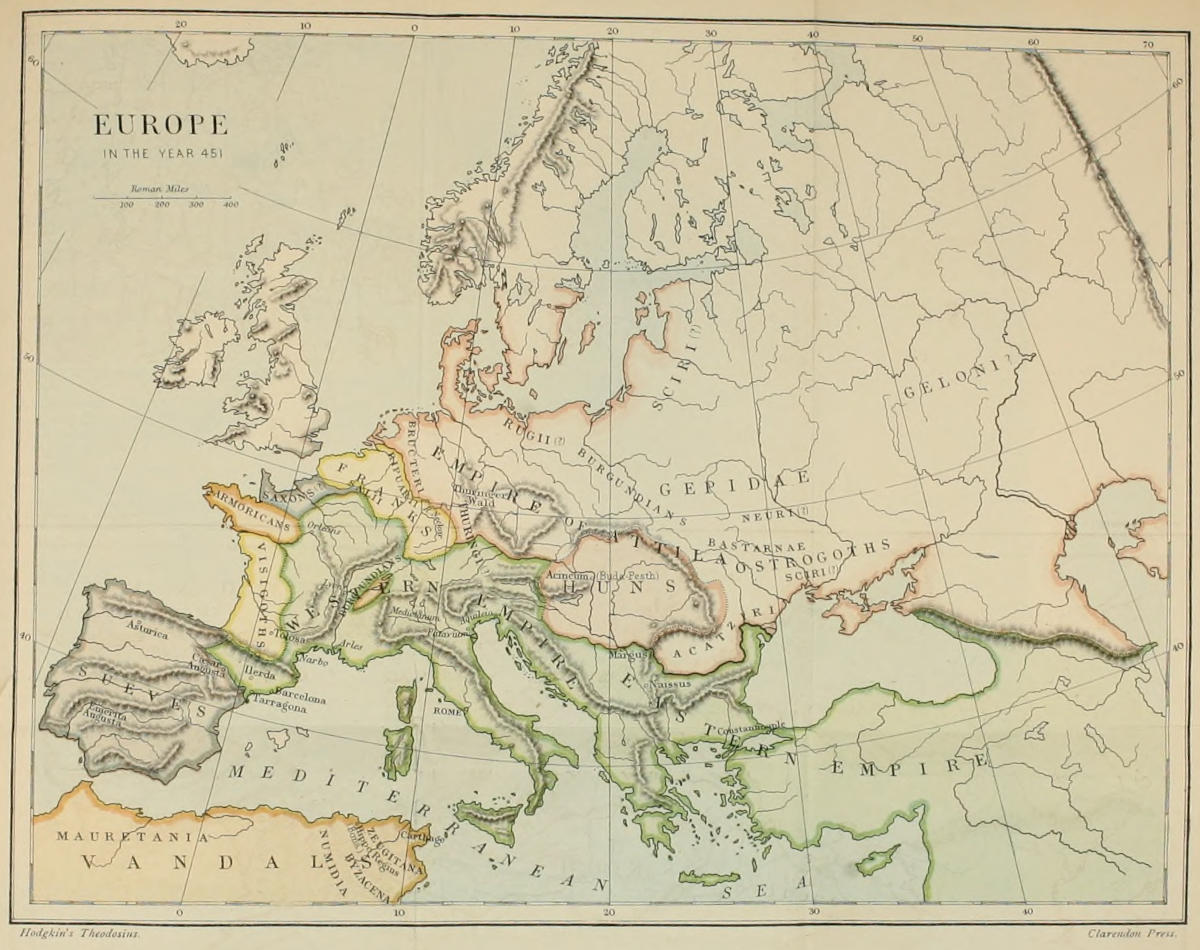
EUROPE IN THE YEAR 451
BY THE SAME AUTHOR.
Italy and her Invaders.
Illustrated with Plates and Maps.
Vols. I-IV, A.D. 376-553.
8vo. 3l. 8s.