Chapter V
Reading edition
For some time Yardley and Parkyns devoted themselves diligently to the search for Mrs. Garnett, but the effort proved like seeking a needle in a bundle of hay. They had nothing to go upon—no detail from which they could make a start. The hotel porters had not the smallest recollection of the lady’s departure, and could give no hint how she had left the hotel nor what might have been her destination.
At length, Yardley, confessing himself conquered, applied to Tempest.
“I know it isn’t fair to come bothering you,” he had said to the barrister; “but the thing’s beaten me. If it were ordinary professional work of mine, I should just report a failure and drop it. I really don’t think it’s any good worrying over it any more, and Parkyns says he’s had enough of it too. But you sent for me to go to the inquest, and you say you are interested, so I decided I would see you again before actually reporting to Lady Stableford.”
“I’m not sure I can help you much. I’m certainly not going to drop it myself, but I don’t at present see how I can put you much further along the road at present. Still, there’s one point. You remember what I suggested as the reason Miss Stableford’s body was stripped?”
“You said it was an attempt to hide her identity; and that if we could find any person upon whom suspicion attached, merely because the body was that of Miss Stableford, that we should then have a clue. That was what you said, wasn’t it?”
“Yes, exactly. But you couldn’t find any such person in relation to Miss Stableford?”
“No, we couldn’t.”
“Well, here’s a suggestion. I tell you frankly, I don’t think it could be substantiated in court. I don’t give it to you as a certain deduction—it’s only a suggestion. The only mystery you can learn of in connection with Miss Stableford is the mystery of her birth.”
“Yes, that is so.”
“Well, now, it’s pretty certain that the murderer of Miss Stableford was a woman—this Mrs. Garnett.”
“Granted. What next?”
The barrister paused. “How old was Mrs. Garnett? The hotel people say middle-aged, forty to forty-five.”
“Old enough to be Miss Stableford’s mother?”
“Yes, the girl was a bit short of twenty-one.”
“Well, Yardley, suppose you’ve got it now?”
“What on earth do you mean?”
“Suppose Mrs. Garnett were Miss Stableford’s mother, she would naturally be concerned in the mystery of the girl’s birth? Yardley, I tell you, if you can find out who was that girl’s mother, you’ll be a big step onwards towards finding out the clue to this mystery. I am fairly certain you will know then who Mrs. Garnett is.”
“Whatever made you think of that, Tempest?”
The barrister made no answer as he walked to the table, picked up a cigarette and lighted it. Apparently he had dismissed the subject from his mind. His next question had no relation to it.
“Have you done anything in the Rellingham murder case, Yardley?”
“How did you know I was working on it?”
“Oh, I advised them to retain you.”
“Then you’re in that as well, are you, Tempest?”
“It all depends what you mean by ‘in’ it. I’m not hunting for the murderer, if that’s what you mean.”
“But you know all about it?”
“I do. What did they tell you, Yardley? You can speak frankly, for I know all there is to be known about it, and I’m curious to know how much they disclosed to you.”
“I think they told me all they knew themselves.”
“About the secret trust?”
“Oh, yes, they told me that;” and Yardley briefly recapitulated the details Tempest already knew.
“I’m glad they told you, Yardley, else I should have had to hold my tongue. You’ve seen the letter Sir John wrote?”
“I’ve got a copy,” and the detective produced it from his letter-case. “Can you give me any tips about that? I want some badly, though I’m not at the end of my tether with that case yet.”
“Well, Yardley, there’s one very curious sentence. Sir John says that if the eventuality the trust is to provide for doesn’t turn up in one hundred years from the 18th of August, 1881, it never will. What do you make of that?”
“If you want to know my candid opinion, I think it’s all damned rot! I believe Sir John was insane, and I’ve been interviewing his doctors. I can’t say they welcome the suggestion, but that’s what I think. Look here, Tempest, how can you call such a trust sane? Did you ever hear of one like it before? It just seems wildly preposterous to me. I think the fact that he could create such a trust—the will’s all in his own handwriting, so he couldn’t have had advice—is just the best proof you could want to demonstrate the truth of his insanity.”
“Yardley, I’m a lawyer—you aren’t. You can take it from me—even if it were not a judgment in court—that the trust is legal, and I think it is perfectly sane. The difficulty is this. Sir John had to deal with a secret, and he did his best to make that secret sacred. But Sir John knew nothing apparently about deduction, for it’s possible to get a good deal of explanation out of the thing as it stands. All I am doubtful about is how far one is justified in trying to find any explanation at all. You see, he leaves things to his partners, trusting blindly in their honour and integrity, and they accept the matter as sacred. I don’t blame them. It’s what they ought to do. They retain me in one way and you in another, and they disclose to us what they decline to make public. You see, you and I in all decency—paid by them, working in their interests—must adopt their standpoint. If they are not justified in ferretting, neither are we.”
“Well, Tempest, your morality is chalks above mine; but take it as you say, I don’t see what you are driving at.”
“I’m simply trying to decide what is the point at which we must stop; but I think we are justified in going this far. It seems to me pretty certain Sir John was considering the honour or the reputation of some third party.”
“That’s so. I’ll admit that, if you bar insanity, I think the same.”
“Very well; that’s one step. Now, he speaks of an interval of one hundred years. What can you connect one hundred years with?”
“It’s a blooming century, if that’s any help.”
“It isn’t, Yardley. To be perfectly candid, I have racked my brains for days over it, and I can think of nothing in which one hundred years from any given date is an integral and essential part of any fact, idea, or supposition.”
“Well, Tempest, if you can’t think of anything, I’m willing to bet there is nothing.”
“I distrust your premise, but I agree with your conclusion, Yardley. What I believe is that it is an outside interval which is sufficient for one to be certain it covers some other known but uncertain interval. Now, what does a hundred years cover?”
“As much as charity. I’ve no doubt you’ve settled it to your own satisfaction. Go on; don’t wait for me.”
“Well, Yardley, I think I can tell you. What’s the length of a man’s life?”
“‘The days of our years shall be three score years and ten, and if by reason of strength they be four score years’—there, you’ve got Bible authority for that, Mr. Tempest.”
“Precisely. An interval of one hundred years is bound to embrace and cover the whole period of any person’s life—to include his birth and his death.”
“How about the centenarians?”
“They are too rare to take into consideration.”
“Well, take it then, Tempest, that you are right. The hundred years is to cover some person’s life. Whose?”
“The life of some person born on the 18th of August, 1881. Now, Yardley, who was born on that day?”
“Really, I’m not the Registrar-General.”
“No, of course not; but I wouldn’t give tuppence for your memory, my dear Yardley.”
“Oh, go on; don’t beat about the bush. Take it for granted I’m as stupid as an owl. I assure you I feel I am when I’m talking to you.”
The barrister laughed, and, taking his cigarette from his mouth, he watched it as the smoke curled away from the burning end.
“Yardley, the water-tight compartments of your mind get locked a bit too tightly. The 18th of August, 1881, is probably—pretty certainly—the date of the birth of Evangeline Stableford. At any rate that is the date of the birth of the child which was offered to Lady Stableford for adoption, and the probabilities are overwhelming that the child that was planted on her was that child.”
“Then do you mean to say Mrs. Garnett murdered Sir John as well?”
The barrister’s eyes half closed, and he spoke slowly and deliberately.
“No, Yardley, I don’t; but mark you, I do say this, that that secret trust refers to Evangeline Stableford, and that Sir John was safeguarding the honour of that girl’s mother, and her mother I am pretty certain was Mrs. Garnett. Now, find the explanation of the one, and you’ve explained the other. The two mysteries are one and the same; of that I’m positive. What we have got to do is to trace Mrs. Garnett, and find out who she is. The more I think of it the more convinced I am that the papers Sir John left, which have been destroyed, would give us the clue. But this also I am certain of, that they were never preserved to clear up murder mysteries.”
“What do you really think, Tempest?”
“No; that’s not fair. I’ve told you what I feel certain about—the things that it seems to me one is justified in arriving at by pure deduction, and justified in acting upon. What I’ve told you already I’ll stand to. Anything beyond that is just guessing, for which I won’t be held responsible.”
“Quite so; but what do you guess?”
“Well, if you will treat this as no more than a guess, and not bracket it as equally a certainty with all the rest that I’ve told you, I don’t mind your knowing what I do think. I believe that Miss Stableford was the daughter of Sir John and Mrs. Garnett, and that the secret trust is an attempt by Sir John to secure that his daughter should be provided for.”
“But that doesn’t explain his death or hers?”
“I grant you that: and that’s precisely why I doubt the accuracy of my guess. Still, it’s the only logical conclusion I have argued out so far. Look here, Yardley. Take it for granted that Miss Stableford was Sir John’s daughter. He can disclose his own position as the father, but he stands to hurt his daughter by labelling her a bastard, and he also stands to damage her mother by labelling her to be immoral. Now, either risk is considerable whilst the two women are alive. Neither matters twopence when they are both dead. Sir John must have known Evangeline was for the present well provided for. The probability was that Lady Stableford would leave her a fortune, and in that case no further provision would be necessary. With that probability it was, it would certainly be, a positive shame to label Evangeline Stableford as illegitimate or her mother as immoral. It would be so absolutely unnecessary.”
“But, steady on, Tempest, how on earth was Sir John to be sure Lady Stableford would leave the girl a fortune? Suppose the girl had lived, and Lady Stableford had left her nothing? How was Sir John to know? How were his partners to know from what you presume—assume it all to be true—that the occasion had arisen when the trust came into operation?”
“They wouldn’t know.”
“Then your argument falls to the ground?”
“No, Yardley, it doesn’t. Your remark takes it one step further forward.”
“How do you make that out?”
“Assume it all to be true, then something else has to be done to bring about the occasion for the intervention of the trust. You can argue it out, and think it over till the crack of doom, Yardley, but I am positive that that trust cannot come into operation by mere fortuitous circumstance. Somebody else has still got to do something; therefore, Yardley, mark this—there is somebody else alive now who knows the whole of the circumstances which were known to Sir John, and that somebody else will create at the proper time, if it be necessary, such an occasion that resort to the trust will be essential. That person is the person whose honour Sir John was safeguarding. Now, that person’s honour is precious in his or her lifetime—it will matter little or nothing after death. Therefore, the other person was watching Miss Stableford’s career. If Evangeline had been provided for by Lady Stableford, nothing would ever have been done. But supposing the old lady had left her unprovided for, then that person by his or her will could and was intended to disclose sufficient to bring the trust into operation for the benefit of Evangeline. You can discuss the thing for a century, Yardley, but you will find that it is the only logical conclusion you can come to on what we know. It’s the only one possible.”
“Why didn’t Sir John simply hand over £20,000 in his lifetime to Miss Stableford? It could have been done anonymously, if there were any secret to be guarded.”
“Very likely he meant to when she came of age. Don’t forget she died a minor.”
“Well, then, why didn’t he hand the money to this other person whom you say knows everything and is now alive?”
“I don’t know, Yardley; but it was probably because he didn’t trust that person. He did trust his partners. Look here, there are scores of people in this world who can be trusted to do a specified thing who are absolute fools over money. They are not necessarily dishonest. It simply is that they muddle money away. Pay it all into a single banking account, and find to their horror, when it is too late, that they have overdrawn their accounts. That’s how half the trust funds which are lost go. That is what Sir John was afraid of.”
“Who do you think that other person is, Tempest?”
“You can take it for granted Sir John never gave away a client in his life. The child’s mother is bound to have known. I expect that other person was the mother.
“Still, after all, Yardley,” said the barrister, as he helped himself to another cigarette from his case, “you see, if it were merely the providing for the welfare of a certain person, there are hundreds of ways in which this could have been done without exciting any suspicion at all. Sir John was a clever lawyer, and knew of those ways. The secret trust was so unnecessary. Therefore, though I am still inclined to think my guess correct, I’m certain that if it be correct, there is a lot more to come out. You see, it is quite possible no provision will ever be claimed under the trust—which makes one doubt the daughter idea. What we know or can guess won’t properly explain everything. Yardley, you must find out Mrs. Garnett and who she is.”
“Can’t you set me something easier to do? Working with you somehow always seems to involve these forlorn hopes, wild-goose sort of hunts. How am I to find the woman?”
“God knows, Yardley; I don’t. I think the most likely way would be to trace the birth of Miss Stableford.”
“But we’ve tried that, and failed.”
“I know; but we’ve only tried England. I’ve never been in such a position myself, and perhaps I don’t know, but it’s always a standing mystery to me, why the illegitimate child of a woman who wants to cover up its birth is ever born in England. A few pounds take you over to France, where not a soul knows you. The mother can call herself Mrs. anybody, and register the child as the child of any father or a mythical father, if you like. The fraud couldn’t possibly come out till afterwards, when the mother is safe back in England. I’ve never looked it up, but I doubt if they would extradite for such an offence. It’s forgery here by Act of Parliament, but I don’t suppose it is in France.”
“You might say the same of any country in Europe?”
“Yes, I agree; but don’t forget the child was only ten days old when it was left with Lady Stableford. The baby was already born, for her sex was disclosed when the first letter was written to Lady Stableford. Between the date at which the lady disclosed her name and address and her finding of the child, there was no time for the infant to have been brought from any great distance. The baby was probably born in France.”
“Do you think it’s worth while going to France and making inquiries there?”
“Hardly; for the odds are 20,000 to one against the birth being registered in the correct or any genuine name. Nor do we know what name to look for. Obviously it couldn’t be Stableford.”
“Up against a blank wall again. Which way round are you going?”
“Well, you’ve got the remarkable likeness between Evangeline Stableford and Dolores Alvarez. Dolores was certainly not the child’s mother. She had never had a child; but it’s worth your while to work out the Alvarez pedigree, for I shall be everlastingly surprised if there proves to have been no blood relationship at all between the two women. I don’t promise you that you’ll find the solution; but that’s the only channel I think of at present, and it’s worth trying. Still, there’s one other alternative. Suppose Sir John is trying to protect the honour of a man, and that the child is not his at all? Suppose Sir John himself were only a trustee, and that he did not create the trust, but only passed it on?”
“Suppose indeed, Tempest! However do you think of things as you do?”
“Think! One can’t help thinking. The alternatives jump at you. But you can take it for granted that if Sir John were protecting a man, that man was no ordinary client. Any man will go to any lengths in the interests of a woman, particularly if she be a pretty woman; but I’m hanged if I think many men would go to the bother Sir John did simply in the interests of a man. Besides, a man’s interests never get so important in this avenue that they are worth such procedure. In fact, it is hardly a very likely solution.”
“Tempest, suppose her father were a king?”
“I’ve thought of that, but then kings’ mistresses are always the wives of other men, who father their children for them. Added to which, Yardley, a king lives his life so much in the open that his bastards are known to many people, often to all the world. They can’t be hidden up. No, it isn’t a king. Do you remember the story of poor Parnell? It’s always been a mystery to me that the Irish have ever tolerated the English Liberal Party since. The Irish were more powerful under Parnell than they have ever been before or since. Yet they let the Radical Nonconformist conscience fire the ultimatum at them that they must throw Parnell over. And so they broke him and broke themselves. It was such sickening cant—that ultimatum. Yardley, she was far more likely to be the child of a man in the position of Parnell than the child of a king. You see, a king is not dependent on public support for his position. A public man is, and the whole of his private life is expected to be white as driven snow. If it isn’t, he’s got to whitewash over the shady places till the public can’t spot them. And that takes some doing. What I doubt is that Sir John would lend himself to it. You see, both the alternatives are unlikely. Which is the least unlikely?”
“Hanged if I know!”
“I’m sure I don’t, Yardley. As far as we know at present, it’s just a case of ‘you pays your money and you takes your choice.’”
“Tempest, what sort of a man was Sir John?”
“Can’t tell you. I’ve seen him in court a few times. Just knew the old boy to nod to, but that’s all. I never held a brief for him. You see, he was one of the beastly respectable sort of solicitor. A divorce case or anything nasty or criminal he’d send on at once to another firm. Nice stodgy conveyancing, chancery work or family trust deeds and things of that kind were all he would do. He was a splendid father to unregenerate cubs.”
“And all the time—as likely as not—he was a hot ’un at home, eh?”
“May have been, for all I know; but I never heard a whisper of that kind of thing about him. He wasn’t a Wesleyan or a class leader or any other advertised kind of humbug. He would play cards at the club. I’ve seen him at Ascot and Good-wood. He was a great first-nighter, and all that sounds pretty decent and ordinary.”
“Have you asked his partners if he had any private clients?”
“Yes, I did. They know of none. As far as they are aware, all the business he did went through the office in the regular way. Occasionally he would press-copy a letter himself in a private letter-book he kept. But Baxter has been through that, and he says there is nothing suspicious in it and nothing the other partners didn’t know about.”
“Then why did he keep the letter-book private?”
“Baxter told me that the letters certainly were private—the sort of letters you wouldn’t let the office boy see, but nothing more than that.”
“I’d like to see that book, Tempest.”
“So should I. But in the face of what Baxter says, I hardly see how we could press the point. We mustn’t let them get the idea that we are merely curious, or they will all just shut up like oysters. Still, Baxter isn’t a fool; and if he says it wouldn’t help us, the probabilities certainly are that he is right. To sum it all up, Yardley, you’ve got the mystery of the death of Sir John, the mystery of the secret trust, and the mystery of the death of Miss Stableford, and I am convinced that all the lot are really only one mystery. But all the same, we haven’t got the explanation of that mystery.”
Some days later, Arthur Baxter came round to Tempest’s chambers.
“I haven’t any idea,” he said, “whether there is anything in it or not, but you asked me about Sir John’s private letter-book. Yesterday I found a letter had been copied in it which I had never previously noticed; and as I can’t explain it, and as neither of my partners know or can even guess to what it refers, we three have all come to the conclusion that you had better be told about it, in case there may be any clue to be got from it.”
“How did you come to miss it before?”
“Well, the old boy didn’t copy it following on the others. It was on a page quite by itself, very nearly at the end of the book. I was looking in the index. I wanted some figures from a certain letter which I knew Sir John had copied in his own book, and I came across the reference ‘S. T. 477.’ Now, it is a 500-page letter-book. The last copied letter is on page 304. Naturally we didn’t look on through a lot of blank pages, and so we missed it. I can’t imagine why he copied it there and not in its proper place.”
“Probably he half meant to tear it out. It was most likely copied for temporary reference, and when the opportunity for its use was over he probably intended to destroy it. That would be why it was only indexed under initials.”
“What do you suppose ‘S. T.’ means?”
“Secret trust, I should guess. Would that fit the letter? Let me see it,” said Tempest.
“Well, here’s a copy of it.”
“Sir John Rellingham has received and carefully considered the letter. In the exercise of his discretion he must decline the request. He cannot but think that the interview is essential.”
“Who was it written to?”
“There isn’t a hint, and it isn’t dated.”
“When was it written?”
“Some time during the week before his death.”
“How can you prove that?”
“Well, it’s rather funny. The copying-ink we used to use in the office was a sticky purple kind of stuff. But we changed to Stephen’s blue-black copying-ink for some reason or other a week before he died, and this letter was written in the new ink.”
“Did Sir John open his own letters at the office?”
“No, the confidential clerk opened everything addressed to anybody. It was the understood thing amongst the lot of us that everything that arrived at that address must be the common interest and knowledge of the firm, so nobody used the address for his private purposes.”
“But suppose a letter marked ‘Private,’ and addressed to one of you personally arrived. What would happen?”
“Oh, Smith would open it!”
“Has Smith seen this copy?”
“Yes, and he says no letters arrived at the office for Sir John, within the last month of his life, that this could possibly have related to.”
“Then Sir John must have received it at his own address?”
“That’s probable. You see, the letter carries over to the second page. Sir John’s private notepaper (he kept some at the office) would fit this letter. The office paper won’t. So much of our stuff is typewritten that all the office paper is the single sheet, square quarto stuff. Our paper never does carry over, because one sheet is one page. Therefore, as he used his private notepaper, with his own address on, to answer it, I should guess it was a reply to a letter which had reached him at home.”
“Baxter, I suppose you haven’t found any letters this could possibly be a reply to?”
“No, there’s nothing. I’ve been through all the letters in his pocket, or that came to the office during the last ten days of his life, and there was nothing at his house. It couldn’t possibly fit anything. Still, Sir John often said that the safest place for a secret was in the fire.”
“Then we had better take it that whatever letter it was a reply to has been destroyed?”
“That seems pretty certainly so. Tempest, can’t you think of any explanation? Can’t you unravel the business? They say you’ve never failed with any one of these murder cases that you’ve tackled. Why have you failed us?”
“No, Baxter, that isn’t cricket. I’m not a detective, and I never undertook to play detective for you. When I have had to get a prisoner off, there’s precious little I stick at. I’ve done all that lay to my hand. I’ve sometimes gone out of my way and done a bit more, but I don’t undertake to do detective work.”
“Tempest, for God’s sake have pity on us! Since this bother cropped up, forty-five clients have formally removed their business from us. Goodness only knows how many more have quietly dropped us without making a fuss and intend never to come back. In twelve months’ time we shan’t have a client left. I’m not married, no more is Marston, and he’s young, but Moorhouse has a wife and family. It’s serious enough for all of us, but it’s Gehenna for him. Can’t you suggest something? What do you think?”
Tempest and the solicitor walked out of Lincoln’s Inn together, and slowly across the fields, and as they went the barrister repeated the story he had argued out with Yardley.
The solicitor stopped and turned and faced the other man on the pavement.
“Tempest, you were present when that trust case was on. Do you remember that woman in court, sitting by herself, heavily veiled at the back, and we wondered what brought her there?”
“Remember! Damn! damn! damn! Why didn’t I think of it? What an asinine fool I was. That must have been Mrs. Garnett. Baxter, why don’t you kick me?”
“I ought to be kicked myself. We were a pair of fools.”
“That explains why she was so interested. Yes, she wanted to know about the trust.”
“Tempest, had you thought all this out when that case was on? If you had, then I will kick you.”
“No, old man, I hadn’t. I was arguing it out with Yardley a few days ago. To be perfectly frank, I tried to put a certain proposition to him, and he kept on objecting and objecting; and all the time, as I was explaining away his objections to him, I was step by step arguing myself further on. That’s the real truth.”
“I wish we had got hold of that woman. Her presence in court that day seems to confirm your theory, Tempest.”
“Baxter, go back to your office and make inquiries whether any of your clients have altered their wills since the date of Evangeline Stableford’s death.”
“I’ve asked that already. We know of no alteration of a will by any client. Of course, we’ve made a good many wills since; but, as far as I can find out, none of them are for any client for whom we held a previous one. But Sir John was a clever lawyer, and I don’t for one moment suppose that the firm would hold such a will as you suppose exists, if we held the other ends of the tangled thread, as apparently we do. It’s all amazingly funny, Tempest.”
“I think it is,” began the barrister, as with his eyes on the ground he slowly paced on along the pavement.
“I’ve a warrant for your arrest, Mr. Baxter!” and both the men turned, as an inspector of police, overtaking them, placed his hand on the solicitor’s arm.
“It’s really come, then?” he gasped, as he turned, his face blanching deathly pale.
“Damn you, Baxter! hold your tongue!” said Tempest, whose mind, accustomed to criminal work, at once saw the danger of the ghastly remark the solicitor had made. “Robson,” he added, for he recognised the inspector, “what’s this arrest for?”
“Murder of Sir John Rellingham, sir.”
“But I understood Parkyns had got that case in hand?”
“So he has, Mr. Tempest. I’m simply making the arrest for him. He’s ill in bed.”
“What’s your evidence, Robson?”
“There’s a lot, Mr. Tempest—all that secret trust business.”
“Oh, that’s only the halfpenny rag stuff! You haven’t arrested Mr. Baxter on that. What’s turned up fresh? Come on—out with it. You’ll have to tell the magistrate under twenty-four hours.”
“Well, Mr. Tempest, a revolver has been found in Mr. Baxter’s rooms, with one chamber empty, whilst the other bullets match the one Sir John Rellingham was killed with.”
“It’s a——” began the solicitor, but Tempest’s hand closed on his arm like a vice. “Be quiet,” he said; adding, “I can’t do much before the magistrate, but I’ll be there.”
“Tempest, try and get me bail?”
“Hopeless, old man. It’s a charge of murder.”
The inspector formally gave his prisoner the usual warning; and Tempest asked, “Where are you going to charge him?”
“Bow Street, sir.”
“When?”
“Now, at once.”
“Then I’ll come along with you.”
The clerk of a friend of Tempest’s passed at the moment, and the barrister stopped him. “Just go into my chambers, and tell my clerk to come along to me at Bow Street at once, will you?”
The three men got into a four-wheeler, and were rapidly driven to the police station. A few minutes of brief formality and Arthur Baxter was charged before the magistrate and remanded. Evidence of arrest and of the finding of the revolver was given.
Tempest knew that, as the necessity for further investigations had been alleged, it was purposeless to try to break up the case at that stage, and he merely contented himself with reserving his cross-examination of the witness.
The inspector asked for a search warrant, to enable a search to be made of the offices of the firm.
Tempest at once objected, pleading the privilege of the solicitor.
“Is there any case on this point, Mr. Tempest?” said the magistrate. “It seems rather an interesting one.”
“I know of none, sir; and, even if there were, his partners could plead the same privilege.”
The inspector urged the necessity of the search strongly, but Tempest strenuously objected.
“I am not sure you are not right, Mr. Tempest. Still, it’s a point that ought to be authoritatively settled. Would you be content if I grant the application of the inspector, subject to an undertaking that no attempt to execute it is made till your appeal is decided? I suppose you will appeal?”
“Certainly.”
“Then that is how it had better stand.”
“But papers may be destroyed meanwhile, your worship?” objected the inspector.
“You must take that risk, inspector. It doesn’t amount to much, for if there ever were anything compromising, I’ve no doubt it was destroyed long ago. Still, it’s an interesting point that ought to be settled. Who issued the search warrant for Mr. Baxter’s rooms, inspector?”
“That was done at Scotland Yard, your worship. But because of this privilege I was told to apply to you, sir, for this other warrant.”
“Quite so—quite so,” assented the magistrate, and Arthur Baxter was led away to the cells.
“Mr. Tempest,” said the magistrate, as the barrister, picking up his hat and stick, was preparing to leave the court, “I’ve no doubt this appeal will take some time. I quite appreciate the reason why you did not ask for bail. It is never ordinarily granted in a charge of murder. But prima facie it seems so unlikely that anyone in the position of Mr. Baxter would be likely to be guilty of the crime, that I look with a good deal of apprehension at the possibility of retaining an innocent man in custody until that appeal can be argued. Between now and next week you will doubtless have an opportunity of consulting your client; and if you find there is any really satisfactory explanation of the discovery of the revolver, and you are in a position to then substantiate it with proper evidence, I am at present inclined to think I might favourably consider an application for bail, providing there is not then any additional evidence. But, of course, it will need to be very substantial bail.”
“I’ll undertake it shall be forthcoming to any amount, sir,” answered the barrister.
The next day Tempest had an interview with the prisoner. “Now, how about this revolver?” he asked.
“My dear man, I know no more about it than you do. I’ve never had a revolver in my hand in my life, much less fired one. I never put it there. I never knew it was there.”
“The inspector swore he found it in your empty suit-case in your bedroom. When did you last use your suit-case?”
“About a fortnight before Sir John was shot. I stayed a week-end with the Trelawneys at Ashover.”
“Haven’t you been away from town since?”
“Oh, yes; but I’ve got a larger case, which I generally use.”
“Who unpacked for you when you came back from Ashover?”
“My man, Bailey.”
“Well, the inspector says the suit-case was not locked—just strapped.”
“That’s how it always is. Do you think the police put it there, Tempest?”
“Oh, no. Parkyns was present when Robson found it. I know Parkyns well, and I’d trust him anywhere. Besides, the police don’t do that kind of thing. They try to get convictions, of course; and if a simple constable makes a mistake he can always get his pals to come and back him up. But higher up in the force they wouldn’t even do that. They are a fine lot of men. Can you trust Bailey?”
“If I find I can’t, I’ll never believe in anyone else so long as I live. I’d have cheerfully trusted my life to him.”
“Well, Baxter, it’s simply this, unless that revolver can be explained it won’t be much good asking for bail. Can you suggest anything? I’ll go and cross-question Bailey, and I’ll see if Parkyns will tell me whether the police have found out where it was purchased. That may help us.”
The barrister left the prison, puzzled and troubled. After the broad hint the magistrate had given him it was disheartening to him as an advocate, and damning to his client, that he could put forward no explanation.
He went straight to Baxter’s rooms and interviewed Bailey. As he had expected, he learned that, of course, the revolver was not in the case when Bailey had unpacked it.
“Did you lock it up then?”
“No, sir; just strapped it. To be quite frank, Mr. Baxter has lost the key of it. That happened years ago. If he ever uses it he always takes it in the railway carriage with him.”
“Were you in the room when the police found it?”
“No, sir, I wasn’t.”
“Bailey, what are Mr. Baxter’s arrangements here? Who are the other servants?”
“There’s only my wife and myself, sir. It’s quite a small flat. The dining-room, the sitting-room, the kitchen, and three bedrooms.”
“Is it ever left entirely empty?”
“Not as a rule, sir; if one’s out the other’s in. Mr. Baxter makes a point of that, unless sometimes when he’s been in himself he’s told me to take my wife out for a walk.”
“Then it’s never been quite empty?”
“Well, I can’t say that. Some time ago my wife’s mother was very ill, and she went home to nurse her. You know, sir, I used to be soldier-servant to Mr. Baxter’s brother—the one who was killed in South Africa. He was in the Army Service Corps. So I could do most things. So Mr. Baxter said that if I could manage his breakfasts he would dine out till my wife came back. That was how we managed it; but, of course, I often had to run out to do shopping, and then the flat would be empty.”
“There would be the chance then that somebody could enter the flat without you knowing?”
“Yes, sir, at those times.”
“But you wouldn’t leave the flat unlocked?”
“No, sir, of course not; but there was only the one latch;” and the man led the way to the door.
Tempest wondered at the array of bolts and chains which was there, and doubtless brought into use every night when three people were sleeping in the flat; whilst all the time a single drop latch was the only protection when the place was unoccupied.
“Who carries the key?”
“There are two, sir. I carry one and Mr. Baxter has one.”
“Has yours ever left your possession?”
“Never, sir.”
“Well, Bailey, unless you or your master are hiding something from me, the explanation of this revolver business must come from you. Can you suggest anything? Look here, I’m on Mr. Baxter’s side, so you needn’t mind what you say to me. Tell me anything you know or can think of—no matter how black it looks. The truth always helps, no matter what it is, when a prisoner is innocent.”
The man hesitated, and Tempest saw at once there was something to come out. He began once or twice in a stammering way, and then stopped.
“Now, what is it?”
“Please, sir, perhaps you ought to know Sir John Rellingham came here the day before he was murdered.”
“Came here! Whatever for?”
“I don’t know, sir.”
“What time of day?”
“About nine o’clock in the evening, sir.”
“Well, why shouldn’t he?”
“No reason at all, sir—only what he said when he left.”
“What was that?”
“I think Mr. Baxter was trying to persuade him to something; for, as he stood in the doorway, I heard Sir John say—‘No, Arthur; don’t say any more. It’s quite final. I will not; I can’t;’ and then I let him out and called a cab for him.”
The barrister’s face grew grave. “Had there been a quarrel?” he asked.
“No, sir. They didn’t seem to have been quarrelling. They seemed to part quite friends, but they had had a long argument. I could hear that much.”
Tempest turned away and moodily walked down the stairs. What had been the point of difference between the two men? When he got back to his chambers in Lincoln’s Inn he found a note from Inspector Parkyns.
“Dear Sir,—In reply to your inquiry, there is no reason at all why I should not tell you. All identification marks on the revolver have been carefully filed out, and we are quite unable to trace it.—Yours respectfully, S. Parkyns.”
Another clue had failed.
When Baxter was again brought up at Bow Street, Tempest was compelled to admit he could at present offer no explanation of the presence of the revolver in the prisoner’s rooms. Not only had he failed in this direction, but evidence was now given by the bankers of Sir John Rellingham, that since the death of Sir John a bill for £2000 had been presented for payment purporting to bear his signature as acceptor. They had never previously known Sir John to accept a bill, and his current credit balance was always so large that it seemed strange he should have done so on this occasion. They had also grave doubt as to the signature. The bill had been presented by a well-known firm of money-lenders, whose endorsement appeared on the back. A member of the firm in question, when called to give evidence, deposed that three months previously they had had dealings with the prisoner, who, professing to be acting for a client, had taken up before maturity a bill bearing the signature of a well-known peer. They had had doubts as to the genuineness of that particular signature, but had discounted it on the strength of the name with which it was endorsed.
Tempest left his seat and went over to the dock.
“Baxter, is this true?” he asked in a low tone.
“Perfectly true. I did deal with them, but I was acting for Lord Deverell, and I did it at his request.”
“Then the papers in the office will explain that?”
“I’m afraid not. He came and called on us, and I saw him. The bill was only £500, and he brought the money in gold. He seemed very upset and anxious about it, so I went off there and then to Isaacson’s—got the bill, and Lord Deverell waited in my room whilst I was away. Consequently there was no note of any kind made about the case. He asked me not to, in fact, and he burnt the bill in my room as soon as he got it back.”
“But you’ll charge him for doing it, won’t you? It will be in your ledger or somewhere?”
“No. You see, we do all his estate business—that’s hundreds a year. So as he seemed very anxious there should be no record made of the case I let it slide. I told Marston and Moorhouse, and they quite agreed.”
“Well, we shall have to get Lord Deverell to give evidence for you.”
“He died three weeks ago.”
Tempest returned to his seat to cross-examine the money-lender.
“How did you get that bill?”
“We discounted it in the ordinary course of business.”
“For whom did you discount it?”
“It was brought to us with this letter,” and the witness produced a letter for inspection. It was handed to the magistrate, who passed it on to Tempest for inspection. To his amazement he saw that it was written on the notepaper of the firm of Rellingham, Baxter, Marston & Moorhouse—obviously in a disguised handwriting.
The note merely stated that the firm were requested by one of their clients to ask Messrs. Isaacson to discount the bill enclosed on the best terms they could, and hand the proceeds to the bearer.
“Who was the bearer?” asked counsel. The witness was unable to say. He had assumed it was one of the firm’s clerks. He had not taken any particular notice of the man.
“How did you get the other bill—the one bearing Sir John Rellingham’s signature?”
“That reached us in the same way, brought by a messenger with a note.”
“Have you got that note?”
The witness produced it. It was similar to the other, but merely asked Messrs. Isaacson to oblige the firm by discounting it, saying that on behalf of a client the firm had to find the money in the course of a few hours, to meet a heavy payment, and their client required time to realise money to meet his liability.
“Was it the same messenger who brought it?”
“I don’t know. I didn’t see the man myself.”
“Would your clerks know?”
“I hardly suppose so. They would simply receive a note, and bring it in to me in each case. There would be nothing in either instance which would give them any special reason to connect a given messenger with any particular transaction. They would know nothing of the transaction or from whom the messenger came.”
“Would there be no entry they would make in your books? Wouldn’t they be aware of the transaction in that way?”
“I always keep my own books.”
“How did you pay these bills?”
“In bank notes.”
“Did you keep the numbers?”
“Yes;” and the witness handed them in.
“Have the notes been traced?” asked the magistrate.
“Yes, sir. I’m going to call evidence,” replied the prosecuting solicitor.
A bank clerk next proved the opening of an account by a Mr. Everard Clarke, who had given references. They had communicated with the references given, and had received satisfactory replies. All the notes had been paid in by Mr. Clarke. In each case the bulk of the money had been withdrawn in gold shortly afterwards, but not all in one sum. The account was now practically closed. Their own charges would more than absorb the small remaining balance. They had since tried to trace Mr. Clarke, but the address he had given had proved fictitious, and the same with his references—these, it was now found, having been written from accommodation addresses.
“Could he recognise Mr. Clarke?”
“He was afraid not. He believed the gentleman only came to the bank once—when he opened the account.”
“Was it the prisoner?”
“I really couldn’t say. I don’t recognise him.”
The barrister sat down in despair, and the prisoner was again remanded. The two men had an interview in the cells immediately afterwards.
“Tempest,” immediately began the solicitor, “those letters are absolute forgeries. There isn’t one of us would have dreamed of doing such a thing. If Lord Deverell had wanted £500 he could have had that much, or £5000, for the mere asking, and we should have paid it out of our current account. We are constantly financing our clients, and we keep a big floating balance for the purpose. Besides, we should never have sent any client to Isaacson’s, and as for sending for £2000 for ourselves, it is ridiculous. Fancy a firm of our standing touching such a crowd or that kind of business!”
“How could they get your notepaper?”
“Easily enough. They could get a heading engraved like ours for a few shillings, if they could find a man they’d trust to do it.”
“Baxter, what did Sir John go to your rooms about the day before he was murdered?”
“Who told you that?”
“Bailey did.”
“Oh, it was simple enough,” the solicitor answered, speaking very slowly. “He—he just came in for a smoke and a chat.”
“Baxter, that’s a lie, and you know it. What was it that he refused to do?”
The other man flushed a dusky crimson. “I’d asked him,” he stammered, “to help me to float a little syndicate I was interested in. He said solicitors ought not to gamble, and so he declined to have anything to do with it.”
From his half-closed eyes Tempest watched the other as he had invented the story. He felt certain the tale was perfectly untrue, and that the solicitor was hiding something. What was that something?
Thinking it all out quietly afterwards, Tempest came to the conclusion that, whether Baxter were innocent or guilty, probably the interview with Sir John had no relation to his murder. Presuming that it had, the motive for the crime was the desire to profit financially by Sir John’s death. The only financial matter that could possibly be on the tapis, and be in issue between Baxter and Sir John, involved the supposition that Baxter had forged Sir John’s signature and that Sir John had found this out. Because the Deverell bill had been taken up and settled, that matter was closed. But the two had parted on quite friendly terms, an impossible supposition if the one had discovered that the other had forged his name. There might be—as there probably were—many private matters which Sir John and his partner could have been discussing which had no relation to the crime. But supposing Baxter’s story were true as regards his interview with Lord Deverell, then there was fraud regarding the inception of the matter in the forgery of the letter on the strength of which the bill had been discounted.
Assuming that fraud, how had Lord Deverell ever got to know of the existence of the bill? Isaacson’s had admitted they did not communicate with him. And why had he wished to take up the bill? His desire to do so was an admission of the signature. Yet why, if that were so, had Lord Deverell troubled to forge a letter from his own solicitors? His own name was on the bill, so there could be no question of an attempt to cover up his identity of his participation in the matter. His interest in it being admitted, it would have been simple enough for him to get it discounted by his own bank, or even by Isaacson’s, who would have jumped at the chance of temporarily obliging a person of his financial stability, even supposing it to be necessary for him to draw a bill at all. There were all these improbabilities in the way of accepting Baxter’s own story. On the other hand, the prosecution alleged that Baxter had himself forged the bill, and written the letter bearing his firm’s name, and then had himself taken the bill up to prevent its presentation. Against that supposition there was only the character of Arthur Baxter. And if Baxter would forge one bill he would forge another. He would know the signatures of both Lord Deverell and Sir John.
But then—and the thought flashed across Tempest’s brain—so would any of the clerks in the office. They could get at the key of the office. It was by no means unlikely that one of them might have had access to Baxter’s rooms. Picking up the telephone, he at once rang up the Exchange and asked to be put on the number which he knew was that of the solicitor’s flat.
“That you Bailey?—I’m Mr. Tempest. Have any of the clerks from the firm’s offices ever been down to Mr. Baxter’s in his absence?—Just ask your wife then.—Yes?—Which of them—Smith, do you say?—When did he come?—Can she fix the day?—What excuse did he give?—Was he allowed to go in?—Oh no, I don’t blame her—of course she knew who Smith was.—Tell her not to say anything.”
Tempest put down the receiver, and sat at his table, puzzled and worried to distraction. Should he have Smith arrested? To all intents and purposes, the evidence against Baxter and Smith was practically the same. If the revolver was found in the suit-case of the former, the latter had had an opportunity of putting it there, and, to all intents and purposes, was the only person who, as far as he could see, had had such an opportunity.
But he felt certain that no jury would convict Smith, and release Baxter, on the evidence as it stood. Smith had had a perfect alibi at the inquest. He had been at home all the evening. Both his father and his brother had given evidence of it, and other evidence was offered, as a party had been taking place at their house that night. Still, they had Smith’s admission that, save Sir John, he was the last to leave, and he might have shot Sir John before he left. If Smith were guilty, he would have to be convicted out of his own mouth, and Tempest believed this would be easier to do, when cross-examining him as a witness, than if he were a prisoner. One can go to greater lengths with a witness than one can in cross-examining a prisoner. Decency compels a prisoner to be given fair play, and a judge would take good care he had it. Picking up a pen, Tempest wrote a note to the inspector:
“Dear Parkyns,—I take it you will have to call Smith (Sir John Rellingham’s confidential clerk) as a witness when Mr. Baxter is tried. I very particularly wish to cross-examine him. I don’t want to arouse his suspicions by doing it before the magistrate, and I don’t want you to put him on his guard by any obvious attentions. But I wish you would pass the word along that care must be taken that he doesn’t slip through our fingers. I shouldn’t be surprised at this, if he thought it likely he would be asked certain questions which I intend to put to him. Could you also make an opportunity of taking that bank clerk to the firm’s offices, and let him see Smith, on the chance of his recognising him as Everard Clarke? If you’ll ask for Mr. Marston, I’ll arrange with him that Smith shall be called in on some excuse whilst you are there.—Yours faithfully, Ashley Tempest.”
A few days later came the reply:
“Dear Sir,—I did as you requested, but Jenks (the bank clerk) evidently did not recognise Smith. I also took Isaacson’s clerk there the next day. He was certain he had never seen Smith before. I will have Smith watched, as you suggest.—Yours respectfully, S. Parkyns.
“P. S.—At Bow Street to-morrow we are calling evidence as to the state of Mr. Baxter’s banking account. He had only a very small balance—far less than one would expect—but he had a balance. I cannot find, however, that he was in debt, and I hear he spends a lot of money in buying pictures, etc.”
“Yardley,” said Parkyns the following day, when the prisoner had been again remanded, “do you think Mr. Tempest knows young Deverell—the young brother of the new Lord?”
“Why?”
“Because there’s one line I’m puzzled to think why your lot don’t try to follow up.”
“What’s that?”
“Well, I don’t know that it’s any particular business of mine to help you with the defence, but it seems so obvious to me. Young Deverell’s a rank bad lot. Oh, I know he hasn’t lost caste, or anything of that kind,” added the inspector, as Yardley attempted to interrupt; “but all the same he’s a bad lot. We’ve had a good many inquiries about him at the Yard over one thing and another, and I know he is hard up. It may not mean anything, and nothing has ever been brought home to him, but he has been mixed up in several fishy transactions that never came into court. You see, Deverell would know who his father’s solicitors were. I know myself he has borrowed money from Isaacson’s. Suppose he forged his father’s name to that bill; and then suppose he got frightened and told his father? The old man, at any rate if it were the first time, might very well try to hush it up according to the evidence Isaacson gave, and there’s no doubt whatever that young Deverell left England between that time and his father’s death. He wasn’t mentioned in Lord Deverell’s will, at least not in the newspaper note of it. I haven’t bothered to see the will itself.”
“But that doesn’t account for the Rellingham bill, Parkyns?”
“No, I quite admit that; and, of course, Mr. Tempest may know a lot of other details that upset what I’ve told you. But just ask him if he knew young Deverell.”
Yardley passed on his conversation with Parkyns to Tempest at the earliest opportunity.
“No,” the barrister at once said. “I know nothing about Deverell. What you tell me is most important;” and once again Tempest’s wits were started in a new direction. That such a person as young Deverell existed he did know, but of his character he was entirely ignorant. The man belonged to a younger generation, and the two had never happened to meet.
The hint of Parkyns opened up a new position. Deverell might have forged the one bill. Whoever did had had access to or had copied the firm’s notepaper. Having successfully discounted one bill it was quite likely a second attempt might be made; and Sir John Rellingham, likely enough, would write personal letters to Lord Deverell, from which his writing and signature could be copied. But Tempest could not think out that supposition any further: nor could he fit it in any way with the discovery of the revolver in Baxter’s suit-case. Involuntarily his suspicions harked back to Smith, and the barrister turned his mind to the possibility of breaking up the alibi which Smith put forward. The alibi given at the coroner’s inquest had certainly never been subjected to cross-examination. Such was the point at which matters stood when an entirely new development occurred. Marston came round to Tempest’s chambers, and, their greeting over, placed a gold watch and chain on the table. “Tempest, this was Sir John’s,” he said.
“Well, how can they help?” said the barrister, picking them up.
“Open the back. I only saw that the back opened yesterday. It’s a keyless watch; and though I bought it at the sale of Sir John’s things I never thought of opening it till yesterday.” Tempest opened the watch, and almost jumped from his seat in his astonishment.
“Look there!” he almost shouted, as he pointed to the miniature hanging on the wall, and then held out, for the other man to compare with it, the portrait inside the case. The two faces were identical.
“Who is it, Tempest?”
“That miniature is Dolores Alvarez, who died twenty years ago, and it’s the living image of Evangeline Stableford, who was murdered the other day.”
“Then, which of the two did Sir John know? Whose portrait was he carrying?”
“You can soon settle that. If it be the younger woman, then this miniature of Sir John’s must have been painted within the last three or four years. Otherwise it could not be a full-grown woman, but would be a picture of a young girl. If the miniature was fitted in by the firm who made the watch, then it’s the portrait of Dolores. I’ve been confident all along—at any rate of late—that the mystery of Sir John’s death and the mystery of Evangeline Stableford’s death was one and the same mystery. This likeness between the three can’t be pure coincidence. Marston, Yardley will tell you that weeks ago I came to the conclusion that Evangeline was Sir John’s daughter, and this portrait in Sir John’s watch is probably that of Evangeline’s mother.”
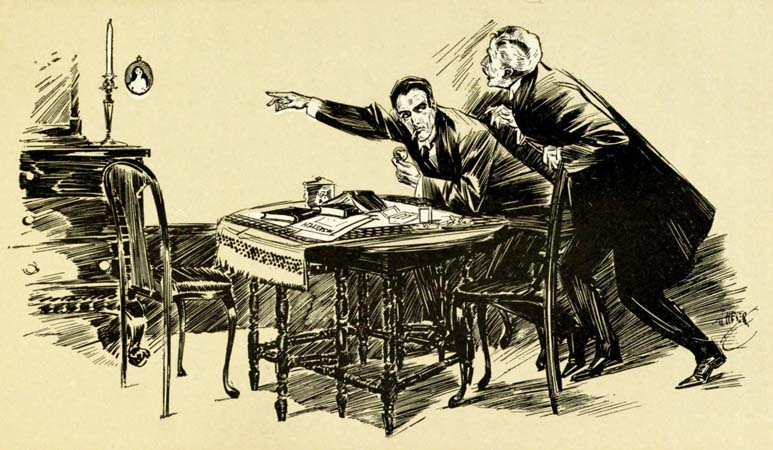
“‘Look there!’ he almost shouted, as he pointed to the miniature”
“Then do you think that Evangeline was the daughter of Dolores Alvarez?”
The barrister lighted a cigarette, and dropped into his habit of pacing up and down his room. At last Marston broke the silence by repeating the question.
“Marston, everything points to that—if there is anything in deductive reasoning when applied to the solution of this kind of problem—it would seem that that is the certain fact. Over and over again I come back to it. Argue it out, reason it out by any chain of reasoning, by any sequence of argument you like to adopt, you must come back, as I always do, to that conclusion. It seems as certain to me as the mathematical answer to a problem in algebra. There is no other conclusion. It’s the logical solution of every argument, but it’s wrong somewhere, for it doesn’t happen to be right.”
“Why not? Why’s it wrong?”
“Simply because Dolores never had a child. The doctors who made the post-mortem are positive about that. It’s a matter that can’t admit of any doubt. It’s a fact that cannot be questioned. Dolores never had a child. So our reasoning is at fault, though I can’t see where.”
“Had she a sister?”
“Only Lady Madeley. Yardley has made inquiries that settle that.”
“Then could Evangeline have been a child of Lady Madeley—unacknowledged, of course?”
“No, that can’t be true either.”
“Why not?”
“Evangeline is left at Lady Stableford’s House on a certain date—within ten days of the date of the marriage of Lord and Lady Madeley. The child that was left was less than ten days old. That much the doctors can swear to. I’ve seen the case book of the man Lady Stableford called in. The child must have been born within a margin of two days on either side of the date of the wedding. Lord Madeley dined with his fiancée at the Langham Hotel the night before the wedding. Obviously a woman could not have been dining out within twenty-four hours of having had a child. The day before that she came to town from Cornwall. After the wedding they went to Paris. The child could not have been born on the wedding day. The day after they dined at the Embassy in Paris. The next day they went on further south. No, Lady Madeley could not have given birth to a child at that time.
“Besides, Marston, the hundred years in the secret trust was to run from 18th August, 1881. That was the date of the wedding day, and that was stated to be the date of the birth of the child originally offered to Lady Stableford, and in all probability that was the child she did adopt. The secret trust was for the benefit of Evangeline, of that I am certain. By the way, I suppose your firm aren’t Lady Stableford’s solicitors by any chance?”
“As it happens we are—or at any rate were. We still have a lot of her papers. She was one of Sir John’s old original clients. Sir John acted for her when she was negotiating for the adoption of that child which you say is Evangeline.”
“Did you make her will?”
“Sir John did.”
“Why didn’t you tell me that?”
“How was I to know there was any connection?”
“What’s the date of Sir John’s will?”
“September, 1900.”
“When did Lady Stableford make her will?”
“Oh, I can’t tell you off-hand. I’ll send you word.”
“No, I’ll come round now.”
Together the two men went to the offices of Messrs. Rellingham, Baxter, Marston & Moorhouse, and Marston turned up the letter-books. “Here you are, Tempest. Lady Stableford must have written, because here, you see, Sir John writes, suggesting Lady Stableford should reconsider her suggestion, and pointing out that going on the stage is not necessarily an abandonment of all morality. Then here’s the next letter in which he sends the will for execution, and again refers to the injustice of leaving the girl penniless, after having brought her up to regard herself as heir. That’s the end of July, 1900.”
“And then Sir John, evidently knowing that Evangeline was cut off with a shilling, I suppose by Lady Stableford, a month or more later creates this secret trust. The thing is self-evident.”
“That may be so, Tempest; but some six months before Sir John died, Lady Stableford and Evangeline were reconciled, and the old lady made another will, by which the girl would have got nearly everything. I remember that will, for I drafted it. Now, Sir John never altered his will or cancelled the secret trust which then became unnecessary, if your theory were right.”
“Oh, that doesn’t matter. He very likely thought it quite probable Lady Stableford might possibly change her mind again.”
“Well, granted it’s all as you say—granted Evangeline was Sir John’s daughter, what’s it all come to?”
“Nothing as yet, Marston; but who was the girl’s mother? Who was or is Lady Rellingham?”
“Did he marry the mother?”
“Quite likely. Let’s look it up. It must be before August, 1881. Come along down to Somerset House.”
Together the two men made the search, and found that early in 1880 John Rellingham, solicitor, had married Sarah Jane Manuel, daughter of Pedro Manuel of Dublin, hairdresser. His second marriage to Georgiana Drury, as they knew, had not taken place until 1890.
“That’s put the stopper on any Alvarez business, Tempest, at any rate.”
“It looks like it certainly.”
Tempest paid for another search ticket, and turned up the marriage of Lord Madeley. Lady Madeley had been married in the name of Eulalie Alvarez.
“I think we must put Yardley on to an investigation of Pedro Manuel and his family. That is obviously the thing to do.” “What earthly chance is there of his finding out anything?”
“Precious little, I’m afraid,” said the barrister. “But there’s one thing we might do, Marston. Bring that trust into court again, and paragraph it as an approaching case, and see if we can tempt the lady to turn up again.”
“I wonder if she would?”
“She might do; for, of course, she can’t have the slightest suspicion that we have guessed she has some connection with the case.”
“How will you bring it on, Tempest? There isn’t much time.”
“Give notice of a motion for Friday next, and put up somebody, and I’ll have enough of a wrangle with him in court to get it into the papers, and then we’ll ask his lordship to adjourn it for a week, on the chance of a mutual settlement. It must be well reported, and I daresay that can be arranged. Very likely the lady will turn up on the following Friday.”
“But can you get the trial of Baxter postponed till afterwards?”
“Yes. I’ll put up some sort of defence, and address the magistrate at great length, and then get another remand. That will throw us over the coming sessions of the Central Criminal Court. There aren’t any sessions in August, so we will have over five weeks. We ought to know where we stand then.”
In due course affidavits were lodged; and Tempest moved on behalf of Marston, for an appointment of a receiver of the trust funds pending the decision of the court on an issue shortly to be raised as to a division of the trust funds between the surviving partners of the late Sir John Rellingham. Other counsel had been briefed for Baxter and for Moorhouse, and for three-quarters of an hour the three men wrangled before the judge. Hints of sensational disclosures, veiled comment, and flat contradiction, all did their work.
“Mr. Tempest,” said the judge, “I’m very much in the dark. Cannot you indicate in some way the nature of this trust? I’m not suggesting you should disclose anything obviously intended to be kept secret; but why was the trust created? Was it to benefit a person or persons, or was it to carry out a purpose? Obviously, under the terms of the will, and by the decree of this court, the money now belongs to the surviving partners of the firm. Why not divide it? Does a purpose still exist to which the partners desire to apply it?”
“Strange as it may appear, my lord, I can only ask your lordship to accept my word that the partners have not and have never had the remotest idea of what object was in the mind of Sir John Rellingham when he created the trust.”
“Surely that cannot be so. The will says, ‘to be applied by them to and for the purposes which I have sufficiently indicated to them.’ You see Sir John says he has indicated. It’s the past tense.”
“Quite so, my lord. The instructions were in a sealed packet. This packet was not to be opened until certain eventualities occurred; and there were certain stringent instructions left with it that the moment litigation began the packet was to be destroyed. Your lordship will remember the Crown did begin litigation, and consequently the papers were destroyed. It seems to me, my lord, that Sir John’s first idea, overriding everything else, was to preserve the secrecy he enjoined upon the trustees he appointed; and rather than that that secrecy should be waived, he preferred that the object of the trust should suffer and his partners benefit. His partners have loyally adhered to his wishes, and the money is theirs. They claim it, and they repudiate any claim to it by anybody else; but, nevertheless, they feel that the past action of the Crown could not have been anticipated by Sir John, and they are disinclined at present to dissipate what were originally trust funds. There has been no quarrel, but at the same time they differ amongst themselves as to the course which should now be pursued. May I put it that they are in a friendly state of doubt and uncertainty?”
The discussion went on; and finally, at the end of an hour, Tempest threw out a suggestion that perhaps, if his lordship would adjourn the case for a week, it might be possible to agree to terms which could then be submitted for the approval of the court. The judge at once consented; and in view of the newspaper interest which had previously been excited on the subject of this secret trust, all of the evening papers and most of the morning ones the next day reported the proceedings with some detail.
Nothing remained to do but to wait patiently for the week which must ensue before they could know whether or not the bait had been effective.
On the following Friday morning Tempest was early in his seat in Chancery Court No. 3. The benches were always packed on a motion day, and Tempest had no desire to take part in the jostling scrimmage for seats, which was usual on such occasions.
A belated K. C. struggled through the crowd in the doorway, his gown half torn from his back in the crush. Seeing Tempest, he turned and said:
“Look here, old man, why can’t you keep your beastly sensational cases out of our way here? Just look at this menagerie of a place instead of the usual staid and sober appearance of a chancery court? It’s demoralising!”
Tempest laughed. “For pity’s sake, don’t blame me. I didn’t bring ’em.”
“No, but your case has.”
“Well, they’ll be awfully disappointed. It’s all arranged between us now.”
“Silence!” called out the usher, and their conversation ended, as everybody rose, and returned the bow of Mr. Justice Barker.
“Mr. So-and-So,” and the judge called on the leader in his court. Tempest turned in his seat and eagerly scanned the faces of those present in court and in the gallery. At last, right at the back of the court, he caught sight of the person for whom he was looking. Dressed in black, and heavily veiled, he saw the same woman who had excited his curiosity on a previous occasion. He looked at Yardley wedged in the crowd near the doorway, and caught the detective’s half-veiled nod which showed that he had also found his quarry. Next to Yardley was standing Craven, his assistant, a perfect sleuthhound of a tracker; and before Tempest’s gaze had dropped again to his papers, he had seen Craven leave the court, to reappear in a moment at the other door, within a yard or two of the woman they wanted.
One by one the King’s Council present in court were called upon; and then, after one or two of the junior bar—habitués of that particular court—had each been given his opportunity by name, came the concluding, “Any more motions behind the bar?” and Tempest rose, and in a few words said that the parties concerned had agreed to ask his lordship to appoint them jointly to be receivers, pending the trial of the issue. The judge promptly assented to the proposal, and then at once the court began to empty of the public, baulked of the anticipated revelation; but Tempest lingered, curious to see what might happen. A tedious dispute as to a right-of-way injunction followed, but the lady sat on, apparently keenly interested. Concluding it to be a ruse to mask any apparent concern with the matter just concluded, and knowing she would be safe in the care of Yardley and Craven, Tempest signed to his clerk to collect his papers, and took his way to the King’s Bench side, where another case awaited him. Marston followed him into the passage.
“Well, it unearthed the lady,” said the barrister.
“Yes, and I saw Yardley was there.”
“So was Craven, his chief assistant. By the way, what instructions did you give him, Marston?”
“He is to find out who she is and where she lives. I wish she had raised her veil in court. I’d have liked to have seen her.”
“So should I; but I never for a moment expected that. She’ll be much too downy a bird. How old would you guess her to be, Marston?”
“Forty to fifty.”
“Yes, that’s what I put her down to be; but one really cannot tell under that veil of hers. It’s only guessing from her figure and manner. She might really be anything from thirty to seventy.”
Late that evening Yardley came round to Tempest’s chambers.
“Well, who is she, Yardley?” was the latter’s greeting.
“She’s staying at the Hotel Victoria, in the name of Mrs. Seymour. I’ve left Craven there, and he’s subsidised one of the chambermaids as well, so I don’t think she’ll slip through our fingers.”
“Where does she come from?”
“I don’t know for certain yet. She’s registered as from Paris. I’ve arranged that one of my young women shall go to the hotel as a chambermaid to-morrow, on the chance of an opportunity of going through the lady’s belongings.”
Three days later Yardley again came round to see Tempest, but only to report an ignominious failure. It was evident that Mrs. Seymour had become aware that she was being watched and had made her plans accordingly.
Asking for a hansom to be called one morning, she had ostentatiously given instructions to the hall porter that she was expecting a visitor at noon, and, if she herself had not returned, the visitor was to be asked to wait. She then gave the cabby directions to go to Paquin’s showrooms in Doder Street, and had driven away. Craven had been inclined to follow; but feeling certain Mrs. Seymour would return, he decided that more was to be gained by overhauling her boxes, and he at once sought his confederate, who was figuring in the hotel as a chambermaid. Together they had thoroughly and systematically searched Mrs. Seymour’s room. Not a scrap of writing did they find—not the faintest clue of any sort from which they could start to establish the identity of Mrs. Seymour. Finally, they had relinquished the search in disgust, and Craven had set himself to await the lady’s return. She never did return; and when Craven reported, Yardley saw at once that the whole thing had been a ruse. The cabby, when found and questioned, told them that when they reached Trafalgar Square, his fare had told him to drive to Euston. He had done so, and the lady had entered the station. The most diligent inquiry failed to produce any person who had seen and recognised or had noticed the lady at the station. None of the booking-clerks recognised her from the description which was given. Her luggage, which remained at the hotel unclaimed, contained nothing of any sufficient value for it to be in the least likely it would ever be claimed, if Yardley were correct in his surmise that Mrs. Seymour had by some means become aware that she herself was under surveillance, and had deliberately elected to withdraw herself from observation.
The court for Crown cases reserved having decided—much to the disgust of the police—that the privilege of a solicitor prevented the execution of the search warrant and the overhauling of the papers of the firm, the trial of Arthur Baxter could no longer be delayed, and took its place in the judge’s list at the ensuing sessions of the Central Criminal Court. At the first reference by the prosecution to the secret trust, Tempest successfully objected. As he pointed out, Baxter had only been advantaged by the action of the Crown, which had, with full knowledge of the consequence, itself precipitated the circumstances, which vested the money in the hands of the surviving partners. That result Baxter could neither have produced nor anticipated; but for the moment assuming he could have produced it, then the three partners were equally concerned, and must be equally guilty; but the Crown had only indicated one, though, on an indictment of the three for conspiracy, a conviction would have been more easy to procure. Finally, he said that if his lordship admitted any reference to the secret trust on the ground of motive, then he should at once call the other surviving partners to prove that no one of the three had ever even suggested the division of the trust money, even after the court had formally declared it to be the absolute property of the partners; but that they had voluntarily reconstituted the trust, or rather had themselves constituted a trust for purposes which they declined to divulge, but which advantaged themselves personally no more than had the original will. In the end the judge upheld the objection. The trial was thus narrowed down to the fact that the partners possessed keys, and could have obtained access; that Baxter had been overheard to have had a difference with Sir John, when the latter had called at his chambers the night preceding the murder; and, what was most damning, that a revolver, with its marks of identification erased, together with bullets similar to the one which had caused the death of Sir John Rellingham, had been found at Mr. Baxter’s chambers secreted in a seldom used suit-case.
The case at best was a weak one; and doubtless relying upon the fact that Arthur Baxter would go into the witness-box and might convict himself under cross-examination, the ruling out of the question of the secret trust seriously handicapped the prosecution. Tempest had frankly told Baxter he didn’t believe the explanation of the quarrel which the solicitor had vouchsafed him, but Baxter declined to give any other. For that reason the barrister was surprised that only one or two formal questions relating to the quarrel were put to Bailey, the factotum of Arthur Baxter, and one of the witnesses called for the prosecution. Consequently Tempest asked Baxter no questions on the point when he put him in the witness-box. But the matter was raised and pressed in his cross-examination. Question after question he cleverly fenced with; but at last, driven into a corner, he gave a full explanation: “I have tried to keep faith with Sir John,” he said; “but you won’t let me. The point was simply this: Sir John called at my chambers, and asked me if I would marry his daughter. Neither I nor my partners at that time had the smallest idea that Sir John had ever been married except to his late wife, whom we all knew, or had ever had a daughter; and when I was talking to him, I didn’t know whether his daughter were illegitimate or legitimate. He showed me her portrait. She was a very beautiful girl; but all I felt inclined to promise was that I was quite willing to meet her, with the idea of marriage, if we mutually liked each other, and providing all knowledge was kept from her until after marriage that she had been the subject of discussion and arrangement between us. I wanted to win the affection of the girl on my own merits, or else I would be no party to such a marriage.”
“But, Mr. Baxter,” had been counsel’s reply, “you say Sir John was asking a favour of you, or requesting you to fall in with a proposal of his? How do you account for the fact that it was Sir John who said, ‘No, Arthur; don’t say any more. It’s quite final. I will not’? You admit, I suppose, that he did say that?”
“Oh, yes, he said it.”
“Well, then, how do you reconcile that with your story?”
“I asked him if he would acknowledge the girl openly as his daughter. He wouldn’t. I tried to persuade him, and then he answered in the words you put to me.”
Then came a searching cross-examination about the two bills. Baxter explained the second one by saying he was acting for the late Lord Deverell. The other bill, which had reached the money-lenders who had discounted it, with a request written in the name of the firm, Baxter absolutely repudiated any knowledge of. He likewise disclaimed the slightest knowledge of the revolver or the bullets, and emphatically denied having himself hidden them in the suit-case.
Tempest then called clerks in the office of the firm to prove that the letter to the money-lenders was not in the handwriting of Mr. Baxter or of any of the firm’s clerks, and then played his trump card. Calling an expert, he proved that the revolver was of faulty construction, and that it had never been fired, and that it would have been quite impossible for the bullet which killed Sir John Rellingham to have been fired from it.
“What would happen if the attempt had been made?”
“It would have burst.”
“Why?”
“Because the barrel of the revolver is imperfectly bored, and at one point the bullet could not have passed through.”
The revolver, a bullet, and a ramrod were then passed to the jury, to satisfy themselves on the point.
With this disclosure the case for the prosecution practically collapsed; and though it pursued its formal course, to its completion, there remained no further doubt that the verdict would be one of acquittal, as eventually it proved to be. Arthur Baxter left the court a free man, honourably acquitted.
When the partners and Tempest were discussing the trial that evening over the dinner which Marston gave to celebrate the result of the trial, Tempest turned to Baxter and asked:
“Why on earth wouldn’t you tell me before what that discussion was that you had with Sir John?”
“Simply because he said the disclosure would be the disclosure of a secret, not of his own, but of somebody else whom he couldn’t give away.”
“Ah! Then I guessed right?”
“What do you mean?”
And then Tempest explained how he had argued himself into the conclusion that the secret trust had been constituted to provide for Sir John’s daughter, and arranged in its curious form that the secret of a third party might be safeguarded.
“Why didn’t you tell me all that, Tempest?”
“I told Marston, but I didn’t see at the time how it affected you. Did Sir John tell you who his daughter was, or what the name was that she was known by?”
“No, he wouldn’t tell me even that, unless I would promise blindly to marry her. As I said in court, I only promised conditionally, and Sir John said that he must refuse to tell me her name.”
“Marston, show him Sir John’s watch.”
The solicitor took the watch from his chain and passed it across the table to his partner.
“That’s the girl whose portrait he showed me, though the face is in a different position.”
“No, Baxter, it isn’t the same girl. The portrait in the watch is an exact duplicate of a miniature I have hanging in my chambers. Twenty years ago I had a watching brief at the inquest of Dolores Alvarez, an actress——”
“I remember the case. Verdict of suicide, wasn’t it?”
“Yes, that was it. It was my first cause célèbre. I saw the dead woman, and was very much struck by her beauty. I collected all the photographs I could purchase of her, and I had a miniature painted from them. It was not exactly like any of the photographs, and I was puzzled how Sir John could have got hold of what was undoubtedly a copy of my miniature till I made inquiries. Then I found that the firm—a big firm of photographers, whom I had commissioned—had been so struck by the miniature that they had ordered a copy of it from the artist, and they had exhibited this copy as a specimen. Sir John had seen it and bought it. Consequently, Baxter, the portrait in Sir John’s watch was to him a fancy portrait, which I assume he must have bought on account of its likeness to his wife—oh, yes, he was married twice. We got the certificate of his first marriage all right—for a man would hardly carry about inside his watch a definite portrait of a person in whom he had no interest. Besides, Baxter, I can probably tell you who Sir John’s daughter was. She was Evangeline Stableford—the actress—the adopted daughter of old Lady Stableford. She was the living image of Dolores Alvarez, and she was murdered a few months ago—since the death of Sir John, in fact. The curious thing is, that every detail and every circumstance of her death exactly reproduces the death of Dolores Alvarez twenty years ago.”
“Were the two women related, Tempest?”
“The likeness is so remarkable that I think they must have been; but, as a matter of actual fact, I cannot prove it. Evangeline was certainly not the daughter of Dolores. The only relative I have unearthed of Dolores is Lady Madeley; and from the date of Lady Madeley’s wedding and the date of Evangeline’s birth, she could not have been the child of Lady Madeley. Besides, Sir John didn’t marry a Miss Alvarez. The maiden name of Lady Rellingham, for I daresay she is still alive, or Sir John wouldn’t have guarded her secret so closely, was Sarah Jane Manuel.”
“But Alvarez may have been only a theatrical name?”
“That’s quite possible—likely even; only, Lady Madeley is married in the name of Alvarez. There’s such a widespread idea, particularly in the lower classes, that a marriage in a false name is invalid, that I hardly think it probable that Lady Madeley would have risked the validity of her marriage by going through the ceremony in any other than her real name. She may have done so, of course; but the probabilities are vastly to the contrary. Frankly, Baxter, the idea of relationship rests exclusively upon the likeness.”
“Yes, that must be so; besides, assume Dolores and Evangeline were related. What’s the nearest possible relationship? You say they can’t be mother and daughter. The next nearest relationship is aunt and niece, on the supposition that Lady Rellingham is an undiscovered sister of Lady Madeley and Dolores Alvarez. You must take into account that it is not an identity of parentage. Evangeline is only a daughter of a supposed sister and Sir John. You must make allowance for her descent from Sir John as well.”
“No, I don’t think you need do that. Given a parent of a pronounced type—what one would call an aggressive type—that type will be reproduced and the type of the other parent submerged altogether. Probably Evangeline exactly reproduced her mother. She had nothing of Sir John in her appearance. Here I’ll show you what I mean. Waiter!”
The obsequious servant hurried forward.
“Send out and buy me a copy of this week’s Sketch, will you?” and Tempest handed a coin to the man.
Shortly afterwards the latter reappeared with the paper for which the barrister had asked. He rapidly turned the pages. “Now this,” he said, “is what I mean. Here is a portrait of the young Lady Madeley—Consuelo, Baroness Madeley in her own right, the daughter of Eulalie Alvarez.”
Folding the paper he indicated the portrait to which he referred. “You see,” he added, “that’s awfully like Dolores. There’s the same type again, submerging any likelihood of a likeness to the other parent, for old Lord Madeley was fair and fat and podgy—blue eyes, as a matter of fact. Sir John was fair, and his features were very indefinite. Evangeline’s mother and Lady Madeley, even if there were no relationship, were of the same physiological type, and that an aggressive one, and you see the type reproduces itself. I’m almost beginning to think it must be merely type and domination of type, and that alone, with no question of consanguinity. Besides, when all’s said and done, it’s a foreign type.”
“But what does that matter?”
“What I mean is this: Just as all niggers look alike to an Englishman, and just as we find it hard to distinguish one Chinaman from another, so a strange type to us overrides in our observations the little differences by which in our own type we distinguish one another and recognise each other. Therefore, may not this type—Spanish, I suppose it must be, from the name Alvarez—override, in our observation (from the fact that it is foreign and unusual), the little niceties of difference by which those who belonged to the type would themselves differentiate?”
“Then, do you mean that these people may not really be so alike as we think they are?”
“That’s precisely what I do mean. Here we have apparently Eulalie Lady Madeley, and Dolores Alvarez, and Consuelo Lady Madeley, whom we know to be related, all very much alike. We have Lady Rellingham and another girl, Evangeline Stableford, and yet another, Sir John’s daughter, if they are not one and the same, though I am sure they are. We are trying to presume an Alvarez relationship for Evangeline, solely on account of her remarkable likeness and the presumed likeness of Lady Rellingham. There is not one other single solitary reason from which relationship can be presumed; and after all, to a person familiar with the type, the likeness might not be so pronounced as to us it appears to be. To a Spaniard, for instance, it might not be sufficient to even suggest relationship. You’ve always got to bear that in mind. So long as the identity of Evangeline was a mystery, we had to clutch at any straw that might prove who she was, and perhaps I attached too great an importance to the likeness. It is nothing like so important now we are practically certain Evangeline was Sir John’s daughter and that we know who her mother was. Besides, Lady Rellingham’s name was Manuel. That name is Spanish or Portuguese, and very likely Jewish as well, which accounts for the occurrence of the type, and, as I said, the likeness may be no more than identity of type.”
“Tempest,” said Marston, “I’m beginning to understand your wonderful success with juries. We argued this likeness point once before, when you were putting forward a very different theory. I thoroughly accepted what you said then, but you have convinced me just as thoroughly of your new proposition.”
The barrister laughed. “I’ll tell you the secret of that. There are weak points in both propositions, because there is in each an unknown quantity, and one argues on the ‘may’ and the ‘might’ and the ‘probable.’ One can always persuade a reasonable man that a thing ‘may’ be so, if the proposition you offer is plausible and not self-negatived. But when you lay down a proposition as not only possible but unquestionably correct, and one goes on to the words ‘is’ and ‘must be’ and ‘therefore,’ one needs to prove things. However, what are we going to do to-night? What do you say, Baxter? How about the Palace?”
Baxter shivered. “Don’t let me stop you others, if you want to go; but I don’t feel up to it. God! It’s only a few hours since the noose was around my neck, and I haven’t got over the horror of it yet.”
The others looked at him with sympathy. They had been ready enough to forget what was over and done with.
“But I told you yesterday, Baxter, that I would get you off. Didn’t you believe I could?”
“It wasn’t you I doubted, Tempest; it was the jury. One does get such damned fools sometimes as jurymen, and there’s an awful lot of prejudice against us. That newspaper campaign was carried to ghastly lengths. Tempest, have you got any nearer in your own way to solving the mystery of either Sir John’s death or Evangeline’s death?”
“No, not an inch nearer; except that I’m pretty certain Evangeline was Sir John’s daughter. At present it’s arguing with several unknown quantities. Still, one has got a bit of a foundation now. Sir John has been proved to have married a certain Sarah Jane Manuel.”
“Then Sarah Jane Manuel was Evangeline’s mother, Q. E. D.? Go along, Tempest!”
“How do you know, Marston? I don’t feel by any means certain on the point. Look here, then, why didn’t Sir John acknowledge his wife and daughter? He told you, Baxter, that he couldn’t because that would involve the disclosure of somebody else’s secret. If she were his daughter by his wedded wife, what secret could there be about her birth? I can assure you that it looks very much as if Evangeline were his illegitimate daughter. Only, if she were, what earthly object could anyone have in murdering her? Sir John had left her nothing in his will. She was not his heir. She stood in no one’s way.”
“Why didn’t Sir John provide for her, Tempest? He was a just, honourable man, with plenty of money. He leaves the whole of his money practically to us—the three of us; and none of us had any claim on him. As a matter of fact, it was the contrary. We were all indebted to Sir John.”
“But you’ve forgotten the probability is that Sir John did provide for her by means of the secret trust. Evangeline was expected to be the heir of Lady Stableford. Here, of course, it won’t go any further. You fellows have got the old lady’s will at your office. Now, did she provide for the girl?”
“Yes. Sir John drew her will, so he knew what she had done.”