Fred M. White (continued 2)
Reading edition
"There you are!" he cried excitedly. "You get all that wet sodden refuse of London and you dump it down here in a heap. You mix with it a heap of vegetable matter so that fermentation shall have every chance. Then you cover it over with some soil, and you let it boil, boil, boil. Then, when millions upon millions of death-dealing microbes are bred and bred till their virility is beyond the scope of science, you build good houses on the top of it. For years I have been prophesying an outbreak of some new disease—or some awful form of an old one—and here it comes. They called me a crank because I asked for high electric voltage to kill the plague—to destroy it by lightning. A couple of high tension wires run into the earth and there you are. See here."
He took his cube of the reeking earth and applied the battery to it. The mass showed no outward change. But once under the microscope a fragment of it demonstrated that there was not the slightest trace of organic life.
"There!" Label cried. "Behold the remedy. I don't claim that it will cure in every case, because we hardly touch the diphtheretic side of the trouble. When there has been a large loss of life we shall learn the perfect remedy by experience. But this thing is coming, and your London is going to get a pretty bad scare. You have laid it down like port wine, and now that the thing is ripe you are going to suffer from the consequence. I have written articles in the Lancet, I have warned people, but they take not the slightest heed."
Hubert went back home thoughtfully. He found the nurse who had Fillingham's case in hand waiting for him in his consulting-room.
"I am just back from my walk," she said. "I wish you would call at Dr. Walker's at Elm Crescent. He has two cases exactly like Mr. Fillingham's, and he is utterly puzzled."
Hubert snatched his hat and his electric needles, and hurried away at once. He found his colleague impatiently waiting for him. There were two children this time in one of the best appointed houses in Devonshire Park, suffering precisely as Fillingham had done. In each instance the electric treatment gave the desired result. Hubert hastily explained the whole matter to Walker.
"It's an awful business," the latter said. "Personally, I have a great respect for Label, and I feel convinced that he is right. If this thing spreads, property in Devonshire Park won't be worth the price of slum lodgings."
By midday nineteen cases of the so-called diphtheria had been notified within the three miles area known as Devonshire Park. Evidently some recent excavations had liberated the deadly microbe. But there was no scare as yet. Label came down again hot-foot with as many assistants as he could get, and took up his quarters with Hubert. They were going to have a busy time.
It was after two before Hubert managed to run across to Fillingham's again. He stood in the studio waiting for Mrs. Fillingham. His mind was preoccupied and uneasy, yet he seemed to miss something from the studio. It was strange, considering that he had only been in the room twice before.
"Are you looking for anything?" Mrs. Fillingham asked.
"I don't know," Hubert exclaimed. "I seem to miss something. I've got it—the absence of the uniform."
"They sent for it," Mrs. Fillingham said vaguely. She was dazed for want of sleep. "The Emperor had to go to some function, and that was the only uniform of the kind he happened to have. He was to have gone away in it after his sitting to-day. My husband persuaded him to leave it when it was here yesterday, and——"
Hubert had cried out suddenly as if in pain.
"He was here yesterday—here, with your husband, and your husband with the diphtheria on him?"
Then the weary wife understood.
"Good heavens——"
But Hubert was already out of the room. He blundered on until he came to a hansom cab creeping along in the sunshine.
"Buckingham Palace," he gasped. "Drive like mad. A five-pound note for you if you get me there by three o'clock!"
Already Devonshire Park was beginning to be talked about. It was wonderful how the daily press got to the root of things. Hubert caught sight of more than one contents bill as he drove home that alluded to the strange epidemic.
Dr. Label joined Hubert presently in Mrs. Fillingham's home, rubbing his huge hands together. He knew nothing of the new dramatic developments. He asked where Hubert had been spending his time.
"Trying to save the life of your friend, the Emperor of Asturia," Hubert said. "He was here yesterday with Fillingham, and, though he seems well enough at present, he may have the disease on him now. What do you think of that?"
Hubert waited to see the great man stagger before the blow. Label smiled and nodded as he proceeded to light a cigarette.
"Good job too," he said. "I am honorary physician to the Court of Asturia. I go back, there, as you know, when I finish my great work here. The Emperor I have brought through four or five illnesses, and if anything is wrong he always sends for me."
"But he might get the awful form of diphtheria!"
"Very likely," Label said coolly. "All these things are in the hands of Providence. I know that man's constitution to a hair, and if he gets the disease I shall pull him through for certain. I should like him to have it."
"In the name of all that is practical, why?"
"To startle the public," Label cried. He was mounted on his hobby now. He paced up and down the room in a whirl of tobacco smoke. "It would bring the matter home to everybody. Then perhaps something will be done. I preach and preach in vain. Only the Lancet backs me up at all. Many times I have asked for a quarter of a million of money, so that I can found a school for the electrical treatment of germ diseases. I want to destroy all malaria. All dirt in bulk, every bit of refuse that is likely to breed fever and the like, should be treated by electricity. I would take huge masses of deadly scourge and mountains of garbage, and render them innocent by the electric current. But no; that costs money, and your poverty-stricken Government cannot afford it. Given a current of 10,000 volts a year or two ago, and I could have rendered this one of the healthiest places in England. You only wanted to run those high voltage wires into the earth here and there, and behold the millions are slain, wiped out, gone for ever. Perhaps I will get it now."
London was beginning to get uneasy. There had been outbreaks before, but they were of the normal type. People, for instance, are not so frightened of smallpox as they used to be. Modern science has learnt to grapple with the fell disease and rob it of half its terrors. But this new and virulent form of diphtheria was another matter.
Hubert sat over his dinner that night, making mental calculations. There were nearly a thousand houses of varying sizes in Devonshire Park. Would it be necessary to abandon these? He took down a large scale map of London, and hastily marked in blue pencil those areas which had developed rapidly of recent years. In nearly all of these a vast amount of artificial ground had been necessary. Hubert was appalled as he calculated the number of jerry-built erections in these districts.
A servant came in and laid The Evening Wire upon the table. Hubert glanced at it. Nothing had been lost in the way of sensation. The story of the Emperor's visit to the district had been given great prominence. An inquiry at Buckingham Palace had elicited the fact that the story was true.
Well, perhaps no harm would come of it. Hubert finished a cigar and prepared to go out. As he flung the paper aside a paragraph in the stop press column—a solitary paragraph like an inky island in a sea of white—caught his eye.
"No alarm need be experienced as to the danger encountered by the Emperor of Asturia, but we are informed that His Majesty is prevented from dining at Marlborough House to-night owing to a slight cold and sore throat caught, it is stated, in the draughts at Charing Cross Station. The Emperor will go down to Cowes as arranged to-morrow."
Hubert shook his head doubtfully. The slight cold and sore throat were ominous. His mind dwelt upon the shadow of trouble as he made his way to the hospital. There had been two fresh cases during the evening and the medical staff were looking anxious and worried. They wanted assistance badly, and Hubert gave his to the full.
It was nearly eleven before Hubert staggered home. In the main business street of the suburb a news-shop was still open.
A flaming placard attracted the doctor's attention. It struck him like a blow.
"Alarming illness of the Asturian Emperor. His Majesty stricken down by the new disease. Latest bulletin from Buckingham Palace."
Almost mechanically Hubert bought a paper. There was not much beyond the curt information that the Emperor was dangerously ill.
Arrived home Hubert found a telegram awaiting him. He tore it open. The message was brief but to the point.
"Have been called in to Buckingham Palace, Label's diphtheria certain. Shall try and see you to-morrow morning. Label."
London was touched deeply and sincerely. A great sovereign had come over here in the most friendly fashion to show his good feeling for a kindred race. On the very start of a round of pleasure he had been stricken down like this.
The public knew all the details from the progress of that fateful uniform to the thrilling eight o'clock bulletin when the life of Rudolph III. was declared to be in great danger. They knew that Dr. Label had been sent for post haste. The big German was no longer looked upon as a clever crank, but the one man who might be able to save London from a terrible scourge. And from lip to lip went the news that over two hundred cases of the new disease had now broken out in Devonshire Park.
People knew pretty well what it was and what was the cause now. Label's warning had come home with a force that nobody had expected. He had stolen away quite late for half-an-hour to his own house and there had been quite free with the pressmen. He extenuated nothing. The thing was bad, and it was going to be worse. So far as he could see, something of this kind was inevitable. If Londoners were so blind as to build houses on teeming heaps of filth, why, London must be prepared to take the consequences.
Hubert knew nothing of this. He had fallen back utterly exhausted in his chair with the idea of taking a short rest—for nearly three hours he had been fast asleep. Somebody was shaking him roughly. He struggled back to the consciousness that Label was bending over him.
"Well, you are a nice fellow," the German grumbled.
"I was dead beat and worn out," Hubert said apologetically. "How is the Emperor?"
"His Majesty is doing as well as I can expect. It is a very bad case, however. I have left him in competent hands, so that I could run down here. They were asking for you at the hospital, presuming that you were busy somewhere. The place is full, and so are four houses in the nearest terrace."
"Spreading like that?" Hubert exclaimed.
"Spreading like that! By this time to-morrow we shall have a thousand cases on our hands. The authorities are doing everything they can to help us, fresh doctors and nurses and stores are coming in all the time."
"You turn people out of their houses to make way then?"
Label smiled grimly. He laid his hand on Hubert's shoulder, and piloted him into the roadway. The place seemed to be alive with cabs and vehicles of all kinds. It was as if all the inhabitants of Devonshire Park were going away for their summer holidays simultaneously. The electric arcs shone down on white and frightened faces where joyous gaiety should have been. Here and there a child slept peacefully, but on the whole it was a sorry exodus.
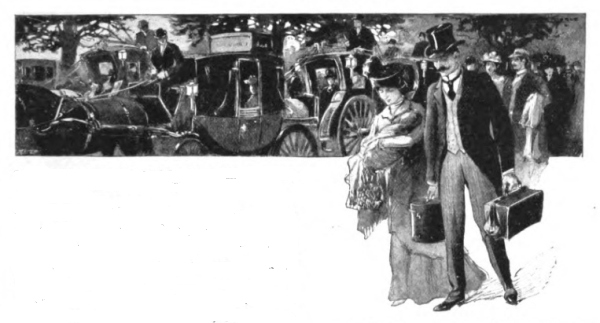
It was if all the inhabitants of Devonshire Park were going away for their summer holidays simultaneously.
"There you are," Label said grimly. "It is a night flight from the plague. It has been going on for hours. It would have been finished now but for the difficulty in getting conveyances. Most of the cabmen are avoiding the place as if it were accursed. But money can command everything, hence the scene that you see before you."
Hubert stood silently watching the procession. There was very little luggage on any of the cabs or conveyances. Families were going wholesale. Devonshire Park for the most part was an exceedingly prosperous district, so that the difficulties of emigration were not great. In their panic the people were abandoning everything in the wild flight for life and safety.
Then he went in again to rest before the unknown labours of to-morrow. Next morning he anxiously opened his morning paper.
It was not particularly pleasant reading beyond the information that the health of the Emperor of Asturia was mentioned, and that he had passed a satisfactory night. As to the rest, the plague was spreading. There were two hundred and fifty cases in Devonshire Park. Label's sayings had come true at last; it was a fearful vindication of his prophecy. And the worst of it was that no man could possibly say where it was going to end.
Strange as it may seem, London's anxiety as to the welfare of one man blinded all to the great common danger. For the moment Devonshire Park was forgotten. The one centre of vivid interest was Buckingham Palace.
For three days crowds collected there until at length Label and his colleagues were in a position to issue a bulletin that gave something more than hope. The Emperor of Asturia was going to recover. Label was not the kind of man to say so unless he was pretty sure of his ground.
It was not till this fact had soaked itself into the public mind that attention was fully turned to the danger that threatened London. Devonshire Park was practically in quarantine. All those who could get away had done so, and those who had remained were confined to their own particular district, and provisioned on a system. The new plague was spreading fast.
In more than one quarter the suggestion was made that all houses in certain localities should be destroyed, and the ground thoroughly cleansed and disinfected. It would mean a loss of millions of money, but in the scare of the moment London cared nothing for that.
At the end of a week there were seven thousand cases of the new form of diphtheria under treatment. Over one thousand cases a day came in. Devonshire Park was practically deserted save for the poorer quarters, whence the victims came. It seemed strange to see fine houses abandoned to the first comer who had the hardihood to enter. Devonshire Park was a stricken kingdom within itself, and the Commune of terror reigned.
Enterprising journalists penetrated the barred area and wrote articles about it. One of the fraternity bolder than the rest passed a day and night in one of these deserted palatial residences, and gave his sensations to the Press. Within a few hours most of the villas were inhabited again! There were scores of men and women in the slums who have not the slightest fear of disease—they are too familiar with it for that—and they came creeping westward in search of shelter. The smiling paradise had become a kind of Tom Tiddler's ground, a huge estate in Chancery.
Nobody had troubled, the tenants were busy finding pure quarters elsewhere, the owners of the property were fighting public opinion to save what in many cases was their sole source of income. If Devonshire Park had to be razed to the ground many a wealthy man would be ruined.
It was nearly the end of the first week before this abnormal state of affairs was fully brought home to Hubert. He had been harassed and worried and worn by want of sleep, but tired as he was he did not fail to notice the number of poorer patients who dribbled regularly into the terrace of houses that now formed the hospital. There was something about them that suggested any district rather than Devonshire Park.
"What does it mean, Walker?" he asked one of his doctors.
Walker had just come in from his hour's exercise, heated and excited.
"It's a perfect scandal," he cried. "The police are fighting shy of us altogether. I've just been up to the station and they tell me it is a difficult matter to keep competent officers in the district. All along Frinton Hill and Eversley Gardens the houses are crowded with outcasts. They have drifted here from the East End and are making some of those splendid residences impossible."
Hubert struggled into his hat and coat, and went out. It was exactly as Walker had said. Here was a fine residence with stables and greenhouses and the like, actually occupied by Whitechapel at its worst. A group of dingy children played on the lawn, and a woman with the accumulated grime of weeks on her face was hanging something that passed for washing out of an upper window. The flower beds were trampled down, a couple of attenuated donkeys browsed on the lawn.
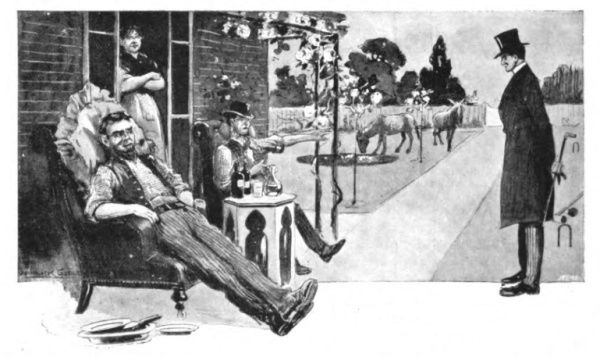
Here was a fine residence actually occupied by Whitechapel at its worst.
Hubert strolled up to the house fuming. Two men were sprawling on a couple of morocco chairs smoking filthy pipes. They looked up at the newcomer with languid curiosity. They appeared quite to appreciate the fact that they were absolutely masters of the situation.
"What are you doing here?" Hubert demanded.
"If you're the owner well and good," was the reply. "If not, you take an' 'ook it. We know which side our bread's buttered."
There was nothing for it but to accept this philosophical suggestion. Hubert swallowed his rising indignation and departed. There were other evidences of the ragged invasion as he went down the road. Here and there a house was closed and the blinds down; but it was an exception rather than the rule.
Hubert walked away till he could find a cab, and was driven off to Scotland Yard in a state of indignation. The view of the matter rather startled the officials there.
"We have been so busy," the Chief Inspector said; "but the matter shall be attended to. Dr. Label was here yesterday, and at his suggestion we are having the whole force electrically treated—a kind of electrical hardening of the throat. The doctor claims that his recent treatment is as efficacious against the diphtheria as vaccination is against smallpox. It is in all the papers to-day. All London will be going mad over the new remedy to-morrow."
Hubert nodded thoughtfully. The electric treatment seemed the right thing. Label had shown him what an effect the application of the current had had on the teeming mass of matter taken from the road cutting. He thought it over until he fell asleep in his cab on the way back to his weary labours.
London raged for the new remedy. The electric treatment for throat troubles is no new thing. In this case it was simple and painless, and it had been guaranteed by one of the popular heroes of the hour. A week before Label had been regarded as a crank and a faddist; now people were ready to swear by him. Had he not prophesied this vile disease for years, and was he not the only man who had a remedy? And the Emperor of Asturia was mending rapidly.
Had Label bidden the people to stand on their heads for an hour a day as a sovereign specific they would have done so gladly. Every private doctor and every public institution was worked to death. At the end of ten days practically all London had been treated. There was nothing for it now but to wait patiently for the result.
Another week passed and then suddenly the inrush of cases began to drop. The average at the end of the second week was down to eighty per day. On the seventeenth and eighteenth days there were only four cases altogether and in each instance they proved to be patients who had not submitted themselves to the treatment.
The scourge was over. Two days elapsed and there were no fresh cases whatever. Some time before a strong posse of police had swamped down upon Devonshire Park and cleared all the slum people out of their luxurious quarters. One or two of the bolder dwellers in that once favoured locality began to creep back. Now that they were inoculated there seemed little to fear.
But Label had something to say about that. He felt that he was free to act now, he had his royal patient practically off his hands. A strong Royal Commission had been appointed by Parliament to go at once thoroughly into the matter.
"And I am the first witness called," he chuckled to Hubert as the latter sat with the great German smoking a well-earned cigar. "I shall be able to tell a few things."
He shook his big head and smiled. The exertion of the last few weeks did not seem to have told upon him in the slightest.
"I also have been summoned," Hubert said. "But you don't suggest that those fine houses should be destroyed?"
"I don't suggest anything. I am going to confine myself to facts. One of your patent medicine advertisements says that electricity is life. Never was a truer word spoken. What has saved London from a great scourge? Electricity. What kills this new disease and renders it powerless? Electricity. And what is the great agent to fight dirt and filth with whenever it exists in great quantities? Always electricity. It has not been done before on the ground of expense, and look at the consequences! In one way and another it will cost London £2,000,000 to settle this matter. It was only a little over a third of that I asked for. Wait till you hear me talk!"
Naturally the greatest interest was taken in the early sittings of the Commission. A somewhat pompous chairman was prepared to exploit Label for his own gratification and self-glory. But the big German would have none of it. From the very first he dominated the Committee, he would give his evidence in his own way, he would speak of facts as he found them. And, after all, he was the only man there who had any practical knowledge of the subject of the inquiry.
"You would destroy the houses?" an interested member asked.
"Nothing of the kind," Label growled. "Not so much as a single pig-sty. If you ask me what electricity is I cannot tell you. It is a force in nature that as yet we don't understand. Originally it was employed as a destroyer of sewage, but it was abandoned as too expensive. You are the richest country in the world, and one of the most densely populated. Yet you are covering the land with jerry-built houses, the drainages of which will frequently want looking to. And your only way of discovering this is when a bad epidemic breaks out. Everything is too expensive. You will be a jerry-built people in a jerry-built empire. And your local authorities adopt some cheap system and then smile at the ratepayers and call for applause. Electricity will save all danger. It is dear at first, but it is far cheaper in the long run."
"If you will be so good as to get to the point," the chairman suggested.
Label smiled pityingly. He was like a schoolmaster addressing a form of little boys.
"The remedy is simple," he said. "I propose to have a couple of 10,000 volts wires discharging their current into the ground here and there over the affected area. Inoculation against the trouble is all very well, but it is not permanent and there is always danger whilst the source of it remains. I propose to remove the evil. Don't ask me what the process is, don't ask me what wonderful action takes place. All I know is that some marvellous agency gets to work and that a huge mound of live disease is rendered safe and innocent as pure water. And I want these things now, I don't want long sittings and reports and discussions. Let me work the cure and you can have all the talking and sittings you like afterwards."
Label got his own way, he would have got anything he liked at that moment. London was quiet and humble and in a mood to be generous.
Label stood over the cutting whence he had procured the original specimen of all the mischief. He was a little quiet and subdued, but his eyes shone and his hand was a trifle unsteady. His fingers trembled as he took up a fragment of the blue grey stratum and broke it up.
"Marvellous mystery," he cried. "We placed the wires in the earth and that great, silent, powerful servant has done the rest. Underground the current radiates, and, as it radiates, the source of the disease grows less and less until it ceases to be altogether. Only try this in the tainted areas of all towns and in a short time disease of all kinds would cease for ever."
"You are sure that stuff is wholesome, now?" Hubert asked.
"My future on it," Label cried. "Wait till we get it under the microscope. I am absolutely confident that I am correct."
And he was.
A BUBBLE BURST.
How a Stock Exchange Scare Dislocated the Life of the Empire for Two Days.
The era of peace which seemed to be well begun in 1906 was naturally marked by an extraordinary commercial and financial activity; an amount of world-wide speculations never equalled in intensity, even in the mad times of the South Sea Bubble, or when Hudson, the Railway King, flourished. The countless millions piled up in English banks earning a 2½ per cent. interest were lavishly withdrawn, new mines had been started, everybody was going to be rich. On the face of it people had good ground for their sanguine expectations. The Rand with its forty square miles of rich gold-bearing reefs containing an untold number of immense fortunes—the richest region on earth—was properly administered for the first time. From the highest to the lowest everybody was investing their savings in South Africa.
In other words, there was a tremendous "boom." Nothing like it had ever been seen in the history of commerce. It was the golden hour of the promoter. Yet, for the most part, the schemes promised well. There was, however, an enormous amount of rubbish in the market. Some of the more thoughtful financiers scented danger ahead, but they were not listened to. The roar of the Kaffir circus resounded in men's ears and made them mad. Park Lane would never be able to hold the new millionaires.
All England was in the grip of the mania. Bona fide speculation and business had become gambling pure and simple. London thought of nothing else. The City was crammed with excited buyers and operators, the little outside broker of yesterday came down to his offices behind a pair of blood horses, and his diamonds were a solid sign of his new prosperity.
A busy day was drawing to a close. Carl Ericsson sat in his office smoking a cigarette. Ericsson yesterday had been waiter in an unimportant restaurant. To-day he had a fine set of offices and a small mansion at Hampstead. He had "arrived" on the crest of the wave as many far less astute adventurers had done. There was a peculiarly uneasy grin on his dark features, a curious twitching of the lips, and he had the tired eyes of the sleepless.
His partner sat opposite him behind a big cigar. He was a fat man with a big jaw and a merciless mouth. Six months before Eli Smith had been a fairly well-to-do suburban butcher. Now he was E. Asherton-Smith, the big financial agent. He boasted, with truth, that he could sign a cheque for £40,000 and be none the worse for it. In the area of the City it would have been difficult to find two choicer specimens of rascality than the partners in Ericsson & Co.
"Got a big card to play, eh?" Asherton-Smith asked.
Ericsson grinned nervously. His lithe little body was quivering with excitement. There was a furtive look in his drooping eyes.
"The ace of trumps," he gurgled; "the coup of the century. Eli, my boy, how much money could we make if we could scare South Africans down five or six points for a week?"
Mr. Asherton-Smith's diamonds heaved with emotion.
"Millions," he said. "Just as many millions as we could stagger under. Makes my mouth like sawdust to think of it. But pass out a bottle of champagne."
Ericsson did so, rose from his seat and peeped into the outer office; the clerks had all gone for the day. He closed the door gently.
"I'm going to tell you," he said. "If I don't tell somebody I shall go mad. I can't sleep at nights for thinking of it. When I do doze off I'm swimming in a river of sovereigns. With a bit of luck, it's a certainty."
"Get on, Carlo. You're just playing with my feelings."
"Well, it's just this way"—Ericsson's voice dropped to a whisper. "There are two lines of cable by which South Africa can communicate with the outside world—the East and West Africa cables. The West Coast line isn't to be relied upon; it breaks down at least once a week. At a time like this a breakdown is a serious matter. The directors have taken the bull by the horns, so at the present moment the West Coast line is out of our calculations. It's under repair, and it's likely to remain so for some time to come. I've ascertained that communication with South Africa by the Western line is impossible. For the next fortnight no message can come or go by that route. This leaves us only the Eastern line to grapple with. If that kindly breaks down for four-and-twenty hours, our fortunes are safe."
"Is it likely?" Asherton-Smith asked.
"Why, yes. It has happened three times during this year. I tell you I have followed this thing pretty keenly. It's more than on the cards. Suppose the breakdown did come, Eli, and we had the last message through? Look at this."
Ericsson took from a safe a sheet of paper—a cablegram message, in fact, sent cut from the office of the East Africa company. It was a genuine document enough, with the date and the hour showing that it had been dispatched from Cape Town on the afternoon of the same day. There were words upon it to the effect that "Bertha has lost her aunt, and the water has been packed in the matchbox."
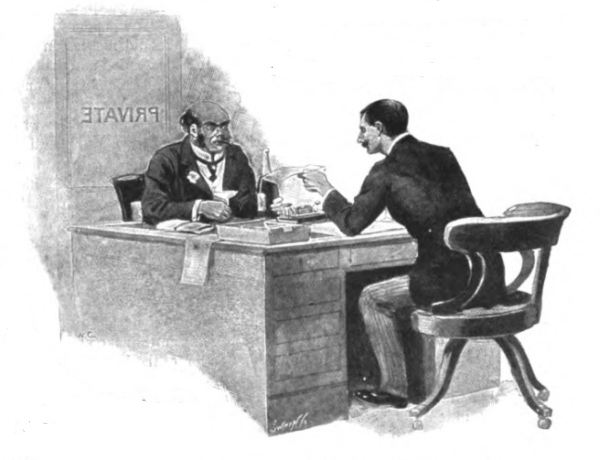
"That isn't our cypher," Asherton-Smith said.
"That isn't our cypher," Asherton-Smith said.
"Quite right; it's the cypher used by The Messenger. The Messenger, my boy, enjoys as high a reputation as The Times. If a cablegram appeared in The Messenger to-morrow saying that there had been an earthquake on the Rand, and that the Johannesburg water-works had overflowed into the deep levels everybody could take it for gospel. That's why I managed to get hold of and learn The Messenger cypher.
"On the off-chance of the Eastern cable breaking down, I've had a cable sent to me every day from a friend in South Africa saying that there has been an earthquake in Johannesburg, and that the mines are flooded out. The cable comes to me in the cypher used by The Messenger people. That's what all that gibberish about Bertha and the water and the matchbox means.
"Suppose you were to walk into the office and say the Eastern line of cable had broken down. As the Western line is under repair that tells me that communication with South Africa is impossible for a day or more. Probably the lines would be unavailable for nearly a week. I've got a spare envelope or two used by the Eastern Company for their messages; I put this flimsy inside and alter my own address 'Bonan' to 'Bonanza'—which is the registered cable address of The Messenger—by the addition of two letters, and there you are. That's why I thought of 'Bonan' and that little office of mine in Long Lane, where I am known as James Jones.
"I've had this scheme in my mind for years. A boy drops into The Messenger office and hands over the cablegram, and there you are. The thing looks perfectly in order; it is the private cypher of the big newspaper, and, moreover, it is quite up-to-date. If the cable breaks down no questions can be asked, and the thing goes into the paper. We've only got to get the same message sent to me every day, and sooner or later our chance comes."
Asherton-Smith was breathing heavily. The prospect was dazzling. Somebody was tapping at the outer door. A large man in a big fur coat entered.
"What are you beggars conspiring about?" he asked. "Got something extra special from down below? Egad, I'd give something for a private wire of my own! We'll get a rest for a day or two. The East Africa cable is bust up south of Mauritius."
The intruder helped himself to a glass of champagne that he obviously didn't want, and drifted out again. The partners glanced at one another without speaking. Perhaps they were just a little frightened.
The thing appeared to be absolutely certain. So far as they could see, the story would be believed implicitly, for The Messenger was absolutely reliable.
The great beauty of the whole scheme was its conclusiveness. There never had been an earthquake on the Rand, but there was no reason why there shouldn't be. And an earthquake would assuredly destroy the Johannesburg water-works, which would mean the washing away of half the place and the flooding of some of the richest mines below the town.
The West Coast cable was under repair and incapable of use. But that frequently happened, as most people interested in South Africa know. There was no chance of the truth trickling back to London viâ Australia or New York. And now the Eastern line had broken down also, as all deep sea cables do on occasion.
"Upon my word, I can't see a flaw anywhere," Ericsson remarked, in a voice that trembled. "If the Eastern line is repaired by morning we shall be none the worse off. Our coup will have miscarried, a few inquiries will be made, and James Jones will never be seen in Long Lane Office again."
Asherton-Smith went home and dined and drank; but sleep was not for his pillow that night. The papers were late in the morning, and that did not lessen his irritability. The breakfast stood untouched, beyond a little dry toast, and some brandy and soda water. Just for the moment the prosperous Asherton-Smith regretted the day when he had been the oily and irresponsible Eli Smith, butcher.
The papers came at last—a whole pile of them: but Asherton-Smith only desired to see The Messenger. He fluttered it open with fingers that trembled. There it was—the news that he sought. He drew a deep breath.
Usually The Messenger avoided sensation; but here was a "scoop" that no human editor could possibly resist. The headlines danced before the reader's eyes.
"Earthquake at Johannesburg! Destruction of the Water Works and the Flooding of the Mines. Great loss of life and property." The Messenger, alone of all the papers, contained this news.
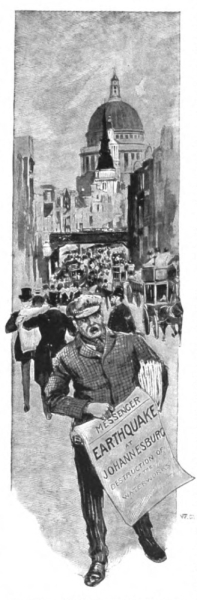
The Messenger, alone of all the papers, contained this news.
A map of Johannesburg, right away from the water-works to the five-mile belt, where the world-renowned mines lay, only served to make the story more convincing. The water would have swept over the city, from the aristocratic suburb of Dornfontein to the auriferous belt that held the wealthy mines.
There were hundreds of millions of money invested here. The news of the disaster would have a depressing effect upon the Stock Exchange. Weak holders would be pretty certain to lose their heads, and the markets would be flooded with shares. Asherton-Smith trembled as he thought of his forthcoming fortune.
A little after ten o'clock he was in the City. In the train and in the streets people were talking about nothing but the great disaster in South Africa. Nobody doubted the story, though only The Messenger contained it. Unfortunately the Eastern line had broken down at a critical moment, and no details were forthcoming for the time being. The Messenger's cable had been the last to come through.
"Going all right, eh?" Asherton-Smith asked. His teeth were chattering, but not with cold. "Pretty satisfied, eh?"
Ericsson nodded and grinned. He looked white and uneasy.
"I've started the machinery," he said. "When prices have dropped five or six points we are going to buy quietly. Mind you, I'm going to make no secret of it. I'm going to pose as the saviour of the market, the one man who refuses to bow to the panic—shall swagger about the stuff being there in spite of a dozen earthquakes. I shall boast that at bed rock prices we can afford to buy to hold. That line will avert suspicion from us when the cat is out of the bag and our fortunes made. And you'll have to back me up in this. What a row there will be when the truth comes to be told!"
Ericsson and his partner pushed their way past inquisitive spectators who had nothing to lose, and therefore enjoyed the strange scene; they elbowed wealthy-looking men in all the garb of prosperity whose haggard faces gave the lie to their outer air.
Everybody was constrained and alert. The big financiers who usually controlled the markets were getting frightened. They assumed that there must be no panic, they desired that nothing should be done till the full magnitude of the disaster could be verified.
But people believed in the integrity of The Messenger which had never played them false yet. The great men of the exchanges and the marts had forgotten their human nature for the moment. They were asking poor humanity to put aside greed and self interest and love of money, the father to forget his savings, and the widow to ignore her dividends. They might just as well have appealed to the common sense of a flood tide swept by the gale.
Two of the big men were penned on the pavement on Cornhill. Their names were good on "'Change" for any amount in reason; they reckoned themselves rich and comfortable. But the strain of the situation was getting on their nerves.
"I'd give £50,000 to have my way here for a few hours, Henderson," said one.
"I'd give twice that to feel that I had what I deemed myself to possess yesterday," said Sir James Henderson. "What would you like to do, Kingsley?"
"Clear the streets," the great bullion broker replied. "Get some troops and Maxims, and declare the City in a state of siege for eight-and-forty hours. Pass a short Act of Parliament prohibiting people from dealing in stocks and shares for a week. By that time the panic would have allayed itself and folks regained their sanity. As it is, thousands are going to be ruined. Every share in the South African market is absurdly inflated, and, even if the disaster is small, prices must keep low. But there is worse coming than that, my friend."
Already rumours were spreading far and wide as to the fall of certain shares. Mines that yesterday stood high in the estimation of the public were publicly offered at a reduction of from eight to ten points; even the gilt-edged securities were suffering.
The feeling grew that nothing was safe. It is the easiest thing in the world to shake public assurance where money is concerned. With one accord the thousands of large and small speculators had set out for the City to get rid of their liability on the earliest possible occasion. They asked for no profits, they demanded no margin—they would have been content to get out at a loss.
It never occurred to the individual that the same brilliant idea might strike a million brains simultaneously. With one accord they rushed to the line of action that might be the ruin of one-third of them. Just for the time purchases by a few bold speculators stopped the rush; but presently they got filled up or frightened, so that by two o'clock some of the best paper in the market was begging at a few shillings the £1 share. When the fact struck New York and reacted on the London market, nobody knew what might happen.
It was fortunate that sellers could not unload at once. Sheaves of telegrams tumbled into brokers' offices, the floors were littered with orange envelopes, the City was musical with the tinkle of telephones. The heads of firms, half mad with worry and anxiety, were offering the girls in the telephone exchange large sums to connect them with this office and the other. The usually sane City of London was as mad now as it had been in the days of the South Sea Bubble.
By three o'clock, however, business on the Stock Exchange had practically come to a standstill. It was useless to deal with waste paper. To-morrow the crowd would doubtless be augmented by thousands of provincial speculators. Already the foreign Bourses were suffering under the strain. Early in the afternoon there were rumours and signs of an excited struggle in Lothbury.
What had happened now? People were straining their ears to listen. The news came in presently. There was a run on the South African Industrial Bank!
When the crowd began to clamour at the doors of the South African Industrial, the manager slipped out by a side entrance and made the best pace he could in the direction of the Bank of England. Once there, all his self-possession deserted him. He asked wildly to see the chief cashier, the general manager, the governors, anybody who might help him for the moment.
But the officials had other things to occupy their attention. From all parts of the country intelligence had arrived to the effect that the panic was at its height. It was only now that the big financiers realised what a large amount of fanatical gambling there had been in South Africans. Everybody had been going to make their fortunes, from humble clerks up to the needy aristocrats. Every penny that could be raked together had gone that way.
And now the country had taken it into its head that the Rand was lost. Wild appeals had been made to the Eastern Cable Company to do something, but they could only reply that their line had broken down somewhere beyond Mauritius, and that, until it could be fished up and spliced. South Africa might as well be in the moon. People were acting as if the Rand had been swallowed up altogether.
The Bank of England was full of great financiers at their wits' ends for some means of allaying the panic and restoring public confidence. The great houses, Rothschild, and Coutts, and the rest, were represented in the governor's parlour.
The presiding genius of the South African Industrial found his way into the meeting. He was sorry to trouble them: he would not have come unless he had been absolutely bound to. But there was a run on his bank, and he wanted £2,000,000 immediately. As to security——
One of the grave financiers laughed aloud. It seemed an awful thing to do in that solemn and decorous parlour, but nobody seemed to notice. But there was a general consensus of opinion that the money must be forthcoming. If one sound bank was allowed to topple over, goodness only knew where the catastrophe might end.
"You will have to do with £500,000 for the present," the chairman said. "There are sure to be applications. You must be diplomatic; festina lente, you know."
"If I could keep open straight away until——"
"Madness. Keep to your regulations. Close at four o'clock. Delay is everything."
The big clock in the room boomed the hour of four. It was as if some long-drawn mental agony had suddenly ceased.
The manager of the South African Industrial fought his way back to the offices with a little comfort at the back of his mind.
There was a lull in the roar as he appeared. He took advantage of it. His courage had come back to him now.
"Close the doors," he said sharply. "It is past four o'clock."
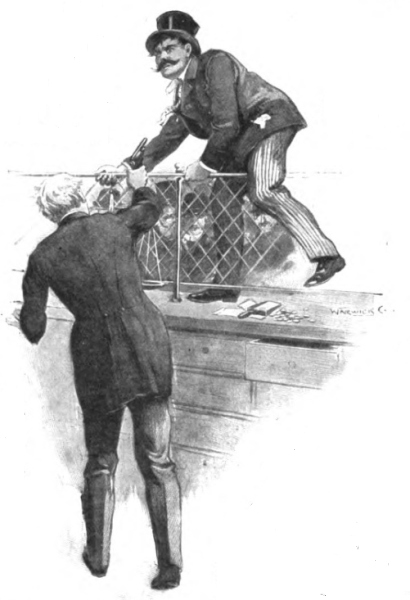
A cashier whipped a revolver out from a drawer.
The mob yelled its protest. A big man climbed over the trellis along the counter. Just for a moment it looked like a lawless riot, but a cashier whipped a revolver out from a drawer, and as the big man looked down the blue bore his courage failed him. There was no further rush, but at, the same time there was no disposition on the part of the crowd to retire.
"We are closed for the day," the manager said with considerable coolness. "You can't expect me to stay here all night merely because you have taken it into your heads to want your money all at once. Come to-morrow and you shall all be paid."
A derisive howl followed. The manager whispered something to one of the clerks and the latter slipped out. Presently there was a commotion at the doors, and half-a-dozen helmets topped the crowd. There was a swaying movement till the long counter creaked again, an oath or two, uplifted sticks and the smashing of a policeman's helmet.
For the next few minutes there was something in the nature of a free fight; blows were freely exchanged, and more than one face bore traces of blood. But there is always something besides physical force behind law and order, and gradually the mob turned back. Gradually the counting-house was cleared and the iron shutters let down.
But the City did not clear. The wildest rumours were in the air. Other banks, doing a more or less large business in the way of withdrawals, had followed the example of the South African Industrial, and this had not tended to restore public confidence. It was pretty clear that every house would have to face a similar run on the morrow.
At eight o'clock the streets were still crowded. It was fairly warm: there was little or no traffic after dusk, and it became evident that thousands of people had all tacitly resolved to do the same thing—remain in the streets all night outside their particular offices or business houses, and wait so that they might have the first chance in the morning. People sat on the paths and in the roadway. Every City house of refreshment had been depleted of food long since.
Under the big electric lamps people reclined, reading the evening papers. It was a gigantic picnic, with tragedy to crown the feast. There was no laughter, nothing but grim determination of purpose.
The papers were full of bad news from the provinces. Everywhere public credit was shaken to breaking point. There had been runs on scores of local banks.
In the West End there was only one topic of conversation. But the theatres and restaurants were open, and life was going on much the same. In a private room at the Savoy Ericsson and his partner in guilt were dining. The waiters had gone, the wine and cigars stood on the table.
There was a subdued look about both of them, a furtive cast of the eyes and just a suggestion of slackness in their hands not due entirely to the champagne. It was a long time before either of them spoke.
"Pretty warm day, Eli," Ericsson suggested.
Asherton-Smith wiped his red damp forehead.
"Rather," he said. "I'm not so sharp as you, I know, but I'd forfeit a few thousands to be well out of this."
Ericsson was not so contemptuous of his thick-witted partner as usual.
"I should like to know what you are driving at," he muttered.
"Well, we've been too sharp. We've played the game too far. Shares were only to drop a few points, and we were to buy for the rise. We've laid out every penny that we could rake together for the rise. And what have we got? Some hundreds of thousands of shares a few points below par? Not a bit of it. If this panic waits two days longer we shall have exchanged all our own cash and our own credit for a ton or two of waste paper."
"It will all come back again," Ericsson said uneasily.
"Ah, but when? The bogey has been too big for the public. We've given them a scare that they will not get over in a hurry for many a day. We've shown them what might happen. And they tumble to the fact that things are far too inflated. The fall of a few points would have put millions into our pockets. As it is, we shall have to hold on perhaps for months. And we're not strong enough to do that."
"If the cable works again to-morrow." Ericsson said hoarsely after a pause, "it——"
"Yes, and if it doesn't? And if the thing goes on, what then? And if there should be a run to-morrow on the Bank of England!"
"I never thought of that," Ericsson groaned. "Pass the brandy. If only to-morrow were Saturday instead of Thursday! A pretty black Thursday it's going to be."
Ericsson and Asherton-Smith were still sipping their brandy, but they were no longer gloating over their prey with shining eyes—they no longer counted their prospective millions. Like the greedy fox they had dropped the substance for the shadow. They were going to be ruined with their victims.
With moody, furtive, bloodshot eyes they looked at each other.
"I suppose we can't drop a hint," Ericsson suggested.
"Drop a hint," Asherton-Smith sneered. "You're a clever chap, you are—too clever by half. But if that's all the idea you've got you'd better shut up. Perhaps you'd like to go and tell the story to the Lord Mayor?"
Ericsson's fine turn for repartee seemed to have deserted him.
"Who could have anticipated anything like this?" he groaned. "And the worst of it is that we dare not say a word. The merest hint would invite suspicion, and you may be pretty sure that they would make the punishment fit the crime. We'll just have to grin and bear it."
Asherton-Smith shook his fist in the speaker's face.
"You miserable swindler!" he yelled. "But for you I should have been a rich man to-day. And now I am ruined—ruined!"
Ericsson bent his head meekly with never a word to say.
The City was awake earlier than usual next morning; indeed, for once, it had not slept. By nine o'clock in the morning the streets were packed. The haggard-eyed, sleepless ones gained nothing by their tenacity, for they were pushed from pillar to post by others, fresh for the fray.
The provincial trains from an early hour had commenced to pour fresh forces into London. A great many business men had slept as best they could in their offices, feeling pretty sure that it was the only way to be on the spot in the morning. They looked tired and worn out.
It was a quiet, persistent, grim crowd. There was no hustling or horse-play, or anything of that kind; even the ubiquitous humourist was absent. They pushed on persistently, a denser crowd round the large banks. As soon as the shutters were down and the doors opened the human tide streamed in.
The run on the banks had set in grimly. Clerks and cashiers from distant branches had been brought up to meet the pressure. There was a confidence in the way they bustled about and handled and paid out the money that was not without its effect. More than one man eyed the pile of notes in his hand and passed them back over the counter again. Here and there people were bewailing the loss of their money.
It was the golden hour of the light-fingered fraternity. They were absolutely covered by the dense crowd so that they could pursue their vocation with impunity. They had only to mark down some rich prize and plunder. Individuals shrieked that they had been robbed, but nobody took any notice.
A burly, red-faced farmer yelled that he had been robbed of £800 in Bank of England notes. Someone by him retorted that it was no loss, seeing that there was a run on the great National Bank.
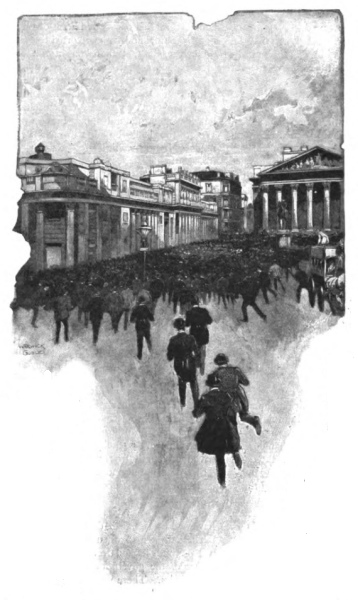
It was the thrilling moment of the day! A run on the Bank of England!
It was the thrilling moment of the day! A run on the Bank of England! And yet it seemed in the light of new circumstances to be the most natural thing in the world. Would the bank be able to cash its own notes? If not—well, if not—nobody could foresee the end.
There were thousands of curious people in the crowd who had no business there whatever. Not that there was any business properly so called done in London that day. There was a surging rush in the direction of Threadneedle Street. It would be something in after life to say that one had seen a run on the Bank of England.
Inside the paying departments huge piles of gold and silver glittered in the sunshine. It was a curious and thrilling contrast between the grave decorum of the clerks and the wild, fierce rush of the public.
The piles of gold and the easy unconcern of the officials satisfied a good many people who pushed to the counters and then fell back again muttering uncomfortably; but, in real truth, the bank managers were becoming a little anxious.
Lord Fairchild, the great capitalist, with his houses in every big city of the world, contrived at length to reach the bank parlour. There was a full meeting of the chairman and governors. A cheerful tone prevailed.
"I sincerely hope we may weather the storm," the chairman said anxiously. "We have had no signal of distress from anyone; but I shall be glad when it is over."
Everybody looked tired and worn out. One or two of the governors had fallen asleep in their chairs. There was a litter of lunch on the table. But very few of those assembled there seemed to care anything for food.
"I calculate that we can last another day," Lord Fairchild said. "By to-morrow I hope we shall have contact with Cape Town again."
Every effort was being made to bring about this desirable consummation. The broken line might be repaired at any moment. News had come from the Mauritius that the broken cable had been fished up, but there was no further information since midnight. Possibly, when contact could be made again, the disaster would prove to be much less than the last message had forecasted.
"It must come," one of the governors sighed. "It must come soon, or Parliament will have to deal with this question. Another two days——"
"I prefer not to think of another two days," Lord Fairchild replied. "If the worst comes to the worst, Government must guarantee our paper. We shall have to issue Treasury bills to make up our deficit. We——"
An excited individual burst without ceremony into the room. His hat was off; his smart frock coat was torn to ribands.
"I am from the office of the East Cable Company," he gasped. "I was told to come here at once. My Lord, I have the most extraordinary news. The great disaster at Johannesburg is—is—is——"
"Get on, man; we are all impatience."
"Is—is no disaster at all. We have verified it. Our agent at Cape Town says he has heard nothing of it. Johannesburg stands where it did. There are four messages through and—well, there has been a cruel fraud, and we are doing our best to get to the bottom of it."
A rousing cheer echoed through the bank parlour. The governors yelled and shook each other by the hand like school-boys. Probably the decorum of that room had never been so grossly violated before.
Lord Fairchild passed into the great office where the public were still pushing and struggling. He stood on a table, his spare and striking figure standing out conspicuously. There were hundreds present who recognised that noble figure.
"Gentlemen," Lord Fairchild cried, "I have just received the most authentic information that Johannesburg stands intact to-day. There has been trickery somewhere, but, thank Heaven, the panic is over."
A perfect yell followed. Men went frantic with delight. When Lord Fairchild said a thing it was accepted as gospel. Hats went high in the air, people shook hands with perfect strangers, there was a rush to pay gold back and take notes instead.
The news spread in the marvellous magnetic way common to the ear of a huge multitude. It ran with lightning speed through the streets. Everybody seemed to know like magic that Lord Fairchild had made a short speech in the Bank of England to the effect that the scare was over. In less than ten minutes the various bank officials were deeply engaged in taking back again the piles of gold they had so recently paid out. The mob roared out patriotic songs, there was a rush in all directions. For the next hour or so the telegraph lines fairly hummed with messages. Within an hour the City had regained much of its usual busy decorum, save for the long stream of people who were getting rid of their gold once more.
With a view to prevent any further exploiting and financial uneasiness on the part of the speculating fraternity, the committee of the Stock Exchange met and formally closed the House till Monday. Under the circumstances the step was an exceedingly wise one.
In the seclusion of the bank parlour Lord Fairchild was closeted with the editor of The Messenger. He had come down post haste to the City to vindicate his character. The famous cablegram lay on the table.
"I need not say, my lord," he began, "that I——"
"You need not say anything about yourself," Lord Fairchild said kindly. "We are quite convinced that you have been made a victim. But how?"
"I can only theorise at present," the Messenger editor replied. "And you, gentlemen, will understand, a great newspaper like ours has correspondents everywhere. We also have a special cypher known only to ourselves. Our man at the Cape is absolutely reliable. Now somebody must have stolen our cypher or possessed himself of the key. Cables come to us addressed to 'Bonanza.' Such was the cable that reached us on the day that the Eastern line broke down. Seeing that it was absolutely in order and apparently delivered in the usual way, we used it, under the impression that we had a great piece of news and one that possibly our rivals did not possess.
"There was nothing in the appearance of the cablegram to excite our suspicions, but since the news of its falseness has come through I have had it examined by an expert who reports that the original telegram had been directed to 'Bonan,' and not to 'Bonanza.' The last two letters had been cleverly forged, but under a very strong glass the forgery is clear. Now you can see the trap. I have been to the office of the Cable Company, and, as I expected, I find that a message was sent on the day in question from Cape Town to a registered 'Bonan.' This 'Bonan' turns out to be one James Jones who has an office in Long Lane. Of course that office was taken for the express purpose of getting that message, so that in case the Eastern line broke down the paper could be forced upon us. Unfortunately it was forced upon us with dire results. We find that the message was repeated day by day in the hopes of a breakdown.
"Now, lots of big houses down South cable quotations, lists of prices, finds of gold-dust and the like every day. All these are in cypher, and perhaps a fortnight might pass without any fluctuations, which would mean practically the receipt of an identical message for days. Nothing but a close search of the records could have aroused suspicion. Besides, the line had broken down, and all the energies of the company were devoted to that.
"If any of you gentlemen like to call at the Cable Company's offices and see the scores of duplicate cypher messages, all more or less alike, you will be convinced that the employés there are not in the least at fault. We have been the victims of a clever conspiracy. We can safely leave the rest to the police."
The City was becoming normal again. By four o'clock it was practically deserted. The offices of the various banks were bursting with the repaid gold. Many clerks were closing up the books and looking forward to a good night's rest.
It was almost impossible to believe that these were the same streets of a few hours before.
Meantime, Ericsson and his partner in the inner room of their offices were gloating over a bewildering array of figures; their gains from the gigantic hoax they had played on the public promised to run into millions.
Rejoicing in the sudden turn in affairs, the two guilty men were building castles in the air with their ill-gotten wealth, when heavy footsteps came up from the office stairs; there was a knocking at the door. The two men started up. Their nerves were humming still from the strain of the past day and night.
"Come in," Asherton-Smith cried unsteadily.
A couple of men entered. One of them had a paper in his hand.
"Mr. Asherton-Smith and Mr. Carl Ericsson, alias James Jones," he said, "I have a warrant for your arrest which I will read to you presently. I warn you not to say too much. Your accomplice, Jacob Peters, has been arrested at Cape Town, and I am instructed by cable that he has made a full confession."
The snarling oath died away on Ericsson's lips.
"It's all up," he said hoarsely, "but it was a chance. Curse Peters for a white-livered fool. But for him I should be worth fifty millions."
THE INVISIBLE FORCE.
A Story of What Might Happen in the Days to Come, when Underground London is Tunnelled in all Directions for Electric Railways, if an Explosion Should Take Place in One of the Tubes.
I.
It seemed as if London had solved one of her great problems at last. The communication difficulty was at an end. The first-class ticket-holders no longer struggled to and from business with fourteen fellow-sufferers in a third-class carriage. There were no longer any particularly favoured suburbs, nor were there isolated localities where it took as long getting to the City as an express train takes between London and Swindon. The pleasing paradox of a man living at Brighton because it was nearer to his business than Surbiton had ceased to exist. The tubes had done away with all that.
There were at least a dozen hollow cases running under London in all directions. They were cool and well ventilated, the carriages were brilliantly lighted, the various loops were properly equipped and managed.
All day long the shining funnels and bright platforms were filled with passengers. Towards midnight the traffic grew less, and by half-past one o'clock the last train had departed. The all-night service was not yet.
It was perfectly quiet now along the gleaming core that lay buried under Bond Street and St. James's Street, forming the loop running below the Thames close by Westminster Bridge Road and thence to the crowded Newington and Walworth districts. Here a portion of the roof was under repair.
The core was brilliantly lighted; there was no suggestion of fog or gloom. The general use of electricity had disposed of a good deal of London's murkiness; electric motors were applied now to most manufactories and work-shops. There was just as much gas consumed as ever, but it was principally used for heating and culinary purposes. Electric radiators and cookers had not yet reached the multitude; that was a matter of time.
In the flare of the blue arc lights a dozen men were working on the dome of the core. Something had gone wrong with a water-main overhead, the concrete beyond the steel belt had cracked, and the moisture had corroded the steel plates, so that a long strip of the metal skin had been peeled away, and the friable concrete had fallen on the rails. It had brought part of the crown with it, so that a maze of large and small pipes was exposed to view.
"They look like the reeds of an organ," a raw engineer's apprentice remarked to the foreman. "What are they?"
"Gas mains, water, electric light, telephone, goodness knows what," the foreman replied. "They branch off here, you see."
"Fun to cut them," the apprentice grinned.
The foreman nodded absently. He had once been a mischievous boy, too. The job before him looked a bigger thing than he had expected. It would have to be patched up till a strong gang could be turned on to the work. The raw apprentice was still gazing at the knot of pipes. What fun it would be to cut that water-main and flood the tunnels!
In an hour the scaffolding was done and the débris cleared away. To-morrow night a gang of men would come and make the concrete good and restore the steel rim to the dome. The tube was deserted. It looked like a polished, hollow needle, lighted here and there by points of dazzling light.
It was so quiet and deserted that the falling of a big stone reverberated along the tube with a hollow sound. There was a crack, and a section of piping gave way slightly and pressed down upon one of the electric mains. A tangled skein of telephone wires followed. Under the strain the electric cable parted and snapped. There was a long, sliding, blue flame, and instantly the tube was in darkness. A short circuit had been established somewhere. Not that it mattered, for traffic was absolutely suspended now, and would not be resumed again before daylight. Of course, there were the work-men's very early trains, and the Covent Garden market trains, but they did not run over this section of the line. The whole darkness reeked with the whiff of burning indiarubber. The moments passed on drowsily.
Along one side of Bond Street the big lamps were out. All the lights on one main switch had gone. But it was past one o'clock now, and the thing mattered little. These accidents occurred sometimes in the best regulated districts, and the defect would be made good in the morning.
It was a little awkward, though, for a great State ball was in progress at Buckingham Palace. Supper was over, the magnificent apartments were brilliant with light dresses and gay uniforms. The shimmer and fret of diamonds flashed back to lights dimmer than themselves. There was a slide of feet over the polished floors. Then, as if some unseen force had cut the bottom of creation, light and gaiety ceased to be, and darkness fell like a curtain.
There were a few cries of alarm from the swift suddenness of it. To eyes accustomed to that brilliant glow the gloom was Egyptian. It seemed as if some great catastrophe had happened. But common-sense reasserted itself, and the brilliant gathering knew that the electric light had failed.
There were quick commands, and spots of yellow flame sprang out here and there in the great desert of the night. How faint and feeble, and yellow and flaring, the lights looked! The electrician down below was puzzled, for, so far as he could see, the fuses in the meters were intact. There was no short circuit so far as the Palace was concerned. In all probability there had been an accident at the generating stations; in a few minutes the mischief would be repaired.
But time passed, and there was no welcome return of the flood of crystal light.
"It is a case for all the candles," the Lord Chamberlain remarked; "fortunately the old chandeliers are all fitted. Light the candles."
It was a queer, grotesque scene, with all that wealth of diamonds and glitter of uniforms and gloss of satins, under the dim suggestion of the candles. And yet it was enjoyable from the very novelty of it. Nothing could be more appropriate for the minuet that was in progress.
"I feel like one of my own ancestors," a noble lord remarked. "When they hit upon that class of candle I expect they imagined that the last possibility in the way of lighting had been accomplished. Is it the same outside, Sir George?"
Sir George Egerton laughed. He was fresh from the gardens.
"It's patchwork," he said. "So far as I can judge, London appears to be lighted in sections. I expect there is a pretty bad breakdown. My dear chap, do you mean to say that clock is right?"
"Half-past four, sure enough, and mild for the time of year. Did you notice a kind of rumbling under—Merciful Heavens, what is that?"
II.
There was a sudden splitting crack as if a thousand rifles had been discharged in the ballroom. The floor rose on one side to a perilous angle, considering the slippery nature of its surface. Such a shower of white flakes fell from the ceiling that dark dresses and naval uniforms looked as if their wearers had been out in a snowstorm.
Cracks and fissures started in the walls with pantomimic effect, on all sides could be heard the rattle and splinter of falling glass. A voice suddenly uprose in a piercing scream, a yell proclaimed that one of the great crystal chandeliers was falling. There was a rush and a rustle of skirts, and a quick vision of white, beautiful faces, and with a crash the great pendant came to the floor.
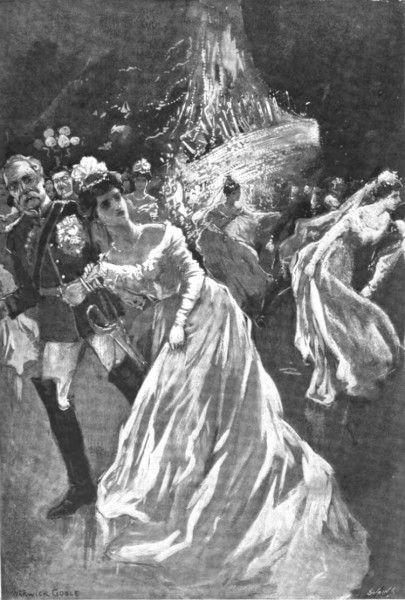
A yell proclaimed that one of the great crystal chandeliers was falling.
The whole world seemed to be oscillating under frightened feet, the palace was humming and thrumming like a harpstring. The panic was so great, the whole mysterious tragedy so sudden, that the bravest there had to battle for their wits. Save for a few solitary branches of candles, the big room was in darkness.
There were fifteen hundred of England's bravest, and fairest, and best, huddled together in what might be a hideous deathchamber for all they knew to the contrary. Women were clinging in terror to the men, the fine lines of class distinction were broken down. All were poor humanity now in the presence of a common danger.
In a little time the earth ceased to sway and rock, the danger was passing. A little colour was creeping back to the white faces again. Men and women were conscious that they could hear the beating of their own hearts. Nobody broke the silence yet, for speech seemed to be out of place.
"An earthquake," somebody said at length. "An earthquake, beyond doubt, and a pretty bad one at that. That accounts for the failure of the electric light. There will be some bad accidents if the gas mains are disturbed."
The earth grew steady underfoot again, the white flakes ceased to fall. Amongst the men the spirit of adventure was rising; the idea of standing quietly there and doing nothing was out of the question.
Anyway, there could be no further thought of pleasure that night. There were many mothers there, and their uppermost thought was for home. Never, perhaps, in the history of royalty had there been so informal a breaking up of a great function. The King and Queen had retired some little time before—a kindly and thoughtful act under the circumstances. The women were cloaking and shawling hurriedly; they crowded out in search of their carriages with no more order than would have been obtained outside a theatre.
But there were remarkably few carriages in waiting. An idiotic footman who had lost his head in the sudden calamity sobbed out the information that Oxford Street and Bond Street were impassable, and that houses were down in all directions. No vehicles could come that way; the road was destroyed. As to the rest, the man knew nothing; he was frightened out of his life.
There was nothing for it but to walk. It wanted two good hours yet before dawn, but thousands of people seemed to be abroad. For a space of a mile or more there was not a light to be seen. Round Buckingham Palace the atmosphere reeked with a fine irritating dust, and was rendered foul and poisonous by the fumes of coal gas. There must have been a fearful leakage somewhere.
Nobody seemed to know what was the matter, and everybody was asking everybody else. And in the darkness it was very hard to locate the disaster. Generally, it was admitted that London had been visited by a dreadful earthquake. Never were the daylight hours awaited more eagerly.
"The crack of doom," Sir George Egerton remarked to his companion, Lord Barcombe.
They were feeling their way across the park in the direction of the Mall.
"It's like a shuddering romance that I read a little time since. But I must know something about it before I go to bed. Let's try St. James's Street—if there's any St. James's Street left."
"All right," Lord Barcombe agreed, "I hope the clubs are safe. Is it wise to strike a match with all this gas reeking in the air?"
"Anything's better than the gas," Sir George said tersely.
The vesta flared out in a narrow, purple circle. Beyond it was a glimpse of a seat with two or three people huddled on it. They were outcasts and companions in the grip of misfortune, but they were all awake now.
"Can any of you say what's happened?" Lord Barcombe asked.
"The world's come to an end, sir, I believe," was the broken reply. "You may say what you like, but it was a tremendous explosion. I saw a light like all the world ablaze over to the north, and then all the lights went out, and I've been waiting for the last trump to sound ever since."
"Then you didn't investigate?" Lord Barcombe asked.
"Not me, sir. I seem to have struck a bit of solid earth where I am. And then it rained stones and pieces of brick and vestiges of creation. There's the half of a boiler close to you that dropped out of the sky. You stay where you are, sir."
But the two young men pushed on. They reached what appeared to be St. James's Street at length, but only by stumbling and climbing over heaps of débris.
The roadway was one mass of broken masonry. The fronts of some of the clubs had been stripped off as if a titanic knife had sliced them. It was like looking into one of the upholsterers' smart shops, where they display rooms completely furnished. There were gaps here and there where houses had collapsed altogether. Seeing that the road had ceased to exist, it seemed impossible that an earthquake could have done this thing. A great light flickered and roared a little way down the road. At an angle a gas main was tilted up like the spout of a teapot, upheaved and snapped from its twin pipes. This had caught fire in some way, so that for a hundred yards or so each way the thoroughfare was illuminated by a huge flare lamp.
It was a thrilling sight focussed in that blue glare. It looked as if London had been utterly destroyed by a siege—as if thousands of well-aimed shells had exploded. Houses looked like tattered banners of brick and mortar. Heavy articles of furniture had been hurled into the street; on the other hand, little gimcrack ornaments still stood on tiny brackets.
A scared-looking policeman came staggering along.
"My man," Lord Barcombe cried, "what has happened?"
The officer pulled himself together and touched his helmet.
"It's dreadful, sir," he sobbed. "There has been an accident in the tubes; and they have been blown all to pieces."
III.
The constable, for the moment, had utterly lost his nerve. He stood there in the great flaring roar of the gas mains with a dazed expression that was pitiful.
"Can you tell us anything about it?" Lord Barcombe asked.
"I was in Piccadilly," was the reply. "Everything was perfectly quiet, and so far as I could see not a soul was in sight. Then I heard a funny rushing sound, just like the tear of an express train through a big, empty station. Yes, it was for all the world like a ghostly express train that you could hear and not see. It came nearer and nearer; the whole earth trembled just as if the train had gone mad in Piccadilly. It rushed past me down St. James's Street, and after that there was an awful smash and a bang, and I was lying on my back in the middle of the road. All the lights that remained went out, and for a minute or two I was in that railway collision. Then, when I got my senses back, I blundered down here because of that big flaring light there; and I can't tell you, gentlemen, any more, except that the tube has blown up."
Of that fact there was no question. There were piles of débris thrown high in one part, and a long deep depression in another like a ruined dyke. A little further on the steel core of the tube lay bare with rugged holes ripped in it.
"Some ghastly electric catastrophe," Sir George Egerton murmured.
It was getting light by this time, and it was possible to form some idea of the magnitude of the disaster. Some of the clubs in St. James's Street still appeared to be intact, but others had suffered terribly. The heaps of tumbled masonry were powdered and glittering with broken glass and a few walls hung perilously over the pavement. And still the gas main roared on until the flame grew from purple to violet, and to straw colour before the coming dawn. If this same thing had happened all along the network of tubes, London would be more or less a hideous ruin.
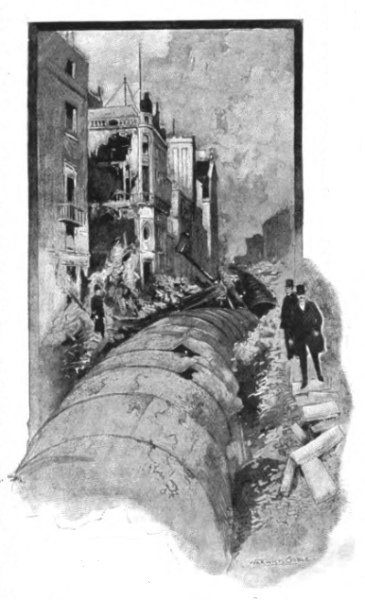
The explosion had had a straight run here, for the road had been raised like some gigantic zigzag molehill.
For the better part of Piccadilly things were brighter. Evidently the explosion had had a straight run here, for the road had been raised like some mighty zigzag molehill for many yards. The wood pavement scattered all over the place suggested a gigantic box of child's bricks strewn over a nursery floor. The tube had been forced up, its outer envelope of concrete broken so that the now twisted steel core might have been a black snake crawling down Piccadilly. Doubtless the expanding air had met with some obstacle in the tube under St. James's Street, hence the terrible force of the explosion there.
There was quite a large crowd in Oxford Street. The whole roadway was wet; the gutters ran with the water from the broken pipes. The air was full of the odour of gas. All the clocks in the streets seemed to have gone mad. Lord Barcombe glanced at his own watch, to find that it was racing furiously.
"By Jove!" he whispered excitedly, "we're in danger here. The air is full of electricity. I went over some works once, and neglected to leave my watch behind me, and it played me the same prank. It affects the mainspring, you know."
There were great ropes and coils of electric wire of high voltage cropping out of the ground here and there; coils attached to huge accumulators, and discharging murderous current freely. A dog, picking his way across the sopping street, trod on one of the wires, and instantly all that remained of the dog was what looked like a twisted bit of burnt skin and bone. It appealed to Sir George Egerton's imagination strongly.
"Poor little brute!" he murmured. "It might have happened to you or me. Don't you know that a force that only gives a man a bad shock when he is standing on dry ground often kills him when the surface is wet? I wonder if we can get some indiarubber gloves and galoshes hereabouts. After that gruesome sight, I shall be afraid to put one foot before the other."
Indeed, the precaution was a necessary one. A horse attached to a cab came creeping over the blocked streets; the animal slipped on a grating connected with the ventilation of the drains, and a fraction of a second later there was no horse in existence. The driver sat on his perch, white and scared.
"The galoshes," Lord Barcombe said hoarsely. "Don't you move till we come back again, my man. And everybody keep out of the roadway."
The cry ran along that the roadway meant instant death. The cabman sat there gibbering with terror. A little way further down was a rubber warehouse, with a fine selection of waders' and electricians' gloves in the window. With a fragment of concrete Sir George smashed in the window, and took what he and Lord Barcombe required. They knew that they would be quite safe now.
More dead than alive the cabman climbed down from his seat and was carried to the pavement on Lord Barcombe's shoulder. The left side of his face was all drawn up and puckered, the left arm was useless.
"Apoplexy from the fright," Sir George suggested.
"Not a bit of it," Lord Barcombe exclaimed, "It's a severe electric shock. Hold up."
Gradually the man's face and arm ceased to twitch.
"If that's being struck by lightning," he said, "I don't want another dose. It was as if something had caught hold of me and frozen my heart in my body. I couldn't do a thing. And look at my coat."
All up the left side the coat was singed so that at a touch the whole cloth fell to pieces. It was a strange instance of the freakishness of the invisible force. A great fear fell on those who saw. This intangible, unseen danger, with its awful swiftness, was worse than the worst that could be seen.
"Let's get home," Lord Barcombe suggested. "It's getting on my nerves. It's dreadful when all the terror is left to the imagination."
IV.
Meanwhile no time was lost in getting to the root of the mischief.
The danger could not be averted by switching off the power altogether at the various electrical stations of the metropolis. At intervals along the tubes were immense accumulators which for the present could not be touched. It was these accumulators that rendered the streets such a ghastly peril.
It was the electrical expert to the County Council—Alton Rossiter—who first got on the track of the disaster. More than once before, the contact between gas and electricity had produced minor troubles of this kind. Gas that had escaped into man-holes and drains had been fired from the sparks caused by a short-circuit current wire. For some time, even as far back as 1895, instances of this kind had been recorded.
But how could the gas have leaked into the tube, seeing that it was a steel core with a solid bedding of concrete beyond? Unless an accident had happened when the tube was under repair, this seemed impossible.
The manager of the associated tubes was quite ready to afford every information to Mr. Rossiter. The core had corroded in Bond Street in consequence of a settling of the earth caused by a leaky water-main. The night before, this had been located and the steel skin stripped off for the necessary repairs.
Mr. Alton Rossiter cut the speaker short.
"Will you come to Bond Street with me, Mr. Fergusson?" he said; "we may be able to get into the tunnel there."
Fergusson was quite ready. The damage in Bond Street was not so great, though the lift shaft was filled with débris, and it became necessary to cut a way into the station before the funnel was reached.
For a couple of hundred yards the tube was intact; beyond that point the fumes of gas were overpowering. A long strip of steel hung from the roof. Just where it was, a round, clean hole in the roadway rendered it possible to work and breathe there in spite of the gas fumes.
"We shall have to manage as best we can," Rossiter muttered. "For a little time, at any rate, the gas of London must be cut off entirely. With broken mains all over the place the supply is positively dangerous. Look here."
He pointed to the spot where the gas main had trended down and where a short-circuit wire had fused it. Here was the whole secret in a nutshell. A roaring gas main had poured a dense volume into the tube for hours; mixed with the air it had become one of the most powerful and deadly of explosives.
"What time does your first train start?" Rossiter asked.
"For the early markets, four o'clock," Fergusson replied. "In other words, we switch on the current from the accumulator stations at twenty minutes to four."
"And this is one of your generating stations?"
"Yes. Of course I see exactly what you are driving at. Practically the whole circuit of tubes was more or less charged with a fearful admixture of gas and air. As soon as the current was switched on a spark exploded the charge. I fear, I very much fear, that you are right. If we can only find the man in charge here! But that would be nothing else than a miracle."
All the same the operator in charge of the switches was close by. Fortunately for him the play of the current in the tube had carried the gases towards St. James's Street. The explosion had lifted him out of his box, and for a time he lay stunned. Dazed and confused, he had climbed to the street and staggered into the shop of a chemist who was just closing the door upon a customer who had rung him up for a prescription.
But he could say very little. There had been an explosion directly he pulled down the first of the switches, and his memory was a blank after that.
Anyway, the cause of the disaster was found. To prevent further catastrophe notice was immediately given to the various gas companies to cut off the supplies at once. In a little time the whole disastrous length of the tube was free from that danger.
By the afternoon a committee had gone over the whole route. At the first blush it looked as if London had been half ruined. It was impossible yet to estimate the full extent of the damage. In St. James's Street alone the loss was pretty certain to run into millions.
Down in Whitehall and Parliament Street, and by Westminster Bridge, the damage was terrible. Here sharp curves and angles had checked the rush of expanding air with the most dire results. Huge holes and ruts had been made in the earth, and houses had come down bodily.
Most of the people out in the streets by this time were properly equipped in indiarubber shoes and gloves. It touched the imagination strongly to know that between a man and hideous death was a thin sheet of rubber no thicker than a shilling. It was like walking over the crust of a slumbering volcano; like skating at top speed over very thin ice.
Towards the evening a thrilling whisper ran round. From Deptford two early specials had started to convey an annual excursion of five hundred men and their wives to Paddington, whence they were going to Windsor. It seemed impossible, incredible, that these could have been overlooked; but by five o'clock the dreadful truth was established. Those two specials had started; but what oblivion they had found—how lingering, swift, or merciful, nobody could tell.
V.
There was a new horror. The story of those early special trains gave the final terror to the situation. Probably they had been blown to eternity. There was just one chance in a million that anybody had escaped. All the same, something would have to be done to put the matter at rest.
Nobody knew what to do; everybody had lost their heads for the moment. It seemed hopeless from the very start. Naturally, the man that everybody looked to at the moment was Fergusson of the associated tubes. With him was Alton Rossiter, representing the County Council.
"But how to make a start?" the latter asked.
"We will start from Deptford," said Fergusson. "We must first ascertain the exact time that the train left Deptford, and the precise moment when the first explosion took place. Mind you, I believe there was a series of explosions. You see, there is always a fair amount of air in the tubes. When the inflowing gas met the cross currents of air, it would be diverted, or pocketed, so to speak. We should have a big pocket of the explosive, followed by a clear space. When the switches were turned on there would be sparks here and there all along the tubes. This means that practically simultaneously the mines would be fired; fired so quickly that the series of reports would sound like one big bang. That this must be so can be seen by the state of some of the streets. In some spots the tube has been wrenched bodily from the earth as easily as if it had been a gaspipe. And then, again, you have streets that do not show the slightest damage. You must agree with me that my theory is a correct one."
"I do. But what are you driving at?"
"Well, I am afraid that my theory is a very forlorn one, but I give it for what it is worth. It's just possible, faintly possible, that those trains ran into a portion of the tube where there was no explosion at all. There were explosions behind them and in front of them, and of course the machinery would have been rendered useless instantly, so that the trains may be trapped with no ingress or outlet. I'm not in the least sanguine of finding anything, but the aftermath of a fearful tragedy. Anyway, our duty is pretty plainly before us—we must go to Deptford. Come along."
The journey to Deptford was no easy one. There were so many streets up that locomotion was a difficult matter. And where the streets were damaged there was danger. It was possible to use cycles, seeing that the rubber tires formed non-conductors, and indiarubber gloves and shoes allowed extra protection. But the mere suggestion of a spill was thrilling. It might mean the tearing of a glove or the loss of a shoe, and then—well, that did not bear thinking about.
"I never before properly appreciated the feelings of the man that Blondin used to carry on his back." Rossiter said as the pair pushed steadily through Bermondsey, "but I can understand his emotions now."
The roads, even where there was no danger, were empty. A man or woman would venture timidly out and look longingly to the other side of the road and then give up the idea of moving altogether. As a matter of fact there was more of it safe than otherwise, but the risks were too awful.
VI.
Meanwhile something like an organised attempt was being made to grapple with the evil. Days must, of necessity, elapse before a proper estimate of the damage could be made, to say nothing of the loss of life.
Nothing very great could be accomplished, however, until the huge accumulators had been cleared and the deadly current switched off. So far as the London area proper was concerned, Holborn Viaduct was the point to aim at. In big vaults there, underground, were some of the largest accumulators in the world. These would have to be rendered harmless at any cost.
But the work was none so easy, seeing that the tube here was crushed and twisted, and all about it was a knot of high-pressure cables deadly to the touch. There was enough power here running to waste to destroy a city. There were spaces that it was impossible to cross; and unfortunately the danger could not be seen. There was no warning, no chance of escape for the too hardy adventurer; he would just have stepped an inch beyond the region of safety, and there would have been an end of him. No wonder that the willing workers hesitated.
There was nothing for it but the blasting of the tube. True, this might be attended with danger to such surrounding buildings as had weathered the storm, but it was the desperate hour for desperate remedies. A big charge of dynamite rent a long slit in the exposed length of tube, and a workman taking his life in his hands entered the opening. There were few spectators watching. It was too gruesome and horrible to stand there with the feeling that a slip either way might mean sudden death.
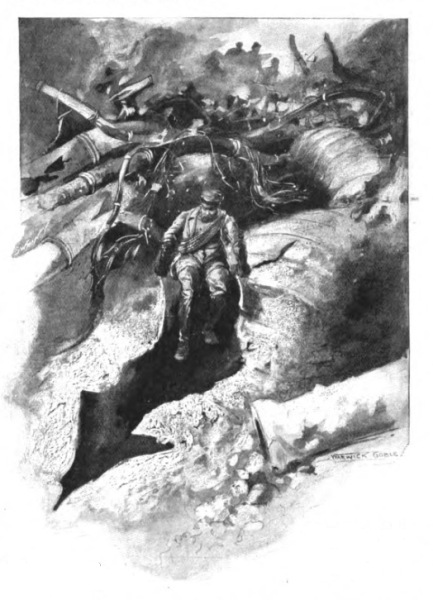
The workman, swathed from head to foot in indiarubber, disappeared from sight.
The workman, swathed from head to foot in indiarubber, disappeared from sight. It seemed a long time before he returned, so long that his companions gave him up for lost. Those strong able men who were ready to face any ordinary danger looked at one another askance. Fire, or flood, or gas, they would have endured, for under those circumstances the danger was tangible. But here was something that appealed horribly to the imagination. And such a death! The instantaneous fusion of the body to a dry charcoal crumb!
But presently a grimed head looked out of the funnel. The face was white behind the dust, but set and firm. The pioneer called for lights.
So far he had been successful. He had found the accumulators buried under a heap of refuse. They were built into solid concrete below the level of the tube, so that they had not suffered to any appreciable extent.