Chapter VIII
Reading edition
I
The Sun of Venice had set! Her bright gold was turned to tarnished brass, her jewels had lost their lustre, and her pearls were moribund! Yet she lingered on for many and many a year—well-nigh two hundred. The beacons of the lagunes and the shrines on the canals burnt dimly, and the incense in the churches seemed to have lost its aroma. Sighs and yawns from dispirited and indolent citizens indicated the dissolution of her industries. Brawls and disputes were exchanged for courtly greetings: gambling dens and brothels prostituted men and women once renowned for temperance and probity.
A lingering death is always the most distressing, both for the individual and the watchers standing by: this was to be the melancholy ending of the “Queen of the Adriatic.” Nevertheless, as with the man, so with the City, lucid intervals recurred and hopeful rallies, wherein episodes, pathetic and stirring, moved the torpid brain and feeble pulse. Venice was “Venus Calva” at her birth—so would she die. Each year saw her robbed of some possession, each year saw her enemies closing more nearly in, each year saw foreigners compressing more and more her markets; and yet, men came and went, and women too, who moved the body politic mightily, and made the lookers-on wonder whether, after all, the Lion of Saint Mark was dying or only sleeping.
Heavy-footed were those decadent years, they took their step from the dismal tramp of mourners at the frequent obsequies of the Doges and Dogaressas. The great bell of the Basilica, announcing year after year, or nearly so, with muffled knell the demise of a Chief Magistrate came to be listened to without emotion. In some hearts, perhaps beating more loyally than the rest, were pangs of remorse for a glorious past never to return, and misgivings for a fateful future fraught with fears, but patriotism, honour, and devotion, were the precious possession of a dwindling minority.
Between 1605 and the end of the Republic in 1797, thirty-one Doges mounted the Ducal throne in turn: their names and dates we know, but very little about their deeds or the times in which they lived,—history was silent. Of their Consorts ten only are known by name and nothing much beside: only four or five of them, in one hundred and ninety years, have left any record in the “Libro d’Oro delle Dogaresse di Venezia.”
The men and women of Venice had become a little less animated and articulate than the face cards in a pack. Indeed the end of Venice was much like the popular game of “La Trappola,” in which thirty-six cards out of the fifty-two were used—the mother of the present-day whist. The suits were four:—“Spade,”—Swords, or Spades,—threatened the faint-hearted; Coppe,—Cups or Hearts,—suggested delights to the perceiving; Denari,—Coins or Diamonds,—hinted at profitable investments; and Bastoni,—Sticks or Clubs,—promised punishment to the dishonest. Venice was a card-table, and Venetians were content to prolong their enervating leisure, beguiled by the chance of the “Naibi,”—tricks,—so named by their children in imitative games.
Certainly the craftsmen and craftswomen still wove rich lengths of cloth of gold, the goldsmiths still made precious jewels, the glass-blowers still produced their fragile virgin-ware, the lacemakers their delicate network, and the hairdressers still turned, tossed, and frizzed, rare strands of golden hair; but princely patronesses at the Ducal Palace were few and unresplendent. The painters went on painting—Canaletto, Guardi, and Longhi, were, in their time, quite as characteristic and far more topical than were Tintoretto, Veronese, and Palma Vecchio, but palette-masters as well as sculptors and architects, were clients of the Doges not of the Dogaressas.
The 10th of January 1645, was a black-letter day for women’s art and artifice in Venice. The Council issued an edict forbidding the Coronation of the Dogaressa as a “cosa non neccessaria!” Apparently her Serenity was not to be denied the solemn Entry, but even that stately function was to be curtailed of much of its pomp and circumstance. The “Bucintoro” was not to be used, the solemn Benediction in the Basilica was discouraged, and the Ducal Palace was closed against the wonted exhibitions of the Trade-Guilds.
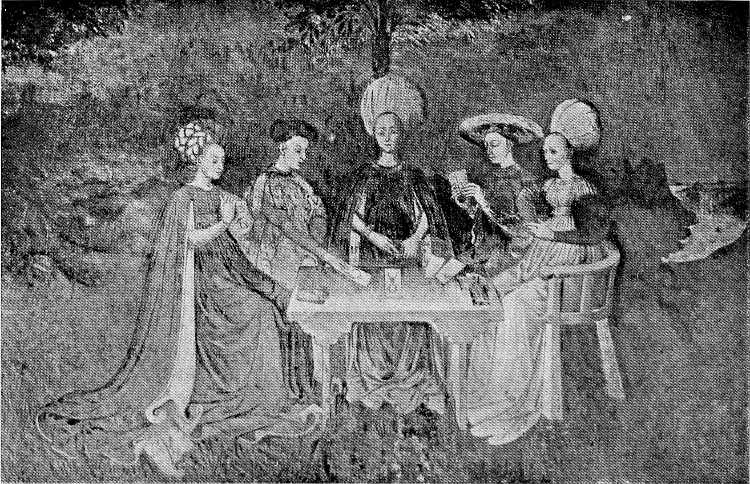
THE GAME OF LA TRAPPOLA.
Michelino da Bedozzo.
PALAZZO BONARDO, MILAN.
After Doge Marino Grimani there followed a dogal line of ten very old men,—all octogenarians,—one after the other, halting to their waiting graves,—striking but lamentable figures of the decay and death of Venice. Whether eight of them were widowers we know not, but only two Dogaressas’ names are recorded,—Signore Elena Barbarigo-Priuli (1618–1623), and Chiara Delfino-Conaro (1625–1629). Those ten old Doges were mostly parsimonious, very weary of life, and generally uninteresting, and probably their wives and families were as prosaic and uninteresting as themselves.
There was however something naively burlesque in the decision of Dogaressa Paolina Loredano-Contarini, the Consort of Doge Carlo Contarini (1655–1656), not to appear in any public ceremonial. She was an immensely stout woman and unusually plain-looking, and she feared that the salutations of the populace would not partake of their usually complimentary character. Venetians had an innate sense of humour, and personal peculiarities appealed irresistibly to their risible faculties. Dogaressa or not, she would undoubtedly have been the butt of ridicule!
Palazzi in his “Fasti Ducales” says of her, “non volvendo mostrarsi in publico.” He adds that on the façade of the church of San Vitale, Guiseppe Guoccola sculptured the busts of Doge Carlo and Dogaressa Paolina Contarini, placed there in gratitude for their noble bequests to the clergy. He also records that Madonna Paolina Loredano, the daughter of Messir Lorenzo Loredano, of the Ducal line, was married to Messir Carlo Contarini on 22nd February 1600, in the Church of San Polo—so they were blessed to see their golden jubilee.
Seven undistinguished Doges followed Doge Carlo Contarini, during thirty-two years—1656–1688. The names of only three Dogaressas are noted:—Signore Andriana Priuli-Conaro (1656), Elisabetta Pisani-Valier (1656–1658), and Lucia Barbarigo-Pesaro (1658–1659); but we know nothing more about them.
In 1688 Venice roused herself once more to welcome home, with enthusiastic honours, one of the greatest generals she had ever produced—Cavaliere Francesco Morosini. Thrice he bore the grand rank of Captain-General of the Venetian fleet, and thrice he carried her colours nobly on to victory. The twenty-five years’ war with Turkey for the possession of Candia gave the Admiral and his devoted forces rare opportunities for the display of patriotism and prowess, and right worthily they acquitted themselves. The worsted Turks were compelled to yield the Morea and its classical sites to the victorious Venetians. That was the rare gift Francesco Morosini laid at the feet of the aged “Queen of the Adriatic.”
No foreign conquest for many a long year had been scored to Venetian arms, and she had lost all that she had fought for; but now new life, new hope, new enterprise swept over canali, campi, and case. Every man was a soldier or sailor, every boy an embryo hero. Turkish flags again waved before the Basilica, Turkish prisoners again filled the Arsenal, Turkish treasures again were poured out upon the Lido. The Captain-General’s return was a triumph. Greeted by nobles and citizens in unison, he was dubbed “Peloponesiaco,” and lifted tumultuously upon the Ducal throne,—lately vacated by the death of Doge Marcantonio Giustiniani.
Alas, we know not whether a jubilant Dogaressa shared his honours. Possibly the valiant hero had had little or no time during his lifelong service to the State for serious love-making, and though, by a sailor’s licence, he may have had a wife in every port, no cicisbeo or patita was possible as Dogaressa. Relics of Doge Francisco Morosini may be seen at the Museo Civico, his tomb is in San Stefano, and a triumphal arch, erected in his honour by the Government, is within the Sala del Scrutino of the Ducal Palace.
If the hero Doge had no Consort, his successor was more fortunate: indeed Doge Silvestro Valier (1694–1700), lives in history upon the fair fame of his wife—many rulers of States and lesser magnates have had the same fortunate experience. We may read, in relation to Dogaressa Elisabetta Quirini-Valier, the true old saying “manners maketh man” as woman maketh man!
In spite of the prohibition of 1645 the new First Lady of Venice made her solemn Entry and was crowned with all the usual ceremonies. On the 4th of March 1694, the Dogaressa, robed in a great State mantle of cloth of gold trimmed with sable, and wearing upon her head a white lace veil and a jewelled Corno, with a collar and pendant cross of diamonds, and attended by a numerous suite of gentlewomen, awaited the deputation of salutation from the Council of “Forty.” Her osella had her profile in relief and the legend:—“Elisabetta Quirina-Valeria Ducissa Venetiarum 1694.” Her progress from the Palazzo Valier to the Ducal Palace has not been described, but it appears that her assumption of the Corno gave umbrage to the Provvidetori delle Pompe, and other captious critics, for a curious enactment of the Council, on 13th July 1700, forbade the Dogaressa wearing at any time a Corno on her head.
Doge Silvestro Valier and Dogaressa Elisabetta Quirini-Valier had been married in the church of Santa Maria Formosa, on the 18th of July 1649: consequently they lived to celebrate their golden wedding in 1699. In the case too of Dogaressa Elisabetta another restriction of the Promissione was cancelled—her right to receive foreign ambassadors. Surrounded by her Court of maids of honour and gentlewomen-in-waiting, she entertained all the envoys in turn accredited to Venice, and moreover, accepted at their hands costly gifts against all the prohibitory clauses of State decrees.
At the Museo Civico is a putative portrait of the Dogaressa. She has fair hair entwined with silver thread, perhaps to foil the natural silver strands, her features retain traces of distinction and of beauty. Her skin is pale, her eyes bright, and she wears an air of repose and refinement with no little natural dignity of carriage. Several of her letters have been preserved, wherein she shows herself to have been a woman of sympathetic and charitable disposition, but of retiring and unassuming manners.
Doge Sebastiano Valier died in 1700, and was buried near the second altar in the right aisle of SS. Giovanni e Paolo, under the enormous monument erected by his father, Doge Betruccio Valier, who died in 1658. There too, eight years after, the widowed Dogaressa was laid to rest. Her memorial statue by Giovanni Bonazza represents her as a large and wrinkled woman, with elaborate curls round her face, and covered to her feet with brocade, furs, laces, embroidery, and jewels—something perchance like a Venetian replica of our own Elisabeth! The epitaph is as follows:—“Elisabetta Quirini Silvestri Conjux, Romana virtute, Veneta Pietate, et Ducale Corona Insignis. Obiit MDCCVIII.”
II
The seventeenth century in Venice, was essentially one of lean years, strangely contrasting with the exuberant life of its predecessor; whilst the eighteenth century saw eight decades of disaster, famine, and death! Candia, the only remaining jewel in the crown of Venice, was rudely snatched from its tarnished setting and no effort was forthcoming to regain the lost treasure. Everything went from bad to worse. The nobles unblushingly proclaimed their contempt for commerce and conquest. The armed bands of the Republic were not maintained as a fighting force, and the ships of war were allowed to rot and rust at their anchorage. The citizens, imitating the madness of their betters, allowed industry and trade to slip through their fingers; and ceased to care when foreign capitalists and foreign workmen settled down among them, and exploited their looms and tools.
Pleasure, extravagance, gaming, and immorality, ate like foul cancers into the vitals of society.
The one and only aim of Venetians of every class was to dissipate the splendid heritage and spend the resources of their ancestors. A noble would light-heartedly wager his bank-balance, his estate, his palace and his all, on some ephemeral passion; and yet the gaiety of life was never so effulgent in the city of Venus. Venice was the plaything of Europe, the pantomime of Italy, and the shadow-dance of herself—bewitching in her heedless spendthrift self-indulgence, a whirling ballerina, scattering her favours, her kisses, and her pleas for plaudits everywhere.
The first eight Doges of the eighteenth century passed sadly across the Dogal pageant ground,—“lean, slippered pantaloons” as Shakespeare has it, or little better. With them went solitarily and unemotionally but two Dogaressas—Signora Laura Conaro-Conaro, 1709–1722, and Signora Elena Badoero-Pisano, 1735–1741. The last we know only by her name, and yet that name is a golden one, for was not the family of Badoero or Partecipazio, the very first of all the nobility, and was not her great ancestor, Agnello Partecipazio, the first Maker and the first “Grand Doge of Venice!” Donna Laura Conaro, daughter of Messir or Cavaliere, Nicolo Conaro,—all the men of Venice claimed knightly rank in her decadent days,—married Messir, or Cavaliere Giovanni Conaro, her cousin, on 11th October 1667, in the church of Gli Gesuati. She appears to have been a very proper sort of woman: at all events the fast life of the nobles and their ladies had no charms for her, and she set her face resolutely against the extravagances and indecencies around her. Consequently, when Doge Giovanni Conaro died in 1722, the Dogaressa entered Religion and became a postulant of the Order of the Augustinians of SS. Gervaso e Protasio. There she passed the residue of her days in fasting, praying, and alms-giving, being consoled greatly by the visits of her three devoted sons, Francesco, Nicolo, and Alvise, whom she received within her narrow cell with its little iron-barred window.
The devout Signora had retained,—rather contrary to any vow of poverty she may have taken,—a quantity of personal belongings—money, articles in gold and silver, and other valuables: these she bequeathed to the Prioress of the Convent, the Reverend Mother Maria Lucia. In a purse were found one thousand six hundred and ninety-four zecchini,—small silver coins,—another purse contained one hundred and forty gold ducats. Among the treasures were crosses, reliquaries, candlesticks, salvers, sconces, pomi or hand-warmers, bowls, knives, forks, spoons, flagons, vases, medals, thimbles, toilet-boxes and brushes, trays, inkstands, etc. etc., all of pure and beautifully wrought silver.
In a chest of drawers, were articles of jewellery, silver filigree work, gold medals, and very many other objects,—lover’s offerings, curios, and rock-crystal beads. Among the personal ornaments were bracelets, rings, and necklaces of diamonds and turquoises. Perhaps the most unexpected property was the Signora’s gilded walnut bedstead, with its coverlet of silk and gold, edged with rare Burano point-lace and gold and silver fringe, and lined with blue and yellow Chinese satin. In a cedar coffer were found a rich robe of crimson velvet worked with gold, a skirt of pink satin trimmed with silver lace, and other costly garments, but, alas, they were all in rags and tatters,—eloquent tokens of the rottenness and emptiness of earthly glory.
Dogaressa Laura, quietly and unregretfully laid aside the robes of State, to die and to be buried in the sackcloth of humility, may she rest in peace. Ten years after reverent hands had laid “Sister” Laura in her humble grave, within the burial-plot of the Convent, two other hands were clasped in the joyous pledge of matrimony,—Cavaliere Giovanni Alvise Mocenigo, Procurator of San Marco, and Donna Pisana Conaro, daughter of Messir Federico Conaro, who, on 5th October 1739, were made man and wife together, in the new and sumptuous church of Santa Maria del Salute. This was an alliance of the two most powerful families of the time, and great things were expected from the union.
The “Archivio Privato di Mocenigo” contains an inventory of Donna Pisana’s trousseau, which gives an excellent idea of the expensive splendour of the wedding outfit of a noble bride.
Cavaliere Mocenigo’s sister, Paolina, had married Prince Trivulzio of Milan, and she, despite her rank, undertook to purchase at first-hand things of beauty and joy for the bride-elect. From Milan went gold brocades and silver silken stuffs of crimson, blue, and pearl colour, embroidered with gold and silver. Paris supplied bodices, fichus and tippets of rich corded silk worked with floral designs in gold and silver, silk handkerchiefs, collarettes, and sleeves of lace and gold and silver thread, and toilet appointments in gold and silver. Antwerp contributed caps, collars and cuffs, of the finest linen thread and linen articles for the toilet—perhaps also underclothing, although not named—ladies were perhaps not so particular then as now in this respect! From England came a gold repeater-watch with a jewelled chain, and many more articles in metal. Home industries were not overlooked for the bill for Burano punto in aria, reached six hundred and sixty gold ducats. The total value, not including magnificent jewels and other splendid items of the goldsmith’s craft, exceeded twenty thousand gold ducats!
In 1763, Cavaliere Giovanni Alvise Mocenigo was unanimously elected Doge by the Council of Forty, and the people acquiesced in his election without demur. The new Doge determined to revive the ceremonies of the sixteenth Century, and the “Forty” appear to have offered no opposition,—indeed they were quite favourable to the project. The Promissione contained several notable clauses with respect to the privileges and honours pertaining to the new Dogaressa. Three days before the election of the Doge the Council decreed that the solemn Entry should be conducted with traditional full State. Her Serenity’s robes of State were to be fashioned on the old-time models, although she was forbidden to assume the Corno. Her right to accept the offerings of the Trade-Guilds, of Ambassadors, and others, was acknowledged.
Upon the morning of her “Triumph,” 22nd April, the Council despatched the Secretaries of State to greet the new First Lady. One of them, Messir Cesare Vignola, offered a flattering address, in the name of the Council, praising her virtues and extolling her charms:—“Your Serenity has the noble and particular admiration of all the Courts of Italy, and their Excellencies look for a great revival of industry and prosperity within the Republic under your discriminating patronage....” The water-pageant, which conducted the Dogaressa to the Ducal Palace, saw no “Bucintoro” certainly, but innumerable flotillas of decorated barcas and gondolas. Within the Sala di Udienza del Doge she was welcomed by the nobles and State officials.
The fêtes were prolonged, as in former times, for three days, upon each of which the Dogaressa appeared in the richest of rich costumes, and her jewels varied with her dress. Upon the first day, after she had removed her heavy State mantle of silver embossed cloth of gold, she wore a sottana, or gown, of silver tissue overlaid with sprays of flowers in gold relief, the bodice was covered with palettes of solid gold with a white cincture of gold and immense brilliants, her long veil of fine white silk lace fell from under a coronet of gold and precious stones. She wore too the customary large pectoral cross of diamonds and many fine gemmed rings.
Each day wound up with a Court ball, at which the Dogaressa danced minuets in turn with each of the Procurators of San Marco. The company included Princess Faustina Rezzonico, niece of the Pope, the wives and daughters of the foreign ambassadors, and all the more distinguished gentlewomen of the Court and City. Great were the public rejoicings at this splendid revival of prestige and prosperity. Surely Venice was once more herself,—the radiant Golden Queen,—at least a second youth was hers. Her silver locks amongst the gold appeared to be recoloured, wrinkles of and witherings of brow and breast vanished, her step was once more lilting. Yes, it was even so, the last flash in the pan,—the expiring effort of a long life. No more Dogaressas followed in Signora Pisana Cornaro-Mocenigo’s golden pageant footsteps,—Venice had no more honours to bestow.
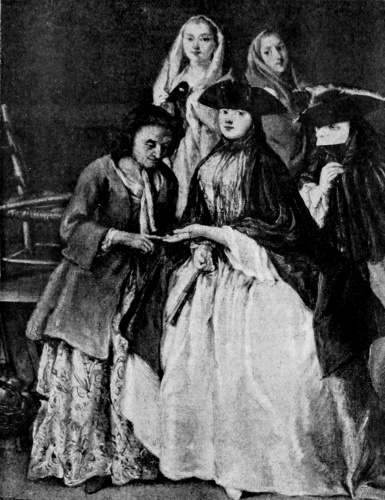
THE FORTUNE-TELLER.
Piero Longhi. (xviii Century).
NATIONAL GALLERY. LONDON.
It was only what might have been expected that poets, musicians, orators, and chroniclers, should illustrate these unwonted festivities, but alas their efforts partook of the fulsome and insincere. The Muse of Poetry, the Spirit of Music, and the Sibyl of History were dying in the common death: their inspirations were as the vapourings of delirium.
“Non le Reine su la cipria sponda Del cornar germe gloriosa e forte Domma a veder l’invita oggi la sorte Che il sangue in te che la virtu secondo.”
Such was their tenor.
Dogaressa Pisana however herself took up her pen, and dipped it in the ink of commonsense. The marriage of her eldest son Alvise, in 1766, with the very youthful Donna Francesca Grimani,—granddaughter of Doge Pietro Grimani, 1741–1752,—was a splendid affair, wherein all the arrangements were personally superintended by the Dogaressa, and she adds in her account “would you believe it, the expenses were more than 456,487 lire.” The marriage was in every way satisfactory, the young couple were talented, highly educated, and very comfortably provided for. As in most things human when fair skies are overhead, a contrary Providence provides unlooked-for tempests, and so the joy-bells of maternity were cruelly changed for the sad knells of mortality. The accomplished and virtuous young wife,—she was only seventeen years of age,—had been nursing her first-born but three short months, when, by some accident or other, as it was reported, she fell swooning into the fire blazing upon the mosaic hearth of her bed-chamber, and, before help could reach her, the bride of a year perished in fearful agony.
This was a stunning grief to good Dogaressa Pisana. She eschewed all ceremonies and mourned in secret for her dear daughter-in-law. At her Consort’s villa at Cordignano, near Ceneda, she found consolation, and there she braced herself for the duties of her station. Among her papers are letters addressed to the steward of the estate, which reveal many natural home-like touches of the simple life she loved so well. The country folk almost worshipped the ground the noble lady trod; she was sponsor to their children, visitor of their sick, their confidante in sorrows and in joys. But her days too were numbered, for, on 10th March 1769, the big bell of the Basilica announced to a sympathising city the death of the magnanimous Dogaressa.
“Near twenty-two o’clock” wrote her Chaplain, “a severe fit of coughing ruptured a blood-vessel in my beloved mistress’s breast and she ceased to live.” Three days after her death the body of the Dogaressa was carried to her burial with every mark of respect and honour. “In death,” the same writer goes on to say, “her Serenity’s face was beautiful and full of colour. She seemed to be wrapt in sweet repose, and her expression betokened what she had been in her life, virtuous, charitable and estimable....”
The funeral obsequies followed the usual custom, only her lying-in-state was in the Basilica, not in the Sala de’ Pioveghi. Four hundred yellow burning wax torches were placed around the bier and the candles of all the altars were alight. The remains were exposed in an open casket, wrapped in a State robe of cloth of gold, with white kid gloves, lace sleeves, and a veil across her bosom to her feet. The “Requiem” and Absolutions were sung by full choir, and the Master of the Ceremonies, Messir Francesco Venier, pronounced the funeral oration. An imposing procession bore the dead Dogaressa across the Piazza and by a circuitous way to SS. Giovanni e Paolo.
Doge Alvise Mocenigo survived his beloved Consort nine years, but in 1771 he contracted a second marriage with a very young girl, Donna Polissena, daughter of Messir Giulio Contarini-Da Mula. It does not appear that she was accorded the position of a Dogaressa and she resided chiefly at the Doge’s country villa, where he was wont to gather all the young, bright and talented people he could around him. His dogado of eleven years was adorned by many cultured women, who displayed phenomenal enthusiasm for classical study, philosophy, poetry, and literature. Probably this was a sublime attempt on the part of the fair sex to correct in some way the indolence and unintelligence of their leisured men-folk. Madonna Polissena Contarini-Da Mula-Mocenigo, was the centre of a little Court of high-souled admirers who greeted her:—
“L’Alme tue glorie echeggiano Ecclesa Polissena....”
There appears to have been two principal candidates for the Ducal throne upon the death of Doge Alvise Mocenigo in 1779,—Cavaliere Andrea Tron and Messir Paolo Renier. The former, however, was overshadowed by a scandal affecting his wife Madonna Caterina and the Secretary of State Antonio Gratarolo, and Renier was elected. He was an accomplished statesman, highly talented, and very ambitious. But his reputation very soon became assoiled by reason of the traffic he made of posts of influence and emolument under Government. His avarice became so grasping that it was said in Venice:—“The Doge makes the beggars at the door of San Marco pay him for their stations!”
Doge Renier’s family had not hitherto been conspicuous for services to the State, although it belonged to the Second grade of the nobility, dating its enrolment from the Genoese War of 1391. His first wife, Madonna Giustina Dona-Renier, to whom he was married on 28th April 1733, was a daughter of Messir Lionardo Dona, or Donato, a Ducal house,—but she never became Dogaressa for her death took place in 1751, and she is buried in the church of San Antonio at Padua.
Renier however was not a widower when he stepped upon the Ducal dais of Estate, but his spouse was not recognised in Court circles, for she had been a rope-dancer! He had picked her up accidentally at Constantinople, the same year that he buried Madonna Caterina: her name was Margherita Delmaz. Friends and descendants of this marriage had quite another story: they said Madonna Margherita had never been a dancer or anything else of the kind. He found her, they affirmed, at Constantinople, where he was an Agent or Consul of his Government,—in a Catholic school for poor girls. He took her away, had her educated at Padua, and then married her. Doge Renier signalised his elevation to the throne by profuse distribution of largesse, hoping thereby to pave the way for Madonna Margherita’s solemn Entry. This was never accomplished, but “La Falsa Dogaressa,” as she was slightingly called, was allowed to reside with her husband in the Ducal Palace. The couple became more and more unpopular by reason of their meanness, insincerity, and ostentation. One story perhaps illustrates as well as another the selfishness and petulance of the Doge and his wife. It was said that she very much disliked the clanging of the church bells,—San Basso, on the North side of the Ducal Palace, was the worst offender. Madonna Margherita sent a peremptory order to the Pievano, or Rector, that if he would not stop his bell she would cut the bell rope! The bells of the Basilica next came into the controversy, but the Prior refused the behest of silence. The Doge interfered and told the Prior that his “bells set all the Dogaressa’s teeth on edge.” A bargain however was struck, the Doge, on his part, promised a monthly subsidy, but whenever this was overdue the Prior was at liberty to ring his bells as before!
During the reign of Doge Renier the last valorous deeds for Venice were done by Admiral Agnello Emo. He attacked the Barbary pirates in 1784–1788 and freed the Adriatic and the coasts of North Africa from their depredations. The valiant Emo took up the baton of Francesco Morosini, and, had his lot been cast in less degenerate days, he would have received from the Venetians a similar “Triumph.” He died alone and in a way dishonoured in the Palazzo Diedo in 1792. It was Doge Marco Foscarini, 1762–1763,—the last of the literary Doges,—who wrote thus of Venice and the Venetians:—“This century will be a terrible one for our children and our grandchildren!” He probably, seer-like, perceived the imminence of the death of the liberties of Venice, but he could not have known that this forecast would come true within fifteen years of his death.
Doge Paolo Renier died on 18th February 1789, and his burial was conducted in secret within the church of San Nicolo da Tolentino,—the reason for this cannot be stated, perhaps he directed this unusual arrangement in his will, fearing the ebullition of popular feeling against himself and his spouse. Madonna Margherita lived on till the 11th of January 1817: her death took place in her apartments in the Mocenigo Palace at San Stae but the place of her burial has not been recorded.
We now reach the last scene in the vivid and venerable pageant of Venice. The body-politic was infinitely more insecure than the fondamento of the least stability; she had no policy, no consistency, and no reserve of energy. Her men and her women were absolutely indifferent to her fate, and ribaldry and buffoonery appeared to be her only rôle. Two circumstances sufficiently illustrate the conditions of society at the end of the eighteenth century: Marital infidelity became so rampant that between 1782–1796, the “Ten” registered two hundred and seventy-four applications for nullity. When the celebrated Princess Gonzaga visited Venice no one would have anything to do with her, although everybody lived in a house of glass. At last Madonna Caterina Tron, wife of a Procurator of Saint Mark, offered to chaperon her and present her at Court. “Ladies,” she said, speaking to her fellow-noble courtesans, “this is Princess Gonzaga, she belongs to an illustrious family: as for the rest I will not answer either for you nor for myself!” The tempest was gathering up its strength to make a last and overwhelming attack upon Venice, defenceless as she was. Quite significant of coming catastrophe the feeblest, the weariest, and the least resourceful of all the long line of Doges,—Lodovico Manin,—in 1789 sat down despondently upon the Ducal throne—the last of the Doges of Venice. A man of strong character or of supreme patriotism might have saved the Republic at least for a time, but no popular leader appeared, and everybody accepted the inevitable without a struggle. The Dogaressa was a simple, good and modest woman, had she been a Valrada Candiano or a Zilia Dandolo she might have made a man of her husband, but she shrank with him from every responsibility and every effort.
Dogaressa Elisabetta Grimani-Manin, daughter of Messir Antonio Grimani, became the wife of Lodovico Manin on 14th September 1748, in the Church of Santa Maria Salute. She died at Treviso on 31st August 1792 of a nervous malady which affected her head. Her body was carried to Venice and was buried with the same honours as those rendered to the departed Dogaressa Pisana Grimani-Mocenigo in 1769, in the Church of Santa Maria degli Scalzi, where the Doge erected the monument which covers his remains as well as hers. She was laid to rest in the last State robe of cloth of gold ever made in Venice, and with her were buried the last insignia of her rank:—her grave was the grave of Venice.
For five years more dragged on the dying Queen of the Adriatic in constant alarm and in peril of death, every day seemed likely to be her last. The funeral peals which had signalised the passing of the last Dogaressa of Venice had scarcely exhausted their echoes over the islets of the lagunes, when upon men’s ears smote another and a less melodious sound—the stunning roar of cannon! The “second Attila” was at hand, his legions were massing in view of San Marco and the Campanile, and it needed but a word to set loose raiders and looters upon palace, church, and homestead, quite as desperate and as cruel as those barbarians, who fourteen hundred years before, had driven the panic-stricken forebears of the men of Venice from terra-firma to the lagune quicksands. Manin feebly backed by the emasculate “Forty,” tried to temporise with the invader of Italy, but Buonaparte knew no such policy. War was declared upon Venice on 1st May 1797, and the Venetians collapsed without striking a blow in self-defence.
Lodovico Manin on 3rd June 1797, divested himself of his mantle of State and his jewelled Corno, and delivered them unresistingly into the hands of Buonaparte’s lieutenant. The “Libro d’Oro” of the nobility was also voluntarily surrendered and publicly burned with the Ducal Regalia in the Piazza. The last state of Venice was infinitely worse than the first. The annihilation of her independence was celebrated by her depraved nobles add citizens with enthusiastic demonstrations of joy, banal doctrines of up-to-date republicanism were madly accepted, and everything that partook of the glorious past was swept away without remorse. The atrophy of the Venetians developed into lunacy—Venice died insane!
The fall of a great man, the end of a great cause, the ruin of an Empire all call forth lamentation, but no tears were shed for the dead Queen, no sighs were breathed for lost liberty, no regrets were uttered for “Venus Calva.” The echoes of a mighty past were stilled, and the gallantries of a thousand years were silenced—save only for the harmonious cries of gondoliers.
“I am coming—stalì—but you know not for whom! Stalì—not for whom! I am passing—premè—but I stay not for you! Premè—not for you!”
I lay down my pen with regret—and as I close my “Libro d’Oro delle Dogaresse di Venezia” I fall into an enchanting reverie, wherein I descry many benevolent faces smiling at me, amid iridescent scintillations of Venetian rainbows. Their hair is golden, but here and there are strands of silver, which only add to the lustre of the gold. Their faces, if wrinkled,—for they are not maidens,—and their open bosoms, if withered, bear no signs of age, for they are beautified by the cunning artifices of the toilet. Their heads are crowned by horned diadems encrusted with flashing jewels, veils of white point-lace lend grace to their coiffures. From their shoulders downwards the figures of my benevolent visitors are vested—some in crimson silk, but most in regal wealth of cloth of gold. Diamonds flash upon their breasts and around their waists.
They are smiling at me, for I have written about them nothing but what is pleasant, and I fancy I hear their sweet melodious voices, whispering in unison, and saying:—“We played our rôle in the best way we could, we made no enemies, but we left many friends—friends such as those who shall read our Story in your ‘Book of Fame.’”
I awoke from my dream, and I knew that I had seen a vision of the noble and devoted Dogaressas of Venice.