Chapter II · — The Varieties of the Dog — First Division (continued 2)
Reading edition
Mr
. Thacker orders the greyhounds out on the fore part of every day; but, instead of being loose and at liberty, they would be much better two and two; then, when he meets with a proper field to loose them in, to give them a good gallop. This will be a greater novelty than if they had been loose on the road, and they will gallop with more eagerness. Four days in a week will be enough for this exercise. On one day there should he a gallop of one or two miles, or even a course for each brace of dogs.
The young dog has usually an older and more experienced one to start with him. That which is of most importance is, that his leader should be a thoroughly stout and high-mettled dog. If he shrinks or shies at any impediment, however formidable, the young one will be sure to imitate him, and to become an uncertain dog, if not a rank coward. Early in November is the time when these initiatory trials are to be made. It is of consequence that the young one should witness a death as soon as possible. Some imagine that two old dogs should accompany the young one at its first commencement. After the death of the leveret, the young dog must be coaxed and fondled, but never suffered to taste the blood.
In kennels in which the training is regularly conducted, the dog should be brushed all over twice every day. Few things contribute so much to health as general cleanliness, and friction applied to the skin. Warmth is as necessary for greyhounds as for horses, and should not be forgotten in cold weather. Body-clothing is a custom of considerable antiquity, and should not be abandoned. The breeder of greyhounds for the purpose of coursing must reckon upon incurring considerable expense; but, if he loves the sport, ho will be amply remunerated by the speed and stoutness of his dogs.
A
question has arisen whether, on the morning of the coursing, any stimulant should be given to the dog. The author of this work would unhesitatingly approve of this practice. He has had abundant experience of the good effect of it; but the stimulus must be that which, while it produces the desired effect, leaves no exhaustion behind
17
.
Contents/Detailed Contents/Index
The Scotch Greyhound
has the same sharpness of muzzle, length of head, lightness of ear, and depth of chest, as the English dog; but the general frame is stronger and more muscular, the hind quarters more prominent, there is evident increase of size and roughness of coat, and there is also some diminution of speed. If it were not for these points, these dogs might occasionally be taken for each other. In coursing the hare, no north-country dog will stand against the lighter southern, although the southern would be unequal to the labour often required from the Highlander.
The Scotch greyhound is said — perhaps wrongly — to be oftenest used by those who look more to the quantity of game than to the fairness and openness of the sport, and in some parts of the country this dog is not permitted to be entered for a sweepstakes, because, instead of depending on his speed alone, as does the English greyhound, he has recourse to occasional artifices in order to intercept the hare. In sporting language he runs sly, and, therefore, is sometimes excluded.
Contents/Detailed Contents/Index
The Highland Greyhound, or Deer-hound
is a larger, stronger, and fiercer dog, and may be readily distinguished from the Lowland Scotch greyhound by its pendulous, and, generally, darker ears, and by the length of hair which almost covers his face. Many accounts have been given of the perfection of its scent, and it is said to have followed a wounded deer during two successive days. He is usually two inches taller than the Scotch greyhound. The head is carried particularly high, and gives to the animal a noble appearance. His limbs are exceedingly muscular, his back beautifully arched. The tail is long and curved, but assumes the form of an almost straight line when he is much excited. The only fault which these dogs have is their occasional ill-temper, or even ferocity; but this does not extend to the owner and his family.
It appears singular that the English greyhound exhibits so little power of scent; but this is simply because he has never been taught to use it, or has been cruelly corrected when he has attempted to exercise it.
Holinshed relates the mischief that followed the stealing of one of these dogs:
"Divers of the young Pictesh nobilitye repaired unto Craithlint, King of the Scots, for to hunt and make merie with him; but, when they should depart homewards, perceiving that the Scotish dogs did far excel theirs, both in fairnesse, swiftnesse, and hardinesse, and also in long standing up and holding out, they got diverse both dogs and bitches of the best kind for breed, to be given them by the Scotish Lords: and yet not so contented, they stole one belonging to the King from his keeper, being more esteemed of him than all the others which he had about him. The maister of the leash, being informed hereof pursued after them that had stolen the dog, thinking, indeed, to have taken him from them: but they not being to part with him fell at altercation, and at the end chanced to strike the maister of the leash through with their horse spears, so that he did die presently. Whereupon noise and crie being raised in the country by his servantes, divers of the Scots, as they were going home from hunting, returned, and falling upon the Picts to revenge the death of their fellow, there ensued a shrewed bickering betwixt them; so that of the Scots there died three score gentlemen, besides a great number of the commons, not one of them understanding what the matter meant. Of the Picts there were about 100 slaine."
Mr
. H.D. Richardson describes a cross between the greyhound and British bloodhound:
"It is a tall muscular raw-boned dog, the ears far larger, and more pendulous, than those of the greyhound or deer-hound. The colour is generally black, or black and tan; his muzzle and the tips of the ears usually dark. He is exceedingly swift and fierce; can pull down a stag single-handed; runs chiefly by sight, but will also occasionally take up the scent. In point of scent, however, he is inferior to the true deer-hound. This dog cannot take a turn readily, but often fails at the double."18
Contents/Detailed Contents/Index
The Irish Greyhound.
This dog differs from the Scotch, in having shorter and finer hair, of a pale fawn colour, and pendent ears. It is, compared with the Scotch dog, gentle and harmless, perhaps indolent, until roused. It is a larger dog than the Scottish dog, some of them being full four feet in length, and proportionately muscular. On this account, and also on account of their determined spirit when roused, they were carefully preserved by some Irish gentlemen. They were formerly used in hunting the wolf when that animal infested the forests of Ireland.
Mr
. Bell says that the last person who kept the pure breed was Lord Altamont, who in 1780 "had eight of them."
19
Contents/Detailed Contents/Index
The Gasehound,
the
agasaeus
of former times, was probably allied to, or connected with, the Irish greyhound. It hunted entirely by sight, and, if its prey was lost for a time, it could recover it by a singular distinguishing faculty. Should the deer rejoin the herd, the dog would unerringly select him again from all his companions:
"Seest thou the gasehound how with glance severe From the close herd he marks the destined deer?"20
There is no dog possessed of this quality at present known in Europe; but the translator of Arrian thinks that it might be produced between the Irish greyhound and the bloodhound.
Contents/Detailed Contents/Index
The Irish Wolf-dog
This animal is nearly extinct, or only to be met with at the mansions of one or two persons by whom he is kept more for show than use, the wild animals which he seemed powerful enough to conquer having long disappeared from the kingdom. The beauty of his appearance and the antiquity of his race are his only claims, as he disdains the chase of stag, fox, or hare, although he is ever ready to protect the person and the property of his master. His size is various, some having attained the height of four feet, and Dr. Goldsmith stales that he saw one as large as a yearling calf. He is shaped like a greyhound, but stouter; and the only dog which the writer from whom this account is taken ever saw approaching to his graceful figure, combining beauty with strength, is the large Spanish wolf-dog: concerning which he adds, that, showing one of these Spanish dogs to some friends, he leaped through a window into a cow-house, where a valuable calf was lying, and seizing the terrified animal, killed it in an instant; some sheep having in the same way disappeared, he was given away.
The
same writer says that his grandfather had an Irish wolf-dog which saved his mother's life from a wolf as she was paying a visit attended by this faithful follower. He rushed on his foe just when he was about to make his spring, and after a fierce struggle laid him dead at his mistress's feet. His name was Bran.
21
Contents/Detailed Contents/Index
The Russian Greyhound
is principally distinguished by its dark-brown or iron-grey colour — its short semi-erect ears — its thin lanky body — long but muscular legs — soft thick hair, and the hair of its tail forming a spiral twist, or fan, (thence called the fan-tailed dog,) and as he runs having a very pleasing appearance. He hunts by scent as well as by sight, and, therefore, small packs of this kind are sometimes kept, against which the wolf, or even the bear, would stand little chance. He is principally used for the chase of the deer or the wolf, but occasionally follows the hare. The deer is the principal object of pursuit, and for this he is far better adapted than to contend with the ferocious wolf. His principal faults are want of activity and dexterity. He is met with in most parts of Russia, where his breed is carefully preserved by the nobility, with whom coursing is a favourite diversion.
Some dogs of this breed were not long ago introduced into Ireland.
Contents/Detailed Contents/Index
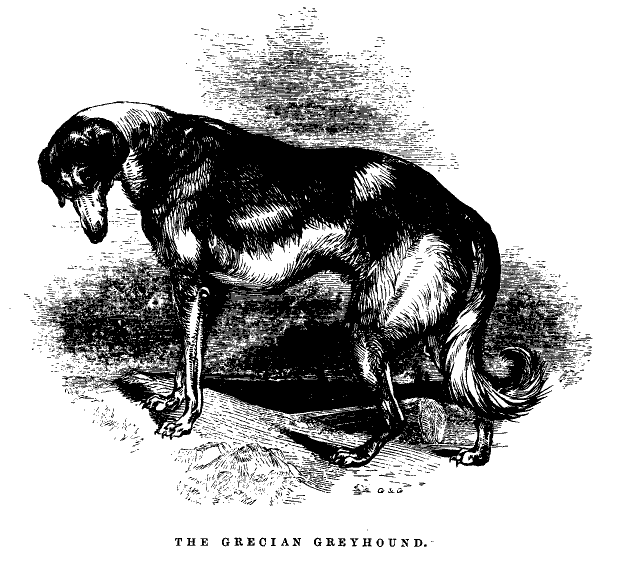
The Grecian Greyhound The author is glad that he is enabled to present his readers with the portrait of one now in the menagerie of the Zoological Society of London. It is the dog whose image is occasionally sculptured on the friezes of some of the ancient Grecian temples, and was doubtless a faithful portrait of one of the dogs which Xenophon the Athenian valued, and was the companion of the heroes of Greece in her ancient glory. The principal difference between the Grecian and the English greyhound is, that the former is not so large, the muzzle is not so pointed, and the limbs are not so finely framed.
Contents/Detailed Contents/Index
The Turkish Greyhound
is a small-sized hairless dog, or with only a few hairs on his tail. He is never used in the field, and bred only as a spoiled pet, yet not always spoiled, for anecdotes are related of his inviolable attachment to his owner. One of them belonged to a Turkish Pacha who was destroyed by the bowstring. He would not forsake the corpse, but laid himself down by the body of his murdered master, and presently expired.
Contents/Detailed Contents/Index
The Persian Greyhound
is a beautiful animal. He is more delicately framed than the English breed; the ears are also more pendulous, and feathered almost as much as those of a King Charles's spaniel. Notwithstanding, however, his apparent slenderness and delicacy, he yields not in courage, and scarcely in strength, to the British dog. There are few kennels in which he is found in which he is not the master.
In
his native country, he is not only used for hunting the hare, but the antelope, the wild ass, and even the boar. The antelope is speedier than the greyhound: therefore the hawk is given to him as an ally. The antelope is no sooner started than the hawk is cast off, who, fluttering before the head of the deer, and sometimes darting his talons into his head, disconcerts him, and enables the greyhound speedily to overtake and master him. The chase, however, in which the Persians chiefly delight, and for which these greyhounds are mostly valued, is that of the
ghoo-khan
, or wild ass. This animal inhabits the mountainous districts of Persia. He is swift, ferocious, and of great endurance, which, together with the nature of the ground, renders this sport exceedingly dangerous. The hunter scarcely gives the animal a fair chance, for relays of greyhounds are placed at various distances in the surrounding country; so that, when those by which the animal is first started are tired, there are others to continue the chase. Such, however, is the speed and endurance of the ghoo-khan, that it is seldom fairly run down by the greyhounds, its death being usually achieved by the rifle of some horseman. The Persians evince great skill and courage in this dangerous sport, galloping at full speed, rifle in hand, up and down the most precipitous hills, and across ravines and mountain streams, that might well daunt the boldest rider.
22
The Persian greyhound, carried to Hindoostan, is not always to be depended upon; but, it is said, is apt to console itself by hunting its own master, or any one else, when the game proves too fleet or escapes into the cover.
Contents/Detailed Contents p. 2/Index
The Italian Greyhound
possesses all the symmetry of the English or Persian one, on a small scale. So far as beauty can recommend it, and, generally speaking, good nature, it is deservedly a favourite in the drawingroom; but, like the large greyhound, it is inferior in intelligence. It has no strong individual attachment, but changes it with singular facility. It is not, however, seen to advantage in its petted and degraded state, but has occasionally proved a not unsuccessful courser of the rabbit and the hare, and exhibited no small share of speed and perseverance. In a country, however, the greater part of which is infested with wolves, it cannot be of much service, but exposed to unnecessary danger. It is bred along the coasts of Italy, principally for the purpose of sale to foreigners.
In order to acquire more perfect beauty of form, and more activity also, the English greyhound has received one cross from the Italian, and with decided advantage. The speed and the beauty have been evidently increased, and the courage and stoutness have not been diminished.
It has been said that Frederick the Great of Prussia was very fond of a small Italian greyhound, and used to carry it about with him under his cloak. During the seven years' war, he was pursued by a party of Austrian dragoons, and compelled to take shelter, with his favourite, under the dry arch of a bridge. Had the little animal, that was naturally ill-tempered and noisy, once barked, the monarch would have been taken prisoner, and the fate of the campaign and of Prussia decided; but it lay perfectly still, and clung close to its master, as if conscious of their mutual danger. When it died, it was buried in the gardens of the palace at Berlin, and a suitable inscription placed over its grave.
Footnote 1:
Annals of Sporting
, vol. vi. p. 99.
return to footnote mark
Footnote 2:
The superstition of the Arabians and Turks with regard to dogs is somewhat singular: neither have they much affection for these animals, or suffer them to be in or near the camp, except to guard it in the night. They have, however, some charity for the females that have whelps. As for other dogs, they feed them well, and give them good words, but never touch them nor go near them, because dogs are regarded as unclean animals. They particularly drive them away in wet weather; for, if one drop of water from a dog should fall on their raiment, their devotion would be interrupted and useless. They who are fond of hunting make their religion subservient to their pleasure, and say that greyhounds and setters are excepted from the general rule, because when not running these dogs are tied up where nothing unclean can reach them, and they are never suffered to eat any thing unclean. Their opinion is the same with regard to small dogs, which are kept with great care, and no one willingly injures a dog, or, if he should injure purposely, or destroy one of them, the law would punish him.
Chevalier Darvieux's
Travels in Arabia Deserta
, 1718, p. 155.
return
Footnote 3:
Heber's Narrative
, p. 500.
return
Footnote 4:
Histoire du Chien
, par Elzear Blaze, p. 54.
return
Footnote 5:
Proceedings of the Zoological Society
, Part I. 833.
return
Footnote 6:
Williamson's
Oriental Field Sports
return
Footnote 7:
Poiret, in his
Travels in Barbary
asserts that
"the dog loses in the East a great part of those good qualities that make him the friend of man. He is no longer a faithful domesticated animal, faithfully attached to his master, and ever ready to defend him even at the expense of his own life. He is cruel and blood-thirsty, his look is savage, and his appearance revolting; carrion, filth, anything is good enough for him if he can but appease his hunger. They seldom bite one another, but they unite against a stranger who approaches the Arab tents, and would tear him to pieces if he did not seek his safety in flight." Vol. i. p. 353.
Denon, when in the city of Alexandria, in Egypt, says,
"I have no longer recognised the dog, that friend of man, the attached and faithful companion — the lively and honest courtier. He is here a gloomy egotist, and cut off from all human intercourse without being the less a slave. He does not know him whose house he protects, and devours his corpse without repugnance." Travels in Lower Egypt, p. 32.
return
Footnote 8:
Histoire du Chien
, p. 200. The Voyage of Dumont d'Urville, vol. ii. p.474.
return
Footnote 9:
Greyhound.
return
Footnote 10:
Overcast, or overrun.
return
Footnote 11:
Ovid,
Metamorph.
, lib. i. v. 353.
return
Footnote 12:
A singular story is told of Richard II, and one of these dogs. It is given in the language of Froissart.
"A grayhounde called Mithe, who always wayted upon the kynge, and would knowe no man els. For when so ever the kynge did ryde, he that kept the grayhounde dyd lette him lose, and he wolde streyght runne to the kynge and faune uppon hym, and leape with his fore fete uppon the kynge's shoulders. And, as the kynge and the Erle of Derby talked togyder in the courte, the grayhounde who was wonte to leape uppon the kynge, left the kynge and came to the Erle of Derby, Duke of Lancastre; and made to him the same friendly continuance and chere as he was wonte to do to the kynge. The duke, who knewe not the grayhounde, demanded of the kynge what the grayhounde wolde do? 'Cousin,' qoud the kynge, 'it is a greate goode token to you, and an evyl signe to me.' 'How knowe you that?' quod the duke. 'I knowe it well,' quod the kynge. 'The grayhounde acknowledgeth you here this daye as Kynge of England, as ye shall be, and I shal be deposed; the grayhounde hath this knowledge naturally: therefore take hyme to you, he wyll followe you and forsake me.' The duke understood well those words, and cheryshed the grayhounde, who would never after followe kynge Richarde, but followed the duke of Lancastre."
return
Footnote 13:
Thacker on Sporting.
return
Footnote 14:
The writer of this work had a brace of greyhounds as arrant thieves as ever lived. They would now and then steal into the cooking-room belonging to the kennel, lift the lid from the boiler, and, if any portion of the joint or piece of meat projected above the water, suddenly seize it, and before there was time for them to feel much of its heat, contrive to whirl it on the floor, and eat it at their leisure as it got cold. In order to prevent this, the top of the boiler was secured by an iron rod passing under its handle of the boiler on each side; but not many days passed ere they discovered that they could gnaw the cords asunder, and displace the rod, and fish out the meat as before. Small chains were then substituted for the cords, and the meat was cooked in safety for nearly a week, when they found that, by rearing themselves on their hind legs, and applying their united strength towards the top of the boiler they could lift it out of its bed and roll it along the floor, and so get at the broth, although the meat was out of their reach. The man who looked after them expressed himself heartily glad when they were gone; for, he said, he was often afraid to go into the kennel, and was sure they were devils, and not dogs.
return
Footnote 15:
Scott's Sportsman's Repository
, p. 97.
return
Footnote 16:
Blaine's
Encyclopedia of Sporting
.
return
Footnote 17:
For a set of laws for Coursing Matches. see
Appendix
.
return
Footnote 18:
Sportsman
,vol. xi. p. 314
return
Footnote 19:
Bell's
British Quadrupeds
, p. 241.
return
Footnote 20:
Tickell's Miscellanies
return
Footnote 21:
Sporting Mag
. 1837, p. 156.
return
Footnote 22:
New Sports. Mag.
xiii. 124.
return
Editorial Supplement A:
both author and editor have evidently been deceived as to the appearance of dingos, as this illustration is completely spurious. The dingo does not look, and could not possibly have looked at any stage, anything like this, as contemporary descriptions match the existing appearance, and large jaws and a thin coat are necessary to kill prey up to the size of the red kangaroo and tolerate the extreme heat, respectively. See The Dingo or any other Australian naturalist site on the Net. I strongly suspect in this case that a mischievous person has placed the head and tail of a fox on a dog's body, which adds insult to injury, as the introduced fox has been and is far more of a menace to the country than the dingo. html Ed. (au)
return
Contents/Detailed Contents, p. 2/Index