JOURNAL
Reading edition
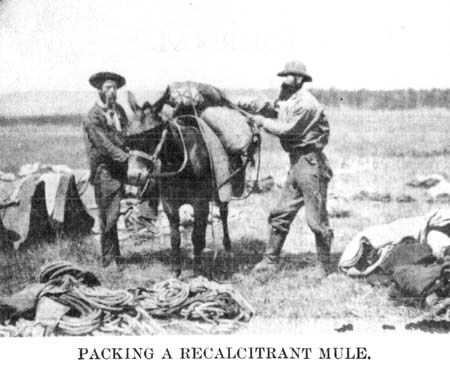
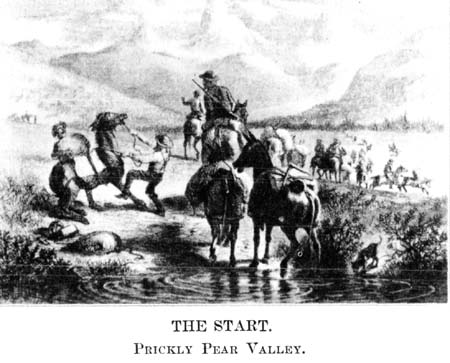
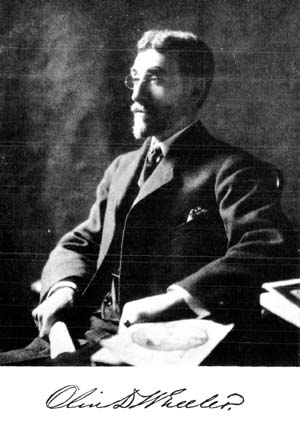
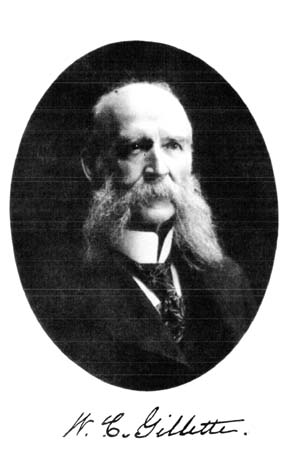
Wednesday, August 17, 1870.—In accordance with the arrangements made last night, the different members of our party met at the agreed rendezvous—the office of General Washburn—at 9 o'clock a.m., to complete our arrangements for the journey and get under way. Our party consisted of Gen. Henry D. Washburn, Cornelius Hedges, Samuel T. Hauser, Warren C. Gillette, Benjamin Stickney, Truman C. Everts, Walter Trumbull, Jacob Smith and Nathaniel P. Langford. General Washburn has been chosen the leader of our party. For assistants we have Mr.—— Reynolds and Elwyn Bean, western slope packers, and two African boys as cooks. Each man has a saddle horse fully rigged with California saddle, cantinas, holsters, etc., and has furnished a pack horse for transportation of provisions, ammunition and blankets. There are but few of our party who are adepts in the art of packing, for verily it is an art acquired by long practice, and we look with admiration upon our packers as they "throw the rope" with such precision, and with great skill and rapidity tighten the cinch and gird the load securely upon the back of the broncho. Our ponies have not all been tried of late with the pack saddle, but most of them quietly submit to the loading. But now comes one that does not yield itself to the manipulations of the packer. He stands quiet till the pack saddle is adjusted, but the moment he feels the tightening of the cinch he asserts his independence of all restraint and commences bucking. This animal in question belongs to Gillette, who says that if he does not stand the pack he will use him for a saddle horse. If so, God save Gillette!
Thursday, August 18.—I rode on ahead of the party from Mr. Hartzell's ranch, stopping at Radersburg for dinner and riding through a snow storm to Gallatin City, where I remained over night with Major Campbell. General Washburn thought that it would be well for some members of the company to have a conference, as early as possible, with the commanding officer at Fort Ellis, concerning an escort of soldiers. I also desired to confer with some of the members of the Bozeman Masonic Lodge concerning the lodge troubles; and it was for these reasons that I rode on to Bozeman in advance of the party.
Friday, August 19.—Rode over to the East Gallatin river with Lieutenants Batchelor and Wright, crossing at Blakeley's bridge and reaching Bozeman at 7 o'clock p.m.
Saturday, August 20.—Spent the day at Bozeman and at Fort Ellis. I met the commanding officer, Major Baker, of the Second U.S. Cavalry, who informs me that nearly all the men of his command are in the field fighting the Indians. I informed him that we had an order for an escort of soldiers, and he said that the garrison was so weakened that he could not spare more than half a dozen men. I told him that six men added to our own roster would enable us to do good guard duty. The rest of the party and the pack train came into Bozeman at night.
This evening I visited Gallatin Lodge No. 6, and after a full consultation with its principal officers and members, I reluctantly decided to exercise my prerogative as Grand Master and arrest the charter of the lodge as the only means of bringing to a close a grievous state of dissension. In justice to my own convictions of duty, I could not have adopted any milder remedy than the one I applied.
Sunday, August 21.—We moved into camp about one-half mile from Fort Ellis on the East Gallatin. General Washburn presented the order of Major General Hancock (recommended by General Baird, Inspector General, as an important military necessity) for an escort. Major Baker repeated what he said to me yesterday, and he will detail for our service five soldiers under the command of a lieutenant, and we are satisfied. General Lester Willson entertained us at a bounteous supper last night. His wife is a charming musician.
Monday, August 22.—We left Fort Ellis at 11 o'clock this forenoon with an escort consisting of five men under command of Lieut. Gustavus C. Doane of the Second U.S. Cavalry. Lieutenant Doane has kindly allowed me to copy the special order detailing him for this service. It is as follows:
Headquarters Fort Ellis, Montana Territory, August 21; 1870. In accordance with instructions from Headquarters District of Montana, Lieutenant G.C. Doane, Second Cavalry, will proceed with one sergeant and four privates of Company F. Second Cavalry, to escort the Surveyor General of Montana to the falls and lakes of the Yellowstone, and return. They will be supplied with thirty days' rations, and one hundred rounds of ammunition per man. The acting assistant quarter-master will furnish them with the necessary transportation. By order of Major Baker. J.G. MacADAMS, First Lieutenant Second Cavalry. Acting Post Adjutant.
The names of the soldiers are Sergeant William Baker and Privates John Williamson, George W. McConnell, William Leipler and Charles Moore. This number, added to our own company of nine, will give us fourteen men for guard duty, a sufficient number to maintain a guard of two at all times, with two reliefs each night, each man serving half of a night twice each week. Our entire number, including the packers and cooks, is nineteen (19).
Along the trail, after leaving Fort Ellis, we found large quantities of the "service" berry, called by the Snake Indians "Tee-amp." Our ascent of the Belt range was somewhat irregular, leading us up several sharp acclivities, until we attained at the summit an elevation of nearly two thousand feet above the valley we had left. The scene from this point is excelled in grandeur only by extent and variety. An amphitheatre of mountains 200 miles in circumference, enclosing a valley nearly as large as the State of Rhode Island, with all its details of pinnacle, peak, dome, rock and river, is comprehended at a glance. In front of us at a distance of twenty miles, in sullen magnificence, rose the picturesque range of the Madison, with the insulated rock, Mount Washington, and the sharp pinnacle of Ward's Peak prominently in the foreground. Following the range to the right for the distance of twenty-five miles, the eye rests upon that singular depression where, formed by the confluent streams of the Madison, Jefferson and Gallatin, the mighty Missouri commences its meanderings to the Gulf. Far beyond these, in full blue outline, are defined the round knobs of the Boulder mountains, stretching away and imperceptibly commingling with the distant horizon. At the left, towering a thousand feet above the circumjacent ranges, are the glowering peaks of the Yellowstone, their summits half enveloped in clouds, or glittering with perpetual snow. At our feet, apparently within jumping distance, cleft centrally by its arrowy river, carpeted with verdure, is the magnificent valley of the Gallatin, like a rich emerald in its gorgeous mountain setting. Fascinating as was this scene we gave it but a glance, and turned our horses' heads towards the vast unknown. Descending the range to the east, we reached Trail creek, a tributary of the Yellowstone, about 3 o'clock in the afternoon, where we are now camped for the night. We are now fairly launched upon our expedition without the possibility of obtaining outside assistance in case we need it, and means for our protection have been fully considered since we camped, and our plans for guard duty throughout the trip have been arranged. Hedges is to be my comrade-in-arms in this service. He has expressed to me his great satisfaction that he is to be associated with me throughout the trip in this night guard duty, and I am especially pleased at being assigned to duty with so reliable a coadjutor as Hedges, a man who can be depended upon to neglect no duty. We two are to stand guard the first half of this first night—that is, until 1 o'clock to-morrow morning; then Washburn and Hauser take our places. Fresh Indian signs indicate that the red-skins are lurking near us, and justify the apprehensions expressed in the letter which Hauser and I received from James Stuart, that we will be attacked by the Crow Indians.[A] I am not entirely free from anxiety. Our safety will depend upon our vigilance. We are all well armed with long range repeating rifles and needle guns, though there are but few of our party who are experts at off-hand shooting with a revolver.
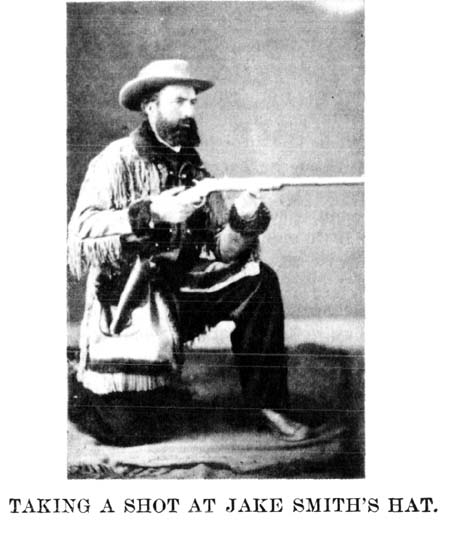
In the course of our discussion Jake Smith expressed his doubt whether any member of our party except Hauser (who is an expert pistol shot) is sufficiently skilled in the use of the revolver to hit an Indian at even a close range, and he offered to put the matter to a test by setting up his hat at a distance of twenty yards for the boys to shoot at with their revolvers, without a rest, at twenty-five cents a shot. While several members of our party were blazing away with indifferent success, with the result that Jake was adding to his exchequer without damage to his hat, I could not resist the inclination to quietly drop out of sight behind a clump of bushes, where from my place of concealment I sent from my breech-loading Ballard repeating rifle four bullets in rapid succession, through the hat, badly riddling it. Jake inquired, "Whose revolver is it that makes that loud report?" He did not discover the true state of the case, but removed the target with the ready acknowledgment that there were members of our party whose aim with a revolver was more accurate than he had thought. I think that I will make confession to him in a few days. I now wish that I had brought with me an extra hat. My own is not large enough for Jake's head. Notwithstanding the serious problems which we must deal with in making this journey, it is well to have a little amusement while we may.
Tuesday, August 23.—Last night was the first that we were on guard. The first relief was Hedges and Langford, the second Washburn and Hauser. Everything went well. At 8 a.m. to-day we broke camp. Some delay occurring in packing our horses, Lieutenant Doane and the escort went ahead, and we did not again see them until we reached our night camp.
We traveled down Trail creek and over a spur of the mountain to the valley of the Yellowstone, which we followed up eight miles to our present camp. Along on our right in passing up the valley was a vast natural pile of basaltic rock, perpendicular, a part of which had been overthrown, showing transverse seams in the rock. Away at the right in the highest range bordering the valley was Pyramid mountain, itself a snow-capped peak; and further up the range was a long ridge covered with deep snow. As we passed Pyramid mountain a cloud descended upon it, casting its gloomy shadow over the adjacent peaks and bursting in a grand storm. These magnificent changes in mountain scenery occasioned by light and shade during one of these terrific tempests, with all the incidental accompaniments of thunder, lightning, rain, snow and hail, afford the most awe-inspiring exhibition in nature. As I write, another grand storm, which does not extend to our camp, has broken out on Emigrant peak, which at one moment is completely obscured in darkness; at the next, perhaps, brilliant with light; all its gorges, recesses, seams and cañons illuminated; these fade away into dim twilight, broken by a terrific flash, and, echoing to successive peals,
"* * * the rattling crags among Leaps the live thunder" in innumerable reverberations.
On the left of the valley the foot hills were mottled with a carpet of beautiful, maroon-colored, delicately-tinted verdure, and towering above all rose peak on peak of the snow-capped mountains.
To-day we saw our first Indians as we descended into the valley of the Yellowstone. They came down from the east side of the valley, over the foot hills, to the edge of the plateau overlooking the bottom lands of the river, and there conspicuously displayed themselves for a time to engage our attention. As we passed by them up the valley they moved down to where their ponies were hobbled. Two of our party, Hauser and Stickney, had dropped behind and passed towards the north to get a shot at an antelope; and when they came up they reported that, while we were observing the Indians on the plateau across the river, there were one hundred or more of them watching us from behind a high butte as our pack-train passed up the valley. As soon as they observed Hauser and Stickney coming up nearly behind them, they wheeled their horses and disappeared down the other side of the butte.[B] This early admonition of our exposure to hostile attack, and liability to be robbed of everything, and compelled on foot and without provisions to retrace our steps, has been the subject of discussion in our camp to-night, and has renewed in our party the determination to abate nothing of our vigilance, and keep in a condition of constant preparation.
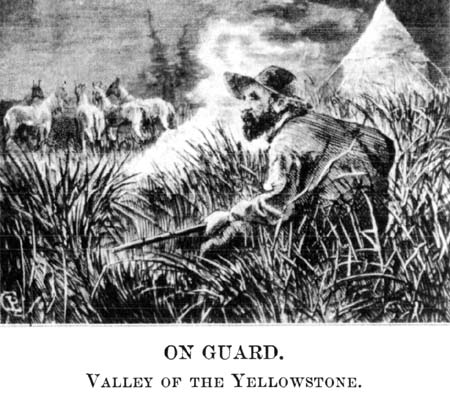
With our long-range rifles and plenty of ammunition, we can stand off 200 or 300 of them, with their less efficient weapons, if we don't let them sneak up upon us in the night. If we encounter more than that number, then what? The odds will be against us that they will "rub us out," as Jim Stuart says.
Jake Smith has sent the first demoralizing shot into the camp by announcing that he doesn't think there is any necessity for standing guard. Jake is the only one of our party who shows some sign of baldness, and he probably thinks that his own scalp is not worth the taking by the Indians.
Did we act wisely in permitting him to join our party at the last moment before leaving Helena? One careless man, no less than one who is easily discouraged by difficulties, will frequently demoralize an entire company. I think we have now taken all possible precautions for our safety, but our numbers are few; and for me to say that I am not in hourly dread of the Indians when they appear in large force, would be a braggart boast.
Mr. Everts was taken sick this afternoon. All day we have had a cool breeze and a few light showers, clearing off from time to time, revealing the mountains opposite us covered from their summits half way down with the newly fallen snow, and light clouds floating just below over the foot hills. Until we reached the open valley of the Yellowstone our route was over a narrow trail, from which the stream, Trail creek, takes its name. The mountains opposite the point where we entered the valley are rugged, grand, picturesque and immense by turns, and colored by nature with a thousand gorgeous hues. We have traveled all this day amid this stupendous variety of landscape until we have at length reached the western shore of that vast and solitary river which is to guide us to the theatre of our explorations. From the "lay of the land" I should judge that our camp to-night is thirty-five to forty miles above the point where Captain William Clark, of the famous Lewis and Clark expedition, embarked with his party in July, 1806, in two cottonwood canoes bound together with buffalo thongs, on his return to the states. It was from that point also that some six hundred residents of Montana embarked for a trip to the states, in forty-two flat boats, in the autumn of 1865.[C] We learn from Mr. Boteler that there are some twenty-five lodges of Crow Indians up the valley.[D]
Wednesday, August 24.—It rained nearly all of last night, but Lieutenant Doane pitched his large tent, which was sufficiently capacious to accommodate us all by lying "heads and tails," and we were very comfortable. Throughout the forenoon we had occasional showers, but about noon it cleared away, and, after getting a lunch, we got under way. During the forenoon some of the escort were very successful in fishing for trout. Mr. Everts was not well enough to accompany us, and it was arranged that he should remain at Boteler's ranch, and that we would move about twelve miles up the river, and there await his arrival. Our preparations for departure being completed, General Washburn detailed a guard of four men to accompany the pack train, while the rest of the party rode on ahead. We broke camp at 2:30 p.m. with the pack train and moved up the valley. At about six miles from our camp we crossed a spur of the mountain which came down boldly to the river, and from the top we had a beautiful view of the valley stretched out below us, the stream fringed with a thin bordering of trees, the foot hills rising into a level plateau covered with rich bunch grass, and towering above all, the snow-covered summits of the distant mountains rising majestically, seemingly just out of the plateau, though they were many miles away. Above us the valley opened out wide, and from the overlooking rock on which we stood we could see the long train of pack horses winding their way along the narrow trail, the whole presenting a picturesque scene. The rock on which we stood was a coarse conglomerate, or pudding stone.
Five miles farther on we crossed a small stream bordered with black cherry trees, many of the smaller ones broken down by bears, of which animal we found many signs. One mile farther on we made our camp about a mile below the middle cañon. To-night we have antelope, rabbit, duck, grouse and the finest of large trout for supper. As I write, General Washburn, Hedges and Hauser are engaged in an animated discussion of the differences between France and Germany, and the probabilities of the outcome of the war. The three gentlemen are not agreed in determining where the responsibility for the trouble lies, and I fear that I will have to check their profanity. However, neither Washburn nor Hedges swears.
Thursday, August 25.—Last night was very cold, the thermometer marking 40 degrees at 8 o'clock a.m. At one mile of travel we came to the middle cañon, which we passed on a very narrow trail running over a high spur of the mountain overlooking the river, which at this point is forced through a narrow gorge, surging and boiling and tumbling over the rocks, the water having a dark green color. After passing the cañon we again left the valley, passing over the mountain, on the top of which at an elevation of several hundred feet above the river is a beautiful lake. Descending the mountain again, we entered the valley, which here is about one and a half to two miles wide. At nineteen miles from our morning camp we came to Gardiner's river, at the mouth of which we camped. We are near the southern boundary of Montana, and still in the limestone and granite formations. Mr. Everts came into camp just at night, nearly recovered, but very tired from his long and tedious ride over a rugged road, making our two days' travel in one. We passed to-day a singular formation which we named "The Devil's Slide," From the top of the mountain to the valley, a distance of about 800 feet, the trap rock projected from 75 to 125 feet, the intermediate layers of friable rock having been washed out. The trap formation is about twenty-five feet wide, and covered with stunted pine trees. Opposite our camp is a high drift formation of granite boulders, gravel and clay. The boulders are the regular gray Quincy granite, and those in the middle of the river are hollowed out by the action of the water into many curious shapes. We have here found our first specimens of petrifactions and obsidian, or volcanic glass. From the top of the mountain back of our camp we can see to-night a smoke rising from another peak, which some of our party think is a signal from one band of the Indians to another, conveying intelligence of our progress. Along our trail of to-day are plenty of Indian "signs," and marks of the lodge poles dragging in the sand on either side of the trail.[E]
Jake Smith stood guard last night, or ought to have done so, and but for the fact that Gillette was also on guard, I should not have had an undisturbed sleep. We know that the Indians are near us, and sleep is more refreshing to me when I feel assured that I will not be joined in my slumbers by those who are assigned for watchful guard duty.
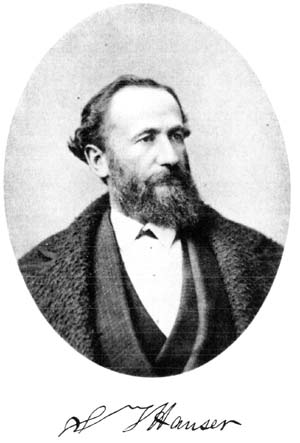
Friday, August 26.—For some reason we did not leave camp till 11 o'clock a.m. We forded Gardiner's river with some difficulty, several of our pack animals being nearly carried off their feet by the torrent. We passed over several rocky ridges or points coming down from the mountain, and at one and a half miles came down again into the valley, which one of our party called the "Valley of desolation." Taking the trail upon the left, we followed it until it led us to the mouth of a cañon, through which ran an old Indian or game trail, which was hardly discernible, and had evidently been long abandoned. Retracing our steps for a quarter of a mile, and taking a cut-off through the sage brush, we followed another trail upon our right up through a steep, dry coulee. From the head of the coulee we went through fallen timber over a burnt and rocky road, our progress being very slow. A great many of the packs came off our horses or became loosened, necessitating frequent haltings for their readjustment. Upon the summit we found a great many shells. Descending the divide we found upon the trail the carcass of an antelope which the advance party had killed, and which we packed on our horses and carried to our night camp. In the morning Lieutenant Doane and one of his men, together with Mr. Everts, had started out ahead of the party to search out the best trail. At 3 o'clock p.m. we arrived at Antelope creek, only six miles from our morning camp, where we concluded to halt. On the trail which we were following there were no tracks except those of unshod ponies; and, as our horses were all shod, it was evident that Lieutenant Doane and the advance party had descended the mountain by some other trail than that which we were following. Neither were there any marks of dragging lodge poles. There are seemingly two trails across the mountain,—a circuitous one by as easy a grade as can be found, over which the Indians send their families with their heavily laden pack horses; and a more direct, though more difficult, route which the war parties use in making their rapid rides. This last is the one we have taken, and the advance party has doubtless taken the other.
Our camp to-night is on Antelope creek, about five miles from the Yellowstone river. After our arrival in camp, in company with Stickney and Gillette, I made a scout of eight or ten miles through the country east of our trail, and between it and the river, in search of some sign of Lieutenant Doane, but we found no trace of him. Parting from Stickney and Gillette, I followed down the stream through a narrow gorge by a game trail, hoping if I could reach the Yellowstone, to find a good trail along its banks up to the foot of the Grand cañon; but I found the route impracticable for the passage of our pack train. After supper Mr. Hauser and I went out in search of our other party, and found the tracks of their horses, which we followed about four miles to the brow of a mountain overlooking the country for miles in advance of us. Here we remained an hour, firing our guns as a signal, and carefully scanning the whole country with our field glasses. We could discern the trail for many miles on its tortuous course, but could see no sign of a camp, or of horses feeding, and we returned to our camp.
Saturday, August 27.—Lieutenant Doane and those who were with him did not return to camp last night. At change of guard Gillette's pack horse became alarmed at something in the bushes bordering upon the creek on the bank of which he was tied, and, breaking loose, dashed through the camp, rousing all of us. Some wild animal—snake, fox or something of the kind—was probably the cause of the alarm. In its flight I became entangled in the lariat and was dragged head first for three or four rods, my head striking a log, which proved to be very rotten, and offered little resistance to a hard head, and did me very little damage. Towards morning a slight shower of rain fell, continuing at intervals till 8 o'clock. We left camp about 9 o'clock, the pack train following about 11 o'clock, and soon struck the trail of Lieutenant Doane, which proved to be the route traveled by the Indians. The marks of their lodge poles were plainly visible. At about four miles from our morning camp we discovered at some distance ahead of us what first appeared to be a young elk, but which proved to be a colt that had become separated from the camp of Indians to which it belonged. We think the Indians cannot be far from us at this time. Following the trail up the ascent leading from Antelope creek, we entered a deep cut, the sides of which rise at an angle of 45 degrees, and are covered with a luxuriant growth of grass. Through this cut we ascended by a grade entirely practicable for a wagon road to the summit of the divide separating the waters of Antelope creek from those of [A]—— creek, and from the summit descended through a beautiful gorge to a small tributary of the Yellowstone, a distance of two miles, dismounting and leading our horses almost the entire distance, the descent being too precipitous for the rider's comfort or for ease to the horse. We were now within four miles of[F]—— creek, and within two miles of the Yellowstone. On the right of the trail, two miles farther on, we found a small hot sulphur spring, the water of which was at a temperature a little below the boiling point, which at this elevation is about 195 degrees. Ascending a high ridge we had a commanding view of a basaltic formation of palisades, about thirty feet in height, on the opposite bank of the Yellowstone, overlooking a stratum of cement and gravel nearly two hundred feet thick, beneath which is another formation of the basaltic rock, and beneath this another body of cement and gravel. We named this formation "Column Rock." The upper formation, from which the rock takes its name, consists of basaltic columns about thirty feet high, closely touching each other, the columns being from three to five feet in diameter. A little farther on we descended the sides of the cañon, through which runs a large creek. We crossed this creek and camped on the south side. Our camp is about four hundred feet in elevation above the Yellowstone, which is not more than two miles distant. The creek is full of granite boulders, varying in size from six inches to ten feet in diameter.
General Washburn was on guard last night, and to-night he seems somewhat fatigued. Mr. Hedges has improvised a writing stool from a sack of flour, and I have appropriated a sack of beans for a like use; and, as we have been writing, there has been a lively game of cards played near my left side, which Hedges, who has just closed his diary, says is a game of poker. I doubt if Deacon Hedges is sufficiently posted in the game to know to a certainty that poker is the game which is being played; but, putting what Hedges tells me with what I see and hear, I find that these infatuated players have put a valuation of five (5) cents per bean, on beans that did not cost more than $1 quart in Helena, and Jake Smith exhibits a marvelous lack of veneration for his kinswoman, by referring to each bean, as he places it before him upon the table, as his "aunt," or, more flippantly, his "auntie." Walter Trumbull has been styled the "Banker," and he says that at the commencement of the game he sold forty of these beans to each of the players, himself included (200 in all), at five (5) cents each, and that he has already redeemed the entire 200 at that rate; and now Jake Smith has a half-pint cup nearly full of beans, and is demanding of Trumbull that he redeem them also; that is, pay five (5) cents per bean for the contents of the cup. Trumbull objects. Jake persists. Reflecting upon their disagreement I recall that about an hour ago Jake, with an apologetic "Excuse me!" disturbed me while I was writing and untied the bean sack on which I am now sitting, and took from it a double handful of beans.
It seems to me that a game of cards which admits of such latitude as this, with a practically unlimited draft upon outside resources, is hardly fair to all parties, and especially to "The Banker."
Sunday, August 28.—To-day being Sunday, we remained all day in our camp, which Washburn and Everts have named "Camp Comfort," as we have an abundance of venison and trout.
We visited the falls of the creek, the waters of which tumble over the rocks and boulders for the distance of 200 yards from our camp, and then fall a distance of 110 feet, as triangulated by Mr. Hauser. Stickney ventured to the verge of the fall, and, with a stone attached to a strong cord, measured its height, which he gives as 105 feet.
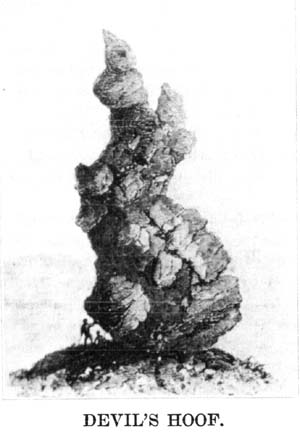
The stream, in its descent to the brink of the fall, is separated into half a dozen distorted channels which have zig-zagged their passage through the cement formation, working it into spires, pinnacles, towers and many other capricious objects. Many of these are of faultless symmetry, resembling the minaret of a mosque; others are so grotesque as to provoke merriment as well as wonder. One of this latter character we named "The Devil's Hoof," from its supposed similarity to the proverbial foot of his Satanic majesty. The height of this rock from its base is about fifty feet.
The friable rock forming the spires and towers and pinnacles crumbles away under a slight pressure. I climbed one of these tall spires on the brink of the chasm overlooking the fall, and from the top had a beautiful view, though it was one not unmixed with terror. Directly beneath my feet, but probably about one hundred feet below me, was the verge of the fall, and still below that the deep gorge through which the creek went bounding and roaring over the boulders to its union with the Yellowstone. The scenery here cannot be called grand or magnificent, but it is most beautiful and picturesque. The spires are from 75 to 100 feet in height. The volume of water is about six or eight times that of Minnehaha fall, and I think that a month ago, while the snows were still melting, the creek could not easily have been forded. The route to the foot of the fall is by a well worn Indian trail running to the mouth of the creek over boulders and fallen pines, and through thickets of raspberry bushes.
At the mouth of the creek on the Yellowstone is a hot sulphur spring, the odor from which is perceptible in our camp to-day. At the base of the fall we found a large petrifaction of wood imbedded in the debris of the falling cement and slate rock. There are several sulphur springs at the mouth of the creek, three of them boiling, others nearly as hot as boiling water. There is also a milky white sulphur spring. Within one yard of a spring, the temperature of which is little below the boiling point, is a sulphur spring with water nearly as cold as ice water, or not more than ten degrees removed from it.
I went around and almost under the fall, or as far as the rocks gave a foot-hold, the rising spray thoroughly wetting and nearly blinding me. Some two hundred yards below the fall is a huge granite boulder about thirty feet in diameter. Where did it come from?
In camp to-day several names were proposed for the creek and fall, and after much discussion the name "Minaret" was selected. Later, this evening, this decision has been reconsidered, and we have decided to substitute the name "Tower" for "Minaret," and call it "Tower Fall."[G]
General Washburn rode out to make a reconnaissance for a route to the river, and returned about 3 o'clock in the afternoon with the intelligence that from the summit of a high mountain he had seen Yellowstone lake, the proposed object of our visit; and with his compass he had noted its direction from our camp. This intelligence has greatly relieved our anxiety concerning the course we are to pursue, and has quieted the dread apprehensions of some of our number, lest we become inextricably involved in the wooded labyrinth by which we are surrounded; and in violation of our agreement that we would not give the name of any member of our party to any object of interest, we have spontaneously and by unanimous vote given the mountain the name by which it will hereafter and forever be known, "Mount Washburn."
In addition to our saddle horses and pack horses, we have another four-footed animal in our outfit—a large black dog of seeming little intelligence, to which we have given the name of "Booby." He is owned by "Nute," one of our colored boys, who avers that he is a very knowing dog, and will prove himself so before our journey is ended. The poor beast is becoming sore-footed, and his sufferings excite our sympathy, and we are trying to devise some kind of shoe or moccasin for him. The rest to-day in camp will benefit him. Lieutenant Doane is suffering greatly with a felon on his thumb. It ought to be opened, but he is unwilling to submit to a thorough operation. His sufferings kept him awake nearly all of last night.
Monday, August 29.—We broke camp about 8 o'clock, leaving the trail, which runs down to the mouth of the creek, and passed over a succession of high ridges, and part of the time through fallen timber. The trail of the Indians leads off to the left, to the brink of the Yellowstone, which it follows up about three-fourths of a mile, and then crosses to the east side. Hauser, Gillette, Stickney, Trumbull and myself rode out to the summit of Mount Washburn, which is probably the highest peak on the west side of the river. Having an aneroid barometer with us, we ascertained the elevation of the mountain to be about 9,800 feet. The summit is about 500 feet above the snow line.
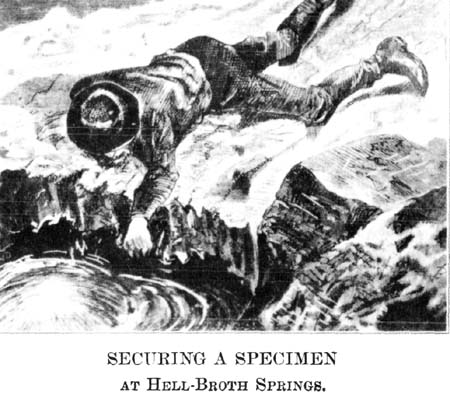
Descending the mountain on the southwest side, we came upon the trail of the pack train, which we followed to our camp at the head of a small stream running into the Yellowstone, which is about five miles distant. As we came into camp a black bear kindly vacated the premises. After supper some of our party followed down the creek to its mouth. At about one mile below our camp the creek runs through a bed of volcanic ashes, which extends for a hundred yards on either side. Toiling on our course down this creek to the river we came suddenly upon a basin of boiling sulphur springs, exhibiting signs of activity and points of difference so wonderful as to fully absorb our curiosity. The largest of these, about twenty feet in diameter, is boiling like a cauldron, throwing water and fearful volumes of sulphurous vapor higher than our heads. Its color is a disagreeable greenish yellow. The central spring of the group, of dark leaden hue, is in the most violent agitation, its convulsive spasms frequently projecting large masses of water to the height of seven or eight feet. The spring lying to the east of this, more diabolical in appearance, filled with a hot brownish substance of the consistency of mucilage, is in constant noisy ebullition, emitting fumes of villainous odor. Its surface is covered with bubbles, which are constantly rising and bursting, and emitting sulphurous gases from various parts of its surface. Its appearance has suggested the name, which Hedges has given, of "Hell-Broth springs;" for, as we gazed upon the infernal mixture and inhaled the pungent sickening vapors, we were impressed with the idea that this was a most perfect realization of Shakespeare's image in Macbeth. It needed but the presence of Hecate and her weird band to realize that horrible creation of poetic fancy, and I fancied the "black and midnight hags" concocting a charm around this horrible cauldron. We ventured near enough to this spring to dip the end of a pine pole into it, which, upon removal, was covered an eighth of an inch thick with lead-colored sulphury slime.
There are five large springs and half a dozen smaller ones in this basin, all of them strongly impregnated with sulphur, alum and arsenic. The water from all the larger springs is dark brown or nearly black. The largest spring is fifteen to eighteen feet in diameter, and the water boils up like a cauldron from 18 to 30 inches, and one instinctively draws back from the edge as the hot sulphur steam rises around him. Another of the larger springs is intermittent. The smaller springs are farther up on the bank than the larger ones. The deposit of sinter bordering one of them, with the emission of steam and smoke combined, gives it a resemblance to a chimney of a miner's cabin. Around them all is an incrustation formed from the bases of the spring deposits, arsenic, alum, sulphur, etc. This incrustation is sufficiently strong in many places to bear the weight of a man, but more frequently it gave way, and from the apertures thus created hot steam issued, showing it to be dangerous to approach the edge of the springs; and it was with the greatest difficulty that I obtained specimens of the incrustation. This I finally accomplished by lying at full length upon that portion of the incrustation which yielded the least, but which was not sufficiently strong to bear my weight while I stood upright, and at imminent risk of sinking in the infernal mixture, I rolled over and over to the edge of the opening; and, with the crust slowly bending and sinking beneath me, hurriedly secured the coveted prize of black sulphur, and rolled back to a place of safety.
From the springs to the mouth of the creek we followed along the bank, the bed or bottom being too rough and precipitous for us to travel in it, the total fall in the creek for the three miles being about fifteen hundred feet. Standing upon the high point at the junction of the creek with the Yellowstone, one first gets some idea of the depth of the cañon through which the river runs. From this height the sound of the waters of the Yellowstone, tumbling over tremendous rocks and boulders, could not be heard. Everything around us—mountains, valleys, cañon and trees, heights and depths—all are in such keeping and proportion that all our estimates of distances are far below the real truth. To-day we passed the mouth of Hell-Roaring river on the opposite side of the Yellowstone.
It was again Jake Smith's turn for guard duty last night, but this morning Jake's countenance wore a peculiar expression, which indicated that he possessed some knowledge not shared by the rest of the party. He spoke never a word, and was as serene as a Methodist minister behind four aces. My interpretation of this self-satisfied serenity is that his guard duty did not deprive him of much sleep. When it comes to considering the question of danger in this Indian country, Jake thinks that he knows more than the veteran Jim Stuart, whom we expected to join us on this trip, and who has given us some salutary words of caution. In a matter in which the safety of our whole party is involved, it is unfortunate that there are no "articles of war" to aid in the enforcement of discipline, in faithful guard duty.
Tuesday, August 30.—We broke camp about 9 o'clock a.m., traveling in a southerly direction over the hills adjoining our camp, and then descended the ridge in a southwesterly direction, heading off several ravines, till we came into a small valley; thence we crossed over a succession of ridges of fallen timber to a creek, where we halted about ten miles from our morning camp and about a mile from the upper fall of the Yellowstone. Mr. Hedges gave the name "Cascade creek" to this stream.
When we left our camp this morning at Hell-Broth springs, I remarked to Mr. Hedges and General Washburn that the wonders of which we were in pursuit had not disappointed us in their first exhibitions, and that I was encouraged in the faith that greater curiosities lay before us. We believed that the great cataracts of the Yellowstone were within two days', or at most three days', travel. So when we reached Cascade creek, on which we are now encamped, after a short day of journeying, it was with much astonishment as well as delight that we found ourselves in the immediate presence of the falls. Their roar, smothered by the vast depth of the cañon into which they plunge, was not heard until they were before us. With remarkable deliberation we unsaddled and lariated our horses, and even refreshed ourselves with such creature comforts as our larder readily afforded, before we deigned a survey of these great wonders of nature. On our walk down the creek to the river, struck with the beauty of its cascades, we even neglected the greater, to admire the lesser wonders. Bushing with great celerity through a deep defile of lava and obsidian, worn into caverns and fissures, the stream, one-fourth of a mile from its debouchure, breaks into a continuous cascade of remarkable beauty, consisting of a fall of five feet, succeeded by another of fifteen into a grotto formed by proximate rocks imperfectly arching it, whence from a crystal pool of unfathomable depth at their base, it lingers as if half reluctant to continue its course, or as if to renew its power, and then glides gracefully over a descending, almost perpendicular, ledge, veiling the rocks for the distance of eighty feet. Mr. Hedges gave to this succession of cascades the name "Crystal fall." It is very beautiful; but the broken and cavernous gorge through which it passes, worn into a thousand fantastic shapes, bearing along its margin the tracks of grizzly bears and lesser wild animals, scattered throughout with huge masses of obsidian and other volcanic matter—the whole suggestive of nothing earthly nor heavenly—received at our hands, and not inaptly as I conceive, the name of "The Devil's Den."
I presume that many persons will question the taste evinced by our company in the selection of names for the various objects of interest we have thus far met with; but they are all so different from any of Nature's works that we have ever seen or heard of, so entirely out of range of human experience, and withal so full of exhibitions which can suggest no other fancy than that which our good grandmothers have painted on our boyish imaginations as a destined future abode, that we are likely, almost involuntarily, to pursue the system with which we have commenced, to the end of our journey. A similar imagination has possessed travelers and visitors to other volcanic regions.
We have decided to remain at this point through the entire day to-morrow, and examine the cañon and falls. From the brief survey of the cañon I was enabled to make before darkness set in, I am impressed with its awful grandeur, and I realize the impossibility of giving to any one who has not seen a gorge similar in character, any idea of it.
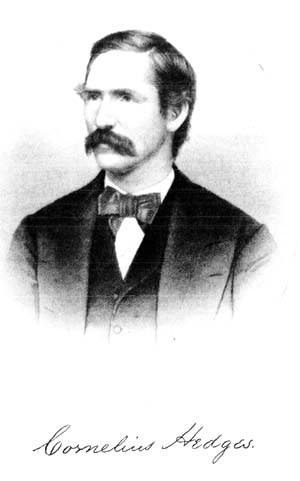
It is getting late, and it is already past our usual bedtime, and Jake Smith is calling to me to "turn in" and give him a chance to sleep. There is in what I have already seen so much of novelty to fill the mind and burden the memory, that unless I write down in detail the events of each day, and indeed almost of each hour as it passes, I shall not be able to prepare for publication on my return home any clear or satisfactory account of these wonders. So Jake may go to. I will write until my candle burns out. Jacob is indolent and fond of slumber, and I think that he resents my remark to him the other day, that he could burn more and gather less wood than any man I ever camped with. He has dubbed me "The Yellowstone sharp." Good! I am not ashamed to have the title. Lieutenant Doane has crawled out of his blankets, and is just outside the tent with his hand and fore-arm immersed in water nearly as cold as ice. I am afraid that lock-jaw will set in if he does not consent to have the felon lanced.
Wednesday, August 31.—This has been a "red-letter" day with me, and one which I shall not soon forget, for my mind is clogged and my memory confused by what I have to-day seen. General Washburn and Mr. Hedges are sitting near me, writing, and we have an understanding that we will compare our notes when finished. We are all overwhelmed with astonishment and wonder at what we have seen, and we feel that we have been near the very presence of the Almighty. General Washburn has just quoted from the psalm:
"When I behold the work of Thy hands, what is man that Thou art mindful of him!"
My own mind is so confused that I hardly know where to commence in making a clear record of what is at this moment floating past my mental vision. I cannot confine myself to a bare description of the falls of the Yellowstone alone, for these two great cataracts are but one feature in a scene composed of so many of the elements of grandeur and sublimity, that I almost despair of giving to those who on our return home will listen to a recital of our adventures, the faintest conception of it. The immense cañon or gorge of rocks through which the river descends, perhaps more than the falls, is calculated to fill the observer with feelings of mingled awe and terror. This chasm is seemingly about thirty miles in length. Commencing above the upper fall, it attains a depth of two hundred feet where that takes its plunge, and in the distance of half a mile from that point to the verge of the lower fall, it rapidly descends with the river between walls of rock nearly six hundred feet in vertical height, to which three hundred and twenty feet are added by the fall. Below this the wall lines marked by the descent of the river grow in height with incredible distinctness, until they are probably two thousand feet above the water. There is a difference of nearly three thousand feet in altitude between the surface of the river at the upper fall and the foot of the cañon. Opposite Mount Washburn the cañon must be more than half a vertical mile in depth. As it is impossible to explore the entire cañon, we are unable to tell whether the course of the river through it is broken by other and larger cataracts than the two we have seen, or whether its continuous descent alone has produced the enormous depth to which it has attained. Rumors of falls a thousand feet in height have often reached us before we made this visit. At all points where we approached the edge of the cañon the river was descending with fearful momentum through it, and the rapids and foam from the dizzy summit of the rock overhanging the lower fall, and especially from points farther down the cañon, were so terrible to behold, that none of our company could venture the experiment in any other manner than by lying prone upon the rock, to gaze into its awful depths; depths so amazing that the sound of the rapids in their course over immense boulders, and lashing in fury the base of the rocks on which we were lying, could not be heard. The stillness is horrible, and the solemn grandeur of the scene surpasses conception. You feel the absence of sound—the oppression of absolute silence. Down, down, down, you see the river attenuated to a thread. If you could only hear that gurgling river, lashing with puny strength the massive walls that imprison it and hold it in their dismal shadow, if you could but see a living thing in the depth beneath you, if a bird would but fly past you, if the wind would move any object in that awful chasm, to break for a moment the solemn silence which reigns there, it would relieve that tension of the nerves which the scene has excited, and with a grateful heart you would thank God that he had permitted you to gaze unharmed upon this majestic display of his handiwork. But as it is, the spirit of man sympathizes with the deep gloom of the scene, and the brain reels as you gaze into this profound and solemn solitude.
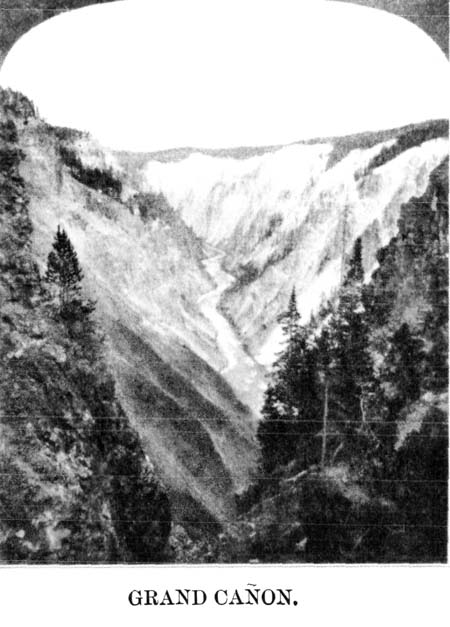
The place where I obtained the best and most terrible view of the cañon was a narrow projecting point situated two or three miles below the lower fall.[H] Standing there or rather lying there for greater safety, I thought how utterly impossible it would be to describe to another the sensations inspired by such a presence. As I took in this scene, I realized my own littleness, my helplessness, my dread exposure to destruction, my inability to cope with or even comprehend the mighty architecture of nature. More than all this I felt as never before my entire dependence upon that Almighty Power who had wrought these wonders. A sense of danger, lest the rock should crumble away, almost overpowered me. My knees trembled, and I experienced the terror which causes, men to turn pale and their countenances to blanch with fear, and I recoiled from the vision I had seen, glad to feel the solid earth beneath me and to realize the assurance of returning safety.
The scenery surrounding the cañon and falls on both banks of the Yellowstone is enlivened by all the hues of abundant vegetation. The foot-hills approach the river, crowned with a vesture of evergreen pines. Meadows verdant with grasses and shrubbery stretch away to the base of the distant mountains, which, rolling into ridges, rising into peaks, and breaking into chains, are defined in the deepest blue upon the horizon. To render the scene still more imposing, remarkable volcanic deposits, wonderful boiling springs, jets of heated vapor, large collections of sulphur, immense rocks and petrifications abound in great profusion in this immediate vicinity. The river is filled with trout, and bear, elk, deer, mountain lions and lesser game roam the plains, forests and mountain fastnesses.
The two grand falls of the Yellowstone form a fitting completion to this stupendous climax of wonders. They impart life, power, light and majesty to an assemblage of elements, which without them would be the most gloomy and horrible solitude in nature. Their eternal anthem, echoing from cañon, mountain, rock and woodland, thrills you with delight, and you gaze with rapture at the iris-crowned curtains of fleecy foam as they plunge into gulfs enveloped in mist and spray. The stillness which held your senses spellbound, as you peered into the dismal depths of the cañon below, is now broken by the uproar of waters; the terror it inspired is superseded by admiration and astonishment, and the scene, late so painful from its silence and gloom, is now animate with joy and revelry.
The upper fall, as determined by the rude means of measurement at our command, is one hundred and fifteen feet in height. The river approaches it through a passage of rocks which rise one hundred feet on either side above its surface. Until within half a mile of the brink of the fall the river is peaceful and unbroken by a ripple. Suddenly, as if aware of impending danger, it becomes lashed into foam, circled with eddies, and soon leaps into fearful rapids. The rocky jaws confining it gradually converge as it approaches the edge of the fall, bending its course by their projections, and apparently crowding back the water, which struggles and leaps against their bases, warring with its bounds in the impatience of restraint, and madly leaping from its confines, a liquid emerald wreathed with foam, into the abyss beneath. The sentinel rocks, a hundred feet asunder, could easily be spanned by a bridge directly over and in front of the fall, and fancy led me forward to no distant period when such an effort of airy architecture would be crowded with happy gazers from all portions of our country. A quarter of the way between the verge and the base of the fall a rocky table projects from the west bank, in front of and almost within reaching distance of it, furnishing a point of observation where the finest view can be obtained. In order to get a more perfect view of the cataract, Mr. Hedges and I made our way down to this table rock, where we sat for a long time. As from this spot we looked up at the descending waters, we insensibly felt that the slightest protrusion in them would hurl us backwards into the gulf below. A thousand arrows of foam, apparently aimed at us, leaped from the verge, and passed rapidly down the sheet. But as the view grew upon us, and we comprehended the power, majesty and beauty of the scene, we became insensible to danger and gave ourselves up to the full enjoyment of it.
Very beautiful as is this fall, it is greatly excelled in grandeur and magnificence by the cataract half a mile below it, where the river takes another perpendicular plunge of three hundred and twenty feet into the most gloomy cavern that ever received so majestic a visitant. Between the two falls, the river, though bordered by lofty precipices, expands in width and flows gently over a nearly level surface until its near approach to the verge. Here a sudden convergence in the rocks compresses its channel, and with a gurgling, choking struggle, it leaps with a single bound, sheer from an even level shelf, into the tremendous chasm. The sheet could not be more perfect if wrought by art. The Almighty has vouchsafed no grander scene to human eyes. Every object that meets the vision increases its sublimity. There is a majestic harmony in the whole, which I have never seen before in nature's grandest works. The fall itself takes its leap between the jaws of rocks whose vertical height above it is more than six hundred feet, and more than nine hundred feet above the chasm into which it falls. Long before it reaches the base it is enveloped in spray, which is woven by the sun's rays into bows radiant with all the colors of the prism, and arching the face of the cataract with their glories. Five hundred feet below the edge of the cañon, and one hundred and sixty feet above the verge of the cataract, and overlooking the deep gorge beneath, on the flattened summit of a projecting crag, I lay with my face turned into the boiling chasm, and with a stone suspended by a large cord measured its profoundest depths. Three times in its descent the cord was parted by abrasion, but at last, securing the weight with a leather band, I was enabled to ascertain by a measurement which I think quite exact, the height of the fall. It is a little more than three hundred and twenty feet; while the perpendicular wall down which I suspended the weight was five hundred and ten feet.
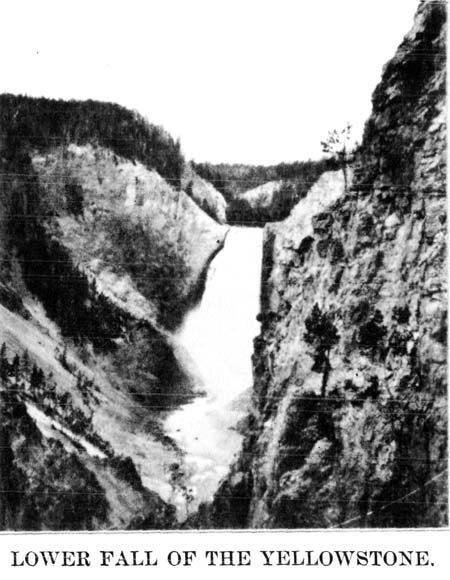
Looking down from this lofty eminence through the cañon below the falls, the scene is full of grandeur. The descent of the river for more than a mile is marked by continuous cascades varying in height from five to twenty feet, and huge rapids breaking over the rocks, and lashing with foam the precipitous sides of the gorge. A similar descent through the entire cañon (thirty miles), is probable, as in no other way except by distinct cataracts of enormous height can the difference in altitude between this point and its outlet be explained. The colors of the rock, which is shaly in character, are variegated with yellow, gray and brown, and the action of the water in its rapid passage down the sides of the cañon has worn the fragments of shale into countless capricious forms. Jets of steam issue from the sides of the cañon at frequent intervals, marking the presence of thermal springs and active volcanic forces. The evidence of a recession of the river through the cañon is designated by the ridges apparent on its sides, and it is not improbable that at no distant day the lower fall will become blended by this process with the upper, forming a single cataract nearly five hundred feet in height.
There are but few places where the sides of the Grand cañon can be descended with safety. Hauser and Stickney made the descent at a point where the river was 1,050 feet below the edge of the cañon, as determined by triangulation by Mr. Hauser. Lieutenant Doane, accompanied by his orderly, went down the river several miles, and following down the bed of a lateral stream reached its junction with the Yellowstone at a point where the cañon was about 1,500 feet in depth—the surface of the ground rising the farther he went down the river.
Mr. Hedges and I sat on the table-rock to which I have referred, opposite the upper fall, as long as our limited time would permit; and as we reluctantly left it and climbed to the top, I expressed my regret at leaving so fascinating a spot, quoting the familiar line:
"A thing of beauty is a joy forever."
Mr. Hedges asked me who was the author of the line, but I could not tell. I will look it up on my return.[I]
Yes! This stupendous display of nature's handiwork will be to me "a joy forever." It lingers in my memory like the faintly defined outlines of a dream. I can scarcely realize that in the unbroken solitude of this majestic range of rocks, away from civilization and almost inaccessible to human approach, the Almighty has placed so many of the most wonderful and magnificent objects of His creation, and that I am to be one of the few first to bring them to the notice of the world. Truly has it been said, that we live to learn how little may be known, and of what we see, how much surpasses comprehension.
Thursday, September 1.—We did not break camp till nearly ten o'clock this morning, the pack-train crossing Cascade creek at its head, and coming into the river trail about two miles above the upper fall. The more direct trail—shorter by one and a half miles—runs along the bank of the river.
If we had not decided, last night, that we would move on to-day, I think that every member of the party would have been glad to stay another day at the cañon and falls. I will, however, except out of the number our comrade Jake Smith. The afternoon of our arrival at the cañon (day before yesterday), after half an hour of inspection of the falls and cañon, he said: "Well, boys, I have seen all there is, and I am ready to move on."
However, the perceptible decline in our larder, and the uncertainty of the time to be occupied in further explorations, forbid more than these two days' stay at the falls and cañon. The sun this morning shone brightly, and its rays were reflected upon the sides of the dismal cañon—so dark, and gray, and still—enlivening and brightening it. To-day has been warm, and nature this morning seemed determined that our last look should be the brightest, for the beauties of the entire landscape invited us to make a longer stay, and we lingered till the last moment, that the final impression might not be lost.
Pursuing our journey, at two miles above the falls we crossed a small stream which we named "Alum" creek, as it is strongly impregnated with alum.
Six miles above the upper fall we entered upon a region remarkable for the number and variety of its hot springs and craters. The principal spring, and the one that first meets the eye as you approach from the north, is a hot sulphur spring, of oval shape, the water of which is constantly boiling and is thrown up to the height of from three to seven feet. Its two diameters are about twelve feet and twenty feet, and it has an indented border of seemingly pure sulphur, about two feet wide and extending down into the spring or cauldron to the edge of the water, which at the time of our visit, if it had been at rest, would have been fifteen or eighteen inches below the rim of the spring. This spring is situated at the base of a low mountain, and the gentle slope below and around the spring for the distance of two hundred or three hundred feet is covered to the depth of from three to ten inches with the sulphurous deposit from the overflow of the spring. The moistened bed of a dried-up rivulet, leading from the edge of the spring down inside through this deposit, showed us that the spring had but recently been overflowing. Farther along the base of this mountain is a sulphurous cavern about twenty feet deep, and seven or eight feet in diameter at its mouth, out of which the steam is thrown in jets with a sound resembling the puffing of a steam-boat when laboring over a sand-bar, and with as much uniformity and intonation as if emitted by a high-pressure engine. From hundreds of fissures in the adjoining mountain from base to summit, issue hot sulphur vapors, the apertures through which they escape being encased in thick incrustations of sulphur, which in many instances is perfectly pure. There are nearby a number of small sulphur springs, not especially remarkable in appearance.
About one hundred yards from these springs is a large hot spring of irregular shape, but averaging forty feet long by twenty-five wide, the water of which is of a dark muddy color. Still farther on are twenty or thirty springs of boiling mud of different degrees of consistency and color, and of sizes varying from two to eight feet in diameter, and of depths below the surface varying from three to eight feet. The mud in these springs is in most cases a little thinner than mortar prepared for plastering, and, as it is thrown up from one to two feet, I can liken its appearance to nothing so much as Indian meal hasty pudding when the process of boiling is nearly completed, except that the puffing, bloated bubbles are greatly magnified, being from a few inches to two feet in diameter. In some of the springs the mud is of dark brown color, in others nearly pink, and in one it was almost yellow. Springs four or five feet in diameter and not over six feet apart, have no connection one with another either above or beneath the surface, the mud in them being of different colors. In some instances there is a difference of three feet in the height to which the mud in adjoining springs attains. There may be in some instances two or more springs which receive their supply of mud and their underground pressure from the same general source, but these instances are rare, nor can we determine positively that such is the case. This mud having been worked over and over for many years is as soft as the finest pigments.
All of these springs are embraced within a circle the radius of which is from a thousand to twelve hundred feet, and the whole of this surface seems to be a smothered crater covered over with an incrustation of sufficient strength and thickness to bear usually a very heavy weight, but which in several instances yielded and even broke through under the weight of our horses as we rode over it. We quickly dismounted, and as we were making some examinations, the crust broke through several times in some thin places through which vapor was issuing. Under the whole of this incrustation the hottest fires seem to be raging, and the heat issuing from the vents or from the crevices caused from the breaking in of the surface is too intense to be borne by the gloved hand for an instant. Surrounding the natural vents are deposits of pure sulphur, portions of which in many instances we broke off, and after allowing them to cool, brought them away with us. On the top of the mountain overlooking the large sulphur spring is a small living crater about six inches in diameter, out of which issue hot vapor and smoke. On the slope adjoining the mud spring is another crater of irregular shape, but embracing about one hundred square inches, out of which issues hot vapor, the rocks adjoining changing color under the intense heat with every breath blown upon them.
The tramp of our horses' feet as we rode over the incrustation at the base of the mountain returned a hollow sound; yet while some of our party were not disposed to venture upon it with their horses, still I think with care in selecting a route there is very little danger in riding over it.
On the mountain, large quantities of sulphur formed by the condensation of the vapor issuing from the crevices, now closed, but once in activity in the incrusted covering, have been deposited, and we collected many specimens of pure and crystallized sulphur. Thousands of pounds of pure and nearly pure sulphur are now lying on the top and sides of the mountain, all of which can be easily gathered with the aid of a spade to detach it from the mountain side incrustations to which it adheres in the process of condensation. We gave to this mountain the name "Crater hill."
Five miles further on we camped near the "Mud geyser." Our course to-day has been for the greater part over a level valley, which was plainly visible from the top of Mount Washburn. The water of the river at this point is strongly impregnated with the mineral bases of the springs surrounding our camp, and that empty into the river above it.
Friday, September 2.—To-day we have occupied ourselves in examining the springs and other wonders at this point. At the base of the foot-hills adjoining our camp are three large springs of thick boiling mud, the largest of which resembles an immense cauldron. It is about thirty feet in diameter, bordered by a rim several feet wide, upon which one can stand within reach of the boiling mass of mud, the surface of which is four or five feet below the rim enclosing it, the rim being a little raised above the surrounding level. Some twelve or fifteen rods from this spring are two other springs from ten to twelve feet in diameter. Near by is a hot (not boiling) spring of sulphur, fifteen to eighteen feet in diameter, too hot to bathe in. From these we passed over the timbered hill at the base of which these springs are situated. In the timber along the brow of the hill and near its summit, and immediately under the living trees, the hot sulphur vapor and steam issue from several fissures or craters, showing that the hottest fires are raging at some point beneath the surface crust, which in a great many places gives forth a hollow sound as we pass over it. Through a little coulee on the other side of the hill runs a small stream of greenish water, which issues from a small cavern, the mouth of which is about five feet high and the same dimension in width. From the mouth, the roof of the cavern descends at an angle of about fifteen degrees, till at the distance of twenty feet from the entrance it joins the surface of the water. The bottom of the cavern under the water seems to descend at about the same angle, but as the water is in constant ebullition, we cannot determine this fact accurately. The water is thrown out in regular spasmodic jets, the pulsations occurring once in ten or twelve seconds. The sides and mouth of this cavern are covered with a dark green deposit, some of which we have taken with us for analysis. About two hundred yards farther on is another geyser, the flow of which occurs about every six hours, and when the crater is full the diameter of the surface is about fourteen feet, the sides of the crater being of an irregular funnelshape, and descending at an angle of about forty-five degrees. At the lowest point at which we saw the water it was about seven feet in diameter on the surface. One or another of our party watched the gradual rise of the water for four or five hours. The boiling commenced when the water had risen half way to the surface, occasionally breaking forth with great violence. When the water had reached its full height in the basin, the stream was thrown up with great force to a height of from twenty to thirty feet, the column being from seven to ten feet in diameter at the midway height of the column, from bottom to top. The water was of a dark lead color, and those portions of the sides of the crater that were overflowed and then exposed by the rise and fall of the water were covered with stalagmites formed by the deposit from the geyser.
While surveying these wonders, our ears were constantly saluted by dull, thundering, booming sounds, resembling the reports of distant artillery. As we approached the spot whence they proceeded, the ground beneath us shook and trembled as from successive shocks of an earthquake. Ascending a small hillock, the cause of the uproar was found to be a mud volcano—the greatest marvel we have yet met with. It is about midway up a gentle pine-covered slope, above which on the lower side its crater, thirty feet in diameter, rises to a height of about thirty-five feet. Dense masses of steam issue with explosive force from this crater, into whose tapering mouth, as they are momentarily dispelled by the wind, we can see at a depth of about forty feet the regurgitating contents. The explosions are not uniform in force or time, varying from three to eight seconds, and occasionally with perfect regularity occurring every five seconds. They are very distinctly heard at the distance of half a mile, and the massive jets of vapor which accompany them burst forth like the smoke of burning gunpowder.
Some of these pulsations are much more violent than others, but each one is accompanied by the discharge of an immense volume of steam, which at once shuts off all view of the inside of the crater; but sometimes, during the few seconds intervening between the pulsations, or when a breeze for a moment carries the steam to one side of the crater, we can see to the depth of thirty feet into the volcano, but cannot often discover the boiling mud; though occasionally, when there occurs an unusually violent spasm or concussion, a mass of mud as large in bulk as a hogshead is thrown up as high as our heads, emitting blinding clouds of steam in all directions, and crowding all observers back from the edge of the crater. We were led to believe that this volcano has not been long in existence; but that it burst forth the present summer but a few months ago. The green leaves and the limbs of the surrounding forest trees are covered with fresh clay or mud, as is also the newly grown grass for the distance of 180 feet from the crater. On the top branches of some of the trees near by—trees 150 feet high—we found particles of dried mud that had fallen upon the high branches in their descent just after this first outburst, which must have thrown the contents of the volcano as high as 250 or 300 feet. Mr. Hauser, whose experience as an engineer and with projectile forces entitles his opinion to credit, estimates from the particles of mud upon the high trees, and the distance to which they were thrown, that the mud had been thrown, in this explosion, to the height of between 300 and 400 feet. By actual measurement we found particles of this mud 186 feet from the edge of the crater.
We did not dare to stand upon the leeward side of the crater and withstand the force of the steam; and Mr. Hedges, having ventured too near the rim on that side, endangered his life by his temerity, and was thrown violently down the exterior side of the crater by the force of the volume of steam emitted during one of these fearful convulsions. General Washburn and I, who saw him fall, were greatly concerned lest while regaining his feet, being blinded by the steam, and not knowing in which direction to turn, he should fall into the crater.
Between the volcano, the mud geyser and the cavern spring are a number of hot sulphur and mud springs, of sizes varying from two to twenty feet in diameter, and many openings or crevices from which issue hot vapor or steam, the mouths of which are covered with sulphur deposits or other incrustations.
From the mud volcano we moved up the valley about four miles to our camp on the river, passing several mud puffs on the way. One of the soldiers brought in a large string of river trout, but the water of the river is strongly impregnated with the overflow from springs near its bank, and is not palatable. Some of our party who have drank the water are feeling nauseated. Others think that their illness is caused by partaking too freely of one of the luxuries of our larder, canned peaches. I assuaged my thirst with the peaches, and have not partaken of the water, and there is no one in our camp in finer condition than I am.
Lieutenant Doane's felon has caused him great suffering to-day, and I have appealed to him to allow me to lance it. I have for many years carried a lancet in my pocketbook, but I find that I have inadvertently left it at home. So all this day, while on horseback, I have been preparing for the surgical operation by sharpening my penknife on the leathern pommel of my saddle as I rode along. I have in my seamless sack a few simple medicines, including a vial of chloroform. Lieutenant Doane has almost agreed to let me open the felon, provided I put him to sleep with the chloroform; but I feel that I am too much of a novice in the business to administer it. However, I have told him that I would do so if he demanded it. Our elevation to-day is about 7,500 feet above sea level.
Saturday, September 3.—This morning General Washburn and I left camp immediately after breakfast and returned four miles on our track of September 1st to Crater Hill and the mud springs, for the purpose of making farther examinations. We found the sulphur boiling spring to be full to overflowing, the water running down the inclined surface of the crust in two different directions. It was also boiling with greater force than it was when we first saw it, the water being occasionally thrown up to the height of ten feet. About 80 or 100 yards from this spring we found what we had not before discovered, a boiling spring of tartaric acid in solution, with deposits around the edge of the spring, of which we gathered a considerable quantity. In the basin where we had found so many mud springs we to-day found a hot boiling spring containing a substance of deep yellow color, the precise nature of which we could not readily ascertain. We accordingly brought away some of it in a bottle (as is our usual custom in such cases of uncertainty), and we will have an analysis of it made on our return home. In the same basin we also found some specimens of black lava.
A half mile south of these springs we found an alum spring yielding but little water and surrounded with beautiful alum crystals. From its border we obtained a great many curiously shaped deposits of alum slightly impregnated with iron. The border of this spring below the surface had been undermined in many places by the violent boiling of the water, to the distance of several feet from the margin, so that it was unsafe to stand near the edge of the spring. This, however, I did not at first perceive; and, as I was unconcernedly passing by the spring, my weight made the border suddenly slough off beneath my feet. General Washburn noticed the sudden cracking of the incrustation before I did, and I was aroused to a sense of my peril by his shout of alarm, and had sufficient presence of mind to fall suddenly backwards at full length upon the sound crust, whence, with my feet and legs extended over the spring, I rolled to a place of safety. But for General Washburn's shout of alarm, in another instant I would have been precipitated into this boiling pool of alum. We endeavored to sound the depth of this spring with a pole twenty-five feet long, but we found no bottom.
Everything around us—air, earth, water—is impregnated with sulphur. We feel it in every drop of water we drink, and in every breath of air we inhale. Our silver watches have turned to the color of poor brass, tarnished.
General Washburn and I again visited the mud vulcano to-day. I especially desired to see it again for the one especial purpose, among others of a general nature, of assuring myself that the notes made in my diary a few days ago are not exaggerated. No! they are not! The sensations inspired in me to-day, on again witnessing its convulsions, and the dense clouds of vapor expelled in rapid succession from its crater, amid the jarring of the earth, and the ominous intonations from beneath, were those of mingled dread and wonder. At war with all former experience it was so novel, so unnaturally natural, that I feel while now writing and thinking of it, as if my own senses might have deceived me with a mere figment of the imagination. But it is not so. The wonder, than which this continent, teeming with nature's grandest exhibitions, contains nothing more marvelous, still stands amid the solitary fastnesses of the Yellowstone, to excite the astonishment of the thousands who in coming years shall visit that remarkable locality.[J]
Returning to the camp we had left in the morning, we found the train had crossed the river, and we forded at the same place, visiting, however, on our way another large cauldron of boiling mud lying nearly opposite our camp. Soon after fording the river we discovered some evidence that trappers had long ago visited this region. Here we found that the earth had been thrown up two feet high, presenting an angle to the river, quite ingeniously concealed by willows, and forming a sort of rifle-pit, from which a hunter without disclosing his hiding place could bring down swans, geese, ducks, pelicans, and even the furred animals that made their homes along the river bank.
We followed the trail of the advance party along the bank of the river, and most of the way through a dense forest of pine timber and over a broad swampy lowland, when we came into their camp on the Yellowstone lake two miles from where it empties into the river, and about ten miles from our morning camp. We passed Brimstone basin on our left, and saw jets of steam rising from the hills back of it. From all appearances the Yellowstone can be forded at almost any point between the rapids just above the upper fall and the lake, unless there are quicksands and crevices which must be avoided.
Yellowstone lake, as seen from our camp to-night, seems to me to be the most beautiful body of water in the world. In front of our camp it has a wide sandy beach like that of the ocean, which extends for miles and as far as the eye can reach, save that occasionally there is to be found a sharp projection of rocks. The overlooking bench rises from the water's edge about eight feet, forming a bank of sand or natural levee, which serves to prevent the overflow of the land adjoining, which, when the lake is receiving the water from the mountain streams that empty into it while the snows are melting, is several feet below the surface of the lake. On the shore of the lake, within three or four miles of our camp, are to be found specimens of sandstone, resembling clay, of sizes varying from that of a walnut to a flour barrel, and of every odd shape imaginable. Fire and water have been at work here together—fire to throw out the deposit in a rough shape, and water to polish it. From our camp we can see several islands from five to ten miles distant in a direct line. Two of the three "Tetons," which are so plainly visible to travelers going to Montana from Eagle Rock bridge on Snake river, and which are such well-known and prominent landmarks on that stage route, we notice to-night in the direction of south 25 degrees west from our camp. We shall be nearer to them on our journey around the lake.
Sunday, September 4.—This morning at breakfast time Lieutenant Doane was sleeping soundly and snoring sonorously, and we decided that we would not waken him, but would remain in camp till the afternoon and perhaps until morning. Walter Trumbull suggested that a proper deference to Jake Smith's religious sentiments ought to be a sufficient reason for not traveling on Sunday, whereupon Jake immediately exclaimed, "If we're going to remain in camp, let's have a game of draw."
Last evening Lieutenant Doane's sufferings were so intense that General Washburn and I insisted that he submit to an operation, and have the felon opened, and he consented provided I would administer chloroform. Preparations were accordingly made after supper. A box containing army cartridges was improvised as an operating table, and I engaged Mr. Bean, one of our packers, and Mr. Hedges as assistant surgeons. Hedges was to take his position at Doarte's elbow, and was to watch my motion as I thrust in the knife blade, and hold the elbow and fore-arm firmly to prevent any involuntary drawing back of the arm by Lieutenant Doane, at the critical moment. When Doane was told that we were ready, he asked, "Where is the chloroform?" I replied that I had never administered it, and that after thinking the matter over I was afraid to assume the responsibility of giving it. He swallowed his disappointment, and turned his thumb over on the cartridge box, with the nail down. Hedges and Bean were on hand to steady the arm, and before one could say "Jack Robinson," I had inserted the point of my penknife, thrusting it down to the bone, and had ripped it out to the end of the thumb. Doane gave one shriek as the released corruption flew out in all directions upon surgeon and assistants, and then with a broad smile on his face he exclaimed, "That was elegant!" We then applied a poultice of bread and water, which we renewed a half hour later, and Doane at about eight o'clock last night dropped off into a seemingly peaceful sleep, which has been continuous up to the time of this writing, two o'clock p.m.[K]
Evening of September 4.—I have been glad to have this rest to-day, for with the time spent in writing up a detailed diary in addition to the work about camp, I have been putting in about sixteen hours work each day. So this afternoon a nap of two or three hours was a pleasant rest. I strolled for a long distance down the shore, the sand of which abounds in small crystals, which some of our party think may possess some value. Craters emitting steam through the water are frequently seen beneath the surface, at a distance of from forty to fifty feet from its margin, the water in which is very hot, while that of the lake surrounding them I found to be too cool for a pleasant bath. In some places the lake water is strongly impregnated with sulphur. One crater emits a jet of steam with a hissing noise as loud as that usually heard at the blowing off of the safety valve of a steam-boat. In the clear light of the setting sun, we can see the three Tetons in a southwesterly direction.
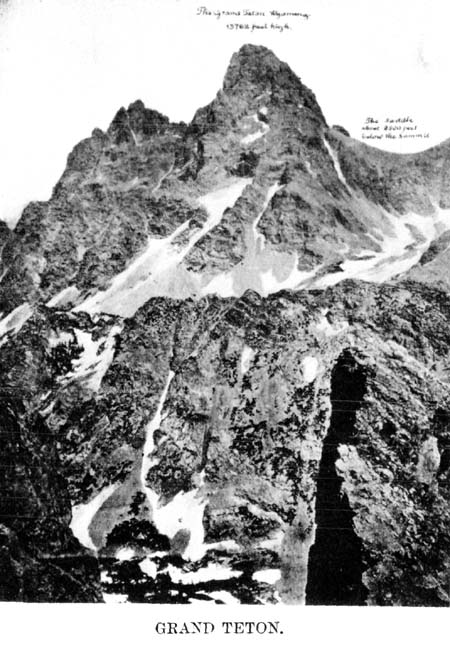
Some member of our party has asked what is the meaning of the word "Teton" given to these mountains.[L] Lieutenant Doane says it is a French word signifying "Woman's Breast," and that it was given to these mountains by the early French explorers, because of their peculiar shape. I think that the man who gave them this name must have seen them from a great distance; for as we approach them, the graceful curvilinear lines which obtained for them this delicate appellation appear angular and ragged. From our present point of view the name seems a misnomer. If there were twelve of them instead of three, they might better be called the "Titans," to illustrate their relation to the surrounding country. He indeed must have been of a most susceptible nature, and, I would fain believe, long a dweller amid these solitudes, who could trace in these cold and barren peaks any resemblance to the gentle bosom of woman.
Monday, September 5.—Lieutenant Doane continued to sleep all last night, making a thirty-six hours nap, and after dressing his thumb and taking an observation to determine our elevation, which we found to be 7714 feet above the ocean, we broke camp at nine o'clock. After the train had got under way, I asked Mr. Hedges to remain behind and assist me in measuring, by a rude system of triangulation, the distance across the lake as well as to the Tetons; but owing to the difficulty we encountered in laying out a base line of sufficient length, we abandoned the scheme after some two hours of useless labor.
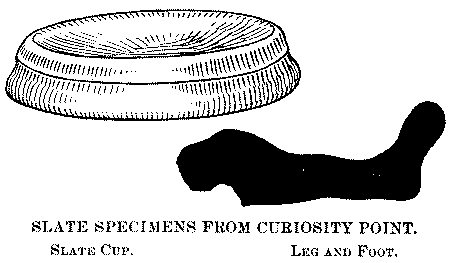
Following the trail of the advance party, we traveled along the lake beach for about six miles, passing a number of small hot sulphur springs and lukewarm sulphur ponds, and three hot steam jets surrounded by sulphur incrustations. After six miles, we left the beach, and traveled on the plateau overlooking the lake. This plateau was covered with a luxuriant growth of standing pine and a great deal of fallen timber, through which at times considerable difficulty was experienced in passing. A little way from the trail is an alkaline spring about six feet in diameter. We came to camp on the shore of the lake, after having marched fifteen miles in a southerly direction. We have a most beautiful view of the lake from our camp. Yesterday it lay before us calm and unruffled, save by the waves which gently broke upon the shore. To-day the winds lash it into a raging sea, covering its surface with foam, while the sparkling sand along the shore seems to form for it a jeweled setting, and the long promontories stretching out into it, with their dense covering of pines, lend a charming feature to the scene. Water never seemed so beautiful before. Waves four feet high are rolling in, and there appear to be six or seven large islands; but we cannot be certain about this number until we reach the south shore. From this point we cannot tell whether the wooded hills before us are islands or promontories. On the shore are to be found large numbers of carnelians or crystallized quartz, agates, specimens of petrified wood, and lava pebbles or globules. We have found also many curious objects of slate formation, resembling hollowed-out cups, discs, and two well formed resemblances of a leg and foot, and many other curious objects which Nature in her most capricious mood has scattered over this watery solitude. All these seem to be the joint production of fire and water; the fire forming and baking them, and the water polishing them. We called this place "Curiosity Point."
If Mount Washington were set in the lake, its summit would be two thousand feet below the surface of the water.
To-night a conference of the party was held, to decide whether we would continue our journey around the lake, or retrace our steps and pass along the north side of the lake over to the Madison. By a vote of six to three we have decided to go around the lake. Mr. Hauser voted in favor of returning by way of the north side. My vote was cast for going around the lake.
As we passed along the shore to-day, we could see the steam rising from a large group of hot springs on the opposite shore of the lake bordering on what seems to be the most westerly bay or estuary.[M] We will have an opportunity to examine them at short range, when we have completed our journey around the lake.
Tuesday, September 6.—We broke camp at ten thirty this morning, bearing well to the southeast for an hour and then turning nearly due south, our trail running through the woods, and for a large part of our route throughout the day, through fallen timber, which greatly impeded our progress. We did not make over ten miles in our day's travel. Frequently we were obliged to leave the trail running through the woods, and return to the lake, and follow the beach for some distance. We passed along the base of a brimstone basin, the mountains forming a semi-circle half way around it, the lake completing the circle. In company with Lieutenant Doane I went up the side of the mountain, which for the distance of three or four miles and about half way to the summit is covered with what appears to be sulphate (?) of lime and flowers of sulphur mixed. Exhalations are rising from all parts of the ground at times, the odor of brimstone being quite strong; but the volcanic action in this vicinity is evidently decreasing.
About half way up the deposit on the mountain side a number of small rivulets take their rise, having sulphur in solution, and farther down the mountain and near the base are the dry beds of several streams from ten to twenty feet in width which bear evidence of having at some time been full to the banks (two or three feet deep) with sulphur water. The small streams now running are warm.
The side of the mountain over which we rode, seems for the most part to be hollow, giving forth a rumbling sound beneath the feet, as we rode upon the crust, which is very strong. In no instance did it give way as did the crust at "Crater hill," under which the fires were raging, though the incrustation appears to be very similar, abounding in vents and fissures and emitting suffocating exhalations of sulphur vapor.
On the sides of the mountain were old fissures, surrounded by rusty looking sulphur incrustations, now nearly washed away. The whole mountain gives evidence of having been, a long time ago, in just the same condition of conflagration as that in which we found "Crater hill;" but all outward trace of fire has now disappeared, save what is found in the warm water of the small streams running down the sides.
Our course for the past two days has been in nearly a south-southeast direction, or about parallel with the Wind river mountains. We have to-day seen an abundance of the tracks of elk and bears, and occasionally the track of a mountain lion.
Wednesday, September 7.—Last night when all but the guards were asleep, we were startled by a mountain lion's shrill scream, sounding so like the human voice that for a moment I was deceived by it into believing that some traveler in distress was hailing our camp. The stream near the bank of which our camp lay, flows into the southeast arm of Yellowstone lake, and for which the name "Upper Yellowstone" has been suggested by some of our party; but Lieutenant Doane says that he thinks he has seen on an old map the name "Bridger" given to some body of water near the Yellowstone. We tried to cross the river near its mouth, but found the mud in the bed of the stream and in the bottom lands adjoining too deep; our horses miring down to their bellies. In accordance with plans agreed upon last night, General Washburn and a few of the party started out this morning in advance of the others to search for a practicable crossing of the river and marshes, leaving the pack train in camp.
In company with Lieutenant Doane I went out upon a reconnaissance for the purpose of determining the elevation of the mountains opposite our camp, as well as the shape of the lake as far as we could see the shore, and also to determine as far as possible our locality and the best line of travel to follow in passing around the lake. There is just enough excitement attending these scouting expeditions to make them a real pleasure, overbalancing the labor attendant upon them. There is very little probability that any large band of Indians will be met with on this side of the lake, owing to the superstitions which originate in the volcanic forces here found.