Volume 2 — DIARY OF JOHN EVELYN. (continued 7)
Reading edition
21st October, 1649. I went to hear Dr. d'Avinson's lecture in the physical garden, and see his laboratory, he being Prefect of that excellent garden, and Professor Botanicus.
30th October, 1649. I was at the funeral of one Mr. Downes, a sober English gentleman. We accompanied his corpse to Charenton, where he was interred in a cabbage-garden, yet with the office of our church, which was said before in our chapel at Paris. Here I saw also where they buried the great soldier, Gassion, who had a tomb built over him like a fountain, the design and materials mean enough. I returned to Paris with Sir Philip Musgrave, and Sir Marmaduke Langdale, since Lord Langdale.—Memorandum. This was a very sickly and mortal autumn.
5th November, 1649. I received divers letters out of England, requiring me to come over about settling some of my concerns.
7th November, 1649. Dr. George Morley (since Bishop of Winchester) preached in our chapel on Matthew 4, verse 3.
18th November, 1649. I went with my father-in-law to see his audience at the French Court, where next the Pope's Nuncio, he was introduced by the master of ceremonies, and, after delivery of his credentials, as from our King, since his
After this, being presented to his Majesty and the Queen Regent I went to see the house built by the late great Cardinal de Richelieu. The most observable thing is the gallery, painted with the portraits of the most illustrious persons and single actions in France, with innumerable emblems between every table. In the middle of the gallery, is a neat chapel, rarely paved in work and devices of several sorts of marble, besides the altar-piece and two statues of white marble, one of St. John, the other of the Virgin Mary, by Bernini. The rest of the apartments are rarely gilded and carved, with some good modern paintings. In the presence hang three huge branches of crystal. In the French King's bedchamber, is an alcove like another chamber, set as it were in a chamber like a movable box, with a rich embroidered bed. The fabric of the palace is not magnificent, being but of two stories; but the garden is so spacious as to contain a noble basin and fountain continually playing, and there is a mall, with an elbow, or turning, to protract it. So I left his Majesty on the terrace, busy in seeing a bull-baiting, and returned home in Prince Edward's coach with Mr. Paul, the Prince Elector's agent.
19th November, 1649. Visited Mr. Waller, where meeting Dr. Holden, an English Sorbonne divine, we fell into some discourse about religion.
28th December, 1649. Going to wait on Mr. Waller, I viewed St. Stephen's church; the building, though Gothic, is full of carving; within it is beautiful, especially the choir and winding stairs. The glass is well painted, and the tapestry hung up this day about the choir, representing the conversion of Constantine, was exceedingly rich.
I went to that excellent engraver, Du Bosse, for his instruction about some difficulties in perspective which were delivered in his book.
I concluded this year in health, for which I gave solemn thanks to Almighty God.40
29th December, 1649. I christened Sir Hugh Rilie's child with Sir George Radcliffe in our chapel, the parents being so poor that they had provided no gossips, so as several of us drawing lots it fell on me, the Dean of Peterborough (Dr. Cousin) officiating: we named it Andrew, being on the eve of that Apostle's day.
1st January, 1649-50. I began this Jubilee with the public office in our chapel: dined at my Lady Herbert's, wife of Sir Edward Herbert, afterward Lord Keeper.
18th January, 1650. This night was the Prince of Condé and his brother carried prisoners to the Bois de Vincennes.
6th February, 1650. In the evening, came Signor Alessandro, one of the Cardinal Mazarine's musicians, and a person of great name for his knowledge in that art, to visit my wife, and sung before divers persons of quality in my chamber.
1st March, 1650. I went to see the masquerados, which was very fantastic; but nothing so quiet and solemn as I found it at Venice.
13th March, 1650. Saw a triumph in Monsieur del Camp's Academy, where divers of the French and English noblesse, especially my Lord of Ossory, and Richard, sons to the Marquis of Ormond (afterward Duke), did their exercises on horseback in noble equipage, before a world of spectators and great persons, men and ladies. It ended in a collation.
25th April, 1650. I went out of town to see Madrid, a palace so called, built by Francis I. It is observable only for its open manner of architecture, being much of terraces and galleries one over another to the very roof; and for the materials, which are mostly of earth painted like porcelain, or China-ware, whose colors appear very fresh, but is very fragile. There are whole statues and relievos of this pottery, chimney-pieces, and columns both within and without. Under the chapel is a chimney in the midst of a room parted from the Salle des Gardes. The house is fortified with a deep ditch, and has an admirable vista toward the Bois de Boulogne and river.
30th April, 1650. I went to see the collection of the famous sculptor, Steffano de la Bella, returning now into Italy, and bought some prints; and likewise visited Perelle, the landscape graver.
3d May, 1650. At the hospital of La Charité I saw the operation of cutting for the stone. A child of eight or nine years old underwent the operation with most extraordinary patience, and expressing great joy when he saw the stone was drawn. The use I made of it was, to give Almighty God hearty thanks that I had not been subject to this deplorable infirmity.
7th May, 1650. I went with Sir Richard Browne's lady and my wife, together with the Earl of Chesterfield, Lord Ossory and his brother, to Vamber, a place near the city famous for butter; when, coming homeward, being on foot, a quarrel arose between Lord Ossory and a man in a garden, who thrust Lord Ossory from the gate with uncivil language; on which our young gallants struck the fellow on the pate, and bade him ask pardon, which he did with much submission, and so we parted. But we were not gone far before we heard a noise behind us, and saw people coming with guns, swords, staves, and forks, and who followed, flinging stones; on which, we turned, and were forced to engage, and with our swords, stones, and the help of our servants (one of whom had a pistol) made our retreat for near a quarter of a mile, when we took shelter in a house, where we were besieged, and at length forced to submit to be prisoners. Lord Hatton, with some others, were taken prisoners in the flight, and his lordship was confined under three locks and as many doors in this rude fellow's master's house, who pretended to be steward to Monsieur St. Germain, one of the presidents of the Grand Chambre du Parlement, and a Canon of Nôtre Dame. Several of us were much hurt. One of our lackeys escaping to Paris, caused the bailiff of St. Germain to come with his guard and rescue us. Immediately afterward, came Monsieur St. Germain himself, in great wrath, on hearing that his housekeeper was assaulted; but when he saw the King's officers, the gentlemen and noblemen, with his Majesty's Resident and understood the occasion, he was ashamed of the accident, requesting the fellow's pardon, and desiring the ladies to accept their submission and a supper at his house. It was ten o'clock at night ere we got to Paris, guarded by Prince Griffith (a Welsh hero going under that name, and well known in England for his extravagancies), together with the scholars of two academies, who came forth to assist and meet us on horseback, and would fain have alarmed the town we received the affront from: which, with much ado, we prevented.
12th May, 1650. Complaint being come to the Queen and Court of France of the affront we had received, the President was ordered to ask pardon of Sir R. Browne, his Majesty's Resident, and the fellow to make submission, and be dismissed. There came along with him the President de Thou, son of the great Thuanus [the historian], and so all was composed. But I have often heard that gallant gentleman, my Lord Ossory, affirm solemnly that in all the conflicts he was ever in at sea or on land (in the most desperate of both which he had often been), he believed he was never in so much danger as when these people rose against us. He used to call it the bataile de Vambre, and remember it with a great deal of mirth as an adventure, en cavalier.
24th May, 1650. We were invited by the Noble Academies to a running at the ring where were many brave horses, gallants, and ladies, my Lord Stanhope entertaining us with a collation.
12th June, 1650. Being Trinity Sunday, the Dean of Peterborough preached; after which there was an ordination of two divines, Durell and Brevent (the one was afterward Dean of Windsor, the other of Durham, both very learned persons). The Bishop of Galloway officiated with great gravity, after a pious and learned exhortation declaring the weight and dignity of their function, especially now in a time of the poor Church of England's affliction. He magnified the sublimity of the calling, from the object, viz, the salvation of men's souls, and the glory of God; producing many human instances of the transitoriness and vanity of all other dignity; that of all the triumphs the Roman conquerors made, none was comparable to that of our Blessed Savior's, when he led captivity captive, and gave gifts to men, namely, that of the Holy Spirit, by which his faithful and painful ministers triumphed over Satan as often as they reduced a sinner from the error of his ways. He then proceeded to the ordination. They were presented by the Dean in their surplices before the altar, the Bishop sitting in a chair at one side; and so were made both Deacons and Priests at the same time, in regard to the necessity of the times, there being so few Bishops left in England, and consequently danger of a failure of both functions. Lastly, they proceeded to the Communion. This was all performed in Sir Richard Browne's chapel, at Paris.
13th June, 1650. I sate to the famous sculptor, Nanteuil, who was afterward made a knight by the French King for his art. He engraved my picture in copper. At a future time he presented me with my own picture, done all with his pen; an extraordinary curiosity.
21st June, 1650. I went to see the Samaritan, or pump, at the end of the Pont Neuf, which, though to appearance promising no great matter, is, besides the machine, furnished with innumerable rarities both of art and nature; especially the costly grotto, where are the fairest corals, growing out of the very rock, that I have seen; also great pieces of crystals, amethysts, gold in the mine, and other metals and marcasites, with two great conchas, which the owner told us cost him 200 crowns at Amsterdam. He showed us many landscapes and prospects, very rarely painted in miniature, some with the pen and crayon; divers antiquities and relievos of Rome; above all, that of the inside of the amphitheater of Titus, incomparably drawn by Monsieur St. Clere himself; two boys and three skeletons, molded by Fiamingo; a book of statues, with the pen made for Henry IV., rarely executed, and by which one may discover many errors in the taille-douce of Perrier, who has added divers conceits of his own that are not in the originals. He has likewise an infinite collection of taille-douces, richly bound in morocco.
He led us into a stately chamber furnished to have entertained a prince, with pictures of the greatest masters, especially a Venus of Perino del Vaga; the Putti carved in the chimney-piece by the Fleming; the vases of porcelain, and many designed by Raphael; some paintings of Poussin, and Fioravanti; antiques in brass; the looking-glass and stands rarely carved. In a word, all was great, choice, and magnificent, and not to be passed by as I had often done, without the least suspicion that there were such rare things to be seen in that place. At a future visit, he showed a new grotto and a bathing place, hewn through the battlements of the arches of Pont Neuf into a wide vault at the intercolumniation, so that the coaches and horses thundered over our heads.
CALAIS
27th June, 1650. I made my will, and, taking leave of my wife and other friends, took horse for England, paying the messenger eight pistoles for me and my servant to Calais, setting out with seventeen in company well-armed, some Portuguese, Swiss, and French, whereof six were captains and officers. We came the first night to Beaumont; next day, to Beauvais, and lay at Pois, and the next, without dining, reached Abbeville; next, dined at Montreuil, and proceeding met a company on foot (being now within the inroads of the parties which dangerously infest this day's journey from St. Omers and the frontiers), which we drew very near to, ready and resolute to charge through, and accordingly were ordered and led by a captain of our train; but, as we were on the speed, they called out, and proved to be Scotchmen, newly raised and landed, and few among them armed. This night, we were well treated at Boulogne. The next day, we marched in good order, the passage being now exceeding dangerous, and got to Calais by a little after two. The sun so scorched my face, that it made the skin peel off.
I dined with Mr. Booth, his Majesty's agent; and, about three in the afternoon, embarked in the packet-boat; hearing there was a pirate then also setting sail, we had security from molestation, and so with a fair S. W. wind in seven hours we landed at Dover. The busy watchman would have us to the mayor to be searched, but the gentleman being in bed, we were dismissed.
Next day, being Sunday, they would not permit us to ride post, so that afternoon our trunks were visited.
The next morning, by four, we set out for Canterbury, where I met with my Lady Catherine Scott, whom that very day twelve months before I met at sea going for France; she had been visiting Sir Thomas Peyton, not far off, and would needs carry me in her coach to Gravesend. We dined at Sittingbourne, came late to Gravesend, and so to Deptford, taking leave of my lady about four the next morning.
5th July, 1650. I supped in the city with my Lady Catherine Scott, at one Mr. Dubois, where was a gentlewoman called Everard, who was a very great chemist.
Sunday 7th July, 1650. In the afternoon, having a mind to see what was doing among the Rebels, then in full possession at Whitehall, I went thither, and found one at exercise in the chapel, after their way; thence, to St. James's, where another was preaching in the court abroad.
17th July, 1650. I went to London to obtain a pass,41 intending but a short stay in England.
25th July, 1650. I went by Epsom to Wotton, saluting Sir Robert Cook and my sister Glanville; the country was now much molested by soldiers, who took away gentlemen's horses for the service of the state, as then called.
4th August, 1650. I heard a sermon at the Rolls; and, in the afternoon, wandered to divers churches, the pulpits full of novices and novelties.
6th August, 1650. To Mr. Walker's, a good painter, who showed me an excellent copy of Titian.
12th August, 1650. Set out for Paris, taking post at Gravesend, and so that night to Canterbury, where being surprised by the soldiers, and having only an antiquated pass, with some fortunate dexterity I got clear of them though not without extraordinary hazard, having before counterfeited one with success, it being so difficult to procure one of the rebels without entering into oaths, which I never would do. At Dover, money to the searchers and officers was as authentic as the hand and seal of Bradshawe himself, where I had not so much as my trunk opened.
CALAIS
13th August, 1650. At six in the evening, set sail for Calais; the wind not favorable, I was very sea-sick, coming to an anchor about one o'clock; about five in the morning, we had a long boat to carry us to land, though at a good distance; this we willingly entered, because two vessels were chasing us; but, being now almost at the harbor's mouth, through inadvertency there broke in upon us two such heavy seas, as had almost sunk the boat, I being near the middle up in water. Our steersman, it seems, apprehensive of the danger, was preparing to leap into the sea and trust to swimming, but seeing the vessel emerge, he put her into the pier, and so, God be thanked! we got to Calais, though wet.
Here I waited for company, the passage toward Paris being still infested with volunteers from the Spanish frontiers.
16th August, 1650. The Regiment of Picardy, consisting of about 1,400 horse and foot (among them was a captain whom I knew), being come to town, I took horses for myself and servant, and marched under their protection to Boulogne. It was a miserable spectacle to see how these tattered soldiers pillaged the poor people of their sheep, poultry, corn, cattle, and whatever came in their way; but they had such ill pay, that they were ready themselves to starve.
As we passed St. Denis, the people were in uproar, the guards doubled, and everybody running with their movables to Paris, on an alarm that the enemy was within five leagues of them; so miserably exposed was even this part of France at this time.
PARIS
The 30th, I got to Paris, after an absence of two months only.
1st September, 1650. My Lady Herbert invited me to dinner; Paris, and indeed all France, being full of loyal fugitives.
Came Mr. Waller to see me, about a child of his which the Popish midwife had baptized.
15th October, 1650. Sir Thomas Osborne (afterward Lord Treasurer) and Lord Stanhope shot for a wager of five louis, to be spent on a treat; they shot so exact that it was a drawn match.
1st November, 1650. Took leave of my Lord Stanhope, going on his journey toward Italy; also visited my Lord Hatton, Comptroller of his Majesty's Household, the Countess of Morton, Governess to the Lady Henrietta, and Mrs. Gardner, one of the Queen's maids of honor.
6th November, 1650. Sir Thomas Osborne supping with us, his groom was set upon in the street before our house, and received two wounds, but gave the assassin nine, who was carried off to the Charité Hospital. Sir Thomas went for England on the 8th, and carried divers letters for me to my friends.
16th November, 1650. I went to Monsieur Visse's, the French King's Secretary, to a concert of French music and voices, consisting of twenty-four, two theorbos, and but one bass viol, being a rehearsal of what was to be sung at vespers at St.
14th December, 1650. I went to visit Mr. Ratcliffe, in whose lodging was an imposter that had liked to have imposed upon us a pretended secret of multiplying gold; it is certain he had lived some time in Paris in extraordinary splendor, but I found him to be an egregious cheat.
22d December, 1650. Came the learned Dr. Boet to visit me.
31st December, 1650. I gave God thanks for his mercy and protection the past year, and made up my accounts, which came this year to 7,015 livres, near £600 sterling.
1st January, 1650-51. I wrote to my brother at Wotton, about his garden and fountains. After evening prayer, Mr. Wainsford called on me: he had long been Consul at Aleppo, and told me many strange things of those countries, the Arabs especially.
27th January, 1651. I had letters of the death of Mrs. Newton, my grand-mother-in-law; she had a most tender care of me during my childhood, and was a woman of extraordinary charity and piety.
29th January, 1651. Dr. Duncan preached on 8 Matt. v. 34, showing the mischief of covetousness. My Lord Marquis of Ormonde and Inchiquin, come newly out of Ireland, were this day at chapel.
9th February, 1651. Cardinal Mazarin was proscribed by Arrêt du Parlement, and great commotions began in Paris.
23d February, 1651. I went to see the Bonnes Hommes, a convent that has a fair cloister painted with the lives of hermits; a glorious altar now erecting in the chapel; the garden on the rock with divers descents, with a fine vineyard, and a delicate prospect toward the city.
24th February, 1651. I went to see a dromedary, a very monstrous beast, much like the camel, but larger. There was also dancing on the rope; but, above all, surprising to those who were ignorant of the address, was the water-spouter, who, drinking only fountain-water, rendered out of his mouth in several glasses all sorts of wine and sweet waters. For a piece of money he discovered the secret to me. I waited on Friar Nicholas at the convent at Chaillot, who, being an excellent chemist, showed me his laboratory, and rare collection of spagyrical remedies. He was both physician and apothecary of the convent, and, instead of the names of his drugs, he painted his boxes and pots with the figure of the drug, or simple, contained in them. He showed me as a rarity some ☿ of antimony. He had cured Monsieur Senatin of a desperate sickness, for which there was building a monumental altar that was to cost £1,500.
11th March, 1651. I went to the Châtelet, or prison, where a malefactor was to have the question, or torture, given to him, he refusing to confess the robbery with which he was charged, which was thus: they first bound his wrist with a strong rope, or small cable, and one end of it to an iron ring made fast to the wall, about four feet from the floor, and then his feet with another cable, fastened about five feet further than his utmost length to another ring on the floor of the room. Thus suspended, and yet lying but aslant, they slid a horse of wood under the rope which bound his feet, which so exceedingly stiffened it, as severed the fellow's joints in miserable sort, drawing him out at length in an extraordinary manner, he having only a pair of linen drawers on his naked body. Then, they questioned him of a robbery (the lieutenant being present and a clerk that wrote), which not confessing, they put a higher horse under the rope, to increase the torture and extension. In this agony, confessing nothing, the executioner with a horn (just such as they drench horses with) stuck the end of it into his mouth, and poured the quantity of two buckets of water down his throat and over him, which so prodigiously swelled him, as would have pitied and affrighted any one to see it; for all this, he denied all that was charged to him. They then let him down, and carried him before a warm fire to bring him to himself, being now to all appearance dead with pain. What became of him, I know not; but the gentleman whom he robbed constantly averred him to be the man, and the fellow's suspicious pale looks, before he knew he should be racked, betrayed some guilt; the lieutenant was also of that opinion, and told us at first sight (for he was a lean, dry, black young man) he would conquer the torture; and so it seems they could not hang him, but did use in such cases, where the evidence is very presumptive, to send them to the galleys, which is as bad as death.
There was another malefactor to succeed, but the spectacle was so uncomfortable, that I was not able to stay the sight of another. It represented yet to me the intolerable sufferings which our Blessed Savior must needs undergo, when his body was hanging with all its weight upon the nails on the cross.
20th March, 1651. I went this night with my wife to a ball at the Marquis de Crevecœur's, where were divers princes, dukes, and great persons; but what appeared to me very mean was, that it began with a puppet-play.
6th May, 1651. I attended the ambassador to a masque at Court, where the French King in person danced five entries, but being engaged in discourse, and better entertained with one of the Queen-Regent's secretaries, I soon left the entertainment.
11th May, 1651. To the Palace Cardinal, where the Master of the Ceremonies placed me to see the royal masque, or opera. The first scene represented a chariot of singers composed of the rarest voices that could be procured, representing Cornaro42 and Temperance; this was overthrown by Bacchus and his revelers; the rest consisted of several entries and pageants of excess, by all the elements. A masque representing fire was admirable; then came a Venus out of the clouds. The conclusion was a heaven, whither all ascended. But the glory of the masque was the great persons performing in it, the French King, his brother the Duke of Anjou, with all the grandees of the Court, the King performing to the admiration of all. The music was twenty-nine violins, vested à l'antique, but the habits of the masquers were stupendously rich and glorious.
23d May, 1651. I went to take leave of the ambassadors for Spain, which were my Lord Treasurer Cottington and Sir Edward Hyde; and, as I returned, I visited Mr. Morine's garden, and his other rarities, especially corals, minerals, stones, and natural curiosities; crabs of the Red Sea, the body no bigger than a small bird's egg, but flatter, and the two legs, or claws, a foot in length. He had abundance of shells, at least 1,000 sorts, which furnished a cabinet of great price; and had a very curious collection of scarabees and insects, of which he was compiling a natural history. He had also the pictures of his choice flowers and plants in miniature. He told me there were 10,000 sorts of tulips only. He had taille-douces out of number; the head of the rhinoceros bird, which was very extravagant, and one butterfly resembling a perfect bird.
25th May, 1651. I went to visit Mr. Thomas White, a learned priest and famous philosopher,43 author of the book "De Mundo," with whose worthy brother I was well acquainted at Rome. I was shown a cabinet of Maroquin, or Turkey leather, so curiously inlaid with other leather, and gilding, that the workman demanded for it 800 livres.
The Dean (of Peterborough) preached on the feast of Pentecost, perstringing those of Geneva for their irreverence of the Blessed Virgin.
4th June, 1651. Trinity Sunday, I was absent from church in the afternoon on a charitable affair for the Abbess of Bourcharvant, who but for me had been abused by that chemist, Du Menie. Returning, I stepped into the Grand Jesuits, who had this high day exposed their Cibarium, made all of solid gold and imagery, a piece of infinite cost. Dr. Croydon, coming out of Italy and from Padua, came to see me, on his return to England.
5th June, 1651. I accompanied my Lord Strafford, and some other noble persons, to hear Madam Lavaran sing, which she did both in French and Italian excellently well, but her voice was not strong.
7th June, 1651. Corpus Christi Day, there was a grand procession, all the streets tapestried, several altars erected there, full of images, and other rich furniture, especially that before the Court, of a rare design and architecture. There were abundance of excellent pictures and great vases of silver.
13th June, 1651. I went to see the collection of one Monsieur Poignant, which for variety of agates, crystals, onyxes, porcelain, medals, statues, relievos, paintings, taille-douces, and antiquities, might compare with the Italian virtuosos.
21st June, 1651. I became acquainted with Sieur William Curtius, a very learned and judicious person of the Palatinate. He had been a scholar to Alstedius, the Encyclopedist, was well advanced in years, and now Resident for his Majesty at Frankfort.
2d July, 1651. Came to see me the Earl of Strafford, Lord Ossory and his brother, Sir John Southcott, Sir Edward Stawell, two of my Lord Spencer's sons, and Dr. Stewart, Dean of St. Paul's, a learned and pious man, where we entertained the time upon several subjects, especially the affairs of England, and the lamentable condition of our Church. The Lord Gerrard also called to see my collection of sieges and battles.
21st July, 1651. An extraordinary fast was celebrated in our Chapel, Dr. Stewart, Dean of St. Paul's, preaching.
2d August, 1651. I went with my wife to Conflans, where were abundance of ladies and others bathing in the river; the ladies had their tents spread on the water for privacy.
29th August, 1651. Was kept as a solemn fast for the calamities of our poor Church, now trampled on by
6th September, 1651. I went with my wife to St. Germains, to condole with Mr. Waller's loss. I carried with me and treated at dinner that excellent and pious person the Dean of St. Paul's, Dr. Stewart, and Sir Lewis Dives (half-brother to the Earl of Bristol), who entertained us with his wonderful escape out of prison in Whitehall, the very evening before he was to have been put to death, leaping down out of a jakes two stories high into the Thames at high water, in the coldest of winter, and at night; so as by swimming he got to a boat that attended for him, though he was guarded by six musketeers. After this, he went about in women's habit, and then in a small-coal-man's, traveling 200 miles on foot, embarked for Scotland with some men he had raised, who coming on shore were all surprised and imprisoned on the Marquis of Montrose's score; he not knowing anything of their barbarous murder of that hero. This he told us was his fifth escape, and none less miraculous; with this note, that the charging through 1,000 men armed, or whatever danger could befall a man, he believed could not more confound and distract a man's thoughts than the execution of a premeditated escape, the passions of hope and fear being so strong. This knight was indeed a valiant gentleman; but not a little given to romance, when he spoke of himself. I returned to Paris the same evening.
7th September, 1651. I went to visit Mr. Hobbes, the famous philosopher of Malmesbury, with whom I had long acquaintance. From his window we saw the whole equipage and glorious cavalcade of the young French Monarch, Louis XIV., passing to Parliament, when first he took the kingly government on him, now being in his 14th year, out of his minority and the Queen Regent's pupilage. First came the pennach of heron, with a band of diamonds, and about him twelve little Swiss boys, with halberds. Then, came the Aide des Cérémonies; next, the grandees of court, governors of places and lieutenants-general of provinces, magnificently habited and mounted; among whom I must not forget the Chevalier Paul, famous for many sea-fights and signal exploits there, because it is said he had never been an Academist, and yet governed a very unruly horse, and besides his rich suit his Malta Cross was esteemed at 10,000 crowns. These were headed by two trumpets, and the whole troop, covered with gold, jewels, and rich caparisons, were followed by six trumpets in blue velvet also, preceding as many heralds in blue velvet semée with fleurs-de-lis, caduces in their hands, and velvet caps on their heads; behind them, came one of the masters of the ceremonies; then, divers marshals and many of the nobility, exceeding splendid; behind them Count d'Harcourt, grand Ecuyer, alone, carrying the King's sword in a scarf, which he held up in a blue sheath studded with fleurs-de-lis; his horse had for reins two scarfs of black
Then came abundance of footmen and pages of the King, new-liveried with white and red feathers; next, the garde du corps and other officers; and lastly, appeared the King himself on an Isabella barb, on which a housing semee, with crosses of the Order of the Holy Ghost, and fleurs-de-lis; the King himself, like a young Apollo, was in a suit so covered with rich embroidery, that one could perceive nothing of the stuff under it; he went almost the whole way with his hat in hand, saluting the ladies and acclamators, who had filled the windows with their beauty, and the air with Vive le Roi. He seemed a prince of a grave yet sweet countenance. After the King, followed divers great persons of the Court, exceeding splendid, also his esquires; masters of horse, on foot; then the company of Exempts des Gardes, and six guards of Scotch. Between their files were divers princes of the blood, dukes, and lords; after all these, the Queen's guard of Swiss, pages, and footmen; then, the Queen-Mother herself, in a rich coach, with Monsieur the King's brother, the Duke of Orleans, and some other lords and ladies of honor. About the coach, marched her Exempts des Gardes: then the company of the King's Gens d'armes, well mounted, 150, with four trumpets, and as many of the Queen's; lastly, an innumerable company of coaches full of ladies and gallants. In this equipage, passed the monarch to the Parliament, henceforth exercising his kingly government.
15th September, 1651. I accompanied Sir Richard Browne, my father-in-law, to the French Court, when he had a favorable audience of the French King, and the Queen, his mother; congratulating the one on his coming to the exercise of his royal charge, and the other's prudent and happy administration during her late regency, desiring both to preserve the same amity for his master, our King, as they had hitherto done, which they both promised, with many civil expressions and words of course upon such occasions. We were accompanied both going and returning by the Introductor of Ambassadors and Aid of Ceremonies. I also saw the audience of Morosini, the Ambassador of Venice, and divers other Ministers of State from German Princes, Savoy, etc. Afterward I took a walk in the King's gardens, where I observed that the mall goes the whole square there of next the wall, and bends with an angle so made as to glance the wall; the angle is of stone. There is a basin at the end of the garden fed by a noble fountain and high jetto. There were in it two or three boats, in which the King now and then rows about. In another part is a complete fort, made with bastions, graft, half-moons, ravelins, and furnished with great guns cast on purpose to instruct the King in fortification.
22d September, 1651. Arrived the news of the fatal battle at Worcester, which exceedingly mortified our expectations.
28th September, 1651. I was shown a collection of books and prints made for the Duke of York.
1st October, 1651. The Dean of Peterborough [Dr. Cosin] preached on Job xiii., verse 15, encouraging our trust in God on all events and extremities, and for establishing and comforting some ladies of great quality, who were then to be discharged from our Queen-Mother's service unless they would go over to the Romish Mass.
The Dean, dining this day at our house, told me the occasion of publishing those Offices, which among the Puritans were wont to be called Cosin's cozening Devotions, by way of derision. At the first coming of the Queen into England, she and her French ladies were often upbraiding our religion, that had neither appointed nor set forth any hours of prayer, or breveries, by which ladies and courtiers, who have much spare time, might edify and be in devotion, as they had. Our Protestant ladies, scandalized it seems at this, moved the matter to the King; whereupon his Majesty presently called Bishop White to him and asked his thoughts of it, and whether there might not be found some forms of prayer proper on such occasions, collected out of some already approved forms, that so the court ladies and others (who spent much time in trifling) might at least appear as devout, and be so too, as the new-come-over French ladies, who took occasion to reproach our want of zeal and religion. On which, the Bishop told his Majesty that it might be done easily, and was very necessary; whereupon the King commanded him to employ some person of the clergy to compile such a Work, and presently the Bishop naming Dr. Cosin, the King enjoined him to charge the Doctor in his name to set about it immediately. This the Dean told me he did; and three months after, bringing the book to the King, he commanded the Bishop of London to read it over, and make his report; this was so well liked, that (contrary to former custom of doing it by a chaplain) he would needs give it an imprimatur under his own hand. Upon this there were at first only 200 copies printed; nor, said he, was there anything in the whole book of my own composure, nor did I set any name as author to it, but those necessary prefaces, etc., out of the Fathers, touching the times and seasons of prayer; all the rest being entirely translated and collected out of an Office published by authority of Queen Elizabeth, anno 1560, and our own Liturgy. This I rather mention to justify that industrious and pious Dean, who had exceedingly suffered by it, as if he had done it of his own head to introduce Popery, from which no man was more averse, and one who in this time of temptation and apostacy held and confirmed many to our Church.
29th October, 1651. Came news and letters to the Queen and Sir Richard Browne (who was the first that had intelligence of it) of his Majesty's miraculous escape after the fight at Worcester; which exceedingly rejoiced us.
7th November, 1651. I visited Sir Kenelm Digby, with whom I had much discourse on chemical matters. I showed him a particular way of extracting oil of sulphur, and he gave me a certain powder with which he affirmed that he had fixed ☿ (mercury) before the late King. He advised me to try and digest a little better, and gave me a water which he said was only rain water of the autumnal equinox, exceedingly rectified, very volatile; it had a taste of a strong vitriolic, and smelt like aqua fortis. He intended it for a dissolvent of calx of gold; but the truth is, Sir Kenelm was an arrant mountebank. Came news of the gallant Earl of Derby's execution by the rebels.
14th November, 1651. Dr. Clare preached on Genesis xxviii., verses 20, 21, 22, upon Jacob's vow, which he appositely applied, it being the first Sunday his Majesty came to chapel after his escape. I went, in the afternoon, to visit the Earl of Norwich; he lay at the Lord of Aubigny's.
16th November, 1651. Visited Dean Stewart, who had been sick about two days; when, going up to his lodging, I found him dead; which affected me much, as besides his particular affection and love to me, he was of incomparable parts and great learning, of exemplary life, and a very great loss to the whole church. He was buried the next day with all our church's ceremonies, many noble persons accompanying the corpse.
17th November, 1651. I went to congratulate the marriage of Mrs. Gardner, maid of honor, lately married to that odd person, Sir Henry Wood: but riches do many things.
To see Monsieur
1st December, 1651. I now resolved to return to England.
3d December, 1651. Sir Lewis Dives dined with us, who relating some of his adventures, showed me divers pieces of broad gold, which, being in his pocket in a fight, preserved his life by receiving a musket bullet on them, which deadened its violence, so that it went no further; but made such a stroke on the gold as fixed the impressions upon one another, battering and bending several of them; the bullet itself was flatted, and retained on it the color of the gold. He assured us that of a hundred of them, which it seems he then had in his pocket, not one escaped without some blemish. He affirmed that his being protected by a Neapolitan Prince, who connived at his bringing some horses into France, contrary to the order of the Viceroy, by assistance of some banditti, was the occasion of a difference between those great men, and consequently of the late civil war in that kingdom, the Viceroy having killed the Prince standing on his defense at his own castle. He told me that the second time of the Scots coming into England, the King was six times their number, and might easily have beaten them; but was betrayed, as were all other his designs and counsels, by some, even of his bedchamber, meaning M. Hamilton, who copied Montrose's letters from time to time when his Majesty was asleep.
11th December, 1651. Came to visit me, Mr. Obadiah Walker, of University College, with his two pupils, the sons of my worthy friend, Henry Hyldiard, Esq., whom I had recommended to his care.
21st December, 1651. Came to visit my wife, Mrs. Lane,44 the lady who conveyed the King to the seaside at his escape from Worcester. Mr. John Cosin, son of the Dean, debauched by the priests, wrote a letter to me to mediate for him with his father. I prepared for my last journey, being now resolved to leave France altogether.
25th December, 1651. The King and Duke received the Sacrament first by themselves, the Lords Byron and Wilmot holding the long towel all along the altar.
26th December, 1651. Came news of the death of that rebel, Ireton.
31st December, 1651. Preached Dr. Wolley, after which was celebrated the Holy Communion, which I received also, preparative of my journey, being now resolved to leave France altogether, and to return God Almighty thanks for His gracious protection of me this past year.
2d January, 1651-52. News of my sister Glanville's death in childbed, which exceedingly affected me.
I went to one Mark Antonio, an incomparable artist in enameling. He wrought by the lamp figures in boss, of a large size, even to the life, so that nothing could be better molded. He told us stories of a Genoese jeweler, who had the great ARCANUM, and had made projection before him several times. He met him at Cyprus traveling into Egypt; in his return from whence, he died at sea, and the secret with him, that else he had promised to have left it to him; that all his effects were seized on, and dissipated by the Greeks in the vessel, to an immense value. He also affirmed, that being in a goldsmith's shop at Amsterdam, a person of very low stature came in, and desired the goldsmith to melt him a pound of lead; which done, he unscrewed the pommel of his sword, and taking out of a little box a small quantity of powder, casting it into the crucible, poured an ingot out, which when cold he took up, saying, "Sir, you will be paid for your lead in the crucible," and so went out immediately. When he was gone the goldsmith found four ounces of good gold in it; but could never set eye again on the little man, though he sought all the city for him. Antonio asserted this with great obtestation; nor know I what to think of it, there are so many impostors and people who love to tell strange stories, as this artist did, who had been a great rover, and spoke ten different languages.
13th January, 1652. I took leave of Mr. Waller, who, having been proscribed by the rebels, had obtained of them permission to return, was going to England.
29th January, 1652. Abundance of my French and English friends and some Germans came to take leave of me, and I set out in a coach for Calais, in an exceedingly hard frost which had continued for some time. We got that night to Beaumont; 30th, to Beauvais; 31st, we found the ways very deep with snow, and it was exceedingly cold; dined at Pois; lay at Pernèe, a miserable cottage of miserable people in a wood, wholly unfurnished, but in a little time we had sorry beds and some provision, which they told me they hid in the wood for fear of the frontier enemy, the garrisons near them continually plundering what they had. They were often infested with wolves. I cannot remember that I ever saw more miserable creatures.
1st February, 1652. I dined at Abbeville; 2d, dined at Montreuil, lay at Boulogne; 3d, came to Calais, by eleven in the morning; I thought to have embarked in the evening, but, for fear of pirates plying near the coast, I dared not trust our small vessel, and stayed till Monday following, when two or three lusty vessels were to depart.
I brought with me from Paris Mr. Christopher Wase, sometime before made to resign his Fellowship in King's College, Cambridge, because he would not take the Covenant. He had been a soldier in Flanders, and came miserable to Paris. From his excellent learning, and some relation he had to Sir R. Browne, I bore his charges into England, and clad and provided for him, till he should find some better condition; and he was worthy of it. There came with us also Captain Griffith, Mr. Tyrell, brother to Sir Timothy Tyrell, of Shotover (near Oxford).
At Calais, I dined with my Lord Wentworth, and met with Mr. Heath, Sir Richard Lloyd, Captain Paine, and divers of our banished friends, of whom understanding that the Count de la Strade, Governor of Dunkirk, was in the town, who had bought my wife's picture, taken by pirates at sea the year before (my wife having sent it for me in England), as my Lord of Norwich had informed me at Paris, I made my address to him, who frankly told me that he had such a picture in his own bedchamber among other ladies, and how he came by it; seeming well pleased that it was his fortune to preserve it for me, and he generously promised to send it to any friend I had at Dover; I mentioned a French merchant there and so took my leave.
6th February, 1652. I embarked early in the packet boat, but put my goods in a stouter vessel. It was calm, so that we got not to Dover till eight at night. I took horse for Canterbury, and lay at Rochester; next day, to Gravesend, took a pair of oars, and landed at Sayes Court, where I stayed three days to refresh, and look after my packet and goods, sent by a stouter vessel. I went to visit my cousin, Richard Fanshawe, and divers other friends.
6th March, 1652. Saw the magnificent funeral of that arch-rebel, Ireton, carried in pomp from Somerset House to Westminster, accompanied with divers regiments of soldiers, horse and foot; then marched the mourners, General Cromwell (his father-in-law), his mock-parliament-men, officers, and forty poor men in gowns, three led horses in housings of black cloth, two led in black velvet, and his charging horse, all covered over with embroidery and gold, on crimson velvet; then the guidons, ensigns, four heralds, carrying the arms of the State (as they called it), namely, the red cross and Ireland, with the casque, wreath, sword, spurs, etc.; next, a chariot canopied of black velvet, and six horses, in which was the corpse; the pall held up by the mourners on foot; the mace and sword, with other marks of his charge in Ireland (where he died of the plague), carried before in black scarfs. Thus, in a grave pace, drums covered with cloth, soldiers reversing their arms, they proceeded through the streets in a very solemn manner. This Ireton was a stout rebel, and had been very bloody to the King's party, witness his severity at Colchester, when in cold blood he put to death those gallant gentlemen, Sir Charles Lucas and Sir George Lisle. My cousin, R. Fanshawe, came to visit me, and informed me of many considerable affairs. Sir Henry Herbert presented me with his brother, my Lord Cherbury's book, "De Veritate."
DEPTFORD
9th March, 1652. I went to Deptford, where I made preparation for my settlement, no more intending to go out of England, but endeavor a settled life, either in this or some other place, there being now so little appearance of any change for the better, all being entirely in the rebels' hands; and this particular habitation and the estate contiguous to it (belonging to my father-in-law, actually in his Majesty's service) very much suffering for want of some friend to rescue it out of the power of the usurpers, so as to preserve our interest, and take some care of my other concerns, by the advice and endeavor of my friends I was advised to reside in it, and compound with the soldiers. This I was besides authorized by his Majesty to do, and encouraged with a promise that what was in lease from the Crown, if ever it pleased God to restore him, he would secure to us in fee farm. I had also addresses and cyphers, to correspond with his Majesty and Ministers abroad: upon all which inducements, I was persuaded to settle henceforth in England, having now run about the world, most part out of my own country, near ten years. I therefore now likewise meditated sending over for my wife, whom as yet I had left at Paris.
14th March, 1652. I went to Lewisham, where I heard an honest sermon on 1 Cor. ii. 5-7, being the first Sunday I had been at church since my return, it being now a rare thing to find a priest of the Church of England in a parish pulpit, most of which were filled with Independents and Fanatics.
15th March, 1652. I saw the "Diamond" and "Ruby" launched in the Dock at Deptford, carrying forty-eight brass cannon each; Cromwell and his grandees present, with great acclamations.
18th March, 1652. That worthy divine, Mr. Owen, of Eltham, a sequestered person, came to visit me.
LONDON
19th March, 1652. Invited by Lady Gerrard, I went to London, where we had a great supper; all the vessels, which were innumerable, were of porcelain, she having the most ample and richest collection of that curiosity in England.
22d March, 1652. I went with my brother Evelyn to Wotton, to give him what directions I was able about his garden, which he was now desirous to put into some form; but for which he was to remove a mountain overgrown with huge trees and thicket, with a moat within ten yards of the house. This my brother immediately attempted, and that without great cost, for more than a hundred yards south, by digging down the mountain, and flinging it into a rapid stream; it not only carried away the sand, etc., but filled up the moat, and leveled that noble area, where now the garden and fountain is. The first occasion of my brother making this alteration was my building the little retiring place between the great wood eastward next the meadow, where, some time after my father's death, I made a triangular pond, or little stew, with an artificial rock after my coming out of Flanders.
29th March, 1652. I heard that excellent prelate, the primate of Ireland (Jacobus Usher) preach in Lincoln's Inn, on Heb. iv. 16, encouraging of penitent sinners.
5th April, 1652. My brother George brought to Sayes Court
13th April, 1652. News was brought me that Lady Cotton, my brother George's wife was delivered of a son.
I was moved by a letter out of France to publish the letter which some time since I sent to Dean Cosin's proselyted son; but I did not conceive it convenient, for fear of displeasing her Majesty, the Queen.
15th April, 1652. I wrote to the Dean, touching my buying his library, which was one of the choicest collections of any private person in England.
The Count de Strade most generously and handsomely sent me the picture of my wife from Dunkirk, in a large tin case without any charge. It is of Mr. Bourdon, and is that which has the dog in it, and is to the knees, but it has been somewhat spoiled by washing it ignorantly with soapsuds.
25th April, 1652. I went to visit Alderman Kendrick, a fanatic Lord Mayor, who had married a relation of ours, where I met with a Captain who had been thirteen times to the East Indies.
29th April, 1652. Was that celebrated eclipse of the sun, so much threatened by the astrologers, and which had so exceedingly alarmed the whole nation that hardly any one would work, nor stir out of their houses. So ridiculously were they abused by knavish and ignorant star-gazers.
We went this afternoon to see the Queen's house at Greenwich, now given by the rebels to Bulstrode Whitelocke, one of their unhappy counselors, and keeper of pretended liberties.
10th May, 1652. Passing by Smithfield, I saw a miserable creature burning, who had murdered her husband. I went to see some workmanship of that admirable artist, Reeves, famous for perspective, and turning curiosities in ivory.
29th May, 1652. I went to give order about a coach to be made against my wife's coming, being my first coach, the pattern whereof I brought out of Paris.
30th May, 1652. I went to obtain of my Lord Devonshire that my nephew, George, might be brought up with my young Lord, his son, to whom I was recommending Mr. Wase. I also inspected the manner of camleting silk and grograms at one Monsieur La Dorées in Moor-fields, and thence to Colonel Morley, one of their Council of State, as then called, who had been my schoolfellow, to request a pass for my wife's safe landing, and the goods she was to bring with her out of France; which he courteously granted, and did me many other kindnesses, that was a great matter in those days.
In the afternoon, at Charlton church, where I heard a Rabinical sermon. Here is a fair monument in black marble of Sir Adam Newton, who built that fair house near it for Prince Henry, and where my noble friend, Sir Henry Newton, succeeded him.
3d June, 1652. I received a letter from Colonel Morley to the Magistrates and Searchers at Rye, to assist my wife at her landing, and show her all civility.
4th June, 1652. I set out to meet her now on her journey from Paris, after she had obtained leave to come out of that city, which had now been besieged some time by the Prince of
On Whit Sunday, I went to the church (which is a very fair one), and heard one of the canters, who dismissed the assembly rudely, and without any blessing. Here I stayed till the 10th with no small impatience, when I walked over to survey the ruins of Winchelsea, that ancient cinq-port, which by the remains and ruins of ancient streets and public structures, discovers it to have been formerly a considerable and large city. There are to be seen vast caves and vaults, walls and towers, ruins of monasteries and of a sumptuous church, in which are some handsome monuments, especially of the Templars, buried just in the manner of those in the Temple at London. This place being now all in rubbish, and a few despicable hovels and cottages only standing, hath yet a Mayor. The sea, which formerly rendered it a rich and commodious port, has now forsaken it.
11th June, 1652. About four in the afternoon, being at bowls on the green, we discovered a vessel which proved to be that in which my wife was, and which got into the harbor about eight that evening, to my no small joy. They had been three days at sea, and escaped the Dutch fleet, through which they passed, taken for fishers, which was great good fortune, there being seventeen bales of furniture and other rich plunder, which I bless God came all safe to land, together with my wife, and my Lady Browne, her mother, who accompanied her. My wife being discomposed by having been so long at sea, we set not forth toward home till the 14th, when, hearing the smallpox was very rife in and about London, and Lady Browne having a desire to drink TUNBRIDGETunbridge waters, I carried them thither, and stayed in a very sweet place, private and refreshing, and took the waters myself till the 23d, when I went to prepare for their reception, leaving them for the present in their little cottage by the Wells.
The weather being hot, and having sent my man on before, I rode negligently under favor of the shade, till, within three miles of Bromley, at a place called the Procession Oak, two cutthroats started out, and striking with long staves at the horse, and taking hold of the reins, threw me down, took my sword, and hauled me into a deep thicket, some quarter of a mile from the highway, where they might securely rob me, as they soon did. What they got of money, was not considerable, but they took two rings, the one an emerald with diamonds, the other an onyx, and a pair of buckles set with rubies and diamonds, which were of value, and after all bound my hands behind me, and my feet, having before pulled off my boots; they then set me up against an oak, with most bloody threats to cut my throat if I offered to cry out, or make any noise; for they should be within hearing, I not being the person they looked for. I told them that if they had not basely surprised me they should not have had so easy a prize, and that it would teach me never to ride near a hedge, since, had I been in the midway, they dared not have adventured on me; at which they cocked their pistols, and told me they had long guns, too, and were fourteen companions. I begged for my onyx, and told them it being engraved with my arms would betray them; but nothing prevailed. My horse's bridle they slipped, and searched the saddle, which they pulled off, but let the horse graze, and then turning again bridled him and tied him to a tree, yet so as he might graze, and thus left me bound. My horse was perhaps not taken, because he was marked and cropped on both ears, and well known on that road. Left in this manner, grievously was I tormented with flies, ants, and the sun, nor was my anxiety little how I should get loose in that solitary place, where I could neither hear nor see any creature but my poor horse and a few sheep straggling in the copse.
After near two hours attempting, I got my hands to turn palm to palm, having been tied back to back, and then it was long before I could slip the cord over my wrists to my thumb, which at last I did, and then soon unbound my feet, and saddling my horse and roaming a while about, I at last perceived dust to rise, and soon after heard the rattling of a cart, toward which I made, and, by the help of two countrymen, I got back into the highway. I rode to Colonel Blount's, a great justiciary of the times, who sent out hue and cry immediately. The next morning, sore as my wrists and arms were, I went to London, and got 500 tickets printed and dispersed by an officer of Goldsmiths' Hall, and within two days had tidings of all I had lost, except my sword, which had a silver hilt, and some trifles. The rogues had pawned one of my rings for a trifle to a goldsmith's servant, before the tickets came to the shop, by which means they escaped; the other ring was bought by a victualer, who brought it to a goldsmith, but he having seen the ticket seized the man. I afterward discharged him on his protestation of innocence. Thus did God deliver me from these villains, and not only so, but restored what they took, as twice before he had graciously done, both at sea and land, I mean when I had been robbed by pirates, and was in danger of a considerable loss at Amsterdam; for which, and many, many signal preservations, I am extremely obliged to give thanks to God my Savior.
25th June, 1652. After a drought of near four months, there fell so violent a tempest of hail, rain, wind, thunder, and lightning, as no man had seen the like in his age; the hail being in some places four or five inches about, broke all glass about London, especially at Deptford, and more at Greenwich.
29th June, 1652. I returned to Tunbridge, and again drank the water, till 10th of July.
We went to see the house of my Lord Clanrickarde at Summer hill, near Tunbridge (now given to that villain, Bradshawe, who condemned the King). 'Tis situated on an eminent hill, with a park; but has nothing else extraordinary.
4th July, 1652. I heard a sermon at Mr. Packer's chapel at Groomsbridge, a pretty melancholy seat, well wooded and watered. In this house was one of the French kings45 kept prisoner. The chapel was built by Mr. Packer's father, in remembrance of King Charles the First's safe return out of Spain.
PENSHURST
9th July, 1652. We went to see Penshurst, the Earl of Leicester's, famous once for its gardens and excellent fruit, and for the noble conversation which was wont to meet there, celebrated by that illustrious person, Sir Philip Sidney, who there composed divers of his pieces. It stands in a park, is finely watered, and was now full of company, on the marriage of my old fellow-collegiate, Mr. Robert Smith, who married my Lady Dorothy Sidney, widow of the Earl of Sunderland.
One of the men who robbed me was taken; I was accordingly summoned to appear against him; and, on the 12th, was in Westminster Hall, but not being bound over, nor willing to hang the fellow, I did not appear, coming only to save a friend's bail; but the bill being found, he was turned over to the Old Bailey. In the meantime, I received a petition from the prisoner, whose father I understood was an honest old farmer in Kent. He was charged, with other crimes, and condemned, but reprieved. I heard afterward that, had it not been for his companion, a younger man, he would probably have killed me. He was afterward charged with some other crime, but, refusing to plead, was pressed to death.
23d July, 1652. Came my old friend, Mr. Spencer, to visit me.
30th July, 1652. I took advice about purchasing Sir Richard's [Browne] interest of those who had bought Sayes Court.
1st August, 1652. Came old Jerome Lennier, of Greenwich, a man skilled in painting and music, and another rare musician, called Mell. I went to see his collection of pictures, especially those of Julio Romano, which surely had been the King's, and an Egyptian figure, etc. There were also excellent things of Polydore, Guido, Raphael, and Tintoretto. Lennier had been a domestic of Queen Elizabeth, and showed me her head, an intaglio in a rare sardonyx, cut by a famous Italian, which he assured me was exceedingly like her.
24th August, 1652. My first child, a son, was born precisely at one o'clock.
2d September, 1652. Mr. Owen, the sequestered divine, of Eltham, christened my son by the name of Richard.
22d September, 1652. I went to Woodcott, where Lady Browne was taken with scarlet fever, and died. She was carried to Deptford, and interred in the church near Sir Richard's relations with all decent ceremonies, and according to the church-office, for which I obtained permission, after it had not been used in that church for seven years. Thus ended an excellent and virtuous lady, universally lamented, having been so obliging on all occasions to those who continually frequented her house in Paris, which was not only an hospital, but an asylum to all our persecuted and afflicted countrymen, during eleven years' residence there in that honorable situation.
25th September, 1652. I went to see Dr. Mason's house, so famous for the prospect (for the house is a wretched one) and description of Barclay's "Icon Animarum."46
5th November, 1652. To London, to visit some friends, but the insolences were so great in the streets that I could not return till the next day.
Dr. Scarborough was instant with me to give the Tables of Veins and Arteries to the College of Physicians, pretending he would not only read upon them, but celebrate my curiosity as being the first who caused them to be completed in that manner, and with that cost; but I was not so willing yet to part with them, as to lend them to the College during their anatomical lectures; which I did accordingly.
22d November, 1652. I went to London, where was proposed to me the promoting that great work (since accomplished by Dr. Walton, Bishop of Chester), "Biblia Polyglotta," by Mr. Pierson, that most learned divine.
25th December, 1652. Christmas day, no sermon anywhere, no church being permitted to be open, so observed it at home. The next day, we went to Lewisham, where an honest divine preached.
31st December, 1652. I adjusted all accompts, and rendered thanks to Almighty God for his mercies to me the year past.
SAYES COURT
1st January, 1652-53. I set apart in preparation for the Blessed Sacrament, which the next day Mr. Owen administered to me and all my family in Sayes Court, preaching on John vi. 32, 33, showing the exceeding benefits of our blessed Savior taking our nature upon him. He had christened my son and churched my wife in our own house as before noticed.
17th January, 1653. I began to set out the oval garden at Sayes Court, which was before a rude orchard, and all the rest one entire field of 100 acres, without any hedge, except the hither holly hedge joining to the bank of the mount walk. This was the beginning of all the succeeding gardens, walks, groves, inclosures, and plantations there.
21st January, 1653. I went to London, and sealed some of the writings of my purchase of Sayes Court.
30th January, 1653. At our own parish church, a stranger preached. There was now and then an honest orthodox man got into the pulpit, and, though the present incumbent was somewhat of the Independent, yet he ordinarily preached sound doctrine, and was a peaceable man; which was an extraordinary felicity in this age.
1st February, 1653. Old Alexander Rosse (author of "Virgilius Evangelizans," and many other little books) presented me with his book against Mr. Hobbes's "Leviathan."
19th February, 1653. I planted the orchard at Sayes Court; new moon, wind west.
22d February, 1653. Was perfected the sealing, livery, and seisin of my purchase of Sayes Court. My brother, George Glanville, Mr. Scudamore, Mr. Offley, Co. William Glanville (son to Sergeant Glanville, sometime Speaker of the House of Commons), Co. Stephens, and several of my friends dining with me. I had bargained for £3,200, but I paid £3,500.
25th March, taille-douce, Monsieur Richett, he was sent by Cardinal Mazarine to make a collection of pictures.
11th April,
17th May, 1653. My servant Hoare, who wrote those exquisite several hands, fell of a fit of an apoplexy, caused, as I suppose, by tampering with mercury about an experiment in gold.
LONDON
29th May, 1653. I went to London, to take my last leave of my honest friend, Mr. Barton, now dying; it was a great loss to me and to my affairs. On the sixth of June, I attended his funeral.
8th June, 1653. Came my brother George, Captain Evelyn, the great traveler, Mr. Muschamp, my cousin, Thomas Keightly, and a virtuoso, fastastical Simons, who had the talent of embossing so to the life.
9th June, 1653. I went to visit my worthy neighbor, Sir Henry Newton [at Charlton], and consider the prospect, which is doubtless for city, river, ships, meadows, hill, woods, and all other amenities, one of the most noble in the world; so as, had the house running water, it were a princely seat. Mr. Henshaw and his brother-in-law came to visit me, and he presented me with a seleniscope.
19th June, 1653. This day, I paid all my debts to a farthing; oh, blessed day!
21st June, 1653. My Lady Gerrard, and one Esquire Knight, a very rich gentleman, living in Northamptonshire, visited me.
23d June, 1653. Mr. Lombart, a famous graver, came to see my collections.
27th June, 1653. Monsieur Roupel sent me a small phial of his aurum potabile, with a letter, showing the way of administering it, and the stupendous cures it had done at Paris; but, ere it came to me, by what accident I know not, it was all run out.
17th August, 1653. I went to visit Mr. Hyldiard, at his house at Horsley (formerly the great Sir Walter Raleigh's47), where met me Mr. Oughtred, the famous mathematician; he showed me a box, or golden case, of divers rich and aromatic balsams, which a chemist, a scholar of his, had sent him out of Germany.
21st August, 1653. I heard that good old man, Mr. Higham, the parson of the parish of Wotton where I was born, and who had baptized me, preach after his very plain way on Luke, comparing this troublesome world to the sea, the ministers to the fishermen, and the saints to the fish.
22d August, 1653. We all went to Guildford, to rejoice at the famous inn, the Red Lion, and to see the hospital, and the monument of Archbishop Abbot, the founder, who lies buried in the chapel of his endowment.
28th September, 1653. At Greenwich preached that holy martyr, Dr. Hewer, on Psalm xc. 11, magnifying the grace of God to penitents, and threatening the extinction of his Gospel light for the prodigious impiety of the age.
11th October, 1653. My son, John Stansfield, was born, being my second child, and christened by the name of my mother's father, that name now quite extinct, being of Cheshire. Christened by Mr. Owen, in my library, at Sayes Court, where he afterward churched my wife, I always making use of him on these occasions, because the parish minister dared not have officiated according to the form and usage of the Church of England, to which I always adhered.
25th October, 1653. Mr. Owen preached in my library at Sayes Court on Luke xviii. 7, 8, an excellent discourse on the unjust judge, showing why Almighty God would sometimes be compared by such similitudes. He afterward administered to us all the Holy Sacrament.
LONDON
28th October, 1653. Went to London, to visit my Lady Gerrard, where I saw that cursed woman called the Lady Norton, of whom it was reported that she spit in our King's face as he went to the scaffold. Indeed, her talk and discourse was like an impudent woman.
21st November, 1653. I went to London, to speak with Sir John Evelyn, my kinsman, about the purchase of an estate of Mr. Lambard's at Westeram, which afterward Sir John himself bought for his son-in-law, Leech.
4th December, 1653. Going this day to our church, I was surprised to see a tradesman, a mechanic, step up; I was resolved yet to stay and see what he would make of it. His text was from 2 Sam. xxiii. 20: "And Benaiah went down also and slew a lion in the midst of a pit in the time of snow"; the purport was, that no danger was to be thought difficult when God called for shedding of blood, inferring that now the saints were called to destroy temporal governments; with such feculent stuff; so dangerous a crisis were things grown to.
25th December, 1653. Christmas day. No churches, or public assembly. I was fain to pass the devotions of that Blessed day with my family at home.
20th January, 1653-54. Come to see my old acquaintance and the most incomparable player on the Irish harp, Mr. Clark,48 after his travels. He was an excellent musician, a discreet gentleman, born in Devonshire (as I remember). Such music before or since did I never hear, that instrument being neglected for its extraordinary difficulty; but, in my judgment, far superior to the lute itself, or whatever speaks with strings.
25th January, 1654. Died my son, J. Stansfield, of convulsion fits; buried at Deptford on
8th February, 1654. Ash Wednesday. In contradiction to all custom and decency, the usurper, Cromwell, feasted at the Lord Mayor's, riding in triumph through the city.
14th February, 1654. I saw a tame lion play familiarly with a lamb; he was a huge beast, and I thrust my hand into his mouth and found his tongue rough like a cat's; a sheep also with six legs, which made use of five of them to walk; a goose that had four legs, two crops, and as many vents.
29th March, 1654. That excellent man, Mr. Owen, preached in my library on Matt. xxviii. 6, a resurrection sermon, and after it we all received the Holy Communion.
6th April, 1654. Came my Lord Herbert, Sir Kenelm Digby, Mr. Denham, and other friends to see me.
15th April, 1654. I went to London to hear the famous Jeremy Taylor (since Bishop of Down and Connor) at St. Gregory's (near St. Paul's) on Matt. vi, 48, concerning evangelical perfection.
5th May, 1654. I bound my lackey, Thomas Headly, apprentice to a carpenter, giving with him five pounds and new clothing; he thrived very well, and became rich.
8th May, 1654. I went to Hackney, to see Lady Brook's garden, which was one of the neatest and most celebrated in England, the house well furnished, but a despicable building. Returning, visited one Mr. Tomb's garden; it has large and noble walks, some modern statues, a vineyard, planted in strawberry borders, staked at ten feet distances, the banqueting-house of cedar, where the couch and seats were carved à l'antique; some good pictures in the house, especially one of Vandyke's, being a man in his shirt; also some of Stenwyck. I also called at bein. I also saw Sir Thomas Fowler's aviary, which is a poor business.
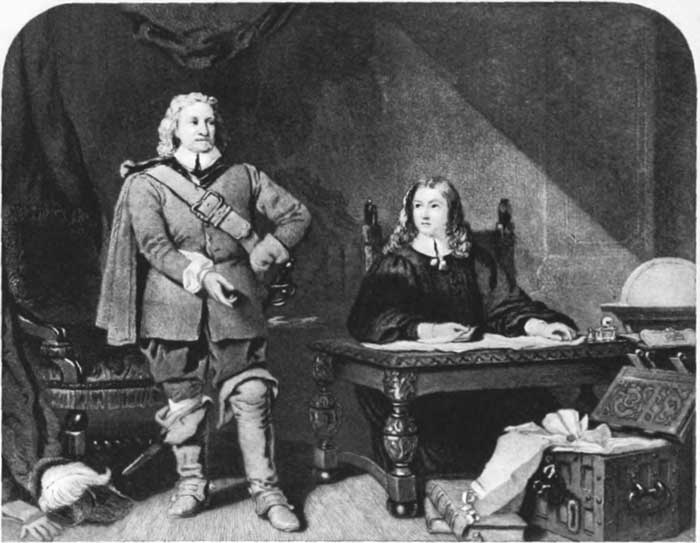
OLIVER CROMWELL DICTATING TO JOHN MILTON
The letter to the Duke of Savoy to stop the persecution of the Protestants of Piedmont, 1655. Photogravure from an engraving by Sartain after Newenham
10th May, 1654. My Lady Gerrard treated us at Mulberry Garden, now the only place of refreshment about the town for persons of the best quality to be exceedingly cheated at; Cromwell and his partisans having shut up and seized on Spring Garden, which, till now, had been the usual rendezvous for the ladies and gallants at this season.
11th May, 1654. I now observed how the women began to paint themselves, formerly a most ignominious thing, and used only by prostitutes.
14th May, 1654. There being no such thing as church anniversaries in the parochial assemblies, I was forced to provide at home for Whit Sunday.
15th May, 1654. Came Sir Robert Stapylton, the translator of "Juvenal," to visit me.
8th June, 1654. My wife and I set out in a coach and four horses, in our way to visit relations of hers in Wiltshire, and other parts, where we resolved to spend some months. We dined at Windsor, saw the Castle and Chapel of St. George, where they have laid our blessed Martyr, King Charles, in the VAULT JUST BEFORE THE ALTAR. The church and workmanship in stone is admirable. The Castle itself is large in circumference; but the rooms melancholy, and of ancient magnificence. The keep, or mount, hath, besides its incomparable prospect, a very profound well; and the terrace toward Eton, with the park, meandering Thames, and sweet meadows, yield one of the most
9th June, 1654. Dined at Marlborough, which having been lately fired, was now new built. At one end of this town, we saw my Lord Seymour's house, but nothing observable save the Mount, to which we ascended by windings for near half a mile. It seems to have been cast up by hand. We passed by Colonel à la moderne. Also, that exceedingly beautiful seat of my Lord Pembroke, on the ascent of hill, flanked with wood, and regarding the river, and so, at night, to Cadenham, the mansion of Edward Hungerford, Esq., uncle to my wife, where we made some stay. The rest of the week we did nothing but feast and make good cheer, to welcome my wife.
27th June, 1654. We all went to see Bath, where I bathed in the cross bath. Among the rest of the idle diversions of the town, one musician was famous for acting a changeling, which indeed he personated strangely.
The facciáta of this cathedral is remarkable for its historical carving. The King's Bath is esteemed the fairest in Europe. The town is entirely built of stone, but the streets narrow, uneven and unpleasant. Here, we trifled and bathed, and intervisited with the company who frequent the place for health, till the 30th, and then went to Bristol, a city emulating London, not for its large extent, but manner of building, shops, bridge, traffic, exchange, market-place, etc. The governor showed us the castle, of no great concernment. The city wholly mercantile, as standing near the famous Severn, commodiously for Ireland, and the Western world. Here I first saw the manner of refining sugar and casting it into loaves, where we had a collection of eggs fried in the sugar furnace, together with excellent Spanish wine. But, what appeared most stupendous to me, was the rock of St. Vincent, a little distance from the town, the precipice whereof is equal to anything of that nature I have seen in the most confragose cataracts of the Alps, the river gliding between them at an extraordinary depth. Here, we went searching for diamonds, and to the Hot Wells, at its foot. There is also on the side of this horrid Alp a very romantic seat: and so we returned to Bath in the evening, and July 1st to Cadenham.
4th July, 1654. On a letter from my wife's uncle, Mr. Pretyman, I waited back on her to London, passing by Hungerford, a town famous for its trouts, and the next day arrived at Deptford, which was 60 miles, in the extremity of heat.
OXFORD
6th July, 1654. I went early to London, and the following day met my wife and company at Oxford, the eve of the Act.
8th July, 1654. Was spent in hearing several exercises in the schools; and, after dinner, the Proctor opened the Act at St. Mary's (according to custom), and the Prevaricators, their drollery. Then, the Doctors disputed. We supped at Wadham College.
9th
10th
11th July, 1654. Was the Latin sermon, which I could not be at, though invited, being taken up at All Souls, where we had the Eunuch mentioned to be baptized by Philip, is called the Gelding: "and Philip and the Gelding went down into the water," etc. The original Acts of the Council of Basil 900 years since, with the bulla, or leaden affix, which has a silken cord passing through every parchment; a secundum usum Sarum exceeding voluminous; then, among the nicer curiosities, the "Proverbs of Solomon," written in French by a lady, every chapter of a several character, or hand, the most exquisite imaginable; an hieroglyphical table, or carta, folded up like a map, I suppose it painted on asses' hide, extremely rare; but, what is most illustrious, there were no less than 1,000 MSS. in nineteen languages, especially Oriental, furnishing that new part of the library built by Archbishop Laud, from a design of Sir Kenelm Digby and the Earl of Pembroke. In the closet of the tower, they show some Indian weapons, urns, lamps, etc., but the rarest is the whole Alcoran, written on one large sheet of calico, made up in a priest's vesture, or cope, after the Turkish and Arabic character, so exquisitely written, as no printed letter comes near it; also, a roll of magical charms, divers talismans, and some medals.
Then, I led my wife into the Convocation House, finely wainscoted; the Divinity School, and Gothic carved roof; the Physic, or Anatomy School, adorned with some rarities of natural things; but nothing extraordinary save the skin of a jackal, a rarely-colored jackatoo, or prodigious large parrot, two humming birds, not much bigger than our bumblebee, which indeed I had not seen before, that I remember.
12th July, 1654. We went to St. John's, saw the library and the two skeletons, which are finely cleansed and put together; observable is here also the store of mathematical instruments, chiefly given by the late Archbishop Laud, who built here a handsome quadrangle.
Thence we went to New College, where the chapel was in its ancient garb, notwithstanding the scrupulosity of the times. Thence, to Christ's Church, in whose library was shown us an Office of Henry VIII., the writing, miniatures, and gilding whereof is equal, if not surpassing, any curiosity I had seen of that kind; it was given by their founder, Cardinal Wolsey. The glass windows of the cathedral (famous in my time) I found much abused. The ample hall and column, that spreads its capital to sustain the roof as one goes up the stairs, is very remarkable.
Next we walked to Magdalen College, where we saw the library and chapel, which was likewise in pontifical order, the altar only I think turned tablewise, and there was still the double organ, which abominations (as now esteemed) were almost universally demolished; Mr. Gibbon, that famous musician, giving us a taste of his skill and talents on that instrument.
Hence, to the Physic Garden, where the sensitive plant was shown us for a great wonder. There grew canes, olive trees, rhubarb, but no extraordinary curiosities, besides very good fruit, which, when the ladies had tasted, we returned in our coach to our lodgings.
13th July, 1654. We all dined at that most obliging and universally-curious Dr. Wilkins's, at Wadham College. He was the first who showed me the transparent apiaries, which he had built like castles and palaces, and so ordered them one upon another, as to take the honey without destroying the bees. These were adorned with a variety of dials, little statues, vanes, etc.; and, he was so abundantly civil, finding me pleased with them, to present me with one of the hives which he had empty, and which I afterward had in my garden at Sayes Court, where it continued many years, and which his Majesty came on purpose to see and contemplate with much satisfaction. He had also contrived a hollow statue, which gave a voice and uttered words by a long, concealed pipe that went to its mouth,49 while one speaks through it at a good distance. He had, above in his lodgings and gallery, variety of shadows, dials, perspectives, and many other artificial, mathematical, and magical curiosities, a waywiser, a thermometer, a monstrous magnet, conic, and other sections, a balance on a demi-circle; most of them of his own, and that prodigious young scholar Mr. Christopher Wren, who presented me with a piece of white marble, which he had stained with a lively red, very deep, as beautiful as if it had been natural.
Thus satisfied with the civilities of Oxford, we left it, dining at Farringdon, a town which had been newly fired during the wars; and, passing near the seat of Sir Walter Pye, we came to Cadenham.
16th July, 1654. We went to another uncle and relative of my wife's, Sir John Glanville, a famous lawyer, formerly Speaker of the House of Commons; his seat is at Broad Hinton, where he now lived but in the gate-house, his very fair dwelling house having been burnt by his own hands, to prevent the rebels making a garrison of it. Here, my cousin William Glanville's eldest son showed me such a lock for a door, that for its filing, and rare contrivances was a masterpiece, yet made by a country blacksmith. But, we have seen watches made by another with as much curiosity as the best of that profession can brag of; and, not many years after, there was nothing more frequent than all sorts of ironwork more exquisitely wrought and polished than in any part of Europe, so as a door lock of a tolerable price was esteemed a curiosity even among foreign princes.
Went back to Cadenham, and, on the 19th, to Sir Edward Baynton's at Spie Park, a place capable of being made a noble seat; but the humorous old knight has built a long single house of two low stories on the precipice of an incomparable prospect, and landing on a bowling-green in the park. The house is like a long barn, and has not a window on the prospect side. After dinner, they went to bowls, and, in the
SALISBURY
20th July, 1654. We proceeded to Salisbury; the cathedral I take to be the most complete piece of Gothic work in Europe, taken in all its uniformity. The pillars, reputed to be cast, are of stone manifestly cut out of the quarry; most observable are those in the chapter house. There are some remarkable monuments, particularly the ancient Bishops, founders of the Church, Knights Templars, the Marquis of Hertford's, the cloisters of the palace and garden, and the great mural dial.
In the afternoon we went to Wilton, a fine house of the Earl of Pembroke, in which the most observable are the dining room in the modern-built part toward the garden, richly gilded and painted with story, by De Crete; also some other apartments, as that of hunting landscapes, by Pierce; some magnificent chimney-pieces, after the best French manner; a pair of artificial winding stairs of stone, and divers rare pictures. The garden, heretofore esteemed the noblest in England, is a large handsome plain, with a grotto and waterworks, which might be made much more pleasant, were the river that passes through cleansed and raised; for all is effected by a mere force. It has a flower garden, not inelegant. But, after all, that which renders the seat delightful is, its being so near the downs and noble plains about the country contiguous to it. The stables are well ordered and yield a graceful front, by reason of the walks of lime trees, with the court and fountain of the stables adorned with the Cæsars' heads.
We returned this evening by the plain, and fourteen-mile race, where out of my lord's hare warren we were entertained with a long course of a hare for near two miles in sight. Near this, is a pergola, or stand, built to view the sports; and so we came to Salisbury, and saw the most considerable parts of the city. The market place, with most of the streets, are watered by a quick current and pure stream running through the middle of them, but are negligently kept, when with a small charge they might be purged and rendered infinitely agreeable, and this made one of the sweetest towns, but now the common buildings are despicable, and the streets dirty.
22d July, 1654. We departed and dined at a farm of my Uncle Hungerford's, called Darnford Magna, situated in a valley under the plain, most sweetly watered, abounding in trouts caught by spear in the night, when they come attracted by a light set in the stern of a boat.
After dinner, continuing our return, we passed over the goodly plain, or rather sea of carpet, which I think for evenness, extent, verdure, and innumerable flocks, to be one of the most delightful prospects in nature, and reminded me of the pleasant lives of shepherds we read of in romances.
Now we arrived at Stonehenge, indeed a stupendous monument, appearing at a distance like a castle; how so many and huge pillars of stone should have been brought together, some erect, others transverse on the tops of them, in a circular area as rudely representing a cloister or heathen and more natural temple, is wonderful. The stone is so exceedingly hard, that all my strength with a hammer could not break a fragment; which hardness I impute to their so long exposure. To number them exactly is very difficult, they lie in such variety of postures and confusion, though they seemed not to exceed 100; we counted only 95. As to their being brought thither, there being no navigable river near, is by some admired; but for the stone, there seems to be the same kind about 20 miles distant, some of which appear above ground. About the same hills, are divers mounts raised, conceived to be ancient intrenchments, or places of burial, after bloody fights. We now went by Devizes, a reasonable large town, and came late to Cadenham.
27th July, 1654. To the hunting of a sorel deer, and had excellent chase for four or five hours, but the venison little worth.
29th July, 1654. I went to Langford to see my Cousin Stephens. I also saw Dryfield, the house heretofore of Sir John Pretyman, grandfather to my wife, and sold by her uncle; both the seat and house very honorable and well built, much after the modern fashion.
31st July, 1654. Taking leave of Cadenham, where we had been long and nobly entertained, we went a compass into Leicestershire, where dwelt another relation of my wife's; for I indeed made these excursions to show her the most considerable parts of her native country, who, from her childhood, had lived altogether in France, as well as for my own curiosity and information.
GLOUCESTER
About two miles before coming to Gloucester, we have a prospect from woody hills into a most goodly vale and country. Gloucester is a handsome city, considerable for the church and monuments. The minster is indeed a noble fabric. The whispering gallery is rare, being through a passage of twenty-five yards in a many-angled cloister, and was, I suppose, either to show the skill of the architect, or some invention of a cunning priest, who, standing unseen in a recess in the middle of the chapel, might hear whatever was spoken at either end. This is above the choir, in which lies buried King Stephen50 under a monument of Irish oak, not ill carved considering the age. The new library is a noble though a private design. I was likewise pleased with the Severn gliding so sweetly by it. The Duke's house, the castle works, are now almost quite dismantled; nor yet without sad thoughts did I see the town, considering how fatal the siege had been a few years before to our good King.
1st August, 1654. We set out toward Worcester, by a way thickly planted with cider fruit. We deviated to the Holy Wells, trickling out of a valley through a steep declivity toward the foot of the great Malvern Hills; they are said to heal many infirmities, as king's evil, leprosy, sore eyes, etc. Ascending a great height above them to the trench dividing England from South Wales, we had the prospect of all Herefordshire, Radnor, Brecknoch, Monmouth, Worcester, Gloucester, Shropshire, Warwick, Derbyshires, and many more. We could discern Tewkesbury, King's road, toward Bristol, etc.; so as I esteem it one of the goodliest vistas in England.
2d August, 1654. This evening we arrived at Worcester, the Judges of Assize and Sheriff just entering as we did. Viewing the town the next day, we found the Cathedral much ruined by the late wars, otherwise a noble structure. The town is neatly paved and very clean, the goodly river Severn running by it, and standing in a most fertile country.
3d August, 1654. We passed next through Warwick, and saw the castle, the dwelling house of the Lord Brook, and the furniture noble. It is built on an eminent rock which gives prospect into a most goodly green, a woody and plentifully watered country; the river running so delightfully under it, that it may pass for one of the most surprising seats one should meet with. The gardens are prettily disposed; but might be much improved. Here they showed us Sir Guy's great two-handed sword, staff, horse-arms, pot, and other relics of that famous knight-errant. Warwick is a fair old town, and hath one church full of ancient monuments.
Having viewed these, I went to visit my worthy friend, Sir H. Puckering, at the Abbey, and though a melancholy old seat, yet in a rich soil.
Hence to Sir Guy's grot, where they say he did his penances, and died. It is a squalid den made in the rock, crowned yet with venerable oaks and looking on a goodly stream, so as, were it improved as it might be, it were capable of being made a most romantic and pleasant place. Near this, we were showed his chapel and gigantic statue hewn out of the solid rock, out of which there are likewise divers other caves cut, and some very capacious.
The next place to Coventry. The cross is remarkable for Gothic work and rich gilding, comparable to any I had ever seen, except that of Cheapside in London, now demolished. This city has many handsome churches, a beautiful wall, a fair free school and library to it; the streets full of great shops, clean and well paved. At going forth the gate, they show us the bone, or rib, of a wild boar, said to have been killed by Sir Guy, but which I take to be the chine of a whale.
LEICESTER
4th August, 1654. Hence, riding through a considerable part of Leicestershire, an open, rich, but unpleasant country, we came late in the evening to Horninghold, a seat of my wife's uncle.
7th August, 1654. Went to Uppingham, the shire town of Rutland, pretty and well built of stone, which is a rarity in that part of England, where most of the rural parishes are but of mud; and the people living as wretchedly as in the most impoverished parts of France, which they much resemble, being idle and sluttish. The country (especially Leicestershire) much in common; the gentry free drinkers.