JOURNAL (continued 2)
Reading edition
FRENCH SCHOOL
June 11th.—After we had finished drawing, we went downstairs into the schoolroom. It was a long room; in it there were two tables, which seemed originally to have been white, but they were now almost black with ink-stains and dirt; at the top of one of the tables sat Madame Crosnier, and at the other Mademoiselle Allemagne. We none of us did anything but write and copy one another's writings; Madame Crosnier sat reading the newspapers, every now and then looking up and saying 'travaillez,' or 'paix.' The girls stained all their frocks and aprons with ink; if the rulers were inky they wiped them on their aprons, and if there were not inkstands enough, they had a very short expedient; they made an inkstand of the table, by pouring some ink on it into which they dipped their pens. The paper of the room was torn off, so that in many places one could see the canvas that covered the walls. Round the room were hung several maps, which looked as if they had been nibbled away by mice. The girls jumped over the stools, spirted ink at one another, tossed about the books, and danced upon the tables;[19] it did not seem to be in the teachers' power to make them be quiet, though they sometimes gave them verses to write; but the most common punishment was either making them kneel down (which the girls seemed to think good fun), or else sending for the bonnet de nuit, which they put on and laughed. Soon after we had come down, one of the girls brought in Madame Crosnier's breakfast. She used to have such a variety; one day fish, another asparagus and oil, another dressed eggs, another pease, another minced beef, etc., along with this she had bread, and wine and water; and afterwards she had a cup of coffee and some more bread, so that she did very well. Soon after Madame Crosnier had finished her breakfast, they had prayers; the girls knelt down, while one of them gabbled over a prayer as quick as she could; the only words we could distinguish were, 'C'est ma faute, c'est ma faute, c'est ma grande faute, par St. Jean, et St. Paul, et St. Pierre' (then all the French girls crossed themselves). Madame Crosnier and Mademoiselle Allemagne very seldom knelt down; they used to be employed mending pens or correcting exercises. After prayers were finished, the girls got up and wrote as before. Madame Crosnier's two children used to come running in, or squealing at the door most of school-time. The youngest was quite an infant, a miserable-looking little thing, wrapt up in a woollen cloth, daubed with dirt: the servants used to sit in the kitchen with it on their knees, and stuff its mouth full of curd. The other child was liked by some of the girls, but I thought it a most disagreeable little brat: it had on a dirty, ragged, little brown pinafore, and its face looked as if it was never washed. At twelve o'clock Madame Crosnier rang a bell, and then all the girls left off school, and went into the luncheon-room. The day-scholars brought their own luncheon, mostly bread and cherries, and capillaire or sorbet to drink; two little French girls brought a bottle of wine, or wine and water, which they drank between them. Those that did not bring their luncheon got the sour French bread and curds, or apples. Mademoiselle Allemagne or Mademoiselle Croissé helped the luncheon. The girls used to eat one, and sometimes two, half slices off the flat loaves a foot in breadth, cut very thick, and sour curd as thick as the bread; the girls used to take dirty knives out of their pockets and spread the curd on the bread. The English girls told us that they got for breakfast, broth or radishes, or apples and bread; for dinner, bouilli or roast mutton, and instead of pudding, vegetables dressed with butter; and for supper nearly the same as at luncheon. After luncheon they used to go into the garden (which was more like a wilderness) and skip or run, or sit and talk, or else they used to amuse themselves in the house, in making little baskets, fishes, crosses, birds, etc., of beads; which was very agreeable work.[20] At one o'clock the bell rang again, and we employed ourselves much the same as in the morning, till two o'clock, when school was over. Annette taught in a different room, principally the little ones. We once looked in: all the little girls were sitting dawdling and scribbling round the table up to their elbows in ink; Annette was walking round rapping the table with a short ruler and saying 'travaillez, travaillez.' The youngest of her scholars, who was only five years old, used to walk up and down the passages most of schooltime, and if any of the English girls spoke to her she used to say, 'Moitié Anglaise, moitié Anglaise.' She could, however, speak nothing but French. Notwithstanding the number of English, not one of the French girls could speak a word of English except Mademoiselle Selina, who used to say 'Good nih, good morning.'[21]
We were altogether very much astonished at this genteel and select school; if I had not seen it, I could not have thought it possible for the girls to be specimens of French young ladies. I only attended a month, and though, at first, it was a change, I was not sorry to leave such a dirty, disagreeable place. Catherine and Euphemia were ill, and therefore stayed a much shorter time. Madame Crosnier's fête was some months after. I was told that on her fête she gave a ball and supper, to which she invited (besides her own friends) all the young ladies and their parents. One English girl said if she might she would have no wish to come, for she knew they would get nothing but scraps to eat and sugar and water to drink.[22] Before the fête it is the custom to give Madame Crosnier a present. One year they gave her a gown, another year a carpet, and this year it was to be a clock. Each of the girls subscribed ten francs or 8s. 4d., and some of the little ones six francs. They also gave a drawing or some present of their own. At Christmas they each gave a pound of tea or sugar, or a pair of gloves or some other thing.
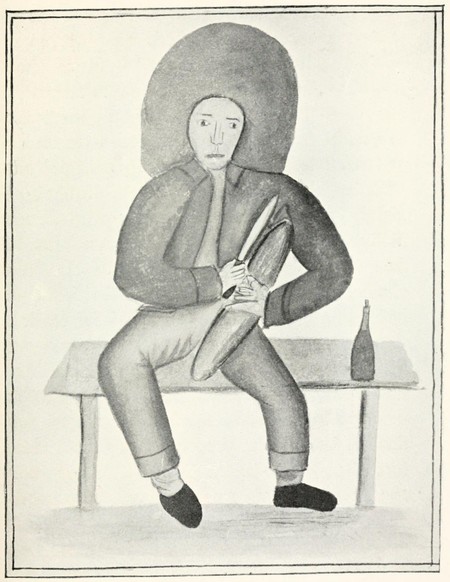
FRENCH MILLER
Before the girls took their première communion (which they take as soon as they are ten years old) Madame Crosnier instructed them a great deal on their catechism, etc.; they did not come down or speak to any of the other girls for a week before.
Near the stables there were several girls who used to beg from every person they met; two were quite rude. As we went we used to see people sitting out of doors getting their breakfasts or dinners. They seemed to have very curious messes: bread and fruit, broth, and porringers of preserves into which they dipt their bread, for dinner. On one bench we generally used to see a number of millers[23] sitting getting their breakfast, with a very long roll and a knife in their hands, and a bottle of vin ordinaire beside them.
RUDE BOY
June 14th.—We had been with Carruthers to the market, and after she had bought her things, as there were more than she could carry, she got a boy (of whom there were plenty ready) to carry some of her goods home for her. When we reached home she paid him the common price, but to our surprise he refused to take it unless he could get a great deal more; she then offered him some meat and bread besides the money, but this he also refused unless he might carry away the plate; and to try and frighten Carruthers he said he would go and bring the commissaire. After remaining for a quarter of an hour the porter's wife came in, and after scolding him for some time she at last obliged him to take the money (which she said was more than was usually given) and the meat and go away, which he did, abusing Carruthers all the way. This was one of the boys who used to point at us on our way to school.
TRIP TO PARIS
June 15th.—I this day went to Paris with mamma and papa: papa had been staying there for a few days. We had a very pleasant ride, and reached the Hôtel du Mont Blanc, Rue de la Paix, where papa had been before. This street is one of the best in Paris; there are footpaths at the sides, and the boulevards run along the bottom. We walked along the boulevards under the rows of trees; at one side there are the Chinese baths, the outsides of which are curiously ornamented with artificial rocks and figures holding umbrellas, etc. There seemed to be a great many people idling about. There was a man with a canary in a kind of moss bower; the bird was so tame as to sit still without attempting to fly away. There was another man with a tame hedgehog, which he held up in his hand to the people; it seemed to be playing tricks. We went through the Passage des Panoramas, where we bought a bunch of clear beads for five sous, a sou dearer than at Versailles. We afterwards went to the Palais Royal, where they asked eight sous a bunch: the shops in the Palais Royal are very dear and disagreeable. There were some curious things at the windows.
FLOWER MARKET—TIVOLI, ETC.
June 16th.—A very fine day. After breakfast we went in a coach to the flower-market. We walked down it: the women had on large straw hats. There were rows of flower-pots down each side, the prettiest collection I ever saw. There were roses, carnations, myrtles, beautiful campanulas, geraniums, Madagascar periwinkles, etc.: there were also strawberries, currant, apple and orange trees, all in pots. The apple-trees were a a very small kind, the branches of which were covered with fruit; there were likewise little oranges on the orange-trees. From this we drove to the Church of St. Sulpice. There is a picture over the altar on which the light falls from the top. There was a wedding going on in it when we entered. They were a curious-looking pair that were married. I was not near enough to see plainly what the priest was doing, but when the ceremony was over he passed close by us muttering to himself all the way; he was dressed very finely, but he was the most horrid-looking old man I ever saw; he reminded us of the Inquisition and everything horrible.
Near the church is the Fontaine de St. Sulpice; it is a very plain little fountain. From this we went to Notre Dame, where we saw the end of a christening. After that we went to the Fontaine des Innocents; it is a large, high fountain, with several lions' heads, which were not playing when we saw it. From this we drove to Tivoli. In going to it we passed through the narrowest streets I was ever in. I do not think two carriages could possibly have passed. They were very dirty and close, and had such disagreeable smells; I was not sorry to get through them. We got out at Tivoli, and walked under a kind of trellis-work up to the house where you pay. Tivoli is not near so nice, or so large as Sydney Gardens at Bath. There are several winding walks bordered with Austrian roses, box, etc. There are a great number of swings and roundabouts of ships, swans, and horses. We saw a man playing at a kind of game; to a long wooden box was fastened a string with a wooden bird at the end of it; he threw it so as to fire a pistol, and then Cupid came out of the top. At one part of the garden there is a steep hill; at the top is a temple, and near the bottom a sort of grotto; at the top are kinds of carriages, and whoever wants to ride down gets into one; they slide in grooves down the hill and under the grotto. I should think it would be a frightful thing. After we had walked over the garden we went into a café and got some cakes and wine. We then left Tivoli and walked up to Montmartre; it is very steep up to it, but when one gets to the top near some windmills one has a view of the whole of Paris and the country round it, quite like a panorama. On our way home we stopped at several shops to buy a cap; but they asked us very dear, and had nothing particularly nice. At some shops there is written 'English spoken here,' and on one 'English spiked here.' It requires a great deal of bargaining to get things for a right price. At some shops there is written 'prix fixe.' The people in the shops are remarkably plain, and plainly dressed.
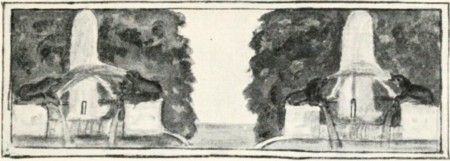
THE FOUNTAIN WITH THE ANIMALS (p. 81).
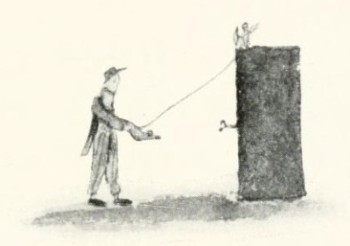
THE CUPID AT TIVOLI (p. 105).
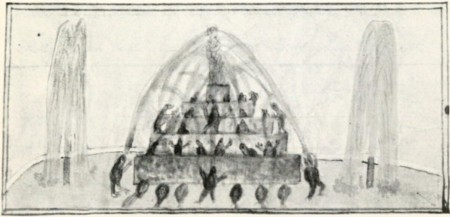
LATONA'S BASIN (p. 81).
SUNDAY
June 17th.—No sooner were we out of bed than there came several men before our windows, and played tunes. One man came into the street with a fiddle, which he played on, made grimaces, and jumped about as if he were crazy. He was a most extraordinary-looking creature; he was dressed like a merry-andrew, with a white wig and a queue on his head; if one had seen him in England one would have thought he was mad. While he was capering about, another man came into the street with a puppet-show; he put a table on the ground, and made first some men and women, and then a carriage, go round it[24] In the middle of the day we walked in the gardens of the Tuileries, which were excessively crowded, and through the square of the Louvre. It is the most beautiful thing of the kind I ever saw; I think it is a much more magnificent palace than that of Versailles. It is beautifully carved round every window and door, and excessively white and clean-looking. I altogether admired this palace, and the Colonne de la Place Vendôme, the most of any of the buildings in Paris. In the evening I walked with papa on the boulevards as far as the Fontaine de Bondy, which was not playing. It was dark when we came back, and the boulevards were crowded with people. The cafés were lighted up, and were full of people sitting taking refreshments. There were stalls like a fair, puppet-shows, and conjurers. I never saw anything so unlike Sunday.[25]
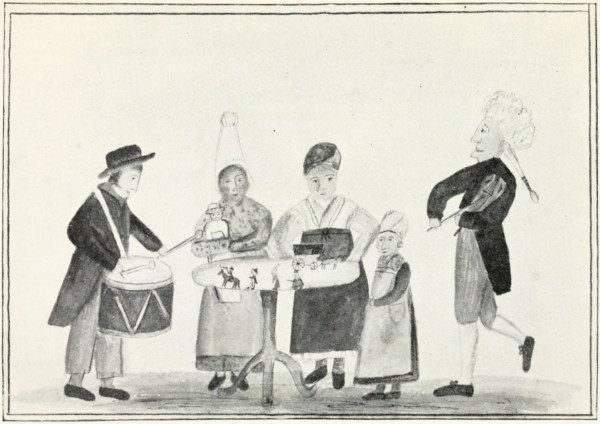
FRENCH PUPPET SHOW
LUXEMBOURG-MAN AND STILTS, ETC.
June 18th.—We went to the Palais Royal (on our way we bought a souvenir). I wanted some little remembrance of France: we went into several shops in the Palais Royal, and the cheapest thing I could get there was a little gilt cart and horse, for which the woman asked ten francs. We, however, got it for eight, which was far too much, as we got as pretty a one in the Rue de la Paix for half the price; we also got some silk winders of mother-of-pearl. The shops in the Palais Royal are very dear and disagreeable: the people seem to make quite a favour of selling you anything.[26] Near this we got some strawberries and cream in a café (Véfours). After that we drove to the Luxembourg. We walked in the gardens, which are very formal, but pretty in their way; there are a great many flowers and roses growing out of the banks of grass. There are a few basins of water, and a great number of statues. We did not see the inside of the palace. As we were returning we saw the King in his coach a good way before us; he had a great many attendants with him. In the afternoon we dined at Major Cape's. Most of the party liked France very much. Just before we went there we saw a crowd in the street, and after looking a little while we observed a man dressed up in scarlet à la Henri Quatre, with a feather in his hat, on horseback. He rode up and down, and seemed to be making a speech. The people then made a large circle round him, and three little boys and a girl who were with him, dressed up like merry-andrews, got on stilts, and marched and danced before him. The man then got off his horse, and got on stilts; the man and the children were on stilts so as to make them the same height, so that the least, who did not look above five or six years old, must have been more than a yard from the ground. They all took hold of hands, waltzed, sauteused, ran under each other's arms, and danced a fine figure-dance. The man did the worst. They danced to the beating of a drum; the little one curtsied on his stilts, and after they had done, the man put him on the horse, and sent him round to collect money. We stayed very late at Major Cape's; and I was glad to go to bed when we came in.
RETURN TO VERSAILLES
June 19th.—This was the last day I was to stay in Paris, for which I was very sorry, as I liked being in Paris a great deal better than in Versailles. There are some very amusing things in Paris, though I do not think it is to be compared to London. We expected Miss Wragge and brothers and sisters to see the museum, which we had been long promised. Miss Wragge, Barbara, the two boys, and Caroline came just after we had finished breakfast; but Catherine and Euphemia were so ill they could not come. (Catherine was not well when we came to Paris, but we hoped by this time she would have been better.) After they had come we bought some gilt gigs, baskets, etc., in a very cheap, civil shop in the Rue de la Paix, where there were a great many little ornaments. We also bought some silk shoes at a good shop near. After we came in, Mr. and Mrs. Fisher called. We did not go to the museum, but went instead to the Louvre, where we had a longer view of the pictures than before; I did not like them better this time than when I first saw them. There were several Quakers in the Louvre; we saw some in the streets of Paris at different times. As soon as we came back from the Louvre we returned to Versailles. On our way we saw the Duchesse d'Angoulême in an open carriage. When we reached the Avenue de Sceaux we found Catherine very ill, and Euphemia not at all well.
COMMUNION
June 20th.—Before breakfast we went to see the girls and boys take their première communion at Notre Dame. The church was so full we could hardly get near to see them.[27] The first set of young ladies that came in were dressed in white muslin frocks trimmed with lace and satin, white sashes, gloves, shoes, and ridicules, lace and white satin caps, and lace or muslin veils; the next set were dressed in the same way with pink sashes; the third set blue; the fourth set green; and the two next sets white. After that came a school of girls dressed in buff cotton frocks and common muslin veils, who seemed to be poor girls: several nuns sat with them. Another set had on thick white frocks. All the girls sat in a seat by themselves. The boys had bows of white ribbon on their arms. Madame Crosnier's school was very smart with white sashes like the others; those of her girls who did not take their communion were dressed in neat white frocks, scarlet sashes, and Leghorn bonnets. Madame Crosnier and her teachers were very nicely dressed. The girls had every advantage that dress could give them; but we could not help remarking how very different a set of English girls would look to those with their dingy complexions. They had candles in their hands, which they lighted and blew out several times during mass. Some of the candles were very much ornamented with gold paper, etc.; one had a little gilt basket filled with flowers round it, and others lyres on them. I thought there was a great chance of the girls setting fire to each other as they sat close together. While we were in the church there were two women with a little child beside us, which squalled and fretted the whole time. It first would have one thing, and then another. The women managed it excessively stupidly; they first gave it a cake, then snatched it away from it, then whipped it, then kissed it; and they looked at each other as much as to say it is impossible to make it be quiet. The French children are little petted, disagreeable, spoiled things; they say that it hurts their health to find fault with them.[28] They are very dirty, and their heads are covered with a cap of dirt which they call the Écaille du bon Dieu, and it is reckoned a kind of sacrilege to take it off. Even the highest ranks of people do not comb their children's hair till they are two years old, that they may be covered with this cap of dirt, which, they say, prevents them having sore eyes and makes them cut their teeth easily. Another prejudice that they have is that nursing and tossing the children about makes them mad; the doctors say that it is only the dull air of England that requires it:[29] some of them say that it is that which causes so many mad people in England. The consequence is that the French babies are dull, heavy, and stupid. We were obliged to leave the church to go to breakfast, so we missed seeing the girls take the sacrament, which they take on their tongues and eat whole without breaking it. After they had done we saw them go home; Madame Crosnier's school went in a coach. In the evening we went again to Notre Dame, where one of the priests preached a sermon to the boys and girls that had taken the sacrament, and told them to prepare for being confirmed the next morning. After the sermon was finished they walked in procession round the inside of the church, the girls first and the boys after, with lighted candles in their hands. Some of the candles were so much broken that they could hardly hold them upright. One or two of the girls did not look more than six or seven years old: we supposed that they had not been taking the communion, but were only walking in the procession. It was altogether a pretty sight. After they had walked round the church they all went home. When they receive their première communion it is customary to give the priest something: this time they gave a clock.
TREE BURNT DOWN
June 23rd.—This day is the fête of St. Jean. We were told that in the evening there was to be a tree burnt down opposite the palace. Accordingly Miss Wragge, brothers, and some of the servants, went to see the ceremony. A tree was fixed up round which were tied bundles of straw and faggots, and a guard stood round it. The son of the governor of the château came out in great style, attended by several servants, with a torch in his hand; he set fire to the tree, and the people tried to pull away the faggots as they were burning. The whole party gave me a very poor account of it. The servants said they could not think what made the people make such a fuss about seeing a bit of a tree burnt down.
FÊTE DIEU
June 24th.—This was the Fête Dieu, a grand fête day in France. Soldiers and priests were passing all the morning. There was a procession at eight o'clock, which I did not see. At half-past eleven we went to the Avenue de St. Cloud, where we were told the procession would pass. There were a very great number of people, amongst others our porter's wife, who ran to get near the procession that the priests might touch her baby. We stood near Madame Crosnier's school; the girls (except Mademoiselle Rose, who was much as usual) were neatly dressed. There were soldiers along each side of the avenue. We were amused at several women who tried to run quickly across before the procession. After we had waited for a long time the procession at last came:—1st, three men on horseback; 2nd, a man in a red gown trimmed with fur, who carried a large red flag—two boys held the strings; 3rd, a man in purple who held a purple flag—two boys held the strings; 4th, a priest with a red flag—two priests held the strings; 5th, pioneers and a band of music; 6th, priests singing; 7th, a number of priests with books and crosses, and a concierge; 8th, priests with censors full of incense, and baskets full of flower-leaves;[30] 9th, several priests holding a crimson velvet canopy, under which was the Bishop of Versailles, an old man of eighty-four. A number of pages dressed in coats embroidered with gold, fleurs-de-lys, etc., and a number of officers, closed the procession. Along each side of the avenue there walked the boys and girls who had taken their première communion, dressed as before. The girls walked on one side and the boys on the other. One of the girls was dressed in white silk and a blue and gold mantle, with long hair over her face and back. We were told that this little girl was dedicated to the Virgin; she was a very curious-looking figure. Several nuns walked with the girls. After them, along each side, there walked a number of priests in very brilliant dresses, gold, red, and green, etc. Besides these there were priests in different parts of the procession. Every now and then the procession stopped, and the priests that went before the bishop turned round and threw incense and flowers, which looked very pretty.
After the procession had passed, we went to see the reposoir of the Lyceum, which we were told was the prettiest. It is a building like a temple. The doors were shut, but a very civil, gentlemanly-looking person let us go in. The pillars were hung with wreaths of green, and there were rows of trees in boxes up the middle, cut like those in the gardens. The altar was a good deal ornamented: there were golden candlesticks, artificial flowers, etc., on it. They were putting away the things while we were there. The person who let us in said it was customary to give away the flowers; we got two or three, which were all that were left. Before the reposoir there was grass laid for the priests to kneel upon; we saw some women picking it up. There was another reposoir in the Avenue de Berri, and one near us at the end of the Avenue de Sceaux, which was made slightly up, out of doors. There were flower-pots on the sides, and a cross of lilies and roses on the top. The children had dressed up little chapels on tables against the wall, in the streets, with little figures, vials full of flowers, coloured paper, etc. As people went by they came to beg 'pour la petite chapelle.' One girl who came was quite a monster: she had no nose, and two teeth that stuck out of her mouth like tusks. Out of some of the windows in the streets were hung pieces of tapestry and old carpets.
June 26th.—Catherine was now extremely ill; indeed, no person seemed very well. What with the cold, and one thing and another, we grew more dismal than ever. This day papa told us for our comfort (for the first time) that as soon as Catherine was able we should all go home. This piece of intelligence made us all happy for a short time, as it was what we did not at all expect. I cannot tell what made me dislike France so very much; one reason I think was that I raised my expectations too high. I had heard so much of the fine climate, the excellent fruit, and the lively people, that I was quite disappointed at the cold weather, the bad fruit,[31] and the dull people. Besides, I felt so far away from home that I grew quite unhappy. Nothing seemed agreeable; I was tired of the gardens and the processions. My greatest amusement was a little rose-tree that died soon after I got it. In the morning when I got up, the only thing I wished was that the day was over, and that we had a day less to stay at Versailles. The family that had lived above us was now gone. Miss Ward and Miss Johnson—two Irish ladies, with Mab, their French servant—now inhabited that part of the house. They had come to France on account of being ill. They were remarkably civil in sending down 'comed-milk,'[32] fruit, or anything else they thought Catherine might like.
BAKER
June 28th.—Carruthers saw our bread-baker standing at the street door talking to some women, with nothing on him but a small apron. The French do not seem to have any idea what delicacy is.
LAVOIR
June 29th.—We went to the lavoir which is at the end of the Avenue de Sceaux. It is covered at both sides, and the water is between. There are boxes full of straw placed along for the women to kneel on. They beat the clothes with wooden things of this shape . When we saw it this time there were twenty women. One good-natured, civil kind of woman took us to see her wash-house, where she made lie. She told us a great deal about the lavoir. A porter takes charge of it; the blanchisseuses pay three, and the bourgeoises four sous each time, and so much for line for drying their things upon. It closes at seven o'clock. The people go to the porter and say, 'Place my boxes in such a place for so many,' and then he arranges them accordingly. I took a sketch of the side of the lavoir; the people seemed very much amused at it. One disagreeable kind of woman called out, 'Mettez moi en peinture, elle n'est pas gentille, je suis plus gentille qu'elle,' and then she held up her face to show us how pretty she was.[33] She told us to draw a woman with a barrow, and she laughed and said, 'Elle est blanchisseuse de torchons.'

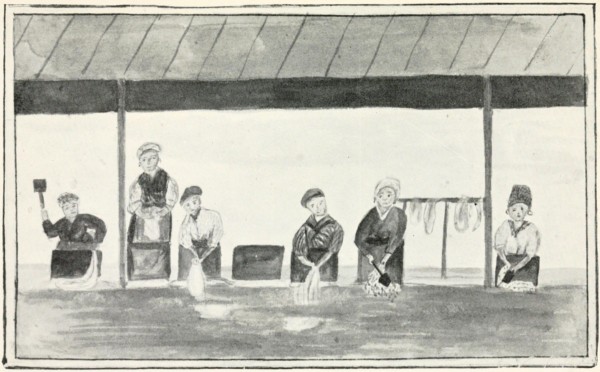
LAVOIR
In France they do the things up very well, but in the washing they spoil them very much. They put the clothes into some kind of liquid which brings the colour out, and they beat them almost into holes. A gown of the servants' was quite spoiled. Our washerwoman had a little girl with green bead baskets in her ears.
July 1821
DUCHESSE D'ORLÉANS' FUNERAL—MARRIAGE
July 2nd.—We went to the Avenue de Paris to see the funeral of the Duchesse d'Orléans, which was to come from Paris. It was close weather; one heavy shower came on and obliged us to take shelter under the trees. There was a person sitting on a stone who told us she was reduced, and talked[34] a great deal. There were soldiers along both sides of the avenue as far as the eye could reach. There were a great many cuirassiers; when the sun shone on their steel armour it glittered very much; two of their horses got loose and galloped all the way down. We waited above two hours before the funeral came. First there came three men on horseback, and after them several other men, then several shabby post-chaises, and next the hearse, which was covered with black velvet and silver. After that came guards, pages, people, carriages, etc. The avenue was crowded with people.
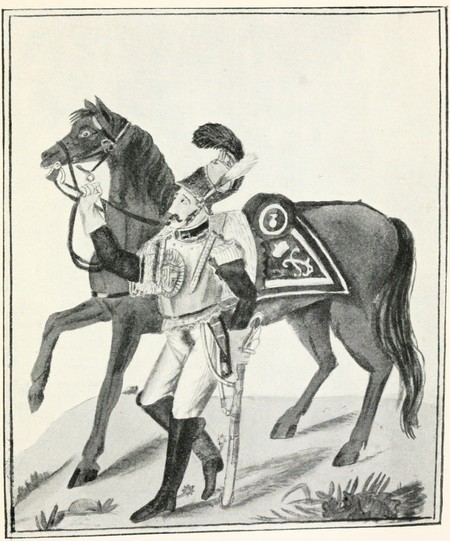
CUIRASSIER
At twelve o'clock we went along with Miss Ward and Miss Johnson[35] to Notre Dame to see the marriage of Marshal Soult's nephew to the femme de chambre of the Duchesse d'Angoulême. We sat very near the altar. The church was excessively full; there were a great many English. The bride was not at all pretty. She wore a white gauze gown trimmed with flowers, over a white satin slip, and a veil fastened round her head with a wreath of white roses. She was little, and had not a good figure; the waist of her gown was very long and made very high in front (which most of the French gowns are), which was not improving to her figure. Marshal Soult was a vulgar-looking man, with a cross, disagreeable countenance. His nephew was not ill-looking. There were three bridesmaids, who looked old enough to be the bride's mother; they were little and fat, and queerly dressed. The marriage ceremony was chiefly done by the priest; he read and prayed by himself, and seemed to have nothing to do with them. At last they each held a lighted candle; the priest read some prayers to them; and one of the little boys brought them a silver castle and a silver plate to kiss. Marshal Soult seemed to look at it with great contempt. During one part of the ceremony a curtain was held over them. While the ceremony was going on we saw the priest do something that appeared very irreverent. After he had been praying on the steps of the altar, no sooner had he risen than he spit on them: we afterwards saw him dancing across the vestry. After the ceremony there was a collection of money. Miss Ward told us only to give a sous or two; we observed the bridegroom thought he had given too much, as he took out of the plate what he had at first given, and put in a smaller sum.
After we returned from the church there was a great deal of rain, thunder and lightning.
PALACE ROOMS—TRIANONS
July 3rd.—A very hot day. We went along with uncle Lancaster to see the inside of the palace. The first part we were shown into was the chapel. It is extremely beautiful and magnificent. We looked at it over the railing, which is marble and gold; the ceiling is painted, and the organ (though silver) is very light and pretty. We next entered the Salon d'Hercule. It is 64 feet long and 54 broad. It is entirely composed of beautiful marble; there is a great deal of painting and gold about the ceiling. The Salle de l'Attendance, Salle de Vénus, Salle de Diane, Salle de Mars, Salle de Mercure, etc., are all much alike, decorated with painting, gold, and marble. After passing through these splendid apartments several other large rooms appeared quite small. The King's library is not fine, nor the bedrooms of the King and Queen. There are some very curious glass closets in which one sees oneself reflected at the top, the bottom, and all sides, apparently without end. The Œil de Bœuf is a long room, but not very splendid. In it is a picture of Louis xiv. surrounded by his family; at the end is a round window like an ox's eye. There is a very plain dining-room, white, with small paintings, which, though nothing like the other rooms, I liked very much; it was quite a relief to my eyes after so much splendour. The Salle de la Guerre is a good deal painted and gilt; there are some very good imitations of bronze. From this you enter the Grande Galerie, which is 222 feet long, 32 broad, and 40 high. There are seventeen large windows, and as many mirrors opposite to them. These are separated by pillars of marble. On the ceiling is painted, in nine large pictures and eighteen small ones, the history of Louis xiv. From the windows of this gallery you have a good view of the gardens. When we were there they were repairing part of it. We passed from this to the Salon de la Paix and several other apartments. The Salle de l'Opéra is very large, and I dare say when it is lighted up it would look very fine; but I thought it far the least pretty of any of the rooms; it looked gone to ruin. The staircase in the palace is marble. The only piece of furniture in the whole palace is a small clock. I don't think I ever saw anything so unlike the residence of a king: there appears to be nothing but gold, marble, glass, and paintings. A man shows the rooms, to whom you give something; both times I was there it was full of people.
We went through the gardens to the Grand Trianon. The rooms are all on one floor. They look very different to the rooms of the other palace, but amusing in their way. We waited in a hall for the person to conduct us through the other apartments. In one of the rooms there is a beautiful inlaid table, round which are represented the signs of the zodiac; it was made by a pupil of Sicard who was deaf and dumb. The beds have plumes of white feathers at the top; they reminded us of hearses. Some of the chairs are very pretty tapestry worked in lilies, roses, and birds. There are also several tapestry pictures. There is a long gallery between the windows, in which there are a great many models of ships. There are also several statues and some curious little agate ornaments in it. In one room there is a beautiful green malachite-of-copper basin, and slabs of the same, given by the Emperor of Russia to Maria Louisa; the man who showed us the rooms did not seem to like to speak about it. In the same room there were some common, vulgar tongs, such as one would not see in a kitchen. There were gold arrows on the chimney-piece for lights, and very pretty lustres. I think the palace is a great deal more amusing than the other. After we had been through the rooms we got some cider and cakes at the place where we left our umbrellas. We did not see the gardens, which are said to be pretty.
When we were rested we went to the Petit Trianon. There is nothing at all to see in the rooms; it is like any small private house. The Queen's bed is gold muslin, and the walls of the room are covered with blue silk. The gardens are remarkably pretty; they are made in imitation of English gardens, designed by the unfortunate Marie Antoinette, and have none of the stiffness and formality of the other French gardens. At one part of the garden there is the figure of a Chinese holding an umbrella; it ought all to turn round like a swing. Near that is a small theatre, or rather music-room. There are little streams in different parts of the gardens, an artificial river, and a pond. After you cross a bridge with rocks at the sides, you enter a dark grotto, from which you go out by a staircase. There is a music-room and a temple and a tower; the man told us that the late Queen used to get on the top of the tower and sing. The pond scenery makes quite a pretty landscape; several willows overhang it, and three or four swans were swimming in it; at one side there is a farm-house, a dairy, and a mill. We were told that the Queen used sometimes to dress herself up like an English farmer's wife, and call herself Mrs. Browne; she used to stay at the farm, and her attendants used to dress up as her servants.
We returned home very much tired with the heat; in the evening there was rain, thunder and lightning.
MADAME VERNIER
July 6th.—As our house was very cold, and the stone floors were thought to be bad for Catherine, we took a house in the Rue Reservoir, which we this day went to; before we went, however, we had quite a battle with Madame Vernier. We warned her a fortnight before that we were going to quit the house; but it was at five in the afternoon, and she said we ought to have given her warning before twelve; she therefore charged us for another month. As mamma knew this was an imposition she was determined not to pay it. She sent for the proprietor of the house (who was very civil), and also for Madame Vernier. The proprietor talked to her a long time, but she would take no less; he then wanted Miss Wragge to go with her to the juge de paix, which of course she did not do. Madame Vernier had been a camp-follower: she was a great, fat woman with a voice like a man's. We heard of several tricks that she had played the English; she said that the French had payed plenty of contributions, and she was determined that the English should make up for it. Once when some people would not pay her what she asked for, she went round the house and picked out every scratch and hole, saying a franc for this, and so much for that, till she made up the sum she wanted. Another time she charged an unreasonable price to some people who were dining there (her husband was a restaurateur), and on their refusing to pay it she locked the gates and threatened to detain their trunks. As the gentleman was very lame, he was glad to pay what she required and get off, though they had bargained before for dinner at so much less per head! When mamma knew what a woman she was she determined not to pay her for the next month. Accordingly she sent for papa, who was at Paris, and papa and Dr. Murdoch (who had resided long in France and spoke French perfectly) went along with Madame Vernier to the juge de paix, who said she was wrong, and in case of her detaining our trunks gave papa the name of a huissier. Madame Vernier told the juge de paix that papa had attempted to strangle her, to which he replied that she looked more likely to strangle one of the garde de corps. She told him that he knew nothing at all about it, and came away in a great passion. She then got a relation of hers who was a lawyer's clerk (or something of the kind), and she brought him upstairs to convince us. The proprietor tried to persuade her to take the money; she, however, refused it; but when she found papa was determined not to give any more they all went downstairs, and after consulting a little while, she sent up to say she would take the money. After this contest she was, like a tamed lion, and was quite civil. We went to our house in the Rue Reservoir, which we did not find quite so comfortable as we had expected.
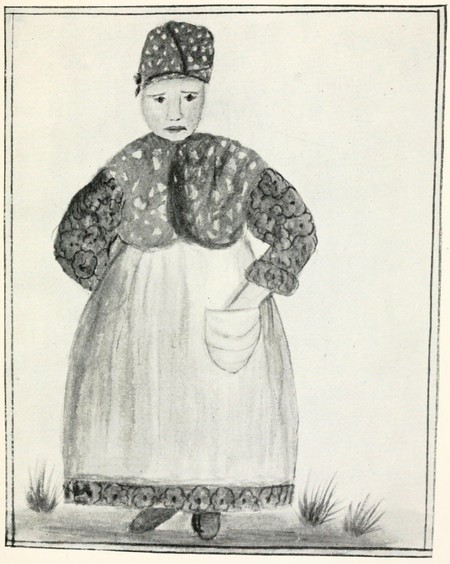
MADAME VERNIER
NEW HOUSE
July 7th.—Our new house was nearly opposite the theatre, which on a Sunday, particularly, was crowded with people; every Sunday evening a number of drunken people passed our windows; one Sunday we counted six close together.[36] Our servants went one day to the play, but it was so dirty that it made them quite sick. Near our house was a priests' school; we used to hear the boys singing a great part of the day and sometimes in the night. Behind our house there was a small garden with very little in it. When mamma went to see the house two of the rooms were carpeted, and everything was very comfortable. Although Monsieur Grincourt had several days to prepare it, when we came to our new house the carpets were taken up, the curtains were taken off some of the beds, and everything was uncomfortable. The fireplaces were full of every kind of rubbish. There were not enough plates, glasses, etc. And we were reduced to many curious expedients. The French are very dilatory about bringing things. We saw they did not intend to give us back our carpets, as the next day they sent a frotteur[37] to clean the floors; however, as we had taken the house with a carpet, we told them to bring it, and we used to send Nannette to scold every day till at last we got all we wanted. They also brought quilts for the beds, but they gave great charges that they were to be taken off at night. We got two tea-kettles which were a most extraordinary shape. The French make some little things very nicely, and other common things extremely awkwardly. There was a bath in the house, and the room adjoining it was remarkably damp; a great many toad-stools grew in the closet; there was also an ants' nest below the floor. The porter's wife was much younger than the one in our other house; her husband lived at Paris; she had one son of eleven or twelve, a very rude boy. Different people lived above us, latterly a Mr. and Mrs. Spurrier. Mr. Spurrier was determined his French servants should do like English servants; if he succeeded, I think he did more than any person did before him.
SUNDAY
July 8th.—The lady above stairs played the whole day without ceasing on the harp; the boys at the priests' school made more noise than usual in their playground; numbers of people were going to a village fête; a great many people passed by on their way to the theatre, among whom was Mademoiselle Croissé; we counted six drunken people; shops were open as usual, and people going about their work as on any other day. On Sunday Madame Crosnier's girls spent the day in working and dancing.
VILLAGE FÊTE
July 9th.—We went in a carriage to see the village fête of Louvécienne. Little Miss Foaker went with us. It was a fine evening. Louvécienne, or Lucien, is above four miles from Versailles; it is very pretty about the village. There were lamps hung across the trees, and seats placed round on the ground where they danced. Three fiddlers were stuck up in a kind of orchestra, and they played a very dull tune extremely badly. I was very much disappointed in the dancing: it was more like a funeral than a dance. The figure was a quadrille. They walked it all till they came to the setting, which they danced in their way, which was almost duller than the walking. All the time they were dancing their faces were as grave as judges: they behaved as if it was a lesson they wished to be done with; as soon as the dance was done they laughed, pulled each other round, and ran off to buy a sweetmeat at one of the booths; then they came back as grave as possible. One of the nicest girls was dressed in a white gown, pink apron, green shoes, and a gold chain; there was one very impudent, disagreeable, vulgar woman, dressed in blue cotton. Some were in white, and some had on red petticoats, high caps, gold chains, etc. There were booths, stalls, whirligigs, roundabouts, etc., like an English fair. We saw an old man and woman of sixty or seventy riding in a roundabout. At the other end, near some trees, there was a party of ladies and gentlemen; they danced much like the peasants, in some respects worse—one or two of them, however, danced tolerably well. This party had rather better music, but very dull. As we went away they were beginning to light the lamps. It looked very pretty to see the people under the trees, but the dancing nearly put one to sleep, and the music was like a funeral dirge. They say that the French like dancing better than anything, and we heard it very much admired. For my part, I think it is neither graceful, nor pretty, nor merry.
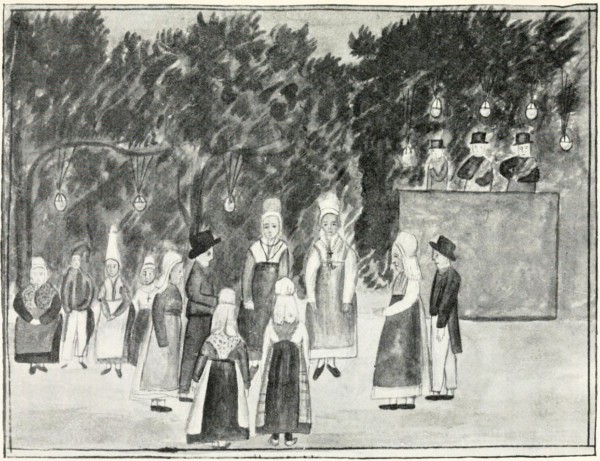
VILLAGE FÊTE
MUSEUM
Tuesday, July 10th.—We went up to Paris at nine o'clock to see the museum; it was a fine morning, but rather cold. It is a very pretty drive; the country is beautiful about the Seine. There were a great many bluebottles and scarlet poppies in the corn, more than I ever saw in England; the fields looked like a sheet of blue and red. In Paris they sell pretty wreaths of bluebottles. We met a cart guarded by eight soldiers, with nothing in it but old chairs and broken tables. We arrived at Paris at twelve o'clock, and went to two flower-shops, where were beautiful artificial flowers. The carnations were scented. They had not many wreaths: the flowers that brides wear are the buds of orange flowers. We bought several single flowers, jessamine, roses, camilla,[38] japonica, etc. From this we all went to the cabinet d'Histoire Naturelle. We remarked the floating baths on the Seine. When we reached the Jardin des Plantes the museum was not open, so we walked in the garden till three o'clock, when the doors are opened. There was quite a crowd of people of all ranks. I think it is wonderful that the things are not hurt, as the people press close to the glasses. We went to the upper gallery first, that we might have more time to examine it. Several rooms open one into the other. There were soldiers with swords in their hands, walking up and down. We had not time to look at everything; we only skimmed over the things. The first rooms contain above two hundred monkeys; we scarcely looked at them at all. In this museum there seems to be every kind of creature. There is a great quantity of bats of all sizes; a rat with a young one on its back; some very small mice, marmottes, opossums, armadillos, lions, tigers, panthers, etc.; a horse; most beautiful little deer, some very small; a chevrotin; cats and dogs. These were all in glass cases round the room. In the middle of the room there were two enormous elephants, a rhinoceros, etc., a hippopotamus, which is a frightful-looking creature with an immense mouth. On the top of the cases there is a morse. In the middle of the next room there is a whale, a wild ox, a buffalo, and a cameleopard which almost touched the top of the room. There was the skin of a snake, like a trunk of a tree, near the top of the room. The animals in the middle of the room were not in cases. There was a great variety of springboks, sjrisboks, etc., in this room, and also porcupines, foxes, and a variety of other animals.
The most beautiful and amusing room was that in which the birds were. There were a great many owls; pink spoonbills, scarlet flamingoes, toucans, parrots of every colour, very pretty kingfishers, penguins, cassowarys, peacocks and hens; there was one petrified ibis. The most beautiful were the humming-birds; their colours were quite dazzling: some were very small, and others larger. There was one beautiful forked-tailed humming-bird: its throat was of the most brilliant green, and its breast amethyst purple; the rest of its body was a shining black. The topaz humming-bird is also very pretty; it has a yellow breast and a red topping. The red-throated humming-bird is also pretty, but not so brilliant as my favourite fork-tail. One of the larger humming-birds is all bright black, like velvet, except the neck, which is the colour of an emerald. No colours could express the brightness of their plumage. There were several nests which were whitish. In the same case with the humming-birds there were some scarlet creepers, very bright and pretty, and one or two blue creepers which were like precious stones. We examined this case longer than any other.
There was a glass case up the middle of the room in which were lobsters, corals, shells, sponges, etc. In one part all the insects were arranged. The butterflies were the most beautiful things I ever saw. There was one very large blue one that dazzled my eyes to look at; another black and bluish lilac; and the Amboyna butterfly, an immense green and black one, with most brilliant colours and shining like velvet. There were several small ones striped yellow and black; one very beautiful small scarlet and purple one; several very large greyish butterflies or moths which had small clear spots in their wings like glass; there were two or three smallish butterflies marked with every colour like marble. The large butterflies were excessively beautiful. There were several English ones beside them that looked quite dull and ugly. There were a great many large moths; one grey and a great deal marked was even bigger than the green butterfly; there was another beautiful large grey moth with purple eyes in its under wings. Besides the butterflies there were several other insects: dragon-flies, the colours of which were quite gone; enormous spiders; a great variety of bees; an ant lion at the bottom of a small pit; very large caterpillars; and a great many other insects.
We then went to the lower gallery, which is not so amusing; but there are some curious fishes, a crocodile, very pretty marbles, a large piece of gold ore, and a great variety of stones, etc. Instead of real precious stones there were only imitations in glass, which looked very shabby. I was very sorry to leave the museum; it was the most amusing and beautiful thing in France. It closes at five o'clock. After we had left it we returned to Versailles.
DUCHESSE DE BERRI—DUCHESSE D'ANGOULÊME
July 15th.—Hearing a great deal of noise amongst the boys in the priests' school, we enquired what was the matter, and were told that it was the Duchesse d'Angoulême and the Duchesse de Berri come to visit the priests' school. We went out to see them, and after waiting a very long time for them, they at last came out, got into an open carriage, and drove away very quickly. There were a lady and a gentleman in the carriage with them, and several soldiers on horseback. There were a great many priests and boys looking out of the windows. Neither the Duchesse d'Angoulême nor the Duchesse de Berri are pretty: the Duchesse de Berri has very red eyes. Before this we had heard of the death of Buonaparte. A man used to go about the streets with a bundle of papers, crying, 'Voici les dernières paroles, et la confession importante que faisoit Napoléon Buonaparte avant de mourir.' We were told that this was a famous spy. It was hot weather for two or three days, and every person watered before their doors.
ENGLISH ROBBERS
July 17th.—This evening we had just returned from walking in the gardens when we were told by the servants that three English robbers had been just then taken up. There were two men and a woman, who had robbed some English at an hotel in Paris of a great deal of money, and gone off with it; they were, however, all stopped and taken up at Versailles. We heard of another Englishman that had swindled. An English lady told us that at Boulogne there were quantities of English who came over in debt, and that a prison there was so full of English that it was called the British Hotel.
HAYFIELD—MUSIC—CHILD
July 18th.—This (and several other) evenings we walked to the hayfield near the Trianons. There were a great many grasshoppers and brown butterflies (meadow arguses) flying out of the haycocks. We sat down on the hay, and Miss Wragge got a wisp of hay round her leg, which she took for a snake; this amused the people very much. Near here we used to see some little pensions of poor children going out to walk. At the gate of the Trianons we saw a little child of about three years old standing. It came up to us with a straw in its hand, which it held like a soldier; it then put it to our faces and tickled them. We asked it where it lived; it said 'là-bas.' Miss Wragge gave it a sou. The French children have a very forward manner; they come up to strangers and talk quite at their ease. We returned by the gardens. There was now a band of music (every Wednesday and Friday) in the King's garden, or the Tapis-vert. There were a great many flowers out in the King's garden: many different sorts of columbine, honeysuckle, syringas, and roses on sticks. The trees in the garden (Hartwell) are not cut like those in the rest of the garden, but are suffered to grow naturally. The music was not pretty; the players seemed very much afraid of tiring themselves, as they rested more than half the time. While the music played to-day, the Tapis-vert was crowded with people. We observed one little boy, who did not look more than three or four years old, with light curly hair and rosy cheeks; he had a kind of little bag before him, in which were different sweetmeats—dogs, lambs, etc. He ran to every person and begged them to buy; his little sweetmeats were a sou apiece. At first we thought it looked very pretty to see the little fellow selling the things, but we soon discovered that he was accompanied by a very disagreeable woman, and as the child followed and plagued every one it was quite unpleasant. As we returned through the gardens we saw some watering-pots—great, awkward, copper things—which we drew on our nails. This was a fine day.

PROCESSION AT THE PREMIÈRE COMMUNION (p. 116).


PROCESSIONS AT THE FÊTE DIEU (p. 118).

A PASSING SOLDIER IN THE STREET (p. 147).
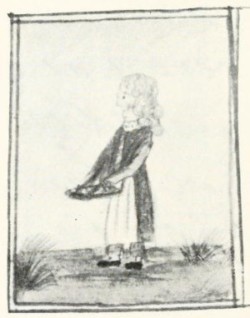
THE TROUBLESOME BOY IN THE KING'S GARDEN (p. 150).
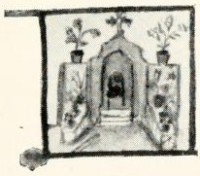
REPOSOIR IN THE AVENUE SCEAUX (p. 121).
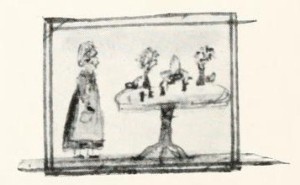
ONE OF THE CHILDREN'S LITTLE 'PETITES CHAPELLES' (p. 121).
MONSIEUR SOUPÉ
July 20th.—Monsieur Soupé (from whom we got our wine) was the King's wine-merchant. He told us that there were 500 bottles of wine a day drunk in the King's house, and that the bills are settled every night; and that the King breakfasts at twelve o'clock on eggs and tea. He told us also that he had seen Buonaparte dine, and that he never took longer than eleven minutes. In the beginning of Louis xvi.'s reign 1300 bottles a day were drunk.
SHEPHERD
July 21st.—This evening (being fine) we walked past the Trianons. We met a shepherd with a flock of Andalusian sheep, and two fine dogs with pieces of wood hung to their necks. He had a crook in his hand, and a bag with a bottle in it by his side; one end of his crook was brass, and at the other there was a kind of little spade. We stopped to talk with the shepherd. Papa asked him what the dogs' names were; he answered 'Petit et Beau-Rouge.' The wood was round their necks so that he might know them. He said that he used the crook to catch the sheep by their legs. He told us that the use of the spade was to punish his dogs, and to explain what he meant, he dug up a piece of earth and threw it at them. Papa asked what was in his bottle. 'Méchant cidre,' he answered. Papa gave him a franc to fill the bottle.
BAL CHAMPÊTRE
July 26th.—We drove out in the carriage this afternoon with Catherine, who was getting better, and who frequently drove out. We went round by the Trianons; in the forest we saw some pretty roebucks, which bounded through the wood. We passed a field full of lilac poppies. In returning we stopped at the Boulevard de St. Antoine, where there was a bal champêtre. There were lamps hung on the trees. The music was very dull. We saw them dance two quadrilles. One garde du corps danced in a most extraordinary manner: he jumped and hopped, and kicked and bounced, as if he had learned off a bear at the North Pole. His partner, a little girl of ten or eleven years old, danced very well. One lady in a pink silk bonnet seemed as if she had learned in the French style, but wanted to dance lighter, for she walked two or three steps and then jumped up. They all kept bad time, walked and hopped. The three Miss Williams and their father were there. In the middle of their dance a heavy shower of rain came on; everybody ran into a house or went home. We saw the Miss Williams standing under a tree, like three white graces, half-way home.
TOADSTOOLS, ETC.
July 28th.—This was an excessively rainy day; we found ten toadstools in Catherine's room. There were several people dining here; there were fires in the rooms, which everybody was glad to get near. It was wet, disagreeable weather. We were all waiting eagerly to go home; the days seemed like weeks. To make them appear shorter, I made a list of all the days till the time we were to go home, and I scratched out one each day. This day was Nannette's fête; she went to a Dutch frow (a German woman), who gave her a nosegay.
BELLE VUE
July 29th.—We drove out this evening to Belle Vue. It was a fine evening. We saw a man standing before his door watering some boxes full of mushrooms. At Belle Vue we went through a house where we had a very fine view of Paris, the Seine and St. Cloud. We looked at a vineyard; there were no grapes on the vines there. We heard that the bad season had injured them.[39]
PRIESTS WITH HOST—CORPSE, ETC.
July 30th.—As we were walking out, we saw some priests carrying the host to a sick person across the street. A boy in red and white walked first, carrying a lantern on the top of a stick; next went another boy carrying a cross. After him two men in scarlet holding a little red canopy over the priest who carried the host. The sick man died next day. The servants saw the body laid out in the porte cochère with a vessel of holy water and a ladle beside it; every person that went past took a ladle full of holy water and sprinkled the corpse with it.
August 1821
VILLE D'AVRY
August 4th.—We drove out this evening to Ville d'Avry. This drive is the prettiest I saw about Versailles; there are woody banks and paths, more like England. It was late when we reached the village, but there was a clear, bright moon; and a woody hill with a house on the top, looked exceedingly pretty in the moonlight. There was also a house under a woody bank covered with vines; and a man was standing on a ladder pruning them. This place is beautiful; more like what I had imagined France. We got out of the carriage to see it plainer.
KING AND WATERS
August 6th.—We were told this morning that the King and Prince Leopold were expected at Versailles. Quantities of troops passed our windows in their way to the Avenue Trianon, where the King was to review them. There were some La Roche Jacquellines on black horses. At about twelve o'clock we went (along with Mr. and Mrs. Spurrier) to Neptune's Bath, near which the King was to pass. The women charged a franc apiece for our chairs. There were rows of soldiers behind the trees. There was a great quantity of people around Neptune's Bath; there seemed to be nearly all Versailles.[40]
There were several carriages waiting for the King in case it should rain, etc.; one of them was gold and red, very gaudy-looking. A carriage came on first before the King. When the King came, one needed four eyes: to look at the King on one side and round to Neptune's Bath at the other, for as soon as ever he came the waters began to play like fairy-work. The water shot out of each vase, Neptune's horses spouted, and the whole water seemed covered with spouts and cascades. In the first open carriage was the King, the Duchess d'Angoulême, Monsieur, and the Duchess de Berri. Prince Leopold did not come. Several carriages followed with attendants. The King is a very fat, contented-looking man. As soon as the carriages had passed the waters stopped. It was an extremely pretty sight. The King went on to the Trianons and stayed there for a long while. When he returned the waters played again. They came back with large bunches of flowers in each carriage. We saw great numbers of the soldiers returning. Although the waters played for so short a time, some of the pipes burst. It costs 1200 francs every time the great waters play. The restaurateurs make a great deal of money when they play, as it brings numbers of people from Paris. About a week before this the restaurateurs caused it to be put in the newspapers that the great waters were to play; and this brought a great many people, who found to their disappointment that it was all false.
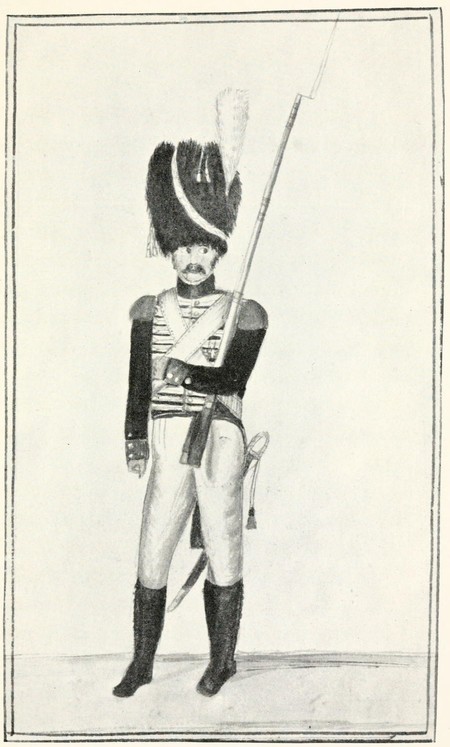
GARDE ROYALE. INFANTERIE CHASSEUR, IER RÉGIMENT
SÈVRE
August 7th.—A very honest man with a voiture was to come for us from Abbeville, and then we were to go home. We expected him on Thursday, but to our great joy he came to-day, two days sooner than was expected. The whole house was in confusion; I was so delighted that I hardly knew what to do. We set off directly to see the china manufactory at Sèvre. The day was very fine, and we had a most pleasant ride. The rooms in which the china was were up a long pair of stairs. In the first room there was nothing but plain white china: the plates are a franc apiece. There were beautiful large painted vases, some with landscapes on them, some purple, and others brown. Very pretty white baskets of flowers; three little children under lace veils made of white biscuit china. Curious-shaped salt-cellars; an inkstand the shape of a boat, etc.; several pictures, one of the King, the Duchesse d'Angoulême, Sappho, etc.; beautiful cups with humming-birds painted on them; a set of plates with flowers, jonquils, polyanthuses, etc., on them; another set with roses, and another with vegetables, with their names marked in gold; Bacchus and Ceres in a car drawn by bulls ornamented with wreaths of gold flowers—the figures are white; a set of plates with Eastern pictures on them, and another with birds beautifully painted. There are several very large vases: one with a purple ground that cost 27,000 francs. There is a large china table on which Minerva is represented presenting the Louvre and other galleries to France. Another table, on which there are different palaces, cost 35,000 francs. There were also some very pretty white ornaments, with cones on the top and baskets of grapes about them. On one plate there is a view of Windsor, and on another General —— drowning in a river in Egypt.
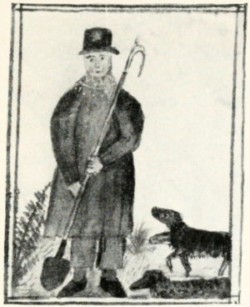
THE SHEPHERD OF THE ANDALUSIAN SHEEP (p. 151).
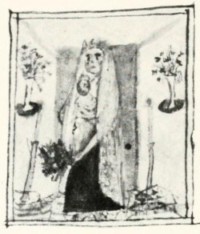
THE VIRGIN IN THE CHURCH OF ST. REMIS (p. 173).
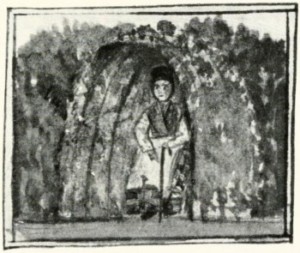
BEGGAR WOMAN IN A BOWER OF DEAD LEAVES (p. 170).
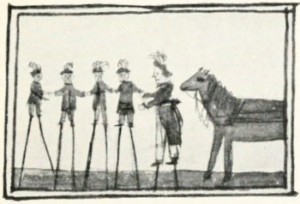
DANCING UPON STILTS (p. 167).
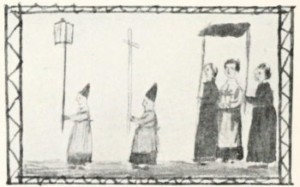
PRIESTS CARRYING THE HOST TO SICK PEOPLE (p. 155).
The man told us that china was much cheaper than formerly. There was a transparency in the window; and some round pieces of glass on which were feathers, flowers, sea-weeds, etc., made in the shape of birds. From Sèvres we drove to St. Cloud. We could not go in front of the palace because the King was there. I did not think it pretty; there were a number of stalls and shops near it which did not look well. There were a great many guards. We returned home by Ville Daure, a very pretty drive. As soon as we got home the whole house was in a bustle, as we were to set off next morning. We had shoes to buy, calls to make, bills to pay, clothes to get from the washerwoman's, masters to pay, gowns to get from Mademoiselle Bouillet, and things to pack up. In the midst of all this bustle, Nannette, who had gone up to Paris, had not returned when she promised, so we left Versailles without her knowing it. We tasted some green almonds at dessert, which were tasteless and insipid. The servants packed till two o'clock in the morning; they got the clothes from the wash at twelve at night. All was confusion, but every person was merry. It was the happiest day we spent in France. I went to bed with delight, happy to think it was the last night I should sleep at Versailles.
WEDNESDAY
August 8th, 1821.—We had a cool but pleasant day to begin our journey. Miss Wragge did not get her gown from Mademoiselle Bouillet till we were all in the carriage, and she declared she would not go without it, and told the man to drive off. At last after great bustling we set off at eleven o'clock; papa, mamma, Catherine and Caroline went before in the carriage, the rest of us went in the voiture. I never felt so little regret at leaving a place. I looked with joy at the houses and people, glad to think I should see them no more. We sang most part of the way. At a distance we saw the convent of St. Cyr. We passed the very long, fine aqueduct of Marli, and a small one further on. About here it was pretty country; there were a good many vineyards and orchards in corn. We had a view of Mount Calvary; near which we saw a set of gypsies by the side of the road. We then saw the Seine running through a pretty valley; and numerous vineyards continued to St. Germains, about which the country is pretty and well wooded. We stopped for some time at Poissy while the man rested his horses. The house was like a public-house, but the mistress was a civil little woman. There was a cloth on the table on which was some Gruyère cheese, a loaf of bread and some pears; we took the pears, which were very good: she charged a franc. She told us that an English lady had been staying there a month. There was a pretty view out of the window. We walked along beside the river, and got a nice view from the bridge; there were a number of washer-women beating their clothes, and the water was white with soap-suds. After we had left Poissy we saw several horses carrying corn; their backs being hung with sheaves in a very curious manner. The corn about here did not look good. There was a good deal of asparagus; in some places there were alternate rows of corn and asparagus. The man who drove us sang most of the time, and altered his voice: he had been in England, and he said that when he came back to France he could not persuade the people that in England it took only one man to shoe a horse. He had an English dog with him, which he said understood English, French, and Spanish. The name of the man was Jean de Grange. Here the country was not so pretty, as there are no hedges; the patches of corn and grass looked just like ribbons, particularly on the side of a hill. We reached Mantes in the evening. After crossing two bridges we saw a curious old church. The river looked full of soap; I think the water must be very unwholesome considering the quantity of soap which goes into it. We went to Hôtel du Grand Cerf. The floor of the parlour was boarded, and there were two vases full of artificial flowers; the people of the inn were civil. Two of our beds were in the parlour, from which they were divided by doors that shut like a closet.
August 9th.—We set off at a quarter to six. There were a few vineyards, but the country was not pretty as far as Châlons. The banks of the Seine are quite lovely, and the river looks well here, as there are several islands in it. We saw a boat full of cattle going across the river. There are a good many houses and vineyards on the banks. Further on there were rows of walnut and plum trees by the roadside, which looked very pretty. The corn looked fine, but very much laid. There were not any animals, except here and there a skinny cow tethered by the roadside. We breakfasted at Vernon. The room we were in was very shabby. In one corner of a room we passed through there was a queer jug—a boy sitting across a barrel. They brought us in an odd-looking teapot; the water was smoked, as the tea-kettle had no lid, and the tea tasted like herbs and water; the milk too was thymy, the butter bad, and the bread sour. We had been told that in this part of the country chickens were fourpence a pair; the woman here told us that they were three francs and a half. It was at Vernon we saw a man sitting at the door eating a raw artichoke and oil. After leaving Vernon there came on a heavy shower of rain. We saw several men mowing the corn. When it was fair, we got out at a cottage to gather some plums; the man shook the tree, and we picked up those that fell; we gave him half a franc, with which he seemed satisfied. We walked up a hill where we saw several butterflies; some with black and yellow striped upper wings, and under wings the colour of a dead leaf. There were rows of apple and pear trees; we picked up a few apples and pears which were not ripe; the apples were like alum and the pears like stone. The country was here much prettier: it was more like England; we even saw a few flocks of sheep, but they did not seem to get much: in one place they were eating the earth. As we were walking up the hill an old woman came to beg; the driver offered her a card of an inn, which he told her was a Bank of England note: she did not, however, take it, but turned away. There were several crucifixes in the villages and at the side of the road. The women about here had generally short petticoats, and very high caps. The babies were wrapped up in swaddling-clothes, like mummies. We stopt at Louviers. The inn was very poor and shabby. The mistress had on a curious cap with long muslin lappets. While dinner was preparing we walked through the town. We went into a curious old cathedral, where were several figures with candles burning before them, and some Virgins dressed with little veils, artificial flowers, etc. There were a great many people kneeling down and repeating prayers. We went into a shop to look for some caps, but they asked a great deal for the commonest, so we did not buy them. The women here all wore the high caps. There was one little boy with long flaxen hair, and the lady who was with him took off his velvet cap to shew us his hair. On our way home we saw the same man and boys dancing upon stilts that I had seen at Paris: there was a great crowd round them, and a woman went about collecting money, saying, 'Encouragez la petite famille.' When we reached the inn dinner had been ready some time. As soon as we had dined we continued our journey. We passed Pont Large in going out of the town. The country was beautiful, and we had another view of the Seine; they were making hay on one of the islands. Our eyes were quite refreshed by seeing two or three green fields hedged in, with a few cows feeding in them. Certainly if any person wished to have a pleasant impression of France they ought to come this way: it is beyond comparison prettier than the Calais road; the banks of the Seine are so beautiful. Near Rouen there is a chalk rock and several caverns with people living in them; and we had another beautiful view of the river. It was dark when we reached Rouen. It is an old, ugly town, but there appeared to be some good shops. We stopped at the Custom-house (there were a number of ships near it): they did not examine our trunks, but sent a person on to the inn with us. We went to the Hôtel de Normandie, which was all in confusion; the father of the people there was just dead: their mother had been dead two years. When papa and mamma asked what we could have for dinner, they said anything; after it was ordered, however, they brought in only very few of the things and said the table d'hôte had eaten it all: and then they brought in two raw pigeons and asked if we would like to have them dressed. One of the hotel servants had been at Brighton, and she said she was very sorry to leave England, and was going to try to get there again. She spoke English tolerably.
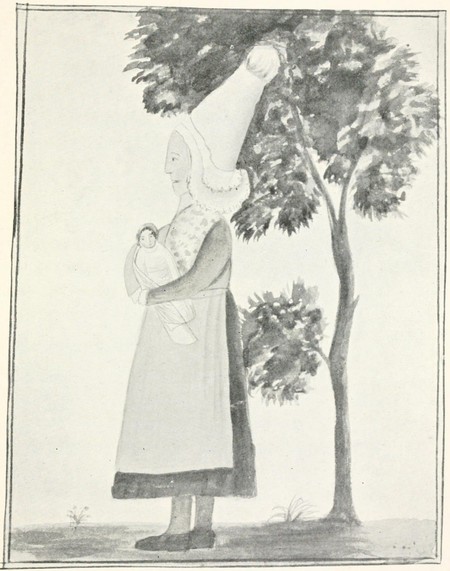
LOUVIERS WOMAN
August 10th.—Before breakfast we went to see the Church of St. Ouen, where there is a beautiful wheel-window over the organ. One of the churches here is like a coach-house. We set off again at nine. The streets we passed through were extremely narrow and dirty, and the town looked very busy, particularly about the shipping and river.[41] We had a fine view of a hill just out of the town. There were a few hedges here. We saw a coffin covered with black and white velvet on some chairs before a door, with several candles burning round it, and a procession of priests and boys with crucifixes at a distance. As we were walking up a hill we saw an old beggar woman sitting by the roadside in a bower of dead leaves: her petticoat was covered with patches of all colours; she begged of us as we went past. We also saw two very curious figures with gilt caps and red cloaks. We did not see near so many beggars this way as we did on the Calais road. We stopped at Tôtes, where we dined. Before dinner we walked out past a long building; we asked some women what it was: they told us it was a corn-market, which belonged to Madame D'Ossonval seigneur du village. We got sugared peas, etc., for dinner. After Tôtes, the country was pretty: there were hedges like England. A good many of the people here (especially the old women) wore ugly cotton caps and ribbons and crosses. We walked up a hill near Dieppe. I almost strained my eyes to see the sea; it was what I had wished to see for a long time; at last, when we had reached the top of a hill, we had a view of the sea and of Dieppe. We went to Taylor's English hotel. Out of the window of the sitting-room you look upon the ships: it is close to the harbour. This day we saw none of the curious caps we had heard about.
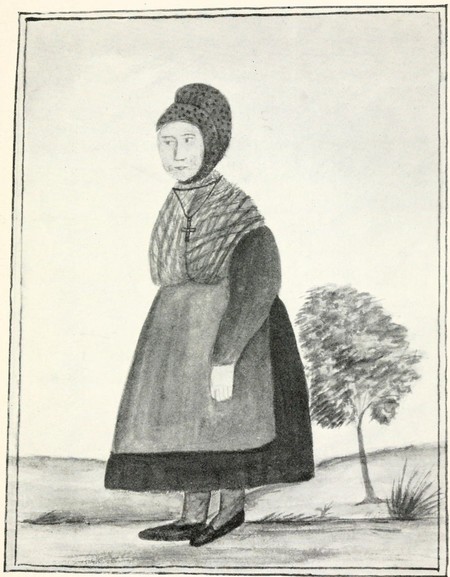
OLD WOMAN WITH A COTTON CAP
August 11th.—After breakfast we went into the market, where we saw quite as curious figures as we had expected. Some of the caps had lappets like butterflies' wings, and large bunches of hair turned up behind. We saw some of the hair hanging at a shop-door: it was coarse like horse-hair. A number of the people were dressed in black. We saw three women, like a mother and her daughters, coming in to market with baskets on their arms. They had on black gowns, aprons, and handkerchiefs; caps, the lappets of which blew out with the wind and showed a great bunch of hair; and gold ornaments about their necks. There was one woman selling fruit who had on a very curious cap: the frame was made of pasteboard, and the front of it covered with gold, silver, spangles, tinsel, etc.; round the top there was a long piece of muslin which hung almost to the ground. The women we saw in the market had their lappets pinned up. Some of the old women had on cotton caps. We passed several shops (in our way to the market) full of little ivory ships and figures beautifully cut. We walked up to the castle, from which we saw the whole of the town. We afterwards went on the cliffs on the outside of the castle, from which we had a view of the sea with several boats on it. A woman came and spoke to us about a house which she had to let; she spoke very bad French: she called cinquante 'shinquante.' I could hardly understand the Dieppe people; they spoke so much through their noses.[42] We wanted to buy a cap and a pair of sabots. We went into two or three shops before we could get a cap to our mind; we at last got a leno cap and an under cap to wear with it, such as the women in black wore, which was the most common kind. They told us that a gilt cap when new cost 20 francs. Our sabots cost sixpence: the old woman thought we intended to wear them, and said we ought to have a nicer kind. We asked several people the way to the Church of St. Remi: the people of Dieppe seemed to have a disagreeable manner. The Church of St. Remi is not beautiful. In one of the little chapels there was a small figure of the Virgin Mary with a child in her arms; her petticoats were painted scarlet, and she had on a lace veil, a crown, and a bunch of flowers in her hand. We went to see the Church of St. Jacques. There is a very pretty purple wheel-window over the organ; and in a kind of recess in the wall there were a great many figures holding a sheet covered with real flowers: before which there were twenty-nine candles burning; several people came and stuck in a candle. We looked into several of the little chapels: in one there was a virgin, in another a ship, in another some filigree work in frames. We dined at the table d'hôte. There were five English gentlemen. We could not sail this evening, as the wind blew into the harbour; so we went to buy pears to take in the ship next day. While we were buying the pears we observed a number of children standing about and looking at the fruit. Papa bought some currants and held them out to the children, upon which they all ran away; papa and the woman told them that the currants were for them, but they cried and seemed quite stupid. At last one boy rather bigger than the rest took courage and said to the others, 'Comme vous êtes bêtes'; and they all began to eat, except one little child who screamed and tried to get away, and a little girl who ran home. We were all anxious to go next day.
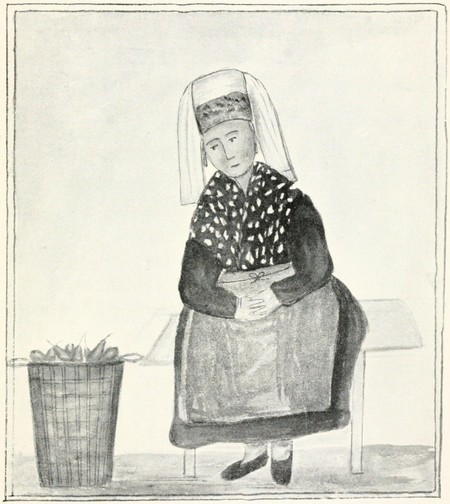
FRUIT-WOMAN WITH GILT CAP
August 12th.—We walked on the pier. There were a number of men working at the ships; and a great many people were walking about. The women had on full petticoats, coloured jackets, red aprons, queer caps, gold chains, long earrings, and large buckles. The children had high caps, and very full petticoats, so that when their backs were turned I took them for dwarfs. Even some of the babies had old women's caps and earrings.[43] Some of the people had very curious caps trimmed with lace; one had a cap with the crown filled full of frills. The most extraordinary-looking creatures were the fish-women: I could hardly tell whether they were men or women. They had on coarse canvas petticoats, so short that one could see their red garters; blue jackets, and canvas belts round their waists. They brought in a great deal of fish this evening on their backs, which they threw down in the streets. Soon after the Peace an English gentleman brought over twelve of these Dieppe fish-women to Brighton to see England; they galloped up and down the streets like wild things, stopping to drink at every public-house: he kept them for a day or two, and then sent them back. The sea looked so smooth and pretty we wished to be on it. We saw the Irish come in. We walked out again in the afternoon beside the chalk cliffs. There are a number of caves in them; one large one with doors at the entrance was full of barrels, etc., and in another was a very deep well. At each side of the pier there is a very large crucifix. Some men were employed driving in posts, and others in filling holes up with mud. There were more people to-day at the table d'hôte; amongst whom was a Frenchman who had a very rough voice; he had just returned from England from seeing the Coronation. He scraped out the inside of his roll, and eat a great many French beans and oil. In the evening we saw a child's funeral passing the window: the coffin was covered with a white cloth with flowers painted on it. We all got ready to go down to the ship. Papa had taken the ship for ourselves, as it was so disagreeable when we came to Calais with so many people. A lady begged that Miss Reed (her niece), who was sixteen, might go over with us, as her father was dead, and her mother wanted her home. She therefore went in the same ship with us.
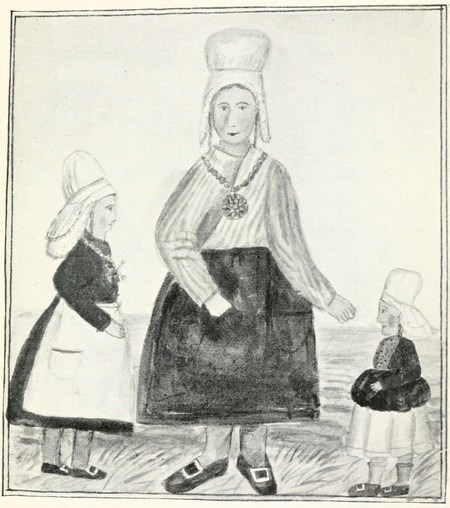
DIEPPE WOMAN AND CHILDREN
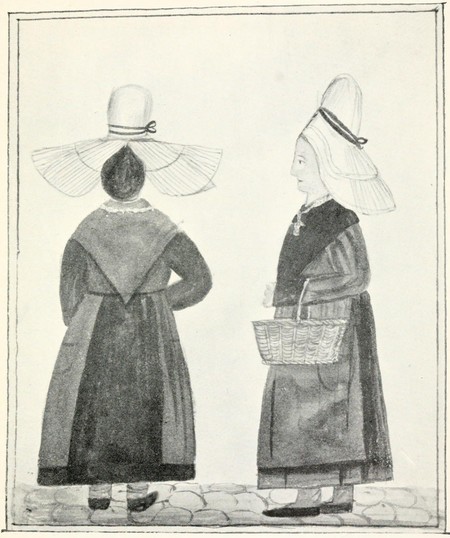
DIEPPE MARKET-WOMAN
SEA
August 12th, 1821.—We embarked at eight o'clock on board the Wellington, Captain Cheeseman: we got down to the ship by a ladder. The moon shone beautifully on the sea. The commissaire came after we were on board; he asked William how he liked France. William said, 'Je déteste la France,' and Stewart added, 'Et je déteste la France aussi.' We went to bed in the cabin, which was very nicely furnished; but the beds were small and uncomfortable. Soon after we felt the ship moving out of the harbour, and I thought with pleasure that I should awake far from France. Mamma and Catherine, who slept in another room, were pretty well; all the rest of us, except Euphemia, were very sick. The light went out, and papa was obliged to awake the steward, who was quite tipsy. The captain slept on the sofa. The steward went every now and then to a bottle, and drank out of it.
August 13th.—I awoke very sick. At ten minutes to six Euphemia went upstairs to see England. After we had had some tea I went on deck, where I lay down, very glad to leave the close, hot cabin. Euphemia was a very useful little person; she went up and down, and got us all we wanted. William and Stewart sang 'Merrily every bosom boundeth, merrily oh, merrily oh.' I raised myself up to see England; the sight of the white cliffs quite refreshed me. A boat came out at eight o'clock in the evening; it was very rainy, but we soon got on shore. We went to the Old Ship Inn; the beds were very comfortable.
ENGLAND
August 14th.[44]—This morning all our bones ached after being at sea, and everything seemed topsy-turvy. It rained so hard that we could not go out. The rooms looked very comfortable, and in the drawing-room there was a pretty clock, and fruit under glasses. There were two neat, civil chambermaids, who looked nicer than some of the French ladies. Our things went to the Custom House; they examined and opened out everything. We had to pay for all our books and drawings, and a smelling-bottle; and for two pipes which only cost twopence a-piece we paid eighteenpence, through a mistake of the servants about the price.
ARUNDEL
August 15th.—Before we set out for Mrs. Howard's[45] at Arundel we went to look at the Pavilion. I did not much admire it; it looks like some Chinese thing. We asked a man if we could go in front of it, but he answered very rudely that we could not. It was delightful weather when we set off. It so happened that both when we left and when we returned to England it was fine weather, and very cold while we were in France. I did not think the country about Brighton so very ugly as I had heard it was. We got on the first stage very quickly. We were particularly struck with the neatness of the cottages; most of them were covered with roses or vines, and the grapes were much more forward than they were in France. Everybody looked so genteel and nice, and the children so pretty. There is a steep hill going into Arundel, and one has a very fine view of the castle. Before Mrs. Howard's house there is a small terrace full of flowers; there were geraniums, and large myrtles growing out of doors, though in France they are obliged to take the laurels into the house in winter.
OWLS
August 16th.—It was very hot to-day. In the evening we went to see the owls at the castle. There is a great deal of fine ivy about the keep. There are altogether seven owls. One they call 'Lord Thurlow,' another 'Lord Ellenborough,' and two others 'barons of the Exchequer'; they crack their bills very badly. One that had come from Hudson's Bay could mew, bark, and make various noises. We afterwards went along a new walk they were making, and then through a field in which were some deer.
August 18th.—We were surprised to observe this morning that the sun was a bluish silver colour, more like the moon; we afterwards saw it was noticed in the newspaper. We went to see the dresses of Mr. Wyndham (the Catholic priest), who lived next door; he was a very civil old man, and used to bring us in apricots and gooseberries. His dresses were very splendid-purple, red, green, gold, etc. We saw the chapel; there were artificial flowers, gold candlesticks, etc., on the altar. As we were walking on the terrace we saw the Duke and Duchess of Clarence, the Duchess of Kent, and the Princess Fedor, the Duchess of Kent's daughter. We saw them afterwards in a carriage. I never saw any place with such swarms of children as Arundel; but I thought them very pretty after what I had lately seen. The weather continued oppressively hot.
CORONATION
August 24th.—We set off five minutes before seven. It was very foggy. There is a pretty hill and a good deal of wood going out of Arundel. After the fog cleared away it was excessively hot; every person looked half roasted. There were a number of pretty cottages; most of which, and even some of the sheds, were covered with vines, roses, and jessamines; there were also many remarkably fine hollyoaks before the doors. Every person looked clean and neat; there seemed to be no poverty: we did not meet with a single beggar. It was delightful to see the green fields full of sheep and cows, all looking so happy. There were several boats full of ladies on the Thames. We saw London some time before we were in it; it only appeared like a great deal of smoke. We scarcely saw any soldiers in London—very different to Paris! We arrived at the New Hummums, Russell Street, at half-past four. In the evening we went to Drury Lane and saw the Coronation. The first play was very ugly. The first scene of the coronation was a distant view of Westminster Abbey. There were a number of soldiers and people painted at a distance. The procession was very long and beautiful. The herb-women walked first, strewing the way with flowers; they were dressed in white, and pink roses on their heads, and the first had on a scarlet mantle. The king had on a crimson velvet robe with an immense long train covered with gold stars, and borne by seven pages. The second scene was the inside of Westminster Abbey: the ceiling was covered with scarlet drapery; there were a great many chandeliers, and one could not imagine anything more magnificent. There were painted people in the galleries, and real people at one end. There was a great deal of music and a large harmonica. The king went up to the altar, and they put on him a purple crown. In the third scene there came in a sailor who sang a curious song about the coronation. The fourth scene was the banquet. There were gold plates and such a number of lights that they made my eyes quite sore. The champion came in on horseback and threw down the glove: two other men on horseback followed him: the horses reared and plunged: a man in armour made of rings stood on each side of him. It was altogether beautiful. It was very hot.
August 25th.—Before we set off we went to Covent Garden market, and saw some beautiful fruit in the shop windows; we had not time to go through it, but what we saw was not to be compared to the flower-markets in Paris. We did not see anything here very pretty. It was excessively hot when we set off. We passed several pretty houses, and we stopped at Hampstead Heath to see Mr. and Mrs. Spedding.[46] We dined at Welwin, not a very good inn. There were several nice little girls dancing along with bundles of corn on their heads. We slept at Antonbury Hill. It was a nice inn, and the people were civil.
August 26th.—The weather to-day was quite changed: it was cold and rainy. We dined at Grantham. In one of the towns we passed through there were some soldiers and a band of music. We slept at Tuxford. It was a middling inn, and the people were civil.
August 27th.—The weather continued cold and disagreeable. We breakfasted at Bawtry. We passed Robin Hood's well. About Ferry Bridge we saw a number of people gathering teasels. We dined at Leeds: it is a dirty, disagreeable town. Numbers of children ran after the carriage; sometimes six or seven got up at a time; we had nothing to do but to watch for them. The country was very pretty. Before Otley there is an excessively steep hill; we walked down it: a number of children got up behind the carriage. We slept at Otley.