Book 5 — CHAPTER V. VEGETABLE LIFE AND ANIMAL LIFE IN THE MOUNTAINS.
W. H. Davenport (William Henry Davenport) Adams translation
THE same changes that we observe in the characters of vegetable life as we advance towards the Pole reproduce themselves, the reader will easily understand, as we ascend the mountain-sides. Only, in the former case the gradation is slow and scarcely perceptible; in the latter, it displays itself rapidly; in such wise that a distance of a few hundred yards in height is equivalent to a journey of several degrees in latitude. It is scarcely necessary to add that the warmer the climate, the higher we must rise to reach the belt or zone where flourish the species peculiar to Arctic countries.
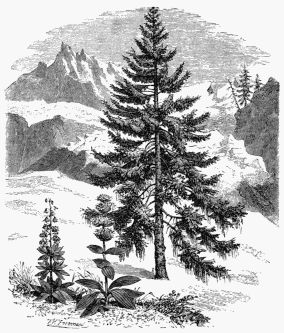
In every land the flora of the lowest region of the mountains is virtually the same as that of the adjacent plains, and it is only at an elevation of 300 feet that we discern a positive change of aspect. In temperate Europe, the Normandy fir and the Epicea begin to form, at that altitude, forests of considerable extent. These trees are from 120 to 150 feet in height, with a pyramidal configuration, sombre foliage, and drooping boughs, and whose bark takes to itself a clothing of various lichens (notably Usneas), the long filaments, branchy and yellowish, clinging to the branches of the most aged individuals. In the shadow of these resinous trees thrive the honeysuckle, the rose, the wild raspberry. At the base of the senile trunks are developed the crawling or climbing stems, ever verdurous, of various lycopodiums. In rocky localities the great yellow gentian unfolds its long spikes of golden flowers, in company with the elegant martagon, whose yellow-spotted red corollas are rolled up turban-wise. At a higher level, between 4500 and 6000 feet, the cembro pine, rare enough in France and England, more common in the mountains of Central Europe, and the larch, whose leaves fall every winter, are the last representatives of the true arborescent Flora.
1. Fir, with bearded Usnea. 2. Great Yellow Gentian. 3. Martagon, or Turk’s Cap Lily.

Still continuing our ascent, we meet now with nothing but an herbaceous vegetation. Here and there only, in turfy places and abrupt ravines, a few birches and some dwarf willows display themselves, scarcely taller than the herbs which surround them. It is in the rocky hollows also that the oleanders or ferruginous rhododendrons vegetate, sole representatives in Europe of a genus which among the Asiatic mountains numbers several species. The Flora of the Alpine prairies is, moreover, extremely varied. The Gramineæ dominate therein, but associated with other families which enamel with the most brilliant colours the bright green carpet of those cold regions; the bright yellow or orange of the Compositæ; the blue of the Phyteumas, of the Larkspurs, and the Campanulas; the rose of the Carnations and the Centaureas; the intense purple of the Ranunculuses (Nigritellæ). In the most arid localities we admire the azure flowers of the little Gentianellas and the white blossoms of the Saxifrages; their presence, under such conditions, filling our souls with wonder, and stimulating our hearts to praise their divine Creator.
“And with childlike, credulous affection, We behold their tender buds expand— Emblems of our own great resurrection, Emblems of the bright and better land.”[203]
Some of the plants which enrich the lofty slopes of the European mountains are endowed with an agreeable aromatic odour, and with keen stimulating properties. Such are the Artemisias and the Achilleæ. To the former of these families belongs the Artemisia glacialis, which the mountaineers consider an universal panacea, and which enters into the composition of the famous liqueur of the Chartreux.
On the threshold of the eternal snows, under the influence of the icy breezes, vegetation grows rarer and yet rarer, until it is reduced to a few species which compensate for their insignificance by their beauty. Such are the Campanula of Allioni, with its graceful bells of blue; the delicate Saxifraga, whose rosy flowers also expose their beauties on the frost-bound shores of Spitzbergen; the Soldanella of the Alps; the Ranunculus of the Glaciers; numerous Androsellæ, some of which do not exceed a third of an inch in height; finally, on the extreme border, and straggling even on the moraines of the Glaciers, where no other plant can live, the little Myosotis, which grows in small tufts covered with white down, and starred with delicate blue flowers. At a still higher level we find only a few lichens relieving the monotonous surface of the rocks; and sometimes, flourishing under unknown circumstances, the Protococcus nivalis, whose red globules communicate to the snow a blood-red tint.
The Mountain Flora will offer us, in other parts of the globe, the same series of diminution, commencing with the groups which people the low lands of each geographical zone, and terminating with those which, at the level of the sea, are met with only in the Frozen Zone. Some mountain-chains, however, possess genera or species exclusively belonging to them. It is on the ridges of Atlas and Lebanon, at an elevation of 3500 or 5400 feet, that the majestic cedars spread their umbrageous branches. The cedars of Atlas attain a stature of 120 to 140 feet, and their trunk measures, at the base, from a yard to a yard and a half in diameter. “When young,” says M. Charles Martins,[204] “they have a pyramidal form; but when they soar above their neighbours, or above the rock which protects them, there comes a sudden storm, a flash of lightning, or an insect pierces their terminal shoot, and deprives them of their shapely spire; the tree is discrowned; then the branches spread horizontally in terraces or layers of verdure, one upon another, screening the sky from the gaze of the traveller, who presses forward in a sort of twilight under these vaults impenetrable to the solar rays. From an elevated point of the mountain still more majestic is the spectacle. The horizontal surfaces resemble lawns of the deepest green, or of a glaucous colour like that of water, upon which are sprinkled cones of a violet hue; the eye plunges into an abyss of greenery in whose depth mutters an invisible torrent.”
Cedar of Lebanon.
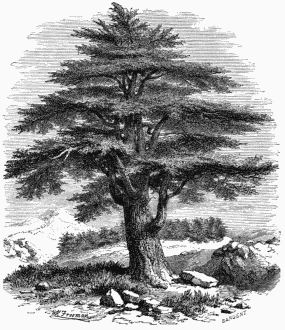
The cedar of Atlas constitutes, if not a species, at least a distinct variety from the cedar of Lebanon. The latter is now very rare on the mountain which is regarded as its native habitat. The prophet Ezekiel describes it in all its glory: “A cedar with fair branches, and with a shadowing shroud, and of a high stature ... his height was exalted above all the trees of the field, and his boughs were multiplied, and his branches became long, because of the multitude of waters, when he shot forth” (Ezek. xxxi. 3, 5). But those immense green forests which once stood out in dark deep shadow against the radiant sky are now reduced to a single scanty grove—a grove containing, according to Dr. Hooker, but four hundred trees, and of these four hundred only twelve of the ancient majestic race. They are situated high up on the western slope of the mountain-range, two hours south-east from Tripoli, and at an elevation above the sea-level of 6172 feet. Most of the Lebanon patriarchs are about 50 feet in height, and of nearly the same girth. One, however, measures 63 feet in circumference.
The cedar was introduced into England towards the close of the seventeenth century, and has become permanently naturalized. It is even found in a flourishing condition as far north as Inverness. It does not, however, attain such gigantic dimensions here as on the slopes of Lebanon. There is one at Goodwood, in Sussex, 25 feet in circumference; and another at Peperharrow, in Surrey, 15 feet. In the Jardin des Plantes a celebrated tree, whose terminal shoot was struck by a chance shot during the siege of the Bastile, boasts of the following proportions:-Ten feet girth at three feet from the ground, and ten feet and a half on a level with the soil. Its horizontal branches extend fully forty-five to fifty feet in length, and cover, consequently, a surface of upwards of 300 feet in circuit.
Rhododendrons of the Himalaya. 1. Rhododendron Pendulum. 2. Rhododendron Dalhousie. 3. Rhododendron Nivale.
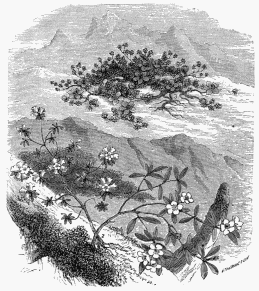
If we would now pass in review the complete series of Zones of Vegetation, it is to the north of Hindostan, in the Himalaya, or to South America and the Cordillera of the Andes, that we must transport ourselves. On the first steps, or lowest terraces, of these immense chains, we shall see the tropical Flora revealing all its wealth and its puissance; there, between 3500 and 6900 feet above the sea-level, we meet with nearly all the plants peculiar to temperate climes, and those which only belong to the northern lands. On the Himalayan slopes, the pine and the cedar flourish at an elevation of 7500 feet. Advancing from this limit, we soon encounter a great variety of Rhododendrons, a shrub now well known in our European gardens, and highly prized for its ever green foliage and rich full bloom. It thrives at the height of 12,000 feet; a few species even battle with the elements at an altitude of 15,000 feet, but they are then only stunted and crawling plants. With these are associated, at about 10,000 feet, the alder, the birch, and the willow. The plains are covered, at the same time, with a prodigious host of Ranunculaceæ, Compositæ, Saxifrages, and Pinnalaceæ, to which succeeds all the army of Lichens. Thus, then, it appears that the same laws determine always and everywhere the orographic distribution of plants. Only the influence of elevation is counterbalanced here by that of climate; whence it results that the arborescent species endure at a far greater height than on our European mountains.
In the same manner that the Himalaya “resumes,” so to speak, the Flora of all the climates of the Old World, does the Cordillera of the Andes, and, notably, that portion of the chain situated between Peru and Venezuela, present all the vegetable types of the New World, disposed upon its plateaux and its slopes as upon a gigantic flight of steps. In the lower region, the plants of Tropical America, favoured by a marshy soil, deck themselves out in their most gorgeous attire. At an elevation of between 1800 and 3500 feet, the vegetation is neither so brilliant nor so varied, but it has not yet thrown off its original character. We remark here a constant abundance of Myrtaceæ, Laurenaciæ, and Bignoniaceæ, as well as numerous epiphytous plants—Orchidaceæ, Ferns, Bromeliaceæ. From 3500 to 9000 feet we mark the successive appearance of plants belonging to the colder countries of North America: Escallionæ, Magnoliaceæ, Vacciniaceæ, and Solanaceæ. Here and there a few Bromeliaceæ and some other epiphytes display themselves. We encounter also in this zone a small number of Palmaceæ; among others, the Ceroxylon and the Diplothenium. But soon the arborescent vegetation almost wholly disappears, and only a few stunted bushes remain, similar to those which, in the Alps, succeed the larch. Then come meadows almost entirely formed of Compositæ, Umbelliferæ, and Saxifrages; and, finally, the Lichens, the last plants-the last forms of vegetable life—lingering on the frontiers of the region of eternal snow.
If the law which presides over the orographic distribution of plants were applicable to the animal kingdom, we should meet on the frozen crests of the mountains with the same species as, or, at least, with analogous species to, those we have seen in the vicinity of the Pole. But it is not so. Plants flourish wherever they can find, with an endurable climate, a soil in which their roots can develop themselves and imbibe the juices needful for their support; but the conditions which render a country inhabitable for animals—I mean the higher animals more particularly—are wholly different and more complex. A facility for removing from place to place in search of food is one of these conditions, and assuredly one of the most essential. But the number of terrestrial animals capable of climbing the scarped flanks, of traversing the narrow ridges, and leaping across the precipitous chasms of the mountains, is extremely limited. However, a few Herbivora excel in these perilous exercises. They are Ruminants of small size, with tiny limbs, and small ungulated hoofs; Moufflons, wild Goats, Chamois, Kids, which seek on inaccessible heights a refuge against the attacks of man and the Carnaria, and bound, with marvellous agility and precision, from rock to rock, from icy crag to crag, over the most formidable gulfs, and up the most precipitous steeps.
The Moufflons, or Wild Sheep, erroneously regarded by some naturalists as the ancestors of our domestic sheep, form a genus whose species are distributed in Asia, America, and Northern Africa, and in the mountainous islands of the Mediterranean. The Musmon Moufflon, which inhabits the mountains of Corsica, of Sardinia, of Cyprus, and of Candia, is nearly the size of a sheep, but far more robust. His hair, which is only wool properly so called, is a reddish-brown over nearly the whole of his body, and whitish under the belly and the legs. His horns are of great size, transversely crumpled, with a simple curve, and a sharp extremity. Among the Asiatic species the largest is the Masimon argali, which inhabits the Altaï and the mountains of Kamtschatka, and approaches the ass in size. His skin is a yellowish-brown, with some white on the fore-feet. His horns describe an almost complete circle. The American species is the Musimon montanus, which we find in the Rocky Mountains. Finally, the region of the Atlas and of the Aurès Mountains is the country of the Ruffled Moufflon (Moufflon à Manchettes), so named on account of his long hairs, which fall from his shoulders upon the extremity of his anterior legs. His neck is also supplied with a thick mane.
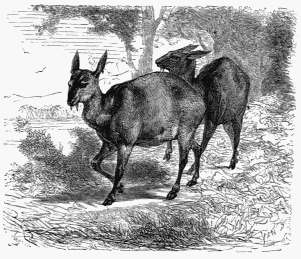
Musk-Deer.
The Wild Goats and Bouquetins probably form, as the best authorities represent, but one and the same genus. In any case the latter are much better known than the former. They closely resemble our domestic goats, from which they chiefly differ in the prodigious development of their horns, the said horns being generally knotty, slightly divergent, and supported by osseous axes. Their name, according to Gervais, comes from two words, Bouc-estain, signifying the Goat of the Rocks. They belong exclusively to the Old Continent. These animals are very wild. The precipitousness and lofty elevation of their pasture-grounds render their chase a matter of peril. The same may be said of the Chamois, or Isard, which inhabits the loftiest ridges of the Alps, the Pyrenees, and the mountains of Greece. Dogs are of no avail in hunting these animals. In Asia the falcon is employed in capturing the bouquetin. In Europe the chamois-hunters are excellent marksmen—indefatigable, fearless, capable of great endurance, keen, and vigilant. It is at morn and eve that they venture forth on their hazardous enterprise. The chamois wander in small troops. Their voice is a kind of low bleating; but when one of them descries approaching danger, he immediately raises a sharp cry, which is the signal of flight. Driven together and closely packed, the poor animals stand at bay, and dash themselves upon the daring hunter with an impetuosity which often proves fatal to him.
The Musk-Deer form a distinct family in the order Ruminantia. In their external conformation they resemble both the stag and the antelope, but they have neither horns nor antlers; their stomach is deficient in the part named the feuillet, which exists in all the other Ruminantia; finally, their upper jaw is provided with two long canines, which among the males project from the mouth, and which serve at one and the same time as defensive arms and as instruments to dig out of the soil the roots upon which these animals feed. All the species of this genus are Asiatic, except one, which is a native of Guinea. I can only particularize here the Musk-Deer of Thibet and Nepaul, which furnishes commerce with the curious product, so useful in medicine and perfumery, known as musk. This product is an extremely odorous and unctuous substance, contained in a special organ situated under the belly of the male. The high price which it commands would make the chase of the musk-deer very profitable, were not these animals so rare and so difficult to get at. They lead a solitary life among the scarped rocks and in the thorny bushes bordering on the glaciers. In winter they descend towards more temperate localities. They are caught either in snares or with nooses, or slain with arrows. The Tongusian hunters, to attract the musk-deer, imitate the cry of their young by applying the mouth to a fragment of bark. The chase is only pursued in winter and autumn. In Thibet the hunters require a special license from the government.
We may pass over the species of Rodents which burrow among the mountains, with a word of allusion to the traditional companion of the poor wandering Savoyard, the Alpine Marmot. This gentle and interesting animal is so well known to my readers that I need not pause to describe him.
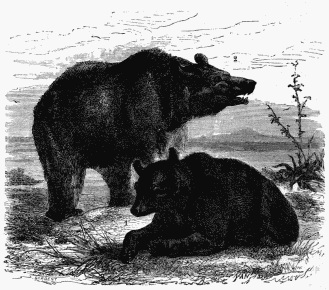
In the deep gorges and dense forests which break up the monotony of the lofty table-lands, live in fierce solitude the congeners of the “Man in the White Cloak” of the Polar deserts—Bears with a thick fur and of a sombre hue. While these animals seem designed by their organization to feed upon flesh, and while their strength enables them to seize upon the largest game—which, indeed, they occasionally do—their diet is omnivorous, and they even exhibit, in general, a marked predilection for the aliment of a vegetable nature. The reader, moreover, will remember with what eagerness the bears of our menageries and zoological gardens devour the bread, cakes, or fruit which their visitors press upon them. In their native mountain homes they will rather fly from man than attack him; but if assailed and closely pressed, they defend themselves bravely, rearing upon their hind-feet, and endeavouring to suffocate their aggressor with their muscular arms. If caught in their youth they are easily tamed, and display a greater intelligence than any of the other carnivora.
The genus Ursidæ, or Bears, is wholly wanting in Africa, but has its representatives in Europe, Asia, and America. The European species are: the great Brown Bear, formerly distributed over all the mountains and through all the forests of Western and Northern Europe, and which is still sufficiently common in the Alps, the Pyrenees, and some wooded highland districts of Russia; and the Bear of Asturias, found only in the sierras of the Iberian peninsula. The latter is of smaller dimensions than the former. His hide is tawny.
Asia possesses: the Syrian Bear and Bear of Lebanon, two varieties of the same species, distinguished by Horsfield under the name of Ursus isabella, in allusion to the dirty brown colour of his skin; the Boar of Thibet, which is found in the Himalayan chain and the islands of Japan—in size and appearance he approximates to our European bear, but differs in the blacker shades of his hair; the Malay Bear (Prochilus Malayanus), which is jet black, climbs trees with agility, and lives on a vegetable diet; and the Juggler, or Jungle Bear of India (Prochilus ursinus), originally named the “Five-fingered Sloth,”—a great favourite with the Indian jugglers on account of his adaptability and mildness.
1. Black Bear of Canada. 2. Gray Bear of North America.
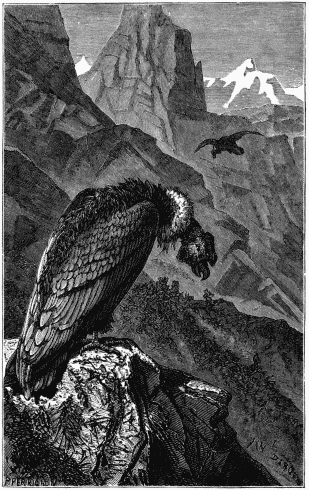
THE CONDOR OF THE ANDES.
To North America belong the Black Bear (Ursus Americanus) and the Grisly Bear (Ursus ferox). The former has a long head, a pointed nose, small eyes, and short round ears; his limbs are strong, unwieldy, and thick; his tail is short; feet large; and the hair on the body smooth, glossy, and black. The Grisly Bear is about nine feet long, a narrow and flattened muzzle, sunken eyes, and formidable teeth; he ranges over not only the entire chain of the Rocky Mountains, but in the prairies and forests which occupy the centre and west of the great continent, where his sanguinary instincts and prodigious strength render him a formidable antagonist. The Black Bear of Canada, on the contrary, is the least ferocious and least carnivorous of his genus. His chief food is of a vegetable nature—grain, fruits, and roots—but he does not disdain an occasional regale of pork. He commits great depredations on the maize-fields, and is also exceedingly partial to honey. From the nature of his food, his flesh is exceedingly succulent, and much relished by the Canadian settlers.
Ascend the wildest and most barren mountains, even to the limit where all life ceases to exist; or the flank of a perpendicular rock, in a crevasse, in some chink or fissure where the foot of man or quadruped may never rest; and there, were you able to approach sufficiently near, you would see some interlaced branches and stems, and within it a few fragments, a few gnawed and polished bones, while a strong odour scented the surrounding air. Regard it more attentively—some tiny creatures are astir upon that unclean couch. Yes: your gaze now rests on the eyry of one of those aërial tyrants, Eagles or Vultures, which alone can dwell on the cloud-crowned, wind-swept heights. I must confine myself here to mentioning the largest and most formidable species, which surpasses all the others in sweep and speed and power of flight—the Condor of the Andes. This bird possesses the habits and voracity of other vultures, and, as if conscious of his enormous strength, shows himself the most audacious. He frequently pounces upon living animals; but his non-retractile talons, blunted by their attrition upon the rocks, do not permit him to carry off his prey; he contents himself with fixing it against the ground with one of his claws, while he rends it to pieces with his powerful beak. Gorged with food, he becomes incapable of flight. You may then approach him; but should you attempt to seize him, he opposes a desperate resistance, and as he enjoys an extraordinary tenacity of life, the victory will probably cause you a prolonged struggle and many cruel wounds.
A story is told of a Chili miner, of more than ordinary physical force, who attacked—hand-to-hand, as it were—a condor while digesting his greedy banquet, and unable to make his escape. The engagement was long and desperate. The man was compelled to put forth all his strength. At length, exhausted, torn, and bleeding, he left his enemy on the field of battle, and carried off for a trophy a few feathers, which he showed to his comrades, affirming that he had never fought a harder fight. The other miners went in search of the corpse of this terrible bird. They found him standing erect, and flapping his wings in order to fly away. They only killed him by crushing in his head with a hatchet.
The condor enjoys the privilege of an exceptional longevity. The Indians of the Andean plains assert that he lives nearly a hundred years. He builds no regular nest; the female is satisfied with a hollow in the rocky cliff of sufficient size to shelter her while hatching her eggs. Both parents busy themselves very attentively in bringing up their young, disgorging in their beaks the food which they have themselves taken. The young birds grow slowly; it is not until they are six weeks old that they begin to flutter round their parents. Their training, however, lasts but a few months; after which they separate of their own accord from the male and female birds, and seek their own nourishment.
The condor has the loftiest flight of all the winged race. He has been seen towering in the “blue serene,” on a level with the snow-crowned summit of Illimani, 23,000 feet above the sea, in a region where man cannot endure the excessive rarefaction of the air. When, in the fulness of time, civilization shall have conquered to itself the South American continent, the condor, flying for refuge to these brain-wildering heights among the icy peaks of the Cordillera, shall be, perhaps, in that quarter of the globe, the latest denizen of the Desert—the last representative of The Savage World.
Index.
A, B, C, D, E, F, G, H, I, J, K, L, M, N, O, P, Q, R, S, T, U, V, W, X, Y, Z
Abbye-Singh, the tiger-killer, 310. Abyssinia, its physical features, 248; flora, 248-50; mountains, 596.—See also Shoa, Tigre. Abyssinian meadow-grass, 242. Acacia detinens, 257. Acacia doratoxylon, 279. Acacias, family of, their characteristics, 411. Acrostichon grande, 277. Actæas described, 261. Adansonia digitata (the Baobab), 409. Adour, the, valley of, 27. Africa, interior of, described, 186, 187; southern plateau, 187, 194, 195; its general physical features, 187, 188; Karroos of Southern Africa, 188, 191.—See Cape Colony, Central Africa, Equitorial Africa, Kaffraria, Kalihari, Natal, Senegambia. African elephant, characteristics of, 451. Agami, the, described, 354. Agouti, the, described, 342. Agua, the, described, 363. Ahu, the, described, 65. Akhaf, the desert of, 106, 109. Albert N’yanza, the, discovered by Sir S. Baker, 202. Alfa, the, described, 150. Alfourous, the, their manners, 525. Alleghany Mountains, the, character of, 216. Alligator, the, its natural history, 357, 358. Alligator lucius, 357. Aloe socotrina, 249. Aloes, various species of, described, 254. Alpaca, the, characteristics of, 334, 335.—See Huanacu. Alpine Squirrel, the, 499. Alps, the, referred to, 14; described, 589, 590. Alps, the Scandinavian, described, 588. Altaï Mountains, the, description of, 594. Amazon, forests of the river, their characteristics, 386, 387. Amboyna, island of, its species, 421. America, progressive civilization of, 205, 206; Spanish conquests in, 206, 209; probable future of, 209; character of its fauna, 281-283.—See North America, South America. Anastatica hierochuntica, 149. Andamanese, the, character of, 525. Andes, the, description of, 597, 598; Condor of, 613, 614; vegetation and character of the Pampas of, 228, 229. Androsellæ, the, described, 601. Annona (ox-heart), the, described, 246. Ant-eater, habits of the great, 346, 347. Anthropomorphic apes, natural history of, 470-487. Antilope Dorcas, the, account of, 169. Apache Indians, the, described, 335. Apalachian Mountains, the, features of, 597. Ape, the, natural history of, 463; habitat, 464.—See Baboon, Chimpanzee, Cynocephali, Cynopitheci, Gorilla, Monkey, Orang-Outang. Apennines, the, their character and aspect, 590. Apios tuberosa, 260. Aponogeton distachyum, 256. Apteryx Australis, its natural history, 377, 378. Aquila bifasciata, 75. Arabian Deserts, the, description of, 106. Arabs, the, their origin, 176; physique, 176; history, 176, 177; religion, 177; attachment to polygamy, 177; love of rapine, 177; religious zeal, 178; general characteristics, 178, 179; household wealth, 178, 180.—See Bedouins. Aralia crassifolia, 277. Ararat, Mount, its physical aspect, 595. Araucanians, the, their habits and manners, 541. Arctic discovery, reference to, and account of, 552-555. Arctic regions, the, described, 548.—See Polar Regions. Ardea alba, 72.—See Heron. Areca saccharifera, 418. Argæus, Mount, description of, 595. Ariel Gazelle, the, natural history of, 169. Aristida pungens, 148. Armadillo, the, natural history of, 345, 346. Arnee Buffalo, the, description of, 297, 308. Arnold, Matthew, quoted, 398, 591. Aroidaceæ, the, family of, 438. Artemisia alba, 151. Artemisia glacialis, 601. Artesian wells, 161. Artocarpus incisa, 414. Arundo conspicua, 275. Asiatic elephant, the, its natural history, 450, 451. Asimina triloba, 259. Asinus Quagga, the, natural history of, 291, 292. Ass, the, its habits and peculiarities, 56. Ass, Wild, the.—See Onagra. Astelia Banksii, 276. Asturias, bear of, described, 609. Atacania, the Pampas of, 219. Ateles, the, their natural history, 489, 490. Atkinson, T. W., quoted, 58, 77, 79, 88. Atlas Mountains, the, their situation and physical aspect, 124, 596. Atmosphere of mountain-regions, 582, 583. Aureilhan, lake of, 30. Australia, discovery of, 231, 232; its deserts, 232; rivers, 232; mountains, 235; adventure and exploration in, 235, 236; wilderness of, 237; expedition by Burke and Wills, 237-240; its flora, 273-281; its fauna, 366-378; its characteristic vegetation, 422-424; its aboriginal population, 522, 523. Auvergne, its extinct volcanoes, 591, 592. Avatsha, mount, 595. Aye-Aye, the, its natural history, 494. Baboon of the Atlas, the, described, 465. Bahiouda, desert of, described, 122, 123. Baker, Sir S., quoted, 202, 287, 288. Baleniceps, the, account of, 321. Balsams, the yellow, described, 261. Bamboo, the, its physiology and uses, 402. Bamunguatos Mountains, the, chain of, 196. Banana, the, its physiology and uses, 246, 249, 402, 403. Banyan, the, account of, 404, 405. Baobab, the, characteristics and discovery of, 409, 410. Barth, Dr., quoted, 204. Barbary Squirrel, the, account of, 500. Barren landes, the, described, 549. Bassia buttyracea, 410. Batata, the, account of, 242. Bates, H. W., quoted, 341, 347, 358, 386, 387, 388, 395, 396, 397, 434, 435, 446, 468. Batna, account of, 127. Baudouin, lake, description of, 114, 117. Bauhinias, the, characteristics of, 439. Bear, the Arctic, natural history of, 565, 566; adventures with, 567, 568; bear of Europe and Asia, 609, 610; of North America, 610, 613. Bear, the White, account of, 551, 566. Beaver, the, natural history of, 342; dams built by, 343, 344; mode of hunting, 345; gradual disappearance of, 345. Bechuana country, the, dryness of, 191. Bedford, Earls of, their works in the Fen country, 44. Bedouins, the, their manners, habits, religion, and warlike disposition, 179, 180. Beloor-tagh, mountains of, described, 595. Benguela, description of, 193; flora of, 251. Benin, climate and aspect of, 193. Berbers, the, their characteristics, 182. Betel-nut tree, the, account of, 422. Biafra described, 193. Bielukha, mount, described, 594. Biscarosse, lake, 30; forest, 38. Bisons, the, natural history of, 338; mode of hunting, 339; food, migrations, uses, 339. Bittern, the great, account of, 72. Black Bear, the, account of, 610. Black mosquito grass, 263. Black Mountains, the, 188, 212, 215. Black pepper, whence procured, 245. Black Swan, the, account of, 376. Boa-Constrictor, the, natural history of, 358, 359. Boars of America, account of, 330. Boitard, quoted, 456. Bolas, Indian, a mode of hunting with, 336, 337. Bonald, quoted, 503. Borassus flabelliformis, 401, 402. Bos arni, 297. Bos bubalus, 297. Boswellia serrata, 407. Botauris stellaris, 72.—See Bittern. Botocoudos, the, described, 539. Bradypus torquatus, 496. Brande, W. T., quoted, 60, 251, 252, 408. Bray, Mrs., quoted, 41. Brayera anthelmintica, 249. Brazil, Campos of, their physical aspects, 270, 271. Bread-fruit tree, its character and properties, 414, 415. Brittany, physical history of, 18-20; geology 18, 19; its Druidic monuments, 19; its landes, 20, 24; its inhabitants, 23; its dunes, or sand-hills, 32, 35. Brown Bear, the, account of, 609. Brun, Malte, quoted, 589. Brush-tailed Rock Wallaby, described, 375. Bryant, W. C., quoted, 216. Bubalus, the, described, 294. Bucephalus viridis, 327. Buckland, Dr., quoted, 447. Buckland, Frank, quoted, 328. Buenos Ayres, Pampas of, 226, 228. Buffalo, the, natural history of, 296; mode of hunting, 297; of Kaffraria, 295, 296. Buffon, quoted, 58, 71, 448, 479. Bull-frog, the, described, 363, 364. Buriäts, the, account of, 91, 92. Burke and Wills, Australian expedition of, 236-240. Burnett, quoted, 310, 313. Burton, Captain R. F., quoted, 514. Bustard, the, natural history of, 75. Butter-tree, the, natural account of, 411. Byron, quoted, 14, 135, 136, 201. Cæsalpineæ, the, account of, 445. Caimans.—See Alligator. Caladium segmium, 245. Calebash nutmeg, the, account of, 246. California, giant trees of, 430, 431. Calla, the, account of, 256. Callistimon salignum, 277. Callithrix sciurus, 490. Calomys bizcacha, 342. Camaroon Mountains, the, account of, 596. Camel, the, natural history of, 58-64; docility and usefulness, 58, 59; physiology, 59, 60; habits, 60-62; moral qualities, 62, 63; story of, 63, 64.—See Dromedary. Camel-herd, the, described, 318. Campanula of Allioni, the, 601. Campos of Brazil, vegetable life of, 272, 273. Canada, future prospects of, 209. Cannes, Keltic memorials at, 19. Cannibalism in Hindostan, 510; in Polynesia, 513; in Africa, 514; in Ombaï, 519. Caoutchouc, nature and properties of, 441, 442. Cape Colony, account of, 188, 191. Cape Eland, the, 295. Cape Negro, 193. Capim Gordura, described, 271. Capybara, account of the, 341. Caracara, the, account of, 355. Caraccas, the Llanos of, 268. Cariama, the, account of, 354. Caribs, the, their manners and customs, 538, 539. Oarnivora, the, habitat and history of, 167-169. Carolinea insignis, 437. Carpathian Mountains, the, account of, 592 Carrette, M., quoted, 166, 167. Carrion plant, the, described, 254. Caspian Mountains, the, 595. Cassanga, flora of, 258. Cassava bread, described, 242. Cassia, the, account of, 241. Casso, the, described, 249. Cassowary, the, natural history of, 318, 319. Castor fiber, 343.—See Beaver. Casuarina equisetifolia, 277. Cathartes, Urubu, the, described, 56. Catoblepus Gnu, the, described, 295. Caucasus, mountain-range of, described, 592. Cazau, lake of, 29, 30. Cebidæ, the, natural history of, 487, 488. Cedar-trees, in the Atlas region, 601, 602; in England, 603; in the Lebanon, 603. Celastrus edulis, 249. Central Africa, physical features of, 196-198. Cerastes, the, natural history of, 171, 172. Cercopithecus Diana, 469. Cercopithecus ruber, 469. Cereopsis, the, account of, 376, 377. Cereus Peruvianus, 266. Cervus Mexicanus, the, account of, 340. Cevennes, the, natural features of, 14, 591. Ceylon, reference to, 415. Ceza, Pierre de, quoted, 438. Chacma, the, described, 470. Chambers, William, quoted, 38. Chamois, the, natural history of, 607, 608. Characeæ, the, described, 259. Cheetah, the, natural history of, 310, 313. Cheiromys Madagascariensis, 494. Chilason, the, described, 68. Chiquitos, the, account of, 540. Chulon, the, described, 68. Ciconia, the, natural history of, 320. Civets, the, natural history of, 316. Citrulli, the, 257. Climate, influence of, 543, 544. Cloquet, Dr., quoted, 110. Clusia rosea, 437. Cobra, the, physiology of, 327, 328. Cocoa-nut palm, the, description of, 245. Cocos oleracea, 245. Coffæa Arabica, 245. Coffee-tree, description of, 245 Coleridge, S. T., quoted, 119, 120, 590. Colocasia mucronatum, 245. Colonial millet, account of, 242. Comanches Indians, the, habits of, 535. Common Buffalo, the, physiology of, 297. Common Squirrel, the, 499. Compass Berg, the, account of, 188. Compositæ, the, in botany, 253. Condor of the Andes, account of, 613, 614. Coniferæ, the, family of, 423, 424. Convolvuli, American, described, 439. Convolvulus Batatas, 242. Cook, Captain, voyages of, 232. Cooper’s Creek, in Australia, 236, 238. Copal-tree, the, properties of, 428. Coracan, the, account of, 242. Corchorus olitorius, 245. Cordilleras, the, physical features of, 267. Corral in Ceylon, the, 299. Corypha Australis, 281. Corypha inermis, 268. Cossacks, the, manners and customs of, 81, 82. Cotton-plant, the, in the Sahara, 158. Cow-tree, the, properties of, 388. Crawford, quoted, 406. Crocodile, the, natural history of, 322; mode of trapping, 323. Crotalus horridus, 359. Croton sebiferum, 407, 408. Cucamis, the, described, 257. Cucurbitaceæ, the, account of, 246. Cuon Bansu, the, described, 315. Curlew, the, natural history of 72, 73. Cuvier, quoted, 286, 345. Cycadaceæ, the, properties and nature of, 286. Cycas circinnalis, 421. Cygnus atratus, 376. Cynocephali, the, natural history of, 464; habits and propensities, 466. Cynopitheci, the, natural history of, 466, 467. Dante, quoted, 148. Darling, the river, in Australia, 235. Dartmoor, physical history of, 39; its tors, or granite hills, 40; morasses, 40; ancient forests, 40. Darwin, Dr., quoted, 341. Date-palm, the, its character, fruit, and uses, 154-156. Date-tree, the, thorny, properties of, 412. Daumas, General, quoted, 132, 164. D’Auret, Madame Leonie, quoted, 565. Daw, the, natural history of, 292. Dead Sea, description of, 99; its phenomena and desolation, 100; its basin, 101; probable origin, exploration of, 102; constituents and character of its waters, 105, 106. Deane, quoted, 20. Delegorgue, quoted, 301, 302. Delta, the, of the Nile, 102. Derrias, the, account of, 470. Deserts, the, of France, 13-38; England, 39-45; of Europe and Asia, 46-50; animal life in, 51-77; inhabitants of, 78-94; deserts of sand, 95, 96, 131, 132, 133; rainless deserts, 96, 97, 123; of salt, 97, 98, 110; of Persia, 97, 98; of Arabia, 106-117; of Africa, 118-134; phenomena of the Deserts, 139-148; vegetation in, 149-162; animal life in, 162-173; fauna of, 173, 174; inhabitants of, 174-185; of Africa, 186-205, et passim. Desfontaines, quoted, 465. Desmoulins, quoted, 558. Desplobado, Desert of, 229. De St. Blaize, M., quoted, 571-573. De St. Vincent, M. Bory, 569. Diard, quoted, 288, 289. Dima, the, account of, 249. Dinotherium, the, described, 447. Dioscorea alata, 242. Djemel, or Common Camel, the, 163-165. Dog-headed Opossum, the, described, 372. Dogs, the Prairie, so-called, 350-352; wild dogs, 313. Dolmens of Brittany, the, 20. Doranthes excelsa, 280, 281. Douc, the, account of, 468. Dracæna terminalis, 422. Dromedary, the, natural history of, 162, 163. Dryandra, the, nature and properties of, 280. Dryobabanops camphora, 418. Dseren, the, described, 67. Du Chaillu, quoted, 323, 481, 483. Duck-billed Platypus, the, characters of, 374, 375. Dunes, or Sand-hills.—See Sand-hills. D’Urville, Dumont, explorations of, 553. Dutch discoveries in Australia, 232. Dyer, quoted, 44 Eagles, adventure with, 75-77. Echidna, the, natural history of, 373, 374. Echinacea purpureas, 261. Egagra, the, reference to, 67. Egypt, desert of, described, 120; soil, 152; vegetable life of, 152-154; inhabitants of, 183, 184. Elæis Guinensis, 412. Eland, the, natural history of, 65, 66. Elburz, Mount, 592. Eleasine Corocana, 242. Eleasine Tocussa, 242. Electric Eel, the, its nature and phenomena, 364; mode of catching them, 365, 366. Elephant, the, natural history of, 286, 450; various species, habitat, mode of march, 451; treatment of the young, 451, 452; mode of entrapping, 452-455; elephant hunts in Hindostan and Ceylon, 455, 456; general characteristics, 456-459. Elephant Seal, the, 568. El-Kantara, Oases of, described, 158, 159. Ellis, Rev. William, quoted, 427, 527. Emerson, R. W., quoted, 516. Emu, the, natural history of, 375, 376; the “Wingless,” 377. England, colonial empire of, 209. Epacridæ, the, natural history of, 277. Ephedra, 264. Ephedra alata, 148. Epicea, the, described, 599. Equatorial Africa, expedition in, by Burton and Speke, 201; Barth and Denham, 203, 204. Erica Cavendishiana, 255. Eriocaulons, the, description of, 262. Eriodendron Samaüma, 388. Erosion, Desert of, its physical features, 128, 131. Eskimos, or Esquimaux, the, in Arctic America, their appearance, character, habits, and manners, 578. Etna, mount, description of, 590; physical character of, 591. Eucalyptic, or gum-trees of Australia, described, 279, 280. Euhydra tribus, 564, 565. Euphorbiaceæ, the, description of, 248, 254. Europe, invasions of, by Asiatic tribes, 79. Falls of the Zambesi, described, 198, 201. Felinska, Madame, quoted, 575. Fen country of England, the, described, 41; extent of, 42; ancient aspect, 42; modern landscapes, oases, drainage, 43, 44; present productiveness, 44; general character, 45. Fennec, the, characteristics of, 314, 315. Ficus Indica, or Banyan-tree, 404, 405; of the Indian Archipelago, 412. Fish Hawk, the, described, 356. Fishing Eagle, the, described, 355, 356. Flamingo, the, description of, 320; habits of, 321; varieties of, 353. Flax, Australian, its properties, 276. Fletcher, quoted, 24. Flying Squirrel, the, natural history of, 500, 501. Fontainebleau, forest of, described, 17. Forbes, Professor, quoted, 573. Forest, a petrified, account of, 117. Forests, their general features, 379, 380; botany of, 380; influence of, on temperature, and properties, 383, 384; in Europe and Asia, 384; in America, 385-389; flora of, 389-394.—See Woods. Forgues, M., quoted, 98, 99. Fox squirrel, the, natural history of, 500. Foxes, the Polar, characteristics of, 565. France, deserts of, described, 13, 14; mountains of, 14-17; forests of, 17; marshes, 17, 18. Fromentin, M., quoted, 132. Gallago, the, account of, 491. Gamboge, Indian, its uses, 415, 416. Gangeticus Crocodilus, 323. Gariep river, the, in South Africa, 191. Gascony, characteristics of the Llandes of, 24, 27-29; its sand-hills, 35, 36. Gavial, the, natural history of, 323. Gazella Sœmmeringii, 169. Gazelles of the Steppes, description of the, 169. Genets, the, natural history of, 316. Gentian, the yellow, described, 599. Gervais, M. Paul, quoted, 371-373, 466. Ghauts, mountain-range of the, in Hindostan, 595. Ghonds, cannibalism amongst the, 511. Gibbon, the historian, quoted, 178, 179. Gibbon-Lar, the, 478. Gibbon Monkey, the, character of, 470; habitat, and natural history of, 477; various species of, 477-479. Gibbon-Siamang, the, 477. Gipsies, the, their habitats, 84; their various names, and immigration into Europe, 85; peculiarities of, 86; in Russia, 87. Giraffe, the, natural history of, 293, 294. Glutton, the Arctic, described, 563. Gneiss mountains, characteristics of, 585, 586. Gnu, the, natural history of, 294, 295. Goat, the Wild, described, 67, 607. Goats’ Serpent, the, account of, 326, 327. Gobi, desert of, its physical features, 97; plateau of, 47. Goethe, quoted, 190. Goose, the Cerefaced, described, 376. Gorilla, the, natural history of, 481-486; its appearance and habits, 482, 483; mode of hunting, 484. Gossypium, the, account of, 407. Gould, quoted, 371. Grallatores, the African, characters of, 321. Gramineæ, the, family of, 437. Granite, structure of, 585. Grasses of the American Steppes, 267. Gray, Dr., quoted, 291. Gray Squirrel, the, account of, 499, 500. Great Karoo, the, described, 188. Green Climber, the, account of, 327. Grey, Sir George, quoted, 376. Grisly Bear, the, habits and physiology of, 610. Guacho of the Pampas, the, 230, 231. Guaiacum, its properties, 264. Guaranis, the, manners and customs of, 538, 539. Guatemala, flora of, 266. Guépard, the, natural history of, 310. Guiana, savannahs of, 245, 246. Guinea corn, its properties, 242. Guinea palm, the, character of, 413. Guinea pepper, nature of, 246. Gulo Arcticus, 563. Gymnoti, the, 364.—See Electric Eel. Gynerium saccharoides, 273. Haliætus Leucocephalus, 355. Hare, the Arctic, 561. Hare, the Varying, 67. Harpy Eagle, the, natural history of, 355. Harris, Major, quoted, 472. Heather-cock, the, described, 75. Hectia Pitcairniæfolia, 279. Helichrysum fruticosum, 255. Hell, Madame Hommaire de, quoted, 50, 58, 61, 62, 63, 81, 84. Helps, Arthur, quoted, 508, 515, 516. Hemionus, or Wild Horse, the, natural history of, 290, 291. Hemippus, or Wild Mare, the, natural history of, 291. Henna plant, the, properties of, 410. Heron of the Steppes, the, described, 72; species of, 72. Herschell, Sir John, quoted, 589. Herve and Lanoye, MM., quoted, 543, 549. Himalaya Mountains, configuration, structure, and vegetation of, 593; glaciers of, 594; cedars and rhododendrons of, 604, 605; flora of, 605. Hindostan, flora of, 398-401. Hindu reverence for the banyan, 405. Hippopotamus, the, natural history of, 286, 287; adventure with, 288. Homer, quoted, 49, 146. Honey-guide, the, why so called, 317. Honeysuckle, the Arctic, described, 556. Hooker, Dr. Joseph, quoted, 593, 603. Hops, the African, description of, 298, 299. Horace, quoted, 193. Horeb, Mount, description of, 112. Horse, the, in America, 350. Horse, the Wild, description of, 290. Hottentots, the, character of, 521. Howling Monkey, physiology of the, 488, 489. Huanacu, the, uses of, 335. Huc, the Abbé, quoted, 69, 70, 75, 76, 77. Hudson’s Bay, account of, 546. Humboldt, A. von, quoted, 48, 49, 78, 226, 268, 350, 359, 389, 439, 469, 555. Hungary, mountain system of, 592. Hurricane in the Steppes, account of, 230. Hyæna of the Cape, the, natural history of, 313. Hyæna villosa, 313. Hydrochærus capybara, 341. Hydrophis, the, account of, 378. Hylobates cinereus, 479. Hylobates leuciscus, 478. Hylobates syndactylus, 477, 478. Hyperborean races, the, their manners, customs, and characteristics, 570, 571. Ibis, the, natural history of, 321. Ice-fields, their aspect, 552. Ice-mountains, features of, 551. Ichneumon, the, natural history of, 316. Ignatia amara, 440. Immortelle, the, characteristics of, 255. India, palms of, their physiology, 401, 402. Indian millet, uses of, 242. Indian oak, its properties, 406. Indians of North America, their history and character, 532-534. Indigo, nature and properties of, 246, 407. Indigofera tinctoria, 245. Ipo-antiar, the, its nature and properties, 416, 417. Iron Bark Tree, the, uses of, 279, 280. Iron Mountains, the, vegetation of, 260, 262. Isonandra-Percha, the, its nature, 418. Jacana, the, characteristics of, 321. Jaguar, the, natural history of, 350. Jalapa officinalis, 439. Janin, Jules, quoted, 18. Jatropha manihot, 242. Java, vegetable life in, 418, 421. Jebel-Gaouss, reference to the, 128. Jebel-Tougour, reference to the, 127. Jephson, quoted, 20. Jerbilla, the, natural history of, 170, 171. Jerboa, the, natural history of, 170. Jocko, the, of Buffon, 479. Jomard, M., quoted, 147. Jordan, valley of the, its physical features, 101, 102. Kabara, the port of, 204. Kaffirs, the, character of, 520, 521. Kaffraria, physical features of, 191; flora of, 252-256. Kalihari Desert, physical features of, 191-193; flora of, 256, 257. Kalmüks, the, ethnology, religion, character, customs of, 83, 84. Kamtschatdales, the, physical features of, 577. Kamtschatka, mountains of, 595. Kanaks, the, 532. Kandelung valley, the, account of, 196, 197. Kangaroo, the Great, physical character, habits, and manners of, 368, 369. Karroos of South Africa, the, 188, 191. Keats, quoted, 196. Kenia, Mount, in Equatorial Africa, 597. Kerman, Desert of, 97, 98. Khaya Senegalensis, 410. Khirgiz, the, races of, 87, 88; customs, dwellings, attire, 89, 90, 91; character and mode of life, 91. Kilimandjaro, Mount, in Equatorial Africa, 597. Kina-balu, Mount, in Africa, 596. Kingsley, Rev. Charles, quoted, 42. Kite, the Black, reference to, 75. Kong Mountains, the, in Africa, 596. Kooloo-Kamba, the, 481. Koragum, the, described, 71. Koran, reference to the, 177. Kordofan, physical features of, 247. Korosko, Desert of, its physical features, 121, 122. Korsak, the, described, 71. Kuen-lun Mountains, the, in Asia, 595. Lacerta crocodilus, 322. Lagomys, the, natural history of, 561, 562. Landor, W. S., quoted, 282. Lanoye, F. de, quoted, 398, 401. Laorty-Hadji, Father, quoted, 101, 102. Laplanders, the, their character, occupation, mode of life, cradles, huts, and general characters, 571-573. Latham, Dr., quoted, 93. Lauraceæ, the, family of, described, 407. Laurus cinnamomum, 414. Lauture, Comte Escayrac de, quoted, 146, 147. Lavatera plebeia, 276. Lawsonia inermis, 410. Lebanon, mountains of, 595. Lecythis ollaria, 434. Leeba river, the, 197, 198; flora of, 257, 258. Leguminosæ, the, family of, described, 277. Leopard, the, natural history and anecdotes of, 303-305. Lepus variabilis, 67. Liana tieuté, described, 417. Lichen esculentus, 173, 174. Lignum vitæ, 264. Limoniastrum Guyanianum, 149. Linnæus (Linne), quoted, 428, 463, 471, 491. Linum marginale, 276. Lion, the, natural history of, 300; old fables respecting, 300; habits of, 301; general characters of, 303. Livingstone, Dr., quoted, 192, 195, 197, 198, 256, 257, 298, 299, 302, 303, 325, 326. Llama, the, natural history of, 333; anecdotes respecting, 337. Llaneros, the, account of, 220. Llano-Estacado, the, 219. Llanora, flora of, 266, 267. Llanos, the.—See Pampas. Lobata, plains of, 197. Loganiaceæ, the, family of, described, 417. Longfellow, quoted, 42, 128, 385, 600. Lorinthaceæ, family of, described, 251. Loris, the, natural history of, 491. Lucan, quoted, 165. Lund, Dr., quoted, 496. Lupata Mountains, in Africa, 191. Lyon, Captain, quoted, 566. Maca, the, account of, 229. Macropus giganteus, 368, 369. Madagascar, flora of, 424-428. Mahari, the, natural history of, 163, 164. Mahogany Tree, the, account of, 410. Maïs del Agua, 270. Makis, the, habits of, 492, 493. Malabar Squirrel, the, natural history of, 500. Malays, the, character and habits of, 526, 527. Mamanchota, Organ Mountain of, 587. Mammoth, the, natural history of, 448-450. Man, supposed analogy between the Ape and, 471; early history of, 515. Manchineal, the, nature and qualities of, 427, 440. Mandinké, the, tribe of, 518. Mandrill, the, described, 469. Mangrove tree, the, physiology of, 411, 412, 442. Manioc, the, properties of, 242. Manna plant, particulars of, 173. Mant, Bishop, quoted, 72-75. Mara, the, reference to, 342. Marmot, the Alpine, account of, 608, 609. Marquesas Islands, the, inhabitants of, 529, 530. Marsupials, their physiology and characteristics, 367.—See Kangaroo, Phalanga, Phascolarctos, Thylacyni. Martagon, the, described, 599. Martens of the North, the, account of, 562, 563. Martin, Sir Roger, his exploits as a tiger-killer, 310. Martins, M. Charles, quoted, 124, 127, 131, 132, 133, 136, 138, 154, 601, 602. Massaranduba, the, described, 388, 435. Mastodon, the, particulars of, 447, 448. Mauritia Palm, the, uses and importance of, 268. Maury, Captain, quoted, 526, 532, 533, 534, 586. Mauvaises Terres, in Nebraska, description of the, 212. Mediterranean, the, 542. Mekran, Desert of, 98. Melantha punctuata, 150, 154, 161, 601, 602. Mesembryanthema described, 253, 257. Mexico, Pampas of, 219; Savage Man in, 537. Michelet, quoted, 321, 322. Milton, the poet, quoted, 100, 197, 265, 393. Milton, Lord, and Dr. Cheadle, quoted, 385, 386. Milvus ater, 75.—See Kite. Minizan, destruction of, 38. Minosa, the, account of, 268. Mint, Australian, described, 276. Mirage, the, description of, 143; its effects and origin, 144, 145; explanation of, 146; characteristics of, 147, 148. Mohammed, reference to, 178. Mollugo cerviana, 253. Moluccas, Flora of the, 421. Mongolia, its position, history, present condition, ruined cities, 92; religion, races, and physical characteristics, 93, 94. Mongolian family, the, offshoots of, 175.—See Arabs, Shemites. Monkey, the, of the Old World, 468; of South America, 468, 488.—See Chacma, Derrias, Douc, Mandrill, Howling Monkey, Preacher Monkey, Red Monkey, Spotted Monkey. Monodora myristica, 246. Monostremata, the, natural history of, 373-375.—See Echidna. Montoir, marshes of, 17, 18. Moore, quoted, 98, 136, 143, 155, 156. Morin, quoted, 203. Mossamedes, gardens of, 251. Mosses, Arctic, properties of, 556. Moufflon, the, description of, 606. Mount Despair, 238. Mountains, the, atmosphere of, 582, 583; distribution and configuration of, 585; constituents of, 585, 586; of Europe, 588, 592, 597, 598; of Asia, 593-596; of Africa, 596, 597; vegetable and animal life of, 598-614. Mourad, Desert of, 127. Mpongwes, the, account of, 518. Mulhaçen, Peak of, in the Pyrenees, 591. Müller, Max, quoted, 79, 88, 92. Murray, C. A., quoted, 351, 352, 360. Murray, the river, 235. Musa, ensete, 249. Musimon argali, 606. Musimon montanus, 606. Musk-deer, the, 608. Musk-ox, the, 557, 558. Mustelidæ, the, natural history of, 317. Mycetes Beelzebub, 468, 469. Mycetes strumineus, 468. Myosotis, the, 601. Myrmecophaga piliata, 346-348. Myrsine variabilis, 277. Nadjed, table-land of, 111. Nandau, the, account of, 353. Nanguer (Gazelle), the, described, 169. Narsilia macropus, 276, 277. Nasalis larvatus, 468. Natal, coast of, 191. Nature, the study of, 428, 429. Negro Cynopithecus, the, described, 467. Negro, the, habitat of, 516, 517; his physical peculiarities, 517; in Africa, 517-521; in Australia, 522. Nelumbium calophyllum, 259, 262. Nepenthes distillatoria (or Pitcher Plant), the, described, 421. New Holland, rivers of, 232. Ngami, Lake, in Central Africa, 194; flora of, 257. Nieuveld Bergen, in South Africa, 187, 597. Niger, the, delta of, 193; valley of, 204. Nigritia, vegetation of, 246, 247. Nile, river, fecundity of, 118, 152; struggle between it and the Desert, 118; mountains of, 119; scenery of the valley of, 120; sources of the, 203; valley of, 152. Nipa fructicans, 418. North America, superiority of, over South America, 209; Deserts of, 210.—See Prairies. Noukahiva, islanders of, 530-532. Nova Zembla, described, 550. Nshiégo-Mbouvé, the, account of, 481. Nubia, women of, 184, 185. Nuphar lutea, 263. Nutmeg, the Calebash, account of, 246. Nux Vomica, its properties, 417. N’yanyizi-Nyassa, lake in Central Africa, 201. Nylghau, the, description of, 295. Oases of the Sahara, 128; their formation, 154; vegetable life of the, 155-157; of El-Kantara, described, 158, 159; of Ouargla, 159, 160; springs of, 161; precarious conditions of the existence of 161, 162. Œnothera macrocarpa, 261. Œstre, the, 558, 561. Ombai, inhabitants of, 528, 529. Onagra, the, natural history of, 291; description of, 56; properties and uses, 56-58. Ophidia, the, physiology and characteristics of, 224, 325. Oplismenus colonus, 242. Opuntia frutescens, 266. Orang-Outang, habitat of, 472; description of, 473; habits of, 473, 474; general details, 474-476. Organ Mountains of Brazil, described, 587. Orinoco, the river, 220, 223. Oriza sativa, its properties, 242. Ostiaks, the, described, 575; priests and worship of, 575; mode of hunting of, 576. Ostrich, the, natural history of, 317; anecdotes of, 318; American species of, 353. Otter of Kamtschatka, the, described, 564. Ouaregla, oasis of, described, 159, 160. Ouistitis, the, account of, 490, 491. Ourmiah, or Urumiyeh, Salt Lake of, 111. Ox, the, in America, 330. Paca, the, natural history of, 341, 342. Pachydermata, the, characteristics of, 285, 286. Palisades of the Hudson, 587; of the Rocky Mountains, 588. Palliser, Captain, his expedition of discovery, 385. Palmaceæ, the, physiology of the family of, 408. Palm Moriche, the, described, 268, 269. Palm tree, in Egypt, 152; growth of, in oases, 156; properties and uses of the fruit, 157; general details, 401, 402. Pampas, the, description of, 219, 220; inhabitants, 220; area and physical aspects, 220-231. Pampas grass, the, uses of, 273. Pampas Indians, the, characteristics of, 539, 540. Pampero, the, phenomenon of, 230. Pandarus candelabrum, 245. Panther, the, natural history of, 303. Papaw tree, the, character of, 442. Papuans, the, their manners and customs, 524, 525. Paradoxures, the, described, 316, 317. Paraguay river, the, 201. Pariah Dog of India, described, 315. Parkyns, Mansfield, quoted, 249, 462. Parry, Captain, expedition of, 580. Partux picta, 295. Pashiúba tree, the, account of, 388, 389, 446. Pasom, the, described, 295. Passiflora, the, order of, 439. Patagonia, Pampas of, their physical aspect, 227, 228, 273; vegetable life in the, 258-266. Patagonians, character of the, 540. Paullinia pinnata, 439. Peccary of America, its natural history, 330. Pecherais, the, their habits, 542. Pelican, the, natural history of, 74, 75. Pennant, quoted, 307. Pennicellaria spicata, 242. Pennisetum fasciculare, 275. Pernambuco, Pampas of, described, 219, 226. Perris, M., quoted, 37. Peru, conquest of, 206, 209; plains of, 267, 268. Petrogale brachiotis, 375. Petrogale penicillata, 375. Phacocœrus, the, natural history of, 289, 290. Phalanga, the, account of, 371. Phascolarctos, the, described, 370. Phascolomys (or Wombat), the, introduced into Europe, 369; discovery of, 370; description of, 371. Philippine Islands, the, vegetable life in, 423. Phlox, the, character of, 261. Picakolou, the, natural history of, 325, 326. Pimelia axiflora, 277. Pine Barrens of Mexico, the, description of, 215, 216. Pine of New Caledonia, the, 424. Pipa, the, account of, 363. Piper nigrum, 245. Pirates of the Desert, 175. Pistacia lentiscus, 148. Pistacia terebinthus, 148. Pistia spatulata, 264. Poa Abyssinica, 142. Polar Regions, the, extent and area of, 544, 545; of America, described, 545; of Asia, 549, 550; of Europe, 550, 551; discoveries in, 551-555; animal and vegetable life in, 555-568; characters of the inhabitants of, 569-579. Polecat, the Arctic, described, 563. Polynesia, cannibalism in, 513; inhabitants of, their manners and customs, 528-532. Pope, the poet, quoted, 151, 509. Porcupine Ant-Eater, the, natural history of, 373, 374. Porphyry, mountains of, 586. Portuguese, discoveries of the, in the Terra Australis, 231, 232. Pott, Professor, quoted, 86. Prairies of North America, description of the, 211-215; of Central America, 216-219; vegetable life in the, 258-266. Preacher Monkey, the, described, 468. Primeval Forests, the, characters of, 385, 386. Pringle, quoted, 194. Proboscideæ, the, physiology of, 447, 448. Protaceæ, the, account of, 256. Proteles Lalandii, 313, 314. Protococcus nivalis, 601. Psamma arenaria, 31. Pteris caudata, 271. Pteromys splendens, 501. Pteromys volans, 501. Pteromys volucella, 501. Ptolemæus, reference to, 151. Pudonta gigas, 345. Puff Adder, the, characters of, 326, 327. Puma, the, natural history of, 348, 349. Pyrenees, the, description of, 591. Pythecus lar, 478. Python Mouse, the, described, 325. Python of Sunda, the, described, 325. Quagga, the, natural history of, 291, 292. Quango, the, valley of, 258. Quarterly Review, quoted, 188. Quichuas, the, manners and habits of, 540, 541. Quicksands in Arabia, described, 110, 111. Quinquina, the, properties of, 441. Race, influence of, on the world’s history, 515, 516. Races of the Desert, their characteristics, 174-185. Radiquet, M. Max, quoted, 530, 531. Rafflesia Arnoldi, discovery of, 417; description of, 418. Rain in the Sahara, 155. Ratellus mellivorus, 317. Rattlesnake, the, physiology of, 359-361. Ravenala Madagascariensis, the, account of, 427. Reach, Angus, quoted, 29, 35. Red Monkey, the, peculiarities of, 469. Red Skins, the, ancient distribution of, 534; false romance with which they have been invested, 534, 535; various races of, 535, 536; physical peculiarities of, 536. Reinaondaban, the, account of, 210. Reindeer, the, natural history of, 558-561. Renan, M., quoted, 176. Rennie, John, reference to, 44. Retama Duriæi, 148. Rhinoceros, the, physiology of, 459, 460; its habitats, 460; the Indian species of, 460; Javanese, 460, 461; African, 461, 462; adventure with a, 462. Rhizophora mangle, 411. Rhus toxicodendrum, 259. Richardson, Sir J., quoted, 211, 561. Rocellæ, the, nature and properties of, 251. Rocky Mountains of North America, the, 210, 211. Rodentia, family of the, described, 169. Roebuck of Tartary, the, described, 65. Roggeveld Bergen, the, in South Africa, 187. Rose, Cooper, quoted, 462. Rose of Jericho, the, described, 149. Ross, Sir James, quoted, 556, 561; Arctic discoveries of, 554, 555. Rowe, Rev. J., quoted, 40. Rowe, Nathaniel, quoted, 300. Ruskin, J., quoted, 383, 384, 579. Saccharum officinarum, 246. Sachot, M. Octave, quoted, 527. Sagalien, inhabitants of, described, 579. Sago-palms, the, properties of, 421. Sahara, the African, its physical aspects, 123, 124; mountains, 127; oases, described, 128, 154; its peculiarity of aspect, 151; area, 151, 152; climate of, 155. Saiga, the, natural history of, 66, 67. Salsolaceæ, the, properties of, 148. Salt Desert, the, character of.—See Deserts. Salt-wort, described, 148. Samoiedes, the, history and character of, 573-575. Sand, Deserts of.—See Deserts. Sand-hills of Brittany, the, 32; their mode of formation, 35; of Gascony, 35; density and configuration, 36, 37; inland encroachments, 37, 38; their peculiar influence, 38; of Africa, 133, 134. Santalum acuminatum, 279. Sapucaya, or Monkey’s Nut, the, described, 434. Sarcoramphus Papa, the, account of, 354. Sarkha, Desert of, 97. Sarmiento, Mount, California, 598. Sarracenia, the, characters of, 262. Sassafras laurel, the, described, 261, 262. Savacou, the, described, 354. Savage Man, his abasement and mean pleasures, 503; his sanguinary instincts, 504, 505; his love of intoxicating drinks, want of a literature and of science, 505; his intellectual deficiencies as compared with Civilized Man, 506; his neglect of trade and commerce, imperfect conceptions of the Supreme Being, 507; sun-worship, 508; his priestcraft and superstition, 509; his low moral standard and cannibal tastes, 510.—For Savage Races, see pp. 516-542, and 569-679. Savannahs of Guinea, their features, 245. Savenay, marshes of, described, 17, 18. Saxifragas, the, properties and uses of, 601. Schomburgk, Sir R., quoted, 417, 439. Scindapsus pertusus, 421. Sciurus Alpinus, account of, 499; Carolinensis, 499, 500; getulus, 500; maximus, 500; vulgaris, 499; vulpinus, 500. Sea-Bear, the, natural history of, 568. Sea-Lion, the, natural history of, 568. Sea-shore Wolf, the, natural history of, 313. Seal, the, habitats, manners, and physiology of, 568. Sechura, pampa of, described, 219. Senegal, serpent-worship of, 323; serpents of, described, 324. Senegambia, physical features of, 240, 241; flora of, 241; cereal growth of, 241, 242. Sennaar, physical features of, 247. Sensitive plant, the, described, 268. Serpent-Bird, the, of the Cape, natural history of, 321. Serpents of the Steppes, the, described, 77; of Asia and Africa, 323-328.—See Ophidia, Viper. Shakspeare, quoted, 322. Shekanis, the, account of, 518, 519. Shelley, the poet, quoted, 43, 105, 379. Shemites, the, characteristics of, 175, 176.—See Arabs, Tibboos, Touraregs. Shepherd races of Asia, their history, manners, customs, and character, 78, 79. Shirwa, Lake, in Africa, 201. Shoa, vegetable life in, 249. Short-eared Rock Kangaroo, the, natural history of, 375. Silk-cotton tree, the, properties of, 388. Silphium laciniatum, 260. Silphium terebinthinaceum, 266. Simoom, the, phenomena and effects of, 135-138. Sinai, Mount, physical aspect and associations of, 112, 113, 114, 597. Sioux Indians, cemeteries of the, 215. Sivas, quicksands of, described, 110, 111. Skags-tol-tind, Mount, referred to, 588. Sloth, natural history, habits, and manners of the, 494-496.—See Three-toed Sloth, Two-toed Sloth. Smilax rotundifolia, 259. Smith, Sydney, quoted, 274. Smyth, Admiral, quoted, 590. Sneebergen, mountain-range so called, 187, 597. Snow, perpetual, limit of, 581. Socotrine aloes, value of, 249. Solidungulæ, the, order of, 290, 291. Somerville, Mrs., quoted, 97, 98, 211, 223, 589. Sonnerat, M., quoted, 494. Sorgho grass, properties of, 242. Southey, quoted, 404, 405, 508. South America, inferiority of, to North, 209; its deserts, 210.—See Pampas, Virgin Forests. Spain, its conquests in America, 206, 209. Spenser, quoted, 356. Sphagnum, the, properties of, 556. Spider Monkey, the, described, 489, 490. Spitzbergen, description of, 550, 551. Spotted Monkey, the, described, 469. Squirrel, the, natural history, habits, and characteristics of, 497-499.—See Alpine Squirrel, Barbary Squirrel, Common Squirrel, Flying Squirrel, Gray Squirrel, Malabar Squirrel. Squirrel Monkey, the, 490. Stag, the Spotted, described, 340; Yellow, described, 57. Staghorn, the, described, 277. Stanley, Dean, quoted, 99, 100, 101, 137. Stapelia hirsuta, 234. Steppes, the, in Europe and Asia, their extent, 46, 47; their plateaux, 47; their vegetable life, 47-49; phenomena connected with, 49, 50; animal life of, 51; ornithology, 71-77; herpetology, 78; inhabitants, 78. Steppes of South America, the, surface of, 220; vegetation, swamps, and conflagrations of, 221-224; a night on, 225; inundations of, 226; solitude of, 227; Steppes of Patagonia, 227, 228; Buenos Ayres and the Andes, 228, 229; of Desplobado, 229; hurricanes of, 230; animal life of, 230, 231. Sterculia acuminata, 445. Sterculiaceæ, the, family of, 411. St. Hilaire, Augustus, quoted, 539. St. John, Spenser, quoted, 596. Stipa crinita, 279. Stipa tenacissima, 150. Stocqueler, quoted, 309. Stork, the, description of, 320. Strachey, Captain, quoted, 593. Strelitza regina, described, 256. Struthio camelus, 318.—See Ostrich. Strychnine, nature and properties of, 417. Styraceæ, family of, their characteristics, 406. Sugar cane, history of, 246. Sugar palm, the, described, 418. Sumatra, vegetable life in, 416, 417; cannibalism in, 511, 513. Sun, worship of, once prevalent, 508. Surinam toad, the, described, 363. Swamp oak, the, qualities of, 277. Swan’s Marsh, the, reference to, 259. Swietenia Mahogani, its uses, 410. Table Mountains, the, geography of, 597. Talfourd, Sir T. N., quoted, 504, 505. Tallow tree, the, properties and uses of, 408. Tamanoir, the, described, 346. Tamarind, the, characteristics of, 411. Tamias, the, account of, 502. Tanganyika, Lake, in Central Africa, 201, 202. Tanguen, or Tanghin, the, properties of, 427. Tapioca, commercial value of, 242. Tapir, the, 288, 289; natural history of the American, 328; mode of defence, and peculiarities of, 329, 330. Tarpan, the, natural history of, 51-55; reference to, 291. Tartar-Nogaïs, the, their territories, customs, and religion, 80, 81. Taro, the, account of, 245. Tarsi, the, description of, 492. Taylor, Henry, quoted, 210. Taylor, Tom, Professor, quoted, 20. Tchad, Lake, discovery of, 203, 204; description of, 204. Teak, the, properties and commercial value of, 406. Tegeter, Mount, referred to, 247. Telfaria pedata, the, described, 246. Temperature, laws affecting, 580. Teneriffe, peak of, described, 597. Tennyson, quoted, 14, 28, 44, 151, 231, 596. Tété, flora of, 258. Texas, vegetable life of, 262-266. Theobroma cacao, properties of, 245. Thibet, bear of, 609. Thomson, quoted, 119. Thrasaëtus, 355. Three-toed Sloth, the, natural history of, 496. Thylacyni, the, natural history of, 371-373. Ti, the, described, 277. Tibboos, the, of Africa, their habits and character, 181-183. Tierra-del-Fuego, inhabitants of, 541. Tiger, the, natural history of, 305; described by Buffon, 306; by Daubenton, 306; characteristics, habits, swiftness of, 307, 308; mode of hunting, 309, 310. Tiger-cats, the, description of, 429. Tigré, geological features of, 248; flora of, 248, 249. Tillandra usneoides, 264, 265. Tip, desert of, 111. Toads.—See Agua, Bull-Frog, Surinam Toad. Tocusra, the, 242. Todea Africana, 256. Toothache-tree, the, described, 264. Topaz, the, account of, 540. Touaregs, the, of Africa, their manners, habits, and characteristics, 181-183. Trachytic rocks, character of, 588. Traveller’s tree, the, described, 279, 427. Trecul, M., quoted, 254, 263, 264, 266. Tree-ferns, their character, 436, 437. Trees, colossal, of Peru, 387-389. Tremaux, M., quoted, 120, 137, 184, 185. Tremblet, M., quoted, 183. Trichecus, 568. Trigonocephalus, the, description of, 361. Tristegis gluttinosa, 271. Tristram, Rev. H. B., quoted, 96, 97, 128. Trumpet-Bird, the, description of, 354. Tumboa, the, physiology of, 251, 252. Tupinambis, the, described, 172. Two-toed Sloth, the, natural history of, 496, 497. Unau, the, described, 496, 497. Unghandia speciosa, 265. Upas-tree, the properties of, 416; fables relating to, 417. Upper Guinea.—See Senegambia. Ural Mountains, the, geology of, 592. Urceola elastica, 418. Uvaria Æthiopica, 246. Vaquois, the, character of, 421, 428. Varan of the Nile, the, described, 173. Varans of the Desert, the, natural history of, 171-173. Variegated Baboon, the, account of, 469. Venezuela, pampas of, 220-226. Vesuvius, Mount, description of, 590. Vibro, the genus, 429. Victoria N’yanza, Lake, discovery and account of, 202. Victoria regia, the, history and description of, 269, 270. Vicuña, the, natural history of, 335-337. Vine, the, account of, 246. Viper, the camel-headed, description of, 361-363. Vipera cerastes, the, natural history of, 171, 172. Vipers, the, of the Desert, 166, 171, 172; of South Africa, 325, 326. Virgin Forests, their extent and characteristics, 385-392; vegetable life in, 393, 394; a day in, 395-397. Vistula, the river, 592. Vitis vinifera, 246. Viverridæ, the, natural history of, 316, 317. Vizcacha, the, described, 342. Vouabembés, the, cannibalism among, 514. Von Martins, the traveller quoted, 387. Von Tschudi, quoted, 229, 333, 334, 337. Vosges, the, mountain-range of, 14, 591. Wallace, Mr., quoted, 329, 330. Walrus, the, natural history of, 568. Water-lily, yellow, the, described, 263. Water snake, the, habits of, 378. Waterton, the naturalist, quoted, 495, 496. Wells in the Sahara, 161. Welwitsch, Dr., quoted, 251. Welwitschia, the, described, 251, 252. Whirlwinds of sand, description of, 141, 142. White, Walter, quoted, 45. White wormwood, the, properties of, 150, 151. Whydah, serpents at, 324. Wilkes, Admiral, quoted, 541, 542; Arctic discoveries of, 553, 554. Wills, W. J., quoted, 236, 238. Wilson, Alexander, quoted, 355, 356. Wistman’s Wood, description of, 40, 41. Wolf of Tartary, description of, 68; his ravages, 68-70. Wombat, the, 370.—See Phascolomys. Wood, Rev. J. G., quoted, 343, 344. Woods of Europe, their aspect and characteristics, 397, 398. Wordsworth, quoted, 177, 209, 247. Wourali, the poison, deadly nature of, 439. Wou-wou, the, natural history of, 478. Wrede, Baron de, quoted, 107, 110. Xanthorrœa arborea, 278, 279. Yakoutes, the, their habits and mode of hunting, 576, 577. Yucca tréculeana, 266. Yvan, Dr., quoted, 587. Zambesi, the, course of, 195, 196; delta and cascades of, 198, 201; vegetation of, 258. Zana, Lake, vegetation on the shores of, 247, 248. Zebra, the, natural history of, 292. Zebra Wolf, the, natural history of, 372. Zibeth, the, described, 316. Zopelotes, the, described, 354. Zorga, the, account of, 194.
List of Illustrations.
WHOLE PAGE ENGRAVINGS.
1A Pyrenean Landscape, 15
2Celtic Memorials in Brittany,21
3The Shepherds of the Landes,25
4A Flood in Brittany,33
5Wild Horses terrified by a Storm,53
6The Dead Sea,103
7Caravan in the Desert,107
8Lake Baudouin (a Salt Lake),115
9Landscape in the Atlas (Region of Tablelands),125
10The Sahara (Desert of Erosion),129
11French Column surprised by the Simoom,139
12Night-Scene in the African Interior,189
13Victoria Falls, River Zambesi,199
14Prairies of North America,207
15View of the “Mauvaises-Terres,” Nebraska,213
16A Prairie on Fire in Central America,217
17Pampas of South America,221
18Australian Landscape,233
19Vegetable Life in the African Plains,243
20Tiger hunting in the Indo-Chinese Peninsula,311
21Hunter pursued by Peccaries,331
22The Virgin Forest of the Gaboon,381
23The Virgin Forest in Brazil,391
24Tropical Vegetation,399
25Flora of the East Indian Islands,419
26A Forest in Madagascar,425
27Flora of the New World,443
28Hunting the Elephant in Africa,453
29A Corral in Ceylon,457
30Death of an Orang-Outang,475
31A Gorilla killing a Negro,485
32A Cannibal Feast among the Battas of Sumatra,511
33The Desert of Ice (Arctic Pole),547
34The Reindeer of Lapland.559
35The Condor of the Andes,611
VIGNETTES.
1The Tarpan, or Wild Horse,51
2Onagra, or Wild Ass,57
3Bactrian Camel,60
4The Eland,65
5Capture of a Wolf by a Kirghiz Horseman,69
6Great Bittern—White Heron—Curlew,73
7The Eagle of the Steppes, and the Antelope Saiga,76
8Cossack Horsemen in the Steppes,83
9Night Encampment of Gipsies in the Steppes,87
10Khirgiz Aoul or Village,90
11Mount Sinai,113
12Ravines of Korosko,122
13Whirlwinds of Sand,141
14A Mirage in the Desert,145
15Jujube Tree—Lentiscus—Tamarisk,150
16Doum-Palm—Date Palm—Alfa,153
17A Street in Ouargla,159
18The Mahari—The Djemel,163
19Striped Hyænas of the Sahara,165
20Jackals disinterring Dead Bodies,166
21Gypaëtos—Sociable Vulture—Cathartes Percnopterus,167
22Gazelles—Antelope—Nanguer,169
23Gazelles of Arabia opposing a Panther,170
24Jerboas attacked by a Horned Viper,171
25Varan of the Nile—Varan of the Desert,172
26Bedouin Shepherds and Bedouin Nomades,180
27Touaregs,181
28Attack upon a Q’sour,182
29Nubian Women,184
30Burke, Wills, and King in the Deserts of Central Australia, 239
31Vegetable Life in South Africa,250
32Vegetable Life of Cape Colony,253
33Vegetable Life of Cape Colony,254
34Vegetable Life of Cape Colony,255
35Vegetable Life in the American Prairies,261
36Vegetable Life in Texas,263
37Vegetable Life in the Texan Prairies,265
38Vegetable Life in the Plains of the Meta,269
39Aquatic plants of Guiana,271
40Vegetable Life in the Pampas,272
41Vegetable Life in Victoria,276
42Vegetable Life on the Australian Plains,278
43Vegetable Life on the Australian Plains,280
44Hippopotamus and Crocodile of the River Nile,286
45Rhinoceros,289
46The Daw and the Quagga,290
47Zebras,292
48A Lion rending a Giraffe,294
49Antelope Gnu—Oreas Lanna—Striped or Banded Gnu,296
50An African Hopo,298
51The African Leopard,304
52Spotted Hyænas,314
53Zibeth and Indian Genet,315
54Striped Parodoxure devouring a Crested Goura,316
55Ostriches,319
56Rose Flamingoes,321
57Python Molure—Echidna—Fennec,326
58American Tapir,329
59Guanaco—Llama—Vicuña,337
60Agouti—Capybara,340
61Armadillo Loricata—Ant-Eater,347
62Cougouars, or Pumas,349
63Bison attacked by Jaguar,350
64Prairie Wolves,351
65Cathartes-Urubu—King of the Vultures,355
66Alligators, or Caimans,357
67Crotalus, and Boa-Constrictor,360
68Trigonocephalus pursued by Birds,362
69Bufo Agua—Pipa Surinamensis,364
70Fishing for Gymnoti,365
71Large-Browed Wombat,369
72Thylacynus Cynocephalus,372
73Ornithorhynchus—Echidna,374
74Apteryx Australis,377
75The Banyan Tree,404
76Baobab—Guinea Palm—Acacia verek,409
77Bread-fruit Tree of Ceylon,414
78Nipa fruticans—Sugar Palm—Ipo-Antiar,416
79Ravenala Madagascariensia—Heritiera argentea—Tanghin,424
80Large-leaved Magnolia—Virginian Catalpa—Pinas Sabiniana,431
81Blechnum Brasiliense—Alsophila horrida—Panicum plicatum—Maranta—Caladium violaceum,436
82Banana—Carolinea insignis—Clusia rosea,438
83Kaffir Hunter carried off by a Rhinoceros,461
84Baboons plundering a Garden,466
85The Black Cynopithecus,467
86Gibbon-Siamang, and Mourning Gibbon,478
87Howling Monkeys,488
88Ateles crossing a River,489
89Maki-Mocoas—White-Mantled Maki,493
90Cheiromys, or Aye-Aye of Madagascar,495
91Aï-Unau,497
92Common European Squirrels,498
93Negroes: Natives of Kidi, Africa,519
94Kaffir Warriors,520
95Hottentots: A Man and Woman,521
96Australians,523
97Papuans,524
98Malays: Male and Two Females,527
99Hovas of Madagascar: Men, Woman, and Child,528
100Warriors of the Island of Ombai,529
101Islanders of Noukahiva,531
102Indians of North America. The Red Skins,533
103Indian Women of North America,536
104The Apaches attacking an Emigrant Train,537
105Guarani Indians (South America),538
106Patagonians,539
107Adelie Land (Antarctic Ocean),554
108Ermine and Sable-Marten,563
109The White Bear and her Cubs,567
110Lapland Fishers,572
111A Samoiede Family,574
112Yakout Warrior worried by a White Bear,576
113Kamtschatdales,577
114The Organ Mountains of Rio Janeiro,586
115The Himalayas: Mount Guarisankar,594
116Fir, with Bearded Usnea—Great Yellow Gentian—Martagon,600
117Cedar of Lebanon,602
118Rhododendrons of the Himalaya,604
119Musk Deer,607
120Black Bear of Canada—Gray Bear of North America,610
Typographical errors corrected by the etext transcriber:
In the Desert of Kahalari=> In the Desert of Kalahari {pg 256}
the evergeen oak=> the evergreen oak {pg 265}
from Monte Video to the mouth of the Rio Nigro=> from Monte Video to the mouth of the Rio Negro {pg 276}
salver-shaped carolla=> salver-shaped corolla {pg 427}
incalculable longivity=> incalculable longevity {pg 430}
with its orbed noon=> with its orbed moon {pg 436}
communicates with the larnyx=> communicates with the larynx {pg 473}
Muller, Max, quoted, 79, 88, 92.=> Müller, Max, quoted, 79, 88, 92. {index}