FOOTNOTES: (continued 2)
Reading edition
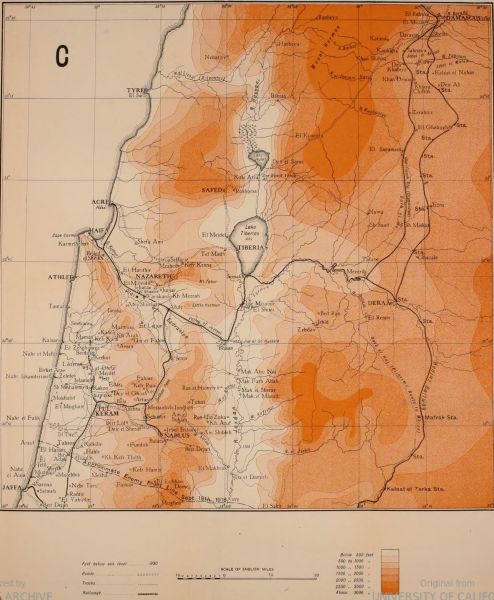
It was now nearly dark, and nothing further could be done that day. The 5th Division remained for the night along a line north of the Wadi el Zabirani, from the Kuneitra-Damascus road to a few miles north-east of Kiswe. The 4th Division concentrated south of Kiswe.
Two troops of the Gloucester Yeomanry, 13th Brigade, and a troop of the 12th Regiment, 4th A.L.H. Brigade, starting from south and west of the town respectively, attempted to reach the big German wireless installation at Kadem Station in the southern suburb. The wireless plant had, however, been prepared for demolition, and was blown up before our troops reached it. Both parties had a warm time, and were continually sniped at by wandering bodies of the enemy from the houses and wooded gardens. Eventually they came upon a number of large ammunition dumps, which had been set on fire and were going off like a monstrous Brock's Benefit, and they had to beat a hurried retreat. All through the early part of the night tremendous explosions shook the air, as the fire reached fresh stacks of shells. Kadem railway station and all the houses round it were completely destroyed, but there was little other damage in the city. The Turks were too dispirited and worn out for deeds of frightfulness, and the Germans too intent on trying to make good their escape. The independence of the city from Turkish rule was actually publicly proclaimed in the Serai early on the afternoon of September the 30th, without any opposition from the Turks, although there were at the time some 15,000 Turkish and German soldiers in the town, including Jemal Pasha, the commander of the IVth Army. A number of these troops had come from Aleppo and Beirût, and the remainder were stragglers who had made their way in, by rail and road, from the south, after the débâcle of September the 19th and succeeding days. Nearly all of them were half starved and worn out by continual marching, and their morale had sunk so low that they made no protest when the whole city broke out in a blaze of Sherifian flags. Insulted and beaten by the people, who refused to give or sell them food, abandoned by their German masters in the most callous manner, diseased and starving, many of the poor wretches died in the streets that night. Many others, less fortunate, met a brutal death at the hands of the populace. Several thousand dragged themselves to the Turkish barracks, which they filled, and overflowed into the parade ground, where some 300 perished during the night. Two considerable bodies did indeed attempt to escape, one along the Beirût road, and the other towards Homs. The fate of the former has already been told. The latter body, which consisted of fresher troops, from Aleppo and Beirût, got out of the town on the north-east, and marched all night along the Homs road.
The next day, October the 1st, as soon as it was light, the 5th Cavalry Division concentrated and moved round to the east of the city, pushing the 13th Brigade as far north as the Homs road, where it got into touch with the 3rd A.L.H. Brigade of the Australian Mounted Division. This brigade passed through the city at dawn, patrols of the 10th A.L.H. Regiment reaching the Serai square about six in the morning, and being thus actually the first troops to enter the city. Passing the Baramkie railway station on the way, they found there a train just about to start for Beirût, the troops in it being ignorant of the fact that the railway had been cut (by the 5th A.L.H. Brigade) the previous night. They were speedily undeceived, and about 500 prisoners and a number of guns and machine guns were taken from the train, and handed over to the 4th and 12th Regiments of the 4th Brigade, which marched to the station later in the morning.
Hurrying through the town, the 3rd Brigade reached the Homs road, and pressed along it on the track of the enemy force that had escaped that way the previous evening. The 10th Regiment came up with part of this force about nine o'clock in the morning, on the Wadi Maraba, near Harista el Basal, and promptly charged it, killing many with the sword, and capturing about 600 prisoners and some forty machine guns. Continuing the pursuit, the cavalry came upon more of the enemy near Duma, and again at Khan Kusseir, twelve miles from Damascus, in the evening. They were engaged in continual skirmishing throughout the day, and the action at Khan Kusseir, where they were opposed by Germans, though short, was severe. The enemy troops had a number of machine guns, and put up a good fight, but were broken by a charge delivered from the cover of some vineyards and olive groves on their right flank, and all of them were killed or captured. The brigade remained at Duma for the night.
The advance troops of the Arab Army, under Lawrence, reached Damascus about half-past eight in the morning, and established their headquarters in the Government buildings.
Meanwhile the two regiments of the 4th A.L.H. Brigade were at work collecting prisoners in the town, and evacuating them to a concentration area near Daraya. All day long the sorry business continued, and by evening nearly 12,000 had been collected. They were in a pitiable state. Many of them, the remnants of the IVth Army, had been chased for 150 miles by our cavalry and by the Arab forces. Constantly bombed by our aircraft, harassed day and night by the Arab Camel Corps and the hostile population of the country through which they passed, denied all food, and often short of water, it is one of the marvels of war that they had struggled so far. The task of getting them out of the city was a horrible one. Many fell by the wayside, and all the efforts of our cavalry failed to get them on their feet again, and they had to be left to die. All night long our over-worked ambulances toiled among them, bringing water and food and what medical assistance was possible, but they were utterly unable to cope with the numbers, and by morning over 600 were dead.
For the first fortnight, and until the rest and good food had had time to take effect, the mortality in the prisoners' camp, though decreasing daily, averaged over a hundred a day.
The whole Turkish force was riddled with disease. Nearly all were suffering from either malaria or dysentery, and there were several cases of smallpox. Venereal disease is endemic among the Turks, and, in normal times, seems to have little effect upon their general health; but, in the exhausted and weakened condition in which they now were, it laid hold on them virulently, and took a heavy toll of lives. An indication of the spread of this disease among the Germans was afforded by a room in the hospital at Afule, which was filled with boxes of salvarsan. This drug, we were informed by German medical officers, was reserved exclusively for the use of German troops.
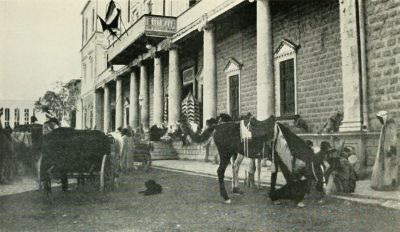
The Emir Feisals' Headquarters at Damascus. Note the Sherifian standards on the balcony.
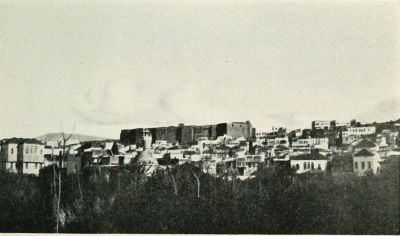
Tripoli. The old Crusader Citadel.
The operations closed on the 2nd October with an extraordinary charge by the 3rd A.L.H. Brigade. Early in the morning, a column of the enemy was seen moving north, parallel to the Homs road, and some miles to the east. This column had evidently hoped, by avoiding the road, to make its way unseen to Khan Ayash, where it would have entered the hills, and probably then made its escape.
The whole brigade immediately mounted, galloped six miles over the open plain, and charged the enemy with the sword. The Turks had with them a few guns and a number of machine guns, which they brought into action and fought to the last. The brigade galloped on, through a hot fire, and charged clean through the enemy force, killing a large number of them, and capturing 1500 prisoners, including a divisional commander, three guns, and twenty-six machine guns. In point of distance this must be a record cavalry charge.
On the same day, detachments from each brigade of the Corps and some of the guns paraded at the village of Sbeine, south of Damascus, and marched through the city from end to end, led by the Corps Commander. This was not intended as a triumphal march, but was a necessary display of force, to overawe the turbulent elements in the town, who threatened to create a state of absolute anarchy.
For political reasons the city was supposed to be in charge of the Arab forces, and an Arab Governor was actually appointed. But, with the best intentions in the world, the small force of so-called 'regular' Arab soldiers could do little or nothing to keep order. The irregular—highly irregular—forces of King Hussein far outnumbered the Arab Army. During the advance on the city, hordes of nomad Arabs had joined his standard, drawn thereto partly, no doubt, by their genuine and deep-rooted hatred of the Turks, but also, and far more strongly, by their equally genuine and deep-rooted love of plunder. Till they reached Damascus, the loot had consisted almost entirely of rifles and ammunition, best of all loot from the desert Arab's point of view, but now that each son of Ishmael was in possession of at least two good rifles, and was festooned with machine gun belts full of cartridges, he felt that he could toy with some more fancy trifles, should they come his way. So it was not surprising that, as soon as they entered the city, they all set to work at once to collect what Thomas Atkins would call 'souvenirs.' They were perfectly good-tempered about it, and only killed a few shopkeepers who made an unconscionable fuss about having their booths looted. No mercy was shown to the Turks, however. They were hunted down and killed remorselessly whereever found. Some of the Arabs even broke into the Turkish hospital, and set about murdering the moribund wretches whom they found there, till driven away by our troops.
The desert-bred Arabs are probably the most independent of mankind. They acknowledge no authority, and will take orders only from those who are able to exact obedience by force of arms. This the Emir Feisal was quite unable to do, even had he been willing, which is doubtful. His attitude seemed to be that boys will be boys, and it would be a shame to interfere with their simple pleasures, after the hard time they had had. One of the first things the 'Boys' did was to open the jail and release all the ruffians therein, who added to the liveliness of the city.
After two days of something like pandemonium, the powers that were recognised the necessity of imposing some sort of restraint on the lawless elements, and two regiments of the Australian Mounted Division were stationed in the city for police duties. The Australian troopers speedily had the situation in hand, and the normal life of Damascus was resumed within forty-eight hours.