"The Death Shot" (continued 5)
Reading edition
In the Texan Colorado there is nothing of this; on the contrary, it is a clear water stream. A circumstance that may seem strange, till the explanation be given—which is, that the name is a misnomer. In other words, the Texan river now bearing the designation Colorado is not that so-called by the Spaniards, but their Rio Brazos; while the present Brazos is their Rio Colorado—a true red-tinted stream. The exchange of names is due to an error of the American map-makers, unacquainted with the Spanish tongue. Giving the Colorado its true name of Brazos, or more correctly “Brazos de Dios” (“The Arms of God”), the origin of this singular title for a stream presents us with a history, or legend, alike singular. As all know, Texas was first colonised by Spaniards, or Spanish Mexicans, on what might be termed the “militant missionary system.” Monks were sent into the province, cross in hand, with soldiers at their back, bearing the sword. Establishments were formed in different parts of the country; San Antonio de Bejar being the ecclesiastical centre, as also the political capital. Around these the aborigines were collected, and after a fashion converted to Christianity. With the christianising process, however, there were other motives mixed up, having very little to do either with morality or religion. Comfortable subsistence, with the accumulation of wealth by the missionaries themselves, was in most instances the lure which attracted them to Texas, tempting them to risk their lives in the so-called conversion of the heathen.
The mission-houses were in the monasterial style, many of them on a grand scale—mansions in fact, with roomy refectories, and kitchens to correspond; snug sitting and sleeping-chambers; well-paved courts and spacious gardens attached. Outside the main building, sometimes forming part of it, was a church, or capilla; near by the presidio, or barrack for their military protectors; and beyond, the rancheria, or village of huts, the homes of the new-made neophytes.
No great difficulty had the fathers in thus handsomely housing themselves. The converts did all the work, willingly, for the sake and in the name of the “Holy Faith,” into which they had been recently inducted. Nor did their toil end with the erection of the mission-buildings. It was only transferred to a more layical kind; to the herding of cattle, and tillage of the surrounding land; this continued throughout their whole lives—not for their own benefit, but to enrich those idle and lazy friars, in many cases men of the most profligate character. It was, in fact, a system of slavery, based upon and sustained by religious fanaticism. The result as might be expected—failure and far worse. Instead of civilising the aborigines of America, it has but brutalised them the more—by eradicating from their hearts whatever of savage virtue they had, and implanting in its place a debasing bigotry and superstition.
Most American writers, who speak of these missionary establishments, have formed an erroneous estimate of them. And, what is worse, have given it to the world. Many of these writers are, or were, officers in the United States army, deputed to explore the wild territories in which the missions existed. Having received their education in Roman Catholic seminaries, they have been inducted into taking a too lenient view of the doings of the “old Spanish padres;” hence their testimony so favourable to the system.
The facts are all against them; these showing it a scheme of villeinage, more oppressive than the European serfdom of the Middle Ages. The issue is sufficient proof of this. For it was falling to pieces, long before the Anglo-Saxon race entered into possession of the territory where it once flourished. The missions are now in a state of decadence, their buildings fast falling into decay; while the red man, disgusted at the attempt to enslave, under the clock of christianising him, has returned to his idolatry, as to his savage life.
Several of these misiones were established on the San Saba river; one of which for a considerable period enjoyed a prosperous existence, and numbered among its neophytes many Indians of the Lipan and Comanche tribes.
But the tyranny of their monkish teachers by exactions of tenths and almost continuous toil—themselves living in luxurious ease, and without much regard to that continence they inculcated—at length provoked the suffering serfs to revolt. In which they were aided by those Indians who had remained unconverted, and still heretically roamed around the environs. The consequence was that, on a certain day when the hunters of the mision were abroad, and the soldiers of the presidio alike absent on some expedition, a band of the outside idolaters, in league with the discontented converts, entered the mission-building, with arms concealed under their ample cloaks of buffalo skin. After prowling about for a while in an insolent manner, they at length, at a given signal from their chief, attacked the proselytising padres, with those who adhered to them; tomahawked and scalped all who came in their way.
Only one monk escaped—a man of great repute in those early times of Texas. Stealing off at the commencement of the massacre, he succeeded in making his way down the valley of the San Saba, to its confluence with the Colorado. But to reach an asylum of safety it was necessary for him to cross the latter stream; in which unfortunately there was a freshet, its current so swollen that neither man nor horse could ford it.
The padre stood upon its bank, looking covetously across, and listening in terror to the sounds behind; these being the war-cries of the pursuing Comanches.
For a moment the monk believed himself lost. But just then the arm of God was stretched forth to save him. This done in a fashion somewhat difficult to give credence to, though easy enough for believers in Holy Faith. It was a mere miracle; not stranger, or more apocryphal, than we hear of at this day in France, Spain, or Italy. The only singularity about the Texan tale is the fact of its not being original; for it is a pure piracy from Sacred Writ—that passage of it which relates to the crossing of the Red Sea by Moses and his Israelites.
The Spanish monk stood on the river’s bank, his eyes fixed despairingly on its deep rapid-running current, which he knew he could not cross without danger of being drowned. Just at this crisis he saw the waters separate; the current suddenly stayed, and the pebbly bed showing dry as a shingle!
Tucking his gown under his girdle, he struck into the channel; and, no doubt, making good time—though the legend does not speak of this—he succeeded in planting his sandalled feet, dry shod, on the opposite shore! So far the Texan story closely corresponds with the Mosaic. Beyond, the incidents as related, are slightly different. Pharaoh’s following host was overwhelmed by the closing waters. The pursuing Comanches did not so much as enter the charmed stream; which, with channel filled up, as before, was running rapidly on. They were found next morning upon the bank where they had arrived in pursuit, all dead, all lying at full stretch along the sward, their heads turned in the same direction, like trees struck down by a tornado!
Only the Omnipotent could have done this. No mortal hand could make such a coup. Hence the name which the Spaniards bestowed upon the present Colorado, Brazos de Dios—the “Hand of God.” Hence also the history, or rather fable, intended to awe the minds of the rebellious redskins, and restore them to Christanity, or serfdom.
Which it did not; since from that day the misiones of San Saba remained abandoned, running into ruin.
It is to one of these forsaken establishments Colonel Armstrong is conducting his colony; his future son-in-law having purchased the large tract of territory attached to it.
To that spot, where more than a century ago the monks made halt, with cross borne conspicuously in one hand, and sword carried surreptitiously in the other, there is now approaching a new invasion—that of axe and rifle—neither ostentatiously paraded, but neither insidiously concealed.
Chapter Forty Four.
A cloud on the cliffs.
After a long toilsome journey through Eastern Texas, the emigrant train has reached the San Saba, and is working its way up-stream. Slowly, for the bottom-land is in some places heavily timbered, and the road requires clearing for the waggons.
The caravan has entered the valley on the left, or northern, bank of the river, while its point of destination is the southern; but a few miles above its confluence with the Colorado is a ford, by which the right side may be reached at low water. Luckily it is now at its lowest, and the waggons are got across without accident, or any great difficulty.
Once on the southern side, there is nothing to obstruct or further delay them. Some ten miles above is the abandoned mission-house, which they expect to reach that day, before going down of the sun.
With perhaps one exception, the emigrants are all happy, most of them in exuberant spirits. They are nearing a new home, having long ago left the old one behind; left also a thousand cankering cares,—many of them more than half a life spent in struggles and disappointments. In the untried field before them there is hope; it may be success and splendour; a prospect like the renewing of life’s lease, the younger to find fresh joys, the older to grow young again.
For weeks has the San Saba mission-house been the theme of their thoughts, and topic of discourse. They will re-people the deserted dwelling, restore it to its pristine splendour; bring its long neglected fields under tillage—out of them make fortunes by the cultivation of cotton.
There is no cloud to darken the horizon of their hopes. The toilsome journey is nearly at an end, and rejoicingly they hail its termination. Whether their train of white tilted wagons winds its way under shadowing trees, or across sunlit glades, there is heard along its line only joyous speech and loud hilarious laughter.
So go they on, regardless about the future, or only thinking of it as full of bright promise. Little do they dream how it may be affected by something seen upon the cliffs above, though not seen by them. At the point they have now reached, the bottom-land is several miles wide, with its bordering of grim bluffs rising on either flank, and running far as eye can see. On the left side, that they have just forsaken, not upon the river’s bank, but the cliff far back, is a cloud. No darkness of the sky, or concentration of unsubstantial vapour. But a gathering on the earth, and of men; who, but for their being on horseback, might be mistaken for devils. In Satan’s history the horse has no part; though, strange to say, Satan’s sons are those who most affect friendship for the noble animal. Of the horsemen seen hovering above the San Saba there are in all twenty; most of them mounted upon mustangs, the native steed of Texas, though two or three bestride larger and better stock, the breed of the States.
All appear Indians, or if there be white man among them, he must have been sun-tanned beyond anything commonly seen. In addition to their tint of burnt umber, they are all garishly painted; their faces escutcheoned with chalk-white, charcoal-black, and vermillion-red. Of their bodies not much can be seen. Blankets of blue and scarlet, or buffalo robes, shroud their shoulders; while buckskin breeches and leggings wrap their lower limbs; mocassins encasing their feet. In addition to its dress, they wear the usual Indian adornments. Stained eagle-plumes stand tuft-like out of their raven-black hair, which, in trailing tresses, sweeps back over the hips of their horses; while strings of peccaries’ teeth and claws of the grizzly bear fall over their breasts in bountiful profusion.
It is true, they are not in correct fighting costume. Nor would their toilet betoken them on the “war-trail.” But the Texan Indian does not always dress warrior-fashion, when he goes forth upon a predatory excursion. More rarely when on a mere pilfering maraud, directed against some frontier settlement, or travelling party of whites. On such occasions he does not intend fighting, but rather shuns it. And, as thieving is more congenial to him, he can steal as cleverly and adroitly in a buckskin hunting-shirt, as with bare arms.
The Indians in question number too few for a war party. At the same time, their being without women is evidence they are on no errand of peace. But for the arms carried, they might be mistaken for hunters. They have spears and guns, some of them “bowie” knives and pistols; while the Indian hunter still believes in the efficacy of the silent arrow.
In their armour, and equipment there are other peculiarities the ordinary traveller might not comprehend, but which to the eye of an old prairie man would be regarded as suspicious. Such an one would at once pronounce them a band of prairie pirates, and of the most dangerous kind to be encountered in all the territory of Texas.
Whoever they may be, and whatever their design, their behaviour is certainly singular. Both by their looks and gestures it can be told they are watching the waggon train, and interested in its every movement; as also taking care not to be themselves observed by those belonging to it. To avoid this they keep back from the crest of the escarpment; so far, it would not be possible to see them from any part of the bottom-land below.
One of their number, afoot, goes closer to the cliff’s edge, evidently sent there by the others as a sort of moving vidette. Screened by the cedars that form its crinière, he commands a view of the river valley below, without danger of being himself seen from it.
At short intervals he passes back a pace or two, and gesticulates to the others. Then returning to the cliff’s edge, he continues on as before.
These movements, apparently eccentric, are nevertheless of grave import. The man who makes them, with those to whom they are made, must be watching the travellers with the intention of waylaying them.
Afar off are the waggons, just distinguishable as such by their white canvas tilts—the latter in contrast with the surface of vivid green over which they are progressing. Slowly crawling along, they bear similitude to a string of gigantic termites bent on some industrial excursion. Still the forms of mounted men—at least forty in number, can be distinguished. Some riding in front of the train, some in its rear, and others alongside of it. No wonder the twenty savage men, who pursue the parallel line along the cliff, are taking care not to approach it too nearly. One would suppose that from such a strong travelling party their chance of obtaining plunder would seem to them but slight. And yet they do not appear to think so. For as the caravan train tardily toils on up the bottom-land, they too move along the upper plain at a like rate of speed, their scout keeping the waggons in sight, at intervals, as before, admonishing them of every movement.
And they still continue watching the emigrant train until the sun sinks low—almost to the horizon. Then they halt upon a spot thickly beset with cedar trees—a sort of promontory projecting over the river valley.
On its opposite side they can see the waggons still slowly creeping along, though now not all in motion. Those in the lead have stopped; the others doing likewise, as, successively, they arrive at the same place.
This in front of a large building, just discernible in the distance, its outlines with difficulty traceable under the fast gathering gloom of the twilight.
But the savages who survey it from the bluff have seen that building before, and know all about it; know it to be one of the abandoned misiones of San Saba; as, also, why those vehicles are now coming to a stop before its walls.
While watching these, but few words are exchanged between them, and only in an under tone. Much or loud talk would not be in keeping with their Indian character. Still enough passes in their muttered speeches—observable also in the expression of their features—for any one hearing the first, or seeing the last, to predict danger to the colony of Colonel Armstrong. If looks count for aught, or words can be relied on the chances seem as if the old San Saba mission-house, long in ruins, may remain so yet longer.
Chapter Forty Five.
A suspicious surveillance.
The ancient monastery, erst the abode of Spanish monks, now become the dwelling-place of the ci-devant Mississippi planter, calls for a word of description.
It stands on the right side of the river, several hundred yards from the bank, on a platform slightly elevated above the general level of the surrounding terrain.
The site has been chosen with an eye to the pleasant and picturesque—that keen look-out towards temporal enjoyment, which at all times, and in all countries, has characterised these spiritual teachers of the heathen.
Its elevated position gives it command of a fine prospect, at the same time securing it against the danger of inundation, when the river is in flood.
In architectural style the mission-building itself does not much differ from that of most Mexican country houses—called haciendas.
Usually a grand quadrangular structure, with an uncovered court in the centre, the patio; around which runs a gallery or corridor, communicating with the doors of the different apartments.
But few windows face outside; such as there are being casements, unglazed, but protected by a grille of iron bars set vertically—the reja. In the centre of its front façade is a double door, of gaol-like aspect, giving admittance to the passage-way, called saguan; this of sufficient capacity to admit a waggon with its load, intended for those grand old coaches that lumbered along our own highways in the days of Dick Turpin, and in which Sir Charles Grandison used luxuriously to ride. Vehicles of the exact size, and pattern, may be seen to this day crawling along the country roads of modern Mexico—relics of a grandeur long since gone.
The patio is paved with stone flags, or tesselated tiles; and, where a head of water can be had, a fountain plays in the centre, surrounded by orange-trees, or other evergreens, with flowering-plants in pots. To rearward of this inner court, a second passage-way gives entrance to another, and larger, if not so sumptuously arrayed; this devoted to stables, store-rooms, and other domestic offices. Still farther back is the huerta, or garden.
That attached to the ancient monastery is an enclosure of several acres in extent, surrounded by a high wall of adobes; made to look still higher from being crested with a palisade of the organ cactus. Filled with fruit trees and flowering shrubs, these once carefully cultivated, but for long neglected, now cover the walks in wild luxuriance. Under their shade, silently treading with sandalled feet, or reclining on rustic benches, the Texan friars used to spend their idle hours, quite as pleasantly as their British brethren of Tintern and Tewkesbury. Oft have the walls of the San Saba mission-house echoed their “ha, ha!” as they quaffed the choicest vintage of Xeres, and laughed at jests ribald as any ever perpetrated in a pot-house. Not heard, however, by the converted heathen under their care; nor intended to be. For them there were dwellings apart; a collection of rude hovels, styled the rancheria. These were screened from view by a thick grove of evergreen trees; the padres not relishing a too close contact with their half-naked neophytes, who were but their peons—in short their slaves. In point of fact, it was the feudal system of the Old World transported to the New; with the exception that the manorial lords were monks, and the villeins savage men. And the pretence at proselytising, with its mongrel mixture of Christianity and superstition, did not make this Transatlantic villeinage a whit less irksome to endure. Proof, that the red-skinned serfs required the iron hand of control is found in the presidio, or soldier’s barrack—standing close by—its ruin overlooking those of the rancheria. They who had been conquered by the Cross, still needed the sword to keep them in subjection, which, as we have seen, it finally failed to do.
Several of the huts still standing, and in a tolerable state of repair, have supplied shelter to the new settlers; most of whom have taken up their abode in them. They are only to serve as temporary residences, until better homes can be built. There is no time for this now. The spring is on, and the cotton-seed must be got into the ground, to the neglect of everything else.
Colonel Armstrong himself, with his daughters and domestics, occupies the old mission-building, which also gives lodgment to Luis Dupré and his belongings. For the young planter is now looked upon as a member of the Armstrong family, and it wants but a word from one in holy orders to make him really so. And such an one has come out with the colonists. The marriage ceremony is but deferred until the cotton-seed be safe under the soil. Then there will be a day of jubilee, such as has never been seen upon the San Saba; a fiesta, which in splendour will eclipse anything the Spanish monks, celebrated for such exhibitions, have ever got up, or attempted.
But “business before pleasure” is the adage of the hour; and, after a day or two given to rest, with the arrangement of household affairs, the real work of colonising commences. The little painted ploughs, transported from the States, are set to soiling their paint, by turning up the fertile clod of the San Saba valley, which has so long lain fallow; while the seed of the cotton-plant is scattered far and wide over hundreds—ay, thousands of acres.
Around the ancient mission is inaugurated a new life, with scenes of industry, stirring as those presided over by the padres.
Is it sure of being as prosperous, or more likely to be permanent?
One confining his view to the valley—regarding only the vigorous activity there displayed—would answer this question in the affirmative.
But he who looks farther off—raising his eyes to the bluff on the opposite side of the river, fixing them on that spot where the Indians made halt—would hesitate before thus prognosticating. In the dusky cohort he might suspect some danger threatening the new settlement.
True, the savages are no longer there. After seeing the waggons one after another becoming stationary, like vultures deprived of a carrion repast, they moved away. But not far. Only about five miles, to a grove of timber standing back upon the plain, where they have made a more permanent camp.
Two alone are left upon the cliff’s edge; evidently to act as videttes. They keep watch night and day, one always remaining awake. Especially during the night hours do they appear on the alert—with eyes bent on the far off mission-buildings—watching the window-lights that steadily shine, and the torches that flit to and fro. Watching for something not yet seen. What can it be?
And what is the design of these painted savages, who look more like demons than men? Is it to attack the new colony, plunder, and destroy it?
Regarding their numbers, this would seem absurd. They are in all only twenty; while the colonists count at least fifty fighting men. No common men either; but most of them accustomed to the use of arms; many backwoodsmen, born borderers, staunch as steel. Against such, twenty Indians—though the picked warriors of the warlike Comanche tribe—would stand no chance in fair open fight. But they may not mean this; and their intent be only stealing?
Or they may be but a pioneer party—the vanguard of a greater force?
In any case, their behaviour is singularly suspicious. Such manoeuvring can mean no good, but may be fraught with evil to Colonel Armstrong and his colonists.
For several successive days is this surveillance maintained, and still nothing seems to come of it. The party of savages remains encamped in the timber at back; while the two sentinels keep their place upon the promontory; though now and then going and coming, as before.
But on a certain night they forsake their post altogether, as if their object has been attained, and there is no need to keep watch any more.
On this same night, a man might be seen issuing out of the mission-building, and making away from its walls. He is not seen, nevertheless. For it is the hour of midnight, and all have retired to rest—the whole household seemingly wrapt in profoundest slumber. Moreover, the man slips out stealthily, through the backdoor; thence across the second courtyard, and along a narrow passage leading into the garden. Having reached this, he keeps on down the centre walk, and over the wall at bottom, through which there chances to be a breach. All these mysterious movements are in keeping with the appearance of the man. For his countenance shows cunning of no ordinary kind. At first glance, and under the moonlight, he might be mistaken for a mulatto. But, though coloured, he is not of this kind. His tawny skin shows a tinge of red, which tells of Indian, rather than African blood. He is, in truth, a mestizo—half Spaniard or Mexican, the other half being the aboriginal race of America.
It is a breed not always evil-disposed, still less frequently ill-featured; and, so far as looks go, the individual in question might claim to be called handsome. He has a plenteous profusion of dark curly hair, framing a countenance by no means common. A face of oval form, regular features, the nose and chin markedly prominent, a pair of coal black eyes, with a well-defined crescent over each. Between his lips are teeth, sound and of ivory whiteness, seeming whiter in contrast with a pair of jet black moustaches.
Taking his features singly, any of them might be pronounced comely. And yet the tout ensemble is not pleasing. Despite physical beauty, there is something in the man’s face that appears repulsive, and causes shrinking in the heart of the beholder. Chiefly is it his eyes that seem to produce this effect; their glance inspiring fear, such as one feels while being gazed at by an adder.
Not always can this sinister look be observed. For the mestizo, when face to face with his superiors, has the habit of holding his eyes averted—cast down, as if conscious of having committed crime, or an intention to commit it.
Most with whom he comes in contact are impressed with the idea, that he either has sinned, or intends sinning; so all are chary of giving him confidence.
No—not all. There is one exception: one man who has trusted, and still continues to trust him—the young planter, Dupré. So far, that he has made him his man of confidence—head-servant over all the household. For it need scarce be told, that the real master of the house is he who rendered it habitable, by filling it with furniture and giving it a staff of servants. Colonel Armstrong is but its head through courtesy due to age, and the respect shown to a future father-in-law.
Why the Creole puts such trust in Fernand—the mestizo’s name—no one can clearly comprehend. For he is not one of those domestics, whose integrity has been tested by long years of service. On the contrary, Dupré has never set eyes on him, till just before leaving Nachitoches.
While organising the expedition, the half-blood had presented himself, and offered to act as its guide—professing acquaintance with that section of Texas whither the colony was to be conducted. But long before reaching their destination, Dupré had promoted him to a higher and more lucrative post—in short, made him his “major-domo.”
Colonel Armstrong does not object. He has not the right. Still less, anybody else. Outsiders only wonder and shake their heads; saying, in whispers, that the thing is strange, and adding, “No good can come of it.”
Could any of them observe the mestizo at this midnight hour, skulking away from the house; could they follow and watch his further movements, they might indulge in something more than a surmise about his fidelity; indeed, be convinced he is a traitor.
After getting about half-a-mile from the mission walls, he makes stop on the edge of attract of timber lying between—its outer edge, open towards the river’s bank, and the bluffs beyond.
There, crouching down by the side of a flat stone, he pours some gunpowder upon it, from a horn taken out of his pocket.
This done, he draws forth a box of lucifer matches; scrapes one across the stone, and sets the powder ablaze.
It flashes up in bright glare, illumining the darkness around.
A second, time he repeats this manoeuvre; a third, and a fourth; and on, till, for the tenth time, powder has been burnt.
Then turning away from the spot, he makes back towards the dwelling-house, entering it by the way he went out, and stealthily as before.
No one within its walls has been witness to the pyrotechnic display.
For all, it has not been unobserved. The Indian videttes, stationed on the far-off bluff, see it. See, and furthermore, seem to accept it as a signal—a cue for action. What but this could have caused them to spring upon the backs of their horses, forsake their post of observation, and gallop off to the bivouac of their comrades; which they do, soon as noting that the tenth flash is not followed by another?
Surely must it be a signal, and preconcerted?
In the life of the prairie savage fire plays a conspicuous part. It is his telegraph, by which he can communicate with far off friends, telling them where an enemy is, and how or when he should be “struck.” A single spark, or smoke, has in it much of meaning. A flash may mean more; but ten following in succession were alphabet enough to tell a tale of no common kind—one, it may be, predicting death.
Chapter Forty Six.
A suspected servant.
Now fairly inaugurated, the new colony gives promise of a great success; and the colonists are congratulating themselves.
None more than their chief, Colonel Armstrong. His leaving Mississippi has been a lucky move; so far all has gone well; and if the future but respond to its promise, his star, long waning, will be once more in the ascendant. There is but one thought to darken this bright dream: the condition of his eldest daughter. Where all others are rejoicing, there is no gladness for her. Sombre melancholy seems to have taken possession of her spirit, its shadow almost continuously seated on her brow. Her eyes tell of mental anguish, which, affecting her heart, is also making inroad on her health. Already the roses have gone out of her cheeks, leaving only lilies; the pale flowers foretelling an early tomb.
The distressing symptoms do not escape the fond father’s observation. Indeed he knows all about them, now knowing their cause. Only through the Natchez newspapers was he first made aware of that secret correspondence between his daughter and Clancy. But since she has confessed all—how her heart went with her words; is still true to what she then said. The last an avowal not needed: her pallid cheeks proclaiming it. The frank confession, instead of enraging her father, but gives him regret, and along with it self-reproach. But for his aristocratic pride, with some admixture of cupidity, he would have permitted Clancy’s addresses to his daughter. With an open honourable courtship, the end might have been different—perhaps less disastrous. It could not have been more.
He can now only hope, that time, the great soother of suffering hearts, may bring balm to hers. New scenes in Texas, with thoughts arising therefrom, may throw oblivion over the past. And perchance a new lover may cause the lost one to be less painfully remembered. Several aspirants have already presented themselves; more than one of the younger members of the colony having accompanied it, with no view of making fortunes by the cultivation of cotton, but solely to be beside Helen Armstrong.
Her suitors one and all will be disappointed. She to whom they sue is not an ordinary woman; nor her affections of the fickle kind. Like the eagle’s mate, deprived of her proud lord, she will live all her after life in lone solitude—or die. She has lost her lover, or thinks so, believing Clancy dead; but the love still burns within her bosom, and will, so long as her life may last. Colonel Armstrong soon begins to see this, and despairs of the roses ever again returning to the cheeks of his elder daughter.
It would, no doubt, be different were the blighted heart that of his younger. With her the Spanish proverb, “un clavo saca otro clavo,” might have meaning. By good fortune, Jessie needs no nail to drive out another. Her natural exuberance of spirits grown to greater joy from the hopes that now halo her young life, is flung over the future of all. Some compensation for her sister’s sadness—something to cheer their common father. There is also the excitement attendant on the industries of the hour—the cares of the cotton-planting, with speculations about the success of the crop—these, with a hundred like thoughts and things, hinder him from so frequently recurring to, or so long dwelling on, that which can but cruelly distress.
It is the night succeeding that in which the mestizo made his private pyrotechnic display; and Colonel Armstrong with his future son-in-law is seated in the former refectory of the mission, which they have converted into a decent dining-room.
They are not alone, or, as in French phraseology better expressed, chez eux mêmes. Six or seven of their fellow-colonists of the better class share the saloon with them—these being guests whom they have invited to dinner.
The meal is over, the hour touching ten, the ladies have retired from the table, only the gentlemen remain, drinking choice claret, which Dupré, a sort of Transatlantic Lucullus, has brought with him from his Louisiana wine bins.
Armstrong himself, being of Scotch ancestry, has the national preference for whisky punch; and a tumbler of this beverage—the best in the world—stands on the table before him. His glass has been filled three times, and is as often emptied.
It need not be said, at this moment he is not sad. After three tumblers of whisky toddy no man can help being hilarious; and so is it with Colonel Armstrong. Seated at the head of his dining-table, the steaming punch before him, he converses with his guests, gay as the gayest. For a time their conversation is on general topics; but at length changes to one more particular. Something said has directed their attention to a man, who waited upon them at table, now no longer in the room.
The individual thus honoured is Dupré’s confidential servant Fernand; who, as already said, is house-steward, butler, factotum of affairs generally.
As is usual with such grand dignitaries, he has withdrawn simultaneously with the removal of the tablecloth, leaving a deputy to look to the decanting of the wine. Therefore, there is nothing remarkable in his disappearance; nor would aught be observed about it, but for a remark made by one of the guests during the course of conversation. A young surgeon, who has cast in his lot with the new colony, is he who starts the topic, thus introducing it:—
“Friend Dupré, where did you get that fellow Fernand? I don’t remember having seen him on your Louisiana plantation.”
“I picked him up in Natchitoches while we were organising. You know I lost my old major-domo last fall by the yellow fever. It took him off while we were down in New Orleans. Fernand, however, is his superior in every sense; can keep plantation accounts, wait at table, drive a carriage, or help in a hunt. He’s a fellow of wonderful versatility; in short, a genius. And what is rare in such a combination of talents, he is devoted to his duties—a very slave to them.”
“What breed may your admirable Crichton be?” asks another of the guests, adding: “He looks a cross between Spaniard and Indian.”
“Just what he is,” answers the young planter; “at least says so. By his own account his father was a Spaniard, or rather a Mexican, and his mother an Indian of the Seminole tribe. His real name is Fernandez; but for convenience I’ve dropped the final syllable.”
“It’s a bad sort of mixture, that between Spaniard and Seminole, and not improved by the Spaniard being a Mexican,” remarks he who made the inquiry.
“I don’t like his looks,” observes a third speaker.
Then all around the table wait to hear what Wharton, the young surgeon, has to say. For it is evident, from his way of introducing the subject, he either knows or suspects something prejudicial to the character of the major-domo. Instead of going on to explain, he puts a second interrogatory—
“May I ask, M. Dupré, whether you had any character with him?”
“No, indeed,” admits the master. “He came to me just before we left Natchitoches asking for an engagement. He professed to know all about Texas, and offered to act as a guide. As I had engaged guides, I didn’t want him for that when he said any other place would do. Seeing him to be a smart sort of fellow, which he certainly has proved, I engaged him to look after my baggage. Since, I’ve found him useful in other ways, and have given him full charge of everything—even to entrusting him with the care of my modest money chest.”
“In doing that,” rejoins the surgeon, “I should say you’ve acted somewhat imprudently. Excuse me, M. Dupré, for making the observation.”
“Oh, certainly,” is the planter’s frank reply. “But why do you say so, Mr Wharton? Have you any reason to suspect his honesty?”
“I have; more than one.”
“Indeed! Let us hear them all.”
“Well; in the first place I don’t like the look of the man, nor ever did since the day of our starting. Since I never set eyes on him before, I could have had no impression to prejudice me against him. I admit that, judging by physiognomy, any one may be mistaken; and I shouldn’t have allowed myself to be led by that. In this case, however, a circumstance has contributed to shaping my judgment; in fact, deciding me in the opinion, that your fellow Fernand is not only dishonest, but something worse than a thief.”
“Worse than a thief!” is the simultaneous echo from all sides of the table, succeeded by a universal demand for explanation.
“Your words have a weighty sound, doctor,” is Colonel Armstrong’s way of putting it. “We are anxious to hear what they mean.”
“Well,” responds Wharton, “you shall know why I’ve spoken them, and what’s led me to suspect this fellow Fernand. You can draw your own conclusions, from the premises I put before you. Last night at a late hour—near midnight—I took a fancy into my head to have a stroll towards the river. Lighting a weed, I started out. I can’t say exactly how far I may have gone; but I know that the cigar—a long ‘Henry Clay’—was burnt to the end before I thought of turning back. As I was about doing so, I heard a sound, easily made out to be the footsteps of a man, treading the firm prairie turf. As it chanced just then, I was under a pecan-tree that screened me with its shadow; and I kept my ground without making any noise.
“Shortly after, I saw the man whose footfall I had heard, and recognised him as M. Dupré’s head-servant. He was coming up the valley, toward the house here, as if returning from some excursion. I mightn’t have thought much of that, but for noticing, as he passed me, that he didn’t walk erect or on the path, but crouchingly, among the trees skirting it.
“Throwing away the stump of my cigar, I set out after him, treading stealthily as he. Instead of entering by the front, he went round the garden, all the way to its rear; where suddenly I lost sight of him. On arriving at the spot where he had disappeared, I saw there was a break in the wall. Through that, of course, he must have passed, and entered the mission-building at the back. Now, what are we to make of all this?”
“What do you make of it, doctor?” asks Dupré.
“Give us your own deductions!”
“To say the truth, I don’t know what deductions to draw, I confess myself at fault; and cannot account for the fellow’s movements; though I take you’ll all acknowledge they were odd. As I’ve said, M. Dupré, I didn’t from the first like your man of versatile talents; and I’m now more than ever distrustful of him. Still I profess myself unable to guess what he was after last night. Can any of you, gentlemen?”
No one can. The singular behaviour of Dupré’s servant is a puzzle to all present. At the same time, under the circumstances, it has a serious aspect.
Were there any neighbouring settlement, the man might be supposed returning from a visit to it; entering stealthily, from being out late, and under fear of rebuke from his master. As there are no such neighbours, this theory cannot be entertained.
On the other hand, there has been no report of Indians having been seen in proximity to the place. If there had, the mestizo’s conduct might be accounted for, upon an hypothesis that would certainly cause apprehension to those discussing it.
But no savages have been seen, or heard of; and it is known that the Southern Comanches—the only Indians likely to be there encountered—are in treaty of peace with the Texan Government. Therefore, the nocturnal excursion of the half-blood could not be connected with anything of this kind.
His singular, and seemingly eccentric, behaviour, remains an unsolved problem to the guests around the table; and the subject is eventually dropped their conversation changing to other and pleasanter themes.
Chapter Forty Seven.
Opposite emblems.
Pleasure has not been the sole purpose for which Colonel Armstrong is giving his little dinner party, else there would have been ladies invited along with the gentlemen. It is rather a re-union to talk over the affairs of the colony; hence the only ladies present were the daughters of the host. And, for the same reason, these have retired from the table at an early hour, betaking themselves to the sala of the old monastery, their sitting and drawing-room. This, though an ample apartment, is anything but a pleasant one; never much affected by the monks, who in their post-prandial hours, preferred sticking to the refectory. A hasty attempt has been made to modernise it; but the light furniture of French Creole fabric, brought along from Louisiana, ill accords with its heavy style of architecture, while its decayed walls and ceilings lezardée, give it a gloomy dismal look, all the more from the large room being but dimly lit up. As it is not a drawing-room party, the ladies expect that for a long while, if not all evening, they will be left alone in it. For a time they scarce know how to employ themselves. With Helen, amusement is out of the question. She has flung herself into a fauteuil, and sits in pensive attitude; of late, alas! become habitual to her.
Jessie, taking up her guitar, commences a song, the first that occurs to her, which chances to be “Lucy Neal,” a negro melody, at the time much in vogue on the plantations of the South. She has chosen the pathetic strain without thought of the effect it may produce upon her sister. Observing it to be painful she abruptly breaks off, and with a sweep of her fingers across the guitar strings, changes to the merrier refrain of “Old Dan Tucker.” Helen, touched by the delicate consideration, rewards it with a faint smile. Then, Jessie rattles on through a mélange of negro ministrelsy, all of the light comical kind, her only thought being to chase away her sister’s despondency.
Still is she unsuccessful. Her merry voice, her laughter, and the cheerful tinkle of the guitar strings, are all exerted in vain. The sounds so little in consonance with Helen’s thoughts seem sorely out of place in that gloomy apartment; whose walls, though they once echoed the laughter of roystering friars, have, no doubt, also heard the sighs of many a poor peon suffering chastisement for disobedience, or apostacy.
At length perceiving how idle are her efforts, the younger sister lays aside her guitar, at the same time starting to her feet, and saying:—“Come, Helen! suppose we go outside for a stroll? That will be more agreeable than moping in this gloomsome cavern. There’s a beautiful moonlight, and we ought to enjoy it.”
“If you wish, I have no objections. Where do you intend strolling to?”
“Say the garden. We can take a turn along its walks, though they are a little weedy. A queer weird place it is—looks as if it might be haunted. I shouldn’t wonder if we met a ghost in it—some of the old monks; or it might be one of their victims. ’Tis said they were very cruel, and killed people—ay, tortured them. Only think of the savage monsters! True, the ones that were here, as I’ve heard, got killed themselves in the end—that’s some satisfaction. But it’s all the more reason for their ghosts being about. If we should meet one, what would you do?”
“That would depend on how he behaved himself.”
“You’re not afraid of ghosts, Helen! I know you’re not.”
“I was when a child. Now I fear neither the living nor the dead. I can dare both, having nought to make me care for life—”
“Come on!” cries Jessie, interrupting the melancholy train of reflection, “Let us to the garden. If we meet a monk in hood and cowl, I shall certainly—”
“Do what?”
“Run back into the house fast as feet can carry me. Come along!”
Keeping up the jocular bravado, the younger sister leads the way out. Arm-in-arm the two cross the patio, then the outer courtyard, and on through a narrow passage communicating with the walled enclosure at back; once a grand garden under careful cultivation, still grand in its neglect.
After entering it, the sisters make stop, and for a while stand surveying the scene. The moon at full, coursing through a cloudless sky, flings her soft light upon gorgeous flowers with corollas but half-closed, in the sultry southern night giving out their fragrance as by day. The senses of sight and smell are not the only ones gratified; that of hearing is also charmed with the song of the czentzontle, the Mexican nightingale. One of these birds perched upon a branch, and pouring forth its love-lay in loud passionate strain, breaks off at sight of them. Only for a short interval is it silent; then resuming its lay, as if convinced it has nought to fear from such fair intruders. Its song is not strange to their ears, though there are some notes they have not hitherto heard. It is their own mocking-bird of the States, introducing into its mimic minstrelsy certain variations, the imitations of sounds peculiar to Texas.
After having listened to it for a short while, the girls move on down the centre walk, now under the shadow of trees, anon emerging into the moonlight; which shimmering on their white evening robes, and reflecting the sparkle of their jewellery, produces a pretty effect.
The garden ground slopes gently backward; and about half-way between the house and the bottom wall is, or has been, a fountain. The basin is still there, and with water in it, trickling over its edge. But the jet no longer plays, and the mason-work shows greatly dilapidated. So also the seats and statues around, some of the latter yet standing, others broken off, and lying alongside their pedestals.
Arriving at this spot, the sisters again stop, and for a time stand contemplating the ruins; the younger making a remark, suggested by a thought of their grandeur gone.
“Fountains, statues, seats under shade trees, every luxury to be got out of a garden! What Sybarites the Holy Fathers must have been!”
“Truly so,” assents Helen. “They seem to have made themselves quite comfortable; and whatever their morals, it must be admitted they displayed good taste in landscape gardening, with an eye on good living as well. They must have been very fond of fruit, and a variety of it—judging by the many sorts of trees they’ve planted.”
“So much the better for us,” gleefully replies Jessie. “We shall have the benefit of their industry, when the fruit season comes round. Won’t it be a grand thing when we get the walks gravelled, these statues restored, and that fountain once more in full play. Luis has promised me it shall be done, soon as the cotton crop is in. Oh! it will be a Paradise of a place!”
“I like it better as it is.”
“You do. Why?”
“Ah! that you cannot understand. You do not know—I hope never will—what it is to live only in the past. This place has had a past, like myself, once smiling; and now like me all desolation.”
“O sister! do not speak so. It pains me—indeed it does. Besides your words only go half-way. As you say, it’s had a smiling past, and’s going to have a smiling future. And so will you sis. I’m determined to have it all laid out anew, in as good style as it ever was—better. Luis shall do it—must, when he marries, me—if not before.”
To the pretty bit of bantering Helen’s only answer is a sigh, with a sadder expression, as from some fresh pang shooting through her heart. It is even this; for, once again, she cannot help contrasting her own poor position with the proud one attained by her sister. She knows that Dupré is in reality master of all around, as Jessie will be mistress, she herself little better than their dependant. No wonder the thought should cause her humiliation, or that, with a spirit imperious as her’s, she should feel it acutely. Still, in her crushed heart there is no envy at her sister’s good fortune. Could Charles Clancy come to life again, now she knows him true—were he but there to share with her the humblest hut in Texas, all the splendours, all the grandeurs of earth, could not add to that happiness, nor give one emotion more.
After her enthusiastic outburst, to which there has been no rejoinder, Jessie continues on toward the bottom of the garden, giving way to pleasant fancies, dreams of future designs, with her fan playfully striking at the flowers as she passes them.
In silence Helen follows; and no word is exchanged between them till they reach the lower end; when Jessie, turning round, the two are face to face. The place, where they have stopped is another opening with seats and statues, admitting the moonlight. By its bright beam the younger sister sees anguish depicted on the countenance of the older.
With a thought that her last words have caused or contributed to this, she is about to add others that may remove it. But before she can speak, Helen makes a gesture that holds her silent.
Near the spot where they are standing two trees overshadow the walk, their boughs meeting across it. Both are emblematic—one symbolising the most joyous hour of existence, the other its saddest. They are an orange, and a cypress. The former is in bloom, as it always is; the latter only in leaf, without a blossom on its branches.
Helen, stepping between them, and extending an arm to each, plucks from the one a sprig, from the other a flower. Raising the orange blossom between her white fingers, more attenuated than of yore, she plants it amid Jessie’s golden tresses. At the same time she sets the cypress sprig behind the plaits of her own raven hair; as she does so, saying:—
“That for you, sister—this for me. We are now decked as befits us—as we shall both soon be—you for the bridal, I for the tomb!”
The words, seeming but too prophetic, pierce Jessie’s heart as arrow with poisoned barb. In an instant, her joy is gone, sunk into the sorrow of her sister. Herself sinking upon that sister’s bosom, with arms around her neck, and tears falling thick and fast over her swan-white shoulders.
Never more than now has her heart overflowed with compassion, for never as now has Helen appeared to suffer so acutely. As she stood, holding in one hand the symbol of bright happy life, in the other the dark emblem of death, she looked the very personification of sorrow. With her magnificent outline of form, and splendid features, all the more marked in their melancholy, she might have passed for its divinity. The ancient sculptors would have given much for such a model, to mould the statue of Despair.
Chapter Forty Eight.
A blank day.
On the frontier every settlement has its professional hunter. Often several, seldom less than two or three; their métier being to supply the settlers with meat and game—venison, the standing dish—now and then bear hams, much relished—and, when the place is upon prairie-land, the flesh of the antelope and buffalo. The wild turkey, too—grandest of all game birds—is on the professional hunter’s list for the larder; the lynx and panther he will kill for their pelts; but squirrels, racoons, rabbits, and other such “varmints,” he disdains to meddle with, leaving them to the amateur sportsman, and the darkey.
Usually the professional votary of Saint Hubert is of solitary habit, and prefers stalking alone. There are some, however, of more social inclining, who hunt in couples; one of the pair being almost universal a veteran, the other a young man—as in the case of Sime Woodley and Ned Heywood. By the inequality of age the danger of professional jealousy is avoided; the younger looking up to his senior, and treating him with the deference due to greater knowledge and experience.
Just such a brace of professionals has come out with the Armstrong colony—their names, Alec Hawkins and Cris Tucker—the former an old bear-hunter, who has slain his hundreds; the latter, though an excellent marksman, in the art of vénerie but a tyro compared with his partner.
Since their arrival on the San Saba, they have kept the settlement plentifully supplied in meat; chiefly venison of the black-tailed deer, with which the bottom-land abounds. Turkeys, too, in any quantity; these noble birds thriving in the congenial climate of Texas, with its nuts and berry-bearing trees.
But there is a yet nobler game, to the hunting of which Hawkins and his younger associate aspire; both being eager to add it to the list of their trophies. It is that which has tempted many an English Nimrod to take three thousand miles of sea voyage across the Atlantic, and by land nearly as many more—the buffalo. Hawkins and Tucker, though having quartered the river bottom, for ten miles above and below the mission-building, have as yet come across none of these grand quadrupeds, nor seen “sign” of them.
This day, when Armstrong has his dinner party, the hunters bethink themselves of ascending to the upper plain, in the hope of there finding the game so much desired.
The place promising best is on the opposite side of the valley, to reach which the river must be crossed.
There are two fords at nearly equal distances from the old mission-house, one about ten miles above, the other as many below. By the latter the waggons came over, and it is the one chosen by the hunters.
Crossing it, they continue on to the bluffs rising beyond, and ascend these through a lateral ravine, the channel of a watercourse—which affords a practicable pass to the plain. On reaching its summit they behold a steppe to all appearance; illimitable, almost as sterile as Saara itself. Treeless save a skirting of dwarf cedars along the cliff’s edge, with here and there a motte of black-jack oaks, a cluster of cactus plants, or a solitary yucca of the arborescent species—the palmilla of the Mexicans.
Withal, not an unlikely place to encounter the cattle with; hunched backs, and shaggy shoulders. None are in sight; but hoping they soon will be the hunters launch out upon the plain.
Till near night they scout around, but without seeing any buffalo.
The descending sun warns them it is time to return home; and, facing for the bluff, they ride back towards it. Some three or four hundred yards from the summit of the pass is a motte of black-jacks, the trees standing close, in full leaf, and looking shady. As it is more than fifteen miles to the mission, and they have not eaten since morning, they resolve to make halt, and have a sneck. The black-jack grove is right in their way, its shade invites them, for the sun is still sultry. Soon they are in it, their horses tied to trees, and their haversacks summoned to disgorge. Some corn-bread and bacon is all these contain; but, no better refection needs a prairie hunter, nor cares for, so long he has a little distilled corn-juice to wash it down, with a pipe of tobacco to follow. They have eaten, drunk, and are making ready to smoke, when an object upon the plain attracts their attention. Only a cloud of dust, and far off—on the edge of the horizon. For all that a sign significant. It may be a “gang” of buffaloes, the thing they have been all day vainly searching for.
Thrusting the pipes back into their pouches, they grasp their guns, with eyes eagerly scanning the dust-cloud. At first dim, it gradually becomes darker. For a whiff of wind has blown the “stoor” aside, disclosing not a drove of buffaloes, but instead a troop of horses, at the same time showing them to have riders on their backs, as the hunters can perceive Indians.
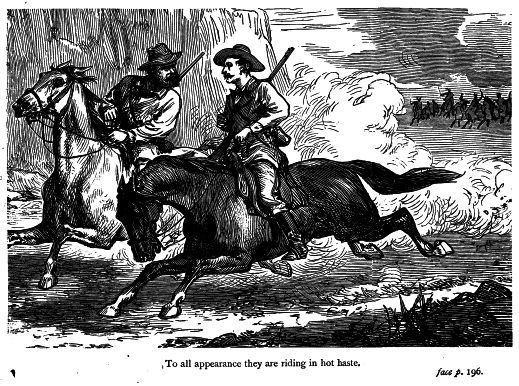
Also that the troop is coming towards them, and advancing at such rapid pace, that in less than twenty minutes after being descried, it is close to the clump of black-jacks. Fortunately for Alec Hawkins and Oris Tucker, the Indian horsemen have no intention to halt there, or rest themselves under the shadow of the copse. To all appearance they are riding in hot haste, and with a purpose which carries them straight towards the pass. They do not even stop on arrival at its—summit; but dash down the ravine, disappearing suddenly as though they had dropped into a trap!
It is some time before the two hunters have recovered from their surprise, and can compare notes about what they have seen, with conjectures as to its bearing. They have witnessed a spectacle sufficiently alarming,—a band of fierce-looking savages, armed with spear and tomahawk—some carrying guns—all plumed and painted, all alike terrible in aspect.
Quick the apparition has passed before their eyes, as suddenly disappearing. The haste in which the Indians rode down the ravine tells of their being bent on some fore-arranged purpose that calls for early execution. It may be murder, or only plunder; and the men may be Comanches—as in every likelihood they are.
“They’re a ugly-looking lot,” says Hawkins, after seeing them file past. “If there were a hundred, instead o’ twenty, I’d predict some danger to our new settlement. They appear to be going that way—at all events they are bound for the river bottom, and the lower crossing. We must follow them, Oris, an’ see if we can make out what’s their game. The red devils mayn’t mean downright robbery, but like enough they intend stealin’. Hitch up, and let’s after em’.”
In a trice the two hunters are in their saddles; and proceeding to the summit of the pass, look down at the valley below. Not carelessly, but cautiously. Hawkins is an old campaigner, has fought Indians before, and knows how to deal with them.
Keeping himself and horse under cover of the cedars, after instructing his comrade to do the same, he reconnoitres the bottom-land, before attempting to descend to it.
As expected, he sees the Indians making for the ford. At the point between the San Saba, and either of its bluffs is a breadth of some four miles, part open meadow land, the other part, contiguous to the river overgrown with heavy timber. Into this the red horsemen are riding, as the two hunters reach the summit of the pass, the latter arriving just in time to see their last files disappear among the trees. It is their cue to descend also, which they do, without further delay.
Hastening down the ravine and on to the river ford, they discover that the Indians have crossed it. The tracks of their horses are on both banks. Beyond, the hunters cannot tell which way they have taken. For though still only twilight it is dark as night under the thick standing trees; and he keenest eye could not discover a trail.
Thus thrown off, they have no choice but continue on to the settlement.
Beaching this at a rather late hour, they do not enter the mission-building nor yet any of the huts of the rancheria. Their own residence is a tent, standing in the grove between; and to it they betake themselves. Once under canvass their first thought is supper, and they set about cooking it. Though they have brought back no buffalo meat a twenty pound turkey “gobbler” has been all day dangling at the horn of Hawkins’ saddle—enough for a plentiful repast.
Oris, who acts as cook, sets to plucking the bird, while Hawkins commences kindling a fire outside the tent. But before the fagots are ablaze, the old hunter, all along abstracted, becomes fidgetty, as if troubled with the reflection of having neglected some duty he ought to have done.
Abruptly breaking off, and pitching aside the sticks, he says:—“This wont do, Cris, nohow. I’ve got a notion in my head there’s something not right about them Indyens. I must up to the house an’ tell the Colonel. You go on, and get the gobbler roasted. I’ll be back by the time its ready.”
“All right,” rejoins Tucker, continuing to make the feathers fly. “Don’t stay if you expect any share of this bird. I’m hungry enough to eat the whole of it myself.”
“You needn’t fear for my stayin’. I’m just as sharp set as yourself.”
So saying, Hawkins strides out of the tent, leaving his comrade to continue the preparations for their repast.
From the hunter’s tent, the house is approached by a narrow path, nearly all the way running through timber. While gliding silently along it, Hawkins comes suddenly to a stop.
“Seems to me I heard a cry,” he mutters to himself; “seems, too, as ’twar a woman’s voice.”
After listening awhile, without hearing it repeated, he adds:
“I reckon, ’twar only the skirl o’ them tree-crickets. The warm night makes ’em chirp their loudest.”
Listening a little longer, he becomes convinced it was but the crickets he heard, and keeps on to the house.
Chapter Forty Nine.
Waiting the word.
To all appearance Fernand’s fireworks are about to bear fruit, this likely to be bitter. As the sky, darker after the lightning’s flash, a cloud is collecting over the new settlement, which threatens to sweep down upon it in a rain storm of ruin. What but they could have caused this cloud; or, at all events, given a cue for the time of its bursting.
It appears in the shape of a cohort of dusky horsemen, painted and plumed. No need to say, they are the same that were seen by Hawkins and Tucker.
Having crossed the river at its lower ford, where so far the hunters saw their tracks, there losing them, the savages continued on. Not by the main road leading to the mission, but along a path which deflects from it soon after leaving the river’s bank. A narrower trace, indeed the continuation of that they had been following all along—the transverse route across the bottom-land from bluff to bluff, on both sides ascending to the steppe.
But though they came down on one side, they went not up on the other. Instead, having reached the nether bluff, they turned sharp along its base, by another and still narrower trace, which they knew would take them up to the mission-building. A route tortuous, the path beset with many obstacles; hence their having spent several hours in passing from the ford to the mission-house, though the distance between is barely ten miles.
No doubt they have good reason for submitting to the irksome delay caused by the difficult track, as also for the cautious manner in which they have been coming along it. Otherwise, they would certainly have chosen the direct road running nearer the river’s bank.
While Colonel Armstrong, and his friends, are enjoying themselves in the refectory of the ancient mission-house, in the midst of their laughing hilarity, the painted cavaliers have been making approach, and are now halted, within less than half-a-mile from its walls. In such fashion as shows, they do not intend a long stay in their stopping place. Not a saddle is removed, or girth untightened; while the bridles, remaining on their horses’ heads, are but used as halters to attach them to the trees.
The men have dismounted, but not to form camp, or make bivouac. They kindle no fires, nor seem caring to cook, or eat. They drink, however; several of them taking flasks from their saddle pouches, and holding them to their heads bottom upward. Nothing strange in this. The Texan Indian, whether Comanche, Kiowa, or Lipan, likes his fire-water as much as a white man, and as constantly carries it along with him. The only peculiarity about these is that, while quaffing, they do not talk in the Indian tongue, but English of the Texan idiom, with all its wild swearing!
The place where they have halted is a bit of glade-ground, nearly circular in shape, only half-encompassed by timber, the other half being an embayment of the bluffs, twin to those on the opposite side of the river bottom. It is shaded three-quarters across by the cliff, the moon being behind this. The other quarter, on the side of the trees, is brilliantly lit up by her beams, showing the timber thick and close along its edge, to all appearance impassable as the façade of rugged rock frowning from the opposite concave of the enclosed circle. Communicating with this are but two paths possible for man or horse, and for either only in single file. One enters the glade coming up the river bottom along the base of the bluff; the other debouches at the opposite end, still following the cliff’s foot. By the former the Indians have entered; but by the latter it is evident they intend going out, as their eyes are from time to time turned towards it, and their gestures directed that way. Still they make no movement for resuming their march, but stand in gathered groups, one central and larger than the rest. In its midst is a man by nearly the head taller than those around him: their chief to a certainty. His authority seems acknowledged by all who address him, if not with deference, in tone and speech telling they but wait for his commands, and are willing to obey them. He, himself, appears waiting for something, or somebody else, before he can issue them, his glance continually turning towards the point where the path leads out upwards.
Impatiently, too, as ever and anon he pulls out a watch and consults it as, to the time. Odd to see a savage so engaged; above all possessed of a repeater! Still the Indians of to-day are different from those of days past, and have learnt many of the white man’s ways—even to wearing watches. The man in question seems to know all about it; and has his reasons for being particular as to the hour. He is evidently acting upon a preconcerted plan, with the time fixed and fore-arranged. And evident also that ten is the hour awaited; for, while in the act of examining his dial, the old mission clock, restored to striking, tolls just so many times; and, before the boom of its cracked bell has ceased rolling in broken reverberation through the trees, he thrusts the watch hurriedly into his fob. Then stands in expectant attitude, with eyes upon the embouchure of the upper path, scanning it more eagerly than ever. There is a strange coincidence between the strokes of the clock and the flashes of Fernanda powder—both numbering the same. Though not strange to the leader of the savage troop. He knows what it is—comprehends the significance of the signal—for signal it has been. A dread one, too, foreboding danger to innocent people. One who could behold this savage band, scrutinise the faces of those composing it, witness the fierce wicked flashes from their eyes, just as the clock is striking, would send up a prayer for the safety of Colonel Armstrong and his colonists.
If further informed as to who the savages are, the prayer would sure be succeeded by the reflection—“Heaven help his daughters! If God guard not, a fearful fate will be theirs—a destiny worse than death!”
Chapter Fifty.
An uncanny skulker.
Still within the garden are the young girls—still standing under the shadow of the two trees that furnished the contrasting symbols,—unconscious of danger near. Helen’s speech, suggesting such painful sequence, has touched her sister to the quick, soon as spoken, afflicting also herself; and for a time they remain with entwined arms and cheeks touching—their tears flowing together. But Jessie’s sobs are the louder, her grief greater than that she has been endeavouring to assuage.
Helen perceiving it, rises to the occasion; and, as oft before, in turn becomes the comforter; their happiness and misery like scales vibrating on the beam.
“Don’t cry so, Jess. Be a good girl, now. You’re a little simpleton, and I a big one. ’Twas very wrong of me to say what I did. Be it forgotten, and let’s hope we may yet both be happy.”
“Oh, if I could but think that!”
“Think it, then. You are happy, and I—shall try to be. Who knows what time may do—that and Texas? Now, my little Niobe, dry up your tears. Mine are all gone, and I feel in first rate spirits. I do indeed.”
She is not sincere in what she says, and but counterfeits cheerfulness to restore that of her sister.
She has well-nigh succeeded, when a third personage appears upon the scene, causing a sudden change in their thoughts, turning these into a new and very different channel.
He whose appearance produces such effect—for it is a man—seems wholly unconscious of the influence he has exerted; indeed, is so.
When first observed, he is coming down the central walk; which, though wide, is partially shadowed by trees. And in their shadow he keeps, clinging to it, as if desirous to shun observation. His step declares it; not bold this, nor regardless, but skulking, with tread catlike; while every now and then he casts a backward glance, as if in fear of some one being behind. Just that which hinders him from seeing those who are in front.
The girls are still standing together, with hands joined—luckily on one of the side-walks, and like himself in shadow—though very near to having separated, and one, at least, rushing out into the light at first sound of his footstep. For to Jessie it gave joy, supposing it that of her Luis. Naturally expecting him to join her, she was almost sure of its being he.
Only for an instant. The tread was too light for a man marching with honest intent, and the step too shuffling to be that of the young planter. So whispered Helen.
Soon they see it is not he, but his major-domo.
Both are annoyed, some little irritated, at being thus intruded upon. At such a time, in the midst of sacred emotions, all the more by a man they both instinctively dislike. For Fernand is not a favourite with either.
Then the idea occurs, he may be coming to seek them, sent with some message from the house, and if so, they can excuse him. Concluding his errand to be this, they await it, in silence.
They are quite mistaken, and soon perceive it. An honest messenger would not be moving as he. While passing the open ground by the ruined waterworks, the moon falls full upon his face, which wears an expression anything but innocent, as they can both see. Besides, his gestures also betray guilt; for he is skulking, and casting glances back.
“What can it mean?” whispers Jessie into Helen’s ear; who replies by placing a finger on her lips, and drawing her sister into deeper shadow.
Silent both stand, not stirring, scarce breathing. One seeing, might easily mistake them for statues—a Juno and a Venus. Fortunately Fernand does not see, else he might scrutinise them more closely. He is too much absorbed about his own affair, whatever it be, to think of any one loitering there at that time of the night.
Where the main garden-walk meets the one going along the bottom, is another open space, smaller than that around the fountain, still sufficient to let in the light of the moon. Here also have been seats and statues; the latter lying shattered, as if hashed to the earth by the hand of some ruthless iconoclast. Just opposite, is a breach in the wall; the mud bricks, crumbled into clods forming a talus on each face of it.
Arriving at this, the mestizo makes stop. Only for an instant, long enough to give a last glance up the garden.
Apparently satisfied, that he is not followed nor observed, he scrambles up the slope and down on the opposite side, where he is lost to the view of the sisters; who both stand wondering—the younger sensibly trembling.
“What on earth is the fellow after?” asks Helen, whose speech comes first.
“What, indeed?” echoes Jessie.
“A question, sister, you should be better able to answer than I. He is the trusted servant of M. Dupré; and he, I take it, has told you all about him.”
“Not a word has he. He knows that I don’t like the man, and never did from the first. I’ve intimated as much to him more than once.”
“That ought to have got Master Fernand his discharge. Your Luis will surely not keep him, if he knows it’s disagreeable to you?”
“Well, perhaps he wouldn’t if I were to put it in that way. I haven’t done so yet. I only hinted that the man wasn’t altogether to my liking; especially made so much of as Luis makes of him. You must know, dear Helen, my future lord and master is of a very trusting nature; far too much, I fear, for some of the people now around him. He has been brought up like all Creoles, without thought for the morrow. A sprinkling of Yankee cuteness wouldn’t do him any harm. As for this fellow, he has insinuated himself into Luis’s confidence in some way that appears quite mysterious. It even puzzles our father; though he’s said nothing much about it. So far he appears satisfied, because the man has proved capable, and, I believe, very useful to them in their affairs. For my part I’ve been mystified by him all along, and not less now. I wonder what he can be after. Can you not give a guess?”
“Not the slightest; unless it be theft. Do you think it’s that?”
“I declare I don’t know.”
“Is there anything he could be carrying off from the house, with the intention of secreting it outside? Some of your Luis’s gold for instance, or the pretty jewels he has given you?”
“My jewels! No; they are safe in their case; locked up in my room, of which I’ve the key with me. As for Luis’s gold, he hasn’t much of that. All the money he possesses—quite fifty thousand dollars, I believe—is in silver. I wondered at his bringing it out here in that heavy shape, for it made a whole waggon-load of itself. He’s told me the reason, however; which is, that among Indians and others out here on the frontier, gold is not thought so much of as silver.”
“It can’t be silver Fernand is stealing—if theft it be. He would look more loaded, and couldn’t have gone so lightly over that wall.”
“Indeed, as you say, he went skipping over it like a grasshopper.”
“Rather say gliding like a snake. I never saw a man whose movements more resembled the Devil in serpent shape—except one.”
The thought of this one, who is Richard Darke, causes Helen Armstrong to suspend speech; at the same time evoking a sigh to the memory of another one—Charles Clancy.
“Shall we return into the house?” asks Jessie, after a pause.
“For what purpose?”
“To tell Luis of what we’ve seen; to warn him about Fernand.”
“If we did the warning would be unheeded. I fear Monsieur Dupré will remain unconvinced of any intended treachery in his trusted servant, until something unpleasant occur; it may be something disastrous. After all, you and I, Jess, have only our suspicions, and may be wronging the fellow. Suppose we stay a little longer, and see what comes of it. No doubt, he’ll soon return from his mysterious promenade, and by remaining, we may find out what he’s been after. Shall we wait for him? You’re not afraid, are you?”
“A little, I confess. Do you know, Helen, this Fernand gives me the same sort of feeling I had at meeting that big fellow in the streets of Natchitoches. At times he glares at me just in the same way. And yet the two are so different.”
“Well, since no harm came of your Nachitoches bogie, it’s to be hoped there won’t any from this one. If you have any fear to stay, let us go in. Only my curiosity is greatly excited by what we’ve seen, and I’d like to know the end of it. If we don’t discover anything, it can do no harm. And if we do—say; shall we go, or try?”
“I’m not afraid now. You make me brave, sister. Besides, we may find out something Luis ought to know.”
“Then let us stay.”
Having resolved to await the coming back of the half-blood, and watch his further movements, the sisters bethink them of seeking a safer place for observation; one where there will be less danger of being themselves seen.
It is to Helen the idea occurs.
“On his return,” she says, “he might stray along this way, and not go up the centre walk. Therefore we had better conceal ourselves more effectually. I wonder he didn’t see us while passing out. No doubt he would have done so, but for looking so anxiously behind, and going at such a rapid rate. Coming back he may not be so hurried; and should he sight us, then an end to our chance of finding out what he’s up to. Where’s the best place to play spy on him?”
The two look in different directions, in search of an appropriate spot.
There can be no difficulty in finding such. The shrubbery, long unpruned, grows luxuriantly everywhere, screening the façade of the wall along its whole length.
Near by is an arbour of evergreens, thickly overgrown with a trellis of trailing plants.
They know of this shady retreat; have been in it before that night. Now, although the moon is shining brightly, its interior, arcaded over by dense foliage, is in dark shadow—dark as a cavern. Once inside it, eye cannot see them from without.
“The very place,” whispers Helen; and they commence moving towards it.
To reach the arbour it is necessary for them to return to the main walk, and pass the place where the bottom wall is broken down; a ruin evidently caused by rude intruders, doubtless the same savages who made the mission desolate. The talus extending to the path, with its fringe of further scattered clods, requires them to step carefully so as to avoid stumbling.
They go hand in hand, mutually supporting one another.
Their white gossamer dresses, floating lightly around them as they glide silently along, give them a resemblance to sylphs, or wood-nymphs, all the more as they emerge into the moonlight.
To complete the sylvan picture, it seems necessary there should be satyrs, or wood-demons, as well.
And such in reality there are, not a great way off. These, or something closely resembling them. No satyrs could show in more grotesque guise than the forms at that moment moving up to the wall, on its opposite side.
Gliding on, the sisters have arrived before the gap. Some instinct, perhaps curiosity, tempts them to take a look through it, into the shadowy forest beyond; and for some time, as under a spell of fascination, they stand gazing into its dark, mysterious depths.
They see nought save the sparkle of fire-flies; and hear nothing but the usual noises of the Southern night, to which they have been from infancy accustomed.
But as they are about moving on again, a sound salutes their ear—distinguishable as a footstep. Irregular and scrambling, as of one stepping among the broken bricks. Simultaneously a man is seen making his way over the wall.
“Fernand!”
No use for them now to attempt concealment; no good can come of it. He has seen them.
Nor does he any longer seem desirous of shunning observation. On the contrary, leaping down from the rampart, he comes straight towards them; in an instant presenting himself face to face, not with the nimble air of a servant, but the demeanour of one who feels himself master, and intend to play tyrant. With the moon shining full upon his tawny face, they can distinguish the play of its features. No look of humility, nor sign of subservience there. Instead, a bold, bullying expression, eyes emitting a lurid light, lips set in a satanic smile, between them teeth gleaming like a tiger’s! He does not speak a word. Indeed, he has not time; for Helen Armstrong anticipates him. The proud girl, indignant at what she sees, too fearless to be frightened, at once commences chiding him.
In words bold and brave, so much that, if alone, the scoundrel might quail under their castigation. But he is not alone, nor does he allow her to continue.
Instead, he cries out, interrupting, his speech not addressed to her, but some one behind:—
“Bring hither the serapes! Quick, or—”
He himself is not permitted to finish what he intended saying; or, if so, his last words are unheard; drowned by a confused noise of rushing and rumbling, while the gap in the garden wall is suddenly closed, as if by enchantment. It is at first filled by a dark mass, seemingly compact, but soon separating into distinct forms.
The sisters, startled, terrified, have but time to give out one wild cry—a shriek. Before either can utter a second, brawny arms embrace them; blinds are thrown over their faces; and, half stifled, they feel themselves lifted from their feet, and borne rudely and rapidly away!
Chapter Fifty One.
Locked in.
At that same moment, when the red Sabines are carrying off his daughters, Colonel Armstrong is engaged, with his fellow-colonists, in discussing a question of great interest to all. The topic is sugar—the point, whether it will be profitable to cultivate it in their new colony. That the cane can be grown there all know. Both soil and climate are suitable. The only question is, will the produce pay, sugar being a bulky article in proportion to its price, and costly in transport through a territory without railroads, or steam communication.
While the discussion is at its height a new guest enters the room; who, soon as inside, makes a speech, which not only terminates the talk about sugar, but drives all thought of it out of their minds.
A speech of only four words, but these of startling significance: “There are Indians about!” ’Tis Hawkins who speaks, having entered without invitation, confident the nature of his news will hold him clear of being deemed an intruder.
And it does. At the word “Indians,” all around the table spring up from their seats, and stand breathlessly expectant of what the hunter has further to communicate. For, by his serious air, they are certain there must be something more.
Colonel Armstrong alone asks, the old soldier showing the presence of mind that befits an occasion of surprise.
“Indians about? Why do you say that, Hawkins? What reason have you to think so?”
“The best o’ reasons, colonel. I’ve seed them myself, and so’s Cris Tucker along with me.”
“Where?”
“Well, there’s a longish story to tell. If you’ll have patience, I’ll make it short as possible.”
“Go on!—tell it!”
The hunter responds to the demand; and without wasting words in detail, gives an epitome of his day’s doings, in company with Cris Tucker. After describing the savage troop, as first seen on the upper plain, how he and his comrade followed them across the river bottom, then over the ford, and there lost their trail, he concludes his account, saying:
“Where they went afterward, or air now, ’taint possible for me to tell. All I can say is, what I’ve sayed already: there are Indians about.”
Of itself enough to cause anxiety in the minds of the assembled planters; which it does, to a man making them keenly apprehensive of danger.
All the more from its being their first alarm of the kind. For, while travelling through Eastern Texas, where the settlements are thick, and of old standing, the savages had not evens been thought of. There was no chance of seeing any there. Only, on drawing nigh to the Colorado, were Indians likely to be encountered; though it did not necessarily follow that the encounter should be hostile. On the contrary, it ought to be friendly; since a treaty of peace had for some time been existing between the Comanches and Texans.
For all this, Colonel Armstrong, well acquainted with the character of the red men, in war as in peace, had not relied altogether on their pacific promises. He knew that such contracts only bind the savage so long as convenient to him, to be broken whenever they become irksome. Moreover, a rumour had reached the emigrants that, although the great Comanche nation was itself keeping the treaty, there were several smaller independent tribes accustomed to make “maraud” upon the frontier settlements, chiefly to steal horses, or whatever chanced in their way.
For this reason, after entering the territory where such pillagers might be expected, the old soldier had conducted his expedition as if passing through an enemy’s country. The waggons had been regularly corralled, and night guards kept—both camp sentinels and outlying pickets.
These rules had been observed up to the hour of arrival at their destination. Then, as the people got settled down in their respective domiciles, and nothing was heard of any Indians in that district, the discipline had been relaxed—in fact, abandoned. The colonists, numbering over fifty white men—to say nothing of several hundred negro slaves—deemed themselves strong enough to repel any ordinary assault from savages. They now considered themselves at home; and, with the confidence thus inspired, had ceased to speculate, on being molested by Indian enemies, or any others.
For this reason the suspicious movements of Dupré’s half-breed servant, as reported by the young surgeon, had failed to make more than a passing impression on those around the dining-table; many of them treating it as an eccentricity.
Now, after hearing Hawkins, they think differently. It presents a serious aspect, is, in truth, alarmingly suggestive of treason.
The half-blood inside the house may be in correspondence with full-blooded Indians outside, for some scheme of thieving or burglary.
The thought of either is sufficient to excite Colonel Armstrong’s guests, and all are on foot ready to take action.
“Dupré, call in your half-breed!” says the Colonel, directing it. “Let us hear what the fellow has to say for himself.”
“Tell Fernand to come hither,” commands the Creole, addressing himself to one of the negro lads waiting at table. “Tell him to come instantly!”
The boy hastens off to execute the order; and is several minutes before making re-appearance.
During the interval, they continue to discuss the circumstances that have so suddenly turned up; questioning Hawkins, and receiving from him minuter details of what he and his comrade have seen.
The additional matter made known but excites them the more, further intensifying their apprehensions.
They’re at their keenest, as the darkey re-enters the room with the announcement that Fernand is not to be found!
“What do you mean, boy?” thunders Dupré, in a voice that well-nigh takes away the young negro’s wits. “Is he not in the house?”
“Dat’s jess what he aint, Mass Looey. De Spanish Indyin’s no whar inside dis buildin’. We hab sarch all oba de place; call out his name in de store-rooms, an’ de coatyard, an’ de cattle closure—ebbery wha we tink of. We shout loud nuf for him to hyeer, ef he war anywha ’bout. He haint gib no answer. Sartin shoo he no inside o’ dis ’tablishment.”
The young planter shows dismay. So also the others, in greater or less degree, according to the light in which each views the matter.
For now on the minds of all is an impression, a presentiment, that there is danger at the bottom of Fernand’s doings—how near they know not.
At any other time his absence would be a circumstance not worth noting. He might be supposed on a visit to some of the huts appropriated to the humbler families of the colonist fraternity. Or engaged outside with a mulatto “wench,” of whom there are several, belonging to Dupré’s extensive slave-gang, far from ill-favoured.
Fernand is rather a handsome fellow, and given to gaiety; which, under ordinary circumstances, would account for his absenting himself from the house, and neglecting his duties as its head-servant. But after what the young surgeon has seen—above all the report just brought in by Hawkins—his conduct will not convey this trivial interpretation. All in the room regard it in a more serious light—think the mestizo is a traitor.
Having come to this general conclusion, they turn towards the table, to take a last drink, before initiating action.
Just as they get their glasses in hand, the refectory door is once more opened; this time with a hurried violence that causes them to start, as though a bombshell had rolled into the room.
Facing towards it, they see it is only the negro boy, who had gone out again, re-entering. But now with fear depicted on his face, and wild terror gleaming from his eyes; the latter awry in their sockets, with little beside the whites seen!
Their own alarm is not much less than his, on hearing what he has to say. His words are,—
“Oh, Mass Kurnel! Mass Looey! Gemmen all! De place am full ob Indyin sabbages! Dar outside in de coatyard, more’n a thousan’ ob um; an’ murderin’ ebbery body!”
At the dread tidings, glasses drop from the hands holding them, flung down in fear, or fury. Then all, as one man, make for the door, still standing open as in his scare the negro lad left it.
Before they can reach it, his words are too fully confirmed. Outside they see painted faces, heads covered with black hanging hair, and plumes bristling above. Only a glimpse they get of these, indistinct through the obscurity. But if transitory, not the less terrible—not less like a tableau in some horrid dream—a glance into hell itself.
The sight brings them to a stand; though, but for an instant. Then, they rush on towards the doorway, regardless of what may await them outside.
Outside they are not permitted to pass. Before they can reach the door, it is shut to with a loud clash; while another but slighter sound tells of a key turning in the wards, shooting a bolt into its keeper.
“Locked in, by God!” exclaims Hawkins, the rest involuntarily echoing his wild words; which are succeeded by a cry of rage as from one throat, though all have voice in it. Then silence, as if they were suddenly struck dumb.
For several moments they remain paralysed, gazing in one another’s faces in mute despairing astonishment. No one thinks of asking explanation, or giving it. As by instinct, all realise the situation—a surprise, an Indian attack. No longer the future danger they have been deeming probable, but its dread present reality!
Short while do they stand irresolute. Hawkins, a man of herculean strength, dashes himself against the door, in hopes of heaving it from its hinges. Others add their efforts.
All idle. The door is of stout timber—oaken—massive as that of a jail; and, opening inward, can only be forced along with its posts and lintels.—These are set in the thick wall, embedded, firm as the masonry itself.
They rush to the windows, in hope of getting egress there.
Equally to be disappointed, baffled. The strong, iron bar resist every effort to break or dislodge them. Though weakened with decaying rust, they are yet strong enough to sustain the shock of shoulders, and the tug of arms.
“Trapped, by the Eternal!” despairingly exclaims the hunter. “Yes, gentlemen, we’re caged to a certainty.”
They need not telling. All are now aware of it—too well. They see themselves shut in—helplessly, hopelessly imprisoned.
Impossible to describe their thoughts, or depict their looks, in that anguished hour. No pen, or pencil, could do justice to either. Outside are their dear ones; near, but far away from any hope of help, as if twenty miles lay between. And what is being done to them? No one asks—none likes to tempt the answer; all guessing what it would be, dreading to hear it spoken. Never did men suffer emotions more painfully intense, passions more heartfelt and harrowing; not even the prisoners of Cawnpore, or the Black Hole of Calcutta.
They are in darkness now—have been from the moment of the door being closed. For, expecting to be fired at from the outside, they had suddenly extinguished the lights. They wonder there has been no shooting, aware that the Comanches carry fire-arms. But as yet there has been no report, either of pistol, or gun!
They hear only voices—which they can distinguish as those of the house-Servants—male and female—all negroes or mulattoes. There are shrieks, intermingled with speeches, the last in accent of piteous appealing; there is moaning and groaning. But where are the shouts of the assailants? Where the Indian yell—the dread slogan of the savage? Not a stave of it is heard—nought that resembles a warwhoop of Comanches!