IV. SUNBURY.
Reading edition
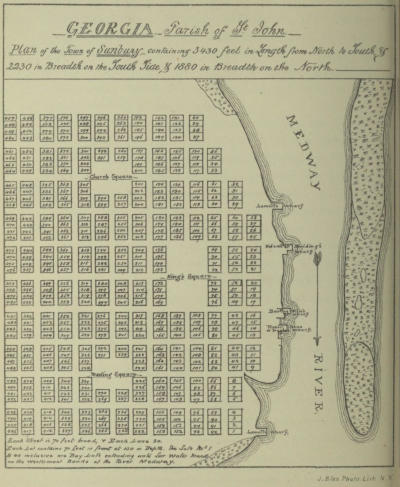
GEORGIA. Parish of St. John.
Plan of the Town of Sunbury containing 3430 feet in Length from North to South, & 2230 in Breadth on the South Side, & 1880 in Breadth on the North.
J. Bien, Photo. Lith. N. Y.
On the 23rd of January, 1734, Mr. Oglethorpe, accompanied by Captain Ferguson and sixteen attendants,—including two Indians,—set out from Savannah in an open row-boat, followed by a yawl carrying provisions and ammunition, upon an exploratory expedition to the Southern frontiers of Georgia.[167] His course lay through the inner passages, and was pursued as far as St. Simons island. For the protection of the Colony it was then determined to form a military station and settlement near the mouth of the Alatamaha; and,—as an outpost and barrier against Spanish invasion,—to erect a strong fort on the high bluff on the western side of St. Simons island. These sites were shortly afterwards occupied and fortified, and were respectively named New Inverness and Frederica. It was during this reconnoissance that the eyes of the Founder of Georgia first rested upon that bold and beautiful bluff which, overlooking the placid waters of Midway river and the intervening low-lying salt marshes, descries in the distance the green woods of Bermuda island, the dim outline of the southern point of Ossabaw, and, across the sound, the white shores of St. Catherine. Although formal session had been made by the Lower Creeks of all lands along the sea-coast from the Savannah to the Alatamaha river, extending westward as high as the tide flowed, and including all islands except a few which the Indians specially reserved for the purposes of hunting, fishing, and bathing, no English settlements had, at that early day, been formed south of the Great Ogeechee river. Fort Argyle,—garrisoned by Captain McPherson and his troop of Rangers, and commanding the passes by which the Indians during the late wars were accustomed to invade Carolina,—was then the only military post of any consequence in the direction of the Spaniards. From this nameless bluff the Aborigines had not then removed, and their canoes might be seen passing and repassing to and from Hussoope, [Ossabaw], and Cowleggee, [St. Catharine], islands and the main. To the quiet woods and waters of this semi-tropical region the English were strangers. The Bermuda grass which, at a later period, so completely covered Sunbury bluff, did not then appear, but magnificent live oaks, in full grown stature and solemn mien, crowned the high-ground even to the very verge where the tide kissed the shore. Cedars, festooned with vines, over-hung the waters. The magnolia grandiflora,—queen of the forest,—excited on every hand the admiration of the early visitor. The sweet-scented myrtle, the tall pine, the odoriferous bay, and other indigenous trees lent their charms to a spot whose primal beauty had encountered no change at the hand of man. The woods were resonant with the songs of birds, whose bright plumage vied in coloring with the native flowers which gladdened the eye and gave gentle odors to the ambient air. Fishes abounded in the waters, and game on the land. Cool sea-breezes tempered the heat of summer, and the rigor of cold was unknown in the depth of winter. It was a gentle, attractive place,—this bold bluff,—as it came from the hand of Nature. Some scene like this did the Poet Waller have in view as he sang:
“Heav’n sure has kept this spot at earth uncurst, To show how all things were created first.”
By a certain grant under the great seal of the Province of Georgia, bearing date the 4th of October, 1757, his Majesty George II conveyed to Mark Carr, his heirs and assigns forever, in free and common socage, “All that tract of land containing five hundred acres, situate and being in the District of Midway in the Province of Georgia, bounded on the east by the Midway river, on the west by land of Thomas Carr, on the south by vacant land, and on all other sides by marshes of the said river.”
The grantee of these lands, which embraced the site of the future town of Sunbury, had been for some twenty years a man of means and of mark in the Colony of Georgia. In 1741 he had been sent by General Oglethorpe to Virginia to raise recruits for the Colony.[168] In his last will and testament, dated June 8th, 1767, and proven before his Excellency Sir James Wright on the 4th of December of the same year, Captain Carr describes himself as being “of the Parish of St. Patrick in the Province of Georgia, Esquire.” He owned lots in the town of Frederica, an island on the north side of Midway river, a tract of land on the main fronting that island, which he had purchased from John Cubbage, and “a plantation on the main over against Jekyll island.” This was his favorite residence. Here, on the 18th of March, 1741,—despite the presence of a guard of soldiers there stationed by General Oglethorpe,—the Indians made an attack very early in the morning, killing several of the soldiers and servants, wounding others, “locking down the women and children in the cellar,” pillaging the house, and carrying away the booty in a large boat belonging to the plantation.[169]
The grant of this five hundred acre tract on Midway river to Mark Carr in fee simple, was made under the operation of the rules adopted by the Common Council in May, 1750, which essentially enlarged the tenures of grants already existing, and provided that future alienations should convey “an absolute inheritance to the grantees, their heirs and assigns.” It will be remembered that under the regulations at first prescribed by the Trustees, five hundred acre tracts were conveyed only to persons well approved by the Trust;—parties who should at their own expense, and within twelve months from the date of the grant, bring ten able-bodied men servants not younger than twenty years of age, and settle upon the lands.
Former alienations of this magnitude had been coupled with other conditions, among which the following may be enumerated as the most important:
I. The grantee obligated himself to abide in Georgia with his servants for a term of not less than three years, building houses and cultivating the lands.
II. Within ten years from the registry of the grant, at least two hundred of the five hundred acres were to be cleared and cultivated.
III. No alienation of the lands thus granted, either in whole or in part, for a term of years or otherwise, was permitted except by special leave.
IV. After the lapse of eighteen years from the date of the grant, should any part of the five hundred acres remain uncultivated, unplanted, uncleared, and without a worm-fence, or pales six feet high, such portion should revert to the Trust, and the grant, pro tanto, was to become void.
V. These grants were in Tail Male.[170]
On the 20th of June, 1758, Mark Carr conveyed three hundred acres of this five hundred acre tract, including that portion bordering upon Midway river, to “James Maxwell, Kenneth Baillie, John Elliott, Grey Elliott, and John Stevens, of Midway, Esquires,” ... in trust that the same should be laid out as a town by the name of Sunbury;—one hundred acres thereof being dedicated as a common, for the use of the future inhabitants;—and in further trust “that they, the said James Maxwell, Kenneth Baillie, John Elliott, Grey Elliott, and John Stevens and their successors, should sell and dispose of all and singular the lots to be laid out in the said town of Sunbury to and for the proper use and behoof of the said Mark Carr.”
Captain McCall[171] suggests that “the town was called Sunbury,—the etymology of which is probably the residence of the sun,—from the entire exposure of this place to his beams while he is above the horizon.” We believe that this projected village was named for Sunbury, a quiet and beautiful town in Middlesex County, on the left bank of the Thames, only a little way above Hampton Court, and distant some eighteen miles by land from London;—it being a pleasant custom among the colonists to perpetuate in their new homes the memories of persons and places dear to them in the mother country.
In ancient records, says Lysons, this place (Sunbury in England) is called Sunnabyri, Sunneberie, Suneberie, &c. Sunnabyri is composed of two Saxon words,—sunna, the sun, and byri, a town,—and may be supposed to denote a place exposed to the sun, or with a southern aspect.
A name better suited to this locality could scarcely have been suggested. It recalls the peaceful memories of one of the gentle towns of old England, and typifies the genial influences of the “King of Day” as, from early dawn until sunset, he irradiates with floods of light the bold bluff “on the westermost bank of the river Midway.”
Two of the Trustees,—John Stevens and John Elliott,—were prominent members of the Midway Congregation. James Maxwell had been for several years a resident of St. John’s Parish. He and John Stevens were members of the Provincial Congress which assembled at Tondee’s Long-room in Savannah on the 4th of July, 1775.[172]
Kenneth Baillie and Grey Elliott were active and influential citizens. The latter was subsequently selected by the General Assembly to act as an assistant from the Colony of Georgia to Dr. Benjamin Franklin who had been chosen by several of the Provinces,—Georgia among the number,—and sent on a special mission to England to represent the wants and grievances of the Colonies, remonstrate against such acts of the Crown as were deemed oppressive, and oppose taxation without representation.[173]
All the Trustees, therefore, were men of position and character, commanding the respect of the community. Their selection for the trust indicated sound judgment and well-placed confidence on the part of Mark Carr.
The road from Savannah to New Inverness in the Darien settlement which, in 1736, in obedience to Mr. Oglethorpe’s orders, was located by Captain Hugh MacKay, Jr., with his company of Rangers, and Indian guides furnished by Tomo-chi-chi, had been completed. Various settlements on the Savannah, Vernon, and Great Ogeechee rivers, and also on St. Simons island and the Alatamaha river having been confirmed, between 1740 and 1750 planters with their families and servants began to move in and occupy desirable localities intermediate the Great Ogeechee and Alatamaha rivers. The sites, at first selected, lay along the line of the Savannah and New Inverness road, and upon high-grounds adjacent thereto bordering upon salt-water streams and swamps emptying into them. Between the Great Ogeechee and South-New Port rivers was formed the Midway settlement.
This district derived its name from its location, which was about midway between the rivers Savannah and Alatamaha then constituting the northern and southern boundaries of the colony. It has been suggested, and the belief is current with some, that the true spelling is Medway, and that both the District and the river which permeates it were named for one of the well-known streams of merrie old England.[174]
On the only plan of Sunbury the writer has been able to procure, and in some of the early records, this river is written Medway. It may be fairly stated, however, that while by some the river may have been called Medway, the district was universally known as Midway. The time-honored church, which still stands, and its predecessor which so long stood near the intersection of the Savannah and Darien, and the Sunbury roads, are both remembered as the Midway and not Medway congregational meeting houses. We are persuaded that the river as well as the district were both named Midway;—the former being called for the latter.
By an act dividing the several districts and divisions of the Province of Georgia into Parishes, passed the 15th day of March, 1758,[175] it was provided that “the town of Hardwick and district of Ogechee, on the south side of the river Great Ogechee, extending northwest up the said river so far as the Lower Indian trading path leading from Mount Pleasant, and southward from the town of Hardwick as far as the swamp of James Dunham, including the settlements on the north side of the north branches of the river Midway, with the islands of Ossabaw, and from the head of the said Dunham’s Swamp in a north-west line, shall be and forever constitute a parish by the name of ‘The Parish of St. Philip’: from Sunbury in the district of Midway and Newport from the southern bounds of the parish of St. Philip, extending southward as far as the north line of Samuel Hastings, and from thence southeast to the south branch of Newport, including the islands of St. Katharine and Bermuda, and from the north line of the said Samuel Hastings northwest, shall be and forever continue a parish by the name of ‘The Parish of St. John’: the town and district of Darien, extending from the south boundary of the parish of St. John to the river Alatamaha, including the islands of Sapelo and Eastwood, and the sea islands to the north of Egg island northwest up the river Alatamaha to the forks of the said river, shall be and forever continue a parish by the name of ‘The Parish of St. Andrew:’ and the town and district of Frederica, including the islands of Great and Little St. Simons, and the adjacent islands shall be and forever continue a parish by the name of ‘The Parish of St. James.’”
Such were the territorial limits of the four southern parishes of the province, approved by Governor Ellis, and designed to promote the establishment of religious worship according to the rites and ceremonies of the Church of England.[176]
As the early population of Sunbury was largely drawn from the members of the Midway congregation,—the most pronounced society existing within the limits of St. John’s parish at the time of its formation,—a brief sketch of that congregation and its establishment in Georgia, may not be deemed irrelevant.
Early in 1697 a body of Puritans from the Towns of Dorchester, Roxbury, and Milton, in Massachusetts, taking with them their pastor,—the Reverend Joseph Lord,—and proclaiming as a leading object the encouragement of churches and the promotion of religion in the Southern plantations, removed with their families and personal effects and formed a new home at Dorchester, in the province of South Carolina. The church which they there established was the first Congregational or Independent Church within the confines of that Colony. All the other religious societies belonged to the established Church of England.
After a residence of more than fifty years, finding their lands impoverished and insufficient for the rising generation,—Dorchester and Beach-Hill proving very unhealthy,—the good reports of the lands in Georgia having been confirmed upon the personal inspection of certain members of the Society who had been sent for that purpose, and a grant of 22,400 acres of land having been secured from the authorities in Georgia,—which grant was subsequently enlarged by the addition of 9,950 acres,—the members of the Dorchester Society commenced moving in 1752 into what is now the swamp region of Liberty County. The settlement lay between Mount Hope Swamp,—the head of Midway river,—on the North, and Bull-Town Swamp on the South. At first, however, it was not so comprehensive. It extended neither to the pine barrens on the West, nor to the salt water on the East. This immigration, begun in 1752, was continued until 1771, when it ceased.[177] According to the records of the Society, there were forty-four removals in all, of which one family came from Charlestown, four from Pon-Pon, and the remaining thirty-nine from Dorchester and Beach-Hill. These removals were most numerous during the years 1754, 1755, and 1756. These immigrants brought their negroes with them, and it appears probable, from the best lights before us, that the population of this colony, after its full establishment, consisted of about 350 whites, and 1500 negro slaves.
The region into which the Dorchester Congregation immigrated was already known as the Midway District. To the General Assembly which convened in Savannah in 1751, Audley Maxwell, Esquire, was sent as a delegate;—its population then entitling it to such representation. It would appear that a number of families residing in the Midway District previous to the arrival of the Dorchester Congregation, united with that Society after it was regularly domiciled in its new home. The Dorchester Colony did not immigrate, in its entirety, to Georgia. Some families continued to dwell at Dorchester and Beach-Hill, where their descendants may yet be found. Others removed elsewhere. With the formation of the new settlement in St. John’s parish, however, the old Dorchester colony in South Carolina lost its integrity and distinctive characteristics.
In locating their plantations amid the swamps of St. John’s parish, the following plan was adopted: After laying by their crops in Carolina in the fall of the year, the planters came with able-bodied hands, and, during the winter, cleared land and built houses. In a season or two having thus sufficiently prepared the way, they brought their families and servants in the early spring, and at once entered upon the cultivation of the soil. Thus was the removal rendered as safe and comfortable as the nature of the case permitted.
Strange to say, their dwellings and plantation quarters were invariably located on the edges of the swamps, in utter disregard of the manifest laws of health. In such malarial situations was the entire year passed. Their houses at first were built of wood, one story high, with dormer windows in the roofs, small in size, without lights, with no inside linings, and with chimneys of clay. The negro-houses were made either of clay or poles. For market, rice was the only article cultivated. While corn was planted on the upland, chief attention was bestowed upon the clearing, ditching, and drainage of the swamps. A miasmatic soil was thus exposed to the action of the sun, at their very doors. The consequence of such injudicious location, and of a general inattention to domestic comfort, was violent sickness and considerable mortality. So frequent were the deaths among children that they seldom arrived at puberty. Those who attained the age of manhood and womanhood possessed feeble constitutions. According to the register kept by the Society, from 1752 to 1772,—the period during which this settlement was being formed,—193 births and 134 deaths occurred. The mortality was greatest during the months of September, October, and November. April, May, June, and August appear to have been the healthiest months:—June particularly so. Bilious fevers in the fall, and pleurisies in the winter and spring, were the diseases which proved most fatal. It used to be said of such as survived a severe attack of bilious fever in the fall, that they would certainly die of pleurisy in the winter or spring.
The Indians being in the vicinity, and at times indulging in acts of hostility, some of the houses of these early settlers were made of hewn cypress logs after the fashion of block houses, and were bullet proof.
The style of agriculture in vogue was of the most primitive sort. The ground was tilled with hoes only. Ploughs were not in use. All rails for fencing were carried on the heads and shoulders of the negroes, and in the same manner was rice transported from the fields. This grain was not only threshed but also beaten by hand: and thus was the crop prepared for market. At first some of the planters sold their crops in Savannah. A trip to that place was the event of the year, and the anticipated journey was talked of in the neighborhood for some time before it was undertaken. Horses were specially fed and carefully attended for a week or more preparatory to the jaunt. Ordinary journeys to church, and of a social character, were performed on horseback. Hence horse-blocks were to be seen at every door. When he would a-wooing go, the gallant appeared mounted upon his finest steed and in his best attire, followed by a servant on another horse, conveying his master’s valise behind him.
Shortly after the Revolutionary war stick-back gigs were introduced. If a woman were in the vehicle and unattended, the waiting man rode another horse, keeping along side of the shaft horse and holding the check rein in his left hand. When his master held the lines, the servant rode behind. Men often went armed to church for fear of the Indians.
The country was filled with game. Ducks and wild geese in innumerable quantities frequented the rice-fields. Wild turkeys and deer abounded. Bears and beavers were found in the swamps, and buffalo herds wandered at no great remove to the southward and northward. There was no lack of squirrels, raccoons, opossums, rabbits, snipe, wood-cock, and quail. Wildcats and hawks were the pest of the region, while the cougar was sometimes heard and seen in the depths of the vine-clad swamps. The waters which they held were alive with fishes, alligators, terrapins, and snakes.
Such, in a few words, was the condition of the swamp region of the Midway District when the town of Sunbury was located. Responding to the trust reposed in them by the conveyance from Mark Carr, Messrs. James Maxwell, Kenneth Baillie, John Elliott, Grey Elliott, and John Stevens, with due dispatch set about laying off the town upon the “westermost bank” of Midway river. The plan, as matured and carried out by them, embraced three public squares,—known respectively as King’s, Church, and Meeting,—and four hundred and ninety-six lots. These lots had a uniform front of seventy feet, and were one hundred and thirty feet in depth. Lots numbers one to forty, inclusive, fronting on the river, were denominated Bay Lots, and carried with them the ownership of the shore to low-water mark. Four lots constituted a block, bounded on three sides by streets, and on the fourth by a lane. The streets were seventy-five feet broad, and the lanes twenty feet wide. The plan of the town was entirely regular. The streets in one direction ran at right angles to the river, and were, at right angles, intersected by the cross streets and lanes. From north to south the length of Sunbury, as thus laid out, was 3430 feet. Its breadth on the south side was 2230 feet, and on the north, 1880 feet.
Within a short time substantial wharves were constructed, the most marked of which were subsequently owned and used by the following merchants: Kelsell & Spalding, Fisher, Jones & Hughes, Darling & Co., and Lamott.
That Sunbury must rapidly have attracted the notice of the colonists and quickly secured a population by no means insignificant or destitute of influence in that day of small things, is evidenced by the fact that as early as 1761 the Governor, by and with the advice and consent of his council, established and declared it to be a port of entry, and appointed Thomas Carr, Collector, John Martin, Naval Officer, and Francis Lee, Searcher. These appointments were confirmed by the Commissioners of his Majesty’s Customs.[178]
By deed prepared by Thomas Bosomworth, Malatche Opiya, Mico, Emperor of the Upper and Lower Creeks, in consideration of ten pieces of stroud, twelve pieces of duffles, two hundred weight of powder, two hundred weight of lead, twenty guns, twelve pairs of pistols, and one hundred weight of vermilion, on the 14th day of December, 1749, conveyed to Thomas and Mary Bosomworth [formerly Musgrove] Hussoope or Ossabaw island, Cowleggee or St. Catherine island,[179] and Sapelo, with their appurtenances, warranting the same to them, their heirs, and assigns, so long as the sun should shine, or the waters flow in the rivers.[180] This claim to the ownership of these valuable islands proved a very annoying one to the colonists. After years of litigation, the dispute was finally settled in 1759, by Royal command, by admitting a demand of Mrs. Bosomworth for £450 for goods alleged to have been expended by her in his Majesty’s service during the years 1747 and 1748, by allowing her a back salary at the rate of £100 per annum for sixteen years and a half, during which she had acted in the capacity of government agent and interpreter, and by confirming to her and her designing husband full right and title to St. Catherine island, in consideration of the fact that they had fixed their residence and planted there.[181]
St. Catherine island was the home of the Bosomworths when Sunbury was settled. Some fourteen years afterwards it formed the residence of the honorable Button Gwinnett, who, having disposed of his stock of merchandise in Charleston, South Carolina, with the proceeds purchased some negroes and a tract of land on St. Catherine, where he devoted himself to agricultural pursuits until, on the outbreak of the Revolutionary war, he was summoned from his retirement by the voice of his fellow-citizens.[182]
Captain McCall, in alluding to the early history of Sunbury, says: “Soon after its settlement and organization as a town, it rose into considerable commercial importance; emigrants came from different quarters to this healthy maritime port, particularly from Bermuda: about seventy came from that island, but unfortunately for them and the reputation of the town, a mortal epidemic broke out and carried off about fifty of their number the first year: it is highly probable they brought the seeds of the disease with them. Of the remainder, as many as were able, returned to their native country. This circumstance, however, did not very much retard the growing state of this eligible spot: a lucrative trade was carried on with various parts of the West Indies in lumber, rice, indigo, corn, &c. Seven square-rigged vessels have been known to enter the port of Sunbury in one day, and about the years 1769 and 1770 it was thought by many, in point of commercial importance, to rival Savannah. In this prosperous state it continued with very little interruption until the war commenced between Great Britain and America.”[183]
In his report on the condition of the Province of Georgia, dated the 20th of September, 1773, Sir James Wright mentions Savannah and Sunbury as being the only ports in the Province. The inlet to the latter he describes as “very good; and, although the river is not more than twenty two miles in length, fifteen feet of water may be carried up to the town distant twelve miles from the sea.” From the same source we learn that during the year 1772 fifty-six vessels of various sorts were entered and cleared at the custom house in the port of Sunbury.[184] The collector of the port at this time was James Kitchen, with a salary of £65 stg, and fees of office amounting to £90. The comptroller and searcher was Isaac Antrobus: salary £60: fees of office amounting to a like sum.
Sunbury soon commanded the rice crop from the adjacent swamp regions. Indigo was planted on the island just below, then called Bermuda, and now known as the Colonel’s Island. The principal trade was with the West Indies and with the Northern Colonies. From the former, supplies of rum and sugar were obtained, and from the latter rum, flour, biscuits, and provisions. To the West Indies were shipped rice, corn, peas, indigo, lumber, shingles, live stock, and barreled beef and pork. Governor Wright regarded the trade with the Northern Colonies as injurious to the Province of Georgia, because, says he, “they take of but little of our produce, and drain us of every trifle of Gold and Silver that is brought here, by giving a price for Guineas, Moidores, Johannes’s Pistols and Dollars far above their real and intrinsic value, so that we can never keep any amongst us.” So anxious was Sunbury to concentrate all the trade of the interior, that at one time it was proposed to connect Midway and North Newport rivers by a canal running between Bermuda island and the main. This project, however, was never consummated. Occasionally vessels arrived from English ports bringing manufactured goods, but such generally sought Savannah as the port of entry and discharge. The purchases of the Sunbury merchants were largely made in or through Savannah, and were thence conveyed in coasting sloops and schooners through the inland passages. Below the town, and on the road to the Colonel’s island, is a locality to this day known as the stave landing, whence, in these early days, constant shipments of staves and shingles were made. On the eastern side of that island, the site of the old shipyard is still pointed out where vessels were repaired and new ones built. It was here that the British landed during the Revolutionary war, when, under Lieut. Col. Fuser, they attempted the reduction of Sunbury.
The health of Sunbury from the time of its settlement until, and even after the Revolutionary war, was good. It became a pleasant residence for the families of many planters whose plantations were located in the swamp regions.
The following is a “list of the Proprietors of the Town of Sunbury in Georgia,” and of the Lots owned by them or their representatives about the period of the war of the Revolution:
Lot No. 1. Mark Carr.
” ” 2. Arthur Carnaby.
” ” 3. Grey Elliott.
” ” 4. Do.
” ” 5. Francis Arthur.
” ” 6. William Graves.
” ” 7. Francis Arthur.
” ” 8. John Cubbidge.
” ” 9. James Maxwell.
” ” 10. Mary Spry.
” ” 11. Samuel Bennerworth.
” ” 12. Stephen Dickinson.
” ” 13. James Fisher. Schmidt & Mölich.
” ” 14. Do. Do.
” ” 15. Swinton & Co.
” ” 16. Darling & Munro.
” ” 17. Francis Arthur.
” ” 18. James Derwell.
” ” 19. Swinton & Co.
” ” 20. Thomas Peacock.
” ” 21. Andrew Darling.
” ” 22. Thomas Young.
” ” 23. Do.
” ” 24. Roger Kelsall.
” ” 25. John James.
” ” 26. Joseph Bacon.
” ” 27. John Stewart, Sen’r.
” ” 28. John Lupton.
” ” 29. Dunbar, Young & Co.
” ” 30. Do.
” ” 31. John Elliott.
” ” 32. James Dunham.
” ” 33. Lyman Hall.
” ” 34. Do.
” ” 35. Samuel Miller.
” ” 36. Kenneth Baillie, Sen’r.
” ” 37. Samuel Bennerworth.
” ” 38. Do.
” ” 39. William Sererson.
” ” 40. Do.
” ” 41. Mark Carr.
” ” 42. Tabitha Bacon.
” ” 43. Do.
” ” 44. John Winn.
” ” 45. David Jervey.
” ” 46. Do.
” ” 47. Francis Arthur.
” ” 48. Francis Lee.
” ” 49. John Quarterman, Jr.
” ” 50. James Dowell.
” ” 51. John Irvine.
” ” 52. Jeremiah Irvine.
” ” 53. Darling & Co.
” ” 54. Matthew Smallwood.
” ” 55. William Peacock.
” ” 56. Isaac Lines.
” ” 57. John Osgood.
” ” 58. Rebecca Way.
” ” 59. John Stewart, Sr.
” ” 60. John Lupton.
” ” 61. James Dunham.
” ” 62. John Shave.
” ” 63. Jacob Lockerman.
” ” 64. Paynter Dickinson.
” ” 65. John Lawson.
” ” 66. Do.
” ” 67. Thomas Ralph.
” ” 68. John Quarterman, Sr.
” ” 69. Thomas Gouldsmith.
” ” 70. James Houstoun.
” ” 71. John Stevens.
” ” 72. Mark Carr.
” ” 73. Hugh Clark.
” ” 74. Do.
” ” 75. Kenneth Baillie, Sr.
” ” 76. Do.
” ” 77. Paris Way.
” ” 78. Nathaniel Yates.
” ” 79. William Dunham.
” ” 80. Charles West.
” ” 81. Daniel Slade.
” ” 82. Jacob Lockerman.
” ” 83. Samuel West.
” ” 84. Thomas Carter, P. Schmidt.
” ” 85. John Elliott.
” ” 86. Do.
” ” 87. William Baker.
” ” 88. Do.
” ” 89. Audley Maxwell.
” ” 90. Elizabeth Simmons.
” ” 91. John Graves.
” ” 92. Do.
” ” 93. Robert Bolton.
” ” 94. John Baker.
” ” 95. John Humphreys.
” ” 96. James Fisher, Francis Guilland.
” ” 97. John Lupton.
” ” 98. Do.
” ” 99. Henry Saltus.
” ” 100. Donald McKay.
” ” 101. Stephen Dickinson.
” ” 102. Do.
” ” 103. William Clark.
” ” 104. Thomas Christie.
” ” 105. Samuel Jeanes.
” ” 106. Moses Way.
” ” 107. William David.
” ” 108. Paynter Dickinson.
” ” 109. Francis Lee.
” ” 110. Do.
” ” 111. James Harley.
” ” 112. Samuel Bacon.
” ” 113. Tabitha Bacon.
” ” 114. John Stewart, Snr.
” ” 115. Do.
” ” 116. Do.
” ” 117. Stephen Dickinson.
” ” 118. Do.
” ” 119. John Elliott.
” ” 120. Do.
” ” 121. Benjamin Stevens.
” ” 122. John Lynn.
” ” 123. Do.
” ” 125. John Sutherland.
” ” 126. Do.
” ” 127. Samuel Jeanes.
” ” 128. Do.
” ” 129. Joseph Tickener.
” ” 130. William Miller.
” ” 131. Richard Mills.
” ” 132. Do.
” ” 133. Peter McKay.
” ” 134. James Miller.
” ” 135. Do.
” ” 136. David Jervey.
” ” 137. William Davis.
” ” 138. Do.
” ” 139. Joseph Serjeant.
” ” 140. John Jones.
” ” 141. Strong Ashmore.
” ” 142. Francis Arthur.
” ” 143. Donald McKay.
” ” 144. Do.
” ” 145. Andrew Way.
” ” 146. James Fisher.
” ” 147. George Monis.
” ” 148. Thomas Way.
” ” 149. James Hatcher.
” ” 150. Do.
” ” 151. Francis Arthur.
” ” 152. Do.
” ” 153. Do.
” ” 154. Do.
” ” 155. John Perkins.
” ” 156. Do.
” ” 157. William Lowe.
” ” 158. Do.
” ” 159. Charles West. Schmidt & Mölich.
” ” 160. Do. Do.
” ” 161. Do.
” ” 162. Do.
” ” 163. William Peacock.
” ” 164. Do.
” ” 165. Charles West.
” ” 166. Do.
” ” 167. William Davis.
” ” 168. Do.
” ” 169. Francis Lee.
” ” 170. Do.
” ” 171. Thomas Vincent.
” ” 172. Benjamin Baker.
” ” 173. Grey Elliott.
” ” 174. Do.
” ” 175. Do.
” ” 176. Do.
” ” 177. John Lupton.
” ” 178. Do.
” ” 179. Do.
” ” 180. Do.
” ” 181. T. Quarterman.
” ” 182. Joseph Bacon.
” ” 185. Susannah Jones.
” ” 186. Do.
” ” 189. Barnard Romans.
” ” 190. Do.
” ” 191. Barnard Romans.
” ” 192. Do.
” ” 200. John K. Zubley.
” ” 205. Edward Way.
” ” 206. Do.
” ” 207. James Fisher.
” ” 208. Do.
” ” 209. Edward Maham.
” ” 210. Do.
” ” 211. Richard Spencer.
” ” 212. Do.
” ” 213. William Swinton.
” ” 214. Do.
” ” 215. Do.
” ” 216. Do.
” ” 217. Samuel Jeanes.
” ” 218. Do.
” ” 219. Do.
” ” 220. Henry Saltus.
” ” 221. James Read.
” ” 222. Do.
” ” 223. Charles West.
” ” 224. Do.
” ” 225. John Shave.
” ” 226. Do.
” ” 227. Richard Baker.
” ” 228. Do.
” ” 229. Marn’k Perry.
” ” 230. Do.
” ” 231. Thomas Dunbar.
” ” 232. Joshua Snowden.
” ” 233. Samuel Burnley. Schmidt & Mölich.
” ” 234. Do.
” ” 235. Do.
” ” 236. Do.
” ” 237. John Milchett.
” ” 238. Do.
” ” 239. James Andrew.
” ” 240. Do.
” ” 241. William Dunham.
” ” 242. Do.
” ” 243. Samuel Jeanes.
” ” 244. Winw’d McIntosh.
” ” 245. David Jervey.
” ” 246. Do.
” ” 247. Francis Lee.
” ” 248. Samuel Morecock.
” ” 249. Mark Carr.
” ” 250. Do.
” ” 251. George Bodington.
” ” 252. Mary Bateman.
” ” 253. John Goff.
” ” 257. Robert Bolton.
” ” 258. Do.
” ” 265. Mark Carr.
” ” 266. Do.
” ” 267. John Bryan.
” ” 268. Do.
” ” 269. Patrick M. Kay.
” ” 270. Do.
” ” 271. Benjamin Andrew.
” ” 272. Do.
” ” 273. Morgan Tabb.
” ” 274. Do.
” ” 275. Morgan Tabb.
” ” 276. Do.
” ” 277. James Watcher.
” ” 278. Do.
” ” 279. Francis Arthur.
” ” 280. Do.
” ” 281. John Bryan.
” ” 282. Samuel Richardson.
” ” 283. John Gaspar Stirkey.
” ” 284. Do.
” ” 285. John Jones (mulatto.)
” ” 289. Thomas Carter.
” ” 290. Do.
” ” 305. Do.
” ” 306. Do.
” ” 307. Do.
” ” 308. Do.
” ” 309. Do.
” ” 313. Samuel Tomlinson.
” ” 314. Do.
” ” 315. Do.
” ” 317. William Swinton.
” ” 318. Do.
” ” 319. Do.
” ” 320. Do.
” ” 340. Peter McKay.
” ” 341. Do.
” ” 342. Do.
” ” 343. Do.
” ” 344. Do.
” ” 345. Do.
” ” 346. Do.
” ” 347. Peter McKay.
” ” 348. Do.
” ” 349. Do.
” ” 350. Do.
” ” 351. Do.
” ” 352. Thomas Quarterman.
” ” 353. Barrack Norman.
” ” 354. Do.
” ” 355. Do.
” ” 356. Tarah, Senior.
” ” 357. Francis Arthur.
” ” 358. Do.
” ” 359. Frederick Hobrendorff.
” ” 360. Do.
” ” 361. Joseph Richardson.
” ” 362. Do.
” ” 373. John Ford.
” ” 403. Thomas Christie.
” ” 404. Do.
” ” 431. Marmaduke Gerry.
” ” 432. Do.
” ” 433. Do.
” ” 434. Robert Smallwood.
” ” 435. Do.
” ” 436. John Winn.
” ” 437. Francis Arthur.
” ” 438. Do.
” ” 473. Do.
” ” 474. Do.
” ” 475. Do.
” ” 476. Do.
” ” 477. Do.
” ” 478. Samuel Bacon.
” ” 479. Francis Lee.
” ” 480. John Tutes.
In the Spring of 1773 William Bartram, at the request of Dr. Fothergill of London, set out “to explore the vegetable kingdom,” and search the Floridas and the western portions of Carolina and Georgia “for the discovery of rare and useful productions of nature.” In his charming narrative of travels and observations, he presents us with this glimpse of our lost town: “After resting, and a little recreation for a few days in Savanna, and having in the meantime purchased a good horse, and equipped myself for a journey southward, I sat off early in the morning for Sunbury, a sea-port town beautifully situated on the main between Medway and Newport rivers, about fifteen miles south of great Ogeeche river. The town and harbour are defended from the fury of the seas by the north and south points of St. Helena and South Catharine’s islands; between which is the bar and entrance into the sound: the harbor is capacious and safe, and has water enough for ships of great burthen. I arrived here in the evening in company with a gentleman, one of the inhabitants, who politely introduced me to one of the principal families, where I supped and spent the evening in a circle of genteel and polite ladies and gentlemen.”[185]
The following day was occupied in exploring Bermuda [now Colonel’s] island, whose soil, plantations of indigo, corn, and potatoes, Indian tumuli of earth and shell, flora and fauna, greatly interested and delighted him.
“On the morrow,” continues Mr. Bartram, “obedient to the admonitions of my attendant spirit, curiosity, as well as to gratify the expectations of my worthy patron, I again sat off on my southern excursion and left Sunbury in company with several of its polite inhabitants who were going to Medway meeting, a very large and well constructed place of worship, in St. John’s parish, where I associated with them in religious exercise and heard a very excellent sermon delivered by their pious and truly venerable pastor, the Rev. —— Osgood. This respectable congregation is independent, and consists chiefly of families and proselytes to a flock which this pious man led, about forty years ago,[186] from South Carolina, and settled in this fruitful district. It is about nine miles from Sunbury to Medway meeting-house, which stands on the high road opposite the Sunbury road. As soon as the congregation broke up I reassumed my travels, proceeding down the high-road towards Fort Barrington, on the Alatamaha, passing through a level country well watered by large streams, branches of Medway and Newport rivers, coursing from extensive swamps and marshes, their sources: these swamps are daily clearing and improving into large fruitful rice plantations, aggrandizing the well inhabited and rich district of St. John’s parish.”[187]
In the absence of records it is impossible to specify, with any degree of accuracy, the ratio of increase which characterized the population of Sunbury during the first twenty years of its existence. That at an early period it became a favorite resort not only for commercial purposes but also for health, admits of no doubt. The probability is that this town culminated in prosperity, population, and importance, about the beginning of the Revolutionary war, when its inhabitants, white and black, numbered, we should say, between eight hundred and a thousand. That, until the retarding influences of the Revolutionary struggle were encountered, Sunbury had steadily, although slowly, advanced in material wealth, influence, and population, may be safely asserted. Bermuda island, too, was comfortably settled by agriculturists, on small plantations, busied chiefly with the production of indigo. Sunken spaces, indicating where the old vats were located, may be seen to this day. A rich and by no means inconsiderable back country was entirely tributary to Sunbury. Rice, cattle, lumber, shingles, staves, and other articles of commerce, brought from the furthest practicable distances, were here concentrated for sale and shipment; and quite an extensive territory drew its supplies from the store-houses and shops of the Sunbury merchants. On one or two occasions cargoes of Africans were landed and sold in this port. The houses, although of wood, were some of them large, and even imposing. The wharves were faced with palmetto and live oak logs, and filled in with oyster shells, sand, and stone-ballast. Among the residents were not a few of gentle birth, refinement, and education. As a rule, the inhabitants led easy, comfortable, simple lives, and were much given to hospitality. No one was ever in a hurry, and the mornings and afternoons, among the better class, were largely devoted to amusements, such as fishing, sailing, riding, and hunting. The evenings were spent in visiting and in social intercourse. It was a good, easy life that these planters, even at that early day, began to lead upon the Georgia coast. It became more striking, abundant, and attractive after the Revolution; but the delightful germs of the most pleasing existence this country has ever known were then present. No aid seems to have been invoked from the Colonial Council in either supporting the town or indicating the manner in which it should be governed. We find no public resolutions or acts on the subject prior to the legislation of 1791. In all likelihood a Magistrate’s Court, and the concurrent views of a few of the prominent citizens, invoked on an emergency, sufficed for the preservation of order and the maintenance of peace.
The general council, however, from time to time, appointed packers, inspectors, and “cullers of lumber” for the port.
By an act passed the 26th of March, 1767, it was made obligatory upon the inhabitants to “clear and keep clear the several squares, streets, lanes, and common” within the town. In consideration of such service they were declared exempt from road duty in the parish of St. John.[188] By the constitution, adopted in convention at Savannah on the 5th day of February, 1777, the parishes of St. John, St. Andrew, and St. James, were consolidated into one county called Liberty. The counties then named and defined within the limits of Georgia were eight in all:—Wilkes, Richmond, Burke, Effingham, Chatham, Liberty, Glynn, and Camden. While to each of the other counties was accorded a representation of ten members, fourteen were allowed to Liberty in consideration of its extent and importance. Sunbury was permitted two special and additional members to represent the trade of the place; and, for like purpose, Savannah was empowered to send four.
At the outbreak of the Revolutionary war the parish of St. John possessed nearly one-third the wealth of the entire province; and its inhabitants were remarkable for their upright and independent character.[189] Three hundred and seventeen of the four hundred and ninety-six lots into which the town of Sunbury was divided, had been sold, and were, many of them at least, occupied by their respective proprietors and their tenants. Among the prominent citizens was Dr. Lyman Hall, a native of Connecticut and a member of the Midway congregation. Although owning and cultivating a rice plantation situated on the Savannah and Darien road a few miles beyond Midway meeting house in the direction of Savannah, he was the proprietor of and resided upon two of the most desirable lots in Sunbury, numbered 33 and 34 on the plan of that town, and fronting upon the river. He was the leading physician not only of the place but also of the adjacent country for many miles. It was mainly through his influence that the parish of St. John acted independently and in advance of the Republican party in Georgia. In acknowledgment of the decided stand then assumed by him, he was, on the 21st of March, 1775, unanimously elected as a delegate to represent the parish in the next general Congress.[190] On the 13th of May following, upon the production of his credentials, he was unanimously admitted to a seat in Congress “as a delegate from the parish of St. John in the Colony of Georgia, subject to such regulations as the Congress should determine relative to his voting.” He carried with him from Sunbury, as a present to the suffering Republicans in Massachusetts, one hundred and sixty barrels of rice, and fifty pounds sterling.
It was not until the 15th of July, 1775, that the Convention of Georgia acknowledged complete allegiance to the general Confederacy, and appointed Archibald Bulloch, John Houstoun, the Rev’d Dr. Zubly, Noble W. Jones, and Lyman Hall as delegates to the Provincial Congress.
Intermediately between the time when Dr. Hall took his seat in Congress as a delegate from the parish of St. John, and this action of the Convention, as he represented only a portion of the Colony of Georgia, he declined voting upon questions which were to be decided by a vote of Colonies. He, however, participated in the debates, advocated the necessity and value of the present Congress, recorded his opinion in all cases except such as required an expression of sentiment by Colonies, and declared his earnest desire and conviction “that the example which had been shown by the parish which he represented would be speedily followed, and that the representation of Georgia would soon be complete.”
When the Declaration of Independence was signed, of the three members from Georgia whose names were affixed to that memorable document, two—Lyman Hall and Button Gwinnett,—were from St. John’s parish: and we may add, from the town of Sunbury:—for, although Gwinnett then resided on St. Catharine island, his home was within sight of that flourishing seaport, all his public and much of his private business was there transacted, he was constantly seen in its streets, was known and honored of its citizens, and in very truth constituted one of them. Two Signers of the Declaration of Independence from one little town in St. John’s parish! and that town clean gone from the face of that beautiful, lonely, and bermuda-covered bluff! It is in perpetuating acts and names like these that memory stays the engulfing waves of oblivion, and administers signal rebuke to “time which antiquates antiquities and hath an art to make dust of all things.”[191] Did the limits of this sketch permit, it would be interesting to detail the efforts made by the parish of St. John to persuade positive resistance to English rule and inaugurate steps contemplating an absolute separation from the mother country when the greater part of Georgia was not persuaded of the expediency of such action and was actually opposed to the proceedings of the Continental Congress. So determined and independent was the rebel spirit in Sunbury, throughout the Midway settlement, and at Darien, that it actually brought about, for the time being, a voluntary political separation from the other parishes of the Colony. So annoyed were the citizens of St. John’s parish by the temporizing policy which characterized the Savannah Convention, that on the 9th of February, 1775, they applied to the Committee of Correspondence in Charleston “requesting permission to form an alliance with them and to conduct trade and commerce according to the act of non-importation to which they had already acceded.” It was strongly urged that having detached themselves from the other parishes in Georgia which hesitated to participate in the movement, they ought to be considered and received as a “separate body comprehended within the spirit and equitable meaning of the Continental Association.”[192]
While admiring the patriotism of the parish, and entreating its citizens to “persevere in their laudable exertions,” the Carolinians conceived it improper, and “a violation of the Continental Association to remove the prohibition in favor of any part of a province.”
Disappointed, and yet not despairing, the inhabitants of the parish of St. John “resolved to prosecute their claims to an equality with the Confederated Colonies.” Having adopted certain resolutions by which they obligated themselves to hold no commerce with Savannah, or elsewhere, except under the supervision of a Committee, and then only for the absolute necessaries of life, they appointed Dr. Hall, as we have already seen, an independent delegate to represent the parish in the general congress of provinces.
The patriotic spirit of its inhabitants, and this independent action of St. John’s parish in advance of the other parishes of Georgia, were afterwards acknowledged when all the parishes were in accord in the Revolutionary movement. As a tribute of praise, and in token of general admiration, by special act of the Legislature the name of Liberty County was conferred upon the consolidated parishes of St. John, St. Andrew, and St. James. Sir James Wright was not far from the mark when he located the head of the rebellion in St. John’s parish, and advised the Earl of Dartmouth that the rebel measures there inaugurated were to be mainly referred to the influence of the “descendants of New England people of the Puritan Independent sect” who, retaining “a strong tincture of Republican or Oliverian principles, have entered into an agreement amongst themselves to adopt both the resolutions and association of the Continental Congress.” On the altars erected within the Midway district were the fires of resistance to the dominion of England earliest kindled; and Lyman Hall, of all the dwellers there, by his counsel, exhortations, and determined spirit, added stoutest fuel to the flames. Between the immigrants from Dorchester and the distressed Bostonians existed not only the ties of a common parentage, but also sympathies born of the same religious, moral, social, and political education. Hence we derive an explanation of the reason why the Midway settlement declared so early for the Revolutionists. The Puritan element cherishing and proclaiming intolerance of established church and the divine right of Kings, impatient of restraint, accustomed to independent thought and action, and without associations which encouraged tender memories of and love for the mother country, asserted its hatreds, its affiliations, and its hopes with no uncertain utterance, and appears to have controlled the action of the entire parish.[193]
When it became evident that England was resolved to coerce her Colonies, the inhabitants of Sunbury and of St. John’s parish determined to place themselves in the best possible condition for effective resistance. While some of the citizens joined the State militia and the regularly constituted Colonial forces, others formed themselves into an infantry company, and a troop of horse, for local defense. The latter was commanded by Captain John Baker, who afterwards attained the rank of Colonel, and, in association with Colonels Cooper and Andrew Maybank, and Major Charles West, rendered signal service in the partisan warfare which ensued.
For the immediate protection of Sunbury a fort was built just below the town upon the point where the high ground ended and the wide impracticable marshes between the main and Bermuda island commenced.
A small defensive work may have existed here at an earlier date. The Record Book of Midway Church discloses the fact that in 1756 a letter was received from the honorable Jonathan Bryan,—one of his Majesty’s council for the Colony,—conveying the intelligence that the Indians were much incensed at several of their people having been killed by some settlers on the Great Ogeechee river in a dispute about cattle, and advising the Midway congregation, with expedition, to construct a fort for their protection. “People,” continues the Journal, “are very much alarmed with the news, and consultations were immediately had about the building and place for a fort, and it was determined by a majority that it should be at Captain Mark Carr’s, low down, and upon the river near the sound, at about seven or eight miles distance from the nearest of the settlement of the Society, which accordingly was begun on the 20th September, 1756.”[194]
On the 11th of July following, apprehending an attack from a French privateer, the Midway people were summoned to Sunbury, where they “raised a couple of batteries and made carriages for eight small cannon which were at the place.” These were probably nothing more than field works thrown up on the bluff just in front of the town. It is to these little forts that Governor Ellis alluded when, upon his second tour of inspection through the southern portion of the Province, he “was pleased to observe that the inhabitants of the Midway District had enclosed their church within a defence, and had erected a battery of eight guns at Sunbury in a position to command the river.”[195]
The State of Georgia being under consideration, it was resolved by Congress, on the 5th of July, 1776, to raise two battalions (one of them to consist of riflemen) to serve in Georgia; that blank commissions be sent to the Convention of Georgia to be filled up with the names of such persons as the Convention should deem proper; that the Legislatures of Virginia, North Carolina, and South Carolina be recommended to allow recruits for these battalions to be enlisted in their several States; that four galleys be built for the defense of the sea-coast, and that two artillery companies, of fifty men each, be enlisted to garrison two forts which the State was to erect at Savannah and Sunbury.[196]
It may, we presume, be safely asserted that the heavy earthwork on Midway river, just south of Sunbury, was laid out and erected about the period of the commencement of the Revolutionary war. If any prior defense there existed, it was so modified and enlarged as completely to lose its identity.
The names of those who were specially charged with the construction of this fort have not been perpetuated, but it lives in tradition that the planters of Bermuda island and of the Midway District, and the citizens of Sunbury contributed mainly to its erection. It was built chiefly by slave labor, and was armed with such cannon as could be procured on the spot, or obtained elsewhere.[197] That its armament was by no means inconsiderable will be conceded when it is remembered that twenty-five pieces of ordnance were surrendered by Major Lane when he yielded the ownership of this work to Colonel A. Prevost. These guns, however, were small, consisting of 4, 6, 9, 12, and 18-pounders, with perhaps one or two 24-pounders. It was called by the Americans, Fort Morris;[198] but, upon its capture by Colonel Prevost, its name was by him changed to Fort George.
At the inception of the Revolutionary war the coast defenses of Georgia were in a most pitiable and dilapidated condition. All her forts were in ruins, or nearly so. On the 20th of September, 1773, Sir James Wright,—who makes no mention of any defensive work at Sunbury,—reports Fort George on Cockspur island, which was built in 1762 of mud walls faced with palmetto logs, with a caponiere inside to serve for officers’ apartments, as “almost in ruins, and garrisoned only by an officer and three men, just to make signals, &c.” Fort Halifax, within the town of Savannah, constructed in 1759 and 1760, and made of plank filled in with earth, with the exception of two of its caponieres, was totally down and unfit for use. Fort Frederick, at Frederica, erected by General Oglethorpe when his regiment was stationed there, had been without a garrison for upwards of eight years, and although some of its tabby walls remained, the entire structure was fast passing into decay. Fort Augusta, in the town of Augusta, made of three-inch plank, had been neglected since 1767 and was rotten in every part. Fort Barrington on the Alatamaha river was in like condition. Of the fort at New Ebenezer, of Fort William on the southern extremity of Cumberland island, of Fort Argyle, and of the other minor defenses erected in the early days of the Colony, scarce a vestige remained.
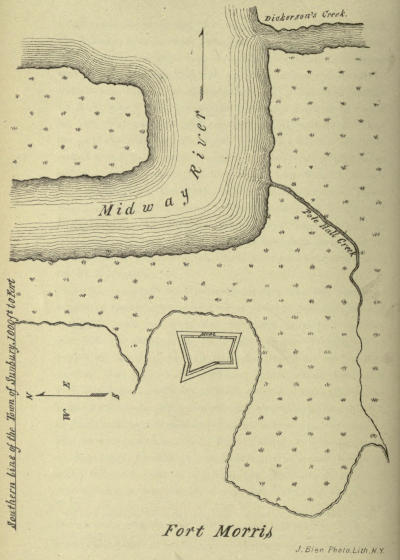
Fort Morris
J. Bien, Photo. Lith. N. Y.
Located some three hundred and fifty yards due south of Sunbury, and occupying the bluff where it first confronts Midway river as, trending inward from the sound, it bends to the north, Fort Morris was intended to cover not only the direct water approach to the town, but also the back river by means of which that place might be passed and taken in reverse. Its position was well chosen for defensive purposes. To the south stretched a wide-spread and impracticable marsh permeated by Pole-haul and Dickerson creeks,—two tributaries of Midway river,—whose mouths were commanded by the guns of the fort. This marsh also extended in front of the work, constituting a narrow and yet substantial protection against landing parties, and gradually contracting as it approached the southern boundary of Sunbury. This fortification was an enclosed earth-work, substantially constructed. Its walls embraced a parade about an acre in extent. The eastern face, confronting the river, was two hundred and seventy-five feet in length. Here the heaviest guns were mounted. The northern and southern faces were respectively one hundred and ninety-one, and one hundred and forty feet in length, while the curtain, looking to the west, was two hundred and forty-one feet long. Although quadrangular, the work was somewhat irregular in shape. From the southern face and the curtain, no guns could be brought to bear upon the river. Those there mounted served only for defense against a land attack. The armament of the northern face could be opposed to ships which succeeded in passing the fort, until they ascended the river so far as to get beyond range. It also commanded the town and the intervening space. The guns were mounted en barbette, without traverses. Seven embrasures may still be seen, each about five feet wide. The parapet, ten feet wide, rises six feet above the parade of the fort, and its superior slope is about twenty-five feet above the level of the river at high tide. Surrounding the work is a moat at present ten feet deep, ten feet wide at the bottom, and twice that width at the top. Near the middle of the curtain may be seen traces of a sally-port or gateway, fifteen feet wide. Such is the appearance of this abandoned work as ascertained by recent survey. Completely overgrown by cedars, myrtles, and vines, its presence would not be suspected, even at a short remove, by those unacquainted with the locality. Two iron cannon are now lying half buried in the loose soil of the parade, and a third will be found in the old field about midway between the fort and the site of the town. During the recent war between the States, two 6-pounder guns were removed from this fort and carried to Riceboro. No use, however, was made of them. Two more, of similar calibre, of iron, and very heavily reinforced at the breech, were taken by Captain C. A. L. Lamar,—whose company was then stationed at Sunbury,—and temporarily mounted on the bluff to serve as signal guns. Despite their age and the exposure to which they had so long been subjected, these pieces were in such excellent condition that they attracted the notice of the Ordnance department, and were soon transported to Savannah. There they were cleaned, mounted upon siege carriages, and assigned to Fort Bartow, where they remained, constituting a part of the armament of that work, until upon the evacuation of Savannah and its dependent forts by the Confederate forces in December, 1864, they passed into the hands of the Federal army.[199]
Sunbury was occupied by the Revolutionists as a military post, and its fort garrisoned at a very early period in the Colonial struggle for independence.[200] In 1776 when Gen. Charles Lee, after full conference with the venerable Jonathan Bryan, projected a plan of operations against St. Augustine for the relief of the southern frontier of Georgia, which had been constantly and sorely vexed by raiding bands from Florida, and to destroy what promised to be a stronghold for the English, the Virginia and North Carolina troops who were in the expedition were ordered to rendezvous at Sunbury. It being the sickly season of the year, and the men being unaccustomed to the climate, much suffering was encountered from fevers. The mortality became so great,—from ten to fifteen dying in a single day,—that the soldiers were removed to the sea-islands in the vicinity for health.[201]
As we all know, through the failure of General Lee to concentrate the requisite men and munitions, the contemplated movement from which so much was anticipated never took place; and when, on the 20th of September, he went North to assume the command to which he had been appointed, he ordered the troops in the neighborhood of Sunbury to follow him.
This project was renewed by General Robert Howe, who advanced as far as Fort Tonyn. There, however, a council of war decided a further prosecution of the enterprise unadvisable. The sick and convalescent,—of whom there was a considerable number,—in gallies and such boats as could be procured were, under the command of Colonel C. C. Pinckney, conducted by the inland passage to Sunbury where, for a time, they were allowed to rest and recruit. They were subsequently transferred to Charleston by the way of Port Royal.[202] Colonel John McIntosh was left in command of Sunbury with one hundred and twenty-seven men. The remnants of Elbert’s and White’s regiments proceeded to Savannah.[203] So far, Sunbury had suffered no molestation at the hands of the King’s forces.
Lord George Germain’s plan for the Southern campaign in 1778 was prepared with “minuteness of detail.” The reduction of Savannah was resolved upon. As a diversion, and with a view to distracting the attention of General Howe and the American forces concentrated for the protection of the then capital of Georgia, General Augustine Prevost was ordered to dispatch from St. Augustine two expeditions, one, by sea, to operate directly against Sunbury, and the other, by land, to march through and harrass the lower portions of Georgia, and, at Sunbury, form a junction with the former.
Responding to his instructions, that officer sent by water a detachment of infantry and light artillery under the command of Lieutenant Colonel Fuser for the capture of Sunbury. Lieutenant Colonel Mark Prevost was charged with the conduct of the expedition by land. He took with him one hundred British regulars. At Fort Howe, on the Alatamaha, he was joined by the notorious McGirth, with three hundred refugees and Indians. On the 19th of November this force entered the Georgia settlements, taking captive all men found on their plantations, and plundering the inhabitants of every article of value capable of transportation. At the point where the Savannah and Darien road crosses Bulltown swamp, Prevost was confronted by Colonel John Baker, who had hastily collected some mounted militia to dispute his advance. After a short skirmish the Americans retreated. Colonel Baker, Captain Cooper, and William Goulding were wounded. At North Newport Bridge, [afterwards called Riceborough Bridge,] further resistance was encountered at the hands of the Patriots, but it was too feeble to materially retard the progress of the invading forces. Meanwhile, Colonel John White,[204] having concentrated about one hundred Continentals and militia, with two pieces of light artillery, took post at Midway Meeting House and constructed a slight breastwork across the road at the head of the causeway over which the enemy must advance. His hope was that he might here keep Prevost in check until reinforcements could arrive from Savannah. An express was sent to Colonel Elbert to advise him of the hostile invasion, and Major William Baker, with a party of mounted militia, was detached to skirmish with the enemy and, at every possible point, interrupt his progress. On the morning of the 24th Colonel White was joined by General Screven with twenty militiamen. It was resolved to abandon the present and occupy a new position a mile and a half the other side of Midway Meeting House where the road was skirted by a thick wood in which it was thought an ambuscade might be advantageously laid. McGirth being well acquainted with the country, and knowing the ground held by Colonel White, suggested to Prevost the expediency of placing a party in ambush at the very point selected by the Americans for a similar purpose. It was further proposed, by an attack and feigned retreat, to draw Colonel White out of his works and into the snare. The contending parties arrived upon the ground almost simultaneously, and firing immediately commenced. Early in the action the gallant General Screven, renowned for his patriotism and beloved for his virtues, received a severe wound, fell into the hands of the enemy, and was by them killed while a prisoner and suffering from a mortal hurt. A shot from one of the field pieces passed through the neck of Prevost’s horse, and both animal and rider fell. Major Roman, commanding the artillery, supposing that the British commander had been killed, quickly advanced his two field pieces to take advantage of the confusion which ensued, and Major James Jackson, thinking the enemy was retreating, shouted victory. Prevost however soon appeared remounted, and advanced in force. Finding himself overborne by numbers, Colonel White retreated upon Midway Meeting House, breaking down the bridges across the swamp as he retired, and keeping out small parties to annoy the enemy’s flanks. Compelled to withdraw still further, and desiring by stratagem to retard the advance of the enemy, Colonel White “prepared a letter as though it had been written to himself by Colonel Elbert, directing him to retreat in order to draw the British as far as possible, and informing him that a large body of cavalry had crossed over Ogechee river with orders to gain the rear of the enemy, by which their whole force would be captured.” This letter was so dropped as in the end to find its way into Colonel Prevost’s hands, who seems to have considered it genuine. It is believed that it exerted much influence in retarding his advance, which was pushed not more than six or seven miles beyond Midway Meeting House in the direction of Savannah. Meanwhile, McGirth, with a strong party, reconnoitering in the direction of Sunbury, ascertained the fact that the expedition under Lieutenant Colonel Fuser had not arrived. This circumstance, in connection with the concentration of the forces of Colonels Elbert and White at Ogeechee ferry, where a breastwork was thrown up and preparation made vigorously to dispute his further progress, determined Prevost to abandon his enterprise and return to St. Augustine. Treating the population as rebels against a lawful sovereign, and utterly refusing to stipulate for the security of the country, Prevost, upon his retreat, burnt Midway Meeting House, and all dwellings, negro-quarters, rice-barns, and improvements within reach. The entire region was ruthlessly plundered;—the track of his retreating army being marked by smoking ruins. His soldiers, unrestrained, indulged in indiscriminate pillage, appropriating plate, bedding, wearing apparel, and everything of value capable of easy transportation. The inhabitants were subjected to insult and indignities. The region suffered terribly, and the patriotism of the people was sorely tried.[205] The scene was such as was subsequently repeated when General Augustine Prevost in 1779 raided through the richest plantations of South Carolina,[206] or when the Federal cavalry under General Kilpatrick, in the winter of 1864-1865, over-ran, occupied, and plundered Liberty county, converting a well ordered and abundantly supplied region into an abode of poverty, lawlessness, and desolation.
Delayed by head winds, Colonel Fuser did not arrive in front of Sunbury until Prevost had entered upon his retreat and was beyond the reach of communication. Late in November, 1778, his vessels, bearing some five hundred men, battering cannon, light artillery, and mortars, anchored off the Colonel’s island. A landing was effected at the ship yard. Thence, the land forces with field pieces, moving by the main road, marched upon Sunbury. The armed vessels sailed up Midway river in concert, and took position in front of the fort and in the back river opposite the town, simultaneously with its investment on the land side by the infantry and artillery. Colonel John McIntosh, with one hundred and twenty-seven Continental troops, and some militia and citizens from Sunbury,—numbering less than two hundred men in all,—held Fort Morris. The town was otherwise unprotected. Having completed his dispositions, Fuser made the following demand upon Colonel McIntosh for the surrender of the fort:
“Sir,
“You cannot be ignorant that four armies are in motion to reduce this Province. One is already under the guns of your fort, and may be joined, when I think proper, by Colonel Prevost who is now at the Medway meeting-house. The resistance you can, or intend to make, will only bring destruction upon this country. On the contrary, if you will deliver me the fort which you command, lay down your arms and remain neuter until the fate of America is determined, you shall, as well as all of the inhabitants of this parish, remain in peaceable possession of your property. Your answer, which I expect in an hour’s time, will determine the fate of this country, whether it is to be laid in ashes, or remain as above proposed.
“I am Sir,
“Your most obedient, &c.,
“L. V. Fuser,
“Colonel 60th Regiment and Commander of his Majesty’s Troops in Georgia, on his Majesty’s Service.”
“P. S.
“Since this letter was closed, some of your people have been firing scattering shot about the line. I am to inform you, that if a stop is not put to such irregular proceedings, I shall burn a house for every shot so fired.”
To this demand the following brave response was promptly returned by Col. McIntosh:[207]
“Fort Morris, Nov. 25, 1778.
“Sir,
“We acknowledge we are not ignorant that your army is in motion to endeavour to reduce this State. We believe it entirely chimerical that Colonel Prevost is at the Meeting-House: but should it be so, we are in no degree apprehensive of danger from a junction of his army with yours. We have no property compared with the object we contend for that we value a rush:—and would rather perish in a vigorous defence than accept of your proposals. We Sir, are fighting the battles of America, and therefore disdain to remain neutral till its fate is determined. As to surrendering the fort, receive this laconic reply: Come and take it.[208] Major Lane, whom I send with this letter, is directed to satisfy you with respect to the irregular, loose firing mentioned on the back of your letter.
“I have the honor to be Sir,
“Your most obedient Servant,
“John McIntosh,
“Colonel of Continental Troops.”
In delivering this reply Major Lane informed Colonel Fuser that the irregular firing of which he complained was maintained to prevent the English troops from entering and plundering Sunbury. With regard to the threat that a house should be burned for every shot fired, Major Lane stated that if Col. Fuser sanctioned a course so inhuman, and so totally at variance with the rules of civilized warfare, he would assure him that Colonel McIntosh, so far from being intimidated by the menace, would apply the torch at his end of the town, whenever Colonel Fuser fired the town on his side, “and let the flames meet in mutual conflagration.”[209]
Instead of assaulting, Fuser hesitated and awaited a report from scouts whom he had sent into the country to ascertain the precise movements of Prevost and learn when his junction might be expected. That officer, as we have seen, unwilling, after the affair near Midway Meeting House, to hazard an engagement with the Continental forces supposed to be advancing from the Great Ogeechee, and surprised at the non-appearance of Fuser before Sunbury, had already commenced his retreat and was beyond the reach of easy communication. Surprised and chagrined at the intelligence, Fuser raised the siege, re-embarked his troops, and returned to the St. Johns river, where he met the returned forces of Prevost. Mutual recriminations ensued between these officers, each charging upon the other the responsibility of the failure of the respective expeditions. Remembering the superior forces at command, it cannot be doubted that either singly or in conjunction Prevost and Fuser could have speedily occupied Sunbury and compelled a surrender of Fort Morris, had their operations been vigorously pressed. When we consider the paucity of Continental troops and militia offering resistance to the invading column of the one, and the slender garrison opposed to the investing forces of the other, the small space and the short time to be overcome in accomplishing a junction, and the further fact that they both must have been aware of the near approach to Savannah of Colonel Campbell’s expedition from which these advances from Florida were distinctly intended to distract the attention of the Revolutionists, we cannot but be surprised that Colonels Fuser and Prevost should thus have abandoned their enterprise when a consummation was manifestly within easy grasp. Upon his retreat from Sunbury Colonel Fuser landed his British regulars at Frederica with instructions to repair and place in good defensive condition the military works which General Oglethorpe had planned and erected at that point.
Having collected his forces, Gen. Robert Howe marched to Sunbury. During his short stay there he did little more than point out and condemn the defenseless condition of the works, and memorialize Congress upon the dangers which threatened the Georgia coast, the lack of men and munitions of war, and the disorganization existing in his scattered army. He was one of those unfortunate officers who, lacking the energy and the ability to make the most of the resources at command, and harping upon the existence of defects and wants which inhered in the very nature of things, constantly clamored for the unattainable, indulged in frequent complaints, neglected careful organization, discipline and dispositions, and, on important occasions, became involved in unnecessary perplexities and loss.
Although relieved from the presence of the enemy, heavy shadows rested upon the inhabitants of St. John’s parish.[210] Desolation and ruin were on every hand. The gathered crops having been burnt, many were without sufficient means of subsistence, and not a few were compelled to look elsewhere for support. These tribulations, however, were but an earnest of sadder ones soon to follow,—trials so grievous that patriotic hearts were well-nigh overborne at thought and apprehension of distresses almost beyond human endurance. These peoples,—the first of the Colony to declare for freedom,—were on the eve of passing under a yoke far more oppressive than that from which not three years before they had sought to escape, and their homes were to become so desolate that expatriation would be found preferable to a perplexing residence and distressful life in the region where they had garnered up present possessions and future hopes.[211]
The year 1778 closed gloomily upon the patriots in Georgia. Its capital fell before the advance of Colonel Campbell. General Howe’s army, retiring in confusion and with much loss, crossed the Savannah river at Sister’s and Zubly’s ferries and rendezvoused in South Carolina, leaving the newly born State entirely open to the enemy. While at Cherokee Hill, on his retreat, General Howe dispatched Lieutenant Tennill with orders to Major Joseph Lane commanding at Sunbury to evacuate that post, and, retiring up the south side of Great Ogeechee river, to join the main army at Zubly’s ferry. This order was received in ample time, if promptly obeyed, to have ensured the salvation of the garrison; but Major Lane, moved by the persuasions of Captain Dollar,—commanding a company of artillery,—and the entreaties of the citizens of Sunbury, resolved to disregard the instructions of his General, and assumed the responsibility of remaining and defending the fort and town.[212] The account of the reduction of Fort Morris and the fall of Sunbury we give in the language of Captain McCall:
“On the first notice of the arrival of the transports [conveying Colonel Campbell’s command,] off the coast of Georgia, General Prevost [then in Florida] marched; and embarked in boats, two thousand men, consisting of artillery, infantry, loyalists, and Indians. On the 6th of January, [1778] that part of his army which moved by water was landed on Colonel’s island, seven miles south of Sunbury, about ten o’clock in the morning; and Prevost with the light infantry, marched and took possession of the town early on the ensuing day. Two American gallies and an armed sloop cannonaded the enemy, but with little effect. The following day the main body of the enemy arrived. Every exertion was made to prevent the landing of the cannon and mortars near the town, by the fire from the gallies and the fort. On the night of the 8th they took advantage of the low tide to pass behind a marsh island[213] opposite to the fort, with a few of their boats containing cannon, howitzers, and mortars, and landed them above the town and placed them on batteries previously prepared. On the morning of the 9th Prevost summoned the fort to surrender unconditionally, accompanied by a statement of his force and the weight of his metal. Major Lane replied that his duty, inclination, and means pointed to the propriety of defending the post against any force however superior it might be. The British batteries of cannon and mortars were opened on the fort and replied to. Lane soon discovered that his fortress would not be long tenable, and began to repent his disobedience of orders. He parlied to obtain better terms than unconditional surrender, but no other would be allowed him: and the time having elapsed for his acceptance or refusal, hostilities recommenced. He parlied again and requested until eight o’clock the next morning to consider of the conditions offered to him, which being peremptorily refused, he assented to them and surrendered the fort containing twenty-four pieces of artillery, ammunition, and provisions, and the garrison consisting of seventeen commissioned officers and one hundred and ninety-five non-commissioned officers and privates, including Continental troops and militia. The American loss was one Captain and three privates killed, and seven wounded. The British loss was one private killed and three wounded.
“The Washington and Bulloch gallies were taken to Ossabaw island, stranded on the beach, and burned by their crews, who took passage on board of Captain Salter’s sloop and sailed for Charleston, but were captured by a British tender and taken to Savannah. Captain John Lawson, of the sloop Rebecca, of sixteen guns, put to sea and got safe to Charleston.”[214]
After the fall of Sunbury the Continental officers captured at Savannah were sent to that place on parole.
When General Prevost, after the junction of his forces with those under Colonel Campbell, moved from the coast into the interior for the complete subjugation of Georgia, the command of Savannah and the adjacent country was confided to Lieutenant Colonel Alexander Innes. Proclamations of the most stringent character were issued by him, by Colonel Campbell, and by Sir Hyde Parker. The inhabitants were enjoined to collect their arms and accoutrements of every description, and surrender them to the military storekeeper. Should these have been concealed or buried, as was not infrequently the case, they were to be uncovered and brought in under pain of rigid search, exposing the delinquent to punishment as an enemy to the King. Special places were designated for the arrival and departure of boats and trading vessels; and permits were required from the superintendents of such ports for the receipt or conveyance of property of any description. An infringement of these regulations worked confiscation of the goods, and punishment of the crews engaged. Peace, freedom, and protection were offered to all who would at once return to their allegiance and join the Royal standard. Three months were allowed for the incoming of the disaffected and deserters, and Savannah was designated as the place where the oath of allegiance would be administered. The proclamation of the 11th of January, 1779, was even more onerous. A reward of two guineas was offered for the apprehension of every citizen still adhering to the Rebel cause, and ten guineas were promised upon the surrender of a Committee or Assembly man to any commanding officer of the King’s garrisons. Prices were prescribed for all articles of merchandise and country produce. Any deviation from this scale of prices was punished by the confiscation of the articles exposed for sale. Only to those who had resumed their allegiance to the Crown were permits to trade granted, and a fine of one hundred pounds sterling was collectible against any merchant dealing with one not an acknowledged and loyal subject of the King. No produce could be exported except under a certificate of the superintendent of the port that it was not wanted for the use of the Royal troops. To the families of those who maintained their devotion to the Rebel cause no mercy was shown. Stripped of property,—their homes rendered desolate,—often without food and clothing,—they were thrown upon the charity of an impoverished neighborhood. The entire coast region of Georgia was now open, and the enemy overran and exacted the most stringent tribute. Many fled from St. John’s parish and from Sunbury upon the first approach of Prevost.
Writing from Purysburg on the 10th of January, 1779, to Colonel C. C. Pinckney, General Moultrie mentions the fact that thousands of poor women, children, and negroes were fleeing from Georgia,—they knew not whither;—“sad spectacle that moved the hearts of his soldiers.”[215]
For the time being the parish of St. John was in a deplorable condition. Multitudes of the inhabitants, unable to sustain themselves in the midst of the utter destitution which there prevailed, set out for Carolina, where they subsisted upon the charity of others until the opening spring afforded an opportunity for planting crops in their new homes. Others, possessing the means of subsistence, were so oppressed by the operation of Royal proclamations and restrictions, that they abandoned the region, seeking refuge in other quarters. Sunbury suffered a material diminution of population, and never recovered from the shock then experienced.
Although in the enemy’s possession, and paralyzed by the onerous exactions then imposed, Southern Georgia did not wholly cease from offering resistance. Colonels Twiggs, Few, and Jones, closely watched the British outposts, cutting off supplies, and harrassing the garrisons whenever opportunity occurred. Along the sea-coast were found private armed vessels, in the service of the Revolutionists, engaged in the removal of Rebel property in the interest of the owners, and in capturing craft in the employ of the King.
Ascertaining that some British officers had accepted an invitation from Mr. Thomas Young to dine with him at Belfast on the 4th of June, 1779, Captain Spencer, commanding an American privateer, determined to surprise and capture the party. For this purpose, proceeding up Midway river in the evening, he landed between eight and nine o’clock at night, and, with twelve of his men, entering the house, made Colonel Cruger and the English officers at the table prisoners of war. Intending to carry off some negroes, Captain Spencer kept his prisoners under guard until morning when, having taken their paroles, he permitted them to return to Sunbury. Colonel Cruger was soon after exchanged for Colonel McIntosh who had been captured at Briar Creek.
On the 28th of the same month Major Baker, advancing toward Sunbury, attacked and defeated a company of mounted recruits under Captain Goldsmith at the White-house. Several of the enemy were killed and wounded. Among the former was Lieutenant Gray, whose head was almost severed from his body by a sabre cut delivered by Robert Sallett. Major Baker entered Sunbury without opposition.[216]
It was by these, and kindred partizan exploits, that the British troops at various detached posts were held in partial check, and the drooping spirits of the oppressed inhabitants from time to time revived.
Upon the appearance of Count D’Estaing’s fleet off the coast of Georgia, General Augustine Prevost concentrated as rapidly as he could within the lines around Savannah the various detachments on duty in the vicinity. That under Lieutenant Colonel Cruger, at Sunbury, was ordered in and reached Savannah on the 10th of September, just two days prior to the landing of the French troops at Beaulieu.
It does not lie within the compass of this sketch to recount the operations of the allied armies under Count D’Estaing and General Lincoln which culminated in that bloody and disastrous repulse on the morning of the 9th of October, 1779. Suffice it to say that Sunbury had her patriotic representatives among the troops commanded by General Lachlan McIntosh, both during the progress of the siege and in the final assault. Two of them at least attested with their lives their supreme devotion to the patriot cause:—Major John Jones who had been for some years a resident of Sunbury, and who was at the time an aid to General McIntosh; and Charles Price, formerly a practising Attorney at Sunbury, and a young gentleman of promise in his profession.[217]
Upon the repulse of the allied armies, and after the departure of Count D’Estaing, and the retreat of General Lincoln into Carolina, the condition of the sea-coast of Georgia was more pitiable than ever. Exasperated by the formidable demonstration, and rendered more arrogant and exacting, the Loyalists set out in every direction upon missions of insult, pillage, and inhumanity. Plundering banditti roved about unrestrained, seizing negroes, stock, furniture, wearing apparel, plate, jewels, and anything they coveted. Children were severely beaten to compel a revelation of the places where valuable property and money were concealed. In the language of Captain McCall,[218] “The militia who had been under the protection of the British, not allowing themselves to doubt of the success of the allied forces, cheerfully participated in a measure which promised the recovery of the State to the union. Future protection was not to be expected, and nothing remained for them but the halter and confiscation from the British or exile for themselves, and poverty and ill-treatment by an insolent enemy for their wives and children who were ordered forthwith to depart the country without the means for travelling or any other means but a reliance on charity for subsistence on their way.
“The obscene language which was used, and personal insults which were offered to the tender sex, soon rendered a residence in the country insupportable. Having neither funds nor means of conveyance for themselves and children, they were obliged to abandon the country under the most deplorable circumstances and seek a dependent residence in the adjoining States at the most inclement season of the year. Numbers whose former condition enabled them to make their neighboring visits in carriages, were obliged to travel on foot; many of them without shoes, through muddy roads and deep swamps.”
Prominent among these raiding Tories was the renegade McGirth.
Under such depressing influences some portions of Liberty county were almost depopulated. Deprived of a support from the back-country, and with nothing to sustain commerce from abroad, Sunbury languished. Its decline, inaugurated when Prevost and Cruger demonstrated the insecurity of the position, and confirmed when Major Lane surrendered Fort Morris, was now day by day accelerated. All who could possibly get away fled the place, and those who remained led lives of disquietude, and penury. In the face of these difficulties, however, Commodore Oliver Bowen, Captains Spencer, Howell, Maxwell, Pray, Hardy, Lawson, Stiles, and others owning private armed vessels, made frequent voyages along the coast, capturing parties who were engaged in collecting provisions for the British troops in Savannah and transporting them through the inland passages, removing the property of the Whigs from the down-trodden districts, and occasionally executing summary vengeance upon the crews of such craft as were known to be employed upon missions of arson, robbery, and murder. Sometimes sharply contested naval engagements occurred, such as that between Captain Braddock with his two American gallies, and the brigantine, Dunmore, Captain Caldeleugh, mounting twelve guns. The Dunmore had sailed from Sunbury for Jamaica, and was attacked so soon as she crossed St. Catharine bar, on the 18th of September, 1779.
On the 4th of June of this year Captain Howell entered the inlet of Sunbury, and learned from a negro that he had been sent out to catch fish for Mr. Kitchins, the Collector of the port, with whom a party of British officers, both civil and military, were to dine that day,—it being the King’s birthday. Although Mr. Kitchins’ house was within four hundred yards of the fort,—now no longer called fort Morris, but named by its captors fort George in honor of his majesty, King George III,—presuming that the assembled guests on this festive occasion would indulge freely and be found entirely off their guard, Captain Howell resolved upon their capture. Ascending the river with muffled oars, and under cover of the night, the Captain with twelve men passed the fort without attracting its notice, and, landing at Sunbury, surrounded the house about eleven o’clock and took the entire party, numbering twelve persons, prisoners. Among the captured was Colonel Roger Kelsall, who had insulted and ill-treated Captain Howell while he was a prisoner of war. Incensed at the recollection of these indignities, Captain Howell was on the eve of taking him out and drowning him in the river, when the prayers of the lady of the house induced him to spare his life. Having exacted from his captives a pledge that they would not again take up arms until regularly exchanged, Captain Howell returned, without loss or molestation, to his privateer.
Upon the transfer of active operations to the Carolinas, Sunbury seems to have been but feebly garrisoned by the enemy. At times, and for a considerable portion of the year 1780, it appears doubtful whether any British force was there stationed. The Royal army in Georgia was then so much reduced that the garrison at Savannah did not exceed five hundred men.[219]
The truth is, the available forces of the State had been so largely withdrawn for service elsewhere, the entire coast region was so thoroughly impoverished, and so many of the Whig families had moved away, that there was scarcely any necessity for maintaining this post except as a matter of convenience in keeping open the land communication between Savannah and St. Augustine.
In this exhausted and comparatively quiet condition did matters remain until the close of the war. We are not aware that any events occurred in Sunbury, during the residue of the struggle, worthy of special mention or calculated to rouse the inhabitants from that quietude born of want and oppression, feebleness and present despair.
The successes of General Greene in Carolina enabled him to inaugurate such measures for the relief of Georgia that, in order to escape from the advancing and investing columns under General Wayne and Colonel Jackson, the British garrison embarked on the 11th of July, 1783, and Savannah, after having been more than four years and a half in the possession of the enemy, was formally surrendered to the Patriots who had already virtually achieved the independence of the thirteen Confederated States.
Colonel James Jackson was designated by General Wayne as the officer to receive the surrender of the town;—a compliment well merited in view of the patriotism and gallantry which had distinguished him during the whole war, and in recognition of the recent active and hazardous service performed by his command while operating in advance of the army of occupation.
Georgia’s losses, particularly along her south-eastern borders, had been very great. Her slave population, although quiet during the struggle, was essentially demoralized and reduced. It is estimated that between the 12th and 25th of July, 1783, not less than five thousand negroes made their escape from Savannah in sailing vessels. Upon the cessation of hostilities the agricultural and commercial interests of the State were in a most disastrous situation. Particularly was this the case in Liberty county where negroes and property of every description had been, from time to time during the continuance of the struggle, carried off, patriotic citizens driven into exile, plantations burned and converted into waste places, and the seeds of poverty and distress sown broadcast.
On the first Monday in August, 1783, Governor Martin convened the Legislature in Savannah. Courts of Justice were re-established, commissioners of confiscated estates appointed, and measures adopted for the rehabilitation of the State. It was not, however, until the assembling of the Constitutional Convention on the first Monday in January, 1784, when Lyman Hall was appointed Governor, George Walton, Chief Justice; Samuel Stirk, Attorney General; John Milton, Secretary of State; John Martin, Treasurer, and Richard Call, Surveyor General, that the machinery of reconstruction was fully set in motion.
With the incoming of peace many who had been absent in the army, and others who had sought, in South Carolina and elsewhere, temporary refuge from the devastations of the war, returned to their former homes in Sunbury and on the adjacent plantations, and entered with becoming spirit and energy upon the labor of rebuilding and repeopling the desolated region. For a season it seemed as if the prosperity of this seaport would be revived. Not a few of its inhabitants, however, having, during the continuance of hostilities, formed settlements elsewhere, determined to remain where they were, and so the ante bellum population was by no means regained. Others had died, and others still in their places of retreat found themselves so impoverished that they could not command the means requisite for a removal.
The first session of the Superior Court of Liberty county was held at Sunbury on the 18th of November, 1783,—their Honors, Chief Justice George Walton, and Assistant Judge Benjamin Andrew, Senior, presiding. On the 20th, the Grand Jury being empanneled and sworn, the Chief Justice delivered a charge in which,—having alluded to the fact that good order and subordination had everywhere characterized the courts presided over by him on this his first riding since the close of the war, and assured them that nothing could so much contribute to confirm the blessings of peace as an observance of the laws which had for their sole object the general happiness of the people,—he spoke as follows: “I congratulate you, gentlemen, on the news of a definitive treaty of peace by which our freedom, sovereignty, and independence are secured. The war which produced it was one of necessity on our part. That we were enabled to prosecute it with firmness and perseverance to so glorious an issue, should be ascribed to the protecting influence of the Great Disposer of events, and be a subject of grateful praise and adoration. While the result of the contest is so honourable and advantageous to us and to posterity, it is to be lamented that those moral and religious duties so essential to the order of society and the permanent happiness of mankind, have been too much neglected. To recover them into practice, the life and conduct of every good man should be a constant example. Your temples, which the profane instruments of a tyrant laid in ashes, should be built again: for nothing tends to harmonize the rude and unlearned organs of man more than frequent meetings in the places of holy worship. Let the monument of your brave and virtuous soldier and citizen,[220] which was ordered by Congress to his memory, be erected on the same ground, that his virtues and the cause in which he sacrificed his life may be seen together by your children and remembered through distant ages.[221]