AN ATTEMPT TO CLASSIFY AND DATE THE VARIOUS SHAPES FOUND IN HERALDIC SHIELDS—PRINCIPALLY IN ENGLAND, WITH INCIDENTAL DATINGS.[1] (continued 2)
Reading edition
It is found in the seals and in the crown-pieces of the Commonwealth, dated 1650.
Taking then the Georgian No. 25—In Willement's Regal Heraldry, the arms of Henrietta Maria, the wife of Chas. I., 1625, are reproduced in this shape.
It becomes very frequent 1783-92, and up to 1806 in monuments and book-plates—see page 56.
The shield is used in a work published at Worcester 1795, Historical Anecdotes of Heraldry and Chivalry.
Very many of the bulky seals so common during the last thirty years of the eighteenth century display coats of arms on shields of this shape, which seems to have been much used about this date. The Liverpool halfpenny, 1791, see No. 78; the Leeds halfpenny, 1791; and the Cronebane halfpenny, 1789; and no doubt many other copper tokens show No. 25.
No. 26 is figured by Randle Holme (Academy of Armoury, 1688), who took it from Sylvanus Morgan's Sphere of Gentry, 1661. He explains it is from old and decayed monuments. It is really adapted from ancient shields, which were used by the Amazons, and they are constantly represented with such shields and with double-headed battle axes on Greek coins (see Petiti de Amazonibus Dissertatio, 1687, p. 180, &c.)
The only change noticeable in these shields is that the Stuart, which extended down to certainly as late as 1694, have perpendicular sides,—with an occasional exception, as that quoted 1625,—while in the Georgian the sides are always more or less bulged out.
Nos. 27, 28, 29, and 30, with which may conveniently be taken the tops, designated "eared couped."
No. 27—This shape occurs in Brussels tapestry, dated 1610. The sides are more hollowed-out, and the ears more projected (Jacquemart's History of Furniture, p. 102, English translation).
Very frequently in ledger tombs, 1718, 1749, 1750, and in 1680 (see Miscell. Genealogica et Heraldica, November, 1884, p. 172).
In a MS. dated 1710;
Also in the Radcliffe book-plate, circa 1720, engraved in Mr. Rylands' Notes on Book-Plates, 1889, p. 30.
No. 28—The arms of Caroline of Brandenburg, wife of George II., 1727, are given on this shield in Willement's Regal Heraldry.
No. 29—Several of the engravings in Guillim's Display, edition 1724, and in The English Baronetage, 1741, partake of this character, thus giving a range from 1610 to 1741 for this group.
No. 31 is a shield very extensively used in Germany and Holland.
It first appears in the seals of the Counts of Flanders (Oliver Vredius) in 1477 and 1487, and disappears in 1602.
It is figured fo. 1b in the Nuremberg Chronicle, published 1493.
It may be constantly found at all dates, and down to the present day in German heraldry.
Nos. 32, 33, and 34.
No. 32—This shield has a very extensive range of date; the first I have noticed is on the tomb of Anne of Cleves, in Westminster Abbey, 1539 (engraved in Willement's Regal Heraldry).
Engravings in an illustrated edition of Ariosto, printed Venetia, 1572, repeat the same shape.
In Bolton's Elements of Armories, 1610, where such arms as those of Paracoussi, King of Plate, The Navatalcas, early Mexicans, and the Incas of Peru, are placed in such shields.
The sixpences and York half-crowns of Charles I., 1614, and the arms on his Great Seal, 1627 (Sandford's Genealogical History, p. 515).
In a MS., 1652, reproduced in Miscell. Genealogica for January, 1885, p. 204.
The Great Seal of Charles II., 1653 (Sandford's Genealogical History, p. 517).
The seals of the Commonwealth in 1651 and 1656.
Engravings in Bisse's edition of Nicholas Upton, published 1654;
Also in Sandford's Genealogical History, 1677.
In the seventeenth and eighteenth centuries, seals with this shape are common enough, many of most beautiful execution, supported by cornucopiæ, fruit and flowers issuant therefrom; these extend from 1670 to 1700. We need only look at our Britannia's shield in a modern penny to see the same, adapted from that coin of Antoninus Pius where occurs the first representation of the figure of Britannia, A.D. 138.
No. 33.—The earliest I have noted is on the seal of Sir Thomas de Bikenore, Knt., attached to a charter, s.d., but about 1300; this is engraved Archæolog. Cantiana, vol. ii, p. 41.
It occurs upon the seals of the Counts of Flanders from 1403 to 1623 (Oliver Vredius); it also appears elsewhere in his work.
It is also on the tomb in Maidstone Church to John Wotton, 1417 (Arch. Cantiana, vol. i, p. 181).
It may be seen in the printer's mark of Richard Pynson, 1530.
I have also noticed No. 33 in one of Camden's grants, dated 2nd May, 1608, to James Master of East Landen, Kent: this is engraved Archæologia Cantiana, vol. v, p. 238.
No. 34 is, I think, chiefly restricted to foreign seals and engravings. I have not, so far, noticed an English example.
Nos. 35, 42, and 43.
No. 35—Egg-shaped may be regarded very much as a variation of No. 32, some artists considering it more graceful and better adapted to hold the arms and leave less of the field vacant. The shield of Edward the Black Prince, preserved at Canterbury, and already noticed at p. 30, was of this shape. He died 1376 (Bolton's Elements, p. 67).
But there is a large number of such seals as may be described egg-shaped, with hollowed-out sides, and frequently framed in scrolls; these are classed as cardioid Nos. 42 and 43, the outlines having been altered by scroll work, although sometimes the scrolls are omitted.
These occur in Divi Britannici, by Sir Winston Churchill, 1675;
In monuments of 1684, &c., in Blomefield's Norfolk;
And of 1699, Miscell. Genealogica et Heraldica for December, 1884, p. 185;
Again in 1715, Herald and Genealogist, vol. ii, p. 230; and they are constantly to be found in monumental tablets.
Very frequently the bases of shields with hollowed-out sides are turned either to dexter or sinister, as noticed in seals throughout the eighteenth century; and in some later Jacobean, and in Chippendale book-plates say from 1720 to nearly the end of the century.
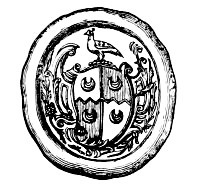
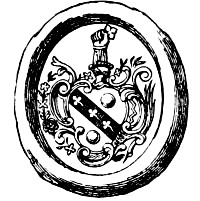
Seal of Bartlett of Marldon and Exeter, co. Devon (Miscell. Genealogica et Heraldica for June, 1887). Seal of Joseph Palmer, King's Messenger: born 1683, died 1759 (Miscell. Genealogica et Heraldica, second series, vol. i, p. 86).
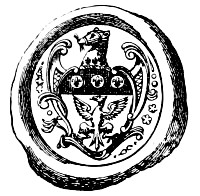
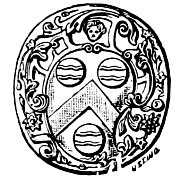
Seal of Michael Grazebrooke of Audnam: born 1723, died 1766 (Miscell. Gen. et Heraldica for 1878). Seal of Joseph Siket to his will, 1758 (Herald and Genealogist, vol. iii, p. 316; also vol. vi, p. 211.)
No. 36—French shields, so constantly represented in French heraldry, appear also in English grants of arms, 1557, 1561, 1582, 1612.
This is just an ordinary square shield, No. 7, with a pointed French base.
This shield, however, may be found at much earlier dates—see remarks on Simon de Montacute's seal to the Baron's letter, 1301, on p. 22; also the very curious brass formerly in St. Nicholas' Church, Lynn, to Thomas Waterdeyn, Mayor of Lynn in 1397 and 1404. This shows two shields, No. 36, which bear his merchant's mark, and stand on either side of a tree. He was alive in 1410 (see engraving, Archæologia, vol. xxxix, p. 505).
No. 39.—This curious Italian shield occurs in Gerard Leigh's Accedens of Armoury, 1562.
Also with curious scroll-work, dated 1589, in a timber house at Norwich, engraved, Archæologia, vol. xvi, p. 194.
In the Great Seal of Charles I., 1640, Sandford's Genealogical History, p. 516.
In the halfpenny of Charles II., 1660.
In the halfpenny of James II., 1685.
Randle Holme, book i, p. 6, would have us believe this was "the veritable shape of the Christal shield given by the goddess Minerva to Perseus, to enable him to slay the Gorgon Medusa, and which was after dedicated to Pallas," and this conceit may account for a monster's head introduced in the Great Seal of Charles I., 1640.
Grotesque shields, somewhat of this shape, are given to Ancient Britons, as in Speed's Theatre of Great Britain, 1676, and in MS. pedigrees of early seventeenth century, for the arms of Welsh princes and early potentates. Randle Holme (Academy of Armoury) gives one of these as from the monument of Mahomet, Emperor of Turkey, and another from the monument of Tamerlane, Emperor of Tartaria.
Nos. 40 and 41 actually do occur frequently in Roman bronzes and monuments, and are reproduced in engravings in Bolton's Elements of Armories, 1610, p. 147, &c. Bolton explains that it (41) occurs on the Column to Antoninus at Rome, but later discoveries have shown that this column was really erected to Marcus Aurelius Antoninus in 174 A.D.
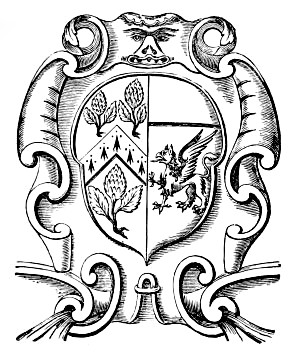
Nos. 42 and 43 cardioid shields (see the remarks upon 33, 34 and 35).—I think these arose from the decorative scroll-work placed around egg-shaped shields, and especially in late Jacobean and Chippendale times, when they may be found in monuments and book-plates. The earliest mural tablet I have noticed is dated 1699, at Winchester Cathedral. This is engraved Miscellanea Genealogica et Heraldica for December, 1884, p. 185.
The engravings in Divi Britannici, noticed under the variations of 35, nearly approach these.
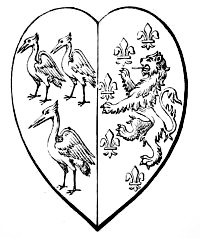
Instances of pure heart-shaped shields occur in the brass to Willem Wenemaer, slain 1325. This is in the vestibule to the hospital which he founded at Ghent (Archæological Journal, vol. vii, p. 287);
Also in a monument at St. Margaret's, Hertford, 1691-2, shown in the annexed illustration. This is from Miscell. Geneal. et Heraldica, January, 1887, p. 197; and the shape may also be found at later dates.
My readers will also refer to that very interesting seal of Richard Basset, about 1145, described at p. 13, and No. 44: it is heart-shaped, greatly lengthened out.
A very curious heart-shaped shield, with the point turned round and scrolled, appears in the wooden effigy to one of the family of Oglander in Brading Church, Isle of Wight. This is supposed to be of sixteenth century. It is engraved in the Anastatic Drawing Society's vol. for 1883.
A curious instance of the recrudescence of early forms occurs when Sylvanus Morgan, vol. i, p. 27, places the arms of one Gill in a triangular shield, such as we noticed in the thirteenth century, and figured No. 1 in the sheet.
Again, heater-pear shields, No. 6, frequently occur in early monuments, as they accorded well with the style of decoration—see the monument to Henry Willoughby, 1581, at Wollaton (Thoroton's Notts, p. 27); also that to Richard Mansfield, 1624, at West Lake Church (Thoroton, p. 27); also that to Thomas Atkinson, 1661, at Newark-on-Trent (Thoroton, p. 200); also in a monument to the Clifton family, about 1670, engraved p. 61 in the same book.
It would be possible to give much more fully the exacter history of several of these shields, showing their various slight variations prevailing at different dates, but such would extend my "attempt" beyond a convenient length.
I have, however, selected one of the most common occurrence, feeling sure that its history will therefore be the more interesting. In A Glossary of Terms used in British Heraldry, published by Parker, Oxford, 1847, the date 1724 is given as the "earliest shield that has been noticed of this tasteless, though still prevalent form," No. 81.
Now, here is the exact sequence with the small variations which I have been able to trace:—
No. 79—Occurs in a book printed by W. Rastell in 1533, quoted in Parker's Glossary.
In an inlaid chimney-piece at Bolsover Castle, with the arms Cavendish impaling Ogle, and therefore the date is 1590-1600.
Also in a MS. pedigree of Howard, date 1580, in the possession of Col. Crosse at Shaw Hill, co. Lancaster.
The next instance I have found is carved on a pew in Warrington Church, and bears the inscription "Richard Massye, 1617." This shows arms quarterly, (1) Rixton of Rixton, (2) Mascy of Rixton, (3) Warburton (?), see Historic Society of Lancashire and Cheshire vol. xxxix, p. 154, where this quartering is discussed; (4) Horton of Horton.
The same shaped shield appears in a monument to Richard Wiatt, who died in 1619. This stands in Isleworth Church, and is engraved in Herald and Gen., vol. iii, p. 500.
No. 84—Is frequently found in MSS. about 1620. I can refer to the pedigree of the Holland and Dukenfield families, which is dated 1622.
The same shield is used in Bysse's edition of Nicholas Upton, which was published in 1654.
Also in a certificate of arms by Segar Garter, 1625, Historic Society of Lancashire and Cheshire, vol. xxxviii, p. 72.
It is also carved in oak in Prescot Church, with the arms of Ogle of Whiston quartering Bertram, and the date 1650.
It again occurs on the gravestone of Richard Clegg, Vicar of Kirkham; the earliest date on which is 1677 (Chetham Society, vol. xcii, p. 128).
The same, but more slightly eared, occurs frequently with the dedicatory arms of the donors of the plates to Sandford's Genealogical History, published 1677.
A ledger stone, dated 1690, with the ears still less strongly marked, is engraved Miscell. Genealog. for February, 1885, p. 242.
No. 82—Occurs in a grant of arms, dated 1684, Miscell. Genealogica, second series, vol. i, p. 397.
The same shield appears in a grant, dated 1696, printed in the same work, first series, vol. ii, p. 191.
Such shields with very slightly marked ears, and with pointed or angular, also with French bases, are found very frequently in book-plates of 1700 and for ten years or so later, and sometimes with the sides very slightly hollowed-out.
No. 83—Is a shield with Queen Anne's arms, 1706, engraved in Willement's Regal Heraldry.
No. 80—May be seen in the monument to Tho. Norreys, 1624, in Rainham Church, Kent (Archæologia Cantiana, vol. vi, p. 295).
A grant of arms, dated 1720, is engraved in Miscell. Genealogica, vol. ii, p. 252, and shews the same shield.
Seals about the year 1718 appear with this same shape, of rather broad proportions, and with French bases rather flattened.
No. 81—In Wright's edition of Peter Heylin's Helps to History, published 1773, this variation is used, but of rather longer proportions.
About 1780, seals are noticed to follow the same character, and with angular or French bases, just as we see them prevailing even to the present day.
Plate VI.
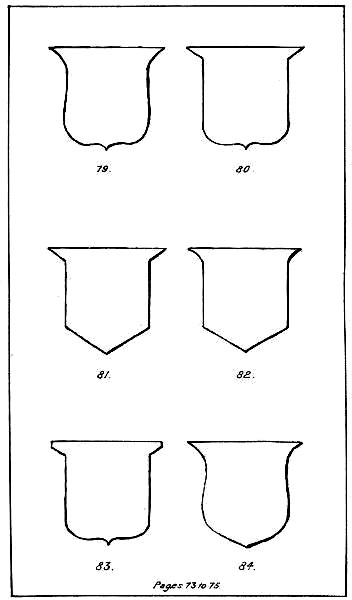
This shield therefore, with slight variations in the ears, may be found from 1533 to the present day; and the date given in Parker's Glossary was fixed upon insufficient research.
Counterseals
in England are usually of the same shape and size as the seal proper; the pendant cake of wax thus showing two complete impressions, one on each side.
Edward the Confessor and his successors have continuously used them; but among subjects they do not appear before 1130—excepting, perhaps, that remarkable instance of two seals conjoined back to back on the charter of Odo, Bishop of Baieux in 1075. See Archæologia, vol. i, p. 335.
Nobility of the blood royal, their wives and daughters, seem to have used counterseals pretty generally from the middle of the twelfth century. The greater titular nobility also adopted them occasionally during that century; but in the next, and until the Baron's letter (1301), a much larger number occur. Their use, however, was very irregular: many prominent titular nobles neglected them, and, on the other hand, we find many families of only moderate territorial position placing secreta on the back of charter seals. I notice as quite remarkable how many ladies who had come to represent a manor, about the middle of the thirteenth century, when the fashion was at its height, at once beautified or safeguarded their seals with a secretum.
After 1301 such extra sealing almost disappears, but there are some very late instances. Humfrey Earl of Stafford and Perche, 1438, placed on the back of his splendid seal a smaller one—the Stafford arms on a heater shield, within a decoration of three Stafford knots, but without any inscription (Archæologia, vol. xxxviii); and some of those large and pretentious seals mentioned as appearing 1450-1475 were used with small counterseals.
Many ecclesiastical communities used counterseals, also the old Cinque ports and other ancient boroughs. Ancient official departments too, such as the Norwich Staple, 1272-1307: these having begun, of course continued their use as an established form.
Secreta
were usually small, and inscribed "Secretum." The first I have noticed is that of Seherus de Quenci, created Earl in 1210—"Secretum Comitis Wintonie." (Spelman's Aspilogia, p. 67.) John de Busli, however, is even a little earlier; "Secretum Johannis de Bueli" (The Earls of Eu, by Chester Waters, p. 33).
After a careful examination I have come to the conclusion that no regulations restricted their use, but counterseals and secreta were adopted or not, according to taste. Some regarded them as an accession of dignity, and some as a safeguard: there seems no doubt it was for the second reason that that signet was placed, in 1529, on the back of the Dartford Priory Seal (see p. 60); and I find another instance, where a seal of the same Priory, in 1534, had as a counterseal the impression of a small signet with the letters I F, being apparently the initials of Isabel or Joan Fane, the prioress at that time.
It will give some idea as to the prevalence of counterseals if I say that to the Baron's letter, 1301, are appended ninety-five seals of the principal nobility. Seventy-nine have no counterseals: to sixteen such are attached; namely, eight of the same size as the seals, and eight greatly smaller. Two of these smaller ones are not inscribed (William de Brehouse and Simon de Montacute), and one only is called "Secretum" (Walteri de Teye). I think this shows they were less commonly used in 1301 than about 1250.
Mantlings from the Sixteenth to the Nineteenth Century.
It is somewhat difficult to treat distinctly of the mantlings prevailing since the beginning of the sixteenth century; but as they afford indirect evidence of date, I venture to draw up the following short description of their variations; and I do so with some diffidence, in the hope that fellow-students may add to my feeble effort, and that thus we may presently arrive at a perfect and dated scheme of these changes.
I am obliged to treat seals separately from drawings and stone carvings, because the circumscribed space in a seal seems to have prevented some of the variations noticed in the others. At the same time, several characteristic changes are found to occur, and at tolerably distinct dates; and so it is possible to lay down very clearly, as to seals, the current of progressive change.
By far the greater number of heraldic Seals at the beginning of the sixteenth century have no mantling, but display only a bare shield, without ornament—unless some scroll-work or architectural lines, to fill up the space within the dotted or plain circles. Such seals occur constantly till the end of the seventeenth century.
About 1550 helmets with mantlings, open and rather sparse, and kept high up on the top of the shield, appear. These mantlings are rather flat, so that a good space is left for the crest, which thus stands out distinctly. As a specimen, see Wm. Lambarde's seal, 1552 (Archæologia Cantiana, vol. v, p. 256).
Although a good many seals continue still with the mantlings kept up about the top of the shield (while sometimes a motto, &c., is introduced below), it is observed that a little after this date mantlings gradually creep downwards, perhaps to two-thirds of the depth of the shield. See a seal of the Throckmorton family, 1576 (Visitation of Warwick, 1619, Harl. Soc.); also those of Lord Chancellor Bromley, 1581 (Herald and Genealogist, vol. v, p. 5); John Ogle, 1597 (Mascy Charters, plate C, Historic Society of Lancashire and Cheshire for 1887); and Edward Osborne, 1618 (Herald and Genealogist, vol. iv, p. 241; also Archæologia Cantiana, vol. v, p. 234).
This is the character of many examples occurring down to about the year 1650, when a greater profusion of mantling began to be shown: of this the seal of Sir Edward Nicholas, engraved on p. 45, is a good example; and it is the first instance I have noticed in which the folds of the mantling come out from behind the shield, thus marring its distinctness. Usually, although the volume of foldings increases, they are kept away from it, so as to leave the impression of the shield standing out and quite clear. In this, too, the folds extend higher up on either side of the crest than is usual in earlier examples.
It may be interesting here to note that of the fifty-nine seals attached to the death warrant of Charles I., in 1648-9—following the very accurate engraving in Monumenta Vetusta, vol. ii,—twenty-one show mantlings, eleven are distinctly without, ten are doubtful, and the remaining seventeen seals are quite illegible.
From about 1650 many beautifully cut signets are found—the arms, with helmets, crests, and mantlings, the points of which rise up on either side of the crest, thus filling up that empty space. The seal of the Cordwainers of Oxford, made in 1680, is a favourable example of the date (Arch. Journal, vol. vi, pp. 159 and 279).
About 1680 I have observed tassels sometimes appear as a finish to the lower ends of mantlings, as in the seal of Thomas Bate, engraved on p. 45; also in a signet of 1683, in Miscellanea Genealogica et Heraldica for 1886, p. 143; and elsewhere.
Shields set in frames of scroll-work, without mantlings, were prevalent from the beginning of the seventeenth century. For an example, see a signet of Fetherston, 1638, engraved in the Visitation of Warwick (Harleian Society).
From about 1670 cornucopiæ, with flowers, &c., appear, supporting shields more or less egg-shaped; and some of them are most exquisitely engraved. But even at so late a date, I have not observed tincture lines introduced.
I have noticed very few seals about this time in the Jacobean taste. Probably no room was left in so confined a space for scroll-work around the base of the shield. But mantlings—rather heavy, although not voluminous, and kept up pretty high—are found towards the end of this seventeenth century. In many cases also, at this time, plain Georgian shields occur, without mantling.
Early in the eighteenth century seals are found in late Jacobean frames, open and with trellis-work, adorned with rushes and flowers, and without mantlings.
The influence of Chippendale taste strongly affected seals from about 1750 to 1775.
Many followed in the style of Adam, with ribbons and festoons of flowers, and sometimes lightly scrolled frames. These, of course, are without mantlings.
We are thus brought to the end of the eighteenth century. Only occasionally have I met with mantlings between about 1740 and 1800; but I must explain that it is very difficult to get together a body of examples of the eighteenth century: such are not old enough to be figured in engravings, and documents likely to bear them are not of sufficient interest to be examined for any other purpose. I trust fellow-students who read this book will sketch, with their dates, all instances of this epoch: it is only in that way we can get together a body of evidence.
It seems to have been very common, also, for successive generations to repeat the style of their seals, as if that were as important as the heraldry displayed; and thus instances of the several variations occur, perhaps, much later than their legitimate dates—as classified above, from many examples. I know one family whose seals from 1718 to 1840 show, with only one or two exceptions, "the tasteless though still prevalent form" No. 80, and without any mantlings.
Although taking Drawings and Stone Carvings together, there are certain differences observable in each; for instance, we constantly find, in monumental sculptures of the sixteenth century, designs with mantlings above and scroll-work below, which very closely correspond with Jacobean book-plates and engravings such as did not appear till about 1720. I would refer to Thoroton's History of Notts, p. 227; where is engraved a monument, at Wollaton, to Henry Willoughby, who died 1581, which is quite Jacobean in taste and treatment. Another equally so is at Newark-upon-Trent Church: this was erected in 1661, to Thomas Atkinson (Thoroton's Notts, p. 200). Another with cornucopiæ and scrolls stands in West Lake Church, to the memory of Richard Mansfield, who died 1624 (Thoroton's Notts, p. 27). This last exactly corresponds with some of Hollar's beautiful designs, in Sandford's Genealogical History, published in 1677; and it is very remarkable that these are a distinct advance upon Hollar's own designs in the preface and dedication to the Bysse edition of Nicholas Upton, which he engraved in 1654; while for nearly fifty years this monumental example had stood in West Lake Church, and we know it was only one of many similar English works. I have many times noticed that sculpture precedes engravings or paintings. It is, I think, inherently so: designing in the round comes first, to be afterwards translated, by skilful and artistic and educated shading, into the flat.
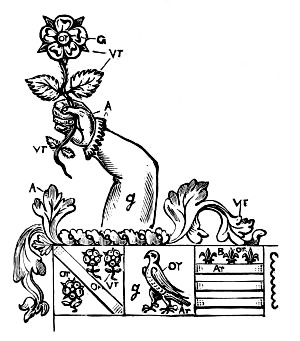
Through the kindness of Dr. Jackson Howard, Maltravers Herald, and Messrs. Mitchell and Hughes, I am able to shew the engraving (from Miscell. Genealogica et Heraldica for 1884, p. 99) of a very unusual mantling from the Confirmation of Arms in 1526, by Thomas Hawley, Clarenceux, to Francoys Galuerdet, a native of Rhodes, and Receiver General in England for the Hospital of St. John of Jerusalem. This mantling is unusually small; there is no helmet, and the torce is beautifully worked [compare the brass to Sir Wm. Say, lithograph No. 71]. I put this forward first because of its early date, and it seems that at this time mantlings in heraldic drawings, grants, &c., were kept very small.
It will be convenient to describe, and in a numbered list as follows, the variations observed at successive dates.
1.—From 1550 to 1570 there is a tendency to keep the greater portion of mantlings above the shield. They are of smaller volume, and one fold is allowed to wander down on each side, ending in a tassel about one-third down the depth of the shield. A very characteristic example is engraved in Miscell. Genealogica et Heraldica for June, 1887, being the grant to Thomas ffletewood, of London, 1st June, 1545. In the grant to John Lambard, 15th January, 1551 (engraved in Archæologia Cantiana, vol. v, p. 247), such a mantling has four tassels, two above carried up somewhat high, and two below standing about one-third down the shield. The mantling to the arms of Goodricke, engraved in Gerard Legh's Accedens of Armory, edition 1562, is of the same character, but without tassels.
2.—A little later the number of folds is observed to increase, and the tassels are carried down further and turn inwards towards the base point of the shield.
3.—In a grant dated 1572, which is printed in Miscell. Genealogica et Heraldica, vol. i, p. 321, occurs the first instance I have noticed of the foldings coming from behind the shield, and the same may be seen in a grant of 1575, printed in Sylvanus Morgan's Sphere of Gentry, lib. ii, p. 74.
4.—From about 1590 to 1630 a return to the simpler style is observable; a single fold wandering away from the body and reaching with tassels to the base of the shield. Occasional instances return wholly to the descriptions given under 1 and 2.
5.—After about 1620 the volume of mantling gradually increased, and seemed to be purposely so arranged as to come out from behind, probably because it was found in drawings to give artistic relief to the shield.
6.—By about the year 1670 mantlings are frequently found of excessive volume, and in a mass, which would be solid were it not skilfully broken by lighter hackings appearing in the central portions; the folds come down in heavy masses, sometimes like great sausages or cucumbers, to the bottom of the shield. Examples of such may be seen in Sandford's Genealogical History, 1677, and in book-plates engraved in Miscell. Genealogica et Heraldica, December, 1886, p. 184, and elsewhere. The skill of the artist affects wonderfully the quality of these designs; it is not only the chiaro-oscuro, but the turning of a line may often sparkle with genius. Sometimes they are extremely flat and heavy, for instance, in the map attached to Thoroton's Notts, 1677, may be seen a specimen, which is a great contrast to Hollar's designs in Sandford's Genealogical History, published in the same year. Again, the frontispiece to Carter's Honor Redivivus, published in 1673, shows flat waves, and behind the shield, coming out two-thirds down its length, the edges rippling into leaves and hackings, while the folds extend down to a boldly hacked and curled cartouche for the motto, out of which spring two branches of olive.
Instances of this style continue to occur down to 1750. We find them so engraved in Guillim's Display, 1724, also in the English Baronetage, 1741, and in some of the engravings in Atkyn's Gloucestershire, 1768.
7.—About the year 1700 appeared for a few years, perhaps we may say till about 1720, book-plates and dedicatory arms with great hacked foldings twisted round and looking something like Catherine-wheel fireworks. Two or four of these occur in book-plates, and sometimes as many as six, three on each side. We notice that these are conventional exaggerations of the less pronounced circular foldings and turnings seen so early as 1677 in some of Hollar's engravings in Sandford's Genealogical History. An engraving at p. 185 in Chauncey's History of Hertford, published in 1700, is especially interesting; it shows a monument, dated 1662, to Hewytt, in Sawbridgeworth Church, where the carver has struggled to avoid the long ugly folds ("cucumbers"), and has introduced very vigorously twisted leaves and hacks which almost approach those conventional Catherine-wheel fireworks as found in book-plates of a later date, say from 1700 to 1720. I would point out that all the armorial engravings in Chauncey's Herts are well worth studying: the mantlings are hacked all over, and extend about four-fifths down the shields in endless small and vigorous twists, the shields themselves being variations of No. 16. Some of the engravings in Plot's Natural History of Oxfordshire, published in 1705, show the same character, also some of those in Atkyn's History of Gloucestershire, published in 1768.
8.—The rebound from this taste led to small mantlings, kept a good deal at the top of the shield, even although there were no supporters, as in a peer's coat of arms, to prevent their downward flow. These occur also when the bases of the shields in Jacobean book-plates are finished off with scroll work, trellis, scales, &c., &c.; the upper part of the shield being ornamented with such smallish mantlings. In Blomefield's Norfolk, 1739, ribbon scrolls extend all round some of the shields in the place of a mantling; while in what is, I suppose, a book-plate, Holland impaling Upton, printed in the pedigrees at the beginning of vol. i, acanthus leaves occur in the base, and break out occasionally, where convenient, from such scrolls, which are arranged round the upper part of the shield. Scrolls are strictly architectural ornaments, and not vegetables. These correspond to the French style called "Bombé," in which curves and undulations of surface in ribbons, &c., were rolled and tossed about for artistic effect. But with our English examples of monuments of the sixteenth century in the same taste (see p. 80), we need not consider that our Jacobean style was borrowed from the French, although that nation, for a full century, ending in 1790, guided the artistic tastes of Europe.
9.—During the Chippendale fashion all martial elements disappear, helmets and mantlings are swept away, and we see the style of Louis XV. borrowed from the prevailing French taste, broken shell-shaped woodwork, rocks, and shell curves (rocaille coquille), hence called "Rococo." It was well enough in the frames of mirrors and furniture, but seems strangely out of place around a cardioid shield of arms, with festoons of flowers and spikes of reeds or grass, while perhaps Cupids or Greek vases on brackets are introduced. Nevertheless, the genius of Chippendale sublimated this into specimens of great beauty. Chippendale's Books of Designs were published in 1759, i vol., folio, and in 1762, i vol., folio.
10.—Mantlings, of course, continued to be shown in grants of arms. We find about 1775 they appear to be smaller again, and confined to the top of the shield, often being carried rather high up on each side of the crest, and frequently ending at the base in two tassels [see a grant 1779, Miscell. Genealogica et Heraldica, second series, vol. iii, p. 41].
11.—This style continued to the beginning of the nineteenth century, when I have observed very light and graceful mantlings thrown about in airy and much hacked foldings, and generally ending in tassels (see a grant 1803, Miscell. Genealogica et Heraldica, original series, vol. ii, p. 20). This character is also seen in many book-plates of this date.
12.—I must now say a few words on the style introduced and skilfully enforced by Robert and James Adam. They, too, adopted from the French, and by their skill and artistic taste developed to great perfection the style of Louis XVI. (1774-90). The rage for this fashion arose in Europe upon the discovery at Pompeii of Roman frescoes preserved in their original colours. The brothers Adam caught the exact spirit of these, and produced heraldic designs, consisting of shell-fluted scrolls, with light and airy festoons of flowers and ribbons, surrounding shields almost invariably Georgian No. 25. The festoons were frequently extended in graceful curves, from pegs, just as we see them in the recovered Roman arabesques, or on the walls of the Petit Trianon. Robert and James Adam published their book in three vols., imp. folio, 1773-1822. For examples of this style see Dugdale's Warwickshire, 1765; Hutchin's Dorset, 1774; Hasted's Kent, 1778; Rudder's Gloucestershire, 1779 (one specimen only); Nichol's Leicestershire, 1795; Shaw's Staffordshire, 1798; Manning and Bray's Surrey, 1804. This long list will show how extremely popular the Adam style continued to be for about thirty years.
13.—As early as 1500, a fan-shaped mantling with rounded base appears; it was formed of an unhacked cloth with many closely folded rays, and occasionally two tassels are attached to the upper corners and hang down as supports on each side of the shield, which stands in the middle—see examples engraved in Herald and Genealogist, vol. viii, p. 247; Archæologia Cantiana, vol. v, p. 248; Miscell. Genealogica et Heraldica, first series, vol. ii, p. 100; &c., &c. This design is continued until after 1700, but seems less closely folded at the later dates, when they are often found in ornamental achievements in pedigrees.
14.—A curious example of a mantling is engraved Herald and Genealogist, vol. viii, p. 254, in which a square sheet or cloth, having no hacking, and attached to the helmet, is folded-in round the edges; through these a cord is passed, ending in two tassels which extend a little below the bottom of the mantle. This portion of the cloth, as well as the back, hangs down straight without any folds. The result is that the shield stands out against the deeply shaded back ground within these folded-in edges, they being in high light. The MS. from which this is taken is dated 1645, and the shield displays the arms of Helsby.
15.—The earliest instance I have noticed of those large unhacked square sheets or mantles called by Porney "drapery," which are drawn up through two rings or ribbons at the upper corners and fall in folds, while in the middle stands the shield of arms, occurs in a monument at Holme Pierpoint to the Countess of Kingston, which bears date 1649 (Thoroton's Notts, p. 90). Such are also engraved in the Sphere of Gentry, 1661; and in the English Baronetage, 1741. These are occasionally to be met with down to 1840. In French heraldry they are commonly found.
In Archæologia Cantiana, vol. x, p. 329, is engraved a curious tent-shaped "drapery," drawn over the helm and held there by a ducal coronet, from which starts the crest, while beneath, and in the middle of the sheet, stand the shield of arms and supporters. This is from "The Confirmation of Supporters, Crest and Arms to Sir Edward Dering, Knt. and Bart., by Sir Wm. Segar, Garter." The first baronet was created 1st Feb., 1626, and Sir Wm. Segar died in 1633; so the date of this drawing is within those seven years.
It must be evident that each artist gave a certain character and style of his own to his work; at the same time the various fashions noted above are found strongly prevailing at the dates given. They were what was approved by the public taste, and any variations only extend to more or less skilful working out. It will be noticed that public taste has several times alternated between sparse and voluminous mantlings. There are indications at the present time which seem to point to a return, within a few years, of the massive convolutions seen during the last quarter of the seventeenth century.
In ledger stones and monuments from 1650 the characteristics given above are followed until about 1780, when other kinds of decoration—palm branches, festoons, and scrolls—very largely superseded mantlings.
IMPORTANT NOTE ON TINCTURE-LINES IN SEALS.
My readers would notice at page 52 and again at page 79 that I could not accept the statements that seals so early as 1648-9 could possibly show tincture-lines. I therefore gave my authorities, and showed pretty evidently that I could not, in the face of other facts, accept them. Since the writing of those pages, Mr. W. H. St. John Hope has very kindly examined for me the original document preserved among the muniments at the House of Lords, and reports that in none of the seals attached to the death-warrant of Charles I. are the tinctures indicated by lines. It is not for me to explain how so accurate an observer as the late Mr. Planché made such a mistake. I think it is probable that the late Mr. Bouttell followed him and enlarged somewhat. The fact, however, is now definitively settled.
I had observed that in those earlier printed books which have copper plates, the invention of Father Silvester de Petra Sancta had been very cautiously and undecidedly adopted. In Spelman's Aspilogia [included in that small folio published by Edward Bysse in 1654, and to which I have frequently referred as containing also the works of Nicholas Upton and John de Bado Aureo] most of the shields have tincture lines; but in some of the copper plates, signs of various planets are given instead of those letters for tinctures which are usually seen in "tricks."
NOTE TO PAGE 36.
I have no doubt that the curious projecting point to which the attention of the reader has been drawn, was meant as a protection against the "Coup de jarret," that terrible feat of arms which aimed at severing the muscles behind the knee, a spot necessarily covered by leather only, and therefore peculiarly vulnerable.