ILLUSTRATIONS
Reading edition
Ballet Pantomime From Pose by Mlle. Louise La GaiFrontispiece
Tanagra FigurePage 3
Greek Vase Decoration “ 3
Tanagra Figure“ 3
Tanagra FiguresFacing Page 4
Greek Ceramics ““ 5
Greek Vase DecorationPage 8
Greek Comedy Dancing“ 9
Statuettes“ 10
Tanagra (A)—Myrina (B)—Tanagra (C).
Greek Relief DecorationsFacing Page 12
Greek Ceramic Decorations““ 13
StatuettesPage 13
Myrina (A)—Tanagra (B)—Myrina (C).
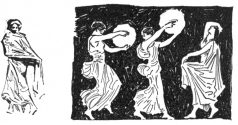
Dance of Nymphs“ 17
Tanagra FiguresFacing Page 20
Greek Comedy DancingPage 21
Dance of Peasants“ 36
Ballet of the Four Parts of the World: Entrance of the Grand Khan“ 41
A Fourteenth Century Ball“ 46
Seventeenth Century Court DancesFacing Page 48
The Tordion (1, 2)—The Pavane (3, 4, 5).
Louis XIV and A Courtier in the Ballet of NightPage 50
Seventeenth Century Court DancesFacing Page 54
The Saraband (1)—The Allemand (3)—The Minuet (2, 4, 5, 6, 7).
The Gavotte““ 55
Mme. Adeline Genée and M. Alexander Volinine““ 64
Ballet Robert le Diable (1)—Butterfly Dance (2)—Pierrot and Columbine (3).
Mme. Genée in Historical Re-Creations and M. Volinine““ 65
Sallé (1)—The Waltz (2)—Camargo (3)—Guimard (4).
Fundamental Positions of the FeetPage 66
Positions of the Arms“ 67
“Glissade”“ 68
“Assembl锓 69
“Assemblé” and Changement (Floor Plan Diagram)“ 69
“Jet锓 70
“Jeté” to the Side“ 71
“Battements”“ 72
Steps of the “Battement” Type“ 74
“Fouett锓 75
Start of A “Fouetté Pirouette”“ 76
“Fouetté Pirouette” (Continued)“ 77
Optional Finish of a “Fouetté Pirouette”“ 78
The “Pirouette Sur le Cou-de-Pied”“ 79
Various “Pirouettes”“ 80
Beginning of the “Renvers锓 82
The “Renversé” (Concluded)“ 83
Two Forms of “Attitude”“ 84
Mechanism of Broad Jump“ 86
Classic Ballet PositionsFacing Page 88
Typical moments in a renversé (1, 2, 3, 4, 5,)—Starting a developpé (6)—Progress of a rond de jambe (7, 8, 9).
Classic Ballet Positions (Continued)““ 89
Rond de jambe (10)—Jeté tour (11)—Pas de bourrée (12)—Preparation for a pirouette (13)—Position sur la pointe (14)—A fouetté tour, inward (14)—A cabriole à derrière (16)—Descent from an entrechat (17)—An arabesque (18).
“La Malagueña y el Torero”““ 122
Typical “Flamenco” PosesPage 129
“Flamenco” Poses“ 133
“Las Sevillanas”“ 137
“El Bolero”Facing Page 138
Typical moment in first copla (1)—Finish of a phrase (2).
“La Jota Aragonesa”““ 139
Type of movement (1)—Finish of a turn (2)—A pirouette (3)—Kneeling position (4)—Woman’s sitting position (5).
Two Groups in “Las Sevillanas”Page 140
Groups in “La Malagueña y el Torero”“ 145
Miscellaneous Spanish Notes“ 147
Two Groups in “Los Panaderos”“ 149
Part of the “Jota” of Aragon“ 152
“La Tarantella”Facing Page 156
Opening of the dance (1)—A poor collection (2)—They gamble for it (la Morra) (3)—She wins (4)—He wins (5).
“La Tarantella”““ 157
An arabesque (1)—Finish of a phrase (2)—Typical moment (3)—Finish of a phrase (4).
“La Tarantella”““ 158
Opening of the dance (1)—A turn back-to-back (2)—A pause after rapid foot-work (3)—Characteristic finishes of phrases (4, 5).
“La Forlana”““ 159
Doctor Pantalone patronized (1)—Defied (2)—Pleads (3)—Accepts the inevitable (4)—Is ridiculed (5).
“La Ciociara”““ 160
Opening promenade (1, 2)—End of promenade (3)—He has “made eyes” at a spectator (4)—Opening of dance (second movement) (5).
“La Ciociara”““ 161
Rustic affection (1)—Again caught in perfidy (2)—Tries to make amends (3)—Without success (4)—Removed from temptation (5).
The Scotch Sword Dance““ 164
A step over the swords (1, 2)—A jump over the swords (3)—Steps between the swords (4, 5).
The “Scotch Reel”““ 165
Use of the Battement (1)—A pirouette (2)—Characteristic style (3, 4)—A turn (5).
The “Shean Treuse”““ 168
The promenade (1, 2)—The thematic step (3)—Finish of a phrase (4).
The “Sailor’s Hornpipe”““ 169
Look-out (1)—Hoisting sail (2)—Hauling in rope (3)—Rowing (4)—Type of step (5)—Type of step (6)—Hoisting sail (7).
Irish Dances““ 174
The Jig (1, 3, 4)—The Hornpipe (2, 5)—The Reel (6, 7, 8).
A “Four-Hand Reel”““ 175
Preparation for woman’s turn under arms (1)—Characteristic style (2)—A turning group figure (3).
The “Irish Jig” and Portrait of Patrick J. Long““ 178
From Various Folk-DancesPage 185
The “Schuhplatteltanz”Facing Page 186
A swing (1)—A turn (2)—A turn, man passing under woman’s arms (3)—A swing, back-to-back (4)—The Mirror (5).
The “Schuhplatteltanz” of Bavaria““ 187
Preparing a turn (1)—A lift (2)—Starting woman’s series of turns (3)—Start of woman’s turns (4)—Man fans her along with hands (5)—Finish of dance (6).
The “Kolo” of Servia““ 190
Start of a turn (1)—Progress of a turn (2)—A bridge of arms (3)—An emphasis (4)—A lift (5).
Poses from Slavonic Dances““ 191
Coquetry (1)—Petulance (2)—Indifference (3)—Emphasis (4)—Jocular defiance (5).
Poses from Slavonic Dances““ 192
Negation (1)—Fear (2)—Supplication (3)—An emphasis (4).
Poses from Slavonic Dances““ 193
Characteristic gesture (1)—Characteristic step (2)—Characteristic gesture (3)—Characteristic step (4)—Same, another view (5)—Ecstasy (6)—The claim of beauty (7).
Arabian “Dance of Greeting”““ 196
Called upon to dance, she reveals herself (1)—Salutation (2)—Profile view of same (3).
Arabian “Dance of Greeting” (Continued)““ 197
“For you I will dance” (4)—“From here you will put away care” (5, 8)—“Here you may sleep” (6)—“Here am I” (7).
Arabian “Dance of Greeting” (Continued)““ 198
“And should you go afar” (9)—“May you enjoy Allah’s blessing of rain” (10)—“And the earth’s fullness” (11).
Arabian “Dance of Greeting” (Continued)““ 199
“May winds refresh you” (12)—“Wherever you go” (13)—“Here is your house” (14)—“Here is peace” (15)—“And your slave” (16).
Arabian “Dance of Mourning”““ 200
The body approaches (1)—The body passes (2)—“I hold my sorrow to myself” (3).
Arabian “Dance of Mourning” (Continued)““ 201
“He has gone out of the house and up to Heaven” (4)—“Farewell” (5).
Arabian “Dance of Mourning” (Continued)““ 202
“He slept in my arms” (6)—“The house is empty” (7)—“Woe is in my heart” (8).
Arab Slave Girl’s Dance““ 203
“Handkerchief Dance” of the Cafés““ 206
The handkerchiefs symbolizing the lovers are animated with the breath of life, but kept dissociated (1)—Brought into semi-association (2)—Separated and dropped (3).
“Handkerchief Dance” (Continued)““ 207
She can dance about, between or away from them, indifferently (4)—Made into panniers, the panniers express her willingness to receive; turned inside out, her willingness to give (5)—One of the two handkerchiefs is thrown to the selected lover (6).
“Dance of the Soul’s Journey”““ 210
The soulless body (1)—Asks for the light of life (2)—Vision dawns (3)—Inexpert in life, she walks gropingly (4).
“Dance of the Soul’s Journey” (Continued)““ 211
She draws aside the veil of the future (5)—Life is seen full and plenteous (6).
“Dance of the Soul’s Journey” (Continued)““ 212
But old age will come (7)—Grief will visit (8)—She shall walk with her nose close to the camel’s foot (9).
“Dance of the Soul’s Journey” (Continued)““ 213
Yet now, from the crown of her head (10)—To the soles of her feet she is perfect (11).
Miscellaneous Oriental NotesPage 215
“Dance of the Soul’s Journey” (Continued)Facing Page 216
Rejoices in the perfect body (12)—And in all good things (13)—Runs from the scene (14).
Characteristic Pantomime in Dancing of Modern Egypt““ 217
Express sorrow (1, 3)—Represents a prayer directed downward and back: i. e., to spirits of evil (2).
“Dance of the Falcon” (Egyptian)““ 218
Shock as the bird strikes his quarry (1)—Rejoicing as he overcomes it (2).
Dancing Girls of Algiers““ 219
Reliefs on Tower of the Temple of Madura (India)Page 219
Persian Dance. Princess Chirinski-ChichmatoffFacing Page 220
Oriental Poses““ 221
Votive offering (3 poses)—Decorative motives (3 poses)—Disclosure of person (1 pose).
Javanese Dancer, Modern““ 222
Relief Carvings, Temple of Borobodul, Java““ 223
Dance of Greeting (1)—Dance of Worship (2)—An Arrow Dance (3).
“Nautch Dance”““ 226
Japanese Dance““ 227
Isadora Duncan““ 242
Greek Interpretative Dance““ 243
Impressions of Isadora DuncanPage 244
Mlle. Lopoukowa, Mlle. Pavlowa, Mlle. Nijinska, with Sr. E. CeccettiFacing Page 246
Mlle. Lydia Kyasht and M. Lytazkin““ 247
“Arabesque”““ 248
“Arrow Dance”““ 249
Bacchanal““ 252
Mlle. Lydia Lopoukowa““ 253
Mlle. Pavlowa in a Bacchanal““ 257
Mlle. Lopoukowa, in Boudoir““ 258
Mlle. Lopoukowa, Interpretative Dance““ 259
Mlle. Lopoukowa, In “Le Lac Des Cygnes”““ 262
M. Alexander Volinine““ 263
Representative Russian Ballet Poses and GroupsPage 265
Representative Russian Ballet Poses and Groups“ 267
The “Waltz Minuet”Facing Page 272
Characteristic style (1)—Variation, position of hands (2)—Preparation for a turn (3)—The Mirror figure (4).
The “Gavotte” Showing Present Tendencies““ 273
Characteristic style (1)—Characteristic style (2)—A curtsy (3)—Arabesque to finish a phrase (4).
Social Dancing; Position of Feet (Diagram)Page 276
The One-Step: The Turn (Diagram)“ 277
The One-Step: Grape-Vine (Diagram)“ 278
The One-Step: Eight (Diagram)“ 279
The One-Step: Square (Diagram)“ 279
The One-Step: A Figure Occupying Three Measures (Diagram)“ 280
The One-Step: The Murray Anderson Turn (Diagram)“ 281
The One-Step: A Cross-Over (Diagram)“ 282
Development of an Arch “À La Pirouette”Facing Page 282
Cross to right (1)—Cross to left (2)—Start of turn (3).
The One-Step““ 283
The “Kitchen Sink” (1)—Position of couple (2).
The “Brazilian Maxixe”““ 283
Characteristic position of advanced foot (3).
The “Boston,” Essential Step (Diagram)Page 284
The WaltzFacing Page 284
A position of the couple in the Waltz-Minuet (1)—Correct position of man’s hand on woman’s back (2)—A position also assumed in the One-step Eight (3)—A Dip (4).
The Waltz““ 285
Correct position of couple (1)—Of feet, in short steps (2)—Of feet, in Dip (3)—Another view of the Dip (4).
The Boston, Step Backward (Diagram)Page 285
The Boston, The Dip (Diagram)“ 286
The Boston, The Dip Simplified (Diagram)Page 287
The Boston, An Embellishment (Diagram)“ 288
The Boston, An Embellishment (Diagram)“ 288
The Boston, Same, with Turns (Diagram)“ 289
The “Hesitation Waltz,” Theme (Diagram)“ 289
The “Hesitation Waltz” Variation on Theme (Diagram)“ 290
The “Tango”Facing Page 290
Characteristic style (1, 2, 4)—Woman circles man (3).
The “Tango”““ 291
Characteristic style.
The “Hesitation Waltz,” the “Lyon Chassé” (Diagram). Page 291
The “Tango”Facing Page 294
The “Tango”““ 295
The reverse (1)—The regular Tango walking step (2)—Style of movement (3)—Position of hands sometimes assumed to emphasize the end of a phrase (4).
The “Tango,” The “Corte” (Diagram)Page 295
The “Tango,” The Scissors (Diagram)“ 295
The “Tango,” The Scissors Variation (Diagram)“ 296
The “Tango,” The Media Luna (Diagram)“ 296
The “Tango”Facing Page 296
The corte (1)—Characteristic style (2)—A variation (3)—Start of a turn (4).
A “Tango” Step““ 297
Man’s foot displaces woman’s (1)—Woman’s foot displaces man’s (2)—Each displaces the other’s foot (3).
The “Tango,” The Eight (Diagram)Page 297
The “Tango,” A Waltz Turn (Diagram)“ 297
The “Tango,” An Easy Step (Diagram)“ 298
A North American Figure in the “Tango”Facing Page 298
Preparation (1)—After the twist (2)—Finishing with a Dip (3).
The “Tango,” Executed to the Rear (Diagram)Page 299
The “Tango,” A North American Figure (Diagram)“ 299
The “Brazilian Maxixe,” First Figure (Diagram)“ 300
The “Brazilian Maxixe,” Third Figure (Diagram)“ 301
The “Brazilian Maxixe” Facing Page 302
Characteristic style (1)—A dip (2)—Variations (3, 4).
The “Brazilian Maxixe”““ 303
Preparation for a turn (1)—Finish of a turn (2)—Characteristic style (3)—A dip (4).
THE DANCE