Chapter VI
Reading edition
Allusive Arms—Armes Parlantes.
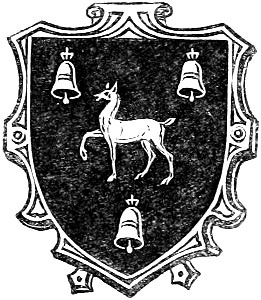
(Arms of the Family of Dobell.)
“Non verbis sed rebus loquimur.”
Allusive Arms are of two kinds: first, those which contain charges that relate to the character, office, or history of the original bearer; and, secondly, those which convey a direct pun upon his name. Of the former description are the covered cups in the arms of Butler, and the bugle-horns in those of Forester.[152] Several examples of this species of bearings are given in the ninth chapter of this volume under the title of ‘Historical Arms.’ At present, I shall confine myself to the second class, which are called, in Latin blazon, Arma Cantantia, in French, Armes Parlantes, and in English, Canting Arms. Of this kind we have examples in the arms of Camel, a camel; Colt, 3 colts; Blackmore, 3 Moor’s heads, &c.
Dallaway, Porny, and other modern writers condemn this species of bearings, as of recent origin, and unworthy of a place amongst the classical devices of antient heraldry. Porny places them in the category of Assumptive Arms—“such as are taken up by the caprice or fancy of upstarts, though of never so mean extraction.” This notion, with whomsoever it originated, is decidedly erroneous, for such charges are found not only in the arms of distinguished nobles and knights in the very earliest days of hereditary armory, but occur also in those of several of the sovereign states of Europe. According to some authors the LIS in the royal arms of France are a play upon the name of Louis, antiently spelt Loys. The arms of Spain exhibit, quarterly, a castle and a lion—a pun upon the names of the united provinces of Castile and Leon; and after the conquest of Granada by Ferdinand and Isabella, a pomegranate was added in the base of the escocheon. As to canting charges in the arms of subjects, we may observe that, in the earliest Roll of Arms extant, that of the time of Henry III,[153] at least nine such occur. To prove this assertion, as well as to give the reader a sample of antient blazon, I shall quote them:
Reinold de Moun—de goules ov ung manche d’argent.
Nicholas de Moeles—d’argent a deux barres de goules, a trois molets en le cheif goules.
Geoffrey de Lucy—de goules a trois lucies d’or.
Roger de Merley—barree d’argent et de goulz, a la bordur d’azure, et merlots d’or en le bordur.
Hugh de Ferrers—Vairre, de argent et d’azur.
Robert Quency—de Goules ung quintefueil de hermyne.
Thomas Corbett—d’or deux corbeaux noir.
Adam de Swyneburne—de goules a trois testes de Senglier d’argent.
Odinel Heron—d’azur a trois herons d’argent.
In another Roll, made temp. Edw. II., armes parlantes are still more abundant.
Sire Peres Corbeht—de or, a ij corbils de sable.
Sire Robert de Eschales—de goules, a vj eschalops de argent.
Suthsex and Suthreye:
Sire Johan Heringaud—de azure, crusule de or a vj harengs (herrings) de or.
Kent:
Sire Robert de Sevens, de azure, a iij vans de or.
Sire Aumori de Lucy, de azure, crusule de or, a iij lucys de or.
Barkschire:
Sire Adam Martel, de sable, a iij martels de argent.
Sire William Videlou, de argent, a iij testes de lou, de goules.
Bokinghamschire:
Sire Rauf de Cheyndut, de azure, a un cheyne de or, a un label de goules.
Sire Johan le Lou, de argent a ij barres de goules, en le chef iij testes de lou de goules.
Estsex:
Sire Johan Passeleu, bende de or e de azure, a un quarter de argent, e un lupard pass-aunt de goules.
Sire Johan Heroun, de azure a iij herouns de argent.
Suthfolk:
Sire Guy Ferre, de goules, a un fer-de-molin de argent, e un bastoun de azure.
Sire Richarde de Cokfeld, de azure, a une croix e iij coks de or.
Sire Huge de Morieus, de azure, a iij foiles de moures de or.
Northfolk:
Sire —— Mounpynzon, de argent, a un lion de sable, a un pinzon[154] de or en le espandle.
Cauntebrugescire:
Sire Giles de Trompintoun, de azure, crusule de or, a ij trompes de or.
Derby et Notingham:
Sire Johan le Fauconer, de argent a iij faucouns de goules.
Sire Johan Bordoun, de goules a iij bordons de argent.
Huntingdonschire:
Sire Johan de Swyneford, d’argent a iij testes de cenglers de goulys.
Norehaunton et Rotelonde:
Sire Geffrey Rossel, de or, a un cheveron azure, e iij roses de goules.
Leycestreschire:
Sire William Bernak, de argent, a une fesse and iij bernaks de sable.
Herefordeschire:
Sire Peres Corbet, de or a un corbyn de sable.
Sire Thomas Corbet, de or a iij corbyns de sable.
Schropschire:
Sire Walter Hakelut, de goules, a iij hackes daneys de or, et un daunce de argent.
Northumberland and Comberland:
Sire Odynel Heron, de argent a iij herons de azure.
Sire Johan Malebis, de argent, a iij testes de bis de goules.
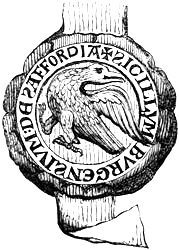
In addition to these, I may adduce the following very antient families, whose arms are not traceable to any grant, but have been borne immemorially as antient arms. The Pelhams bear three pelicans, and their crest is a peacock. The puns in both instances, it must be confessed, are very poor; still, few will doubt that puns were intended. The Arundels bear six swallows, in French hirondelles. The Barons D’Aquila, temp. Henry III, bore eagles; the Bourgchiers, water-bowgets; the Heringauds, herrings; Lupus, Earl of Chester, a wolf’s head; Shouldham, Abbot of St. Saviour’s, shovellers; the Bacons, a boar; the Wingfelds, wings; the Rokewoods, chess-rooks; the Pigots, pick-axes; the Boleynes, bulls’ heads; the Shelleys, shells; and an infinity of others.
Dame Julyan Berners was no stranger to such arms, for she distinctly mentions the coat of Peter de Roches, bishop of Winchester, who “baar iij rochys (roaches) after his awne naam.” The cross-corded, borne by the roper who became a “nobull man,” spoken of by that lady, belongs to the other class of allusive arms, as conveying a hint at his former menial occupation.
That this kind of charges became too common in the early part of the seventeenth century, Dallaway is, perhaps, correct in affirming; but those were punning days, and quaint conceits often took the place of true wit. Camden, the correctness of whose heraldric taste none will presume to question, did not hold arma cantantia in so contemptible a light as some of his successors in office have done; for among the arms granted by him, a list of which is given by Morgan,[155] the following, among others, occur:
Dobell of Falmer, co. Sussex, Sable, a doe passant between three bells argent.[156]
Bullock of London. Bulls’ heads.
Foster of London. Bugle-horns.
Hampson of Kent. Hemp-breaks.
Fisher of Staffordshire. A Kingfisher.
Conie of Huntingdonshire. Coneys.
Crowch.[157] Crosses formée.
Langhorn. Bugle-horns.
Cannon of Pembrokeshire. Crest. A cannon.
Treherne. Three herns.
Cross of Lincolnshire. A cross-crosslet.
Knightley. A lance.[158]
There was a kind of Rebus much in vogue in the fourteenth and following centuries, which, although not regulated by the laws of blazon, possessed somewhat of the heraldric character. Many persons, even those of antient family, who bore regular coats of arms, adopted various figures for the purpose of expressing their names pictorially; for instance, one John Eagleshead gave as his seal an eagle’s head, surrounded by the motto,
“HOC AQUILÆ CAPUT EST, SIGNUMQUE FIGURA JOHANNIS.”
The Abbot of Ramsay bore, in the same way, a ram in the sea, with an appropriate legend. One Harebottle expressed his name by a hare upon a bottle; while Islip, abbot of Westminster, represented his by a man slipping out of a tree, and supposed to exclaim, “I slip!” These “painted poesies,” as Camden styles them, occur chiefly in painted glass windows, in decorated Gothic architecture, and in the title-pages of early printed books.[159]
One of the most singular rebuses I have seen occurs in a window in the chapel at Lullingstone, co. Kent, the seat of Sir P. H. Dyke, Bart. It is that of Sir John Peché. In this instance the arms of the personage are surrounded by a wreath, composed of two branches of a peach tree bearing fruit, every peach being marked with an Old English e; Peach-é. It is curious that this device proves the true pronunciation of the name, which was formerly supposed to be Peche.
The common rebus, although it did not come into general use until after the introduction of regular heraldry, may boast of a much higher antiquity, for such devices occur as the representatives of names of no less eminence than those of Cicero and Cæsar; not to mention those of celebrated sculptors and mint-masters, who, in the palmiest days of Rome, frequently marked the productions of their genius with a rebus. Taking into consideration the great antiquity of these “name-devices,” and their early introduction into the armorial shield, I cannot see any good reason for the strong prejudices which have existed against them in modern times. To me, indeed, they appear not only ‘allowable’ but ‘commendable’ armory; for arms, like names, are signs of personality, and therefore those which ‘speak to the eye’ most intelligibly are preferable to those charges which have in themselves no meaning.[160]
There can be no doubt but that, from the mutations our language has experienced within the last six centuries, many of the allusions contained in coats of arms are greatly obscured, while others are totally lost. The arms of the family of Eschales, now written Scales, exhibit eschalops (escallops), and those of Sykes, fountains—a syke, in the northern dialects, signifying a spring, or rather that kind of well, which was formerly sunk within the precincts of a camp.
In order to show how numerous allusive arms are in English armory, I will here give a list of those occurring in the Baronetage as it stood in 1836,[161] omitting, for the sake of brevity, the details of the blazon.
Bacon. (Crest.) A boar.
Shelley. Three whelk-shells.
Burdett of Bramcote. Six birds (martlets).
Foulis. Three leaves (feuilles, Fr.)
Palmer. (Crest.) A demi panther, holding a palm-branch. Motto: “Palma virtuti.”
Rivers. Two bars dancetté. Query: if these were not originally wavy, to represent rivers?
Mansell. Three maunches.
Hazlerigg. Three hazel-leaves.
Goring. Three annulets (rings!)
Wolseley. (Crest.) A wolf’s head.
Burgoyne. Three birds (martlets), and three talbots (canes).
Hampson. Three hemp-breaks.
Swinburne. (Crest.) A demi boar.
Ashburnham. (Crest.) An ash tree.
Brooke. (Crest.) A Brock (O. E. for badger).
Burdett of Burthwaite. Three birds (martlets).
Head. Three unicorns’ heads.
Oxenden. Three oxen.
Parker of London. A stag’s head.
Ramsden. Three ram’s heads.
Colt. Three colts.
Warrender. (Crest.) A rabbit.
Featherstonhaugh. Three feathers.
Sheffield. Three garbs (sheaves).
Cunliffe. Three conies.
Wolff. (Crest.) A wolf.
Bernard-Morland. Quarters a bear.
Coote. Three cootes.
Heron. Three herons.
Sykes. Three fountains (sykes, vide p. 126).
Fletcher. Four arrow-heads.
Beevor. (Crest.) A beaver.
Hunter-Blair. Three hunting horns.
Miller. A cross moline.
Call. Three trumpets.
Gould. Or, a griffin segreant.
Baring. A bear’s head.
Lamb. Three lambs.
Boughey-Fletcher. Four arrows.
Trowbridge. An antient bridge.
Milnes. Three windmill-sails.
Ball. A hand-grenade.
Baynes. Cross bones.
Metcalfe. Three calves.
Kay. (Crest.) A griffin’s head holding a key.
Lethbridge. A bridge.
Hartwell. A hart.
Shelley. Three whelk shells, as before.
Lockhart. A heart within a fetter-lock.
Fraser. Three cinquefoils, or rather strawberry-leaves (Fr. fraises).
Corbet. A corby or raven.
Wood of Gatton. A tree.
Baird. A boar.
Cockerell. Two cocks.
Fletcher of Carrow. Four arrow-heads.
Sheaffe. Three garbs (sheaves).
Anderson. A saltier or St. Andrew’s cross.
Broke. (Crest.) A brock or badger.
Wylie. A [wily] fox.
Griffies-Williams. Four griffins.
Waller. Three walnut leaves. (Crest.) A walnut tree.
Oakes. Three oak branches.
Trotter. (Crest.) A horse!
Brooke of Colebrook. A brock again.
Dalrymple-Horn (Elphinstone). Three bugle-horns.
Key. Three keys.
Foster (Antiently written Forester). Three bugle-horns.
Holyoake-Goodricke. (Crest.) An oak tree with a scroll containing the words “Sacra Quercus.”
Paulett. Three swords. The sword was the distinctive mark of St. Paul.
Roe. (Crest.) A roebuck.
A more thorough acquaintance with English archaisms and provincialisms would probably enable one to detect numerous other bearings corresponding with the surnames of the bearers; but these seventy examples, cited from one branch of our lesser nobility only, are fully sufficient to prove that there is nothing mean or disgraceful in canting or allusive arms.
It would be a matter of little difficulty to fill fifty pages with arms of this description, but a few more, and those of the most remarkable, may be given. The family of Still bear guttée d’eau, drops of water; STILLA, Lat. a drop; Drope, Lord Mayor of London, also bore guttée; and Harbottle bore three drops or. Vere, Earl of Oxford, gave a boar, in Latin VERRES.
Clear, Bright, Day, and St. Clere bear a ‘sun in splendour;’ the same luminary is also given by Dyson and Pearson; while Delaluna bears a crescent, and Sterling stars.
The crest of Holden-Rose, as given in Baker’s Northamptonshire, may be briefly described as a hand HOLDING A ROSE!
Harrison bears a hedgehog, in French herisson; Pascall, a paschal-lamb; and Keats three cats!
And bears gules a Roman & argent!
Brand, Lord Dacre, bears two brands, or antient swords, in saltire; Hose, three legs couped at the thigh; and Pickering, a pike between three annulets.
“Le même usage (says Salverte) a été alternativement cause et effet.” We have already seen that multitudes of armorial ensigns have been borrowed from the bearers’ names—it is asserted by several authors that, in many cases, surnames were borrowed from arms. Salverte[162] thinks that many of the chiefs who were engaged in the Crusades assumed and handed down to their posterity names allusive to the charges of their banners. He also notices, from the history of Poland, the fact that there were in that country, in the twelfth century, two families called respectively Rose and Griffon, and he thinks “we may with probability suppose, that both took from their arms those names, which no longer subsist, because hereditary surnames were not yet established in Poland.” In Sweden, again, according to this learned writer, there is proof that the nobles followed such a practice. “One who bore in his arms the head of an ox assumed the name of Oxenstiern (front de bœuf;) and another took the name of Sparr, on account of the cheveron which formed the principal feature of his coat.”
“A particular instance of the armorial ensign being metonymically put for the bearer of it, occurs in the history of the Troubadours, the first of whom was called the Dauphin, or knight of the Dolphin, because he bore this figure on his shield. In the person of one of his successors, the name Dauphin became a title of sovereign dignity. Many other surnames were in this manner taken from arms, as may be inferred from the ordinary phraseology of romance, where many of the warriors are styled knights of the lion, of the eagle, of the rose, &c., according to the armorial figures they bore on their shields.”[163] At tournaments the combatants usually bore the title of Knights of the Swan, Dragon, Star, or whatever charge was most conspicuous in their arms.[164]
The arms of Trusbut are three water-bowgets, ‘Très boutz.’ Mr. Montagu thinks the name was taken from the bearings.[165]
The royal line of Plantagenet derived their appellation from the Planta genesta, their very antient badge.
There is certainly some probability that a few of our English surnames, particularly those derived from the animal kingdom, come immediately from an heraldrical source; though it would be a matter of great difficulty positively to ascertain whether the names or the arms were adopted first.
Without attempting to decide, therefore, which had the earliest existence, I shall annex certain surnames of an heraldrical character, which have found their way into our family nomenclature, and give the more prominent features of the blazon borne with those names, leaving it to the reader to form his own conclusions:
1. Cross. Many families of this name bear crosses and crosslets.
2. Saltire bears billets and a bordure, but not the ordinary so called.
3. Cheveron bears two cheverons.
4. Canton. Several families are so designated, but not one of them bears the canton of heraldry.
5. Billet. The same remark applies.
6. Gore. In various coats, crosslets, lions and bars, but not one gore, the only hint at the name being bulls’ heads in two or three coats.
7. Pile. A cross and four nails.
8. Mascle. Some families of Mascall bear barry of eight, others fleur-de-lis and a bordure, and the family of Mascule, a fesse.
9. Roundle. Roundell does not bear this charge.
10. Barry. Of the many families of this name some bear barry, bars and barulets; and Barr bears (int. al.) a bar.
11. Paly. Two families bear bends; but not one paly.
12. Delves. The family of Delves bear these in several arrangements.
Pale, Fesse, Chief, Bend, Quarter, and an infinity of the names of charges, do not occur as English surnames.
Of the etymology of the somewhat common name Crown-in-shield, I am entirely ignorant; nor do I find any arms assigned to it.
(Rebus of De Aquila.)
