HISTORY (continued 2)
Reading edition
The credit side of Minitree’s account in Ledger G is as follows:
£s.d.
1746
Decembr 5By making & burning95 7½
41,255 Bricks at 4/6
1747
SeptembrBy stacking & burning 16 9½
11,200 Do at 1/6
By making & burning14210
62,849 Do at 4/6
By making & burning 4 6
1000 Do at 4/6
By short paid of my 9½
Order on Majr
Champe
By building part of 10½
my House
The last item, in particular, is clear indication that an architectural project of importance was underway and that Mercer had set about to make Marlborough the equal of Virginia’s great plantations. Only “part of my house” was built by Minitree, yet his bill was more than five times the total cost of Mercer’s previous house, completed in 1730!
Since it was customary in Virginia to make bricks on the site of a new house, utilizing the underlying clay excavated from the foundation, Minitree, as well as Anderson, made his bricks at Marlborough before using them. Mortar for laying bricks was made of lime from oystershells. In 1747 and 1748, we learn from the ledger, 61½ hogsheads of oystershells were bought from Abraham Basnett, an “Oysterman,” payment having been made in cash, meat, and brandy. “Flagstones &c ” were obtained in 1747 through Major John Champe at a cost of £36 4s. 6d. These may have been the same stones brought up as “a load of stone” by “Boatswain Davis” of Boyd’s Hole in Passapatanzy in October 1747 for £4 5s. 5d.
Early in 1748 a new set of developments concerning the house took place. Major William Walker of Stafford, revealed in the journal and the ledgers as an old acquaintance of Mercer’s, then became the “undertaker,” or contractor, for the house. Walker was a talented man who had started out as a cabinetmaker, a craft in which his brother Robert still continued. Whiffen (The Public Buildings of Williamsburg) shows that he both designed and built a glebe house for St. Paul’s Parish, Hanover County, in 1739-1740, and the steeple for St. Peter’s Church in New Kent the latter year. Also in 1740 he built a bridge across the Pamunkey for Hanover County. At the same time that he was engaged on Mercer’s mansion, he undertook in March 1749 to rebuild the burned capitol at Williamsburg. He died 11 months later before bringing either of these major projects to completion.[95]
Walker’s carpenter was William Monday. Mercer settled with Monday in March 1748 for a total bill of £126 16s. 2½d., but with a protest addressed to himself in the ledger: “By work done about my House which is not near the value as by Majr Walker’s Estimate below, yet to avoid Disputes & as he is worth nothing I give him Credit to make a full Ballance.”
Meanwhile, William Bromley, a joiner, had gone to work on the interior finish. Like Minitree and Walker, Bromley represented the highest caliber of artisanship in the colony. Eighteen years later Mercer referred to Bromley, “who,” he said, “I believe was the best architect that ever was in America.”[96] Bromley employed several apprentices, among them an Irishman named Patterson.[97] For the interval from July 9, 1748, to December 25, 1750, Bromley was paid £140 1s. ½d., almost entirely for wages. The payment included “3 pr hollows & rounds / 6 plane irons / 1 gallon Brandy.” For the same period Andrew Beaty, also a joiner, received £113 5s. 1½d. On June 19, 1749, Mercer noted in his journal, “Beaty’s apprentice came to work.” These men were specialists in framing woodwork and in making paneling, doors, wainscoting, and exterior architectural elements of wood.
The opulence of the building’s finish is indicated by a charge on Walker’s account for “his Carver’s work 69 days at 5/, £17. 15....” Previously, while Minitree was still working on the house, an item had been entered in August 1747, “To Cash paid for cutting the Chimneypiece ... 6.3.” A chimneypiece was usually the ornamental trim or facing around a fireplace opening, although in this instance the overpanel may have been meant.
Jacob Williams, a plasterer, worked 142½ days for a total of £22 4s. 4d., while his helper Joseph Burges was employed 43 days for £5 7s. 6d. Walker charged £3 8s. 11d. for “his Painters work about my house,” and a purchase of “42 gallons of Linseed Oyl” was recorded in the general charges account. Three books of goldleaf, which Mercer had obtained from George Gilmer, the Williamsburg apothecary, were charged, together with paint, to Walker.
In May 1750, a charge by George Elliot, “Turner, Stafford,” was recorded, “By turning 162 Ballusters at 6d, £4.1....” Another item, for supplying “341½ feet Walnut Plank at 2d,” settled in October, may have been for the wood of which the balusters were made.
Thomas Barry, “Bricklayer,” carried on the work that Minitree had not completed. His account for 1749 follows:
£s.d.
By Building the Addition to my House26
22 Arches at 6/612
900 Coins & Returns at 6/214
A Frontispiece310
Underpinning & altering the Cellar2
raising a Chimney15
building an Oven 15
building a Kiln1
building a Kitchen910
3 Arches at 6/ 18
2 Plain Do at 2/6 5
500 Coins & returns at 6/110
55190
Expensive stone was imported for the house by Captain Roger Lyndon, master of the Marigold, whose account occurs in the ledger:
£s.d.
1749AprilBy 630 Bricks at 20/ pr m. 10
DecrBy Gen’l Charges for
hewn Stone from Mr
Nicholson[98]65164
1750JuneBy Gen’l Charges for
sundrys by the Marigold
By Do for freight of
Stones to my House5
It is interesting to note that bricks, probably carried from England as ballast, were brought by Captain Lyndon.
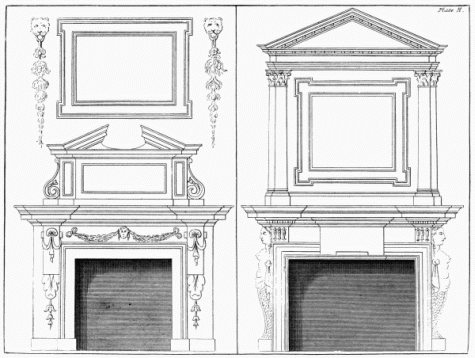
Figure 11.—Fireplace mantels illustrated in William Salmon’s Palladio Londonensis. (Courtesy of the Library of Congress.)
Not all the hewn stone was fashioned in England. William Copein, a Prince William County mason, and Job Wigley were employed together in 1749 to the amount of £2 8s. In 1750 Copein was paid by Mercer for 64 days of work at 3s. 1d. per day, totaling £9 17s. 4d. Copein was another accomplished craftsman, the marks of whose skill still are to be seen in the carved stone doorways of Aquia Church in Stafford County and in the baptismal font at Pohick Church in Fairfax.
The design of the house will be considered in more detail later in the light of both archeological and documentary evidence. It is already quite clear, however, that the new mansion was remarkably elaborate, reflecting the workmanship of some of Virginia’s best craftsmen. The most significant clues to its inspiration are found in the titles of four books which Mercer purchased in 1747. These are listed in the inventory of his books in Ledger G as follows:
“Hoppne’s Architecture.” This was probably The Gentlemans and Builders Repository on Architecture Displayed. Designs Regulated and Drawn by E. Hoppus, and engraved by B. Cole. Containing useful and requisite problems in geometry ... etc, (1738). Edward Hoppus was “Surveyor to the Corporation of the London Assurance.” He also edited Salmon’s Palladio Londonensis. We find no writer on architecture named Hoppne and assume this was a mistake.
“Salmon’s Palladio Londonensis.” Palladio Londonensis: or the London Art of Building, by William Salmon, which appeared in at least two editions, in 1734 and in 1738, had a profound influence on the formal architecture of the colonies during the mid-century.
“Palladio’s Architecture.” The Italian Andrea Palladio was the underlying source of English architectural thought from Christopher Wren down to Robert Adam. Under the patronage of Lord Burlington, this book was brought out in London in an English translation by Giacomo Leoni under the title The Architecture of A. Palladio; in Four Books. It had appeared in three editions prior to this inventory, in 1715, 1721, and 1742, according to Fiske Kimball (Domestic Architecture of the American Colonies and of the Early Republic; New York: Charles Scribner’s Sons, 1924, p. 58). Mercer probably owned one of these. “Langley’s City & Country Builder.” City and Country Builder’s and Workman’s Treasury of Design by Battey Langley, 1740, 1745. This was another copybook much used by builders and provincial architects.
Figure 12.—Doorways illustrated in William Salmon’s Palladio Londonensis (the London Art of Building), one of the books used by William Bromley, the chief joiner who worked on Mercer’s mansion. (Courtesy of the Library of Congress.)
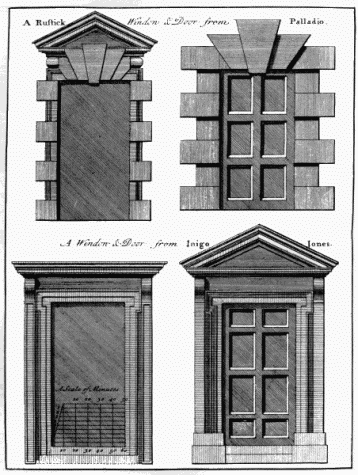
All four of these books were listed in succession in the ledger and bracketed together. Next to the bracket are the initials “WB,” to indicate that the books had been lent to someone who bore those initials. In this case it is virtually certain that the initials are those of William Bromley, to whom the books would have been of utmost importance in designing the woodwork of the house.
Door hardware was purchased from William Jordan in June 1749, according to an item for “Locks & Hinges” that amounted to the large sum of £13 8s. 8d.
DOMESTIC FURNISHINGS
As the mansion progressed, so did the acquisition of furnishings suitable to its elegance. As early as 1742, doubtless in anticipation of the new house, Mercer had bought from Hunter a “lanthorn,” three porringers, two cotton counterpanes at 27s., a plate warmer for 7s. 6d., a half-dozen plates for 3s. 6d., a half-dozen deep plates for 6s., a dozen “Stone Coffee cups” for 18d., a dozen knives and forks for 3s., two tin saucepans at 4d. each, and “4 Dishes, 19½ lib.” (obviously large pewter chargers). In 1743 he bought “5 gallon Basons 4/7” and “2 pottle Basons at 2/4” (for toilet use), “1 Soop Spoon 1/,” and “1 Copper Chocolate pot 7/6 & mull Stick 6d,” “2 blew & Wt Jugs 2/” (probably Westerwald stoneware), and “1 Flanders Bed Bunt, 25” (colored cotton or linen used for bedcovers).
In 1744 Mercer acquired from Charles Dick 4 candlesticks for a penny each, 2 pairs of large hinges, a “hair sifter,” “2 kitchen buck hand knives,” 12 cups and saucers for 2s., “1 milkmaid 2d” (probably a shoulder yoke), and “1 bucket ½d.” In 1745 a 5-gallon “Stone bottle” for 3s. 6d., “1 doz. butcher knives,” a hearthbroom, six spoons for a shilling, a pair of scissors, “8 Chamberdoor Locks wth brass knobs £2,” and “1 Sett finest China 35/, 2 punch bowls ... 2.7” were purchased.
The following year Mercer paid a total of £23 for a silver sugar dish, weighing 8 oz., 5 dwt.; one dozen teaspoons and tray, 8 oz., 7 dwt.; a teapot and frame, 26 oz., 8 dwt. This lot of silver probably was bought at second hand, having been referred to as “Pugh’s Plate pd Edwd Wright as by Rect.” He paid John Coke, a Williamsburg silversmith, £1 6s. for engraving and cleaning it. In the meanwhile, in 1745, he had sold Coke £6 worth of old silver. He also sold a quantity of “old Plate” for £15 17s. 3d. to Richard Langton in England through Sydenham & Hodgson. In 1747 he made a large purchase of silver from the silversmith William King[99] of Williamsburg:
oz.dwt.£s.d.
May 1747
By Bernard
Moore for
1 Cup51 130 8 3
By James
Power for
1 Waiter8 7½4 14 2½
By a pair of
Sauceboats25 8
By a large
Waiter29 348 11 3½
By a smaller
Do23 8
By a small Do8 8
148 15½ @ 11/384 13 9
In March 1748, Mercer settled with Captain Lyndon for the following:
£s.d.
1superfine large gilt Sconce glass616
1Do55
1Walnut & gold Do210
1Marble Sideboard 32/6 Bragolo [sic] 32/635
The following June he bought a marble table from William Jordan and in October “4 looking Glasses,” which Jordan obtained from Sydenham & Hodgson.
Figure 13.—Table-desk made in 1749 for Henry Purefoy of Shalstone Manor in Buckinghamshire by John Belchier of London. In the following year, John Mercer received £43 13s. worth of “Cabinet Ware” from that noted cabinetmaker. (Reproduced from Purefoy Letters, 1735-1753, G. Bland, ed., Sidgwick and Jackson, Ltd., London, 1931, by courteous permission of the publisher.)
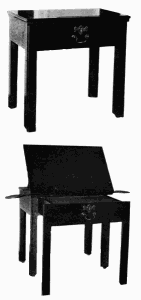
Meanwhile, William Walker’s brother Robert made 14 chairs for Mercer, on which William’s carver spent 54 days. The total cost was £30 8s. The quality of Mercer’s furniture is illustrated further by a purchase in 1750 from Lyonel Lyde,[100] a London merchant, of £43 13s. worth of “Cabinet Ware from Belchier.” Belchier was a leading London furniture maker, whose shop in 1750 was located on the “south side of St. Paul’s, right against the clock.” Sir Ambrose Heal, in The London Furniture Makers, illustrates a superb japanned writing cabinet in green and gold chinoiserie made by Belchier in 1730.[101] Belchier also supplied Shalstone Manor, the Buckinghamshire estate of Henry Purefoy, with a table-desk in 1749 (fig. 13).[102]
The ledger notes other occasional purchases of furniture during this period. In 1746 Mercer paid cash “for oysters & a bedsteed,” in the amount of 10s. 6d. In September 1748, he bought “an Escritoire” from tutor John Phipps, for which he paid £5.
LIGHTING DEVICES
Artificial lighting for the manor house receives sparse mention. The four candlesticks bought in 1744 for a penny each were probably of iron or tin for kitchen use. Candlesticks purchased earlier probably remained in use, sufficing for most illumination. It is a modern misconception that colonial houses were ablaze at night with lamplight and candlelight. Candles were expensive to buy and time-consuming to make, while lamps rarely were used before the end of the century in the more refined areas of households. The principal use of candles was in guiding one’s way to bed or in providing the minimum necessary light to carry on an evening’s conversation. During cold weather, fireplaces were a satisfactory supplement. In general, early to bed and early to rise was the rule, as William Byrd has shown us, and artificial light was only a minor necessity.
Nevertheless, some illumination was needed in the halls and great rooms of colonial plantation houses, especially when guests were present—as they usually were. The three sconce glasses which Captain Lyndon delivered to Mercer in 1748 were doubtless elegant answers to this requirement. These glasses were mirrors with one or more candle branches, arranged so that the light would be reflected and multiplied. On special occasions, these, and perhaps some candelabra and a scattering of candlesticks to supplement them, provided concentrations of light; for such affairs the use of ordinary tallow candles, with their drippings and smoke, was out of the question. A pleasant alternative is indicated by the purchase in April 1749 of “11½ lib. Myrtle Wax att 5d ... 14.4½” and “4 lib Beeswax 6/” from Thomas Jones of the Eastern Shore. Similar purchases also are recorded. Myrtle wax came from what the Virginians called the myrtle bush, better known today as the bayberry bush. Its gray berries yielded a fragrant aromatic wax much favored in the colonies. In making candles it was usually mixed with beeswax, as was evidently the case here. A clean-burning, superior light source, it was nonetheless an expensive one. Burning in the brackets of the sconce glasses at Marlborough, heightening the shadows of the Palladian woodwork and, when snuffed, emitting its faint but delicious fragrance, it must have been a delight to the eyes and the nostrils alike.
NEGROES
Negroes played an increasingly important part in the life of Marlborough, particularly after the manor house was built. Between 1731 and 1750 Mercer purchased 89 Negroes. Most of these are listed by name in the ledger accounts. Forty-six died in this period, while 25 were born, leaving a total of 66 Negroes on his staff in 1750. In 1746 he bought 6 men and 14 women at £21 10s. from Harmer & King in Williamsburg. The new house and the expanded needs for service were perhaps the reasons for this largest single purchase of slaves.
There is no indication that Mercer treated his slaves other than well, or that they caused him any serious difficulties. On the other hand, his frequent reference to them by name, the recording of their children’s names and birth dates in his ledger, and the mention in his journal of new births among his slave population all attest to an essentially paternalistic attitude that was characteristic of most Virginia planters during the 18th century. Good physical care of the Negroes was motivated perhaps as much by self-interest in protecting an investment as by humane considerations, but, nonetheless, we find such items in the ledger as “To Cash pd Doctor Lynn for delivering Deborah.”
That discipline served for the Negroes as it usually did for all colonials, whether the lawbreaker were slave, bondsman, or free citizen, is indicated by an entry in the Dick account: “2 thongs wth Silk lashes 1/3.” One must bear in mind that corporal punishment was accepted universally in the 18th century. Its application to slaves, however, usually was left to the discretion of the slave owner, so that the restraint with which it was administered depended largely upon the humanity and wisdom of the master.
The use of the lash was more often than not delegated to the overseer, who was hired to run, or help run, the plantation. It was the overseer who had a direct interest in eliciting production from the field hands; a sadistic overseer, therefore, might create a hell for the slaves under him. It is clear from Mercer’s records that some of his overseers caused problems for him and that at least one was a brutal man. For October 1747 a chilling entry appears in the account of William Graham, an overseer at Bull Run Quarters: “To Negroes for one you made hang himself. £35.” Entered in the “Negroes” account, it reappears, somewhat differently: “To William Graham for Frank (Hanged) £35 Sterling. £50. 15.” This is one of several instances on record of Negroes driven to suicide as the only alternative to enduring cruelties.[103] In this case, Graham was fined 50 shillings and 1293 pounds of tobacco.
We do not know, of course, whether other Negroes listed as dead in Mercer’s account died of natural causes or whether cruel treatment contributed to their deaths. In the case of a homesick Negro named Joe, who ran away for the third time in 1745, Mercer seems reluctantly to have resorted to an offer of reward and an appeal to the law. Even so, he declined to place all the blame on Joe. Joe had been “Coachman to Mr. Belfield of Richmond County” and in the reward offer Mercer states that Joe
... was for some time after he first ran away lurking about the Widow Belfield’s Plantation.... He is a short, well-set Fellow, about 26 Years of Age, and took with him several cloaths, among the rest a Suit of Blue, lined and faced with Red, with White Metal Buttons, Whoever will secure and bring home the said Negroe, shall receive Two Pistoles Reward, besides what the Law allows: And as I have a great Reason to believe, that he is privately encouraged to run away, and then harboured and concealed, so that the Person or Persons so harbouring him may be thereof convicted, I will pay to such Discoverer Ten Pistoles upon Conviction. This being the third Trip he has made since I bought him in January last, I desire he may receive such Correction in his Way home as the Law directs, when apprehended.[104]
Whether Joe received the harsh punishment his offense called for is not recorded. However, in 1748 Mercer accounted for cash paid for “Joe’s Lodging & burial £3. 10.,” suggesting that Joe enjoyed death-bed care and a decent burial, even though he may have succumbed to “such correction ... as the law directs.”
As has already been suggested, his overseers seem to have given Mercer more trouble than his slaves. One was Booth Jones of Stafford, about whom Mercer confided in his ledger, “By allowed him as Overseer tho he ran away about 5 weeks before his time was out by wch I suffered more damage than his whole wages. £3. 11.” Meanwhile, in 1746 William Wheeland, an overseer at Bull Run Quarters, “imbezilled” 40 barrels of corn.
James Savage was one of the principal overseers and seems to have been in charge first at Sumner’s Quarters and then at Bull Run Quarters. John Ferguson succeeded him at the former place. William Torbutt was also at Bull Run, while Mark Canton and Nicholas Seward were overseers at Marlborough.
The outfitting of slaves with proper clothes, blankets, and coats was an important matter. It called for such purchases as 121 ells of “ozenbrigs” from Hunter in 1742. “Ozenbrigs” was a coarse cloth of a type made originally in Oznabruck, Germany,[105] and was traditionally the Negro field hand’s raiment. Many purchases of indigo point to the dying of “Virginia” cloth, woven either on the plantation or by the weavers mentioned earlier. Presumably, shoes for the Negroes were made at Marlborough, judging from a purchase from Dick of 3¼ pounds of shoe thread. The domestic servants were liveried, at least after the mansion was occupied. William Thomson, a Fredericksburg tailor, made “a Coat & Breeches [for] Bob, 11/.” Bob was apparently Mercer’s personal manservant, who had served him since 1732. Thomson also was paid £4 16s. 2d. for “Making Liveries.” The listing of such materials as “scarlet duffel” and “scarlet buttons” points to colorful outfitting of slaves.
SAILING, FISHING, HUNTING
Water transportation was essential to all the planters, most of whom owned sloops. We have seen that Mercer used a sloop for his earliest trading activities before he settled at Marlborough, and it is apparent that in the 1740’s either this same sloop or another which may have replaced it still was operated by him. Hauling tobacco to Cave’s warehouse, picking up a barrel of rum in Norfolk or a load of lumber on the Eastern Shore were vital to the success of the plantation. To equip the sloop, 14 yards of topsail, ship’s twine, and a barrel of tar were purchased in 1747. Mercer had two Negroes named “Captain” and “Boatswain,” and we may suppose that they had charge of the vessel. Such an arrangement would not have been unique, for many years after this, in 1768, Mercer wrote that “a sloop of Mr Ritchie’s that came around from Rappa for a load of tobacco stopped at my landing; his negro skipper brought me a letter from Mr Mills....”[106]
That there was considerable hunting at Marlborough is borne out by repeated references to powder, shot, gunpowder, and gunflints. Fishing may have been carried on from the sloop and also in trap-nets of the same sort still used in Potomac Creek off the Marlborough Point shore. In 1742 purchases were made of a 40-fathom seine and 3 perch lines, and in 1744 of 75 fishhooks and 2 drumlines.
BOOKS
In Ledger G, Mercer listed all the books of his library before 1746. He then listed additions as they occurred through 1750 (Appendix K). This astonishing catalog, disclosing one of the largest libraries in Virginia at that time, reveals the catholicity of Mercer’s tastes and the inquiring mind that lay behind them. Included in the catalog are the titles of perhaps the most important law library in the colony.
The names of all sorts of books on husbandry and agriculture are to be found in the list: “Practice of farming,” “Houghton’s Husbandry,” “Monarchy of the Bees,” “Flax,” “Grass,” and Evelyn’s “A Discourse of Sallets.” Mercer’s interest in brewing, which later was to launch a full-scale, if abortive, commercial enterprise is reflected in “London Brewer,” “Scott’s Distilling and Fermentation,” “Hops,” and the “Hop Gardin,” while “The Craftsman,” “Woollen Manufacture,” and “New Improvements” indicate his concern with the efficiency of other plantation activities.
He displayed an interest in nature and science typical of an 18th-century man: “Bacon’s Natural History,” “Gordon’s Cosmography,” “Gordon’s Geography,” “Atkinson’s Epitome of Navigation,” “Ozamun’s Mathematical Recreations,” “Keill’s Astronomy,” and “Newton’s Opticks.” Two others were “Baker’s Microscope” and “Description of the Microscope &c.” It may be significant that in 1747 Mercer bought three microscopes from one “Doctor Spencer” of Fredericksburg, the books on the subject and the instruments themselves possibly having been intended for the education of the three boys.
“150 Prints of Ovid’s Metamorphosis” appears, in addition to “Ovid’s Metamorphosis and 25 Sins,” for which Mercer paid £8 6s. to William Parks in 1746. “Catalog of Plants” and “Merian of Insects” are other titles related to natural science.
Many books on history and biography are listed—for example, “Life of Oliver Cromwell,” “Lives of the Popes,” “Life of the Duke of Argyle,” “Hughes History of Barbadoes,” “Catholick History,” “History of Virginia,” “Dr. Holde’s History of China,” “The English Acquisitions in Guinea,” “Purchas’s Pilgrimage.”
There are 25 titles under “Physick & Surgery,” reflecting the planter’s need to know the rudiments of medical care for his slaves and family. Art, architecture, and travel interested him also, and we find such titles as “Noblemen’s Seats by Kip,” “Willis’s Survey of the Cathedrals,” “8 Views of Scotland,” “Perrier’s Statues,” “Pozzo’s Perspective,” “100 Views of Brabant & Flanders,” “History of Amphitheatres.” There was but one title on music—“The Musical Miscellany,” mentioned previously. “Report about Silver Coins” was probably an English report on the exchange rate of silver coinage in the various British colonies.
Mercer kept abreast of English literature of his own and preceding generations: “Swift’s Sermons,” the “Spectator” and the “Tatler,” “Pope’s Works,” “Turkish Spy,” “Tom Brown’s Letters from the Dead to the Living,” “Pamela,” “David Simple,” “Joseph Andrews,” “Shakespeare’s Plays,” “Ben Jonson’s Works,” “Wycherley’s Plays,” “Prior’s Works,” “Savage’s Poems,” “Cowley’s Works,” and “Select Plays” (in 16 volumes), to mention but a few. The classics are well represented—“Lauderdale’s Virgil,” “Ovid’s Art of Love,” “Martial” (in Greek), as well as a Greek grammar and a Greek testament. There were the usual sermons and religious books, along with such diverse subjects as “Alian’s Tacticks of War,” “Weston’s Treatise of Shorthand” and “Weston’s Shorthand Copybook,” and “Greave’s Origin of Weights, &c.” He subscribed to the London Magazine and the Gentleman’s Magazine, and received regularly the Virginia Gazette.
While most of Mercer’s books were for intellectual edification or factual reference, a few must have served the purpose of sheer visual pleasure. Such was Merian’s magnificent quarto volume of hand-colored engraved plates of Surinam insects, with descriptive texts in Dutch. The 18th-century gentleman’s taste for the elegant, the “curious,” and the aesthetically delightful were all satisfied in this luxurious book, which would have been placed appropriately on a table for the pleasure of Mercer’s guests.[107]
THE PETITION
Although overseeing the construction of his mansion, buying the furniture for it, and assembling a splendid library would have been sufficient to keep lesser men busy, Mercer was absorbed in other activities as well. On May 10, 1748, for example, he recorded in his journal that he went “to Raceground by James Taylor’s & Wido Taliaferro’s,”[108] traveling 50 miles to do so. On December 13, 1748, he went “to Stafford Court & home. Swore to the Commission of the Peace,” thus becoming a justice of the peace for Stafford County.
Figure 14.—Archeological survey plan superimposed over detail of 1691 plat, showing southwest corner of town developed by Mercer. It can be seen that the mansion foundation was in the area near the change of course “by the Gutt between Geo. Andrew’s & the Court house,” hence in the vicinity of the courthouse site.
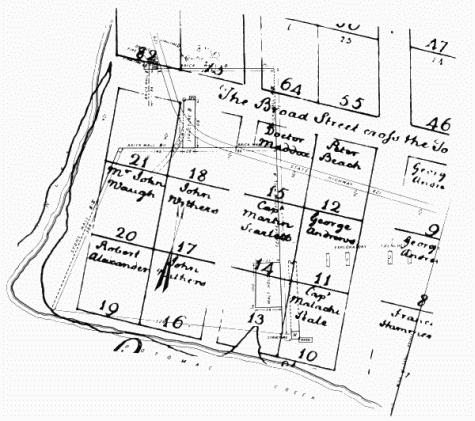
In the meanwhile, years had gone by, and no action had been taken on the suit in chancery brought in the 1730’s to establish Savage’s survey of Marlborough as the official one. During this time, Mercer had continued to build on various lots other than those he owned, “relying on the Lease and Consent of [the feoffees], at the Expense of above Fifteen Hundred Pounds, which Improvements would have saved forty lots.” Finally, “judging the only effectual way to secure his Title would be to procure an Act of General Assembly for that purpose,”[109] Mercer applied to the Stafford court to purchase the county’s interest in the town, to which the court agreed on August 11, 1747, the price to be 10,000 pounds of tobacco. Since this transaction required legislative approval, Mercer filed with the House of Burgesses the petition which has served so often in these pages to tell the history of Marlborough.
Mercer argued in the petition that the county had nothing to lose—that it “had received satisfaction” for at least 30 lots, some of which he might be obliged to buy over again; that, considering the history of the town, no one but himself would be likely to take up any other lots, the last having been subscribed to in 1708; and that his purchase of the town would be not to the county’s disadvantage but rather to his own great expense. He was willing to accept an appraisal from “any one impartial person of Credit” who would say the town was worth more, and to pay “any Consideration this worshipful House shall think just.”
He pointed out that the two acres set aside for the courthouse were excluded and that they “must revert to the Heir of the former Proprietor, (who is now an Infant).” He did not indicate in the petition that he himself was the guardian of William Brent, infant heir to the courthouse property. It is most significant, therefore, that in asking for favorable action he added, “except the two acres thereof, which were taken in for a Courthouse, as aforesaid and which he is willing to lay of as this worshipful House may think most for the Benefit of Mr. William Brent, the Infant, to whom the same belongs, or to pay him double or treble the worth of the said two acres, if the same is also vested in your Petitioner.” (Italics supplied.) Plainly, Mercer had much at stake in obtaining title to the courthouse land. This supports the hypothesis that the Gregg survey of 1707 infringed on the courthouse land, that Ballard’s lot 19 on the Gregg survey overlapped it, and that Mercer’s first two houses, and now his mansion, were partly on land that rightfully belonged to his ward, William Brent. Mercer apparently had so built over all the lower part of Marlborough without regard to title of ownership, and had so committed himself to occupancy of the courthouse site, that he was now in the embarrassing position of having to look after William Brent’s interests when they were in conflict with his own. Likely it is that he had depended too much on acceptance of the still-unauthorized Savage survey to correct the previous discrepancies by means of its extra row of lots.
Still further indication that the courthouse land was at issue is found in the proceedings that followed the petition. In these, there are repeated references to Mercer’s having been called upon to testify “as the Guardian of William Brent.” Clearly, the legislators were concerned with the effect the acceptance of the petition would have on Brent’s interests. If Mercer, as seems likely, was building his mansion on the courthouse land, the burgesses had reason to question him. In any case, the House resolved in the affirmative “That the said Petition be rejected”.[110]
This setback was only temporary, however. The wider problems of Marlborough had at least been brought to light, so that by the time the next fall session was held Mercer’s 18-year-old suit to have Savage’s designated the official survey finally was acted upon:
“At a General Court held at the Court House in Williamsburg the 12th October 1749” the John Savage survey of 1731 was “Decreed & Ordered” to be “the only Survey” of Marlborough. The problem of overlapping boundaries occasioned by the conflicts between the first two surveys was solved neatly. Mercer agreed to accept lots 1 through 9, 22 and 25, and 33, 34, 42, and 43, “instead of the sd 17 lots so purchased.” The new lots extended up the Potomac River shore, while the “sd 17 lots” were those which he had originally purchased and had built upon. Since he had “saved” these 17 lots by building on them, according to the old laws for the town, “it is further decreed & ordered that the said Town of Marlborough grant & convey unto the sd John Mercer in fee such & so many other Lotts in the said Town as shall include the Houses & Improvmts made by the said John Mercer according to the Rate of 400 square feet of Housing for each Lot so as the Lots to be granted for any House of greater Dimensions be contiguous & are not separated from the said House by any of the Streets of the said Town.”[111]
Thus, Mercer’s original titles to 17 lots were made secure by substituting new lots for the disputed ones he had occupied. This device enabled the feoffees to sell back the original lots—at £182 per lot—with new deeds drawn on the basis of the Savage survey. The final provision that lots be contiguous when a house larger than the minimum 400 square feet was built on them, and that the house and lots should not be separated by streets from each other, guaranteed the integrity of the mansion and its surrounding land. No mention was made here, or in subsequent transfers, of the courthouse land. Presumably it was conveniently forgotten, Mercer perhaps having duly recompensed his ward.
HEALTH AND MEDICINE
Three weeks before his petition was read in the House, Mercer became ill. On October 26, 1748, he noted in his journal, “Very ill obliged to keep my bed.” This was almost his first sickness after years of apparently robust health. Such indispositions as he occasionally suffered had occurred, like this one, at Williamsburg, where conviviality and rich food caused many another colonial worthy to founder. In this case, anxiety over the outcome of his petition may have brought on or aggravated his ailment. In any event, he stayed throughout the court session at the home of Dr. Kenneth McKenzie, who treated him. On November 3 he noted that he was “On Recovery,” and two days later “went out to take the air.” The following appears in his account with Dr. McKenzie:
October 1748:By Medicines & Attendance
myself & Ice£7.19.11
By Lodging &c. 7 weeks6. 6. 7
From William Parks, on another occasion, he bought “Rattlesnake root,” which was promoted in 18th-century Virginia as a specific against the gout, smallpox, and “Pleuritick and Peripneumonic Fevers.”[112] Twice he bought "British oyl," a favorite popular nostrum sold in tall, square bottles, and on another occasion “2 bottles of Daffy’s Elixir.”[113] In 1749 he settled his account with George Gilmer, apothecary of Williamsburg, for such things as oil of cinnamon, Holloways’ Citrate, “Aqua Linnaean,” rhubarb, sago, “Sal. Volat.,” spirits of lavender, and gum fragac. The final item in the account was for April 22, 1750, for “a Vomit.” The induced vomit, usually by a tartar emetic, was an accepted cure for overindulgence and a host of supposed ailments. That inveterate valetudinarian and amateur physician, William Byrd, was in the habit of “giving” vomits to his sick slaves.[114]
In November and December 1749 Mercer sustained his first long illness, during which he was attended by “Doctor Amson.” “Taken sick” at home on November 13, he evidently did not begin to recover until December 11. Whatever improvement he may have made must have received a setback on the last day of the year, when he recorded in his journal: “Took about 60 grains of Opium & 60 grains of Euphorbium by mistake instead of a dose of rhubarb.”
RELIGION AND CHARITIES
Mercer’s religious observances were irregular, although usually when he was home he attended Potomac Church. At the same time he continued as a vestryman in Overwharton Parish (which included Potomac and Aquia churches). On September 28, 1745, the vestry met to decide whether to build a new Aquia church or to repair the old one. They “then proceeded to agree with one William Walker, an Undertaker to build a new brick Church, Sixty Feet Square in the Clear, for One Hundred and Fifty Three Thousand Nine Hundred and Twenty Pounds of Transfer Tobacco.”[115] In October Mercer entered in Ledger G, under the Overwharton Parish account, “To drawing articles with Walker.” In December he charged the parish with “2 bottles claret” and “To Robert Jackson for mending the Church Plate.” Jackson was a Fredericksburg silversmith.[116]
The following March, the proprietors of the Accokeek Ironworks petitioned the Committee on Propositions and Grievances with an objection to the vestry’s decision to rebuild, claiming that “as the said Iron-Works lie in the Parish aforesaid, and employ many Tithables in carrying on the same, they will labour under great Hardships thereby....”[117] The petition was rejected, but nothing seems to have been done on the new church until three months after Walker’s death in February 1750, when Mourning Richards was appointed undertaker.[118]
Mercer’s charities in this decade form a short list. His only outright gift was his “Subscription to Protestant working-Schools in Ireland. To my annual Subscription for Sterling £5.5.” In 1749 he did £12 3s. worth of legal work for the College of William and Mary, which he converted into “Subscriptions to Schools” of equal value; in other words, he donated his services.
CATHERINE MERCER’S DEATH AND ANN ROY’S ARRIVAL
On April 1, 1750, Mercer went to Williamsburg for the spring session and stopped en route to visit his friend Dr. Mungo Roy at Port Royal in Caroline County. He remained at Williamsburg until the seventh, except for going on the previous day to “Greenspring” to be entertained by Philip Ludwell in the Jacobean mansion built a century earlier by Governor Berkeley. Again stopping off at Port Royal, he returned home on May 10. He remained there until June 15, when he made the laconic entry in his journal: “My wife died between 3 & 4 at noon.” What time this denotes is unclear.
Figure 15.—Portrait of Ann Roy Mercer, John Mercer’s second wife and the daughter of Dr. Mungo Roy of Port Royal, painted in 1750 or shortly thereafter. (Courtesy of Mrs. Thomas B. Payne.)
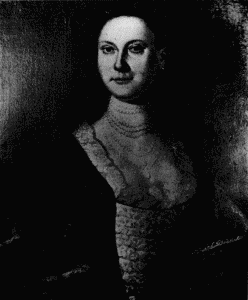
Following this loss—Catherine Mercer was only 43—Mercer remained at home for five days, then visited his sister-in-law Mrs. Ann Mason. The next night he stayed with the pastor of Aquia Church, Mr. Moncure, then returned to Marlborough and remained there for nearly a month. Meanwhile, he purchased from Fielding Lewis, at a cost of £3 18s. 7½d., “sundrys for mourning.” William Thomson, the Stafford tailor, made his mourning clothes. The preparations for the funeral must have been elaborate; it was not held until July 13.
At the end of July Mercer went to Williamsburg, thence to Yorktown, and from there to Hampton and Norfolk by water on an “Antigua Ship,” returning to Hampton on August 5 on a “Negro Ship,” evidently having caught passage on oceangoing traders. The younger children remained in Williamsburg with George and a nurse. On September 8 he went to Port Royal and stayed “at Dr. Roy’s.” He returned home on the 10th, then went back to Port Royal on the 14th, staying at Dr. Roy’s until the 20th, attending Sunday church services during his visit. He returned home again on the 23rd, only to visit Dr. Roy once more on the 28th. The October court session drew him to Williamsburg, where he remained until November 7. While there, he purchased the following from James Craig,[119] a jeweler:
£s.d.
By a pair of Earrings212
By a pair of Buttons212
By a plain Ring116
On November 8 he returned to Dr. Roy’s. On the 10th he added a characteristically sparse note to his chronicle, “Married to Ann Roy.”
The period for mourning poor Catherine was short indeed. But the mansion at Marlborough needed a mistress, and Mercer’s children, a mother. A new chapter was about to open as the decade closed. From the meticulous records that Mercer kept, it has been possible to see Mercer as a dynamic cosmopolite, accomplishing an incredible amount in a few short years. His constant physical movement from place to place, his reading of the law and of even a fraction of his hundreds of books in science, literature, and the arts, his managing of four plantations, attending two monthly court sessions a year at Williamsburg, looking after the legal affairs of hundreds of clients, concerning himself with the design and construction of a remarkable house and selecting the furnishings for it—all this illustrates a personality of enormous capacity.
Marlborough was now a full-fledged plantation. Although the legacy of an earlier age still nagged at Mercer and prevented him from holding title to much of the old town, he had, nevertheless, transformed it, gracing it with the outspread grandeur of a Palladian great house.
FOOTNOTES:
V Mercer and Marlborough, from Zenith to Decline, 1751-1768
THE OHIO COMPANY
The long last period of Mercer’s life and of the plantation he created began at a time of growing concern about the western frontier and the wilderness beyond it. In 1747 this concern had been expressed in the founding of the Ohio Company of Virginia by a group of notable colonial leaders: Thomas Cresap, Augustine Washington, George Fairfax, Lawrence Washington, Francis Thornton, and Nathaniel Chapman. George Mason was an early member, and so, not surprisingly, was John Mercer, whose prestige as a lawyer was the primary reason for his introduction to the company. We learn from the minutes of the meeting on December 3, 1750.
“[Resolved] That it is absolutely necessary to have proper Articles to bind the Company that Mason ..., Scott & Chapman or any two of them, apply to John Mercer to consider and draw such Articles and desire him attend the next general meeting of the Company at Stafford Courthouse....”[120]
At the meeting in May 1751, Mercer presented the Articles and was “admitted as a Partner on advancing his twentieth part of the whole Expence.”[121] From then on he was virtually secretary of the company, as well as its chief driving force. He was made a committee member with Lawrence Washington, Nathaniel Chapman, James Scott, and George Mason, who was treasurer. The “Committee” was the central or executive board.
With the leading members living in Stafford County or nearby, most of the meetings of both the company and the committee were held at Stafford courthouse, and occasionally in private houses of the members. We can imagine with what pride Mercer noted in his journal for February 5-7, 1753, “Ohio Committee met at my house.” The important role played by the Ohio Company in the Mercers’ lives—and by them in the Company—is fully recounted in the George Mercer Papers Relating to the Ohio Company of Virginia.
GEORGE, JOHN, AND JAMES
Mercer doubtless threw himself into the Ohio Company’s affairs with characteristic drive and enthusiasm. We may surmise that there was heady talk at Marlborough about the frontier and of dangerous exploits against the Indians and the French—enough, at least, to have stirred youthful cravings for adventure among the Mercer boys. Certain it is that George and John Fenton, aged 19 and 18, respectively, joined the frontier regiment of their neighbor Colonel Fry as young officers “upon the first incursions of the French.”[122]
James, aged 16 and too young for soldiering, exhibited an unusual aptitude for architecture. His talent was noticed by William Bromley, the master joiner on the mansion house, who told Mercer that James “had a most extraordinary turn to mechanicks.” On the strength of this, Mercer decided that James should become a master carpenter or joiner, then synonymous with “architect.” In America in 1753 professional architects, as we know them, did not exist; gentlemen, some very talented, designed and drafted, while skilled joiners or carpenters followed general directions, executing, engineering, and inventing as they went along.
Mercer’s decision was as unconventional as it was prescient, being made at a time when gentlemen were not expected to learn a trade, yet at a moment when the respected place the professional architect was later to have could be envisioned. Indeed, he explained his feeling that those who possessed architectural skills “were more beneficial members of society, and more likely to make a fortune, with credit, than the young Gentlemen of those times, who wore laced jackets attended for improvement at ordinaries, horse races, cock matches, and gaming tables.” Motivated by this honest sense of values, forged in the experience of a self-made man, Mercer proceeded to bind James “apprentice to Mr. Waite, a master carpenter and undertaker (of Alexandria), who covenanted to instruct him in all the different branches of that business. At the same time I bound four young Negro fellows (which I had given him) to Mr. Waite, who covenanted to instruct each of them in a particular branch. These, I expected, when they were out of their time, would place him in such a situation as might enable him to provide for himself, if I should not be able to do any more for him. It is notorious that I received the compliments of the Governour, several of the Council, and many of the best Gentlemen in the country, for having set such an example, which, they said, they hoped would banish that false pride that too many of their countrymen were actuated by.”
On June 25, 1753, Mercer noted in his journal, “At home. Bound son James & Peter & Essex to Wm Waite for 5 yrs.” However commendable this effort to banish “false pride” may have been, it was probably not a realistic solution for James’ career. James, as we shall see, was to make his own choice later and was to follow with great distinction in his father’s footsteps as a lawyer.
GROWING BURDENS, RESPONSIBILITIES, AND DEBTS
Meanwhile, Mercer had announced his intention to publish a new edition of the Abridgment. In doing so, he adopted a hostile, testy approach that was unusual even in 18th-century advertising. Implying that he was doing a favor to an ungrateful populace, he stated in the Virginia Gazette on August 16, 1751, “I have been prevail’d upon to print it, if I have a prospect of saving myself, though the Treatment I met from the Subscribers to the last had determined me never to be again concerned in an Undertaking of this Kind.” On the following February 20, he announced in the Gazette that if there were 600 subscribers by the last of the next General Court he would send the copy to press. If not, he would return the money to those who had subscribed, “which I should not have troubled myself with, if I could have thought of any other Expedient to secure myself against the base Usage I met with from the Subscribers to my former Abridgment, who left above 1200 of them on my Hands.” This kind of advertising had its predictable response: publication of the new Abridgment was postponed indefinitely.
The first suggestion that all was not well in Mercer’s financial affairs was given in an advertisement in the Gazette on April 10, 1752. In this he noted that he had agreed to pay the debts of one Francis Wroughton, a London merchant, out of Wroughton’s effects. However, although Wroughton’s effects had not materialized, he promised to make payment anyway, “notwithstanding a large Ballance due to myself.” He concluded, “Besides Mr. Wroughton’s Debts, I have some of my own (and not inconsiderable) to pay, therefore I hope that such Gentlemen as are indebted to me will, without putting me to the Blush which a Dunn will occasion, discharge their Debts....”
Perhaps to alleviate these difficulties, he had advertised in the Gazette on the previous March 15 that he would lease “3,000 Acres of extraordinary good fresh Land, in Fairfax and Prince William,” but there is no evidence that he was successful.
Signs of irritability became increasingly noticeable. In 1753 he outraged his fellow justices at Stafford court—so much so that they brought charges against him before the Executive Council “for misbehavior as a Justice.”[123] It was decided that, although “his Conduct had been in some Respects blameable, particularly by his Intemperance, opprobrious Language on the Bench, and indecent Treatment of the other Justices, ... that in Consideration of his having been a principal Instrument in a due Administration of Justice, and expediting the Business of the County, it has been thought proper to continue him Judge of the Court.”[124]
A growing burden of debt, in contrast to the prosperity of the preceding decade, clearly affected Mercer’s attitude, as we can see in a Gazette advertisement on November 7, 1754: “I will not undertake any new, or finish any old Cause, ’til I receive my Fee, or Security for it to my liking: And I hope such Gentlemen as for above these seven years past have put me off with Promises every succeeding General Court will think it reasonable now to discharge their accounts.” Concurrent with indebtedness was an almost annual increase in the size of his family. In 1752 Grace Fenton Mercer was born, the next year Mungo Roy, and in 1754 Elinor.
At the same time, he still pursued the restless activity that characterized his earlier years. On July 24, 1753, Mercer went “to Balthrop’s, Smith’s Ordinry & Vaulx’s,”[125] a distance of 27 miles, during which he “Overset.” On the 25th he went on eight miles farther “to Colo Phil Lee’s”[126] for a three-day meeting of the Ohio Company, then went the whole 35 miles home on the 28th. On September 6 he was called eight miles away “to Boyd’s hole on Inquest as Coroner & home by 4 in the morng,” while the next day he was “at home. Son Mungo Roy born abt 2 in the morning.” On the 19th Mungo Roy was christened. Four days later he went 15 miles to Fredericksburg for the christening of William Dick’s son Alexander, returning home the next day. The following day Mercer journeyed 14 miles and back to “Holdbrook’s Survey” by way of Mountjoy’s, and repeated the trip the next day, stopping at Major Hedgman’s[127] coming and going. On October 5 he made a three-day trip to Williamsburg, covering the distance in stretches of 16, 52, and 42 miles per day, respectively. He went by way of Port Royal, where he “Met Mr Wroughton,” presumably the London merchant whose creditors he had agreed to pay. The second day took him by way of King William courthouse. On the return on November 4-6, he came via Chiswell’s Ordinary[128] and New Kent courthouse (which he noted had "Burnt"), covering a total of 110 miles.
On June 3, 1754, his clerk reported to duty, according to a journal entry: “Rogers came here at £50 pr annum.” Rogers remained in Mercer’s employ until 1768.
Mercer seems to have been driving himself to the limit, not to achieve success as in the prior decades, but rather to hold secure what he already had. The specter of debt now hung over him, as it did over nearly every planter, under the increasing burdens of the French and Indian War. The 17th-century wisdom of William Fitzhugh and Robert Beverley in seeking to lead the colony away from complete dependence upon tobacco was apparent to those who would remember. Marlborough, although still technically a town, was now in reality a tobacco plantation, and Mercer, despite his status as a lawyer, was as irretrievably committed to the success or failure of tobacco as was Fitzhugh 70 years earlier. The hard years were now upon all, and, like his equally hard-pressed debtors, Mercer was suffering from them.
LIFE AT MARLBOROUGH DURING THE FRENCH AND INDIAN WARS
On March 11, 1755, after nearly 30 years of uncertainty about his titles to Marlborough, Mercer at last was granted the entire 52-acre town in a release from the feoffees, Peter Daniel and Gerard Fowke. This was made with the provision that he should be “Eased from making improvements on the other twenty-six Lots (those not built upon), to prevent their forfeiture and the County will be wholly reimbursed, which it is not probable it ever will be otherwise as only one Lot has been taken up in forty-seven years last past and there is not one House in the said town which has not been built by the said Mercer.”[129]
While the day-to-day events of Marlborough went on much as ever, the conflict between the British and the French spread from Canada southward along the western ridge of the Appalachians. This expansion, inevitably, was reflected in the Mercers’ activities in many ways, both great and small. As the struggle approached its climax, Braddock’s troops came to Virginia in March 1755, and were quartered in Alexandria. Among them was John Mercer’s brother, Captain James Mercer, who was a professional soldier. On March 25 John left Marlborough for Alexandria, probably to greet James and to have him billeted at William Waite’s house where young son James already was living as Waite’s apprentice. This bringing together of two far-flung members of the Mercer family had unanticipated results. Captain James was a British gentlemen-officer, untouched by the leveling influences of colonial life and therefore untempted to banish “false pride” by any such radical means as John had employed with young James. Indeed, the sight of his nephew learning a mechanical trade must have been a rude shock, for we learn from John Mercer that Captain James “found means to make his nephew uneasy under his choice; and I was from that time incessantly teazed, by those who well knew their interest over me, until I was brought to consent very reluctantly that he should quit the plumb and square” and become a lawyer.[130]
Mercer returned to Marlborough by way of George Mason’s, near the place where a few months later William Buckland was to begin work on “Gunston Hall.” He remained there all day on April 1—“at Mr Mason’s wind bound,” he wrote in his journal. The next day he went “home through a very great gust.”
The problems of managing a plantation went on through peace and through war. Besides a multitude of Negroes, there were also indentured white servants at Marlborough. One of these ran away and was advertised in the Virginia Gazette on May 2, 1755:
... a Servant Man named John Clark, he pretends sometimes to be a Ship-Carpenter by Trade, at other Times a Sawyer or a Founder ... he is about 5 feet 7 inches high, round Shoulders, a dark Complexion, grey eyes, a large Nose and thick Lips, an Englishman by birth; had on when he went away, a blue Duffil Frock with flat white Metal Buttons and round Cuffs, red corded Plush Breeches, old grey Worsted Stockings, old Shoes, and broad Pewter Buckles, brown Linen wide Trousers, some check’d Shirts, and a Muslin Neckcloth; had also an old Beaver Hat bound round with Linen.
On October 24, the Gazette carried another advertisement related to Mercer’s problems of personnel:
A Miller that understands the Management of a Wind-mill, and can procure a proper Recommendation, may have good Wages, on applying to the Subscriber during the General Court, at Williamsburg, or afterwards, at his House in Stafford County, before the last Day of November, or if any such Person will enclose his Recommendation, and let me know his Terms by the Post from Williamsburg, he may depend on meeting an Answer at the Post-Office there, without Charge, the first Post after his Letter comes to my Hands. John Mercer
In the meanwhile, the war had broken out in full scale, and the disaster at Fort Duquesne had taken place. Mercer apparently learned the bad news at a Stafford court session, for he noted in his journal on July 9, after observing his attendance at court, “General Braddock defeated.” We can imagine his concern, for both George and John Fenton were participants in the campaign.
On April 18, 1756, John Fenton was killed in action while fighting under Washington.[131] Curiously, his death was not mentioned in the journal. Instead, we learn of the death of John Mercer’s horse on the way to Williamsburg in April and of the fact that, on his return in May, Mercer lost his way and traveled 46 miles in a day. He tells us that he went “to Mr Moncure’s by water” on May 26, a distance of 15 miles, and that he made a round trip from Mr. Moncure’s to Aquia Church for a total of 12 miles. On July 14, he noted that he went “to Majr Hedgman’s & returning thrown out of the chaise & very much bruised.”
The demands of the war are revealed in journal entries made in June 1757. On the 20th he wrote, “to Court to prick Soldiers & home,” and on the 27th, “to Court to draft Soldiers & home.” As at other times in the journal, birth and death, in their tragic immediacy and repetitiveness, were juxtaposed in September: on the 24th, “Son John born”; on the 27th, “Brother James died at Albany”; on the 28th, “Son John died.”
In 1758 George Mason ran for the office of burgess from both Stafford and Fairfax. On July 11, Mercer went to the Stafford elections, where “Lee & Mason” were chosen. On the 15th, he went “to Mr Selden’s & home by water to see Mr Mason,” who evidently had come to Marlborough for a visit. Four days later, he traveled to Alexandria for the elections there and saw “Johnston & Mason” elected.
In the fall of 1758 he went, as usual, to Williamsburg. His route this time was long and devious, taking him to both Caroline and King William County courthouses on the way, for a total of 121 miles in five days. We learn of one of the hazards of protracted journeys in the 18th century from a notation repeated daily in his journal for four days following his arrival: “at Williamsburg Confined to Bed with the Piles.”
On November 15, soon after his return to Marlborough, Mercer was sworn to the new commission of Stafford justices. Five days previously his son Catesby had been buried, but, as usually happened, new life came to take the place of that which had survived so briefly. On May 17, 1759, Mercer recorded, “Son John Francis born at 7 in the Evening.” John Francis evidently was given an auspicious start in life by a christening of more than ordinary formality: “May 28. to Colo Harrison’s with the Govr Son christened.”
During 1759 the second edition of the Abridgment was published in Glasgow, Scotland, this time with neither public notice nor recrimination.[132] On November 25, Mercer met the growing problem of his indebtedness by deeding equal shares of some of his properties, as well as whole amounts of others, to George and James Mercer, Marlborough and a few other small holdings excepted. Fifty Negroes were included in the transaction. This action was followed immediately by the release of the properties under their new titles to Colonel John Tayloe and Colonel Presley Thornton for a year, thus providing cash by which George and James could pay £3000 of John Mercer’s debts.[133]
The Ohio Company was experiencing its difficulties also. Mercer’s importance in it was demonstrated by his appointment to “draw up a full State of the Company’s Case setting forth the Hardships We labour under and the Reasons why the Lands have not been settled and the Fort finished according to Royal Instructions....”[134] This was his most responsible assignment during his activity in the company.
Indebtedness throughout these years lurked constantly in the background, now and then breaking through acutely. In 1760, for example, William Tooke, a London merchant, brought suit to collect £331 1s. 6d. which Mercer owed him. Two years later Capel Hanbury sued Mercer for £31 10s.[135]
In 1761 George Washington and George Mercer ran for burgesses from Frederick County in the Shenandoah Valley, and both were elected. John Mercer, evidently anxious to be present for the election, undertook the arduous journey to Winchester, leaving Marlborough on May 15. His itinerary was as follows:
May15to Fredericksburg15
16to Nevill’s Ordinary37
17to Ashby’s Combe’s & Winchester32
18at Winchester (Frederick Election)
(Geo Washington and Geo Mercer elected)
19to Mr Dick’s Quarter18
20to Pike’s Mr Wormley’s Quarter12
21to Snickers’s Little River Quarters &
Nevill’s60
22to Fallmouth & home50
In the previous year Anna had been born, and now, on December 14, 1761, Maria arrived. Between the 8th and the 20th of August, 1762, entries were made that suggest that there was an epidemic of sorts at Marlborough: “Cupid died // Tom (Poll’s) died // Daughter Elinor died // Miss B. Roy died.” In his long letter to George, written in 1768, he reflected on the fact that, although through the years 98 Negroes had been born at Marlborough, he, at that time, had fewer than the total of all he had ever bought. “Your sister Selden,” he wrote “attributes it to the unhealthiness of Patomack Neck, which there may be something in.... I thank God, however, that my own family has been generally as healthy as other people’s.”[136]
THE END OF THE WAR AND THE STAMP ACT
The year 1763 marked the end of the war. It also signaled a turning point in the colonies’ relations with England. In a royal proclamation the King prohibited the colonies from expanding westward past the Appalachian ridge, in effect nullifying the Ohio Company’s claims and objectives. George Mercer was appointed agent of the company and was dispatched to England to plead its cause.
By this time Britain was beginning to apply the other allegedly oppressive measures which preceded the Revolution. Antismuggling laws were enforced, implemented by “writs of assistance,” thus increasing colonial burdens which had been avoided previously by widespread smuggling. The South was particularly hard hit by parliamentary orders forbidding the colonies the use of paper money as legal tender for payment of debts. In a part of the world where a credit economy and chronic indebtedness made a flexible currency essential, this measure was a disastrous matter.
Despite the ominousness of the times, Mercer continued with the daily routine, the minutiae of which filled his journal. He noted on January 9, 1763, that he went to Potomac Church—“Neither Minister or clerk there.” On February 21 he went a mile—probably up Potomac Creek—to watch “John Waugh’s halling the Saine & home.” On March 1 his merchant friend John Champe was buried. After the funeral Mercer went directly to Selden’s for an Ohio Company meeting.
From December 10 until March 1765, Mercer was sick. Of this interval, he wrote George in 1768 that “My business had latterly so much encreased, together with my slowness in writing, & Rogers, tho a tolerable good clerk, was so incapable of assisting me out of the common road, that when you saw me at Williamsburg, I was reduced by my fatigue, to a very valetudinary state.”[137] Indebtedness, overwork, advancing age, and the reverses of the times had evidently caused a crisis.
Passage of the Stamp Act in 1765, to raise revenues to support an army of occupation in the colonies, struck close to John Mercer, for George, while in England, had been designated stamp officer for Virginia. George returned to Williamsburg, little expecting the hostile greeting he was to receive from a crowd of angry planters. Quickly disavowing his new office, he returned the stamps the following day.
Many made the most of George’s tactical blunder in accepting the stamp-officer appointment. Indeed, the Mercers seem to have been made the scapegoats for the frustrations and turmoil into which the mother country’s actions had plunged the colony. George Mercer was hanged in effigy at Westmoreland courthouse, and James Mercer took to the Gazettes to defend him. There were counterattacks on James while he was absent in Frederick County, and Mercer himself rushed in with a lengthy satirical diatribe entitled “Prophecy from the East.” Occupying all the space normally devoted to foreign news in Purdie & Dixon’s Virginia Gazette for September 26, 1766, this struck out at anonymous attackers whom Mercer scathingly nicknamed Gibbet, Scandal, Pillory, and Clysterpipe. He later explained to George that James’ “antagonist was backed by so many anonymous scoundrels, that I was drawn in during his abscence at the springs in Frederick to answer I did not know whom tho it since appears Dr Arthur Lee was the principal, if not the only assassin under different vizors, & he was so regardless of truth that he invented & published the most infamous lies as indisputable facts: on your brother’s return I got out of the scrape but from a paper war it turned to a challenge, which produced a skirmish, in which your bro. without receiving any damage broke the Doctors head, & closed his eyes in such a manner as obliged him to keep his house sometime....”[138]
Of John Mercer’s own attitude towards the Stamp Act there can be no question. On November 1, 1765, he noted in his journal, “The damned Stamp Act was to have taken place this day but was proved initially disappointed.” He is said to have written a tract against the Stamp Act, although no copy has survived.
THE CLOSING YEARS[139]
The elements of tragedy mark Mercer’s final years—the tragedy of John Mercer and Marlborough interwoven with the epic failures of the colonial experiment. Prompted by his illness, he quit his legal practice in the courts in 1765. In the same year he “gave notice to the members of the Ohio Company, that my health & business would not longer allow me to concern myself in their affairs which they had entirely flung upon my hands.” He also “on account of my deafness, refused to act as a justice, which I should not have done otherwise, as I have the satisfaction to know that I have done my country some service in this station.”
Heavily in debt, disillusioned and embittered by the dwindling results of his struggles, he wrote that “I have attended the bar thirty-six years, through a perpetual hurry and uneasiness, and have been more truly a slave than any one I am, or ever was, master of; yet have not been able, since the first day of last January, to command ten pounds, out of near ten thousand due me.” Recoiling from his situation, he desperately sought a way out and a means to recover his losses. With self-deceptive optimism he seized upon the idea of establishing a brewery at Marlborough, since “our Ordinaries abound & daily increase (for drinking will continue longer than anything but eating).” Accordingly, he built a brewhouse and a malthouse, each 100 feet long, of brick and stone, together with “Cellars, Cooper’s house & all the buildings, copper & utensils whatever, used about the brewery.” He depended at first on his windmill for grinding the malt, but to avoid delays on windless days, “I have now a hand-mill fixed in my brewhouse loft that will grind 50 bushels of malt (my coppers complement) every morning they brew.”
To get his project under way, Mercer plunged further into the depths of debt by buying 40 Negroes “to enable me to make Grain sufficient to carry on my brewery with my own hands.” These cost £8000, “a large part of which was unpaid, for payment of which I depended on the Brewery itself & the great number of Debts due to me.” But the external fate which was driving him closer and closer to destruction now struck with the death of John Robinson, treasurer of the colony, who, having lent public funds promiscuously to debtor friends, had left a deficiency of £100,000 in the colonial treasury. A chain reaction of suits developed, threatening James Hunter of Fredericksburg, Mercer’s security for purchase of the slaves.
The brewery lumbered and stumbled. Mercer’s first brewer, a young Scot named Wales, prevailed upon him to spend £100 to alter the new malthouse. On September 16, 1765, William King, evidently a master brewer, arrived. He immediately found fault with Wales’ changes in the malthouse. Within three weeks, however, King died. King’s nephew, named Bailey, then came unannounced with a high recommendation as a brewer from a man he had served only as a gardener. Mercer was impressed: “You may readily believe I did not hesitate to employ Bailey on such a recommendation, more especially as he agreed with King in blaming the alteration of the malt house & besides found great fault with Wales’s malting.” Faced with rival claims as to which could brew better beer, Mercer allowed each to brew separately. “Yet though Bailey found as much fault with Wales’s brewing as he did with his malting, that brewed by Wales was the only beer I had that Season fit to drink.” Wales, however, brewed only £40 worth of beer, barely enough to pay his wages, let alone maintenance for himself and his wife. Although Bailey brewed enough to send a schooner load of it to Norfolk, it was of such “bad character” that only two casks were sold, the remainder having been stored with charges for two months, then brought back to Marlborough, where an effort to distill it failed.
In 1766 there was a similar tale. Five hundred fifty bushels of malt were produced, but much of the beer and ale was bad. In January 1766, Andrew Monroe[140] was employed as overseer. “Wales complains of my Overseer & says that he is obliged to wait for barley, coals & other things that are wanted which, if timely supplied with he could with six men & a boy manufacture 250 bushels a week which would clear £200.... My Overseer is a very good one & I believe as a planter equal to any in Virginia but you are sensible few planters are good farmers and barley is a farmer’s article,” Mercer wrote to George. Besides the overhead of slaves and nonproductive brewers, the establishment required the services of two coopers at £20 per year.
Purdie & Dixon’s Virginia Gazette for April 10, 1766, carried the advertisement of Mercer’s brewery:
To be SOLD, at the MARLBOROUGH BREWERY
STRONG BEER AND PORTER at 18d. and ALE at 1s. the gallon, Virginia currency, in cask, equal in goodness to any that can be imported from any part of the world, as nothing but the genuine best MALT and HOPS will be used, without any mixture or substitute whatsoever; which, if the many treaties of brewing published in Great Britain did not mention to be frequently used there, the experience of those who have drunk those liquors imported from thence would point out to be the case, from their pernicious effects.
The severe treatment we have lately received from our Mother Country, would, I should think, be sufficient to recommend my undertaking (though I should not be able to come up to the English standard, which I do not question constantly to do) yet, as I am satisfied that the goodness of every commodity is its best recommendation, I principally rely upon that for my success; and my own interest, having expended near 8000 l. to bring my brewery to its present state, is the best security I can give the publick to assure them of the best usage, without which such an undertaking cannot be supported with credit.
The casks to be paid for at the rate of 4s. for barrels, 5s. for those between 40 and 50 gallons, and a penny the gallon for all above 50 gallons; but if they are returned in good order, and sweet, by having been well scalded as soon as emptied, the price of them shall be returned or discounted.
Any person who sends bottles and corks may have them carefully filled and corked with beer or porter at 6s. or with ale at 4s. the dozen. I expect, in a little time, to have constant supply of bottles and corks; and if I meet the encouragement I hope for, propose setting up a glasshouse for making bottles, and to provide proper vessels to deliver to such customers as favour me with their orders such liquors as they direct, at the several landings they desire, being determined to give all the satisfaction in the power of
Their most humble servant, JOHN MERCER
Foolhardy though the brewery was, a glass factory would have been the pinnacle of folly. Yet it was seriously on Mercer’s mind. In his letter to George he wrote:
A Glass house to be built here must I am satisfied turn to great profit, they have some in New England & New York or the Jerseys & find by some resolves the New England men are determined to increase their number.
Despite his manifest failure, Mercer confidently attempted to persuade George of the possibilities of the brewery and even the glasshouse. Shifting from one proposal to another, he suggested that he could “rent out all my houses and conveniences at a reasonable rate,” or take in a partner, although “I have so great a dislike for all partnerships, nothing but my inability to carry it on my self could induce me to enter into one.”
In spite of these desperate thrashings about in a struggle to survive, Mercer’s empire was collapsing. When Monroe arrived as overseer, he
found [according to Mercer] but 8 barrels of corn upon my plantation, not enough at any of my quarters to maintain my people, a great part of my Stock dead (among them some of my English colts & horses in the 2 last years to the amt of £ 375. 10. —) & the rest of them dying, which would have infallibly have been their fate if it had not been for the straw of 1000 bushels of barley & the grains from the brewhouse.... Convinced of his [Monroe’s] integrity, I have been forced to submit the entire management of all the plantation to him.
The following passage from the letter summarizes Mercer’s financial predicament:
“I reced in 1764 £1548 ... 4 ... 3½ & in 1765 £961 ... 5 ... 4½ but since I quitted my practice I reced in 1766 no more than £108 ... 16 ... 1 of which I borrowed £24.10.—& 7 ... 1 ... 6 was re’ced for the Governor’s fees. £20 ... 8 ... 4 I got for Opinions &c and from the brewery £28 ... 3 ... the remaining £28 ... 16 is all I received out of several thousands due for all my old & new debts. In 1767 I reced £159 ... 9 ... 3 of which borrowed £5 ... 15 ...—the governor’s fees £10 ... 7 ... 6 reced for opinions &c. £49 ... 6 ...—from the brewhouse £66 ... 14 ... of which £94 ... 14 ... 3 was from the brewery & 9 in 1766 I gave a collector £20 besides his board ferrage & expences & finding him horses & his whole collection during the year turned out to be £27 ... 2 ... 10. In the two years my taxes levied and quitrents amounted to £199 ... 8 ... 1 which would have left a ballance of £1 . 13 . 3 in my favour in that time from the brewery & my practice (if it could be so called) & all my debts, in great part of which you and your brother are jointly & equally interested. What then remained to support me & a family consisting of about 26 white people & 122 negroes? Nothing but my crops, after that I had expended above £100, for corn only to support them, besides rice & pork to near that value & the impending charge of £125 for rent, of £140 to overseers yearly, remained, & £94 ... 14 ... 3 out of those crops, as I have already mentioned, proceeding from the brewery, was swallowed up in taxes (tho the people in England say we pay none, but I can fatally prove that my estate from which I did not receive sixpence has, since the commencement of the war, paid near a thousand pounds in taxes only).”
On December 25, 1766, Mercer made public his situation in Rind’s Virginia Gazette:
The great Number of Debts due to me for the last seven Years of my Practice, and the Backwardness of my Clients (in attending whose Business, I unhappily neglected my own) to make me Satisfaction, would of itself, if I had had no other Reason, have obliged me to quit my Practice. And when I found that by such partial Payments as I chanced to receive I was able to keep up my Credit, I can appeal to the Public, whether any Person, who had so many outstanding Debts, was less importunate, or troublesome, to his Debtors, But when I found, upon my quitting the Bar, all Payments cease, and that I would not personally wait upon my Clients, I could not approve of the Method of Demand, by the Sheriff, too commonly in Practice, without Necessity. I therefore employed a Receiver, who, ever since the first day of January last, has been riding through the Northern Neck, and even as far as Williamsburg, and who to this Time has not been able, out of near ten thousand Pounds, to collect as much as will pay his own Wages, and discharge my public taxes (for Proof of which I will produce my Books to any Gentleman concerned or desirous to see them). This too, at a Time when my own Debts contracted by the large Expences I have been at for some Years past for establishing a Brewery, has disabled me by any other Means from discharging them, (except when they would take lands, Assignments of Debts, or any thing I can spare, without Detriment to my Plantations or Brewery). Selling Lands avail nothing, I have bonds for some sold four or five Years ago but I can’t get the Money for them. I therefore cannot be thought too unreasonable to give this public Notice (which the Circumstances of the Country make most disagreeable to me) that I shall be against my inclination obliged to bring Suits, immediately after next April General Court, against all persons indebted to me who do not before that Time, discharge their Debts to me or my Son James Mercer, who will have my Books during the said Court to settle with every Person applying to him. And as some Persons have since my quitting the Practice, sent to me for Opinions and to settle Accounts without sending my Fees, to prevent any more Applications of that Sort, I give this Public Notice, that tho’ I shall always be ready to do any Thing of that Kind (which can be done at my own House) upon receiving an adequate Satisfaction for it, it will be in vain to expect it be any Messenger they may send without they send the Money. There are some Gentlemen who must know that nothing in this Advertisement can relate to them but that any of their Commands will at any Time, be readily complied with by their
and the Public’s humble Servant JOHN MERCER
Dec. 8, 1766
Figure 16.—Advertisement of the services of Mercer’s stallion Ranter. Andrew Monroe, grandfather of the President, was Mercer’s overseer. (Purdie’s Virginia Gazette, April 18, 1766.)
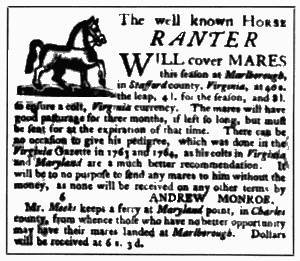
Andrew Monroe, as manager of the plantation, advertised over his own name in Purdie & Dixon’s Virginia Gazette, of April 18, 1766, the services of “The well known Horse RANTER,” an English stallion imported by Mercer in 1762 (fig. 16). One senses that without Monroe, Marlborough would have collapsed completely. In spite of his ministrations, however, there were difficulties with the staff. Purdie & Dixon’s Gazette carried the following on June 6, 1766:
MARLBOROUGH, STAFFORD county, May 26, 1766.
Run away from the subscriber, some time last February, a Negro man named TEMPLE, about 35 years old, well set, about 5 feet 6 inches high, has a high forehead, and thick bush beard; he took a gun with him, and wore a blue double breasted jacket with horn buttons. I suspect he is harboured about Bull Run, in Fauquier county, where he formerly lived. I bought him, with his mother and sister, from Mr. Barradall’s executors in Williamsburg above 20 years ago, and expected he would have returned home; but as he has been so long gone, I am doubtful he may endeavour to get out of the country by water, of which he may understand something, as he was two years on board the Wolf sloop of war in the West Indies, and carries the marks of the discipline he underwent on board.
Likewise run away last Whitsun holydays two indented servants, imported from LONDON last September, viz. JOSEPH WAIN of Bucknell, in the county of Oxford, aged 22 years, about 5 feet 4 inches high, round shouldered, stoops pretty much in his walk, has a down look, and understands ploughing. WILLIAM CANTRELL of Warwickshire, aged 19, about the same height, and stoops a little, but not so much as WAIN, has a scar under one of his eyes, but which is uncertain, has some marks of the smallpox, his hair is of a dark brown and short, but Wain’s is cut off, he pretends to understand ploughing and country business, and has drove a waggon since he has been in my service; they both have fresh look. The clothes they left home in were jackets of red plaids, brown linen shirts, Russia drill breeches with white metal buttons, and thread stockings; Cantrell with an old hat and new shoes, and Wain with a new hat and old shoes; But as it is supposed that they were persuaded to elope with four Scotch servants belonging to the widow Strother, on Potowmack run in this county, whom they went to see, and who went off at the same time, it is probable that they may exchange their clothes, or have provided some other. It is supposed that they will make for Carolina, where it is said an uncle of one of Mr. Strother’s servants lives; and as several horses are missing about the same time in these parts, it is very probable they did not choose to make such a journey on foot. Whoever secures my servants and Negro, or any of them shall, besides the reward allowed by law, be paid any reasonable satisfaction, in proportion to the distance and extraordinary trouble they may be put to.
JOHN MERCER
Mercer seems to have been concerned principally with his brewers and with the wasteful scheme they furthered with their incompetencies. Even they seem to have been beyond his strength, for he became ill in January 1766, and suffered recurrently the rest of the year. From his journal we can detect a once-strong man’s struggle against the first warnings of approaching death:
August26Rode6 m. &home had a fever12
27sick
28Rode5 m. &home10
29 2 m. &Do had an Ague4
30 Do
31 Do
Sept1 Had an Ague
2Rode5 m. &home10
* * *
Sept22to Mr Selden’s & ret’d abot a mile but
went back12
23home by 12 and went to bed10
24Confined to my bed
(remained so rest of month)
Oct1 Confined to my bed and very ill
5DoSat up alittle
6Do Better
7Do Do
8Drove out 3 m & home6
He informed George that after his return from Mr. Selden’s on September 23 he was for “several days under strong delerium and had the rattles.” By the beginning of 1768, however, he was able to boast that “I think I may safely aver that I have not been in a better [state of health] any time these twenty years past, & tho’ I am not so young, my youngest daughter ... was born the 20th day of last January.”
On April 22, 1766, he noted in the journal that the “Kitchen roof catched fire” and on May 15 that he “Took Possion [sic] of my summer house.” The latter was probably located in the garden, where, during his convalescence in the spring, he was able to make a meticulous record of the blooming of each plant, flower, tree, and shrub, constituting a most interesting catalog of the wild and cultivated flora of 18th-century Marlborough. The catalog is indicative of Mercer’s ranging interests and his knowledge of botanical terms (see Appendix L). That the garden was perhaps as interesting as the house is borne out by the fact that in 1750, as the house was reaching completion, Mercer had brought from England a gardener named William Blacke, paying Captain Timothy Nicholson for his passage.
Mercer’s close attention to the natural phenomena around him began with his illness in 1766. On January 4, only a few days after he had become ill, he installed a thermometer in his room, and eight days later moved it to his office. Regularly, from then until the close of his journal, except when he was absent from Marlborough, he recorded the minimum and maximum readings. One has only to look at the figures for the winter months to realize that “heated” rooms, as we understand them, were little known in the 18th century. Only on Christmas Eve in 1767 did the temperature range from a low of 41° to as high as 63°, because, as Mercer noted, “A good fire raised the Thermometer so high.”
Although Mercer apparently found surcease from his cares in the peaceful surroundings at Marlborough, his responsibilities went on nevertheless. The cost of keeping slaves remained an enormous and wasteful one: “Every negroes cloaths, bedding, corn, tools, levies & taxes will stand yearly at least in £5,” he wrote to George. In his letter he placed an order through George for clothing, which included 25 welted jackets “for my tradesmen & white servants,” indicating the large number of white workmen on his staff. It also included 20 common jackets, 45 pair of woolen breeches, 1 dozen greatcoats, 5 dozen stockings, 1½ dozen for boys and girls, 4 dozen “strong felt hats & 600 Ells of ozenbrigs. We shall make Virga cloth enough to cloath the women and children, but shall want 50 warm blankets & 2 doz of the Russia drab breeches.” Against the advice of his merchant friend Jordan, he declined to order a superior grade of jacket for his Negroes that would last two years, since “most negroes are so careless of their cloathes & rely so much on a yearly support that I think such jackets as I had are cheapest & last the year very well.”
He ordered George to buy new sheeting for family use, including “84 yds of such as is fit for compa,” inasmuch as “my wife is ashamed of her old sheets when any strangers come to the house.” He also placed an order for windmill sails, which, he observed, were costly in the colony, and could be made only at Norfolk.
My millwrights directions were
The Drivers 3 foot 6 inches broad The leaders 3 3
} 23 feet long
A Suit I had made at Norfolk by those dimensions proved too long, something, they should be of Duck No. 2.
In addition, he ordered nails, 50 yards of haircloth, a yard wide, for the malt kiln, a “drill plow with brass seed boxes for wheat, turnips, lucarn pease &c.,” and a considerable number of books, particularly for his children. “Bob. Newbery at the Bible & Sun in St. Paul’s churchyard can best furnish you at the cheapest rate with books best adapted to the real instruction as well as amusement of children from two to six feet high.”
The long letter was finally finished on January 28, 1768, its great length partly dictated by the fact that the river had frozen, immobilizing the posts. He noted in his journal that on February 16 he was in Fredericksburg and “dined at my Sons being my birthday and 63 yrs old.” On the 24th he attended a meeting of the Ohio Company at Stafford courthouse and on March 14 returned there for a court session. The next day he went home to Marlborough, perhaps never to leave again. The journal ended at the close of the month. The next that we hear of him appeared in Rind’s Virginia Gazette on October 27:
On Friday, the 14th instant, died at his house in Stafford County, John Mercer, Esq., who had practiced the law with great success in this colony upwards of forty years. He was a Gentleman of great natural abilities inspired by an extensive knowledge, not only in his profession, but in several other branches of polite literature. He was of a humane, generous and chearful disposition, a facetious companion, a warm friend, an affectionate husband, a tender parent, and an indulgent master.
Figure 17.—Plate from Maria Sibylla Merian’s Metamorphosis Insectorum Surinamensium efte Veranderung Surinaamsche Insecten (Antwerp, 1705), an elegant work in Mercer’s Library.
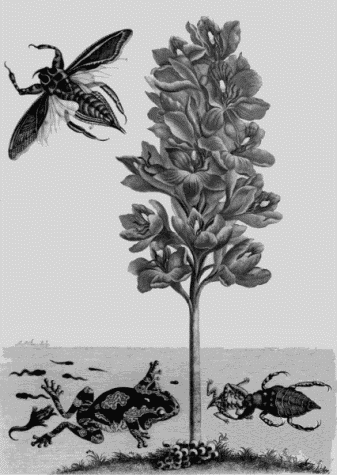
FOOTNOTES:
VI Dissolution of Marlborough
JAMES MERCER’S ADMINISTRATION OF THE ESTATE
James Mercer was now “manager” of John Mercer’s estate. George, heavily in debt, remained in England never returning to Virginia. The staggering task of rescuing the estate from bankruptcy was left to James. The immediate necessity was to reduce wasteful overhead at Marlborough and to liquidate non-essential capital investment. On December 15, 1768, James advertised in Rind’s Virginia Gazette:
A large and well chosen collection of BOOKS, being all the library of the late John Mercer, Esq., deceased, except such as are reserved for the use of his children. Those to be sold consist of more than 1200 volumes now at home, with which it is hoped may be reckoned upwards of 400 volumes which appear to be missing by the said Mercer’s catalogue.... The borrowers are hereby requested to return them before the 19th of December next, the day appointed for the appraising of the estate....
Also to be sold, about 20 mares and colts, and 40 pair of cows and calves. The colts are the breed of the beautiful horse Ranter, who is for sale; his pedigree has been formerly published in this Gazette, by which it will appear he is as well related as any horse on the continent. He cost 330 l. currency at his last sale, about 4 years ago, and is nothing worse except in age, and that can be but little in a horse kept for the sole use of covering....
Except for attempting to dispose of the library and the horses and livestock, no significant changes were undertaken until after September 7, 1770, when John Mercer’s widow, Ann Roy Mercer, died. Reduction of the plantation to simpler terms then began in earnest. Purdie & Dixon’s Virginia Gazette published the following advertisement on October 25, 1770:
To be SOLD on Monday the 19th of November, if fair, otherwise next fair day, at Marlborough, the seat of the late John Mercer Esq: deceased.
The greatest part of his personal estate (except slaves) consisting of a variety of household furniture too tedious to mention; a number of well chosen books, in good condition; a very large and choice flock of horses, brood mares, and colts, all blooded, and mostly from that very beautiful and high bred horse Ranter a great number of black cattle, esteemed the best in the colony, equal in size to any beyond the Ridge, but superiour to them, because they will thrive in shorter pastures; also 700 ounces of fashionable plate, and a genteel family coach, not more than seven years old, seldom used, with harness for six horses. Those articles were appraised, in December 1768, to 1738 l. The horses and black cattle are since increased, and now are in very good order; so that any person inclinable to purchase may depend on having enough to choose out of.
Also will then be sold several articles belonging to a BREWERY, viz. a copper that boils 500 gallons, several iron bound buts that contain a whole brewing each, coolers, &c. &c. and a quantity of new iron hoops and rivets for casks of different forms, lately imported.
Purchasers above 6 l. will have credit until the Fredericksburg September fair, on giving bond with security, with interest from the day of sale; but if the money is paid when due, the interest will be abated.
Proper vessels will attend at Pasbytansy, for the conveyance of such as come from that side of Potomack Creek.
It is clear that Ranter and his colts, as well as the cattle, had not been disposed of at the former sale. Further, it is obvious that there was an end to brewing at Marlborough, a result which James must have been all too glad to bring about.
This sale, however, was also unsuccessful. In the May 9, 1771, issue of Purdie & Dixon’s Virginia Gazette we learn that “The wet Weather last November having stopped the Sale of the personal Estate of the late John Merser, Esquire, the Remainder ... will be sold at Marlborough, on Monday, the 27th of this Month, if fair....” We learn that the family beds, apparently alone of the furniture, had been sold, and that the chariot had been added to the sales list. Apparently the library still remained largely intact, as “a great Collection of well chosen Books” was included. Ranter was still for sale, now at a five percent discount “allowed for ready money.”
But again—so an advertisement of June 13 reads in the same paper—the sale was “prevented by bad Weather.” June 20 was appointed the day for the postponed sale. This time an additional item consisted of 200 copies of Mercer’s “old Abridgment” (doubtless the 1737 edition), to be sold at five shillings each.
In the meanwhile, James had employed one Thomas Oliver, apparently of King George County, as overseer for the four plantations which were in his custody—Aquia, Accokeek, Belvedere, and Marlborough. On May 31, 1771, Oliver made a detailed report to Mercer on “the true state & Condition of the whole Estate and its Contents as they appear’d when this return was fill’d up”.[141] Included in it was an inventory of every tool, outbuilding, vehicle, and servant. The Marlborough portion of this is given in Appendix M. Oliver added an N.B. summarizing the condition of the animals and the physical properties. The following of his remarks are applicable to Marlborough:
... The work of the Mill going on as well as Can be Expected till Mr. Drains is better, the Schoo and Boat unfit for any Sarvice whatsoever till repair’d. if Capable of it. the foundation of the Malt house wants repairing. the Manor house wants lead lights in some of the windows. the East Green House wants repairing. the west do wants buttments as a security to the wall on the south side. The barn, tobacco houses at Marlbrough & Acquia must be repaired as soon as possible.... five stables at Marlbrough plantation must be repair’d before winter. we have sustai’d no damage from Tempest or Floods. it will Expedient to hyer a Carpinder for the woork wanted can not be accomplish’d in time, seeing the Carpenders must be taken of for harvest which is Like to be heavy. I will advertise the sale at Stafford Court and the two parish Churches to begin on the 20th of June 1771.... P.S. The Syder presses at Each plantation & Syder Mill at Marlborough totally expended.... Negro Sampson Marlbro Company Sick of the Gravel.... Negro Jas Pemberton at Marlbh Sick Worme Fever.
The sale as advertised and, presumably, as posted by Oliver was again a failure. Apparently no one attended. The situation must have been regarded then as desperate, for James advertised on August 29, 1771, in Purdie & Dixon’s Virginia Gazette substantially the same material as before. This time, however, it was “To be SOLD, at the Townhouse in Fredericksburg, on the 24th day of September next (being the second Day of the Fair).” Added to the former list were “About two Hundred Weight of HOPS of last Crop,” “About four hundred Weight of extraordinary good WOOL with a variety of Woollen and Linen Wheels, Reels, &c.,” as well as “A Number of GARDEN FLOWER POTS of different forms. Some ORANGE, LEMON and other EVERGREENS, in Boxes and Pots.” The valuable but unwanted Ranter was again put up.