Front matter (continued 3)
Reading edition
I should like to give a few final hints on Chafing-Dish party-giving, the result of my own experience, which has been both bitter and sweet. Imprimis: “Don’t ask too many people,” as H. J. Byron said on his deathbed, when his coachman told him that one of his horses was ailing and he thought he had better give him a ball. “You should always be two,” quoth the Abbé Morellet, “to eat a truffled turkey. It is my invariable practice. I am going to dine off one to-day. We shall be two—the turkey and myself.”
A fellow feeding makes us wondrous kind, and I do not for a moment suggest that Chafing-Dish meals should always be soli, far from it; a duet is delightful, a trio tactful, and a quartet quieting. I cannot advise going beyond that number. Chaffinda is always present, of course, but she does not count as company, she is merely the hand-maiden, the geisha, the tutelary genius hovering over the meal.
I have already enjoined the absolute necessity of rehearsal; leave nothing to chance. If you want to make your little effect, see that it is properly stage-managed: your properties ready, your limes in working order, and your band parts ready and complete. “In the green salad days of my youth, when I rarely spoke aught but the truth,” I tried more than once to dazzle my guests with unrehearsed effects, but in every case the result was dire failure. All that sort of thing is magnificent, but it is not cookery.
Again, do not attempt too elaborate a bill of fare. Be pre-Raphaelite in your attention to detail rather than Academic in your mass of lavish decoration. Of two evils choose the prettier, and prefer a discreet little meal of soup, meat, vegetable and savoury, to an elaborate programme which defeats its own ends, and clogs the appetite.
It is such much better form to be simple, poor and proud—besides, it costs less. About forty years ago the late Lord Sidney Godolphin Osborn wrote a letter on the growing love of luxury to the Times, in the course of which he said: “The wealthy per force of their positions must have large expensive establishments; they are doomed to live in show houses; they are the proper consumers of the produce of the decorative arts; but they yet have to eat, and here comes the question. How can they eat in character? How can they dine up to their pictures, sculpture, plate, and music?”
The answer is easy enough. They can never dine up to their pictures, because they are usually dyspeptic.

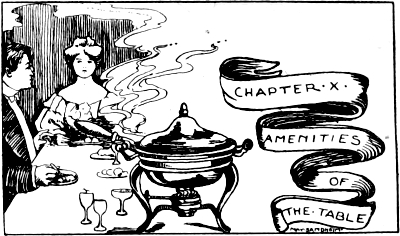
CHAPTER·X·AMENITIES·OF·THE·TABLE
“I had some hopes of the cook at first, but when I talked to her tightly and closely, I could make nothing of her: she was all wiggle-waggle, and I could never persuade her to be categorical.” Dr. Johnson (“D’Arblay’s Memoirs”).
Some of us have been to school. It was usually a long time ago. Still, here and there a man with a memory may recollect that when Achilles, in the “Iliad,” has granted the request of the unhappy Priam in reference to the dead body of his son, his next remark to the old man is an eminently practical and sensible one: “Let us now go to dinner!” It has struck me that this classical allusion may have been one of the reasons for the erection of the Achilles statue at Hyde Park Corner; just to remind late dawdlers in the Park that dinner-time and dressing-tide wait for no man or woman.
I have already had the presumption to suggest that we eat too often and too much and too late and too elaborately; this has emboldened me to further frankness. A French friend who “knew himself” in dining matters said to me once: “En Angleterre on se nourrit bien, mais on ne dine pas.” He was both right and wrong. Right as regards the very pseudo-French cookery of the affluent middle-class, wrong as regards the best restaurants and hotels.
Buckle, in his “History of Civilisation,” following Cabanis, considers food as one of the four physical agents most powerfully influencing the human race. Men’s manners and morality, their customs and condition, depend mainly on what they eat. The boldness of the Norseman and the timidity of the Bengalee are justly due to their respective preference for meat or vegetables, for carbonaceous or nitrogenous diet. Slavery in India is the direct result of rice, in Egypt of dates, of maize in Mexico and Peru.
We must, therefore, adapt ourselves to circumstances in so far as the circumstances adapt themselves to us. It is no longer fashionable to get drunk, and in a generation or two it will be the worst kind of form to eat more than three courses at dinner.
“Tell me what you eat and I will tell you what you are,” said Brillat-Savarin, Judge of the French Court of Cassation in 1826, and not a professed cook, as so many folk seem to imagine. He goes on to say: “The gourmets by predestination can be easily told. They have broad faces, bright eyes, small foreheads, short noses, full lips, and rounded chins. The females are plump and pretty rather than handsome, with a tendency to embonpoint.”
This is not complimentary, and does not seem to be borne out by experience. Women gourmets are fewer than men, but they make up in knowledge what they lack in number. Both Goethe and Byron have left it on record that they objected to seeing women eat, but nowadays, with better table manners, it is not a disagreeable sight, except perhaps at a Swiss table d’hôte.
An English dinner-party, in the present year of grace, is not at all ugly. It may be—and sometimes is—almost a thing of beauty. The modern dinner-table approaches as nearly to the old Greek type as is compatible with the widely divergent character of the two civilisations. It certainly follows the classic pattern in two valuable particulars—beauty and repose. True, we do not wreathe our heads in roses, nor carry doves nestling in the folds of our robes, nor pour libations of wine over one another (such a messy habit!), but we have done away, for good and all, let us hope, with the dreadful mid-Victorian table decorations. Instead of hideous dish-covers, branching candelabra, hideous épergnes, and appalling “set pieces,” we have Hawthorn bowls of roses, delicate Venetian glass, beaten copper finger-bowls, perfectly plain silver, and the simplest of white china. Everything perfect of its kind, and its kind the non-ostentatious.
We have also become franker in the honest avowal of our appetites. Even in our grandmothers’ time it was considered somewhat immodest to take a second helping without being pressed. Pressure was expected as a politeness from the host. An old manual of table etiquette says: “Offer every dish at least thrice to each guest. Timid appetites must be tempted, for they exist still, especially among literary folk!”
Altogether we are much politer, outwardly at any rate, than we used to be. Even a Royal Duke has manners. So he had formerly—but they were mostly bad. It is told of one of the Royal Family, of a couple of generations ago, that he was dining at Belvoir, and his host, noticing His Royal Highness studying the menu at dinner, asked him if he would like anything that did not appear on the bill of fare. “Yes; roast pig and apple dumpling,” was the gracious reply.
The daring simplicity of the royal appetite is splendid, but the pity is that it was not more pleasantly put.
Another reform in our dining arrangements is the greater love which folks now bear to fresh air. Formerly dining-rooms were heated up as though the guests were early cucumbers, and wanted forcing. This, I am sure, contributed greatly to the dulness of the average dinner-party. As the result of careful observation, I have found, by experimenting with a thermometer, that at a temperature of 62° Fahrenheit conversation flows easily and every one’s wits are at their best and sharpest. At 75° or higher the most elastic spirits become subdued. If any one says to me: “So-and-so was not himself last night at dinner,” I am always tempted to ask: “What was the temperature?”
Why will people, when they dine out in public places, insist on having music? It seems to me a confusion of the arts, and with little ear for music I cannot bring myself to take my soup in polka time, or masticate my whitebait to the Intermezzo from “Cavalleria Rusticana.” It is quite a modern fad, for in 1874 G. A. Sala discusses music at dinner in a magazine, and only refers to it in royal palaces. With all deference to those who know better, it seems to me to be rather rude to good music, and to a good dinner.
All the foregoing is in direct relation to the art of the Chafing Dish, because the refinement of modern cookery is nowhere more evident than in dealing with Chaffinda. I have been to a dinner-party where two Chafing Dishes were brought on to the table after the sweets, one being placed before the host and the other before the hostess. Deft servants handed the necessary ingredients, and in five minutes, the guests (we were eight, I think) were enjoying a little egg savoury, piping hot, and cooked before their eyes. This sort of thing may become quite common. Who knows?
The table for an ordinary Chafing-Dish meal, whether luncheon, dinner or supper, such as might be cooked after a diligent study of the foregoing chapters, should be arranged as simply as possible. One end bears the Chafing Dish on its own little tray and cloth. The remaining three-quarters of the table may be laid for a smallish party, and, by all the canons of good taste, avoid decorating it with tulle or nun’s veiling, or chiffon, or whatever the silly, flimsy, puffy stuff is called. You might as well put ostrich feathers and bombazine in the middle of the table. Good simple glass and china, the older the better, as a rule, because the forms are more beautiful; and I see no need for uniformity in either service, so long as each individual piece is beautiful in itself. Pewter plates retain the heat splendidly, and some of the old ones are excellent in design. Wooden platters are affected by some people for meats, and I confess that the red juice of the meat on the well-scrubbed surface is very pleasing. Keep the centre ornament very low, so that one can see and talk across it. A big dish of almost any old blue and white ware, with a very few flowers, but each bloom perfect in itself, is my own ideal. Nothing is more trying than to talk to your opposite neighbour across a small table, through a mass of tightly packed towering flowers, or a jungle of dense fern. It is not beautiful, but just annoying.
Chafing-Dish cookery, I am delighted to be able to add, seems to engender the love of beautiful things. It is so easy to pick up and use, in parlour cookery, all sorts of quaint and delightful pieces of china of curious and old-fashioned design. They may not all be genuine; in fact, most of them are pretty certain not to be. But if the shape is good, the colouring pleasing, and the form well adapted for holding sauce, sweetmeats, condiments, or anything else, then, so far as Chaffinda is concerned, their genuineness and intrinsic value is a secondary matter.
One is occasionally tempted by the offer of a real old silver Chafing Dish with or without an ivory handle. Cooking in such an implement would be an ultra refinement of the art. But the temptation must be resisted, such things are not for daily use, although at one time and in some houses a silver dish no doubt was always put before the master, wherein to make his Welsh Rabbit.
There is a sort of huge silver Chafing Dish in the Cluny Museum, which rather suggests a cauldron, so vast are its dimensions. It is evidently fairly old and has seen much use, though it is not quite evident what could have been cooked in it, unless it were the original marmite of Monsieur Deharme, which never left off cooking.
Grimod de la Reynière places on record, as an example to all good cooks, this extraordinary marmite—or stockpot—of Monsieur Deharme, a restaurateur in the Rue des Grands-Augustins. He calls it “the everlasting marmite,” as, at the date of writing (1803), it had not been off the fire for eighty-five years! During that time it had cooked at least three hundred thousand capons, for Monsieur Deharme’s specialty was the purveying of well-cooked hot capons at any hour of the day and night. His establishment was always open, and the procession of succulent birds to the marmite was unending; in fact, the Deharme fowl was regenerated perpetually in one long procession of—apparently—the same bird, born anew for each successive customer. The author adds that this marmite was celebrated throughout Europe—and no wonder.
In preparing some of the recipes in preceding chapters, Chafers may find some difficulty, if it be summer-time, in keeping one portion of the dish hot whilst the other portion is cooking. When I have no fire in the room, I use a copper tray with two spirit lamps underneath. This is a splendid invention and no Chafer should be without one. Then there is another useful thing to remember. The lower hot-water dish, if filled with water and put over the lamp, only half turned up, will keep food warm in the Chafing Dish for ever so long. This is often useful to know, as it is so pleasant to find something unexpectedly prepared and ready when one had feared that all the cooking had to be done by oneself. After a late night’s work such a surprise is very comforting.
In preparing a Chafing-Dish meal it is important to remember the sequence of cooking, so that the waits between the courses shall not be too long. I use two Chafing Dishes, so that there need be no delay; one can be cleaned whilst the other is in use. If you are making soup, have the fish ready so that it only wants hotting up. If your second course takes a little time, fill up the interval with something cold, or a salad. Work out your plan carefully beforehand so that there can be no possibility of accident, and if the occasion be special, and you wish to shine to your very best advantage, I earnestly recommend you to have a full-dress rehearsal the day before, and time yourself accurately for each dish; then there can be little chance of failure.
The setting forth of menus seems to me to be an entirely futile method of filling up a cook-book. No one ever follows them, because things never happen just so as to make all the materials simultaneously available. It is much better to dip here and there in a book—to choose a soup, a meat, and a salad; or a fish, a bird, and a savoury; or a soup, a fish, and a sweet (an it be Friday)—to suit your convenience, pocket, and taste of the moment.
Further, as I have already explained, I do not pretend to have done more than touch on the fringe of the possibilities of the Chafing Dish. I have only described what I have done, and hinted at what others may do. But what I particularly want to draw attention to is the scope for original research in the cult of Chaffinda. A long winter’s evening is much more profitably spent experimenting with the Chafing Dish than—well, playing Patience, for instance.
I do not desire to make every unmarried man and woman a cook. Far from it. But it would do us no harm to think a little more of the quality of the food we eat, and less of the quantity. Few of us, however, are so stomach-ridden as Mynheer Welters, Burgomaster of Dilburg, in a delightful novel published thirty years ago, called “The Burgomaster’s Family,” by Christine Muller, and translated from the Dutch by Sir John Shaw-Lefevre. Burgomaster Welters worshipped his stomach. What a good dinner was to him no words can express. It was the realisation of all his dreams and wishes. The content of soul and the feeling of philanthropy which his eyes expressed after such a dinner must have been seen to be described. He was accused of marrying Widow de Graaff because she knew the recipe of a certain pie which she would not divulge at a less price than marriage. If any one spoke of glorious summer, he only thought of early vegetables; France reminded him of Veuve Cliquot, and Germany of Bavarian beer.
An American Chafing-Dish book in my possession contains the following quaint apothegm: “The Chafing Dish not only makes possible the sincerest expression of the most perfect hospitality, but it seems the true symbol of good fellowship.” The sentiment herein expressed is unimpeachable, and I should like to be able to use such pretty talk myself. It is exactly what I wanted to explain, but being clumsy in the expression of intimate feeling, I cannot get beyond something to this effect: “The Chafing Dish is a handy thing to have about the house, and turns up usefully at the most unexpected moments. It is a ripping good idea!”
INDEX
PAGE
Almonds, Salted, 153
Alderman’s Walk, 34
Anchovy and Cucumber Salad, 136
Anchovy Eggs, 147
Antiquity of the Chafing Dish, 3
Apple Fritters, 179
Apples, Stewed, 181
Whiskey, 187
Artichokes, Braized, 115
Artichoke Chips, Fried, 115
Bacon and Cauliflower Salad, 136
Banana Cream, 185
Beans, Broad, 120
Italian, 120
French, 119
Haricot, 122
Beef, Chipped, 86
Devilled, 84
Steak, 83
Strips, 21
Bigarade Sauce, 173
Bills of Fare, 33
Bird’s-Nest Soup, 51
Biscuits, Devilled, 154
Savoury, 152
Black Butter Sauce, 169
Bloaters, Grandfather’s, 77
Bombay Toast, 153
Braized Artichokes, 115
Olives, 152
Bread Salad, 136
Sauce, 168
Brigands’ Fowls, 99
Broad Beans, 120
Italian, 120
Brown Sauce, 165
Browned Tongue, 31
Brussels Sprouts, 121
Bubble and Squeak, 90
Butter, Black, Sauce, 169
Sauce, 164
Buttered Lobster, 63
Carrot Soup, 49
Cauliflower and Bacon Salad, 136
Celeriac Salad, 131
Celery Salad, 130
Chafed Salmon, 59
Chafing Dish, Antiquity of, 3
Outfit, 19
Chapon, The, 128
Cheese, Matador, 151
Chestnuts, 123
Coffee, 182
Devilled, 153
Chicken, Brigands’, 99
Creamed, 102
Howtowdie, 100
Minced, 24
Roman, 101
Chicory Salad, 130
Chipped Beef, 86
Cleanliness, 29
Cockroach Soup, 51
Cocotte, Eggs en, 145
Cod Pudding, 60
Coffee Barometer, 188
Chestnuts, 182
Cold Meats, 30
Court Bouillon, 69
Cream Banana, 185
Creamed Chicken, 102
Smelts, 72
Creçy Soup, 49
Cross Star Soups, 40
Cucumber and Anchovy Salad, 136
Cutlets, Mutton, 27
Dandelion Leaves, 130
Decoration of Dinner Table, 198
Devilled Beef, 84
Biscuits, 154
Chestnuts, 153
Devil, The, 154
Digestive Prawns, 65
Dining-room Temperature, 196
Dinner, Music at, 197
Table Decoration, 198
Eggs, 139
Anchovy, 147
en Cocotte, 145
Kempton, 146
Lady Effingham’s, 145
Newmarket, 146
Poached, 141
Scrambled, 141
Eels, Matelote, 76
Nettled, 76
Souchet, 75
Endive Salad, 130
Etena Jarvat, 94
Fatiguing, A, Salad, 128
Figs, Stuffed, 186
Fisherman’s Sauce, 173
Flattered Lobster, 64
Fowl, Brigands’, 99
Roman, 101
French Beans, 119
Names, 34
Menus, 34
Fried Artichoke Chips, 115
Herrings, 57
Parsley, 122
Pineapple, 182
Potatoes, 113
Tomatoes, 114
Fritters, Apple, 179
Frizzled Ham, 88
Gallimaufrey, 89
Game, Minced, 24
Germiny Soup, 52
Gröt, Skansk, 186
Grandfather’s Bloaters, 77
Green Peas, 123
Goulasch, 93
Gubbins’ Sauce, 170
Ham, Frizzled, 88
in Hades, 88
Jellied, 22
Toast, 151
Haricot Beans, 122
Herrings, Fried, 57
Hodge’s Sausages, 92
Howtowdie, 100
Hurried Sardines, 71
Italian Broad Beans, 120
Sauce, 170
Jardinière Salad, 136
Jellied Ham, 22
Kabobs, 99
Kedgeree, 73
Martin Harvey’s, 74
Kempton Eggs, 146
Lady Effingham’s Eggs, 145
Leeks, Welsh, 119
Lettuce Salad, 130
Lobster, Buttered, 63
Flattered, 64
Polly, 63
Locust Soup, 51
Macaroni, 155
Madeleine Sauce, 169
Maître d’Hôtel Sauce, 166
Martin Harvey’s Kedgeree, 74
Mary’s Potatoes, 112
Mashed Potato Salad, 131
Matador Cheese, 151
Matelote of Eels, 76
Mayonnaise, 7
Mealies, 125
Meat, Cold, 30
Menus, 33
Milk, Rice, 185
Minced Chicken, 24
Game, 24
Mushrooms, 116
Stewed, 117
Music at Dinner, 197
Mustard Sauce, 168
Mutton Cutlets, 27
Saddle of, 34
Steaks, 94
Mutton, Turkish, 94
Venison, 95
Nettled Eels, 76
Newmarket Eggs, 146
Oddments, 177
Olives, Braized, 152
Omelettes, 142
Onions, 9
Sauce, 170
Outfit of Chafing Dish, 19
Oysters, 68
Palestine Soup, 47
Parsley, Fried, 122
Peas, 123
Pea Soup, 42
Perigueux Sauce, 174
Pheasant, Yesterday’s, 104
Pineapple, Fried, 182
Piquant Sauce, 166
Plump and Wallop, 96
Poached Eggs, 141
Polly, Lobster, 63
Poor Man’s Sauce, 169
Soup, 46
Potatoes and Point, 97
Fried, 113
Mary’s, 112
Mashed Salad, 131
Salad, 130
Sala’s, 112
Uglies, 112
Prawns, Digestive, 65
On the Grass, 67
Wiggle, 66
Preserved Soups, 40
Pudding, 178
Cod, 60
Purée of Spinach, 116
Rabbit, Welsh, 149
Ravigote Sauce, 166
Ravioli, 157
Reform Sauce, 167
Rehearsals, Necessary, 202
Remoulade Sauce, 166
Rhubarb, Stewed, 181
Rice Milk, 185
Robert Sauce, 28
Romaine Salad, 130
Roman Fowl, 101
Rules for Salad, 128
Rump Steak, 83
Saddle of Mutton, 34
Salads, 128
Anchovy and Cucumber, 136
Bacon and Cauliflower, 136
Bread, 136
Cauliflower, 130
and Bacon, 136
Celeriac, 131
Celery, 130
Chestnuts and Sprouts, 135
Chicory, 130
Cucumber and Anchovy, 136
Dandelion, 130
Endive, 130
Green Peas and Walnuts, 135
Jardinière, 136
Lettuce, 130
Mixture, 127
Potato, 130
Mashed, 131
Romaine, 130
Rules, 128
Sprouts and Chestnuts, 135
Tomato, 130
Walnuts and Green Peas, 135
Sala’s Potatoes, 112
Salmon, Chafed, 59
Salted Almonds, 153
Sardines in a Hurry, 71
Waldorf, 71
Sauces, 159
Bigarade, 173
Black Butter, 169
Bread, 168
Brown, 165
Butter, 164
Fisherman’s, 173
Gubbins’, 170
Italian, 170
Madeleine, 169
Maître d’Hôtel, 166
Mustard, 168
Onion, 170
Perigueux, 174
Piquant, 166
Poor Man’s, 169
Ravigote, 166
Reform, 167
Robert, 28
Remoulade, 166
Soubise, 167
White, 165
Sausages, Hodge’s, 92
Savoury Biscuits, 152
Scrambled Eggs, 141
Scouse, 98
Skansk Gröt, 186
Smelts, Creamed, 72
Smothered Turbot, 70
Soubise Sauce, 167
Souchet of Eels, 75
Sprats, 61
Soups, 38
Bird’s-nest, 51
Carrot, 49
Cockroach, 51
Creçy, 49
Cross Star, 40
Germiny, 52
Locust, 51
Palestine, 47
Pea, 42
Poor Man’s, 46
Preserved, 40
Turtle, 43
Spinach Purée, 116
Sprats, Souchet, 61
Sprouts and Chestnut Salad, 135
Stargazer Pie, 60
Steak, Beef, 83
Mutton, 94
Rump, 83
Stewed Apples, 181
Mushrooms, 116
Rhubarb, 181
Strips of Beef, 21
Stuffed Figs, 186
Sweets, 175
Tagliatelli, 156
Temperature of Dining-room, 196
Thistles, 118
Toast, 26
Bombay, 153
Ham, 151
Tomatoes, 114
Tomatoes, Fried, 114
Tongue, Browned, 31
Trout in Small Broth, 69
Turbot, Smothered, 70
Turkish Mutton, 94
Turtle Soup, 43
Uglies, Potatoes, 112
Vegetables, 108
Vegetarianism, 108
Venison Mutton, 95
Waldorf Sardines, 71
Walk, Alderman’s, 34
Walnut and Green Pea Salad, 135
Welsh Leeks, 119
Rabbit, 149
Whiskey Apples, 187
White Sauce, 165
Wiggle Prawns, 66
Yesterday’s Pheasant, 104
Zrazy, 87
Printed by Ballantyne, Hanson & Co. London & Edinburgh