"The Cruise of the Thetis" (continued 5)
Reading edition
“You are no doubt anxious to learn the result of the enquiries into the truth of Alvaros’ story which I undertook to make, yesterday afternoon. Well, I can tell you this: I have ascertained, beyond all possibility of doubt, that the Montijos are, as that scoundrel stated, in La Jacoba; and also that they are all to be shipped off to Fernando Po by the steamer El Marañon, which steamer is appointed to leave the harbour on Sunday next. But by whose authority they are being thus summarily dealt with, I cannot understand, or ascertain; the only thing which is quite certain being that they have not been tried or convicted publicly. That, however, is nothing, for it is common knowledge that scores—indeed, I may say hundreds—of people who have been suspected of disloyalty to the Government have mysteriously vanished, from time to time, and have never again been heard of. In the light of what we now know, however, there is little doubt in my mind that they have all been sent either to Ceuta or to Fernando Po. Poor Cuba! She is indeed a downtrodden country, and it is little wonder that her people are at last rising up in arms against the atrocious system of tyranny and misgovernment under which they are groaning. The Capitan-General is a good man, and means well, I believe: but he is weak, and is moreover hampered and embarrassed to the point of helplessness by the multiplicity of impossible instructions which he receives from home; and, furthermore, he is in the hands of a number of unscrupulous, overbearing subordinates who have arrogated to themselves almost autocratic powers, and who act upon their own responsibility, without consulting him. I believe this is what has occurred in the case of the Montijos: this fellow Alvaros has somehow managed to work himself into a position of very considerable power, and I have little doubt that he, and he only, is responsible for the whole shameful business, which, in my opinion, has been neither more nor less than a determined but unsuccessful attempt to force the unhappy Señorita Isolda into a marriage with him!”
“Well,” said Jack grimly, “he is going to repent of that business in sackcloth and ashes before he dies; he has received his first instalment of punishment this morning, and there is more in store for him!”
“By the way,” said Don Ramon, “what do you propose to do with the Montijos when you have rescued them, in the event of this mad scheme of yours proving successful?”
“Oh,” said Jack, “I haven’t thought of that, thus far! Of course it will be for Don Hermoso to decide where he will go and what he will do when we have got him and his safely out of the convict ship. I imagine that he will be anxious to return to his own place and take care of his property, if he can. But, if not, he can always find safety in Jamaica.”
“Y–es,” assented Don Ramon doubtfully; “that is of course all right, so far as it goes. But the chances are that Alvaros’ next move will be to procure the confiscation of Don Hermoso’s property, and secure its possession to himself. Now, just let us consider that point for a moment. Should that happen, what will poor Don Hermoso do?”
“I know what I should do in such a case,” said Jack. “I should return to my property, and if Alvaros happened to be in possession of it—well, it would be so much the worse for Alvaros, that’s all! I tell you, Don Ramon, that in the struggle which is just now beginning in this island, it is the bold, strong men who are going to ‘come out on top’, as the Yankees say; and in the course of the next month or two the Spanish Government will have its hands so full that it will have no time to deal with individuals.”
“Yes,” said Don Ramon with decision, “I believe you are quite right there, my young friend, and probably the most daring policy will be the safest for all Cubans to pursue. Yes, there are possibilities in that idea of yours, I believe; but I must think it over at greater leisure than I have to spare for it just now. Meanwhile, it will manifestly be very advantageous for Don Hermoso to know precisely how affairs stand, and what are the latest developments, before he attempts to return to his home. I will therefore— By the way, how long do you anticipate that it will take you to effect the rescue?”
“Quite impossible to say,” answered Jack. “The Marañon will no doubt keep the Cuban coast close aboard until she gets as far east as, say, Cavana Point, and then steer about midway between Great Inagua and Hayti, keeping to the southward of all the banks, and so passing into the open Atlantic, probably ‘taking her departure’, in the navigator’s sense of the term, from Cape Viejo Français, on the northern coast of Hayti, and striking thence, as straight across as she can go, to Fernando Po. It is my intention to go to sea to-morrow, or next day, perhaps, and lie in wait for her; after which I shall follow her at a sufficient distance to avoid arousing the suspicions of the captain, and pounce upon her at the first favourable opportunity that presents itself. But probably, if all goes well with us, they will be free again in a fortnight from to-day.”
“Upon my word,” said Don Ramon, laughing, “it is positively exhilarating to hear the confident tone in which you talk; you are actually inveigling me into the indulgence of some sort of ridiculous hope that your enterprise will be successful! Now, let us talk for a moment or two as though that hope were going to be realised. When you have accomplished the rescue of our friends, you had better put into some Cuban port where your yacht is not known, and communicate with me by telegraph. Now, what would be the best place for you to call at?”
“Really,” said Jack, “I don’t think it matters very much; the Thetis has been into practically every port in Cuba, but that is no reason why she should not enter any of them again. For you must remember that it will be some time before the escape of the Montijo family is known; probably not until the Marañon has travelled all the way to Fernando Po and back—if she is indeed to return to Havana, which, by the way, is by no means certain. How would Guantanamo do?”
“Guantanamo would do very well indeed,” answered Don Ramon. “Yes; Guantanamo let it be. Now, the next matter to be considered is the question of a cipher in which to communicate, for of course it goes without saying that a cipher of some sort must be used; it would never do for such treasonable correspondence as we have in our minds to be carried on in plain language, capable of being understood by every telegraph clerk or letter-sorter through whose hands it may chance to pass. You don’t happen to be acquainted with any first-class cipher, I suppose?”
“Yes, I do, if I can but recall it to mind,” said Jack. “I met with it in a book some time ago, and it struck me as being especially good from the fact that it consisted entirely of figures, and that it was not necessary to use precisely the same figures every time to represent any particular letter; hence it seems impossible for anyone to decipher it without the key. Now, let me consider: how did it go? Something like this, I think. Can you let me have a pencil and a sheet of paper?”
Don Ramon produced the articles required, and Singleton set to work with them. Presently he glanced up with an exclamation of satisfaction. “Yes,” he said, “that is right; I thought I had not forgotten it. This is how it goes:” and he proceeded to explain the system to Don Ramon.
“Excellent!” exclaimed the latter; “nothing could be better, for it is absolutely safe. Very well, Señor, we will use this cipher, then, in communicating with each other; and you will wire to me upon your arrival at Guantanamo. Meanwhile, I will make it my business to watch the course of events here, and be prepared to furnish you with all the news as soon as I hear of your return. Now, is there anything else remaining to be arranged?”
They both considered for several minutes, and at length came to the conclusion that there was not. Whereupon, breakfast having been by this time dispatched, Jack rose and took his leave, laden down with kind and encouraging messages for the Montijos, to be delivered when the rescue of the family should have been accomplished.
From Don Ramon’s house Jack made his way to the British Consulate, where he bade farewell to the Consul, explaining to that gentleman that he was tired of shore life, and intended to go to sea for a change; and that, further, he did not in the least know whether he should return, or whether he should decide to go home.
“If you will take my advice, young gentleman,” said the Consul, “you will go home—and stay there; or, at least, you will stay away from Cuba until all these troubles are over.”
Jack promised that he would give that advice his most careful consideration; after which he bade his fellow-countryman adieu, and made his way aboard the yacht, where Milsom was found busily arranging to take the Thetis alongside a coal hulk as soon as the water lighter had cast off. The remainder of that day was a busy time for both men, for Milsom still had his clearance to effect, and all the stores to receive; while Jack spent the afternoon at the railway station awaiting the arrival of the baggage, the due dispatch of which Calderon had notified to him by telegraph. It arrived late in the afternoon, and was taken straight aboard the yacht, where it was placed at haphazard in the cabins lately occupied by the various members of the Montijo family. Then, when at length the bustle of preparation was ended, and the yacht was in condition to leave at a moment’s notice, Jack and Milsom adjourned to the chart-house to discuss those matters which were to ensue upon the departure of the Thetis from Havana harbour.
“Now,” said Singleton, as he took from a drawer in the chart case a large-scale chart of Cuba, and laid it on top of the case, “how long do you suppose it will take you to effect the transmogrification of this ship by means of that disguise of yours?”
“Well,” answered Milsom, “seeing that I have never yet rigged the arrangement, I am not prepared to say, to half an hour or so, just how long it will take. I reckon that, under favourable conditions, it ought to be done in about four hours; but, to make all certain, suppose we call it twelve hours. That ought to suffice and at the same time leave a sufficient margin for any small alterations that may be necessary. You seem just a little bit inclined to sneer at my ‘wonderful’ disguise, Master Jack; but you had better wait until you have seen it before you do that. I venture to remind you that I am a Navy man, and, as such, I know a thing or two about disguising ships: I’ve had a little experience in that direction during the carrying out of manoeuvres; and I am prepared to make a bet that if you—not knowing anything about the arrangement, mind you—were to pass this vessel, in her disguised condition, within half a mile, you would never recognise her.”
“All right, Phil, old chap, don’t get your back up! I’ll take your word for it that the thing is all right,” said Jack. “And if I seemed to speak disparagingly of your contrivance, forgive me, old man, will you? I’ve had a good deal to worry me lately, and I’m afraid that both my nerves and my temper are a bit on edge; but I daresay I shall feel better when we get to sea again and can start to circumvent the Spanish Government, or at least that part of it which is responsible for the misrule and shameful injustice which are rampant in Cuba. Now, I think I understood you to say that you require quiet water to enable you to rig this disguising arrangement, so I propose to go to sea to-morrow—which will be Thursday—and run down the coast to the eastward in search of a secluded spot in which we can effect our transformation without being interfered with or overlooked by anybody. Now, let us have a look at the chart.”
“There ought not to be very much difficulty in finding a suitable spot,” remarked Milsom, as the pair bent over the sheet. “Ah,” he continued, laying his finger upon the paper, “here we are! This should be a perfectly ideal place; just sufficient water, a lee to shelter under, and very little likelihood of being disturbed at our work. We can go in here through the Boca de Sagua la Grande, haul up to the south-east, and come to anchor in this little bight in two and a quarter fathoms of water. And when our preparations are complete we can go out to sea again by way of the Boca de Maravillas, thus avoiding the observation of the people who tend the light on Hicacal Cay, who will be sure to notice us as we go in. By the way, I picked up a rather useful little item of information while I was ashore this afternoon. I fell in with the harbour-master, who seems quite a decent sort of chap, as Spaniards go; he and I have gradually grown to be rather chummy since we have been in harbour here, and upon the strength of the fact that I was clearing for sea I took him into that place on the quay yonder and cracked a farewell bottle of wine with him. As we emptied the bottle we yarned together upon various topics; and by and by he made some casual mention of the Marañon, to which I replied by saying that she had the appearance of being rather a fast vessel, and that I thought it a pity that her skipper did not take a little more pride in her appearance and smarten her up a bit by giving her a lick of paint occasionally. He shrugged his shoulders and asked: What would I? The ship was a convict ship, and her appearance was a matter of no consequence. As to her speed, she could steam twelve knots, but her most economical speed was eight, and he opined that eight knots would therefore be her pace on the trip to Fernando Po, for which reason he rather pitied the unfortunate convicts who were doomed to travel in her, for she had the reputation of being a most uneasy ship in a seaway. I also ascertained from him that she is timed to sail at two o’clock on Sunday afternoon, which should bring her off our hiding-place about—let me see—yes, about seven o’clock on Monday morning. Now, if her skipper should chance to keep the coast pretty close aboard, as he possibly may, we ought to catch a glimpse of her from our masthead as she goes past: but if, on the other hand, he should push her off into mid-channel, to get the full benefit of the current, I think our best plan will be to allow her, say, four hours for delay in starting, and then follow until we sight her, when our further actions can be governed by circumstances. So I have instructed Perkins to pass the word round among the deck hands for everybody to take a good look at her, so that they may know her again when they see her.”
“Good!” exclaimed Jack. “That is excellent; the news is well worth a bottle of wine. You don’t think, I suppose, that your friend had any suspicion of our intention, and deliberately told you all that for the purpose of misleading you?”
“Not he,” answered Milsom confidently; “he is too simple a chap to conceive any such suspicion as that. Besides, why should he? We have done nothing to lead even the most suspicious Spaniard to connect our departure with that of El Marañon. Oh, no! what he told me slipped out in the most casual way in the ordinary course of conversation, and you may be sure that I was particularly careful not to question him, or to say anything which might lead him to suppose that I took the least interest in the movements of the ship.”
“Well,” said Jack, “we must hope for the best; but I am horribly anxious, Phil, lest anything should go wrong with this scheme of ours. So much depends upon its success, you know. By the way, what about a pilot for this place where we are going to transform the ship? How shall we manage about him?”
“We shall not need to ‘manage’ at all,” answered Milsom, “for the simple reason that we shall not take a pilot. If we get under way at about eight o’clock to-morrow morning we shall reach our destination with several hours of daylight in hand; and with the help of this chart, a hand aloft on the foremast, and two leadsmen in the forechains, I will guarantee to take this little hooker in and out of that berth without so much as scratching her paint. Oh, no, we shall not take a pilot, who might possibly go back to Havana and set people wondering what the mischief was our object in slipping in behind Esquivel del Norte cay!”
Chapter Fourteen.
The rescue.
With all due observance of the courtesies of the sea the graceful, white-hulled Thetis dipped a farewell salute to the Spanish warships in Havana harbour as she next morning swept past them, outward bound, shortly after nine o’clock in the morning of a glorious April day. Jack was on the navigating bridge with Milsom, and as the beautiful little ship, looking as spick and span as though just fresh from the stocks, and with all her brasswork gleaming and flashing like burnished gold in the brilliant morning sunlight, brought the lighthouse abeam and gaily plunged her keen, shapely bows into the heart of the first blue, wind-whipped, foam-crested surge that met her, and in joyous greeting playfully flung a shower of diamond-tinted spray over her starboard cathead, the young man sighed a sigh of relief, and flung from his shoulders the heavy load of care and anxiety that had of late been wearing him down a great deal more than he knew or even suspected: for now, at last, the expedition that meant so much to him had actually begun, and very soon he would know the best and the worst that was to be known; and perhaps, after all, the worst might prove to be not nearly so bad as he had been led to believe. Alvaros, he was convinced, was not only a blatant braggart, but also an unmitigated liar, and it might be that the foul deed of which he had boasted had never happened, and that the boast was merely another lie.
Milsom, regarding his companion with a sympathetic eye, noted how Jack straightened up and flung back his shoulders like a fighter preparing for the fray, and how his eye brightened and his cheek flushed as the strong, salt breeze met his nostrils and swept into his lungs, exhilarating as a draught of wine—and chuckled, for he knew now that the worst was over, and that the collapse which he had been half-dreading would not now come. As for himself, he was as happy as a man can be who is unable to forget that a calamity has befallen certain of his friends. But he was a keen, light-hearted sailor, intensely fond of his profession, and he was now fairly started upon an expedition that very strongly appealed to his professional instincts; he felt like a hunter, and the exhilarating excitement of stalking and running down his prey tended to very largely obliterate the memory of everything else. And he was throwing himself heart and soul into this mad undertaking of Jack’s for the deliverance of their friends; he saw the difficulty and recognised the extreme danger of the adventure, and with keen zest he laid himself out to conquer the one and evade the other. Even now, when the yacht had but barely cleared the harbour mouth, he adopted his first ruse for the mystification of the foe, for he understood that it was quite possible that some curious eye might follow the course of the vessel and possibly suspect something if it were seen that she was going the same road that the convict steamer would be following a few days later; he therefore instructed the helmsman to make a very wide and gradual sweep to the eastward, hauling up almost imperceptibly at the rate of a point every quarter of an hour, and thus rendering it absolutely impossible for an observer to guess whether the Thetis was going out through the Florida Strait or down the Nicholas and Old Bahama channels. Also, for the first hour he allowed her to travel at the sober pace of fourteen knots; after which he spoke down the voice tube to Macintyre in the engine-room, and the next instant the little craft was shearing through the long, foam-flecked surges like a chasing dolphin, as the Scotchman gave her all the steam that her engines could take.
It was about seven bells in the afternoon watch when, the yacht running in toward the land on a south-easterly course, the head of the mast from which the light on Hicacal Cay is shown appeared dead ahead, and Milsom at once gave orders for the engines to be slowed down to fourteen knots. Then, turning to Jack, he said: “Now, young man, I shall want your assistance, for I am going to personally undertake the job of piloting the little hooker into her hiding-place. The chart still lies spread out on the chart-house table, where we left it last night, and with that before you you ought to be able to con the ship into the Boca without the slightest difficulty. Once she is there, I will take charge again, and give you my directions from the fore-masthead, whither I am about to go; and I shall want you to stand by the engine-room telegraph and transmit my orders to the engine-room smartly. You had better keep that mast yonder fair and square over the bowsprit end until the Boca opens out clearly; then you can ease your helm over to port and head her straight in. Now, I’m off.”
And, therewith, Milsom left the bridge and ran down on to the fore deck, from which he was presently hoisted to the fore-masthead in a boatswain’s chair bent on to a whip rove through the sheave-hole at the masthead. By the time that he was up there the low, mangrove-clothed cays were visible from the bridge; then Jack gave orders for the helm to be ported, and a quarter of an hour later the yacht shot into smooth water between Bushy and Hicacal Cays, and Milsom took in hand the conning of the craft, following the trend of the channel by eye from his lofty lookout, with a couple of leadsmen in the forechains to further help him. But there was no difficulty, for, once inside the cays, the water was both smooth and clear, and Milsom was able to follow unerringly the line of deepest water. As he had anticipated, the unwonted spectacle of so trim and handsome a little vessel as the Thetis attracted the interested attention not only of the lightkeepers but also of the fishermen inhabiting the little cluster of huts near the cottage of the former; but that could not be helped, and, after all, they probably concluded that the yacht was bound to Sagua la Grande, and would think no more about her. And a quarter of an hour later she had slipped round a projecting point, out of sight, and was safely riding at anchor in her hiding-place.
As Milsom had foreseen, they reached their destination with some hours of daylight in hand, and the moment that the anchor was down all hands went to work and routed out from the secret recesses of the ship a heterogeneous assortment of light iron rods, bars, angles, and sheets; wood framing and planking; and great rolls of canvas, painted a light, smoky-grey tint, which Milsom asserted would render a vessel practically invisible at a distance of three miles, and the precise composition of which had cost him weeks of anxious thought and study. Then the crew were divided into three gangs; and while one party busied itself, under Macintyre, in sorting out, bolting together, and fixing in position those portions which were to effect a transformation in the appearance of the yacht’s bows, another party, under Milsom, was similarly employed in altering the appearance of the vessel’s handsome stern, and the third party, under Perkins, was clothing the brightly varnished masts in tight-fitting canvas coats, painted in the all-pervading grey which was to be the colour of the vessel when the work of disguising her should be complete; fixing a bogus fighting top on the ship’s foremast; enclosing the chart-house in a casing which should give it the semblance of a conning tower; getting a couple of light signalling yards aloft; and painting the several boats grey. When the men knocked off work at sunset, a great deal had been done; but it was not until six bells in the forenoon watch next day that the work of transformation was finally completed to Milsom’s satisfaction, and then the Thetis—temporarily re-christened the Libertad—so strongly resembled a modern two-funnelled torpedo gunboat that she might easily have deceived even a professional eye at a distance of half a mile; and when, further, a long pennant flaunted itself from the main truck, and the flag of Cuba Libre waved from the ensign staff, the gallant skipper, critically surveying his transmogrified ship from the dinghy, confidently announced that he would defy anybody to trace the most remote resemblance between the vessel upon which his eyes rested and the trim English yacht which had steamed out of Havana harbour on the previous day.
On the following Monday morning at daylight the furnace fires were lighted on board the disguised yacht, and at the same time a man with sharp eyes was sent aloft to the fore-masthead to watch the offing over the tops of the low mangrove trees, and give notice of the passage of the Marañon, should she happen to heave in sight; but hour after hour passed with no sign of her, unless one of the eastward-going trails of smoke that showed on the horizon during the forenoon happened to emanate from her. They waited patiently until noon, and then, nothing having been seen of the convict ship, Jack and Milsom agreed that it was quite useless to wait any longer; and half an hour later the fishermen outside the Boca de Maravillas were astonished to see a craft, which some of them described as a cruiser, while the others spoke of her as a gunboat, sweep through the passage and head away north-east, as though to clear the eastern extremity of Cay Sal Bank on her way northward through the Santaren Channel. The vessel showed no colours, but was flying a pennant, and the general opinion was that she was an American man-o’-war; though what she had been doing in Sagua la Grande harbour, or how she had got there, nobody seemed able to guess.
But although, to the unsophisticated fishermen of Sagua la Grande, the mysterious warship appeared to be bound north, she was really bound south-east through the Nicholas and Old Bahama channels: and when the yacht had made an offing of some fifteen miles—by which time she was of course out of sight of the fishermen’s boats, Milsom ordered the helm to be ported and the engines sent full speed ahead, she having by that time run on to a line which the ex-Navy man had pencilled on his chart as the probable course of the convict steamer; and if that craft had left Havana at the hour arranged, and were steaming at the rate which the harbour-master had anticipated would be her pace, she must now be nearly sixty miles ahead. That was a fairly long lead, certainly; but there is a big difference between a speed of eight knots and that of twenty-four, and Milsom calculated that, if the Marañon were really ahead of them, they ought to overtake her in something like three hours. As a matter of fact, they sighted the craft dead ahead about five bells in the afternoon watch, identified her to their entire satisfaction about half an hour later, and passed her, some sixteen miles to the southward, about one bell in the first “dog.”
“Now,” said Milsom, when he came down from aloft after personally satisfying himself as to the identity of the great, dirty-white, rust-streaked hull crawling along in the northern board, “let me make a little calculation. Our plan is to appear ahead of her, steaming to the northward and westward—to meet her, in fact, instead of overtaking her; and the proper time to do this will be about a quarter of an hour before sunset. I take it that she is steaming at about the pace which my friend the harbour-master allowed her—that is to say, about eight knots. At that rate she will be about eight miles farther to the eastward at a quarter of an hour before sunset. That means that—um—um—yes, that will be about right. Now, Jack, my hearty, cheer up! for unless something goes very radically wrong with our scheme, our friends ought to be safe and snug aboard this dandy little hooker in a couple of hours’ time. Now, it is you, my friend, who are going to play the giddy pirate and wrest our friends, at the sword’s point, out of the hands of the oppressor, so cut away down below, my lad, and get into your disguise; and while you are doing that the deck hands can be doing the same, so as to render it impossible for them to be identified at any future time, should they be met in the streets of Havana, or elsewhere, by anybody belonging to the Marañon.”
Half an hour later Jack re-appeared on deck, his already well-bronzed face and hands stained to the darkness of a mulatto’s skin, and his corpus arrayed in an old, weather-stained, and very-much-the-worse-for-wear Spanish naval lieutenant’s uniform, which Don Ramon had caused one of his servants to procure for him at a second-hand wardrobe dealer’s in Havana; his disguise being completed by the addition of a black wig and a ferocious moustache and whiskers, obtained through the same channel at a theatrical wig-maker’s shop. To say that his own mother would not have known him in this get-up is to put the matter altogether inadequately; and his appearance on deck was the signal for a roar of mingled admiration and mirth from all hands. Meanwhile, the crew had pinned their faith to burnt cork and their working slops as a disguise, except the five who were to form Jack’s boat’s crew; these having discarded their working slops and donned dungaree overalls, ancient cloth trousers, rusty with salt-water stains, and stiff with tar and grease, big thigh-boots, and worsted caps. A cutlass belted to the waist, and a knife and brace of revolvers in the belt gave the finishing touch of realism to the get-up, and obviated any possibility of doubt as to the seriousness of their mission.
By this time the moment had arrived when, according to Milsom’s calculations, the yacht ought to be turned round to meet the Marañon, now out of sight astern; the helm was accordingly put hard over, and the nimble little craft swept round until she was heading direct for the spot where it had been calculated that the two ships should meet. No combination of circumstances could possibly have been more favourable for the adventure than were those at that moment prevailing. There was no craft of any description in sight as far as the eye could see; the trade wind was blowing quite a moderate breeze; and the sea was not sufficiently formidable to render the task of transferring the rescued people from one ship to the other by means of an open boat at all difficult or dangerous. Moreover, the sun, fast dropping toward the horizon, was quickly losing his intensity of light, and as rapidly plunging all objects into a delicious soft golden haze, in which all detail was lost; it was therefore in the highest degree unlikely that even the keenest eye on board the convict steamer would be able to detect the imposition that was being practised upon them.
Presently, a smudge of brown smoke soaring above the horizon broad on the port bow showed that the unsuspecting quarry was approaching; and a minute or two later her masts, fine as spiders’ webs, began to rise against the warm, golden glow of the western sky, then her funnel appeared, and finally her bridge and chart-house—appearing as completely detached and isolated objects in the rarefied atmosphere—suddenly showed themselves on the horizon, alternately appearing and disappearing with the rise and fall of the ship over the swell. Then Milsom rang down to the engine-room for half speed; and a little later, when the Marañon was hull-up and the two vessels were closing fast, he ordered the forward port twelve-pound quick-firer to be loaded with a blank charge. Then, when the two craft were about a mile apart, he ordered the Cuban flag to be run up to the main gaff-end, and the gun to be fired as a polite invitation to the other craft to heave-to, at the same time stopping his own engines.
Apparently the skipper of the Marañon did not know what to make of it; for, beyond hoisting Spanish colours, he took no notice of the summons, making no attempt to stop his engines.
“Mr Perkins,” shouted Milsom, “just heave a shot across that chap’s fore-foot, will ye? and we will see whether he understands that language. But for goodness’ sake take care that you don’t hit him by mistake. We don’t want to have the destruction of that vessel on our consciences.”
Bang! barked the twelve-pounder for the second time, and there was now a vicious tone in the bark which said unmistakably that the gun was shotted; while, if anybody on board the Marañon had any doubt about it, that doubt was a moment later dispelled by the sudden up-leaping of a fountain of foam some twenty fathoms ahead of the vessel. That proved conclusively that the mysterious gunboat flying the Cuban flag was in no humour to be trifled with; and the Spanish captain, objurgating vehemently, rang down for his engines to stop. Thereupon the “gunboat”, which by this time had swung round, presenting a view of her stern, with the name Libertad emblazoned upon it in gold letters, lowered a boat, into which four seamen, a coxswain, and a big, black-bearded officer dropped. When the frail craft, propelled by the four sturdy oarsmen, pushed off, and went dancing, light as an empty eggshell, over the purple swell toward the convict ship, the officers on the bridge of which did not fail to note that the crew of the stranger had carefully trained two long, beautifully polished guns and a couple of Maxims on them, “as a gentle hint that there was to be no nonsense,” as Milsom put it.
Meanwhile, the crew of the Marañon, seeing the boat approaching, busied themselves with the task of lowering their side ladder, which they got into position just as the boat dashed alongside and her crew tossed their oars. Although the swell was by no means high, the convict ship rolled heavily upon it as soon as she lost her way, and Jack had to watch his opportunity to spring out of the boat on to the ladder without accident; but he managed it cleverly, and the next moment stood upon the deck of the Marañon, where he found the captain of the ship and his chief officer awaiting him. As he stepped in through the gangway he courteously lifted his cap in salute; but the other man was far too angry to acknowledge or return the salute. Instead, he made a step forward, with corrugated brow and clenched fist, and exclaimed:
“Señor, I demand to know the reason of this outrage! Who are you; and why have you dared to stop my ship upon the high seas?”
By way of reply to the man’s menacing demeanour, Jack allowed his left hand to drop on to the butt of one of the pair of revolvers which he carried in his belt. And, instead of answering the very reasonable question which had been put to him, he said:
“Captain, I greatly regret to trouble you, but I must ask you to have the goodness to muster your prisoners on deck. Please do it at once; for the light will soon be gone, and I am anxious to complete my; business with you before the darkness falls.”
“Muster my prisoners on deck?” stormed the captain. “For what reason, Señor? And again I ask, Who are you; and by what authority—?”
Jack raised his hand deprecatingly. “My good sir,” he exclaimed, “why waste time in asking foolish and useless questions, when I have already intimated to you that I am in a hurry? Will you have the very great goodness—and, I may add, the wisdom—to comply with my request? Or will you compel me to shoot you, in the hope that this gentleman—who, I presume, is your chief officer—will be more reasonable and obliging than yourself?”
This hint had the desired effect; the skipper turned away, and, giving certain instructions to his companion, made his way up on to the bridge again, while the other went below. Ten minutes later the prisoners, under the charge of a strong guard of soldiers, began to make their way up on deck; and presently the officer who had gone below to carry out the skipper’s instructions re-appeared, with the information that the prisoners were now all paraded forward, and ready for the inspection which he presumed the Señor wished to make of them. Whereupon Jack, calling the coxswain up out of the boat alongside for the purpose of keeping an eye upon things generally, and seeing that no trickery was attempted, went forward to the fore deck, where about three hundred men, women, and children were drawn up in four lines or ranks, two on each side of the deck. The chief officer, or mate, accompanied him.
The first face he recognised was that of his friend and chum Carlos, but oh, how shockingly changed! The poor fellow was thin as a skeleton, ghastly pale under the almost vanished tan of the sun, dirty, dishevelled, and in rags. But that was not the most shocking change that Jack noticed in him; it was the look of mingled fear, hate, and horror that gleamed in the young man’s eyes, the kind of look that tells of systematic and long-continued cruelty.
“Take him aft,” said Jack to the officer who was attending him, laying his hand lightly on Carlos’ shoulder as he spoke; and he noted with horror how, as he lifted his hand, the poor youth shrank and cowered, as though he expected to be struck. Then presently he came to Señora Montijo, who, poor soul, looked into Jack’s face vacantly and laughed, as he directed her, too, to be taken aft! It was clear that she was quite mad; and Jack ground his teeth as he inwardly vowed fresh vows of vengeance against the infamous ruffian who was the author of such unspeakable misery and ruin. A little farther on he found Don Hermoso, whose condition seemed even worse than that of his son. But the Señorita Isolda he could not find, although he searched the remainder of the prisoners twice over. Then he walked aft to where Don Hermoso and his wife and son were standing listlessly together, exchanging an occasional word or two with each other, but apparently too utterly wretched to take notice of anything, or to engage in continuous conversation.
Jack addressed himself to Carlos, in English. “Carlos, old chap,” he said, “don’t start, or look surprised, or appear to recognise me; but you know me, old fellow, don’t you? I am Jack—Jack Singleton; that is the yacht over yonder, disguised as a gunboat; and I have come to take you all away out of this wretched ship, and restore you to your home. But I cannot find your sister. Is she not with you?”
This apparently simple question had the most extraordinary effect upon Don Hermoso and Carlos. The former, suddenly dropping his face in his hands, began to sob and moan hysterically, while Carlos as suddenly dropped on his knees on the deck, and, lifting his clenched hands skyward, began to call down bitter curses upon the head of Alvaros.
Jack shuddered as he listened, and again ground his teeth in impotent fury, for he soon gathered, from his friend’s wild words, that the cruelty of which the Spaniard had boasted had indeed been true. But he could gather no information as to the whereabouts of Señorita Isolda from the now frenzied ravings of her brother; and it was only with the utmost difficulty that he at length drew from Don Hermoso the dreadful tidings that his daughter, who had been brought on board the ship a raving maniac, had that very morning contrived to elude the guard, and, rushing on deck, had thrown herself overboard and never been seen again!
Poor Jack was so utterly overwhelmed at this awful confirmation of his worst forebodings that several minutes elapsed ere he could speak, and even then he could find no words wherewith to soothe the despair of his friends: but presently he managed to tell them again that he was there to restore them to liberty, and that there were plenty of friends who would stand by them upon their return to their home; then he asked them whether they knew of any more prisoners on board who, like themselves, were the victims of Spanish injustice and tyranny, suggesting that, if so, those poor wretches should also be restored to freedom; whereupon Don Hermoso mentioned that he believed there were two or three more political prisoners on board, and, at Jack’s request, accompanied him forward and pointed them out. These also Jack ordered aft, and when they came abreast of the gangway he directed them down into the boat, whither Don Hermoso and his bereaved family followed them, Jack going last, and informing the skipper of the Marañon ere he left that he might now proceed on his voyage, which that individual forthwith did; while, as soon as the released prisoners were on board the yacht, and the boat hoisted to the davits, that craft continued her course to the westward—until the convict steamer was out of sight, when the bows of the Thetis were again turned eastward and her speed reduced to dead slow, for she now had to be stripped of her disguise and restored to her normal appearance again, and some convenient spot for the performance of this operation had to be found, Milsom not deeming it wise to return and effect it in the spot from which they had so recently come. This spot was eventually found, in the shape of a tiny cove near Point Lucrecia; and into it they steamed at daylight next morning, leaving it again the same evening, an hour before sunset, when the Thetis again showed as the trim, white-hulled English yacht, with all her boats bright varnished as of yore, neither yacht nor boats bearing the slightest trace of ever having been even remotely connected with the mysterious “gunboat” that had been seen by the fishermen to steam out of Sagua la Grande harbour.
When at length, by the exercise of illimitable patience, Jack succeeded in persuading his friends to believe that their troubles were over, and had induced them to settle down in peace and comfort aboard the yacht, and also to ease their aching hearts by telling him what they had undergone since that day when they so blithely parted from him at the railway station at Havana, it was a really heartrending story of cruel oppression and shameful, irresponsible tyranny to which he felt himself obliged to listen. There is no need to give the full details here; it is sufficient to simply state that upon their arrival at Bejucal, the first station beyond Santiago, they were accosted by a sergeant, who ordered them to leave the train, and who, with the assistance of a couple of files of soldiers, conveyed them back to Havana by goods train late that same night, marching them all off to La Jacoba prison about three o’clock the next morning, where each of them was confined in a separate cell. Later in the day—that is to say, about eleven o’clock in the morning—Don Hermoso was visited by a file of soldiers, who informed him that the governor demanded his presence, and roughly commanded him to follow them. Having obeyed this command, the Don presently found himself in a kind of office, and confronted with Alvaros, who ordered the two guards to leave him alone with their prisoner. Then, this having been done, Alvaros informed Don Hermoso that, in consequence of certain information supplied to the Government, his house had been searched during his absence, and sufficient treasonable correspondence found therein to send the entire family to the penal settlements for life. Next he reminded Don Hermoso that he had on a certain occasion paid him and his family the compliment of proposing for the hand of Doña Isolda, and that the Don had seen fit to reject the proposal with scorn and contumely; yet such, he said, was his generous and forgiving nature that he was quite willing not only to overlook that affront, but also to secure the pardon of Don Hermoso and his family for their treason to the Spanish Government, if the said Don Hermoso would now withdraw his refusal and give his consent to his daughter’s marriage with him, Don Sebastian Alvaros, a scion of one of the most noble families in Old Spain. Don Hermoso’s reply to this suggestion was the repetition of a categorical and uncompromising refusal; whereupon Alvaros fell into a paroxysm of rage and swore that he would either compel Don Hermoso to give his consent, or certain very dreadful things would happen to every member of the family, Doña Isolda included. And certain very dreadful things had happened, among which floggings and starvation might be mentioned, the whole culminating in their condemnation to transportation for life to the horrors of the penal settlement of Fernando Po, when Don Hermoso persisted in his refusal and declared that he would rather see his daughter dead than wedded to such a scoundrel as Don Sebastian Alvaros. These were the bare outlines of the story, as told by Don Hermoso, but there were details of words said and deeds done that caused Jack Singleton to “see red”, and to wonder how it was that a man, made in God’s image, could ever become degraded to a condition so much lower than that of the beasts that perish; and how it was that such fiends in human form were permitted to live and to work their wicked will upon others. “However,” he comforted himself by saying, “such atrocities as Señor Alvaros has committed do not go unpunished, and the time will come when he will wish that he had shot himself rather than yield to the suggestions of his own evil heart!” How truly he prophesied, and how awful was the retribution that was to fall upon Don Sebastian Alvaros, Jack little knew, otherwise it is possible that even his righteous anger might have been mitigated, his craving for vengeance drowned in the fountain of pity!
Chapter Fifteen.
Retribution.
It was a trifle over thirty-six hours from the moment of the deliverance of Don Hermoso and his wife and son when the Thetis, brilliant in all the bravery of white enamel paint, gilt figurehead and ornamental scroll-work, freshly varnished boats, and scintillating brasswork, steamed into Guantanamo harbour and let go her anchor off the little town—or village, for it is scarcely more—of Caimamera. The visit of the yacht to this out-of-the-way spot was ostensibly for the purpose of enabling that erratic and irresponsible young Englishman, her owner, to enjoy a day or two’s fishing, Guantanamo harbour being noted for the variety of fish with which its waters teem, and the excellent sport which they afford; but Jack’s first act was to go ashore and pay an early visit to the telegraph office, from which he dispatched a cipher wire to Don Ramon Bergera, briefly acquainting that gentleman with the bare facts of the rescue and Doña Isolda’s death. Then he allowed the crew to take a couple of boats and go fishing, while he devoted himself to the arduous task of comforting and consoling his friends as best he could; indeed, that had been his chief occupation from the moment when the Montijos had first come on board the yacht from the convict ship. Nor were his efforts altogether unavailing, although it was exceedingly difficult to find words of comfort for those whose hearts were still bleeding from the tragic loss of the being who was dearest to them all. With the Señora Montijo Jack was much more successful than with her husband and son, for the poor soul’s reason was entirely gone, and to such an extent, indeed, that she seemed to have completely forgotten every circumstance connected with their recent misfortunes, appearing to merely remember Jack as someone with whom certain pleasant memories, vaguely recalled, were connected, and in whose society she therefore took pleasure. She very rarely spoke, never rationally, but was content to walk fore and aft the deck by the hour, with her hand on Jack’s supporting arm and her eyes gazing dreamily at the deck planks. She took even more pleasure in Jack’s society than she did in that of her husband and son, both of whom were at this time gloomy, saturnine, silent brooders upon revenge.
On the second day after their arrival in Guantanamo harbour there came a letter from Don Ramon, briefly congratulating Jack upon his success and the Montijos upon their deliverance, and requesting them to remain where they were for the present, as he had been unable to gather any definite news, but was busily conducting a number of enquiries. Then, after the lapse of a full week, there came another letter from the same source, informing them that the writer had received a communication from Señor Calderon, Don Hermoso’s manager, stating that Señor Alvaros—now promoted to the rank of major—had appeared at the hacienda with the intelligence that Don Hermoso and his family, having been found guilty of the crime of conspiracy against the Spanish Government, had been shipped off to Fernando Po for life; and the estates, having been sequestrated, had been given to him as a reward for meritorious service: furthermore, that, Señor Calderon having had long experience in the management of the estate, Major Alvaros was disposed to allow him to retain the post of manager, at least for the present, upon condition that he was found to serve his new master faithfully: and that, finally, Señor Calderon was henceforward to account to Major Alvaros for all income and expenditure connected with the estate. Don Ramon then went on to state that, upon receipt of this communication, he had taken it upon himself to pay a flying visit to Señor Calderon, upon which occasion he, Don Ramon, had informed the Señor of the escape of Don Hermoso from the convict ship, and had instructed him to hold the property, at all hazards, until Don Hermoso’s return. And the letter wound up by strongly urging Don Hermoso to return to his property forthwith and hold it against all comers, arming his peons and dependents, if necessary; although the writer was of opinion that the Government generally, and Alvaros in particular, would soon be much too busy to find time to dispute Don Hermoso’s right to the possession of his property.
Thereupon a council of war was held on the yacht’s quarter-deck—the members consisting of Don Hermoso, Carlos, Jack, and Milsom—at which it was ultimately decided that the Thetis should weigh anchor forthwith and run over to Calonna, there to land Don Hermoso, the Señora, Carlos, and Jack, who would then proceed to the hacienda with all speed; while the yacht, under Milsom’s command, was to proceed to the Laguna de Cortes, and there remain concealed until it should be seen in what way she could best be employed, after which Milsom was to return by boat to Calonna, and from thence make his way to the hacienda, in order that he might be on the spot to receive such verbal instructions as might be necessary. This arrangement was duly carried out, and the evening of the following day witnessed the return of the little party to the home which they had so joyously left some months before, little dreaming of the sad circumstances under which they would next gaze upon the familiar surroundings.
They were welcomed back by the employés of the estate with every sign of the utmost satisfaction, tempered with deep and sincere sorrow at the tragic fate of the young and beautiful daughter of the house, who had contrived during her short life to render herself idolised by every individual in her father’s service, from Señor Calderon downward. In the presence of the master and mistress the negroes, with that innate sense of delicacy which governs their conduct toward those whom they love, were careful that the signs of their grief at the loss of their beloved young mistress should be confined to a few respectful expressions of sympathy; but when Mamá Faquita, Señorita Isolda’s old nurse, having extracted from Carlos a tolerably full and detailed account of the circumstances that had culminated in her beloved young mistress’s death, went the round of the negro huts that night, she kindled in the breasts of her fellows a flame of fury and vengeful longing that was destined to consume Señor Alvaros.
It is not to be wondered at that, after what Don Hermoso had suffered, personally and through his family, from Spanish misrule, his interest in the management of his vast estates should occupy only a secondary position in his mind; and that he should relegate that management almost entirely to the capable hands and conscientious mind of Señor Calderon, giving the first and most important place to the advancement, by every means in his power, of the aims of the revolutionaries. With this object, therefore, he shut himself up in his own private room for the three weeks following his return home, and plunged strenuously into a voluminous correspondence with Marti, Jesus Rabi, Antonio Maceo, Maximo Gomez, and other more or less prominent insurgent leaders, making exhaustive enquiry into the condition and prospects of the party, and offering advice and assistance in its several projects: while Jack and Carlos made long excursions in various directions for the purpose of personally ascertaining the feeling of the inhabitants and adding fuel to the smouldering flame of insurrection by every means in their power; for it may be said at once that the shocking tyranny, the cruel injustice, and the callous indifference on the part of the island authorities which had rendered possible such a disaster as that which had befallen his friends had kindled in Jack Singleton’s breast such fiery indignation, and such a loathing abhorrence, that—quixotic as the resolve may seem to some—he had at once determined to throw in his lot with that of the Montijos, and assist by every means in his power to free Cuba from Spanish misrule.
In this fashion nearly two months went by, during which, by Don Hermoso’s instructions, the armament of the Thetis had been dismounted, remounted upon field carriages constructed by the carpenter and engineers of the vessel, landed, with their ammunition, at various points on the coast, and delivered over to the armed bands of the revolutionaries, who were by this time springing up like mushrooms all over the island; and the yacht, under Milsom’s command, had been dispatched to New York for further supplies. And during the whole of this time, thanks to the fact that the secret had been kept from everybody but sympathisers whose discretion might be relied on, the rescue and return of the Montijo family remained unsuspected by the Spanish authorities.
Then, one morning, a message reached Señor Calderon from Major Alvaros, to the effect that the latter would arrive at the hacienda that night, on a business visit, and that all necessary preparations were to be made for his reception. This message Calderon at once handed to Don Hermoso, with a request for instructions as to how the matter should be dealt with; whereupon Jack and Carlos, who happened to be at hand that day, at once undertook the duty of receiving the Spaniard suitably.
It was nearly five o’clock in the evening when Alvaros, hot, tired, and dusty from his long ride from Pinar del Rio and his previous journey by train, drew rein and dismounted before the broad flight of steps leading up to the gallery which ran round the house, and, handing over his horse to an obsequious negro who was in waiting, proceeded to ascend the steps, his brow wrinkled into a frown of displeasure at Calderon’s failure to be present to give him a suitably respectful greeting upon his arrival. He reached the top of the steps, paused for a moment to glance around him at the wide prospect visible from the commanding elevation of the gallery, and then strode forward to enter the house, the wide folding doors of which stood, as usual, invitingly open. But as he did so, and ere his foot reached the threshold, he was confronted by Carlos, who, emerging suddenly from the obscurity of the entrance hall, levelled a revolver straight at the Spaniard’s right eye, so that before that individual could recover from his astonishment, he found himself gazing into the grooved barrel.
“Hands up, you villain and murderer!” exclaimed the young Cuban, glaring savagely along the sights of the levelled weapon into Señor Alvaros’ eye: “hands up; or I will blow your worthless brains out with as little compunction as that with which I would crush a venomous snake beneath my heel! Quick! Don’t hesitate, or I fire!”
Alvaros did not hesitate; there was that in the expression of Carlos’ eye, and in the yearning curl of his finger round the trigger, which told the Spaniard that the least sign of hesitation would be fatal; and, with the fear of death upon him, he instantly halted and flung up his hands. Had he only known to what that was the prelude he would probably have kept them down and marched on to his death!
Then, from behind Carlos, Jack appeared, with a whistle in his hand, which he raised to his lips, and upon which he blew a shrill blast. At the sound a number of negroes appeared, one of them bearing a long coil of raw-hide rope, with a noose at one end of it, in his hand. This rope Jack took from the hands of the negro and, dropping the noose over Alvaros’ head, drew it fairly tight, and then handed the rest of the rope back to the black.
“Señor,” exclaimed the quaking Spaniard, with quivering lips, “are you about to murder me?”
“Not just yet,” answered Jack cheerfully. “What we may eventually do I will not pretend to say, because, you see, such vermin as you are not fit to live; but at present we are only going to give you the second instalment—I gave you the first, you will remember”—pointing to the officer’s still stiff elbow—“of the punishment due to you for your infamous treatment of Don Hermoso and his family.”
The fellow was by this time white as a corpse, and his lips were tremulous with terror, yet he strove to carry things off with a high hand.
“I presume, Señor,” he said, “that it is due to your instrumentality that that young ruffian is here at this moment, instead of on his way to Fernando Po; and as he is here, I take it for granted that the remaining members of the family are not far off. But rest assured that a terrible retribution awaits you, not only for this outrage upon me, but also for your rescue of prisoners sentenced by the Spanish Government to transportation!”
“Yes,” said Jack; “no doubt; I am quite willing to take your word for that. But,” altering his tone from one of banter to that of concentrated anger, “let me tell you, Señor Alvaros, that Señorita Isolda Montijo is dead—owing to your cruelty—and for that and your other crimes retribution is about to fall on you. And this is the first part of it!”
Saying which, he unbuckled Alvaros’ sword, drew the weapon from its sheath, and snapped the blade across his knee.
“There!” he exclaimed, flinging the pieces from him; “you will never again disgrace that weapon by wearing it. Lead him away, Pedro; and if he attempts any nonsense, just choke him with that lariat.”
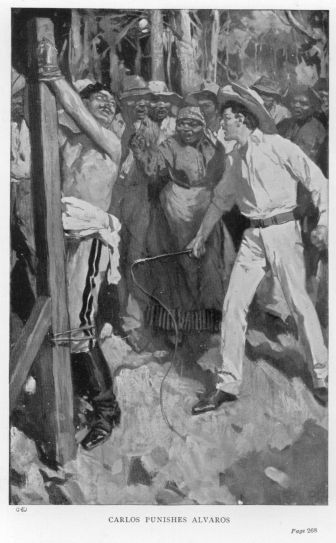
“This way, Señor,” exclaimed Pedro, roughly jerking the lariat in the direction of the steps, as a hint to the prisoner that he was to descend them; and in this ignominious fashion the once arrogant but now cowering and cringing Spaniard was led away under Jack’s supervision, while Carlos, selecting a heavy riding-whip from the rack, followed the procession. The prisoner was conducted to the negro quarters, which were situated about half a mile from the house, with a belt of timber between it and them; and there he was stripped to his trousers, and firmly lashed to a post which had been hastily erected for the purpose. Then, the whole of the negroes employed upon the plantation having been assembled, Carlos related to the blacks the several sufferings and indignities which Alvaros had caused to be inflicted upon the members of the Montijo family, and how to him was due the death of the Señorita, his sister, whom they had all loved so well: and when he had finished his story he flogged Alvaros until the miserable wretch screamed and howled for mercy, offering the most abject excuses and apologies for his conduct, and vowing by all the saints that if Carlos would but release him he would leave Cuba, never to return; that he would surrender the Montijo estates to their rightful owner; that he would never breathe to a single living soul a syllable as to what had passed; and that he would also do a number of other unlikely, not to say impossible, things. Then, when his arm was tired, and he could flog no longer, Carlos desisted, and ordered Alvaros to be cast loose from the stake and securely confined in an empty tobacco shed, with a negro on guard at the door of the building to see that he did not escape. When at length the shrinking, cringing creature was hustled into his prison and securely bound, Carlos turned to him and said:
“You have now received the second instalment of punishment for your atrocious crime. You will be kept here until it is convenient to remove you, being fed meanwhile upon bread and water. And when a convenient time arrives you will be placed on board a ship and marooned, which will be the final instalment of the punishment which your evil deeds have called down upon your head. The best thing I can wish you is that what you have suffered to-day, and will suffer in the future, will bring home to you the evil of your ways, and lead to your sincere repentance for them.” And therewith he passed from Señor Alvaros’ sight—to be seen by him no more.
That same night, when the white people had all retired to rest in the great casa, Mamá Faquita stole away down to the negro quarters and, going from hut to hut, roused their occupants and summoned them to a great palaver in the open space which the huts surrounded, and in which the children were wont to play. The scene was a weirdly picturesque one, for, prior to rousing the negroes, Mamá had kindled a great fire in the centre of the open space; and in front of this, in a great semicircle, the negroes congregated, squatting on their heels and rolling their eyeballs in the flickering light of the flames, while Mamá addressed them. They were all free, but had all been slaves not so very many years before: many of them were born Africans, with their savage instincts still practically as strong within them as they had ever been; while in the case of the rest, although their association with white men from their birth had rendered them more amenable in some respects than were the more recent importations, the tenacity with which they had adhered to their fetish-worship, with all its secret and horribly revolting customs, tended to keep them still utterly savage at heart, and only too ready to lend a willing ear to any suggestion which offered them an excuse to indulge their inherent lust for cruelty. Moreover, the African black who has been a slave is a singular combination of good and evil: on the one hand, he is capable of affection and devotion, to an extraordinary degree, toward those who have treated him well; while, on the other, he is equally capable of the most ferocious and implacable hatred of those who have injured him or those he loves; also, he is extraordinarily impressionable. Mamá Faquita, being herself a full-blooded negress, was of course perfectly well aware of these peculiarities in the nature of her audience; and she played upon them as a skilled musician does upon a sensitively responsive instrument. She dwelt eloquently and at length upon the invariable kindness with which they had one and all been treated by the amo and his family, and especially by the young Señorita, whom some of them at least were able to remember as a little, toddling baby, and whom they all had loved as passionately as though she had been their own; and as she spoke thus the tears of grief streamed down her cheeks, and she wrung her hands in anguish evoking a ready and sympathetic response from her hearers. Then she went on to recall to their memory the sad homecoming of two months ago, and the dreadful tale that they had been told when they asked why the Señorita had not also returned: and finally she reminded them—as though any reminder were by this time necessary—that the author of the family’s woe now lay, ay, at that very moment, imprisoned in the tobacco shed, within a stone’s-throw of the spot where they were then assembled. She spoke with qualified satisfaction of the punishment which the young master had inflicted upon the picaro in their presence a few hours ago; she admitted that, so far as it went, it was good: but she contended that it did not go nearly far enough, considering the monstrous character of the crime of which the prisoner had been guilty; and she asserted her conviction that white men did not know how to punish, that they were altogether too squeamish in their notions, particularly in the matter of dealing mercifully with those who had injured them; and that it was only the negro who thoroughly understood how to devise a punishment to properly fit the crime.
It was enough; there was no need for her to say another word. With consummate skill she had gradually wrought her audience up to a pitch of demoniac fury; she had pictured her—and their—beloved young mistress in the power of the wretch who crouched with smarting, lacerated back yonder in the shed—insulted, ill-treated, and finally driven to madness and death by him: and now, at a word from one of them, the whole body of negroes sprang to their feet and, with low, hissing, muttering execrations and threats, infinitely more terrifying to listen to than the loudest yells of ferocity, ran to the shed and, with a few low-murmured words of explanation to the guard, demanded the surrender of the prisoner. The demand was conceded with scarcely a word of protest, and five minutes later the miserable Alvaros, in a speechless frenzy of fear, was being hurried along a lonely bush path, known only to the negroes, to a spot some three miles distant. What happened to him when he arrived there must be left untold; suffice it to say that Major Alvaros was never more seen of men, and the mystery of his disappearance remains unsolved to this day, although Carlos Montijo and Jack Singleton are under the delusion that they know what became of him. Furthermore, the inhabitants of the hacienda were never troubled by inconvenient enquiries about him, for it afterwards transpired that when he set out upon his fateful journey he had not thought fit to say whither he was going, or how long he intended to be absent; by the time, therefore, that his prolonged absence from duty had provoked enquiry, all trace of him was completely lost.
The male occupants of the house were just finishing early breakfast next morning when Señor Calderon presented himself before them, in a condition of considerable mental discomposure, with the intelligence that the prisoner had apparently contrived to effect his escape; for one of the negroes had just come up to the house with the report that, upon his opening the door of the tobacco shed to give the captive his breakfast, Alvaros was found to have disappeared, and no trace of him had thus far been discovered. This was distinctly alarming news, for it was instantly recognised that if Alvaros had really contrived to get clear away, he would undoubtedly make the best of his way back to Havana and there report to the authorities the violence to which he had been subjected; and also, possibly, the rescue of the Montijos from the convict ship, though mention of the latter would probably depend upon whether their conviction had been the result of representations to the Capitan-General, or whether, as Don Ramon Bergera had surmised, it had been the work of Alvaros alone. In either case, the consequences were likely to be quite serious to the Montijos; and Carlos, accompanied by Jack and Calderon, at once hurried away to investigate the circumstances of the alleged escape.
Upon their arrival at the tobacco shed they found the door of the building still locked and the negro guard still posted before it, the door having been re-fastened, as Calderon explained, immediately upon the discovery of the prisoner’s disappearance. Entering the shed, they at once satisfied themselves as to the truth of the statement that its late occupant was no longer in it, for the building was absolutely empty, and, being a perfectly plain structure, with simply four stone walls, a cement floor, and an unceiled roof, there was no nook or cranny in which even a rat, much less a man, could conceal himself. Moreover, the rope by which he had been, as it was thought, securely bound before being left on the previous evening, was lying upon the floor, immediately beneath one of the large, shuttered openings in the walls which were used for the admission of light and air into the shed as required. The position of the rope naturally led to an examination of the opening beneath which it lay; and it was then found that the massive bolts securing the shutter had been drawn, and that therefore there was nothing to prevent the prisoner from escaping through the opening—provided that he could free himself from the rope and reach it. But how he had contrived to accomplish these two things was the mystery: for Carlos and Jack had both been present during the lashing-up of Alvaros, and they both felt that they would have been fully prepared to declare that for the prisoner to release himself would be a simple impossibility, so securely had he been bound; while the sill of the opening was quite nine feet from the floor, and for a man to reach it without the help of a ladder, or some similar aid, seemed equally impossible,—and there was no such aid in the building. It occurred to Jack that the prisoner, after freeing himself from his bonds, might have succeeded in throwing the loop of the rope over one of the shutter bolts, and so have drawn himself up; but to accomplish such a feat in absolute darkness again seemed an absolute impossibility. Altogether, the circumstances seemed to be enveloped in impenetrable mystery; there was only one indisputable fact, which was that the prisoner was gone. Then the negro guard was severely questioned, but he seemed quite unable to throw any light upon the matter; his statement was that he had exercised the utmost vigilance all through the night, that he had heard no sound of movement on the part of the prisoner, had noticed nothing to suggest an attempt at escape, and was utterly confounded when, upon unlocking the door to take in the prisoner’s breakfast, he found that the bird had flown. This was his story, and no amount of cross-examination caused him to deviate in the slightest degree from it; for when a negro lays himself out to deceive, the fact that he is lying through thick and thin causes him no qualms of conscience.
The investigation thus conclusively pointed to the fact that the prisoner had somehow contrived to escape; and, that having been established, the obviously proper thing to do was to endeavour to recapture him. Horses were therefore ordered to be saddled and taken up to the house; a Fantee negro, who had been re-named Juan, and who had the reputation of being a marvellously expert tracker, was ordered to examine the ground about the tobacco shed for tracks, and to hold himself ready to accompany the hunters; and Jack and Carlos then returned to the house to equip themselves. In something less than half an hour the party, consisting of Jack and Carlos, mounted, and each armed with a rifle, and half a dozen negroes, including Juan, set out.
The hunt began at the tobacco shed, beneath the unbolted shutter of which Juan declared that, despite the hardness of the ground, he had succeeded in detecting the footprints of the fugitive; and thence it took its course northward, strange to say, in the direction of the mountains, instead of toward Pinar del Rio, as the two young white men had naturally expected. This was so surprising that, as soon as the direction became apparent, Carlos called a halt and openly expressed his conviction that the Fantee was making a mistake; but Juan confidently declared that he was doing nothing of the sort, and, in support of his statement, pointed to certain barely perceptible marks here and there on the ground, which he asserted were the tracks of the fugitive—this assertion being corroborated by the other negroes. To the eyes of the white men the marks in question were so very slight and vague as to convey absolutely no meaning at all; indeed, they could not in some cases convince themselves that there really were any marks; but then the ground was so dry and hard that even their horses left scarcely a trace of their passage: they were therefore obliged to take Juan’s word for it that they were on the right track, and follow where he led.
They were of opinion that, considering Alvaros’ condition after the terrific punishment which Carlos had inflicted upon him only a few hours previously, and the circumstance that he seemed to have been travelling for several hours in darkness, over country that must have been absolutely strange to him, he could not have made very rapid progress, or gone very far; and after the first hour they were in momentary expectation of coming upon him: but mile after mile was traversed, and still Juan asserted that the fugitive was yet some distance ahead, and that they did not appear to be gaining on him very rapidly—due, as the negro pointed out, to the extreme difficulty of tracking over such hard and, for the most part stony, ground. The fact was that Juan and his fellow-negroes, having arranged among themselves a course of action during the short period while Carlos and Jack were preparing for the expedition, were enacting a very cleverly carried out piece of comedy, so cleverly performed, indeed, that neither of the young men had the slightest suspicion that they were being deceived.
At length the track, which had led them steadily over rising ground almost from the moment of starting, conducted the party to the entrance of a very wild, romantic, and picturesque-looking gorge which seemed to pierce right into the very heart of the mountains. For some time the going had been growing increasingly difficult, especially for the two horsemen; and now a single glance ahead sufficed to show that it must speedily become impossible for mounted men, for the side of the mountain grew increasingly steep, as one looked forward, until, about a quarter of a mile farther on, it seemed to be practically perpendicular, while the pine trees grew so thickly that in places it appeared as though there would be scarcely room for a man, much less a horse, to pass; moreover, the side of the hill was covered with big outcrops of rock, interspersed with loose boulders, to pass over and among which would require a clear head, a steady eye, and a sure foot. The two young men therefore determined to dismount forthwith and proceed on foot, leaving their horses in charge of one of the negroes.
And it was well that they did so, for the path almost immediately grew so steep and difficult that before they had advanced another hundred yards the party found it necessary to frequently drop on their hands and knees to pass some of the more awkward places without being precipitated into the stream which they heard brawling some hundreds of feet below them at the bottom of the ravine. And now, as they slowly and with difficulty made their way along the steep mountain-side, a low murmur, gradually growing in strength and volume of sound, told them that they were approaching a waterfall or cataract of some sort: and after another half-hour of exhausting and perilous crawling, and slipping, and sliding over the loose and shaley ground, they came in sight of it as it opened out before them from behind an enormous, precipitous crag—a solid column of water about twenty feet in diameter, leaping out of a narrow cleft in the rock some three hundred feet above them, and gradually resolving itself into mist as it plunged down into the dark and gloomy depths of the gorge below. To Carlos—and still more to Jack—it seemed impossible that the fugitive should have chosen to pursue the track which they were now following—for to where did it lead? The place was quite new to Carlos; he had never been there before, and it seemed unlikely in the extreme that a stranger to the neighbourhood as Alvaros was would know more about it than one who had dwelt only a few miles off during practically his whole life: yet Juan was now pressing on, a long way ahead, as though he were following on a hot scent, and presently he disappeared altogether in a thick cluster of fir trees high up the side of the hill. Ten minutes later he emerged on the other side of the clump and went scrambling toward the spot where the stream of water spouted out of the rock. Then Carlos saw him suddenly stop and look steadily down the almost vertical side of the mountain, then at the ground at his feet. It took the two lads nearly a quarter of an hour to reach the spot where Juan stood, now surrounded by the other four negroes, to whom he was talking animatedly; and, as they approached, the Fantee pointed to some scars on the hillside which looked as though they had been quite recently made by the passage of some heavy body.
“Look, Señores,” he cried; “that is where the Spaniard has gone! A loose boulder caught him just here and swept him down into the gorge below. We shall never see him again!”
Carlos and Jack looked. Yes; the marks were precisely such as a falling boulder would make, and they were apparently quite fresh, possibly less than half an hour old. But how did Juan know that Alvaros had gone down the hillside with the boulder? Jack asked the question.
“Because,” answered the black triumphantly, “he came as far as this—as we have seen by his footprints—but went no farther; there are no more footprints to be found. And see, the boulder struck the ground just here”—pointing to a big, raw dint in the soil—“and bounded off, striking again down there where you see that mark. It must have struck here just as the Spaniard reached the spot, and hurled him down to the bottom of the gorge before it. He is doubtless down there at the bottom of the stream, at this moment, pinned down by the boulder that killed him!” And the other negroes emphatically corroborated the statements and suggestions.
To Jack and Carlos the theory enunciated by Juan appeared quite possible. Of course they had to accept Juan’s word for it that the fugitive’s footsteps had been followed thus far, and had utterly disappeared at the precise spot where the boulder—or whatever it was—had struck. But, this much granted, the remainder of the story seemed quite plausible, seemed indeed the only possible explanation; and since it was quite impossible to test its truth or falsehood without descending to the river below—which was also an impossibility—they were disposed to accept it as true.
And thus, very materially assisted by the fortuitous fall of a boulder down a hillside, did the negroes on Señor Montijo’s estate successfully hoodwink their white masters, and effectually and for ever put a stop to any further enquiries as to what had become of Major Alvaros, of His Spanish Majesty’s light infantry, and erstwhile Governor of La Jacoba.
Chapter Sixteen.
The War-cloud overshadows the Hacienda Montijo.
For the first fortnight or three weeks following the evanishment of Señor Alvaros a considerable degree of uneasiness prevailed at the hacienda Montijo, the inmates of which daily looked for the appearance of some emissary of the Spanish Government, charged with the duty of investigating the circumstances connected with the disappearance of an important Spanish official: and it was recognised that not only would the enquiries of such an individual be difficult to reply to, but also that his presence would incidentally result in the discovery that the members of the Montijo family, instead of being at Fernando Po, were—with one exception—at home again. It was admitted to be a contingency that needed careful yet firm handling, and after much consideration a plan was evolved by Jack and Carlos which it was believed would deal effectively with the difficulty, and the necessary steps were taken. But as day after day passed without bringing upon them the complication which they apprehended, their uneasiness rapidly lessened, until at length a day arrived when the conviction forced itself upon them that the attention of the Spanish Government was so fully occupied with other and much more important matters that the disappearance of Señor Alvaros seemed likely to be permitted to pass without especial notice. And thereupon Jack undertook to pay a visit to Don Ramon Bergera in Havana, with the object of ascertaining, as far as possible, what was the attitude of the Spanish official mind upon the subject. He accordingly set out for Pinar del Rio one morning after early breakfast, and arrived in Havana the same afternoon, intending to return to the hacienda Montijo on the following day. But he remained in Havana a full fortnight, during which he and Don Ramon learned many things—among them, the facts that Señor Alvaros was solely responsible for the arrest and attempted transportation of the Montijos, and also for the seizure of the estate—neither of which acts had been reported to the Capitan-General, or been officially recorded: and that, doubtless because of these important reasons, when he had set out on his last journey to visit the estate which he had thus secretly seized, he had omitted to mention to anyone his intentions, his destination, or the probable duration of his absence, with the result that eventually, when the accumulated arrears of his work at length attracted attention and provoked enquiry, nobody could throw the least light upon his whereabouts. The conviction had therefore at length been arrived at that—the man being well-known as possessing a singularly arrogant, overbearing, and irascible disposition—he had perished in some obscure and, quite possibly, discreditable quarrel; and his post as Governor of La Jacoba Prison had been given to another man. These particulars had been gleaned by dint of very patient and careful enquiry on the part of Don Ramon, so judiciously conducted that not a particle of suspicion had anywhere been raised that any enquiry at all was being made: and with them Jack returned to the hacienda and restored tranquillity to the minds of its inhabitants, for it had now been made clear not only that they might dismiss all apprehension of embarrassing enquiry concerning the fate of Señor Alvaros, but also that nobody was likely to dispute Don Hermoso’s right to retain his own property.
But no sooner were their minds relieved upon this point than they were filled with apprehension on another, namely, poor Señora Montijo’s mental condition, which seemed to steadily grow worse. For the first few months of the unfortunate lady’s affliction she had been very quiet, giving no trouble at all, and appearing to suffer chiefly from complete loss of memory. But now, just at the moment when Jack and Carlos were completing their preparations to take the field with the rebel forces, a change for the worse occurred: her memory returned to her intermittently, bringing with it the recollection of her daughter’s fate, and then, by some peculiar mental process, nothing would console the unhappy mother but the presence and companionship of her son and Jack; and if the lads happened to be both absent when these paroxysms of revived memory occurred, the poor lady quickly became plunged into a condition of such abysmal despair and such maniacal violence that she was for the time being a menace to herself and everybody else. Nobody but Carlos or Jack seemed to have the power of soothing her, and sometimes the combined efforts of both were needed: thus it came about that many months passed, during which the two youths felt themselves constrained to remain within call, and to devote themselves to the task of alleviating the misery of the unhappy lady.
Meanwhile, the rebellion, which had arisen in the first instance in the province of Santiago, was for some time confined to the eastern end of the island. At the moment of its outbreak Spain had a garrison of some seventeen thousand men in Cuba, which was an amply sufficient force to have stamped out the rising, had the authorities dealt with it energetically. But they either could not, or would not, see, until it was too late, that serious trouble was impending; and when at length this fact was recognised, and the garrison raised to some thirty thousand men, the rebellion had made such headway that the rebels already had a force of four thousand men in the field, with Maximo Gomez as its Commander-in-chief, and Antonio Maceo as second in command. At this time, however, very few whites had actually taken up arms in the revolutionary cause, for Gomez was a native of San Domingo, while Maceo was a mulatto, and the whites in Cuba entertained the same objection to serving under coloured men that is to be found practically all the world over. But this was more than compensated for by the great accession of coloured recruits attracted to the insurgent ranks by the appearance of Maceo in a position of authority. At the same time secret committees were formed in every town in Cuba for the purpose of preaching the gospel of revolt, with the result that the whole province of Santiago and the greater part of Puerto Principe quickly became aflame.
General Martinez Campos, the Capitan-General of the island, at length began to realise the increasing gravity of the situation, and sent to his home government a report to the effect that, in consequence of the rapid spread of the rebellion, it would be absolutely necessary to occupy every province of the island in force, and to vigorously attack the insurgents wherever met with in the field; and that, to do this effectively, he must have still more troops. Accordingly, more troops were dispatched, with the result that by the end of the year 1895 the Spanish arms in Cuba totalled no less than one hundred thousand men, while the rebel strength had increased to ten thousand, who, however, were very badly in need of arms, ammunition, and stores. Consequently Milsom, in the Thetis, was kept busy at this time picking up supplies wherever he could get them, and then smuggling them into the island with a boldness and ingenuity that completely baffled all the efforts of the Spaniards to detect him.
The proportion of Spanish troops to the revolutionary forces was at this time, it will be observed, as ten to one. This, on paper, appears to be enormous, yet it was not so in reality: for, whereas the Cubans were all native to the soil and inured to the climate, and were, moreover, familiar with the topography of the country, the Spanish soldiers were mostly young, raw recruits, poor shots, quite new to service in the Tropics, unacclimatised, of poor stamina, and therefore peculiarly liable to fall victims to the fever and dysentery which follow upon exposure to tropical rain. Moreover, they were badly fed, and worse looked after; the great disparity between the strength of the two forces was consequently much more apparent than real. Then, too, the Spanish officers were mostly of very indifferent quality: they suffered from the same climatic disabilities as their men; the heat enervated them to such an extent that they could not be induced to take the least trouble about anything, or undertake the least labour; they made no attempt to improve the quality of their men’s shooting; they were lax in the enforcement of discipline—save, perhaps, in the exaction of a proper measure of respect from their subordinates; they were strangers to the island and quite ignorant of its topography, and they were too indolent to attempt to learn anything of it; and, lastly, the maps with which they had been supplied were even worse than useless, for they were absolutely misleading. Thus the insurgents experienced no difficulty in eluding the pursuit of the Spanish forces, and in luring them, time after time, into carefully prepared traps, from which escape was only possible at the cost of heavy loss.
The insurgents were careful that news of their oft-repeated successes against the Spanish troops should be published throughout the island, despite the desperate efforts of the authorities to suppress it; and, as a consequence, new recruits were constantly being added to their ranks. The insurrectionary movement grew apace; and at length a provisional Government was formed, with the Marquez de Cisneros at its head, as President of the Cuban Republic. The first act of the new Government was to divide up the entire island into different districts; and over each district was appointed a civilian as Prefect. It was of course only natural that the Prefecture of the Pinar del Rio district should be offered to Don Hermoso Montijo; but when he was made fully acquainted with the views of the provisional Government he declined it, for he considered that these views on certain points were so extreme as to render the Government unpopular, and to bring absolute ruin upon a very important section of the community, the planters to wit. One of the proposals of the new Government was to impose certain taxes for the purpose of raising funds wherewith to carry on the revolutionary movement, and to this there could of course be no reasonable objection; but when it was further proposed that non-payment of those taxes should be punished by the destruction of the buildings and crops and the seizure of the live stock of defaulters, Don Hermoso asserted that such action was altogether too drastic, and savoured too much of tyranny to meet with his approval, and he firmly declined to associate himself in any way with it, electing to continue instead to serve the movement, as heretofore, by lavish contributions of money, and the assistance of the yacht.
The next step of the insurgent leaders was also one of which Don Hermoso very strongly disapproved, and against which he passionately pleaded—in vain, with the result that a certain feeling of estrangement, not very far removed from enmity, arose between him and the leading spirits of the revolution. The latter, it appeared, had conceived the idea that so long as industry was permitted to flourish in the island, so long would Spain be able to find the necessary funds for the maintenance of a large army in Cuba; but that the moment industry ceased, the fountain of revenue must run dry, and the troops must be withdrawn. They therefore determined to march their forces right through the island to Havana, destroying everything before them; and this terrible resolution they carried into effect, with the result that their track became a long line of burnt cane fields and fire-blackened buildings, the owners of which, whether Spaniards or Cubans, foes or sympathisers, were of course absolutely ruined. The Capitan-General, with ten thousand men, vainly strove to check this terrible advance, but the insurgents easily eluded him and forced their way into the western provinces; with the result that the home Government superseded Campos, sending out in his stead General Don Valeriano y Nicolan Weyler, a man of wide military experience, and possessing a sinister and unenviable reputation for energy and relentless severity.