"Thirteen Hundred Miles in my Caravan" (continued 4)
Reading edition
At the village of Kirkliston, some miles from Corstorphine, with its intelligent policemen, I stopped for the night in a little meadow. It was a pleasant surprise to find in the clergyman here a man from my own University.
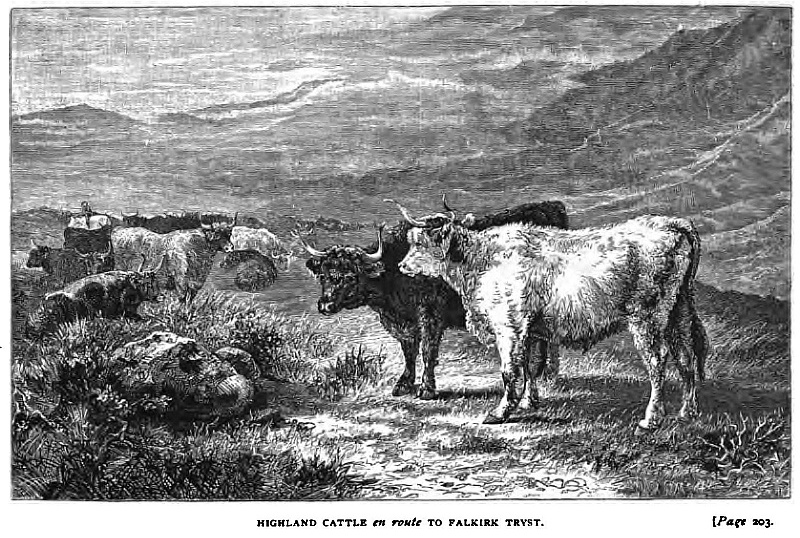
Kirkliston was all en gala next day; flags and bands, and games and shows, and the greatest of doings. But after an early morning ride to those wonderful works where the Forth is being bridged, we went on our way, after receiving gifts of fruit and peas from the kindly people about.
By the way, Kirkliston boasts of one of the biggest distilleries in Scotland.
But it quite knocks all the romance out of Highland whisky to be told it is made from American maize instead of from malt. Ugh!
Splendid road through a delightful country all the way to Linlithgow. Pretty peeps everywhere, and blue and beautiful the far-off Pentlands looked.
At Linlithgow even my coachman and valet were made to feel that they really were in Scotland now, among a race of people whose very religion causes them to be kindly to the stranger.
Through Polmont and on through a charming country to Falkirk, celebrated for its great cattle tryst.
July 29th.—At Linlithgow I visited every place of note—its palace and its palace prison, and its quaint and ancient church. Those gloomy prison vaults made my frame shiver, and filled my mind with awe. “Who enters here leaves hope behind” might well have been written on the lintels of those gruesome cells.
There are the remains of a curious old well in the palace courtyard. A facsimile of it, when at its best, is built in a square in the town. Standing near it to-day was a white-haired, most kindly visaged clergyman (The Rev. Dr Duncan Ogilvie), with whom I entered into conversation. I found he came originally from my own shire of Banff, and that he was now minister of a church in Falkirk.
He gave me much information, and it is greatly owing to his kindness that I am now, as I write, so comfortably situated at Falkirk.
A pleasant old stone-built town it is, with homely, hearty, hospitable people. Many a toil-worn denizen of cities might do worse than make it his home in the summer months. There is plenty to see in a quiet way, health in every breeze that blows, and a mine of historical wealth to be had for merely the digging. The town is celebrated for its great cattle fair, or tryst.
Away from Falkirk, after holding a levée as usual, during which a great many pleasant and pretty people stepped into the Wanderer.
The country altogether from Edinburgh to Glasgow is so delightful that I wonder so few tourists pass along the road.
As soon as we leave the last long straggling village near Falkirk, with its lovely villas surrounded by gardens and trees, and get into the open country, the scenery becomes very pretty and interesting, but on this bright hot day there is a hazy mist lying like a veil all over the landscape, which may or may not be smoke from the great foundries; but despite this, the hills and vales and fertile tree-clad plains are very beautiful to behold.
Stone fences (dykes) by the wayside now divide the honour of accompanying us on our journey with tall hedges snowed over with flowering brambles, or mingled with the pink and crimson of trailing roses. (A dyke in Scotland means a stone or turf fence.)
What beauty, it might be asked, could a lover of nature descry in an old stone fence? Well, look at these dykes we are passing. The mortar between the stones is very old, and in every interstice cling in bunches the bee-haunted bluebells. The top is covered with green turf, and here grow patches of the yellow-flowering fairy-bedstraw and purple “nodding thistles,” while every here and there is quite a sheet of the hardy mauve-petalled rest-harrow.
Four miles from Falkirk we enter the picturesque and widely scattered village of Bonny Bridge. This little hamlet, which is, or ought to be, a health resort, goes sweeping down a lovely glen, and across the bridge it goes straggling up the hill; the views—go where you like—being enchanting. Then the villas are scattered about everywhere, in the fields and in the woods. No gimcrack work about these villas, they are built of solid ornamentally-chiselled stone, built to weather the storms of centuries.
By-and-bye we rattle up into the village of Dennyloanhead. Very long it is, very old and quaint, and situated on a hill overlooking a wide and fertile valley. The houses are low and squat, very different from anything one ever sees in England.
Through the valley yonder the canal goes wimpling about, and in and out, on its lazy way to Glasgow, and cool, sweet, and clear the water looks. The farther end of the valley itself is spanned by a lofty eight-arched bridge, over which the trains go noisily rolling. There is probably not a more romantic valley than this in all the diversified and beautiful route from Edinburgh to Glasgow. Tourists should take this hint, and health-seekers too.
Passing through this valley over the canal, under the arches and over a stream, the road winds up a steep hill, and before very long we reach the hamlet of Cumbernauld.
An unpretentious little place it is, on a rocky hilltop and close to a charming glen, but all round here the country is richly historical.
We stable the horses at the comfortable Spurr Hotel and bivouac by the roadside. A little tent is made under the hedge, and here the Rippingille cooking-range is placed and cooking proceeded with.
Merry laughing children flock round, and kindly-eyed matrons knitting, and Hurricane Bob lies down to watch lest any one shall open the oven door and run away with the frizzling duck. Meanwhile the sun shines brightly from a blue, blue sky, the woods and hedges and wild flowers do one good to behold, and, stretched on the green sward with a pleasant book and white sun umbrella, I read and doze and dream till Foley says,—
“Dinner’s all on the table, sir.”
No want of variety in our wanderings to-day. Change of scenery at every turn, and change of faces also.
On our way from Cumbernauld we meet dozens and scores of caravans of all descriptions, for in two days’ time there is to be a great fair at Falkirk, and these good people are on their way thither.
“Thank goodness,” I say to my coachman, “they are not coming in our direction.”
“You’re right, sir,” says John.
For, reader, however pleasant it may be to wave a friendly hand to, or exchange a kindly word or smile with, these “honest” gipsies, it is not so nice to form part in a Romany Rye procession.
Here they come, and there they go, all sorts and shapes and sizes, from the little barrel-shaped canvas-covered Scotch affair, to the square yellow-painted lordly English van. Caravans filled with real darkies, basket caravans, shooting-gallery caravans, music caravans, merry-go-round caravans, short caravans, long caravans, tall caravans, some decorated with paint and gold, some as dingy as smoke itself, and some mere carts covered with greasy sacking filled with bairns; a chaotic minglement of naked arms and legs, and dirty grimy faces; but all happy, all smiling, and all perspiring.
Some of these caravans have doors in the sides, some doors at front and back; but invariably there are either merry saucy children or half-dressed females leaning out and enjoying the fresh air, and—I hope—the scenery.
The heat to-day is very great. We are all limp and weary except Polly, the parrot, who is in her glory, dancing, singing, and shrieking like a maniac.
But matters mend towards evening, and when we pause to rest the horses, I dismount and am penning these lines by the side of a hedge. A rippling stream goes murmuring past at no great distance. I could laze and dream here for hours, but prudence urges me on, for we are now, virtually speaking, in an unknown country; our road-book ended at Edinburgh, so we know not what is before us.
“On the whole, John,” I say, as I reseat myself among the rugs, “how do you like to be a gipsy?”
“I’m as happy, sir,” replies my gentle Jehu, “as a black man in a barrel of treacle.”
Chapter Twenty One.
Glasgow and Grief—A Pleasant Meadow—Thunderstorm at Chryston—Strange Effects—That Terrible Twelfth of August—En Route for Perth and the Grampians.
“O rain! you will but take your flight, Though you should come again to-morrow, And bring with you both pain and sorrow; Though stomach should ache and knees should swell, I’ll nothing speak of you but well; But only now, for this one day, Do go, dear rain! do go away.” Coleridge.
In Scotland there are far fewer cosy wee inns with stabling attached to them than there are in England; there is therefore greater difficulty in finding a comfortable place in which to bivouac of a night. In towns there are, of course, hotels in abundance; but if we elected to make use of these, then farewell peace and quiet, and farewell all the romance and charm of a gipsy life.
It was disheartening on arriving at the village of Muirhead to find only a little lassie in charge of the one inn of the place, and to be told there was no stabling to be had. And this village was our last hope ’twixt here and Glasgow. But luckily—there always has been a sweet little cherub sitting up aloft somewhere who turned the tide in times of trouble—luckily a cyclist arrived at the hostelry door. He was naturally polite to me, a brother cyclist.
“Let us ride over to Chryston,” he said; “I believe I can get you a place there.”
A spin on the tricycle always freshens me up after a long day’s drive, and, though I was sorry to leave the poor horses a whole hour on the road, I mounted, and off we tooled. Arrived at the farm where I now lie, we found that Mr B— was not at home, he had gone miles away with the cart. But nothing is impossible to the cyclist, and in twenty minutes we had overtaken him, and obtained leave to stable at the farm and draw into his field.
A quiet and delightful meadow it is, quite at the back of the little village of Chryston, and on the brow of a hill overlooking a great range of valley with mountains beyond.
The sky to-night is glorious to behold. In the east a full round moon is struggling through a sea of cumulus clouds. Over yonder the glare of a great furnace lights up a quarter of the sky, the flashing gleams on the clouds reminding one of tropical wild-fire. But the sky is all clear overhead, and in the northern horizon over the mountains is the Aurora Borealis. Strange that after so hot a day we should see those northern lights.
But here comes Hurricane Bob.
Bob says, as plainly as you please, “Come, master, and give me my dinner.”
Whether it be on account of the intense heat, or that Hurricane Bob is, like a good Mohammedan, keeping the feast of the Ramadan, I know not, but one thing is certain—he eats nothing ’twixt sunrise and sunset.
Glasgow: Glasgow and grief. I now feel the full force of the cruelty that kept my letters back. My cousins, Dr McLennan and his wife, came by train to Chryston this Saturday forenoon, and together we all rode (seven miles) into Glasgow in the Wanderer. We were very, very happy, but on our arrival at my cousins’ house—which I might well call home—behold! the copy of a telegram containing news I ought to have had a week before!
My father was dying!
Then I said he must now be gone. How dreadful the thought, and I not to know. He waiting and watching for me, and I never to come!
Next morning I hurried off to Aberdeen. The train goes no farther on Sunday, but I was in time to catch the mail gig that starts from near the very door of my father’s house, and returns in the evening.
The mail man knew me well, but during all that weary sixteen-mile drive I never had courage to ask him how the old man my father was. I dreaded the reply.
Arrived at my destination, I sprang from the car and rushed to the house, to find my dear father—better. And some days afterwards—thank God for all His mercies—I bade him good-bye as he sat by the fire.
No quieter meadow was ever I in than that at Chryston, so I determined to spend a whole week here and write up the arrears of my literary work, which had drifted sadly to leeward. Except the clergyman of the place, and a few of the neighbouring gentry, hardly any one ever came near the Wanderer.
If an author could not work in a place like this, inspired by lovely scenery and sunny weather, inhaling health at every breath, I should pity and despise him.
I never tired of the view from the Wanderer’s windows, that wondrous valley, with its fertile farms and its smiling villas, and the great Campsie range of hills beyond. Sometimes those hills were covered with a blue haze, which made them seem very far away; but on other days, days of warmth and sunshine, they stood out clear and close to us; we could see the green on their sides and the brown heath above it, and to the left the top of distant Ben Ledi was often visible.
Thunderstorm at Chryston.
It had been a sultry, cloudy day, but the banks of cumulus looked very unsettled, rolling and tossing about for no apparent reason, for the wind was almost nil.
Early in the afternoon we, from our elevated position, could see the storm brewing—gathering and thickening and darkening all over Glasgow, and to both the north and south-west of us, where the sky presented a marvellous sight.
The thunder had been muttering for hours before, but towards four pm the black clouds gathered thick and fast, and trooped speedily along over the Campsie Hills. When right opposite to us, all of a sudden the squall came down. The trees bent before its fury, the caravan rocked wildly, and we had barely time to place a pole under the lee-side before the tempest burst upon us in all its fury.
Everything around us now was all a smother of mist. It reminded me of a white squall in the Indian Ocean. The rain came down in torrents, mingled with hail. It rattled loudly on the roof and hard and harsh against the panes, but not so loud as the pealing thunder.
The lightning was bright, vivid, incessant. The mirrors, the crystal lamps, the coloured glasses seemed to scatter the flashes in all directions; the whole inside of the Wanderer was like a transformation scene at a pantomime.
It was beautiful but dangerous.
I opened the door to look out, and noticed the row of ash-trees near by, sturdy though they were, bending like fishing-rods before the strength of the blast, while the field was covered with twiglets and small branches.
But the squall soon blew over, and the clouds rolled by, the thunder ceased or went growling away beyond the hills, and presently the sun shone out and began to dry the fields.
By the twelfth day of August—sacred to the Scottish sportsman—I had made up my literary leeway and got well to windward of editors and printers. I was once more happy.
That Terrible Twelfth of August.
We were to start on the twelfth of August for the north, en route for the distant capital of the Scottish Highlands—Inverness.
What is more, we were going to make a day of it, for my brave little Highland cousin Bella (Mrs McLennan) and her not less spirited friend Mrs C were to go a-gipsying and journey with me from Chryston to Stirling.
It was all nicely arranged days beforehand. We promised ourselves sunshine and music and general joy, with much conversation about the dear old days of long ago. And we were to have a dinner al fresco on the green sward after the manner of your true Romany Rye.
Alas for our hopes of happiness! The rain began at early morn. And such rain! I never wish to see the like again. The sky reminded me of some of Doré’s pictures of the Flood.
During one vivid blink of sunshine the downpour of rain looked like glass rods, so thick and strong was it.
In less than two hours the beautiful meadow that erst was so hard and firm was a veritable Slough of Despond. This was misfortune Number 1. Misfortune Number 2 lay in the fact that the busman did not meet the train the ladies were coming by, so for two long Scotch miles they had to paddle on as best they could through pelting rain and blackest mud.
Nor had the ladies come empty-handed, for between them they carried a large parrot-cage, a parcel, and a pie. (Polly had been spending a week in Glasgow, and was now returning.)
It was a pie of huge dimensions, of varied contents, and of curious workmanship—nay, but curious workwomanship—for had not my cousin designed it, and built it, and furnished it with her own fair fingers? It was a genuine, palpable, edible proof of feminine forethought.
Not, however, all the rain that ever fell, or all the wind that ever blew, could damp the courage of my cousin. Against all odds they came up smiling, the Highland lass and her English friend—the thistle and the rose.
But the rain got worse: it came down in bucketfuls, in torrents, in whole water. It was a spate.
Then came misfortune Number 3, for the wheels of the Wanderer began to sink deep in the miry meadow. We must draw on to the road forthwith, so Corn-flower and Pea-blossom were got out and put-to.
But woe is me! they could not start or move her. They plunged and pawed, and pawed and plunged in vain—the Wanderer refused to budge.
“I’ve a horse,” said Mr R—, quietly, “that I think could move a church, sir.”
“Happy thought!” I said; “let us put him on as a tracer.”
The horse was brought out. I have seldom seen a bigger. He loomed in the rain like a mountain, and appeared to be about nineteen hands high, more or less.
The traces were attached to buckles in our long breeching. Then we attempted to start.
It might now have been all right had the trio pulled together, but this was no part of Pea-blossom’s or Corn-flower’s intention.
They seemed to address that tall horse thus: “Now, old hoss, we’ve had a good try and failed, see what you can do.”
So instead of pulling they hung back.
I am bound to say, however, that the tall horse did his very best. First he gave one wild pull, then a second, then a third and a wilder one, and at that moment everything gave way, and the horse coolly walked off with the trace chains.
It was very provoking, all hopes of enjoyment fled. Hardly could the strawberries and cream that Mrs R brought console us. Here we were stuck in a meadow on the glorious twelfth, of all days, in a slough of despair, in a deluge of rain, and with our harness smashed.
No use lamenting, however. I sent my servant off to Glasgow to get repairs done at once, and obtain hydraulic assistance for the semi-wrecked Wanderer.
About noon there came round a kindly farmer Jackson.
“Men can do it,” he said, after eyeing us for a bit. “There’s nothing like men.”
I had sent the ladies into the farmhouse for warmth, and was in the saloon by myself, when suddenly the caravan gave herself a shake and began to move forward.
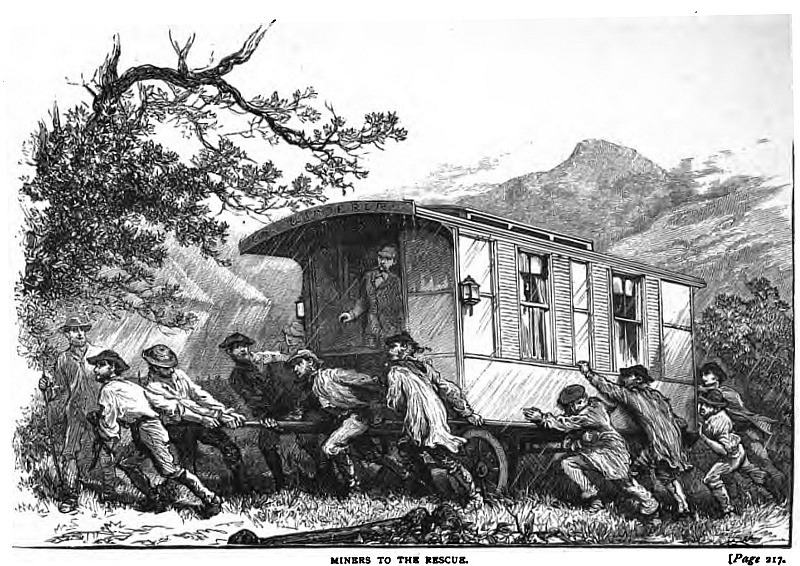
In some surprise I opened the door and looked out. Why, surely all the manhood of Chryston was around us, clustering round the wheels, lining the sides, pushing behind and pulling the pole. With a hip! ho! and away we go!
“Hurrah, lads, hurrah!”
“Bravo, boys, bravo!”
In less time than it takes me to tell it, the great caravan was hoisted through that meadow and run high and dry into the farmer’s courtyard.
To offer these men money would have been to insult them—they were Scotch. Nor can a kindness like this be measured by coin. I offered them liquid refreshment, however, but out of all who helped me I do not think that half-a-dozen partook.
All honour to the manly feelings of the good folks of Chryston.
But our day’s enjoyment was marred and we were left lamenting.
August 13th. We are off.
We are gone, over bank, bush, and scaur. And happy we feel, on this bright, bracing morning, to be once more on the road again with our backs to old England, our faces to the north.
Click, click—click, click! Why, there positively does seem music in the very horses’ feet. They seem happy as well as ourselves. Happy and fresh for, says my gentle Jehu, “They are pulling, sir, fit to drag the very arms out of ye.”
“Never mind, John,” I reply, “the Highland hills are ahead of us, and the heather hills, my Jehu. Knowest thou this song, John?”
“‘O! glorious is the sea, wi’ its heaving tide, And bonnie are the plains in their simmer pride; But the sea wi’ its tide, and the plains wi’ their rills, Are no half so dear as my ain heather hills. I may heedless look on the silvery sea, I may tentless muse on the flowery lee, But my heart wi’ a nameless rapture thrills When I gaze on the cliffs o’ my ain heather hills. Then hurrah, hurrah, for the heather hills, Where the bonnie thistle waves to the sweet bluebells, And the wild mountain floods heave their crests to the clouds, Then foam down the steeps o’ my ain heather hills.’”
No wonder the rattling chorus brought half-dressed innocent cottage children to their doors to wave naked arms and shout as we passed, or that their mothers smiled to us, and fathers doffed their bonnets, and wished us “good speed.”
But summer has gone from nature if not from our hearts. All in a week the change has come, and many-tinted autumn was ushered in with wild and stormy winds, with rain and floods and rattling thunder.
Not as a lamb has autumn entered, but as a lion roaring; as a king or a hero in a pantomime, with blue and red fire and grand effects of all kinds.
There is a strong breeze blowing, but it is an invigorating one, and now, at eight o’clock on this morning, the sun is shining brightly enough, whatever it may do later on.
What a grand day for the moors! It will quite make up for the loss of yesterday, when doubtless there were more drams than dead grouse about.
In Glasgow, days ago, I noticed that the poulterers’ windows were decorated with blooming heather in anticipation of the twelfth.
I saw yesterday afternoon some “lads in kilts”—Saxons, by the shape of their legs. But I do not hold with Professor Blackie, that if you see a gentleman in Highland garb “he must either be an Englishman or a fool.”
For I know that our merriest of professors, best of Greek scholars, and most enthusiastic of Scotchmen, would himself wear the kilt if there was the slightest possibility of keeping his stockings up!
Chapter Twenty Two.
On the High Road to the Highlands.
”... Here the bleak mount, The bare bleak mountain speckled thin with sheep; Grey clouds, that shadowing spot the sunny fields; And river, now with bushy rocks o’erbrowed, Now winding bright and full, with naked banks; And seats and lawns, the abbey and the wood; And cots and hamlets, and faint city spire.” Coleridge.
At Cumbernauld, the people were pleased to see us once more, and quite a large crowd surrounded the Wanderer. On leaving the village we were boarded by a young clergyman and his wife, such pleasant enthusiastic sort of people that it does one good to look at and converse with.
Passed strings of caravans at Dennyloanhead, and exchanged smiles and good-morrows with them. Then on to the Stirling road, through an altogether charming country.
Through Windsor Newton, and the romantic village of Saint Ninian’s, near which is Bannockburn.
Then away and away to Stirling, and through it, intending to bivouac for the night at Bridge of Allan, but, Scot that I am, I could not pass that monument on Abbey Craig, to Scotland’s great deliverer; so here I lie on the grounds of a railway company, under the very shadow of this lovely wooded craig, and on the site of a memorable battle.
How beautiful the evening is! The sun, as the song says, “has gone down o’er the lofty Ben Lomond,” but it has left no “red clouds to preside o’er the scene.”
A purple haze is over all yonder range of lofty mountains, great banks of cloud are rising behind them. Up in the blue, a pale scimitar of a moon is shining, and peace, peace, peace, is over all the wild scene.
By-the-bye, at Saint Ninian’s to-day, we stabled at the “Scots wha hae,” and my horses had to walk through the house, in at the hall door and out at the back. (Travellers will do well to ask prices here before accepting accommodation.) But nothing now would surprise or startle those animals. I often wonder what they think of it all.
We were early on the road this morning of August 14th, feeling, and probably looking, as fresh as daisies. Too early to meet anything or anyone except farmers’ carts, with horses only half awake, and men nodding among the straw.
Bridge of Allan is a sweet wee town, by the banks of the river, embosomed in trees, quite a model modern watering-place.
We travel on through splendid avenues of trees, that meet overhead, making the road a leafy tunnel, but the morning sun is shimmering through the green canopy, and his beams falling upon our path make it a study in black and white.
The road is a rolling one, reminding us forcibly of Northumbrian banks and Durham braes.
The trains here seem strangely erratic, we meet them at every corner. They come popping out from and go popping into the most unlikely places, out from a wood, out of the face of a rock, or up out of the earth in a bare green meadow, disappearing almost instantly with an eldritch shriek into some other hole or glen or wood.
Through the city of Dunblane, with its Ruined cathedral, by narrow roads across country fifteen miles, till we reach Blackford, and as there are to be games here to-morrow, we get run into a fine open meadow behind Edmund’s Hotel, and bivouac for the night.
Both my coachman and my valet were Englishmen, and it would be something new for them, at all events.
The meadow into which I drove was very quiet and retired. The games were to be held in an adjoining rolling field, and from the roof of the Wanderer a very good view could be had of all the goings-on.
On looking at my notes, written on the evening before the Highland gathering, I find that it was my doggie friend Hurricane Bob who first suggested my stopping for the games.
“Did ever you see such a glorious meadow in your life?” he seemed to say, as he threw himself on his broad back and began tumbling on the sward. “Did you ever see greener grass,” he continued, “or more lovely white clover? You must stay here, master.”
“Well, I think I will stay, Bob,” I replied.
“What say you, Pea-blossom?” I continued, addressing my saucy bay mare.
“Stay?” replied Pea-blossom, tossing her head. “Certainly stay. You stopped a whole week at Chryston, and I thought I was going to be a lady for life.”
“And what say you, Corn-flower?” I continued, addressing my horse, who, by the way, is not quite so refined in his ideas as Pea-blossom.
“Which I’d stop anyw’eres,” said Corn-flower, taking an immense mouthful of clover, “where there be such feeding as this.”
Well, when both one’s horses, besides his Newfoundland dog and his servants, want to stay at a place for the night, compliance in the master becomes a kind of a virtue.
The Evening before the Games.
“Now rose Sweet evening, solemn hour; the sun, declined, Hung golden o’er this nether firmament, Whose broad cerulean mirror, calmly bright, Gave back his beamy image to the sky With splendour undiminished.” Mallet.
The village is all a-quiver to-night with the excitement of expectancy, and many an anxious eye is turned skywards.
“If the breeze holds from this direction,” says the landlord of the hotel, “it will be fine for certain.”
Poor fellow! little could he dream while he spoke of the dreadful accident that would befall him but a few hours after he thus talked so hopefully.
At sunset to-night a balloon-like cloud settles down on the peak of distant Ben Voirloch, and as this soon becomes tinged with red, the lofty hill has all the appearance of a burning mountain. But all the northwestern sky is now such a sight to see that only the genius of a Burns could describe it in words, while no brush of painter could do justice to it, now that the immortal Turner is no longer on earth.
There are leaden-grey clouds banked along near the horizon; behind these and afar off are cloud-streaks of gold, which—now that the sun is down—change slowly to crimson, then to grey and to bronze.
An hour after sunset these cloud-streaks are of a strange pale yellow colour, only one shade deeper than the sky-tint itself. Even while I am still gazing on it this last turns to a pale sea-green of indescribable beauty, and high up yonder rides a half-moon.
Deeper and deeper grows the yellow of the cloud-streaks till they assume a fiery orange colour; above this is the green of the empty sky, while higher still, betwixt this and the blue vault of heaven, in which the moon is sailing, is a misty blush of crimson.
But now all the distant mountain-tops get enveloped in clouds of leaden-grey, the night-air becomes chill; I close my notes and retire to my caravan, and soon I hope to be sleeping as soundly as my honest dog yonder.
Travelling about, as I constantly do, in all sorts of queer places and among all kinds of scenes, both in towns and in the country, it may not seem surprising that I am often the right man in the right place when an accident occurs. I am certain I have saved many lives by being on the spot when a medical man was wanted instantly.
I did retire to my caravan; but, instead of going to bed, all inviting though it looked, I began to read, and after an hour spent thus the beauty of the night lured me out again. “Happy thought!” I said to myself; “it must be nearly eleven o’clock; I shall go and see what sort of people are emptied out of the inns.”
But at the very moment I stood near the door of the hotel already mentioned, the innkeeper had been hurled from the topmost banisters of the stairs by a drunken farmer who had fallen from above on him.
The shrieks of women folks brought me to the spot.
“Oh! he is killed, he is killed!” they were screaming.
And there he lay on his back on the cold stones with which his head had come into fearful contact. On his back he was, still as death, to all appearance dead. With half-open eyes and dilated pupils, and pulseless. His injuries to the skull were terrible. Two medical men besides myself despaired of his life. But above him, a few steps up the stairs, and lying across them half asleep and unhurt, lay the doer of the deed. Oh! what a sermon against the insinuating horribleness of intoxicating drink did the whole scene present!
The Morning of the Games.
It is going to be a beautiful day, that is evident. White fleecy clouds are constantly driving over the sun on the wings of a south-east wind.
Bands of music have been coming from every direction all the morning. They bring volunteers, and they bring their clansmen and the heroes who will soon take part in the coming struggle.
Now Highland gatherings and games, such as I am describing, are very ancient institutions indeed in Scotland I have no reference book near me from which to discover how old they are. But in “the ’45” last century, as most of my readers are probably aware, a great gathering of the clans took place among the Highland hills, presumably to celebrate games, but in reality to draw the claymore of revolt and to fight for Royal Charlie. They will know also how sadly this rebellion ended on the blood-red field of Culloden Moor.
During the summer and autumn seasons nearly every country district in the north has its great Highland gathering; but the two chief ones are Braemar and Inverness. The latter is called the northern meeting, and has a park retained all the year round for it. At Braemar, the Queen and Royal family hardly ever fail to put in an appearance.
The clans, arrayed in all the pomp and panoply of their war-dress, in “the garb of old Gaul,” each wearing its own tartan, each headed by its own chieftain, come from almost every part of the north-eastern Highlands to Braemar with banners floating and bagpipes playing, a spirit-stirring sight to see.
The ground on which the games take place is entirely encircled by a rope fence, and near are the white tents of the officers in charge, the various refreshment-rooms, and the grand stand itself. The whole scene is enlivening in the extreme; the dense crowd of well-dressed people around the ropes, the stand filled tier on tier with royalty, youth, and beauty, the white canvas, the gaily-fluttering flags, the mixture of tartans, the picturesque dresses, the green grass, the cloud-like trees, and last, but not least, the wild and rugged mountains themselves—the effect of the whole is charming, and would need the pen of a Walter Scott to do justice to it.
But to return to the games about to begin before me. Crowds are already beginning to assemble and surround the ropes, and independent of the grand stand, there are on this ground several round green hills, which give lounging-room to hundreds, who thus, reclining at their ease, can view the sports going on beneath them.
I am lying at full length on the top of my caravan, a most delightful position, from which I can see everything. Far down the field a brass band is discoursing a fantasia on old Scottish airs. But the effect is somewhat marred, for this reason—on the grass behind the grand stand, with truly Scottish independence of feeling, half-a-dozen pipers are strutting about in full Highland dress, and with gay ribbons fluttering from their chanters, while their independence is more especially displayed in the fact that every piper is playing the tune that pleases himself best, so that upon the whole it must be confessed that at present the music is of a somewhat mixed character.
From the top of my caravan I call to my gentle Jehu John, alias my coachman, who comes from the shire of bonnie Berks.
“John,” I shout, “isn’t that heavenly music? Don’t you like it, John? Doesn’t it stir your blood?”
Now John would not offend my national feelings for all the world; so he replies,—
“It stirs the blood right enough, sir, but I can’t say as ’ow I likes it quite, sir. Dessay it’s an acquired taste, like olives is. Puts me in mind of a swarm o’ bees that’s got settled on a telegraph pole.”
But the games are now beginning. Brawny Scots, tall, wiry Highlanders, are already trying the weights of the great caber, the stones, and the hammers. So I get down off my caravan, and, making my way to the field, seat myself on a green knoll from which I can see and enjoy everything.
Throwing the Heavy Hammer.—This is nearly always the first game. The competitors, stripped to the waist, toe the line one after the other, and try their strength and skill, the judges after each throw being ready with the tape. Though an ordinary heavy hammer will suit any one for amateur practice, the real thing is a large ball fastened to the end of a long handle of hard, tough wood.
It is balanced aloft and swung about several times before it quits the hands of Hercules, and comet-like flies through the air with all the velocity and force that can be communicated to it.
Donald Dinnie, though he wants but two years of being fifty, is still the champion athlete and wrestler of the world. There is a good story told of Donald when exhibiting his prowess for the first time in America. The crowd it seems gave him a too limited ring. They did not know Donald then.
“Gang back a wee bit!” cried Donald.
The ring was widened.
“Gang back a wee yet?” he roared.
The crowd spread out. But when a third time Donald cried “Gang back!” they laughed in derision.
Then Donald’s Scotch blood got up. He swung the great hammer—it left his hands, and flew right over the heads of the onlookers, alighting in the field beyond.
No one in San Francisco would compete with Donald, so he got the records of other athletes, and at a public exhibition beat them all.
Throwing the light hammer is another game of the same kind.
Putting the Stone.—The stone, as an Irishman would say, is a heavy round iron ball. You plant the left foot firmly in advance of the right, then balancing the great stone or ball on the palm of the right hand on a level with the head for a few moments, you send it flying from you as far as possible. There is not only great strength required, but a good deal of “can,” or skill, which practice alone can give.
Tossing the Caber.—The caber is a small tree, perhaps a larch with the branches all off. You plant your foot against the thin end of it, while a man raises it right up—heavy end uppermost—and supports it in the air until you have bent down and raised it on your palms. The immense weight of it makes you stagger about to keep your balance, and you must toss it so that when the heavy end touches the ground, it shall fall right over and lie in a line towards you. This game requires great skill and strength, and it is seldom indeed that more than one man succeeds in tossing the caber fair and square.
There are heavy and light hammers, there are heavy and light putting-stones, but there is but one caber (at principal games), and at this game the mighty Donald Dinnie has no rival.
The jumping and vaulting approach more to the English style of games, and need not be here described; and the same may be said about the racing, with probably one exception—the sack race. The competitors have to don the sacks, which are then tied firmly round the neck, then at the given signal away they go, hopping, jumping, or running with little short steps. It is very amusing, owing to the many tumbles the runners get, and the nimble way they sometimes recover the equilibrium, though very often no sooner are they up than they are down again.
There usually follows this a mad kind of steeplechase three times round the course, which is everywhere impeded with obstructions, the favourite ones being soda-barrels with both ends knocked out. Through these the competitors have to crawl, if they be not long-legged and agile enough to vault right over them.
The dancing and the bagpipe-playing attract great attention, and with these the games usually conclude. At our sports to-day both are first-class.
The dancing commences with a sailor’s hornpipe in character, and right merrily several of the competitors foot it on the floor of wood that has been laid down on the grass for the purpose. Next comes the Highland fling, danced in Highland dress, to the wild “skirl” of the great Highland bagpipe. Then the reel of Tulloch to the same kind of music.
Here there are of course four Highlanders engaged at one time.
I hope, for the sake of dear auld Scotland, none of my readers will judge the music of the Highland bagpipes from the performances of the wretched specimens of ragged humanity sometimes seen in our streets. But on a lovely day like this, amidst scenery so sublime, it is really a pleasure to lie on the grass and listen to the stirring war march, the hearty strathspey or reel, the winning pibroch, or the sad wail of a lament for the dead.
Few who travel by train past the village or town of Auchterarder have the faintest notion what the place is like. “It is set on a hill,” that is all a train traveller can say, and it looks romantic enough.
But the country all round here, as seen by road, is more than romantic, it is wildly beautiful.
Here are some notes I took in my caravan just before coming to this town. My reason for giving them now will presently be seen.
“Just before coming to Auchterarder we cross over a hill, from which the view is singularly strange and lovely. Down beneath us is a wide strath or glen, rising on the other side with gentle slope far upwards to the horizon, with a bluff, bare, craggy mountain in the distance. But it is the arrangement and shape of the innumerable dark spruce and pinewoods that strike the beholder as more than curious. They look like regiments and armies in battle array—massed in corps d’armée down in the hollow, and arranged in battalions higher up; while along the ridge of yonder high hill they look like soldiers on march; on a rock they appear like a battery in position, and here, there, and everywhere between, e’en long lines of skirmishers, taking advantage of every shelter.”
It was not until Monday morning that I found out from the kindly Aberuthven farmer, in whose yard I had bivouacked over the Sunday, that I had really been describing in my notes a plan of the great battle of Waterloo. The woods have positively been planted to represent the armies in action.
Had not this farmer, whom we met at the village, invited us to his place, our bivouac over the Sunday would have been on the roadside, for at Aberuthven there was no accommodation for either horses or caravan.
But the hospitality and kindnesses I meet with everywhere are universal.
The morning of the 17th of August was grey and cloudy, but far from cold. Bidding kindly Farmer M— and his family good-bye, we went trotting off, and in a short time had crossed the beautiful Earn, and then began one of the longest and stiffest ascents we had ever experienced.
A stiff pull for miles with perspiring horses; but once up on the braeland above this wild and wonderful valley the view was indescribably fine. The vale is bounded by hills on every side, with the lofty Ben Voirloch far in the rear.
The Earn, broad, clear, and deep, goes winding through the level and fertile bottom of the valley, through fields where red and white cattle are grazing, through fields of dark-green turnips, and fields yellow with ripening barley. And yonder, as I live, is a railway train, but so far away, and so far beneath us, that it looks like a mere mechanical toy.
High up here summer still lingers. We are among hedgerows once more and wild roses; the banks beneath this are a sight. We have thistles of every shade of crimson, and the sward is covered with beds of bluebells and great patches of golden bird’s-foot trefoil; and look yonder is an old friend, the purple-blue geranium once more.
From the fifth milestone, the view that suddenly bursts upon our sight could hardly be surpassed for beauty in all broad Scotland. A mighty plain lies stretched out beneath us, bounded afar off by a chain of mountains, that are black in the foreground and light blue in the distance, while great cloud-banks throw their shadows over all.
But soon we are in a deep dark forest. And here I find the first blooming heath and heather, and with it we make the Wanderer look quite gay.
How sweetly sound is the sleep of the amateur gipsy! At Bankfoot, where we have been lying all night, is a cricket-ground. I was half awakened this morning (August 18th) at 5:30 by the linen manufactory hooter—and I hate a hooter. The sound made me think I was in Wales. I simply said to myself, “Oh! I am in South Wales somewhere. I wonder what I am doing in South Wales. I daresay it is all right.” Then I sank to sleep again, and did not wake till nearly seven.
The village should be a health resort.
Started by eight. A lovely morning, a mackerel sky, with patches of blue. Heather hills all around, some covered with dark waving pine forests.
But what shall I say about the scenery ’twixt Bankfoot and Dunkeld? It is everywhere so grandly beautiful that to attempt to describe it is like an insult to its majesty and romance.
Now suppose the reader were set down in the midst of one of the finest landscape gardens, in the sweetest month of summer, and asked to describe in a few words what he saw around him, would he not find it difficult even to make a commencement? That is precisely how I am now situated.
But to run through this part of the country without a word would be mean and cowardly in an author.
Here are the grandest hills close aboard of us that we have yet seen—among them Birnam; the most splendid woods and trees, forest and streams, lakes and torrents, houses and mansions, ferns and flowers and heather wild. Look where I will it is all a labyrinth, all one maze of wildest beauty, while the sweet sunshine and the gentle breeze sighing thro’ the overhanging boughs, combined with the historical reminiscences inseparable from the scenery, make my bewilderment pleasant and complete.
Yes! I confess to being of a poetic turn of mind, so make allowance, mon ami, but—go and see Dunkeld and its surroundings for yourself—
“Here Poesy might woke her heaven-taught lyre, And look through nature with creative fire The meeting cliffs each deep-sunk glen divides; The woods, wild scattered, clothe their ample sides. Th’ outstretching lake, embosomed ’mong the hills, The eye with wonder and amazement fills. The Tay meandering sweet in infant pride, The Palace rising by its verdant side, The lawns wood-fringed in nature’s native taste, The hillocks dropt in nature’s careless haste; The arches striding o’er the newborn stream, The village glittering in the noontide beam.”
The above passage, from the poet Barns, refers to the village and scenery of Kumon, but it equally well describes the surroundings of Dunkeld.
Pitlochrie is our anchorage to-night.
The little town, when I first approached it, seemed, though picturesque and lovely in the extreme, almost too civilised for my gipsy ideas of comfort; the people had too much of the summer-lodging caste about them; there were loudly dressed females and male mashers, so I felt inclined to fly through it and away as I had done through Perth.
But the offer of a quiet level meadow at the other end of this village of villas, surrounded by hills pine-clad to their summits, and hills covered with heather, the maiden-blush of the heather just appearing on it, tempted me, and here I lie.
Met many delightful people, and still more delightful, happy children.
The wandering tourist would do well to make his headquarters here for at least a week. There is so much to be seen all around. It is indeed the centre of the land of romance and beauty.
Started next day through the Pass of Killiecrankie. Who has not heard of the wild wooded grandeur of this wonderful pass, or of the battle where the might of Claverhouse was hurled to the ground, and the hero himself slain?
It was a sad climb for our horses, but the pass is fearfully, awesomely grand. One cannot but shudder as he stands on the brink of the wooded chasm, over which the mounted troopers were hurled by the fierce-fighting Highlanders.
Just after leaving the pass, on the right is a meadow, in the centre of which is a stone, supposed by most tourists to mark the spot where the great Claverhouse fell. It is not so, but a preaching stone, where outdoor service was held in days of yore.
Behold up yonder, high above it on the hillside, the granite gables of “Ard House” peeping out above the trees. Near here was Claverhouse slain, shot while his horse was stooping to drink some water.
Made our midday halt in front of Bridge of Tilt Hotel. Were visited by many good people. Brakes laden with tourists pass and repass here all day long, for the scenery around here is far famed; splendid forests and wild rugged mountains, lochs and waterfalls—everything Highland.
A wretched kilted piper strutted round the Wanderer after dinner, playing pibrochs. I like the bagpipes and I love the Highland garb, but when the former is wheezy and shrieking, when the latter is muddy and ragged, and the musician himself pimply-faced and asthmatical, it takes away all the romance.
I saw this miserable piper afterwards dancing and shrieking. He was doing this because an ostler belaboured his bare legs with a gig whip.
I was glad to hear the real Highland bagpipes soon after. The wild music came floating on the autumn air from somewhere in the pine forest, and I could not help thinking of McGregor Simpson’s grand old song, the March of the Cameron Men—
“I hear the pibroch sounding, sounding, Deep o’er the mountains and glen, While light springing footsteps are trampling the heath - ’Tis the march of the Cameron men.”
The day is fiercely hot, but a breeze is blowing and the roads are good.
On leaving Blair Athol the way continues good for a time; we catch a glimpse of the Duke’s whitewashed castle on the right, among the trees and wood.
But we soon leave trees behind us, though on the left we still have the river. It is swirling musically round its bed of boulders now; in winter I can fancy how it will foam, and rage, and rush along with an impetuosity that no power could resist!
We are now leaving civilisation behind us—villas, trees, cultivated fields, and even houses—worth the name—will for a time be conspicuous only by their absence.
Some miles on, the road begins to get bad and rough and hilly, rougher by far than the roads in the Wolds of York or among the banks of Northumberland. It gets worse and worse, so rough now that it looks as if a drag-harrow had been taken over it.
We are soon among the Grampians, but the horses are wet and tired. Even Pea-blossom, hardy though she be, is dripping as if she had swum across a river, while poor Corn-flower is a mass of foam, and panting like a steam engine.
We were told we ought to go past the Highland hamlet of Struan. We find now, on enquiring at a wayside sheiling, that Struan is out of our way, and that it consists of but one small inn and a hut or two, where accommodation could hardly be found for man or beast.
So we go on over the mountains.
About a mile above Struan, we stop to let the horses breathe, and to gaze around us on the wild and desolate scene. Nothing visible but mountains and moorland, heath, heather, and rocks, the only trees being stunted silver birches.
Close beside the narrow road, so close indeed that a swerve to one side, of a foot or two, would hurl the Wanderer over the rock, is the roaring river Garry. Its bed is a chaos of boulders, with only here and there a deep brown pool, where great bubbles float and patches of frothy foam, and where now and then a great fish leaps up. The stream is a madly rushing torrent, leaping and bounding from crag to crag, and from precipice to precipice, with a noise like distant thunder.
We see an occasional small covey of whirring grouse. We see one wriggling snake, and a lizard on a heather stem, and we hear at a distance the melancholy scream of the mountain whaup or curlew,—a prolonged series of shrill whistling sounds, ending in a broken shriek—but there are no other signs of life visible or audible.
Yes, though, for here comes a carriage, and we have to go closer still—most dangerously close—to the cliff edge, to give it room to pass.
The horses are still panting, and presently up comes a Glasgow merchant and his little boy in Highland dress.
He tells us he is a Glasgow merchant. Anybody would tell anyone anything in this desolate place; it is a pleasure to hear even your own voice, and you are glad of any excuse to talk.
He says,—
“We are hurrying off to catch the train at Blair Athol.”
But he does not appear to be in much of a hurry, for he stays and talks, and I invite him and his child up into the saloon, where we exchange Highland experiences for quite a long time.
Then he says,—
“Well, I must positively be off, because, you know, I am hurrying to catch a train.”
I laugh.
So does the Glasgow merchant.
Then we shake hands and part.
Chapter Twenty Three.
Snow-Posts—A Moonlight Ramble—Dalwhinnie—A Danger Escaped—An Ugly Ascent—Inverness at Last.
“The rugged mountain’s scanty cloak Was dwarfish shrubs of birch and oak, And patches bright of bracken green, And heather red that waved so high, It held the copse in rivalry; But where the lake slept deep and still, Dank osiers fringed the swamp and hill.” Scott. “Now wound the path its dizzy ledge Around a precipice’s edge.” Idem.
Farther and farther on we walk or trot, and wilder and still more wild grows the scenery around us.
Not a tree of any kind is now visible, nor hedge nor fence bounds the narrow road; we are still close to the Garry. Beyond it are heath-clad banks, rising up into a braeland, a hill, or mountain, while the river is far down at the bottom of a cutting, which its own waters have worn in their rush of ages.
The road gets narrower now.
It cannot be more than nine feet at its widest. But the hills and the mountains are very beautiful; those nearest us are crimsoned over with blooming heather; afar off they are half hidden in the purple mist of distance.
All my old favourite flowers have disappeared. I cannot see even a Scottish bluebell, nor a red, nodding foxglove, only on mossy banks the pink and odorous wild thyme-blooms grow among the rocks, tiny lichens paint the boulders, and wherever the water, from some rill which has trickled down the mountain side, stops, and spreads out and forms a patch of green bog land, there grow the wild sweet-scented myrtle, and many sweetly pretty ferns. (The sweet gall, or candleberry myrtle.)
In some places the hills are so covered with huge boulders as to suggest the idea that Titans of old must have fought their battles here,—those rocks their weapons of warfare.
We must now be far over a thousand feet above the sea-level, and for the first time we catch sight of snow-posts, sometimes singly, sometimes in pairs.
The English tourist would in all probability imagine that these were dilapidated telegraph poles. They serve a far different purpose, for were it not for them in winter, when the ground is covered with snow, and the hollows, and even the ravines, are filled up,—were it not for these guiding posts, the traveller, whether on foot or horseback, might get off the path, and never be heard of or seen any more, until the summer’s sun melted the snow and revealed his corpse.
Toiling on and on through these mountain fastnesses, we cannot help wondering somewhat anxiously where we can rest to-night. Dalwhinnie, that sweetest spot in this highland wilderness, is still seventeen miles away. We cannot reach there to-night. A fall moon will rise and shine shortly after sunset—this is true, but to attempt so long a journey with tired horses, with so great a weight behind them, and in so rugged a country, would be to court an accident, if not destruction.
There is, about four miles ahead of us, a shooting lodge at Dalnacardoch. Yes, but they who live there may not consider hospitality and religion to be nearly akin. We’ll try.
“Pull up, Corn-flower.”
“Pull up, Pea-blossom.”
Pea-blossom is tired herself. If you but shake the whip over her she angrily nibbles at Corn-flower’s nose.
“He,” she says as plain as horse can speak, “is in the fault. I am pulling all I can, but he is not doing half the work.”
Dalnacardoch at long last.
Dalnacardoch! Why, the name is big enough for a good-sized town, or a village at the very least, but here is but a single house. In the good old coaching days it had been a coaching inn.
I go to the door and knock.
The butler appears.
“Who lives here?”
“A Mr Whitely, sir, from Yorkshire has the shooting.”
“Ha,” I think, “from Yorkshire? Then am I sure of a welcome.”
Nor was I mistaken. On a green flat grass plot, near to this Highland shooting-box lies the Wanderer; the horses are in a comfortable stable, knee-deep in straw, with corn and hay to eat in abundance, and I am happy and duly thankful.
It is now past nine o’clock; I have dined, and Hurricane Bob and I go out for a stroll in the sweet moonlight, which is flooding mountain, moor, and dell.
The day has been fiercely hot, but the night is still and starry, and before morning there will be ice on every pool.
How black and bare the hills are, and how lonesome and wild! but what must they be in winter, when the storm winds sweep over them, and when neither fur nor feather can find food and shelter anywhere near them?
“Bob, my boy, we will go to bed.”
The stillness of the night is sublime, unbroken save by the distant murmur of the Garry, a sound so soothing that I verily believe it would have lulled even Maecenas himself to sleep.
On August 20th, as fresh as larks, cold though it had been all night, we started on our route for Dalwhinnie. What an appetite the Highland air gives one! I felt somewhat ashamed of myself this morning, as rasher after rasher of bacon, and egg after egg, disappeared as if by legerdemain; and after all, the probability is that a biscuit and cheese at eleven o’clock may be deemed a necessity of existence.
It is a bright sunny morning, but the road is rough and stony; on some parts the débris has been washed from the mountain sides, and left to lie across the road, in others some faint attempts at repairs have been undertaken. The plan is primitive in the extreme. A hole is dug in the hillside, and the earth and shingle spaded on to the road.
Plenty of sheep are grazing on the boulder-covered mountains, plenty of snakes and lizards basking in the morning sunshine. Some of the snakes are very large and singularly beautiful, and glitter in the sunlight as if they had been dipped in glycerine.
This is a land of purple heath, but not of shaggy wood. It would be impossible for any one to hang himself here, unless he requisitioned one of the snow-posts. It is the land of the curlew, the grouse, and the blackcock,—the land mayhap of the eagle, though as yet we have not seen the bird of Jove. The road now gets narrower and still more narrow, while we ride close to the cliffs, with—far below us—the turbulent Garry. Were we to meet a carriage now, passing it would be impossible, and there is no room to draw off.
Never before perhaps did a two-ton caravan attempt to cross the Grampians. There are heath-clad braelands rising around us at all sides. Some of the banks near Dalnaspiddal are a sight to behold. The heather that clothes them is of all shades, from pink to the deepest, richest red. So too are the heaths. These last rest in great sheets, folded over the edge of cliffs, clinging to rocks, or lying in splendid patches on the bare yellow earth. Here, too, are ferns of many kinds, the dark-green of dwarf-broom, and the crimson of foxglove bells.
When we stop for a few minutes, in order that I may gather wild flowers, the silence is very striking, only the distant treble of the bleating lamb far up the mountain side, and the answering cry of the dam.
Here we drive now, close under the shadow of a mountain cliff about two thousand feet high; and from the top cascades of white water are flowing.
My coachman marvels. Where on earth, he asks, do these streams come from? He knows not that still higher hills lie behind these.
Owing to our great height above the sea-level, the horses pant much in climbing. But the wind has got up, and blows keen and cold among these bleak mountains.
Shortly after leaving Dalnaspiddal, the road begins to ascend a mountain side, amidst a scene of such wild and desolate grandeur, as no pen or pencil could do justice to.
It was a fearful climb, with Bob running behind, for even his weight, 120 pounds, lightens the carriage appreciably; with the roller down behind an after wheel, and my valet and I pushing behind with all our might, the horses at long last managed to clamber to the highest point. I threw myself on a bank, pumped and almost dead. So were the horses, especially poor Corn-flower, who shook and trembled like an aspen leaf. On looking back it seemed marvellous how we had surmounted the steep ascent. To have failed would have meant ruin. The huge caravan would have effectually blocked the road, and only gangs of men—where in this dreary, houseless wilderness would they have come from?—could have taken us out of the difficulty.
Dalwhinnie Hotel is indeed an oasis in the wilderness. It is a hospice, and in railway snow-blocks has more than once saved valuable lives. Both master and mistress are kindness personified.
Here, near the hotel, is a broad but shallow river; there is a clump of trees near it too. Fact! I do not mean to say that an athlete could not vault over most of them, but they are trees nevertheless. The house lies in what might be called a wide moorland, 1,200 feet above the sea-level, with mountains on all sides, many of them covered with snow all the year round.
I started next day for Kingussie, six hundred feet below the level of Dalwhinnie, where we encamped for the night behind the chief hotel.
My dear cousin, Mrs McDonald, of Dalwhinnie, had come with me as far as this town, accompanied by some of her sweet wee children, and what a happy party we were, to be sure! We sang songs and told fairy tales, and made love—I and the children—all the way.
Honest John, my cousin’s husband, came in the dogcart, and showed me all the beauties of this charming village, which is situated among some of the finest and wildest scenery in the Scottish Highlands. Beauties of nature, I mean, but we met some pretty people too. Among the latter is old Mrs Cameron, who keeps a highland dram-shop at the other end of the village, and talked to John as she would to a child. She is far over seventy, but so pleasant, and so stout, and so nice.
I promised to stop at her door next day as I drove past, and though we started before the hills had thrown off their nightcaps, our old lady was up and about. She entered and admired the caravan, then went straight away and brought out her bottle. Oh! dear reader, she would take no denial.
The lady loved to talk, and did not mind chaff. I tried to make it a match between herself and my young valet. But—
“’Deed, indeed, no, sir,” she replied, “it is your coachman I’m for, and when he comes back I’ll be all ready to marry him.”
So we drove away laughing.
Though frosty dews fell last night, the morning is delightful. So also is the scenery on all sides. Hills there are in abundance to climb and descend, but we surmount every difficulty, and reach the romantic village of Carrbridge long before dusk.
Here we are to spend the Sunday, and the caravan is trotted on to a high bit of tableland, which is in reality a stackyard, but overlooks the whole village.
Narrow Escape of “Wanderer.”
This happened to-day, and our adventure very nearly led to a dark ending of our expedition. On our road to Carrbridge, and just at the top of a hill, with a ravine close to our near wheel, the horse in a dogcart, which we met, refused to pass, shied, and backed right against our pole end.
For a moment or two we seemed all locked together. The danger was extreme; our horses plunged, and tried to haul us over, and for a few brief seconds it seemed that the Wanderer, the dogcart, plunging horses, and all, would be hurled off the road and over the brae. Had this happened, our destruction would have been swift and certain; so steep and deep was it that the Wanderer must have turned over several times before reaching the bottom.
Monday, August 24th.—I am this morning en route for Inverness, five-and-twenty miles, which we may, or may not, accomplish. We have now to cross the very loftiest spurs of the Grampian range.
We are now 800 feet above the level of the sea. We have to rise to 1,300, and then descend to Inverness. Were it all one rise, and all one descent, it would simplify matters considerably, but it is hill and dale, and just at the moment when you are congratulating yourself on being as high as you have to go, behold, the road takes a dip into a glen, and all the climbing has to be repeated on the other side.
My last Sunday among the mountains! Yes! And a quiet and peaceful one it was; and right pleasant are the memories I bear away with me from Carrbridge; of the sweet little village itself, and the pleasant natural people whom I met; of the old romantic bridge; of the hills, clad in dark waving pine-trees; of the great deer forests; of moorlands clad in purple heather; of the far-off range of lofty mountains—among them, Cairngorm—their sides covered with snow, a veritable Sierra Nevada; of the still night and the glorious moonlight, and of the murmuring river that sang me to sleep, with a lullaby sweeter even than the sound of waves breaking on a pebbly beach.
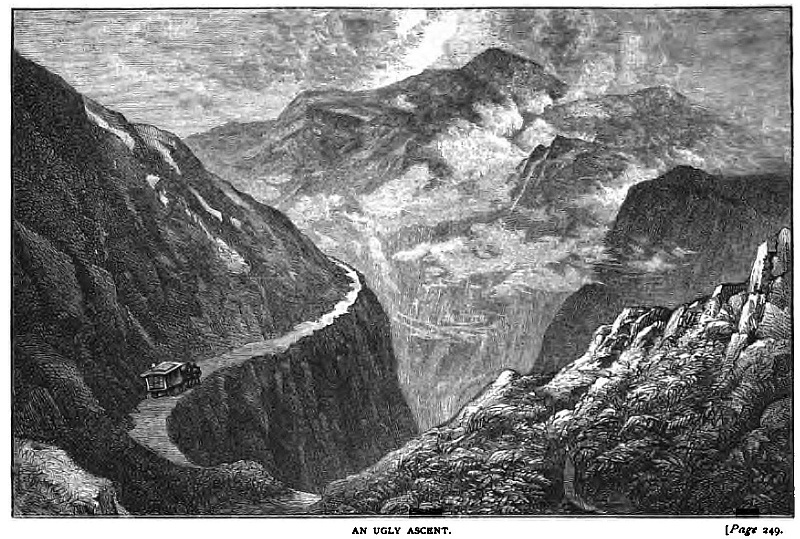
We are off at 8:15 am, and the climb begins. After a mile of hard toil, we find ourselves in the centre of a heather-clad moor. Before and around us hills o’er hills successive rise, and mountain over mountain. Their heads are buried in the clouds. This gives to the scene a kind of gloomy grandeur.
A deep ravine, a stream in the midst, roaring over its pebbly bed.
A dark forest beyond.
Six miles more to climb ere we reach our highest altitude.
Three miles of scenery bleaker and wilder than any we have yet come to.
A dark and gloomy peat moss, with the roots of ancient forest trees appearing here and there.
It gets colder and colder, and I am fain to wrap myself in my Highland plaid.
We meet some horses and carts; the horses start or shy, and remembering our adventure of yesterday we feel nervous till they pass.
On and on, and up and up. We are among the clouds, and the air is cold and damp.
We now near the gloomy mountains and deep ravines of Slochmuichk.
We stop and have a peep ahead. Must the Wanderer, indeed, climb that terrible hill? Down beneath that narrow mountain path the ravine is 500 feet deep at the least. There is a sharp corner to turn, too, up yonder, and what is beyond?
This Page Missing.
This Page Missing.
Chapter Twenty Four.
Wild Flowers—A Hedgerow in July—Hedgerows in General—In Woodland and Copse—In Fields and in Moorlands.
“Ye wildlings of Nature, I doat upon you, For ye waft me to summers of old, When the earth teemed around me with fairy delight. And when daisies and buttercups gladdened my sight, Like treasures of silver and gold.” Campbell. “Fair, my own darling, are the flowers in spring... Rathe primrose, violet, and eglantine, Anemone and golden celandine. Not less delicious all the birds that sing Carols of joy upon the amorous wing, Earine, in these sweet hours of thine.” Mortimer Collinz (to his wife).
From the day we started from the tree-clad plains of bird-haunted Berks till that on which, after crossing the wild Grampian range, we rolled into the capital of the Scottish Highlands, the Wanderer was gay interiorly with wild and garden flowers.
Did we purchase these flowers? Never once, for, strange as it may seem, I do not think that I ever left a town or village or humblest hamlet without having a bouquet or two presented to me.
Nor were the persons who brought those flowers always such as one would feel inclined to associate with the poetry that floated around their floral gifts.
A rosebud or a lily, in the fair fingers of a beautiful girl, is idyllic; it is in keeping with nature. But what say you to a bunch of sweet-scented carnations, pinks, and lilac pea-blooms trailing over the toil-tinted fingers of some rustic dame of forty?
Would you not accept the latter almost as readily as the former? Yes, you would, especially if she said,—
“Have a few flowers, sir? I know you are fond of them.”
Especially if you knew that a great kindly lump of a heart was beating under a probably not over-fashionable corset, and a real living soul peeping out through a pair of merry laughing eyes.
But rough-looking men, ay, even miners, also brought me flowers.
And children never failed me. Their wee bits of bouquets were oft-times sadly untidy, but their wee bits of hearts were warm, so I never refused them.
Some bairnies were too shy to come right round to the back door of the Wanderer with their floral offerings; they would watch a chance when they imagined I was not looking, lay them on the coupé, and run.
Which of the wild flowers, I now wonder, did I love the best? I can hardly say. Perhaps the wild roses that trailed for ever over the hedgerows. But have they not their rivals in the climbing honeysuckle and in the bright-eyed creeping convolvulus? Yes, and in a hundred other sweet gems.
Not a flower can I think of, indeed, that does not recall to my mind some pleasant scene.
“Even now what affections the violet awakes; What loved little islands, twice seen in their lakes, Can the wild water-lily restore; What landscapes I read in the primrose’s looks, And what pictures of pebbles and minnowy brooks, In the vetches that tangle the shore.”
If any proof were needed that I had derived the most intense pleasure from the constant companionship of the wild flowers in my caravan rambles, it is surely to be found in the fact that I am writing this chapter, on a bitter winter’s morning in the month of March, sitting in my garden wigwam. When I essayed to commence work to-day I found my writing fluid was frozen, and I could not coax even a dip from the bottle until I had set it over the stove.
And yet it is a morning in March.
Last year at this time the sun was warm, the air was balmy, the crocuses, primroses, snowdrops, and even the tulips were in bloom, and the brown earth was soft and dry. Now it is as hard as adamant. But there is beauty even in this wintry scene. If I take a walk into the garden I find that the hoarfrost brightens everything, and that the tiniest object, even a blade of grass or a withered leaf, is worthy of being admired.
That tall row of spectre-like poplar trees—whether it be winter or summer—is a study in itself. But last night those trees were pointing at the stars with dark skeleton fingers. Those fingers are pointing now at the blue, blue sky, but they seem changed to whitest coral. Those elm trees along the side of yonder field are clothed with a winter foliage of hoarfrost. Seems as though in a single night they had come again into full leaf, and those leaves had been changed by enchantment into snow. As the sunlight streams athwart them they are beautiful beyond compare.
My wild-birds are here in the garden and on the lawns in dozens, huddled in under the dwarf spruces, firs, and laurels, and even cock-robin looks all of a heap.
Hey presto! I have but to shut my eyes and think back, and the scene is changed. I see before me—
A Hedgerow in July.
Where am I? Away up north on a Yorkshire wold. The horses are out and grazing on the clovery sward by the roadside.
How silent it is!
As I lie here on my rugs on the coupé, I can hear a mole rustling through the grass at the hedge-foot. But the hedgerow itself, and all about it, how refreshing to look upon!
Surely no billhook or axe of woodsman has ever come near it since first it began to grow. Its very irregularity gives it additional charm. The hedge itself is really of blackthorn, but its white or pink-ticked blossoms have faded and given place to haws. Here and there, as far as you can see, up through it grow wild dwarf oak bushes, their foliage crimson or carmine tipped, dwarf plane-trees, with broad sienna leaves, that glitter in the sunshine as if they had been varnished; and elder-trees with big white stars of blossom, and rougher leaves of darkest green. Young elms, too, are yonder, and infant ash trees with stems as black as ink and strangely tinted leaves.
(Plane-trees, so-called, but in reality the Sycamore: the Acer pseudo-platanus of naturalists.)
“The sycamore, capricious in attire, Now green, now tawny, and ere autumn yet Has changed the woods, in scarlet honours bright.”
Here and there wild roses, pale pink or deepest crimson, blush out; here and there are patches of honeysuckle, and here and there waves of the white flowery bryony roll foaming over the green.
In some places the light and tender-leaved woody nightshade, whose berries in bunches of crimson and green are so pretty in autumn, impart a spring-like appearance to this hedgerow.
Nor does the beauty of my hedgerow end here for all along beneath grow rare and lovely grasses, interspersed with star-eyed silenes and gorgeous spikes of the purple stachys, while the adjoining sward is carpeted over with beds of brilliant clover, red and white, with golden bird’s-foot trefoil, and patches of pale blue speedwells.
Bees are very busy all over this glory of colour, humming as they fly from flower to flower, but becoming abruptly silent as soon as their feet touch the silken blossoms. And birds there are too, though now they have for the most part ceased to sing, except the robin and a yellow-hammer, and these birds will continue lilting long after even the autumn tints are on the trees.
Hedgerows in General.
These were almost ever with us—one long-drawn delight. For five hundred miles, indeed, they accompanied the Wanderer on her journey. When, at any time, they left us for a space, and stone fences or wooden palings took their place, we were never happy until they again appeared.
From memory I jot down the names of a few of the plants and flowers that mingled with them, or trailed over or through them, constituting their chief charm and beauty.
First on the list, naturally enough, come the rose gems, including the sweetbriar or eglantine, with its deep pink flowers and sweetly-scented leaves; the field-rose, the Rosa arvensis, with pale pink blossoms, and the charming Rosa canina, or dog-rose, with petals of a darker red.
As I have already said, these roses grew everywhere among the hedges, in garlands, in wreaths, and in canopies, and always looked their best where the blackthorns had not been disfigured by touch of billhook or pruning shears.
In the earlier spring the hedges had a beauty of their own, being snowed over with clustering blossoms.
The bryony and the honeysuckle I have already mentioned. The green and crimson berries on the former, when the summer begins to wane, are rivalled only by those of the charming woody nightshade.
Regarding the honeysuckle, a naturalist in a London magazine wrote the other day as follows:—
“In the ordinary way, the branches grow out from the parent stem and twine round the first support they meet front right to left;”—the italics are mine—“but should they fail to find that support, two branches will mutually support each other, one twining from left to right, the other from right to left.”
Now the fact is that the honeysuckle twines from left to right, and if two or three branches are together, as we often find them, it is the weaker who twine round the stronger,—still from left to right.
The wild convolvulus, with its great white bell-like blossoms, that so often stars the hedgerows with a singular beauty, twines always to meet the sun.
The Vicia cracca, or purple climbing vetch, is an object of rare loveliness in July and August. It is a species of clustering-blossomed tare or sweet-pea, with neat, wee green leaves, and flowers of a bluish purple. It is not content with creeping up through the hedge, but it must go crawling along over the top to woo the sunshine.
Later on in summer and early autumn blooms the well-known bramble—the black-fruited rubus.
No poet, as far as I am aware, has yet celebrated the purple trailing vetch in song, but the bramble has not been forgotten.
Hear Elliott’s exquisite lines:—
“Though woodbines flaunt and roses glow O’er all the fragrant bowers, Thou needst not be ashamed to show Thy satin-threaded flowers. For dull the eye, the heart is dull, That cannot feel how fair, Amid all beauty, beautiful, Thy tender blossoms are. * * * * *. “While silent showers are falling slow, And ’mid the general hush, A sweet air lifts the little bough, Low whispering through the bush. The primrose to the grave has gone; The hawthorn flower is dead; The violet by the moss’d grey stone Hath laid her weary head; But thou, wild bramble, back dost bring, In all their beauteous power, The fresh green days of life’s fair spring, And boyhood’s blossoming hour.”
Nestling down by the hedgerow foot, among tall reeds and grey or brown seedling grasses, is many and many a charming wild flower, such as the stachys, the crimson ragged-robbin, with flowers like coral, and the snow-white silene.
Woodland and Copse.
Far away in bonnie Scotland, where the woods are mostly composed of dark, waving, brown-stemmed pine-trees, feathery larches—crimson-tasselled in early spring—or gloomy spruces, there is often an absence of any undergrowth, unless it be heather. But English copses are often one wild tanglement of trailing flowering shrubs, with banks of bracken or ferns.
I have often stopped to admire the marvellous beauty of these copse-lands; their wealth of silent loveliness has more than once brought the tears to my eyes.
So now I refrain from describing them, because any attempt to do so would end in failure. But, reader, have you seen an English woodland carpeted with deep-blue hyacinths, with snowy anemones, or with the sweet wee white pink-streaked sorrel, with its bashful leaves of bending green? Have you seen the golden-tasselled broom waving in the soft spring wind? Or, later on in the season, the tall and stately foxgloves blooming red amidst the greenery of a fern bank? If not, a treat, both rich and rare, may still be yours.
Is it not said that the wild anemone or wind-flower grew from the tears shed by Venus over the grave of Adonis?
“But gentle flowers are born, and bloom around, From every drop that falls upon the ground: Where streams his blood, there blushing springs the rose, And where a tear has dropped a wind-flower blows.”
I think it must be the wood-anemone that is referred to as the snowdrop in that bonnie old Scottish song, My Nannie’s awa’:—
“The snowdrop and primrose our woodlands adorn, And violets blaw in the dews o’ the morn, They pain my sad bosom, sae sweetly they blaw, They mind me on Nannie—and Nannie’s awa’.”
Fields and Moorland.
Turning to these, what oceans of beauty I saw everywhere around me during all the months of my travel!
In May, many of the uplands were covered with the yellow-blooming furze or whins. The black forest, for instance, ’twixt Guildford and Frimley, was a sight worth travelling long miles to look upon; while nothing could excel the fragrance of the perfume shed everywhere around.
The furze lies low to the ground where it has plenty of sunlight, but straggles upwards to seek the light when it grows in the woodlands.
Sweet-scented thistles of every shade—I had almost added “and every shape”—grew plentifully in corners of fields we passed, mostly prickly, but some harmless; lilac, pale pink, dark crimson, and purple; field thistles, milk thistles, melancholy thistles, and nodding thistles.
This latter species I found growing in glorious profusion on the links of Musselburgh, and I quite adorned my caravan with them.
Wherever thistles grow in fields, the tansy is not far off; a showy, yellow, too-hardy flower, without, in my opinion, a vestige of romance about it. Perhaps the sheep think differently, for long after Scottish fields and “baulks” are picked bare, they can always find a pluck of sweet green grass by taking their tongues round a tansy stem.
The yellow meadow vetchling is a beautiful, bright-yellow, pea-like flower, that dearly loves a snug corner under a hedge or bush of furze.
The pink-blossomed geranium-like mallow we all know. It is none the less lovely, however, because common; and here is a hint worth knowing—it looks well in a vase, and will bloom for weeks in water.
But a far more lovely flower, that I first foregathered with, I think, in Yorkshire, is the wild blue geranium, or meadow crane’s-bill. Words alone could not describe its beauty, it must be seen. It mostly grows by the wayside.
Need I even name the corn-marigold, or the blush of the corn-poppies among green growing wheat, or the exquisitely lovely sainfoin, that sheds its crimson beauty over many a southern field; or the blue and charming corn-flower, that delights to bloom amid the ripening grain?
Oh! dear farmer, call it not a weed, hint not at its being a hurt-sickle—rather admire and love it.
Nay, but the farmer will not, he has no romance about him, and will quote me lines like these:—
“Bluebottle, thee my numbers fain would raise, And thy complexion challenge all my praise, Thy countenance like summer skies is fair; But ah! how different thy vile manners are. A treacherous guest, destruction thou dost bring To th’ inhospitable field where thou dost spring, Thou blunt’st the very reaper’s sickle, and so In life and death becom’st the farmer’s foe.”
But cowslips, and buttercups—
“The winking Mary-buds begin To ope their golden eyes.” Shakespeare.
—And the chaste and pretty ox-eye daisy, even a farmer will not object to my adoring, for the very names of these bring to his mind sleek-sided cattle wading in spring time knee-deep in fields of green sweet grass.
And what shall I say of gowan or mountain-daisy? Oh! what should I say, but repeat the lines of our own immortal bard:—
“Wee, modest, crimson-tipped flower, Thou’s met me in an evil hour, For I maun crush among the stoure Thy slender stem: To save thee now is past my power, Thou bonnie gem?”
The spotted orchis is a sweet-scented Highland moorland gem, but right glad I was to find it meeting me on the banks of Northumberland. Far over the borders grew the pretty Scottish bluebell, and on rough patches of ground the trailing lilac rest-harrow.
Singly, a sprig of bluebells may not look to much advantage, but growing in great beds and patches, and hanging in heaps to old rained walls, or turf-capped dykes, they are very effective indeed.
I had meant to speak in this chapter of many other flowers that grow by the wayside—of the dove’s foot cranebill, of the purple loose-strife, of the sky-blue chicory and the pink-eyed pimpernel, of the golden bird’s-foot trefoil, of purple bugles, of yellow celandine, and of clover red and white. I had even meant to throw in a bird or two—the lark, for instance, that seems to fan the clouds with its quivering wing, the fluting blackbird of woodland and copse, the shrill-voiced mocking mavis, that makes the echoes ring from tree to tree; the cushat, that croodles so mournfully in the thickets of spruce; the wild-screaming curlew, and mayhap the great eagle itself.
But I fear that I have already wearied the reader, and so must refrain.
Stay though, one word about our Highland heather—one word and I have done. I have found both this and heath growing in England, but never in the same savage luxuriance as on the wilds of the Grampian range. Here you can wander in it waist-deep, if you are not afraid of snakes, and this Erica cineria you will find of every shade, from white—rare—to pink and darkest crimson:—
“Those wastes of heath That stretch for leagues to lure the bee, Where the wild bird, on pinions strong, Wheels round, and pours his piping song, And timid creatures wander free.”
I trust I may be forgiven for making all these poetical quotations, but as I commenced with one from the poet Campbell, so must I end with one from the selfsame bard. It is of the purple heath and heather he is thinking when he writes:—
“I love you for lulling me back into dreams Of the blue Highland mountains, and echoing streams, And of birchen glades breathing their balm. While the deer is seen glancing in sunshine remote, And the deep-mellow gush of the wood-pigeon’s note, Makes music that sweetens the calm.”
Chapter Twenty Five.
A Chapter about Children—Children in Bouquets—Children by the “sad sea-wave”—sweet maudie brewer—wee dickie ellis—the miner’s sprite.
“On these laughing rosy faces There are no deep lines of sin; None of passion’s dreary traces, That betray the wounds within.” Tupper.
As much even as the wild flowers themselves were the children a feature in the seemingly interminable panorama, that flitted past me in my long tour in the Wanderer. The wild flowers were everywhere; by wayside, on hillside, by streamlet, in copse, hiding in fairy nooks among the brackens in the woodlands, carpeting mossy banks in the pine forests, floating on the lakes, nodding to the running brooklets, creeping over ruined walls and fences, and starring the hedgerows,—wild flowers, wild flowers everywhere.
Wild flowers everywhere, and children everywhere.
Country children: minding cows or sheep or pigs; trotting Blondin-like along the parapets of high bridges; riding or swinging on gateways; stringing daisies on flowery meads; paddling in stream or in burn; fishing by lonely tarns; swinging in the tree-tops; or boring head first through hedges of blackthorn and furze.
Village children: sitting in dozens on door-steps; a-squat on the footpath, nursing babies as big as themselves; at play on the walks or in the street midst; toddling solemnly off to school, with well-washed faces, and book-laden; or rushing merrily home again, with faces all begrimed with mud and tears.
Seaside children: out in boats, rocked in the cradle of the deep; bathing in dozens, swimming, sprawling, splashing, whooping; squatting among the seaweed; dabbling in pools, or clinging to the cliffs with all the tenacity of crabs.
Children everywhere, all along. Curly-pated children, bare-legged children, well-dressed children, and children in rags, but all shouting, screaming, laughing, smiling, or singing, and all as happy, seemingly, as the summer’s day was long.
“Harmless, happy little treasures, Full of truth, and trust, and mirth; Richest wealth and purest pleasures In this mean and guilty earth. “But yours is the sunny dimple, Radiant with untutored smiles; Yours the heart, sincere and simple, Innocent of selfish wiles. “Yours the natural curling tresses, Prattling tongues and shyness coy; Tottering steps and kind caresses, Pure with health, and warm with joy.”
Look at that little innocent yonder in that cottage doorway. There is a well-kept garden in front of the house, but not a flower in it more sweet than she. Round-faced, curly-tressed, dimpled chin and cheeks and knee. It is early morning, she has rushed to the door in her little night-dress; one stocking is on, the other she waves wildly aloft as she cheers the Wanderer.
Here at a village door is a group—a bouquet you may say—worth looking it. Three such pretty children, seated in a doorway, on the steps. They are dressed in blue, with white socks and fairy-like caps, and the oldest is holding a bald-headed crowing baby in her lap.
Here is another tableau: three pretty little well-dressed maidens, hand-in-hand, dancing and whirling in Indian circle round a hole which has been dug in the green sward; a fourth seated close by the hole, flicking the dust up in clouds with a green bough, and giving each a full share of it. Never mind the lace-edged dresses, heed not the snow-white pinafores, round and round and round they go, and how they laugh and shout, and enjoy it!
And here is a bouquet from Musselburgh, though perhaps it has a somewhat fishy flavour. A group of chubby children on the beach, among the somewhat black sand; one has a large crab-shell with a string to it—this is his cart, and it is laden with cockle-shells and star-fish; another boy has a dead eel on a string; a baby is lying on its face digging holes in the sand with a razor shell, and a little girl is nursing a cod’s head for a doll, and has dressed it up with seaweed. They have bare heads and feet, and smudgy faces, but dear me! they do look happy!
Five little kilted boys, squatting on the grass; between them is a round kettle pot half-filled with porridge, and each holds in his hand a “cogie” of milk. But they start to their feet as the Wanderer rolls past, wave aloft their horn spoons, and shout till we are out of sight.
Here is a little cherub of some seven summers old. He very likely belongs to that pretty cottage whose redbrick gable peeps out through a cloudland of trees yonder. He has a barrow, and it is nearly full, for the boy has been scavenging on the road, gathering material to make the mushrooms grow in his father’s garden. Right in the centre of this he has dug a nest, and in this nest is seated his baby brother. He is telling him a story, and the baby brother is crowing and kicking, and looking all over so delighted and joyful in his questionable nest, that one almost envies him. That youngster may emigrate some day, and he may become President of America yet. When I think of that I cannot help feeling a kind of respect for him.
The most smudgy-faced children I noticed on my tour were, I think, some of those in the outlying villages of the North Riding of Yorks. Of course, they always came trooping out to view the caravan, from cottage doors, from garden gates, from schools, and from playgrounds, the foremost calling aloud to those behind to come quick, to run, for a show was coming.
If we happened to stop, they would gather around us and stare with saucer eyes and open mouths astonished, expectant. If we drove on quickly, they speedily set up an impromptu “Hip, hip, hoor—ay—ay!” and waved their arms or ragged caps in the air.
Talk about the great unwashed! These were the little unwashed, and a far larger section of the public than their bigger brethren.
Do not blame the poor things because their faces are not over cleanly. It may not even be the fault of their parents. Early of a morning we often met children going toddling off to school, with books and slates, and, mind you, with faces that positively glistened and reflected the sunbeams, the result of recent ablutions, and a plentiful use of soap. We met school children again coming from school of an evening, but sadly different in facial aspect, for lo! and alas! grief soon begins of a morning with a child, and tears begin to flow, so cheeks get wet, and are wiped, and dust begrimes them, and long ere evening the average boy’s face is woefully be-smudged.
I found a little Scotch boy once standing with his face against a hayrick weeping bitterly. I daresay he had been chastised for some fault and had come here to indulge in the luxury of a good cry. But would he own it? No, he was too Scotch for that.
“What are ye greetin’ (weeping) about, my wee laddie?” I said, pulling him round.
“I’m no greetin’,” he replied through his tears.
“It looks unco’ like it,” I ventured to remark.
“I tell you, si-si-sir,” he sobbed, “I’m no gaga—greetin’. I’m only just letting—
“‘The tears doon fa’, For Jock o’ Hadedean.’”
I gave him a penny on the spot, and that changed his tune.