EDITORIAL
Reading edition
ENVY.
It is unfortunate that in the recent newspaper discussion of an Appeal to Europe sent out not by this Association but by a number of colored men of influence and standing, reference was constantly made to the lowest personal motives and seldom to the arguments presented.
It is true that with all peoples, and especially with a race in the throes of birth-pain, personal likes and jealousies play a wretchedly large part. But it does not follow that they explain all the struggle and difference of opinion. It is true that the rise of a man like Mr. Booker T. Washington to a place of commanding influence has made him an object of envy to many narrow souls. But it does not follow that the thousands of intelligent people who differ with Mr. Washington are all actuated by such motives, or are unable to distinguish great and vital principles apart from personal feeling.
When, therefore, such differences of opinion arise, as it is natural and healthy that they should arise, it is both wrong and unjust to assume the motive to be necessarily low. Particularly is this true when adequate causes of deep and compelling importance are openly and honestly given as the cause of this difference.
Are such causes sufficient to sustain the complainers? That is a matter of argument, not of innuendo or abuse. No man and no cause are above the careful scrutiny and criticism of honest men, and certainly to-day there is in the United States a very large field for argument as to the proper attitude of colored leaders toward the race problem.
THE TRUTH.
To the honest seeker for light the puzzling thing about the Southern situation is the absolutely contradictory statements that are often made concerning conditions. For instance, the New York Evening Post is taken to task by the Norfolk (Va.) Landmark for assuming that Southern colored men are largely disfranchised. The Virginia paper says “No Negro in Virginia can be kept from voting, provided he measures up to the same requirements for the exercising of that right that the white man must. The laws of the State will protect him in the right should election officials deny it him. That Negroes in this State may freely qualify to vote is fully attested by the fact that thousands of them do vote.” Again, the New Orleans Picayune declares with regard to the complaint of disfranchisement, “The arrant and absolute falsity of the specification in regard to the ballot is seen in the fact that every legal bar to the exercise of the ballot applies to whites and Negroes alike. Every elector (voter) must either be able to read and write or, in case of illiteracy, he must pay taxes on ordinary assessable property of the minimum value of $300. These laws are strictly in accordance with the requirements of the Constitution of the United States, and have been so pronounced by the courts.”
Just so in earlier days before legal disfranchisement, paper after paper and orator after orator declared that the Negro could and did vote without let or hindrance.
Despite this, every intelligent person in the United States knows that these statements are false. The Southern testimony to this is itself open and convincing. Not only have we Mr. Tillman’s frank and picturesque testimony on the past, but to-day the Richmond (Va.) Leader says that all is well in Virginia “since we disfranchised the Negro”; Congressman Underwood of Alabama says the Alabama Negro “does not count for anything politically” in that State; a 17prominent judge on the Mississippi bench says “The Negroes in Mississippi do not vote and should not,” and it is a matter of plain official record in Louisiana that of over 150,000 Negro males 21 years of age and over (of whom nearly 70,000 could read and write) there were in 1908 only 1,743 registered as voters, and these were disfranchised by the “White Primary” system. In the face of these facts, does it pay deliberately to misrepresent the truth?
OPPORTUNITY.
A friend of our Association writes: “While I heartily approve of the colored people being given an opportunity to improve their condition, I feel that after doing what I can to help them to earn a living honorably, they must depend on their own resources to advance themselves.” This is the attitude of many excellent friends of humanity, but it assumes that if a man is fairly equipped for earning a living to-day he will have the opportunity to do so, and that the paths before him will be open so as to make the rise of the deserving possible.
It is precisely because the opportunity to earn a living, even for those equipped to do so, is not given to-day to thousands of colored people in the United States, that the National Association for the Advancement of Colored People exists. It is wrong and wasteful to do for people what they can and ought to do for themselves, but when the doors of opportunity are so shut in their faces so as to discourage and keep back the hard-working and deserving, then action is called for.
To-day Negroes may work freely as menials at low wages; they may work freely as farm laborers under conditions of semi-slavery; higher than that they meet unusual difficulties—the difficulty of saving capital from low wages to farm or go into business; the difficulty of securing admission to the trades even when competent; the difficulty of securing protection under the law and of rearing a family in decency; the difficulty of educating their children; the difficulty of protecting their rights by the ballot. To be sure, if they are unusually gifted and pushing they may push higher at the risk of insult and bitter opposition. Thus the fact remains that the mass of the willing, eager workers of the race are held back and forced down by a deep and growing race prejudice, and these, pressing down on the lower strata, encourage in them laziness and vagrancy and crime. The National Association for the Advancement of Colored People is an organization for giving the colored race a reasonable opportunity to help itself.
SCHOOLS.
The philanthropist of a city like New York is bewildered and often exasperated by the demands and begging of colored schools in the South.
To some extent this is inevitable, and is due to the fact that the United States is undertaking to give elementary education to a race of ten million people very largely by private philanthropy instead of making this a State and even a national charge, and leaving to voluntary effort the college work and work of social uplift.
But beyond this the philanthropic world is to some extent itself to blame because of the encouragement it gives to unknown and unvouched-for enterprises and to unwise and unjustifiable attempts to duplicate existing foundations.
The representative of a great fund once called on the writer and expressed great sorrow that an alleged school in the South to which one of the most prominent New York philanthropists had given $5,000 was found on investigation to be no school at all. This was unfortunate, but there are hundreds of good and deserving schools starving for help which this philanthropist did not give to because their representatives did not appear so glib or plausible. It is not the smoothest talker who necessarily is doing the best work.
18
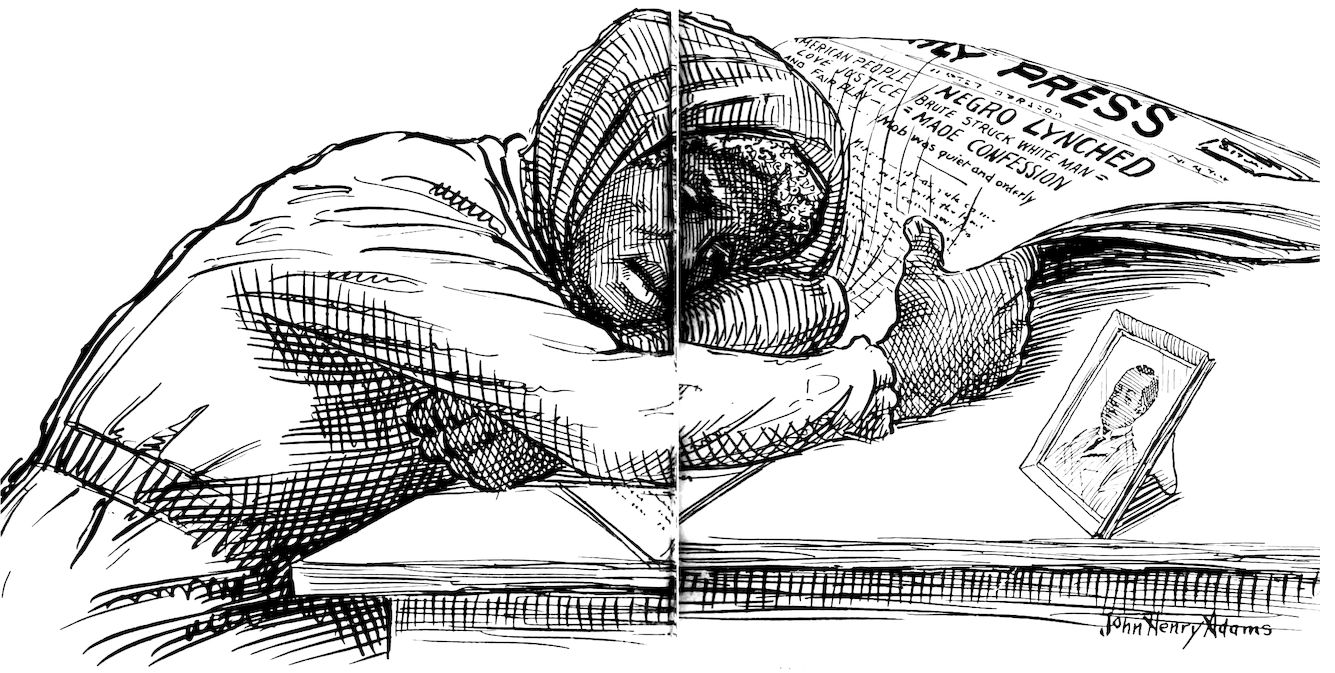
THE NATIONAL PASTIME. Seventy-five per cent. of the Negroes lynched have not even been accused of rape.
20Again, indiscriminate and ill-advised giving encourages such things as are happening in Atlanta. Atlanta needs public elementary schools, but it does not need more private schools. The existing schools are equipped for excellent work in industries, agriculture, college training and some professional work. With adequate help and endowment they could do splendid work.
Because, however, one man deservedly lost his job at one of these great schools, he is attempting to found a new school in Atlanta and unnecessarily duplicate this work. Soon he will appear in New York asking funds, and without investigation or thought many will give. When they find their efforts wasted the deserving schools will suffer.
There is crying need of an impartial, thoroughly reliable directory of educational and philanthropic effort among Negroes, a central information bureau on broad lines, with maps and figures at command which could furnish unbiased facts. The National Association for the Advancement of Colored People is ready to undertake such a work immediately on a small scale, and to expand it whenever it can get the necessary support.
THE OLD STORY.
There is without doubt a large criminal and semi-criminal class among colored people. This is but another way of saying that the social uplift of a group of freedmen is a serious task. But it is also true, and painfully true, that the crime imputed carelessly and recklessly against colored people gives an impression of far greater criminality than the facts warrant.
Take, for instance, a typical case: A little innocent schoolgirl is brutally murdered in New Jersey. A Negro vagabond is arrested. Immediately the news is heralded from East to West, from North to South, in Europe and Asia, of the crime of this black murderer. Immediately a frenzied, hysterical mob gathers and attempts to lynch the poor wretch. He is spirited away and the public is almost sorry that he has escaped summary justice. Without counsel or friends, the man is shut up in prison and tortured to make him confess. “They did pretty near everything to me except kill me,” whispered the wretched man to the first friend he saw.
Finally, after the whole black race in America had suffered aspersion for several weeks, sense begins to dawn in Jersey. After all, what proof was there against this man? He was lazy, he had been in jail for alleged theft from gypsies, he was good natured, and he drank whiskey. That was all. Yet he stayed in jail under no charge and under universal censure. The coroner’s jury found no evidence to indict him. Still he lay in jail. Finally the National Association for the Advancement of Colored People stepped in and said, “What are you holding this man for?” The Public Prosecutor got red in the face and vociferated. Then he went downtown, and when the habeas corpus proceedings came and the judge asked again: “Why are you holding this man?” the prosecutor said chirpily, “For violating election laws,” and brought a mass of testimony. Then the judge discharged the prisoner from the murder charge and congratulated the National Association for the Advancement of Colored People—but the man is still in jail.
Such justice is outrageous and such methods disgraceful. Black folk are willing to shoulder their own sins, but the difference between a vagabond and a murderer is too tremendous to be lightly ignored.
“SOCIAL EQUALITY.”
At last we have a definition of the very elusive phrase “Social Equality” as applied to the Negro problem. In stating their grievances colored people have recently specified these points:
1. Disfranchisement, even of educated Negroes.
2. Curtailment of common school training.
3. Confinement to “Ghettos.”
4. Discrimination in wages.
5. Confinement to menial employment.
216. Systematic insult of their women.
7. Lynching and miscarriage of justice.
8. Refusal to recognize fitness “in political or industrial life.”
9. Personal discourtesy.
Southern papers in Charlotte, Richmond, New Orleans and Nashville have with singular unanimity hastened to call this complaint an unequivocal demand for “social equality,” and as such absolutely inadmissible. We are glad to have a frank definition, because we have always suspected this smooth phrase. We recommend on this showing that hereafter colored men who hasten to disavow any desire for “social equality” should carefully read the above list of disabilities which social inequality would seem to prescribe.
ASHAMED.
Any colored man who complains of the treatment he receives in America is apt to be faced sooner or later by the statement that he is ashamed of his race.
The statement usually strikes him as a most astounding piece of illogical reasoning, to which a hot reply is appropriate.
And yet notice the curious logic of the persons who say such things. They argue:
White men alone are men. This Negro wants to be a man. Ergo he wants to be a white man.
Their attention is drawn to the efforts of colored people to be treated decently. This minor premise therefore attracts them. But the major premise—the question as to treating black men like white men—never enters their heads, nor can they conceive it entering the black man’s head. If he wants to be a man he must want to be white, and therefore it is with peculiar complacency that a Tennessee paper says of a dark champion of Negro equality: “He bitterly resents his Negro blood.”
Not so, O Blind Man. He bitterly resents your treatment of Negro blood. The prouder he is, or has a right to be, of the blood of his black fathers, the more doggedly he resists the attempt to load men of that blood with ignominy and chains. It is race pride that fights for freedom; it is the man ashamed of his blood who weakly submits and smiles.
JESUS CHRIST IN BALTIMORE.
It seems that it is not only Property that is screaming with fright at the Black Spectre in Baltimore, but Religion also. Two churches founded in the name of Him who “put down the mighty from their seats and exalted them of low degree” are compelled to move. Their palatial edifices filled with marble memorials and Tiffany windows are quite useless for the purposes of their religion since black folk settled next door. Incontinently they have dropped their Bibles and gathered up their priestly robes and fled, after selling their property to colored people for $125,000 in good, cold cash.
Where are they going? Uptown. Up to the wealthy and exclusive and socially select. There they will establish their little gods again, and learned prelates with sonorous voices will ask the echoing pews: “How can the Church reach the working man?”
Why not ask the working man? Why not ask black people, and yellow people, and poor people, and all the people from whom such congregations flee in holy terror? The church that does not run from the lowly finds the lowly at its doors, and there are some such churches in the land, but we fear that their number in Baltimore is not as great as should be.
“EXCEPT SERVANTS.”
The noticeable reservation in all attempts, North and South, to separate black folk and white is the saving phrase, “Except servants.”
Are not servants colored? Is the objection, then, to colored people or to colored people who are not servants? In other words, is this race prejudice inborn antipathy or a social and economic caste?
22