Chapter IV
Reading edition
CRIMINAL ANTHROPOLOGY (PSYCHICAL).
§ 1. Moral Insensibility.
The moral insensibility of the instinctive and habitual criminal, his lack of forethought, his absence of remorse, his cheerfulness, had been noted long before they were exhaustively studied by Despine. In the argot of French criminals, conscience is la muette, and to induce any one to lead a dishonest life is l’affranchir. This moral insensibility is, indeed, a commonplace of observation with all who have come in close contact with criminals. Gall remarked: “If criminals have remorse, it is that they have not committed more crimes, or that they have let themselves be caught.” Dostoieffsky, speaking from his intimate and sympathetic acquaintance with convicts in Siberia, said: “During so many years I ought to have been able to seize some indication, however fugitive, of regret, of moral suffering. I have perceived positively nothing. Seclusion and excessive work only develop among those people a profound hatred, the thirst of forbidden pleasures, and a terrible indifference.” He goes on to tell of a parricide who remarked carelessly, in the course of conversation: “Take my father, for example; he was never ill up to the day of his death.” “Scenes of heartrending despair are hardly ever witnessed among prisoners,” observes Dr. Wey of Elmira; “their sleep is disturbed by no uneasy dreams, but is easy and sound; their appetites, also, are excellent.”[54] “It is a most singular thing,” remarks Mr. Davitt, “that I have met very few individuals in prison who gave evidence in appearance or talk of being truly miserable, no matter what the length of their sentence, amount of extra punishment, or contrast between their previous and their convict life may have been.”[55] Mr. Davitt seems inclined to attribute this sinister contentment to a sort of heroic fortitude providentially implanted in the criminal breast. He refers, however, to one man who never smiled during the time he was in Dartmoor. “His existence seemed to be one perpetual sorrow, and he formed altogether the most striking exception to the rule of non-despairing prisoners which came under my notice during my long intercourse with Dartmoor’s criminal population.” Now this man was a Swansea stone-mason who had come home one Saturday evening “a little fresh,” but not drunk, to find his wife in tears, and on learning that she had been insulted by a man who lived on the other side of the street, he rushed out, chisel in hand, to the man’s house and left him desperately wounded. It is clear that this man, who was sentenced to seven years’ penal servitude, was not an instinctive criminal, or an habitual criminal at all; it was the strength of his social, and not of his anti-social, instincts which had caused his crime. He was merely a criminal by passion, and his case forms, therefore, no exception to the general rule.
On the whole we may conclude that the practice of the instinctive and habitual criminal corresponds very closely with the faith of that religious sect who in Commonwealth days held “that heaven and all happiness consists in the acting of those things which are sin and wickedness,” and “that such men and women are most perfect and like to God or eternity which do commit the greatest sins with least remorse.”
Despine, in his Psychologie Naturelle (1868), studied this question on the largest scale in order to obtain exact results. “I addressed myself for this purpose,” he tells us, “to the collection of the Gazette des Tribunaux, going back to 1825, and I soon acquired certainty that this psychical peculiarity is an invariable rule among these criminals.... I acquired the certainty that those who premeditate and commit crime in cold blood never experience moral remorse. I found also that those who manifest acute sorrow and real remorse after a criminal act, have committed that act either under the influence of a violent passion which has momentarily stifled the moral sense, or by accident, without intention.” He concludes that the two great psychical conditions for crime are moral insensibility and perversity, with two accessory moral anomalies, imprudence and lack of foresight.
“You premeditated your crime?” said the judge. “Yes, for eighteen months.” “But that is monstrous.” “I know; I ought to have done it in April, but having no money, I arranged it for January.” A murderer, after receiving sentence, was led out in the midst of a crowd who hurled imprecations at him. He saw a comrade and shouted to him, almost laughing—“Hallo! I’ve just been condemned to death.” An Albanian, after having killed a traveller to rob him, lamented that the expense of the shot amounted to five paras; he had only found four paras on the victim; that was his one regret. An assassin after his crime passed two days eating and drinking with a comrade; “he was as gay as a lark,” said the latter. “But,” said the judge to the accused, “one fact indicates remorse on your part: you were about to cut your throat when arrested.” “That was that I might not be taken to prison.”
Wainewright unblushingly avowed his atrocities. How could he kill such an innocent and trustful creature as Helen Abercrombie, he was asked once. After a moment’s reflection he replied, “Upon my soul I don’t know, unless it was because she had such thick legs.”
It would be easy to give many similar stories exhibiting the moral insensibility of the instinctive criminal, frequently manifested in brutal bravado. They are, however, easily accessible and of sufficient notoriety. It is enough to give one more. A corporal at Paris killed an old woman, the landlady of an inn, in order to rob her. He was condemned to death without any hope that his penalty would be commuted. He knew this, but was not disturbed, and was proud of his calmness and sangfroid; he talked to his warders on the most various subjects, without reference, however, to his crime; read books from the prison library, and finally devoted himself to what he called the literary labours of his last hours. He had a taste for verse, and wrote a drama concerning his crime. “Death!” he often said to those around him; “I cannot fear it either as a soldier or as a philosopher. Yet it is overtaking me in my youth and strength. It is a terrible thing, but I am prepared, and I shall go to my execution courageously and with head erect.” The acts of this Socratic criminal agreed with his words. He slept peacefully, rose and dressed himself with a smile on his lips, glad, as he said, to find himself still in this world, where it is, after all, so pleasant to live. His appetite was always good, and he joked with the warder who attended him about the small amount of food supplied to him. “Patience!” he exclaimed, “à la guerre comme à la guerre.”
An executioner told Lombroso that all the highwaymen and murderers went to their deaths joking. It would, however, be a mistake to trace moral insensibility in the tranquil avocations and bon-mots of men who, whatever their crimes, are about to pay the extreme forfeit for them. One criminal occupied his last hours with arranging his unpublished literary works; another gave lessons in hygiene to the warders; a third remarked to those who sought to hurry him to the place of execution, “Do not be disturbed; they will not begin without me.” Such stories have, however, been recorded of the most eminent political offenders in all countries.
PLATE IX.
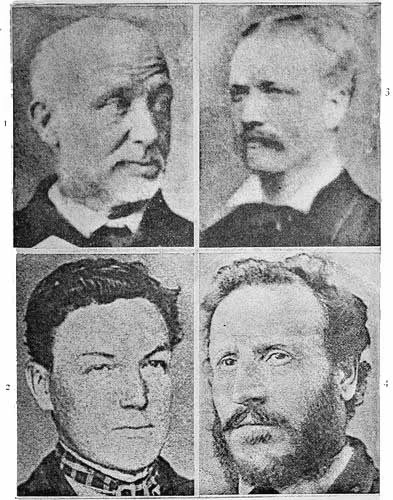
Dr. Corre, in his interesting work, Les Criminels, has investigated the historic and judicial documents relative to the last moments of 88 criminals condemned to death, of whom 64 were men and 24 women. Of the men 25 died in a cowardly manner, already half-dead with fear, or else after a despairing struggle with the executioner. These were more than two-fifths of the whole number, and included many of the chief criminal celebrities, some of them educated men, doctors and priests. Four accepted their fate in a state of extreme nervous excitement, accompanied by loquacity. Twelve maintained to the end a cynical and theatrical attitude; these were vain individuals, often with some pretensions to literary ability; Lacenaire is the type of them. Five died with indifference, an impassivity which recalls the insensibility of the brute or the unconsciousness of the madman. Eighteen went out of the world with a calm and resigned courage, often repentant, and prepared by the exhortations of the priest. They belonged to various social classes. Those of the lower classes were generally more sincere, and publicly avowed their guilt, holding themselves up as warnings to others; those belonging to the middle classes, anxious to leave behind a doubt as to their guilt, declared themselves innocent; others were silent. Of the 24 women, only 5 (about one-fifth) showed cowardice. Only one, a poisoner, showed “revolting cynicism.” The rest, 18 in number, were self-possessed and resigned, frequently repentant, and generally consoled by religious administrations. In this category is included the Marquise de Brinvilliers, who for a long quarter of an hour was exposed to an immense crowd nearly naked—“mirodée, rasée, dressée et redressée par le bourreau,” wrote Mme. de Sevigné—with unshaken firmness. Three-fourths of the women, little more than one-fourth of the men, are among those who died with resigned self-possession. The cynicism, cowardice, and brutal passivity of the others alike testify to moral insensibility.
Out of more than 400 murderers Bruce Thomson had known, only three expressed remorse. Of the 4000 criminals who have passed through Elmira, 36.2 per cent. showed on admission positively no susceptibility to moral impressions; only 23.4 per cent. were “ordinarily susceptible.” Dr. Salsotto, in his recent study of 130 women condemned for premeditated assassination or complicity in such assassination,[56] was only able to recognise genuine penitence in six. He is careful to point out that precise statistics on this point are of no great value, unless they are associated with a very intimate knowledge of individual criminals; the assumed penitence is seldom real, and the real penitence is not obtrusive. Dostoieffsky, the most profound student of the human heart who has ever studied criminals intimately, has noted this fact—“In one prison there were men whom I had known for several years, whom I believed to be savage beasts, and for whom, as such, I felt contempt; yet at the most unexpected moment their souls would involuntarily expand at the surface with such a wealth of sentiment and cordiality, with such a vivid sense of their own and others’ suffering, that scales seemed to fall from one’s eyes; for an instant the stupefaction was so great that one hesitated to believe what one had seen and heard.”
The moral insensibility of the instinctive criminal is the cause of his cruelty, a cruelty which he frequently displays from his childhood. Rossi found in ten of his 100 criminals an exaggerated and precocious cruelty; one of them, as a child, used to take young birds, pull out their feathers, and roast them alive; another revenged himself on birds for the punishments imposed on him by his parents. A certain amount of cruelty is, however, almost normal in healthy children. The instinctive criminal is more distinctively marked by his continuance of the same practices throughout life. At Buenos Ayres a man killed his father in order to rob him, and not finding the money, he placed his mother’s feet on the fire to make her confess that of which she was ignorant. Another, after killing an entire family, played with the corpses of the children by throwing them in the air and catching them alternately. Another, mentioned by Lombroso, when shown a photograph of his wife whom he had murdered, testified to the identity without the tremor of an eyelid, tranquilly adding that after inflicting the fatal wound he had asked for forgiveness, which had not been granted. A little nursemaid poisoned the twin children under her care with the phosphorus from a box of matches, in order to procure the excitement of going out to the doctor’s and the chemist’s.[57]
In India no motive for murder seems too unnatural or too far-fetched to be occasionally true. “A village schoolmaster in Aligarh (1881) killed one of his pupils; and a stepfather in the same district threw his two stepsons into the Ganges because he was tired of them. A man in Jhansi (1885) killed his daughter because his neighbour had slandered her, in order that the girl’s blood might be upon the neighbour’s head. A master murdered his servant (1881) and threw the body before his enemy’s door, solely in order to bring a false charge against the latter. A similar case occurred in Azamgarh five years later: a boy was murdered by his grandfather and uncle; they threw the body into a sugar-cane field, and then charged the owner with the crime. A still stranger story comes from the Mutha District: Randbir, a Jat, who had once been a thriving man in Randbirpur, fell into the hands of the moneylenders, lost his property and his house, and became for some crooked reason embittered against his old fellow-villagers. He made up his mind to bring them into trouble. Taking his chopper with him, he met a little Chamar girl, whom he took into a temple in Bahadurpur. There he cut her throat and slightly wounded himself, and then brought a charge of dacoity and murder against the people of his old village.”[58]
Such moral insensibility is, no doubt, intimately related to the physical insensibility already noted, and is of an equally morbid or atypical character. It passes far beyond that of the savage with which the moral insensibility involved in deliberately killing or injuring a fellow-creature may fairly be compared. “How you snore!” said one person to another. “Do it again, and I kill you.” An hour afterwards he killed him. Lord Gifford mentions an Australian woman of the Muliana tribe who admitted having killed and eaten two of her own children, who annoyed her by crying. (The Australian aborigines are, however, usually very tender to their children.) A Maori chief said to Mr. Tregear—“If I go out for a morning walk with my spear, and I see a man, and I push my spear through him, that isn’t murder—that is ‘killing.’ But if I invite him to my home, give him food, tell him to sleep, and then kill him, that is ‘murder.’”[59] Such a clear-cut distinction as this testifies to a considerable degree of moral insensibility. It must be noted, however, that while in this respect the criminal approximates to the savage, he is at the same time related to those more or less civilised persons who tolerate killing with equanimity when it is called war.
§ 2. Intelligence.
The two most characteristic features in the intelligence of the average criminal are at first sight inconsistent. On the one hand he is stupid, inexact, lacking in forethought, astoundingly imprudent. On the other hand he is cunning, hypocritical, delighting in falsehood, even for its own sake, abounding in ruses. These characteristics are fully illustrated in the numerous anecdotal books which have been written concerning crime and criminals.
Several attempts have been made to attain accurate figures as to the relative intelligence of criminals, but there must be a considerable element of guess-work in such calculations. Dr. Marro, a reliable observer, detected a notable defect of intelligence in 21 cases out of 500. He found that incendiaries and then murderers yielded the largest proportion of individuals with defective intelligence; then came vagabonds, sexual offenders, those convicted of assault, highwaymen, and those convicted of simple theft. The fraudulent class, as well as pickpockets and burglars, showed no instances of defective intelligence. That is to say that criminals against the person show a much lower level of intelligence than criminals against property.
The stupidity and the cunning of the criminal are in reality closely related, and they approximate him to savages and to the lower animals. Like the savage, the criminal is lacking in curiosity, the foundation of science, and one of the very highest acquisitions of the highly-developed man. He is constantly compared in this respect to animals. Macé, a former chief of the Parisian police de sûreté, remarks: “In spite of the cunning and tricks, which are too gratuitously credited to thieves, their stupidity generally is scarcely credible; they nearly all resemble the ostrich who, when his head is hidden behind a leaf, thinks that he is not seen because he cannot see.” Dr. Corre remarks: “There is something feline in the criminal: like the cat, indolent and capricious, yet ardent in the pursuit of an aim, the anti-social being knows only how to satisfy his impulsive instincts.” Dr. Wey of Elmira says: “It is a mistake to suppose that the criminal is naturally bright. If bright, it is usually in a narrow line and self-repeating. Like the cunning of the fox, his smartness displays itself in furthering his schemes, and personal gratification and comfort.” “Many criminal illiterates,” he remarks elsewhere, “are so densely stupid as to be unable to tell the right hand from the left.” M. Joly, discussing the criminal’s delight in ruse, adds: “Animals are of all living things fondest of ruse when their special instincts are in action. Idle and untrained children, resolved to deceive their teachers and to amuse themselves at all risks, are more rusé than their comrades at the head of the class. Women make use of ruse much more than men.” I will quote, finally, on this point some words of Dr. A. Krauss[60]:—“The specialists say that criminals are more astute than intelligent. But what is this astuteness? It is an instinctive, innate faculty, which does not depend on real intelligence, and which is already found precociously perfected in children, in the lowest savages, in women, and also in imbeciles; although experience comes to its aid, it is never capable of artificial culture. It is essentially a faculty limited to the consideration of concrete cases, and which is chiefly concerned with the deception of others. The mental inertia so often combined with this faculty is recognised in this, that a criminal, in planning a crime, does not calculate all the possible eventualities, and immediately after the success of his action he loses all caution, as if the energy of his mind directed to the project and its execution was exhausted at one stroke. Beside this instinctive faculty, intelligence is a faculty of infinite variety, which matures slowly, and gradually affects language and questions of abstract culture. It needs to be cultivated with diligence, and with the help of a happy organisation of the nervous centres. It often develops late even in highly-gifted men.”
At the same time men of undoubted intellectual power are sometimes found among criminals. Villon, one of the truest, if not one of the greatest of poets, was a criminal, a man perpetually in danger of the gallows; it does not seem to me, however, by any means clear that he was what we should call an instinctive criminal. Vidocq, a clever criminal who became an equally successful police official, and wrote his interesting and instructive Memoirs, may not have been, as Lombroso claims, a man of genius, but he was certainly a man of great ability. Eugene Aram is now generally recognised as a comparative philologist who foresaw and to some extent inaugurated some of the later advances of that science.
PLATE X.
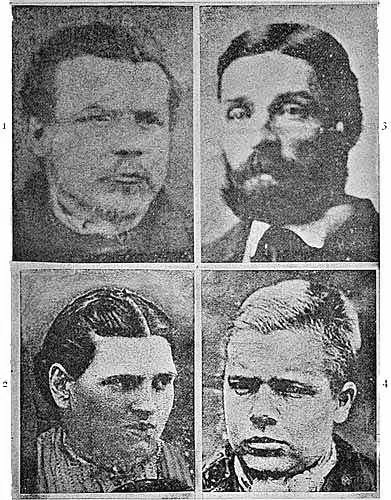
Jonathan Wild is an interesting example of a criminal of great practical ability, a man whose genius for organisation would have made him equal to any position in which he might have been placed. “In the republic of the thieves’ guild”—I quote Mr. Pike’s excellent summary of his career[61]—“Jonathan Wild became as it were a dictator; but like many of the great men of the middle ages, he owed his greatness to double dealing. From small beginnings he became, in London at least, the receiver-in-chief of all stolen goods. He acquired and maintained this position by the persistent application of two simple principles: he did his best to aid the law in convicting all those misdoers who would not recognise his authority, and he did his best to repair the losses of all those who had been plundered and who took him into their confidence. By degrees he set up an office for the recovery of missing property, at which the government must, for a time, have connived. Here the robbed sought an audience of the only man who could promise them restitution; here the robbers congregated like workmen at a workshop, to receive the pay for the work they had done. Wild was, in some respects, more autocratic than many kings, for he had the power of life and death. If he could reward the thief who submitted to him, he could hang the robber who omitted to seek his protection. If he could, for a sufficient fee, discover what had been lost, he could, when his claims were forgotten, make the losers repent their want of worldly wisdom. He was not above his position, and never allowed such a sentiment as generosity to interfere with the plain rules of business. He carried a wand of office, made of silver, which he asserted to be an indication of authority given to him by the government. Valuable goods he carefully stowed away in some of his numerous warehouses; and when there was no market for them in England, through the apathy of the persons robbed, or the dangers to dishonest purchasers, he despatched them on board a ship of his own to Holland, where he employed a trustworthy agent. Like barbarian monarchs, he gave presents when he wished to express a desire for friendship and assistance; and in order that the recipients of these favours might not be compromised, he retained a staff of skilled artizans, who could so change the appearance of a snuff-box, a ring, or a watch, that not even the real owner could recognise it. When satisfied with the good service of any of his subordinates who might be in danger, he gave them posts in his own household, with money and clothing, and found employment for them in clipping and counterfeiting coin. He did not even restrict his operations to London, but, in imitation of other great conquerors and pillagers, or perhaps through the independent working of his own intellect, he divided England into districts, and assigned a gang to each; each had to account to him, as the counties of old to the king, for the revenue collected. And as a well-appointed army has its artillery, its cavalry, and its infantry, so among Jonathan Wild’s retainers there was a special corps for robbing in church, another for various festivities in London, and a third with a peculiar aptitude for making the most of a country fair. The body-guards of a sovereign are usually chosen for their appearance, or for tried valour in the field. Wild’s principle of selection was somewhat different. He considered that fidelity to himself was the first virtue in a follower, and that fidelity was certain only when there was absolute inability to be unfaithful. For this reason the greatest recommendation which any recruit could possess was that he had been a convict, had been transported, and had returned before the time of his sentence had expired. Such a man as this not only had experience in his profession, but was legally incapable of giving evidence against his employer. Through his actions he was always in the power of Wild, who, as the law stood, could never be in his power. Thus Wild’s authority was in two ways supreme. Nor was he the first man who ever abused such authority. He did what political parties had done in earlier times. He used without stint or scruple all the means at his disposal, either to ensure his own safety, or to crush any one whom he suspected. It was necessary, according to the public opinion of his time, that a considerable number of thieves and robbers should be hanged; he satisfied at once the popular notions of justice and his own principles by bringing to the gallows all who concealed their booty, or refused to share it with himself. When required, he provided also a few additional victims in the form of persons who had committed no offence whatever. Sometimes he destroyed them because they were unfortunately in possession of evidence against himself, sometimes only because a heavy reward had been offered for the conviction of any one who might have perpetrated a great crime, and because, with the gang at his back, it was quite as easy to prove the case against the innocent as against the guilty, and not less convenient.” Wild’s greatness had a sudden fall. He was arrested for coming to the rescue of a highwayman near Bow, and his enemies at once took courage. He was speedily overwhelmed with evidence, and was hanged in 1725.
§ 3. Vanity.
The vanity of criminals is at once an intellectual and an emotional fact. It witnesses at once to their false estimate of life and of themselves, and to their egotistic delight in admiration. They share this character with a large proportion of artist and literary men, though, as Lombroso remarks, they decidedly excel them in this respect. The vanity of the artist and literary man marks the abnormal element, the tendency in them to degeneration. It reveals in them the weak points of a mental organisation, which at other points is highly developed. Vanity may exist in the well-developed ordinary man, but it is unobtrusive; in its extreme forms it marks the abnormal man, the man of unbalanced mental organisation, artist or criminal.
George Borrow, who was so keen a student of men, has some remarks on the vanity of criminals in regard to dress:—“There is not a set of people in the world more vain than robbers in general, more fond of cutting a figure whenever they have an opportunity, and of attracting the eyes of their fellow-creatures by the gallantry of their appearance. The famous Sheppard of olden times delighted in sporting a suit of Genoese velvet, and when he appeared in public generally wore a silver-hilted sword at his side; whilst Vaux and Hayward, heroes of a later day, were the best-dressed men on the pavē of London. Many of the Italian bandits go splendidly decorated, and the very gipsy robber has a feeling for the charms of dress; the cap alone of the Haram Pasha, a leader of the cannibal gipsy band which infested Hungary towards the conclusion of the last century, was adorned with gold and jewels to the value of four thousand guilders. Observe, ye vain and frivolous, how vanity and crime harmonise. The Spanish robbers are as fond of this species of display as their brethren of other lands, and, whether in prison or out of it, are never so happy as when, decked out in a profusion of white linen, they can loll in the sun, or walk jauntily up and down.” He then describes the principal features of Spanish robber foppery.[62]
More significant and even more widely spread is the moral vanity of criminals. “In ordinary society,” said Vidocq, “infamy is dreaded; among a body of prisoners the only shame is not to be infamous; to be an escarpe (assassin) is the highest praise.” This is universally true among every group of murderers or of thieves; the author of a large criminal transaction is regarded by all his fellows as a hero, and he looks down upon the others with contempt; the man who has had the misfortune to be imprisoned for a small or, in the opinion of criminal society, disreputable offence, represents himself as the author of some crime of magnitude.
A Russian youth of nineteen killed an entire family. When he heard that all St. Petersburg was talking of him, he said: “Now, my schoolfellows will see how unfair it was of them to say that I should never be heard of.” It is this same weak-minded desire to excite interest and sympathy which leads young men and women of ill-balanced mental organisation to commit suicide in some public and startling fashion. The same feeling, and also, doubtless, the need for expression, leads to the frequency with which criminals keep diaries. The Marquise de Brinvilliers wrote a minute account of her vices and crimes which was brought up in evidence against her; Wainewright appears to have kept a diary of this kind which also fell into other hands; John Wilkes Booth, the shallow-brained young actor who killed President Lincoln, had, with his stagy patriotism, some of the characteristics of the instinctive criminals, showing themselves especially in his morbid vanity. The chief suffering he felt after the deed was to his vanity. He wrote in his diary: “I struck boldly, and not as the papers say; I walked with a firm step through thousands of his friends; was stopped, but pushed on. A colonel was at his side. I shouted Sic Semper before I fired. In jumping broke my leg. I passed all the pickets. Rode sixty miles that night, with the bone of my leg tearing the flesh at every jump.” And again he writes: “After being hunted like a dog through swamps, woods, and last night chased by gun-boats till I was forced to return, wet, cold, and starving, with every man’s hand against me, I am here in despair. And why? For doing what Brutus was honoured for—what made Tell a hero.” And again: “I am abandoned, with the curse of Cain upon me, when, if the world knew my heart, that one blow would have made me great.”
The excessive vanity of the criminal sometimes leads him to commit the imprudence of talking about his plans beforehand, and so courting detection. Before killing three rich men, a murderer was heard to say, “I want to do something great: oh, I shall be talked about!” We hear of Wainewright’s “insatiable and morbid self-esteem.” He enjoyed the respect paid to him in prison, and insisted upon being treated as a gentleman. A prisoner concluded a letter to her accomplice, “Your Lucrezia Borgia.” Sometimes the vanity of the criminal shows itself in the artistic or dramatic representations which he makes of his crime. Perhaps the most curious and audacious attempt is that recorded by Lombroso, who gives a representation of it: three assassins had themselves photographed as they appeared with knives in their hands and looks of resolute villainy, when about to commit the deed.
The Abbé Moreau has described the reception of a great criminal by his fellows at the prison of La Grande Roquette. He is immediately surrounded, though the curiosity remains respectful; “he is a king in the midst of his subjects; envious looks are cast at those privileged individuals who have succeeded in placing themselves near him; they listen eagerly for his slightest word; they do not speak their admiration for fear of interrupting him, and he knows that he dominates and fascinates them.”
§ 4. Emotional Instability.
The criminal everywhere is incapable of prolonged and sustained exertion; an amount of regular work which would utterly exhaust the most vigorous and rebellious would be easily accomplished by an ordinary workman. He is essentially idle; the whole art of crime lies in the endeavour to avoid the necessity of labour. This constitutional laziness is therefore one of the chief organic bases of crime. Make idleness impossible and you have done much to make the criminal impossible. It is not without reason that French criminals call themselves pègres (from pigritia), the idle. Lemaire, a notorious French criminal of the beginning of the century, was speaking for all his class when he said to his judges: “I have always been lazy; it is a shame, I admit, but I am not adapted for work; to work one needs an effort, and I am incapable of it; I only have energy for evil; if one must work I do not care about life; I would rather be condemned to death.”
While he is essentially lazy, and exhibits this even in his general neglect of personal cleanliness (though sometimes dressed outwardly as an ordinary man of the world), the criminal is capable of moments of violent activity. He cannot, indeed, live without them; they are the chief events of his spiritual life.
Louis Desprez, an unfortunate littérateur, imprisoned at Saint-Pélagie for a literary offence, “summed up the psychology of criminals,” remarks M. Émile Gautier, “in one picturesque formula: They see the world under the aspect of an immense gaol alternating with an immense brothel. And this is true. For them imprisonment is the normal condition. Liberty is their holiday, an occasional transitory holiday, during which they wallow in the far niente and debauch, like sailors who consume in three days the earnings of eighteen months, but a holiday which will have an end, a foreseen and expected end.”
The criminal craves for some powerful stimulus, excitement, uproar, to lift him out of his habitual inertia. That is why the love of alcohol is in all countries so strong among criminals. The man who is organised as we have seen the criminal to be must have some powerful stimulant to take him out of himself, to give him a joy which is otherwise beyond his grasp, and alcohol is the stimulant which comes easiest to hand. When, as frequently happens, he is the child of alcoholic parents, the craving for drink soon obtains morbid intensity. Crime and drink are intimately bound together, although we must beware of too unreservedly setting down drink as the cause of crime. Both crime and drink are the morbid manifestations of organic defects which for the most part precede birth. The abuse of alcohol is not, however, universal among criminals, at all events when any intellectual ability is required. “It would not do to drink in our business,” said a sharper to Lombroso.
The criminal finds another strong form of excitement in gambling. The love of cards is even more widely spread among criminals than the love of drink. It frequently becomes a passion. Lauvergne tells of a band of criminals who played for two days without intermission. We hear of a French prisoner who gambled away his meagre rations of bread and wine and at last died of starvation; of another who in the excitement of the game forgot his approaching execution.
To all forms of sexual excitement, natural and unnatural, criminals of both sexes resort, often from a very early age. The prison, in which the criminal is confined alone, or with persons of the same sex, serves to develop perverted sexual habits to a high degree. Prince Krapotkine, speaking of the moral influence of prisons on prisoners in France, writes:—“The facts which we came across during our prison life surpass all that the most frenzied imagination could invent. One must have been for long years in a prison, secluded from all higher influences and abandoned to one’s own and that of a thousand convicts’ imaginations, to come to the incredible state of mind which is witnessed among some prisoners. And I suppose that I shall say only what will be supported by all intelligent and frank governors of prisons, if I say that the prisons are the nurseries for the most revolting category of breaches of moral law.”[63] There is unquestionable evidence that the same practices exist, notwithstanding all discipline, in English prisons.
Such practices grow up chiefly as a means of excitement and diversion in vacuous lives. Love, in its highest and strongest forms, seems to be extremely rare. This is true even when love is the cause of the crime. The love, even when strong, remains rather brutal. When a man was asked if he really loved the woman for whose sake he had murdered her husband, he replied: “Oh, if you had seen her naked!”
The craving for excitement, for intoxication, for uproar, finds its chief satisfaction in the love of orgy, which is now almost confined, at all events in its extreme forms, to the criminal and his intimate ally, the prostitute. The orgy is the criminal’s most sacred festival; here he attains his highest experiences of forgetful exhilaration. Vidocq, still a criminal at heart, even after he had become a police official, has described the orgy in his Memoirs:—“Imagine a rather large square hall, with walls, once white, now blackened by exhalations of every kind: such is, in all its simplicity, the aspect of a temple of Bacchus and Terpsichore. At first by a very natural optical illusion, one is only struck by the smallness of the place, but when the eye succeeds in piercing the atmosphere, thick with a thousand vapours which are not inodorous, the size becomes manifest by the details which escape from the chaos. This is the moment of creation; everything clears up; the mist dissipates, becomes peopled and animated; there is movement, agitation, not of empty shadows but of substantial forms which cross and interlace in every direction. What beatitude! What a joyous life! Never for epicureans were so many felicities gathered together as here for those who love to wallow in mire. Around, rows of tables, on which, without their ever being cleaned, disgusting libations are renewed a hundred times a day, serve to frame in a space which is reserved for what are called the dancers. At the end of this infectious den rises, supported by four worm-eaten pillars, a kind of platform, its construction hidden by two or three fragments of old tapestry. On this hencoop the musicians are perched, two clarinettes, a fiddle, a loud trombone, and a deafening drum.... In this receptacle one finds none but prostitutes and their bullies, sharpers of all kinds, swindlers of the lowest sort, and a good many of those disturbers of the night whose lives are divided into two parts, one consecrated to rowdyism, the other to robbery.”
More interesting than this resort to external sources of stimulus, and more significant of emotional instability, are the spontaneous outbursts of excitement common among criminals, curious self-evolved intoxications springing from mysterious and incalculable depths of the organism. Dostoieffsky has studied these outbursts and admirably described them. “A prisoner has lived tranquilly,” he tells us,[64] “for several consecutive years, and his conduct has been exemplary. All at once, to the great astonishment of his guardians, he mutinies and recoils before no crime, even murder or rape. Every one is astonished. This unexpected explosion is the anguished, convulsive manifestation of personality, an instinctive melancholy, a desire to affirm the degraded ego, an emotion which obscures the judgment. It is like a spasm, an access of epilepsy; the man who is buried alive and who suddenly awakes strikes in despair against his coffin-lid; he strives to push it back, to raise it; his reason convinces him of the uselessness of all his efforts, but reason has nothing to do with his convulsions. It must not be forgotten that nearly every manifestation of the personality of the prisoner is considered a crime; also that the question whether the manifestation is important or insignificant is perfectly indifferent to the prisoner. Risk for risk, it is better to go to the extreme, even to murder. It is only the first step that costs; little by little the man is carried away and can no longer be held in.” The prison has much to answer for in the development of these emotional outbreaks, and it is only in prison that there is opportunity of studying them. It would, however, be rash to conclude that they are entirely due to prison conditions. They are in harmony with all that we know of criminal psychology, and it is not alone under prison conditions that they are the causes of crime.
In Germany these periodic explosions (known as Zuchthaus-Knall) have been described by Delbrück and Krafft-Ebing. In Italy they have been noted by Lombroso, especially in very hot weather and at such times as epileptic attacks are most frequent, and he regards them as fresh proof of a close relationship between the instinctive criminal and the epileptic. In England they appear to be rare in men, but, on the other hand, common in women who have, in prison language, “broken out.” This wild fit of maniacal violence which from time to time seizes on the women confined in prisons, and might almost be regarded as an exaggerated or vicarious form of orgy, has been studied with some care in England. Here as well as abroad it is frequently supposed to be a voluntary insubordination deserving punishment.
A lady superintendent thus described the “breaking out” to Mayhew:—“Sometimes they know when the fit is coming on, and will themselves ask to be locked up in the refractory wards. When they’re in these fits they’re terribly violent indeed; they tear up and break everything they can lay their hands on. The younger they are the worse they behave. The most violent age, I think, is from seventeen to two or three and twenty;—indeed they are like fiends at that age very often.” The medical officer told him that “4 per cent. of the whole of the prisoners, or 20 in 600, were subject to such fits of violent passion, and these were almost invariably from fifteen to twenty-five years of age.” “Women,” he added, “seldom injure themselves or those around them, though they will break their windows, and even occasionally tear their own clothing to ribbons.”[65]
Miss Mary Carpenter, in her Female Life in Prison, reproduces what she tells us is a characteristic dialogue:—
“‘Miss G., I’m going to break out to-night.’
“‘Oh, nonsense; you won’t think of any such folly, I’m sure.’
“‘I’m sure I shall.’
“‘What for?’
“‘Well, I’ve made up my mind, that’s what for. I shall break out to-night—see if I don’t.’
“‘Has any one offended you or said anything?’
“‘N-no. But I must break out. It’s so dull here. I’m sure to break out.’
“‘And then you’ll go to the “dark” [cell].’
“‘I want to go to the “dark.”’
“And the breaking out often occurs as promised; the glass shatters out of the window frames; strips of sheets and blankets are passed through or left in a heap in the cell; the guards are sent for, and there is a scuffling and fighting and scratching and screaming that Pandemonium might equal, nothing else.”
Dr. Nicolson has made an interesting observation as to the periods when these “breakings-out” are most liable to occur. “At dates corresponding with the menstrual period there is a greater likelihood of their occurrence. Besides having verified this in several cases myself, I have the testimony of experienced prison matrons to the same effect.” These maniacal outbursts of hysteria may be compared to the somewhat similar effects observed especially at the menstrual periods among the epileptic, the insane, and the imbecile. Thus Dr. H. Sutherland (West Riding Asylum Reports, vol. ii.), from observations on 500 inmates of the West Riding Asylum, remarks that in epileptic insanity the fits are generally increased in number, and the patients generally become excited at the catamenial period; while the mania exacerbations usually occur at this time. He notes the frequency of excitement, violence, indecent language, tearing up clothes, etc., among insane women generally at this period. In a girl with congenital imbecility, who became violent, cruel, and capricious at puberty, Dr. Langdon Down noted that the monthly period was always marked by insubordination, violent language, rude gestures, and untruthfulness. In ordinary healthy young girls the onset of the monthly period is often marked by a fit of unusual boisterousness.
The period of the year seems also to have some influence on the emotional instability. Miss Carpenter remarks that “the prisoners are always the most ill-behaved at Christmas time,” perhaps because this period has, even before the days of Christianity, been associated with excesses. Among the men at Elmira, judging from the charts given by Dr. Wey, there is a tendency to insubordination in the autumn, and also in the spring. In Spanish prisons, it appears from Salillas’s Vida Penal en España, quarrels and arrests are much more common in spring and summer than at any other season. Thus, to take one record: March-May, 8; June-Aug., 9; Sept.-Nov., 4; Dec.-Feb., 3. Two suicides both occurred in September.
Very interesting is the instinctive and irresistible character of criminal impulses, as shown by evidence which there is no good reason to impeach. Casanova, speaking of his clever schemes of fraud, says: “When I put into execution a spontaneous idea which I had not premeditated, it seemed to me that I was following the laws of destiny, and yielding to a supreme will.” Several pickpockets have said to Lombroso: “You see, in those moments of inspiration (sic) we cannot restrain ourselves, we have to steal.” “I did try very hard, Miss,” the women will sometimes say to the matron, remarks Miss Carpenter, “but it wasn’t to be. I was obliged to steal, or to watch some one there was a chance of stealing from. I did try my best, but it couldn’t be helped, and here I am. It wasn’t my fault exactly, because I did try.” A pickpocket said to Marro: “When I see any one pass with a watch in his pocket, even though I have no need of money, I feel a real need to take it.” Dostoieffsky, giving a minute account of one of the convicts who was most feared, but who was sincerely devoted to him, says: “He sometimes stole from me, but it was always involuntary; he scarcely ever borrowed from me, so that what attracted him was not money or other interested motive.” Once it was a Bible which he sold to obtain drink. “Probably he felt a strong desire for drink that day, and when he felt a strong desire for anything it had to be satisfied. I endeavoured to reproach him as he deserved, for I regretted my Bible. He listened to me without irritation, very peacefully; he agreed with me that the Bible is a very useful book, and he sincerely regretted that I no longer possessed it, but he felt no repentance, not even for an instant, for having stolen it; he looked at me with such assurance that I immediately ceased to scold him. He bore my reproaches because he judged that it could not be otherwise, that he deserved to be blamed for such an action, and that I ought to abuse him, in order to relieve myself, as a consolation for the loss; but privately he esteemed it a folly, a folly which a serious man would have been ashamed to speak of. I even think he regarded me as a child, an urchin who does not understand the simplest things in the world.”
Precisely the same instinctive and involuntary impulses, unaccompanied by shame, are found among various lower races. Of the natives of British New Guinea, for instance, it has been said, “They are inveterate thieves, but they experience no sense of shame when they are discovered. They frequently say that they can feel an irresistible power which compels them to put out their hand and close it upon some article which they covet, but which does not belong to them.”[66]
§ 5. Sentiment.
It may seem a curious contradiction of what has already been set down concerning the criminal’s moral insensibility, his cruelty, and his incapacity to experience remorse, when it is added that he is frequently open to sentiment. It is, however, true. Whatever refinement or tenderness of feeling criminals attain to reveals itself as what we should call sentiment or sentimentality. Their cynicism allies itself with sentiment in their literary productions. Their unnatural loves are often sentimental, as revealed in the character of the tattoo marks. Two interesting examples of criminal sentiment have recently been recorded by Dr. Lindau. A German criminal (it is perhaps as well to note that he was a German), having murdered his sweetheart most cruelly, went back to her house to let out a canary which might suffer from want of food. Another, after having killed a woman, stayed behind to feed her child which was crying. Lacenaire, on the same day that he committed a murder, risked his own life to save that of a cat. Eugene Aram was very indulgent to animals. Wainewright was always very fond of cats; in his last days “his sole companion was a cat for which he evinced an extraordinary affection.” One of the chief characters of Wainewright’s essays is their sentimentality. Himself, when in prison, he described as the possessor of “a soul whose nutriment is love, and its offspring art, music, divine song, and still holier philosophy.”
PLATE XI.
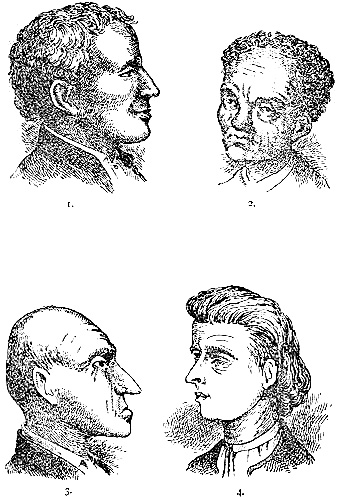
All prisoners make pets of birds, or animals, or flowers, if they get the chance. This is simply the result of solitude, and has no connection whatever with criminal psychology. It is found, if anything, more frequently among non-criminal prisoners. No one has described better than Dostoieffsky, in his Recollections of the Dead-House, the part that animals play in the lives of prisoners. He describes at length the goat, the horse, the dogs, the ducks, the eagle. No one who has once read it may forget the history of the eagle. The eagle would not be tamed; solitary and inconsolable he refused all food; at last his mournful despair aroused the sympathy of the convicts; they resolved to liberate him, bore him to the ramparts on the cold and grey autumn afternoon, and stood long and wistfully watching him as he winged his way across the steppes, free.
Family affection is by no means rare among criminals. Often indeed, as is well known, it constitutes the motive for the crime. It is very rare to find a prisoner who is not touched by an allusion to his mother. Inspector Byrnes, of New York, says: “Remember that nearly all the great criminals of the country are men who lead double lives. Strange as it may appear, it is the fact that some of the most unscrupulous rascals who ever cracked a safe, or turned out a counterfeit, were at home model husbands and fathers. In a great many cases wives have aided their guilty partners in their villainy, and the children too have taken a hand in it. But in as many all suggestions of the criminal’s calling was left outside the front door. There was George Engles, the forger. His family lived quietly and respectably, mingled with the best of people, and were liked by all they met. George Leonidas Leslie, alias Howard, who was found dead near Yonkers, probably made away with by his pals, was a fine-looking man, with cultured tastes and refined manners. Billy Porter and Johnny Irving were not so spruce, but they would pass for artisans; and Irving is said, in all his villainy, to have well provided for his old mother and his sisters. Johnny the Greek paid for his little girls’ tuition at a convent in Canada, and had them brought up as ladies, without even a suspicion of their father’s business reaching them. I know this same thing to be done by some of the hardest cases we have to contend with.”
Inspector Byrnes also mentions a celebrated burglar and forger of America, called by the fraternity “the Prince of Thieves,” on account of his great liberality; “it is a well-known fact that he has always contributed to the support of the wives and families of his associates when they were in trouble.”
The criminal appreciates sympathy. Dostoieffsky tells how immediately the convicts responded to a governor who was affable and good-natured, and treated the prisoners as equals: “They did not love him, they adored him.... I do not remember that they ever permitted themselves to be disrespectful or familiar. On the contrary. When he met the governor the convict’s face suddenly lighted up; he smiled largely, cap in hand, even to see him approach.” Prince Krapotkine quotes and confirms the observations of Dr. Campbell, an experienced prison surgeon. By mild treatment, says Dr. Campbell, “with as much consideration as if they had been delicate ladies, the greatest order was generally maintained in the hospital.” He was struck with that “estimable trait in the character of prisoners—observable even among the roughest criminals; I mean the great attention they bestow on the sick. The most hardened criminals,” he adds, “are not exempt from this feeling.”
Such sentiment as this—limited, imperfect, fantastic, as it may sometimes seem—is the pleasantest spot in criminal psychology. It is also the most hopeful. In the development of this tenderness lies a point of departure for the moralisation of the criminal. What a ruined fund of fine feeling, for instance, was concealed in the young thief, recorded by Lombroso, who committed suicide by hanging, having first set his shoes on the bed between two straw crosses, as though to say, “I am going; pray for me.” “If one thinks of it,” adds Lombroso, “it is a pathetic poem.”
§ 6. Religion.
In all countries religion, or superstition, is closely related with crime. The Sansya dacoits, in the Highlands of Central India, would spill a little liquor on the ground before starting on an expedition, in order to propitiate Devi. “If any one sneezed, or any other very bad omen was observed, the start was postponed. If they heard a jackal, or the bray of the village donkey, their hearts were cheered; but a funeral or a snake turned them back. They were also very superstitious about their oil. The vessel was not allowed to touch the ground until the oil had been poured upon the torch, and then it was dashed on the earth; and from that moment until the job was finished no water touched their lips.”[67]
Among 200 Italian murderers Ferri did not find one who was irreligious. “A Russian peasant,” remarks Mr. Kennan, “may be a highway robber or a murderer, but he continues nevertheless to cross himself and say his prayers.” Dostoieffsky also notes the religious ardour with which the convicts gave candles and gifts to the church. All those who live by unlawful methods, said Casanova, confide in the help of God. Naples is the most criminal city in Europe for crimes against the person; the number of murderers there is about 16 in 100,000, while in Italy generally it is 8.12; and in Ireland (the least criminal land in Europe) it is about 5. Naples is also the most religious city in Europe. “No other city,” observes Garofalo,[68] “can boast of such frequent processions; no other, perhaps, is so zealous an observer of the practices of the church. But unfortunately—as an illustrious historian [Sismondi], speaking of the Italians of his day, wrote—‘the murderer, still stained with the blood he has just shed, devoutly fasts, even while he is meditating a fresh assassination; the prostitute places the image of the Virgin near her bed, and recites her rosary devoutly before it; the priest, convicted of perjury, is never inadvertently guilty of drinking a glass of water before mass.’ Those words of Sismondi’s,” Garofalo adds, “are as true to-day as when they were written.” Of Marro’s 500 criminals, 46 per cent. were regular frequenters of church, 25 per cent. went irregularly. Among sexual offenders the proportion of frequenters rose to 61 per cent. A man of sixty, known to Marro, imprisoned for rape on a child of eight, was much scandalised at the irreligious talk of some of his companions. “I do not imitate them,” he said; “morning and evening I say my prayers.”
Among women, the governor of Saint Lazare remarked to M. Joly, it is especially the criminals by passion who are superstitious, thieves very slightly so; they are practical women.
It must not be supposed that there is insincerity or hypocrisy in the religion of criminals. For the man of low culture the divine powers lend themselves easily to the succour of the individual, and it is always as well to propitiate them. German murderers believe they can do this crudely, according to Casper, by leaving their excrement at the spot of the crime. A rather higher grade of intelligence will effect the same end by prayer. A wife who was poisoning her husband wrote to her accomplice:—“He is not well ... if God wished it. Oh, if God would have pity on us, how I would bless Him! When he complains [of the effects of the poison] I thank God in my heart.” And he answers, “I will pray to Heaven to aid us.” And she again, “He was ill yesterday. I thought that God was beginning His work. I have wept so much that it is not possible God should not have pity on my tears.” Lombroso found 248 tattooed prisoners out of 2480 bearing religious symbols, while the slang of criminals witnesses to a faith in God, in the immortality of the soul, and in the church. When a woman who had strangled and dismembered a child, in order to spite its relations, heard her sentence of death pronounced, she turned to her advocates and said, “Death is nothing. It is the salvation of the soul that is everything. When that is safe, the rest is of no account.”
It is clear how easily religious beliefs and religious observances, especially in Catholic countries, lend themselves to the practices of the ignorant criminal, and it very rarely happens that the criminal condemned to death fails to avail himself of the ministrations of the chaplain (only once in more than thirty years at La Roquette), and frequently to respond to them with gratifying eagerness. In religion his primitive emotional nature, with its instability and love of sentiment, easily finds what it needs. A French chaplain of experience and intelligence told M. Joly that he had “more satisfaction” with his prisoners than with people of the world. The Rev. E. Payson Hammond, who has conducted many missions to prisoners, finds very great aptitude for conversion among them. Of the convicts of the State Prison of Jefferson City, in the United States, for instance, he remarks:—“Many hearts were melted to tears, and I believe that a very large number were converted.” “Convicts at their last hour,” wrote Lauvergne, “nine times out of ten die religiously. Whatever the enormity of their crimes, they all leave durable recollections in the heart of the priest who assists them. He sees them long afterwards in his dreams, beautiful and happy.”
When the criminal is not superstitiously devout, he is usually stupidly or brutally indifferent. Maxime du Camp, during a visit to the prison of Mazas, at service time on Sunday, had the curiosity to look into thirty-three cellules, to observe the effect of the ceremony: three were reading the mass; one stood up, with covered head, looking at the altar; one was on his knees; one displayed a prayer-book, but was reading a pamphlet; one wept with head buried in his arms; twenty-six sat at their tables, working or reading.
It seems extremely rare to find intelligently irreligious men in prison. The sublime criminals whom we meet with in Elizabethan dramas, arguing haughtily concerning Divine things and performing unheard-of atrocities, are not found in our prisons. Free-thinkers are rarely found. A trifle will induce the prisoner to inscribe himself as Protestant, instead of Catholic, or vice versâ, or to change from one side to the other; but out of 28,351 admissions to three large metropolitan prisons, remarks the Rev. J. W. Horsley, only fifty-seven described themselves as atheists, and this number, he adds, must be further reduced as containing some Chinese and Mahommedans. It should be noted that a profession of atheism would deprive the prisoner of no advantage or privilege open to the others. Mr. Horsley once resolved to keep notes of the first twelve consecutive cases of those who on entrance described themselves either positively as atheists or negatively as of no religion. The results were interesting: 1 was a thief, a rather ignorant person, whose chief reason for being an infidel was that his parents had “crammed religion down his throat.” 2 an ex-soldier, a heavy drinker, and when asked why he had described himself as an atheist, “he said he only called himself mad;” he was actually insane. 3 a burglar, who said he meant that he never attended church because he had seen so much hypocrisy among professing Christians; in a few days he gave up the designation of atheist. 4 was a swindler, a great liar, and probably insane. 5 was a lad of nineteen, of very little intellect, who had deserted from the army; his father had been “a follower of Bradlaugh.” 6 a German Jew, who frequented Christian churches, but not having been baptised, simply did not know how to describe himself. 7 an intemperate schoolmaster, charged with deserting his family; he meant that he had ceased to attend religious worship because he was conscious that his religion was merely formal; his “atheism” was simply a form of penitent self-abnegation. 8 a conceited lad of seventeen who had assaulted his guardian, and had adopted atheism to justify his spirit of revenge. 9 a young man who had robbed his employer; he was brought up under religious influences, but having attracted attention by objecting to revealed religions, became a Secularist lecturer. 10 a prostitute and dipsomaniac with 150 convictions; always called herself an atheist when she was in a bad temper or drunk. 11 a young baker who had taken poison; called himself an atheist under influence of laudanum; goes regularly to a Congregational Chapel. 12 a girl of fifteen; she meant that she rarely, if ever, attended any place of worship. So that only in two or three, or at most four cases out of the twelve, was there profession of atheism in any legitimate sense of the word.
PLATE XII.
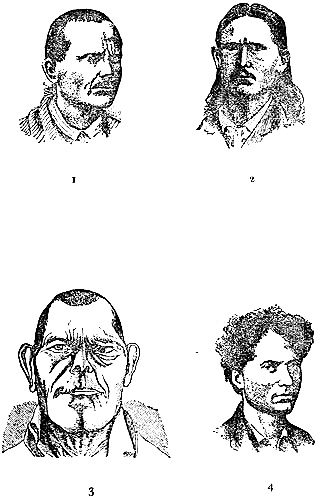
§ 7. Thieves’ Slang.
Every profession, every isolated group of persons, almost every family possesses a more or less extended set of words and phrases which are unintelligible to strangers. This dialect is termed in English slang, in French argot, in Italian gergo. The most highly developed and the most widely extended slang of this kind is that used by habitual criminals. Every country has its own thieves’ slang, but within the bounds of that country the slang is generally intelligible; the Lombard thief, Lombroso remarks, can understand the Calabrian; Parisian argot is intelligible at Marseilles. The use of criminals’ slang marks the recidivist. “When a man talks argot,” said the Abbé Crozes, “he is registered in the army of evil-doers.”
“I was jogging down a blooming slum in the Chapel, when I butted a reeler, who was sporting a red slang. I broke off his jerry, and boned the clock, which was a red one, but I was spotted by a copper, who claimed me. I was lugged before the beak, who gave me six doss in the Steel. The week after I was chucked up I did a snatch near St. Paul’s, was collared, lagged, and got this bit of seven stretch.” That is a pickpocket’s history of his arrest as narrated to Mr. Davitt. Here is the translation:—“As I was walking down a narrow alley in Whitechapel, I ran up against a drunken man, who had a gold watch-guard. I stole his watch, which was gold, but was seen by a policeman, who caught me and took me before the magistrate, who gave me six months in the Bastille [the old House of Correction, Coldbath Fields]. When I was released I attempted to steal a watch near St. Paul’s, but was taken again, convicted, and sentenced to seven years’ penal servitude.”
Mr. Horsley has an interesting passage on English thieves’ slang, which I will transcribe at length:—“Of multifold origin, it is yet mainly derived from Romany or gipsy talk, and thereby contains a large Eastern element, in which old Sanskrit roots may readily be traced. Many of these words would be unintelligible to ordinary folk, but some have passed into common speech. For instance, the words bamboozle, pal (companion, a friend), mull (to make a mull or mess of a thing), bosh (from the Persian), are pure gipsy words, but have found some lodging, if not a home, in our vernacular. Then there are survivals (not always of the fittest) from the tongue of our Teutonic ancestors, so that Dr. Latham, the philologist, says—‘The thieves of London’ (and he might still more have said the professional tramps) ‘are the conservators of Anglo-Saxonisms. Next there are the cosmopolitan absorptions from many a tongue. From the French bouilli we probably get the prison slang term ‘bull’ for a ration of meat. ‘Chat,’ thieves’ term for house, is obviously château. ‘Steel,’ the familiar name for Coldbath Fields Prison, is an appropriation and abbreviation of Bastille; and he who ‘does a tray’ (serves three months’ imprisonment) therein, borrows his word from our Gallican neighbours. So from the Italian we get casa for house, filly (figlia) for daughter, donny (donna) for woman, and omee (uomo) for man. The Spanish gives us don, which the universities have not despised as a useful term. From the German we get durrynacker, for a female hawker, from dorf, a village, and nachgehen, to run after. From Scotland we borrow duds for clothes, and from the Hebrew shoful for base coin. Purely of native manufacture, however, and entirely artificial, are the two classes of rhyming and back-slang which mingle with cant to make a whole. By the former, any word that rhymes with the one you mean to use is put in its place, and gradually becomes accepted. This has the merit of unintelligibility when it is desired not to let chance passers-by know of what we are speaking, which naturally occurs not seldom in the days of detectives and plain-clothes constables. Suppose I have ‘touched’ (i.e., been successful in some robbery), and feel inclined for some relaxation in company with my sweetheart (or one of them), I might address her thus—‘Come, cows and kisses, put the battle of the Nile on your Barnet Fair, and a rogue and villain in your sky-rocket; call a flounder and dab with a tidy Charing Cross, and we’ll go for a Bushey Park along the frog and toad into the live eels.’ This would apparently be but a pendant to the celebrated bit of nonsense extemporised by Foote, but, as a matter of fact, to a master or mistress of rhyming slang it would at once be understood as—‘Come, missus, put a tile (hat) on your hair, and a shilling in your pocket; call a cab with a tidy horse, and we’ll go for a lark along the road into the fields.’ And the second class of manufactured slang is that largely patronised by costermongers. It is called back-slang, and simply consists of spelling (more or less accurately) words backwards. Thus—‘Hi, yob! kool that enif elrig with the nael ekom. Sap her a top o’ reeb and a tib of occabot,’ is only, ‘Hi, boy! look at that fine girl with the lean moke (donkey). Pass her a pot of beer and a bit of tobacco.’ The art or merit of this form of slang consists in the rapidity, often remarkable, with which such words can be reversed. Thus a gentleman, wishing to test the skill of a professor of the art with a word not in common use in the market, asked his coster friend what was the back slang for hippopotamus. At once he answered, ‘Summatopoppy,’ the y being euphoniously put for ih.”[69] Mr. Davitt thus describes a form of slang (“thieves’ Latin”) commonly used by professional burglars and the superior order of thieves:—“Its chief peculiarity consists in reversing the position of the syllables of a word containing more than one syllable, and making two syllables of all words having only one in ordinary pronunciation, by adding a vowel or liquid consonant to the first or second part of such word. By the application of this simple rule to slang words, the ‘lingo’ becomes too complicated for any but the initiated to understand. For instance, if two thieves were hunting for game, and one were to see a policeman, he would shout to his comrade—‘Islema! Ogda the opperca!’ which in slang is—‘Misle! Dog the copper!’ Otherwise—‘Vanish! See the policeman!’”[70] Very similar practices prevail in the thieves’ slang of France, Italy, Spain, and India. It is doubtless, indeed, universal. Closely allied is the kind of slang called largongi, by which, for example, macaroni becomes lacaronimique, and vache, lachevane.
The chief interest of the slang of habitual criminals is psychological. It furnishes us with a curious insight into the mental processes of those who invent and use it; it is itself an embodiment of criminal tendencies; in Victor Hugo’s vigorous phrase, “C’est le verbe devenu forçat.” It is full of metaphorical expressions, of objects named after their attributes. Nearly everything is degraded, sometimes with coarse and fantastic wit. “While the imagination of the poet gives a soul to animate objects,” remarks M. Joly, “the imagination of the criminal transforms living forms into things, assimilates man to animals.” Thus the skin for them is leather, the face un mufle, the mouth un bec, the arm un aileron. The body is called the corpse, and to eat is to put something in one’s corpse. The woman who supports a bully is called his saucepan (marmite), a friend un poteau; ne pas être méchant means to be a fool. Everything is thus vulgarised. The criminal instinctively depreciates the precious coinage of language, just as to his imagination money is at Paris “zinc,” and in the Argentine Republic “iron.”
The soul in French argot is significantly called la fausse, and the conscience la muette; shame is simply la rouge. In English slang, as Mr. Horsley remarks, “the delicate expression ‘fingersmith’ is descriptive of a trade which a blunt world might call that of a pickpocket. Or, again, to get three months’ hard labour is more pleasantly described as getting thirteen clean shirts, one being served out in prison each week. The tread-wheel again is more politely called the everlasting staircase, or the wheel of life, or the vertical care-grinder. Penal servitude is dignified with the appellation of serving her Majesty for nothing, and an attempt is even made to lighten the horror of the climax of a criminal career by speaking of dying in a horse’s night-cap—i.e., a halter.” So that while the better things of life are degraded, there is a tendency to elevate those that truly indicate degradation.
The criminal slang of France and Italy has been studied in its psychological bearings much more thoroughly than the English, by Mayor, Lombroso, and others. Lombroso considers that the most marked and most curious characteristic of criminal slang is that already noted by which a thing is designated by its most salient qualities from the criminal point of view. Thus the advocate becomes the blanchisseur or imbiancatore (washerman); the juge d’instruction, the curicux or the père sondeur; the sermon, l’ennuyeuse or tediosa; the purse is la santa; the court, la juste. “The guillotine,” remarks M. Joly, “is designated without imprecation, without contempt, without hatred, but with a wealth of expressions and with a resignation, one might almost say a fatalistic humour, which is not reassuring for them—or for others. The executioner himself is called the juge de la paix.”
Etrangler un perroquet is to drink a glass of absinth, the allusion being to the colour (green), and also, it is said, to the sensation in swallowing the absinth, and to other minute points. A prostitute is the hôtel du besoin, a Louis-quinze, and also the bourre-de-soie, in allusion, it is said, to murmured offers and a silk dress; the brothel is le cloaque. In Venetian slang a promise is called a shadow. In Bavarian cant a playing card is karzerweg—the road to prison.
Very strange, remote, and bizarre are some of these slang synonyms, full of coarse ironies and jests. Paradouze = paradis (douze instead of dise); saucisse = moi (by way of moi-s-aussi); crottard = trottoir; blanchir du foie = to intend betrayal (play on foi); perdreau = pederaste (pedro-pédero); herbe sainte = absinthe; être dans l’infanterie = to be pregnant (enfanter); moulin à vent = derrière; pape = verre de rhum (Rome); veronique = lanterne (verre); vert-de-gris = absinthe (play on vert and verre, with allusion to its deleterious properties); demoiselle du Pont-neuf (that all may go over) = prostitute; apaier = to assassinate; boire dans la grande tasse = to drown oneself; a knife is a lingre (from Langres, the French Sheffield); the souteneur (a prostitute’s bully) is called by the English word fish, or some similar name (poisson, goujon, baraillon, maquereau); the prostitute is called morue, and Banc de Terre-Neuve is applied to that portion of the Parisian boulevards lying between the Madeleine and the Porte Saint-Denis.
Sometimes the slang of criminals, like that of the rest of the world, commemorates an historical fact. To dethrone in France is juilletiser. The sun is le grand Jablo, Jablochoff’s electric lamps having been the first used to illuminate Paris. A coup de Raguse is a defection, in allusion to the Duke of Ragusa. In Italy a drunkard is called a Frenchman, a beggar a Spaniard, a card-sharper a Greek. In Spain a thief is called a Murcio, from the province of Murcia.
Words are frequently abbreviated. As examples, Lombroso mentions tra = travail; ces mess = ces Messieurs = the police; chand = marchand; lubre = lugubre; abs = absinthe; avoir ses aff = avoir ses affaires (menstrues); mac = maquereau = souteneur, of a prostitute.
Very curious are the large number of foreign words, in more or less corrupted form generally, which are to be found in criminal slang. In the German cant Hebrew words are numerous; German and French in Italian; German and English in French; Italian and Romany in English. “Hebrew, or rather Yiddish,” Lombroso observes, “supplies the half of Dutch slang, and nearly a fourth of German, in which I counted 156 out of 700, and in which all the terms for various crimes (except band-spicler for a cheater at dice) are Jewish.” The presence of archaisms, classical and mediæval, is also curious.
It is more interesting to find a revelation of the things in which the criminal is most intimately interested by noting the wealth and variety of synonyms for certain words. Thus Cougnet and Righini found 17 words for warders or police; 9 for the act of sodomy; 7 for plunder. French cant has 44 synonyms for drunkenness, besides 20 for drinking, and 8 for wine, in all 72; while there are only 19 for water and 36 for money.
This slang is largely of ephemeral life, but a considerable proportion is permanent. Its tendency is, however, to die out. The modern professional criminal avoids slang as he avoids tattooing.
PLATE XIII.
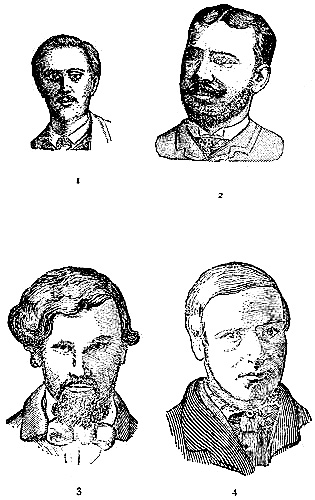
§ 8. Prison Inscriptions.
Whenever the average human being is secluded for any considerable length of time from his fellows, he experiences the need of embodying some literary or artistic expression of himself. This instinct seems to be deeper and more wide-spread than that which induces some people to leave their names or other sign manual—the frothiest efflorescence of vain moments—on the places they visit. There is no vanity here, and it is an instinct from which no individual, whatever his degree of culture, is exempt; it is indeed scarcely distinguishable from the instinct which leads to the production of heroic works of art. The expression must vary with the individual. I knew a room, the residence of a long succession of medical students during certain weeks of seclusion involved by hospital duty, of which the walls were covered by inscriptions, humorous or broadly witty, cleverly artistic sketches, happy lines from the classics. Each person’s inscription is after his kind: Mgr. Darboy, the Archbishop of Paris, writes in the form of a cross, “O crux, mentis robur, ave;” Bill Sykes at Clerkenwell writes, “Lads, your only friend here is your brown lofe and pint of thick.”
In general, it seems, the lower the order of culture the more complete and trustworthy is the inscription as an expression of individual peculiarities. “The child loves to speak to himself,” as Dr. Corre remarks; “the negro, and especially the negress, think aloud; and if from restraint or distrust the criminal keeps silent his most intimate thoughts, he feels himself compelled to fix them wherever he may find himself, on the walls of his prison, or on the books that are lent to him. It is for himself, for himself alone, that he writes what he cannot or dare not say, and these revelations are very curious for the psychologist.” His desires and lusts, his aspirations, his coarse satires and imprecations, his bitter reflections, his judgments of life, are all recorded in these prison inscriptions on whitewashed walls, cell doors, margins of books, tin knives, and the bottoms of skilly cans and dinner tins. In Italy they have been studied in reference to their psychological significance with characteristic thoroughness by Lombroso; and in England Mr. Horsley and Mr. Davitt have recorded a considerable number.[71] The Italian inscriptions, on the whole, are marked by a greater preponderance of the sentimental, reflective, and imprecatory elements; the English are generally very practical and material, dealing with food questions, or giving a concise statement of the event which led to the individual’s incarceration, with occasional tendency to moral aspiration and didactic exhortation. Mr. Horsley notes that comparatively few inscriptions are found on the women’s side, but that these are obscene much more frequently than on the men’s side. I conclude from Lombroso’s very comprehensive collection that this remark also holds good of the Italian inscriptions. It should be added that every inscription is an infringement of prison regulations; it is “a vulgar question of bread and water to the hungry author,” and the impulse which produces it must therefore be of considerable strength.
Here are a few terse English examples of exploits, probably the work of old hands, and recorded by Mr. Davitt and Mr. Horsley:—
“A burst in the City. Copped while boning the swag. 7 stretch, 1869. Roll on 1876. Cheer up, pals.”
“Little Dicky from the New Cut. 10 and a ticket. Put away by a Moll” (i.e., sold by a prostitute).
“Fullied for a clock and slang” (i.e., committed for trial for stealing watch and chain).
“Poor old Jim, the lob crawler, fell from Racker, and got pinched” (i.e., James and Racker having gone out to commit till robberies, the former was apprehended, and the latter escaped).
“For seven long years have I served them, And seven long years I have to stay, For meeting a bloke in our Alley, And taking his ticker away.” “The judge he seven years gave me, Transported to Van Diemen’s Land, Far away from my friends and relations, And the girl with the dark velvet band.”
The last writer was at Dartmoor, and introduced Van Diemen’s Land because of the exigencies of rhyme.
The delights of food inspire much verse, and dissatisfaction with its quality or quantity a large number of remarks:—
“I had for my dinner, ochone! ochone! One ounce of mutton and three ounce of bone!”
“Here’s luck to the pint of skilly!”
“Lord save me from starvashun!”
“One more month then out we go, Then for feed of hot Coco; Fried Bread and steak, Plenty of Beer, Better luck than we get here.” “Cheer up, boys, down with sorrow, Beef to-day, Soup to-morrow.”
“O for a pot of beer!”
“Love is a great thing,” writes an Italian philosopher, “but hunger surpasses everything.”
“O who can tell the panes I feel, A poor and harmless sailor, I miss my grog and every meal; Here comes the blooming jailer.”
A poet, Crutchy Quinn by name, known to Mr. Davitt, and who was himself acquainted with seven of the prisons he characterises, wrote as follows with a nail on the bottom of a dinner can:—
“Millbank for thick shins and graft at the pump; Broadmoor for all laggs as go off their chump; Brixton for good toke and cocoa with fat; Dartmoor for bad grub but plenty of chat; Portsmouth, a blooming bad place for hard work; Chatham on Sunday gives four ounce of pork; Portland is worst of the lot for to joke in— For fetching a lagging there’s no place like Woking.”
Quinn, in spite of his name, was not an Irishman, but two-thirds of the prison-poets, Mr. Davitt found, are Irish.
From the more miscellaneous group of sentimental, religious, moral, didactic, and reflective sayings may be quoted the following:—
“The heart may breake, yet may brokenly live on.”
Mr. Davitt found a book at Newgate with “Good-bye, Lucy dear,” written throughout it, and at the end—
“Good-bye, Lucy dear, I’m parted from you for seven long year. Alf. Jones.”
A poet of a more caustic school had added beneath this—
“If Lucy dear is like most gals, She’ll give few sighs or moans, But soon will find among your pals Another Alfred Jones.”
Remarks against women are by no means rare, as the following given by Lombroso—
“La donna è un essere inutile; io la stima soltanto quando la ch...
Napoleone I. empereur.”
And another Italian writes—
“He is a poor deluded fool who believes in the love and honour of women.”
But the women reciprocate this sentiment, and in an Italian illustrated magazine a woman writes—
“In this stormy sea which is called the world I have only found fleeting pleasures and cruel disillusions. And if I felt any happiness I had to pay for it with bitter tears. Never believe in the love of men: for them love is a pastime. When you have sacrificed for them honour, family, religion, interest, youth, they will turn their shoulders to you with contempt, in search of other loves. That is the kind of thing that man is.”
But the same woman writes passionately to her accomplice in murder, robbery, and adultery—
“Questo foglio dal cuor ti mando, L’ho scritto ieri sera lacrimando, L’ho scritto avante cena, Senza inchiostro e senza penna. La punta del mio cuore era la penna, Il sangue delle mia vene era l’ inchiostro, Se penna e calamaio poco ti costa, Se merito pietà ti prego d’ una riposta. Addio, Addio, Addio, mio bene, Addio, mio amore, Tu sei il mio cuore, Per ti morirò. 1886.”
Another woman’s inscription is a pathetic recollection of an old ballad—
“I wish to God my baby was born, And smiling on its father’s knee, And I, poor girl, lay in my grave, The green grass growing over me.”
Beneath a design of a funeral monument a thief wrote this inscription (translated from Lombroso)—
“Here lies the body of poor Tulac Who, tired of stealing in this world, Goes to steal in another. His happy relatives have erected this memorial.”
Very significant of mental vacuity in solitude are some inscriptions given by Mr. Horsley:—
“21,000 times have I walked round this cell in a week.”
“3330 bricks in this cell.”
“131 black tiles, 150 red tiles in this cell.”
Good resolutions and moral exhortations are not uncommon:—
“It’s no good crying, you have got to do it, then after you have done it don’t do it any more; I wont.”
“Cheer up, girls; it’s no use to fret.”
“Brethren in adversity, turn your heart to God and be happy.”
“Good-bye all. Give up drink.”
“½ pint whisky brought me here—took the pledge for 2 years—renewable for ever.”
“The Lord saith, It is good to be here.”
“The Almighty for master, the devil for servant. Amen.”
“Fear God and scorn the Devil, then you will not be here again.”
The Italian inscriptions supply a more dubious exhortation:—
“O thieves! our profession is ruined by those rascally judges. But courage! Forward!”
This brief account would not be complete if I neglected to give some specimens of the imprecations, crude erotic aspirations, and perverse instincts which occupy some considerable space in Lombroso’s collection. I will leave them untranslated:—
“Abbasso il direttore delle carcere e il capo-guardia, che sono due avanzi di galera. A morte le gafe [warders] e tutti le spie, a morte il capo-guardiano delle carcere, a morte l’Arca che sono la rovina di tanti giovani.”
“Mia adorata stella, quando potrô ch...?”
“Pensare che in questo stesso luogo vi sono tante bighe [women] che hanno volontà di farsi infilzare e non possono e tanti p... che infilzerebbero un cane altro che una f... e non possono farlo.”
“Pare impossible. Che si possa stare tanto tempo senza piantare il membro in una f... od in un culo. Eppure sono già 22 mesi che me lo meno due volte ogni quattro giorno e non sono ancora tisico.”
The last I will give was written by a woman in a religious book, and is translated by Lombroso from the Piedmontese dialect—
“La Marietta del taglio salute le sue amiche che fanno la porca come lei, e saluta tutti i giovanotti che l’hanno ch... Menatevi una volta l’uccello al mio gusto, che io me la meno al vostro, e quando sarô libera venite a trovarmi che ce l’ho sempra calda e stretta tanto che volete. Allegri!”
§ 9. Criminal Literature and Art.
M. Joly has made some interesting investigations (which he has recorded recently in the Archives de l’Anthropologie Criminelle) concerning the favourite reading of French prisoners. He found that such criminals do not read either Molière or Voltaire. Nor do they care for the psychological novel of character and analysis; they have no taste and no capacity for introspection; they prefer the rococo style, and an old romance in five or six volumes called Épreuves du Sentiment is a great favourite at La Grande Roquette. This is what we should expect from that sentimentalism which has already been noted. But among the favourite prison novelists Alexandre Dumas is facile princeps. We must not seek to explain this by finding in Dumas a response to specific criminal instincts. In this matter prisoners are at one with a very large body of non-prisoners, with George Sand, Tolstoï, and Rossetti at their head. It is the universally human quality in the prolific novelist, the anodyne of his entrancing and unflagging interest, the satisfaction which he offers to the love of adventure, by which Dumas fetters the criminal as well as the man of genius. The female prisoners at Saint Lazare, unlike the male prisoners, are constantly asking for Voltaire’s books, which, however, the sisters are not able to supply. They are very fond of Henri Conscience, the Flemish Walter Scott, a preference which is also by no means shared by the men, and they delight in all sorts of innocent and sentimental love-stories, although their marginal annotations to these do not always admit of reproduction.
If the favourite reading of those whose criminal career is decided is of so innocent a character, the same cannot always be said of the literature read by the immature. There is ample and unquestionable evidence to show that a low-class literature in which the criminal is glorified, as well as the minute knowledge of criminal arts disseminated by newspapers, have a very distinct influence in the production of young criminals.[72] Tropmann, a notorious French murderer, was influenced by novels. The famous criminal Lacenaire, who glorified himself and was glorified by others, has had an influence in the production of crime down to our own day. After every celebrated or startling crime, some weak-minded and impressionable persons go and commit the like, or give themselves up to the police under the impression that they have been guilty of the crime. It is youths and children who are especially prone to the imitation of criminal events from books or from real life. After the murders associated with the name of Jack the Ripper several murders by young children took place throughout the country.
It is not, usually, until he is in prison that the criminal tries to find literary expression for himself. This expression takes chiefly the form of verse, nearly always of a rude character, often affected or boastful, but not seldom vigorous or pathetic. A criminal has been known to declaim from the scaffold a poem on his own death; another asked and obtained permission to present his defence in verse. It would be difficult to give stronger proof of a predilection for verse forms.
A song, of which this is a translation, was heard in a Russian prison:—
“In this spot where infamy has placed for ever her dwelling, two angels pant, having in their hands a cross.... But at night, with measured steps, slowly, slowly, watching the prison, the sentinels turn. Within these walls are sadness and terror. Without are life, gold, and liberty.... But the black echo of that slow, slow step warns me: Thou shalt stay, stay.” This was written and most sweetly sung by a man who had cruelly murdered his wife.
The poetic productions of English criminals, however numerous, are of no great interest; they seem to appear at their best in the inscriptions already given. Mr. Davitt has a chapter on “Prison ‘Poets,’” but what he has to say of them is not encouraging, although he tells us that Portsmouth has the reputation of being “a community of imprisoned songsters,” and such a specimen as the following does not produce much desire for more—
“’Twas one fine morning I left Wakefield Jail, Myself and comrades we did cry our fill,” etc.
One could write as well as that without being a convict.
Lamb and other good judges thought well of Thomas Wainewright, the forger and poisoner. As a man of letters he enjoyed considerable reputation as a critic, and was certainly a man of refined artistic tastes.[73] It is to-day not easy to detect in him many signs of critical insight or fine literary ability. He was one of the writers of that “Dandy and Silver Fork School” of whom Hazlitt says:—“Macassar Oil, Eau de Cologne, Hock and Seltzer Water, Atta of Roses, Pomade Divine, glance through the page in inexhaustible confusion, and make your head giddy.” His writing is but the vain froth of a nauseous life. The following extract is fairly characteristic:—“It appears to us that the time requireth not the hand of genius to give it a gusto for the tastes and feelings of what are called the lower orders,—rather the reverse! We want more macaroni and champagne, less boxing and bull beef. Now, Mr. Drama [Hazlitt] of the London seems determined to show his readers that his stomach is hearty—that he can relish bread and cheese and porter, which certainly are very fine things in the country, and—when we can get nothing else—and so far, all this is very well. But surely, in the centre of fashion, we might be now and then indulged with more elegant fare,—something that would suit better with the diamond rings on our fingers, the antique cameos in our breast-pins, our cambric pocket-handkerchief breathing forth Attargul, our pale lemon-coloured kid gloves! some chicken fricaseed white, for instance; a bottle of Hock or Moselle, and a glass of Maraschino.” These things and the like of these were for Wainewright the only things in the world that seemed desirable, and his passion for them lay at the root of his crimes.
In Italy we meet with a genuine, and often traditional body of criminal songs which is of great interest. It is found in chief perfection in Italy and the large neighbouring islands, Sardinia, Corsica, and especially Sicily, where the civilisation is more primitive, and the level of criminality much higher. In the Canti Siculi of the able and enthusiastic folklorist, Pitré, there are twenty-seven which he describes as Prison Songs; with others rather similar in the same collection, the total amounts to forty-one (4 per cent. of the whole), mostly declarations of vengeance, laments for lost liberty, imprecations against judges and police. Some are in praise of prison, as the following:—
“Carcere, vita mia, cara, felice! Lo starmi entro di te come mi piace! Se spiechi il capo a quel che mal ne dice, O pensa che far perdere la pace. Qua sol travi i fratelli e qua gli amici,” etc.
There are also fine notes of despair, and sweet recollections of the absent mother or sweetheart. Sardinia, a land of brigandism and assassination, has produced numerous criminal songs of interest. “The Corsican songs collected by Tommaseo,” remarks Lombroso, “might be said to be almost all the creation of brigands. Nearly all breathe vengeance for a slain friend, or hatred against an enemy, and admiration for murder.” A ferocious Corsican brigand, named Peverone, who used to leave his mark behind by covering his victim with capsicums (peperoni), wrote verses which, says Lombroso, “would not be unworthy of Laura’s sweet singer.” In such a case as that of Corsica, we must, however, be very cautious how we use the word “criminal.” In that land barbarous conceptions still rule; a child is brought up from its earliest days in an atmosphere of robbery and bloodshed; what in a more civilised country we call “crime” is there to a large extent the normal social state. It is in Corsica that a parish may vote a pension to a brigand (the commune of Ciammance, for example, in 1886); that more than half the persons liable to serve as jurymen in an arrondissement (4400 out of 8000 in one instance) may themselves have appeared behind the bar; and where a mayor (arrondissement of Sartène) may issue a proclamation in the following terms:—“Art. I. The carrying of arms is formally forbidden on the territory of the commune of Levie. Art. II. Exception is made in the case of persons notoriously in a state of enmity.”
As a specimen of French criminal literature I will give a poem by Lebiez, the young murderer spoken of in Chapter I.; it is addressed to a young girl’s skull:—
“De quelque belle enfant restes froids et sans vie, Beau crâne apprêté par mes mains, Dont j’ai sali les os et la surface blanchie D’un tas de noms grecs et latins, Compagnon triste et froid de mes heures d’étude, Toi que je viens de rejeter Dans un coin, ah! reviens tromper ma solitude, Réponds à ma curiosité. Dis-moi combien de fois ta bouche s’est offerte Aux doux baisers de ton amant; Dis-moi quels jolis mots de ta bouche entr’ ouverte Dans des heurs d’égarement ... Insensé!... Tu ne peux répondre, pauvre fille; Ta bouche est close maintenant, Et la mort, en passant, de sa triste faucille A brisé tes charmes naissants. Triste leçon pour nons, qui croyons que la vie Peut durer pendant de longs jours! Et jeunesse, et bonheur, et beauté qu’on envie, Tout passe ainsi que les amours! Aussi, quand, vers le soir, âpre et dur à la tache, Je travaille silencieux, Mon esprit suit le monde et, tout inquiet, s’attache A des pensers plus sérieux, Je rêve au temps qui passe ... alors je te regarde, Et, songeant aux coups de destin, Sur ton front nu je crois lire en tremblant: ‘Prends garde, Mortel, ton tour viendra demain.’”
When his papers were returned to him by the police, Lebiez wrote on the margin of this: “Poor verses! but, bad as they are, they are a faithful picture of the state of my mind in moments of solitude. In the world I am amiable and gay. I am taken for a wild fellow, who mocks at everything; but if they knew my character thoroughly, if they were aware that when I laugh and joke I have just come out of a solitude of despair and tears! If they knew that there are sobs at the bottom of my heart when smiles cover my lips, they would not say that I mock at everything. My gaiety is only a mask which hides the anguish which has for so long torn my heart.”