Family and Genus Indeterminate
Reading edition
Figure 9e,f
Referred Material.—Distal portion of left ulna ANSP 15713.
Locality and Horizon.—Inversand Company marl pit, near Sewell, Gloucester County, New Jersey; Hornerstown Formation, Late Cretaceous (Maastrichtian); not found in situ, collected on shelf formed by "blue bed"; collected 31 August 1977 by Richard S. White.
Measurements (in mm).—Distal width 2.6, distal depth 3.1, width and depth of shaft near point of break 1.8 × 1.9.
Comparisons.—This specimen comes from a very small bird. The only modern pelagic birds in this size range are the storm-petrels of the family Oceanitidae and the fossil resembles this family in the extremely straight shaft of the ulna, the shape and depth of the tendinal grooves, and the relatively well-developed scars for the attachment of the secondaries. It differs from the Oceanitidae in having the ventral lip of the external condyle much more rounded and protrudent past the plane of the shaft, whereas the carpal tubercle in dorsal view is markedly smaller. On this basis, the fossil certainly could not be referred to the Oceanitidae and that it should be associated with the Procellariiformes may be doubted as well.
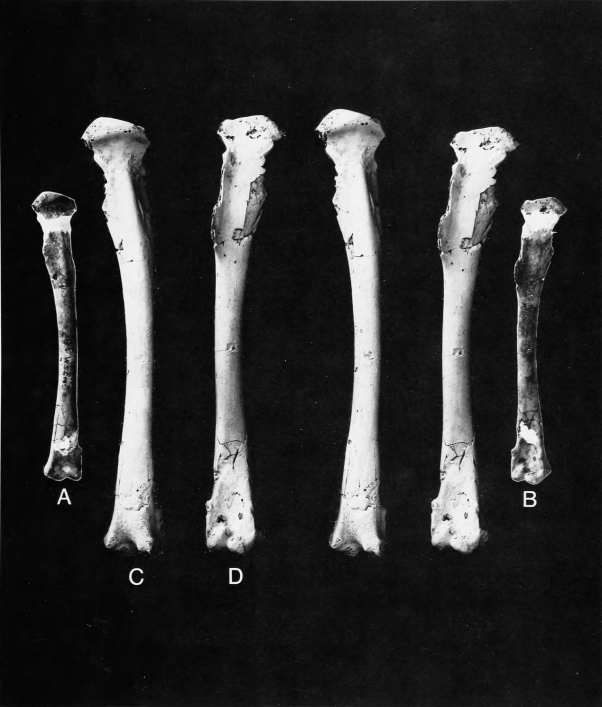
Figure 10.—Tytthostonyx glauconiticus, new genus and species (holotype, NJSM 11341), right humerus: a,b, anconal and palmar views of uncoated specimen to show reconstructed areas, × 0.8; c,d, stereophotographs of coated specimen in anconal and palmar views, × 1.3.
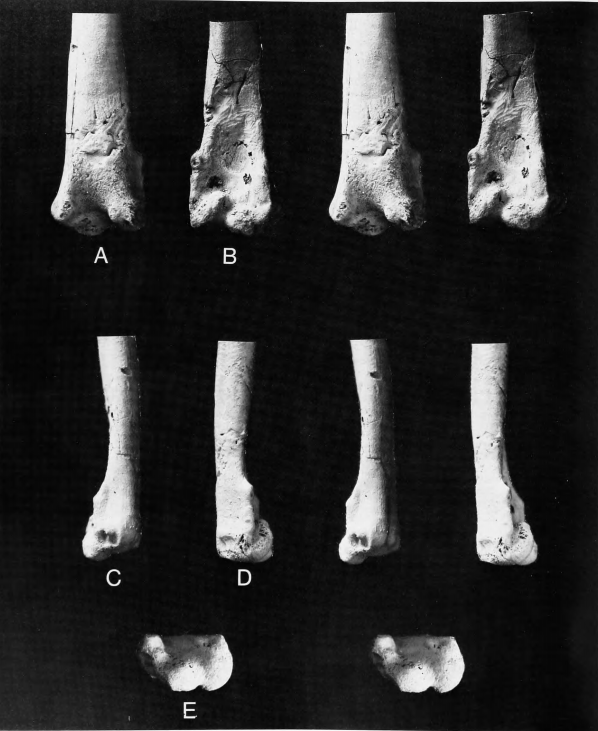
Figure 11.—Tytthostonyx glauconiticus, new genus and species (holotype, NJSM 11341), stereophotographs of distal end of right humerus: a, anconal view; b, palmar view; c, ventral view; d, dorsal view; e, distal view. (All figures × 2; specimens coated with ammonium chloride to enhance detail.)