Front matter
Reading edition
Sir Walter Scott
THE COUNTRY OF SIR WALTER SCOTT
BY CHARLES S. OLCOTT
Author of George Eliot: Scenes and People of Her Novels
ILLUSTRATED FROM PHOTOGRAPHS BY THE AUTHOR
BOSTON AND NEW YORK HOUGHTON MIFFLIN COMPANY The Riverside Press Cambridge
COPYRIGHT, 1913, BY CHARLES S. OLCOTT ALL RIGHTS RESERVED Published September 1913
TO MY WIFE THE COMPANION OF MY TRAVELS TO WHOSE SYMPATHETIC COOPERATION I AM INDEBTED FOR MUCH OF THE MATERIAL THIS BOOK IS AFFECTIONATELY DEDICATED
CONTENTS
Introduction
I. The 'Making' of Sir Walter II. The Lay of the Last Minstrel III. Marmion IV. The Lady of the Lake V. Rokeby VI. The Bridal of Triermain VII. The Lord of the Isles VIII. Waverley IX. Guy Mannering X. The Antiquary XI. The Black Dwarf XII. Old Mortality XIII. Rob Roy XIV. The Heart of Midlothian XV. The Bride of Lammermoor XVI. A Legend of Montrose XVII. Ivanhoe XVIII. The Monastery XIX. The Abbot XX. Kenilworth XXI. The Pirate XXII. The Fortunes of Nigel XXIII. Peveril of the Peak XXIV. Quentin Durward XXV. St. Ronan's Well XXVI. Redgauntlet XXVII. Tales of the Crusaders XXVIII. Woodstock XXIX. The Fair Maid of Perth XXX. The Chronicles of the Canongate and Other Tales The Highland Widow The Two Drovers The Surgeon's Daughter Anne of Geierstein Count Robert of Paris Castle Dangerous XXXI. A Successful Life
Index
ILLUSTRATIONS
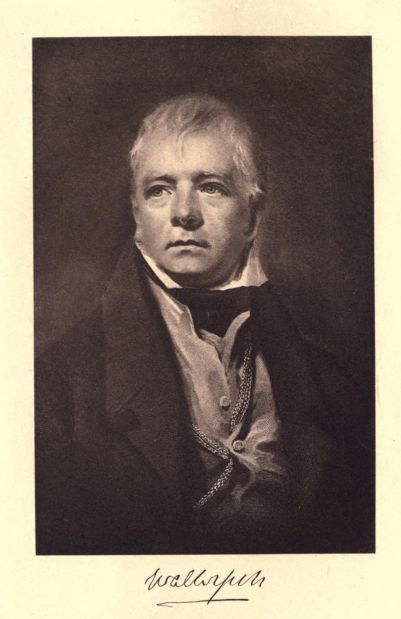
Portrait of Sir Walter Scott . . . Frontispiece Photogravure from an engraving by William Walker of a painting by Sir Henry Raeburn, R.A., 1822.
Smailholm
Kelso Abbey
The Popping Stone
Lasswade Cottage
Map Of Scotland Showing localities of Scott's writings
St. Mary's Loch
Branksome Hall
Melrose Abbey
Ashestiel
Entrance to Norham Castle
Llndisfarne Abbey
Tantallon Castle
Loch Achray
Cambusmore
Glenfinglas
Stirling Castle
Brackenbury Tower, Barnard Castle
The Valley of the Tees From Barnard Castle
The Valley of St. John Showing Triermain Castle Rock
Turnberry Castle, Coast of Ayrshire
Grandtully Castle
Doune Castle From the Teith
Ullswater Waverley's retreat after the defeat of the Chevalier
Caerlaverock Castle
Edinburgh from the Castle
Auchmuthie
The Black Dwarf's Cottage
Craignethan Castle (Tillietudlem)
Crichope Linn
Chillingham Castle
Loch Lomond from Inversnaid
St. Anthony's Chapel
Crichton Castle
Loch Lubnaig
Map of England Showing Localities of Scott's writings
Castle of Ashby de la Zouch
The Buck-Gate Entrance to the Duke of Portland's estate, Sherwood Forest
The Avenue of Limes, Sherwood Forest
Interior of Fountains Abbey
Coningsburgh Castle
Cathcart Castle
Leicester's Buildings, Kenilworth
Cæsar's Tower, Kenilworth
Entrance to Warwick Castle
Mervyn's Tower, Kenilworth
Lerwick, Shetland
A Crofter's Cottage, Orkney
Sumburgh Head, Shetland
Scalloway, Shetland
The Standing Stones of Stennis
Stromness, Orkney
Map of London Showing localities of Scott's writings
The Pack-Horse Bridge, Haddon Hall
The Saxon Tower, Isle of Man
The Tweed and Eildon Hills
Scott's Tomb, Dryburgh
Hoddam Castle
Powis Castle, Wales
Godstow Priory Burial-place of 'The Fair Rosamond'
Loch Tay
House of the Fair Maid of Perth
Abbotsford
Scott Monument, Edinburgh
INTRODUCTION
On the first day of May, 1911, we began our exploration of the 'Scott Country.' I say we, because I was accompanied by the companion of a much longer journey, of which that year was the twenty-fifth milestone. Whether from reasons of sentiment resulting from the near approach of our silver anniversary, or because of more prosaic geographical considerations, we began at the place where Walter Scott discovered that he would be likely to see more of the beauty of life if he were equipped with two pairs of eyes rather than one. This was at the village of Gilsland, in the north of England, where the poet first met the companion who was to share the joys and sorrows of the best years of his life. A pony and dogcart took us clattering up to the top of the hill, where, leaving our conveyance, we started down the glen to the banks of the river Irthing. Here the camera promptly responded to the call of a beautiful view and the first exposure was made:—a gently flowing stream of shallow water, scarcely covering the rocky bed of the river; a pleasant path along the bank, well shaded from the sun; and a slender little waterfall in the distance;—the same scene which so often met the eyes of Walter Scott and his future bride as they strolled along the stream in their 'courting' days.
This was the beginning of a tour which eventually led into nearly every county of Scotland, as far north as the Shetland Islands, and through a large part of England and Wales. We went wherever we thought we might find a beautiful or an interesting picture, connected in some way with the life of Sir Walter, or mentioned by him in some novel or poem. Knowing that he had derived his inspiration from an intimate knowledge of the country, we sought to follow his footsteps so far as possible. Months of preparation had been devoted to the work before leaving home. Every novel and poem had to be read, besides many books of reference, including, of course, Lockhart's Life, for it would not have been safe to trust to the recollections of earlier reading. Notes were made of the places to be sought, and two large maps were prepared on which I marked circles with a red pencil around all points which I thought ought to be visited, until my maps began to look as though they were suffering from a severe attack of measles. Then the route was laid out by 'centres.' The first was Carlisle, then Dumfries, Melrose, Edinburgh, Berwick, Glasgow, Stirling, Callander, the Trossachs, Oban, and so on until the entire country had been covered. From each 'centre' as a convenient point of departure we explored the country in many directions, visiting so far as possible every scene of the novels and poems that could be identified.
It was surprising to find so many of these scenes exactly as Sir Walter had described them. The mountains and valleys, the rivers, lakes, and waterfalls, the wild ruggedness of the seaside cliffs, the quaint little old-fashioned villages, the ruined castles and abbeys, all brought back memories of the romances which he had so charmingly set amidst these scenes. It was like actually living the Waverley Novels to see them. And in seeing them, we came to know, on intimate terms, Sir Walter himself; to feel the genial influence of his presence as if he were a fellow traveller, and to love him as his companions had done a century ago.
But our constant purpose was to do more than this. With the help of the camera we sought to catch something of the spirit of the scenery and to bring it home with us, in the hope that those who have never seen the 'Scott Country' might at least have a few glimpses of it, and that those who have seen all or a part of it, might find in these views a pleasant reminder of what must have been a happy experience.
There is no occasion to add at the present time to the volume of literary criticism of such well-known novels and poems as those of Scott, nor is it possible to add any material facts to his biography. This book makes no such claim. It does not attempt to retell the romances, except in so far as may be necessary to explain their connexion with the scenery or to introduce the 'original' of some well-known character. If a glimpse of the novelist's genial face is seen now and then, it is because his spirit pervades every nook and corner of bonnie Scotland, and it would be impossible for appreciative eyes to view the scenery without seeing something of the man whose genius has added so greatly to its charm.
If this book shall add to the pleasure of any of the readers of Sir Walter Scott by bringing them into the atmosphere of his novels and poems, and so a little nearer to the kindly personality of the man, its purpose will have been fulfilled.
THE COUNTRY OF SIR WALTER SCOTT