At Westminster.
Reading edition
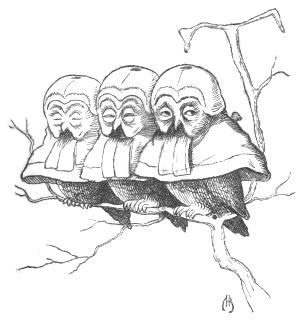
This is Westminster Hall. You know it at once. To your left is one door for Parliament; to your right are seven, for the lawyers. If you peep into the first of these legal entrances, you will probably see the cake-woman; and if the court is sitting you will certainly find an eager knot of grey-bearded, spectacled, wigged, and gowned barristers, engaged on “three corners,” Bath buns, and pennyworths of plum gingerbread. Passing through this reminiscence of schooldays, you will bewilder yourself among a series of doors that shut one upon another. You will possibly avoid the cross-cutting and divergent passages, and, with the help of a sad policeman, lifting a heavy crimson curtain, you will take off your hat, and find yourself in a court of justice. The first thing you look for is a “place,” which you find high up in the back seats; and when this has been climbed into, with more or less noise, you find yourself facing the bench. By the bench, of course I mean the judges. They are peculiar. Their dress is rather startling at first, till you get used to it; but it is nothing to their caps, which are represented by a little black spot on the top of the wig, and, therefore, may be said to out-muffin the muffin cap of the Bluecoat boy. You may, perhaps, imagine that a remorseful, or, perhaps, shamefaced feeling on the part of the last invented judge has led to his contenting himself with a mere white spot. But be this as it may, from reasons of either dress or feature, our judges do not quite look like ordinary human beings; at all events, the casual observer is sure to deny them that privilege. One likens a celebrated dispenser of justice to a benevolent and intellectual gorilla; another believes that all judges give one some dim idea of a blinking, dozy kind of barn owl; a third suggests good old ladies—motherly persons, given to advice and management, and the having of their own way; while one more daring has even compared the celebrated and, as I said before, “newly invented” summer up, to a jolly apple-cheeked old maid, sitting in judgment upon her married sisters. Perhaps it is not until these humourists see them as judges in their own cause that they discover them to be neither blind, weak, nor old-womanish.
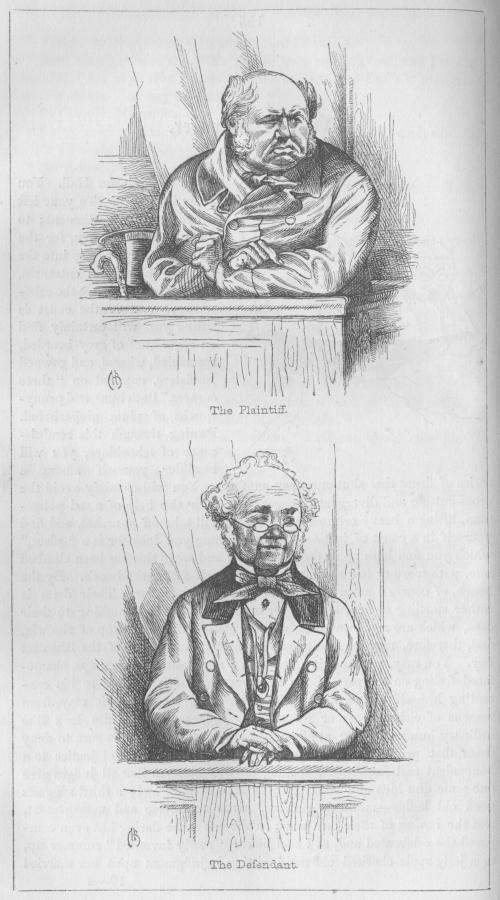
The Plaintiff.
The Defendant.
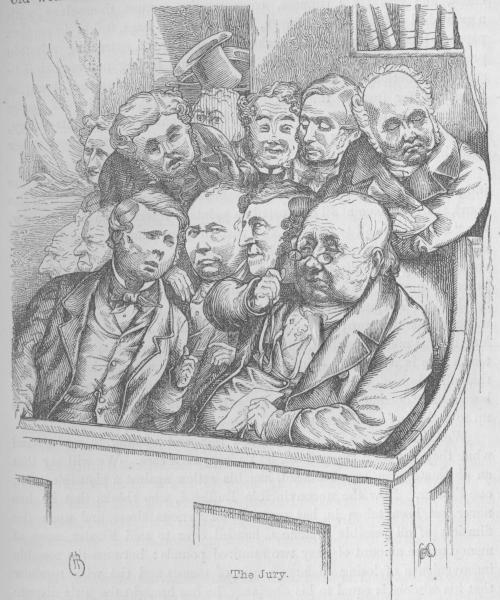
The Jury.
But between the back seats and the bench, look for the bar, and if you don’t exactly see the bar, you will the counsel, which is the same thing. Possibly you may hear them—for they are given to talking; to each other, if they have no better resource; but to the jury, or at all events to the judge, if they can find an occasion: some who, curiously enough, have round noses, round eyes, round mouths, and double chins, are sonorous, emphatic, and what we will call portwiney: others are ponderous, slow, chest-speaking men, but these are mostly tall, lank, and coarse-haired, with terrible noses—long, from the bridge downward, and blunt at the point; some, again, of the sharp, acid, suspicious sort—shriek a great deal; while there are a few—great men these—who are so confidential and communicative, that they seem (using a colloquial phrase) to talk to the jury “like a father.”
Among the counsel who having nothing to say either for self or client, and who (as I suppose, consequently) amuse themselves with a great deal of light-porter’s work, in carrying fat bags, full of important papers; there are many who make a great show of extracting valuable precedents from thick calf-bound law books, and having neither briefs to study nor motions to make, engage themselves in inditing the obscurest directions for further thick volumes, on the smallest slips of paper procurable, which slips—folded into the semblance of pipe-lights—they, at the hazard of turning illegal summersaults, pass on to the short usher with the bald head.
But do not, for one moment, imagine that when you have looked at the judges and the counsel and taken in the general aspect and bearings of the court, that you have at all exhausted its points of interest; on the contrary, the “interest” is all to come. You wish to know what is going on—is it debt or slander? breach of promise or breach of contract? and curiously enough, it is generally the latter. Contracts of all sorts, that are supposed to form a kind of barrier against law, and which, at all events, are held as safeguards or talismans, are mostly the direct road to that monosyllabic mantrap; some people never think of breaking a contract so long as it is merely implied, but reduced to black and white they want to tear a hole in it directly,—indeed, in the sense in which it has been said that all mischief is caused by woman, you will find that every action at law has a “document” lying at the bottom of it—from promissory notes up to architects’ estimates, this will always hold good.
Well, having seen both Bench and Bar, and wishing to understand what they are both engaged in, let us suppose a case. We will say that an obstinate man, one Bullhead, has his action against a plausible man, one Floater. Now the unconvincible Bullhead, who thinks that he has never yet been taken in, has somehow at various times, and upon the flimsiest of all possible pretences, handed over to said Floater sums of money to the amount of—say two hundred pounds: between the possible inconvenience of losing so large a sum of money and the wish to show that his wisdom is equal to his obstinacy, he has brought the little dispute out of his own frying-pan into the judicial fire.
There he stands, or rather leans in the witness-box, carefully checking off his short answers with his forefinger on the sleeve of his coat, and screwing his face on one side, as if to concentrate all his intellect into the left eye that is so widely open; he looks very untractable, with his stumpy brows knitted closely over his thick stumpy nose; but what chance can he possibly have against such a cool hand as the defendant, Floater, Esq., with his very white stick-up hair bearing witness to his respectability, and his very black lay-down eyebrows covering the unbarnacled portion of those side-glancing eyes? How gently his jewelled fingers are laid on the edge of the witness-box! how shockingly informal the “document”—of whatever sort—proves to be during his examination—what a respectable man he is! Three letters after his name. Do you think he would have trusted himself in such a lion’s den as this if he were not assured of getting the best of it? Oh, no! this is the sort of thing—either in court or out of court—that he lives on, and lives very well too. Barring anxieties and worries, which all are liable to—with the exception of constant flitting, which, to some people, is a mere matter of health; put on one side a few visits to the Queen’s Bench, and this is a highly prosperous man! He has his spring lamb out of its due season; asparagus; five suits of clothes and three servants; he has managed somehow to rear a large family, and, what is more, to dispose of them in various ways; he will, most probably, fail in accumulating money, may, perhaps, die in extreme poverty—there is no knowing; but as he is not a miser, as he began life without a farthing, and as, moreover, he is an easy-going sort of philosopher in his way, he may content himself to the last; and contentment, as we know, is a very hard thing to compass after all.
Of course, and as usual, the jury hardly know what to make of it; the stout foreman inclines to the plaintiff in despite of law; but he is evidently puzzled all the same; the thin man with the bridgy nose, the cold man with the round head, and the argumentative juryman with the mutton-chop whisker, all look at it, as they say, “legally,” and decide in favour of the defendant. The jocular “party,” with the curly red hair and the two tufts of chin-growing beard, treats it all as good fun, and is ready to give his verdict for the defendant too, because as he says:—“He is such a jolly old humbug, you know,” which mode of settlement, however, is not looked upon as sufficient by his two neighbours, to whom it is a much more serious matter. One of these is trying to make up his mind, a feat he has never yet successfully accomplished, so I suppose that as usual it will be made up for him by somebody else; as for the other, after three hours’ reflection he has really come to a decision, but, unfortunately, it is entirely opposed to everything that the judge will tell them in his summing up, and of course they will all be led by his lordship.
My lord is neither a mumbling nor a short-tempered judge; he will take them in hand kindly, explain away both counsel for plaintiff and for defendant, and read them a great deal of his notes, which are a thousandfold clearer, fuller, and more accurate than the reporter’s “flimsy,” although during the trial he has been distinctly seen to write four long letters, has gone twice to sleep, and has made seven recondite legal jokes, including the famous ever-recurring and side-splitting innuendo of calling upon the usher to cry silence, or “Sss-h,” whenever the somewhat indistinctly speaking junior for the plaintiff rises—there will be no withstanding his clear-headedness.
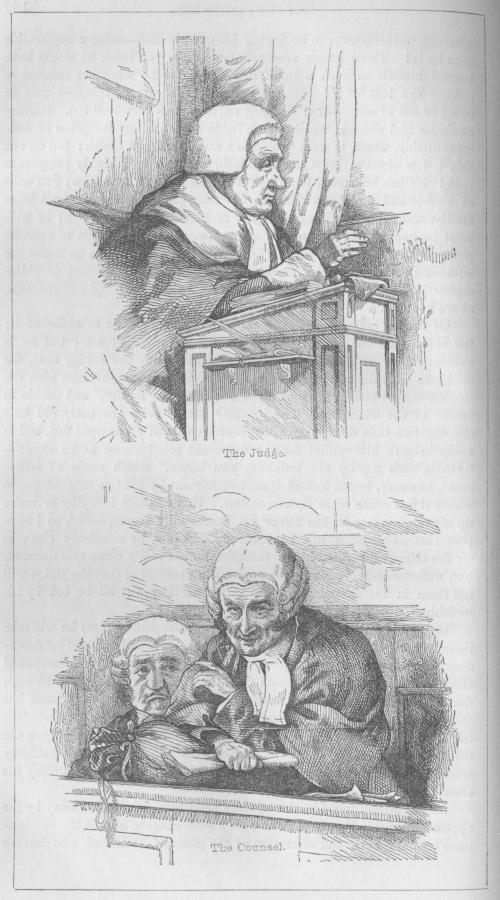
The Judge.
The Counsel.
As you would imagine, these jurors have been in turn led away by the opposing counsel. For the plaintiff; they were made to admire the consummate common sense and discretion of the plaintiff, Bullhead, who having diluted his ordinary keenness with that admirable faith in human nature, which is the keystone of all commercial transactions in this arcadian world, has for the first time in his life, found his confidence misplaced by the conduct of the defendant. Said the advocate: far be it from him to call Floater, Esq., M.Q.S., by any derogatory appellations; he was not a swindler, he was not a rogue, he was not a wolf in sheep’s clothing, he was perhaps the victim of a misconception or a want of memory, but a very honourable man all the same—an opinion which the jury would endorse by giving full damages to his discreet and sensible client.
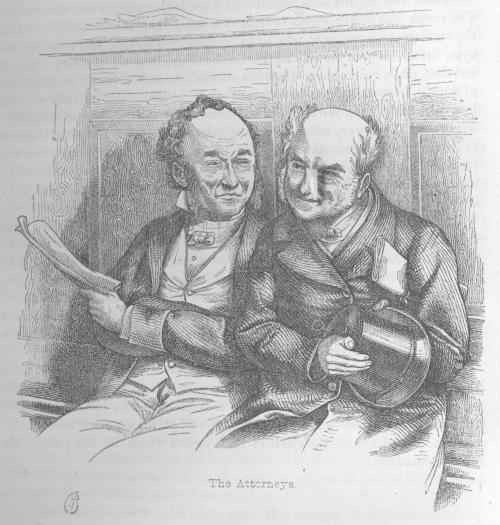
The Attorneys.
But, said the counsel for the defendant—a foxy man with reddish hair, angular eyes, and a mouth that seems to have a hole punched in each end of it: he would not call Mr. Bullhead a villain of the deepest die, he would not say that he had laid a plot to blast the happiness of the domestic health of his unfortunate, his scrupulously respectable, and he would add his distinguished client; no, not he—far from it, he would suppose that an obtuseness of intellect on the part of the, at all events, short-tempered plaintiff, had led him to imagine, and so forth. And by the way, notice how these foxy counsel do cuddle themselves up, how they look askance, and wriggle about to show their honesty and straightforwardness,—for indeed I suppose we must admit that they are honest and straightforward from their point of view, although they do shake their heads at his lordship whenever a particularly damaging statement is put forward by the opposite side, and although they do paint black with a grey tint, and find a few spots upon the purest white. Thank goodness, they have the attorneys to throw the blame upon when there happens to be any, and the attorneys sitting under the bar, and putting their heads together, have, I suppose, shoulders broad enough to bear it.
These two do not look ingenuous: here is the smooth and the rough. The rough one never seems to believe a word that is said to him, while the smooth one appears to take in everything. The one, half shutting his eyes, draws his face down and his forehead up, into all the fifty lines of unbelief, while Smoothman drags his cheeks into such a lovely smiling look of faith in everything you have to propose, that you really begin to wonder how that underhung jaw and knitted brow came into the same company. Well, there is not very much to choose between them—if Diogenes is given to sharp practice, Smoothman is a very bulldog for holding on wherever he gets his teeth in; and for twisting a grievance into court, for sublimating an action into a verdict, and a verdict into bills of costs, I think they are equally to be trusted.
So we will say that this trial has gone against the angry plaintiff; that it is one more feather in the cap of Foxy Q.C., and money in the purse to Floater, M.Q.S.; that the jury are aware of having supported the glory of the English nation and the majesty of the law; that the learned judge, disrobed and unwigged, is no longer a good old lady, but a distinguished gentleman; and the ushers having cried Ssss-h all the day, which seems to be their responsible and arduous and only duty, are going home to dinner, leaving the reporters to pack up and follow.
One word about the “Press” before we part. Just one word to note the elderly press-man, who is of a shrewd, parroty appearance, and who has sat in court so many years reporting, that his grey hair has at last taken the form, colour, and texture of a judge’s wig: his aspect is severe; he seems to have imbibed the spirit of that justice which he has passed his life in recording.