Part 2 — THE SCIENTIFIC UNIVERSAL LANGUAGE: ITS CHARACTER AND RELATION TO OTHER LANGUAGES.
Reading edition
ARTICLE TWO.
CORRESPONDING FIRST DISCRIMINATIONS IN THOUGHT AND LANGUAGE.
The purpose of these papers, as announced and partially carried forward in the preceding one, is to explain the nature of the New Scientific Universal Language, a component part of the new Science of Universology, and to exhibit its relation to the Lingual Structures hitherto extant. For this purpose we entered upon the necessary preliminary consideration of the fundamental question of the Origin of Speech. We found that the latest developments of Comparative Philology upon this subject, as embodied in Prof. Müller's recent work, 'Lectures on the Science of Language,' brought us no farther along to the goal of our investigation than Compound Roots—one-, two-, three-, four-, five—(or more) letter Roots—some four or five hundred of which are the insoluble residuum which the Philologists furnish as the Ultimate Elements of Language. It was pointed out that these Roots are not, however, the Ultimate Elements of Language, any more than Compound Substances are the Prime Constituents of Matter; and that, as Chemistry, as a Science, could begin its career, only after a knowledge of the veritable Ultimate Elements of the Physical Constitution of the Globe was obtained, so a True Science of Language must be based upon an understanding of the value and meaning of the True Prime or Ultimate Elements of Speech—the Vowels and Consonants.
It is with the exposition of the nature of these Fundamental Constituents of Language, and of their Correspondential Relationship or Analogy with the Fundamental Constituents of Thought, the Ultimate Rational Conceptions of the Mind, that the New Universal Language begins its developments. Through its agency we may hope to find, therefore, a satisfactory solution to the problem of the Origin of Speech, which Comparative Philology abandons at the critical point, and so to be able to pass to the consideration of the more specific objects of our present inquiry.
Universology establishes the fact that there is Analogy or Repetition of Plan throughout the various Departments of the Universe. It demonstrates, in other words, that the same Principles which generate, and the same Laws which regulate, the Phenomena of the Universe as a whole, fulfil the same functions in connection with the Phenomena of every one of its parts. The Mathematical, Psychological, or any other specific Domain is, therefore, an expression or embodiment of the same System of Principles and Laws, with reference to both Generals and Details, which is otherwise exhibited in Mechanics, Physics, Chemistry, and elsewhere universally; just as the same Architectural Plan may be variously employed in constructions of different size, material, color, modes of ornamentation, etc.; and may be modified to suit the requirements of each individual construction. To every Elementary Form of Thought there is, consequently, a corresponding and related Law of Number, of Form, of Color, of Chemical Constitution, and of Oral Sound or Speech. Every Basic Idea, to state it otherwise, pertaining to the Universe at large or to any of its Divisions, has its counterpart or double in every other Division. Or, to express it yet another way: the manifold, diverse, and unlike Appearances or Phenomena which the Universe presents to our understanding, are not radically and essentially different; but are the same Typal Ideas or Thoughts of God or of Nature, arrayed in various garbs, and, hence, assuming varying presentations. The Numerical Unit, the Geometrical Point, the Written Dot, the Globule, the Chemical Atom, the Physical Molecule, the Physiological Granule, the Yod or Iota, the least Element of Sound, are, for example, Identical Types, differently modified or clothed upon in accordance with the medium through which they are to be phenomenally presented. It is with this Echo or Repetitory Relationship, existing between all the Domains of the Universe, but more particularly as exhibited between the two Domains of Ideas and Language, that we are at present concerned.
It is sufficiently obvious that Analogy should be sought for first, in the Generals of any department under examination, and, subsequently, through them, in the Particulars. In respect to the two Domains now under special consideration, this relation is between the Fundamental Elements of Thought, including those called by the Philosophers the Categories of the Understanding, and the Fundamental Elements of Language. In pointing out the Correspondence subsisting between the Elements of these two Domains, I shall use, partly by way of condensation, and partly by copious extracts, the Elaborate Expositions contained in the yet unpublished text books of Universology. And, as what follows relating to this subject will consist, almost wholly, of this material, I do not deem it essential to encumber the page with numerous and unnecessary quotation marks. It is advisable to caution the Reader, however, that as my present purpose is explanation and illustration only, and not formal demonstration, what is about to be given will be mostly in the nature of mere statement, unaccompanied by any other evidence of its truthfulness than may be found in the self-supporting reasonableness of the statements themselves.
It was the basic and axiomatic proposition of Hegel's Philosophy, that the first discrimination of Thought and Being in any sphere is into two factors, a Something and a Nothing;—that which constitutes the main or predominant element of the Conception or Creation, and that which we endeavor to exclude from contemplation or activity, but which, nevertheless, by virtue of the impossibility of perfect or absolute abstraction, inevitably becomes a minor or subordinate element in the Idea or the Act which may be engaging the attention. Something and Nothing are also averred to be equal factors in the Constitution of Thoughts or Things, because both are alike indispensable to the cognition of either; because, in other words, it is only by the presence of the Nothing as a background or contrasting element, that the Something has an independent or cognizable existence. If there were no blank space, for instance, there could be no Moon, relatively, or so far as our ability to perceive it is concerned. For the Moon is, in this illustration, a Something which is visible to us, and of which we have a knowledge, only by reason of the fact that it is surrounded by and contrasted with that which is not Moon, and which, in reference to the particular aspect under consideration is, therefore, a Nothing; though it in turn may be a Something or main object of attention in some other view or conception, where some other factor shall be the Nothing.
That this Relationship of Antithesis and Rank existed, as between the Constituents of some Thoughts or Things, was known from the earliest times, and gave rise to the terms Positive and Negative, expressive of it. But Hegel was the first—of modern Philosophers, at least—to point out its necessarily Universal and fundamental character, and to assume it as the starting-point in the development of all Philosophy and Science.
So far as concerns the investigation of the Universe from the Philosophical point of view (which is the less precise and definite aspect), Hegel is right in affirming that the first discrimination of all Thought and Being is that between Something and Nothing. But he is wrong in regarding the starting-point or first differentiation of Science, as being identical with that of Philosophy. Science considers, primarily and predominantly, the more exact and rigorous relations of Phenomena; and the existence of an exact and definite point of departure in Thought and Being, more fundamental, from the Scientific or rigorously precise point of view, than that of Hegel, is the initiatory proposition of Universology.
A full explanation of the nature of this Starting-point is not, however, in place here. And as the discrimination into Something and Nothing serves all the purposes of our present inquiry, a single word respecting the character of the Universological Point of Departure in question is all that it is now necessary to say concerning it.
This Starting-point of Thought and Action has reference to the Ideas of Oneness (Primitive Unity) and Twoness (Plurality). These conceptions give rise to two Primordial Principles, which form the basis of the development of Universology, and which are fundamental in every Department of the Universe and in the Universe as a whole, namely: The Principle of Unism (from the Latin unus, one), the Spirit of the Number One, the Principle of Undifferentiated, Unanalyzed, Agglomerative Unity; and The Principle of Duism (from the Latin duo, two), the Spirit of the Number Two, the Principle of Differentiation, Analysis, Separation, Apartness, or Plurality, typically embodied in Two, the first division of the Primitive Unity, and especially representative of the Principle of Disunity, the essence of all division or plurality. One, in the Domain of Number, and Unism, in the Department of Primordial Principles, correspond, it must be added, with The Absolute (the Undifferentiated and Unconditioned), as one of the Aspects of Being; while Two, in the Domain of Number, and Duism, among Primordial Principles, are allied with The Relative (the Differentiated and Conditioned), of which latter Domain Something and Nothing are the two Prime Factors. The distinction between One and Two, or their analogous Aspects of Being, Absolute and Relative, is, therefore, prior to that between Something and Nothing, because Something and Nothing are two terms of The Relative (Two), which has first to be itself discriminated from The Absolute (One) before it can be sub-divided into these two factors.
While the nature of this discrimination into Something and Nothing may be sufficiently intelligible to the student of Metaphysics, it may not be so to the Reader unaccustomed to Philosophical Speculation. For the purpose, therefore, of rendering it somewhat clearer, I will point out the manner in which it exhibits itself in respect to the Constitution of the External World and elsewise.
The Totality of all material objects and substances is the Positive Material Universe. This is contained in Space, which is the Negative Material Universe. Compoundly the two, Matter and Space, are the whole Material Universe, as to the Parts or Constituent Factors of which it consists.
Theoretically, and in one, and by no means an unimportant sense, the Zero-Element or Nothing-side of the Universe or of a given Department of Being, is one whole half, or an equal hemisphere of the Totality of Being. Thus, for example, Zero (0) in the usage of the Arabic Numbers, while it is represented in an obscure way merely by a single figure below the nine digits, yet stands over, in a sense, against all the digits, and all their possible combinations, as equal to them all in importance. For it is by means of this Zero (0) that the One (1) for instance, becomes 10, 100, 1000, etc.; and that all the Positive Numbers acquire their relative values, according to the places or positions in space which they occupy.
In another sense, however, the Negative Ground of Being, in the Universe at large, or in any given Domain, quickly sinks out of view, and Positive Being becomes the whole of what is commonly regarded. It is in this sense that, ordinarily, in speaking of The Digits of Number, the Zero is left out of the count.
In the same manner, when speaking or thinking of the Material Universe, while the notion of Space is ever present, and is, in the absolute sense, an equal half of the whole conception, still it is Matter, the total congeries of objects and substances in Space, of which we mainly think; the Space, as such, being understood and implied, but subordinated as a mere negative adjunct of the positive idea.
In strictness, Matter and Space are so mutually dependent on each other, that either without the other is an impossible conception. The notion of Space permeates that of Matter; passing through it, so to speak, as well as surrounding it; so that it needs no proof that Matter cannot be conceived of as existing without Space. But, on the other hand, Space is only the negation of Matter; the shadow, as it were, cast by Matter; and, so, dependent on Matter for the very origin of the idea in the mind.
If Space, therefore, be the analogue of Nothing; Matter, wholly apart from Space, is only a theoretical Something, really and actually as much a Nothing as Space itself, when abstractly considered in its equally impossible separation from Matter. But Matter, completely separated from Space, is the exact external analogue of the Something opposed to the Nothing of abstract Metaphysical Thinking. Here, then, is a lucid exposition, by virtue of these analogies, of the famous Metaphysical Axiom of Hegel, which, at its announcement, threw all Europe into amazement:
Something = (equal to) Nothing.
It is the logic of this statement that all Reality or Relative Being is a product of two factors, each of which is a Nothing. The strangeness of this proposition will disappear when it is recognized that these two Nothings are mere aspects or sides of presentation of the Product, which is itself the only Reality. In respect to the Real Being, those two sides are Nothings. But, as appearances or ideal views of the Reality under the process of analytical abstraction in the mind, they are so far Somethings as to receive names and to be treated of and considered as if they were Realities. Reality in the Absolute aspect, the aspect of Undifferentiated Unity, (Unismal), contains these two factors interblended and undiscriminated. In the Relative aspect, that of Duality, (Duismal), it is the compound of these two factors separated and distinguished. Finally, in the Integral aspect of Compound Unity (Trinismal), it consists of the Unismal and the Duismal aspects contrasted—the only real state, or possible condition of actual existence. And this is the Type of all Reality or Real Existence in every department of Being in the Universe.
But practically and ordinarily, these strictly analytical views of the question of existence are abandoned. Reality, compounded, as we have seen that it is when viewed in this way, of a Positive and a Negative Factor, is assumed as itself a Simple Element and set over against the grand residuum of Negation in the Universe of Being. This is what Kant, less analytical than Hegel, has done, when, in distributing the Categories of Thought, he has contrasted Reality with Negation.
This is, as if, in respect to the External Material World, we were to divide Matter—the Planets, for example, first assigning to them the portions of Space which they bodily and respectively fill as if it were a part of themselves—from the remaining ocean or grand residuum of Space which surrounds them and in which they float. This residuum of Space would then be spoken of as Space, and the Planetary Bodies, along with and including the spaces which they fill, would be spoken of as Matter. This is a kind of division, less analytical, but more convenient, obvious, and practical, than the other which would attempt to separate the whole of Space from the Matter within Space. It is in this more practical manner that we ordinarily think of the division of the Heavens into the Domains of Matter and Space.
Between Reality, then, including a subordinate portion of Space—the content and volume of the Planet—and the grand ocean of Space, outlying and surrounding the Planet, there is Limitation, the outline of the Planet, the Limit or dividing surface between the space within it and the space without.
It is this Congeries of the Aspects of Being which Kant denominates Quality, as a name of a Group of the Categories of the Understanding; and which he divides into
1. Reality.
2. Negation.
3. Limitation.
He then treats Reality as synonymous with the Affirmative (Positive), and Negation as synonymous with the Negative; although, as we have seen, this Affirmative is not strictly equivalent to the Something of Hegel, nor this Negative to his Nothing. For Reality we may, in a general sense, put Substance, and for Limitation we may put Form, Omitting Negation which repeats the Nothing, as Reality repeats the Something, it may now be said that the next Grand Division of the Elements of Universal Being (after that into Something and Nothing) is into
1. Substance.
= 3. Existence.
2. Form.
That is to say: The Relative (The Domain of Cognizable Being) is first made known to us through the differentiation and discrimination of the two Factors Something and Nothing which lie undifferentiated and indistinguishable in The Absolute (The Primitive Ground of Being). The Relative then subdivides into 1. Substance (Reality), and, 2. Form (Limitation), which reunite to constitute that actualized Being which we denominate Existence. Or, tabulated, thus:
THE ABSOLUTE (The Primitive Ground of Being) CONTAINS UNDIFFERENTIATED AND INDISTINGUISHABLE THE TWO FACTORS SOMETHING and NOTHING WHICH CONSTITUTE THE FIRST TERMS AND DISCRIMINATIONS OF THE RELATIVE (The Domain Of Cognizable Being); WHICH ITSELF DIVIDES INTO SUBSTANCE (Reality) and FORM (Limitation), THE PRIME CONSTITUENTS OF EXISTENCE.
To comprehend the vast importance of these discriminations, it is necessary to understand that precisely those Principles of Distribution which are applicable to the Universe at large are found to be applicable to every minor sphere or domain of the Universe; in the same manner as the same Geometrical Laws which prevail in the largest circle prevail equally in the smallest. It is the prevalence of Identical Principles in diverse spheres which is the source of that Universal Analogy throughout all spheres that lies at the basis of Universology, and gives the possibility of such a Science. The nature of this Analogy, as well as the value of the discriminations themselves, will be more clearly seen by glancing at corresponding discriminations in other spheres.
In the Constitution of the External World, Something is represented, as we have seen, by the solid and tangible substance which we call Matter, and Nothing by the Expanse of Space.
In the Science of Acoustics, Sound, the pure Phonos, is the Something, the Reality, as it is denominated by Kant, the Positive Factor of Speech. Silence is the relative Nothing, the Negation, so called by Kant, the Negative Factor of Speech. The Silences, or Intervals of Rest which intervene between Sounds (and also between Syllables, Words, Sentences, and still larger divisions of Speech), are only so many successive reappearances of this negative element. Silence, the Nothing of Sound, is, in fact, in the most radical aspect of the subject, one entire half or hemisphere or equal Factor of the whole of Speech or Music. Josiah Warren, the author of a work entitled 'Music as an Exact Science,' is the only writer I have noticed who has had the discrimination distinctively to recognize Silence as one of the Elements of the Musical Structure.
Impliedly it is, however, always so recognized. The Silences intervening between tones tunewise, or in respect to altitude, are, in Musical Nomenclature, denominated Intervals. Timewise Silences, or those which intervene between Tones rhythmically considered, are called Rests. The Intervals of Silence between Syllables and Words, in Oral Speech, are represented in the printed book by what the Printer calls Spaces, which are blank or negative Types interposed between the positive Types expressive of Sounds. This term Space or Spaces carries us to the analogous Total Space or Blank Space and intervening reaches of Space between the Planets, Orbs or Material Worlds, the former the corresponding Nothing of the total Material Universe of which these worlds are the Something; as exhibited in the demonstrations of Universology.
In the Domain of Optics, covering the Phenomena of Light, Shade and Color, Light is the Positive Factor or Something, and Darkness the Negative Factor or Nothing. Light is, therefore, the analogue of Sound, and Darkness the analogue of Silence. That is to say, each of these two, Silence and Darkness, denote the absence, the lack, the want or the negation of the opposite and Positive Element or Factor.
So in Thermotics, the Science of Heat, Heat itself is the Positismus or Something of the Domain; and Cold the Negatismus or Correlative Nothing. Heat is, consequently, the analogue of Sound and Light; while Cold is the analogue of Silence and Darkness.
In respect to the Domain of Mind, Positive Mental Experience (Feelings, Thoughts, and Volitions, including self-consciousness) are the Positive Factor, the Something of Mentality. Inexperience, the lack of mental exercitation, hence Ignorance, is the Negative Factor, or Nothing. The Correspondential Relationship or Analogy existing between this Domain of the Universe and others already mentioned is testified to in a remarkable manner by our use of Language. We denominate the want of Feeling Cold or Frigidity—in respect to the Mind or the individual character. The absence of Thought and Knowledge, or, in other words, Intellectual Barrenness, is called Darkness or Obscurity of the Mind. While the lack of Will or Purpose in the Mind is said to be the absence of Tension or Strain (the great Musical term); and the Stillness or quiet hence resulting may be appropriately designated as the Silence of the Mind; Musical Silences being, as pointed out above, technically termed Rests.
With this superficial exhibition of the most radical aspect of the Echo of Idea or Repetition of Type which subsists between all the departments of the Universe, I pass to the more specific consideration of this Analogy as concerning the Domain of Thought and the Domain of Language.
Setting aside from our present consideration Silence, the Negative factor or Negatismus of Language, and fixing our attention upon Sound, the Positive factor or Positismus of Language, we discover it to be composed of two constituents, Vowels and Consonants.
The Vowel is the Substance, the Reality of Language, and the Consonant is the Form, the Limitation.
By Vowel sound is meant the free or unobstructed, and as such unlimited flow of the vocalized or sounding breath. Vowels are defined in the simplest way as those sounds which are uttered with the month open; as a (ah) in Father, o in roll, etc.
Consonants are, on the contrary, those sounds which are produced by the crack of commencing or by obstructing, breaking, or cutting off the sounding breath, by completely or partially closing the organs of speech; as, for instance, by closing the lips, as when we pronounce pie, by, my, etc.; or by pressing the point of the tongue against the gums and teeth, as when we say tie, die, etc.; or by lifting the body of the tongue against the hard palate or roof of the mouth, as when we give the k or hard g sound, as in rack, rag, or in any other similar way.
Consonants are, therefore, the breaks or limitations upon the otherwise unbroken and continuous vocality, voice, or vocalized breath. In other words, as already said, Vowel-Sound is the Elemental Substance, and Consonant-Sound the Elemental Form of Language, or Speech. (By Vowels and Consonants are here meant, the Reader should closely observe, Vowel-Sounds and Consonant-Sounds, as produced by the Organs of Speech, and as they address themselves to the Ear, distinguished and wholly apart from the letters or combinations of letters by which they are diversely represented to the Eye in different languages.)
By a valid but somewhat remote analogy, the Vowel-Sounds of Language may be regarded collectively as the Flesh, and the Consonant-Sounds as the Bone or Skeleton of the Lingual Structure. Flesh is an Analogue or Correspondential Equivalent of Substance. Bone or Skeleton, which gives outline or shape to the otherwise soft, collapsing, and lumpy flesh-mass of the Human or Animal Body, is an Analogue of Correspondential Equivalent of Limitation or Form; as the framework of a house is the shaping or form-giving factor or agent of the entire structure.
Vowel-Sounds are soft, fluent, changeful, and evanescent. One passes easily into another by slight deviations of pronunciation, resulting from trivial differences in National and Individual condition and culture; like the Flesh of the animal, which readily decays from the Bony Skeleton, while the last remains preserved for ages as a fossil. The Vowel-Sounds so readily lose their identity, that they are of slight importance to the Etymologist or Comparative Philologist, who is, in fact, dealing in the Paleontology of Language.
The Consonants are, on the contrary, the Fossils of Speech; bony and permanent representatives of Framework, of Limitation, of Form. Consonant-Sounds are also sometimes denominated Articulations. This word means joinings or jointings. It is from the Latin articulus, a Joint, and is instinctually applied to the Consonant-Sounds in accordance with their analogy with the Skeleton of the Human or Animal System.
By an easy and habitual slide in the meaning of Words, a term like Joint is sometimes used to denote the break or opening between parts, and sometimes to denote one of the parts intervening between such breaks; as when we speak of a joint of meat, meaning thereby what a Botanist would signify by the term Internode, the stretch or reach or shaft of bone extending from one joint (break) to another, with the meat attached to it.
Consonants have, in like manner, a double aspect as Articulations or Joints. In a rigorous and abstract sense, the Consonant has no sound of its own. It is simply a break or interruption of Sound. Etymologically, it is from the Latin con, WITH, and sonans, SOUNDING; as if it were a mere accessory to a (vowel) Sound; the Vowels being, in that sense, the only sounds. In this sense, the Consonants are analogous with the mere cracks or opening joints, which intervene between the bones of the Skeleton. In other words, they are no sounds, but mere nothings; the analogy, in that case, of Abstract Limitation.
Practically, on the contrary, the Consonant takes to itself such a portion of the vocalized or sounding breath which it serves primarily to limit, that it becomes not merely a sound ranking with the Vowel; but the more prominent and abiding sound of the two. It is in this latter sense, that it is the Analogue of the Bone.
In Phonography, as in Hebrew and some other Languages, the letters representing the Consonant-Sounds only are written or printed; the Vowel-Sounds being either represented by mere points added to the Consonant characters, or left wholly unrepresented, to be supplied by the intelligence of the Reader. The written words so constructed, represent the real words with about the degree of accuracy with which a skeleton represents the living man; so that the meaning can be readily gathered by the practised reader, by the aid of the context. In Phonography, the Consonant-Sounds, which are simple straight or curved lines, are joined together at their ends, forming an outline shape, somewhat like a single script (written) letter of our ordinary writing. These outline words are then instinctually and technically called Skeleton-words, from the natural perception of a genuine Scientific Analogy.
Consonants constitute, then, what may be denominated the Limitismus (Limiting Domain) of Language. The Limit is primarily represented by the Line (a line, any line); then by the Line embodying Substance as seam, ridge, bar, beam, shaft, or bone; and, finally, by a System of Lines, Shafts or Bones which may then be jointed or limited in turn among themselves, forming a concatenation of Lines, Bars or Shafts, the framework of a machine or house or other edifice, or the ideal columnar and orbital structure of the Universe itself. All these conceptions or creations belong to the practical Limitismus, the Form Aspect or Framework of Being in Universals and in Particulars in every Sphere and Department of the Universe.
The Limitismus of Being so defined then stands over against or contrasted with the Substancismus (Substance-Domain) of Being which embraces the Substances, Materials or Stuffs of creation of whatsoever name that infill the interstices of the Framework or are laid upon it, and constitute the richness and fulness and plumpness of the Structure, as the Flesh does of the Body.
The wholeness or Integrality of the structure then consists of the composity of these Two (Limitismus and Substancismus), as the wholeness of the Body consists of the Flesh and the Bone. The Consonants being the Limitismus, and the Vowels the Substancismus of Language; the Two united and coordinated comprise the Trinismal Integrality or Integralismus of Speech.
The Vowels denote, then, Reality, as distinguished from Limitation, or, what is nearly the same thing, Substance, as distinguished from Form.
There are in all Seven (7); or if we include one somewhat more obscure than the rest, a kind of semi-tone, there are Eight (8) full-toned, perfectly distinct and primary Vowel-Sounds, which constitute the Fundamental Vowel Scale of the Universal Alphabet. Their number and nature is governed by the Mechanical Law of their organic production in the mouth. And the number can only be increased by interposing minor shades of sound, as we produce minor shades of color by blending the Seven (7) Prismatic Colors. The new Sound will then belong, in predominance and as a mere variety, to one of these Seven (7) Primary Sounds.
These Seven (7) Sounds constitute the Leading Vowel-System of all Languages; with certain irregularities of omission in the Vowel-System of some Languages.
By the addition of Five (5) equally leading Diphthongs (or Double Vowels) the number of leading Vowel representations is carried up to Twelve (12) or Thirteen (13)—which may then be regarded as the Completed Fundamental Vowel Scale of the Universal Lingual Alphabet.
There are, in like manner, Seven (7)—or Eight (8)—Leading Realities of the Universe, and of every Minor Sphere or Domain of Being in the Universe, which correspond with, echo or repeat, and are therefore the Scientific Analogues of, these Seven (7) Leading Vowel-Sounds, as they occur among the Elements of Speech.
In representing the Vowel-Sounds, it is better, for numerous reasons, to use the letters with their general European Values, than it is to conform to their altered or corrupted English Values. For instance, the Vowel I (i) is pronounced in nearly every language of Europe, and in all those languages which the Missionaries have reduced to writing, as we pronounce e or ee, or as i in machine, or pique; E (e) is pronounced as we enunciate a in paper; and A is reserved for the full Italian sound of a (ah), as in father; U is pronounced like oo, as in German, Spanish, Italian and many other languages.
The Seven (7) Vowels in question are then as follows:
1. I, i (ee in feel).
2. E, e (a in mate).
3. A, a (a in fa-ther).
4. o, o (aw in awful).
5. u, u (u in curd).
6. o, o (o in no-ble).
7. u, u (oo in fool).
These sounds are produced in the middle, at the back, and at the front of the mouth respectively. These localities, and something of the nature of the sounds themselves, as slender or full, will be plainly illustrated by the annexed figure:
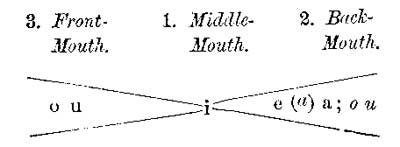
The following description of the organic formation or production of these sounds now becomes important.
The Vowel-Sound I (ee) is the most slender and condensed of the Vowel-Scale. It is produced at the middle or central part of the mouth, by forcing a slight, closely-squeezed current of Sounding Breath, through a small, smooth channel or opening made by forming a gutter or scoop of the flattened point of the tongue; while, at the same time, the tongue is applied at the edges to the teeth and gums. This sound has, therefore, an actual form resembling that of a thread or line; or still better, like that of a wire drawn through one of the iron openings by means of which wire is manufactured. It resembles also a slight, smooth, roundish stream of fluid escaping through a tube or trough.
This sound has relation, therefore, in the first place, to Centrality or Centre; and then to Length (or Line), which is the First Dimension of Extension. The I-sound continued or prolonged gives the idea of Length. But broken into Least Units of the same quality of Sound, we have individualized Vowel-Sounds of this quality, each one of which is a new Centre; like the successive Points of which a Line is composed.
An individual sound, I, has relation, therefore, to Centre and to Point generally. As such it stands representatively for the Soul or Identity or Central Individuality of Being—for that which gives to anything its distinctive character, as existing in the Point or the Unit, or the Atom, or in any Individual Object or Thing from the Atom up to a World and to the Universe as a whole. Identity is, perhaps, the best single term furnished by our Language to signify this basic idea. Individuality approximates the meaning. It is the pivotal notion of Being itself, and has relation, therefore, to Ontology, the Science of Abstract Being. Essence and Essential Being are terms which may also be used in defining it. The Reader should understand, however, that with reference to this Sound, as to those to be hereafter considered, there is no term or terms in any Language which will indicate their meaning exactly. The analysis of Ideas upon which Universology is based is more fundamental than any which has preceded it. Its Primary Conceptions are, therefore, broader and more inclusive than any former ones which existing terms are employed to denote. In explaining the meaning of these First Elements of Sound, then, as related to the First Elements of Thought, all that is now attempted is to convey as clear a notion of this meaning as is possible with our present terminology, without any expectation that the precise meaning intended will be at once or entirely apprehended.
The sound E (a in mate) is likewise a slender, abstract-like, middle-mouth sound; but differs from I in the fact that it is produced by flattening the opening for the Sounding Breath instead of retaining it in a roundish position. The angles of the mouth are drawn asunder, as if pointing outward to the sides of the head, and the sound is, as it were, elongated in the crosswise direction, as if a stick or a quill were held in the teeth, the extremities extending outward to the sides. A line, in this direction, is the measurer of Breadth, which is the Second Dimension of Extension, crossing the Length-line represented by I at right angles. Side-wise-ness is synonymous with Relation, as one of the Sub-divisions of Reality, or, in other words, of the Realities of Being. Re-lation is, etymologically, from the Latin re, BACK or REFLECTED, and latus, SIDE; that which mutually and reciprocally re-sides the Centre, or furnishes it with sides or wings. The Vowel-Sound E (a, in mate) is, therefore, the Analogue or Corresponding Representative or Equivalent in the Domain of Sound of that Fundamental Conception which, in respect to Thought, is denominated Relation, in respect to Position Collaterality or Sideness, and in respect to Dimension Breadth or Width.
The Sound A (a in father) is made farther back in the mouth, with the mouth stretched quite open, and is the richest and most harmonious of the Vowel Sounds—the Queen of the Vowels. It is the Italian A, the sound most allied with Music and Euphony, and yet a sound which is greatly lacking in the English Language.
The English Reader must guard himself from confounding the Vowel-Sound of which we are here speaking, with the Consonant R, the alphabetical name of which is by a lax habit of pronunciation made to be nearly identical with this Vowel-Sound; while for this beautiful and brilliant and leading Vowel in the Alphabet of Nature we have no distinct letter in English, and reckon it merely as one of the values or powers of the Letter A, to which we ordinarily give the value of E (a in mate, ai in pain).
This Vowel A (ah, a in father) is made with the mouth so open that the form of its production suggests the insertion of a stick or other elongated object in a perpendicular direction to retain the jaws in their position; a practice said sometimes to be resorted to by the Italian Music Teacher, in order to correct the bad habit of talking through the teeth, common among his English pupils.
This height and depth involved in the Sound of the Vowel A (ah) relates it to Thickness, the Third Dimension of Extension; as the Sound I is related to Length, the First of these Dimensions, and the Sound E to Breadth, the Second of them.
Thickness is again related to richness and sweetness, to fulness and fatness, as of the good condition of an Animal in flesh, or of rich and productive soils. And these ideas are again related to wealth or to riches generally; and, hence, again to Substance. The objects of wealth are called goods, and a wealthy man is said to be a 'man of substance.' A (ah) is the representative or pivotal Vowel; that one which embodies most completely the Vowel Idea. Its inherent meaning is especially, therefore, that of Substance or Reality, which, is, in a more general way, as we have seen, the meaning of all the Vowels. The most real, tangible, sensible substance from an ordinary point of view being. Matter, this Vowel-Sound allies itself also with Matter or Materiality as contrasted with Spiritual Substance.
There is, it must now be observed, a flattened variety of A (ah), which will here be represented by the same letter italicized, thus, A, a, which is the so-called flat sound of A (ah) as when heard prolonged in mare, pear, etc., or when stopped, in man, mat, etc. This sound is intermediate in position between E and A (ah). That is to say, it is produced farther back in the mouth and with the mouth somewhat more open than when we say E, and not so far back as when we say A (ah); and with the mouth less open. As contrasted with the A (ah), it is a thin, flat, and slightly unsatisfactory and disagreeable sound, analogically related to the natural semitone fa of the Diatonic Scale of Musical Tones. This Sound signifies accordingly, Thinness, Attenuated Matter, the Ghost or Spirit of Nature, related to Odic Force, Magnetisms, Electricity, etc.; still not, however, Spirit in the sense of Mind, or in the Religio-Spiritual sense of the word. This is the exceptional or bastard Vowel-Sound which has but an imperfect or half claim to be inserted in the Leading Vowel Scale. When inserted, its natural position is between the E and the A (ah), although for certain reasons it sometimes changes position with the A (ah), following instead of preceding it.
The next two Vowel-Sounds, o (aw in awful), and u (u in curd), are somewhat like the a (a in mare), exceptional or bastard Sounds. They are unheard in many Languages, and unrecognized as distinct sounds in many Languages where they are, in fact, heard. Very few Languages have distinct Letter-Signs for them. In using the Roman Alphabet, I am compelled to adopt a contrivance to represent them; which is, as in the case of the a, to print them in italic types, for which, when the remainder of the word is in italic, small capitals are substituted, thus: Oful (awful); Urgent; or, in case the whole word is intended to be italicized, for the sake of emphasis, Oful, Urgent. In script or handwriting, the italic Letter is marked by underscoring a single line, and the small capital by underscoring two lines.
O (aw) is the fullest of the Vowel-Sounds. It is made with the mouth still farther open than when we say A (ah), and somewhat farther back; or, rather, with the cavity enlarged in all directions, and especially deepened. The mouth is stretched in all ways to its utmost capacity, giving a hollow, vacant effect to the voice, instead of the rich, mellow and substantial sound of the A (ah). The Sound so produced is, nevertheless, on the one hand, a broader quality of the A (ah), and there is a strong tendency on the part of the A (ah) to degenerate into it, as when the uneducated German, says Yaw for Ja (yah). On the other hand, this sound has something of the quality of O. It is, therefore, intermediate in quality between A (ah) and O. In respect to meaning, it is the Type, Analogue, Equivalent, or Representative of Volume or Space, whether filled or unfilled by Substance. That is to say, it is the Analogue of Space, not in the sense in which we formerly regarded Space as the negation of Matter; but in the sense of Infinite Dimensionality, or of Dimensionality in all directions, as a vague generalization from the three special dimensions Length, Breadth, and Thickness. It is, therefore, round or ball-like, and huge, and, in respect to the nature of the tone, vague and vacant.
Space as mere nothing has no Letter-Sign in the Alphabet; but is represented by the blank types or spaces used by the printer to separate his syllables and words, as shown heretofore. Space as a Department of Reality, as one of the Realities of the Universe, a bastard or semi-Reality it is true, but nevertheless, belonging to that Domain, is denoted by the Vowel-Sound o (aw).
The Sound u (uh, u in curd), the fifth of the Scale, is called among Phoneticians, the Natural Vowel. It is the simple, unmodulated or unformed vocal breath permitted to flow forth from the throat or larynx with no effort to produce any specific sound. It is the mere grunt, a little prolonged; the unwrought material out of which the other and more perfect Vowel Sounds are made by modulation, or, in other words, by the shapings and strains put upon the machinery of utterance. The Hebrew scheva, the French eu, and e mute, are varieties of this easily-flowing, unmodulated, unstable, unsatisfactory sound. Like the o (aw), this sound u (uh) has a vacant, unfinished, and inorganic character as a sound, while yet, from its great fluency, its frequent occurrence tends, more than that of any other sound, to give to Language that conversational fluency, rapidity and ease which are especially characteristic of the French Tongue. From this same easy laxity of its nature all the other Vowel Sounds tend, in English particularly, when they are not accented, to fall back into this Natural Vowel; as in the following instances: Roman, broken, mirth, martyr, Boston, curd, etc.; words which we pronounce nearly Romun, brokun, murth, martur, Bostun, curd, etc.
This Sound, as to inherent meaning, is, by its alliance with the idea of flux, flow and continuity, the Type, Analogue, Equivalent or Representative in the Domain of Oral Sound of that Fundamental Conception which, in respect to Idea, we denominate Time; and of Stream-like or Currental Being of all kinds.
Space, denoted by o (aw), has relation to the Air as an atmosphere, and to the Ocean of Ether in filling the Great Spheral Dome of Empyrean or Firmament. The Vowel-Sound u (uh) has a similar relation to Fluidity or Liquidity, and, hence, to Water as a typical fluid, to the Ocean Flux or Tide, to the Flowing Stream, etc. This Time-like idea is uni-dimensional or elongate in a general or fluctuating sense; not specifically like I. It is in view of this characteristic, that it is broadly and primarily contrasted with the Spacic significance of o (aw), which is omnidimensional.
The two remaining Vowel-Sounds, the O and U (oo), repeat the o (aw) and u (uh), in a sense, but in a new and more refined stage or degree of development. The sound O is made at the front mouth—the locality the most openly in sight of any at which Sound is produced—by rounding the lips into an irregularly-circular, face-like, or disk-like presentation. The O Sound so produced denotes Presence, as of an object by virtue of its reflection of Light; and, hence, Light, Clearness, Purity, Reflection.
The U (oo in fool) is an obscured or impure pronunciation of the O. The lips are protruded as if to say O; but not being sufficiently so for the production of the pure Sound, the Sound actually given is mixed, or made turbid or thick. The U-Sound denotes accordingly Retiracy, Obscurity, Shade, Turbidity, Mixedness, or Impurity, as of Colors in a dim light, or as of Materials in a slime or plasma, etc.
Metaphysically, O denotes Pure Theory, the Abstract; and U (oo) signifies the Actual or Practical, the Tempic, the Concrete (the Temporal or Profane), which is always mixed with contingency.
Other Vowel-Sounds, shades more or less distinct of some one of these Leading Sounds, are interspersed by nature between these diatonic Sounds, like the half tones and quarter tones in Music. Two of these French eu and e muet modifications of u (uh) have been mentioned. Eu is modulated at the lips, and e muet at the middle mouth, but both have the general character of u (uh). The French U is a modification of the U (oo), of the Scale just given, but made finer, and approximating I (ee). The Italian O is a modification of o (aw). These four are the Leading Semi-tone Sounds; which along with a carry the Scale from Seven (7) diatonic up to twelve (12) chromatic. As they will be passed over for the present with this mere mention, the points of the Scale at which they intervene will not be now considered.
Discarding these minor shades of Sounds, the Leading Scale of Vowel-Sounds is augmented from Seven (7) or Eight (8) to Twelve (12) or Thirteen (13), by the addition of the following five (5) Diphthongs or Double Vowels. In respect to the quality of Sound, they are pronounced just as the Vowels of which they are composed would be if separated and succeeding each other. To make the Diphthong long, the two Sounds are kept quite distinct. To make it short, they are closely blended; as, AU (ah-oo), long; A[)U] (ahoo), short. With no diacretical mark they are pronounced ad libidum, or neither very long nor short.
The following are the five (5) Diphthongs which complete the Vowel Scale:
The IU is composed of the first Vowel I (ee) and the last U (oo). The I-sound, so placed before another Vowel-Sound, tends readily to be converted into or more properly to prefix to itself the weak Consonant-Sound represented in English by Y (in German and Italian by J); thus YIU for IU. The whole of the three Sounds so involved (a real Triphthong) are represented by the English U long—which is never a simple Vowel-Sound—as in union, pronounced yioonyun.
This Diphthong IU (or yiu) denotes Conjunction, Conjuncture, Event (the two ends meeting); and also Coupling or Unition; a central point between extremes.
The next and the most important of the Diphthongs (except AU) is AI, compounded of the third (A) and the first (I) of the simple Vowel-Sounds. It is pronounced very nearly like the English long I, as in pine, fine, etc., which is not a simple Vowel; but is compounded of the two simple Vowels above mentioned (A and I, ahee) in a very close union with each other; or, as it were, squeezed into each other. The Tikiwa (Tee-kee-wah) combination (this is the name of the Scientific Universal Language), AI, is not ordinarily quite so close, and when pronounced long, is quite open, so that each Vowel is distinctly heard (ah-ee).
This Diphthong AI may be regarded as embracing and epitomizing the lower or ground wing or half of the Simple Vowel-Scale (I E a A); its meaning is, therefore, that of Basic or Substantial Reality: the Ground of Existence.
Contrasted with this is the next Diphthong, OI (aw-ee), compounded of the fifth (o) and the first (I) Vowel-Sounds. It is the Sound of oy in boy. The I contained in this Diphthong may be regarded as standing in the place of U at the other extremity of the Scale. This last Sound has a tendency to return into I through the French slender U, illustrating the Principle of the Contact of Extremes. The Diphthong OI may, therefore, be viewed as embracing and epitomizing the upper or ethereal wing or half of the Simple Vowel Scale (o u O U); its meaning is, therefore, that of Aerial or Ascending Reality; Loftiness or Loft.
Next there occurs a Diphthong OI, pronounced as the same letters in the English word going, which has a half claim to be ranked with the Leading Diphthongs. It is sometimes reckoned into, and sometimes out of, the Scale—like a among the Simple Vowels. Its meaning is that of Frontness, Prospect.
Finally, the great Focal Diphthong, that which includes and epitomizes the whole Vowel Scale, is AU (ah-oo), compounded of the third Vowel-Sound (A) and the Seventh (or Eighth) U. It is the sound heard in our, or in the Spanish causa. The meaning of this Supreme Diphthong and general Vowel Representative is Universal Reality. It stands practically in the place of all the Vowels, in the Composition of Words of an inclusive meaning. That is to say, it integrates in its signification, all that is inherently signified by all the other Vowels.
While, however, AU is practically and usually the Representative, Analogue or Equivalent, in the Domain of Language, of Universal Reality among the Elements of Being, this is so only in practice. Theoretically, the Diphthong best adapted to represent this Idea is AO; the A and the O being, in a supreme sense, the two most prominent or leading Vowels. But it is a little difficult to retain the Organs of Utterance in the position which they must assume in order to pronounce these two Vowel-Sounds in conjunction. The organs readily and naturally slide into the easier position in which they utter AU. This is correspondential with the difficulty always experienced in adhering to Pure Theory (O); and the natural tendency to glide from it, as ground too high for permanent occupation, into the more accommodating Domain of the Practical (U).
The Full Scale of Vowel Sounds coupled with the Full Scale of the (Indeterminate) Realities of Universal Being is, therefore, as follows:
1. Sounds.2. Realities of Being.
1. I, i (ee as in feel).Entity or Identity (Centre, Least Element, Essential Being, Individuality).
2. E, e (a as in mate).Relation (Sideness, Collaterality, Adjectivity).
3. A, a (a as in mare).Unsubstantiality (Thinness, Ghost, Apparition).
4. A, a (a as in fa-ther).Substance (Thickness, Materiality, Richness, Goodness).
5. O, o (aw as in awful).Space (Volume, Expansion).
6. U, u (u as in curd).Time (Flux, Flow).
7. O, o (o as in noble).Light (Reflection, Parity, Clearness, Theory).
8. U, u (oo as in fool).Shade (Retiracy, Turbidity, Mixture, Practice).
9. IU, iu (YIU), (u in union, use).Conjunction (Event, Joining).
10. AI, ai (ah-ee, i in fine).Basic Reality (Ground of Existence).
11. Oi, oi (aw-ee, oy in boy).Aerial or Ascending Reality (Loft, Loftiness).
12. OI, oi (o-ee, oi in going).Frontness, Prospect.
13. AU, au (ou in our).Universal Reality.
The Vowels and Diphthongs of this Basic Scale may be Long or Short, without any change of quality. This difference is indicated by diacritical marks, which it is not now necessary to exhibit.
In addition to these merely quantitative differences in the Vowel-Sounds, there is a corresponding difference of Quality, which produces a Counter-Scale of Vowel-Sounds; an echo or repetition of the Basic Scale throughout its entire length. This new Scale is a Series of Sounds predominantly short in quantity. They are called by Mr. Pitman the Stopped Vowels. (In German they are denominated the Sharp Vowels.) These Sounds are nearly always followed by a Consonant-Sound in the same syllable, by which they are stopped or broken abruptly off, and the purity of their quality as Vowels affected or disturbed.
It is not essential for our present purpose to give a detailed list of these Vowels; more especially as every Reader will readily recall them; as I, in pIn; E, in pEt; A in pAt; o, in not; u, in but; O, in stOne, cOAt; U, in fUll.
In respect to the Vowel Diphthongs, the Stopped Sounds are not materially different from the short quantities of the corresponding Full ones; and no effort need be made to distinguish the two former varieties of Sound. The same is true of the Short and Stopped Sounds of A (ah). But the difference is very marked in the remaining Seven (7) Simple Vowels; the Stopped Sounds of which are given above. For the ordinary purposes of Language it is not necessary to distinguish these Stopped Sounds by any diacritical mark. But in the short Root-Words, where a difference of meaning depends upon the difference between the full and stopped Vowel, the so-called grave accent is employed to denote the stopped quality, as pique, pick, for example, written thus: pik, pik.
The meaning of the Stopped Vowel-Sounds is merely the broken or fractionized aspect of the same ideas which are symbolized by the corresponding Full Vowel-Sounds.
The nature and meaning of the Vowels being thus explained with sufficient amplitude for the uses now in view, we are prepared to advance, in a subsequent paper, to the consideration of the individual Consonant-Sounds, their character and inherent signification.