Volume 3 — Continental Monthly.
Reading edition
EDITORS:
HON. ROBERT J. WALKER, CHARLES G. LELAND, HON. FRED. P. STANTON, EDMUND KIRKE.
The readers of the Continental are aware of the important position it has assumed, of the influence which it exerts, and of the brilliant array of political and literary talent of the highest order which supports it. No publication of the kind has, in this country, so successfully combined the energy and freedom of the daily newspaper with the higher literary tone of the first-class monthly; and it is very certain that no magazine has given wider range to its contributors, or preserved itself so completely from the narrow influences of party or of faction. In times like the present, such a journal is either a power in the land or it is nothing. That the Continental is not the latter is abundantly evidenced by what it has done—by the reflection of its counsels in many important public events, and in the character and power of those who are its staunchest supporters.
By the accession of Hon. Robert J. Walker and Hon. F. P. Stanton to its editorial corps, the Continental acquires a strength and a political significance which, to those who are aware of the ability and experience of these gentlemen, must elevate it to a position far above any previously occupied by any publication of the kind in America. Preserving all "the boldness, vigor, and ability" which a thousand journals have attributed to it, it will at once greatly enlarge its circle of action, and discuss, fearlessly and frankly, every principle involved in the great questions of the day. The first minds of the country, embracing men most familiar with its diplomacy and most distinguished for ability, are to become its contributors; and it is no mere "flattering promise of a prospectus" to say, that this "magazine for the times" will employ the first intellect in America, under auspices which no publication ever enjoyed before in this country.
Charles Godfrey Leland, the accomplished scholar and author, who has till now been the sole Editor of the Magazine, will, beside his editorial labors, continue his brilliant contributions to its pages; and Edmund Kirke, author of "Among the Pines," will contribute to each issue, having already begun a work on Southern Life and Society, which, will be found far more widely descriptive, and, in all respects, superior to the first.
While the Continental will express decided opinions on the great questions of the day, it will not be a mere political journal: much the larger portion of its columns will be enlivened, as heretofore, by tales, poetry, and humor. In a word, the Continental will be found, under its new staff of Editors, occupying a position and presenting attractions never before found in a magazine.
TERMS TO CLUBS.
Two copies for one year,Five dollars.
Three copies for one year,Seven dollars.
Six copies for one year,Thirteen dollars.
Eleven copies for one year,Twenty-four dollars.
Twenty copies for one year,Forty-four dollars.
PAID IN ADVANCE
Postage, Thirty-six cents a year, to be paid by the Subscriber.
SINGLE COPIES.
Three dollars a year, in advance. Postage paid by the Publisher.
JOHN F. TROW, 50 Greene St., N. Y., PUBLISHER FOR THE PROPRIETORS.

As an Inducement to new subscribers, the Publisher offers the following liberal premiums:
Any person remitting $3, in advance, will receive the magazine from July, 1862, to January, 1864, thus securing the whole of Mr. Kimball's and Mr. Kirke's new serials, which are alone worth the price of subscription. Or, if preferred, a subscriber can take the magazine for 1863 and a copy of "Among the Pines," or of "Undercurrents of Wall Street," by R. B. Kimball, bound in cloth, or of "Sunshine in Thought," by Charles Godfrey Leland (retail price, $1. 25.) The book to be sent postage paid.
Any person remitting $4.50, will receive the magazine from its commencement, January, 1862, to January, 1864, thus securing Mr. Kimball's "Was He Successful? "and Mr. Kirke's "Among the Pines," and "Merchant's Story," and nearly 3,000 octavo pages of the best literature in the world. Premium subscribers to pay their own postage.
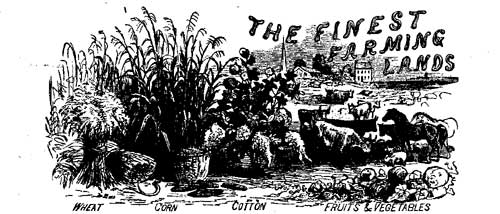
EQUAL TO ANY IN THE WORLD!!!
MAY BE PROCURED
At FROM $8 to $12 PER ACRE,
Near Markets, Schools, Railroads, Churches, and all the blessings of Civilization.
1,200,000 Acres, in Farms of 40, 80, 120, 160 Acres and upwards, in ILLINOIS, the Garden State of America.
The Illinois Central Railroad Company offer, ON LONG CREDIT, the beautiful and fertile PRAIRIE LANDS lying along the whole line of their Railroad. 700 MILES IN LENGTH, upon the most Favorable Terms for enabling Farmers, Manufacturers, Mechanics and Workingmen to make for themselves and their families a competency, and a HOME they can call THEIR OWN, as will appear from the following statements:
ILLINOIS.
Is about equal in extent to England, with a population of 1,722,666, and a soil capable of supporting 20,000,000. No State in the Valley of the Mississippi offers so great an inducement to the settler as the State of Illinois. There is no part of the world where all the conditions of climate and soil so admirably combine to produce those two great staples, Corn and Wheat.
CLIMATE.
Nowhere can the Industrious farmer secure such immediate results from his labor as on these deep, rich, loamy soils, cultivated with so much ease. The climate from the extreme southern part of the State to the Terre Haute, Alton and St. Louis Railroad, a distance of nearly 200 miles, is well adapted to Winter.
WHEAT, CORN, COTTON, TOBACCO.
Peaches, Pears, Tomatoes, and every variety of fruit and vegetables is grown in great abundance, from which Chicago and other Northern markets are furnished from four to six weeks earlier than their immediate vicinity. Between the Terre Haute, Alton & St. Louis Railway and the Kankakee and Illinois Rivers, (a distance of 115 miles on the Branch, and 136 miles on the Main Trunk,) lies the great Corn and Stock raising portion of the State.
THE ORDINARY YIELD
of Corn is from 60 to 80 bushels per acre. Cattle, Horses, Mules, Sheep and Hogs are raised here at a small cost, and yield large profits. It is believed that no section of country presents greater inducements for Dairy Farming than the Prairies of Illinois, a branch of farming to which but little attention has been paid, and which must yield sure profitable results. Between the Kankakee and Illinois Rivers, and Chicago and Dunleith, (a distance of 56 miles on the Branch and 147 miles by the Main Trunk,) Timothy Hay, Spring Wheat, Corn, &c., are produced in great abundance.
AGRICULTURAL PRODUCTS.
The Agricultural products of Illinois are greater than those of any other State. The Wheat crop of 1861 was estimated at 35,000,000 bushels, while the Corn crop yields not less than 140,000,000 bushels besides the crop of Oats, Barley, Rye, Buckwheat, Potatoes, Sweet Potatoes, Pumpkins, Squashes, Flax, Hemp, Peas, Clover, Cabbage, Beets, Tobacco, Sorgheim, Grapes, Peaches, Apples, &c., which go to swell the vast aggregate of production in this fertile region. Over Four Million tons of produce were sent out the State of Illinois during the past year.
STOCK RAISING.
In Central and Southern Illinois uncommon advantages are presented for the extension of Stock raising. All kinds of Cattle, Horses, Mules, Sheep, Hogs, &c., of the best breeds, yield handsome profits; large fortunes have already been made, and the field is open for others to enter with the fairest prospects of like results. Dairy Farming also presents its inducements to many.
CULTIVATION OF COTTON.
The experiments in Cotton culture are of very great promise. Commencing in latitude 39 deg. 30 min. (see Mattoon on the Branch, and Assumption on the Main Line), the Company owns thousands of acres well adapted to the perfection of this fibre. A settler having a family of young children, can turn their youthful labor to a most profitable account in the growth and perfection of this plant.
THE ILLINOIS CENTRAL RAILROAD
Traverses the whole length of the State, from the banks of the Mississippi and Lake Michigan to the Ohio. As its name imports, the Railroad runs through the centre of the State, and on either side of the road along its whole length lie the lands offered for sale.
CITIES, TOWNS, MARKETS, DEPOTS.
There are Ninety-eight Depots on the Company's Railway, giving about one every seven miles. Cities, Towns and Villages are situated at convenient distances throughout the whole route, where every desirable commodity may be found as readily as in the oldest cities of the Union, and where buyers are to be met for all kinds of farm produce.
EDUCATION.
Mechanics and working-men will find the free school system encouraged by the State, and endowed with a large revenue for the support of the schools. Children can live in sight of the school, the college, the church, and grow up with the prosperity of the leading State in the Great Western Empire.
PRICES AND TERMS OF PAYMENT—ON LONG CREDIT.
80 acres at $10 per acre, with interest at 6 per ct. annually on the following terms:
Cash payment $48 00
Paymentin one year48 00
Paymentin two years48 00
Paymentin three years48 00
Paymentin four years236 00
Paymentin five years224 00
Paymentin six years212 00
Paymentin seven years300 00
40 acres, at $10 00 per acre:
Cash payment $24 00
Paymentin one year24 00
Paymentin two years24 00
Paymentin three years24 00
Paymentin four years118 00
Paymentin five years112 00
Paymentin six years106 00
Paymentin seven years100 00
Address Land Commissioner, Illinois Central Railroad, Chicago, Ill.
Number 1425 Cents