Volume 2 — CHAPTER IX.
Reading edition
CONFESSIONS OF A COLUMBUS.
The Cause of my Cruise—No Work—The Atlantic Greyhound—Irish Ship—Irish Doctor—Irish Visitors—Queenstown—A Surprise—Fiddles—Edward Lloyd—Lib—Chess—The Syren—The American Pilot—Real and Ideal—Red Tape—Bribery—Liberty—The Floating Flower Show—The Bouquet—A Bath and a Bishop—"Beastly Healthy"—Entertainment for Shipwrecked Sailors—Passengers—Superstition.
America in a Hurry—Harry Columbus Furniss—The Inky Inquisition—First Impressions—Trilby—Tempting Offers—Kidnapped—Major Pond—Sarony—Ice—James B. Brown—Fire!—An Explanation.
Washington—Mr. French of Nowhere—Sold—Interviewed—The Sporting Editor—Hot Stuff—The Capitol—Congress—House of Representatives—The Page Boys—The Agent—Filibuster—The "Reccard"—A Pandemonium—Interviewing the President.
Chicago—The Windy City—Blowers—Niagara—Water and Wood—Darkness to Light—My Vis-à-Vis—Mr. Punch—My Driver—It Grows upon Me—Inspiration—Harnessing Niagara—The Three Sisters—Incline Railway—Captain Webb.

Travelling—Tickets—Thirst—Sancho Panza—Proclaimed States—"The Amurrican Gurl"—A Lady Interviewer—The English Girl—A Hair Restorer—Twelfth Night Club Reception at a Ladies' Club—The Great Presidential Election—Sound Money v. Free Silver—Slumland—Detective O'Flaherty.
NEVER felt better in my life, but my friends all assured me that I looked ill. If I wasn't ill, I ought to be. I must be overworked and break down. I had "burnt the candle at both ends and in the middle as well," and it was a duty I owed to humanity to collapse. For years I had done the work of three men with the constitution of one, so one day it came to pass that I was forced by my friends into the consulting-room of a celebrated physician, labelled "Ill. To be returned to Dead Letter Office, or to be sent by foreign mail to some distant land, or to be cremated on the spot," anything but to leave me free to return to my mad disease, the worst mania of all—the mania for work.
My good physician stripped me, pommelled me, stethoscoped me, made me say "99" when he had squeezed all the breath out of me (why "99"? Why not "98" or "4"?—he was testing internal rebellion), flashed a reflector under my eyes, seized a drumstick and hammered me under my knee-joints, sat upon me literally and figuratively, and told me to give up all food, drink, pleasure, and work for two months, which I did. My balance at the bankers' and my balance on the scales were both reduced considerably. I lost a good many pounds in weight and money.
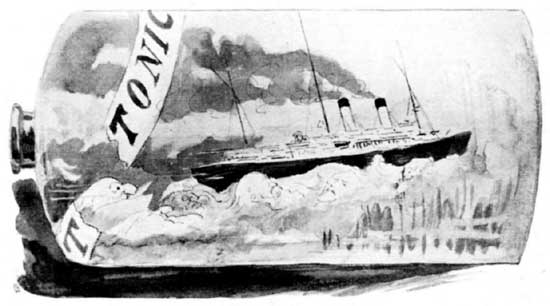
My friends all assured me that I looked well, but I never felt so ill in all my life. If I was not ill, I ought to be. I tried to work, but broke down. I was idle in the mornings, in the evenings, and in the middle of the day as well, and it was a duty I owed to my doctor to collapse. So one day I forced myself into his consulting-room before a hundred patients waiting their turn, labelled "Well again." I pushed him into his chair, pommelled him 99 times, flashed my cane under his eyes, seized the poker and hammered him under his knee-joints, and told him I would get him six months' hard labour if he did not pronounce me sound,—he did.
"You only want a tonic now, my dear fellow—a sea-trip!"
"A Teutonic," I replied Majestically. "The very thing—sails to-morrow—a new berth—I'll be born again under a White Star—au revoir!"
"Your prescription!" he called after me. "Take it, and if you value your life act up to it to the letter."
It contained two words and no hieroglyphics. Those two words were—"No Work!"
How I acted up to it the following pages will show.
AN ATLANTIC "GREYHOUND."
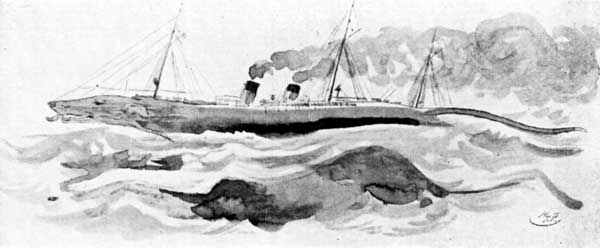
In strong contrast to the crowd and bustle at leaving in the afternoon is the quietude late in the evening. Many promenade up and down the beautiful deck under the electrically-lighted roof, and gaze upon the lights of many craft flitting to and fro in the gentle breeze like will-o'-the-wisps, postponing retiring, as they are not yet accustomed to the vibration of the Atlantic greyhound, which trembles underneath them as if, like the real greyhound in full cry after a hare, it is literally straining every muscle to beat the record from the Old World to the New.
What a difference has taken place since those "good old days" of those good old wooden ships, with their good old slow passages and their good old uncomfortable berths! Now the state cabin is an apartment perfectly ventilated, gorgeously furnished, equipped with every modern improvement, and electrically lighted; the switches close to the bed (not berth) enable one to turn the light on or off at will. The ever-watchful attendant comes in, wishes me good-night, after folding my clothes, and departs. Leaving the incandescent light burning over my head, I open the book dealing with the wonders of America which I have taken from the well-stocked library, and read of great Americans, from Washington to the man who has brought this very light to such perfection, turning over page after page of well-nigh incredible description of the country which has raised the system of "booming" to a high art, till my brain reels with an Arabian Nightish flavour of exaggeration, and turning off the electric current, I am gradually lulled to sleep by the rhythmical vibrations of the steamer, the sole reminder that I am in reality sleeping upon a ship and about to enjoy a thorough week's rest.
I awoke from the dreams in which I had pictured myself a veritable Columbus, and drawing aside the blind of my porthole, I looked out into the morning light, and was, perhaps, for a second surprised to see land. "Sandy Hook already! Can it be?" Well, hardly, just at present. Though who can tell but that in another fifty years it may be possible in the time? It is in reality the "Ould Counthry," and we are nearing Queenstown.
There is a good muster at breakfast, and everyone is smiling, having had at least one good night's rest on the voyage. The waters skirting the Irish coast sometimes outdo the fury of the broad Atlantic, and are generally just as troubled and combatant as the fiery political elements on the little island; but so far we have had a perfect passage, and the beautiful bay of Queenstown looks more charming than ever as the engines stop for a short period before their five days' incessant activity to follow.
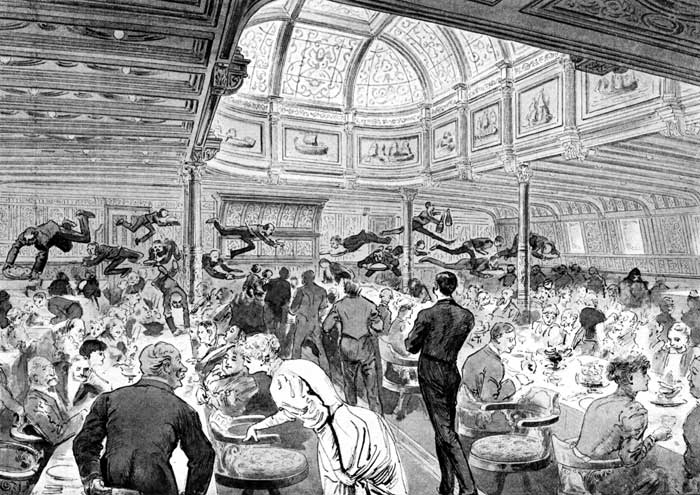
Not only the ship, but the doctor, comes from the Emerald Isle. Who crossing the Atlantic does not know the witty Dr.——? "Ah, shure, me darlin', and isn't it himself that's a broth av a bhoy?" And so he is, simply bubbling over with humour and good-nature. Presiding at one end of the long table, I have to pass him as I leave the saloon. Having sketched Irish scenery and Irish character in my youth, I am not tempted to open my forbidden sketch-book; but somehow or other I find myself making a rapid sketch of the Doctor as he rises from his seat at the end of the table to wish the "top of the mornin'" to a lady who sits on his right. My excuse is to send it to his friend, my doctor in London. Then, without thinking, I sketch in a few other passengers, and instinctively make a note of the surroundings. I confess I am already guilty of breaking my pledge! And, therefore, make my escape on deck.
The huge steamer seems to act as a sort of magnet on the small fry of the harbour, for they rush out to her from the land in all their sorts and sizes, in a desperate race for supremacy. Prominent among this fleet is a long, ungainly rowing-boat propelled by a tough Hibernian, and seated in the stern are his women folk, surrounded by baskets, who, in strong Milesian vernacular, urge the rower on in his endeavours to reach the ship first. Looked down upon them from your floating tower, they strongly resemble a swarm of centipedes. Harder and harder pull the "bhoys," and louder and louder comes the haranguing of the females as they approach us. I have my eye on the lady in the stern of the first boat. She is fair, fat, and forty, possessed of really massive proportions, most powerful lungs, and a true Irish physiognomy—a cast of countenance in which it always strikes me that Nature had originally forgotten the nasal organ, and then returning to complete the work had taken between finger and thumb a piece of flesh and pinched it, thus forming the nose rather high up on the face, while the waste of material below goes to make the upper lip.
THE SALOON OF THE TEUTONIC. THE FIRST MORNING AT BREAKFAST.
The puller of the stroke oar is probably her husband, two others are wielded evidently by her two sons, and the bow is taken by her strapping daughter. One of her arms encircles the merchandise she intends to dispose of on board our vessel, while the other vigorously helps to propel the oar held by her brawny husband. All the while she is urging on her crew in her native language, with what may be commands, exhortations, or even blessings, but sounding to the unaccustomed Saxon ear very much like curses, which chase one another out of her capacious mouth with a rapidity unequalled by even an irritated monkey at the Zoo.
AT QUEENSTOWN—A REMINISCENCE.
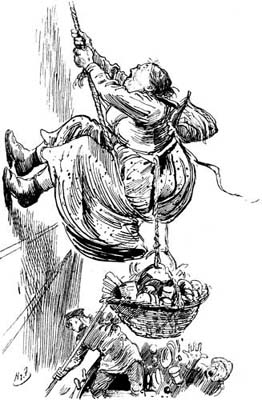
Their lumbering craft is the first to touch the side of the Teutonic. Standing up in the boat, the good old lady exerts her vocal powers on the crew on the lower deck, with the result that a rope fully fifty feet long is thrown in her direction, having a loop on the end of it, by which she is lassoed. With an agility only acquired after years of practice, she adjusts the loop rapidly round her, and calls on the crew to hoist away. The boat heels over to one side as she vigorously pushes herself away from it, and souse the old dame goes up to her waist in the water; the good-natured sailors give an extra jerk, and up she comes, with baskets tied round her waist, and her feet acting as fenders against the side of the ship. Fortunately the Teutonic is bulky enough to resist heeling over under this extra weight on the starboard side. She is shipped like a bale of goods, and is immediately engaged in discharging some more of her loquacity in directing the acrobatic performances of her daughter, who is the next to ascend.
This scene caused much laughter, and I was induced to make a sketch of the lady's acrobatic performance.
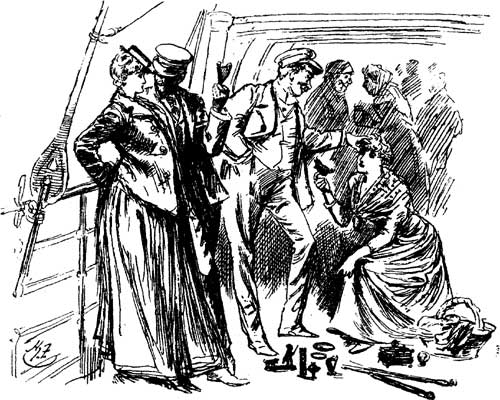
The other maritime vendors are hauled up in similar unceremonious fashion, and they take possession of both decks. The pretty daughter of Erin lays out with no little artistic taste her bog-oak ornaments, and 'Arry (for the genus cad is to be encountered even on board such aristocratic ships as these) attempts to be rampantly facetious at her expense. But the damsel with the unkempt auburn locks flowing about her comely face, lit up by a pair of blue Irish eyes under their dark lashes, takes the cad's vulgarity together with his money, like the pill with the jam, giving in return the valueless pieces of carved wood, until her little stock is exhausted and a good morning's work is done.
On the lower deck trade is brisker. The emigrants (principally by this line Scandinavians, in their picturesque peasant dress, the Germans of course preferring to go by their own line, the North German Lloyd) are fitting on Tam o' Shanters of the crudest colours, scarves of hues that would cause the steamer's danger signals to turn pale, and eatables of all descriptions—I ought to say of all the worst descriptions. Unhealthy-looking cakes in which the currants are as scarce as Loyalists in the part of the country in which they are made, tinned meats and fruits that look suspiciously like condemned provisions or unsavoury salvage; in fact the only really genuine article of diet was that contained in the milk-pails. I may here remark that these alien steerage passengers don't really care for wholesome food. Nothing could be better than the excellent food prepared by the ship's steward, but these emigrants prefer to bring with them provisions that beggar description.
BOG-OAK SOUVENIRS.
All the time the Irish purveyors are emptying their baskets and filling their pockets, and rowing back to the shore enriched and delighted; their brothers and sisters are flowing up the gangway in a continual stream, with weeping eyes and breaking hearts at the thought of leaving their country perhaps for ever; and as soon as they are all on board, together with the mails, which have come overland to Queenstown, we up anchor, steam past Fastnet Rock, and soon the Old World is out of sight behind us.
But all this is a thing of the past. Ladies are not now pulled up on to the deck, nor is the promenade turned into a miniature Irish fair. When last the boat stopped as usual in Queenstown bay I sadly missed the familiar scene, and having nothing better to do I went on shore. As a number of us strolled off the tender on which the mails were to return I noticed two men in ordinary dress standing some distance off, looking on at the scene. They were both fine specimens of humanity, each of them about six feet high. "Detectives," I whispered to one of my friends. And as we approached these gentlemen, I said to one of them, "Looking for anyone this morning?"
"Not for you, Mr. Furniss."
Considering I had never been in Queenstown in my life, that I had never been in the grip of these "sleuth-hounds" of the police, I must admit that the British detective is not so stupid as we generally imagine, for no doubt these men knew by telegraph the name of everybody on board and amused themselves by placing us as I had amused myself by placing them.
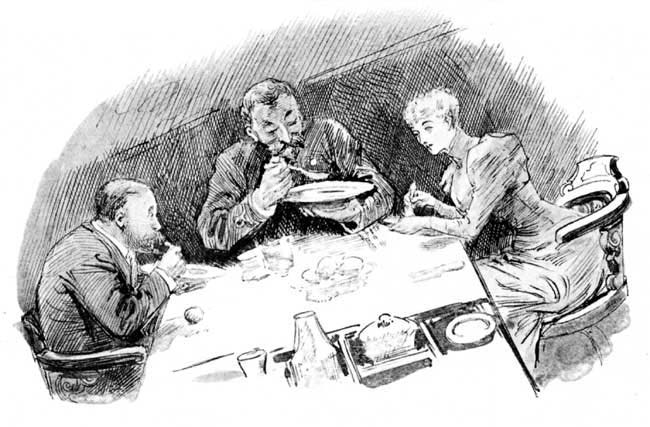
The Captain generally has some voyager under his special care, and my vis-à-vis, his protégée upon this trip, was a most charming and delightful young lady on her way to rejoin her family in the Far West. The skipper's seat is vacant at breakfast time, and should the weather be rough, at the other meals also. If the elements are very boisterous, the "fiddles" are screwed on to the tables, and on them a lively tune is played by the jingling glasses and rattling cutlery to the erratic beating of the Atlantic wave. The Captain's right and left hand neighbours are exempt from the use of these appliances, and the small area caused by this is the only space in the yards and yards of table unencumbered by the "fiddles." The Captain scorns the aid of such mechanical contrivances, and chatters away unconcerned, gracefully balancing his soup-plate in his hands the while. I followed his example as one to the manner born, but had I not been a bit of an amateur conjuror I am afraid that I should not have been so successful. The Captain challenged me, however, to make a sketch with the same ease as I ate my dinner—and again I was forced to break my pledge!
THE CAPTAIN'S TABLE.
It was amusing to listen to the petty jealousies and the little grumblings of those not satisfied with their lot at table. One lady stated as an excuse for having her meals in her cabin that her neighbour, a bagman—or "drummer," as Americans would call him—made a noise with his mouth while eating; and another lady elected to dine in her stateroom in solitude because in the saloon she had her back to a Bishop instead of her face!
It was my good fortune to meet on board that most genial and gifted of men, "England's greatest tenor," Mr. Edward Lloyd, who under the management of that equally genial and energetic impresario, Mr. Vert, was on his way to charm the ears of our cousins on the other side. Then we had one of the greatest favourites in the sporting world, who was popping over, as he had been continually doing from his earliest youth, to look after his estates in his native country. From the Captain down to the under stokers he had been with all a familiar figure for many years, and he had a pleasant word and a shake of the hands for everybody. He could give you the straight tip for the Derby, was a fund of information anent the latest weights for the big handicaps, and on our arrival in the States it was with general satisfaction that we learnt that one of his horses had won a race while its owner was crossing the "Herring Pond."
We had yet another celebrity on board in the person of the bright little Italian whose clever caricatures, especially those of Newmarket and Newmarket celebrities, so delight us in the pages of Vanity Fair over the nom de crayon "Lib." I think he caused us as much amusement as his sketches, caricaturing everybody on board, not even excepting himself, whom he most truthfully depicted as a common or barn owl. Or was it I who drew him as the owl? I forget. But I do know that he looked uncommonly like one as a rule, for he used to lie wrapped in his Inverness upon a deck chair, his face only visible, with pallid cheeks and distended eyes, and I did more than one caricature of him for his fair admirers. That was on the rough days, for like a great many foreigners, and English people too for the matter of that, he was a bad sailor. Fortunately for me, I am a hardened sailor, and as such cannot feel the amount of consideration I should otherwise do for those less lucky than myself.
When the weather was calm I used to notice my Italian friend seated, surrounded by the ladies, with an air of triumph and a smile upon his intelligent visage. He was having his revenge! When he was not sketching, he was playing chess with the Captain.
NOT UP IN A BALLOON.
Now this commander was a captain from the top of his head to the soles of his feet. A stern disciplinarian, erect, handsome, uncommunicative, not a better officer ever stood on the bridge of an Atlantic or any other liner. He had a contempt for the "Herring Pond," and manipulated one of these floating hotels with as much ease as one would handle a toy boat. "When a navigator's duty's to be done," he was par excellence a modern Cæsar, but despite his sternness he had a sense of humour, and his unbending moments struck one with an emphasised surprise.
He could not bear a bore. Those fussy landlubbers who are always tapping the barometers, asking questions of every member of the crew, testing, sounding, and finding fault with the weather chart, had better steer clear of the worthy Captain, as with hands thrust deep in his pockets he strides from one end of the deck to the other during the course of his constitutional. It is on record that one of these fussy individuals, edging up to a well-known Captain as he was going on to the bridge when a mist was gathering, and the siren was about to blow as customary when entering on an Atlantic fog, remarked:
"Captain, Captain, can't you see that it is quite clear overhead?"
The Captain turned on his heel to ascend to the bridge, and scornfully rejoined:
"Yes, sir, yes, sir; but can't you see that I am not navigating a balloon?"
On one occasion the Captain had been through a terribly stormy afternoon and night, and had not quitted his post on the bridge for one minute, the weather being awful. Fogs, icebergs, and the elements all combined to make it a most anxious time for the one man in charge of the valuable vessel and her cargo of 1,700 souls, and during the whole period the unflinching skipper had not tasted a mouthful of food. The Captain's boy, feeling for his master, had from time to time endeavoured with some succulent morsel to make him break his long fast; but the firm face of the Captain was set, his eyes were fixed straight ahead, and his ears were deaf to the lad's appeal. It was breakfast time when the boy once more ventured to ask the Captain if he could bring him something to eat. This time he got an answer.
"Yes," growled the Captain, "bring me two larks' livers on toast!"
These Atlantic Captains of the older school were a hardened and humorous lot of navigators, and many a story of their eccentricity survives them: one in particular of an old Captain seeing the terror of the junior officer during that nervous ordeal of treading the bridge for the first time with him. This particular old salt, after a painful silence, turned on the young man and said, "I like you. I'm very much impressed by you. I've heard a lot about you—in fact, my dear sir, I should like to have your photograph. You skip down and get it."
The nervous and delighted youth rushed off to his cabin, and informed his brother officers of the compliment the old man had just paid him. He was in luck's way, and running gaily up on to the bridge, presented his photograph, blushing modestly, to the old salt.
"'Umph! Got a pin with you?"
"Ye—es, sir."
"Ah, see! I pin you up on the canvas here. I can look at you there and admire you. You can go, sir; your photograph is just as valuable as you appear to be on the bridge. Good morning."
The Captain of the ship I was on had his chessmen pegged, and holes in the board into which to place them, so that despite any oscillations of the ship they would remain in their places; but the unfortunate part of the business was that although he could provide sea-legs for his chessmen it was more than he could do for his opponent, and it was as good as a play to see Signor "Lib" hiding from the Captain when the weather was not all it might be, and he in consequence felt anything but well. One mate after another would be despatched with the strictest orders from the Captain to search for the cheerless chessite; but after a time the Captain's patience would be exhausted, his strident voice could be heard calling upon the caricaturist to come forth and show himself, and eventually he might be seen en route to his cabin with the box of chessmen under one arm and his opponent under the other.
CHESS.
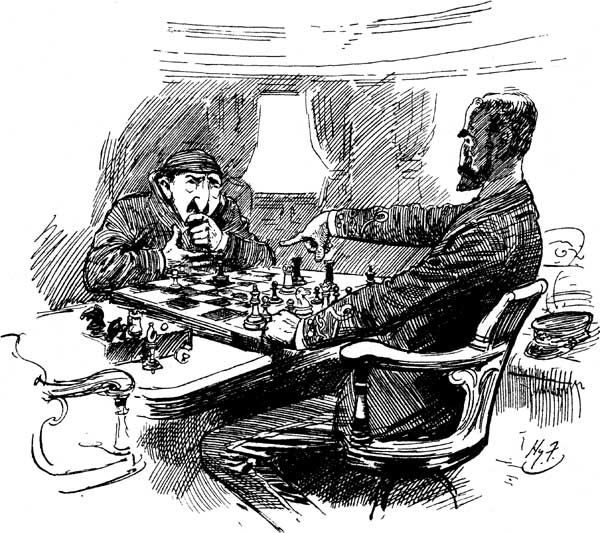
I was cruel enough on more than one occasion to follow them and witness the sequel.
"Your move, now—your move!"
"Ah, Captain! I do veel zo ill! Ze ship it do go up and down, up and down, until I do not know vich is ze bishop and vich is ze queen!"
"Nonsense, sir, nonsense! Your move—look sharp, and I'll soon have you mated!"
The poor artist did move, and quickly too, but it was to the outside of the cabin!
The Captain was triumphant at table, telling us of his victory, but his poor opponent could only point to his untouched plate and to the waves dashing against the portholes, and with that shrug of the shoulders, so suggestive to witness but so difficult to describe, would thus in dumb show explain the cause of his defeat.
I remember well on one beautiful afternoon, the sky bright and the sea calm, just before the pilot came on board when we were nearing the States, Signor Prosperi (for that was his name) came up to me, his face the very embodiment of triumph:
"Ah, I have beaten ze Captain at last—but ze sea is smooth!"
On the outward voyage, as I said before, we had a host in Mr. Edward Lloyd, but he was under contract not to warble until a certain day which had been fixed in New York, and no doubt his presence had a deterrent effect upon the amateur talent, with the exception of one lady, who came up to Mr. Lloyd and said:
"You really must sing;—you really must!"
"I am very sorry, madam, but I really can't—I am not my own master in this matter."
"Oh, but you must," she rejoined. "I have promised that if you will sing, I will!"
An American who had "made his pile," as the Yankees say, remarked to the hard-worked vocalist:
"I think, sir, that as you are endowed with such a beautiful voice you ought by it to benefit such a deserving entertainment as this."
MR. LLOYD AND THE LADY. "IF YOU WILL SING, I WILL!"
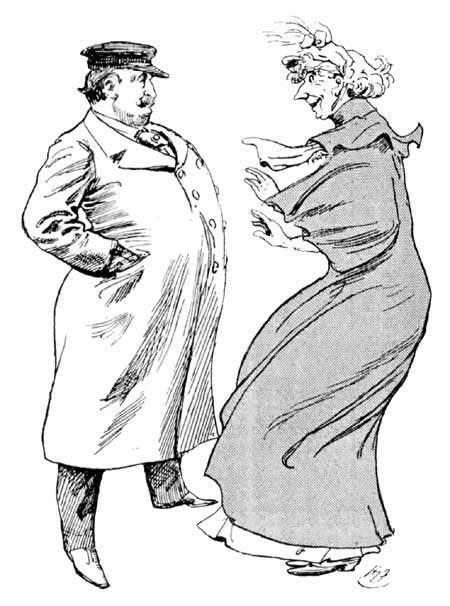
"Certainly," replied the world-famed tenor. "My fee for singing is fifty guineas, and I will be pleased to oblige the company if you will pay a cheque for that amount into the sailors' fund."
And, in my opinion, a right good answer too. These middle-men and their wives and daughters are always pestering professional men to give their services to charities for nothing, but in cases like the one I have just cited they take very good care that they do not unloosen their own purse-strings to help the cause along and equalise the obligation.
However the concert took place, and I, unable to resist the flattering request to "do something," and not being prohibited from taking part—as Mr. Lloyd was—made several sketches, just to keep my hand in, and they were raffled for.
All goes well and smoothly on the voyage until one night you are awakened by a harsh, grating, shrieking sound. You start from your slumbers, and for a moment imagine that in reality you are in the interior of some fearsome ocean monster, who is bellowing either in rage or fear, for the sound is unique in its wild hideousness, half a screech and half a wail, aggressive and yet mournful. Your ears have just recovered from the first shock when they are assaulted by another, and yet another, at intervals of about a minute. It is the voice of the siren. Was ever a more inappropriate name bestowed upon the steam whistle of an Atlantic liner? It conveys to me the news that we are passing through an Atlantic fog, and I defy anyone, be they in the most perfect ship, under the safest of commanders, to feel comfortable in such circumstances. The siren still wails, and like Ulysses and his companions I feel very much inclined to stuff my ears with wax. Indeed, peering out of my porthole through the mist, I almost seem to see the figures of the mythological voyager and his companions carved in ice, no doubt beguiled by the treacherous music of the siren. These are in reality our main terrors, the icebergs.
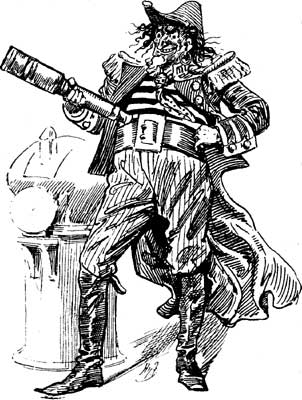
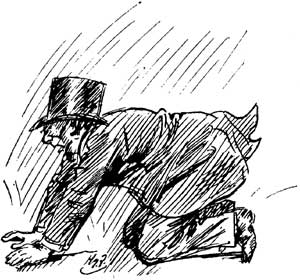
THE AMERICAN PILOT—IDEAL.THE AMERICAN PILOT—REAL.
It is a relief when we have left them behind and evaded the clutches of the demon fog, and the fresh breeze and the glorious sun lend a new beauty to the sparkling water, showing us in the distance white specks skimming over the waves like gulls, the first sign that we are approaching land—the white gleaming wings of the pilot yachts.
Signals are exchanged, and one of these boats comes nearer and nearer to us, tacking to perfection. Through our glasses we already seem to see the stalwart figure of the pilot standing in the stern. On his brow he wears a storm-defying cap, the badge of the warrior of the waves; the loose shirt, the top boots, and the weather-beaten jacket all combine to make up a picturesque figure, and I sketched what seemed to me to be the figure of the man who was coming on board to guide us to the Hook of Sandy. As the little vessel approaches us the intervening sail hides from my view the figure of the one man I want to see. A boat is lowered from the side of the pilot boat, into which two sailors descend. Who on earth is this who steps in after them and takes the rudder lines? He sports a top hat, kid gloves, and patent shoes. Is he a commercial traveller? He looks it. He is rowed to the side of the steamer, and then the fun begins. A rope ladder is lowered from the deck, which is immediately clutched by one of the oarsmen in the boat, and this commonplace commercial scrambles towards it. Just then a wave breaks over him, and more like a drowned excursionist than an American pilot this little man is hauled on board.
I think a great deal of the Atlantic, but I am sorely disappointed with the American pilot.
The Americans pride themselves upon their independence, and surely a more independent race never existed. The brow-beaten Britisher is not long in finding this out, and in my case it was most clearly demonstrated to me at the first stoppage of the steamer after leaving Queenstown. After our headlong race across the broad Atlantic, after every nut and screw in the vessel has been strained to save every particle of time, and every moment watched and calculated, here at the mouth of the Hudson, in sight of the colossal statue of Liberty, we are kept waiting under a broiling sun on a beautiful day for an unconscionable time whilst forsooth the health officer or his subordinate is enjoying his lunch. Fancy 1,700 foreigners being kept waiting because a paid official—paid by the shipowners of England—wishes to satisfy his selfish greediness!
I watched for this gentleman as he crawled on board, having come across eventually from his riparian villa. There were no apologies (Americans never apologise). I don't know the gentleman's name, but here I show you his face. His check I have described already.
Now that I have touched on America itself, I wish it to be understood that it is not my intention to look out for and comment upon the faults of our American cousins, but rather in describing my all too brief visits to a charming people in a charming country to deal with their merits. But it is proverbial that first impressions are everything, and the first I received of official America, in the person of this particular individual, was the only instance I saw which would not compare favourably with the red-tapeism of our own country. And I must say, from what I was told even by Americans themselves, that the worst side of their countrymen is to be seen where the official department is concerned, and to illustrate this I shall still stick to the official (or his representative, whichever it was) that I have just been describing.
THE HEALTH OFFICER COMES ON BOARD.
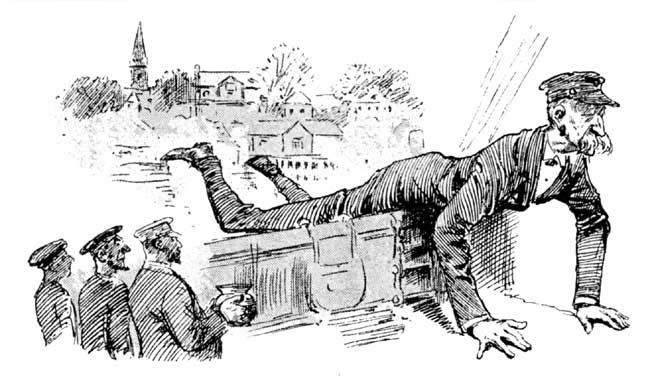
The ship which followed that in which I came over brought from England some persons who were at the time the talk of American society. They had been connected with some gigantic scandal, and the interviewers, scenting copy from afar, were ready to spring upon them. Of course, it was known that it was to the interest of the reporters (and they were only doing their duty) to get on board at Sandy Hook, and to frustrate them a special steamer was sent down with instructions to the captain of the liner that no one was to accompany the officer of health on board. The medical officer came in his tug with the whole batch of reporters, and declared that he would not permit the vessel to proceed into port unless his friends were allowed on board. The almighty dollar had polluted officialism, and disclosed to the incoming strangers that the huge statue of Liberty before them, which held on high the torch of advancement and enlightenment, was really a snare and a delusion, at any rate as far as red-tapeism was concerned.
JUST IN TIME!
And so I arrived after a week's thorough rest, with my sketch-book full! I could not help breaking my pledge; it was my first trip across the Atlantic, and everything was therefore new and interesting. In fact, so was all I saw in the States, and my pencil was always busy. I was looking forward to a genuine rest on my return journey, but it happened to be in the crowded season, and the ship was so full I was asked, as a particular favour to "a very distinguished cleric," to share my cabin with him.
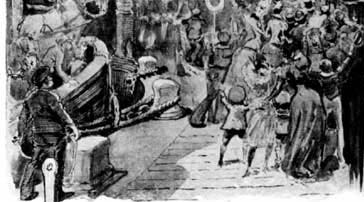
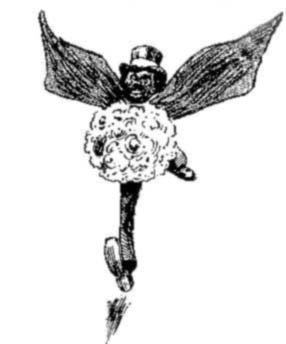
The departure of an Atlantic liner has a great attraction on both sides of the "Herring Pond," but there is a difference. Passengers leaving England are surrounded with cheap and vulgar literature, newspapers, guide-books, sticks, and umbrellas. Leaving America, the liner is turned into a floating flower show. Most beautiful bouquets labelled with the names of the lady passengers are on view in the saloon. Just as the last gangway is drawn on to the shore, amid cries of "Clear away!" we hear suddenly "Hold hard!" There is a commotion. Someone has not yet arrived; we lean over the side of the ship to see who is coming. Perhaps it is an important emissary of the Government, or even the President himself. We all push forward; the stalwart New York police keep back the crowd; the crew of the good ship Majestic hold the gangway in its place as the centre of attraction trips gaily up it. It is a diminutive nigger messenger from a florist's, with a huge bouquet of flowers. I imagine I see my own name on the label, so I modestly seclude myself in my own cabin, whence I only emerge after we have passed Bartholdi's colossal figure, just to have one last peep at the country in which I have stored up such pleasant memories.
"A FLOATING FLOWER SHOW."
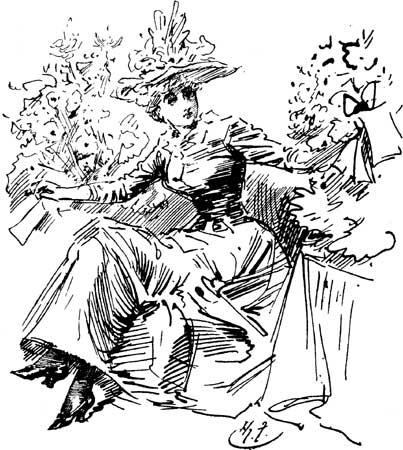
By this time the bouquets of the flower show had been transferred to the cabins of their owners. I may mention, by the way, that the cynical lady on board, who wore a solitary bunch of faded violets in her dress, informed me that most of the ladies paid for the bouquets themselves, and had them sent on board with their names attached. I don't wish to seem egotistical, but I know that when I went back to my own cabin I found the greatest difficulty in forcing the door open. There was a huge bundle of something or other pressing against it. A fragrant scent was wafted through the opening, which sent a thrill through me. It must be the big bouquet! I gave one final shove, burst the door open, and discovered the bouquet to be a bishop, who was scenting his handkerchief at the time with otto of roses. It was worth the journey to America to have the honour of sharing a cabin with a bishop on the return journey. But what a contrast between us! What a theme for W. S. Gilbert! Punch and the pulpit rocked together in the cradle of the deep!
When I first came on board I made arrangements at once with the bath steward, and, being rather an early bird, I fixed my time to be called at seven o'clock. When I retired to the cabin I found the worthy bishop (he is now Lord Primate of Ireland) looking plaintively at his berth. Like all on board it was roomy and comfortable, but probably Sir Edward Harland had not taken the portly prelate (who, by the way, is almost a neighbour of his) as a gauge for the size of the berths. Mine was, if anything, a trifle larger, so I respectfully invited the bishop to change with me.
THE BATH STEWARD AND THE BISHOP. "YOUR TIME, SIR! YOUR TIME!"
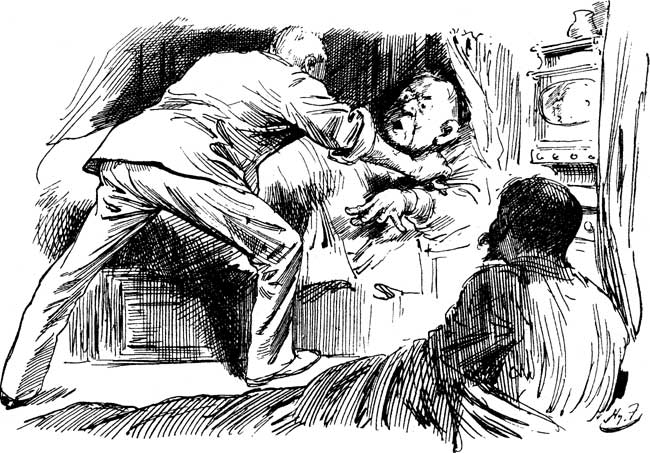
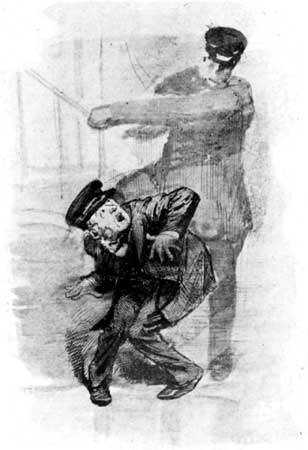
I was awakened next morning by assault and battery being committed on the poor bishop, of which I was the innocent cause. An athletic-looking man, with a white jacket, and sleeves rolled up to his elbows, was shaking the very life out of my clerical friend and shouting "Seven o'clock! Your time, sir! Seven o'clock! Your time!" The bishop looked something like a criminal sentenced to death must do when the hangman awakes him on the fatal morning, and I had to explain to the bath steward that we had changed berths, and that in future No. 2 was to be awakened instead of No. 1.
Perhaps it is not generally known that suicide is nearly as prevalent as mal de mer amongst these Americans who are rushing over for a few weeks' repose. They work at such a fearful rate, slaves to that insatiable god the almighty dollar, that eventually they either have to fly to a lunatic asylum or an Atlantic liner. After a day or two on the latter the calm and repose and the vast sea around them prove too much of an antidote; the overtaxed brain gives way, and overboard they go. An Englishman is too fond of exercise to allow high pressure to get the better of him in this way, and the difference between English and American people on these liners is most marked. Directly an American family comes on board they select places for their deck chairs, which, except for meals, they never leave. From early morning until late at night, much to the astonishment of the Americans, the English passengers—men, women, and children—pace the deck as if it were a go-as-you-please contest for immense prizes. Being a good sailor but a bad sleeper, I think I fairly qualified for first prize. Morning, noon, and night, round and round those magnificent decks I went, to the disgust and envy of those who could not move off their deck chairs, and who loathed the very sight of me.
AMERICANS AND ENGLISH ON DECK.
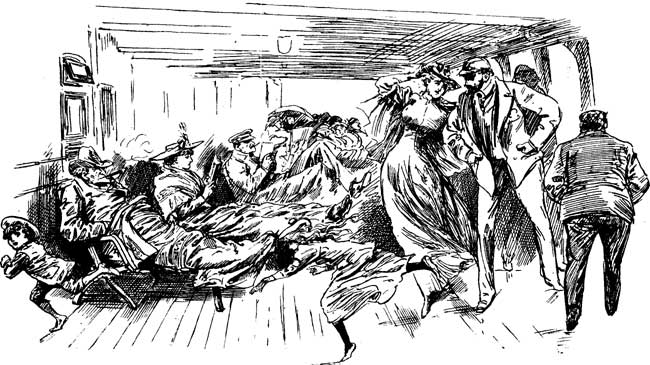
It so happened that together with a few other privileged passengers I dined a little later than the rest, so I had an opportunity of observing the weak ones suffering on deck whilst others were struggling with their meals below, and I promenaded round that deck, battling with the elements to get an extra edge on my excellent appetite. I remember that when passing some ladies on my way down to dinner, they feebly endeavouring to eat a biscuit or two and drink a glass of champagne, one turned her pallid face to another and murmured, "I am so glad that energetic little man has been obliged to give in at last!"
They ought to have seen me at the table half-an-hour afterwards, that's all!
That reminds me of my friend poor Alfred Cellier, who was wintering in the South once at the same time as we were there for my wife's health. I was returning from a meet one day, hot and mud-bespattered, when I met the talented musician walking feebly along in the sun with his furs on. He called to me to stop, which I did, and his dreamy, good-natured face assumed a most malevolent expression as he hissed at me, "I hate you! I hate you! You look so beastly healthy."
Even on board ship the American still clings to his iced water, but some think it is time to train for the European habit of taking wine at dinner. I noticed a Westerner who with his wife was sitting down for probably the first time to table d'hôte. He took up the wine list, and went right through the sherries, hocks, clarets, champagnes, and even liqueurs. Now at the end of the wine lists on these vessels there is appended a list of various mineral waters. The names of these (or was it the price?) seemed to take the fancy of the American. "I guess this Hunyadi Janos sounds well—I calculate if you put a bottle of that on ice it'll do us just right."
Sailors are superstitious. Some will, or used to, rob themselves of the necessities of life to purchase a baby's "caul," and wear it around their neck as a charm.
To sail out of harbour on a Friday was unheard of. In these days of science, days in which steam has driven the old frigate-rigged sailing ships from the seas, one would have thought that superstition would have vanished with the old hulks, and that in the floating palaces crossing the Atlantic, in which longshoremen take the place of old-time sea-dogs, charms and omens would have lost their power. Yet sailor superstitions are as hard to kill even in these gorgeous up-to-date liners as it is to exterminate the rats in the hold or the cockroaches in the larder.
The last journey I made to America was in the favourite liner the Germanic. I was chatting to one of the crew, an old salt, the day we left Queenstown; he was looking out to sea; his brow was clouded, and he shook his head mournfully.
"Are we in for a bad passage?" I asked.
"Don't know yet, sir; aren't seen all them on board yet. We had a terrible passage the week afore last goin' East, but I expected it. We 'ad an Archbishop on board!"
I informed him that on the present journey we had two priests on board, and two professional atheists—"so what kind of passage were we to expect?"
After a moment's serious thought the mariner replied, "I think, sir, we may reckon we shall have an average." And curious to relate we did.
The two Freethinkers who thus balanced the ecclesiastics were Messrs. Foote and Watts, who were on a mission to America to induce Colonel Robert G. Ingersoll to visit England.
The stranger in America, if he be a public man in his own country, is treated like a suspected criminal. Every movement is watched, every action reported, and as he passes from city to city a description and report precedes him, and there is an eye, or rather a couple of dozen eyes, to mark his coming and grow keener when he comes.
But he is watched by friends, not by detectives, and his actions are reported in public prints, not in private ledgers. It is not the arm of the law, but the hand of friendship, that shadows him, and those stereotyped passports to friendship, letters of introduction from friends at home, are as needless to introduce him as a life-preserver or a Colt's revolver to protect him. He had better amuse himself while in mid-ocean by presenting them to the porpoises that dive and splutter round the ship, for the only object they will accomplish will be the filling of his waste-paper basket on his return home.
AMERICAN INTERVIEWING—IMAGINARY.
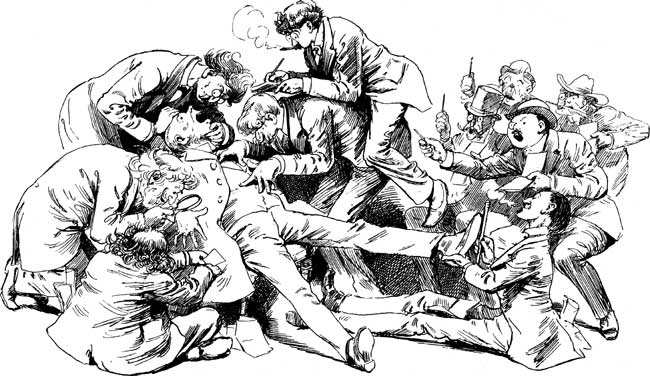
AMERICAN INTERVIEWING—REAL.
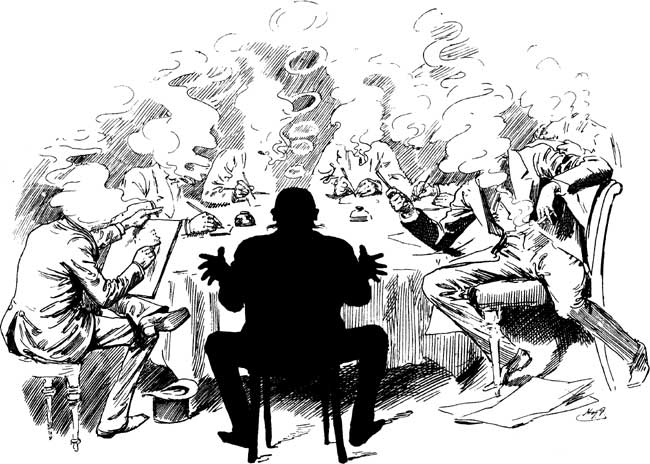
Major Hospitality arrested me the moment I arrived, and handed me over to the Inky Inquisition—eight gentlemen of the Press—who placed me on the interviewer's rack at the demand of insatiable modern journalism. I scraped through the ordeal as well as could be expected in the circumstances, considering I hadn't yet acquired my land-legs. The raging waves may roar their loudest, and the stormy winds may blow their hardest, but they don't affect me. It is only when I find myself on terra firma once more that I feel any effects from an ocean trip. For the benefit of those who are subject to mal de mer I will disclose my prescription to act as a reliable safeguard, and that is to mesmerise yourself so that once on board no sensations seem to you strange or unwonted. The only drawback is that I have not yet discovered how to unmesmerise myself, although my theory worked splendidly when on board, so that when I get on shore I feel as if I were still on the sea. I am always ducking breakers, descending companion ladders, and I roll across the street as if it were the deck of a liner. Every building I enter seems to be rocking up and down, up and down, and as on the occasion I refer to I sat before the knights of the quill to be cross-examined, I felt as if I were in the cabin of a ship rather than in my own room at the hotel, and that the books on the table were in reality fiddles to keep the glasses and other things from falling off.
It is, therefore, not to be wondered at that the next day I find myself described as "not a well man," although "his face is ruddy," and "his blue eyes have a tired look and his hand is not so steady as it might be." I would like to know whose hand would be steady if, after six days of Atlantic travel, he was landed to find himself suddenly confronted with eight talented gentlemen, cross-questioning him ad lib., measuring the length of his foot, counting the buttons on his coat, and the hairs on his head, and if, after his tiring journey, he happened to yawn, looking to see whether he had false teeth or not!
And then to be handed a bad pen and worse paper, and have to draw pictures in pen and ink, in the space of five minutes, for the eight gentlemen who were watching to see "how it's done"! I have sketched crowned heads on their thrones, bishops in their pulpits, thieves in their dens, and beauties in their drawing-rooms; but I never felt such nervousness as I did when I had to caricature myself on the occasion of my first experience of American interviewing.
In my seeing America in a hurry, I addressed the reporters somewhat in this fashion:
"SANDY."
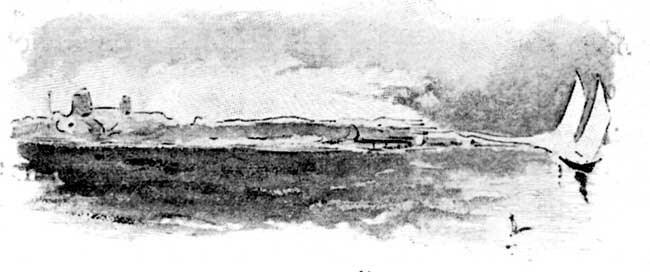
"I am not disappointed with anything I have seen. I was told that I would find the worst-paved streets in the world. I have found them. I was told that I would see unsightly, old-fashioned telegraph-poles sticking up in the streets. I have seen them. I was told that I would have to pay a small fortune for my cab from the docks to my hotel. I have paid it. I was told that a newspaper reporter would ask me what I thought of America as soon as I landed. I am asked that question by eight gentlemen of the Press; indeed, I was interrogated upon that point by the representative of a leading American paper before I left the shores of England. I was told that I would find the most charming and best-dressed women in the world. That promise is more than realised.
"I find New York as bright as Paris, as busy as London, as interesting as Rome, and, in fact, I am so delighted and bewildered with everybody and everything that, like the old lady's parrot, I don't say much, but I think a deal; and now my difficulty is to convey those thoughts to the public through the medium of your valuable papers."
Scores of Columbuses arrive at Sandy Hook every week to discover America for themselves, from Charles Columbus Dickens to Rudyard Columbus Kipling, to say nothing of Tom, Dick, Harry Columbus Brown, Jones, Robinson. It is hardly fair to say that they go over with their pockets full of letters of introduction to their American cousins, who receive them with open arms and unlimited hospitality, and then that these Toms, Dicks, and Harrys bring back in exchange notes for columns of ridicule and abuse of their Transatlantic friends. If our Americans have a fault, it is a very slight one. They are too sensitive. They seem to forget that they receive and honour some of our countrymen as critics and satirists, but they expect that on leaving their shores their late guests will wash off the critical and satirical sides of their natures just as an actor removes his paint and make-up on leaving the boards.
Americans, both publicly and privately, are incessantly interviewing the stranger: "What do you think of our great country? What do you think of ourselves?" They live in a glass house filled with forced young plants, from out of which house they may throw stones at the stranger, but woe betide the critic who has the temerity to cast one in return. He gets his impressions from the hothouse society snobs reared in the hotels of the cities, the dollar worshipper, the vulgar millionaire, made more obnoxious by the newer European importation, happily a plant not true to the American soil. We strangers too often see but the cut flowers, showy, glaring, to-day; jaded, gone to-morrow. We do not see the cultured orchid or the natural wild flowers of America, for the simple reason we do not look for them in seeing that wonderful country in a hurry.
My first impression of New York was that of a faded back-cloth in a melodrama; but when you get upon the stage, or, in other words, into the streets, you find yourself amid a transformation scene of wonderful activity and brilliancy. Some of the streets, in fact most of them in which business is transacted, resemble strongly the shop scenes in harlequinades, for the Americans have carried advertising so far that their streets of shops, and especially those in New York, are simply museums of grotesque advertisement.
Gigantic hands advertising gloves, huge hats, boots, and animals form a heterogeneous collection of anything but beautiful models, gilded and painted in all the most flaming colours, piled on top of each other on every house from street level to attic, each tradesman vieing with the other in screeching to the public to "Buy! buy!! buy!!!" by means of the curiosities and monstrosities of the advertiser's art.
CHIROPODY.
A few years ago a celebrated Continental authoress came to London for the first time, in the height of the season, to stay a week in order to get her impressions for a book she was writing, in which the heroine had flown to London for that period of time. She went everywhere and saw everything; just before she left London I asked her what had impressed her most of all she had seen. In reply she said, "The fact that the drivers of public vehicles never cracked their whips!"
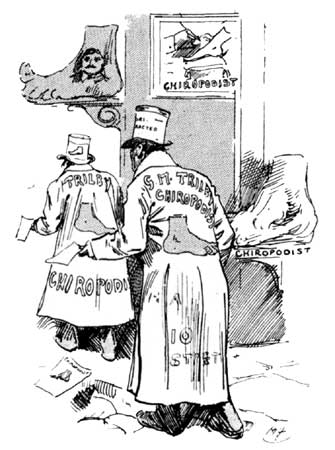
If I were asked what impressed me most about New York, I should not say Brooklyn Bridge, or Wall Street, or the Elevated Railway, but the number of chiropodists' advertisements! They confront you at every turn; these huge gilded models of feet outside the chiropodists' establishments, some painted realistically and many adorned with bunions, are destined to meet your eye as you stroll through the streets. Should you look up, you will see them suspended from the first floor window, or painted on canvas on the front of the house. Avoid the shops altogether, and you are bound to knock up against some gentleman in the gutter encased in a long white waterproof, on which is portrayed the inevitable foot and the name and address of the chiropodist.
Now why is this? The Americans have pretty feet and small hands, both men and women. Is it vanity, and do they squeeze their feet into boots too small for them, or are their pedal coverings badly made, or does the secret lie in the rough pavements of their thoroughfares? I am glad to say that I never required the services of a foot doctor, but I know that my feet have ached many and many a time after promenading the New York pathways.
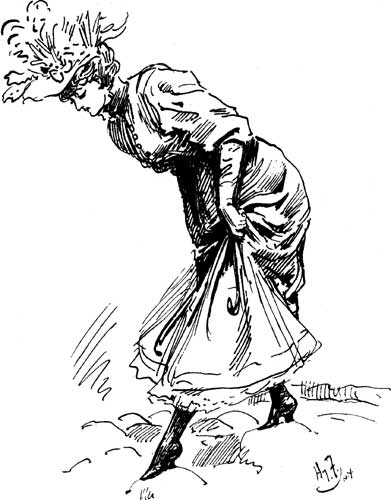
New York ought to be called New Trilby.
"NEW TRILBY."
I was offered more than once an open cheque which I might fill in to cover all my expenses from the time I left England until I reached the shores of the Old Country again if I would supply a journal with one page of impressions of America illustrated. A suggestion of this sort in an English newspaper office would have just about the same effect as a big canister of dynamite! I didn't accept any of these tempting offers. I didn't go to the States on my first visit to paint glaring pictures, or to make up stories, or to marry an American heiress, nor did I go in search of the almighty dollar. I simply went as a tourist in search of health, and with the desire of shaking hands with my many friends on the other side.
I was therefore extremely annoyed on my arrival to find the irrepressible lecture agent, Major Pond, had coolly announced that I was going over to him, and he had actually taken rooms for me at the Everett House! Of course I informed the interviewers that I was not going to tour with Pond or to make money in any way. I was merely a bird of passage, a rara avis, a visitor without an eye on the almighty dollar.
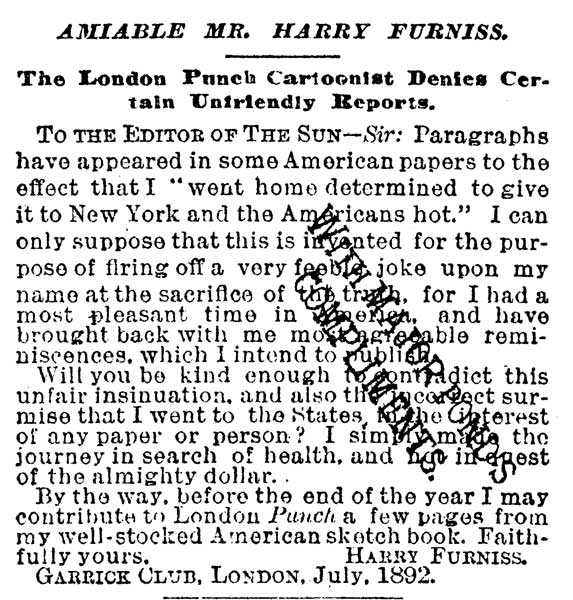
After I returned to England an irresponsible paragraphist informed the American public that I went home determined to give it to them hot. This contradiction of mine appeared, and was sent to me by the Major. Note in it I contradict his report that I went over in his interests.
Major Pond is a typical American, hospitable, kind, with an eye for business, but I do not appear in his entertaining book, nor was I ever on his business books either. He sat for me on the shoeblack's street chair outside his office when I made a sketch of him, and he was so obliging I believe he would have stood on his head if I had asked him. He managed to get me to stand in front of the camera, but not in front of an audience.
Some day I shall write a paper entitled "Photographers I Have Met," for few people have faced the fire of the camera oftener than I. I am not a fashionable beauty, nor much of a celebrity, neither am I honestly a vain man—I shrink from the rays of the too truthful lens—but I have been dragged into the line of fire and held there until the deed is done, like an unwilling convict. In nearly every town I have visited have I undergone this operation, and the result is a collection of criminal-looking, contorted countenances of a description seldom seen outside the museum of a police station.
MAJOR POND.
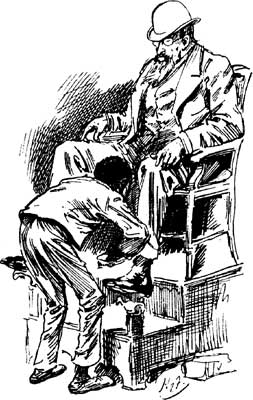
I was therefore determined not to incur this risk in America. Photographers sent their cards, but they saw me not (perhaps if they had they would have repented of their invitation). However, one day I was secured by stratagem.
I was walking along Union Square with Major Pond, whose martial bearing impressed me as much as his 'cuteness fascinated me. He had that morning heard of my determination not to be photographed, and as he walked along he suddenly stepped into a doorway, his arm in mine, touched a button in a side panel, down rushed an elevator, the door was flung open, and I was flung in. "Sarony," said the Major, and up, up, up we flew.
"The photographer?" I asked hurriedly.
"The artist," the Major replied; "one of the greatest flesh drawers" (nude studies) "we have in this gr—e—a—t country, sir. Here he is, deaf to everything but art, and to everyone but artists."
Who can say photography is not high art when you have to go up seven stories to it?
I now stood before the greatest photographer in the world—and the smallest. I stood—he danced. He talked—I listened.
"Come here," he cried; "you are an artist—you can understand genius—you can appreciate my work."
And he produced from a portfolio a quantity of studies, or, as the Major would call them, "flesh drawings," prettily touched in with the stump and chalk with a chic familiar to those who know the facility of the French school. He patted me on the shoulder, kissed his hand to his work, and fell into raptures over the human form divine with an earnestness which showed him to be a true artist. With his sitter in front of him he was even more enthusiastic, placing you into position, and striking attitudes in front of you till you felt inclined to dance "Ta ra ra boom de ay" instead of remaining rigid. I pointed out to him that my hair being of an auburn hue, that on my chin and the remnant on my head came out black.
"Ah, we shall alter that," he said, and he powdered my head. "And now to counteract that—here goes!" and with some soot or charcoal he touched over the scanty parts on my "dome of thought." During this process I noticed that his own luxurious head of hair was not a fixture. He wore a fez, and as he paused and pirouetted and struck attitudes, he would pull the fez over one eye coquettishly, or over the other one ferociously, and with it went his hair, parting and all. It is no wonder this energetic photographer was so successful with the instantaneous process, or that he so cleverly caught in the lens theatrical dancers and others in motion to perfection. Of the most successful of his photos that I saw was that of a row of comedians dancing together, and although I was not present at the moment the photograph was taken, I have no doubt, from the pleasant smile of their faces and their artistic poses, that all credit was due to the late Sarony.
THE GREAT SARONY.
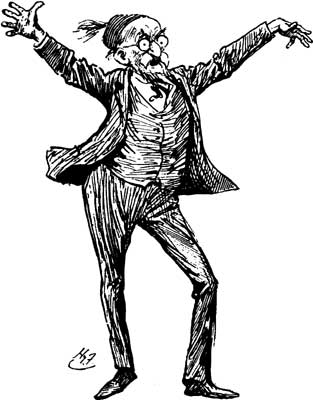
The Major had his "Bureau" in Everett House. There he arranged for his "stars," and there under false pretences he decoyed me, and there for the first time initiated me into the obnoxious habit of drinking iced water.
Most people are aware that in Nicaragua there dwell a tribe who gradually kill themselves by an extraordinary predilection for eating a certain kind of clay. These people are of the lowest order, and may therefore be pardoned for their foolishness in turning themselves into plaster casts; but why the enlightened Americans choose to convert themselves into walking icebergs through drinking so much iced water is unaccountable to the alien. They certainly do play havoc with their digestions. They eat rapidly and recklessly, and swallow with startling rapidity, for having all the dishes placed before them at once they have no waiting in between the courses to assist digestion, and almost before they have swallowed their food they freeze it with draughts of iced water.
At this hotel in New York there lived for some years an Italian singer, who was a great favourite in the city, and whose horror of iced water was a terror to all the waiters. They knew that it was as much as their lives were worth, and certainly as much as the glass was worth, to set a drink of this concoction before him. If any new or forgetful waiter offered the obnoxious liquid to the foreigner, it was soon thrown at his head or to the other end of the room. Americans seldom show their feelings, but anything they resent they will harbour in their minds, and never forget.
In due course this singer died. The weather was hot at the time, and the body in the shell was surrounded by ice until the time came to carry it out of the hotel. As it passed through the hall the manager, who had had many and many an upbraiding from the excitable Italian after the latter had been proffered the hateful iced water, rushed out and triumphantly exclaimed:
"'Guess, sir, you've got plenty of ice now, whether you like it or not!'"
I was told that kindness would be showered upon me in America. I lived in a perfect blizzard of hospitality, the force of which was too much for me to stand up against. The poet asks, "What's in a name?" I don't know, I'm sure, but I know what's not in a name, and that's something by which you can identify the owner of it.
You are introduced to a man, his name being given you as Mr. James B. Brown. You could never forget his face as long as you live, but there is nothing in the name of James B. Brown to fix it in your memory. Indians are more practical—they adopt nicknames. Amongst them the gentleman in question would probably be known as "Cherrybeak," "Bleary Eye," or some such descriptive cognomen.
I felt the want of this common-sense system when in America terribly. While there I lived at the highest pressure of hospitality. Breakfasts, luncheons, teas, dinners, suppers, receptions and all sorts of gatherings, sometimes two or three of them in one day. At each of them I was introduced to most interesting people, names perfectly familiar to me but faces unknown. I was bewildered beyond description. I made many friends, and as a natural consequence I made many blunders. The worst of these latter I really must record, and pray that should this confession meet the eye of my hospitable friend I trust he will forgive me—indeed I know he will, for he is one of the best and cleverest of men.
JAMES B. BROWN!
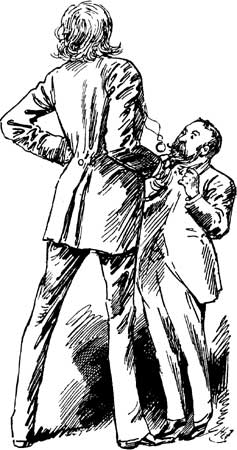
I was invited to an excellent dinner by a well-known man of letters I had never met before. I accepted the invitation on condition I should be allowed to leave early, as I had engagements two or three deep for that evening. I came away with the best impression of my host and all his friends. I saw their jokes and their faces, and knew I would recollect both, but their names! how to recollect them was the puzzle. That evening I met more distinguished people at the second house I visited, more at the third, and still more at the fourth. I shall never forget their kindness, but I gave up all hopes of trying to recollect hundreds of names, all new to me in one evening. The problem was hopeless. The following morning callers began early, and more invitations poured in. At breakfast one of my new acquaintances called.
"Tell me, Mr. Furniss, have you met our great literary man and renowned humorist, Mr. James B. Brown?"
"Brown, Brown!" I repeated (that was not the name of course, but it will do). "Well, no. I know his name so well, but I don't think I have yet had the pleasure of making his acquaintance."
"Not know James B. Brown? Well, you must straightaway. Now let me reckon. You leave New York at four this afternoon—you must lunch first. Why not with me at the —— Club? I'll get James B. Brown there or I'll swallow Bartholdi's statue!"
I found refusals were of no avail, so I agreed. At one I entered the club, at two minutes past one James B. Brown entered, and we met. He was my first host of the previous evening!
We were formally introduced. I smiled—James B. Brown didn't. James B. Brown pulled himself up to his full height—about double mine—I never felt so small before. I shook his hand (he didn't shake mine) and said:
"This is a great honour and pleasant surprise," and I pulled the dismayed celebrity gently to my side, when getting on tip-toes I telephoned up the string of his eye-glass:
"Keep up the joke, Mr. Brown, keep it up. Fact is, I was so delighted at meeting you last night and so charmed with you that when I was asked if I had met you before I said 'No,' so that I might have the pleasure of meeting you again. Forgive me!"
James B. Brown shook my hand warmly, and telephoned down:
"Sir, this is the greatest compliment I have ever received. Your sin will be forgiven for your sincere flattery of so humble an admirer as myself."
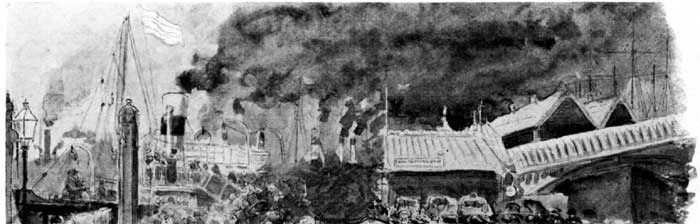
Americans claim to be superior to us in respect of three things—their facility in travelling, their fire system, and their after-dinner speaking. One of these I will not question, and that is the Fire Brigade. It is necessary for America to excel in this respect, for with their huge warehouses and stores overstocked with inflammable goods fire would destroy their cities as Chicago was destroyed, were they not so wonderfully prompt and efficient with their engines and appliances.
When I arrived in the States I only presented two of the very numerous letters of introduction with which I was supplied. One was to the Chief of Police in New York, and the other was to the Captain of the Fire Brigade. The latter I met, when I arrived at the station at which he is located, just coming out in ordinary clothes, for it was his night off; but such is the pride taken by the Fire Brigade in their work that whatever engagement he was going to keep was abandoned, and he was at my service until I had seen everything it was possible to see in connection with the famous Fire Brigade.
FIRE!
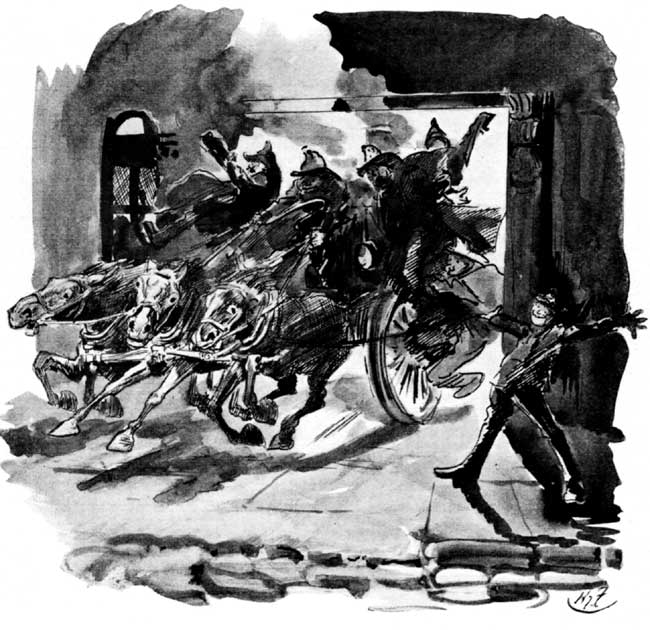
As I was speaking to the Captain in the engine-room I noticed a couple of horses standing there. One of them was a grey mare with a most cunning look, and as the Captain was informing me that "she had done continuous work here for some years," she gave me an artful wink of confirmation. Just at that moment the alarm bell suddenly vibrated, and before you could say Jack Robinson (even if you wanted to), seemingly by magic but in reality by electricity, the halters fell from the horses' heads, and to my surprise, without any one being near them they rushed to their places at either side of the shaft of the engine. There were manholes in the ceiling, through which brass rods were suspended vertically. Down these slid half-dressed men, who seemed to turn a somersault into their clothes during the descent on to the engine, the harness suspended above the horses dropped on to their backs, and in an instant they were in the street, the engine manned, its fire ablaze, and the horses alive to the stiff job they had before them of reaching the fire in an incredibly short space of time. But hardly had they taken the first leap from one of the boulders over the cavities with which New York streets abound to another, than a whistle from the Captain stopped them. It was a false alarm given for my edification. Before they could get back into the engine-house I was conducted by the Captain into the dormitory, where I concealed myself under a bed. Without a grumble the men came up and literally walked out of their clothes, for boots, pants and everything are all one piece. They opened these carefully and laid them ready by the side of their beds, and in a few minutes were all snoring fast asleep.
The Captain gave a slight tap on the floor as a signal for another false alarm. At the first sound of the bell, with one bound the men were out of bed, in another into their combinations, and in a third they were going head over heels down the holes in the floor, just as mice would disappear down theirs at the sight of a cat, and in a second or two I heard again the rumbling of the engine over the pavement.
We escaped before the men were back again to bed, but hardly had I been shown the completeness of everything, and gone into details which I need not repeat here, and had another wink from the old grey mare, which plainly said, "Ah, I knew those alarms were false," when her two ears went up like a flash as she sprang under her harness once more, the other animal as quickly by her side. The third alarm was a genuine one, and she knew it. The Captain and I, as soon as the alarm was given, rushed in the direction of the fire, but we had not got to the first corner before the old mare and her companion flew past, and I just had time to notice that the men were completing their toilet as they were hurled by. Quickly followed the officer of the night in his one-horse trap, and by the time we got to the fire, which was only round a block of buildings, an exhibition of fire engines and appliances was collected there which beggars description. The water tower, a huge affair seventy or eighty feet high, built up like a crane, which shoots water on to the top of the burning building; so also are the hook and ladder brigade, the men with the jumping net—in fact, everything is at hand. This is accounted for by the fact that a policeman at any corner, when giving the alarm of a fire, touches an electric button or turns a handle, which gives the signal at every fire station, unloosing the horses and putting everything into motion at once.
THE ALARM.
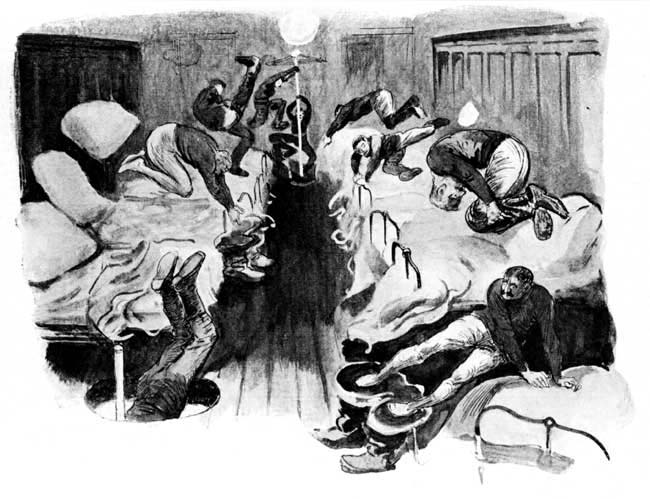
The one weak point in the whole system is that the alarms are not isolated, which means that every signal of fire in the big city of New York disturbs every man and horse at every station, some of them nine miles away from the scene of the conflagration, for so anxious are the men to be up to time that they are often in the street, harnessed, equipped and ready, before the second signal comes to acquaint them with the locality and extent of the fire. At least that was then the system.
When I returned to England I stopped once as I was passing a fire station and told the men of the wonders I had seen in America. A very athletic, sailor-looking fireman, who had listened attentively to all I had to say, chimed in with "Yes, sir, what you've said is quite true, for I've been in America myself, and seen them at work; but though they may possibly get to the fire a few seconds quicker than we, when we do get there we put it out. That's more than they do generally."
"Well, perhaps so," I rejoined; "but then you haven't the wonderful electric apparatus for dropping the harness on to the horses' backs!"
"No," said he, "we go a step further than that; the harness is on the horses' backs beforehand!"
This youth's visit to America had evidently had a sharpening effect upon him, for he was a bit too wideawake for me.
Being on a trip for rest and health, I found the gaiety of New York too much for me, so having whispered to my friends that I was going to study culture and eat bacon and beans in Boston, I quietly slipped off to study Congress and to feast my eyes on the beautiful city of Washington.
Not being clean-shaven I could not wear a false beard, so I took a false name. "Mr. Harry Furniss of London Punch" went in the spirit to Boston (for had I stayed much longer in New York my used-up body would have been returned in spirits to England); "Mr. French of Nowhere" went in the flesh to Washington.
On arriving at my hotel I signed "Mr. French of Nowhere." Reporters who scan the hotel list did not think "Mr. French of Nowhere" a subject worthy of dissection, so for a few days I thought I should enjoy perfect peace with profit. A "stocky little Englishman" taking notes en passant with an amateurish fervency was probably what most people would think who cared to think at all of the stranger in their midst.
But it so happened that in going down by train from New York I sat opposite to a very delightful American gentleman, and we chatted away in the most friendly fashion. We parted on arriving at the city. Next day I happened to "strike" him in the street.
"I've been on the look-out for you everywhere, Mr. French" (I had given him my assumed name in the train). "I am very anxious to show you all over this beautiful city, and my brother the Judge is also anxious that you should dine at his house."
I thanked him most cordially, and accepted his kind offer, saying that I should be ready for him at my hotel at 9 o'clock the next morning. We parted, but my conscience pricked me for giving him a false name, so I hurried back after him and explained to him the whole circumstance. It was flattering to me to see that he took a greater interest than ever in being my guide. The next morning Mr. French (to all but my new acquaintance) was in the hall of the "Arlington" at the appointed time. I waited and waited, but my guide did not put in an appearance. Presently a strange gentleman came up to me, and boldly addressed me by my proper name. I saw at once I was in the clutches of an interviewer, so I point-blank contradicted him, and asserted that my name was French.
"That won't do for me," he said.
"Then you won't do for me," I said, and turned upon my heel.
However, I rather liked the look of the man, and didn't like to disappoint him altogether, being a journalist myself.
"I am waiting for a gentleman," I said. "I expect him every minute, and then I must be off."
"You may wait, but I guess that gentleman won't arrive," said the journalist, "and I want a column out of you for our evening paper."
A frightful thought flashed across my mind.
"Have I been sold?"
I had, and I thought more of the gentleman of the Press (all the Pressmen were very kind to me in Washington, and, indeed, all over America) than I did of my newly-made erratic acquaintance.
When I paid my second and professional visit to Washington years afterwards, of course it was a different matter. My representative had for business reasons to invite the Press to "boom" me. I was rated a good subject for interviewers, being only too pleased to do my best for our mutual benefit. One day a representative of the important Washington family paper called. We lunched and chatted, and subsequently over a cigar he informed me that he knew nothing about art or artists or politics, nor had he any object in common with me—in fact, he was the sporting editor. The interview appeared—two long columns on prize fighting! I was the innocent "peg" upon which the sporting writer hung his own ideas. He discussed "a rendezvous in the Rockies," remote from the centre of civilisation, as surely an appropriate locale for a train-scuttling speciality or a fight to a death finish between Roaring Gore and Wild Whiskers. A pair of athletes, scienced to the tips of their vibrating digits, compelled to appeal to the courtesy of a wild and well-whiskered Legislature, would doubtless appear inconsistent to gentlemen of the National Sporting Club of London, who were anxious to have the big fight settled within earshot of Bow Bells, in the luxurious rooms of the London National Sporting Club. One combatant, I declared, "swallowed the gruel rammed at him as if it were mother's milk," the lads "had enough blood on tap to run a sizeable slaughterhouse"; then a British fighter "swallowing a lobster salad on top of a whiskey sour, with a dose of prussic acid by way of dessert"; and references to my knowledge of the "Freds," "Toms," or "Dicks" of the Sporting Press of London, and to my familiarity with "Charlies," "Fitzs," and "Jims" of the "Magic Circle," were astounding.
My manager rushed into my rooms with the paper in question. "This will ruin your prospects here! We depend on the women folk; they will never come to hear you after reading this!" And so it was. In spite of other interviewers at Washington writing of me as "an English good fellow, rich and juicy, and genial in flavour, like other hot stuffs of that remarkable country"; and another,
"Harry Furniss' eclipse of the gayety of John Bull, with facile pencil and brilliant tongue, attracted a cultured assemblage to the Columbia Theatre. Furniss, a plump lump of a man, all curves from pumps to poll, in gesture and in the breezy flourish of his sentences, genially cynical like Voltaire, cuts an engaging figure in his black coat that he wears with the inborn grace of a well-dined Londoner, a bon vivant, whose worldly shaft tickles and never bites, for he is a gentleman whose wit wins and never wounds. Furniss is Thackeray in the satirist's mellow moments, and there is no little of the Thackerian spirit radiating in the pictures of this rotund and quaint little caricaturist."
I did very bad business in Washington, largely due to bad management. Five o'clock teas had become the rage of Washington Society, and my appearances in the theatre were between 4.15 and 6 o'clock in the afternoon. Alluding to this a critic wrote in the Morning Times: "It may help Mr. Furniss to forgive the small audiences here in Washington if he is informed that during this season none of his English friends have made a very glittering success; nearly all of them have lost money or made very little. We seem to be somewhat down on Englishmen this year."
As Washington is the capital of America, so the Capitol, where Congress meets, is the cap of the capital, the dome, of course, being the Capitol's cap, and a capital cap it is, covering the collective councillors of the country. The Capitol itself looks like a huge white eagle protecting the interests of the States. Audubon's Bird of Washington is the name of the eagle well-known to naturalists, but this rara avis is the Falcho Washingtoniensis. At its heart is seated the Supreme Court, keeping an eagle eye on the laws of the land; under its right wing is the Senate (equivalent to the English House of Lords); and the left shelters the House of Representatives (corresponding to our House of Commons). At first this bird of buildings had no wings, and the three representative assemblies sat in the Central Edifice; afterwards the wings were added, and now the Capitol is fly enough for anything. It soars high above the city, and from its summit a capital birdseye view is naturally obtained.
The Senate in the American Congress answers to the House of Lords in the British Parliament. The "sporting editor" would doubtless say that each in its respective country is the right hand of the Government, and when there happens to be a genuine stand-up fight, as foreseen with Spain, an international contest, although the "left," in prize ring phraseology (the House of Representatives in America and the House of Commons in England), does all the preliminary work, it is reserved for the right, when the critical moment arrives, to administer the knock-out blow.
THE THRONE IN THE SENATE.
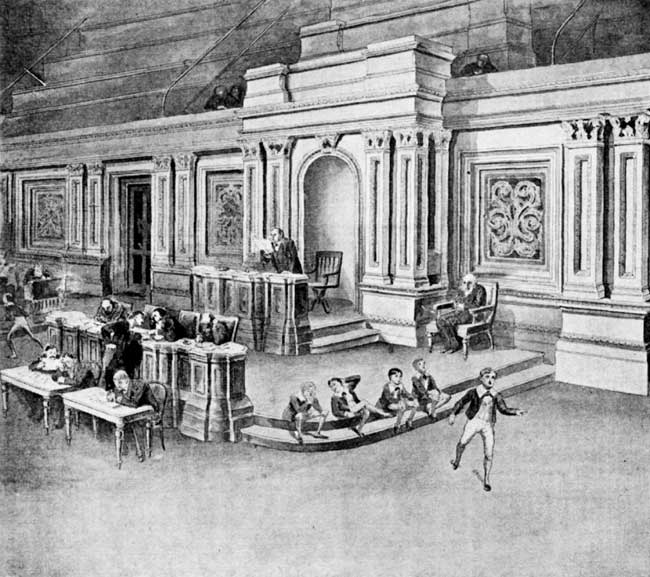
In both the Old Country and the New these superior senators are politically alike. Representatively they are as different as iced water is to old port.
THE THRONE, HOUSE OF REPRESENTATIVES.
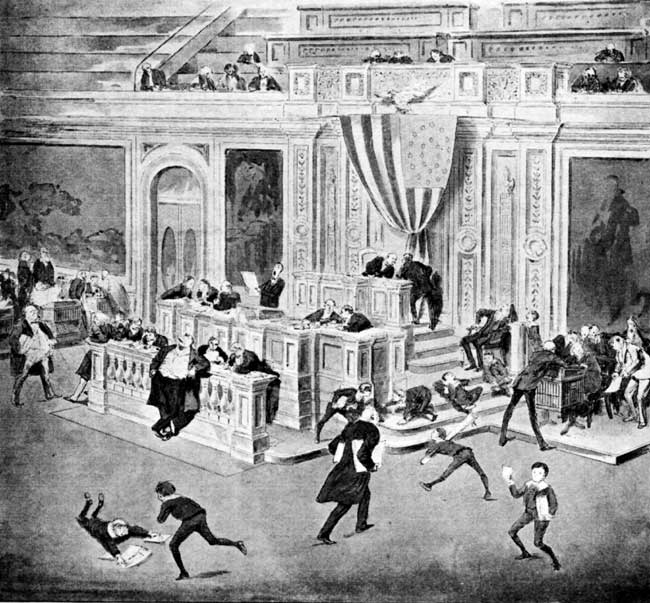
The seating of the senators in these two assemblages is typical of the countries they represent. In the British House of Lords the Peers loll about on scarlet sofas; in America the chosen ones sit at desks. The British Peer has forsaken one lounge to occupy another; the American has left the office desk for the desk in office. In Britain the House of Lords is composed of Princes and Peers, with an admixture of bishops, brewers, and other political party pullers; it is also an asylum for stranded political wrecks from the Lower House. Soldiers and sailors, too, are honoured and are sent there, not as politicians, but merely to exist for the time being in a sort of respectable retreat, before being translated to the crypt of Westminster Abbey or St. Paul's. John Bull has made this hereditary hotch-potch, and he must swallow it. Jonathan selects his senators to his own taste, and has them dished up fresh from time to time.
The Senate is not sombre and sedate as is our Upper House, but simplicity itself—no gilded throne, no Lord Chancellor in wig and gown, no offensive officialism. It looks like a huge auction room, the auctioneer being the deputy President standing at a table hammer in hand knocking down the separate business of State lot by lot as put up by the clerks.
The House of Representatives, like the Senate, reminds one very much of an auction room. It is a splendid hall, but its size prevents Members from being heard very distinctly, particularly as they talk away amongst themselves, except when anything particularly interesting is going on. In the Senate the table, and the clerks' table, are of dark wood; in the House of Representatives they are of white marble. The American flag hanging over the balcony gives it a semi-theatrical look, and the white marble table resembles an American bar, making one feel inclined to go up to it and order a brandy-smash, a gin-sling, or a corpse-reviver.
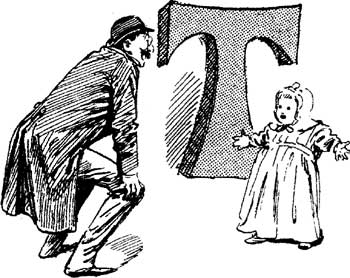
HE House has not met as I enter. The page-boys are playing at leapfrog, and some early Members are disposing of their correspondence, and instead of reproving the boys cast glances at them that seem to signify they would like to join in the game themselves. Presently a Member comes in backwards through one of the doorways, calling out to something that is following him. I lean over to see if he has brought his favourite dog or domestic cat, when a little infant in modernised Dutch costume comes in waddling laughingly after her parent. Another Member turns round on his swivel chair as his page-boy runs up to him, shakes him heartily by the hand, tosses him on his foot and gives him a "ride-a-cock-horse." Oh, you English sticklers for etiquette! What would you say if Mr. Labouchere came in on all fours with his little child pulling his coat-tails and whacking him with a stick, or if Sir William Harcourt played at leapfrog with Lulu round the Speaker's chair?
THE HOUSE OF REPRESENTATIVES.
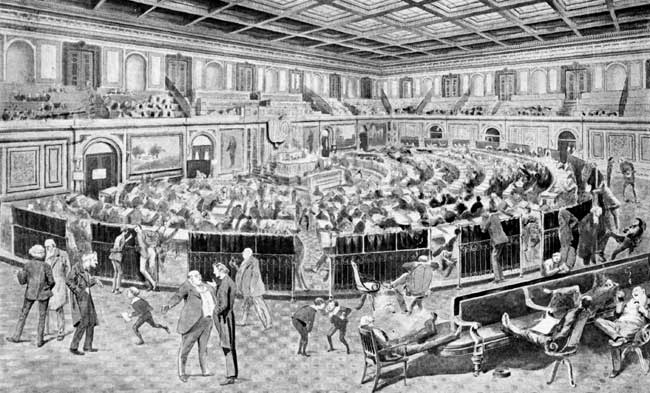
My drawing will show you better what the House of Representatives is like than any written description I can give. Each Member has his own desk, with his Parliamentary papers all around him. He is not bothered, as Members are in England, by having his papers sent to his private house, or having to call for them at the office when he arrives, or actually having to fight for a seat. Americans pay their Representatives, and consider that they too have a right to be accommodated with a seat whenever they want one to see them, and to know who they are; so you have in front of you a diagram of the sitting arrangements of the House, with the names of the Members.
AN EX-SPEAKER.
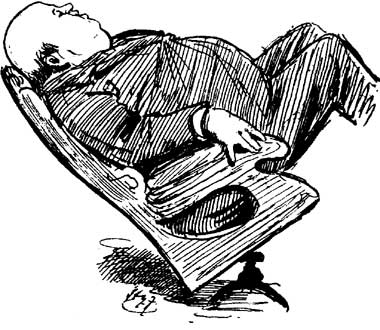
At 12 o'clock the procession enters. An official carries a little wand with the eagle on top, and after the Chaplain (during my first visit I saw the "Blind Chaplain," the Rev. W. H. Milburn) has delivered a few touching words about the floods in Minnesota, the reading of the "reakard" begins. The House buzzes with conversation and displays the utmost indifference while the minutes of the last meeting are read with extraordinary rapidity by a clerk with a grating voice. Every now and then a Member corrects a misprint in the "reakard" of what he has said, and then leave of absence is given to applicants for it, who have to state their reasons. The Chairmen of the various Committees then report to the House, Chairmen of Committees taking in turn to sit in the Speaker's Chair and preside over the House, whilst anyone can examine them.
Instead of calling out a Member by his name—Mr. Bacon or Mr. Beans—the Speaker calls upon "the gentleman from Illinois," or "the gentleman from Michigan." But if any question arises to which some Member has an objection filibustering is rampant. The Speaker rises and asks if there is any objection to the consideration of the Bill. After a pause he says, "The Chair hears none," and is about ordering the Bill to be engrossed when some Member objects and a division is taken, the Members standing up to be counted. Groups of them, however, do not pay a bit of attention, and sit about on their desks smoking cigars and telling stories, and when the numbers are given some of these will get up and complain that their names are not included, as they did not hear, or went out to speak to a friend, or some trivial excuse like that, so they are counted again. One in particular I noticed and made a sketch of peeling and eating an apple, and he strolled up afterwards and demanded to have his name inserted. More delay; then "the gentleman from Somewhere-else" informs the Speaker that there is not a quorum. "The gentleman from Bedlam" demands a division taken by tellers, and the Speaker agrees, and is just appointing the tellers, when "the gentleman from Obstructianna" calls for "Yeas and Nays," which means, gentle reader, that the whole of the House of Representatives have to be called out by name, from Alpha to Omega. Those not wishing to vote smoke or eat apples. Then some Member comes in and informs the Speaker that he didn't hear his name when it was called.
In case the reader may think I am exaggerating I append the following cutting from the "Congressional Record," vol. xxiii., No. 93.:
"Mr. O'NEILL of Pennsylvania. Mr. Speaker, I am paired, but I have voted in order to make a quorum.
The SPEAKER. There is no quorum.
Mr. HENDERSON of Iowa. Mr. Speaker, when my name was called the first time I did not hear it, and the second time I was examining some papers and my name was passed before I could answer.
The SPEAKER. Did the gentleman fail to hear his name?
Mr. HENDERSON of Iowa. I heard it called, but did not answer in time.
The SPEAKER. The gentleman understands the rule. If the gentleman states that he was in the Hall of the House and failed to hear his name, his vote will be recorded.
Mr. HENDERSON of Iowa. I was.
The vote of Mr. Henderson of Iowa was recorded.
Mr. PATTERSON of Tennessee. Mr. Speaker, I desire to vote.
The SPEAKER. Was the gentleman in the Hall, and did he fail to hear his name called?
Mr. PATTERSON of Tennessee. Yes, sir.
The vote of Mr. Patterson of Tennessee was recorded.
Mr. DOLLIVER. Mr. Speaker, although paired I have voted to make a quorum.
Mr. McKEIGHAN. Mr. Speaker, I was in the Hall and heard my name, but did not vote because I did not understand the measure. If it is in order I desire now to vote.
The SPEAKER. The Chair can not entertain the gentleman's request under the rule.
Mr. HUFF. Mr. Speaker, I voted to make a quorum. I am paired with Mr. Kribbs.
The SPEAKER. On this vote the yeas are 136 and the nays 3. No quorum has voted.
Mr. O'NEILL of Pennsylvania. I withdraw my vote.
Mr. HOLMAN. Mr. Speaker, I ask unanimous consent that another vote be taken, which I have no doubt will show the presence of a quorum.
Mr. BURROWS. Mr. Speaker, can not that request be modified so as to provide for taking the vote on the passage of the Bill instead of on the engrossment and third reading? I ask unanimous consent that the vote may be taken on the passage of the Bill.
Mr. Chipman rose.
The SPEAKER. The Chair will state that the roll call having disclosed the absence of a quorum, no business is in order but a call of the House or a motion to adjourn.
Mr. HOLMAN. Then, Mr. Speaker, I move a call of the House.
A call of the House was ordered."
Then that grating voice calls out the list from A to Z, the pairs are called, more explanations given, then there is more filibustering (I think that is the correct word) on the part of the obstructionists, and for the third time the same farce is enacted. Then the division takes place, when the Members leave their seats and are counted as they enter. No, the division takes place before the last count, for after the names are called again and there are more explanations, when the Speaker "recognises the gentleman's right," or does not as the case may be. I know three hours of this was enough to show me that, although the Americans may boast of being our superiors in many ways, such a farce as I have described could never take place in the British Parliament. Why on earth don't they take a division as we do, when the Members leave their seats and the Ayes and Noes are locked in separate Lobbies, and as they re-enter their votes are recorded and they are counted by the tellers, and the question at issue is settled finally without doubt? I must say that for a practical people the Parliamentary procedure seemed to me the most unpractical ceremony I had ever witnessed. Yet they are practical in some Parliamentary matters. For instance, there is a Committee of Rules, presided over by the Speaker, which meets to decide what time the House shall devote to each question, say two hours—one for the Democrats and one for the Republicans. Each speaker in the debate is allowed five minutes, and when this is up the Speaker reminds him of the fact by rapping the table with his hammer.
AN EX-MINISTER.
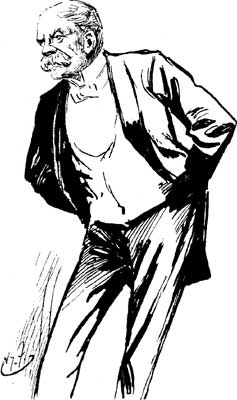
Again, it is very convenient that a Member can have speeches that he has never delivered printed on the Parliamentary record. In England a country Member is about to make a speech, and being anxious to let his constituents have it in full he gives it to the representatives of his local paper, and it is in the press before he delivers it. Something may happen to prevent the delivery of the speech, and Hansard has not a line of it. A curious thing happened in the "Congressional Record" a year or two ago. The same speech was published as having been uttered by two very different Members. This occurred through a New York orator handing his speech (a eulogium on a deceased Member) to a friend to correct. This friend had an eye to business, and he picked out another Member who yearned to be thought an orator but who was not blessed with forensic power and had never made a speech in his life, and sold him the speech for forty dollars. He walked into the House swelling in anticipation of his coming effort, but his chagrin was great when he discovered precisely the same speech in the "Record." How is this for an instance of American journalistic smartness?
After the exhibition of filibustering I described the House adjourned, having done absolutely nothing but convince the stranger in the gallery that payment of Members leads to a waste of time, which is not played ducks and drakes with by the Members of our House.
An evening sitting is, of course, livelier, though at the outset there are more strangers in the gallery than Members on the floor. It is amusing to note how the ladies crowd the seats, and how the Congressman lolls on the sofa in the outer circle of the chamber, or turns round in his chair at his desk, crossing his legs on the desk in front of him, puffs his cigar, and, heedless of the fate of the nation, turns round and fascinates the fair ones in the gallery. It is amusing also to see a Member leave his seat during his speech and walk all over the floor, snapping his fingers and pummelling any desk handy. The official reporter follows him about, book in hand, wherever the Member's eloquence leads him, and his friends crowd around him when he stands or walks and vigorously applaud him; so do the audience in the gallery when his eloquence ceases, while his friends rush to shake his hand. He then walks round and receives congratulations, like a man passing round the hat. The clapping of the desk lids is very effective as a means of approval or otherwise; but if the orator goes too far and a scene is the result, the noise is too much even for the American House of Representatives, and the Serjeant-at-Arms has to take the spread-eagle on a toasting fork and walk up to the windy Member. I have made a sketch of a Member who made an aggressive speech, and on being replied to by another Member, walked up to the Speaker, leant on his desk, and puffed his cigar right under his nose. All this to one accustomed to the English House of Commons is beyond comprehension, and the only parallel I can think of is the trial scene in "The Bells," when Mathias walks about the court and snaps his fingers at the judges and then acts the perpetration of the deed for which he is called upon to answer.
During my stay I heard a very funny specimen of rant from a gentleman of the name of Turner, who was suffering from an attack of Anglophobia. He would delight the Mortons and Conybeares whom we have to tolerate, and his pronunciation of the Old Country's language was even worse than the sentiments he expressed. He spoke of the "extremest spirit" of "official daytee," whatever that may mean; the next screech brought out "domestic hoorizon," and he pathetically alluded to his constituents as the people who lived in the "boomed city, who do not get an elegant reward for their labor."
ANGLOPHOBIA.
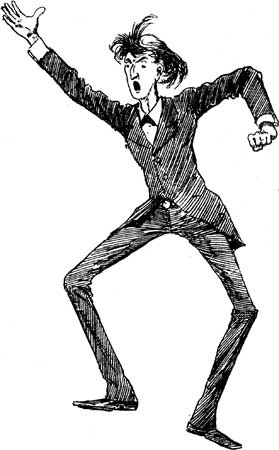
I was also amused by another gentleman in a discussion about some Bills. He jumped up, and rushing over to where his opponents sat, he shouted at them, "Talk! You?—you—you—you—you—you—you—you?" (and with dreadful emphasis) "I've reported your little Bills!"
Then there were cries of "Go ahead! Vote! vote! vote! vote!" and to crown the gentleman's vehemence he cried out repeatedly, "I demand a division!" (Chorus): "Pull him down!"
"I demand a division!" "Pull him down!"
"I demand a division!" "Pull him down!"
And he refused to leave off until the eagle-topped toasting fork was brought into play once more.
A veritable pandemonium is this Parliament! Fascinating to me, who have spent so much time in studying every detail of our own Parliament, which I have not the slightest doubt would prove just as strange and funny to the American visitor, if like me he sees the ridiculous side of everything, even of such an august assemblage as that of the legislators of a nation.
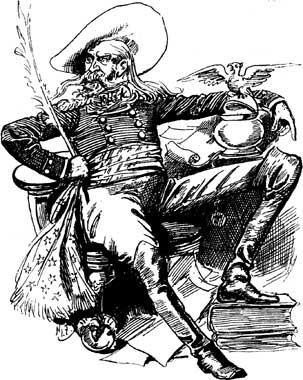
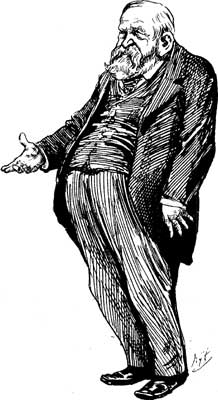
THE PRESIDENT—IDEAL.THE PRESIDENT—REAL.
Privacy is unknown in America. Everyone there, from the President in the White House to your Chinese washerman in his laundry, is accessible to all. I have visited both with less difficulty than I would experience in approaching Brown, Jones or Robinson in this country. Here the business man's time is his own, and you must not rob him of a minute any more than of his cheque-book. In America a business man's time belongs to anyone who may require it. You walk in to see him at will, and if Jonathan can earn a dollar whilst in his bath by talking to you through the keyhole he will do it, and he is just as open in giving his time to show you any gracious action. The busiest man in America, the President, surrounded by affairs of State, leaves them and shakes my hand in welcome to his country. I say shakes my hand, for although I apologise for my intrusion (which, by the way, was quite unnecessary) and pay him some pleasant compliments, President Harrison replies only by shaking my hand. I wax eloquent over the magnificence of the great country over which he presides; I touch upon the coming election, and even give him some information of value which I happen to have overheard by accident. I lead him to believe that I am entrusted with secrets by the English Cabinet about the Behring Straits and other vexed questions, and I openly tell him what I believe to be the dark designs of England upon a free country; in fact, I don't know what I don't tell him, and now that he is no more I see no just cause or impediment why I should not now make public his reply. It is all on the next page.