Volume 1 — A SCENE IN THE LOBBY.
Reading edition
I shall, in describing the curtain rising on this historical incident, borrow Mr. Lucy's own account of the way in which the Member approached me after he had seen my illustration to Mr. Lucy's clever Diary of the Week:
"It was shortly after seven o'clock that Mr. Harry Furniss strolled into the Lobby. He had been suffering from a long and severe sickness, dedicating this the first evening of his convalescence to a visit to the scene of labours which have delighted mankind. Over the place there brooded an air of ineffable peace. The bustle of the earlier hour of meeting was stilled. The drone of talk went on in the half-empty House within the glass doors. Now and then a Member hastily crossed the floor of the Lobby, intent on preparations for dinner. One of these chanced to be Mr. Swift MacNeill, a Member who, beneath occasional turbulence of manner, scarcely conceals the gentlest, kindliest disposition, a gentleman by birth and training, a scholar and a patriot. The House, whilst it sometimes laughs at his exuberance of manner, always shows that it likes him. Mr. Furniss, seeing him approach with hurried step, may naturally have expected that he was making haste to offer those congratulations on renewed health and reappearance on the scene of labour that had already been proffered from other quarters. What followed has been told by Mr. Furniss in language the simplicity and graphicness of which Defoe could not have excelled."
Mr. Lucy refers to the following account I wrote at the time:
"On my return to continue my work in Parliament for Mr. Punch after my severe illness, I found the jaded legislators yearning for fresh air, and even the approaching final division on the Home Rule Bill had failed to arouse more than a languid interest. I felt this depression when I entered the Lobby, its sole occupants being the tired-out doorkeepers and the leg-weary policemen. I really believe a swarm of wasps would not have roused them to activity, for I noticed a bluebottle resting undisturbed upon the nose of one of Inspector Horsley's staff. Even the Terrace was dusty, and the Members rusty and morose. One of the Irish Members had selected as his friend Frank Slavin, the well-known prize-fighter, who had an admiring group round him, to whom no doubt he was relating the history of his many plucky battles.
WHAT HAPPENED.
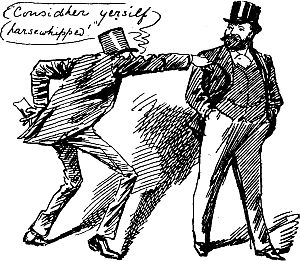
"The stimulating effect of this may have been the cause for the assault upon me in the Inner Lobby, which has afforded the stale House some little excitement, which has been the salvation of the silly season. So many papers have given startling accounts of this attack upon me, some stating that I was caned, others that I was pummelled, shaken like a dog, and so on, that I am glad to take the opportunity of giving a clear statement of what really occurred. I was standing close to the doors of the Inner Lobby, talking to Mr. Cuthbert Quilter, when Mr. Swift MacNeill interrupted us by asking me, 'Are you the man that draws the cartoons in Punch?' 'That depends upon what they are,' said I. 'I refer to one,' said the excited Member, 'that has annoyed me very much,' 'Let me see it,' I replied. Mr. MacNeill then drew out his pocket-book and showed me a cutting from the current number of Punch. 'Yes,' I said, 'that is from a drawing of mine,' 'Then ye're a low, black-guardly scoundrel,' melodramatically exclaimed the usually genial Member. Taking two or three steps back, he hissed at me, with a livid face, a series of offensive epithets too coarse for publication. Having exhausted his vocabulary of vulgarity, a happy thought seemed to strike him. 'I want to assault you,' he said, and forthwith he nervously and gingerly tapped me as if he were playing with a hot coal. He then danced off to Members who were looking on, crying, 'This is the scoundrel who has caricatured me; witness, I assault him!' and he recommenced the tapping process which constituted this technical assault. DR. TANNER. Knowing that Mr. MacNeill is a very excitable subject, and at once detecting that this assault was a 'put-up job,' I was determined to remain perfectly cool; and, truth to tell, the pirouetting of the agitated Member hugely amused me, particularly as the more excited he became, the more he resembled the caricature which was the cause, or supposed to be the cause, of this attack, I treated the hon. Member exactly as the policeman treated the bluebottle—with perfect indifference, not even troubling to brush away the trifling annoyance. But when in the midst of its buzzing round me I moved in the direction of one of the officials, it flew away. Then appeared what I had been anticipating, and the real cause of the insult transpired. Dr. Tanner came up to me just as I recollect Slavin approaching Jackson in their historic fight. He showered the grossest insults upon me, and I was surrounded at once by his clique, who were anxious for the scene which must have occurred had I, like Jackson, been the first to let out with my left. But here again was I face to face with a chronically excited Member, backed up by his friends, and I refused to be drawn into a brawl. But the secret of the real cause of this organised attack upon me was revealed to me by Dr. Tanner, who at once informed me that it was the outcome of my imitations of the Irish Members in my entertainment, 'The Humours of Parliament,' which I have given for two seasons all over the country. This was my offence; my caricature of Mr. Swift MacNeill the excuse for the attack."
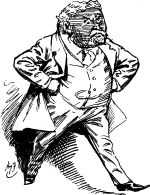
ASSAULT ON ME IN THE HOUSE. WHAT THE PRESS DESCRIBED.
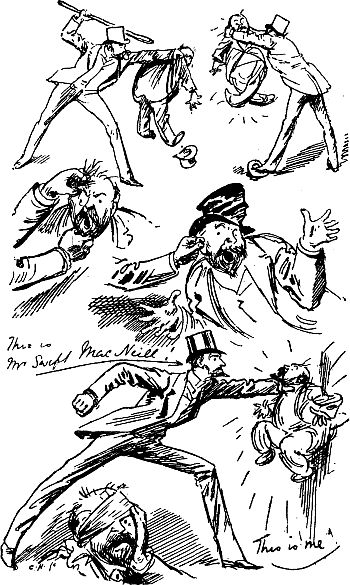
Mr. MacNeill's "technical assault" was a very childish incident. He merely touched the sleeve of my coat with the tip of his finger, and asked me if I would accept that as a "technical assault." This mysterious pantomime was subsequently explained to me, and meant that I was to take out a summons—but I only laughed. At the moment Mr. MacNeill was pirouetting round me at a distance, Mr. John Burns came on to the scene, and chaffed Mr. MacNeill, drawing an imaginary picture (for Mr. Burns was not in the Lobby) of a real assault upon me. A gentleman connected with an evening paper, who happened to enter with Mr. Burns, failed to see Mr. Burns's humour, and thereupon took down in shorthand Mr. Burns's imaginary picture as a matter of fact. It was published as a fact, and, for all I know or care, some may still believe that I was assaulted!
When I read that I had been treated like a cur, I was rather amused; but when I read a statement in the papers from a man like John Burns saying that he saw me "taken by the lapels of the coat and shaken like a dog, and then taken by the ear and shaken by that," I thought the joke had been carried far enough. Determined to have this cock-and-bull story contradicted at once, I went down to the House and saw Mr. John Burns, who expressed to me his regret that he should have invented the story, and he left me to go to the writing-room, and promised I should have from him a written contradiction.
After waiting a considerable time, a message was brought to me that Mr. Burns declined to keep his promise. I therefore wrote these particulars and sent them off to the Press. At the same time Mr. Burns, who had been closeted with some Radical journalists, wrote an offensive note—which was shown me, and which I advised him to publish.
Poor Mr. MacNeill! Well may he say, "Save me from my friends!" The Press put on their comic men to make copy at his expense. If I were to publish it all, it would make a volume as large as this. By permission I publish the following lay from the St. James' Budget (September, 1893):
"THE LAY OF SWIFT MACNEILL.
(Picked up in the Lobby.)
"Have ye heard, have ye heard, of the late immortal fray, When the lion back of Swift MacNeill got up and stood at bay, When the lion voice of Tanner cried, 'To Judas wid yer chaff!' An' the Saxon knees were shaking, though they made believe to laugh.
"'Twas widin the Commons' Lobby, in the corner by the dure, There was Misther Harry Furniss a-standing on the flure, When up to him came stalking, like O'Tarquin in his pride, The bowldest of the bowld, MacNeill, wid the Docther by his side.
"Then the valiant Swift MacNeill from his pocket he took out A picther very like him, an' he brandished it about, An' he held it up to Furniss for his Saxon eyes to see, An' he asked of him, 'Ye spalpeen, is this porthrait meant for me?'
"''Tis your likeness, as I see it,' was the answer that he got, An' the wrath of Misther Swift MacNeill then wax'd exceeding hot, An' he cast the picther from him, an' he trod it on the ground, An' he took an' danced an Irish jig the artist's form around.
"'Ye spalpeen,' thus again he spoke, 'ye most obnoxious fellow! Ye see that I'm a lion, yet ye've made me a gorilla; If your Saxon eyes are blinded to the truth of what I say, Go and borrow for a moment the glasses of Tay Pay.
"'They will show ye that our seventy are Apollos one and all, That we're most divinely lovely an' seraphically tall; They will show ye we're all angels—though for divils I'll allow, 'Tis the black ones ye'll be seeing where the lost to Redmond bow.'
"Then Misther Swift MacNeill, just to lave his meaning clear, Wid flowers of Irish eloquence filled Mr. Furniss' ear; An' he also shook wid passion, an', moreover, shook his fist, An' the Docther an' his blackthorn stood all ready to assist.
"Misther Furniss smiled serenely, an' the only word he spoke Was to say it seemed that Misther Swift was slow to see a joke, But for all his jokes an' blarney, things were looking like a fight, When a minion of the Spayker was seen to be in sight.
"Then Apollo Swift MacNeill from his dignity got down, An' he withered Misther Furniss wid a godlike parting frown, An' he stalked along the Lobby wid his grand O'Tarquin stride, An' the other Mimbers followed him, an' went the House inside.
"An' there they still are threading on the necks of Saxon slaves, An' nightly wid their eloquence they're digging Saxon graves; An' my counsel to the artist who their fatures would porthray, Is to thry and see their beauty through the glasses of Tay Pay."
JOHN BURNS.
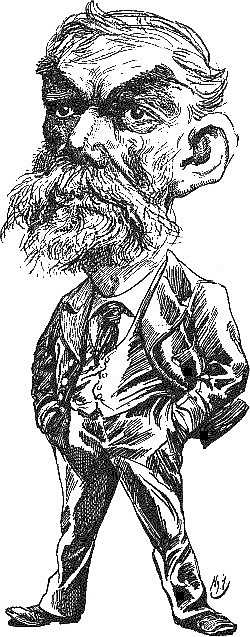
This manufactured "scene," coming as it did in the silly season, was made to serve instead of the Sea-Serpent, the Toad-in-the-Rock, the Shower of Frogs, and other familiar inventions for holiday reading. Unfortunately the poor Members of Parliament obliged to remain in St. Stephen's had to suffer far more than I did through the eccentricity of Mr. Swift MacNeill. Several of them complained to me that he lured them into the corridors and corners of the House, and then vigorously set to work to demonstrate practically how he assaulted me, or how he imagined he assaulted me, to the discomfiture and consternation of the poor M.P's.
I should like to explain why this "technical assault" on me was not made a matter of discussion. I did intend a friendly Member should have brought it before the Speaker, and in that way published the truth of the matter and exposed the stupid inventions of Burns & Co. With that object I had an interview with the Speaker, and he implored me not under any circumstances to have it brought before the House. He was already tired, at the end of a trying session, and did not want any personal questions discussed, which invariably led to protracted scenes. For that reason, and for that reason only, it was not mentioned in Parliament, notwithstanding it was really a much more serious affair than was imagined. It was a deliberately organised conspiracy. When I was leaving the Lobby, after my amusing interview with Mr. MacNeill, in which he told me that I was "technically assaulted," Chief Inspector Horsley took me down a private passage, and informed me that he had been looking for me, as he had discovered there was a conspiracy to attack me, and at that moment nine or ten Members from Ireland were in the passage downstairs, out of which I would have in the ordinary course gone through, lying in wait for me. So I left with him by another door.
NOTE FROM SIR FRANK LOCKWOOD, AFTER READING THE BOGUS ACCOUNT OF THE "ASSAULT."
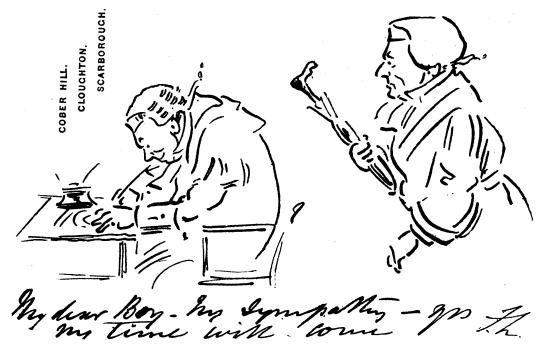
In this I was not more to blame than other caricaturists, but I was more in evidence, and was selected to be "technically assaulted," so as to force me to bring an action, in which all papers, except those supporting the Irish Party, would have been attacked and discussed, and their influence if possible injured for purely political purposes. An aggrieved person, smarting under a gross injustice, does not "technically assault" the aggressor. Had Mr. MacNeill tried it on with me, weak and ill as I was, I think I had enough power to oblige him; as it happened, I only saw the humour of the thing.
LETTER SUPPOSED TO COME FROM LORD CROSS. (LOCKWOOD'S JOKE.)
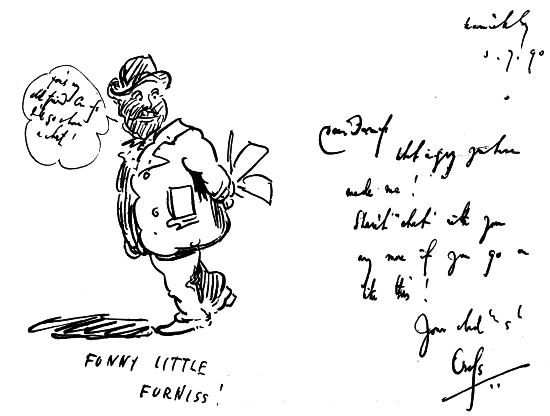
One of the most amusing sketches I received was this from Sir Frank Lockwood. Lockwood and I frequently exchanged caricatures, as shown by the clever sketches I introduce here and there in these pages. Sometimes he sent me some chaffing note written in a disguised hand, and disguised drawing; but the latter experiment, although it failed to deceive, certainly entertained me greatly. Here is a letter supposed to be from Lord Cross, a favourite subject of mine when he was in the Lower House. Seldom a week passed but I made his nose shorter and his upper lip longer, made his head stick out, and his spectacles glisten. Did he object? No, no! "Grand Cross" is a man of the world; nor was he ever a mere notoriety-seeking political adventurer. I once met him at dinner, and we chatted over my caricatures of him, and I recollect his saying, "A man is not worth anything if he is thin-skinned, and certainly not worth much if he cannot enjoy a joke at his own expense."
Sir Frank Lockwood whiled away the weary hours in Parliament to his own amusement and those around him, but he was not aware perhaps that what he did was seen from the Ladies' Gallery. The ladies got a birdseye view of his caricatures in progress. One in particular was the cause of much amusement, not only to the ladies, but to the Members. My lady informant related the incident to me thus: "I always watch Mr. Lockwood sketching, and I saw he had his eye on the burly figure of a friend of mine sitting on the Ministerial bench. Mr. Gladstone turned round to say something to him, and his quick eye detected Mr. Lockwood sketching. The artistic Q.C. handed the sketch (which I saw was a caricature of the late Lord Advocate) to Mr. Gladstone, who fairly doubled up with laughter, and handed it to those on either side of him. Eventually it was sent over to Mr. MacDonald and Mr. Balfour, and they thoroughly enjoyed the caricature of themselves, as did all their Tory friends. But we had seen it first!" It may have been this sketch subsequently sent to me and redrawn in Punch.
I recall an incident which happened one evening when I was on watch in the Inner Lobby to find and sketch a newly-elected M.P., who, I heard, was about to make his maiden speech, and it was most important I should catch him. Just as I was going up to the Press Gallery, Sir Frank Lockwood came into the Lobby and offered to get me a seat under the Gallery where I could see the new M.P. to advantage. The new M.P. was "up," so Lockwood went into the House to fetch me the Sergeant's order. I waited impatiently for his return; a long time passed; still I waited. A smiling Member came out of the House, and I asked him if he had seen Lockwood. "Oh, rather," he replied, smiling still; "I've just been sitting by him, watching him make a capital caricature of a chap making his maiden speech." When the Member had finished his speech, Lockwood ran out, and cheeringly apologised to me for his absent-mindedness. "So tempting, you know, old chap, I couldn't resist sketching him!"
Sir Frank Lockwood was perhaps the most favourable modern specimen of the buoyant amateur. Possessing a big heart, kindly feeling, a brilliant wit, and a facile pen, he treated art as his playfellow and never as his master. And in the spirit in which his work was executed so must it be judged. The work of an amateur artist possessing a distinct vein of humour is, in my opinion, far more entertaining than that of the professional caricaturist, the former being absolutely spontaneous and untrammelled by the conscientiousness of subsequent publication, of correct draughtsmanship, made only from impressions of the moment, and not the effort (as in the case of many a professional humorist) of having to be funny to order.
SIR F. LOCKWOOD.
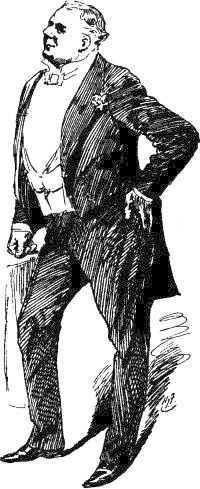
An excellent example of the amateur at his best is to be found in the drawings of Sir Frank Lockwood. No one would resent less than Lockwood himself having the term "amateur" applied to his work; indeed, he would, I am sure, have felt proud to be classed in the same category as several of our most popular humorous artists.
Circumstances connected with a curious coincidence concerning a caricature (what alliteration!) are worth confirming.
One morning I was taking my usual horse exercise round the ride in the inner circle of Regent's Park, before that spot, once the quiet haunt of the horseman, became the noisy ring of the cyclist. At that time a few cycling beginners used the circle for practice, and their alarming performances were gradually depleting the number of equestrians. One of these novices came down the hill, having an arm round the neck of his instructor, and one leg on the pedal, the other in mid air. He was unable to steer the machine, and as I cantered up, the performer's hat, which had been over one eye, fell off, disclosing the features of Professor Bryce. The next moment the machine, its rider and his instructor, were "all of a heap" on the ride up which my horse was cantering. I had just time to jump my horse on to the path and thus save my own neck, and the life of the energetic Member of Parliament, who I noticed later in the day, when sitting in the Press Gallery, was on the front Opposition bench, next to Sir Frank Lockwood, quite unconcerned. I made a rough sketch of the incident of the morning, and sent it down to my brother Two Pins, Sir Frank, with a request that his friend Bryce should in future select some other spot to practise bicycling. This was handed to Lockwood just as he was leaving the House, strange to say, on his way home to dress for a dinner at Professor Bryce's. Lockwood mischievously placed the sketch in the pocket of his dress coat, and at the dinner led up to the subject of cycling, suggesting at the same time that his host ought to try it.
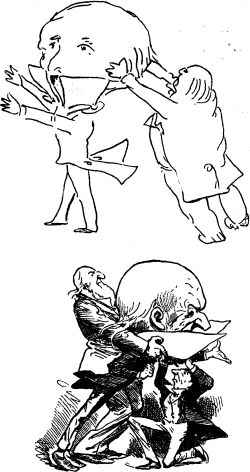
LEWIS CARROLL'S SUGGESTION, AND MY SKETCH OF IT IN PUNCH.
"Well, strange to say, Lockwood, I've been seriously thinking of it, but I don't know how one should begin."
"Don't you?" cried Lockwood from the other end of the table. "What do you say to this, nearly killing my friend Harry Furniss!" And my caricature was produced and handed down from guest to guest, to the chagrin of the host. That was Lockwood's version of the coincidence.
Suggestions for Punch came to me from most unexpected quarters, but were rarely of any use. Lewis Carroll—like every one else—got excited over the Gladstonian crisis, and Sir William Harcourt's head to Lewis Carroll was much the same as Charles the First's to Mr. Dick in "David Copperfield," for I find in several letters references to Sir William.
"Re Gladstone's head and its recent growth, couldn't you make a picture of it for the 'Essence of Parliament'? I would call it 'Toby's Dream of A.D. 1900,' and have Gladstone addressing the House, with his enormous head supported by Harcourt on one side, and Parnell on the other."
This suggestion is the only one I adopted. Strange to say, neither Gladstone, Parnell, nor Lewis Carroll lived to see 1900.
"Is that anecdote in the papers true, that some one has sent you a pebble with an accidental (and not a 'doctored') likeness of Harcourt? If so, let me suggest that your most graceful course of action will be to have it photographed, and to present prints of it to any authors whose books you may at any time chance to illustrate!"
This is the "anecdote":
"Someone found on the seashore the other day a pebble moulded exactly on the lines of Mr. Furniss' portrait of Sir William Harcourt."
NATURE'S PUZZLE PORTRAIT.
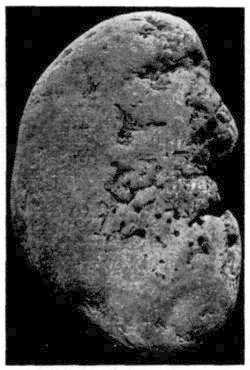
Other notices were in verse. This from Vanity Fair is the best:
"For Fame, 'tis said, Sir William craves, And to some purpose he has sought her; His face is fashioned by the waves: When will his name be 'writ in water'?"
I lay under a charge of plagiarism. Nature had "invented" my Harcourt portrait, and had been at work upon it probably before I was born; the wild waves had by degrees moulded a shell into the familiar features, and when completed had left the sea-sculptured sketch high and dry on the coast. I now publish, with thanks, a photo-reproduction of the shell (not a pebble) as I received it: it is not in any way "doctored." It is a large, weather-beaten shell.
There is no doubt but that at one time Lewis Carroll studied Punch, for in one of his earliest letters to me he writes:
"To the best of my recollection, one of the first things that suggested to me the wish to secure your help was a marvellously successful picture in Punch of a House of Lords entirely composed of Harcourts, where the figures took all possible attitudes, and gave all possible views of the face; yet each was a quite unmistakable Sir William Harcourt!"
Again he refers to Punch (March, 1890):
"A wish has been expressed in our Common Room (Christ's Church, Oxford), where we take in and bind Punch, that we could have 'keys' to the portraits in the Bishop of Lincoln's Trial and the 'ciphers' in Parliament" (a Parliamentary design of mine, "The House all Sixes and Sevens"). "Will you confer that favour on our Club? If you would give me them done roughly, I will procure copies of those two numbers, and subscribe the names in small MS. print, and have the pages bound in to face the pictures. The simplest way would be for you to put numbers on the faces, and send a list of names numbered to correspond."
Yet a few years brought a change (October, 1894):
"No doubt it is by your direction that three numbers of your new periodical have come to me. With many thanks for your kind thought, I will beg you not to waste your bounties on so unfit a recipient, for I have neither time nor taste for any such literature. I have much more work yet to do than I am likely to have life to do it in—and my taste for comic papers is defunct. We take in Punch in our Common Room, but I never look at it!"
Hardly a generous remark to make to a Punch man who had illustrated two of his books, and considering that Sir John Tenniel had done so much to make the author's reputation, and Punch had always been so friendly; but this is a bygone.
PUNCH AT PLAY.
ell, Sir John, the Grand Old Man of Punch, the evergreen, the ever-delightful Sir John, has earned a night's repose after all his long day of glorious work and good-fellowship. "A great artist and a great gentleman": truer words were never spoken. It seems but yesterday he and I took our rides together; but yesterday he and I and poor Milliken—three Punch men in a boat—were "squaring up" at Cookham after a week's delightful boating holiday on the Thames.
"There sat three oarsmen under a tree, Down, a-down, a-down—hey down! They were as puzzled as puzzled could be, With a down; And one of them said to his mate, 'We've got these mems in a doose of a state,' With a down derry, derry down!
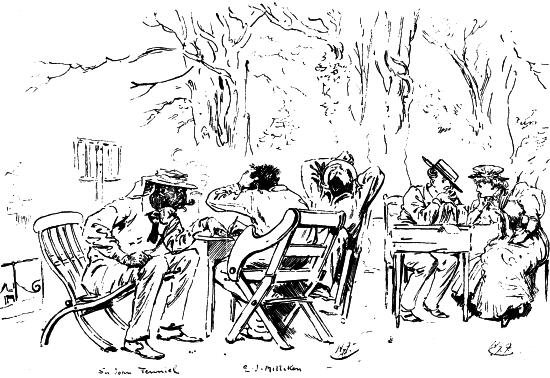
"Oh, they were wild, these oarsmen three, Down, a-down, a-down—hey down! Especially one with the white puggree, With a down; For it's precious hard to divide by three A sum on whose total you can't agree, With a down derry, derry down!
"They bit their pencils and tore their hair, Down, a-down, a-down—hey down! But those blessed bills, they wouldn't come square, With a down; 'Midst muddle and smudge it is hard to fix If a six is a nine or a nine is a six, With a down derry, derry down!
"A crumpled account from a pocket of flannel Down, a-down, a-down—hey down! With dirt in dabs, and the rain in a channel, With a down, Is worse to decipher than uniform text, Oh, that is the verdict of oarsmen vext, With a down derry, derry down!
"A man in a boat his ease will take, Down, a-down, a-down—hey down! But financial conscience at last will wake, With a down; Then Nemesis proddeth the prodigal soul When he finds that the parts are much more than the whole, With a down derry, derry down!
"Those oarsmen are having a deuce of a time, Down, a-down, a-down—hey down! The man in the puggree is ripe for crime, With a down. Now heaven send every boating man For keeping accounts a more excellent plan, With a down derry, derry down!"
So pencilled poet Milliken. "The man in the puggree" is Sir John,—ripe for many years to come, and when he has another banquet, may I be there to see.
The Two Pins Club was a Punch institution.
Original notice of
"THE TWO PINS CLUB.
"There are Coaching Clubs, Four-in-hand Clubs, Tandem Clubs, and Sporting Clubs of all sorts, but there is no Equestrian Club.
"The object of the present proposed Club is to supply this want.
"The Members will meet on Sundays, and ride to some place within easy reach of town: there lunch, spend a few hours, and return.
"Due notice will be given of each 'Meet,' and replies must be sent in to the Secretary by Wednesday afternoon at latest. When it is considered necessary, Luncheon will be ordered beforehand for the party, and those who have neglected to reply by the time fixed, and who do not attend the Meet, will be charged with their share of the Luncheon.
"There will be other Meets besides those on Sundays, which will be arranged by the Members from time to time.
"The title of the Club is taken from the names of the two most celebrated English Equestrians known to 'the road,' viz.:—
'DICK TURPIN'
and
'JOHN GILPIN.'
"The Members of 'THE TWO PINS' will represent all the dash of the one and all the respectability of the other.
"The original Members at present are:—
MR. F. C. BURNAND. MR. JOHN TENNIEL. MR. LINLEY SAMBOURNE. MR. HARRY FURNISS. MR. R. LEHMANN.
"It is not proposed at first to exceed the number of twelve. The other names down for invitation to become members are—
MR. FRANK LOCKWOOD, Q.C., M.P. MR. JOHN HARE.[3] SIR CHARLES RUSSELL, Q.C., M.P.
"We hope you will join. The eight Members can then settle a convenient day for the first Meet, and inaugurate the TWO PINS CLUB.
LORD RUSSELL'S ACCEPTANCE TO DINE WITH ME.
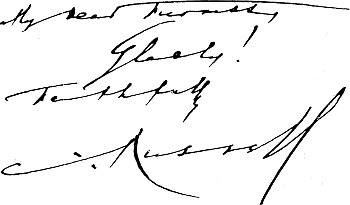
The Two Pins Club was started in 1890, and flourished until its President, Lord Russell, was elevated to the Bench. My only claim for distinction in connection with it rests on the fact that I was the only member who, except when I was in mid-Atlantic on my return from the States, never missed a meet. Were the Club now a going concern, I would, of course, refrain from mentioning it, but as it is referred to in the "History of Punch" by Mr. Spielmann, and in "John Hare, Comedian," by Mr. Pemberton, I may be pardoned and also forgiven for repeating the one joke ever made public in connection with this remarkable Club.
One afternoon our cavalcade was approaching Weybridge, which had been the scene of the boyish pranks of one of our members. To the amusement of us all, this brother Two Pins, as reminiscences of the district were recalled to him by one object and another, grew terribly excited.
"Ah, my boys, there is the dear old oak tree under which I smoked my first cigarette! And there, where the new church stands, I shot my first snipe. Dear me, how all is altered! I wonder if old Sir Henry Tomkins still lives in the Lodge there, and what has become of the Rector's pretty daughter?" etc.
Sir Frank Lockwood, observing lettering on the side of a house, "General Stores," casually asked our excited reminiscent friend if he "knew a General Stores about these parts?"
"General Stores! Of course I do, but he was only a Captain when I lived here!"
When the members lunched at The Durdans our host and honorary member, Lord Rosebery, remarked that it was a Club of "one joke and one horse!" the fact being that we all drove over from Tadworth, Lord Russell's residence, where we were staying, with the exception of Lord Russell himself, who rode. We had, of course, each a horse: some of the members a great deal more than one, but we were careful to trot out one joke between us: "General Stores" became our general and only story.
The first public announcement respecting the Club appeared in the Daily Telegraph, the 4th of May, 1891:
"The T.P.C. held its first annual meeting at the 'Star and Garter Hotel' yesterday morning. There was a full attendance of members. Under the careful and conciliatory guidance of the President, Sir Charles Russell, supported mainly by Mr. F. C. Burnand, Mr. Frank Lockwood, Mr. Harry Furniss, Mr. Edward Lawson, Mr. Charles Mathews, Mr. John Hare, Mr. Linley Sambourne, and Mr. R. Lehmann (hon. sec.), the customary business was satisfactorily transacted, and the principal subjects for discussion were dealt with in a spirit of intelligent self-control. Mr. Arthur Russell was unanimously elected a member of the association, which in point of numbers is now complete."
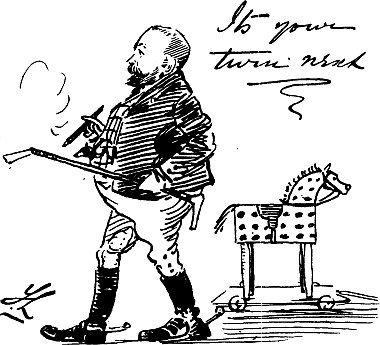
This sketch is à propos of Mr. Linley Sambourne's portrait in "Vanity Fair." Note refers to his being made Solicitor-General.
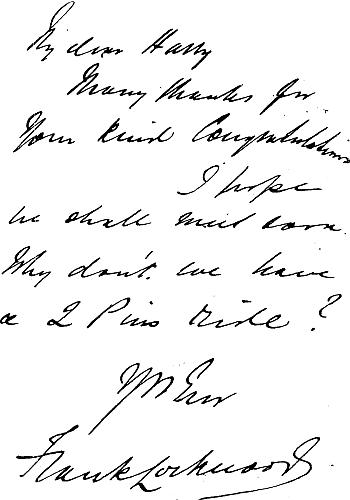
But the object of the Club being carefully concealed, much mystery surrounds its name. Few were aware that it was merely a band of "Sontag-Reiters." Our hon. sec., being at the time prominent in politics, received congratulations from those who imagined the T.P.C. was a political association, and much wonderment was excited by the decidedly enigmatical appellation of the small and select society. Sir Edward Lawson showed marked ingenuity in retaining the mystery by his paragraphs in his paper. The first meet of our second season was the only one I missed during the years the Club existed:
"The first meeting of the T.P.C. for the season of 1892 took place yesterday at the 'Star and Garter Hotel,' under the presidency of Sir Charles Russell, who was assisted in the performance of his duties by Mr. Frank Lockwood, Mr. Linley Sambourne, Mr. Edward Lawson, and Mr C. W. Mathews. The arrangements for the season were completed, and a digest was made of the subjects which claimed the immediate consideration of the members. The President called attention to a delay which had occurred in the fulfilment of certain artistic duties which had been entrusted to Mr. Harry Furniss and Mr. Linley Sambourne, and which had been retarded in their accomplishment by Mr. Furniss' voyage to America. But it was understood that immediate attention would now be bestowed upon the work in hand; and the remainder of the business was of a routine character."
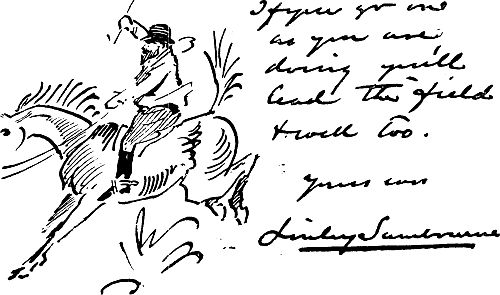
MR. LINLEY SAMBOURNE.
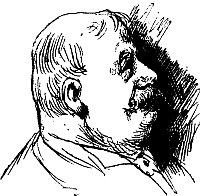
The "artistic duties" referred to, I have no recollection of, but I know that at our preliminary meeting, when all matters, artistic and otherwise, were discussed and arranged, the two following important resolutions were proposed, seconded, and carried unanimously:—
"That Mr. Rudolph Lehmann be elected Permanent Secretary, and that the duty of sending out all notices convening the Meets of the T.P.C., as well as all arrangements connected with the Club, be entrusted to him; and that every notice of meeting be posted and prepaid by him eight lunar, or at least three calendar, days before the date of each Meet; and further, that records in a neat and clerkly style of each and every Meet be faithfully kept by the said Secretary, and be at all times open for the inspection of each and every member of the T.P.C."
"That Mr. Linley Sambourne shall provide at his own expense the notepaper and envelopes required for the business of the Club, and shall invent and draw a design, which design, also at his own expense, he shall cause to be stamped or otherwise engraved on the said notepaper and envelopes, and shall cause the said notepaper so stamped or engraved to be forwarded to the Perpetual President, the Permanent Secretary, and the other members, for use in connection only with the business of the Club."
"It was further resolved that all maps and charts be kept at the Secretary's Office, and in the event of any dispute, the Ordnance Map or the Admiralty Chart shall be decisive."
But during the existence of the Club there never was any cause to refer to an Ordnance Map or Admiralty Chart. There never was a Secretary's Office, nor did Mr. Linley Sambourne either design or provide the notepaper or envelopes, nor are there any records in existence, either printed or written "in a neat and clerkly style," of the merry meetings of this unique Club. It ran its delightful and dangerous course, its wild career, unmarred by any dispute or accident. The last "meet" was to dine Lord Russell on his elevation to the Bench.
PORTRAIT OF ME AS A MEMBER OF THE TWO PINS CLUB, BY LINLEY SAMBOURNE.
I shall never forget the first occasion on which I saw the late Lord Russell. It was in the old days when the Law Courts were in Westminster,—and I, in search of "character," strangely enough found myself wandering about the Divorce Court, where so many characters are lost. It was a cause célèbre,—the divorce suit of a most distinguished Presbyterian cleric who charged his wife, the co-respondent being the stable-boy. Russell (then plain Mr.) was for the clergyman, and when I entered the crowded court, he was in the midst of his appeal to the jury, working himself up to a pitch of eloquence, appealing to all to look upon the saintly figure of the man of prayer (the plaintiff, who was playing the part by kneeling and clasping his hands), and asking the jury to scorn all idea of his client having any desire to free himself of his wife so as to marry his pretty governess, or cousin, or whomever it was suggested he most particularly admired. Russell had arrived at quoting Scripture,—he was at his best, austere, eloquent, persuasive, an orator, a gentleman, a great advocate, and as sanctimonious as his kneeling client.
THE LATE LORD RUSSELL, THE PRESIDENT OF THE TWO PINS CLUB.
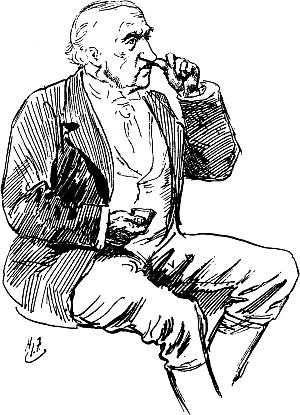
He was interrupted by someone handing him a telegram. As he opened it he said, waving it towards his client, "This may be a message from Heaven to that saint,—ah, gentlemen of the jury, the words so pure—so—so——" (he reads the telegram).
"D——! D——! D——!" He crushed the telegram in his hand, and with an angry gesture threw it away. Although his words were drowned by the "laughter in Court," his gestures and face showed his chagrin and disgust. The Grand National had been run half-an-hour before.
Years afterwards, on his own lawn at Tadworth, I told him of this incident, and asked him what the contents of that telegram were. He declared I was wrong, such an incident never occurred in his career. I convinced him I was right—it was the first time I saw him, and every detail was vividly impressed upon my memory. After dinner he came to me and said, "Furniss, I have been thinking over that incident. You are quite right—it has all come back to me. I lost my temper, I recollect, because I had wired to my boy over there to make a bet for me on an outsider at a long price; when at lunch, I heard the horse had won. I was delighted, and therefore at my best when I addressed the jury. The telegram was from my boy to say that he forgot to put the money on!"
Riding has caused my appearance in a Police Court, but not as a member of the Two Pins Club. In October, 1895, I was returning from my usual ride before breakfast, accompanied by my little daughter; we turned into the terrace in which we live, and our horses cantered up the hill about 120 yards. As we were dismounting, a Police Inspector passed, addressing me by name, and in a most offensive tone declared that he would summon me, as I had been cautioned before for furious riding. This remark was so absolutely untrue that I met the summons, and the Inspector in the Court made three distinct statements on oath: That I spurred my horse (when cross-examined by me, he gave a minute description of my spurs); that I charged up the hill 250 yards at the rate of sixteen miles an hour; and that I had been cautioned before for the same thing. Now, I have never been cautioned in my life; the distance I went up the hill is 120 yards, and no horse could get up any pace in that distance; and I do not wear spurs, although two constables swore I did.
The magistrate, face to face with these three facts, looked the picture of misery. It was evident to him, as it must be evident to every fair-minded man, that the police were in the wrong. And when the magistrate was thinking out this dilemma, I made a fatal mistake. I gave my reason for appearing as a sacrifice on my part to show the magistrate the sort of evidence upon which poor cabmen and others are fined and made to suffer. The magistrate, Mr. Plowden, waxed very wroth, and as he could not punish me, and would not reprimand the police, I was asked to pay the costs of the summons, which was withdrawn. The late Mr. Montagu Williams, who sat in the Marylebone Police Court, the court in which I was charged with furious riding, gave it as his private opinion that the longer a policeman was in the service the less he could rely upon his word.
"FURIOUS RIDING." SKETCH BY F. C. GOULD. From the "Westminster Gazette."
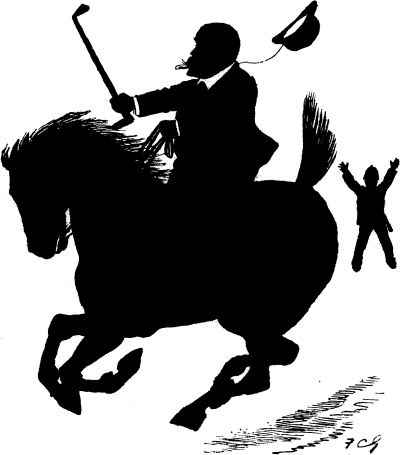
This case led to all sorts of trouble. I was assailed by people in the street, strangers to me, for "riding over children." Letters came from all sorts of societies—Cruelty to Animals, and other excellent institutions. I found people measuring the terrace; others riding up it to see if it were possible to get the pace (which it is not), but few knew the truth. The constable when I left the court remarked to me, "I'll tache ye to caricature Oirishmen in Parleymint!" However, I was repaid by the humour the incident gave rise to in the imagination of my brother workers on the Press. Mr. F. C. Gould made this capital sketch, and others portrayed my crime in verse. The following was written to me by one of London's most celebrated editors, and has never been published before:
"H. Furniss was an artist gent Of credit and renown, Who'd ride a horse up Primrose Hill With any man in town.
"The morn was fine as morn could be Upon last Thursday week, And, like the early morn, H. F. Was up before the beak.
"(Full little dreamed that worthy cit, Some dozen mornings hence He would be 'up before the beak' In quite another sense.)
"Upon two tits of pranksome mood, The gallant Lika Joko And Likajokalina rode, 'Desipere in loco.'
"'Cantare pares' rode the pair, Ad equitatum nati,' But to a bobby's summons not 'Respondere parati.'
"So 'appy rode the blithesome pair, They scoured the hill and plain, And warming with their morning's work, Rode hotly home again.
"But by the slope of Primrose Hill The rude Inspector Ross Beheld H. Furniss canter up Upon his foaming hoss.
"'Look 'ere, young man,' says he to him, 'There are some children dear That by the ridin' of you folk Do go in bod'ly fear.
"'Your hasting steed pull up, I say! S'welp me, draw your rein! The innocents abroad, young man, Are frightened by you twain.
"'Look at yer smokin' job 'oss 'ere— I seen you job 'is flank! 'E's well nigh done—tyke 'im away, And back upon the rank.'
"H. Furniss fixed him with his eye; His brow was awful cross; He Kyrled his lip contemptuous-like At this rude man of Ross.
"'The spirit of my gallant cob, Ruffian, you shall not squelch; I ride nor Scotch nor Irish hot, But Furniss-heated Welsh.
"'Mine and my daughter's gentle pace Could not affright a foundling; Be off, and peep down areas, or Move on some harmless groundling!'
"The Inspector glared: 'Come, Mr. F., We can't stand this no longer; I summons you to Marylebone'— (He muttered something stronger).
* * * * *
"Good Mr. Plowden heard the charge, As two policemen swore it; Then heard H. Furniss' defence, And sagely pondered o'er it.
"'The Inspector swears you galloped up; You swear you merely trotted: My own opinion in this case Is, as usual, Gordian-knotted.
"'Now Gordian knots were tied to be By magistrates divided; We cut them—and the severed ends Do much as once the tied did.
"'In this case, add the paces up, And then divide by two: A canter is the quotient; I think that that should do.
"'A sound decision that will please Both parties this I trust is; It is a fine distinction, but Avoids the fires of justice.
"'You, Mr. Furniss, must disburse Two bob costs to my till, And promise me to try no more Primrose babes to kill.
"'And all in Court, take warning by The furious Canterer's fate, And go not up the Primrose path At such an awful rate.
"'But if your sluggish livers you Must vigorously shake, "Vigor's Horse Exercise at Home" (Vide Prospectus) take.'"
As a matter of fact, the magistrate did not look at the charge-sheet, or know me, or catch my name, or he might have made his usual joke at my expense in another way.
MY PORTRAIT, BY F. C. BURNAND.
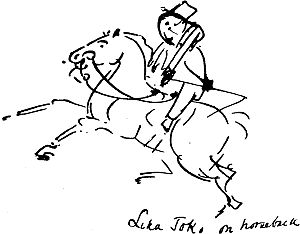
Mr. Burnand and I rode a great deal together. Avoiding the Row, my editor preferred to ride to Hampstead, Harrow, or Mill Hill, calling for me on the way. Once, when I could not ride, he wrote: "Very sorry to hear of your being laid up with a cold; it shows what even the Wisest and Best amongst us are liable to. The idea is monstrous of a Cold Furniss. A coal'd furniss is satisfactory. Don't take too much out of yourself with riding. 'He speaks to thee who hath not got a horse'—Shakespeare." Then follows later a specimen of his irrepressible good humour:
22 Nov.
"Alas and alack! I've got a hack, But the weather's been such, I've not got on his back.
"I got no jog Because of the fog, And up to twelve, In breeches and boots, Which I had to shelve And recover my foots. I lunched at the 'G' (So there was, you see, One Gee for me).
"Then I came back And wrote some play But oh, good lack! No riding to-day. If foggy here, At Ramsgate 'twas clear.
"Alas and alack! I'll sell my hack, Much to my sorrow. I'll ride to-morrow, That is, if fine, But not at nine. I shall not start, if I'm alive And have the heart, till ten forty-five.
"Away to parks I'll trot To get a little hot, Also to get a little dirty, And with you be 11.30.
"Till one, Then done. Back to Lunch, Then to Office of Punch. This my plan, you'll be happy to learn, is At your disposal, Mr. Furniss."
But excursions in search of material my editor and I had to do on foot, and were not so pleasing; still, Mr. Burnand always managed to have his little joke in all circumstances.
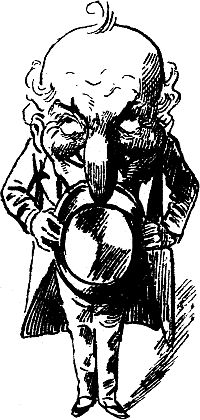
One day he and I were "doing" the picture shows in the interests of Mr. Punch. At one o'clock, feeling jaded and tired, a retreat to the Garrick Club to lunch was suggested. "Happy thought!" said my editor. "Better still, here is an invitation for two to the Exhibition of French Cookery at Willis's Rooms. Capital lunch there, I should think." So off we went, anticipating a recherché lunch. Fancy our chagrin on arrival to find cooks galore, discussing their art, but, alas! their art, like the high art of the Masters of the Brush in our National Gallery, was all under glass! Aggravatingly appetising, but absolutely uninteresting to the two hungry art critics. We soon were in a cab and at the Garrick. As we pulled up, the greatest gourmet of the Club, that clever actor, Arthur Cecil, greeted us:
"Hallo, Frank, where have you two come from?"
"Oh, Arthur, such luck! Furniss and I have just had the most recherché lunch you could imagine."
"H'm—hullo—h'm—where? The deuce you have! Lucky dogs! Eh, what was it like?"
"Oh, you can see it for yourself; it's going on now at the French Cookery Exhibition in Willis's Rooms. Special invitation—ah, here's a ticket."
"Thanks, old chap! what a treat! I'm off there! No, no; you fellows mustn't pay the cab—I'll do that. Here, driver—Willis's Rooms—look sharp!"
Arthur Cecil undoubtedly was a quaint fellow and a clever actor, but he had an insatiable appetite. One would never have thought so, judging from appearance: his clever, clean-cut face, his small, thin figure, together with the little hand-bag he always carried, rather suggested a lawyer or a clergyman. His eccentricity was a combination of absent-mindedness and irritability. The latter failing, he told me, would at times take complete control of him: for instance, he had to leave a train before his journey was completed, as he felt it impossible to sit in the carriage and look at the alarm bell without pulling it. I have watched him seated in the smoking-room of the club we both attended, in which the star-light in the centre of the ceiling was shaded by a rather primitive screen of stretched tissue paper, gazing at it for half-an-hour at a time, and eventually taking all the coins out of his pocket to throw them one after another at the immediate object of his irritation. He frequently succeeded in penetrating the screen, the coins remaining on the top of it, to the delight of the astonished waiters.
His eccentricity—perhaps I ought to say in this case his absent-mindedness—is illustrated by an incident which happened on the morning of the funeral of a great friend of his. As Cecil (his real name was Blount) was having his bath, he was suddenly inspired with some idea for a song; so, pulling his sponge-bath into the adjoining sitting-room closer to the piano, he placed a chair in it, and sat down to try it over. A friend, rushing in to fetch him to the funeral, found him so seated, singing and playing, balancing the dripping sponge on the top of his head.
THE CARICATURING OF PICTURES.
THE PICTURE SHOWS. Design from "Punch."
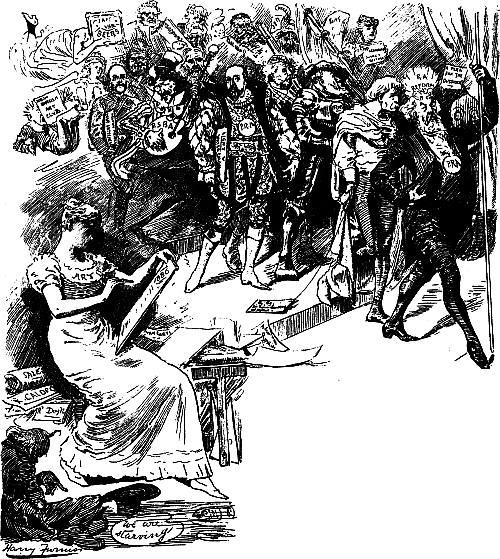
To feed upon one's own kind is a custom which, like so many other vestiges of a previous civilisation, seems in the present day to have a fair chance of revival. We have long had with us the City Cannibal, the Fleet Street Cannibal, the Dramatic, Literary and Musical Cannibals. Latterly the Society Cannibal has come more distinctly to the front. Then why, I long ago asked myself, should there not be the Cannibal of the etching pen and the brush? Especially as the writhing victims of those mighty instruments appear to be so enamoured of their fate as to besiege that comic slaughter-house, the studio of the caricaturist, and with persistent cries of "Eat us! eat us! Our turn next!" solicit the "favour of not being forgotten" in his next batch of "subjects."
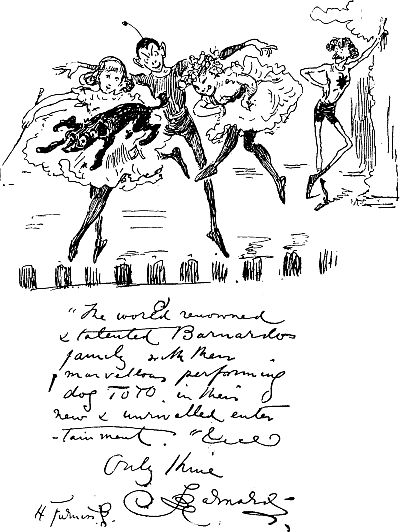
It may be a revelation to many of my readers, but I can assure them it is a fact, that it is only in very exceptional cases that artists object to having their pictures caricatured. Indeed, many of the leading painters have given me to understand that the omission of their work from my sketches would be anything but agreeable to them, although, when the desired travesties of their pictures appear, they may pretend to be highly indignant. There is one Royal Academician of my acquaintance who has so keen an appreciation of humour that he never loses an opportunity of giving me a hint when his magnifying glass has detected the slightest element of the grotesque in a fellow artist's work. And that most amiable of men, the late Frank Holl, could never refrain, when occasion offered, from directing my attention to the humorous points of his sitters, although I need hardly add that no trace of his having perceived them was ever apparent in any of his works. Do artists object? Well, in Punch, May, 1889, du Maurier touches this point:
"What our artist (the awfully funny one) has to put up with: Brown: 'I say, look here! What the deuce do you mean by caricaturing my pictures—hay?' Jones: 'Yes, confound you! and not caricaturing mine!'"
I have even known artists so anxious to be parodied that, if they happened to have a vein of humour in their pencils, they would actually send me caricatures of their own pictures. Even poor Fred Barnard once sent me an admirable sketch, caricaturing an excellent portrait of his three children which he had painted for the Royal Academy, where it duly appeared. Others less humorously imaginative perhaps have written to me assuring me of the great pleasure which would have been theirs had they themselves conceived the idea which my caricature of their work supplied.
Although, however, there are so few artists who object to having their pictures caricatured, there is, of course, another side to the question. It is indeed most true that nothing kills like ridicule, and in the course of my experience I have found it is just as easy unconsciously to inflict an injury with my pen and Indian ink as it is to do good. Let us suppose, for instance, that a great painter has just finished a very sentimental work—a picture so brimful of beauty and pathos that it appeals to everybody, myself included. As I stand before it, and admire, it is impossible perhaps for me to restrain a sympathetic tear from making its appearance in, at all events, one of my eyes. But how about the other? Ah! with regard to that other eye, I must confess it is very differently employed, and, superior to my control, is searching the canvas high and low for that "something ridiculous" which, except in the case of the very greatest masters, is always there. Now what ensues? The purchaser of that picture, who, mark you, unlike myself, regarded it and admired it with both of his eyes, congratulates himself upon its acquisition. I have known it for a fact, however—to my regret—that after the publication of the caricature the purchaser was never able to look at his picture again through his own glasses, and bitterly regretted his outlay.
THE GREAT BACCARAT CASE. MY SKETCH IN PENCIL MADE IN COURT, AND CONGRATULATORY NOTE FROM THE EDITOR OF PUNCH.
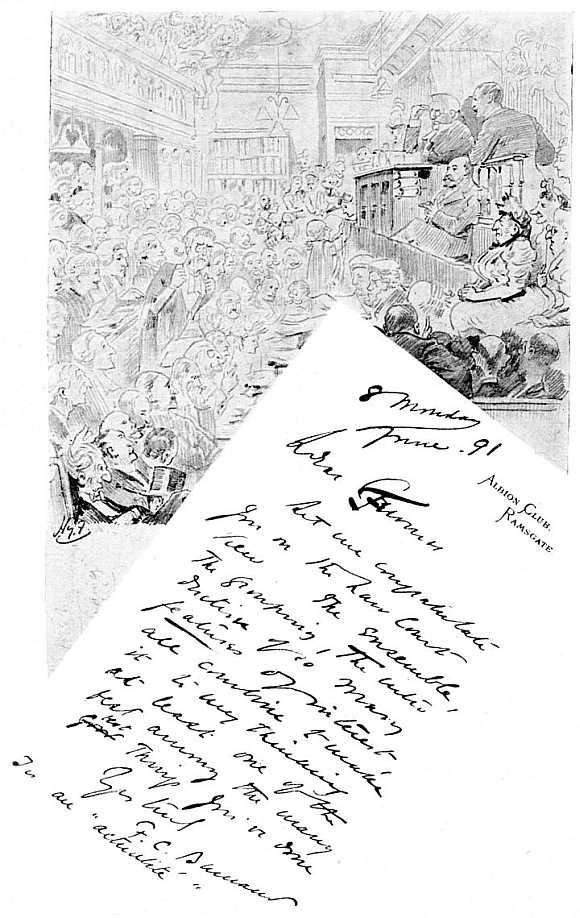
An art publisher with whom I was acquainted agreed to pay a heavy sum for the copyright of a work of a well-known and popular painter, and after the caricature had appeared in Punch he resolved to forego the publication of the engraving from it by which he had hoped to recoup his expenditure, because he considered that the sobriety of the work was so completely destroyed as to preclude the possibility of sale; and an eminent sculptor, who was responsible for a well-known statue which I caricatured some years ago when it appeared in the Royal Academy, has told me, since it was put up in the Metropolis, that he has actually meditated replacing it by another piece, owing to the ludicrous suggestion affixed to it.
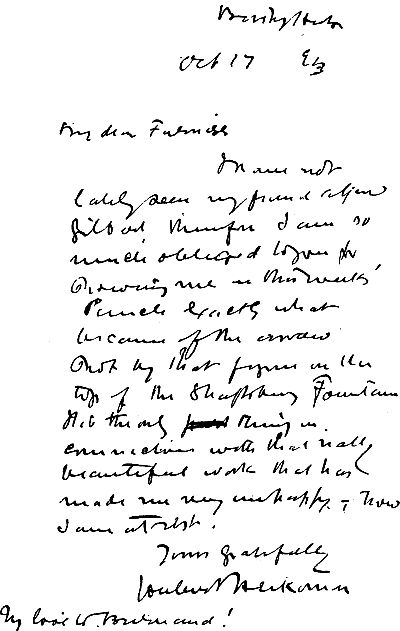
On the other hand, the caricature of an important work is sometimes received in the proper spirit. Here is a letter from Professor Herkomer, with reference to my caricature of the work of our greatest art genius, Alfred Gilbert, R.A.:
Of course, the caricaturing of pictures has its seamy as well as its smooth side. Among the annoyances to which an artist engaged on this description of work is exposed I am inclined to give a prominent place to the fussy and vexatious regulations imposed upon him by the authorities at Burlington House. One would have supposed, for instance, that anyone like myself, who is well-known as merely taking notes for caricature, would have been allowed to consult his own convenience to some extent in making his sketches. But not a bit of it. The penalty is something too dreadful if you are found making the slightest note of a picture at the Royal Academy at any other time than on the one appointed day. The object of this regulation is, of course, to protect the copyright of the pictures—a very proper and legitimate precaution; but I submit that a better instance of the spirit of Red Tapeism which is so rampant at Burlington House, and which I am always endeavouring to expose, could not be adduced than the inability of the officials to discriminate between the accredited representative of a paper and the piratical sketcher who is taking notes for an illegitimate purpose. I need hardly say that this regulation is peculiar to the Royal Academy. At the Grosvenor Gallery, which, alas! is no more, the officials about the place understood these matters better, and at all times were pleased to give every facility to the representative of the Press. The polite secretary would give up his chair to me any day I liked to look in, and would often point out to me some comical feature in the surrounding canvases which his sly humour had detected.
A PRISONER.
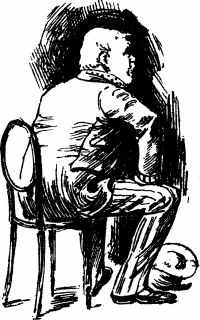
Equal praise must indeed be accorded to the management of the New Gallery and all the other Exhibitions with which I have been brought in contact in the course of my professional duties. Personally, as I have always made my notes at the Royal Academy on the authorised occasion, I have had nothing to fear from those who preside there. But my friend Linley Sambourne, who wished upon one occasion to caricature a picture of Burne-Jones' for a political cartoon in Punch (of course altering the figures and indeed everything else, so as not in any way to trench upon the great artist's copyright) was dogged by a detective, arrested, and finally thrown into the darkest dungeon beneath the Burlington House moat! Protest was useless. What his terror must have been my pen fails to describe. Visions of the thumbscrew, the rack, and all the tortures conceivable rose in the fertile imagination of my colleague, and beads of perspiration made their appearance upon his massive brow. After weary hours, when lunch-time without the lunch had come and gone, and the pangs of hunger began to be added to his other miseries, when he was reflecting that his week's work for Punch was yet unfinished, that the engravers would be in despair at not having it in time, and that at that moment his editor was probably telegraphing to him all over London and instituting a search for his person all over his club, suddenly the bolts of his prison-chamber were withdrawn and his gaoler, the blood-thirsty tyrant Red Tape, allowed the genial artist to return to the bosom of his wife and family—not, however, without leaving a hostage behind him. The sketch—the guilty sketch—the cause of all his troubles, was detained. In vain the harassed artist explained to his grim Cerberus that the work was wanted for the next week's issue of Punch, and although as a matter of fact it duly appeared at the appointed time, Mr. Sambourne had to trust to his memory instead of to the courtesy and common sense of Burlington House for the reproduction of his skit.
I remember another incident which will serve to illustrate the trials and misfortunes of the caricaturist when pursuing his vocation outside the walls of his studio. It was the opening day of the New Gallery, and as I draw my sketches of the pictures with an ordinary pen and liquid Indian ink direct, and have them afterwards, like all my drawings, photographed on wood and engraved—of late years they are reproduced by process engraving—I was holding my bottle of ink and my sketch-book in one hand, while my pen was busy with the other. Upon arriving very early in the morning I thought I must have made a mistake, and that I had entered a manufactory of hats, for the hall was almost entirely taken up with hat-boxes. Upon enquiry, however, I learned that these merely contained the new hats in which the directors would, later on, receive their visitors. When the hall began to fill, and the fashionable crowd was pouring in, I was standing in the central lobby, sketching away with a will, when my friend Sir William Agnew, always early to arrive on such occasions, happened to come up and soon interested me in conversation about the genius of Millais and the beauties of Burne-Jones. In my energetic manner I was debating a matter of some little interest when my eye caught that of Mr. Comyns-Carr, who, with his newly-selected hat on, was standing close by and regarding me with an expression of indescribable horror. "What is the matter with Carr?" I observed to Agnew; "surely Sargent should be here and hand down that expression to posterity." But when I followed his eyes as they passed sternly from mine to the floor, my hat nearly sprang off my head at the sight which I beheld! Forgetting that I held the bottle of ink in the hand with which I had been suiting the action to the word in my animated harangue to Sir William, I had splashed the virgin marble on which we were standing in all directions with hideous stains of the blackest of liquids. In my consternation I did not stay to see the incongruous figure of the charwoman and bucket who was immediately introduced amid the élite of fashionable London, but fled incontinently from the gallery and, rushing in where angels fear to tread, sought sanctuary in my accustomed haunt, the Gallery of the House of Commons. There at least I thought I should be safe. Presently, when I had somewhat recovered from my agitation, I was making my way out of the House when I encountered a friend in the Central Lobby. I was explaining to him the unfortunate contretemps which had occurred at the New Gallery, and utterly forgot that I still held the bottle of ink in my hand, and on the sacred floor we stood upon I had perpetrated the offence again!
My only consolation for this chapter of accidents was that the particular ink in my bottle is different from the ordinary writing fluid, and leaves no stain behind it. It is in fact merely paint, and is innocent of gall. There are inks, as there are other forms of journalism, whose consequences are not so easily effaced or so harmless; but like the caricaturist's work itself, the material with which it is accomplished often looks blacker than it really is.
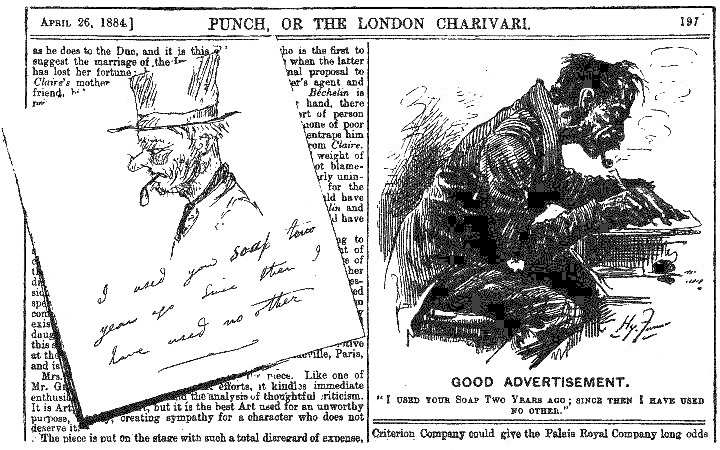
ORIGINAL IDEA AS SENT TO ME. MY DRAWING OF IT IN PUNCH.
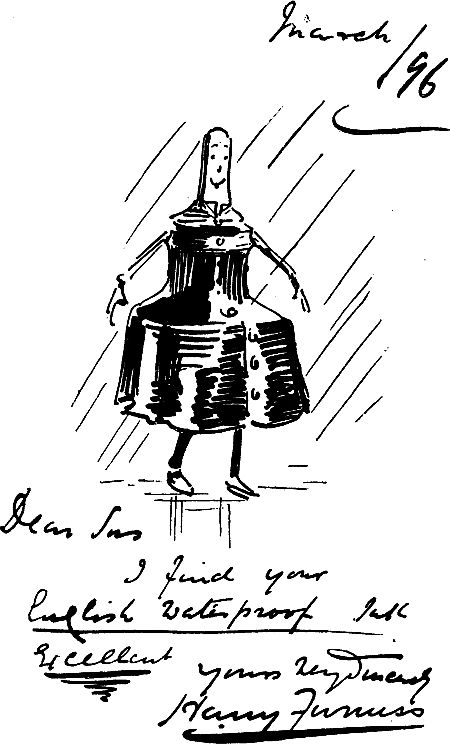
Fortunately all this happened previous to the introduction of the ink I use now, known as Waterproof ink—ink that will not run when washed over with water. The manufacturers of this article sent me a specimen bottle to experiment with, and asked me for my opinion of it. In replying, I sent the following note. The sketch was touched in to amuse my youngest boy, who was puzzled by the meaning of Waterproof ink. The makers, in acknowledging the note, asked me to mention the sum I would accept if, with my permission, they used the note and sketch I sent as an advertisement. I replied that they were welcome to use my note, but that I could not accept payment. However I received in a few days a large parcel of artists' materials: paints, sketch-books, brushes, pencils, &c.
This is more than I ever received for a better known advertisement: "I used your soap two years ago." I was never offered so much as a cake of soap from those who used my Punch sketch so freely! Permission was given for its use by the proprietors of Punch, not knowing I had any objection, and at the time I was ill with fever and unable to protest. The firm certainly paid me some years afterwards for the publication of the same advertisement for two insertions in a periodical I was starting, but only at the ordinary rate. I mention this fact as I have heard from friends all over the world that I received untold gold for the use of it, and as it has interested so many perhaps I may at the same time clear up another fallacy, which I did not know existed until I read Mr. Spielmann's "History of Punch." In that he refers to the very "oft-quoted drawing (lately used as an advertisement), the idea of which reached him from an anonymous correspondent. It is that of a grimy, unshaven, unwashed, mangy-looking tramp, who sits down to write, with a broken quill, a testimonial for a firm of soap-makers. A further point of interest about this famous sketch was that Charles Keene was deeply offended by it at first, in the groundless belief that it was intended as a skit upon himself. It must at least be admitted that the head is not unlike what one might have expected to belong to a dissipated and dilapidated Charles Keene." Poor Keene! How sorry I was to read this when too late to explain to him that he was never in my mind for a moment when I was drawing it! But, strange to say, the original who sat for it was a brother artist, another Charles, quite as delightful as Keene, equally clever in his own way, and my greatest friend—Charles Burton Barber, the animal painter, in appearance rather like Charles Keene, but nothing of the Bohemian about him, and a non-smoker! Still I am always being told that I had So-and-so in my eye when drawing the figure. I might in truth quote Sir John Tenniel's remark à propos of being accused of caricaturing his late comrade, Horace Mayhew, as the "White Knight" in "Alice in Wonderland": "The resemblance was purely accidental, a mere unintentional caricature, which his friends, of course, were only too delighted to make the most of." Ah, those friends are at the bottom of all these misunderstandings. I could a tale, or two, unfold, but that—that's another volume.
I SIT FOR JOHN BROWN.
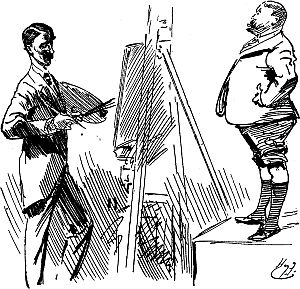
Yes, poor Barber sat for the tramp, and I in return sat to him for a figure quite as incongruous in my case as the tramp was in his. I sat for John Brown for the picture Queen Victoria had commissioned of Mr. Brown surrounded by her pet dogs, which she had in her private room. She was so delighted with the picture that she had a replica made of it, and placed it in the passage outside, so that it was the first picture she looked at as she left her room. Barber's animals and children were delightful, but he was weak with his men, and was in trouble over John Brown's calves,—it was then that I posed for the "brawny Scott," but only for the portion here mentioned.
A CRIB BY AN AMERICAN ADVERTISER.
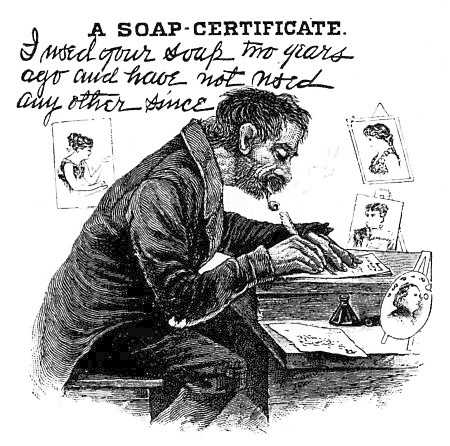
This figure of the tramp in my sketch of "I used your soap two years ago" has in fact been mistaken for myself. A relative of my own, who has been living in the Cape for many years, paid a visit to London, and on his return informed his children that he had seen me and brought my portrait back with him. "Oh, we have Cousin Harry's portrait in our nursery for some time: one he has signed too." It was the Punch-Pears production in colour! I am sure I do not know how ridiculous stories are received as true, that I got a fabulous sum for the use of this one; that such-and-such a member of the staff gets a huge retaining fee, &c., and other inventions—one in particular. If I have met one, I have met a score of people at different times of my life who positively declared that they actually sent that ever famous line: "Punch's advice to those about to marry—Don't!" and received immediately remuneration in sums varying from £5 to £500. That joke was probably conceived and thrown in at the last moment, at the critical point when the editor is "making up" the paper.
As I am writing these disjointed notes for family reading, it may perhaps not be out of place just to refer to the domestic relations of the staff of Punch. Our wives and families were invited to meet on the occasion of the Lord Mayor's procession, when they may have been observed upon the roof of the publishing office—till recently it was in Fleet Street—from which coign of vantage they had an excellent view of the civic show, afterwards having a capital lunch in a room on the first floor. Yet how much men who live on their wits owe to their domestic happiness! It is a pleasant fact to be able to chronicle that—I believe at all times—the domestic lives of the Punch staff have been most happy. It is rather curious that all of them have made the same kind of matrimonial selection—they have married "sensible wives," women who have all been sympathetic, devoted, bright, and domesticated. The wit at the dinner-table, the humorous writer or the caricaturist in the pages you read, is a very different dog at home. It must naturally be so. It is the reaction, and it is to such men that the woman possessed of tact and cheerfulness is invaluable. In truth, Punch's advice to those about to marry, "Don't!" has been disregarded by the majority of his members, in every case with the utmost satisfaction to themselves.
BRADBURY, AGNEW, & CO. LD. PRINTERS, LONDON AND TONBRIDGE.