NOTES
Reading edition
INTRODUCTION
He was born . . . at Pallas. This is the usual account. But it was maintained by the family of the poet’s mother, and has been contended (by Dr. Michael F. Cox in a Lecture on ‘The Country and Kindred of Oliver Goldsmith,’ published in vol. 1, pt. 2, of the Journal of the ‘National Literary Society of Ireland.’ 1900) that his real birth-place was the residence of Mrs. Goldsmith’s parents, Smith-Hill House, Elphin, Roscommon, to which she was in the habit of paying frequent visits. Meanwhile, in 1897, a window was placed to Goldsmith’s memory in Forgney Church, Longford,—the church of which, at the time of his birth, his father was curate.
his academic career was not a success. ‘Oliver Goldsmith is recorded on two occasions as being remarkably diligent at Morning Lecture; again, as cautioned for bad answering at Morning and Greek Lectures; and finally, as put down into the next class for neglect of his studies’ (Dr. Stubbs’s History of the University of Dublin, 1889, p. 201 n.)
a scratched signature upon a window-pane. This, which is now at Trinity College, Dublin, is here reproduced in facsimile. When the garrets of No. 35, Parliament Square, were pulled down in 1837, it was cut out of the window by the last occupant of the rooms, who broke it in the process. (Dr. J. F. Waller in Cassell’s Works of Goldsmith, [1864–5], pp. xiii-xiv n.)
a poor physician. Where he obtained his diploma is not known. It was certainly not at Padua (Athenaeum, July 21, 1894). At Leyden and Louvain Prior made inquiries but, in each case, without success. The annals of the University of Louvain were, however, destroyed in the revolutionary wars. (Prior, Life, 1837, i, pp. 171, 178).
declared it to be by Goldsmith. Goldsmith’s authorship of this version has now been placed beyond a doubt by the publication in facsimile of his signed receipt to Edward Dilly for third share of ‘my translation,’ such third share amounting to 6 pounds 13s. 4d. The receipt, which belongs to Mr. J. W. Ford of Enfield Old Park, is dated ‘January 11th, 1758.’ (Memoirs of a Protestant, etc., Dent’s edition, 1895, i, pp. xii-xviii.)
12, Green Arbour Court, Old Bailey. This was a tiny square occupying a site now absorbed by the Holborn Viaduct and Railway Station. No. 12, where Goldsmith lived, was later occupied by Messrs. Smith, Elder & Co. as a printing office. An engraving of the Court forms the frontispiece to the European Magazine for January, 1803.
or some of his imitators. The proximate cause of the Citizen of the World, as the present writer has suggested elsewhere, may have been Horace Walpole’s Letter from XoHo [Soho?], a Chinese Philosopher at London, to his friend Lien Chi, at Peking. This was noticed as ‘in Montesquieu’s manner’ in the May issue of the Monthly Review for 1757, to which Goldsmith was a contributor (Eighteenth Century Vignettes, first series, second edition, 1897, pp. 108–9).
demonstrable from internal evidence. e.g.—The references to the musical glasses (ch. ix), which were the rage in 1761–2; and to the Auditor (ch. xix) established by Arthur Murphy in June of the latter year. The sale of the ‘Vicar’ is discussed at length in chapter vii of the editor’s Life of Oliver Goldsmith (‘Great Writers’ series), 1888, pp. 110–21.
started with a loss. This, which to some critics has seemed unintelliglble, rests upon the following: ‘The first three editions, . . . resulted in a loss, and the fourth, which was not issued until eight [four?] years after the first, started with a balance against it of £2 16s. 6d., and it was not until that fourth edition had been sold that the balance came out on the right side’ (A Bookseller of the Last Century [John Newbery] by Charles Welsh, 1885, p. 61). The writer based his statement upon Collins’s ‘Publishing book, account of books printed and shares therein, No. 3, 1770 to 1785.’
James’s Powder. This was a famous patent panacea, invented by Johnson’s Lichfield townsman, Dr. Robert James of the Medicinal Dictionary. It was sold by John Newbery, and had an extraordinary vogue. The King dosed Princess Elizabeth with it; Fielding, Gray, and Cowper all swore by it, and Horace Walpole, who wished to try it upon Mme. du Deffand in extremis, said he should use it if the house were on fire. William Hawes, the Strand apothecary who attended Goldsmith, wrote an interesting Account of the late Dr. Goldsmith’s Illness, so far as relates to the Exhibition of Dr. James’s Powders, etc., 1774, which he dedicated to Reynolds and Burke. To Hawes once belonged the poet’s worn old wooden writing-desk, now in the South Kensington Museum, where are also his favourite chair and cane. Another desk-chair, which had descended from his friend, Edmund Bott, was recently for sale at Sotheby’s (July, 1906).
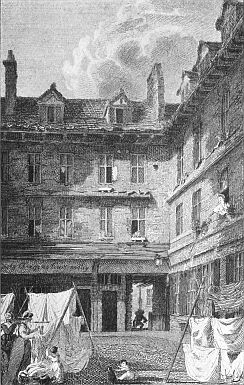
GREEN ARBOUR COURT, LITTLE OLD BAILEY (as it appeared in 1803)
EDITIONS OF THE POEMS.
No collected edition of Goldsmith’s poetical works appeared until after his death. But, in 1775, W. Griffin, who had published the Essays of ten years earlier, issued a volume entitled The Miscellaneous Works of Oliver Goldsmith, M.B., containing all his Essays and Poems. The ‘poems’ however were confined to ‘The Traveller,’ ‘The Deserted Village,’ ‘Edwin and Angelina,’ ‘The Double Transformation,’ ‘A New Simile,’ and ‘Retaliation,’—an obviously imperfect harvesting. In the following year G. Kearsly printed an eighth edition of Retaliation, with which he included ‘The Hermit’ (‘Edwin and Angelina’), ‘The Gift,’ ‘Madam Blaize,’ and the epilogues to The Sister and She stoops to Conquer;* while to an edition of The Haunch of Venison, also put forth in 1776, he added the ‘Epitaph on Parnell’ and two songs from the oratorio of The Captivity. The next collection appeared in a volume of Poems and Plays published at Dublin in 1777, where it was preceded by a ‘Life,’ written by W. Glover, one of Goldsmith’s ‘Irish clients.’ Then, in 1780, came vol. i of T. Evans’s Poetical and Dramatic Works, etc., now first collected, also having a ‘Memoir,’ and certainly fuller than anything which had gone before. Next followed the long-deferred Miscellaneous Works, etc., of 1801, in four volumes, vol. ii of which comprised the plays and poems. Prefixed to this edition is the important biographical sketch, compiled under the direction of Bishop Percy, and usually described as the Percy Memoir, by which title it is referred to in the ensuing notes. The next memorable edition was that edited for the Aldine Series in 1831, by the Rev. John Mitford. Prior and Wright’s edition in vol. iv of the Miscellaneous Works, etc., of 1837, comes after this; then Bolton Corney’s excellent Poetical Works of 1845; and vol. i of Peter Cunningham’s Works, etc. of 1854. There are other issues of the poems, the latest of which is to be found in vol. ii (1885) of the complete Works, in five volumes, edited for Messrs. George Bell and Sons by J. W. M. Gibbs.
Most of the foregoing editions have been consulted for the following notes; but chiefly those of Mitford, Prior, Bolton Corney, and Cunningham. Many of the illustrations and explanations now supplied will not, however, be found in any of the sources indicated. When an elucidatory or parallel passage is cited, an attempt has been made, as far as possible, to give the credit of it to the first discoverer. Thus, some of the illustrations in Cunningham’s notes are here transferred to Prior, some of Prior’s to Mitford, and so forth. As regards the notes themselves, care has been taken to make them full enough to obviate the necessity, except in rare instances, of further investigation. It is the editor’s experience that references to external authorities are, as a general rule, sign-posts to routes which are seldom travelled.*
THE TRAVELLER.
It was on those continental wanderings which occupied Goldsmith between February, 1755 and February, 1756 that he conceived his first idea of this, the earliest of his poems to which he prefixed his name; and he probably had in mind Addison’s Letter from Italy to Lord Halifax, a work in which he found ‘a strain of political thinking that was, at that time [1701]. new in our poetry.’ (Beauties of English Poesy, 1767, i. III). From the dedicatory letter to his brother—which says expressly, ‘as a part of this Poem was formerly written to you from Switzerland, the whole can now, with propriety, be only inscribed to you’—it is plain that some portion of it must have been actually composed abroad. It was not, however, actually published until the 19th of December, 1764, and the title-page bore the date of 1765.* The publisher was John Newbery, of St. Paul’s Churchyard, and the price of the book, a quarto of 30 pages, was 1s. 6d. A second, third and fourth edition quickly followed, and a ninth, from which it is here reprinted, was issued in 1774, the year of the author’s death. Between the first and the sixth edition of 1770 there were numerous alterations, the more important of which are indicated in the ensuing notes.
The didactic purpose of The Traveller is defined in the concluding paragraph of the Dedication; and, like many of the thoughts which it contains, had been anticipated in a passage of The Citizen of the World, 1762, i. 185:—‘Every mind seems capable of entertaining a certain quantity of happiness, which no institutions can encrease, no circumstances alter, and entirely independent on fortune.’ But the best short description of the poem is Macaulay’s:—‘In the Traveller the execution, though deserving of much praise, is far inferior to the design. No philosophical poem, ancient or modern, has a plan so noble, and at the same time so simple. An English wanderer, seated on a crag among the Alps, near the point where three great countries meet, looks down on the boundless prospect, reviews his long pilgrimage, recalls the varieties of scenery, of climate, of government, of religion, of national character, which he has observed, and comes to the conclusion, just or unjust, that our happiness depends little on political institutions, and much on the temper and regulation of our own minds.’ (Encyclop. Britannica, Goldsmith, February, 1856.)
The only definite record of payment for The Traveller is ‘Copy of the Traveller, a Poem, 21l,’ in Newbery’s MSS.; but as the same sum occurs in Memoranda of much later date than 1764, it is possible that the success of the book may have prompted some supplementary fee.
A Prospect, i.e. ‘a view.’ ‘I went to Putney, and other places on the Thames, to take ‘prospects’ in crayon, to carry into France, where I thought to have them engraved’ (Evelyn, Diary, 20th June, 1649). And Reynolds uses the word of Claude in his Fourth Discourse:—‘His pictures are a composition of the various draughts which he had previously made from various beautiful scenes and prospects’ (Works, by Malone, 1798, i. 105). The word is common on old prints, e.g. An Exact Prospect of the Magnificent Stone Bridge at Westminster, etc., 1751.
Dedication. The Rev. Henry Goldsmith, says the Percy Memoir, 1801, p. 3, ‘had distinguished himself both at school and at college, but he unfortunately married at the early age of nineteen; which confined him to a Curacy, and prevented his rising to preferment in the church.’
with an income of forty pounds a year. Cf. The Deserted Village, ll. 141–2:—
A man he was, to all the country dear, And passing rich with forty pounds a year.
Cf. also Parson Adams in ch. iii of Joseph Andrews, who has twenty-three; and Mr. Rivers, in the Spiritual Quixote, 1772:—‘I do not choose to go into orders to be a curate all my life-time, and work for about fifteen-pence a day, or twenty-five pounds a year’ (bk. vi, ch. xvii). Dr. Primrose’s stipend is thirty-five in the first instance, fifteen in the second (Vicar of Wakefield, chapters ii and iii). But Professor Hales (Longer English Poems, 1885, p. 351) supplies an exact parallel in the case of Churchill, who, he says, when a curate at Rainham, ‘prayed and starved on forty pounds a year.’ The latter words are Churchill’s own, and sound like a quotation; but he was dead long before The Deserted Village appeared in 1770. There is an interesting paper in the Gentleman’s Magazine for November, 1763, on the miseries and hardships of the ‘inferior clergy.’
But of all kinds of ambition, etc. In the first edition of 1765, p. ii, this passage was as follows:—‘But of all kinds of ambition, as things are now circumstanced, perhaps that which pursues poetical fame, is the wildest. What from the encreased refinement of the times, from the diversity of judgments produced by opposing systems of criticism, and from the more prevalent divisions of opinion influenced by party, the strongest and happiest efforts can expect to please but in a very narrow circle. Though the poet were as sure of his aim as the imperial archer of antiquity, who boasted that he never missed the heart; yet would many of his shafts now fly at random, for the heart is too often in the wrong place.’ In the second edition it was curtailed; in the sixth it took its final form.
they engross all that favour once shown to her. First version—‘They engross all favour to themselves.’
the elder’s birthright. Cunningham here aptly compares Dryden’s epistle To Sir Godfrey Kneller, II. 89–92:—
Our arts are sisters, though not twins in birth; For hymns were sung in Eden’s happy earth: But oh, the painter muse, though last in place, Has seized the blessing first, like Jacob’s race.
Party=faction. Cf. lines 31–2 on Edmund Burke in Retaliation:—
Who, born for the Universe, narrow’d his mind, And to party gave up what was meant for mankind.
Such readers generally admire, etc. ‘I suppose this paragraph to be directed against Paul Whitehead, or Churchill,’ writes Mitford. It was clearly aimed at Churchill, since Prior (Life, 1837, ii. 54) quotes a portion of a contemporary article in the St. James’s Chronicle for February 7–9, 1765, attributed to Bonnell Thornton, which leaves little room for doubt upon the question. ‘The latter part of this paragraph,’ says the writer, referring to the passage now annotated, ‘we cannot help considering as a reflection on the memory of the late Mr. Churchill, whose talents as a poet were so greatly and so deservedly admired, that during his short reign, his merit in great measure eclipsed that of others; and we think it no mean acknowledgment of the excellencies of this poem [The Traveller] to say that, like the stars, they appear the more brilliant now that the sun of our poetry is gone down.’ Churchill died on the 4th of November, 1764, some weeks before the publication of The Traveller. His powers, it may be, were misdirected and misapplied; but his rough vigour and his manly verse deserved a better fate at Goldsmith’s hands.
tawdry was added in the sixth edition of 1770.
blank verse. Cf. The Present State of Polite Learning, 1759, p. 150—‘From a desire in the critic of grafting the spirit of ancient languages upon the English, has proceeded of late several disagreeable instances of pedantry. Among the number, I think we may reckon blank verse. Nothing but the greatest sublimity of subject can render such a measure pleasing; however, we now see it used on the most trivial occasions’—by which last remark Goldsmith probably, as Cunningham thinks, intended to refer to the efforts of Akenside, Dyer, and Armstrong. His views upon blank verse were shared by Johnson and Gray. At the date of the present dedication, the latest offender in this way had been Goldsmith’s old colleague on The Monthly Review, Dr. James Grainger, author of The Sugar Cane, which was published in June, 1764. (Cf. also The Bee for 24th November, 1759, ‘An account of the Augustan Age of England.’)
and that this principle, etc. In the first edition this read—‘and that this principle in each state, and in our own in particular, may be carried to a mischievous excess.’
Remote, unfriended, melancholy, slow. Mitford (Aldine edition, 1831, p. 7) compares the following lines from Ovid:—
Solus, inops, exspes, leto poenaeque relictus. Metamorphoses, xiv. 217. Exsul, inops erres, alienaque limina lustres, etc. Ibis. 113.
slow. A well-known passage from Boswell must here be reproduced:—‘Chamier once asked him [Goldsmith], what he meant by slow, the last word in the first line of The Traveller,
Remote, unfriended, melancholy, slow.
Did he mean tardiness of locomotion? Goldsmith, who would say something without consideration, answered “yes.” I [Johnson] was sitting by, and said, “No, Sir, you do not mean tardiness of locomotion; you mean, that sluggishness of mind which comes upon a man in solitude.” Chamier believed then that I had written the line as much as if he had seen me write it.’ [Birkbeck Hill’s Boswell, 1887, iii. 252–3.) It is quite possible, however, that Goldsmith meant no more than he said.
the rude Carinthian boor. ‘Carinthia,’ says Cunningham, ‘was visited by Goldsmith in 1755, and still (1853) retains its character for inhospitality.’
Campania. ‘Intended,’ says Bolton Corney, ‘to denote La campagna di Roma. The portion of it which extends from Rome to Terracina is scarcely habitable.’
a lengthening chain. Prior compares Letter iii of The Citizen of the World, 1762, i. 5:—‘The farther I travel I feel the pain of separation with stronger force, those ties that bind me to my native country, and you, are still unbroken. By every remove, I only drag a greater length of chain.’ But, as Mitford points out, Cibber has a similar thought in his Comical Lovers, 1707, Act v:—‘When I am with Florimel, it [my heart] is still your prisoner, it only draws a longer chain after it.’ And earlier still in Dryden’s ‘All for Love’, 1678, Act ii, Sc. 1:—
My life on’t, he still drags a chain along, That needs must clog his flight.
with simple plenty crown’d. In the first edition this read ‘where mirth and peace abound.’
the luxury of doing good. Prior compares Garth’s Claremont, 1715, where he speaks of the Druids:—
Hard was their Lodging, homely was their Food, For all their Luxury was doing Good.
my prime of life. He was seven-and-twenty when he landed at Dover in February, 1756.
That, like the circle bounding, etc. Cf. Vicar of Wakefield, 1766, ii. 160–1 (ch. x):—‘Death, the only friend of the wretched, for a little while mocks the weary traveller with the view, and like his horizon, still flies before him.’ [Prior.]
And find no spot of all the world my own. Prior compares his namesake’s lines In the Beginning of [Jacques] Robbe’s Geography, 1700:—
My destin’d Miles I shall have gone, By THAMES or MAESE, by PO or RHONE, And found no Foot of Earth my own.
above the storm’s career. Cf. 1. 190 of The Deserted Village.
should thankless pride repine? First edition, ‘’twere thankless to repine.’
Say, should the philosophic mind, etc. First edition:—
’Twere affectation all, and school-taught pride, To spurn the splendid things by heaven supply’d
hoard. ‘Sum’ in the first edition.
Boldly proclaims that happiest spot his own. In the first version this was—
Boldly asserts that country for his own.
And yet, perhaps, etc. In the first edition, for this and the following five lines appeared these eight:—
And yet, perhaps, if states with states we scan, Or estimate their bliss on Reason’s plan, Though patriots flatter, and though fools contend, We still shall find uncertainty suspend; Find that each good, by Art or Nature given, To these or those, but makes the balance even: Find that the bliss of all is much the same, And patriotic boasting reason’s shame!
On Idra’s cliffs. Bolton Corney conjectures that Goldsmith meant ‘Idria, a town in Carniola, noted for its mines.’ ‘Goldsmith in his “History of Animated Nature” makes mention of the mines, and spells the name in the same way as here.’ (Mr. J. H. Lobban’s Select Poems of Goldsmith, 1900, p. 87). Lines 84–5, it may be added, are not in the first edition.
And though the rocky-crested summits frown. In the first edition:—
And though rough rocks or gloomy summits frown.
lines 91–2. are not in the first editions.
peculiar, i.e. ‘proper,’ ‘appropriate.’
winnow, i.e. ‘waft,’ ‘disperse.’ John Evelyn refers to these ‘sea-born gales’ in the ‘Dedication’ of his Fumifugium, 1661:— ‘Those who take notice of the scent of the orange-flowers from the rivage of Genoa, and St. Pietro dell’ Arena; the blossomes of the rosemary from the Coasts of Spain, many leagues off at sea; or the manifest, and odoriferous wafts which flow from Fontenay and Vaugirard, even to Paris in the season of roses, with the contrary effect of those less pleasing smells from other accidents, will easily consent to what I suggest [i.e. the planting of sweet-smelling trees].’ (Miscellaneous Writings, 1825, p. 208.)
Till, more unsteady, etc. In the first edition:—
But, more unsteady than the southern gale, Soon Commerce turn’d on other shores her sail.
There is a certain resemblance between this passage and one of the later paradoxes of Smollett’s Lismahago;—‘He affirmed, the nature of commerce was such, that it could not be fixed or perpetuated, but, having flowed to a certain height, would immediately begin to ebb, and so continue till the channels should be left almost dry; but there was no instance of the tide’s rising a second time to any considerable influx in the same nation’ (Humphry Clinker, 1771, ii. 192. Letter of Mr. Bramble to Dr. Lewis).
lines 141–2. are not in the first edition.
Its former strength was but plethoric ill. Cf. The Citizen of the World, 1762, i. 98:—‘In short, the state resembled one of those bodies bloated with disease, whose bulk is only a symptom of its wretchedness.’ [Mitford.]
Yet still the loss, etc. In the first edition:—
Yet, though to fortune lost, here still abide Some splendid arts, the wrecks of former pride.
The paste-board triumph and the cavalcade. ‘Happy Country [he is speaking of Italy], where the pastoral age begins to revive! Where the wits even of Rome are united into a rural groupe of nymphs and swains, under the appellation of modern Arcadians [i.e. the Bolognese Academy of the Arcadi]. Where in the midst of porticos, processions, and cavalcades, abbes turn’d into shepherds, and shepherdesses without sheep, indulge their innocent divertimenti.’ (Present State of Polite Learning, 1759, pp. 50–1.) Some of the ‘paste-board triumphs’ may be studied in the plates of Jacques Callot.
By sports like these, etc. A pretty and well-known story is told with regard to this couplet. Calling once on Goldsmith, Reynolds, having vainly tried to attract attention, entered unannounced. ‘His friend was at his desk, but with hand uplifted, and a look directed to another part of the room; where a little dog sat with difficulty on his haunches, looking imploringly at his teacher, whose rebuke for toppling over he had evidently just received. Reynolds advanced, and looked past Goldsmith’s shoulder at the writing on his desk. It seemed to be some portions of a poem; and looking more closely, he was able to read a couplet which had been that instant written. The ink of the second line was wet:—
By sports like these are all their cares beguil’d; The sports of children satisfy the child.
(Forster’s Life, 1871, i. pp. 347–8).
The sports of children. This line, in the first edition, was followed by:—
At sports like these, while foreign arms advance, In passive ease they leave the world to chance.
Each nobler aim, etc. The first edition reads:—
When struggling Virtue sinks by long controul, She leaves at last, or feebly mans the soul.
This was changed in the second, third, fourth, and fifth editions to:—
When noble aims have suffer’d long controul, They sink at last, or feebly man the soul.
No product here, etc. The Swiss mercenaries, here referred to, were long famous in European warfare.
They parted with a thousand kisses, And fight e’er since for pay, like Swisses. Gay’s Aye and No, a Fable.
breasts This fine use of ‘breasts’—as Cunningham points out—is given by Johnson as an example in his Dictionary.
With patient angle, trolls the finny deep. ‘Troll,’ i.e. as for pike. Goldsmith uses ‘finny prey’ in The Citizen of the World, 1762, ii. 99:—‘The best manner to draw up the finny prey.’ Cf. also ‘warbling grove,’ Deserted Village, l. 361, as a parallel to ‘finny deep.’
the struggling savage, i.e. wolf or bear. Mitford compares the following:—‘He is a beast of prey, and the laws should make use of as many stratagems and as much force to drive the reluctant savage into the toils, as the Indians when they hunt the hyena or the rhinoceros.’ (Citizen of the World, 1762, i. 112.) See also Pope’s Iliad, Bk. xvii:—
But if the savage turns his glaring eye, They howl aloof, and round the forest fly.
lines 201–2 are not in the first edition.
For every want, etc. Mitford quotes a parallel passage in Animated Nature, 1774, ii. 123:—‘Every want thus becomes a means of pleasure, in the redressing.’
Their morals, like their pleasures, are but low. Probably Goldsmith only uses ‘low’ here in its primitive sense, and not in that which, in his own day, gave so much umbrage to so many eighteenth-century students of humanity in the rough. Cf. Fielding, Tom Jones, 1749, iii. 6:— ‘Some of the Author’s Friends cry’d—“Look’e, Gentlemen, the Man is a Villain; but it is Nature for all that.” And all the young Critics of the Age, the Clerks, Apprentices, etc., called it Low and fell a Groaning.’ See also Tom Jones, iv. 94, and 226–30. ‘There’s nothing comes out but the ‘most lowest’ stuff in nature’—says Lady Blarney in ch. xi of the Vicar, whose author is eloquent on this topic in The Present State of Polite Learning, 1759, pp. 154–6, and in She Stoops to Conquer, 1773 (Act i); while Graves (Spiritual Quixote, 1772, bk. i, ch. vi) gives the fashion the scientific appellation of tapino-phoby, which he defines as ‘a dread of everything that is low, either in writing or in conversation.’ To Goldsmith, if we may trust George Colman’s Prologue to Miss Lee’s Chapter of Accidents, 1780, belongs the credit of exorcising this particular form of depreciation:—
When Fielding, Humour’s fav’rite child, appear’d, Low was the word—a word each author fear’d! Till chas’d at length, by pleasantry’s bright ray, Nature and mirth resum’d their legal sway; And Goldsmith’s genius bask’d in open day.
According to Borrow’s Lavengro, ch. xli, Lord Chesterfield considered that the speeches of Homer’s heroes were frequently ‘exceedingly low.’
How often, etc. This and the lines which immediately follow are autobiographical. Cf. George Primrose’s story in The Vicar of Wakefield, 1766, ii. 24–5 (ch. i):—‘I passed among the harmless peasants of Flanders, and among such of the French as were poor enough to be very merry; for I ever found them sprightly in proportion to their wants. Whenever I approached a peasant’s house towards night-fall, I played one of my most merry tunes, and that procured me not only a lodging, but subsistence for the next day.’
gestic lore, i.e. traditional gestures or motions. Scott uses the word ‘gestic’ in Peveril of the Peak, ch. xxx, where King Charles the Second witnesses the dancing of Fenella:—‘He bore time to her motions with the movement of his foot—applauded with head and with hand—and seemed, like herself, carried away by the enthusiasm of the gestic art.’ [Hales.]
Thus idly busy rolls their world away. Pope has ‘Life’s idle business’ (Unfortunate Lady, l. 81), and—
The busy, idle blockheads of the ball. Donne’s Satires, iv. l. 203.
And all are taught an avarice of praise. Professor Hales (Longer English Poems) compares Horace of the Greeks:—
Praeter laudem, nullius avaris. Ars Poetica, l. 324.
copper lace. ‘St Martin’s lace,’ for which, in Strype’s day, Blowbladder St. was famous. Cf. the actress’s ‘copper tail’ in Citizen of the World, 1762, ii. 60.
To men of other minds, etc. Prior compares with the description that follows a passage in vol. i. p. 276 of Animated Nature, 1774:—‘But we need scarce mention these, when we find that the whole kingdom of Holland seems to be a conquest upon the sea, and in a manner rescued from its bosom. The surface of the earth, in this country, is below the level of the bed of the sea; and I remember, upon approaching the coast, to have looked down upon it from the sea, as into a valley.’
Where the broad ocean leans against the land. Cf. Dryden in Annus Mirabilis, 1666, st. clxiv. l. 654:—
And view the ocean leaning on the sky.
the tall rampire’s, i.e. rampart’s (Old French, rempart, rempar). Cf. Timon of Athens, Act v. Sc. 4:—‘Our rampir’d gates.’
bosom reign in the first edition was ‘breast obtain.’
Even liberty itself is barter’d here. ‘Slavery,’ says Mitford, ‘was permitted in Holland; children were sold by their parents for a certain number of years.’
A land of tyrants, and a den of slaves. Goldsmith uses this very line as prose in Letter xxxiv of The Citizen of the World, 1762, i. 147.
dishonourable graves. Julius Caesar, Act i. Sc. 2.
Heavens! how unlike, etc. Prior compares a passage from a manuscript Introduction to the History of the Seven Years’ War:—‘How unlike the brave peasants their ancestors, who spread terror into either India, and always declared themselves the allies of those who drew the sword in defence of freedom.’*
famed Hydaspes, i.e. the fabulosus Hydaspes of Horace, Bk. i. Ode xxii, and the Medus Hydaspes of Virgil, Georg, iv. 211, of which so many stores were told. It is now known as the Jhilum, one of the five rivers which give the Punjaub its name.
Pride in their port, etc. In the first edition these two lines were inverted.
Here by the bonds of nature feebly held. In the first edition—
See, though by circling deeps together held.
Nature’s ties was ‘social bonds’ in the first edition.
Where kings have toil’d, and poets wrote for fame. In the first edition this line read:—
And monarchs toil, and poets pant for fame.
Yet think not, etc. ‘In the things I have hitherto written I have neither allured the vanity of the great by flattery, nor satisfied the malignity of the vulgar by scandal, but I have endeavoured to get an honest reputation by liberal pursuits.’ (Preface to English History.) [Mitford.]
Ye powers of truth, etc. The first version has:—
Perish the wish; for, inly satisfy’d, Above their pomps I hold my ragged pride.
Mr. Forster thinks (Life, 1871, i. 375) that Goldsmith altered this (i.e. ‘ragged pride’) because, like the omitted Haud inexpertus loquor of the Enquiry, it involved an undignified admission.
lines 365–80 are not in the first edition.
Contracting regal power to stretch their own. ‘It is the interest of the great, therefore, to diminish kingly power as much as possible; because whatever they take from it is naturally restored to themselves; and all they have to do in a state, is to undermine the single tyrant, by which they resume their primaeval authority.’ (Vicar of Wakefield, 1766, i. 202, ch. xix.)
When I behold, etc. Prior compares a passage in Letter xlix of The Citizen of the World, 1762, i. 218, where the Roman senators are spoken of as still flattering the people ‘with a shew of freedom, while themselves only were free.’
Laws grind the poor, and rich men rule the law. Prior notes a corresponding utterance in The Vicar of Wakefield, 1766, i. 206, ch. xix:—‘What they may then expect, may be seen by turning our eyes to Holland, Genoa, or Venice, where the laws govern the poor, and the rich govern the law.’
I fly from petty tyrants to the throne. Cf. Dr. Primrose, ut supra, p. 201:—‘The generality of mankind also are of my way of thinking, and have unanimously created one king, whose election at once diminishes the number of tyrants, and puts tyranny at the greatest distance from the greatest number of people.’ Cf. also Churchill, The Farewell, ll. 363–4 and 369–70:—
Let not a Mob of Tyrants seize the helm, Nor titled upstarts league to rob the realm... Let us, some comfort in our griefs to bring, Be slaves to one, and be that one a King.
lines 393–4. Goldsmith’s first thought was—
Yes, my lov’d brother, cursed be that hour When first ambition toil’d for foreign power,—
an entirely different couplet to that in the text, and certainly more logical. (Dobell’s Prospect of Society, 1902, pp. xi, 2, and Notes, v, vi). Mr. Dobell plausibly suggests that this Tory substitution is due to Johnson.
Have we not seen, etc. These lines contain the first idea of the subsequent poem of The Deserted Village (q.v.).
Where wild Oswego spreads her swamps around. The Oswego is a river which runs between Lakes Oneida and Ontario. In the Threnodia Augustalis, 1772, Goldsmith writes:—
Oswego’s dreary shores shall be my grave.
The ‘desarts of Oswego’ were familiar to the eighteenth-century reader in connexion with General Braddock’s ill-fated expedition of 1755, an account of which Goldsmith had just given in An History of England, in a Series of Letters from a Nobleman to his Son, 1764, ii. 202–4.
marks with murderous aim. In the first edition ‘takes a deadly aim.’
pensive exile. This, in the version mentioned in the next note, was ‘famish’d exile.’
To stop too fearful, and too faint to go. This line, upon Boswell’s authority, is claimed for Johnson (Birkbeck Hill’s Boswell, 1887, ii. 6). Goldsmith’s original ran:—
And faintly fainter, fainter seems to go.
(Dobell’s Prospect of Society, 1902, p. 3).
How small, of all, etc. Johnson wrote these concluding ten lines with the exception of the penultimate couplet. They and line 420 were all—he told Boswell—of which he could be sure (Birkbeck Hill’s Boswell, ut supra). Like Goldsmith, he sometimes worked his prose ideas into his verse. The first couplet is apparently a reminiscence of a passage in his own Rasselas, 1759, ii. 112, where the astronomer speaks of ‘the task of a king . . . who has the care only of a few millions, to whom he cannot do much good or harm.’ (Grant’s Johnson, 1887, p. 89.) ‘I would not give half a guinea to live under one form of government rather than another,’ he told that ‘vile Whig,’ Sir Adam Fergusson, in 1772. ‘It is of no moment to the happiness of an individual’ (Birkbeck Hill’s Boswell, 1887, ii. 170).
The lifted axe. Mitford here recalls Blackmore’s
Some the sharp axe, and some the painful wheel.
The ‘lifted axe’ he also traces to Young and Blackmore, with both of whom Goldsmith seems to have been familiar; but it is surely not necessary to assume that he borrowed from either in this instance.
Luke’s iron crown. George and Luke Dosa, or Doscha, headed a rebellion in Hungary in 1513. The former was proclaimed king by the peasants; and, in consequence suffered, among other things, the torture of the red-hot iron crown. Such a punishment took place at Bordeaux when Montaigne was seventeen (Morley’s Florio’s Montaigne, 1886, p. xvi). Much ink has been shed over Goldsmith’s lapse of ‘Luke’ for George. In the book which he cited as his authority, the family name of the brothers was given as Zeck,—hence Bolton Corney, in his edition of the Poetical Works, 1845, p. 36, corrected the line to—
Zeck’s iron crown, etc.,
an alteration which has been adopted by other editors. (See also Forster’s Life, 1871, i. 370.)
Damien’s bed of steel. Robert-Francois Damiens, 1714–57. Goldsmith writes ‘Damien’s.’ In the Gentlemen’s Magazine for 1757, vol. xxvii. pp. 87 and 151, where there is an account of this poor half-witted wretch’s torture and execution for attempting to assassinate Louis XV, the name is thus spelled, as also in other contemporary records and caricatures. The following passage explains the ‘bed of steel’:—‘Being conducted to the Conciergerie, an ‘iron bed’, which likewise served for a chair, was prepared for him, and to this he was fastened with chains. The torture was again applied, and a physician ordered to attend to see what degree of pain he could support,’ etc. (Smollett’s History of England, 1823, bk. iii, ch. 7, § xxv.) Goldsmith’s own explanation—according to Tom Davies, the bookseller—was that he meant the rack. But Davies may have misunderstood him, or Goldsmith himself may have forgotten the facts. (See Forster’s Life, 1871, i. 370.) At pp. 57–78 of the Monthly Review for July, 1757 (upon which Goldsmith was at this date employed), is a summary, ‘from our correspondent at Paris,’ of the official record of the Damiens’ Trial, 4 vols. 12 mo.; and his deed and tragedy make a graphic chapter in the remarkable Strange Adventures of Captain Dangerous, by George Augustus Sala, 1863, iii. pp. 154–180.
line 438. In the first edition of ‘The Traveller’ there are only 416 lines.
THE DESERTED VILLAGE.
After having been for some time announced as in preparation, The Deserted Village made its first appearance on May 26, 1770.* It was received with great enthusiasm. In June a second, third, and fourth edition followed, and in August a fifth was published. The text here given is that of the fourth edition, which was considerably revised. Johnson, we are told, thought The Deserted Village inferior to The Traveller: but ‘time,’ to use Mr. Forster’s words, ‘has not confirmed that judgment.’ Its germ is perhaps to be found in ll. 397–402 of the earlier poem.
Much research has been expended in the endeavour to identify the scene with Lissoy, the home of the poet’s youth (see Introduction, p. ix); but the result has only been partially successful. The truth seems that Goldsmith, living in England, recalled in a poem that was English in its conception many of the memories and accessories of his early life in Ireland, without intending or even caring to draw an exact picture. Hence, as Lord Macaulay has observed, in a much criticized and characteristic passage, ‘it is made up of incongruous parts. The village in its happy days is a true English village. The village in its decay is an Irish village. The felicity and the misery which Goldsmith has brought close together belong to two different countries, and to two different stages in the progress of society. He had assuredly never seen in his native island such a rural paradise, such a seat of plenty, content, and tranquillity, as his “Auburn.” He had assuredly never seen in England all the inhabitants of such a paradise turned out of their homes in one day and forced to emigrate in a body to America. The hamlet he had probably seen in Kent; the ejectment he had probably seen in Munster; but, by joining the two, he has produced something which never was and never will be seen in any part of the world.’ (Encyclop. Britannica, 1856.) It is obvious also that in some of his theories—the depopulation of the kingdom, for example—Goldsmith was mistaken. But it was not for its didactic qualities then, nor is it for them now, that The Deserted Village’ delighted and delights. It maintains its popularity by its charming genre-pictures, its sweet and tender passages, its simplicity, its sympathetic hold upon the enduring in human nature. To test it solely with a view to establish its topographical accuracy, or to insist too much upon the value of its ethical teaching, is to mistake its real mission as a work of art.
Dedication. I am ignorant of that art in which you are said to excel. This modest confession did not prevent Goldsmith from making fun of the contemporary connoisseur. See the letter from the young virtuoso in The Citizen of the World, 1762, i. 145, announcing that a famous ‘torse’ has been discovered to be not ‘a Cleopatra bathing’ but ‘a Hercules spinning’; and Charles Primrose’s experiences at Paris (Vicar of Wakefield, 1766, ii. 27–8).
He is since dead. Henry Goldsmith died in May, 1768, at the age of forty-five, being then curate of Kilkenny West. (See note, p. 164.)
a long poem. ‘I might dwell upon such thoughts . . . were I not afraid of making this preface too tedious; especially since I shall want all the patience of the reader, for having enlarged it with the following verses.’ (Tickell’s Preface to Addison’s Works, at end.)
the increase of our luxuries. The evil of luxury was a ‘common topick’ with Goldsmith. (Birkbeck Hill’s Boswell, 1887, ii. 217–8.) Smollett also, speaking with the voice of Lismahago, and continuing the quotation on p. 169, was of the opinion that ‘the sudden affluence occasioned by trade, forced open all the sluices of luxury, and overflowed the land with every species of profligacy and corruption.’ (Humphry Clinker, 1771, ii. 192.—Letter of Mr. Bramble to Dr. Lewis.)
Sweet AUBURN. Forster, Life, 1871, ii. 206, says that Goldsmith obtained this name from Bennet Langton. There is an Aldbourn or Auburn in Wiltshire, not far from Marlborough, which Prior thinks may have furnished the suggestion.
Seats of my youth. This alone would imply that Goldsmith had in mind the environment of his Irish home.
The decent church that topp’d the neighbouring hill. This corresponds with the church of Kilkenny West as seen from the house at Lissoy.
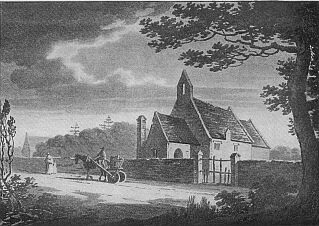
KILKENNY WEST CHURCH (R. H. Newell)
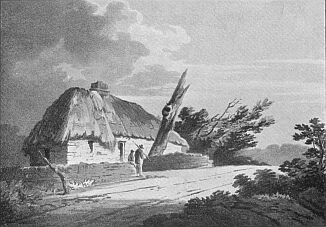
The hawthorn bush. The Rev. Annesley Strean, Henry Goldsmith’s successor at Kilkenny West, well remembered the hawthorn bush in front of the village ale-house. It had originally three trunks; but when he wrote in 1807 only one remained, ‘the other two having been cut, from time to time, by persons carrying pieces of it away to be made into toys, etc., in honour of the bard, and of the celebrity of his poem.’ (Essay on Light Reading, by the Rev. Edward Mangin, M.A., 1808, 142–3.) Its remains were enclosed by a Captain Hogan previously to 1819; but nevertheless when Prior visited the place in 1830, nothing was apparent but ‘a very tender shoot [which] had again forced its way to the surface.’ (Prior, Life, 1837, ii. 264.) An engraving of the tree by S. Alken, from a sketch made in 1806–9, is to be found at p. 41 of Goldsmith’s Poetical Works, R. H. Newell’s edition, 1811, and is reproduced in the present volume.
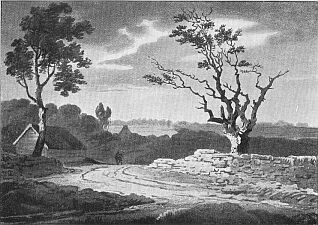
HAWTHORN TREE (R. H. Newell)
How often have I bless’d the coming day. Prior, Life, 1837, ii. 261, finds in this an allusion ‘to the Sundays or numerous holidays, usually kept in Roman Catholic countries.’
Amidst thy bowers the tyrant’s hand is seen. Strean’s explanation (Mangin, ut supra, pp. 140–1) of this is as follows:—‘The poem of The Deserted Village, took its origin from the circumstance of general Robert Napper [Napier or Naper], (the grandfather of the gentleman who now [1807] lives in the house, within half a mile of Lissoy, and built by the general) having purchased an extensive tract of the country surrounding Lissoy, or Auburn; in consequence of which many families, here called cottiers, were removed, to make room for the intended improvements of what was now to become the wide domain of a rich man, warm with the idea of changing the face of his new acquisition; and were forced, “with fainting steps,” to go in search of “torrid tracts” and “distant climes.”’
Prior (Life, 1837, i. 40–3) points out that Goldsmith was not the first to give poetical expression to the wrongs of the dispossessed Irish peasantry; and he quotes a long extract from the Works (1741) of a Westmeath poet, Lawrence Whyte, which contains such passages as these:—
Their native soil were forced to quit, So Irish landlords thought it fit; Who without ceremony or rout, For their improvements turn’d them out ... How many villages they razed, How many parishes laid waste ... Whole colonies, to shun the fate Of being oppress’d at such a rate, By tyrants who still raise their rent, Sail’d to the Western Continent.
The hollow-sounding bittern guards its nest. ‘Of all those sounds,’ says Goldsmith, speaking of the cries of waterfowl, ‘there is none so dismally hollow as the booming of the bittern.’ . . . ‘I remember in the place where I was a boy with what terror this bird’s note affected the whole village; they considered it as the presage of some sad event; and generally found or made one to succeed it.’ (Animated Nature, 1774, vi. 1–2, 4.)
Bewick, who may be trusted to speak of a bird which he has drawn with such exquisite fidelity, refers (Water Birds, 1847, p. 49) to ‘the hollow booming noise which the bittern makes during the night, in the breeding season, from its swampy retreats.’ Cf. also that close observer Crabbe (The Borough, Letter xxii, ll. 197–8):—
And the loud bittern, from the bull-rush home, Gave from the salt-ditch side the bellowing boom.
Princes and lords may flourish, or may fade; A breath can make them, as a breath has made.
Mitford compares Confessio Amantis, fol. 152:—
A kynge may make a lorde a knave, And of a knave a lord also;
and Professor Hales recalls Burns’s later line in the Cotter’s Saturday Night, 1785:—
Princes and lords are but the breath of kings.
But Prior finds the exact equivalent of the second line in the verses of an old French poet, De. Caux, upon an hour-glass:—
C’est un verre qui luit, Qu’un souffle peut détruire, et qu’un souffle a produit.
A time there was, ere England’s griefs began. Here wherever the locality of Auburn, the author had clearly England in mind. A caustic commentator has observed that the ‘time’ indicated must have been a long while ago.
opulence. In the first edition the word is ‘luxury.’
And, many a year elapsed, return to view. ‘It is strongly contended at Lishoy, that “the Poet,” as he is usually called there, after his pedestrian tour upon the Continent of Europe, returned to and resided in the village some time. . . . It is moreover believed, that the havock which had been made in his absence among those favourite scenes of his youth, affected his mind so deeply, that he actually composed great part of the Deserted Village ‘at’ Lishoy.’ (Poetical Works, with Remarks, etc., by the Rev. R. H. Newell, 1811, p. 74.)
Notwithstanding the above, there is no evidence that Goldsmith ever returned to his native island. In a letter to his brother-in-law, Daniel Hodson, written in 1758, he spoke of hoping to do so ‘in five or six years.’ (Percy Memoir, 1801, i. 49). But in another letter, written towards the close of his life, it is still a thing to come. ‘I am again,’ he says, ‘just setting out for Bath, and I honestly say I had much rather it had been for Ireland with my nephew, but that pleasure I hope to have before I die.’ (Letter to Daniel Hodson, no date, in possession of the late Frederick Locker Lampson.)
Where once the cottage stood, the hawthorn grew. Here followed, in the first edition:—
Here, as with doubtful, pensive steps I range, Trace every scene, and wonder at the change, Remembrance, etc.
In all my griefs—and God has given my share. Prior notes a slight similarity here to a line of Collins:—
Ye mute companions of my toils, that bear, In all my griefs, a more than equal share! Hassan; or, The Camel Driver.
In The Present State of Polite Learning, 1759, p. 143, Goldsmith refers feelingly to ‘the neglected author of the Persian eclogues, which, however inaccurate, excel any in our language.’ He included four of them in The Beauties of English Poesy, 1767, i. pp. 239–53.
To husband out, etc. In the first edition this ran:—
My anxious day to husband near the close, And keep life’s flame from wasting by repose.
Here to return—and die at home at last. Forster compares a passage in The Citizen of the World, 1762, ii. 153:—‘There is something so seducing in that spot in which we first had existence, that nothing but it can please; whatever vicissitudes we experience in life, however we toil, or wheresoever we wander, our fatigued wishes still recur to home for tranquillity, we long to die in that spot which gave us birth, and in that pleasing expectation opiate every calamity.’ The poet Waller too—he adds—wished to die ‘like the stag where he was roused.’ (Life, 1871, ii. 202.)
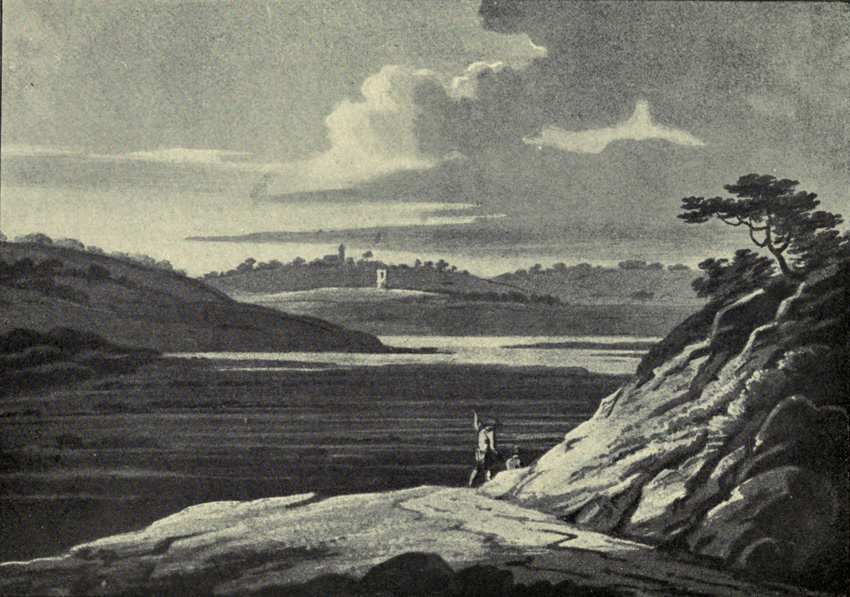
South View from Goldsmith’s Mount (R.H. Newell)
How happy he. ‘How blest is he’ in the first edition.
And, since ’tis hard to combat, learns to fly. Mitford compares The Bee for October 13, 1759, p. 56:—‘By struggling with misfortunes, we are sure to receive some wounds in the conflict. The only method to come off victorious, is by running away.’
surly porter. Mr. J. M. Lobban compares the Citizen of the World, 1762, i. 123:—‘I never see a nobleman’s door half opened that some surly porter or footman does not stand full in the breach.’ (Select Poems of Goldsmith, 1900, p. 98.)
Bends. ‘Sinks’ in the first edition. unperceived decay. Cf. Johnson, Vanity of Human Wishes, 1749, l. 292:—
An age that melts with unperceiv’d decay, And glides in modest innocence away;
and Irene, Act ii, Sc. 7:—
And varied life steal unperceiv’d away.
While Resignation, etc. In 1771 Sir Joshua exhibited a picture of ‘An Old Man,’ studied from the beggar who was his model for Ugolino. When it was engraved by Thomas Watson in 1772, he called it ‘Resignation,’ and inscribed the print to Goldsmith in the following words:—‘This attempt to express a Character in The Deserted Village, is dedicated to Dr. Goldsmith, by his sincere Friend and admirer, JOSHUA REYNOLDS.’
Up yonder hill. It has been suggested that Goldsmith was here thinking of the little hill of Knockaruadh (Red Hill) in front of Lissoy parsonage, of which there is a sketch in Newell’s Poetical Works, 1811. When Newell wrote, it was already known as ‘Goldsmith’s mount’; and the poet himself refers to it in a letter to his brother-in-law Hodson, dated Dec. 27, 1757:—‘I had rather be placed on the little mount before Lishoy gate, and there take in, to me, the most pleasing horizon in nature.’ (Percy Memoir, 1801, p. 43.)
And fill’d each pause the nightingale had made. In Animated Nature, 1774, v. 328, Goldsmith says:—‘The nightingale’s pausing song would be the proper epithet for this bird’s music.’ [Mitford.]
No cheerful murmurs fluctuate in the gale. (Cf. Goldsmith’s Essay on Metaphors (British Magazine):—‘Armstrong has used the word ‘fluctuate’ with admirable efficacy, in his philosophical poem entitled The Art of Preserving Health.
Oh! when the growling winds contend, and all The sounding forest ‘fluctuates’ in the storm, To sink in warm repose, and hear the din Howl o’er the steady battlements.
The sad historian of the pensive plain. Strean (see note to l. 13) identified the old watercress gatherer as a certain Catherine Giraghty (or Geraghty). Her children (he said) were still living in the neighbourhood of Lissoy in 1807. (Mangin’s Essay on Light Reading, 1808, p. 142.)
The village preacher’s modest mansion rose. ‘The Rev. Charles Goldsmith is allowed by all that knew him, to have been faithfully represented by his son in the character of the Village Preacher.’ So writes his daughter, Catharine Hodson (Percy Memoir, 1801, p. 3). Others, relying perhaps upon the ‘forty pounds a year’ of the Dedication to The Traveller, make the poet’s brother Henry the original; others, again, incline to kindly Uncle Contarine (vide Introduction). But as Prior justly says (Life, 1837, ii. 249), ‘the fact perhaps is that he fixed upon no one individual, but borrowing like all good poets and painters a little from each, drew the character by their combination.’
with forty pounds a year. Cf. Dedication to The Traveller, p. 3, l. 14.
Unpractis’d. ‘Unskilful’ in the first edition.
More skilled. ‘More bent’ in the first edition.
The long remember’d beggar. ‘The same persons,’ says Prior, commenting upon this passage, ‘are seen for a series of years to traverse the same tract of country at certain intervals, intrude into every house which is not defended by the usual outworks of wealth, a gate and a porter’s lodge, exact their portion of the food of the family, and even find an occasional resting-place for the night, or from severe weather, in the chimney-corner of respectable farmers.’ (Life, 1837, ii. 269.) Cf. Scott on the Scottish mendicants in the ‘Advertisement’ to The Antiquary, 1816, and Leland’s Hist. of Ireland, 1773, i. 35.
The broken soldier. The disbanded soldier let loose upon the country at the conclusion of the ‘Seven Years’ War’ was a familiar figure at this period. Bewick, in his Memoir (‘Memorial Edition’), 1887, pp. 44–5, describes some of these ancient campaigners with their battered old uniforms and their endless stories of Minden and Quebec; and a picture of two of them by T. S. Good of Berwick belonged to the late Mr. Locker Lampson. Edie Ochiltree (Antiquary)—it may be remembered—had fought at Fontenoy.
Allur’d to brighter worlds. Cf. Tickell on Addison—‘Saints who taught and led the way to Heaven.’
And fools, who came to scoff, remained to pray. Prior compares the opening lines of Dryden’s Britannia Rediviva:—
Our vows are heard betimes, and heaven takes care To grant, before we can conclude the prayer; Preventing angels met it half the way, And sent us back to praise, who came to pray.
As some tall cliff, etc. Lucan, Statius, and Claudian have been supposed to have helped Goldsmith to this fine and deservedly popular simile. But, considering his obvious familiarity with French literature, and the rarity of his ‘obligations to the ancients,’ it is not unlikely that, as suggested by a writer in the Academy for Oct. 30, 1886, his source of suggestion is to be found in the following passage of an Ode addressed by Chapelain (1595–1674) to Richelieu:—
Dans un paisible mouvement Tu t’élèves au firmament, Et laisses contre toi murmurer cette terre; Ainsi le haut Olympe, à son pied sablonneux, Laisse fumer la foudre et gronder le tonnerre, Et garde son sommet tranquille et lumineux.
Or another French model—indicated by Mr. Forster (Life, 1871, ii. 115–16) by the late Lord Lytton—may have been these lines from a poem by the Abbé de Chaulieu (1639–1720):—
Au milieu cependant de ces peines cruelles De notre triste hiver, compagnes trop fidèles, Je suis tranquille et gai. Quel bien plus précieux Puis-je espérer jamais de la bonté des dieux! Tel qu’un rocher dont la tête, Égalant le Mont Athos, Voit à ses pieds la tempête Troubler le calme des flots, La mer autour bruit et gronde; Malgré ses emotions, Sur son front élevé règne une paix profonde, Que tant d’agitations Et que ses fureurs de l’onde Respectent à l’égal du nid des alcyons.
On the other hand, Goldsmith may have gone no further than Young’s Complaint: Night the Second, 1742, p. 42, where, as Mitford points out, occur these lines:—
As some tall Tow’r, or lofty Mountain’s Brow, Detains the Sun, Illustrious from its Height, While rising Vapours, and descending Shades, With Damps, and Darkness drown the Spatious Vale: Undampt by Doubt, Undarken’d by Despair, Philander, thus, augustly rears his Head.
Prior also (Life, 1837, ii. 252) prints a passage from Animated Nature, 1774, i. 145, derived from Ulloa, which perhaps served as the raw material of the simile.
Full well they laugh’d, etc. Steele, in Spectator, No. 49 (for April 26, 1711) has a somewhat similar thought:—‘Eubulus has so great an Authority in his little Diurnal Audience, that when he shakes his Head at any Piece of publick News, they all of them appear dejected; and, on the contrary, go home to their Dinners with a good Stomach and chearful Aspect, when Eubulus seems to intimate that Things go well.’
Yet he was kind, etc. For the rhyme of ‘fault’ and ‘aught’ in this couplet Prior cites the precedent of Pope:—
Before his sacred name flies ev’ry fault, And each exalted stanza teems with thought!
(Essay on Criticism, l. 422). He might also have cited Waller, who elides the ‘l’:—
Were we but less indulgent to our fau’ts, And patience had to cultivate our thoughts.
Goldsmith uses a like rhyme in Edwin and Angelina, Stanza xxxv:—
But mine the sorrow, mine the fault, And well my life shall pay; I’ll seek the solitude he sought, And stretch me where he lay.
Cf. also Retaliation, ll. 73–4. Perhaps—as indeed Prior suggests—he pronounced ‘fault’ in this fashion.
THE SCHOOL HOUSE (R. H. Newell)
That one small head could carry all he knew. Some of the traits of this portrait are said to be borrowed from Goldsmith’s own master at Lissoy:—‘He was instructed in reading, writing, and arithmetic’—says his sister Catherine, Mrs. Hodson—‘by a schoolmaster in his father’s village, who had been a quartermaster in the army in Queen Anne’s wars, in that detachment which was sent to Spain: having travelled over a considerable part of Europe and being of a very romantic turn, he used to entertain Oliver with his adventures; and the impressions these made on his scholar were believed by the family to have given him that wandering and unsettled turn which so much appeared in his future life.’ (Percy Memoir, 1801, pp. 3–4.) The name of this worthy, according to Strean, was Burn (Byrne). (Mangin’s Essay on Light Reading, 1808, p. 142.)
Near yonder thorn. See note to l. 13.
The chest contriv’d a double debt to pay. Cf. the Description of an Author’s Bedchamber, p. 48, l. ult.:—
A cap by night—a stocking all the day!
The twelve good rules. ‘A constant one’ (i.e. picture) ‘in every house was “King Charles’ Twelve Good Rules.”’ (Bewick’s Memoir, ‘Memorial Edition,’ 1887, p. 262.) This old broadside, surmounted by a rude woodcut of the King’s execution, is still prized by collectors. The rules, as ‘found in the study of King Charles the First, of Blessed Memory,’ are as follow:— ‘1. Urge no healths; 2. Profane no divine ordinances; 3. Touch no state matters; 4. Reveal no secrets; 5. Pick no quarrels; 6. Make no comparisons; 7. Maintain no ill opinions; 8. Keep no bad company; 9. Encourage no vice; 10. Make no long meals; 11. Repeat no grievances; 12. Lay no Wagers.’ Prior, Misc. Works, 1837, iv. 63, points out that Crabbe also makes the ‘Twelve Good Rules’ conspicuous in the Parish Register (ll. 51–2):—
There is King Charles, and all his Golden Rules, Who proved Misfortune’s was the best of schools.
Her late Majesty, Queen Victoria, kept a copy of these rules in the servants’ hall at Windsor Castle.
the royal game of goose. The ‘Royal and Entertaining Game of the Goose’ is described at length in Strutt’s Sports and Pastimes, bk. iv, ch. 2 (xxv). It may be briefly defined as a game of compartments with different titles through which the player progresses according to the numbers he throws with the dice. At every fourth or fifth compartment is depicted a goose, and if the player’s cast falls upon one of these, he moves forward double the number of his throw.
While broken tea-cups. Cf. the Description of an Author’s Bedchamber, p. 48, l. 18:—
And five crack’d teacups dress’d the chimney board.
Mr. Hogan, who repaired or rebuilt the ale-house at Lissoy, did not forget, besides restoring the ‘Royal Game of Goose’ and the ‘Twelve Good Rules,’ to add the broken teacups, ‘which for better security in the frail tenure of an Irish publican, or the doubtful decorum of his guests, were embedded in the mortar.’ (Prior, Life, 1837, ii. 265.)
Shall kiss the cup. Cf. Scott’s Lochinvar:—
The bride kissed the goblet: the knight took it up, He quaff’d off the wine and he threw down the cup.
Cf. also The History of Miss Stanton (British Magazine, July, 1760).—‘The earthen mug went round. Miss touched the cup, the stranger pledged the parson,’ etc.
Between a splendid and a happy land. Prior compares The Citizen of the World, 1762, i. 98:—‘Too much commerce may injure a nation as well as too little; and . . . there is a wide difference between a conquering and a flourishing empire.’
To see profusion that he must not share. Cf. Animated Nature, iv. p. 43:—‘He only guards those luxuries he is not fated to share.’ [Mitford.]
To see those joys. Up to the third edition the words were each joy.
There the black gibbet glooms beside the way. The gallows, under the savage penal laws of the eighteenth century, by which horse-stealing, forgery, shop-lifting, and even the cutting of a hop-bind in a plantation were punishable with death, was a common object in the landscape. Cf. Vicar of Wakefield, 1706, ii. 122:—‘Our possessions are paled up with new edicts every day, and hung round with gibbets to scare every invader’; and Citizen of the World, 1762, ii. 63–7. Johnson, who wrote eloquently on capital punishment in The Rambler for April 20, 1751, No. 114, also refers to the ceaseless executions in his London, 1738, ll. 238–43:—
Scarce can our fields, such crowds at Tyburn die, With hemp the gallows and the fleet supply. Propose your schemes, ye senatorian band, Whose ways and means support the sinking land: Lest ropes be wanting in the tempting spring, To rig another convoy for the king.
Where the poor houseless shivering female lies. Mitford compares Letter cxiv of The Citizen of the World, 1762, ii. 211:—‘These poor shivering females have once seen happier days, and been flattered into beauty. They have been prostituted to the gay luxurious villain, and are now turned out to meet the severity of winter. Perhaps now lying at the doors of their betrayers, they sue to wretches whose hearts are insensible, or debauchees who may curse, but will not relieve them.’ The same passage occurs in The Bee, 1759, p. 126 (A City Night-Piece).
Near her betrayer’s door, etc. Cf. the foregoing quotation.
wild Altama, i.e. the Alatamaha, a river in Georgia, North America. Goldsmith may have been familiar with this name in connexion with his friend Oglethorpe’s expedition of 1733.
crouching tigers, a poetical licence, as there are no tigers in the locality named. But Mr. J. H. Lobban calls attention to a passage from Animated Nature [1774, iii. 244], in which Goldsmith seems to defend himself:—‘There is an animal of America, which is usually called the Red Tiger, but Mr. Buffon calls it the Cougar, which, no doubt, is very different from the tiger of the east. Some, however, have thought proper to rank both together, and I will take leave to follow their example.’
The good old sire. Cf. Threnodia Augustalis, ll. 16–17:—
The good old sire, unconscious of decay, The modest matron, clad in homespun gray
a father’s. ‘Her father’s’ in the first edition.
silent. ‘Decent’ in the first edition.
On Torno’s cliffs, or Pambamarca’s side. ‘Torno’=Tornea, a river which falls into the Gulf of Bothnia; Pambamarca is a mountain near Quito, South America. ‘The author’—says Bolton Corney—‘bears in memory the operations of the French philosophers in the arctic and equatorial regions, as described in the celebrated narratives of M. Maupertuis and Don Antonio de Ulloa.’
That trade’s proud empire, etc. These last four lines are attributed to Johnson on Boswell’s authority:—‘Dr. Johnson . . . favoured me by marking the lines which he furnished to Goldsmith’s Deserted Village, which are only the ‘last four’.’ (Birkbeck Hill’s Boswell, 1887, ii. 7.)
PROLOGUE OF LABERIUS.
This translation, or rather imitation, was first published at pp. 176–7 of An Enquiry into the Present State of Polite Learning in Europe, 1759 (Chap. xii, ‘Of the Stage’), where it is prefaced as follows:— ‘MACROBIUS has preserved a prologue, spoken and written by the poet [Decimus] Laberius, a Roman knight, whom Caesar forced upon the stage, written with great elegance and spirit, which shews what opinion the Romans in general entertained of the profession of an actor.’ In the second edition of 1774 the prologue was omitted. The original lines, one of which Goldsmith quotes, are to found in the Saturnalia of Macrobius, lib. ii, cap. vii (Opera, London, 1694). He seems to have confined himself to imitating the first fifteen:—
Necessitas, cujus cursus transversi impetum Voluerunt multi effugere, pauci potuerunt, Quo me detrusit paene extremis sensibus? Quem nulla ambitio, nulla umquam largitio, Nullus timor, vis nulla, nulla auctoritas Movere potuit in juventa de statu; Ecce in senecta ut facile labefecit loco Viri Excellentis mente clemente edita Submissa placide blandiloquens oratio! Etenim ipsi di negare cui nihil potuerunt, Hominem me denegare quis posset pati? Ergo bis tricenis annis actis sine tota Eques Romanus Lare egressus meo Domum revertar mimus. nimirum hoc die Uno plus vixi mihi quam vivendum fuit.
Rollin gives a French translation of this prologue in his Traité des Études. It is quoted by Bolton Corney in his Poetical Works of Oliver Goldsmith, 1845, pp. 203–4. In his Aldine edition of 1831, p. 114, Mitford completed Goldsmith’s version as follows:—
Too lavish still in good, or evil hour, To show to man the empire of thy power, If fortune, at thy wild impetuous sway, The blossoms of my fame must drop away, Then was the time the obedient plant to strain When life was warm in every vigorous vein, To mould young nature to thy plastic skill, And bend my pliant boyhood to thy will. So might I hope applauding crowds to hear, Catch the quick smile, and HIS attentive ear. But ah! for what has thou reserv’d my age? Say, how can I expect the approving stage; Fled is the bloom of youth—the manly air— The vigorous mind that spurn’d at toil and care; Gone is the voice, whose clear and silver tone The enraptur’d theatre would love to own. As clasping ivy chokes the encumber’d tree, So age with foul embrace has ruined me. Thou, and the tomb, Laberius, art the same, Empty within, what hast thou but a name?
Macrobius, it may be remembered, was the author, with a quotation from whom Johnson, after a long silence, electrified the company upon his first arrival at Pembroke College, thus giving (says Boswell) ‘the first impression of that more extensive reading in which he had indulged himself’ (Birkbeck Hill’s Boswell, 1887, i. 59). If the study of Macrobius is to be regarded as a test of ‘more extensive reading’ that praise must therefore be accorded to Goldsmith, who cites him in his first book.
ON A BEAUTIFUL YOUTH STRUCK BLIND WITH LIGHTNING.
This quatrain, the original of which does not appear to have been traced, was first published in The Bee for Saturday, the 6th of October, 1759, p. 8. It is there succeeded by the following Latin epigram, ‘in the same spirit’:—
LUMINE Acon dextro capta est Leonida sinistro Et poterat forma vincere uterque Deos. Parve puer lumen quod habes concede puellae Sic tu caecus amor sic erit illa Venus.
There are several variations of this in the Gentleman’s Magazine for 1745, pp. 104, 159, 213, 327, one of which is said to be ‘By a monk of Winchester,’ with a reference to ‘Cambden’s Remains, p. 413.’ None of these corresponds exactly with Goldsmith’s text; and the lady’s name is uniformly given as ‘Leonilla.’ A writer in the Quarterly Review, vol. 171, p. 296, prints the ‘original’ thus—
Lumine Acon dextro, capta est Leonilla sinistro, Et potis est forma vincere uterque Deos. Blande puer, lumen quod habes concede sorori; Sic tu caecus Amor, sic erit illa Venus;
and says ‘it was written by Girolamo Amalteo, and will be found in any of the editions of the Trium Fratrum Amaltheorum Carmina, under the title of ‘De gemellis, fratre et sorore, luscis.’ According to Byron on Bowles (Works, 1836, vi. p. 390), the persons referred to are the Princess of Eboli, mistress of Philip II of Spain, and Maugiron, minion of Henry III of France, who had each of them lost an eye. But for this the reviewer above quoted had found no authority.
THE GIFT.
This little trifle, in which a French levity is wedded to the language of Prior, was first printed in The Bee, for Saturday, the 13th of October, 1759. Its original, which is as follows, is to be found where Goldsmith found it, namely in Part iii of the Ménagiana, (ed. 1729, iii, 397), and not far from the ditty of le fameux la Galisse. (See An Elegy on Mrs. Mary Blaize, infra, p. 198):—
ETRENE A IRIS.
Pour témoigner de ma flame, Iris, du meilleur de mon ame Je vous donne à ce nouvel an Non pas dentelle ni ruban, Non pas essence, ni pommade, Quelques boites de marmelade, Un manchon, des gans, un bouquet, Non pas heures, ni chapelet. Quoi donc? Attendez, je vous donne O fille plus belle que bonne ... Je vous donne: Ah! le puis-je dire? Oui, c’est trop souffrir le martyre, Il est tems de s’émanciper, Patience va m’échaper, Fussiez-vous cent fois plus aimable, Belle Iris, je vous donne ... au Diable.
In Bolton Corney’s edition of Goldsmith’s Poetical Works, 1845, p. 77, note, these lines are attributed to Bernard de la Monnoye (1641–1728), who is said to have included them in a collection of Étrennes en vers, published in 1715.
I’ll give thee. See an anecdote à propos of this anticlimax in Trevelyan’s Life and Letters of Lord Macaulay, ed. 1889, p. 600:—‘There was much laughing about Mrs. Beecher Stowe [then (16th March, 1853) expected in England], and what we were to give her. I referred the ladies to Goldsmith’s poems for what I should give. Nobody but Hannah understood me; but some of them have since been thumbing Goldsmith to make out the riddle.’
THE LOGICIANS REFUTED.
These lines, which have often, and even of late years, been included among Swift’s works, were first printed as Goldsmith’s by T. Evans at vol. i. pp. 115–17 of The Poetical and Dramatic Works of Oliver Goldsmith, M.B., 1780. They originally appeared in The Busy Body for Thursday, October the 18th, 1759 (No. v), having this notification above the title: ‘The following Poem written by DR. SWIFT, is communicated to the Public by the BUSY BODY, to whom it was presented by a Nobleman of distinguished Learning and Taste.’ In No. ii they had already been advertised as forthcoming. The sub-title, ‘In imitation of Dean Swift,’ seems to have been added by Evans. The text here followed is that of the first issue.
Wise Aristotle and Smiglecius. Cf. The Life of Parnell, 1770, p. 3:—‘His imagination might have been too warm to relish the cold logic of Burgersdicius, or the dreary subtleties of Smiglesius; but it is certain that as a classical scholar, few could equal him.’ Martin Smiglesius or Smigletius, a Polish Jesuit, theologian and logician, who died in 1618, appears to have been a special bête noire to Goldsmith; and the reference to him here would support the ascription of the poem to Goldsmith’s pen, were it not that Swift seems also to have cherished a like antipathy:—‘He told me that he had made many efforts, upon his entering the College [i.e. Trinity College, Dublin], to read some of the old treatises on logic writ by Smeglesius, Keckermannus, Burgersdicius, etc., and that he never had patience to go through three pages of any of them, he was so disgusted at the stupidity of the work.’ (Sheridan’s Life of Swift, 2nd ed., 1787, p. 4.)
Than reason-boasting mortal’s pride. So in The Busy Body. Some editors—Mitford, for example—print the line:—
Than reason,—boasting mortals’ pride.
Deus est anima brutorum. Cf. Addison in Spectator, No. 121 (July 19, 1711): ‘A modern Philosopher, quoted by Monsieur Bale in his Learned Dissertation on the Souls of Brutes delivers the same Opinion [i.e.—That Instinct is the immediate direction of Providence], tho’ in a bolder form of words where he says Deus est Anima Brutorum, God himself is the Soul of Brutes.’ There is much in ‘Monsieur Bayle’ on this theme. Probably Addison had in mind the following passage of the Dict. Hist. et Critique (3rd ed., 1720, 2481b.) which Bayle cites from M. Bernard:—‘Il me semble d’avoir lu quelque part cette Thèse, Deus est anima brutorum: l’expression est un peu dure; mais elle peut recevoir un fort bon sens.’
B—b=Bob, i.e. Sir Robert Walpole, the Prime Minister, for whom many venal ‘quills were drawn’ circa 1715–42. Cf. Pope’s Epilogue to the Satires, 1738, Dialogue i, ll. 27–32:—
Go see Sir ROBERT— P. See Sir ROBERT!—hum— And never laugh—for all my life to come? Seen him I have, but in his happier hour Of Social Pleasure, ill-exchang’d for Pow’r; Seen him, uncumber’d with the Venal tribe, Smile without Art, and win without a Bribe.
A courtier any ape surpasses. Cf. Gay’s Fables, passim. Indeed there is more of Gay than Swift in this and the lines that follow. Gay’s life was wasted in fruitless expectations of court patronage, and his disappointment often betrays itself in his writings.
And footmen, lords and dukes can act. Cf. Gil Blas, 1715–35, liv. iii, chap. iv:—‘Il falloit voir comme nous nous portions des santés à tous moments, en nous donnant les uns aux autres les surnoms de nos maîtres. Le valet de don Antonio appeloit Gamb celuiet nous nous enivrions peu à peu sous ces noms empruntés, tout aussi bien que les seigneurs qui les portoient véritablement.’ But Steele had already touched this subject in Spectator, No. 88, for June 11, 1711, ‘On the Misbehaviour of Servants,’ a paper supposed to have afforded the hint for Townley’s farce of High Life below Stairs, which, about a fortnight after The Logicians Refuted appeared, was played for the first time at Drury Lane, not much to the gratification of the gentlemen’s gentlemen in the upper gallery. Goldsmith himself wrote ‘A Word or two on the late Farce, called High Life below Stairs,’ in The Bee for November 3, 1759, pp. 154–7.
A SONNET.
This little piece first appears in The Bee for October 20, 1759 (No. iii). It is there called ‘A Sonnet,’ a title which is only accurate in so far as it is ‘a little song.’ Bolton Corney affirms that it is imitated from the French of Saint-Pavin (i.e. Denis Sanguin de Saint-Pavin, d. 1670), whose works were edited in 1759, the year in which Goldsmith published the collection of essays and verses in which it is to be found. The text here followed is that of the ‘new edition’ of The Bee, published by W. Lane, Leadenhall Street, no date, p. 94. Neither by its motive nor its literary merits—it should be added—did the original call urgently for translation; and the poem is here included solely because, being Goldsmith’s, it cannot be omitted from his complete works.
This and the following line in the first version run:—
Yet, why this killing soft dejection? Why dim thy beauty with a tear?
STANZAS ON THE TAKING OF QUEBEC.
Quebec was taken on the 13th September, 1759. Wolfe was wounded pretty early in the action, while leading the advance of the Louisbourg grenadiers. ‘A shot shattered his wrist. He wrapped his handkerchief about it and kept on. Another shot struck him, and he still advanced, when a third lodged in his breast. He staggered, and sat on the ground. Lieutenant Brown, of the grenadiers, one Henderson, a volunteer in the same company, and a private soldier, aided by an officer of artillery who ran to join them, carried him in their arms to the rear. He begged them to lay him down. They did so, and asked if he would have a surgeon. “There’s no need,” he answered; “it’s all over with me.” A moment after, one of them cried out, “They run; see how they run!” “Who run?” Wolfe demanded, like a man roused from sleep. “The enemy, sir. They give way everywhere!” “Go, one of you, to Colonel Burton,” returned the dying man; “tell him to march Webb’s regiment down to Charles River, to cut off their retreat from the bridge.” Then, turning on his side, he murmured, “Now, God be praised, I will die in peace!” and in a few moments his gallant soul had fled.’ (Parkman’s Montcalm and Wolfe, 1885, ii. 296–7.) In his History of England in a Series of Letters, 1764, ii. 241, Goldsmith says of this event:—‘Perhaps the loss of such a man was greater to the nation than the conquering of all Canada was advantageous; but it is the misfortune of humanity, that we can never know true greatness till the moment when we are going to lose it.’* The present stanzas were first published in The Busy Body (No. vii) for Tuesday, the 22nd October, 1759, a week after the news of Wolfe’s death had reached this country (Tuesday the 16th). According to Prior (Life, 1837, i. 6), Goldsmith claimed to be related to Wolfe by the father’s side, the maiden name of the General’s mother being Henrietta Goldsmith. It may be noted that Benjamin West’s popular rendering of Wolfe’s death (1771)—a rendering which Nelson never passed in a print shop without being stopped by it—was said to be based upon the descriptions of an eye-witness. It was engraved by Woollett and Ryland in 1776. A key to the names of those appearing in the picture was published in the Army and Navy Gazette of January 20, 1893.
AN ELEGY ON MRS. MARY BLAIZE.
The publication in February, 1751, of Gray’s Elegy Wrote in a Country Church Yard had set a fashion in poetry which long continued. Goldsmith, who considered that work ‘a very fine poem, but overloaded with epithet’ (Beauties of English Poesy, 1767, i. 53), and once proposed to amend it ‘by leaving out an idle word in every line’ [!] (Cradock’s Memoirs, 1826, i. 230), resented these endless imitations, and his antipathy to them frequently reveals itself. Only a few months before the appearance of Mrs. Blaize in The Bee for October 27, 1759, he had written in the Critical Review, vii. 263, when noticing Langhorne’s Death of Adonis, as follows:—‘It is not thus that many of our moderns have composed what they call elegies; they seem scarcely to have known its real character. If an hero or a poet happens to die with us, the whole band of elegiac poets raise the dismal chorus, adorn his herse with all the paltry escutcheons of flattery, rise into bombast, paint him at the head of his thundering legions, or reining Pegasus in his most rapid career; they are sure to strew cypress enough upon the bier, dress up all the muses in mourning, and look themselves every whit as dismal and sorrowful as an undertaker’s shop.’ He returned to the subject in a Chinese Letter of March 4, 1761, in the Public Ledger (afterwards Letter ciii of The Citizen of the World, 1762, ii. 162–5), which contains the lines On the Death of the Right Honourable ***; and again, in The Vicar of Wakefield, 1766, i. 174, à propos of the Elegy on the Death of a Mad Dog, he makes Dr. Primrose say, ‘I have wept so much at all sorts of elegies of late, that without an enlivening glass I am sure this will overcome me.’
The model for An Elegy on Mrs. Mary Blaize is to be found in the old French popular song of Monsieur de la Palisse or Palice, about fifty verses of which are printed in Larousse’s Grand Dictionnaire Universel du XIX me Siècle, x. p. 179. It is there stated to have originated in some dozen stanzas suggested to la Monnoye (v. supra, p. 193) by the extreme artlessness of a military quatrain dating from the battle of Pavia, and the death upon that occasion of the famous French captain, Jacques de Chabannes, seigneur de la Palice:—
Monsieur d’La Palice est mort, Mort devant Pavie; Un quart d’heure avant sa mort, Il était encore en vie.
The remaining verses, i.e. in addition to those of la Monnoye, are the contributions of successive generations. Goldsmith probably had in mind the version in Part iii of the Ménagiana, (ed. 1729, iii, 384–391) where apparently by a typographical error, the hero is called ‘le fameux la Galisse, homme imaginaire.’ The verses he imitated most closely are reproduced below. It may be added that this poem supplied one of its last inspirations to the pencil of Randolph Caldecott, who published it as a picture-book in October, 1885. (See also An Elegy on the Death of a Mad Dog, p. 212.)
Who left a pledge behind. Caldecott cleverly converted this line into the keynote of the poem, by making the heroine a pawnbroker.
When she has walk’d before. Cf. the French:—
On dit que dans ses amours Il fut caresse des belles, Qui le suivirent toujours, Tant qu’il marcha devant elles.
Her last disorder mortal. Cf. the French:—
Il fut par un triste sort Blesse d’une main cruelle. On croit, puis qu’il en est mort, Que la plaie étoit mortelle.
Kent Street, Southwark, ‘chiefly inhabited,’ said Strype, ‘by Broom Men and Mumpers’; and Evelyn tells us (Diary 5th December, 1683) that he assisted at the marriage, to her fifth husband, of a Mrs. Castle, who was ‘the daughter of one Burton, a broom-man . . . in Kent Street’ who had become not only rich, but Sheriff of Surrey. It was a poor neighbourhood corresponding to the present ‘old Kent-road, from Kent to Southwark and old London Bridge’ (Cunningham’s London).* Goldsmith himself refers to it in The Bee for October 20, 1759, being the number immediately preceding that in which Madam Blaize first appeared:—‘You then, O ye beggars of my acquaintance, whether in rags or lace; whether in Kent-street or the Mall; whether at the Smyrna or St. Giles’s, might I advise as a friend, never seem in want of the favour which you solicit’ (p. 72). Three years earlier he had practised as ‘a physician, in a humble way’ in Bankside, Southwark, and was probably well acquainted with the humours of Kent Street.
DESCRIPTION OF AN AUTHOR’S BEDCHAMBER.
In a letter written to the Rev. Henry Goldsmith in 1759 (Percy Memoir, 1801, pp. 53–9), Goldsmith thus refers to the first form of these verses:—‘Your last letter, I repeat it, was too short; you should have given me your opinion of the design of the heroicomical poem which I sent you: you remember I intended to introduce the hero of the poem, as lying in a paltry alehouse. You may take the following specimen of the manner, which I flatter myself is quite original. The room in which he lies, may be described somewhat this way:—
The window, patch’d with paper, lent a ray, That feebly shew’d the state in which he lay. The sanded floor, that grits beneath the tread: The humid wall with paltry pictures spread; The game of goose was there expos’d to view And the twelve rules the royal martyr drew: The seasons, fram’d with listing, found a place, And Prussia’s monarch shew’d his lamp-black face The morn was cold; he views with keen desire, A rusty grate unconscious of a fire. An unpaid reck’ning on the frieze was scor’d, And five crack’d tea-cups dress’d the chimney board.
And now imagine after his soliloquy, the landlord to make his appearance, in order to dun him for the reckoning:—
Not with that face, so servile and so gay, That welcomes every stranger that can pay, With sulky eye he smoak’d the patient man, Then pull’d his breeches tight, and thus began, etc.
All this is taken, you see, from nature. It is a good remark of Montaign[e]’s, that the wisest men often have friends, with whom they do not care how much they play the fool. Take my present follies as instances of regard. Poetry is a much easier, and more agreeable species of composition than prose, and could a man live by it, it were no unpleasant employment to be a poet.’
In Letter xxix of The Citizen of the World, 1762, i. 119–22, which first appeared in The Public Ledger for May 2, 1760, they have a different setting. They are read at a club of authors by a ‘poet, in shabby finery,’ who asserts that he has composed them the day before. After some preliminary difficulties, arising from the fact that the laws of the club do not permit any author to inflict his own works upon the assembly without a money payment, he introduces them as follows:—‘Gentlemen, says he, the present piece is not one of your common epic poems, which come from the press like paper kites in summer; there are none of your Turnuses or Dido’s in it; it is an heroical description of nature. I only beg you’ll endeavour to make your souls unison* with mine, and hear with the same enthusiasm with which I have written. The poem begins with the description of an author’s bedchamber: the picture was sketched in my own apartment; for you must know, gentlemen, that I am myself the heroe. Then putting himself into the attitude of an orator, with all the emphasis of voice and action, he proceeded.
Where the Red Lion, etc.’
The verses then follow as they are printed in this volume; but he is unable to induce his audience to submit to a further sample. In a slightly different form, some of them were afterwards worked into The Deserted Village, 1770. (See ll. 227–36.)
Where Calvert’s butt, and Parsons’ black champagne. The Calverts and Humphrey Parsons were noted brewers of ‘entire butt beer’ or porter, also known familiarly as ‘British Burgundy’ and ‘black Champagne.’ Calvert’s ‘Best Butt Beer’ figures on the sign in Hogarth’s Beer Street, 1751.
The humid wall with paltry pictures spread. Bewick gives the names of some of these popular, if paltry, decorations:—‘In cottages everywhere were to be seen the “Sailor’s Farewell” and his “Happy Return,” “Youthful Sports,” and the “Feats of Manhood,” “The Bold Archers Shooting at a Mark,” “The Four Seasons,” etc.’ (Memoir, ‘Memorial Edition,’ 1887, p. 263.)
The royal game of goose was there in view. (See note, p. 188.)
And the twelve rules the royal martyr drew. (See note, p. 187.)
The Seasons, fram’d with listing. See note to l. 10 above, as to ‘The Seasons.’ Listing, ribbon, braid, or tape is still used as a primitive encadrement. In a letter dated August 15, 1758, to his cousin, Mrs. Lawder (Jane Contarine), Goldsmith again refers to this device. Speaking of some ‘maxims of frugality’ with which he intends to adorn his room, he adds—‘my landlady’s daughter shall frame them with the parings of my black waistcoat.’ (Prior, Life, 1837, i. 271.)
And brave Prince William. William Augustus, Duke of Cumberland, 1721–65. The ‘lamp-black face’ would seem to imply that the portrait was a silhouette. In the letter quoted on p. 200 it is ‘Prussia’s monarch’ (i.e. Frederick the Great).
With beer and milk arrears. See the lines relative to the landlord in Goldsmith’s above-quoted letter to his brother. In another letter of August 14, 1758, to Robert Bryanton, he describes himself as ‘in a garret writing for bread, and expecting to be dunned for a milk score.’ Hogarth’s Distrest Poet, 1736, it will be remembered, has already realized this expectation.
A cap by night—a stocking all the day. ‘With this last line,’ says The Citizen of the World, 1762, i. 121, ‘he [the author] seemed so much elated, that he was unable to proceed: “There gentlemen, cries he, there is a description for you; Rab[e]lais’s bed-chamber is but a fool to it:
A cap by night—a stocking all the day!
There is sound and sense, and truth, and nature in the trifling compass of ten little syllables.”’ (Letter xxix.) Cf. also The Deserted Village, l. 230:—
A bed by night, a chest of drawers by day.
If Goldsmith’s lines did not belong to 1759, one might suppose he had in mind the later Pauvre Diable of his favourite Voltaire. (See also APPENDIX B.)
ON SEEING MRS. ** PERFORM IN THE CHARACTER OF ****.
These verses, intended for a specimen of the newspaper Muse, are from Letter lxxxii of The Citizen of the World, 1762, ii. 87, first printed in The Public Ledger, October 21, 1760.
ON THE DEATH OF THE RIGHT HON. ***
From Letter ciii of The Citizen of the World, 1762, ii. 164, first printed in The Public Ledger, March 4, 1761. The verses are given as a ‘specimen of a poem on the decease of a great man.’ Goldsmith had already used the trick of the final line of the quatrain in An Elegy on Mrs. Mary Blaize, ante, p. 198.
AN EPIGRAM.
From Letter cx of The Citizen of the World, 1762, ii. 193, first printed in The Public Ledger, April 14, 1761. It had, however, already been printed in the ‘Ledger’, ten days before. Goldsmith’s animosity to Churchill (cf. note to l. 41 of the dedication to The Traveller) was notorious; but this is one of his doubtful pieces.
virtue. ‘Charity’ (Author’s note).
bounty. ‘Settled at One Shilling—the Price of the Poem’ (Author’s note).
TO G. C. AND R. L.
From the same letter as the preceding. George Colman and Robert Lloyd of the St. James’s Magazine were supposed to have helped Churchill in The Rosciad, the ‘it’ of the epigram.
TRANSLATION OF A SOUTH AMERICAN ODE.
From Letter cxiii of The Citizen of the World, 1762, ii. 209, first printed in The Public Ledger, May 13, 1761.
THE DOUBLE TRANSFORMATION.
The Double Transformation first appeared in Essays: By Mr. Goldsmith, 1765, where it figures as Essay xxvi, occupying pp. 229–33. It was revised for the second edition of 1766, becoming Essay xxviii, pp. 241–45. This is the text here followed. The poem is an obvious imitation of what its author calls (Letters from a Nobleman to his Son, 1764, ii. 140) that ‘French elegant easy manner of telling a story,’ which Prior had caught from La Fontaine. But the inherent simplicity of Goldsmith’s style is curiously evidenced by the absence of those illustrations and ingenious allusions which are Prior’s chief characteristic. And although Goldsmith included The Ladle and Hans Carvel in his Beauties of English Poesy, 1767, he refrained wisely from copying the licence of his model.
Jack Book-worm led a college life. The version of 1765 reads ‘liv’d’ for ‘led’.
And freshmen wonder’d as he spoke. The earlier version adds here—
Without politeness aim’d at breeding, And laugh’d at pedantry and reading.
Her presence banish’d all his peace. Here in the first version the paragraph closes, and a fresh one is commenced as follows:—
Our alter’d Parson now began To be a perfect ladies’ man; Made sonnets, lisp’d his sermons o’er, And told the tales he told before, Of bailiffs pump’d, and proctors bit, At college how he shew’d his wit; And, as the fair one still approv’d, He fell in love—or thought he lov’d. So with decorum, etc.
The fifth line was probably a reminiscence of the college riot in which Goldsmith was involved in May, 1747, and for his part in which he was publicly admonished. (See Introduction, p. xi, l. 3.)
usage. This word, perhaps by a printer’s error, is ‘visage’ in the first version.
Skill’d in no other arts was she. Cf. Prior:—
For in all Visits who but She, To Argue, or to Repartee.
Five greasy nightcaps wrapp’d her head. Cf. Spectator, No. 494— ‘At length the Head of the Colledge came out to him, from an inner Room, with half a Dozen Night-Caps upon his Head.’ See also Goldsmith’s essay on the Coronation (Essays, 1766, p. 238), where Mr. Grogan speaks of his wife as habitually ‘mobbed up in flannel night caps, and trembling at a breath of air.’
By day, ’twas gadding or coquetting. The first version after ‘coquetting’ begins a fresh paragraph with—
Now tawdry madam kept, etc.
A sigh in suffocating smoke. Here in the first version follows:—
She, in her turn, became perplexing, And found substantial bliss in vexing. Thus every hour was pass’d, etc.
Thus as her faults each day were known. First version: ‘Each day, the more her faults,’ etc.
Now, to perplex. The first version has ‘Thus.’ But the alteration in line 61 made a change necessary.
paste. First version ‘pastes.’
condemn’d to hack, i.e. to hackney, to plod.
A NEW SIMILE.
The New Simile first appears in Essays: By Mr. Goldsmith, 1765, pp. 234–6, where it forms Essay xxvii. In the second edition of 1766 it occupies pp. 246–8 and forms Essay xix. The text here followed is that of the second edition, which varies slightly from the first. In both cases the poem is followed by the enigmatical initials ‘*J. B.,’ which, however, as suggested by Gibbs, may simply stand for ‘Jack Bookworm’ of The Double Transformation. (See p. 204.)
Long had I sought in vain to find. The text of 1765 reads—
‘I long had rack’d my brains to find.’
Tooke’s Pantheon. Andrew Tooke (1673–1732) was first usher and then Master at the Charterhouse. In the latter capacity he succeeded Thomas Walker, the master of Addison and Steele. His Pantheon, a revised translation from the Latin of the Jesuit, Francis Pomey, was a popular school-book of mythology, with copper-plates.
Wings upon either side—mark that. The petasus of Mercury, like his sandals (l. 24), is winged.
No poppy-water half so good. Poppy-water, made by boiling the heads of the white, black, or red poppy, was a favourite eighteenth-century soporific:—‘Juno shall give her peacock poppy-water, that he may fold his ogling tail.’ (Congreve’s Love for Love, 1695, iv. 3.)
With this he drives men’s souls to hell.
Tu.... ....virgaque levem coerces Aurea turbam.—Hor. Od. i. 10.
Moreover, Merc’ry had a failing.
Te canam.... Callidum, quidquid placuit, iocoso Condere furto.—Hor. Od. i. 10.
Goldsmith, it will be observed, rhymes ‘failing’ and ‘stealing.’ But Pope does much the same:—
That Jelly’s rich, this Malmsey healing, Pray dip your Whiskers and your tail in. (Imitation of Horace, Bk. ii, Sat. vi.)
Unless this is to be explained by poetical licence, one of these words must have been pronounced in the eighteenth century as it is not pronounced now.
In which all modern bards agree. The text of 1765 reads ‘our scribling bards.’
EDWIN AND ANGELINA.
This ballad, usually known as The Hermit, was written in or before 1765, and printed privately in that year ‘for the amusement of the Countess of Northumberland,’ whose acquaintance Goldsmith had recently made through Mr. Nugent. (See the prefatory note to The Haunch of Venison.) Its title was ‘Edwin and Angelina. A Ballad. By Mr. Goldsmith.’ It was first published in The Vicar of Wakefield, 1766, where it appears at pp. 70–7, vol. i. In July, 1767, Goldsmith was accused [by Dr. Kenrick] in the St. James’s Chronicle of having taken it from Percy’s Friar of Orders Gray. Thereupon he addressed a letter to the paper, of which the following is the material portion:—‘Another Correspondent of yours accuses me of having taken a Ballad, I published some Time ago, from one by the ingenious Mr. Percy. I do not think there is any great Resemblance between the two Pieces in Question. If there be any, his Ballad is taken from mine. I read it to Mr. Percy some Years ago, and he (as we both considered these Things as Trifles at best) told me, with his usual Good Humour, the next Time I saw him, that he had taken my Plan to form the fragments of Shakespeare into a Ballad of his own. He then read me his little Cento, if I may so call it, and I highly approved it. Such petty Anecdotes as these are scarce worth printing, and were it not for the busy Disposition of some of your Correspondents, the Publick should never have known that he owes me the Hint of his Ballad, or that I am obliged to his Friendship and Learning for Communications of a much more important Nature.—I am, Sir, your’s etc. OLIVER GOLDSMITH.’ (St. James’s Chronicle, July 23–5, 1767.) No contradiction of this statement appears to have been offered by Percy; but in re-editing his Reliques of Ancient English Poetry in 1775, shortly after Goldsmith’s death, he affixed this note to The Friar of Orders Gray:—‘As the foregoing song has been thought to have suggested to our late excellent poet, Dr. Goldsmith, the plan of his beautiful ballad of Edwin and Emma [Angelina], first printed [published?] in his Vicar of Wakefield, it is but justice to his memory to declare, that his poem was written first, and that if there is any imitation in the case, they will be found both to be indebted to the beautiful old ballad, Gentle Herdsman, etc., printed in the second volume of this work, which the doctor had much admired in manuscript, and has finely improved’ (vol. i. p. 250). The same story is told, in slightly different terms, at pp. 74–5 of the Memoir of Goldsmith drawn up under Percy’s superintendence for the Miscellaneous Works of 1801, and a few stanzas of Gentle Herdsman, which Goldsmith is supposed to have had specially in mind, are there reproduced. References to them will be found in the ensuing notes. The text here adopted (with exception of ll. 117–20) is that of the fifth edition of The Vicar of Wakefield, 1773[4], i. pp. 78–85; but the variations of the earlier version of 1765 are duly chronicled, together with certain hitherto neglected differences between the first and later editions of the novel. The poem was also printed in the Poems for Young Ladies, 1767, pp. 91–8.* The author himself, it may be added, thought highly of it. ‘As to my “Hermit,” that poem,’ he is reported to have said, ‘cannot be amended.’ (Cradock’s Memoirs, 1828, iv. 286.)