MONTAGUE GLASS (continued 4)
Reading edition
"Strike one!" Eschenbach shouted. "You should please remember this is a sample play only, and 'tain't necessary you should send 'em so fast."
Kanef nodded, while Croplin returned the ball; and this time Eschenbach poised himself to knock a heaven-kissing fly.
"Play ball!" he cried again, and once more Kanef executed a pirouette on the mound preparatory to pitching the ball. Simultaneously Eschenbach stepped back one pace and fanned the air just as the oncoming ball took a sudden drop. A moment later it landed squarely in the pit of his stomach, and with a smothered "Woof!" he sank to the ground.
"Oo-ee!" wailed the hundred operators with one breath, while Birsky and Zapp ran wildly toward the home plate.
"Mr. Eschenbach," Birsky exclaimed, "um Gottes willen! What did that loafer done to you?"
"It's all right," Eschenbach gasped, struggling to his feet. "I ain't hurted none, and in a regular game I would take my first base already."
"Well, take it here," Birsky said. "Don't mind us, Mr. Eschenbach—or maybe you ain't got none mit you."
He put his hand to his hip-pocket and drew out a pocket flask, which Eschenbach, however, waved away.
"That's expressly something which a ballplayer must never got to touch during a game," Eschenbach cried as he dusted off his trousers with his handkerchief and once more seized the bat. "Now, then, Mr. Pitcher," he cried, "send me a real slow one straight over the plate."
Birsky and Zapp returned to the edge of the lot, scowling savagely at Kanef, who was once more engaged in wiping his hands in the dust. This time, however, he executed no preliminary dance steps, and Eschenbach swung his bat to such good purpose that the ball went sailing between the first and second bases at the height of a short man's shoulder—or, to be exact, at the height of Jacob Golnik's right shoulder, from which it rebounded into the left eye of Joseph Bogin, the shop foreman.
Amid the scene of confusion that ensued only Jonas Eschenbach remained calm.
"As clean a hit as ever I see!" he cried proudly, and strolled off toward the excited mob that surrounded Golnik and Bogin, both of whom were shrieking with fright and pain.
"D'ye think they're hurted bad, Mr. Eschenbach?" Zapp inquired anxiously.
"Schmooes—hurt bad!" Eschenbach retorted. "Why should a little thing like that hurt 'em bad?"
He was still intoxicated with the triumph of making what would have been a home run in a regular game, and his face bore a pleased smile as he turned to Birsky.
"I says to myself when I seen that ball coming," he continued, "I would put that right between first and second bases, about where that short and that big feller is standing—and that's exactly what happened."
Birsky stared at his prospective customer in shocked surprise.
"Then you done it on purpose!" he exclaimed.
"Certainly I done it on purpose," declared Eschenbach. "What do you think it was—an accident?"
He swung his bat at a pebble that lay in his path and Birsky and Zapp edged away.
"Well, if I was you, Mr. Eschenbach," Birsky said, "I wouldn't say nothing more about it to nobody. Even if you would meant it as a joke, understand me, sometimes them things turns out serious." With this dictum he elbowed his way through the sympathetic crowd that hemmed in the victims. "Koosh, Golnik!" he bellowed. "You might think you was injured for life the way you are carrying on."
"Never mind, Mr. Birsky," Golnik whimpered, "I am hurted bad enough. If I would be able to handle a pair of shears in six weeks already I'm a lucky man." He heaved a tremulous sigh and nodded his head slowly. "Little did I think," he wailed, "when I fixed up this here mutual aid society that I would be the first one to get the sick benefit."
Joseph Bogin ceased his agonizing rocking and turned fiercely to Golnik.
"What d'ye mean, the first one?" he demanded. "Ain't I in on the sick benefit also? Not alone would I draw a sick benefit, Golnik, but might I would come in for the losing-one-eye benefit, maybe, the way I am feeling now."
"You would what?" Birsky shouted. "You would come in for nothing, Bogin! All you would come in for is losing your job, Bogin, if you don't be careful what you are saying round here."
At this juncture Jonas Eschenbach bustled toward them and clapped his hands loudly.
"Now, then, boys," he called, "the whole team should please get out on the field."
He pointed to a tall, simian-armed operator who stood listening intently to the conversation between Golnik and Birsky.
"You, there," Jonas said to him, "you would play right field—and get a move on!"
The operator nodded solemnly and flipped his fingers in a deprecatory gesture.
"It don't go so quick, Mr. Eschenbach," he said, "because, speaking for myself and these other fellers here, Mr. Eschenbach, I would like to ask Mr. Birsky something a question."
He paused impressively, and even Golnik ceased his moaning as the remaining members of the baseball team gathered round their spokesman.
"I would like to ask," the operator continued, "supposing Gott soll hüten I am getting also Makkas in this here baseball, Mr. Birsky, which I would be losing time from the shop, Mr. Birsky, what for a sick benefit do I draw?"
Birsky grew livid with indignation.
"What for a sick benefit do you draw?" he sputtered. "A question! You don't draw nothing for a sick benefit." He appealed to Eschenbach, who stood close by. "An idee, Mr. Eschenbach," he said. "Did y'ever hear the like we should pay a sick benefit because some one gets hurted spieling from baseball already? The first thing you know, Mr. Eschenbach, we would be called upon we should pay a benefit that a feller breaks his fingers leading two aces and the ten of trumps, or melding a round trip and a hundred aces, understand me; because, if a feller behaves like a loafer, y'understand, he could injure himself just so much in pinochle as in baseball."
"Schon gut, Mr. Birsky," the operator continued amid the approving murmurs of his fellow players, "that's all I want to know."
As they moved off in the direction of the West Farms subway station, Golnik's resentment, which for the time had rendered him speechless, gave way to profanity.
"So," he cried, choking with indignation, "I was acting like a loafer, was I? And that's how I got hurted!"
Here he contorted his face and clapped his hand to his injured shoulder in response to a slight twinge of pain; and for at least two minutes he closed his eyes and gasped heavily in a manner that suggested the agonies of death by the rack and thumbscrews.
"You will hear from me later, gentlemen," he said at last, "and from Bogin also, which we wouldn't take no part of your sick benefit."
He fell back exhausted against the outstretched arm of a bearded operator; and thus supported, he seized Bogin's elbow and started to leave the lot, with the halting steps of Nathan the Wise in the last act of that sterling drama, as performed by the principal tragedian of the Canal Street Theatre.
"And you would see, Mr. Birsky," he concluded, "that we got plenty witnesses, which if we wouldn't get from you and Mr. Eschenbach at the very least two thousand dollars, understand me, there ain't no lawyers worth the name in this city!"
Three minutes later there remained in Adelstern's lot only two of Birsky & Zapp's employees—namely, the pitcher and the catcher of Eschenbach's team; and they were snapping the ball back and forth in a manner that caused Eschenbach's eyes to gleam with admiration.
"Nu, Mr. Eschenbach," Birsky croaked at last, "I guess we are up against it for fair, because not only we would lose our designer and shop foreman, y'understand, but them fellers would sue us sure."
Eschenbach waved his hands airily.
"My worries!" he said. "We would talk all about that to-morrow afternoon in your store."
Again he seized the bat and swung it at a pebble.
"But, anyhow," he concluded, "there's still five of us left, Mr. Birsky; so you and Zapp get out on right and left field and we'll see what we can do."
He crossed over to the home plate and pounded the earth with the end of his bat.
"All right, boys," he called. "Play ball!"
Louis Birsky limped wearily from the cutting room, where he had been busy since seven o'clock exercising the functions of his absent designer.
"Oo-ee!" he exclaimed as he reached the firm's office. "I am stiff like I would got the rheumatism already."
Barney Zapp sat at his desk, with a pile of newly opened mail in front of him, and he scowled darkly at his partner, who sank groaning into the nearest chair.
"I give you my word, Barney," Birsky went on, "if that old Rosher would of kept us a minute longer throwing that verflüchte Bobky round, understand me—never mind he wouldn't come in here and buy a big order from us this morning—I would of wrung his neck for him. What does he think we are, anyway—children?"
Zapp only grunted in reply. He was nursing a badly strained wrist as the result of two hours' fielding for Jonas Eschenbach; and thus handicapped he had been performing the duties of Joseph Bogin, the shop foreman, who only that morning had sent by his wife a formal note addressed to Birsky & Zapp. It had been written under the advice of counsel and it announced Bogin's inability to come to work by reason of injuries received through the agency of Birsky & Zapp, and concluded with the notice that an indemnity was claimed from the funds of the mutual aid society, "without waiving any other proceedings that the said Joseph Bogin might deem necessary to protect his interests in the matter."
"Nu, Zapp," Birsky said after Zapp had shown him Bogin's note, "you couldn't prevent a crook like Bogin suing you if he wants to, understand me; and I bet yer when Eschenbach comes in here this afternoon he would buy from us such a bill of goods that Bogin's and Golnik's claims wouldn't be a bucket of water in the ocean."
For answer to this optimistic prophecy Zapp emitted a short and mirthless laugh, while he handed to his partner another letter, which read as follows:
Hotel Prince Clarence,—Sunday night.
Friend Birsky: As I told you Saturday, lots of things might happen before Monday, which they did happen; so that I cannot look over your sample line on account I am obliged to leave for Cordova right away. Please excuse me; and, with best wishes for the success of your society, I am
Yours truly,
Jonas Eschenbach.
P.S. I will be back in New York a free man not later than next week at the latest, and the first thing I will call at your place. We will talk over then the society and what happens with your designer yesterday, which I do not anticipate he will make you any trouble—and the other man, neither.
J. E.
"Well," Birsky commented as he returned the letter to Zapp, "what of it?"
"What of it!" Zapp exclaimed. "You are reading such a letter and you ask me what of it?"
"Sure," Birsky replied; "I says what of it and I mean what of it! Is it such a terrible thing if we got to wait till next week before Eschenbach gives us the order, Zapp?"
"If he gives us the order next week!" Zapp retorted, "because, from the way he says nothing about giving us an order oder looking over our sample line, Birsky, I got my doubts."
"Schmooes, you got your doubts!" Birsky cried. "The feller says as plain as daylight——" Here he seized the letter to refresh his memory. "He says," Birsky continued: "'P.S. I will be back in New York a free man not later than next week at the latest, and the first thing I will call at your place.' Ain't that enough for you?"
Zapp shrugged his shoulders in a non-committal fashion.
"I would wait till next week first," he said, "before I would congratulate myself on that order."
Birsky rose painfully to his feet.
"You could do as you like, Zapp," he said, "but for me I ain't worrying about things not happening until they don't, Zapp; so, if any one wants me for anything I would be over in Hammersmith's for the next half-hour."
Ten minutes later he sat at his favourite table in Hammersmith's café; and, pending the arrival of an order which included Kreploch soup and some eingedämpftes Kalbflieisch, he gazed about him at the lunch-hour crowd. Nor was his appetite diminished by the spectacle of H. Dexter Adelstern and Finkman engaged in earnest conversation at an adjoining table, and he could not forbear a triumphant smile as he attacked his plate of soup. He had barely swallowed the first spoonful, however, when Adelstern and Finkman caught sight of him and they immediately rose from their seats and came over to his table.
"Why, how do you do, Mr. Birsky?" Adelstern cried. "I hear you had a great game of baseball yesterday."
Birsky nodded almost proudly.
"You hear correct," he said. "Our mutual aid society must got to thank you, Mr. Adelstern, for the use of your Bronix lots."
"Don't mention it," Adelstern replied; "in fact, you are welcome to use 'em whenever you want to, Mr. Birsky."
He winked furtively at Finkman, who forthwith broke into the conversation.
"Might he would buy 'em from you, maybe, Adelstern," he suggested, "and add 'em to his other holdings on Ammerman Avenue!"
Birsky felt that he could afford to laugh at this sally of Finkman's, and he did so rather mirthlessly.
"Why don't you buy 'em, Finkman?" he suggested. "From the way you are talking here the other day to Mr. Eschenbach, you would need 'em for your mutual aid society which you are making a bluff at getting up."
"I ain't making no bluffs at nothing, Birsky," Finkman replied, "because, Gott sei dank, I don't got to steal other people's idees to get business."
"Do you think I am stealing Adelstern's idee of this here mutual aid society, Finkman?" Birsky demanded, abandoning his soup and glaring at his competitor.
"We don't think nothing, Birsky," Adelstern said; "because, whether you stole it oder you didn't stole it, Birsky, you are welcome to it. And if you would send round to my place this afternoon yet I would give you, free for nothing, a lot of bats and balls and other Bobkies just so good as new, which I ain't got no use for no more."
"What d'ye mean, you ain't got no use for 'em?" Birsky demanded. He began to feel a sense of uneasiness that made nauseating the idea of eingedämpftes Kalbfleisch.
"Why, I mean I am giving up my mutual aid society," Adelstern replied. "It's taking up too much of my time—especially now, Mr. Birsky, when Eschenbach could hang round my place all he wants to, understand me; he wouldn't give me no peace at all."
For a brief interval Birsky stared blankly at Adelstern.
"Especially now!" he exclaimed. "What are you talking about, especially now?"
"Why, ain't you heard?" Adelstern asked in feigned surprise.
"I ain't heard nothing," Birsky said hoarsely.
"Do you mean to told me," Finkman interrupted, "that you ain't heard it yet about Eschenbach?"
"I ain't heard nothing about Eschenbach," Birsky rejoined.
"Then read this," Finkman said, thrusting a marked copy of the Daily Cloak and Suit Review under Birsky's nose; and ringed in blue pencil was the following item:
Cordova, Ohio—Jonas Eschenbach to Retire. Jonas Eschenbach's department store is soon to pass into new hands, and Mr. Eschenbach will take up his future residence in the city of New York. Negotiations for the purchase of his business, which have been pending for some time, were closed Saturday, and Mr. Eschenbach has been summoned from New York, where he has been staying for the last few days, to conclude the details of the transaction. The purchaser's name has not yet been disclosed.
As Louis laid down the paper he beckoned to the waiter. "Never mind that Kalbfleisch," he croaked. "Bring me only a tongue sandwich and a cup coffee. I got to get right back to my store."
By a quarter to six that afternoon the atmosphere of Birsky & Zapp's office had been sufficiently cleared to permit a relatively calm discussion of Eschenbach's perfidy.
"That's a Rosher for you—that Eschenbach!" Birsky exclaimed for the hundredth time. "And mind you, right the way through, that crook knew he wasn't going to give us no orders yet!
"But," he cried, "we got the crook dead to rights!"
"What d'ye mean, we got him dead to rights?" Zapp inquired listlessly.
"Don't you remember," Birsky went on, "when he hits the Schlag there yesterday, which injured Golnik and Bogin, he says to us he seen it all the time where they was standing and he was meaning to hit 'em with the ball?"
Zapp nodded.
"And don't you remember," Birsky continued, "I says to him did he done it on purpose, and he said sure he did?"
Zapp nodded again and his listlessness began to disappear.
"Certainly, I remember," he said excitedly, "and he also says to us we shouldn't think it was an accident at all."
Birsky jumped to his feet to summon the stenographer.
"Then what's the use talking?" he cried. "We would right away write a letter to Golnik and Bogin they should come down here to-morrow and we will help 'em out."
"Aber don't you think, if we would say we would help 'em out, understand me, they would go to work and get an idee maybe we are going to pay 'em a sick benefit yet?"
"Sick benefit nothing!" Birsky said. "With the sick benefit we are through already; and if it wouldn't be that the bank is closed, understand me, I would right away go over to the Kosciusko Bank and transfer back that five hundred dollars, which I wouldn't take no chances, even if Feldman did say that without the 'as' the 'Treasurer' don't go at all."
"Do it to-morrow morning first thing," Zapp advised; "and write Golnik and Bogin they should come down here at eleven o'clock, y'understand; so that when they get here, understand me, we could show 'em if they are going to make a claim against the mutual aid society, Birsky, they are up against it for fair."
When the two partners arrived at their place of business the following morning at eight o'clock, however, their plans for the dissolution of the mutual aid society were temporarily forgotten when, upon entering their office, they discerned the bulky figure of Henry Feigenbaum seated in Birsky's armchair.
"Honestly, boys," Feigenbaum said as he bit off the end of a cigar, "the way you are keeping me waiting here, understand me, it would of served you right if I would of gone right over to Adelstern's and give him the order instead of you, y'understand; aber the way Adelstern treats Jonas Eschenbach, understand me, I would rather die as buy a dollar's worth of goods from that Rosher."
"What d'ye mean, the way Adelstern treats Eschenbach?" Birsky asked.
"Why, just so soon as Eschenbach tells him he is going to sell out," Feigenbaum continued, "Adelstern right away disbands his mutual aid society; and he also just so good as tells Eschenbach to his face, y'understand, that all this baseball business was a waste of time, understand me, and he only done it to get orders from Eschenbach! And a man like Eschenbach, which he is a philanthropist and a gentleman, understand me, takes the trouble he should give Adelstern pointers about this here mutual aid society, which they are a blessing to both employers and employees, verstehst du mich, all I could say is that Adelstern acts like a loafer in throwing the whole thing up just because Eschenbach quits!"
"Aber, Mr. Feigenbaum," Birsky said, while a puzzled expression came over his face, "I thought you said when you was here last time that Eschenbach goes too far in such things."
"When I was here last," Feigenbaum replied, "was something else again; but when I left here Friday, understand me, right up till the last minute Eschenbach says no, he wouldn't let twenty thousand of the purchase price remain on a real-estate mortgage of the store property. When I got to Cordova Saturday morning my lawyers there says that Eschenbach stood ready to close the deal on them terms, y'understand, provided I would let the old man look after our store's employees' association, which I certainly agreed to; and so I bought his business there and then, and I must got to buy at least five thousand dollars goods before Wednesday morning for shipment by ten days already."
"You bought Eschenbach's store!" Zapp exclaimed.
Feigenbaum wriggled in Birsky's chair, which fitted him like a glove; and after he had freed himself he rose ponderously.
"Aber one moment, Mr. Feigenbaum," Birsky pleaded. "Did I understood you to say that Eschenbach is to look after the mutual aid society in your store?"
"I hope you ain't getting deef, Birsky," Feigenbaum replied.
"And you agreed to that?" Zapp cried.
"I certainly did," Feigenbaum said; "which, as I told you before, I am coming to believe that this here mutual aid society business is an elegant thing already, boys. And Eschenbach tells me I should tell you that if he don't get here by next Sunday you should warm up that pitcher and catcher of yours, as he would sure get down to New York by the Sunday after."
Birsky led the way to the showroom with the detached air of a somnambulist, while Zapp came stumbling after.
"And one thing I want to impress on you boys," Feigenbaum concluded: "you want to do all you can to jolly the old boy along, understand me, on account I might want to raise ten or fifteen thousand dollars from him for some alterations I got in mind."
"Zapp," Birsky cried after he had ushered Feigenbaum into the elevator at ten minutes to eleven, "I am going right over to the Kosciusko Bank and——"
"What are you going to do?" Zapp cried in alarm, "transfer back that five hundred dollars after what Feigenbaum tells us?"
"Transfer nothing!" Birsky retorted. "I am going over to the Kosciusko Bank, understand me, and I am going to change that account. So, when them Roshoyim come in here, Zapp, tell 'em to wait till I get back. By hook or by crook we must got to get 'em to come to work by to-morrow sure, the way we would be rushed here—even if we must pay 'em a hundred dollars apiece!"
Zapp nodded fervently.
"Aber why must you got to go over to the bank now, Birsky?" he insisted.
"Because I don't want to take no more chances," Birsky replied; "which I would not only put in the 'as,' understand me, but I would write on the bank's signature card straight up and down what the thing really is"—he coughed impressively to emphasize the announcement—"Louis Birsky," he said, "as Treasurer of the Mutual Aid Society Employees of Birsky & Zapp!"
CHAPTER SEVEN
THE MOVING PICTURE WRITES
When Max Schindelberger opened the door leading into the office of Lesengeld & Belz his manner was that of the local millionaire's wife bearing delicacies to a bedridden laundress, for Max felt that he was slumming.
"Is Mr. Lesengeld disengaged?" he asked in the rotund voice of one accustomed to being addressed as Brother President three nights out of every week, and he cast so benevolent a smile on the stenographer that she bridled immediately.
"Mis-ter Lesengeld," she called, and in response B. Lesengeld projected his torso from an adjacent doorway.
"Miss Schimpf," he said pleadingly, "do me the favour and don't make such a Geschrei every time somebody comes in the office. Goes through me like a knife yet."
Max Schindelberger's smile took on the quality of indulgency as he advanced slowly toward B. Lesengeld.
"How do you do, Mr. Lesengeld?" he said, proffering his hand; and after glancing suspiciously at the extended palm Lesengeld took it in a limp clasp.
"I already suscribed to that—now—asylum, ain't it?" Lesengeld began, for his experienced eye had at once noted the fraternal society charm, the I.O.M.A. lapel button, and the white tie that proclaimed Max to be a philanthropist.
Max laughed as heartily as he could.
"Ain't it funny," he said, "how just so soon as anybody sees me they think I am going to do something charitable? As a matter of fact, Mr. Lesengeld, I am coming here to see you on a business matter which really it ain't my business at all."
Lesengeld grudgingly held open the door, and Max squeezed past him.
"You got a comfortable place here, Mr. Lesengeld," he began, "plain and old-fashioned, but comfortable."
Lesengeld removed some dusty papers from a chair.
"It suits me," he said. "Take a seat, Mr. ——"
"Schindelberger," Max said as he sat down.
"Used to was Schindelberger, Steinfeld & Company in the underwear business?"
Max nodded and his smile began to fade.
"My partner Belz got a couple of the composition notes in the middle compartment in our safe for six years already," Lesengeld continued. "He keeps 'em for sowveneers, on account the feller he took 'em off of—a relation from his wife's—was no good, neither. Which you was telling me you wanted to see me about a business matter."
Max Schindelberger cleared his throat.
"Anybody could have reverses in business," he said.
"Sure, I know," Lesengeld commented. "Only there is two kinds of reverses, Mr. Schindelberger, reverses from up to down and reverses from down to up, like when a feller couldn't pay his composition notes, Mr. Schindelberger, and two years later is buying elevator apartments yet in his wife's name, Mr. Schindelberger." He tapped the desk impatiently. "Which you was saying," he added, "that you wanted to see me about a business matter."
Max coughed away a slight huskiness. When he had started from his luxuriously appointed office on lower Nassau Street to visit Mr. Lesengeld on East Broadway, he had felt a trifle sorry for Lesengeld, so soon to feel the embarrassment and awkwardness incidental to meeting for the first time, and all combined under one frockcoat, the District Grand Master of the I.O.M.A., the President of the Bella Hirshkind Home for Indigent Females, and director and trustee of three orphan asylums and of an eye, ear, and throat infirmary. With the first reference to the defunct underwear business, however, Max began to lose the sense of confidence that the dignity of his various offices lent him; and by the time Lesengeld had mentioned the elevator apartment houses he had assumed to Max all the majesty of, say, for example, the Federal Grand Master of the I.O.M.A., with Jacob H. Schiff and Andrew Carnegie thrown in for good measure.
"The fact is," Max stammered, "I called to see you about the three-thousand dollar mortgage you are holding on Rudnik's house—the second mortgage."
Lesengeld nodded.
"First mortgages I ain't got any," he said, "and if you are coming to insinivate that I am a second-mortgage shark, Mr. Schindelberger, go ahead and do so. I am dealing in second mortgages now twenty years already, and I hear myself called a shark so often, Mr. Schindelberger, that it sounds like it would be a compliment already. I come pretty near getting it printed on my letterheads."
"I didn't said you was a second-mortgage shark, Mr. Lesengeld; a man could be a whole lot worse as a second-mortgage shark, understand me, and do a charity once in awhile, anyhow. You know what it stands in Gemara yet?"
Schindelberger settled himself in his chair preparatory to intoning a Talmudical quotation, but Lesengeld forestalled him.
"Sure, I know," he said, "it stands in Gemara a whole lot about charity, Mr. Schindelberger, but it don't say no more about second mortgages as it does about composition notes, for instance. So if you are coming to me to ask me I should give Rudnik an extension on his Clinton Street house, you could learn Gemara to me till I would become so big a Melammed as you are, understand me, and it wouldn't make no difference. I never extend no mortgages for nobody."
"But, Mr. Lesengeld, you got to remember this is an exception, otherwise I wouldn't bother myself I should come up here at all. I am interesting myself in this here matter on account Rudnik is an old man, understand me, and all he's got in the world is the Clinton Street house; and, furthermore, he will make a will leaving it to the Bella Hirshkind Home for Indignant Females, which if you want to go ahead and rob a lot of poor old widders of a few thousand dollars, go ahead, Mr. Lesengeld."
He started to rise from his chair, but he thought better of it as Lesengeld began to speak.
"Don't make me no bluffs, Schindelberger," Lesengeld cried, "because, in the first place, if Rudnik wills his house to the Bella Hirshkind Home, what is that my business? And, in the second place, Belz's wife's mother's a cousin got a sister which for years, Belz, makes a standing offer of five hundred dollars some one should marry her, and finally he gets her into the Home as single as the day she was born already."
"One or two ain't widders," Schindelberger admitted, "but they're all old, and when you say what is it your business that Rudnik leaves his house to charity, sure it ain't. Aber it's your business if you try to take the house away from charity. Even if you would be dealing in second mortgages, Mr. Lesengeld, that ain't no reason why you shouldn't got a heart once in a while."
"What d'ye mean, I ain't got a heart?" Lesengeld demanded. "I got just so much a heart as you got it, Mr. Schindelberger. Why, last night I went on a moving pictures, understand me, where a little girl gets her father he should give her mother another show, verstehst du, and I assure you I cried like a baby, such a soft heart I got it." He had risen from his chair and was pacing excitedly up and down the little room. "The dirty dawg wants to put her out of the house already on account she is kissing her brother which he is just come home from twenty years on the Pacific Coast," he continued; "and people calls me a shark yet, Mr. Schindelberger, which my wife and me is married twenty-five years next Succos Halamode and never so much as an unkind breath between us."
"That's all right, Mr. Lesengeld," Schindelberger said. "I don't doubt your word for a minute, but when it comes to foreclosing a mortgage on a house which it, so to speak, belongs to a home for poor widders and a couple of old maids, understand me, then that's something else again."
"Who says I'm going to foreclose the mortgage?" Lesengeld demanded.
"You didn't said you was going to foreclose it," Schindelberger replied, "but you says you ain't never extended no mortgages for nobody."
"Which I never did," Lesengeld agreed; "but that ain't saying I ain't never going to. Seemingly, also, you seem to forget I got a partner, Mr. Schindelberger, which people calls him just so much a shark as me, Mr. Schindelberger."
"Aber you are just telling me your partner is putting into the Bella Hirshkind Home a relation from his wife's already, and if he wouldn't be willing to extend the mortgage, Mr. Lesengeld, who would? Because I needn't got to tell you, Mr. Lesengeld, the way business is so rotten nowadays people don't give up so easy no more; and if it wouldn't be that the Bella Hirshkind Home gets from somebody a whole lot of assistance soon it would bust up sure, and Belz would quick find himself stuck with his wife's relation again, and don't you forget it."
"But——" Lesengeld began.
"But nothing, Mr. Lesengeld!" Schindelberger cried. "Here's where the Bella Hirshkind Home is got a show to make a big haul, so to speak, because this here Rudnik has got something the matter with his liver which it is only a question of time, understand me, on account the feller is an old bachelor without anybody to look after him, and he eats all the time twenty-five-cent regular dinners. I give him at the outside six months."
"But are you sure the feller makes a will leaving his house to the Bella Hirshkind Home?" Lesengeld asked.
"What d'ye mean, am I sure?" Schindelberger exclaimed. "Of course I ain't sure. That's why I am coming up here this morning. If you would extend first the mortgage on that house, Mr. Lesengeld, Rudnik makes the will, otherwise not; because it would cost anyhow fifteen dollars for a lawyer he should draw up the will, ain't it, and what's the use we should spend the money if you take away from him the house?"
"But if I would extend first the mortgage, Schindelberger, might the feller wouldn't make the will maybe."
Schindelberger clucked his tongue impatiently.
"Just because I am so charitable I don't got to be a fool exactly," he said. "If you would extend the mortgage, Mr. Lesengeld, I would bring Rudnik up here with a lawyer, and before the extension agreement is signed Rudnik would sign his will and put it in your safe to keep."
Lesengeld hesitated for a minute.
"I'll tell you, Schindelberger," he said at length; "give me a little time I should think this matter over. My partner is up in the Bronix and wouldn't be back till to-morrow."
"But all I want is your word, Mr. Lesengeld," Schindelberger protested, "because might if I would go back and tell Rudnik you wouldn't extend the mortgage he would go right away to the river and jump in maybe."
"Yow, he would jump in!" Lesengeld cried. "Only the other day I seen on a moving pictures a fillum which they called it Life is Sweet, where an old man eighty years old jumps into the river on account his grandson died in an elegant furnished apartment already; and when a young feller rescues him he gives him for ten thousand dollars a check, which I wouldn't believe it at all if I didn't seen the check with my own eyes yet. I was terrible broke up about the grandson, Mr. Schindelberger, aber when I seen the check I didn't got no more sympathy for the old man at all. Fifty dollars would of been plenty, especially when the young feller turns out to be the son of the old man's boy which he ain't heard from in years."
"Sure, I know," Schindelberger agreed, "aber such things only happen in moving pictures, Mr. Lesengeld, and if Rudnik would jump in the river, understand me, the least that happens him is he would get drownded and the Bella Hirshkind Home would go Mechulla sure."
"Well, I'll tell you," Lesengeld said; "you could say to Rudnik that I says I would extend the mortgage supposing my partner is agreeable, on consideration he would leave the house to the Bella Hirshkind Home, and Rudnik is to pay three hundred and fifty dollars to my lawyer for drawing the extension agreement."
"Aber, Mr. Lesengeld——" Schindelberger began. He was about to protest against the size of the bonus demanded under the guise of counsel fee when he was interrupted by a resounding, "Koosh!" from Lesengeld.
"That is my last word and the very best I could do," Lesengeld concluded, "except I would get my lawyer to fix up the will and schenk it to you free for nothing."
"I don't know what comes over you lately, Belz," Lesengeld complained the following morning. "Every day you come down looking like a bear mit a spoiled tail."
"I got a right to look that way," Belz replied. "If you would got such a wife's relation like I got it, Lesengeld, there'd be no sitting in the same office with you at all. When it isn't one thing it's another. Yesterday my wife's mother's a sister's cousin gets a day off and comes round and gets dinner with us. I think I told you about her before—Miss Blooma Duckman. Nothing suits that woman at all. The way she acts you would think she lives in the bridal soot at the Waldorfer, and she gets my wife so mad, understand me, that she throws away a whole dish of Tzimmus in the garbage can already—which I got to admit that the woman is right, Lesengeld—my wife don't make the finest Tzimmus in the world."
"Suppose she don't," Lesengeld commented. "Ain't it better she should spoil some Tzimmus which all it's got into it is carrots, potatoes, and a little chuck? If it would be that she makes a failure mit Gänse oder chickens which it really costs money, understand me, then you got a right to kick."
"That's what I says," Belz replied, "aber that Miss Duckman takes everything so particular. She kicks about it all the way up in the subway, which the next time I get one of my wife's relations in a Home, either it would be so far away she couldn't come to see us at all, or it would be so nearby that I don't got to lose a night's rest seeing her home. I didn't get to bed till pretty near two o'clock."
He stifled a yawn as he sat down at his desk.
"All the same, Lesengeld," he added, "they certainly got a nice place up there for old women. There's lots of respectable business men pays ten dollars a week for their wives in the Catskills already which they don't got it so comfortable. Ain't it a shame, Lesengeld, that with a charity like that which is really a charity, people don't support it better as they do?"
"I bet yer!" Lesengeld cried. "The way some people acts not only they ain't got no hearts, y'understand, but they ain't got no sense, neither. I seen a case yesterday where an old Rosher actually refuses to pay a month's rent for his son's widder mit a little boy, to save 'em being put out on the sidewalk. Afterward he goes broke, understand me, and when the boy grows up he's got the nerve to make a touch from him a couple of dollars and the boy goes to work and gives it to him. If I would be the boy the old man could starve to death; I wouldn't give him not one cent. They call us sharks, Belz, but compared with such a Haman we ain't even sardines."
"Sure, I know," Belz said as he consulted the firm's diary; "and if you wouldn't waste your time going on so many moving pictures, Lesengeld, might you would attend to business maybe. Yesterday was ten days that feller Rudnik's mortgage is past due, and what did you done about it? Nothing, I suppose."
"Suppose again, Belz," Lesengeld retorted. "A feller was in here to see me about it and I agreed we would give Rudnik an extension."
"What!" Belz cried. "You agreed you would give him an extension! Are you crazy oder what? The way money is so tight nowadays and real estate gone to hellandall, we as good as could get a deed of that house from that feller."
"Sure we could," Lesengeld replied calmly, "but we ain't going to. Once in a while, Belz, even in the second-mortgage business, circumstances alters cases, and this here is one of them cases; so before you are calling me all kinds of suckers, understand me, you should be so good and listen to what I got to tell you."
Belz shrugged his shoulders resignedly.
"Go as far as you like," he said, "aber if it's something which you seen it on a moving pictures, Lesengeld, I don't want to hear it at all."
"It didn't happen on a moving pictures, Belz, but just the same if even you would seen it on a moving pictures you would say to yourself that with a couple of fellers like you and me, which a few hundred dollars one way or the other wouldn't make or break us, understand me, we would be all kinds of crooks and highwaymen if we would went to work and turn a lot of old widders out into the street."
"Lesengeld," Belz shouted impatiently, "do me the favour and don't make no speeches. What has turning a lot of old widders into the street got to do with Rudnik's mortgage?"
"It's got a whole lot to do with it," Lesengeld replied, "because Rudnik's house he is leaving to a Home for old women, and if we take away the house from him then the Home wouldn't get his house, and the Home is in such shape, Belz, that if it wouldn't make a big killing in the way of a legacy soon they would bust up sure."
"And that's all the reason why we should extend the mortgage on Rudnik?" Belz demanded.
"That's all the reason," Lesengeld answered; "with three hundred and fifty dollars a bonus."
"Then all I could say is," Belz declared, "we wouldn't do nothing of the kind. What is three =hundred and fifty dollars a bonus in these times, Lesengeld?"
"But the Home," Lesengeld protested.
"The Home should bust up," Belz cried. "What do I care about the Home?"
"Aber the widders?" Lesengeld insisted. "If the Home busts up the widders is thrown into the street. Ain't it?"
"What is that my fault, Lesengeld? Did I make 'em widders?"
"Sure, I know, Belz; aber one or two of 'em ain't widders. One or two of 'em is old maids and they would got to go and live back with their relations. Especially"—he concluded with a twinkle in his eye—"especially one of 'em by the name Blooma Duckman."
"Do you mean to told me," Belz faltered, "that them now—widders is in the Bella Hirshkind Home?"
"For Indignant Females," Lesengeld added, "which Max Schindelberger is president from it also."
Belz nodded and remained silent for at least five minutes.
"I'll tell you, Lesengeld," he said at last, "after all it's a hard thing a woman should be left a widder."
"You bet your life it's a hard thing, Belz!" Lesengeld agreed fervently. "Last week I seen it a woman she is kissing her husband good-bye, and the baby also kisses him good-bye—decent, respectable, hard-working people, understand me—and not two minutes later he gets run down by a trollyer car. The next week they take away from her the furniture, understand me, and she puts the baby into a day nursery, and what happens after that I didn't wait to see at all. Cost me ten cents yet in a drug store for some mathematic spirits of ammonia for Mrs. Lesengeld—she carries on so terrible about it."
Belz sighed tremulously.
"All right, Lesengeld," he said; "write Rudnik we would extend the mortgage and he should call here to-morrow."
"If I got to lose the house I got to lose it," Harris Rudnik declared as he sat in B. Lesengeld's revolving chair on the following morning. "I ain't got long to live anyhow."
He tucked his hands into his coat-pocket and glared balefully at Schindelberger, who shrugged his shoulders.
"That's the way he is talking right along," he said. "Did you ever hear the like? Mind you, it ain't that he's got anybody he should leave the house to, Mr. Belz, but he ain't got no use for women."
"What d'ye mean, I ain't got no use for women?" Rudnik cried. "I got just so much use for women as you got it, aber not for a lot of women which all their lives men make suckers of themselves working their heads off they should keep 'em in luxury, understand me, and then the men dies, y'understand, right away the widders is put in homes and other men which ain't related to 'em at all must got to leave 'em their hard-earned Geld, Mr. Belz, so they could sit with their hands folded doing nothing."
"What are you talking nonsense doing nothing!" Schindelberger retorted. "Them old women works like anything up there. I told you before a dozen times, Rudnik, them women is making underwear and jelly and stockings and Gott weiss was noch."
Rudnik turned appealingly to Belz.
"Mr. Belz," he said, "do me the favour and let me leave my money to a Talmud Torah oder a Free Loan Association."
"Free Loan Association!" Lesengeld and Belz exclaimed with one voice.
"An idee!" Belz shouted. "What d'ye take us for, Rudnik? You are going too far."
"Cutthroats!" Lesengeld muttered hoarsely. "Stealing bread out of people's mouths yet. A lot of people goes to them Roshoyim and fools 'em into lending 'em money they should play Stuss and Tarrok, while their families is starving yet. If you want to leave your house to a Free Loan Association, Rudnik, you might just so well blow it up mit dynamite and be done with it."
"Aber a Talmud Torah School," Rudnik cried; "that's something which you couldn't got no objection to."
"Don't talk like a fool, Rudnik!" Schindelberger interrupted. "When you got a chance to leave your money to a Home for widders, what are you fooling away your time making suggestions like Talmud Torah schools for? A young feller would get along in business if he never even seen the outside of a Talmud Torah, aber if the widders lose their Home, understand me, they would starve to death."
"Yow, they would starve to death!" Rudnik said. "You could trust a widder she wouldn't starve, Mr. Schindelberger. Them which didn't got no relations they could easy find suckers to give 'em money, and them which did got relations, their families should look after 'em."
Belz grew crimson with pent-up indignation.
"Loafer!" he roared. "What d'ye mean, their families should look after 'em?"
Belz walked furiously up and down the office and glowered at the trembling and confused Rudnik.
"Seemingly you ain't got no feelings at all, Rudnik," he continued. "Schindelberger tells you over and over again they are working them poor widders to death up there, and yet you want to take away the roofs from their backs even."
"No, I didn't, Mr. Belz," Rudnik said. "I didn't say nothing about a roof at all. Why, I ain't even seen the Home, Mr. Belz. Could you expect me I should leave my money to a Home without I should see it even?"
"My worries if you seen it oder not!" Belz retorted. "The thing is, Rudnik, before we would extend for you the mortgage you must got to make not a will but a deed which you deed the house to the Bella Hirshkind Home, keeping for yourself all the income from the house for your life, because otherwise if a man makes a will he could always make another will, aber once you give a deed it is fixed und fertig."
This ultimatum was the result of a conference between Belz and his counsel the previous evening, and he had timed its announcement to the moment when he deemed his victim to be sufficiently intimidated. Nevertheless, the shock of its disclosure spurred the drooping Rudnik to a fresh outburst.
"What!" he shouted. "I should drive myself out of my house for a lot of widders!"
"Koosh!" Schindelberger bellowed. "They ain't all widders. Two of 'em is old maids, Rudnik, and even if they would be all widders you must got to do as Mr. Belz says, otherwise you would drive yourself out of your house anyway. Because in these times not only you couldn't raise no new second mortgage on the house, but if Lesengeld and Belz forecloses on you the house would hardly bring in auction the amount of the first mortgage even."
Rudnik sat back in his chair and plucked at his scant gray beard. He recognized the force of Schindelberger's argument and deemed it the part of discretion to temporize with his mortgagees.
"Why didn't you told me there is a couple old maids up there?" he said to Schindelberger. "Old maids is horses of another colour; so come on, Mr. Schindelberger, do me the favour and go up with me so I could anyhow see the Home first."
He slid out of his chair and smiled at Schindelberger, who stared frigidly in return.
"You got a big idee of yourself, Rudnik, I must say," he commented. "What do you think, I ain't got nothing better to do as escort you up to the Bella Hirshkind Home?"
"Rudnik is right, Schindelberger," Lesengeld said; "you should ought to show him the Home before he leaves his house to it."
"I would show him nothing," Schindelberger cried. "Here is my card to give to the superintendent, and all he is got to do is to go up on the subway from the bridge. Get off at Bronix Park and take a Mount Vernon car to Ammerman Avenue. Then you walk six blocks east and follow the New Haven tracks toward the trestle. The Home is the first house you come to. You couldn't miss it."
Rudnik took the card and started for the door, while Belz nodded sadly at his partner.
"And you are kicking I am cranky yesterday morning," he said. "In the daytime is all right going up there, but in the night, Lesengeld, a bloodhound could get twisted. Every time I go up there I think wonder I get back home at all."
"I bet yer," Lesengeld said. "The other evening I seen a fillum by the name Lawst in the Jungle, and——"
"Excuse me, gentlemen," Schindelberger interrupted, "I got a little business to attend to by my office, and if it's all the same to you I would come here with Rudnik to-morrow morning ten o'clock."
"By the name Lawst in the Jungle," Lesengeld repeated with an admonitory glare at Schindelberger, "which a young feller gets ate up with a tiger already; and I says to Mrs. Lesengeld: 'Mommer,' I says, 'people could say all they want to how fine it is to live in the country,' I says, 'give me New York City every time,' I says to my wife."
Harris Rudnik had been encouraged to misogyny by cross eyes and a pockmarked complexion. Nevertheless, he was neither so confirmed in his hatred of the sex nor so discouraged by his physical deformities as to neglect shaving himself and changing into a clean collar and his Sabbath blacks before he began his journey to the Bella Hirshkind Home. Thus when he alighted from the Mount Vernon car at Ammerman Avenue he presented, at least from the rear, so spruce an appearance as to attract the notice of no less a person than Miss Blooma Duckman herself.
Miss Duckman was returning from an errand on which she had been dispatched by the superintendent of the Home, for of all the inmates she was not only the youngest but the spryest, and although she was at least half a block behind Harris when she first caught sight of him, she had no difficulty in overtaking him before he reached the railroad track.
"Excuse me," she said as he hesitated at the side of the track, "are you maybe looking for the Bella Hirshkind Home?"
Harris started and blushed, but at length his misogyny asserted itself and he turned a beetling frown on Miss Duckman.
"What d'ye mean, am I looking for the Bella Hirshkind Home?" he said. "Do you suppose I come up here all the way from Brooklyn Bridge to watch the trains go by?"
"I thought maybe you didn't know the way," Miss Duckman suggested. "You go along that there path and it's the first house you are coming to."
She pointed to the path skirting the railroad track, and Harris began to perspire as he found himself surrendering to an impulse of politeness toward this very young old lady. He conquered it immediately, however, and cleared his throat raspingly.
"I couldn't swim exactly," he retorted as he surveyed the miry trail indicated by Miss Duckman, "so I guess I'll walk along the railroad."
"You could do that, too," Miss Duckman said, "aber I ain't allowed to, on account the rules of the Home says we shouldn't walk along the tracks."
Harris raised his eyebrows.
"You don't mean to told me you are one of them indignant females?" he exclaimed.
"I belong in the Home," Miss Duckman replied, colouring slightly, and Rudnik felt himself being overcome by a wave of remorse for his bluntness. He therefore searched his mind for a sufficiently gruff rejoinder, and finding none he shrugged his shoulders.
"Well," he said at last, "there's worser places, lady."
Miss Duckman nodded.
"Maybe," she murmured; "and anyhow I ain't so bad off as some of them other ladies up there which they used to got husbands and homes of their own."
"Ain't you a widder, too?" Rudnik asked, his curiosity again getting the upper hand.
"I ain't never been married," Miss Duckman answered as she drew her shawl primly about her.
"Well, you ain't missed much," Rudnik declared, "so far as I could see."
"Why," Miss Duckman exclaimed, "ain't you never been married, neither?"
Rudnik blinked solemnly before replying.
"You're just like a whole lot of ladies," he said; "you must got to find out everything." He turned away and stepped briskly on to the railroad track.
"But ain't you married?" Miss Duckman insisted.
"No," he growled as he started off. "Gott sei dank."
For a brief interval Miss Duckman stood and watched his progress along the ties, and then she gathered her parcels more firmly in her arms and began to negotiate the quagmire that led to the Home. She had not proceeded more than a hundred feet, however, when a locomotive whistle sounded in the distance.
"Hey, mister!" she shouted; but even if Rudnik heard the warning it served only to hasten his footsteps. Consequently the train was almost upon him before he became aware of it, and even as he leaped wildly to one side the edge of the cowcatcher struck him a glancing blow. Miss Duckman dropped her bundles and plunged through the mud to where Rudnik lay, while the train, which was composed of empty freight cars, slid to a grinding stop a short distance up the track.
She was kneeling recklessly in the mud supporting Rudnik with both her hands when the engineer and the fireman reached them.
"Is your husband hurted bad?" the engineer asked Miss Duckman.
The tears were rolling down Miss Duckman's worn cheeks, and her lips trembled so that she could not reply. Nevertheless, at the word "husband" her maidenly heart gave a tremendous bound, and when the engineer and the fireman lifted Rudnik gently into the caboose her confusion was such that without protest she permitted the conductor to assist her carefully up the car steps.
"Sit ye down on that stool there, lady," he said. "As far as I can see your man ain't got no bones broken."
"But——" Miss Duckman protested.
"Now, me dear lady," the conductor interrupted, "don't ye go worritin' yerself. I've got me orders if anybody gets hit be the train to take him to the nearest company's doctor in the direction I'm goin'. See? And if you was Mister and Missus Vanderbilt, they couldn't treat you no better up to the Emergency Hospital."
"But——" Miss Duckman began. Again she attempted to explain that Rudnik was not her husband, and again the conductor forestalled her.
"And if he's able to go home to-night," he said finally, "ye'll be given free transportation, in a parlour car d'ye mind, like ye'd be on your honeymoon."
He patted her gently on the shoulder as he turned to a waiting brakeman.
"Let her go, Bill," he cried, and with a jubilant toot from the engine Miss Duckman's elopement was fairly under way.
When Harris Rudnik opened his eyes in the little white-curtained room of the Emergency Hospital, Miss Duckman sat beside his bed. She smiled encouragingly at him, but for more than five minutes he made no effort to speak.
"Well," he said at length, "what are you kicking about? It's an elegant place, this here Home."
Miss Duckman laid her fingers on her lips.
"You shouldn't speak nothing," she whispered, "on account you are sick, aber not serious sick."
"I know I am sick," Rudnik replied. "I was just figuring it all out. I am getting knocked down by a train and——"
"No bones is broken," Miss Duckman hastened to assure him. "You would be out in a few days."
"I am satisfied," he said faintly. "You got a fine place here, Missis."
Miss Duckman laid her hand on Rudnik's pillow.
"I ain't a Missis," she murmured. "My name is Miss Blooma Duckman."
"Blooma," Rudnik muttered. "I once used to got a sister by the name Blooma, and it ain't a bad name, neither." He was not entirely softened by his mishap, however. "But, anyhow, that ain't here or there," he said. "Women is just the same—always kicking. What is the matter with this Home, Miss Duckman? It's an elegant place already."
"This ain't the Home," Miss Duckman explained. "This is a hospital, which when you was hit by the engine they put you on the train and took you up here."
"Aber what are you doing here?" he asked after a pause.
"I come along," Miss Duckman said; "and now you shouldn't talk no more."
"What d'ye mean, you come along?" he cried. "Didn't you go back to the Home?"
Miss Duckman shook her head, and Rudnik turned on his pillow and looked inquiringly at her.
"How long am I up here, anyhow?" he demanded.
"Four days," Miss Duckman said, and Rudnik closed his eyes again. For ten minutes longer he lay still and then his lips moved.
"What did you say?" Miss Duckman asked.
"I says Blooma is a pretty good name already," he murmured, smiling faintly, and the next moment he sank into a light sleep.
When he awoke Miss Duckman still sat by the side of his bed, her fingers busy over the hem of a sheet, and he glanced nervously at the window through which the late afternoon sun came streaming.
"Ain't it pretty late you should be away from the Home?" he inquired. "It must be pretty near six, ain't it?"
"I know it," Miss Duckman said; "and the doctor says at six you should take this here powder."
"Aber shouldn't you got to be getting ready to go back to the Home?" he asked.
Miss Duckman shook her head.
"I ain't going back no more," she answered. "I got enough of them people."
Rudnik looked helplessly at her.
"But what would you do?" he said. "You ain't got no other place to go to, otherwise you wouldn't got to live in a Home."
"Sure, I know," she replied as she prepared to give him his powder; "but Gott sei dank I still got my health, and I am telling the lady superintendent here how they work me at the Home, and she says I could stop here till I am finding something to do. I could cook already and I could sew already, and if the worser comes to the worst I could find a job in an underwear factory. They don't pay much, but a woman like me she don't eat much. All I want is I could get a place to sleep, and I bet yer I could make out fine. So you should please take the powder."
Rudnik swallowed his powder.
"You says you could cook," he remarked after he had again settled himself on his pillow. "Tzimmus, for instance, und Fleisch Kugel?"
"Tzimmus und Fleisch Kugel is nothing," she declared. "I don't want to say nothing about myself, understand me, because lots of women to hear 'em talk you would think wonder what cooks they are, and they couldn't even boil a potater even; aber if you could eat my gefüllte Rinderbrust, Mister ——"
"Rudnik," he said as he licked his moist lips, "Harris Rudnik."
"Mister Rudnik," she proceeded, "oder my Tebeches, you would got to admit I ain't so helpless as I look."
"You don't look so helpless," Rudnik commented; "I bet yer you could do washing even."
"Could I?" Miss Duckman exclaimed. "Why, sometimes at the Home I am washing from morning till night, aber I ain't kicking none. It really agrees with me, Mr. Rudnik."
Rudnik nodded. Again he closed his eyes, and had it not been that he swallowed convulsively at intervals he would have appeared to be sleeping. Suddenly he raised himself on his pillow.
"Do you make maybe a good cup coffee also?" he inquired.
"A good cup coffee I make in two ways," Miss Duckman answered. "The first is——"
Rudnik waved his hand feebly.
"I'll take your word for it," he said, and again lapsed into quietude.
"D'ye know," he murmured at length, "I ain't drunk a good cup coffee in years already?"
Miss Duckman made no answer. Indeed she dropped her sewing and passed noiselessly out of the room, and when she returned ten minutes later she bore on a linen-covered tray a cup of steaming, fragrant coffee.
"How was that?" Miss Duckman asked after he had emptied the cup.
Rudnik wiped his mouth with the back of his hand.
"All I could say is," he replied, "if your Tzimmus ain't no worser as your coffee, Miss Duckman, nobody could kick that you ain't a good cook."
Miss Duckman's faded cheeks grew pink and she smiled happily.
"I guess you are trying to make me a compliment," she said.
"In my whole life I never made for a woman a compliment," Rudnik declared. "I never even so much as met one I could make a compliment to yet except you, and mit you it ain't no compliment, after all. It's the truth."
He lay back on his pillow and gazed at the ceiling for fully a quarter of an hour, while Miss Duckman sewed away industriously.
"After all," he said at last, "why not? Older men as me done it."
"Did you say something?" Miss Duckman asked.
Rudnik cleared his throat noisily.
"I says," he replied, "you should please be so good and don't bother yourself about that—now—underwear factory job till I am getting out of here."
"A Home is a Home," B. Lesengeld said as he and Belz sat in the office nearly a week later; "but if Schindelberger wouldn't show up here with Rudnik to-day yet, Belz, we would foreclose sure."
"Would we?" Belz retorted. "Well, I got something to say about that, too, Lesengeld, and I'm going to give the Bella Hirshkind people a couple days longer. To-day is Blooma Duckman's day out again, and me and Mrs. Belz we sit home last night and we couldn't do a thing on account Mrs. Belz is dreading it so. Think what it would be if that woman is thrown back on our hands."
"If she is so terrible as all that why do you let her come at all?" Lesengeld asked, and Belz heaved a great sigh.
"I'll tell you, Lesengeld," he said, "she's really got a very good heart, y'understand; aber is it Mrs. Belz's fault she ain't such a A Number One cook? Every time that Blooma Duckman comes round she rubs it in yet, and she snoops under beds to see is it clean oder not, and she gets the girl so worked up, understand me, that we are hiring a new one every week. At the same time the woman means well, Lesengeld, but you know how that is: some people means so well you couldn't stand 'em at all."
Lesengeld nodded.
"Sure, I know," he said. "I seen it last week a case where a feller all the time means well and is trying to do good. He is taking pity on a tramp, understand me, and the tramp ganvers his silver spoons and everything, and I says to Mrs. Lesengeld: 'Mommer,' I says, 'it only goes to show,' I says, 'if you feel you are beginning to take pity on a feller,' I says, 'you shouldn't got no mercy on him at all,' I says. 'Otherwise he will go to work and do you every time,' I says. So that's why I am telling you, Belz, I guess the best thing we could do is we should right away foreclose Rudnik's house on him. Then if Schindelberger is such a charitable sucker as all that, let him buy in the house for the Bella Hirshkind Home and be done with it. All we want is our money back and we would be satisfied. What is the use we consider Rudnik's feelings. Ain't it?"
"Do you think I am holding off on Rudnik's account?" Belz exclaimed indignantly. "I never even got an idee to take pity on the feller at all. An old snoozer like him which he's got only one house to his name, understand me, he don't deserve no better. So go ahead and ring up Schindelberger and tell him that's what we would do."
Lesengeld turned to the desk, but even as he took the telephone receiver from the hook Schindelberger himself came in.
"Endlich!" Belz exclaimed. "We was expecting you a whole week yet. Are you ready to fix up about Rudnik's mortgage?"
Schindelberger sat down and carefully placed his hat on Belz's desk.
"The mortgage I didn't come to see you about exactly," he said. "I got something else to tell you."
"Something else I ain't interested in at all," Belz rejoined. "We was just going to telephone and ask you why don't Rudnik fix it up about the mortgage?"
"I am coming to that presently," Schindelberger said. "What I want to say now is, Mr. Belz, that I am very sorry I got to come here and tell you an information about your wife's cousin, Miss Blooma Duckman."
"Blooma Duckman!" Belz exclaimed. "What's the trouble; is she sick?"
Schindelberger shook his head.
"Worser as that," he explained. "She disappeared from the Bella Hirshkind Home a week ago already and nobody sees nothing from her since."
For a brief interval Belz stared at his visitor and then he turned to Lesengeld.
"Ain't that a fine note?" he said.
"All we are discovering is a couple packages she got with her, which the superintendent sends her over to West Farms she should buy some groceries, and on her way back she drops the packages and disappears."
"Might she fell down a rock maybe?" Lesengeld suggested. "The other day I am seeing a fillum where a feller falls down a rock already and they search for him a hundred people yet. They get near him as I am to you, Schindelberger, and still they couldn't find him anyhow on account the feller is too weak to say something."
"How could she fall down a rock?" Schindelberger interrupted. "It's all swamps up there. But, anyhow, Belz, we are wasting time here talking about it. The best thing is you should ring up the police."
"What d'ye mean, wasting time?" Belz cried. "You're a fine one to talk about wasting time. Here the woman disappears a week ago already and you are only just telling me now."
Schindelberger blushed.
"Well, you see," he said, "we all the time got hopes she would come back." In point of fact he had purposely delayed breaking the news to Belz in order that the settlement of Rudnik's mortgage extension should not be prejudiced. "But now," he added ingenuously, "it don't make no difference, because Rudnik telephones me yesterday morning that the whole thing is off on account he is married."
"Married!" Lesengeld cried. "Do you mean to told me that old Schlemiel gets married yet?"
"So sure as you are sitting there. And he says he would come round here this morning and see you."
"He should save himself the trouble," Belz declared angrily. "Now particularly that Blooma Duckman ain't up there at all, I wouldn't extend that mortgage, not if he gives a deed to that Home to take effect right to-day yet. I shouldn't begun with you in the first place, Schindelberger."
Schindelberger seized his hat.
"I acted for the best," he said. "I am sorry you should get delayed on your mortgage, gentlemen, aber you shouldn't hold it up against me. I done it for the sake of the Bella Hirshkind Home, which if people gets sore at me on account I always act charitable, that's their lookout, not mine."
He started for the door as he finished speaking, but as he placed his hand on the knob some one turned it from the other side and the next moment he stood face to face with Rudnik.
"So!" Schindelberger exclaimed. "You are really coming up here, are you? It ain't a bluff, like you are taking my card to go up to the Home and you never went near the place at all."
Rudnik shut the door behind him.
"What d'ye mean, I didn't go near the place at all?" he said angrily. "Do you think I am such a liar like you are, Schindelberger? Not only did I go near the place, but I got so near it that a hundred feet more and the engine would knocked me into the front door of the Home already."
It was then that Lesengeld and Belz observed the stout cane on which Rudnik supported himself.
"I come pretty close to being killed already on account I am going up to the Home," he continued; "and if nobody is asking me to sit down I would sit down anyway, because if a feller gets run over by a train he naturally don't feel so strong, even if he would escape with bruises only."
"Did you got run over with a train?" Schindelberger asked.
"I certainly did," Rudnik said. "I got run over with a train and married in six days, and if you go to work and foreclose my house on me to-day yet, it will sure make a busy week for me." He looked pathetically at Belz. "Unless," he added, "you are going to give me a show and extend the mortgage."
Belz met this appeal with stolid indifference.
"Of course, Rudnik," he said, "I'm sorry you got run over with a train; but if we would extend your mortgage on account you got run over with a train and our other mortgagees hears of it, understand me, the way money is so tight nowadays, every time a mortgage comes due them suckers would ring in trollyer-car accidents on us and fall down coal-holes so as we would give 'em an extension already."
"And wouldn't it make no difference that I just got married?" Rudnik asked.
"If an old feller like you gets married, Rudnik," Belz replied, "he must got to take the consequences."
"An idee!" Lesengeld exclaimed. "Do you think that we are making wedding presents to our mortgagees yet, Rudnik?"
"It serves you right, Rudnik," Schindelberger said. "If you would consent to the Home getting your property I wouldn't said nothing about Miss Duckman's disappearing and Belz would of extended the mortgage on you."
"I was willing to do it," Rudnik said, "aber my wife wouldn't let me. She says rather than see the house go that way she would let you gentlemen foreclose it on us, even if she would got to starve."
"I don't know who your wife is," Schindelberger rejoined angrily, "but she talks like a big fool."
"No, she don't," Rudnik retorted; "she talks like a sensible woman, because, in the first place, she wouldn't got to starve. I got enough strength left that I could always make for her and me anyhow a living, and, in the second place, the Home really ain't a home. It's a business."
"A business!" Schindelberger cried. "What d'ye mean, a business?"
"I mean a business," Rudnik replied, "an underwear business. Them poor women up there makes underwear from morning till night already, and Schindelberger here got a brother-in-law which he buys it from the Home for pretty near half as much as it would cost him to make it."
"Rosher!" Max Schindelberger shrieked. "Who tells you such stories?"
"My wife tells me," Rudnik replied.
"And how does your wife know it?" Belz demanded.
"Because," Rudnik answered, "she once used to live in the Home."
"Then that only goes to show what a liar you are," Schindelberger said. "Your wife couldn't of been in the Home on account it only gets started last year, and everybody which went in there ain't never come out yet."
"Everybody but one," Rudnik said as he seized his cane, and raising himself from the chair he hobbled to the door.
"Blooma leben," he cried, throwing the door wide open; and in response Mrs. Rudnik, née Blooma Duckman, entered.
"Nu, Belz," she said, "ain't you going to congradulate me?"
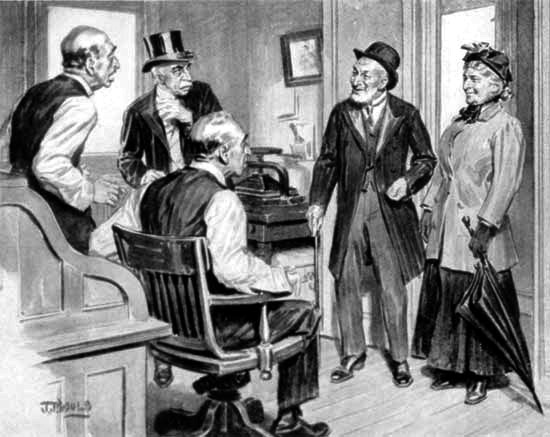
"Nu, Belz, ain't you going to congradulate me?"
Belz sat back in his chair and stared at his wife's cousin in unaffected astonishment, while Schindelberger noiselessly opened the door and slid out of the room unnoticed.
"And so you run away from the Home and married this Schnorrer?" Belz said at length.
"Schnorrer he ain't," she retorted, "unless you would go to work and foreclose the house."
"It would serve you right if I did," Belz rejoined.
"Then you ain't going to?" Mrs. Rudnik asked.
"What d'ye mean, he ain't going to?" Lesengeld interrupted. "Ain't I got nothing to say here? Must I got to sacrifice myself for Belz's wife's relations?"
"Koosh, Lesengeld!" Belz exploded. "You take too much on yourself. Do you think for one moment I am going to foreclose that mortgage and have them two old people schnorring their living expenses out of me for the rest of my days, just to oblige you? The mortgage runs at 6 per cent., and it's going to continue to do so. Six per cent. ain't to be sneezed at, neither."
"And ain't he going to pay us no bonus nor nothing?" Lesengeld asked in anguished tones.
"Bonus!" Belz cried; "what are you talking about, bonus? Do you mean to told me you would ask an old man which he nearly gets killed by a train already a bonus yet? Honestly, Lesengeld, I'm surprised at you. The way you talk sometimes it ain't no wonder people calls us second-mortgage sharks."
"But, lookyhere, Belz——" Lesengeld began.
"'S enough, Lesengeld," Belz interrupted. "You're lucky I don't ask you you should make 'em a wedding present yet."
"I suppose, Belz, you're going to make 'em a wedding present, too, ain't it?" Lesengeld jeered.
"That's just what I'm going to do," Belz said as he turned to the safe. He fumbled round the middle compartment and finally produced two yellow slips of paper. "I'm going to give 'em these here composition notes of Schindelberger's, and with what Blooma knows about the way that Rosher is running the Bella Hirshkind Home she shouldn't got no difficulty making him pay up."
He handed the notes to Rudnik.
"And now," he said, "sit right down and tell us how it comes that you and Blooma gets married."
For more than a quarter of an hour Rudnik described the details of his meeting with Miss Blooma Duckman, together with his hopes and aspirations for the future, and when he concluded Belz turned to his partner.
"Ain't it funny how things happens?" he said. "Honestly, Lesengeld, ain't that more interesting than most things you could see it on a moving pictures?"
Lesengeld nodded sulkily.
"It sure ought to be," he said, "because to go on a moving pictures you pay only ten cents, aber this here story costs me my half of a three-hundred-and-fifty dollar bonus. However, I suppose I shouldn't begrudge it 'em. I seen the other evening a fillum by the name The Return of Enoch Aarons, where an old feller stands outside on the street and looks through a winder, and he sees a happy married couple mit children sitting in front of a fire. So I says to my wife: 'Mommer,' I says, 'if that old snoozer would only get married,' I says, 'he wouldn't got to stand outside winders looking at other people having a good time,' I says. 'He would be enjoying with his own wife and children,' I says, and I thinks right away of Rudnik here." He placed his hand on Rudnik's shoulder as he spoke. "But now Rudnik is married," he concluded, "and even if he wouldn't got children he's got a good wife anyhow, which it stands in the Siddur already—a good wife is more valuable as rubies."
Rudnik seized the hand of his blushing bride. "And," he added, "rubies is pretty high nowadays."
CHAPTER EIGHT
COERCING MR. TRINKMANN
"I don't know, Mr. Trinkmann, what comes over you, you are always picking on me," Louis Berkfield said. "Me, I am doing my best here."
"You are doing your best here, Louis!" Harris Trinkmann exclaimed. "Do you call them ashtrays doing your best? They got on them Schmutz from the time I bought 'em off of Dreiner which he busted up way before the Spanish War already. The knives and forks, too, Louis. Do you think it's a pleasure to a customer when he is eating Kalbfleisch that he finds on his fork a piece of Bismarck herring from last night already? You are ruining my trade, Louis."
"What do you mean, ruining your trade, Mr. Trinkmann?" Louis rejoined. "I ain't no pantryman. If the customers complains that the fork got on it a piece Bismarck herring, that is from the pantryman a Schuld. What have I got to do with herring on the forks?"
"You got everything to do with it," Trinkmann declared. "A pantryman is a feller which no one could depend upon, otherwise he wouldn't be a pantryman, Louis; but a waiter, that's something else again. If a waiter wouldn't see that the forks ain't schmutzig, who would see it? The trouble is here nobody takes any interest at all. Me, I got to do everything myself."
Mr. Trinkmann returned to the cashier's desk over which Mrs. Trinkmann habitually presided, and taking a cigarette pen-fashion twixt thumb and forefinger, he lit it slowly and threw away the match with a gesture that implied more strongly than words, "I am sick and tired of the whole business."
The fact was that Mr. Trinkmann had undergone that morning as much as one man could endure without the relief that profanity affords. To be precise, only three hours before, Mrs. Trinkmann had presented him with twins, both girls.
"The thing has got to stop sometime, Louis," he said, as he came from behind the desk. He referred, however, to the ashtrays and the forks. "Either you would got to turn around a new leaf, or you could act like a slob somewheres else, understand me, because I wouldn't stand for it here."
"What are you talking nonsense—act like a slob, Mr. Trinkmann?" Louis cried. "I am working here for you now six years next Tishabav, and everybody which comes here in the place I always give 'em good satisfaction."
"You got too swell a head, Louis," Mr. Trinkmann continued, gaining heat. "You would think you was a partner here the way you act. You talk to me like I would be the waiter and you would be the boss. What do you think I am, anyway?"
"But, Mr. Trinkmann——" Louis began.
"Things goes from bad to worst," Trinkmann went on, his voice rising to a bellow. "You treat me like I would be a dawg."
"Aber, Mr. Trinkmann," Louis whimpered, "I——"
"Koosh!" Trinkmann shouted. "I got enough of your Chutzpah. I am through with you. Comes three o'clock this afternoon, you would quit. D'ye hear me?"
Louis nodded. He would have made some articulate protest, but his Adam's apple had suddenly grown to the dimensions of a dirigible balloon; and though there surged through his brain every manner of retort, ironical and defiant, he could think of nothing better to do than to polish the ashtrays. Polishing powder and rags alone could not have produced the dazzling brilliancy that ensued. It was a sense of injustice that lent force to every rub, and when he began to clean the forks Louis imparted to his labour all the energy of a discharged waiter wringing his employer's neck.
Before he had half concluded his task the other waiters arrived, for Louis was but one of a staff of three, with the distinction that though his two associates were only dinner waiters, Louis served breakfast, dinner, and supper. Marcus, the elder of the two, bore a brown-paper package with an air of great solemnity, while Albert, his companion, perspired freely in spite of a chill March air blowing outside.
"Mr. Trinkmann," Marcus began, "Louis telephones me this morning which you got a couple new arrivals in your family and——"
"Louis!" Trinkmann roared, and Louis in response approached the desk with the polishing cloth in his hand. "Do you mean to told me you are using the telephone without asking me?"
"I thought, Mr. Trinkmann," Louis hastened to explain, "that so long you got in your family——"
"What is it your business what I got in my family?" Trinkmann asked.
Louis' eyes kindled and he gave free play to his indignation.
"For you I don't care at all, Mr. Trinkmann," he said, "but for Mrs. Trinkmann which she is always acted to us like a lady, understand me, I am telephoning Marcus he should bring with him a few flowers, Mr. Trinkmann, which if you wouldn't take 'em to her, we could easy send 'em up by a messenger boy, and here is a nickel for using the telephone."
He plunged his hand into his trousers-pocket and dashed a coin on to the desk. Then, reaching behind him with both hands, he untied his apron. "Furthermore," he said, "I wouldn't wait till three o'clock, Mr. Trinkmann. Give me my money and I would go now."
"Pick up that apron, Louis," Trinkmann commanded, "because, so sure as I am standing here, if you wouldn't wait on the customers till three o'clock I wouldn't pay you not one cent."
"So far as that goes, Mr. Trinkmann," Louis commenced, "I ain't——"
"And if you get fresh to me oder to the customers, Louis," Trinkmann concluded, "you wouldn't get your money, neither."
"Did the customers ever done me anything, Mr. Trinkmann?" Louis retorted. "Why should I get fresh to the customers which every one of them is my friends, Mr. Trinkmann? And as for getting fresh to you, Mr. Trinkmann, if I would want to I would. Otherwise not."
With this defiance Louis picked up his polishing cloth and his apron and proceeded to the kitchen, to which Marcus and Albert had already retreated. His courage remained with him until he had refastened his apron, and then he discerned Marcus and Albert to be regarding him with so mournful a gaze that the balloon again expanded in his throat, and forthwith—to pursue the simile further—it burst. He opened the door leading from the kitchen to the paved space littered with packing boxes, which had once been the backyard, and despite the cold March weather he stepped outside and closed the door behind him.
Ten minutes later the first luncheon customer arrived and Louis hastened to wait upon him. It was Max Maikafer, salesman for Freesam, Mayer & Co., and he greeted Louis with the familiarity of six years' daily acquaintance.
"Nu, Louis," he said, "what's the matter you are catching such a cold in your head?"
Louis only sniffled faintly in reply.
"A feller bums round till all hours of the night, understand me," Max continued, "and sooner or later, Louis, a lowlife—a Shikkerer—gives him a Schlag on the top from the head, verstehest du, and he would got worser as a cold, Louis."
Louis received this admonition with a nod, since he was incapable of coherent speech.
"So, therefore, Louis," Max concluded, as he looked in a puzzled fashion at Louis' puffed eyelids, "you should bring me some Kreploch soup and a little gefüllte Rinderbrust, not too much gravy."
He watched Louis retire to the kitchen and then he motioned to Albert, who was industriously polishing the glasses at a nearby table.
"What's the matter with Louis, Albert?" he asked.
"Fired," Albert said out of the corner of his mouth, with one eye on the cashier's desk, where Mr. Trinkmann was fast approaching the borderline of insanity over a maze of figures representing the previous day's receipts.
"What for?" Max asked.
"I should know what for!" Albert exclaimed. "The boss is mad on account he got twins, so he picks on Louis that the ashtrays ain't clean and the forks, neither. So Louis he don't say nothing, and Trinkmann gets mad and fires him."
He glanced furtively at the cashier's desk just as Trinkmann suddenly tore up his paperful of figures, and in one frightened bound Albert was once more at his glass polishing.
"Well, Trinkmann," Max cried, as he made ready to absorb the soup by tucking one corner of his napkin into the top of his collar, "I must got to congradulate you."
Trinkmann was on his way to the kitchen for the purpose of abusing the pantryman as a measure of relief to his figure-harried brain. He paused at Max's table and distorted his face in what he conceived to be an amiable grin.
"No one compels you to congradulate me, Mr. Maikafer," he said, "and, anyhow, Mr. Maikafer, with business the way it is, understand me, twins ain't such Simcha, neither."
"Sure, I know," Max rejoined; "but so far as I could see, Trinkmann, you ain't got no kick coming. You do a good business here. You got three good waiters and the customers don't complain none."
"Don't they?" Trinkmann grunted.
"Not at the waiters, Trinkmann," Max said significantly. "And the food is all right, too, Trinkmann. The only thing is, Trinkmann, when a feller got a nice gemütlicher place like you got it here, y'understand, he should do his bestest that he keeps it that way."
Trinkmann's smile became a trifle less forced at Max's use of the adjective gemütlicher, for which the English language has no just equivalent, since it at once combines the meanings of cozy, comfortable, good-natured, and homelike.
"Certainly, I am always trying to keep my place gemütlich, Mr. Maikafer," Trinkmann declared, "but when you got waiters, Mr. Maikafer, which they——"
"Waiters ain't got nothing to do with it, Trinkmann," Max interrupted. "On Sutter Avenue, Brownsville, in boom times already was a feller—still a good friend of mine—by the name Ringentaub, which runs a restaurant, Trinkmann, and everybody goes there on account he keeps a place which you could really say was gemütlich. The chairs was old-fashioned, mit cane seats into 'em, which they sagged in the right place, so that if you was sitting down, y'understand, you knew you was sitting down, not like some chairs which I seen it in restaurants, Trinkmann, which if you was sitting down, you might just as well be standing up for all the comfort you get out of it."
"The chairs here is comfortable," Trinkmann remarked.
"Sure, I know," Max continued. "Then in this here restaurant was tables which they only got 'em in the old country—big, heavy tables, understand me, which you pretty near kill yourself trying to move 'em at all. A feller sits at such a table, Trinkmann, and right away he thinks he must drink a cup coffee; and not alone that, Trinkmann, but he must got to order coffee for the crowd. He couldn't even help himself, Trinkmann, because such a table makes you feel good to look at it. That's what it is to keep a gemütlicher place, Trinkmann."
Trinkmann nodded and sat down at Max's table.
"Furthermore, Trinkmann," Max continued, "everything in the place was the same. The ashtrays was from brass like them there ashtrays you used to got here, Trinkmann."
Max looked meaningly at the burnished brass utensil that stood in the middle of the table.
"That's the same ashtrays which we always got here," Trinkmann retorted.
"Are they?" Max said. "Well, somebody must of done something to 'em on account they don't look so gemütlich no longer. That's the same mistake Ringentaub made it, Trinkmann. He ain't satisfied he is got such a big trade there, Trinkmann, but he must go to work and get a partner, a feller by the name Salonkin, which he pays Ringentaub two thousand dollars for a half interest in the business. Salonkin is one of them fellers, understand me, which is all for improvements, Trinkmann. Gemütlichkeit is something which he don't know nothing about at all, y'understand, and the first thing you know, Trinkmann, Salonkin says the chairs is back numbers. He fires 'em right out of there, understand me, and buys some new chairs, which actually for a thin man to sit on 'em for five minutes even would be something which you could really call dangerous. Also the tables Salonkin says is junk, so he sells 'em for fifty cents apiece and puts in them marble-top tables like a lot of tombstones in a cemetery."
"Marble-top tables is anyhow clean," Trinkmann declared.
"Clean they may be," Max admitted, "but gemütlich they ain't. And, anyhow, Trinkmann, do you know what started the whole trouble there?"
Trinkmann shook his head.
"Well, it was the forks," Max said solemnly. "The forks which Ringentaub got it before he goes as partners together with Salonkin always looks like they would be a little dirty, understand me. So what does the customer do, Trinkmann? They take first thing after they sit down the fork in hand, understand me, and dip it in the glass of water which the waiter brings 'em. Then when the time comes which they want to drink the water, Trinkmann, they remember they cleaned the fork in it and they order instead a glass of beer. Afterward when Salonkin takes ahold there, y'understand, he raises hell with the waiters they should keep clean the forks, which they done it, Trinkmann, because the feller Salonkin was a regular Rosher, understand me, and the waiters is scared to death of him. What is the result, Trinkmann? The sales of beer right away drops to nothing, understand me, and everybody drinks the glass water instead."
At this juncture Trinkmann looked up and observed Albert at work on the tumblers.
"Albert!" he cried. "Leave the glasses alone, d'ye hear me?"
Albert put down the glass he was wiping and commenced to rub the knives and forks, whereat Trinkmann jumped to his feet.
"The forks, neither," he yelled. "Instead you should be standing there wasting your time, fill up with water the glasses and tell Louis never mind, he shouldn't polish any more them ashtrays."
When Max Maikafer concluded his lunch he proceeded at once to the cashier's desk, over which Trinkmann himself presided.
"Cheer up, Trinkmann," he said, as he paid his check. "You got a face so solemn like a rich uncle just died and left you to remember him by a crayon portrait."
"Well, I'll tell you, Mr. Maikafer," Trinkmann said, "I got all I could stand to-day. Not alone my wife goes to work and has twins on me, Mr. Maikafer, but I also got to fire a feller which is working for me here six years."
"What d'ye mean?" Max cried in well-feigned astonishment. "You are going to fire Albert?"
"Not Albert," Trinkmann said; "Louis."
"Why, what did Louis done?" Max asked.
"He done enough, Mr. Maikafer," Trinkmann replied. "Here lately he gets to acting so fresh you would think he owns the place."
"Well, why not?" Max commented. "After all, Trinkmann, you got to give Louis credit; he works hard here and he keeps for you many a customer. Because I want to tell you something, Trinkmann, which I am only saying it for your own good, understand me—there's lots of times you are acting so grouchy to the customers that if it wouldn't be Louis smoothes 'em down they wouldn't come near your place at all."
"What the devil are you talking about?" Trinkmann shouted. "If you wasn't such a big fool you would know I am always polite to my customers. Furthermore, I never lost a customer since I am in business, and if you don't like the way I run my restaurant you don't got to come here. That's all."
Maikafer nodded as he pocketed his change.
"All right, Trinkmann," he said. "But you know what happens when a concern lets a salesman go. He easy finds a partner and starts to do business with his old firm's customers on his own account."
Trinkmann laughed aloud.
"That Schnorrer ain't got money enough to stock a pushcart, let alone a restaurant," he jeered.
"That's all right," Maikafer retorted. "I know a feller which runs for years a place in East New York—Brownsville—Trinkmann, and when he hears Louis ain't working, not only he would be glad to give him a job as waiter, but he would stake him to an interest in the restaurant yet."
Trinkmann flapped his right hand at Maikafer in a gesture of derision.
"Schmooes!" he cried.
"No Schmooes at all," Max said, as he passed out of the door. "He's the feller I am talking to you about by the name Ringentaub, and across the street is plenty vacant stores."
Ten minutes after Max had departed Simon Feinsilver entered.
"Say, Trinkmann," he asked, as he paused at the cashier's desk on his way to one of Louis' tables, "did you seen it Max Maikafer this morning?"
Had Trinkmann scrutinized Simon's face with any degree of care he might have observed a mischievous gleam in Simon's eyes; but at the mere mention of Maikafer's name Trinkmann exploded.
"What d'ye mean, did I seen it Maikafer?" he demanded.
"Why I just asked you," Simon said calmly, "on account he was to meet me at my office and he ain't showed up at all."
"Well, I ain't surprised to hear that, Mr. Feinsilver," Trinkmann rejoined less viciously. "Because even if Maikafer is such a good friend of yours, the feller is so busy with other people's business, what he ain't got no business to butt in at all, that his own business he lets go to the devil. Am I right or wrong?"
Simon nodded and sat down at one of Louis' tables.
"Albert," Trinkmann cried, "wait on Mr. Feinsilver."
"That's all right," Feinsilver declared; "I got plenty time."
"Albert," Trinkmann repeated, "take Mr. Feinsilver's order."
Albert left his station on the opposite side of the room and approached Feinsilver with a conciliatory smile.
"What would you like to-day, Mr. Feinsilver?" he said.
"I would like Louis," Feinsilver replied; "so go ahead, Albert, and tell Louis when he gets through serving those two fellers over there to wait on me."